A New String-to-Dependency Machine Translation Algorithm
with a Target Dependency Language Model
Libin Shen
BBN Technologies Cambridge, MA 02138, USA
Jinxi Xu
BBN Technologies Cambridge, MA 02138, USA
Ralph Weischedel
BBN Technologies Cambridge, MA 02138, USA
Abstract
In this paper, we propose a novel string-to-dependency algorithm for statistical machine translation. With this new framework, we em-ploy a target dependency language model dur-ing decoddur-ing to exploit long distance word relations, which are unavailable with a tra-ditional n-gram language model. Our ex-periments show that the string-to-dependency decoder achieves 1.48 point improvement in BLEU and 2.53 point improvement in TER compared to a standard hierarchical string-to-string system on the NIST 04 Chinese-English evaluation set.
1 Introduction
In recent years, hierarchical methods have been suc-cessfully applied to Statistical Machine Translation (Graehl and Knight, 2004; Chiang, 2005; Ding and Palmer, 2005; Quirk et al., 2005). In some language pairs, i.e. Chinese-to-English translation, state-of-the-art hierarchical systems show significant advan-tage over phrasal systems in MT accuracy. For ex-ample, Chiang (2007) showed that the Hiero system achieved about 1 to 3 point improvement in BLEU on the NIST 03/04/05 Chinese-English evaluation sets compared to a start-of-the-art phrasal system.
Our work extends the hierarchical MT approach. We propose a string-to-dependency model for MT, which employs rules that represent the source side as strings and the target side as dependency struc-tures. We restrict the target side to the so called well-formed dependency structures, in order to cover a large set of non-constituent transfer rules (Marcu et al., 2006), and enable efficient decoding through dy-namic programming. We incorporate a dependency
language model during decoding, in order to exploit long-distance word relations which are unavailable with a traditional n-gram language model on target strings.
For comparison purposes, we replicated the Hiero decoder (Chiang, 2005) as our baseline. Our string-to-dependency decoder shows 1.48 point improve-ment in BLEU and 2.53 point improveimprove-ment in TER on the NIST 04 Chinese-English MT evaluation set. In the rest of this section, we will briefly dis-cuss previous work on hierarchical MT and de-pendency representations, which motivated our re-search. In section 2, we introduce the model of string-to-dependency decoding. Section 3 illustrates of the use of dependency language models. In sec-tion 4, we describe the implementasec-tion details of our MT system. We discuss experimental results in sec-tion 5, compare to related work in secsec-tion 6, and draw conclusions in section 7.
1.1 Hierarchical Machine Translation
Graehl and Knight (2004) proposed the use of target-tree-to-source-string transducers (xRS) to model translation. In xRS rules, the right-hand-side(rhs) of the target side is a tree with non-terminals(NTs), while the rhs of the source side is a string with NTs. Galley et al. (2006) extended this string-to-tree model by using Context-Free parse trees to represent the target side. A tree could represent multi-level transfer rules.
The Hiero decoder (Chiang, 2007) does not re-quire explicit syntactic representation on either side of the rules. Both source and target are strings with NTs. Decoding is solved as chart parsing. Hiero can be viewed as a hierarchical string-to-string model.
Ding and Palmer (2005) and Quirk et al. (2005)
it will
find
boy
the
[image:2.612.111.258.59.124.2]interesting
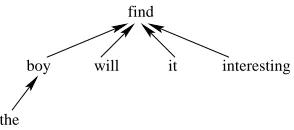
Figure 1: The dependency tree for sentence the boy will find it interesting
followed the tree-to-tree approach (Shieber and Sch-abes, 1990) for translation. In their models, depen-dency treelets are used to represent both the source and the target sides. Decoding is implemented as tree transduction preceded by source side depen-dency parsing. While tree-to-tree models can rep-resent richer structural information, existing tree-to-tree models did not show advantage over string-to-tree models on translation accuracy due to a much larger search space.
One of the motivations of our work is to achieve desirable trade-off between model capability and search space through the use of the so called well-formed dependency structures in rule representation.
1.2 Dependency Trees
Dependency trees reveal long-distance relations be-tween words. For a given sentence, each word has a parent word which it depends on, except for the root word.
Figure 1 shows an example of a dependency tree. Arrows point from the child to the parent. In this example, the word find is the root.
Dependency trees are simpler in form than CFG trees since there are no constituent labels. However, dependency relations directly model semantic struc-ture of a sentence. As such, dependency trees are a desirable prior model of the target sentence.
1.3 Motivations for Well-Formed Dependency Structures
We restrict ourselves to the so-called well-formed target dependency structures based on the following considerations.
Dynamic Programming
In (Ding and Palmer, 2005; Quirk et al., 2005), there is no restriction on dependency treelets used in transfer rules except for the size limit. This may re-sult in a high dimensionality in hypothesis
represen-tation and make it hard to employ shared structures for efficient dynamic programming.
In (Galley et al., 2004), rules contain NT slots and combination is only allowed at those slots. There-fore, the search space becomes much smaller. Fur-thermore, shared structures can be easily defined based on the labels of the slots.
In order to take advantage of dynamic program-ming, we fixed the positions onto which another an-other tree could be attached by specifying NTs in dependency trees.
Rule Coverage
Marcu et al. (2006) showed that many useful phrasal rules cannot be represented as hierarchical rules with the existing representation methods, even with composed transfer rules (Galley et al., 2006). For example, the following rule
• <(hong)Chinese, (DT(the) JJ(red))English>
is not a valid string-to-tree transfer rule since the red is a partial constituent.
A number of techniques have been proposed to improve rule coverage. (Marcu et al., 2006) and (Galley et al., 2006) introduced artificial constituent nodes dominating the phrase of interest. The bi-narization method used by Wang et al. (2007) can cover many non-constituent rules also, but not all of them. For example, it cannot handle the above ex-ample. DeNeefe et al. (2007) showed that the best results were obtained by combing these methods.
In this paper, we use well-formed dependency structures to handle the coverage of non-constituent rules. The use of dependency structures is due to the flexibility of dependency trees as a representation method which does not rely on constituents (Fox, 2002; Ding and Palmer, 2005; Quirk et al., 2005). The well-formedness of the dependency structures enables efficient decoding through dynamic pro-gramming.
2 String-to-Dependency Translation
2.1 Transfer Rules with Well-Formed Dependency Structures
A string-to-dependency grammar G is a 4-tuple
G=<R, X, Tf, Te >, whereRis a set of transfer
terminals in the source language, andTe is a set of
terminals in the target language1.
A string-to-dependency transfer rule R ∈ Ris a 4-tupleR =< Sf, Se, D, A >, where Sf ∈ (Tf ∪
{X})+
is a source string, Se ∈ (Te∪ {X})+ is a
target string,Drepresents the dependency structure forSe, andAis the alignment between Sf andSe.
Non-terminal alignments inAmust be one-to-one. In order to exclude undesirable structures, we only allow Se whose dependency structure D is well-formed, which we will define below. In addi-tion, the same well-formedness requirement will be applied to partial decoding results. Thus, we will be able to employ shared structures to merge multiple partial results.
Based on the results in previous work (DeNeefe et al., 2007), we want to keep two kinds of depen-dency structures. In one kind, we keep dependepen-dency trees with a sub-root, where all the children of the sub-root are complete. We call them fixed depen-dency structures because the head is known or fixed. In the other, we keep dependency structures of sib-ling nodes of a common head, but the head itself is unspecified or floating. Each of the siblings must be a complete constituent. We call them floating de-pendency structures. Floating structures can repre-sent many linguistically meaningful non-constituent structures: for example, like the red, a modifier of a noun. Only those two kinds of dependency struc-tures are well-formed strucstruc-tures in our system.
Furthermore, we operate over well-formed struc-tures in a bottom-up style in decoding. However, the description given above does not provide a clear definition on how to combine those two types of structures. In the rest of this section, we will pro-vide formal definitions of well-formed structures and combinatory operations over them, so that we can easily manipulate well-formed structures in decod-ing. Formal definitions also allow us to easily ex-tend the framework to incorporate a dependency lan-guage model in decoding. Examples will be pro-vided along with the formal definitions.
Consider a sentence S = w1w2...wn. Let
d1d2...dn represent the parent word IDs for each
word. For example,d4 = 2 means thatw4 depends
1
We ignore the left hand side here because there is only one non-terminalX. Of course, this formalism can be extended to have multiple NTs.
it will
find
boy
the
find
boy
[image:3.612.348.504.58.237.2](a) (b) (c)
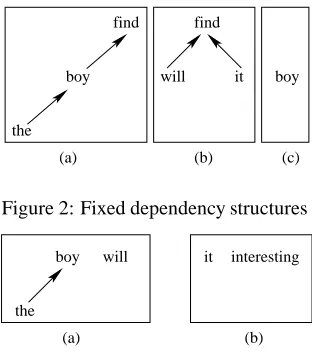
Figure 2: Fixed dependency structures
boy will
the
interesting it
(a) (b)
Figure 3: Floating dependency structures
onw2. Ifwiis a root, we definedi= 0.
Definition 1 A dependency structure di..j is fixed on headh, where h ∈ [i, j], or fixed for short, if and only if it meets the following conditions
• dh ∈/ [i, j]
• ∀k∈[i, j]andk =6 h,dk∈[i, j]
• ∀k /∈[i, j],dk=hordk ∈/ [i, j]
In addition, we say the category of di..j is (−, h,−), where−means this field is undefined.
Definition 2 A dependency structuredi...djis float-ing with children C, for a non-empty set C ⊆ {i, ..., j}, or floating for short, if and only if it meets the following conditions
• ∃h /∈[i, j], s.t.∀k ∈C, dk =h
• ∀k∈[i, j]andk /∈C, dk∈[i, j]
• ∀k /∈[i, j], dk∈/ [i, j]
We say the category ofdi..jis(C,−,−)ifj < h,
or(−,−, C)otherwise. A category is composed of the three fields(A, h, B), wherehis used to repre-sent the head, andA and B are designed to model left and right dependents of the head respectively.
A dependency structure is well-formed if and only if it is either fixed or floating.
Examples
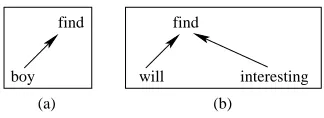
We can represent dependency structures with graphs. Figure 2 shows examples of fixed structures, Figure 3 shows examples of floating structures, and Figure 4 shows ill-formed dependency structures.
interesting will
find find
boy
[image:4.612.104.266.58.117.2](a) (b)
Figure 4: Ill-formed dependency structures
boy does not have its child word the in the tree. 4(b) is ill-formed because it is not a continuous segment. As for the example the red mentioned above, it is a well-formed floating dependency structure.
2.2 Operations on Well-Formed Dependency Structures and Categories
One of the purposes of introducing floating depen-dency structures is that siblings having a common parent will become a well-defined entity, although they are not considered a constituent. We always build well-formed partial structures on the target side in decoding. Furthermore, we combine partial dependency structures in a way such that we can ob-tain all possible well-formed but no ill-formed de-pendency structures during bottom-up decoding.
The solution is to employ categories introduced above. Each well-formed dependency structure has a category. We can apply four combinatory oper-ations over the categories. If we can combine two categories with a certain category operation, we can use a corresponding tree operation to combine two dependency structures. The category of the bined dependency structure is the result of the com-binatory category operations.
We first introduce three meta category operations. Two of them are unary operations, left raising (LR) and right raising (RR), and one is the binary opera-tion unificaopera-tion (UF).
First, the raising operations are used to turn a completed fixed structure into a floating structure. It is easy to verify the following theorem according to the definitions.
Theorem 1 A fixed structure with category (−, h,−) for span[i, j] is also a floating structure with children {h} if there are no outside words depending on wordh.
∀k /∈[i, j], dk 6=h. (1)
Therefore we can always raise a fixed structure if we assume it is complete, i.e. (1) holds.
it will
find
boy
the
interesting
LA LA
LA RA RA
LC RC
Figure 5: A dependency tree with flexible combination
Definition 3 Meta Category Operations
• LR((−, h,−)) = ({h},−,−)
• RR((−, h,−)) = (−,−,{h})
• UF((A1, h1, B1),(A2, h2, B2)) = NORM((A1 t A2, h1th2, B1tB2))
Unification is well-defined if and only if we can unify all three elements and the result is a valid fixed or floating category. For example, we can unify a fixed structure with a floating structure or two float-ing structures in the same direction, but we cannot unify two fixed structures.
h1th2 =
h1 ifh2=−
h2 ifh1=−
undefined otherwise
A1tA2 =
A1 ifA2=− A2 ifA1=− A1∪A2 otherwise
NORM((A, h, B)) =
(−, h,−) ifh6=−
(A,−,−) ifh=−, B=−
(−,−, B) ifh=−, A=− undefined otherwise
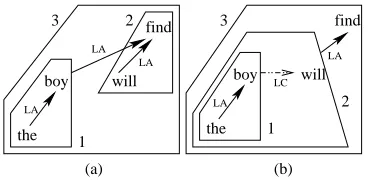
Next we introduce the four tree operations on de-pendency structures. Instead of providing the formal definition, we use figures to illustrate these opera-tions to make it easy to understand. Figure 1 shows a traditional dependency tree. Figure 5 shows the four operations to combine partial dependency struc-tures, which are left adjoining (LA), right adjoining (RA), left concatenation (LC) and right concatena-tion (RC).
Child and parent subtrees can be combined with adjoining which is similar to the traditional depen-dency formalism. We can either adjoin a fixed struc-ture or a floating strucstruc-ture to the head of a fixed structure.
[image:4.612.314.537.299.442.2]ad-will find
boy
the
LA
LA LA
will find
boy
the
LA
LA
LC
2
3 2
1 1
3
[image:5.612.94.278.59.149.2](b) (a)
Figure 6: Operations over well-formed structures
vantage of various translation fragments encoded in transfer rules.
Figure 6 shows alternative ways of applying op-erations on well-formed structures to build larger structures in a bottom-up style. Numbers represent the order of operation.
We use the same names for the operations on cat-egories for the sake of convenience. We can easily use the meta category operations to define the four combinatory operations. The definition of the oper-ations in the left direction is as follows. Those in the right direction are similar.
Definition 4 Combinatory category operations
LA((A1,−,−),(−, h2,−))
= UF((A1,−,−),(−, h2,−))
LA((−, h1,−),(−, h2,−))
= UF(LR((−, h1,−)),(−, h2,−))
LC((A1,−,−),(A2,−,−))
= UF((A1,−,−),(A2,−,−))
LC((A1,−,−),(−, h2,−))
= UF((A1,−,−),LR((−, h2,−)))
LC((−, h1,−),(A2,−,−))
= UF(LR((−, h1,−)),(A2,−,−))
LC((−, h1,−),(−, h2,−))
= UF(LR((−, h1,−)),LR((−, h2,−)))
It is easy to verify the soundness and complete-ness of category operations based on one-to-one mapping of the conditions in the definitions of cor-responding operations on dependency structures and on categories.
Theorem 2 (soundness and completeness)
Suppose X and Y are well-formed dependency structures. OP(cat(X),cat(Y))is well-defined for a given operation OP if and only if OP(X, Y) is well-defined. Furthermore,
cat(OP(X, Y)) =OP(cat(X),cat(Y))
Suppose we have a dependency tree for a red apple, where both a and red depend on apple. There are two ways to compute the category of this string from the bottom up.
cat(Da red apple)
= LA(cat(Da),LA(cat(Dred),cat(Dapple))) = LA(LC(cat(Da),cat(Dred)),cat(Dapple))
Based on Theorem 2, it follows that combinatory operation of categories has the confluence property, since the result dependency structure is determined.
Corollary 1 (confluence) The category of a
well-formed dependency tree does not depend on the or-der of category calculation.
With categories, we can easily track the types of dependency structures and constrain operations in decoding. For example, we have a rule with depen-dency structuref ind ← X, whereX right adjoins tof ind. Suppose we have two floating structures2,
cat(X1) = ({he, will},−,−)
cat(X2) = (−,−,{it, interesting})
We can replaceX byX2, but not byX1based on the definition of category operations.
2.3 Rule Extraction
Now we explain how we get the string-to-dependency rules from training data. The procedure is similar to (Chiang, 2007) except that we maintain tree structures on the target side, instead of strings.
Given sentence-aligned bi-lingual training data, we first use GIZA++ (Och and Ney, 2003) to gen-erate word level alignment. We use a statistical CFG parser to parse the English side of the training data, and extract dependency trees with Magerman’s rules (1995). Then we use heuristic rules to extract trans-fer rules recursively based on the GIZA alignment and the target dependency trees. The rule extraction procedure is as follows.
1. Initialization:
All the 4-tuples (Pfi,j, Pm,n
e , D, A) are valid phrase alignments, where source phrasePfi,jis
2Here we use words instead of word indexes in categories to
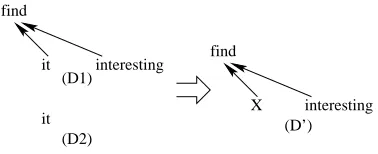
it find
interesting (D1)
(D2)
it X
find
[image:6.612.90.279.59.136.2]interesting (D’)
Figure 7: Replacing it withXinD1
aligned to target phrasePm,n
e under alignment3
A, andD, the dependency structure forPm,n e ,
is well-formed. All valid phrase templates are valid rules templates.
2. Inference: Let (Pfi,j, Pm,n
e , D1, A) be a valid rule
tem-plate, and (Pfp,q, Ps,t
e , D2, A) a valid phrase
alignment, where[p, q] ⊂[i, j],[s, t] ⊂[m, n],
D2 is a sub-structure of D1, and at least one word inPfi,jbut not inPfp,qis aligned.
We create a new valid rule template
(P0
f, Pe0, D0, A), where we obtain Pf0 by
replacingPfp,qwith labelX inPfi,j, and obtain
P0
eby replacingPes,twithX inPem,n.
Further-more, We obtainD0 by replacing sub-structure
D2 with X inD14. An example is shown in Figure 7.
Among all valid rule templates, we collect those that contain at most two NTs and at most seven ele-ments in the source as transfer rules in our system.
2.4 Decoding
Following previous work on hierarchical MT (Chi-ang, 2005; Galley et al., 2006), we solve decoding as chart parsing. We view target dependency as the hidden structure of source fragments.
The parser scans all source cells in a bottom-up style, and checks matched transfer rules according to the source side. Once there is a completed rule, we build a larger dependency structure by substituting component dependency structures for corresponding NTs in the target dependency structure of rules.
Hypothesis dependency structures are organized in a shared forest, or OR structures. An
AND-3ByPi,j
f aligned toP m,n
e , we mean all words inP i,j
f are
either aligned to words inPm,n
e or unaligned, and vice versa.
Furthermore, at least one word inPfi,jis aligned to a word in
Pm,n
e .
4IfD
2 is af loating structure, we need to merge several
dependency links into one.
structure represents an application of a rule over component OR-structures, and an OR-structure rep-resents a set of alternative AND-structures with the same state. A state means an-tuple that character-izes the information that will be inquired by up-level AND-structures.
Supposing we use a traditional tri-gram language model in decoding, we need to specify the leftmost two words and the rightmost two words in a state. Since we only have a single NTX in the formalism described above, we do not need to add the NT la-bel in states. However, we need to specify one of the three types of the dependency structure: fixed, floating on the left side, or floating on the right side. This information is encoded in the category of the dependency structure.
In the next section, we will explain how to ex-tend categories and states to exploit a dependency language model during decoding.
3 Dependency Language Model
For the dependency tree in Figure 1, we calculate the probability of the tree as follows
P rob = PT(f ind)
×PL(will|f ind-as-head)
×PL(boy|will, f ind-as-head)
×PL(the|boy-as-head)
×PR(it|f ind-as-head)
×PR(interesting|it, f ind-as-head)
HerePT(x) is the probability that wordx is the
root of a dependency tree. PL and PR are left and
right side generative probabilities respectively. Let
wh be the head, andwL1wL2...wLn be the children on the left side from the nearest to the farthest. Sup-pose we use a tri-gram dependency LM,
PL(wL1wL2...wLn|wh-as-head) = PL(wL1|wh-as-head)
×PL(wL2|wL1, wh-as-head)
×...×PL(wLn|wLn−1, wLn−2) (2)
wh-as-head represents wh used as the head, and
it is different from wh in the dependency language
model. The right side probability is similar.
partial hypotheses in a bottom-up decoding, we need to save more information in categories and states.
We use a 5-tuple(LF, LN, h, RN, RF)to repre-sent the category of a dependency structure. h rep-resents the head. LF andRF represent the farthest two children on the left and right sides respectively. Similarly, LN and RN represent the nearest two children on the left and right sides respectively. The three types of categories are as follows.
• fixed:(LF,−, h,−, RF)
• floating left:(LF, LN,−,−,−)
• floating right:(−,−,−, RN, RF)
Similar operations as described in Section 2.2 are used to keep track of the head and boundary child nodes which are then used to compute depLM scores in decoding. Due to the limit of space, we skip the details here.
4 Implementation Details
Features
1. Probability of the source side given the target side of a rule
2. Probability of the target side given the source side of a rule
3. Word alignment probability 4. Number of target words
5. Number of concatenation rules used 6. Language model score
7. Dependency language model score
8. Discount on ill-formed dependency structures We have eight features in our system. The values of the first four features are accumulated on the rules used in a translation. Following (Chiang, 2005), we also use concatenation rules likeX → XX for backup. The 5th feature counts the number of con-catenation rules used in a translation. In our sys-tem, we allow substitutions of dependency struc-tures with unmatched categories, but there is a dis-count for such substitutions.
Weight Optimization
We tune the weights with several rounds of decoding-optimization. Following (Och, 2003), the k-best results are accumulated as the input of the op-timizer. Powell’s method is used for optimization with 20 random starting points around the weight vector of the last iteration.
Rescoring
We rescore 1000-best translations (Huang and Chiang, 2005) by replacing the 3-gram LM score with the 5-gram LM score computed offline.
5 Experiments
We carried out experiments on three models. • baseline: replication of the Hiero system. • filtered: a string-to-string MT system as in
baseline. However, we only keep the transfer rules whose target side can be generated by a well-formed dependency structure.
• str-dep: a string-to-dependency system with a dependency LM.
We take the replicated Hiero system as our baseline because it is the closest to our string-to-dependency model. They have similar rule extrac-tion and decoding algorithms. Both systems use only one non-terminal label in rules. The major dif-ference is in the representation of target structures. We use dependency structures instead of strings; thus, the comparison will show the contribution of using dependency information in decoding.
All models are tuned on BLEU (Papineni et al., 2001), and evaluated on both BLEU and Translation Error Rate (TER) (Snover et al., 2006) so that we could detect over-tuning on one metric.
We used part of the NIST 2006 Chinese-English large track data as well as some LDC corpora collected for the DARPA GALE program (LDC2005E83, LDC2006E34 and LDC2006G05) as our bilingual training data. It contains about 178M/191M words in source/target. Hierarchical rules were extracted from a subset which has about 35M/41M words5, and the rest of the training data were used to extract phrasal rules as in (Och, 2003; Chiang, 2005). The English side of this subset was also used to train a 3-gram dependency LM. Tra-ditional 3-gram and 5-gram LMs were trained on a corpus of 6G words composed of the LDC Gigaword corpus and text downloaded from Web (Bulyko et al., 2007). We tuned the weights on NIST MT05 and tested on MT04.
5
Model #Rules baseline 140M filtered 26M
[image:8.612.89.283.134.260.2]str-dep 27M
Table 1: Number of transfer rules
Model BLEU% TER%
lower mixed lower mixed
Decoding (3-gram LM)
baseline 38.18 35.77 58.91 56.60 filtered 37.92 35.48 57.80 55.43 str-dep 39.52 37.25 56.27 54.07
Rescoring (5-gram LM)
baseline 40.53 38.26 56.35 54.15 filtered 40.49 38.26 55.57 53.47 str-dep 41.60 39.47 55.06 52.96
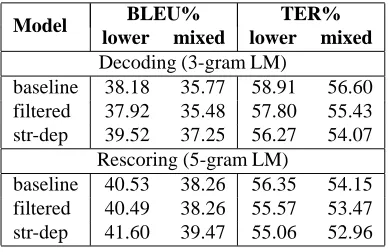
Table 2: BLEU and TER scores on the test set.
Table 1 shows the number of transfer rules ex-tracted from the training data for the tuning and test sets. The constraint of well-formed dependency structures greatly reduced the size of the rule set. Al-though the rule size increased a little bit after incor-porating dependency structures in rules, the size of string-to-dependency rule set is less than 20% of the baseline rule set size.
Table 2 shows the BLEU and TER scores
on MT04. On decoding output, the
string-to-dependency system achieved 1.48 point improve-ment in BLEU and 2.53 point improveimprove-ment in TER compared to the baseline hierarchical string-to-string system. After 5-gram rescoring, it achieved 1.21 point improvement in BLEU and 1.19 improve-ment in TER. The filtered model does not show im-provement on BLEU. The filtered string-to-string rules can be viewed the string projection of string-to-dependency rules. It means that just using depen-dency structure does not provide an improvement on performance. However, dependency structures al-low the use of a dependency LM which gives rise to significant improvement.
6 Discussion
The well-formed dependency structures defined here are similar to the data structures in previous work on mono-lingual parsing (Eisner and Satta, 1999; Mc-Donald et al., 2005). However, here we have fixed structures growing on both sides to exploit various translation fragments learned in the training data,
while the operations in mono-lingual parsing were designed to avoid artificial ambiguity of derivation.
Charniak et al. (2003) described a two-step string-to-CFG-tree translation model which employed a syntax-based language model to select the best translation from a target parse forest built in the first step. Only translation probabilityP(F|E)was em-ployed in the construction of the target forest due to the complexity of the syntax-based LM. Since our dependency LM models structures over target words directly based on dependency trees, we can build a single-step system. This dependency LM can also be used in hierarchical MT systems using lexical-ized CFG trees.
The use of a dependency LM in MT is similar to the use of a structured LM in ASR (Xu et al., 2002), which was also designed to exploit long-distance re-lations. The depLM is used in a bottom-up style, while SLM is employed in a left-to-right style.
7 Conclusions and Future Work
In this paper, we propose a novel
string-to-dependency algorithm for statistical machine trans-lation. For comparison purposes, we replicated the Hiero system as described in (Chiang, 2005). Our string-to-dependency system generates 80% fewer rules, and achieves 1.48 point improvement in BLEU and 2.53 point improvement in TER on the decoding output on the NIST 04 Chinese-English evaluation set.
Dependency structures provide a desirable plat-form to employ linguistic knowledge in MT. In the future, we will continue our research in this direction to carry out translation with deeper features, for ex-ample, propositional structures (Palmer et al., 2005). We believe that the fixed and floating structures pro-posed in this paper can be extended to model predi-cates and arguments.
Acknowledgments
References
I. Bulyko, S. Matsoukas, R. Schwartz, L. Nguyen, and J. Makhoul. 2007. Language model adaptation in machine translation from speech. In Proceedings of the 32nd IEEE International Conference on Acoustics, Speech, and Signal Processing (ICASSP).
E. Charniak, K. Knight, and K. Yamada. 2003. Syntax-based language models for statistical machine transla-tion. In Proceedings of MT Summit IX.
D. Chiang. 2005. A hierarchical phrase-based model for statistical machine translation. In Proceedings of the 43th Annual Meeting of the Association for Computa-tional Linguistics (ACL).
D. Chiang. 2007. Hierarchical phrase-based translation. Computational Linguistics, 33(2).
S. DeNeefe, K. Knight, W. Wang, and D. Marcu. 2007. What can syntax-based mt learn from phrase-based mt? In Proceedings of the 2007 Conference of Em-pirical Methods in Natural Language Processing. Y. Ding and M. Palmer. 2005. Machine translation using
probabilistic synchronous dependency insertion gram-mars. In Proceedings of the 43th Annual Meeting of the Association for Computational Linguistics (ACL), pages 541–548, Ann Arbor, Michigan, June.
J. Eisner and G. Satta. 1999. Efficient parsing for bilex-ical context-free grammars and head automaton gram-mars. In Proceedings of the 37th Annual Meeting of the Association for Computational Linguistics (ACL). H. Fox. 2002. Phrasal cohesion and statistical machine
translation. In Proceedings of the 2002 Conference of Empirical Methods in Natural Language Processing. M. Galley, M. Hopkins, K. Knight, and D. Marcu. 2004.
What’s in a translation rule? In Proceedings of the 2004 Human Language Technology Conference of the North American Chapter of the Association for Com-putational Linguistics.
M. Galley, J. Graehl, K. Knight, D. Marcu, S. DeNeefea, W. Wang, and I. Thayer. 2006. Scalable inference and training of context-rich syntactic models. In COLING-ACL ’06: Proceedings of 44th Annual Meeting of the Association for Computational Linguistics and 21st Int. Conf. on Computational Linguistics.
J. Graehl and K. Knight. 2004. Training tree transducers. In Proceedings of the 2004 Human Language Technol-ogy Conference of the North American Chapter of the Association for Computational Linguistics.
L. Huang and D. Chiang. 2005. Better k-best parsing. In Proceedings of the 9th International Workshop on Parsing Technologies.
D. Magerman. 1995. Statistical decision-tree models for parsing. In Proceedings of the 33rd Annual Meeting of the Association for Computational Linguistics.
D. Marcu, W. Wang, A. Echihabi, and K. Knight. 2006. SPMT: Statistical machine translation with syntacti-fied target language phraases. In Proceedings of the 2006 Conference of Empirical Methods in Natural Language Processing.
R. McDonald, K. Crammer, and F. Pereira. 2005. Online large-margin training of dependency parsers. In Pro-ceedings of the 43th Annual Meeting of the Association for Computational Linguistics (ACL).
F. J. Och and H. Ney. 2003. A systematic comparison of various statistical alignment models. Computational Linguistics, 29(1).
F. J. Och. 2003. Minimum error rate training for sta-tistical machine translation. In Erhard W. Hinrichs and Dan Roth, editors, Proceedings of the 41st Annual Meeting of the Association for Computational Linguis-tics (ACL), pages 160–167, Sapporo, Japan, July. M. Palmer, D. Gildea, and P. Kingsbury. 2005. The
proposition bank: An annotated corpus of semantic roles. Computational Linguistics, 31(1).
K. Papineni, S. Roukos, and T. Ward. 2001. Bleu: a method for automatic evaluation of machine transla-tion. IBM Research Report, RC22176.
C. Quirk, A. Menezes, and C. Cherry. 2005. De-pendency treelet translation: Syntactically informed phrasal SMT. In Proceedings of the 43th Annual Meeting of the Association for Computational Lin-guistics (ACL), pages 271–279, Ann Arbor, Michigan, June.
S. Shieber and Y. Schabes. 1990. Synchronous tree ad-joining grammars. In Proceedings of COLING ’90: The 13th Int. Conf. on Computational Linguistics. M. Snover, B. Dorr, R. Schwartz, L. Micciulla, and
J. Makhoul. 2006. A study of translation edit rate with targeted human annotation. In Proceedings of Associ-ation for Machine TranslAssoci-ation in the Americas. W. Wang, K. Knight, and D. Marcu. 2007. Binarizing
syntax trees to improve syntax-based machine transla-tion accuracy. In Proceedings of the 2007 Conference of Empirical Methods in Natural Language Process-ing.