Graph-based Semi-Supervised Model for Joint Chinese Word
Segmentation and Part-of-Speech Tagging
Xiaodong Zeng† Derek F. Wong† Lidia S. Chao† Isabel Trancoso‡
†Department of Computer and Information Science, University of Macau ‡INESC-ID / Instituto Superior T´ecnico, Lisboa, Portugal
[email protected], {derekfw, lidiasc}@umac.mo, [email protected]
Abstract
This paper introduces a graph-based semi-supervised joint model of Chinese word segmentation and part-of-speech tagging. The proposed approach is based on a graph-based label propagation technique. One constructs a nearest-neighbor simi-larity graph over all trigrams of labeled and unlabeled data for propagating syn-tactic information, i.e., label distribution-s. The derived label distributions are re-garded as virtual evidences to regular-ize the learning of linear conditional ran-dom fields (CRFs) on unlabeled data. An inductive character-based joint model is obtained eventually. Empirical results on Chinese tree bank (CTB-7) and Microsoft Research corpora (MSR) reveal that the proposed model can yield better result-s than the result-superviresult-sed baresult-selineresult-s and other competitive semi-supervised CRFs in this task.
1 Introduction
Word segmentation and part-of-speech (POS) tag-ging are two critical and necessary initial proce-dures with respect to the majority of high-level Chinese language processing tasks such as syn-tax parsing, information extraction and machine translation. The traditional way of segmentation and tagging is performed in a pipeline approach, first segmenting a sentence into words, and then assigning each word a POS tag. The pipeline ap-proach is very simple to implement, but frequently causes error propagation, given that wrong seg-mentations in the earlier stage harm the subse-quent POS tagging (Ng and Low, 2004). The join-t approaches of word segmenjoin-tajoin-tion and POS join- tag-ging (joint S&T) are proposed to resolve these t-wo tasks simultaneously. They effectively allevi-ate the error propagation, because segmentation
and tagging have strong interaction, given that most segmentation ambiguities cannot be resolved without considering the surrounding grammatical constructions encoded in a POS sequence (Qian and Liu, 2012).
In the past years, several proposed supervised joint models (Ng and Low, 2004; Zhang and Clark, 2008; Jiang et al., 2009; Zhang and Clark, 2010) achieved reasonably accurate results, but the outstanding problem among these models is that they rely heavily on a large amount of labeled data, i.e., segmented texts with POS tags. However, the production of such labeled data is extremely time-consuming and expensive (Jiao et al., 2006; Jiang et al., 2009). Therefore, semi-supervised jot S&T appears joto be a najotural solujotion for easily in-corporating accessible unlabeled data to improve the joint S&T model. This study focuses on using a graph-based label propagation method to build a semi-supervised joint S&T model. Graph-based label propagation methods have recently shown they can outperform the state-of-the-art in sever-al natursever-al language processing (NLP) tasks, e.g., POS tagging (Subramanya et al., 2010), knowl-edge acquisition (Talukdar et al., 2008), shallow semantic parsing for unknown predicate (Das and Smith, 2011). As far as we know, however, these methods have not yet been applied to resolve the problem of joint Chinese word segmentation (CWS) and POS tagging.
Motivated by the works in (Subramanya et al., 2010; Das and Smith, 2011), for structured prob-lems, graph-based label propagation can be em-ployed to infer valuable syntactic information (n-gram-level label distributions) from labeled data to unlabeled data. This study extends this intui-tion to construct a similarity graph for propagating trigram-level label distributions. The derived label distributions are regarded as prior knowledge to regularize the learning of a sequential model, con-ditional random fields (CRFs) in this case, on both
labeled and unlabeled data to achieve the semi-supervised learning. The approach performs the incorporation of the derived labeled distributions by manipulating a “virtual evidence” function as described in (Li, 2009). Experiments on the da-ta from the Chinese tree bank (CTB-7) and Mi-crosoft Research (MSR) show that the proposed model results in significant improvement over oth-er comparative candidates in toth-erms of F-score and out-of-vocabulary (OOV) recall.
This paper is structured as follows: Section 2 points out the main differences with the re-lated work of this study. Section 3 reviews the background, including supervised character-based joint S&T model based on CRFs and graph-based label propagation. Section 4 presents the details of the proposed approach. Section 5 reports the ex-periment results. The conclusion is drawn in Sec-tion 6.
2 Related Work
Prior supervised joint S&T models present ap-proximate 0.2% - 1.3% improvement in F-score over supervised pipeline ones. The state-of-the-art joint models include reranking approaches (Shi and Wang, 2007), hybrid approaches (Nakagawa and Uchimoto, 2007; Jiang et al., 2008; Sun, 2011), and single-model approaches (Ng and Low, 2004; Zhang and Clark, 2008; Kruengkrai et al., 2009; Zhang and Clark, 2010). The proposed ap-proach in this paper belongs to the single-model type.
There are few explorations of semi-supervised approaches for CWS or POS tagging in previ-ous works. Xu et al. (2008) described a Bayesian semi-supervised CWS model by considering the segmentation as the hidden variable in machine translation. Unlike this model, the proposed ap-proach is targeted at a general model, instead of one oriented to machine translation task. Sun and Xu (2011) enhanced a CWS model by interpolat-ing statistical features of unlabeled data into the CRFs model. Wang et al. (2011) proposed a semi-supervised pipeline S&T model by incorporating n-gram and lexicon features derived from unla-beled data. Different from their concern, our em-phasis is to learn the semi-supervised model by injecting the label information from a similarity graph constructed from labeled and unlabeled da-ta.
The induction method of the proposed approach
also differs from other semi-supervised CRFs al-gorithms. Jiao et al. (2006), extended by Mann and McCallum (2007), reported a semi-supervised CRFs model which aims to guide the learning by minimizing the conditional entropy of unla-beled data. The proposed approach regularizes the CRFs by the graph information. Subramanya et al. (2010) proposed a graph-based self-train style semi-supervised CRFs algorithm. In the proposed approach, an analogous way of graph construction intuition is applied. But overall, our approach dif-fers in three important aspects: first, novel feature templates are defined for measuring the similari-ty between vertices. Second, the critical propersimilari-ty, i.e., sparsity, is considered among label propaga-tion. And third, the derived label information from the graph is smoothed into the model by optimiz-ing a modified objective function.
3 Background
3.1 Supervised Character-based Model The character-based joint S&T approach is oper-ated as a sequence labeling fashion that each Chi-nese character, i.e., hanzi, in the sequence is as-signed with a tag. To perform segmentation and tagging simultaneously in a uniform framework, according to Ng and Low (2004), the tag is com-posed of a word boundary part, and a POS part, e.g., “B NN” refers to the first character in a word with POS tag “NN”. In this paper, 4 word bound-ary tags are employed: B (beginning of a word), M (middle part of a word), E (end of a word) and S (single character). As for the POS tag, we shal-l use the 33 tags in the Chinese tree bank. Thus, the potential composite tags of joint S&T consist of 132 (4×33) classes.
The first-order CRFs model (Lafferty et al., 2001) has been the most common one in this task. Given a set of labeled examples Dl = {(xi, yi)}l
i=1, where xi = x1ix2i...xNi is the
se-quence of characters in theith sentence, andyi = y1
iy2i...yiN is the corresponding label sequence.
The goal is to learn a CRFs model in the form,
p(yi|xi; Λ) = 1
Z(xi; Λ)
exp{
N
X
j=1 K
X
k=1
λkfk(yij−1, y j
i, xi, j)}
(1) whereZ(xi; Λ) is the partition function that
the baseline feature templates of joint S&T are the ones used in (Ng and Low, 2004; Jiang et al., 2008), as shown in Table 1. Λ = {λ1λ2...λK} ∈
RKare the weight parameters to be learned. In
su-pervised training, the aim is to estimate theΛthat
maximizes the conditional likelihood of the train-ing data while regulariztrain-ing model parameters:
L(Λ) =
l
X
i=1
logp(yi|xi; Λ)−R(Λ) (2)
R(Λ)can be any standard regularizer on
parame-ters, e.g.,R(Λ) =k Λ k /2δ2, to limit overfitting
on rare features and avoid degeneracy in the case of correlated features. This objective function can be optimized by the stochastic gradient method or other numerical optimization methods.
Type Font Size
Unigram Cn(n=−2,−1,0,1,2)
Bigram CnCn+1(n=−2,−1,0,1)
Date, Digit and Alphabetic Letter
[image:3.595.304.529.398.565.2]T(C−2)T(C−1)T(C0) T(C1)T(C2)
Table 1: The feature templates of joint S&T.
3.2 Graph-based Label Propagation
Graph-based label propagation, a critical subclass of semi-supervised learning (SSL), has been wide-ly used and shown to outperform other SSL meth-ods (Chapelle et al., 2006). Most of these algo-rithms are transductive in nature, so they cannot be used to predict an unseen test example in the fu-ture (Belkin et al., 2006). Typically, graph-based label propagation algorithms are run in two main steps: graph construction and label propagation. The graph construction provides a natural way to represent data in a variety of target domains. One constructs a graph whose vertices consist of la-beled and unlala-beled examples. Pairs of vertices are connected by weighted edges which encode the degree to which they are expected to have the same label (Zhu et al., 2003). Popular graph con-struction methods includek-nearest neighbors (k -NN) (Bentley, 1980; Beygelzimer et al., 2006), b-matching (Jebara et al., 2009) and local recon-struction (Daitch et al., 2009). Label propaga-tion operates on the constructed graph. The pri-mary objective is to propagate labels from a few labeled vertices to the entire graph by optimiz-ing a loss function based on the constraints or
properties derived from the graph, e.g., smooth-ness (Zhu et al., 2003; Subramanya et al., 2010; Talukdar et al., 2008), or sparsity (Das and Smith, 2012). State-of-the-art label propagation algo-rithms include LP-ZGL (Zhu et al., 2003), Ad-sorption (Baluja et al., 2008), MAD (Talukdar and Crammer, 2009) and Sparse Inducing Penal-ties (Das and Smith, 2012).
4 Method
The emphasis of this work is on building a joint S&T model based on two different kinds of data sources, labeled and unlabeled data. In essence, this learning problem can be treated as incorporat-ing certain gainful information, e.g., prior knowl-edge or label constraints, of unlabeled data into the supervised model. The proposed approach em-ploys a transductive graph-based label propagation method to acquire such gainful information, i.e., label distributions from a similarity graph con-structed over labeled and unlabeled data. Then, the derived label distributions are injected as vir-tual evidences for guiding the learning of CRFs.
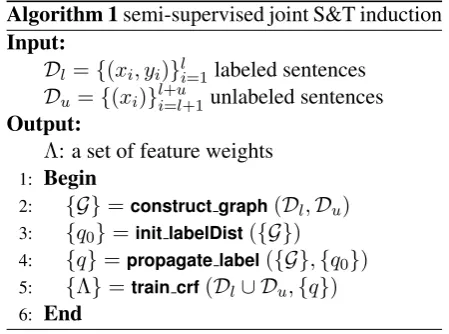
Algorithm 1semi-supervised joint S&T induction Input:
Dl ={(xi, yi)}li=1labeled sentences Du ={(xi)}l+ui=l+1unlabeled sentences
Output:
Λ: a set of feature weights
1: Begin
2: {G}=construct graph(Dl,Du)
3: {q0}=init labelDist({G})
4: {q}=propagate label({G},{q0})
5: {Λ}=train crf(Dl∪ Du,{q})
6: End
The model induction includes the following steps (see Algorithm 1): firstly, given labeled and unlabeled data, i.e., Dl = {(xi, yi)}li=1
with l labeled sentences and Du = {(xi)}l+ui=l+1
with u unlabeled sentences, a specific similarity
graph G representing Dl and Du is constructed
(construct graph). The vertices (Section 4.1) in
the constructed graph consist of alltrigrams that occur in labeled and unlabeled sentences, and edge weights between vertices are computed using the cosine distance between pointwise mutual infor-mation (PMI) statistics. Afterwards, the estimated label distributionsq0of vertices in the graphGare
the label propagation procedure (propagate label) is conducted for projecting label distributions q
from labeled vertices to the entire graph, using the algorithm of Sparse-Inducing Penalties (Das and Smith, 2012) (Section 4.2). The final step
(train crf)of the induction is incorporating the
in-ferred trigram-level label distributionsqinto CRFs
model (Section 4.3). 4.1 Graph Construction
In most graph-based label propagation tasks, the final effect depends heavily on the quality of the graph. Graph construction thus plays a cen-tral role in graph-based label propagation (Zhu et al., 2003). For character-based joint S&T, unlike the unstructured learning problem whose vertices are formed directly by labeled and unlabeled in-stances, the graph construction is non-trivial. Das and Petrov (2011) mentioned that taking individu-al characters as the vertices would result in various ambiguities, whereas the similarity measurement is still challenging if vertices corresponding to en-tire sentences.
This study follows the intuitions of graph con-struction from Subramanya et al. (2010) in which vertices are represented by character trigrams oc-curring in labeled and unlabeled sentences. For-mally, given a set of labeled sentencesDl, and
un-labeled onesDu, whereD,{Dl,Du}, the goal is
to form an undirected weighted graphG = (V, E),
where V is defined as the set of vertices which covers all trigrams extracted from Dl and Du.
Here, V = Vl∪Vu, whereVl refers to trigrams
that occurs at least once in labeled sentences and
Vu refers to trigrams that occur only in unlabeled
sentences. The edges E ∈ Vl ×Vu, connect all
the vertices. This study makes use of a symmet-ric k-NN graph (k = 5) and the edge weights are measured by a symmetric similarity function (E-quation (3)):
wi,j =
(
sim(xi, xj) ifj ∈ K(i) ori∈ K(j)
0 otherwise
(3) whereK(i)is the set of theknearest neighbors of xi(|K(i) = k,∀i|) and sim(xi, xj) is a
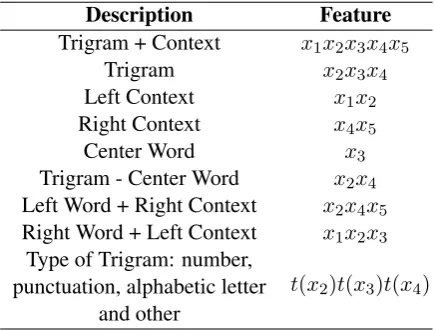
similari-ty measure between two vertices. The similarisimilari-ty is computed based on the co-occurrence statistic-s over the featurestatistic-s in Table 2. Mostatistic-st featurestatistic-s we adopted are selected from those of (Subramanya et al., 2010). Note that a novel feature in the last row encodes the classes of surrounding
character-s, where four types are defined: number, punctu-ation, alphabetic letter and other. It is especially helpful for the graph to make connections with tri-grams that may not have been seen in labeled data but have similar label information. The pointwise mutual information values between the trigram-s and each feature intrigram-stantiation that they have in common are summed to sparse vectors, and their cosine distances are computed as the similarities.
Description Feature
Trigram + Context x1x2x3x4x5
Trigram x2x3x4
Left Context x1x2
Right Context x4x5
Center Word x3
Trigram - Center Word x2x4
Left Word + Right Context x2x4x5
Right Word + Left Context x1x2x3
Type of Trigram: number, punctuation, alphabetic letter
and other
[image:4.595.308.526.196.361.2]t(x2)t(x3)t(x4)
Table 2: Features employed to measure the sim-ilarity between two vertices, in a given tex-t “x1x2x3x4x5”, where the trigram is “x2x3x4”.
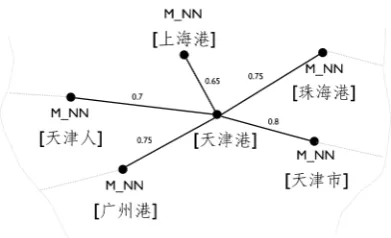
The nature of the similarity graph enforces that the connected trigrams with high weight appearing in different texts should have similar syntax con-figurations. Thus, the constructed graph is expect-ed to provide additional information that cannot be expressed directly in a sequence model (Subra-manya et al., 2010). One primary benefit of this property is on enriching vocabulary coverage. In other words, the new features of various trigram-s only occurring in unlabeled data can be ditrigram-scov- discov-ered. As the excerpt in Figure 1 shows, the trigram “天津港” (Tianjin port) has no any label informa-tion, as it only occurs in unlabeled data, but for-tunately its neighborhoods with similar syntax in-formation, e.g., “上海港” (Shanghai port), “广州
港” (Guangzhou port), can assist to infer the cor-rect tag “M NN”.
4.2 Label Propagation
Figure 1: An excerpt from the similarity graph over trigrams on labeled and unlabeled data.
are typically associated with a given instance. In fact, the sparsity is also a common phenomenon among character-based CWS and POS tagging. The following convex objective is optimized on the similarity graph in this case:
argmin
q l
X
j=1
kqj−rj k2
+µ l+u
X
i=1,k∈N(i)
wik kqi−qkk2 +λ l+u
X
i=1 kqi k2
s.t. qi≥0,∀i∈V
(4) where rj denotes empirical label distributions of
labeled vertices, andqi denotes unnormalized
es-timate measures in every vertex. Thewikrefers to
the similarity between theith trigram and thekth trigram, andN(i) is a set of neighbors of theith
trigram. µandλare two hyperparameters whose
values are discussed in Section 5. The squared-loss criterion1 is used to formulate the objective function. The first term in Equation (4) is the seed match loss which penalizes the estimated label dis-tributionsqj, if they go too far away from the
em-pirical labeled distributionsrj. The second term
is the edge smoothness loss that requiresqishould
be smooth with respect to the graph, such that two vertices connected by an edge with high weight should be assigned similar labels. The final term is a regularizer to incorporate the prior knowledge, e.g., uniform distributions used in (Talukdar et al., 2008; Das and Smith, 2011). This study applies the squared norm of q to encourage sparsity per
vertex. Note that the estimated label distribution
1It can be seen as a multi-class extension of quadratic cost
criterion (Bengio et al., 2006) or as a variant of the objective in (Zhu et al., 2003). An entropic distance measure could also be used, e.g., KL-divergence (Subramanya et al., 2010; Das and Smith, 2012).
qi in Equation (4) is relaxed to be unnormalized,
which simplifies the optimization. Thus, the objec-tive function can be optimized by L-BFGS-B (Zhu et al., 1997), a generic quasi-Newton gradient-based optimizer. The partial derivatives of Equa-tion (4) are computed for each parameter ofq and
then passed on to the optimizer that updates them such that Equation (4) is maximized.
4.3 Semi-Supervised CRFs Training
The trigram-level label distributions inferred in the propagation step can be viewed as a kind of valu-able “prior knowledge” to regularize the learning on unlabeled data. The final step of the induc-tion is thus to incorporate such prior knowledge into CRFs. Li (2009) generalizes the use of vir-tual evidence to undirected graphical models and, in particular, to CRFs for incorporating external knowledge. By extending the similar intuition, as illustrated in Figure 2, we modify the structure of a regular linear-chain CRFs on unlabeled data for smoothing the derived label distributions, where virtual evidences, i.e.,q in our case, are donated
by{v1, v2, . . . , vT}, in parallel with the state vari-ables{y1, y2, . . . , yT}. The modified CRFs model
allows us to flexibly define the interaction between estimated state values and virtual evidences by po-tential functions. Therefore, given labeled and un-labeled data, the learning objective is defined as follows:
L(Λ) +
l+u
X
i=l+1
Ep(yi|xi,vi;Λg)[logp(yi, vi|xi; Λ)]
(5) where the conditional probability in the second term is denoted as
p(yi, vi|xi; Λ) = 1
Z0(xi; Λ)exp{
N
X
j=1 K
X
k=1
λkfk(yij−1, y j i, xi, j)
+α N
X
t=1
s(yti, vti)}
(6) The first term in Equation (5) is the same as E-quation (2), which is the traditional CRFs learn-ing objective function on the labeled data. The second term is the expected conditional likelihood of unlabeled data. It is directed to maximize the conditional likelihood of hidden states with the derived label distributions on unlabeled data, i.e.,
the probability is still conditional on x. Here,
Z0(x; Λ)is the partition function of normalization
that is achieved by summing the numerator over bothyandv. A virtual evidence feature function ofs(yit, vti) with pre-defined weightα is defined
to regularize the conditional distributions of states over the derived label distributions. The learning is impacted by the derived label distributions as E-quation (7): firstly, if the trigram xti−1xtixt+1i at
current position does have no corresponding de-rived label distributions(vti = null), the value of
zero is assigned to all state hypotheses so that the posteriors would not affected by the derived infor-mation. Secondly, if it does have a derived label distribution, since the virtual evidence in this case is a distribution instead of a specific label, the la-bel probability in the distribution under the current state hypothesis is assigned. This means that the values of state variables are constrained to agree with the derived distributions.
s(yti, vti) =
(
qxt−1
i xtixti+1(y t
i) ifvti 6=null
0 else
(7) The second term in Equation (5) can be op-timized by using the expectation maximization (EM) algorithm in the same fashion as in the generative approach, following (Li, 2009). One can iteratively optimize the Q functionQ(Λ) =
P
yp(yi|xi; Λg) logp(yi, vi|xi; Λ), in whichΛgis
the model estimated from the previous iteration. Here the gradient of the Qfunction can be
mea-sured by:
∂Q(Λ)
∂Λk
=X
t
X
yit−1,yt i
fk(yit−1, yit, xi, t).
(p(yti−1, yit|xi, vi; Λ)−p(yit−1, yit|xi; Λ))
(8)
The forward-backward algorithm is used to mea-sure p(yti−1, yit|xi, vi; Λ) and p(yit−1, yit|xi; Λ).
Thus, the objective function Equation (5) is op-timized as follows: for the instancesi= 1,2, ..., l,
the parameters Λ are learned as the supervised
manner; for the instancesi=l+ 1, l+ 2, ..., u+l,
in the E-step, the expected value ofQfunction is
computed, based on the current modelΛg. In the
M-step, the posteriors are fixed and updatedΛthat
[image:6.595.328.504.62.162.2]maximizes Equation (5).
Figure 2: Modified linear-chain CRFs integrating virtual evidences on unlabeled data.
5 Experiment
5.1 Setting
The experimental data are mainly taken from the Chinese tree bank (CTB-7) and Microsoft Re-search (MSR)2. CTB-7 consists of over one mil-lion words of annotated and parsed text from Chi-nese newswire, magazine news, various broadcast news and broadcast conversation programs, web newsgroups and weblogs. It is a segmented, POS tagged3and fully bracketed corpus. The train, de-velopment and test sets4 from CTB-7 and their corresponding statistics are reported in Table 3. To satisfy the characteristic of the semi-supervised learning problem, the train set, i.e., the labeled da-ta, is formed by a relatively small amount of an-notated texts sampled from CTB-7. For the un-labeled data in this experiment, a greater amount of texts is extracted from CTB-7 and MSR, which contains 53,108 sentences with 2,418,690 charac-ters.
The performance measurement indicators for word segmentation and POS tagging (joint S&T) are balance F-score, F = 2PR/(P+R), the harmon-ic mean of precision (P) and recall (R), and out-of-vocabulary recall (OOV-R). For segmentation, a token is regarded to be correct if its boundaries match the ones of a word in the gold standard. For the POS tagging, it is correct only if both the boundaries and the POS tags are perfect matches.
The experimental platform is implemented based on two toolkits: Mallet (McCallum and Kachites, 2002) and Junto (Talukdar and Pereira, 2010). Mallet is a java-based package for s-tatistical natural language processing, which in-cludes the CRFs implementation. Junto is a
graph-2It can be download at: www.sighan.org/bakeoff2005. 3There is a total of 33 POS tags in CTB-7.
4The extracted sentences in train, development and test set
based label propagation toolkit that provides sev-eral state-of-the-art algorithms.
Data #Sent #Word #Char #OOV Train 17,968 374,697 596,360
Develop 1,659 46,637 79,283 0.074 Test 2,037 65,219 104,502 0.089
Table 3: Training, development and testing data.
5.2 Baseline and Proposed Models
In the experiment, the baseline supervised pipeline and joint S&T models are built only on the train data. The proposed model will also be compared with the semi-supervised pipeline S&T model de-scribed in (Wang et al., 2011). In addition, two state-of-the-art semi-supervised CRFs algorithms, Jiao’s CRFs (Jiao et al., 2006) and Subramanya’s CRFs (Subramanya et al., 2010), are also used to build joint S&T models. The corresponding set-tings of the above candidates are listed below:
• Baseline I: a supervised CRFs pipeline S&T
model. The feature templates are from Zhao et al. (2006) and Wu et al. (2008).
• Wang’s model: a semi-supervised CRFs
pipeline S&T model. The same feature tem-plates in (Wang et al., 2011) are used, i.e., “+n-gram+cluster+lexicon”.
• Baseline II: a supervised CRFs joint S&T
model. The feature templates introduced in Section 3.1 are used.
• Jiao’s model: a semi-supervised CRFs joint
S&T model trained using the entropy regular-ization (ER) criteria (Jiao et al., 2006). The optimization method proposed by Mann and McCallum (2007) is applied.
• Subramanya’s model: a self-train style
semi-supervised CRFs joint S&T model based on the same parameters used in (Sub-ramanya et al., 2010).
• Our model: several parameters in our model
are needed to tune based on the development set, e.g.,µ,λandα.
In all the CRFs models above, the Gaussian reg-ularizer and stochastic gradient descent method are employed.
5.3 Main Results
This experiment yielded a similarity graph that consists of 462,962 trigrams from labeled and un-labeled data. The majority (317,677 trigrams) oc-curred only in unlabeled data. Based on the de-velopment data, the hyperparameters of our mod-el were tuned among the following settings: for the graph propagation, µ ∈ {0.2,0.5,0.8} and
λ ∈ {0.1,0.3,0.5,0.8}; for the CRFs training,
α ∈ {0.1,0.3,0.5,0.7,0.9}. The best performed
joint settings areµ = 0.5,λ= 0.3andα = 0.7.
With the chosen set of hyperparameters, the test data was used to measure the final performance.
Model SegmentationF1 OOV-R F1POS TaggingOOV-R Baseline I 94.27 60.12 91.08 51.72
Wang’s 95.17 63.10 91.64 53.29 Baseline II 95.14 61.52 91.61 52.29 Jiao’s 95.58 63.05 92.11 53.27 Subramanya’s 96.30 67.12 92.46 57.15 Our model 96.85 68.09 92.89 58.36
Table 4: The performance of segmentation and POS tagging on testing data.
model. Moreover, the two graph-based approach-es, i.e., Subramanya’s and our model, outperform the others. Most importantly, the boldface num-bers in the last row illustrate that our model does achieve the best performance. Overall, for word segmentation, it obtains average improvements of 1.43% and 8.09% in F-score and OOV-R over oth-ers; for POS tagging, it achieves average improve-ments of 1.09% and 7.73%.
0 10,00020,00030,00040,00050,000 94.0
94.5 95.0 95.5 96.0 96.5 97.0 97.5
W ang's Jiao's Subramanya's Our
F
-s
c
o
r
e
Number of unlabeled sentences
0 10,00020,00030,00040,00050,000 91.0
91.5 92.0 92.5 93.0 93.5
W ang's Jiao's Subramanya's Our
F
-s
c
o
r
e
Number of unlabeled sentences
0 10,00020,00030,00040,00050,000 60.0
62.5 65.0 67.5 70.0
W ang's Jiao's Subramanya's Our
O
O
V
-R
Number of unlabeled sentences
0 10,00020,00030,00040,00050,000 51.0
52.5 54.0 55.5 57.0 58.5
W ang's Jiao's Subramanya's Our
O
O
V
-R
[image:8.595.72.291.193.373.2]Number of unlabeled sentences
Figure 3: The learning curves of semi-supervised models on unlabeled data, where left graphs are segmentation and the right ones are tagging.
5.4 Learning Curve
An additional experiment was conducted to inves-tigate the impact of unlabeled data for the four semi-supervised models. Figure 3 illustrates the curves of F-score and OOV-R for segmentation and tagging respectively, as the unlabeled data size is progressively increased in steps of 6,000 sentences. It can be clearly observed that al-l curves of our modeal-l are abal-le to mount up steadi-ly and achieve better gains over others consistent-ly. The most competitive performance of the oth-er three candidates is achieved by Subramanya’s model. This strongly reveals that the knowledge derived from the similarity graph does effectively strengthen the model. But in Subramanya’s mod-el, when the unlabeled size ascends to approxi-mately 30,000 sentences the curves become nearly asymptotic. The semi-supervised pipeline model, Wang’s model, presents a much slower growth on all curves over the others and also begins to over-fit with large unlabeled data sizes (>25,000
sen-tences). The figure also shows an erratic fluctu-ation of Jiao’s model. Since this approach aims
at minimizing conditional entropy over unlabeled data and encourages finding putative labelings for unlabeled data, it results in a data-sensitive mod-el (Li et al., 2009).
5.5 Analysis & Discussion
A statistical analysis of the segmentation and tag-ging results of the supervised joint model (Base-line II) and our model is carried out to comprehend the influence of the graph-based semi-supervised behavior. For word segmentation, the most signif-icant improvement of our model is mainly concen-trated on two kinds of words which are known for their difficulties in terms of CWS: a) named enti-ties (NE), e.g., “天津港” (Tianjin port) and “保税 区” (free tax zone); and b) Chinese numbers (CN), e.g., “八点五亿” (eight hundred and fifty million) and “百分之七十二” (seventy two percent). Very often, these words do not exist in the labeled data, so the supervised model is hard to learn their fea-tures. Part of these words, however, may occur in the unlabeled data. The proposed semi-supervised approach is able to discover their label information with the help of a similarity graph. Specifically, it learns the label distributions from similar words (neighborhoods), e.g., “上海港” (Shanghai port), “保护区” (protection zone), “九点七亿” (nine hundred and seventy million). The statistics in Ta-ble 5 demonstrate significant error reductions of 50.44% and 48.74% on test data, corresponding to NE and CN respectively.
Type #word #baErr #gbErr ErrDec%
NE 471 226 112 50.44
CN 181 119 61 48.74
Table 5: The statistics of segmentation error for named entities (NE) and Chinese numbers (CN) in test data. #baErrand#gbErrdenote the count of segmentations by Baseline II and our model; ErrDec%denotes the error reduction.
aver-Pattern #baErr ↓ Pattern #baErr ↑
NN→VV 58 38 NN→NR 13 6
CD→NN 41 27 IJ→ON 9 5
NR→VV 29 17 VV→NN 4 3
JJ→NN 18 11 NR→NN 1 3
[image:9.595.76.289.61.127.2]NR→VA 19 10 JJ→AD 1 2
Table 6: The statistics of POS tagging error pat-terns in test data. #baErrdenote the count of tag-ging error by Baseline II, while ↓ and↑ denotes the number of error reduced or increased by our model.
age. More impressively, there is a large portion of fixed error pattern instances stemming from OOV words. Meanwhile, it is also observed that the dis-ambiguation of error patterns in the right portion of the table slightly suffers from our approach. In reality, it is impossible and unrealistic to request a model to be “no harms but only benefits” under whatever circumstances.
6 Conclusion
This study introduces a novel semi-supervised ap-proach for joint Chinese word segmentation and POS tagging. The approach performs the semi-supervised learning in the way that the trigram-level distributions inferred from a similarity graph are used to regularize the learning of CRFs model on labeled and unlabeled data. The empirical re-sults indicate that the similarity graph information and the incorporation manner of virtual evidences present a positive effect to the model induction.
Acknowledgments
The authors are grateful to the Science and Tech-nology Development Fund of Macau and the Re-search Committee of the University of Macau for the funding support for our research, un-der the reference No. 017/2009/A and RG060/09-10S/CS/FST. The authors also wish to thank the anonymous reviewers for many helpful comments.
References
Shumeet Baluja, Rohan Seth, D. Sivakumar, Yushi Jing, Jay Yagnik, Shankar Kumar, Deepak Ravich, and Mohamed Aly. 2008. Video suggestion and discovery for youtube: taking random walks through the view graph. InProceedings of WWW, pages 895-904, Beijing, China.
Mikhail Belkin, Partha Niyogi, and Vikas Sindhwani.
2006. Manifold regularization. Journal of machine learning research, 7:2399–2434.
Yoshua Bengio, Olivier Delalleau, and Nicolas Le Roux. 2006. Label propogation and quadratic crite-rion.MIT Press.
Jon Louis Bentley. 1980. Multidimensional divide-and -conquer. Communications of the ACM, 23(4):214 -229.
Alina Beygelzimer, Sham Kakade, and John Langford. 2006. Cover trees for nearest neighbor. In Proceed-ings of ICML, pages 97-104, New York, USA Olivier Chapelle, Bernhard Sch¨o lkopf, and Alexander
Zien. 2006. Semi-supervised learning.MIT Press. Samuel I. Daitch, Jonathan A. Kelner, and Daniel A.
Spielman. 2009. Fitting a graph to vector data. In Proceedings of ICML, 201-208, NY, USA.
Dipanjan Das and Noah A. Smith. 2011. Semi-supervised framesemantic parsing for unknown predicates. In Proceedings of ACL, pages 1435-1444, Portland, Oregon, USA.
Dipanjan Das and Slav Petrov. 2011. Unsupervised Part-of-Speech Tagging with Bilingual Graph-based Projections. In Proceedings of ACL, pages 1435-1444, Portland, Oregon, USA.
Dipanjan Das and Noah A. Smith. 2012. Graph-based lexicon expansion with sparsity-inducing penalties. InProceedings of NAACL, pages 677-687, Montr´eal, Canada.
Tony Jebara, Jun Wang, and Shih-Fu Chang. 2009. Graph construction and b-matching for semi-supervised learning. InProceedings of ICML, 441-448, New York, USA.
Wenbin Jiang, Liang Huang, Qun Liu, and Yajuan Liu. 2008. A Cascaded Linear Model for Joint Chinese Word Segmentation and Part-of-Speech Tagging. In Proceedings of ACL, pages 897-904, Columbus, O-hio.
Wenbin Jiang, Liang Huang, and Qun Liu. 2009. Au-tomatic Adaptation of Annotation Standards: Chi-nese Word Segmentation and POS Tagging – A Case Study. InProceedings of he ACL and the 4th IJC-NLP of the AFIJC-NLP, pages 522–530, Suntec, Singa-pore.
Feng Jiao, Shaojun Wang, and Chi-Hoon Lee. 2006. Semi-supervised conditional random fields for im-proved sequence segmentation and labeling. In In Proceedings of ACL, pages 209–216, Sydney, Aus-tralia.
John Lafferty, Andrew McCallum, and Fernando Pereira. 2001. Conditional Random Field: Prob-abilistic Models for Segmenting and Labeling Se-quence Data. In Proceedings of ICML, pages 282-289, Williams College, USA.
Xiao Li. 2009. On the use of virtual evidence in con-ditional random fields. InProceedings of EMNLP, pages 1289-1297, Singapore.
Xiao Li, Ye-Yi Wang, and Alex Acero. 2009. Extract-ing structured information from user queries with semi-supervised conditional random fields In Pro-ceedings of ACM SIGIR, pages 572-579, Boston, USA.
Gideon S. Mann and Andrew McCallum. 2007. Ef-ficient computation of entropy gradient for semi-supervised conditional random fields. In Proceed-ings of NAACL, pages 109-112, New York, USA.
McCallum and Andrew Kachites. 2002. MALLET: A Machine Learning for Language Toolkit. Software athttp://mallet.cs.umass.edu.
Tetsuji Nakagawa and Kiyotaka Uchimoto. 2007. A hybrid approach to word segmentation and POS tag-ging. InProceedings of ACL Demo and Poster Ses-sion, pages 217–220, Prague, Czech Republic.
Hwee Tou Ng and Jin Kiat Low 2004. Chinese part-of-speech tagging: One-at-a-time or all-at-once? word-based or character-based? InProceedings of EMNLP, Barcelona, Spain.
Xian Qian and Yang Liu. 2012. Joint Chinese Word Segmentation, POS Tagging and Parsing. In Pro-ceedings of EMNLP-CoNLL, pages 501-511, Jeju Is-land, Korea.
Yanxin Shi and Mengqiu Wang. 2007. A dual-layer CRF based joint decoding method for cascade seg-mentation and labelling tasks. InProceedings of IJ-CAI, Hyderabad, India.
Amarnag Subramanya, Slav Petrov, and Fernando Pereira. 2010. Efficient graph-based semi-supervised learning of structured tagging models. In Proceedings of EMNLP, pages 167-176, Mas-sachusetts, USA.
Weiwei Sun. 2011. A Stacked Sub-Word Model for Joint Chinese Word Segmentation and Part-of-Speech Tagging. In Proceedings of ACL, pages 1385–1394, Portland, Oregon.
Weiwei Sun and Jia Xu. 2011. Enhancing Chinese word segmentation using unlabeled data. In Pro-ceedings of EMNLP, pages 970-979, Scotland, UK.
Partha Pratim Talukdar, Joseph Reisinger, Marius Pas-ca, Deepak Ravichandran, Rahul Bhagat, and Fer-nando Pereira. 2008. Weakly Supervised Acquisi-tion of Labeled Class Instances using Graph Ran-dom Walks. InProceedings of EMNLP, pages 582-590, Hawaii, USA.
Partha Pratim Talukdar and Koby Crammer. 2009. New Regularized Algorithms for Transductive Learning. InProceedings of ECML-PKDD, pages 442 - 457, Bled, Slovenia.
Partha Pratim Talukdar and Fernando Pereira. 2010. Experiments in graph-based semi-supervised learn-ing methods for class-instance acquisition. In Pro-ceedings of ACL, pages 1473-1481, Uppsala, Swe-den.
Yiou Wang, Jun’ichi Kazama, Yoshimasa Tsuruoka, Wenliang Chen, Yujie Zhang, and Kentaro Torisa-wa. 2011. Improving Chinese word segmentation and POS tagging with semi-supervised methods us-ing large auto-analyzed data. InProceedings of IJC-NLP, pages 309–317, Chiang Mai, Thailand.
Yu-Chieh Wu Jie-Chi Yang, and Yue-Shi Lee. 2008. Description of the NCU Chinese Word Segmenta-tion and Part-of-Speech Tagging for SIGHAN Bake-off. In Proceedings of the SIGHAN Workshop on Chinese Language Processing, pages 161-166, Hy-derabad, India.
Jia Xu, Jianfeng Gao, Kristina Toutanova, and Herman-n Ney. 2008. BayesiaHerman-n semi-supervised chiHerman-nese word segmentation for statistical machine transla-tion. InProceedings of COLING, pages 1017-1024, Manchester, UK.
Yue Zhang and Stephen Clark. 2008. Joint word seg-mentation and POS tagging using a single percep-tron. In Proceedings of EMNLP, pages 888-896, Columbus, Ohio.
Yue Zhang and Stephen Clark. 2010. A fast decoder for joint word segmentation and POS-tagging using a single discriminative model. In Proceedings of EMNLP, pages 843-852, Massachusetts, USA.
Hai Zhao, Chang-Ning Huang, Mu Li, and Bao-Liang Lu. 2006. Effective tag set selection in Chinese word segmentation via conditional random field modeling. InProceedings of PACLIC, pages 87-94, Wuhan, China.
Xiaojin Zhu, Zoubin Ghahramani, and John Laffer-ty. 2003. Semi-supervised learning using Gaussian fields and harmonic functions. In Proceedings of ICML, pages 912–919, Washington DC, USA.