An exploration of the relationship between undergraduate
pharmacy knowledge and professional practice.
WATERFIELD, Jonathan Stephen.
Available from Sheffield Hallam University Research Archive (SHURA) at:
http://shura.shu.ac.uk/20499/
This document is the author deposited version. You are advised to consult the publisher's version if you wish to cite from it.
Published version
WATERFIELD, Jonathan Stephen. (2014). An exploration of the relationship between undergraduate pharmacy knowledge and professional practice. Doctoral, Sheffield Hallam University (United Kingdom)..
Copyright and re-use policy
See http://shura.shu.ac.uk/information.html
Sheffield Hallam University Learning and Informrd'on Services
Adsetts Centre, City Campus Sheffield S1 1WD
ProQuest Number: 10701146
All rights reserved INFORMATION TO ALL USERS
The quality of this reproduction is dependent upon the quality of the copy submitted. In the unlikely event that the author did not send a com plete manuscript and there are missing pages, these will be noted. Also, if material had to be removed,
a note will indicate the deletion.
uest
ProQuest 10701146
Published by ProQuest LLC(2017). Copyright of the Dissertation is held by the Author.
All rights reserved.
This work is protected against unauthorized copying under Title 17, United States C ode Microform Edition © ProQuest LLC.
ProQuest LLC.
789 East Eisenhower Parkway P.O. Box 1346
An Exploration of the Relationship between Undergraduate
Pharmacy Knowledge and Professional Practice
Jonathan Stephen Waterfield
A dissertation submitted in partial fulfilment of the requirements of Sheffield Hallam University for the Degree of Doctor of Education
January, 2014
CONTENTS
Page
ABSTRACT 6
ACKNOWLEDGEMENTS 7
CHAPTER 1: INTRODUCTION TO PHARMACY EDUCATION 8
Overall aim of research 8
What is the focus of this research 9
Why is this work important? 10
Background to research area 11
A narrative approach to the research 16
Developing a reflexive approach 18
Relationship to Bourdieu’s concept of reflexivity 19
Personal journey into reflexivity 20
Summary of personal constructs 22
CHAPTER 2: LITERATURE REVIEW 27
Schon: The swamp of practice - overview 29
Technical rationality and pharmacy knowledge 30
Reflection in action 36
Reflection within different contexts 40
Under-utilisation of knowledge 41
Relationship between technical rationality and the social context 46
Continuing professional development 49
Educating the practitioner 50
Summary 52
Bourdieu: Field theory - overview 54
Forms of capital 55
The School of Pharmacy Field 57
Habitus 62
Summary 69
Bernstein: Knowledge relations and professional identity - overview 70
Vertical and horizontal knowledge 72
Singulars and Regions 76
Genericism 78
Implications for vocational knowledge 81
Summary 83
Conclusion - key themes from the literature review 86
Application to professional identity 86
Research Questions 89
CHAPTER 3: RESEARCH DESIGN 91
Key influences of Schon, Bourdieu and Bernstein 92
Developing choices on my research journey 93
What is meant by objectivity and subjectivity in pharmacy culture? 94
Rationale for mixed methods approach 97
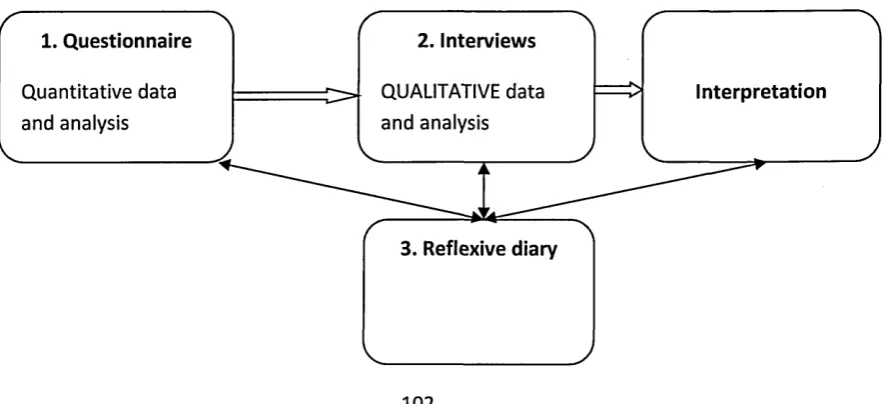
Design of mixed methods study 101
Rationale for the three components used 103
Ethical considerations 113
CHAPTER 4: METHODS OF RESEARCH 115
Phase 1: Questionnaire 115
Administration of questionnaire 115
Phase 2: Interviews 116
Phase 3: Ongoing reflexive work 118
Development of research instruments 118
Methods of data analysis: Questionnaire 122
Methods of data analysis: Interviews 125
CHAPTER 5: QUESTIONNAIRE RESULTS AND DISCUSSION 132
Stage 1: General questionnaire data 132
Stage 2: Questionnaire statements 134
Theme 1: Scientific identity 134
Theme 2: Integration of science and practice 135
Theme 3: Practice-based curriculum 138
Theme 4: MPharm as a wider education 141
Theme 5: Ease of MPharm development 142
Theme 6: Knowledge application 143
Stage 3: Analysis of themes across a range of variables within the sample 145 Stage 4: Initial summary of the questionnaire data and investigation of 153 further variables
Stage 5: Analysis of questionnaire written comments 155
Summary of questionnaire findings 162
Reflexive summary 164
CHAPTER 6: INTERVIEW NARRATIVES AND DISCUSSION 166
Respondent profile 169
Theme 1: A scientific identity 170
Theme 2: Integration of pharmaceutical science and pharmacy practice 182
Theme 3: Describing pharmacy knowledge 192
Theme 4: Relevance and contextualisation of curriculum content 202
Theme 5: The education and training divide 210
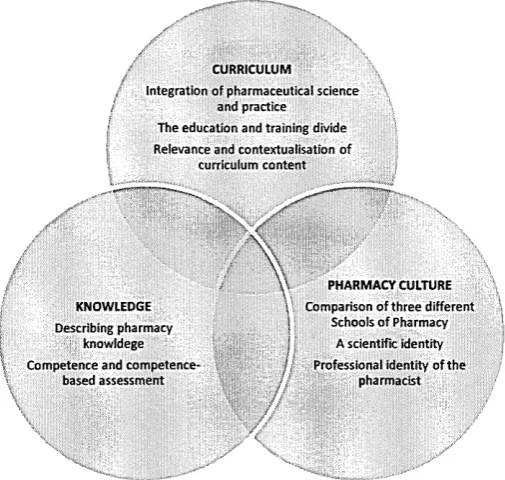
Theme 6: Competence and competence-based assessment 215 Theme 7: A comparison of Schools of Pharmacy N, R and T 226 Theme 8: The professional identity of a pharmacist 232
CHAPTER 7: CONCLUSION AND EVALUATION 241
Key findings 241
Evaluation 254
Contributions to the field 257
Reflexive summary: The prescription metaphor 259
REFERENCES 260
LIST OF TABLES
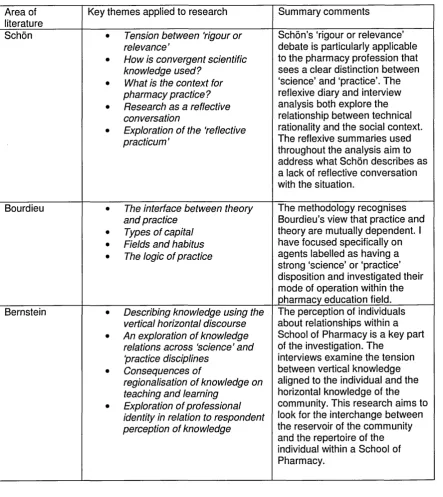
3.1 The influence of Schon, Bourdieu and Bernstein on my 92 research methodology
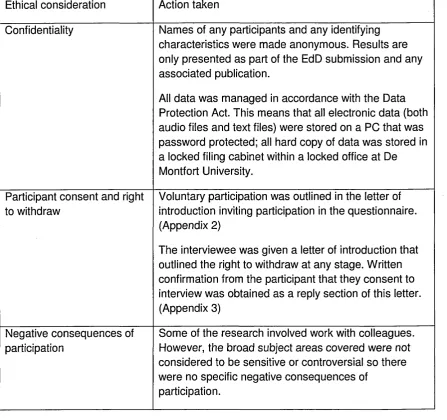
3.2 Main ethical considerations for the research project 114
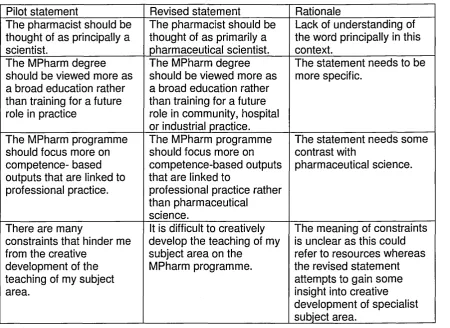
4.1 Examples of questionnaire development 119
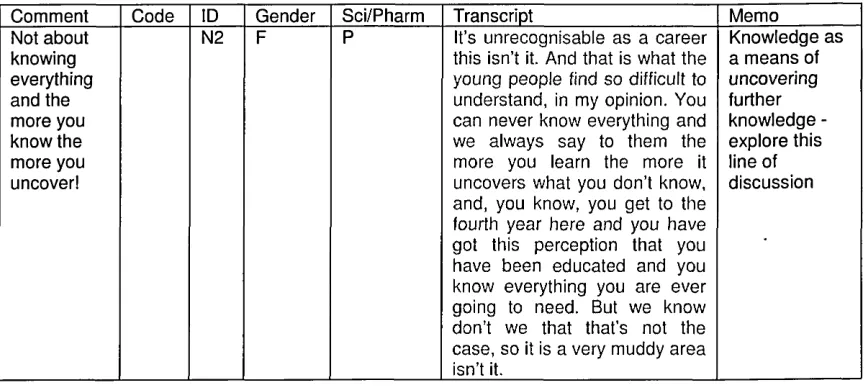
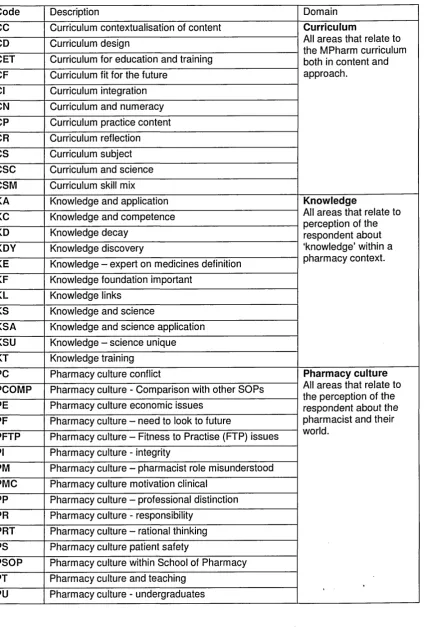
4.2 Example extract of Excel sheet for analysis of respondent N2 127 4.3 List of codes developed to support interview analysis of 130
institution N
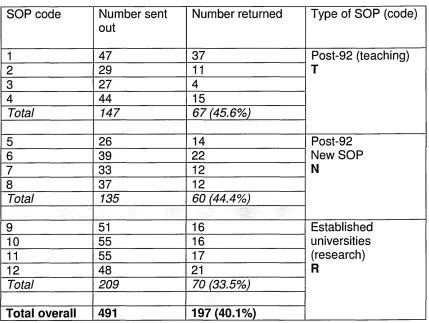
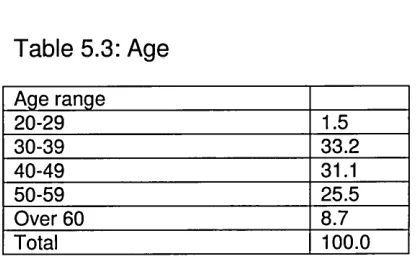
5.1 Types of School of Pharmacy (SOP) in sample group 132 5.2 Percentage of respondents with reference to: gender 133 5.3 Percentage of respondents with reference to: age 133 5.4 Percentage of respondents with reference to: pharmacist/non- 133
pharmacist
5.5 Percentage of respondents with reference to: subject area 133 5.6 Summary matrix of analysis of questionnaire by theme 146 5.7 Cross-tabulation data for pharmacist/non-pharmacist/gender 154 5.8 Questionnaire written response: What in your view is the 156
MPharm for?
5.9 Questionnaire written response: What in essence is the main 158 role of the pharmacist?
5.10 Questionnaire written response: Any further comments on your 160 answers?
6.1 Types of institution and interviewee profile 169 6.2 Differences in how knowledge is viewed between scientist and 195
pharmacy practitioner
6.3 Personal views that describe knowledge 199
6.4 Definitions of absolute (A) or relative (R) competence by 221 practice and science-based respondents
7.1 The relationship between key findings and interview narrative 242 themes
LIST OF FIGURES
2.1 An overview of the literature review 28
3.1 Design based on Sequential Explanatory Design showing 102 relationship of research components
3.2 Adaptation of Explanatory Design: Participant Selection Model 110 4.1 The integration of themes from the interviews 131 5.1 Summary of overall trends from questionnaire 163 6.1 A diagrammatic representation of the interview themes 168 6.2 The ascending scale of respondent perception of the 172
importance of science within School N
6.3 The pharmacy practitioner’s positive view of science 173
6.4 Tensions of contextualisation 207
6.5 Describing the MPharm as education or training 212 6.6 Assignment of a label to three different types of School of 227
Pharmacy
C O O O ^ J C » U l4 ^ G O r\ D 5.1 5.2 5.3 5.4 5.5 5.6 5.7 5.8 5.9 5.10 5.11 5.12 5.13 5.14 5.15 5.16 5.17 5.18 5.19 5.20 5.21 5.22 5.23 5.24 1
LIST OF GRAPHS
Scientific identity (statement 1) Scientific identity (statement 5)
Integration of science and practice (statement 2) Integration of science and practice (statement 6) Integration of science and practice (statement 7) Integration of science and practice (statement 8) Integration of science and practice (statement 14) Practice-based curriculum (statement 9)
Practice-based curriculum (statement 10) Practice-based curriculum (statement 13) MPharm as wider education (statement 3) Ease of MPharm development (statement 11) Ease of MPharm development (statement 12) Knowledge application (statement 15)
Knowledge application (statement 4)
Scientific identity with reference to respondent type
Integration of science and practice with reference to respondent type
Practice-based curriculum with reference to respondent type MPharm as wider education with reference to respondent type Ease of MPharm development with reference to respondent type
Knowledge application with reference to respondent type Descriptions of the purpose of the MPharm degree by percentage of respondents
Descriptions of the main role of the pharmacist by percentage of respondents
Descriptions of further responses and clarification by percentage of respondents
APPENDIX
Ethical approval of research project Cover letter for questionnaire Participant information for interview Questionnaire
Semi-structured interview schedule Questionnaire rationale document
Summary of numerical data from questionnaire Provisional interview summary document Sample interview transcript for respondent N2
ABSTRACT
Pharmacy education is undergoing a transition as the pharmacy profession aspires to a more clinical role. The two main areas of study within the
undergraduate curriculum are pharmaceutical science and pharmacy ‘practice’. ‘Practice’ includes subjects that relate directly to the practice of pharmacy such as: dispensing, pharmacy law, ethics and communication skills. In recent years the ‘practice’ content of the undergraduate curriculum for the Master of
Pharmacy (MPharm) programme has increased in comparison to the traditional emphasis on pharmaceutical science. The thesis examines the tension between pharmaceutical science and pharmacy ‘practice’ framed by a discussion of the perspectives of Schon, Bourdieu and Bernstein.
A mixed methods approach included a questionnaire study of the views of academic members of staff across 12 Schools of Pharmacy (SOP). The questionnaire was followed by 12 semi-structured interviews with respondents representing three different types of SOP. The data collection was undertaken in conjunction with the ongoing writing of a reflexive diary to summarise
emerging themes. The research design is based on a narrative, reflexive approach where I recognise my personal history in relation to the interface between knowledge and professional practice.
Overall the questionnaire results from nearly 200 respondents portray the MPharm curriculum as an educational rather than a training programme where there is the integration of science and ‘practice’ and the opportunity to apply knowledge. Key findings from the interviews indicate a polarisation between the views of pharmaceutical scientists and pharmacy practitioners regarding what constitutes pharmacy knowledge. There is a general lack of clarity about the professional role of the pharmacist. My research shows that whilst an appeal to scientific identity strengthens the claim for professional status there is also some uncertainty about the scientific identity of the pharmacist particularly in the new SOP.
The findings show that the move towards an integration of science and
‘practice’ is a challenging ideal as the scientific subject specialist and pharmacy practitioner occupy different spaces within the pharmacy education field.
Acknowledgement of the social basis of knowledge can support our
ACKNOWLEDGEMENTS
I wish to acknowledge the excellent support I have received throughout this
research programme. Special thanks to Mike Coldwell and Paul Garland, who
have guided my research journey and offered supportive and helpful academic
insight at all stages of the project. I am indebted to all of the respondents who
gave generously of their time and particularly those who participated in the
interviews. I would also like to thank colleagues in the Leicester School of
Pharmacy for their support. Finally many thanks to Alison, Daniel, Anna and
Mark for their sustained patience and encouragement.
CHAPTER 1: INTRODUCTION TO PHARMACY EDUCATION
This chapter provides an outline of the overall aim of the research, why I
consider this work to be important and an overview of some key background
issues that inform the research area. A narrative approach has been taken to
this work and I justify this by an explanation that links this approach to reflexivity
and my claims to validity. The chapter concludes with a discussion of my
personal journey into reflexivity and a summary of my personal constructs within
this field of study.
Overall aim of the research
The overall aim of this study was to explore how pharmacy knowledge within
the Master of Pharmacy (MPharm) undergraduate curriculum relates to future
professional practice. This study has focused on three key areas:
• the distinction between pharmaceutical science and professional
practice areas of the curriculum and how this issue is viewed
• the different views of pharmacy educators on the preparation of the
future practitioner for professional practice
• the ongoing education versus training debate within a vocational
pharmacy education programme
My formative consideration of these areas and initial consideration of the
literature resulted in the publication of two papers:
• ‘Two approaches to vocational education and training. A view from
ongoing move towards a more practice-based curriculum needs opening
up to a much wider discussion than is currently evident in the literature.
• 7s pharmacy a knowledge-based profession? (Waterfield, 2010) which
framed a theoretical question about the nature of knowledge and
professionalism and how this relates to the pharmacy profession.
There is a statement of the specific research questions at the end of the
literature review in Chapter 2.
What is the focus for this research?
It is useful at the outset to distinguish between ‘pharmaceutical science’ and
‘pharmacy practice’ as the two main areas of study within the MPharm
curriculum. Typically pharmaceutical science includes subjects such as
chemistry, pharmacology and pharmaceutics. Pharmacy ‘practice’ includes
subjects that relate directly to the practice of pharmacy such as: dispensing,
pharmacy law, ethics and communication skills. Scientists have their own
practice and this is often overlooked in pharmacy education where there is a
dichotomous reference to ‘science’ or ‘practice’. One key area of debate
identified in the relationship between theoretical knowledge, education and
professionalism is the lack of integration between pharmaceutical science and
pharmacy practice. In his book ‘Researching Higher Education', Tight states
that knowledge is in many ways the most fundamental and the most theorized
area within higher education, but the least researched (Tight, 2003). The focus
for this research is undergraduate pharmacy education from the viewpoint of the
pharmacy educator.
Why is this work important?
Pharmacists have a certain moral responsibility as they are the gatekeepers to
safe drug usage and are required to use their knowledge responsibly within the
healthcare system. It can be argued that because the knowledge and work of
the pharmacist relates to medicine, the profession has the potential to make a
massive impact on society. The converse view suggests that the failure of
pharmacists to gain control over the ‘social object’ of medicine by their
subordinate relationship with the medical profession and their close association
with a supply function, has reduced their usefulness and status as a profession.
Somewhere in the middle of these two extremes the pharmacist is situated in a
knowledge-based role but is constrained by an ambiguous professional identity.
There are three main reasons why I view this work as important. Firstly, an
insight into the views of pharmacy educators offers a unique window on the
world of pharmacy as it provides material from people across a range of
disciplines that span professional practice and pharmaceutical sciences.
Secondly, this rich data source could potentially offer a significant contribution
to the debate about the nature of the pharmacy profession, pharmacy
knowledge and the position of pharmacy practice within the MPharm curriculum.
Finally it is possible that this research may develop a transformative agenda as
the work may ultimately contribute to our understanding and development of the
pharmacy curriculum. This in turn may influence the evolving role of the
Background to the research area
A research project commissioned by the Royal Pharmaceutical Society of Great
Britain (RPSGB) and undertaken by Wright et al. (2006) compared pharmacy
with other healthcare professional education and training. The report concluded
that pharmacy education in the UK in comparison with other UK health
disciplines and with pharmacy education in comparable other countries is
treated as a science degree rather than a clinical qualification. This identity as
a science degree is almost like a ‘hangover effect’ from the way that pharmacy
has evolved from its historic scientific roots into a more clinically orientated
profession.
In recent years the aspiration for a more clinical profession has resulted in a
move to increase the amount of ‘pharmacy practice’ teaching both within the
Schools of Pharmacy and also within pharmacy practice settings. There has
also been a considerable expansion of the number of Schools of Pharmacy in
the UK. The number of Schools of Pharmacy in England increased from 12 to
21, between 1999 and 2009 and the number of students more than doubled
from 4200 to 9800 (MEE, 2011). This expansion in pharmacy education and
increasing emphasis on clinical curriculum content provides a dynamic research
field that is ripe for further exploration.
On a purely practical level, the lack of recognition as a clinical qualification
highlighted by Wright and his colleagues, as opposed to a clearer emphasis on
a scientific course of study, has implications in terms of funding clinical
placements. At a more theoretical level, the current increase in the pharmacy
practice components (compared to the pharmaceutical science components) of
the curriculum has resulted in significant questions of debate amongst various
stakeholders, such as:
• What is the nature of pharmacy practice and how can future practitioners
be most effectively prepared for their role?
• Is there a danger that the scientific identity of the pharmacist is
compromised as scientific components of the pharmacy degree
programme are marginalised?
• Is the MPharm degree programme seen as competence-based training
for future practice or a more holistic education?
These questions offer a potentially rich source of discussion, within a profession
that is undergoing enormous change. The language used in the government
paper: ‘Pharmacy in England - building on strengths, delivering the future’,
indicates a strong support for the “untapped expertise and capacity’ of the
pharmacy profession and the preparation of future practitioners for a more
clinical role (DOH, 2008 p86). It is clear from the General Pharmaceutical
Council (GPhC) publication of the standards for the initial education and training
of pharmacists (GPhC, 2011) that the regulatory body are looking for a more
competence-based approach to the delivery and assessment of the MPharm
degree. However, it is less clear how foundation pharmaceutical sciences are
both included and integrated within the new curriculum. The position of
pharmaceutical science and the relationship to professional practice is a debate
that is beginning to gather momentum and is an active area of discussion within
In 1997 there was a significant change in pharmacy education as the pharmacy
degree course moved from the three year BPharm or BSc programme to the
four year MPharm programme. Under the Bologna agreement for educational
equivalence across Europe, this four year programme is classified as an
‘undergraduate Masters programme’ which is a lesser qualification than the
traditional MSc degree (Chamberlain, 2005). The UK four year degree is the
shortest of the European pharmacy degrees, as typical pharmacy degrees
within mainland Europe are five to six years. However, the European Union
Directive on the education and training of pharmacists was not the only driver
for the move to a longer pharmacy degree course. A report from an education
working group of the RPSGB (2002) cited a number of other reasons for the
change to a four year degree which are summarised below:
• Compensation for a reduced breadth of science curriculum within
secondary education
• To address advances in biological and chemical sciences in sufficient
depth to be able to understand new approaches to drug therapy
• To incorporate a grounding in social and behavioural sciences to meet
the needs of patients and other healthcare professionals as highlighted in
the Nuffield Report (Nuffield, 1986)
It is significant to note that two of the drivers for an expanded pharmacy degree
programme related to the increased science content of the curriculum. This
aspiration to increase scientific content appears to contrast with the current
trend, which is an increase in practice-based teaching.
There has been some discussion about the move from a three year to a four
year programme and the use of the term ‘Integrated Masters’ to describe study
at both undergraduate and Master’s levels. One study, comparing the “rhetoric
and reality' of the expanded degree programme, involved interviewing 10
pharmacy course leaders and concluded that the change from BPharm to
MPharm was led by “contention and insecurity rather than debate” (Sie et al.,
2003 p169). Their study suggests that as Schools of Pharmacy have
redesigned their curriculum there is a lack of homogeneity between
programmes. The 26 Schools of Pharmacy in the UK are required to adhere to
the indicative syllabus and education standards of the GPhC regulatory body.
However, within these constraints all Schools have different approaches to the
delivery of the MPharm curriculum. For example, different course providers will
vary in the proportion of pharmaceutical science, pharmacy practice and
placement-based learning within the curriculum according to their own interests,
expertise and ethos. This lack of uniformity of content is not confined to
pharmacy programmes in the UK. For example a comparison of pharmacy
education programmes in New Zealand and the United States demonstrated
that whilst there has been some consensus of opinion about what knowledge,
skills and attributes a modern pharmacy graduate should possess, the content
and emphasis of different programmes differs widely (Shaw, 2002).
The question this research project centres on is the nature of the relationship
and interface between education and professional practice, which is a
significant and dynamic area of discussion, relating to knowledge and
An ongoing challenge for the pharmacy profession is to produce practitioners
who are both scientists and healthcare professionals. There has been a decline
in the number of academic, science-based pharmacists (Taylor and Harding,
2002) coupled with a rise in the number of undergraduate pharmacy students.
This trend of a reduction in academic pharmacists who are responsible for
greater numbers of future pharmacists has implications for the development of
the pharmacy profession. Potentially this situation could lead to a shortfall in the
area of professional knowledge. At the time of writing there are significant
moves to modernise the education and training of future pharmacists, by the
Modernising Pharmacy Careers Programme Board (MPCPB). This board is part
of Medical Education England (MEE), which is an independent advisory body
established to advise ministers on education, training and workforce planning
for doctors, dentists, healthcare scientists and pharmacists. The MEE
programme was set up following the publication of the government paper lA
High Quality Workforce: NHS Next Stage Review’ (Darzi, 2008). Part of the
work undertaken by the MPCPB was a comprehensive review by the University
of London Institute of Education, which identified a number of weaknesses in
current arrangements for the delivery of undergraduate and pre-registration
training of pharmacists. The four main areas of weakness identified are:
• Students have very little exposure to patients and learning in a clinical
environment
• Quality assurance across the pre-registration year is variable and not a
responsibility of the Schools of Pharmacy
• Students have a strong science education and training, but they have
difficulty in applying the science into clinical practice to benefit patients
• The application of communication skills to practice scenarios
The MPCPB proposes major restructuring and funding of pharmacy education
“to allow patients, the public and the NHS to benefit more completely from the
unique contribution that pharmacists - as medicine experts - make to health,
wellbeing and patient safety (MEE, 2011). At the same time the regulatory
body have developed a set of new education standards that utilise a more
competence-based approach (GPhC, 2011). Overall pharmacy education
portrays a dynamic research field that offers an opportunity to explore the
relationship between theory and practice in an evolving healthcare profession.
A narrative approach to research
In this section I justify my narrative approach to the exploration of this area, the
relationship to Bourdieu’s concept of reflexivity and how this links to my claims
to validity. A full explanation of my research design is provided in Chapter 3
which follows on from a review of the literature in Chapter 2.
Polkinghorne (1995 p5) describes narrative enquiry as a “subset of qualitative
research designs in which stories are used to describe human action”. For this
research the main way I use a narrative approach is the utilisation of a reflexive
diary as one of my research instruments to facilitate the construction of reflexive
summary accounts. From a pragmatic viewpoint this is a way of trying to bring a
sense of order into the thematic analysis of interview narratives and ongoing
reflection on the theory-practice dichotomy within pharmacy education. There
are three basic claims within the narrative research literature summarised by
Moen(2008 p60) that I have applied to this investigation.
• Stories told depend on a number of factors such as the individual’s past
and present experience, his/her values, the audience listening to the
narrative and when and where the narrative is being heard
• Narratives are multi-voiced as they are an interaction between beliefs
and experiences and present and future external voices
These three claims can be related to my own approach to research and my
claims to validity. Firstly the knowledge that individuals use a narrative
framework to explain their experience of the world is fundamental to a study that
engages with the individual academic viewpoint. It has been important to tune
into these individual narratives and through this activity look for my own
narrative as a way of bringing structure into my understanding of the theory-
practice question within pharmacy education. Secondly, the position of the
individual and his/her relationship to the listener will clearly impact on the
narrative and I have taken this into account when analysing the interview
narratives. Thirdly I recognise the multi-voiced nature of narrative in the
construction of my own reflexive summary accounts. The research project has
encouraged me to examine my own reflexive personal journey and to
summarise my personal constructs.
The overriding research questions guide the entire investigation and have
arisen from my personal experience and disposition. For example one of the
research questions asks: what areas of pharmacy knowledge are viewed as
important by pharmacy educators? This question stems directly from my
observation of how different educators view their own discipline in relation to
practice within a vocational field. Throughout the research a reflexive process
has added strength to the investigation as this iterative process continually
scans for an internal disposition and how this is linked to my own experience.
Moen (2008) describes narrative as an understanding of how human actions
are related to the social context in which they occur. I find this definition helps to
frame my work as it develops the concept of narrative from a purely descriptive
account to a method of relating a narrative to the social world of pharmacy
education. A narrative approach has supported the use of a reflexive process
throughout the entire research project.
Developing a reflexive approach
Reflexivity is a term that is used in many different ways in the literature and
reflexivity and reflection are often used interchangeably (D’Cruz et al., 2007).
For the purposes of this research I have focused on the use of this term in
ethnomethodology where it is claimed that the social order is not imposed from
the outside but is created by people using their reflection on and interaction
within the social world. I view reflexivity as a step beyond simply looking back in
a reflective way. Reflexivity involves the interaction of individual reflection with
theoretical perspectives and the unique experience of the individual within the
field. In a research setting this approach acknowledges that the researcher is
an integral part of the world that they study. Traditionally researchers may have
tried to hide or ignore the effects of the researcher, whereas a more transparent
acknowledgement of the reflexive researcher may reap greater benefits. This
methodological concept has consequences at a practical level. For example,
the use of interviews as described by Schuman (1982) in a comparison of
survey takes responses literally, ignores the interviewer as a source of influence
and treats sampling as unproblematic. This is contrasted with a survey that
treats research as a search for meaning, ambiguities and discrepancies and
these make up an important part of the data rather than being ignored or
regarded as obstacles.
Relationship to Bourdieu’s concept of reflexivity
The Bourdieusian influence on my review of the literature and a definition of key
terms are described in Chapter 2 where I have drawn on field theory to describe
some of the tensions within pharmacy education. It is important at the outset to
highlight that Bourdieu’s concept of reflexivity has been applied to the narrative
approach to my research. From a personal perspective I found the final part of
Bourdieu’s ‘Science of Science and Reflexivity (Bourdieu, 2004) the most
powerful as he starts to unpack his personal life journey in relation to his theory.
This work is expanded in ‘Sketch fora Self Analysis’ (Bourdieu, 2007) where he
recounts and analyses life experiences in relation to his theoretical journey. At
the outset Bourdieu states that “this is not an autobiography” having been
critical of the narcissism that can result from looking back at an individual life.
The account offers a refreshing way of objectivating by making him the object.
The key characteristics evident are the way that Bourdieu breaks with the
structuralist paradigm by focusing more on individual habitus of the socialised
agent rather than a structural system. Bourdieu speaks of “objectivating the
subject of objectivation” (Bourdieu, 2004 p95) and makes it clear that a point of
view is taken from a particular point or social space and that the objectivating
point of view is that point. The incidents portrayed in his life story demonstrate
clearly that our perceptions, visions, beliefs and expectations are all socially
structured. The illusion that there is one point of view is systematically eroded
as the correspondence between positions and position takings is demonstrated.
Bourdieu’s work in this area has helped to shape my thinking about the
objectivity-subjectivity debate and identity within the polarised pharmacy
education field. This area is discussed more fully in an explanation of my
research design in Chapter 3. An important part of my claim to validity is the
recognition of myself in the research process. In the application of a narrative
approach to the research of my own profession I acknowledge my own set of
dispositions. Drawing out my habitus is important in the process of objectivating
the subject of objectivation. In the adoption of a narrative approach and how this
relates to Bourdieu’s concept of reflexivity I have been mindful of the following:
• The critical balance between personal experience (autobiographical
influences) and theoretical perspectives
• The recognition of myself and others as socialised agents within the field
of pharmacy education rather than an emphasis on pharmacy education
structures
• A sense that my point of view will be shared by others who have a similar
habitus
Personal journey into reflexivity
I find reflexivity a challenging concept as this process involves the move from
the comfortable detached zone into an examination of the layers of my own
background. As I have examined myself as an example of researcher exploring
pharmacy knowledge in relation to the MPharm curriculum and professional
practice, I have considered the impact of my own background. This activity
of the detached third person and has required a more descriptive account. My
career history in community pharmacy and the practicalities of this sector would
imply that I would favour a more practice-based curriculum. However, my
practice experience of under-utilisation of scientific knowledge and professional
domination of the medical profession has influenced my view that pharmacy is
essentially a scientific profession that needs to retain its unique roots within all
aspects of medicine. This empathy with the immense value of pharmaceutical
scientists and the dissemination of their knowledge to future pharmacists has
been tempered by my experience of practice. In the social world of patients and
carers the social needs of patients are sometimes ignored and there can be an
imbalance between protocol driven ‘science’ and the real needs of the public.
Ideally I want more balance so that neither science nor practice dominates the
field of pharmacy education.
Without digressing too far, a typical example would centre on repeated antibiotic
prescriptions for a mother and her two young children with frequent upper
respiratory tract infections. They may be repeatedly treated with the correct
antibiotic and receive accurate ‘evidence-based’ technical advice about their
medication, but their real problem is that they live in inadequate overcrowded
housing that is affecting their health. As an accessible primary healthcare
professional the pharmacist cannot ignore this social dimension and this typical
example therefore has theoretically influenced my view on the question of
relevant social pharmacy knowledge. My reflexivity has also taken into account
that for a significant formative part of my working life I worked as a secondary
science teacher and whilst remaining a registered pharmacist I was fully
engaged in another area of work. This has influenced my views in many ways
as I have had a different external vantage point of the pharmacy profession.
One of the personal views I find difficult to suppress is the lack of creativity
within the profession in meeting the needs of patients. This brief excursion into
reflexivity has confronted me with my own disposition that knowledge is not
coherent enough on the MPharm degree programme and there is a need for
greater integration and creativity.
In the next section I summarise my personal constructs and explain why I attach
importance to specific points within this area of focus. I recognise that my
epistemological approach involved me in constructing knowledge, so it follows
that it would be logical to state my personal stance on some of the key areas
that will be opened up during this investigation.
Summary of personal constructs
This study has made me more comfortable with a hermeneutic approach where
I aim to interpret and construct rather than find out and make specific
knowledge claims in a positivist tradition. As Gadamer states the researcher
both must and should start from the viewpoint of his/her own culture and
tradition (Gadamer, 1995). Hans Gadamer observes this as a hermeneutic
philosopher in his book ‘Truth and Method’. He argues that prior to the
application of any method there is always the operative understanding of truth
(Gadamer, 1995). He develops the notion that it is the understandings of truth
that produce the method, rather than methods producing truth, which is
ontologically questionable. A related conclusion is that all methods including
scientific methods, can only find the sorts of things they are ‘tuned’ for (Slife and
methods are not ‘tuned’ for human beings then the method can miss what is
true and important. This highlights the epistemological problem of opening up
scientific knowledge and culture, a domain that can sometimes be seen as ‘cut
and dried’.
According to Habermas we have allowed instrumental rationality (defined as
action oriented to the achievement of efficiency in human life) to be our
measure in areas of life where it is inappropriate. One of his main themes is that
valid knowledge can only emerge from a situation of free and open dialogue.
Whilst a critic of positivism in ‘Knowledge and Human Interests’ (Habermas,
1972) he describes a theory of communicative action, where people try to
influence one another by putting forward claims in an open way that can be
criticised and subjected to debate. For Habermas the emphasis is on an active
dialogue or argumentation moving towards a consensus.
From my viewpoint, within the area of social practice-based knowledge where
objectivity (in the commonly understood scientific sense) is unobtainable I am
sympathetic towards a theory of communicative action as a procedural ideal.
This ideal is not fully realisable but acts as a means of regulating discourse and
is a blunt approximation for objectivity within the social world. This is the main
reason why I have focused on interaction with academic colleagues which
involves communicative action to explore my research questions.
The dichotomy of the pharmaceutical scientist and pharmacy practitioner
resonates with a discourse that highlights differences between scientific theory
and everyday action and practice. It appears that neither side can enter fully
into the dialectic and my research aims to uncover this area, but before I make
this step I examine my own perspectives.
My main role as lecturer in pharmacy practice in a School of Pharmacy cannot
be clearly separated from my own experience as a pharmacy student, career
history in pharmacy and education, my view of science or my current practice
as a locum community pharmacist.
Looking back to my experience as a student I was clear that I wanted to
undertake some study that would lead to direct employment within a healthcare
environment. My initial impression of the pharmacy degree programme was that
it was extremely scientific and covered a wide range of biological, chemical and
physical sciences. Any vocational elements appeared to be marginalised and
tacked on the end of the programme. It appeared that any specific training
would take place during the pre-registration stage and the degree was seen as
more of an academic challenge, with long contact hours and intense scientific
content. This surprised me and I constantly questioned the relevance of some
of the areas that were studied in relation to their usefulness in future practice.
During the pre-registration training period I felt a sense of disappointment and
some frustration as I perceived that the knowledge gained during the degree
programme did not appear to be fully utilised. I decided to change career
direction, completed a postgraduate certificate in education and started work as
a secondary science teacher. Immediately I began to see that I could apply
scientific knowledge and use everyday examples that would be useful in the
classroom. Paradoxically I felt that I was using my pharmaceutical knowledge
naive view and several years later I started work as a pharmacist thinking that
my view about pharmacy knowledge had been misjudged. However, on starting
work as a pharmacist with a fresh stance in that I had several years of work
experience in education I continued to feel uncomfortable that the knowledge
gained during my degree and its relationship to pharmacy practice was still
considerably unbalanced. Subsequently there have been some changes within
both the pharmacy profession and recent changes within pharmacy education
but my view is that there is insufficient dialogue in this area. My career history
from this point has involved a blend of both pharmacy practice and education
but it was not until the point of writing up this research that I have been able to
crystallise my own views.
My guiding constructs can be summarised as:
1. Pharmacists like other healthcare professions are dominated by the medical
profession and the scientific knowledge of pharmacy which is unique to the
pharmacy profession can be seen or used as a source of power as the
pharmacist builds his/her own professional identity. For example
pharmacists continually claim that they are the ‘medicines expert’ and have
a superior knowledge of medicines than any other healthcare professional.
This does not appear to be challenged or discussed in an open forum.
(Knowledge as power)
2. The pharmacy degree course has a scientific bias which helps to maintain
the power and status balance as described in (1) above but this scientific
knowledge is not fully utilised within community pharmacy which is the main
sector of practice. (Knowledge - locked within profession)
3. There is an overall lack of creativity in terms of linking scientific knowledge
with current practice, so that the knowledge can be mobilised. The most
recent education standards published by the regulatory body emphasise the
importance of integration and contextualisation of pharmaceutical science
and pharmacy practice. Whilst this problem has been identified there is a
long journey ahead to demonstrate how knowledge can be liberated and
used in practice. The profession appears to be stilted by its own history and
lacking in individual identity. (Profession - lacking in identity)
4. There is a certain lack of thinking about the nature of pharmacy knowledge
within the pharmacy profession and the academic community. The emphasis
is on structures such as curriculum content and the measurement of outputs
against prescriptive standards rather than a more holistic view of the social
object of medicine and the agency of individuals. There is a predominant
naive positivist culture where there is an attempt to reduce pharmacy to
series of scientific rules where troublesome outliers and the many
uncertainties associated with medicines are often ignored. This is linked to a
lack of reflexivity and the pharmacy profession being structured rather than
structuring. (Profession - strong naive positivist culture)
The above four guiding constructs enabled me to start as Gadamer (1995)
describes from the viewpoint of my own culture and tradition and reach some
‘fusion of horizons' with the area under investigation. Having described the
overall aim of the research and justified my narrative, reflexive approach the
next chapter describes how a review of the literature has been used to develop
CHAPTER 2: LITERATURE REVIEW
The aim of the literature review was to draw on three major bodies of literature
that relate strongly to the issue of theory and practice in professional education.
The three selected areas include:
1. Schon’s swamp of practice and technical rationality with a discussion of
reflection in and on practice.
2. Bourdieu’s field theory within the sociology of education
3. Bernstein’s social realist approach with a discussion of knowledge
relations and professional identity
These three areas were chosen as they relate to certain key tensions within the
area of pharmacy education as shown by Figure 2.1. The review provides a
summary of these three areas and incorporates a critical account of the
literature drawn on in a way that informs the issue of professional knowledge
within the world of pharmacy education.
Overall, the review was designed to take a UK view of pharmacy education but
work from the international community was also used to illustrate and
consolidate certain themes and concepts that relate to the research questions.
Where appropriate to the research questions similar issues from the medical
and nursing literature were considered as these are the two main health
professions that relate most closely to pharmacy.
Figure 2.1: An overview of the literature review
Bourdieu: Field Theory
The tension between scientists and practitioners
within the School of Pharmacy Field
Bernstein: Knowledge relations and
professional identity Schon: The swamp ofpractice
The tension between scientific and professional knowledge
j The tension between / technical rationality and
reflecting in practice
Whilst this literature review was designed to be narrative in style, a systematic
approach was made to the searching and analysis of literature. Some of the
methods described were influenced by the practical guide by Aveyard on
conducting a literature review (Aveyard, 2006). The following electronic
databases and search engines were used: ERIC (United States Education
Resources Information Centre), CINAHL (Cumulative Index to Nursing and
Allied Health Literature), Pharm-line, Web of Knowledge and Google Scholar.
The key search terms used included: pharmacy knowledge; pharmacy
education; professional practice education and pharmacy practice.
All literature from 1970 onwards including primary research, review articles,
policy documents and professional opinion that appeared to relate to the
consisted of tabulating a summary of the following areas: the type of study, the
main findings, the strengths and limitations of the paper and brief initial notes on
how the paper contributed to the area of investigation. Once this summary
process had been completed each paper was then assigned a code which
aimed to encapsulate the essence of each paper. The categorisation of
literature was useful in the organisation of the discussion.
1. Schon: The swamp of practice
Overview
Schon’s important and influential work ‘The reflective practitioner - how
professionals think in action’ (Schon, 1983) outlines a criticism of confidence in
professional knowledge. Professionals find it difficult to articulate the areas that
lead to ‘professional competence’ and to make sense of uncertainty within an
everyday work context. One of the reasons for this, Schon claims, is that we are
bound to an epistemology of practice which does not help the professional
describe competence or the importance of competence. The literature review
starts by examining the term ‘technical rationality’ and Schon’s topography of
professional practice where the high ground of research-based theory is
contrasted with the swampy lowland of practice. The emphasis on reflection in
action where practitioners respond by having a reflective conversation with the
situation is contrasted with reflection on action as seen in the current continuing
professional development (CPD) model within healthcare. Reflection in action is
also contrasted with the move towards commodification of knowledge evident
within pharmacy and other healthcare professions. The review then draws on
Schon’s work on reflection in different contexts. A contrast is seen between
creative design professions where reflection in action is evident and scientific
professions where practitioners appear to draw on an existing store of worked
solutions to a current practice problem. This leads to a discussion of the
relationship between technical rationality and social context which is closely
related to current pharmacy practice education and Schon’s ‘rigour or
relevance’ dilemma. Reflection on action as seen in CPD can be linked to
Kolb’s learning cycle (Kolb, 1984) and the potential problems associated with
this interpretation of reflection. The final part of this section of the review draws
on Schon’s work on educating the practitioner and his concept of a reflective
practicum as a setting designed for the task of learning a practice (Schon, 1987
p37).
Technical rationality and pharmacy knowledge
Schon sets the scene by describing the dominant epistemology of practice as
‘technical rationality’ where “professional activity consists in instrumental
problem solving made rigorous by the application of scientific theory and
technique”(Schon, 1983 p21). The systematic knowledge base of a profession
is described as having four essential properties as it is specialised, firmly
bounded, scientific and standardised (Schon, 1983 p23). The application of
standardised knowledge is seen as important where professionals apply
general principles and standardised knowledge to concrete problems.
When considering pharmacy as a profession in relation to ‘technical rationality’
a useful starting point is to examine if there is any evidence for the values that
underpin the practice of pharmacy. For example a study undertaken by Benson
settings and presented various ethical dilemmas concluded that practice was
predominantly discussed using a scientific mode of rationality.
Turner and Samson (1995) argue that pharmacists’ knowledge base is precise
and highly technical and is largely lacking in mystery compared to the more
clinical mentality of doctors who are constantly applying knowledge to make
decisions in an uncertain clinical environment. To counteract this argument it is
undeniable that medical decision-making is now more closely regulated by the
enforcement of national clinical guidelines from organisations such as the
National Institute for Health and Care Excellence. By contrast pharmacists
monitor both patients and physicians’ usage of medicines and their professional
role can incorporate a surveillance and intervention role. In this role pharmacists
can exercise their judgement over the use of medicines and this provides some
substantive reasoning for their professional status.
Technological advances have rationalised the pharmacy profession to such an
extent that the ‘McDonaldisation’ theory proposed by Ritzer (2000) strikes a
chord with the practice of community pharmacy. For example the introduction of
standard operating procedures, protocols for staff-client interactions and in
some cases automated robotic dispensing all demonstrate a calculated
predictability that is far removed from a professional ethos as described by
Ritzer. There is an argument that the push for pharmacists to deliver more
general health related services in the community does not raise their
professional status as intended but removes them further from their core area of
expertise and knowledge which is medicines. The language used in government
documentation encourages the delivery of services such as weight
management and blood pressure monitoring according to a standardised
template but with little acknowledgement for professional autonomy. The ‘puli’ to
move the pharmacist away from the mechanical dispensing process should be
viewed alongside the ‘push’ to professionalise pharmacy support staff such as
the pharmacy technician. Pharmacy technicians can now become accredited to
check the prescription for accuracy before the medicines are given to the
patient. This final prescription check has traditionally been the professional
domain of the pharmacist. It appears that the pharmacist is struggling to claim
his/her own professional discipline and status as they diversify and move away
from the technical rationality of a clearly defined dispensing process.
An important question asked by Schon is: how did the split between science
and practice emerge? Schon describes how technical rationality is the heritage
of positivism rooted in the historical rise of the application of science and
technology (Schon, 1983 p31). The uncertainty, unique nature, instability and
conflict of values seen in practice are observed by Schon as troublesome to a
positivist epistemology. This leads to Schon’s description of the varied
topography of professional practice with the high hard ground where the
practitioner makes effective use of research-based theory and technique. This
is contrasted with the swampy lowland where situations are confusing “messes”
and not amenable to a technical solution (Schon, 1983 p42). A choice is
presented for the practitioner between staying on the high ground or
descending to the swamp. The choice is further portrayed as a contrast
between high ground rigour that deals with problems of little social importance
and low ground challenging activities where technical rigour is sacrificed. This
stark contrast is a useful framework when considering a healthcare profession
One example used by Schon is the separation of the medical curriculum into the
preclinical science stage and the clinical practice stage which reflects two
distinct phases and a separation between theory and practice (Schon, 1983
p28). The traditional pharmacy curriculum was also separated in this way where
there is a clear distinction between the scientific early stages of the MPharm
and the more practice-based content of the latter stages of the degree
programme. Today this clear distinction between science and practice is not
encouraged as the regulatory body encourages a more ‘integrated’ approach to
science and practice. My research opens up questions about what integration
means and this clearly relates to Schon’s swamp of practice and the conflict
between rigour and relevance.
In considering the gap between professional knowledge and real world practice
Schon draws on the work of Schein and Glazer (Schon, 1983 p45). Schein
views the basic and applied sciences as convergent and practice as divergent.
One of the characteristics of a profession is the ability to take convergent
knowledge and convert it into a professional service. Schon makes it clear that
in order to be able to do this the individual needs divergent thinking skills.
Glazer made a distinction between the types of profession and labelled
medicine and law as a major profession compared to social work which is
labelled as a minor profession. A major profession is seen as having a stable
institutional context where professional knowledge leads to professional
practice. By contrast a minor profession is seen as having no fixed content of
professional knowledge and a shifting context of practice. This work acts as a
stimulus to ask questions about pharmacy as a profession and what type of
knowledge is used by a pharmacist?
Becher (1989) in his book ‘Academic Tribes and Territories’ attempts to
distinguish between hard, pure, soft and applied knowledge This terminology is
used to classify disciplines, using a dichotomous system, into hard pure, hard
applied, soft pure and soft applied. For example physics is labelled hard, pure
science, engineering hard applied, as opposed to sociology which is designated
soft pure knowledge and management as soft applied. This approach is limited
and a more hermeneutic approach may be more helpful when describing
professional knowledge. This is echoed by Moses (1990) in the assertion that
using these ‘ideal types’ as academic disciplines can cause problems for the
educational researcher. Becher expands his classification by assigning the term
convergent or divergent to different disciplines in terms of their place in the
social world and disciplinary community. Immediately this classification moves
away from the hard and soft classification as for example physics, mathematics,
economics and history can be thought of as representing convergent disciplines
that look inward and yet representing both hard and soft sciences. The use of
the terms convergent and divergent can be useful when examining the
pharmacy profession that is mainly patient facing (divergent) but draws on
convergent scientific core knowledge. Valimaa(1998) states that sociology is a
‘multiparadigm science’, geography and pharmacy are highly multidisciplinary
and mechanical engineering and modern languages represent socially
divergent disciplines. The multidisciplinary nature of pharmacy can be seen in
the following statement that provides some insight into the breadth and depth of
“Pharmacists through their education and training can consider (and conceptualise) a drug molecule, together with its formulation and delivery as a medicine. They have an in-depth knowledge of pharmacology and therapeutics, physicochemical properties o f drugs and excipients, biopharmacy and
pharmacokinetics, adverse drug reactions and drug interactions. It is this
complex, varied and integrated expert knowledge that qualifies them, and them
alone, to make professional judgements relating to medicines.” (Harding and
Taylor, 2004)
This quotation communicates a technical rationality and the high ground of the
pharmacy profession. However, it is less clear how this knowledge is divergent
and is used within the low ground swamp of practice.
One of the problems associated with the analysis of the pharmacy profession in
relation to technical rationality is that much of the work undertaken in practice
still relates to the supply and dispensing of medication. With the exception of
the clinical check of the prescription for appropriateness, all of this type of
supply work can be undertaken by a non-pharmacist. In many cases dispensing
is delegated to a technician and there is also the controversial issue of doctor
dispensing where the dispensing in a medical practice is delegated to
unqualified ancillary staff such as a receptionist. Clearly, this reflection on
practice contradicts the idea that the professional knowledge and technical
rationality required for the work of the mainly dispensing pharmacist is
inaccessible.
The claim that pharmacy knowledge cannot be commodified is more difficult to
defend in an age where specialist knowledge is more widely available. In many
cases patients have a very detailed understanding of their condition. This has
been amplified by the use of the term ‘expert patient’ by the Department of
Health (Donaldson, 2003). However, while the expert patient may have
accessed specialist information it is unlikely that they will have the global
therapeutic overview that is grounded in the specialist and integrated
knowledge of a pharmacist. For this reason it would seem justifiable to argue
that pharmaceutical knowledge cannot be commodified and packaged as
information. With the relatively recent introduction of patient information leaflets
with prescribed medication, pharmacists are often approached by patients who
query the sometimes worrying content of such information leaflets. It is very
difficult for a lay person to assess the practical significance of a catalogue of
side effects stated by the manufacturer, without the associated knowledge of
pharmacology and risk-benefit analysis.
Reflection in action
An important concept articulated by Schon is ‘reflection-in-action’ which is seen
to be spontaneous, intuitive and difficult to articulate. An example used is the
way that a medical practitioner recognises a family of symptoms which “centres
on the ‘art’ by which practitioners sometimes deal with situations of uncertainty,
instability, uniqueness and value conflict (Schon, 1983 p50). As an
accomplished musician Schon uses the analogy of jazz musical improvisation
and being able to think on your feet. When thinking about the epistemology of
practice Schon poses the question: is it about knowing more than we can say?
The parallel with pharmacy is less clear as the articulation of pharmacy
knowledge tends towards a safer evidence-based medicine approach where
there is little room for interpretation or improvisation.
In a large systematic review on reflective practice in healthcare professions
many as an essential characteristic of professional competence. Schon’s work
outlines the need for an inquiry into the epistemology of practice or what kind of
knowing that competent practitioners engage in, as this is often not verbalised.
The way in which Schon challenged practitioners to examine the tension of
technical knowledge versus ‘artistry’ in developing professional standards is
particularly relevant to the pharmacy profession and the aim of my research.
Scribner (1986) describes the use of ‘skilled practical thinking’ as thinking that is
embedded in the larger purposive activities of daily life that involve little formal
knowledge. The knowledge and skill used in this type of thinking is developed
and learned by experience. One clear characteristic of this type of thinking is
that it is flexible and in contrast to an algorithmic, mechanical procedure to solve
a problem. Formal knowledge in combination with this type of thinking is a
powerful and unique tool for problem solving. A typical scenario of this type of
skilled practical thinking applied to pharmacy is the way that a pharmacist may
use ‘common sense’ strategies to improve patient adherence to his/her
treatment. For example formal (technical) knowledge of respiratory disease is of
little use for patients with arthritis who are unable to use their hands effectively
to manipulate an inhaler device for asthma without an appropriate practical
compliance aid.
Work that is based on reflection in action assumes that the profession has a
certain knowledge base to draw on. The question of pharmacy being a
knowledge-based profession where practitioners reflect in action is critical to the
aim of this research. The McDonaldisation theory (Ritzer, 2000) referred to
earlier is relevant when considering the thesis of deskilling of pharmacists and
the general commodification of knowledge. Commodification of knowledge
suggests that the pharmacist can be bypassed by providing patients with
standard detailed information about their medication. To counter-balance this
theory it is necessary to look more closely at the types of knowledge used by
pharmacists and the specialist skills that they employ. Skill can be taken to refer
to the capacity to accomplish a task, which may be kept analytically separate
from the substantive knowledge connected with the task itself (Freidson, 2001).
While knowledge and skill are often compartmentalised and seen separately,
the term skill cannot be totally separated from knowledge. Traditionally
pharmacists utilised their scientific knowledge to develop the skills necessary to
formulate, compound and dispense medicines. As this is no longer the role of
the community pharmacist (and therefore the majority of pharmacists) it can be
argued that the pharmacist has been deskilled and does not have specialist
skills. However, in common with many professions the skills used are tacit in
that they cannot be completely connected to systematic theory or defined by a
clear structure or protocol. It was Polanyi (1967) who made a case for artful
practice that is based on experience rather than formal theory. Polanyi argued
that in any activity there are two different dimensions of knowledge which are
mutually exclusive. Focal knowledge is about an object or phenomenon in
focus. Tacit knowledge is a term used to describe how knowledge can be used
as a tool to handle or improve what is in focus.
The tacit knowledge of the pharmacist can be demonstrated in such areas as
responding to symptoms. While there have been many attempts to formalise
this process with the use of protocols and algorithms, all of these processes
knowledge and skill to determine if the symptoms presented are self limiting or
whether the opinion of another healthcare professional is required. By contrast,
focal knowledge would involve a detailed knowledge of a specific product and
whilst this is helpful when responding to symptoms it has much more limited
value in solving a problem for a patient. The use of tacit knowledge can also be
applied to the pharmacist who is making an ethical decision over the supply of a
prescription only medicine in an emergency, or the reporting of suspected
misuse of drugs in a client or colleague. The skills involved in these complex
decisions cannot always be verbalised and are based on experience rather than
formal theory. Tacit knowledge therefore is not codified and can only be
transmitted by focused training or more often gained through personal
experience. It is this type of knowledge that is more concerned with ‘know-how’
rather than ‘know-what’. One of the problems associated with tacit knowledge is
that it becomes deeply embedded in the professional culture, organisation and
individual and is difficult to transfer. This is a problem that I explore in the next
section of the literature review when I consider Bourdieu’s field theory.
Schon distinguishes between reflection ‘in' and ‘on' action. Within healthcare
professional culture reflection ‘on’ action is commonly seen within continuing
professional development (CPD) where the professional is expected to reflect
by looking back on his/her practice and use this activity to inform future practice.
Reflection ‘in’ action implies a much more obscure process where technical
problem solving is placed in the broader context of reflective engagement with
practice.