The transaction pattern through automating TrAM
LAUNDERS, I., POLOVINA, S. <http://orcid.org/0000-0003-2961-6207> and
HILL, R.
Available from Sheffield Hallam University Research Archive (SHURA) at:
http://shura.shu.ac.uk/32/
This document is the author deposited version. You are advised to consult the
publisher's version if you wish to cite from it.
Published version
LAUNDERS, I., POLOVINA, S. and HILL, R. (2009). The transaction pattern through
automating TrAM. In: 17th International Conference on Conceptual Structures,
Moscow, Russia, July 26-31 2009. Aachen, CEUR-WS.
Copyright and re-use policy
See
http://shura.shu.ac.uk/information.html
Sheffield Hallam University Research Archive
The Transaction Pattern through Automating
TrAM
Ivan Launders1, Simon Polovina2, and Richard Hill2
1 BT Global Services, PO Box 200, London, United Kingdom
2 Cultural, Communication & Computing Research Centre (CCRC)
Sheffield Hallam University, Sheffield, United Kingdom {r.hill,s.polovina}@shu.ac.uk
Abstract. Transaction Agent Modelling (TrAM) has demonstrated how the early requirements of complex enterprise systems can be captured and described in a lucid yet rigorous way. Using Geerts and McCarthy’s REA (Resource-Events-Agents) model as its basis, the TrAM process manages to capture the ‘qualitative’ dimensions of business transactions and business processes. A key part of the process is automated model-checking, which CG has revealed to be beneficial in this regard. It enables models to retain the high-level business concepts yet providing a formal structure at that high-level that is lacking in Use Cases. Using a concep-tual catalogue informed by transactions, we illustrate the automation of a transaction pattern from which further specialisations impart a tested specification for system implementation, which we envisage as a multi-agent system in order to reflect the dynamic world of business activity. It would furthermore be able to interoperate across business domains as they would share the generalised TM as a pattern.
1
Introduction
Transactions form a crucial part in enterprise systems and should therefore form a crucial part of their design. A central element of a transaction is the exchange of resources between agents. Transaction Agent Modelling (TrAM) exploits the formal underpinnings of Conceptual Graphs (CG) and Economic Accounting, a transactions-oriented architecture that is based upon Geerts and McCarthy’s Resource-Events-Agents (REA) model [4],[12],[13],[15]. REA enables models to be built that reflect business activities which may include economic transactions. These models use the following core concepts:
– Resource - Any resource that is the subject of an exchange ortransaction;
– Event - The activities that are required for a transaction to take place;
– Agent- A person, system or organisation that participates in the transaction.
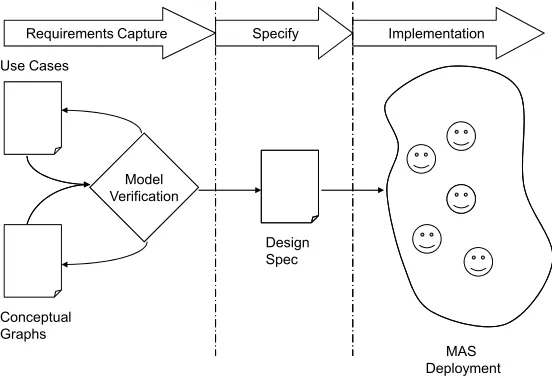
factored into design in order to usefully support business decisions. TrAM expli-cates and tests the subjective human judgement that otherwise leads to errors of omission or commission in capturing these qualitative nuances of transactions that nonetheless have significant consequences [13]. In outline, TrAM firstly cap-tures the concept of a transaction, referred to as the Transaction Model (TM), permitting high-level models including their qualitative dimensions to be rapidly constructed and evaluated during the early requirements phase [7],[8]. This pro-cess ensures that vital domain knowledge is captured and retained from the outset so it is not lost in the later phases that lead to system prototyping and implementation. Secondly, it enables the validation of the generated models in a formal manner that is based on the TM, with business scenarios expressed as rules. This process specialises the TM according to each particular business domain, thus providing a transaction pattern from which these specialisations impart a tested specification for system implementation. We envisage this sce-nario as a multi-agent system in order to reflect the dynamic world of business activity. It would furthermore be able to interoperate across business domains as they would share the generalised TM as a pattern [13]. This is aided by using a generic ontology in the form of a ‘conceptual catalogue’, as explained later. The explication and testing of transactions is underpinned by the formal rigour un-derlying CG, including a range of computing operations that can be performed with them. Indeed, prior work has identified that CG software tools, namely Amine (http://amine-platform.sourceforge.net/), enable TrAM to be developed further by automating certain key CG operations such as projection, specialisa-tion and maximal join [17]. Since it is a rich and well engineered applicaspecialisa-tion of CG theory in software, Amine also provides a model-checking environment that also assists the debugging of ontologies by identifying erroneous inconsistencies. TrAM is illustrated in Figure 1, which describes the overall stages in designing and implementing an enterprise system:
1. Initial concept analysis with UML use cases and CG; 2. Refine requirements analysis with CG and UML use cases; 3. Inference against the TM and verify;
4. Translate to an implementation design specification (e.g. UML);
5. Implementation (as a multi-agent system, MAS, or an alternative form of enterprise application).
Fig. 1.The original TrAM framework.
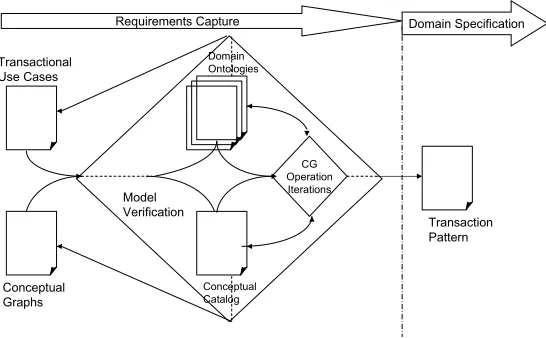
that TrAM will encourage Amine and other CG tools out of the research labs into mainstream use. An overall approach for this automated form of TrAM is as follows:
1. Conduct Transactional Use-Case (TUC) Analysis; 2. Transform into CG;
3. Create and Refine the Type Hierarchy; 4. Build the TM Ontology;
5. Include the Conceptual Catalogue;
6. Refer to the Generic Transaction Model (TM); 7. Implement the TM Pattern;
8. Test and Refine the TM with Business Rules.
2
The TrAM Automation Process
Fig. 2.TrAM, with automation.
2.1 Step 1 - Conduct Transaction Use-Case (TUC) Analysis
Fig. 3.Transactional Use-Case.
2.2 Step 2 - Transform into CG
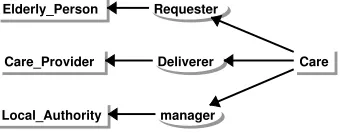
The next step is to translate the Transactional Use-Case into CG. Figure 4 provides the CG for the community healthcare exemplar. In TrAM the initial analysis with CG and TM is an iterative step leading to a refined requirements analysis, progressively refining the easily readable but comparatively informal TUC model with the rigour and formality of CG operations such as specialisa-tion. TUC analysis captures process-level tasks without unduly compromising
Requester Elderly_Person
manager
Deliverer Care
Local_Authority Care_Provider
Fig. 4.The TUC in CG.
[image:6.595.224.394.454.522.2]2.3 Step 3 - Create and Refine the Type Hierarchy
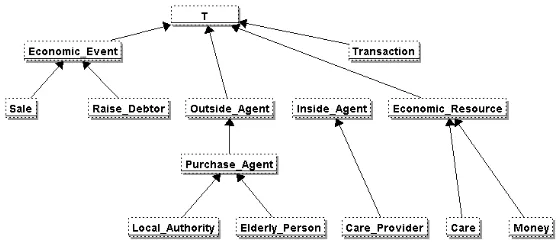
[image:7.595.168.448.314.437.2]Figure 5 illustrates the initial type hierarchy for the healthcare scenario. It is the starting point for building the ontology for this domain. Applying the TrAM process involves expanding the type hierarchy. Refinement in the type hierar-chy brings an alignment of each category in the TM domain ontology; refinement can also define a partial ordering of an ontology. A comprehensive type hierarchy also needs to capture and include relations. Types and relations are augmented by some generic ontology not specific to business transactions. It serves to re-flect business diversity by allowing the TM for one domain to interoperate with TMs of other domains according to more generic terms. As well as enabling en-terprises to discover hitherto unidentified business transactions that reflect the wider scope of their capabilities, it helps identify the TM as a design pattern [1], [3]. As indicated earlier, we refer to this generic ontology as a conceptual catalogue.
Fig. 5.Type Hierarchy for Health Care.
2.4 Step 4 - Build the TM Ontology
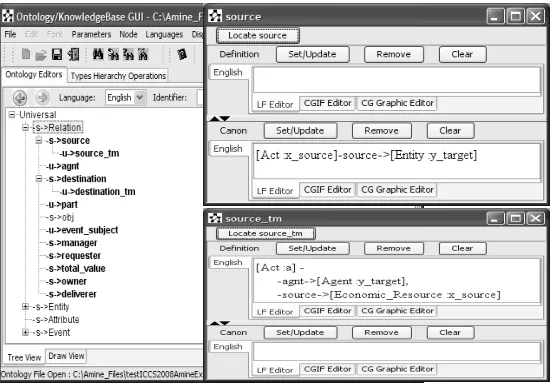
Fig. 6.Healthcare Ontology in Amine.
on them such as projection and maximal join. Amine’s Ontology layer is used in order to create, edit, query, test and subsequently specialise the TM. The more specialised the TM the more it informs about what it is attempting to model. Using Amine’s ontology layer we are therefore able to implement a refined type hierarchy, including relational types and subtypes. Building and testing a prototype TM ontology satisfies a key step in TrAM by verifying the conceptual analysis of an enterprise system.
2.5 Step 5 - Include the Conceptual Catalogue
Fig. 7.Developing a TM Conceptual Catalogue in Amine.
is a definition because it is described in terms of its super-relation source i.e. source. It exemplifies how the TM is integrated with SCC. The other examples (e.g. ‘destination’) are given elsewhere [6].
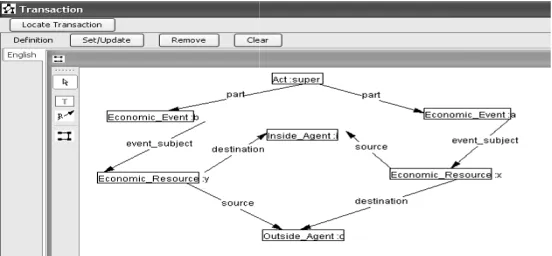
2.6 Step 6 - Refer to the Generic Transaction Model (TM)
we have identified in our transactional use-case analysis. The Inside Agent and Outside Agent refer to the parties involved with the transaction. The Inside and Outside prefix denotes the relative perspective of the transaction for each party. The braces ‘*’ denote plurality, indicating that each concept can represent a number of aggregated resources, events or agents. The TM is a formal structure of the TUC, embodying abstract concepts that can nonetheless be connected with SCC, specialised and tested across domains including by the automated processes we have described.
Transaction
Inside_Agent: {*}
Outside_Agent: {*} part
part Economic_Event: {*b}
Economic_Event: {*a}
Economic_Resource: {*d} Economic_Resource: {*c}
source destination event_subject
event_subject
[image:10.595.175.446.236.320.2]destination source
Fig. 8.The Transaction Model (TM).
2.7 Step 7 - Implement the TM Pattern
We have identified the TM new pattern in accordance with the expectations of software design and higher level patterns [1],[3]. Figure 9 illustrates the Amine implementation for the TM as a design pattern in CG. Amine enables the con-struction of an accurate implementation of the TM, developing in parallel a conceptual catalogue of conceptual relations.
[image:10.595.170.446.488.616.2]2.8 Step 8 - Test and Refine the TM with Business Rules
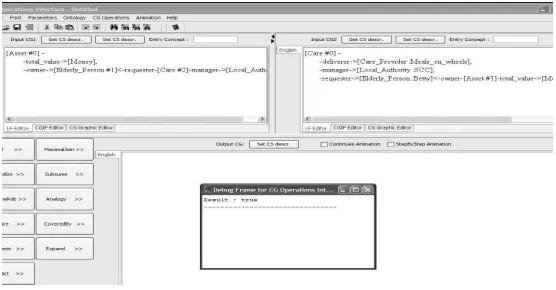
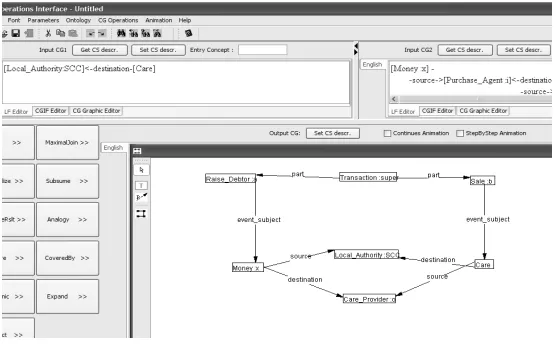
Having built and verified the TM Ontology, the next part of the automation pro-cess is to use Amine’s CGOperations interface to perform projection (subsume) and maximal join in order to implement business rules against the TM thus testing it and further specialising it. This is a stage that clearly benefits from automation. The human expert conceptualises these rules and the computer then runs the resultant structures. Previously in TrAM this was conducted manually, and certainly in our experiences most unsuccessfully. Undoubtedly therefore, automating this stage in TrAM provides the necessary refinements to the TM. It reveals design detail in type definition and canons providing further refine-ments. Figure 10 provides the CG for an example business rule in the community healthcare system. It shows that if an elderly person has assets below a certain threshold then the local authority is the destination (i.e. pays) for the care. This is described more precisely elsewhere [14]. The IF part (the antecedent) of the rule is projected (subsume in Amine) against a ‘fact’ CG that is provided and describes an actual business scenario. If it projects the THEN part of rule can undergo a Maximal Join to the TM, hence refining (specialising) it. Figure 11
IF
THEN
Local_Authority destination Care THEN
Local_Authority destination Care manager
total_value
£: @<threshold
Local_Authority
Asset: {*}
owner Elderly_Person requester Care IF
THEN
Local_Authority destination Care THEN
Local_Authority destination Care manager
total_value
£: @<threshold
Local_Authority
Asset: {*}
[image:11.595.168.447.353.489.2]owner Elderly_Person requester Care
Fig. 10.Healthcare System Business Rule.
Fig. 11.Fact to Project Rule into, in Amine.
[image:12.595.169.447.444.589.2]because projections can be made into larger graphs containing more enterprise system information. The maximal join occurs on the maximally extended pro-jection. In summary the rules part of the process is achieving inference in two
Fig. 13.Successful maximum join in operation through the TM.
steps, by projection of the IF part (antecedent) and by assertion of the THEN part (consequent).
3
Results
4
Concluding Remarks
Exploring the Transaction Pattern through the automation of TrAM provides a sound starting point for the implementation of a transaction pattern as an archi-tecture for implementing multi-agent enterprise systems. The benefit of model verification from the implementation of the TM domain ontology and a concep-tual catalogue, now permits the designer to examine the transaction model in operation. Implementation or prototyping reveals design detail in terms of CG behaviour within the TM as well as testing the proof of business rules when work-ing with the ontology. Amine allows the designer to verify the model, through the refinement of the TM ontology, editing, querying, testing and subsequently specialising the TM. Amine provides useful automation by checking type hierar-chies; however it is not easy to adjust and edit the ontology in Amine if an error is made a in the upper levels of the ontology. Whilst such issues may typify the immaturity of CG tools in general, we are of the view that applications will drive the development of CG tools. TrAM, even with this automation, thus remains in development when compared to arguably, less expressive, but more integrated UML tools.
5
Acknowledgements
This work has been assisted by Amine’s author, Adil Kabbaj. We also acknowl-edge the support of our colleague Lynne Dawson. We thank the many students whom we have taught TrAM to and reminded us of CG’s general applicability in the real world. Part of this project was in receipt of an AgentCities Deployment Grant from the European Union AgentCities.rtd Project (IST-2000-28385).
References
1. de Moor, A. (2005) Patterns for the Pragmatic Web. In Proc. Of the 13th Interna-tional Conference on Conceptual Structures (ICCS 2005), Kassel, Germany, July, 1-18,2005
2. Fowler. M. (2004) UML Distilled (Third Edition), Addison-Wesley, 103-104. 3. Gamma, E., Helm, R., Johnson, R., Vissides, J., (1994) Design patterns: Elements
of reusable object-oriented software, Addison-Wesley.
4. Geerts, G. L., McCarthy. W. E. (1991). ”Database Accounting Systems”, in Infor-mation Technology Perspectives in Accounting: an Integrated Approach, Chapman and Hall, 159-183.
5. Gruber, T.R. (1993). A Transaction Approach to Portable Ontology Specification. Knowledge Acquisition 5: p199-220
7. Hill, R. (2006). ‘Capturing and Specifying Multi-Agent Systems for the Manage-ment of Community Healthcare’ in Yoshida, H., Jain, A., Ichalkaranje, A., Jain, L.C., Ichalkaranje, N., editors, ‘Advanced Computational Intelligence Paradigms in Healthcare - 1’, Chapter 6, 127-164, Studies in Computational Intelligence, 48, Springer, Berlin.
8. Hill, R., Polovina, S., Beer, M. D. (2005) ”From concepts to agents: Towards a framework for multi-agent system modelling”, Proceedings of the Fourth Interna-tional Joint Conference on Autonomous Agents and Multiagent Systems (AAMAS), Utrecht University, Netherlands, ACM Press, 1155-1156.
9. Hrub, P., Kiehn, J., & Scheller, C. V. (2006). Model-driven design using business patterns. Berlin; New York: Springer-Verlag.
10. Jacobson, I., Christerson, M., Jonsson, P. and Overgaard, G. (1992) Object-Oriented Software Engineering. Wokingham, England: Addison-Wesley.
11. McCarthy, W. E., (1982) ”The REA Accounting Model: A Generalized Framework for Accounting Systems in a Shared Data Environment”, The Accounting Review, 554-578.
12. McCarthy, W. E., (1979) ”An Entity-Relationship View of Accounting Models”, The Accounting Review, 667-686.
13. Polovina S., Hill, R. (2009) ”A Transactions Pattern for Structuring Unstructured Corporate Information in Enterprise Applications”, International Journal of Intel-ligent Information Technologies, April-June 2009, Vol. 5, No. 2, IGI Publishing, 34-48.
14. Polovina, S., Hill, R. (2005). ”Enhancing the Initial Requirements Capture of Multi-Agent Systems through Conceptual Graph”, Proceedings of 13th Interna-tional Conference on Conceptual Structures (ICCS ’05): Conceptual Structures: Common Semantics for Sharing Knowledge, July 18-22, 2005, Kassel, Germany, Dau, F., Mugnier, M-L., Stumme, G. (Eds.); LNAI 3596, Springer, 439-452. 15. Polovina, S. (1993) ”Bridging Accounting and Business Strategic Planning Using
Conceptual Graphs”, Conceptual Structures: Theory and Implementation, Pfeiffer, Heather D; Nagle, T. (Eds.), LNAI, Springer-Verlag, Berlin, 312-321.
16. Sowa, J. F., (2000) Knowledge Representation: Logical, Philosophical, and Com-putational Foundations, Brooks Cole Publishing Co., Pacific Grove, CA.