Letter to the editor: Enhancing dietary practices, general
nutrition knowledge and body composition of a female
International Rugby Union player incorporating
smartphone application technology
CURTIS, Chris, RUSSELL, Mark and RANCHORDAS, Mayur <http://orcid.org/0000-0001-7995-9115>
Available from Sheffield Hallam University Research Archive (SHURA) at: http://shura.shu.ac.uk/18613/
This document is the author deposited version. You are advised to consult the publisher's version if you wish to cite from it.
Published version
CURTIS, Chris, RUSSELL, Mark and RANCHORDAS, Mayur (2018). Letter to the editor: Enhancing dietary practices, general nutrition knowledge and body
composition of a female International Rugby Union player incorporating smartphone application technology. Journal of Sports Medicine and Physical Fitness, 58 (3), 366-368.
Copyright and re-use policy
See http://shura.shu.ac.uk/information.html
1
Letter to the Editor: Enhancing dietary practices, general nutrition knowledge
and body composition of a female International Rugby Union player
incorporating smartphone application technology
Christopher Curtis 1, Mark Russell 2, Mayur K Ranchordas 3
1 School of Sport, Health and Applied Science, St Mary’s University, Twickenham,
United Kingdom
2
School of Social and Health Sciences, Leeds Trinity University, Leeds, United
Kingdom
3
Academy of Sport and Physical Activity, Sheffield Hallam University, Sheffield,
United Kingdom
Corresponding Author: Chris Curtis, School of Sport, Health and Applied Sciences,
St Mary’s University, Twickenham, United Kingdom
2 Dear Editor,
In clinical scenarios, patient engagement via the use of smartphone application
technology has positively impacted upon a range of quality of life measures by
improving adherence to weight loss treatments [1] and clinical dietetic practices [2].
However, despite use as a tool by sports dieticians [3], the success of nutrition
application technology within athletic populations remains unclear.
In sports where the nutritionist is employed on a part-time or consultancy basis, the
provision of nutrition education primarily occurs at live-in training camps that take
place on fewer than 10 times annually. Thus, players experience prolonged periods
of time whereby the athlete/practitioner contact is limited; a factor which may
influence the efficacy of interventions or educational programmes administered.
The use of smartphone food picture applications is becoming increasingly prevalent
for nutrition practitioners to inform dietary intake [4]. Given improved adherence and
intervention engagement following nutrition application usage in clinical populations,
we provide data comparing nutrition application usage to habitual practice (limited
contact with a performance nutritionist) in young International female Rugby Union
players in the time separating consecutive training camps (8 weeks).
After gaining institutional ethics approval, two 19-year-old female Rugby Union
players, playing in the highest tier of women’s rugby in England (English
Premiership), participated in this study and were allocated to one of two conditions.
In the 8-weeks separating consecutive training camps, one player maintained their
usual practices (which acted as the control; CONT) whereas the other athlete used a
3
interactions. Both players provided written informed consent before study
involvement.
Energy and macronutrient intake were assessed before and after the 8-week
between-camp period using a three-day food diary. Diaries required quantification of
portion size using household measures (as per reference: [5]) encompassing two
training days and one match day. Food diaries were analysed retrospectively using
dietary analysis software (Nutritics v3.06, Ireland). Nutrition knowledge of both
athletes was tested using the General Knowledge Nutrition Questionnaire (GKNQ).
Anthropometric data including height (Stadiometer, Seca, UK), body mass (Seca,
UK) and body composition (using sum of 8 skinfolds; Harpenden Skinfold Callipers,
UK) were collected in accordance with published protocols (International Society for
the Advancement of Kinanthropometry Level 1).
Following familiarisation, the player in APP photographed and provided a description
of foods and drinks consumed in the 8 weeks between training camps. These
images and descriptions were then uploaded to the applications database and were
available to view remotely by the first author (MealLogger, New York, United States).
The player received the on-going nutrition support via the application. Information
and feedback was provided by the first author on the suitability, composition and
timing of the uploaded meals/snacks in relation to the player’s daily lifestyle and
training/competition schedule.
As part of the nutrition support provided to CONT, current practices of email
correspondence and face-to-face contact with the first author during International
training camps remained in place. For context, this included an email every 2-weeks
4
A total of 161 meals (~3 meals/day) and 117 drinks were photographed and logged
by the player in APP during the 8-week intervention. Follow-up questioning
confirmed that >85% of meals consumed were captured. In APP, total energy intake
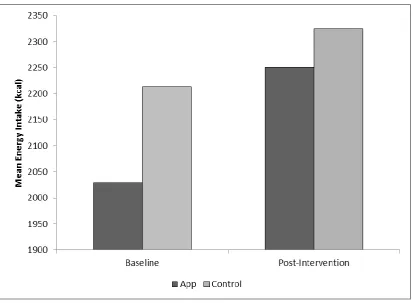
increased by 9% (mean pre, mean post: 2029 kcal.d-1, 2213 kcal.d-1; Figure 1) over
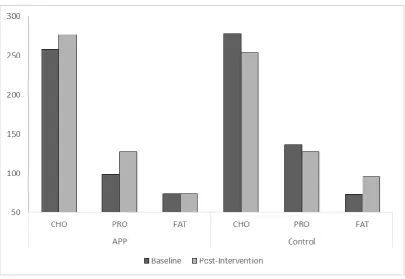
the 8 weeks. Carbohydrate intake increased by 7% (mean pre, mean post: 258 g.d-1,
277 g.d-1) whereas average protein intake increased by 29% (mean pre, mean post:
99 g.d-1, 128 g.d-1). There was no change in fat intake between baseline and
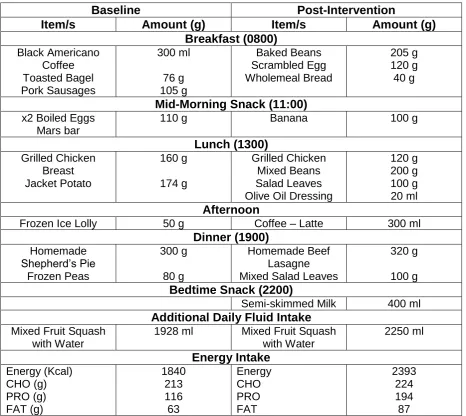
post-intervention; being, 74 g.d-1(Figure 2) Examples of daily food intake from baseline
and post-intervention can be seen in Table 1 for APP. Conversely, total average
energy intake increased by 3% in CONT (mean pre, mean post: 2251 kcal.d-1, 2325
kcal.d-1) over the 8 week period. In CONT carbohydrate intake decreased by 9%
(mean pre, mean post: 278.1 g.d-1, 254 g.d-1) whereas protein intake decreased by
6% (mean pre, mean post: 135.6 g.d-1, 127.8 g.d-1). Average fat intake increased by
23% (mean pre, mean post: 73.2 g.d-1, 95.1 g.d-1). Scores observed in the GKNQ
increased more so in APP (+8%; 61% - 69%) versus CONT (+6%; 49% - 54%)
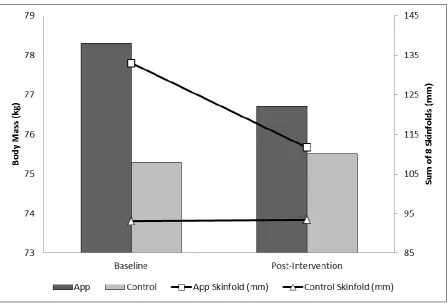
between baseline and post-intervention, respectively. Body mass in APP decreased
by 2% (78.3 kg to 76.7 kg, -1.6 kg) whereas in CONT body mass increased by 0.2%
(75.3 kg to 75.5 kg). The total sum of 8 skinfolds in APP reduced by 16% (133 mm to
111.7 mm, -21.3 mm; Figure 3) whereas in CONT skinfolds increased by 0.3% (93.1
mm to 93.4 mm, +0.3 mm). In APP, subjective comments supported the efficacy of
the technology during the intervention period. More specifically, the player strongly
agreed that they found using the nutrition application technology helpful, that the
support helped improve their nutrition knowledge, aided their thoughts around their
5
In high-level competitive female rugby players, this data provides applied evidence
supporting the efficacy of nutrition application usage alongside typical support for
improving general nutrition knowledge, dietary practices and body composition in the
time between consecutive training camps. Notably, as this study took place during
times of the season where interactions between athletes and practitioners may be
limited, the nutrition application technology facilitated a greater level of interaction
between practitioner and player. It is likely that the effect of regular information and
feedback on meal/snack suitability improved adherence to the existing nutritional
support provided during training camps.
This data is offered as an example for performance nutrition practitioners looking to
implement effective nutrition strategies to improve general nutrition knowledge and
body composition in other team sport players in applied contexts. However, we
identify some limitations to our findings; notably, although this intervention worked for
the athlete in APP, it is difficult to state whether this intervention would suit all
athletes and their lifestyles. Further research is therefore required to assess the use
of nutrition application technology in larger numbers of athletic cohorts to
substantiate our findings.
6
List of Abbreviations:
APP – Application intervention
CONT – Control
GKNQ – General Knowledge Nutrition Questionnaire
7
Declarations:
Ethics Approval and Consent to Participate:
Written informed consent was obtained from the participant, which adopted the ethics principles described by the Sheffield Hallam University Ethics Committee.
Consent for Publication:
The participants were informed of the rationale and purpose of the case study and consent for publication was obtained.
Availability of Data Material:
All data generated or analysed during this study are included in this published article
[and its supplementary information files].
Competing Interests:
The authors report no conflicts of interest within this paper.
Funding:
The authors report no funding sources of this paper.
Author Contributions:
The case study was designed by both CC & MKR, data was collected and analysed
by CC. Data interpretation and manuscript preparation was undertaken by CC, MKR
& MR. All authors involved in the case study approved the final version of the paper.
Acknowledgements:
8
References:
1. Thomas, J.G., Wing, R.R. (2013) Health-e-call, a smartphone-assisted
behavioural obesity treatment: pilot study.JMIR Mhealth Uhealth. 1(1):E3
2. Lieffers, J.R., Vance, V.A., Hanning, R.M. (2014) Use of mobile device
applications in Canadian dietetic practice.Can J Diet Pract Res. 75(1):41-7
3. Jospe, M.R., Fairbairn, K.A., Green, P., Perry. T.L. (2015) Diet App Use by
Sports Dieticians: A Survey in Five Countries.JMIR Mhealth Uhealth. 3(1):E7
4. Hongu, N., Pope, B.T., Bilgic, P., Orr, B.J., Suzuki, A., Kim, A.S., Merchant,
N.C., Roe, D.J. (2015) Usability of a smartphone food picture app for assisting
24-hour dietary recall: a pilot study.Nutr Res Pract. 9(2):207-12
5. Russell, M., Pennock, A. (2011) Dietary analysis of young professional soccer
players for 1 week during the competitive season.J Strength Cond Res.
9
Figure 1: Average energy intake (kcal) of both APP and Control at baseline
10
Figure 2: Average macronutrient intake (g) of APP and Control at baseline and
11
12
Baseline Post-Intervention
Item/s Amount (g) Item/s Amount (g) Breakfast (0800) Black Americano Coffee Toasted Bagel Pork Sausages 300 ml 76 g 105 g Baked Beans Scrambled Egg Wholemeal Bread 205 g 120 g 40 g
Mid-Morning Snack (11:00)
x2 Boiled Eggs Mars bar
110 g Banana 100 g
Lunch (1300) Grilled Chicken Breast Jacket Potato 160 g 174 g Grilled Chicken Mixed Beans Salad Leaves Olive Oil Dressing
120 g 200 g 100 g 20 ml
Afternoon
Frozen Ice Lolly 50 g Coffee – Latte 300 ml
Dinner (1900) Homemade Shepherd’s Pie Frozen Peas 300 g 80 g Homemade Beef Lasagne Mixed Salad Leaves
320 g
100 g
Bedtime Snack (2200)
Semi-skimmed Milk 400 ml
Additional Daily Fluid Intake
Mixed Fruit Squash with Water
1928 ml Mixed Fruit Squash
[image:13.595.66.533.107.523.2]with Water 2250 ml Energy Intake Energy (Kcal) CHO (g) PRO (g) FAT (g) 1840 213 116 63 Energy CHO PRO FAT 2393 224 194 87