CORRELATION BETWEEN DAMPING COEFFICIENTS AND
EXTERNALLY INJECTED CURRENTS IN OSCILLATIONS
PRODUCED BY LITHIUM IONS IN FROG SKIN
BY CARLOS ALBERTO BAPTISTA*, MARGARIDA PERESTRELLO RAMOS
Biomembranes Laboratory, Department of Plant Biology, Science Faculty, University of Lisbon, 1300 Lisbon Codex, Portugal
AND CARLOS HENRIQUES DE JESUS
Biology Centre, Gulbenkian Institute of Science, Ap. 14, 2781 Oeiras Codex, Portugal
Accepted 2 November 1987
SUMMARY
Oscillations in the electrical parameters elicited by Li+ added to the mucosal side of frog skin in vitro were studied under different experimental conditions.
The correlation between the damping coefficient and the size of the externally injected current was ascertained. The size of the overall epithelial resistance in NaCl-Ringer seems to be a good indicator of the qualitative behaviour of the skin in the presence of L i+: the higher the resistance the less probable the occurrence of oscillations.
Addition of amiloride allowed the calculation of the electromotive force in Na+ -and Li+-Ringer.
Calculations of the 'total equivalent inductance' and 'total equivalent capacitance' of an oscillating skin were made using resistance values (R), damping coefficients (a) and frequency of oscillation (to).
INTRODUCTION
Galeotti (1904) reported that the transepithelial potential difference across frog skin can only be maintained in vitro if sodium or lithium ions are present in the bathing solutions. After Ussing & Zerahn (1951) had established the equality of net sodium transport and short-circuit current, Zerahn (1955) proved that lithium ions were actively transported from the mucosa to the serosa.
* Present address: Biological Sciences Department, Columbia University, New York, NY 10027, USA.
Hashida (1922) was the first to report that lithium ions can induce quasi-periodic oscillations in the potential difference across frog skin in vitro. Takenaka (1936) found that lithium ions could elicit oscillations only when administered on the outside of the skin. The oscillations were insensitive to pH and could be stopped by certain anaesthetics.
Teorell (1954) found that oscillations could be produced with lithium concen-trations greater than 20mmol I"1 on the mucosal side, and that oscillations could be detected in the potential difference, in the short-circuit current and in the total epithelial resistance. The potential difference of the oscillations varied between (M mV and 10—20 mV and the short-circuit current between 1 and 2^Acm~ . The frequency of the oscillations was between 0-05 and 0-2 cycles min~'. Oscillations could be observed for several hours, and tended to be damped until they were extinguished. Sometimes they could be damped, disappear and then be spon-taneously reinitiated.
Finkelstein (1961) reported that, in the presence of LiCl, the injection of a pulse of electrical current could induce a short sequence of oscillations in the electrical potential of the frog skin mounted in vitro. Successive injections of current could induce new sequences of oscillations. Thellier and his coworkers have published a theoretical model and experimental data dealing with the induction of oscillations by lithium ions in frog skin in vitro (Thellier et al. 1976; Lassalles, Hartmann & Thellier, 1980; Lassalles, Hyver & Thellier, 1981). Their model postulates that macroscopic oscillations result from the synchronization of local oscillators. The main evidence supporting the model is as follows.
1. The principal variables controlling the start of oscillations are the external concentration of lithium and the internal concentration of potassium. For example, when the internal potassium concentration is raised from the normal value of 2mmoll~' to lOmmolP1 oscillations disappear without a significant change in the baseline value of the potential difference.
2. Amiloride, parachloromercuribenzoic acid and amphotericin B, which affect mucosal permeability, cause the cessation of the oscillations. Washing does not reverse the results except in the case of amiloride.
3. Fragments of the same skin can oscillate independently with different amplitudes, periods, phases and durations.
4. Two skin fragments oscillating independently can be synchronized if electrically connected by an ohmic resistance of relatively low value.
5. A skin fragment not oscillating or weakly oscillating can be made to oscillate strongly if electrically connected to a strongly oscillating skin fragment.
From this evidence it can be inferred that both the size of the electrical current externally injected and the size of the epithelial resistance are important parameters for the definition of the control limits within which oscillations occur.
MATERIALS AND METHODS
Experiments were performed on the abdominal skin of the frog Rana ridibunda. Animals of both sexes were used. In the laboratory the frogs were kept unfed, at a constant temperature of 4°C, with sufficient tap water to keep the ventral skin moist. The abdominal skin was removed from double-pithed animals and mounted in Ussing-type chambers. The skin area exposed to Ringer's solution was 3- 14cm2 and the volume of each half-chamber was 4 ml.
In all experiments Ringer's solution used on the inside chamber, NaCl-Ringer, contained (in mmoll"1): NaCl, 100; KC1, 4; CaCl2, 0-5; Tris-base, 10. The outside
Ringer's solution was either NaCl-Ringer or a solution in which NaCl was substituted by LiCl (LiCl-Ringer). Experiments were also performed without Cl~, in which case the Ringer composition was (in mmoll"1): sodium gluconate, 100; K2SO4, 2; CaSO4, 0-5; Tris-base, 10. pH was adjusted to 7-4 whenever necessary. Ringer's solutions were aerated throughout the experiments. All experiments were performed at room temperature. In all experiments the skin was first equilibrated by filling both compartments with NaCl-Ringer's solution and then left until stable electrical readings were obtained. This took about 1 h. For transepithelial potential measurements two 3 % agar—NaCl Ringer bridges connected the outer and inner solutions to a pair of calomel electrodes. For current injection two 3 % agar—NaCl Ringer bridges connected the mucosal and serosal solutions to a pair of Ag/AgCl electrodes.
Two types of electrical device were used. (1) An automatic voltage-clamp continuously short-circuited the skin. This also allowed the clamping of the skin at a different voltage ( + 5mV) every 12s by the use of a voltage pulse. (2) A manual system was used so that fixed currents could be injected. A Keithley 610C electrometer was used to record voltage measurements and an AVO-Meter 8MK5 to record current measurements. Paper recordings were obtained with a Philips dual-pen recorder.
Short-circuit current (SCC) values and the total epithelial resistance (R) were measured with the automatic voltage-clamp. When the second method was used, resistance values and transepithelial potential differences (PD) for different exper-imental conditions were measured. These were as follows. Voc, spontaneous open-circuit transepithelial potential difference. V0C1, open-open-circuit transepithelial potential difference after clamping the preparation for at least 30 min with the injection of a current equal to the short-circuit current initially measured. V], closed-circuit transepithelial potential difference with the preparation clamped at a constant current equal to the short-circuit current measured when the injection started. V2,
closed-circuit transepithelial potential difference with the preparation clamped at a constant current equal to twice the short-circuit current measured when the injection started.
Treatment of data
Results are expressed as mean values ± S.E.M. Statistical comparisons were made using Student's £-test.
RESULTS
During preliminary experiments we found that not all skins oscillated when LiCl-Ringer was added. Since some of these showed oscillations when short-circuiting was effected we decided to investigate this effect.
Fig. 1 illustrates the effect of depolarizing currents on the transepithelial potential difference in the presence of Li+. After stabilization of electrical parameters, mucosal NaCl-Ringer was substituted by LiCl-Ringer. The transepithelial potential difference was monitored under open-circuit conditions. No oscillations were observed. After about 80min an electric current was injected equal to the short-circuit current at the moment of starting the injection. This injection of fixed current was maintained for 2h, irrespective of changes in PD. The injection of this depolarizing current immediately induced oscillations in the PD. The amplitudes of the initially quasi-sinusoidal oscillations decreased with time, mainly in the second hour. This was also true for the oscillation frequency. After 2h the injection of
SCC
2 40
20
- 3 0
- 4 0
20 60 "100 160
Time (min)
220 280
current was stopped and the oscillatory nature of the transepithelial PD disappeared. Injection of a stronger depolarizing current equal to twice the SCC at the moment of starting the injection produced oscillations in the PD. These oscillations were much more damped and were observed for only 20min, compared with 2h.
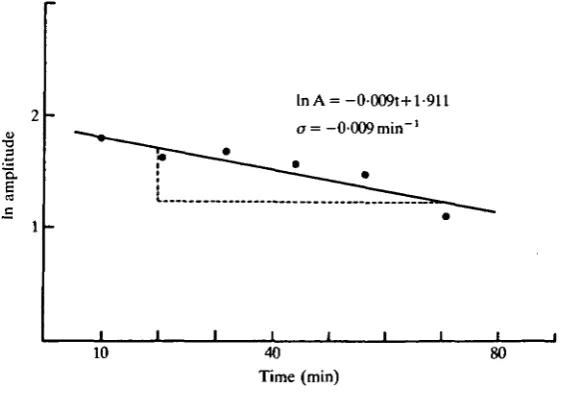
To clarify the nature of the damping time constant (a), the amplitude values (A) of the damping oscillations were plotted against time (Fig. 2). Here the power of the logarithmic term is dimensionless. Since AQ cannot be determined and it does not change the slope, we have used only experimentally determined values of A. In the experiment shown in Fig. 2, the regression line relating the natural logarithm of the amplitudes to the time values of their progression showed that o= — 0-009 min"1.
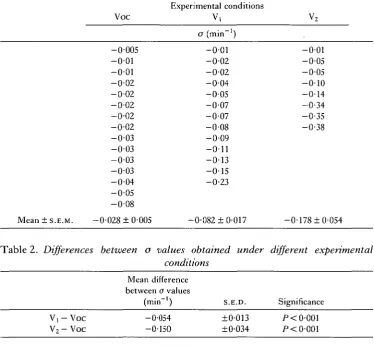
Data from all experiments where damped oscillations were obtained were subjected to regression analysis. Table 1 summarizes o values for Voc, Vi and V2
conditions (see Materials and Methods). Tables 2 and 3 show the average o values obtained under different experimental conditions and comparisons between values using Z-tests. Table 2 shows the differences in a values between Vj and Voc and between V2 and Voc. Table 3 shows the differences in o values between V0C1 and Voc. a values in VoCj conditions were obtained from preparations which oscillated in Voc and/or in VOC]. These results show clearly that the injection of an electric current changes the ionic profiles of the preparation, which in turn are reflected in the increased values of the damping coefficients.
Another parameter studied was the change of oscillation frequency with time. Results obtained for the damped oscillations under the different experimental conditions showed a tendency for higher frequencies to be observed when higher depolarizing currents were injected, with smaller frequencies under open-circuit conditions. Frequencies appeared to decrease with time under all experimental
•o
3
"5.
lnA = -0009t+l-911 a=-0009min"1
10 40
Time (min)
[image:5.451.86.367.410.606.2]80
conditions. However, in no case were differences statistically significant. Average frequencies (co) were centred around (MO cycles min~ .
Our results showed a correlation between the induction of oscillations and the size of the injected current. Since we could not obtain oscillations in some experiments,
Table 1. Values of ofor experiments where damped oscillations were obtained
Experimental conditions
VOC V, V2
a (min"1)
-0-01 -0-05 -0-05 - 0 - 1 0 - 0 - 1 4 - 0 - 3 4 - 0 - 3 5 - 0 - 3 8 0-005 0-01 0-01 0-02 0-02 0-02 0-02 0-02 0-03 0-03 0-03 0-03 0-04 0-05 0-08
- 0 0 1 - 0 0 2 - 0 0 2 -0-04 - 0 0 5 -0-07 -0-07 -0-08 - 0 0 9 - 0 1 1 -0-13 - 0 1 5 -0-23
[image:6.451.39.414.156.505.2]Mean ± S.E.M. -0-028 ±0-005 -0-082 ±0-017 -0-178 ±0-054
Table 2. Differences between a values obtained under different experimental
conditions
Table 3
Voc, Voc Voc, - Voc
V, - Voc V2 - Voc
Mean difference between a values
(min"1)
-0-054 -0150 S.E.D. ±0-013 ±0-034 Significance P<0-001 P < 0 0 0 1
. Differences between a values obtained under open-circuit conditions
Mean values of a (min~')
-0-052 - 0 0 2 8
S.E.M. iV 0007 (17) 0005 (15)
Mean difference between a values
(min"1)
-0024
S.E.D. Significance
±0006 />< 0-001
a values in the Voc, condition were obtained from preparations which oscillated in Voc and/or
in V'OC,.
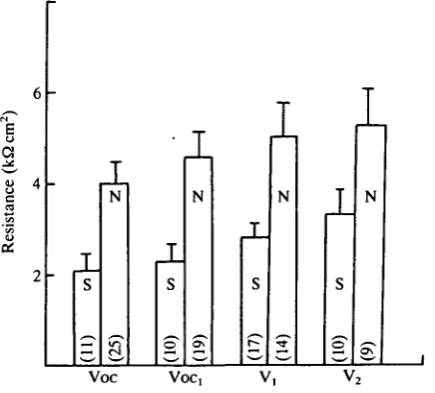
we re-analysed all experimental data. We looked at the total resistance of the epithelia in NaCl-Ringer at the start of the experiment for all experimental conditions. Fig. 3 gives the mean values of the initial total epithelial resistance in NaCl-Ringer. Preparations which did (S) or did not (N) oscillate after the addition of LiCl-Ringer are indicated. Fig. 3 shows that for each experimental condition the mean resistance of the skins in which PD oscillated in the presence of LiCl was significantly lower than that of the skins where oscillations were not observed. For example, considering Voc, the mean total resistance when oscillations were observed was 2-1 ± 0-4kQcm2 (iV =11) whereas it was 4-0 ± 0-5 kQcm2 (N = 25) for the skins that did not show PD
oscillations. Above 3-3 ±0-5 kQcm2 no skin oscillated in any of our experimental conditions. These results show that induction of the oscillations depends on the total epithelial resistance.
To assess how the partial conductances of the participating ions contributed to this correlation, we carried out experiments where Cl~ was substituted by gluconate. Fig. 4 shows that the relatively high (approx. 40 %) partial chloride conductance did not change appreciably with different values of total resistance.
The effect of amiloride (10~4moll~') on the SCC and total epithelial resistance in NaCl- or LiCl-Ringer's solutions was also studied. The results obtained in one representative experiment are shown in Fig. 5. An automatic voltage pulse ( + 5 mV) was imposed every 12 s so that total tissue resistance could be continuously followed by measuring current deflections. When the electrical parameters were stable in NaCl-Ringer, amiloride was added on the mucosal side. SCC was rapidly reduced
i
a
T
s
(25
)
_L
s
©
1
N
T
s
J
N
T
s
o
I
N
[image:7.451.119.337.375.571.2]Voc Voc, V,
0-4
0-3
<*>
0-2
0 1
-, = 1-43GCI+O11
0-1 0-2
GCi
0-3
Fig. 4. Total epithelial conductance (Gt) as a function of chloride conductance ( G Q ) .
15
-1.0
Amiloride
-i^—
i \ i
Wash
/
1:
Wash
1
J
Wash | LiCI
1
\
i l i
Amiloride \
>— i V
Wash \
/ 100 160
Time (min)
• ' •/ 240
from 13-5^Acm~2 to values near zero. Total tissue resistance also rapidly increased (from 1850 Qcm2 to 2620 Qcm2). After washing, SCC and total resistance values of ll-2juAcm~ and 1860 Qcm2, respectively, were measured, indicating that the preparation recovered reasonably well from the addition of amiloride. Mucosal NaCl-Ringer was then replaced by LiCl-Ringer. This resulted in a partial inhibition of the SCC (from 10-3 to 3fiAcm~2) and an increase of the total tissue resistance
(from 1860 to 2143 Qcm2). A further addition of amiloride on the mucosal side resulted in a rapid and complete inhibition of the remaining SCC and an increase in the total tissue resistance (from 2143 to 3000 Qcm ). Both effects were reversed by washing.
Table 4 gives the ratios between the amiloride-insensitive conductance in LiCl-Ringer and in NaCl-LiCl-Ringer for individual experiments. The results were obtained from experiments identical to that shown in Fig. 5. The mean value of the ratio was 0-90 ±0-10 {N=i), suggesting that the effect of amiloride in the transporting system is the same in both NaCl- and LiCl-Ringer.
In Fig. 6 the difference between SCC values before and after amiloride addition have been plotted against the corresponding variations in total tissue conductance. The slopes of the regression lines obtained provide the frog skin 'electromotive force' in NaCl-Ringer (circles) or LiCl-Ringer (stars). As the results show, the electromo-tive force in NaCl-Ringer was about 119mV whereas in LiCl-Ringer it dropped to near 32 mV.
Fig. 7 shows the correlation between values of injected current (abscissa) and the calculated time constants (a) (ordinate) for observed oscillations. The injected currents were always once or twice the SCC value measured at the start of the injection for each experiment, o values were graphically determined as shown in Fig. 2. As Fig. 7 shows, the higher the injected depolarizing current the stronger the damping effect observed. This correlation will be considered further in the discussion of the proposed model.
Table 4. Ratios between the amiloride-insensitive conductance in the presence of
LiCl and the amiloride-insensitive conductance in the presence of NaCl
Amiloride-insensitive conductance (mScm~2)
LiCl-Ringer NaCl-Ringer Guci/GNaci 121
103 0-79 0-85 0-63
Mean±s.E.M. 0 9 0 ± 0 1 0 Values were obtained from experiments identical to the one shown in Fig. 5. Guci. conductance in LiCl; G\aci, conductance in NaCl.
Amiloride was present at 10~4moll~'. 0086
0-213 0-300 0075 0090
DISCUSSION
When we started our preliminary experiments we were puzzled by the fact that not all preparations in open-circuit conditions responded with oscillatory behaviour to
100
-%
1 6 0
20
ASCCNa = 119-46AG.-0-26, /•= 0-99
ASCCLi = 32-28AG.-0-28, r = 0-58
0 1 041 0-7
AG, (mScm~2)
1 0
Fig. 6. Determination of the frog skin 'electromotive force' in the presence of NaCl or LiCl. The figure shows the linear relationship between the variation of the short-circuit current (ASCC) and the variation of the total conductance (AG,) due to the addition of amiloride (10~4 mol 1~') to the mucosal side. Circles are values in NaCl-Ringer; stars are
values in LiCl-Ringer. Electromotive force in NaCl = 119-46 mV; electromotive force in LiCl = 32-28 mV.
010
0
-0-20
— Cl.Aft
• 10 • • • 1 • 1 • • •
XA
• • •
•
-20 i
•
•
•
30
i i
•
• •
A cm"2)
40
•
the mucosal addition of lithium ions. In some of these experiments, however, the change to a short-circuit condition resulted in the appearance of oscillations. We decided to study systematically the effect of externally injected currents on the production of oscillations brought about by lithium ions. Fig. 1 illustrates the results for a single experiment, and in Fig. 3 we summarize the general pattern of behaviour. Although our initial puzzlement was somewhat reduced, in some preparations we could not elicit oscillations even in the presence of injected currents.
During the experiments shown in Fig. 1 there appeared to be a correlation between the level of injected current and the damping velocity of the induced oscillations. To investigate whether this relationship could be substantiated we determined values of the time constant of damping for all oscillations showing it (o < 0) in our experimental conditions. The method of determination of o is shown in Fig. 2, in which we have constructed a linear transformation of the evolving exponential of damping. Table 1 summarizes the results obtained in conditions Voc, Vj and V2.
There was a significant relationship between the value of the time constant and the size of the injected current (Table 2). Injection of stronger depolarizing currents produced higher damping a values.
Since measurements of a values in two of our experimental conditions (V; and V2) were obtained under closed-circuit conditions, the relationship supports the findings of Thellier et al. (1976) and Lassalles et al. (1980, 1981) that an externally injected current can synchronize local oscillators. To see if a synchronization effect could be obtained solely by a modification of the ionic concentration profile of the compart-ments involved we measured o values under open-circuit conditions after the injection for at least 30 min of a current equal in size to the short-circuit current at the start of the injection (VOC)). Results are given in Table 3 and indicate a statistically significant difference between o values before and after the injection of current. These results support the well-established view (Koefoed-Johnsen & Ussing, 1958; Ussing, 1960) that the sodium and lithium permeabilities of the mucosal barrier are higher than those of the serosal ones.
As indicated earlier, we recorded 'positive' and 'negative' results for observable oscillations. Externally injected currents could in some cases produce oscillations in preparations starting with 'negative' results. To examine this, we assessed the results for a single parameter, the total initial NaCl-Ringer transepithelial resistance. Irrespective of the effect of different levels of injected current, no skin was seen to oscillate at a resistance above about 3-3kQcm2 (Fig. 3).
E
£
50sa 40
30
20
LiCl
20 40 60 80 100 120 Time (min)
140 160 180 200 220
Fig. 8. Spontaneous oscillation of transepithelial potential difference after the addition of LiCl, showing a phase of oscillations of increasing amplitude followed by an endogenously controlled phase with damping.
Short-circuit current differences measured at the same time are shown in Fig. 6, based upon a small number of experimental points, from which we can approxi-mately calculate the electromotive force for sodium and lithium ions. We could not, however, tell whether this difference in electromotive forces indicates different efficiencies for the same pump or the existence of two different pumps. Nevertheless, in either case we can conclude that the effect of amiloride on the mucosal side is to impair the active transport of both sodium and lithium. Kristensen (1983) and Larsen & Rasmussen (1985) have shown that amiloride also affects chloride conductance. Although the experiments we carried out used short-circuit conditions, where the contribution of Cl~ conductance was smaller, a comparison may still be made although the values may be overestimated.
These results will be useful in future model computations. The model of Lassalles
et al. (1981) is based on classical descriptions from the theory of oscillations, whereas
the model of Lew, Ferreira & Moura (1979) deals directly with the transport parameters. Computer results using the first model generate oscillations, where the chosen operational parameters relating mucosal and serosal compartments are dimensionless. The second model is based upon a set of formal equations whose parameters are directly related to the epithelial behaviour, but does not consider oscillating patterns. A synthesis of both models would prove very helpful. As a step towards this we have constructed Fig. 7, in which the value of the current injected and the determined values of the time constants are plotted for all oscillations. This allows us to calculate the relationship between a classical oscillation parameter (the time constant) and an epithelial oscillation parameter (the externally injected current). The correlation coefficient obtained was 0-62, N = 39; P < 0-0 1 .
values of R = 2380 Qcm2, co = 0-106 cycles min"1, a= —0-03 min"1, total equivalent inductance = 2-38X106Hcm"2 and total equivalent capacitance = 3400//Fcm"2.
During our experiments we did not always obtain quasi-sinusoidal and damped oscillations although we considered only these for the presented data. Oscillations with increasing amplitudes (<7>0) were occasionally observed. In Fig. 8 we show data from an experiment in which, after the addition of LiCl-Ringer to the mucosal solution, the skin began to oscillate with increasing amplitude and subsequently entered a control phase with damping. The analogue of RLC series network behaviour, mathematically imposes for the first phase (CT>0) either a negative
resistance or a negative inductance, which is biologically absurd. For a complete mathematical description of the results depicted in Fig. 8 we may need to use formulations derived from the 'equations to the differences' (May, 1976) or more complex and linked second-order differential equations.
We would like to thank Dr Maria da Graga Emilio, Professor Campos Rosado, Professor Fernando Catarino and Dr Kelo Correia da Silva, for their helpful comments and revision of the manuscript.
REFERENCES
FlNKELSTElN, A. (1961). Lithium-induced oscillations of potential and resistance in isolated frog
skm.J.gen. Physiol. 44, 1165-1176.
GALEOTTI, G. (1904). Uber die elektromotorischen Krafte, welche an der Oberflache trierischer Membranen bei der Beriihrung mit verschiedenen Elektrolyten zustande kommen. Z. phys.
chem. 49, 542-562.
HASHIDA, K. (1922). Untersuchungen uber das electromotorische Verhalten der Froschhaut.
J. Biochem., Tokyo 1, 21-67.
KOEFOED-JOHNSEN, K. & USSING, H. H. (1958). The nature of the frog skin potential. Ada
physiol. scand. 42, 298-308.
KRISTENSEN, P. (1983). Exchange diffusion, electrodiffusion and rectification in the chloride transport pathway of frog skin._7. Membr. Biol. 72, 141-151.
LARSEN, E. H. & RASMUSSEN, B. E. (1985). A mathematical model of amphibian skin epithelium with two types of transporting cellular units. Pfliigers Arch. ges. Physiol. 405 (Suppl. 1), S50-S58.
LASSALLES, J. P., HARTMANN, A. & THELLIER, M. (1980). Oscillation of the electric potential of frog skin under the effect of L i+: Experimental approach. J. Membr. Biol. 56, 107-119. LASSALLES, J. P., HYVER, C. & THELLIER, M. (1981). Oscillation of the electrical potential of the
frog skin under the effect of L i+: Theoretical formulation. Biophys. Chem. 14, 65-80.
LEW, V. L., FERREIRA, H. G. & MOURA, T . (1979). The behaviour of transporting epithelial cells. I. Computer analysis of a basic model. Proc. R. Soc. Ser. B 206, 53-83.
MAY, R. M. (1976). Simple mathematical models with very complicated dynamics. Nature, Loud. 261, 459.
TAKENAKA, S. (1936). Studies on the quasi periodic oscillations of the electrical potential of frog's
skin. Jap. J. med. Sci. III. Biophys. 4, 143.
TEORELL, T . (1954). Rhythmical potential and impedance variations in isolated frog skin induced by lithium ions. Ada physiol. scand. 31, 268-284.
THELLIER, M., LASSALLES, J. P., STELZ, T . , HARTMANN, A. & AYADI, A. (1976). Oscillations de potentiel et de courant electriques transepitheliaux sous l'effet du lithium. C. R. hebd. Seanc.
USSING, H. H. (1960). The frog skin potential. J. gen. Physiol. 43, 135-147.
UssiNG, H. H. &ZERAHN, K. (1951). Active transport of sodium as the source of electric current in the short-circuited isolated frog skin. Ada physiol. scand. 23, 110-127.
ZERAHN, K. (1955). Studies on the active transport of lithium in the isolated frog skin. Ada