Timothy W. Storer
A Thesis Submitted for the Degree of PhD at the
University of St. Andrews
2007
Full metadata for this item is available in Research@StAndrews:FullText
at:
http://research-repository.st-andrews.ac.uk/
Please use this identifier to cite or link to this item:
http://hdl.handle.net/10023/223
This item is protected by original copyright
Remote Electronic Voting
A thesis to be submitted to the
UNIVERSITY OF ST ANDREWS
for the degree of
DOCTOR OF PHILOSOPHY
by
Timothy W. Storer
School of Computer Science University of St Andrews
of the elector should be affixed to the paper at a
public polling-place, or if there be no such place
conveniently accessible, at some office open to all
the world, and in the presence of a responsible
public officer. The proposal which has been thrown
out of allowing the voting papers to be filled up at
the voter’s own residence, and sent by the post, or
called for by a public officer, I should regard as
fatal. The act would be done in the absence of the
salutary and the presence of all the pernicious
influences. The briber might, in the shelter of
privacy, behold with his own eyes his bargain
fulfilled, and the intimidator could see the extorted
obedience rendered irrevocably on the spot.
This thesis describes the design of a novel class of pollsterless voting schemes. Many cryptographic voting schemes necessitate a pollster because the client side computations are beyond the understanding or ability of the voter. Such interactions require that the voter trust the software to perform operations on their behalf, and in effect, the pollster acts as the voter. Conversely, the pollsterless schemes presented here permit voters to interact with an election authority directly, without complex computations. Pollsterless schemes have the additional advantage of permitting voting on virtually any networked device, increasing the potential mobility of voting.
it has not been submitted in any previous application for a higher degree.
date signature of candidate
I was admitted as a research student in September 2002 and as a candidate for the degree of Doctor of Philosophy in September 2003; the higher study for which this is a record was carried out in the University of St Andrews between 2002 and 2006.
date signature of candidate
I hereby certify that the candidate has fulfilled the conditions of the Resolution and Regu-lations appropriate for the degree of Doctor of Philosophy in the University of St Andrews and that the candidate is qualified to submit this thesis in application for that degree.
date signature of supervisor
In submitting this thesis to the University of St. Andrews I understand that I am giving permission for it to be made available for use in accordance with the regulations of the University Library for the time being in force, subject to any copyright vested in the work not being affected thereby. I also understand that the title and abstract will be published, and that a copy of the work may be made and supplied to any bona fide library or research worker.
This thesis, and the work it describes, would never have been completed without the support of many others.
Those who have provided academic guidance during the course of this project include my initial supervisor, Ursula Martin, who provided much early input; Pam Briggs and Linda Little at the PACT Laboratory at Northumbria University; and James McKinna within the School. In addition, the work was generously funded by Microsoft Research, and later by ESRC.
Many members of the School played a part in ensuring that this thesis was completed and submitted on time. I thank in particular Graeme Bell, James McKinna and Tom Kelsey, who gave their time to read the final drafts and/or provided practice for the oral defence. Thanks also to my friends in the School who contributed by simply making another four years as a student so worthwhile; and to my parents for not asking too often whether I would be getting a job soon.
My supervisor, Ishbel Duncan, deserves special thanks for her constant support over four years, ensuring that the work was completed. Ishbel proved an endless source of advice, ideas, encouragement and (most importantly) candid criticism.
Tim Storer and Ishbel Duncan. Polsterless remote electronic voting.
Journal of E–Government, 1(1):75–103, October 2004.
Tim Storer and Ishbel Duncan.
Practical remote electronic elections for the UK.
In Stephen Marsh, editor, Privacy, Security and Trust 2004 Proceedings of the Second
An-nual Conference on Privacy, Security and Trust, pages 41–45, Fredericton, New Brunswick,
Canada, October 2004. National Research Council Canada, University of New Brunswick.
Tim Storer and Ishbel Duncan.
Modelling context for the design of remote electronic voting schemes.
In Pedro Isa´ıas, Piet Kommers, and Maggie Macpherson, editors, IADIS International
Con-ference e-Society 2004, volume 2, pages 1001–1004, Avila, Spain., July 2004. IADIS
Press.
Tim Storer and Ishbel Duncan.
Two variations of the mCESG pollsterless e-voting scheme.
In Randal Bilof, editor, COMPSAC 05 The 29th Annual International Computer Software
& Applications Conference, pages 425–430, Edinburgh, Scotland, July 2005. IEEE
List of Figures vi
List of Tables viii
1 Introduction 1
1.1 Remote Electronic Voting in Computer Science . . . 1
1.2 Thesis Hypothesis . . . 2
1.3 Major Contributions . . . 3
1.4 Organisation of Thesis . . . 3
2 Voting and Technology 5 2.1 Voting and Automation . . . 6
2.2 Voting Framework . . . 10
2.3 Voting Contexts . . . 15
2.3.1 Classification of Voting Contexts . . . 15
2.3.2 Instances of Voting Contexts . . . 33
2.3.3 Summary: Voting Context Diversity . . . 37
2.4 Requirements and Standards . . . 37
2.4.1 Voluntary Voting System Guidelines . . . 37
2.4.2 Common Criteria . . . 42
2.4.3 CESG Security Study (UK) . . . 44
2.4.4 Summary . . . 46
2.5 Voting Schemes . . . 47
2.5.1 Mix – Nets . . . 48
2.5.2 Homomorphic Schemes . . . 49
2.5.3 Blind Signature Schemes . . . 50
2.5.4 Hybrid Schemes . . . 53
2.5.5 RIES . . . 62
2.5.6 Summary of Voting Schemes . . . 63
2.6 Voting Systems and Technologies . . . 63
2.6.1 Ballots and Boxes . . . 64
2.6.2 Postal or Mail in Paper Ballots . . . 66
2.6.3 Lever Machines . . . 66
2.6.4 Punch Card/Optical Scan . . . 67
2.6.5 Direct Recording Electronic Machines (DREs) . . . 68
2.6.6 Remote Electronic Voting Systems . . . 71
2.6.7 Summary of Voting Systems and Technologies . . . 73
2.7 Conclusions . . . 73
3 Requirements for UK Public Elections 75 3.1 Introduction . . . 75
3.2 Convenience Requirements . . . 77
3.3 Electoral System . . . 79
3.3.1 Unordered Selection of Options . . . 80
3.3.2 Ordered Selection of Options . . . 81
3.3.3 Mixed Member . . . 81
3.4 Secrecy Requirements . . . 82
3.4.1 Threat Model . . . 82
3.4.2 Voter Privacy . . . 83
3.4.3 Tally Secrecy . . . 84
3.5 Accuracy Requirements . . . 84
3.6 Summary of UK Requirements . . . 86
4.1 Properties of Pollsterless Schemes . . . 89
4.2 Malkhi et al’s Scheme . . . 93
4.2.1 Initiation . . . 94
4.2.2 Pre-Voting Verification . . . 94
4.2.3 Voting and Tallying . . . 94
4.2.4 Comment . . . 96
4.3 The CESG Study Scheme . . . 96
4.3.1 Voting Credentials . . . 97
4.3.2 Vote Casting . . . 99
4.3.3 Election System Architecture . . . 99
4.3.4 Discussion . . . 101
4.3.5 Local Authority Pilots . . . 105
4.4 Conclusions . . . 105
5 The mCESG Pollsterless Remote Electronic Voting Scheme 107 5.1 Introduction . . . 108
5.2 Formalisation . . . 108
5.2.1 Notation . . . 109
5.2.2 Initiation . . . 109
5.2.3 Vote Casting . . . 113
5.2.4 Tallying . . . 115
5.2.5 Summary of Formalisation . . . 117
5.3 Vote Verification . . . 117
5.3.1 Motivation . . . 117
5.3.2 The Publisher . . . 118
5.3.3 Verifying a Vote . . . 119
5.4 Revised Architecture . . . 121
5.4.1 Initiation . . . 123
5.4.2 Voting andridChecking . . . 127
5.5 Adaptations . . . 129
5.5.1 Multi-member Electoral Systems . . . 129
5.5.2 Ordinal Electoral Systems . . . 132
5.5.3 Two Step Vote Casting . . . 134
5.5.4 Receipt Free Scheme 1 . . . 136
5.5.5 Polling Station Scheme . . . 140
5.5.6 Receipt Free Scheme 2 . . . 142
5.6 Conclusions . . . 149
6 Evaluation of the mCESG Scheme 150 6.1 Introduction . . . 150
6.2 Prototype mCESG Scheme Implementation . . . 151
6.2.1 Election Authority Implementation . . . 152
6.2.2 Provision of Available Voting Channels . . . 153
6.2.3 Credential Generation and Delivery Format . . . 154
6.2.4 Bulletin Board . . . 156
6.2.5 Hardware Configuration . . . 157
6.3 Requirements Analysis . . . 158
6.4 User Acceptance Study . . . 162
6.4.1 Motivation . . . 162
6.4.2 Demonstration . . . 164
6.4.3 Study Design . . . 165
6.4.4 Results . . . 166
6.4.5 Summary . . . 170
6.5 Threat Analysis . . . 170
6.5.1 Domain Collusion Analysis . . . 170
6.5.2 Denial of Service . . . 173
6.5.3 Voting Channels . . . 174
6.5.4 Credential Delivery . . . 175
6.6 Summary . . . 176
7 Future Research Directions 177 7.1 Introduction . . . 177
7.2 Further Adaptations to the mCESG Scheme and Implementation . . . 178
7.2.1 Distributed Bulletin Board . . . 179
7.2.2 Distributed Domain Implementation . . . 180
7.2.3 Distributed Election Scheme . . . 183
7.3 Pilot Elections . . . 184
7.3.1 Research Questions . . . 185
7.3.2 Target Context . . . 187
7.4 Summary of Future Work . . . 188
8 Conclusions 190 8.1 Review of Chapters . . . 190
8.2 Assessment of Contribution . . . 192
8.3 Review of Hypothesis . . . 193
8.4 Concluding Remark: The Importance of Context . . . 194
Bibliography 195
Glossary 210
2.1 Voting framework . . . 12
2.2 Ballot paper representations of votes for sample electoral systems . . . 18
2.3 Accuracy requirements for a voting context . . . 26
2.4 Vote signature attack on ordinal electoral systems . . . 29
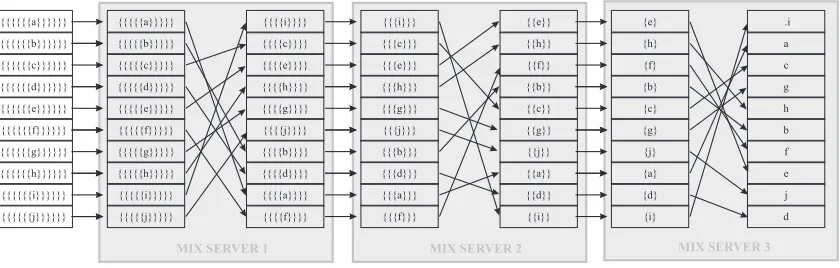
2.5 Mix-net anonymous channel architecture . . . 49
2.6 Blind signature voting scheme . . . 52
2.7 Hybrid voting schemes . . . 55
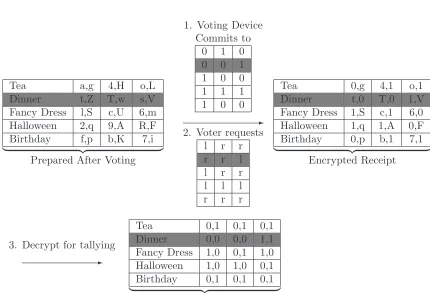
2.8 The Chaum scheme two layer ballot paper . . . 56
2.9 The Prˆet `a Voter scheme ballot paper . . . 59
2.10 The VoteHere scheme ballot paper . . . 61
2.11 Examples of Direct Recording Electronic voting machines . . . 71
4.1 Pollster and pollsterless electronic voting schemes . . . 90
4.2 Initiation, pre-voting verification and voting phases of the Malkhi et al poll-sterless scheme . . . 95
4.3 CESG voting scheme credentials . . . 98
4.4 CESG Election System . . . 100
5.1 Initiation phase of the CESG Scheme . . . 112
5.2 The voting phase of the CESG scheme . . . 114
5.3 Tallying phase of the CESG scheme . . . 116
5.4 The mCESG secure bulletin board . . . 120
5.5 The distributed domains of the mCESG Election Authority . . . 122
5.6 Initiation phase of the mCESG scheme . . . 124
5.7 The completed mCESG voting credentials . . . 126
5.8 Voting and checking phase of the mCESG scheme . . . 128
5.9 Tallying phase of the mCESG scheme . . . 130
5.10 mCESG scheme voting credentials for the MMSP electoral system adapta-tion . . . 132
5.11 mCESG scheme voting credentials for the ordinal electoral system adapta-tion . . . 133
5.12 The two step adaptation of the mCESG scheme . . . 135
5.13 Receipt free adaptation of the mCESG voting credentials. . . 137
5.14 Voting phases of the partially receipt free mCESG scheme. . . 138
5.15 Polling station adaptation of the mCESG scheme . . . 141
5.16 Voting credentials of the cut and choose receipt free adaptation of the mCESG scheme . . . 144
5.17 Initiation phase of the cut and choose mCESG scheme adaptation . . . 145
5.18 State of the bulletin board after vote casting in the cut and choose adapta-tion of the mCESG scheme . . . 147
5.19 State of the bulletin board after vote checking in the cut and choose adap-tation of the mCESG scheme . . . 148
5.20 Tallying phase of the cut and choose adaptation to the mCESG scheme . . . 149
6.1 Gateway and Vendor domain interaction of the prototype mCESG system . 153 6.2 Secure stationary mock-up of the mCESG voting credentials . . . 155
6.3 mCESG prototype implementation bulletin board . . . 156
2.1 Common Criteria Evaluation Assurance Levels . . . 43
2.2 Voting technology classifications . . . 64
6.1 Results of the mCESG user acceptance study . . . 168
6.2 mCESG scheme collusion analysis. . . 172
Introduction
Overview
This chapter describes the motivation for this thesis and formulates the hypothesis that for a remote electronic voting systems to be deployed in the UK, a remote voting scheme must be designed with respect to the particular requirements of the UK’s specific context. The chapter concludes by describing the structure of this thesis.
1.1
Remote Electronic Voting in Computer Science
In recent years, voting systems have become a highly politicised and controversial topic for computer scientists and other researchers [34], with many raising the prospect of the accuracy of public elections being violated by the use of electronic technologies [57, 91]. Electronic voting systems have even been used to direct discussion on the risk of interaction between digital technologies and society in university courses [4]. Yet the ‘automation of honesty’ which is embodied in the topic of electronic voting has a long history stretching back to the ancient Greeks [13]. More recently, the introduction of networked voting tech-nologies has raised the prospect of voters participating in elections remotely without the
need to attend a polling station. Remote electronic voting has been proposed as a means of improving the experience of voting through increased convenience, improved accuracy in recording voter intentions and improving equality of access to a voting system across a broad spectrum of voter capabilities [3]. In the UK, the government was until recently con-ducting pilots of remote electronic voting, as a possible mechanism for increasing turnout [41, 42]. In addition, electronic voting systems, both remote and supervised, are used in a wide variety of contexts, generally without controversy.
This thesis places a novel class of remote voting schemes within a framework for voting systems as a whole. The thesis describes a new class of pollsterless remote voting schemes. A prototype implementation of the scheme is then described and evaluated with respect to the specific requirements of the UK public election context. The results of the evaluation will be used to argue that pollsterless schemes are particularly suited for the UK context.
1.2
Thesis Hypothesis
1.3
Major Contributions
The major contributions of the work are as follows:
• A novel class of remote pollsterless remote electronic voting schemes, mCESG.
• An investigation of the requirements for new voting systems specific to the UK public context.
• A demonstrable implementation of the mCESG scheme as a prototype system to
support a range of requirements (and therefore contexts).
• An evaluation of the mCESG class of schemes and the prototype system with respect
to the requirements for alternative voting systems in the United Kingdom context.
• A novel evaluation of the user acceptance aspects of the mCESG prototype imple-mentation using focus group observation of video-taped scenarios.
• A survey of the existing research efforts into voting systems, structured as a
hierar-chical framework.
• A discussion of potential future expansions of the work presented in this thesis,
no-tably the prospect of further adaptations to the basic mCESG scheme and prospects for conducting pilots of the prototype system within a research agenda.
1.4
Organisation of Thesis
Chapter 4 reviews the properties of pollsterless remote voting schemes and describes two previously proposed pollsterless schemes. Chapter 5 describes a new pollsterless remote voting scheme, together with a variety of useful properties for the UK voting context. Sev-eral adaptations to the basic scheme are described to illustrate the flexibility of the mCESG scheme. The adaptations demonstrate that mCESG is a class of novel voting schemes. Chapter 6 describes several evaluations of the mCESG scheme with respect to UK require-ments, including a user acceptance study and a threat analysis.
Voting and Technology
How hard is it to count ballots? Harder than you think. Well, maybe not
harder than you all think, but harder than a lot of the electorate thinks.
– Jim Adler
Overview
This chapter introduces the history of the association between technology and voting. A framework is presented for collating the various research efforts into voting systems as a hierarchical model of:
• the voting contexts which describe the circumstances and motivation in which a vote
is conducted.
• the requirements and standards which are specified for a voting system to be used in
a given context, imposing constraints on the release of information from an election, for example.
• the voting schemes which provide an abstract description of a voting system that will
achieve the desired properties specified by a voting context’s requirements.
• the collection of participants, technologies, media and processes which are employed
to implement a particular scheme as a voting system.
A survey of the research efforts at each of the levels of the framework is then conducted. The survey illustrates the validity of the proposed framework with respect to existing re-search efforts. The chapter concludes by noting the diversity of voting contexts for which voting systems must be designed and deployed.
2.1
Voting and Automation
The association between technology and vote casting has a long history. The ancient Greeks used coloured pebbles (ballota) for decision making in the Athenian parliament, or Agora. The practice has been noted as an early attempt to ‘automate honesty’ in public affairs [13]. Later, the inventor Thomas Edison patented an ‘automatic vote recorder’ capable of recording and automatically tallying the for/against votes of a congressional motion. However, Edison was unable to sell the invention to Congress, because, as one congressman noted, the device made democracy too quick [36].
The later introduction of electro–mechanical lever machines to US elections (circa 1890) was a result of a desire to eliminate the frauds associated with the practice of chain
vot-ing, an attack using paper ballots. To initiate the attack, a voter enters a polling station,
using a small type face for candidate names in order to make customization by the voter difficult. The practice gave rise to the term ‘party ticket’ [73].
Many attacks on paper ballots are not possible on lever machine devices, since there is no separate ballot record for the voter to manipulate – rather a vote is cast by incrementing mechanical counters. Despite preventing chain–voting and party tickets, the lever machine is instead vulnerable to an attack on the vote counting mechanism, a phenomenon common to voting systems that do not retain a separate copy of each voter’s choice (‘ballotless’ technologies). For lever machines, the attack requires access to the internal mechanisms of the device, where the incrementation of counters can be modified such that a proportion of votes for a particular candidate are not counted [91].
Electronic counting machines were introduced in the United States during the 1950’s. Ini-tially, votes were counted using punch card reader machines, a technology that persisted into the 21st century. To make a selection in a particular race a vote uses a stylus to remove small pre-scored ‘chads’ from a card ballot. Electronic counting devices are intended to provide a cross between the efficiency of vote counting of lever machines and the supposed desirability of retaining an individual physical record of each vote cast.
However, the punch card voting systems used in Florida caused controversy in the 2000 Presidential elections due to the combination of a high rejection rate of votes and a close contest between the Republican and Democratic candidates for the electoral college votes available in the state. A significant proportion of votes were rejected by the counting tech-nology because the chads were left partially in place by worn or damaged punching equip-ment (the infamous ‘hanging, dimpled and pregnant chads’) [20, 127]. The effect was to register a higher than anticipated rate of ‘under votes’ (votes where no choice is recorded for a particular race). It is unclear whether this benefited either candidate, since the attempt to undertake a manual recount (for which there was no provision in law) was halted by the courts [54, 142].
Recording Electronic (DRE) Machines which have replaced them have proved to be equally problematic for a range of political activists, election officials and computer scientists [34, 57]. Analysis of the source code for a voting system used in public elections in the United States suggested a range of potential attacks on an election using the system including the ability to modify results or bring voting to a halt [77]. Similarly, the SERVE project which was intended to provide overseas military voters with a remote voting system to replace existing inadequate methods, was cancelled following a critical evaluation of the system [69].
In the United Kingdom and elsewhere in Europe, voting technology has, until very recently, been largely unchanged since the late 19th Century. In the UK, electoral fraud, which had been prevalent for much of the 19th Century, had largely been eliminated by legislative reforms completed in the early 20th Century, notably including harsh penalties for treating (bribing of voters) and the introduction of the secret ballot [106, 112]. Resulting levels of public confidence in the employed voting system combined with relatively high levels of participation in public elections [132] limited the motivation to employ alternative voting systems until relatively recently.
was less pronounced than the introduction of postal voting [60, 102] and as a result, the Government has postponed further large scale pilots at least until 2007 [55]. Despite the lack of progress directly on electronic voting systems, the Government is continuing to in-troduce new technology into the UK’s voting system in order to improve convenience and efficiency; legislation has been introduced, for example, to provide a nationwide electronic electoral register, with the required technology already under investigation [37, 70]. Small scale pilots are planned for 2006 to test the use of new technologies and procedures out with pilots of remote electronic voting systems. The pilots will test, for example, the use of online electoral rolls, coupled with the printing of ballot papers on demand [1, 62].
Besides the experimentation with electronic voting technologies for public elections, new schemes and/or systems have been proposed and implemented for a variety of contexts in which voting takes place. Voting schemes have been proposed for: jury voting contexts where it is desirable to publish only whether the result of a vote has reached some criteria, plurality or unanimity for example [61]; parliamentary or committee voting where the asso-ciation between votes and voters is sometimes published in order to hold the parliamentar-ians responsible for their decisions [81]; and shareholder voting where voters are allocated different weighting strengths for their votes [67]. Similarly, electronic voting systems have been deployed for a variety of voting contexts out with the scope of binding public elec-tions. In the early 1970s, a telephone voting system was deployed for polling citizen in San Francisco in non-binding referenda [104]. Recently non-government organisations have begun using remote electronic voting to replace postal voting [92]. Organisations such as professional associations, trade unions, political parties and societies use remote electronic voting systems to elect office bearers and pass motions, where the use of a paper ballot and polling station system would be inconvenient for the organisation’s members. Con-sideration has also been made for enabling proxy voting using electronic technologies for shareholder voting contexts [31].
systems must exhibit. When deciding to implement a new voting system, two particular motives may be identified. First, new technologies are proposed as a means of eliminating the vulnerabilities which permit attacks in current technologies. Flaws identified in the existing system inform requirements of the new technology to prevent these abuses. Sec-ond, new voting technologies are proposed as a means of improving the accessability of an election and the convenience of participating.
The diversity of contexts in which new voting systems are deployed, coupled with the dif-fering motives for transitioning to different voting systems implies that when the require-ments for electronic voting systems are specified the diversity must be accommodated. The next section of this chapter describes a framework to be used throughout this thesis for discussing the contexts, requirements, schemes and systems involved in voting. Using the framework, a survey is then conducted of the research efforts at each of the levels in the framework hierarchy. Given the diversity of the field, the survey necessarily describes topics which are not restricted to computer science. To be able to discuss the design and im-plementation of voting systems from the perspective of Computer Science, it is necessary to cover those topics from other fields which impact on that process. The chapter concludes by noting that the diversity of voting contexts is reflected in the diversity of requirements approaches, schemes and systems that have been developed to accommodate them.
2.2
Voting Framework
Throughout the literature related to the field of voting systems, relevant terminology is often used interchangeably. Several terms may be used to describe a single concept (voting system or electoral system for example), or alternatively, a single term (vote) may apply to several definitions.
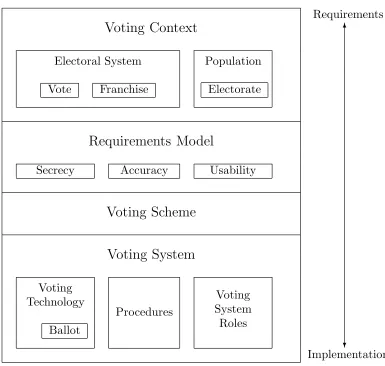
of voting can be portrayed prior to consideration of particular voting technologies as a topic. The terminology may then be organised into a layered framework into which the various research efforts concerning voting systems may be integrated. Figure 2.1 illustrates a framework for organising the terms described below in a structured manner. The goal of the framework is to provide structure for the field of voting systems, illustrating where the various diverse research efforts (from a range of disciplines and backgrounds) may be integrated.
Voting Context. The organisational and/or geographical context in which voting occurs,
General elections to the Westminster Parliament in the United Kingdom for example. A voting context gives rise to a set of requirements for the manner in which voting is to be conducted. Such requirements are unique to the context for which they are de-scribed, although there may be similarities between sets of requirements for similar contexts. Requirements for elections to the United States House of Representatives should bear some similarities to requirements for United Kingdom elections to the Westminster Parliament, whilst not being identical. Requirements for voting systems may be categorised, for example, in terms of electoral system and usability. Re-quirements from the voting context are used to generate lower level reRe-quirements for technologies, for example, the strength of encryption for communication of tallies on unsecured channels.
Electoral System. Expresses the rules for voting in a particular voting context. An
elec-toral system may be modelled as consisting of a set of voting round types, rules for transitioning between round types and rules for deciding whether to terminate the election. For each voting round type, constraints on how votes may be expressed and the algorithm for aggregating votes to produce a tally for that round must be described. Rules for transitioning between voting round types and termination are dependent on the tally of votes cast in that round and the independent set of inputs for that round.
? 6 Requirements
Voting Context
Electoral System
Vote Franchise
Population
Electorate
Requirements Model
Secrecy Accuracy Usability
Voting Scheme
Voting System
Voting Technology
Ballot
Procedures
Voting System
Roles
[image:27.595.135.520.121.487.2]Implementation
Figure 2.1: Illustration of levels of abstaction of the framework for voting systems. At the highest level,
a voting context exhibits the properties that must be captured by a requirements model. The voting
context encapsulates the terms of eligibility for voters (the franchise) and the electoral system rules by
which vote casting is conducted. The electoral system specifies the constraints on how a vote may be
expressed and counted. The role of a requirements model is to capture this context such that they may
be fulfilled by the voting scheme. The voting system is an implementation of an envisaged scheme which
combines both voting technology and manual processes outwith the technology. As such, roles other
than that of voter occur at the system level of the terminology, since aspects of a scheme may be either
election. Members of a population which satisfy a franchise are considered eligible to vote.
Proposal. The manner in which a decision to be made is presented to a voter, including
constraints on how the voter may express a choice (through a vote).
Vote The abstract expression of a voter’s choice within the constraints expressed by an
associated electoral system.
Voter. An entity (typically human) eligible to vote in at least one round of the electoral
system. Franchises are used to distinguish between different voting eligibilities.
Tally. The aggregate of votes cast in a round of voting according to rules specified by the
electoral system.
Requirements Model The methodology for capture of requirements for a voting context.
Voting Scheme. The abstract description of the technology, agents and procedures
de-signed to satisfy the requirements of a particular voting context.
Voting System. The collection of technologies and procedures implemented to satisfy the
conditions and requirements of a voting context. A brief example of a voting system is a Constituency Returning Officer implementing the terms of the Representation of the People Act 1983 (as amended) in order to conduct a parliamentary election using paper ballots marked in a polling station on a single day and placed in a box which is sealed until all votes are counted after the close of poll.
Voting Technology. An implementation of the technological aspects of a voting scheme.
Voting technologies without associated voting schemes are commonly hard to evalu-ate with respect to the requirements of the underlying voting context.
Ballot. The implementation of a proposal and/or vote as a distinct record within the voting
A further set of definitions related to the framework which provide descriptions for the execution of a voting system are as follows:
Election. An single execution of the procedures and technologies implemented in a voting
context. Given that a voting system must accommodate all the circumstances that occur, an election represents an execution path through an electoral system and also through a voting system.
Voting. The collective act of casting votes to obtain some decision, electing officials from
a larger set of candidates or deciding whether to accept or reject a motion before a parliament or committee for example.
A significant departure from some other works on voting systems is that a description of the term democratic is excluded from the definitions employed in this work, although more unusually, a definition is provided of the related term franchise. The choice is deliberate since the understanding of the term democratic is dependent on the voting context in which it is used. Defining democracy as a requirement for a voting system becomes problematic for a single definition as:
• Democratic may refer to the results obtainable from a given electoral system. A
common political argument, for example, is that “proportional electoral systems” are more democratic with respect to participating groupings of candidates (political parties), whilst the converse argument is that non proportional electoral systems are more democratic to unorganised candidates [115].
• A voting context may be specifically undemocratic, for example, individual
share-holders in a company receive votes weighted by the proportion of total shares in the company they possess. The framework discussed here is designed to capture the broad range of contexts in which voting takes place.
• Definitions of democracy commonly refer to “all eligible citizens”, for public
in the eligibility criteria (franchise). The satisfaction of a ‘democracy requirement’ then, is dependent on what one considers to be reasonable criteria for franchise.
• Where definitions refer to “equal access to the voting system”, necessary trade–offs
resulting from the disparate circumstances of voters are either ignored, or the defini-tion of democracy through equal access is diluted. For example, a common technique for public election is to require that most voters attend polling stations to cast a vote on a paper ballot with those voters unable to do so able to complete their paper bal-lot at home and send it via a postal service. Whilst this approach ensures that all voters (or at least all voters able to complete paper ballots) are able to participate in the voting, those voters who complete their ballots at home necessarily experience a reduced level of voting privacy compared with voting in a supervised polling station.
Therefore, in this work, the term “democratic” is defined indirectly in terms of the require-ments of a given voting context, rather than attempting to adopt a uniform definition to be applied to all contexts.
2.3
Voting Contexts
In this section, the classification of voting contexts is discussed in terms of the properties that a voting scheme is required to exhibit, together with a discussion of the characteristics of common classes of voting contexts.
2.3.1
Classification of Voting Contexts
2.3.1.1 Electoral System
The collection of rules under which elections are conducted are referred to as electoral systems [103]. The classification and/or characterisation of electoral systems is consid-ered a topic within the domain of political science, since the design of such systems have significant consequences for the organisations which operate them [115]. The classifica-tion of electoral systems in political science is therefore concerned with the consequences of an electoral system’s rules. A typical classification (Norris or Reynolds for exam-ple [103, 115]) begins with a high level description of a system as being either “propor-tional”, “combined” or “majoritarian”, in reference to the system’s likelihood of distribut-ing representation proportionately amongst organisations of candidates [103]. Further sub-classifications are also dependent on the degree of proportionality of a system, with Norris decomposing Majoritarian electoral systems into those requiring a majority of votes for a winning candidate (Alternative Vote, for example) and those requiring only a plurality (Simple Plurality, or First Past The Post). The approach adopted by political science, then, is to categorise electoral systems by the emergent properties of the results from the elections which are run under them.
However, an alternative approach to the classification of electoral systems has been to iden-tify discrete characteristics for comparison [72]. Adapting this approach allows an electoral system to be described as:
• A series of voting round types and rules for transition between rounds of voting [47]. Whilst many electoral systems incorporate only a single round of voting leading to a result, other electoral systems (French Parliamentary and Presidential elections, for example) incorporate two rounds of voting in the circumstances where a candidate does not win a simple majority of first round votes. Farquharson describes electoral systems as consisting of multiple rounds of decision making [47].
Common-wealth citizens over the age of 18 resident in the country; those excluded include, ‘peers of the realm’ and ‘lunatics’ [121]. The franchise may also incorporate geo-graphical qualifications, with a voter required to be resident within the boundaries of a specified district.
• A description of the legal expression of a voter’s choice, which shall be termed a
proposal to a voter throughout this work in an attempt to avoid ambiguity. A vote cast
under Single Transferable Vote (STV), for example, requires voters to rank options in order of preference, whilst referenda permit a vote to consist only of an accept (yes) or reject (no) of the statement under question.
• The algorithm by which votes are aggregated to produce a tally. Whilst simple
elec-toral systems such as Simple Plurality total up votes for each candidate, more com-plex electoral systems may perform vote re-distribution over a series of tallying it-erations until a sufficient number of winning candidates have been identified. The tallying algorithm may also need to take account of results from other elections. A mixed member system, as used to elect representatives to the Scottish Parliament, weights the number of list members elected according to the number of constituency members elected for a given party [125].
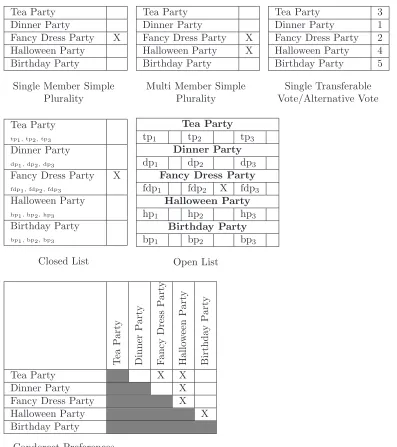
Whilst there is considerable diversity in the electoral systems used across different voting contexts, it is possible to identify commonality to the extent that classes of electoral systems may be identified. Such classes of electoral system are described below and sample votes cast on paper ballots are presented in Figure 2.2.
Tea Party Dinner Party
Fancy Dress Party X Halloween Party
Birthday Party
Single Member Simple Plurality
Tea Party Dinner Party
Fancy Dress Party X Halloween Party X Birthday Party
Multi Member Simple Plurality
Tea Party 3
Dinner Party 1 Fancy Dress Party 2 Halloween Party 4 Birthday Party 5
Single Transferable Vote/Alternative Vote
Tea Party tp1, tp2, tp3 Dinner Party dp1, dp2, dp3
Fancy Dress Party fdp1, fdp2, fdp3
X Halloween Party
hp1, hp2, hp3 Birthday Party bp1, bp2, bp3
Closed List
Tea Party
tp1 tp2 tp3 Dinner Party
dp1 dp2 dp3 Fancy Dress Party
fdp1 fdp2 X fdp3 Halloween Party
hp1 hp2 hp3 Birthday Party
bp1 bp2 bp3
Open List T ea P a rt y D in n er P a rt y F a n cy D re ss P a rt y H a ll ow ee n P a rt y B ir th d ay P a rt y
Tea Party X X
Dinner Party X
Fancy Dress Party X
Halloween Party X
Birthday Party
[image:33.595.133.530.102.549.2]Condorcet Preferences
Figure 2.2: Ballot paper representations of votes for sample electoral systems. Simple Plurality votes
are expressed as choices for one or more options, each choice having equal value. An ordinal vote (used
for Single Transferable and Alternative Vote electoral systems) is expressed as a ranking of one or more
options. A Closed List vote is expressed as a choice for a list of pre-ordered options. An Open List vote
is expressed as a choice for both a list and a particular option within that list (strictly, the options are
a set which are arranged as a list during tallying). A Condorcet Preferences vote is expressed as a
Multi Member Simple Plurality (MMSP) Voters may choose as many options as there are vacancies. Tallying is the same as for SMSP systems. When voters are only provided with a single vote, the system is re-named Single Non-Transferable Vote. Some instances of MMSP mandate that a voter must not cast more than one vote for the same option.
Closed List Votes are represented by a choice for a list of candidates from a set of lists. The number of candidates elected from a list depends on the number of votes received by the list and the particular algorithm used for tallying. In general for each round of tallying, the option at the top of the list with the most number of votes is selected as a winner and removed from that list. The tally of votes for the winning list is then reduced by some amount. For example, the d’Hondt Closed List algorithm divides a list’s votes by the number of options currently chosen, plus one for each round of tallying.
Open List As for closed list systems, options are organised into sets. However votes are cast for individual options rather than the set of options. Sets of options are ordered during tallying into lists by the number of votes for each option. Options are then selected from lists in the same manner as the closed lists. For public elections, open list electoral systems permit voters to choose a candidate within a political party’s list, as well as voting for the candidate.
Single Transferable Vote (STV) Votes are represented by an ordering of options by pref-erence. Winning options are calculated in a series of tallying rounds, in which a winning option must obtain more than a specified quota of votes. The calculation of the quota varies, although the Droop calculation is commonly adopted in which the quota is calculated as the total number of votes divided by the number of vacancies+1:
Q= votes
vacancies+ 1
successive rounds of tallying. If after a round of tallying, no option has more votes than the calculated quota, the least favoured option (the option with the current least number of votes) is eliminated and each of its votes is distributed to the next preference on the vote. Conversely, if an option receives more than the necessary quota of votes, a surplus proportion of the votes is distributed to other options. This process occurs repeatedly until all vacancies have been occupied. Where only one option is to be elected, STV is the same as for the Alternative Vote system, since no distribution of surplus votes occurs, as the quota is 50% of votes cast.
STV is used for public elections in the Republic of Ireland.
Non-Instant Run-Off Votes are cast as for SMSP elections, although a winning candi-date is required to obtain a majority of votes cast (more than half). Voting thus proceeds in rounds, with one or more least favoured options eliminated after each round of voting until a candidate receives half of all votes cast in a round. Non-instant Run-Off is used for French Presidential and Parliamentary Elections.
Condorcet Preference Voting Votes in Condorcet schemes represent all possible com-parisons between options, with an X in Figure 2.2 indicating that the option in that row is preferred when compared to the option in that column. Winners in Condorcet elections are calculated by summing the number of comparisons that an option wins. Condorcet schemes may result in ambiguities that are non-trivial to resolve if there is no clear
Con-dorcet winner, or preferred option.
research council, where the votes of the decision making committee are published. Con-versely, the same electoral system might be used to select parliamentary representatives for a constituency, but in this case the individual choices of voters are not published – the same electoral system is employed with two different sets of secrecy requirements. The follow-ing sections discuss further properties of votfollow-ing contexts which are not part of an electoral system, but are specified with respect to one.
Electoral Systems used in Specific Voting Contexts For specific instances of electoral systems, substantial variation from the general classes described above may be identified. For example, variations of the STV system may use different mechanisms to re-distribute surplus votes of different candidates. Surplus votes for re-distribution may be selected randomly, or all votes of a winning option may be re-distributed with a reduced value (which can be calculated using a variety of functions), or indeed a hybrid of both options may be used. The above examples provide only common classes of electoral systems, since providing an exhaustive survey is not practical within the confines of this work.
2.3.1.2 Secrecy, Privacy and Anonymity
Although not mandatory for vote casting itself, many voting contexts impose restrictions on the communication of information associated with voting. These restrictions are cat-egorised here as secrecy requirements, referring to stipulations that particular items of information may not be communicated between participants during some period of time (possibly unlimited). Such requirements are enforced via a variety of mechanisms (techno-logical, procedural or legal) depending on the voting context and deployed voting system.
competing candidates, for example O’Leary [106]. Typical of such definitions is:
“Nobody should be able to link a voter’s identity to his vote, after the latter has been cast.” [53, pp 104]
This definition is problematic for several reasons. As Kremer notes, any scheme designed to fulfill this requirement will fail in the circumstances where a tally of results is published and the results are unanimous [78], since the result eliminates uncertainty as to any voter’s choice. Whilst for large electorates, the likelihood of such circumstances arising is small, certain contexts do increase the possibility of secrecy violations. For a practical exam-ple, consider the context of public elections in the United States where a large number of elections are often voted on together (President, US Senator, US Congressman, State Senator etc). A common practice is for each polling place to post a local tally of results, sometimes for each Direct Recording Electronic (DRE) machine used to collect votes. For polling places with a small electorate (commonly in rural districts), there is a substantial probability that all voters will choose the same option, violating individual secrecy.
Several approaches have been advocated to accommodate this possibility. Several authors suggest that voter privacy requirements should be weakened by reference to a system
in-distinguishability property, that is, an external observer should not be able to distinguish
between two executions of a voting system in which the votes of two voters have been switched, for example [78]. A system can thus fulfill this requirement even if results are published, despite voters being in unanimity. This approach therefore advocates weaken-ing formal definitions of privacy requirements for votweaken-ing systems in the context where the weaker definition is still acceptable.
Others have argued that voting schemes and their implementations should be designed to provide stronger properties in which a unanimous result does not reveal the associa-tion between a voter and a vote. One approach is for schemes to incorporate coercion
resistance which prevents an external observer determining whether an eligible voter
the voter anonymity - the identities of participating voters is not externally determinable. Mercuri notes the Common Criteria definition of anonymity:
“ensure that a user may use a resource or service without disclosing the user’s identity. The requirements for anonymity provide protection of the user identity.” [91, 101]
Similarly, anonymity is a commonly adopted requirement for voting schemes that employ anonymous channels, for example Michels and Horst:
“Privacy: The votes are casted [sic] anonymously.” [95]
However, adopting anonymity to protect voting privacy fails when voting is compulsory (in Australian public elections, for example), since all voters are assumed to participate in all elections.
Further complexities arise in terms of the required protection that must be assigned to vot-ing privacy. Whilst international agreements (such as the European Convention on Human Rights) specify that voter privacy is an absolute, the United Kingdom employs a voting system that provides election authorities with the ability to associate votes with voters. Ar-guments have been made that the practice has limited value as an auditing tool and should cease [68, App. 3]. In addition, some have suggested the practice is contrary to interna-tional law [111]. Article Three of the First Protocol of the European Convention on Human Rights, for example:
“The High Contracting Parties undertake to hold free elections at reason-able intervals by secret ballot, under conditions which will ensure the free ex-pression of the opinion of the people in the choice of the legislature.” [17, Prot 1. Art. 3]
However, there has been no indication from the UK government that a change in procedure is imminent. Particular circumstances therefore must be taken into account when designing voting schemes or implementing existing schemes with weakened properties.
specification of secrecy requirements is concerned with individual voters, their votes and the final published tally.
The preceding section has discussed the complexity of specifying requirements for secrecy for voting contexts. To summarise, a general approach must identify the target information of the requirement (voter, vote, tally etc), the participant(s) who must not receive the infor-mation (from an electoral system perspective) and temporal constraints (the period of time the information must be kept secret).
2.3.1.3 Accuracy, Verifiablity and Dependability
A common requirement of elections conducted in most voting contexts is that the final pub-lished tally is accurate with respect to the votes cast by individual voters and the algorithm specified by the electoral system for producing a tally. Schneier has argued that require-ments must extend to the voters themselves, that is, accuracy should refer to a tally being accurate with respect to the vote a voter intended to cast [130]. Such a definition considers (whether accidently or intentional) misleading user interface design to be an attack on the accuracy of an election.
Vote Castingk Storagek Tallyingk
Roundn
Roundk
Round 1 Parametersk
[image:41.595.140.517.85.275.2]Initiationk Authenticationk
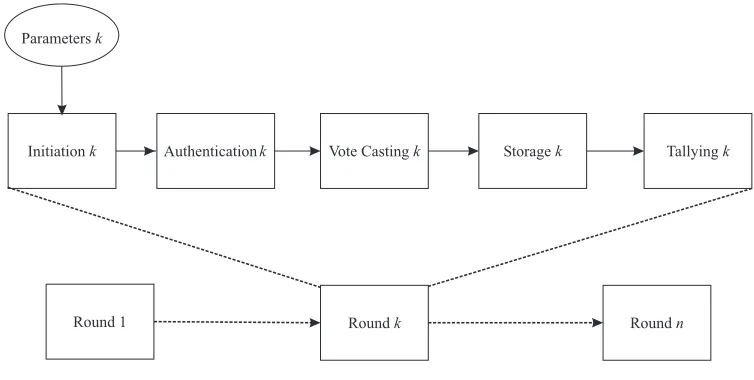
Figure 2.3: The problem of ensuring accuracy of an election result. An attacker is presented with
several points at which to perform an attack. The feasibility of attack depends on the specification of
secrecy requirements discussed in Section 2.3.1.
The conflict in public elections thus illustrates that the accuracy of a tally may be dependent on an observer’s perspective and access to other information during the execution of a vote. The assessment of accuracy of the tally then becomes dependent on the accuracy of other information provided to an observer, which may have been established as accurate, or alternatively the accuracy must be taken on trust.
Ensuring the accuracy of an election is therefore an end-to-end process, as noted by Schneier [130]. Figure 2.3 illustrates a generic electoral system in which voting proceeds in a series of rounds. Each round consists of vote casting, storage, collection and tallying. Transitions occur between each round of voting depending on both tallies from the previous round and the parameters specified for the election.
An attacker may choose to violate the accuracy of the election at any one of the points (or multiple points) in the election process:
During initiation. Attacks on a voting system during initiation can violate the accuracy of
may prevent some otherwise eligible voters from participating. Several authors have documented the use of literacy criteria for participating in public elections in the United States as a mechanism for disenfranchising poorer voters [52, 54, 126].
During voter authentication. The accuracy of an election is violated if non-eligible
vot-ers are permitted to participate, since the result of the election will no longer reflect the intention of legitimate voters.
At the voting interface. According to the definition of accuracy proposed by Schneier
[130], a user interface which obstructs accurate vote casting constitutes an attack on the accuracy of an election. During the 2000 US General election, the layout of punch cards ballots in a ‘butterfly’ was criticised because voters mis-construed which hole to punch for a particular candidate [2, 39]. Other deliberate attacks have been noted with voting interfaces which use labelled buttons to indicate voting options. To attack these systems, labels are switched in precincts where voters are thought to have a preference for an opposing candidate, such that that candidate’s votes are unintentionally cast for an opponent.
During vote casting. The vote casting process records the vote cast by a voter at the
inter-face. Thus, vote casting attacks are distinguished from interface attacks by accurately obtaining the voter’s choice, but altering the choice prior to storage.
During storage and communication. Attacks on a collection of votes include altering
cast votes, adding extra votes (either for non-existent voters, non-participating voters or by adding extra votes not associable with particular voters), or removing votes (either through ‘intelligently’ removing votes identified for an opposing candidate, or ‘blindly’ removing all votes in a collection suspected of being biased towards a particular candidate).
During vote tallying. Whilst simple tallying algorithms are possible to verify if the
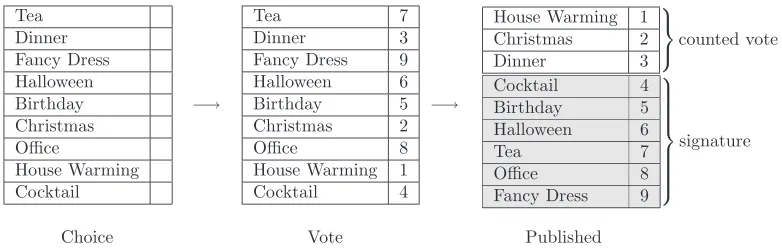
tallying algorithm revealed a minor defect in the allocation of votes once candidates had been elected [134]. Whilst such a minor flaw would not affect the determination of winners, the case illustrates that correct tallying of votes is an element of election accuracy. Alternatively, if the collection of votes for tallying are not available for in-spection, then the accuracy of the resulting tally becomes more difficult to ascertain. Pieters has attempted to differentiate between voting schemes where collections of votes are published to enable open tallying and those where a tally is derived from an encrypted collection of votes [110]. Publishing the collection of votes for inspec-tion by external observers may not be possible, for example, in circumstances where the expression of choice represented by a vote may be used to identify a vote in a tally. This possibility was again identified in the context of the STV electoral system, when the vendor proposed electronically publishing the list of votes cast to demon-strate the correctness of their tallying algorithm. An STV vote lists candidates in order of preference. Commentators noted that lower-order preferences (which are unlikely to affect the result of an election) may be configured to produce a unique
preference signature such that the vote may be identified in the published list and an
attacker can ensure a voter has organised their higher order preferences ‘correctly’ [134]. Figure 2.4 illustrates this potential attack on secrecy.
The result of attacking the accuracy of one or more processes within the accuracy model is dependent both on the voting context and the nature and goal of the attack. Attacks which undetectably alter results of elections are considered the most problematic since by their definition, they are not expected to be identified or if identified, they may not be correctable. Mechanisms for preventing such attacks include quality control techniques on the technologies and processes employed in a voting system; and the use of voting schemes which provide external verifiability of the correctness of an election result.
Denial of Service (DoS) attacks on voting systems (which prevent a decision being made)
Tea Dinner Fancy Dress Halloween Birthday Christmas Office House Warming Cocktail −→ Tea 7 Dinner 3
Fancy Dress 9 Halloween 6 Birthday 5 Christmas 2
Office 8
House Warming 1 Cocktail 4
−→
House Warming 1 Christmas 2 Dinner 3 counted vote Cocktail 4 Birthday 5 Halloween 6 Tea 7 Office 8
Fancy Dress 9
signature
[image:44.595.134.525.77.203.2]Choice Vote Published
Figure 2.4: The vote signature attack on ordinal electoral systems, where all votes are published as
a means of verifying the accuracy of the tallying algorithm. In the illustration, an attacker from the
House Warming Party instructs the voter on the order of the party’s candidates. Then, the voter is
assigned a unique permutation of preferences 4–9, which are not used to elect candidates, but identify
the vote when published, violating the vote’s secrecy. In this example, an attacker would be able to
assign signatures to 720 voters.
However, as noted by Mercuri, many elections are time sensitive [91]. The issues which influence voter choices at one point in time may not be replicated later. A further problem with successful DoS is that the confidence of an electorate in a voting system (and the resulting choice made) may be reduced when an attack is reported. Election systems that cannot resist DoS may be suspected of being vulnerable to more subtle undetected attacks on the tally itself. It may be noted that an attack on the result of an election that is detected will degenerate into a DoS attack if the voting system cannot recover from the damage caused.
The ability for a voting system to recover from an attack rather than cause the relevant election to be re-run is dependent on the choices made for a particular voting context. For example, the UK voting system for public elections is designed with the ability to identify and invalidate illegally cast votes (under court order) whilst the possible violation of voter privacy makes this practice illegal in the Republic of Ireland [89]. The properties of voting systems need to be designed to reflect the priorities of the contexts in which they are deployed.
voting system which ensures accuracy at all steps in the voting process is simplified if se-crecy is not required. However, since a variety of voting contexts incorporate some form of secrecy requirement with respect to the votes cast in an election, ensuring accuracy at the successive processes described above is non-trivial. For a particular voting context, it is necessary to identify the steps in the voting process for which ensuring accuracy is non-trivial due to requirements specified for secrecy. Generally, the more restrictive the requirements for secrecy, the greater the difficulty is for a voting scheme and implementing voting system to ensure secrecy.
Voting systems may well be implemented on the understanding that certain components are trusted in order to fulfill requirements that are otherwise in conflict. Such schemes spec-ify the components that are considered trusted, or else alternatively demonstrate how trust may be distributed across multiple components under an assumption that a certain propor-tion will not collaborate to violate the accuracy, or secrecy, of an elecpropor-tion. Alternatively, where no satisfactory implementation of a set of secrecy and accuracy requirements can be obtained it may be necessary to relax the constraints so that an election may be conducted at all. Of course, such an approach does not preclude the later implementation of a system satisfying the stricter requirements.
2.3.1.4 Usability and Acceptability
ISO 9241-11 refers to usability as:
“the extent to which a product can be used by specified users to achieve specified goals with effectiveness, efficiency and satisfaction in a specified con-text of use.”
noting that not only is a usable system designed to allow a user to achieve desired goals (effectiveness and efficiency), but also that the user must be satisfied with the result. The usability of a system is not just the extent to which tasks are completed efficiently and quickly, but also the degree of ease and satisfaction with which a user interacts with that system. A particular factor relevant to voting systems for judging usability is the extent to which a user would consider using it again to repeat a given task. Maurer notes that systems which suffer from poor usability will be by-passed by users, employing alternative methodologies instead to complete their task [86]. In this sense, usability also incorpo-rates the acceptability of a system to users - the likelihood that they will accept its use to accomplish a particular task rather than a parallel and potentially less efficient system.
The usability requirements of a voting context, then, are dependent on the capabilities of voters specified by the relevant electoral system’s franchise. Given that a separate franchise may be specified for each round type in an electoral system, the capabilities of voters may vary across multiple rounds and within the rounds of voting themselves.
Factors which influence usability constraints for a voting system (with respect to voters) include:
Electoral complexity. The variety of choice which the electoral system presents to a voter.
the voter may participate in. A voting system may be required to mask complexity in a voting system, if too much choice is considered a deterrent to participation. For example, voting systems employed for public elections in the United States provide a ‘party ticket’ option for voters who wish to vote for a single party’s selection of candidates for multiple elections, rather than individually selecting that party’s can-didates on the system.
Literacy. A voting context may require a voting system to accommodate varying levels of
literacy within the population of voters.
Physical capabilities of voters. A voting context may require a voting system to
accom-modate physical disabilities of voters. The precise disabilities accomaccom-modated and the manner in which the accommodation is made is context dependent. For example, the provision of DRE machines in polling places for public elections which support blind voters are mandated by recent federal legislation in the United States [58], whilst vot-ers in the United Kingdom may either receive assistance or use a tactile template to mark a paper ballot [121].
Cost of participation. Norris notes (in a theoretical framework of participation) that the
cost of participation in an election is a contributory factor for a voter deciding whether to participate in an election [102, 103]. High participation costs may result if a voter is required to purchase particular technology or travel to a distant location in order to vote. High costs of participation deter voter participation and thus have a detrimental effect on the usability of a voting system. A voting context may set limits on the acceptable costs of participation in an election.
Cost of implementation An organisation must usually commit at least some resources to
need to be relaxed in order to make the cost of conducting an election affordable to an organisation.
A voting system that successfully implements secrecy and accuracy constraints, but as a result is unusable by the participating voters is not at all useful as a decision making tool. As for the compromise between secrecy and accuracy discussed in Section 2.3.1, fundamental conflicts between accuracy, secrecy and usability may need to be resolved in favour of usability if a decision is to be made at all using the voting system and an implementation fulfilling all requirements is not known. For example, the use of remote voting technologies (postal or remote electronic voting, for example) may be necessary for geographically widely distributed populations. The use of supervised polling stations is impractical in such contexts, however desirable it is to employ them in order to achieve desirable secrecy requirements.
2.3.2
Instances of Voting Contexts
The previous section presented a framework for considering the variety of contexts in which voting takes place. This section describes a selection of voting context instances in order to illustrate the diversity of voting system requirements. It is not argued that the voting context types described here faithfully represent a single real world instance of a voting context. Rather the voting context types provide descriptions of classes of real world voting contexts.
2.3.2.1 Public Elections
Public elections are perhaps the most commonly perceived type of voting context. Public elections are a feature of societies as a means of choosing legislators, executives and other public officials. Public voting contexts may also decide issues of public policy such as in
referenda considered too significant to be decided by a legislator alone.
A diverse range of electoral systems are employed for public elections, although typically all enfranchised members of a population have equal voting capabilities.
Typically, public election voting contexts require that the association between voters and individual votes is kept secret. Secrecy requirements may also state that information re-garding whether a voter participated in an election or not be kept secret.
In common with other voting contexts, requirements for accuracy are common for pub-lic elections. The nature of pubpub-lic elections makes demands on voting systems to ensure accuracy, including:
Authentication The large, diverse population of voters eligible to participate in public
elections makes authentication of voters harder when compared to the small popu-lations who typically participate in parliamentary and jury voting contexts. Authen-tication of voters typically requires some pre-constructed infrastructure used for au-thentication in other contexts. However, overly onerous auau-thentication requirements may conflict with usability requirements by preventing voters from participating. The conflict between stronger authentication of voters and accessibility of voting systems is a controversial issue in the United States, where voter authentication has been per-ceived as a mechanism for limiting participation [91], whilst weak authentication has been shown to permit personation [52].
Voter interface The large electorate typically requires voting systems to be able to
flexible voting interfaces [2], or alternatively providing multiple parallel voting sys-tems for a single context, with the intention that every voter is able to use at least one interface [42].
Vote storage, collection and tallying Public elections require that voting systems ensure
(or at least provide re-assurance) that a tally is accurate with respect to votes cast, despite the requirement that the association between a voter and a vote is secret.
2.3.2.2 Legislative or Committee Motions
Parliamentary and committee voting share many common characteristics. Parliaments con-sist of a set of legislators, representing a larger body of people. A measure to be voted on will be presented before the parliament and may be discussed amongst the legislators. Once the discussions are completed a vote is conducted, in which all legislators are usually equal participants (other than a chairperson). Votes are most often conducted for or against the wording of a particular motion and as such a SMSP electoral system is employed.
Both the tally of votes and the association between votes and voters are published so that a decision may be acted upon and also so that the legislator is accountable to the larger body of represented people.
of voting, since a voter is only considered eligible if they are present in the chamber for voting.
2.3.2.3 Jury Decisions
Jury voting is the most restrictive form of voting system considered here, in terms of the amount of information published concerning the result of the vote. Jury voting contexts characteristically employ a SMSP electoral system with just two options available - for or against a motion; the guilt of an accused, for example.
In contrast to public elections, the specific tally resulting from votes cast by jurors is not usually made public. Rather, a statement of whether the tally of votes for a motion reached a threshold (plurality, more than two thirds majority, unanimity etc.) is published. Such a restrictive secrecy requirement can have the advantage of protecting the value of a voter’s choice in circumstances where voters are unanimous, as discussed in Section 2.3.1.
A consequence of such secrecy is that the accuracy of the tally of votes may be hard to determine. In some jury voting contexts, each of the voters may know the association between individual votes and voters but since the voters are usually a small subset of an interested population and are unable to prove the choice of other voters this is not consid-ered a violation of secrecy. Some voting schemes have been proposed in which even voters do not know the association of votes and other voters. Such schemes produce proofs that a statement concerning a collection and tally of encrypted votes is accurate without revealing the value of individual votes of the tally [61].
2.3.2.4 Shareholder Motions
![Table 2.1: Common Criteria Evaluation Assurance Levels as summarised by Mercuri [91].](https://thumb-us.123doks.com/thumbv2/123dok_us/8671697.376959/58.595.200.459.77.254/table-common-criteria-evaluation-assurance-levels-summarised-mercuri.webp)
![Figure 2.6:The Blind signature voting scheme as proposed by [51]. The voter encrypts their vote](https://thumb-us.123doks.com/thumbv2/123dok_us/8671697.376959/67.595.163.490.213.439/figure-blind-signature-voting-scheme-proposed-voter-encrypts.webp)
![Table 2.2:Voting technologies classified by location and casting medium. This classification is incontrast to other schema (see for example [53, pp64]), where priority is given to the medium of the](https://thumb-us.123doks.com/thumbv2/123dok_us/8671697.376959/79.595.117.542.77.320/voting-technologies-classied-location-casting-classication-incontrast-priority.webp)