Counting Cases in Substitope Algorithms
David C. Banks, Stephen A. Linton, and Paul K. Stockmeyer
Abstract—We describe how to count the cases that arise in a family of visualization techniques, including Marching Cubes, Sweeping Simplices, Contour Meshing, Interval Volumes, and Separating Surfaces. Counting the cases is the first step toward developing a generic visualization algorithm to produce substitopes (geometric substitutions of polytopes). We demonstrate the method using “GAP,” a software system for computational group theory. The case-counts are organized into a table that provides a taxonomy of members of the family; numbers in the table are derived from actual lists of cases, which are computed by our methods. The calculations confirm previously reported case-counts for four dimensions that are too large to check by hand and predict the number of cases that will arise in substitope algorithms that have not yet been invented. We show how Po´lya theory produces a closed-form upper bound on the case counts.
Index Terms—Isosurface, level set, group action, orbit, geometric substitution, Marching Cubes, separating surface, Po´lya counting, substitope.
æ
1
A FAMILY OF
VISUALIZATION
ALGORITHMS
T
HEMarching Cubes (MC) algorithm was presented byLorensen and Cline in 1987 as an exhaustive-search technique that generates a level set (isosurface) of a scalar function [1]. The algorithm iterates over each cube tesselat-ing a compact subvolume ofIR3on which the functionf is defined. The sign of fðviÞ constis evaluated at the eight
vertices vi of a cube, where const is some user-defined
constant (the isovalue). Neglecting the degenerate case where the sign is exactly zero, each of the eight vertices can be in one of two states: positive or negative (black or white). These produce 28¼256 patterns. Many of these patterns turn out to be equivalent under the symmetries of the cube (such as rotation or mirror-reflection). Other patterns are equivalent under reversal of colors (for example, all-black being equivalent to all-white). Through patient brute-force organization of the 256 patterns, one discovers there to be 14 or 15 equivalence classes of the colorings. Among the 15 cases is a chiral pair that are mirror images of each other, so these two are equivalent if orientation is ignored.
In the MC algorithm, the pattern of a given cube is matched to one of these 14 or 15 cases and a predetermined arrangement of polygons is fitted to meet the constraint fðviÞ const¼0 for points p along edges of the cube. In
other words, the cube is replaced by zero or more triangles approximating the level set. Fig. 2 (bottom right) shows one case of a geometric substitution that occurs in MC. The figure illustrates how substitution proceeds in variations of the basic MC algorithm: Ann-simplex orn-cube is replaced
by a polytope. Then-cube, with2nvertices, generalizes the
sequencepoint, segment, square, cube; then-simplex, withnþ
1vertices, generalizes the sequencepoint, segment, triangle, tetrahedron; a polytope generalizes the sequence point, segment, polygon, polyhedron [2]. Polytopes that result from a geometric substitution are called substitopes [3]. Fig. 2 illustrates how substitution proceeds in variations on the basic MC algorithm: In general, ann-simplex or n-cube is replaced by a substitope. The following section surveys several substitope algorithms that have been developed in recent years.
1.1 Survey of Substitope Algorithms
MC has inspired numerous modifications and extensions. These variations reveal a family of algorithms whose members are distinguished by a few key parameters. A selection of these substitope algorithms is surveyed below.
Variation of the shape. If a 3-simplex (tetrahedron), rather than a 3-cube, tiles the domain, then the scalar function is evaluated at only four vertices [4], [5]. One advantage of using tetrahedra rather than cubes is that their analysis is simpler: Only three cases arise for the vertex colorings of a tetrahedron, rather than 14 for a cube. Fig. 2 (top right) shows one of these three cases.
Variation of the dimension. The two-dimensional version of MC is popularly called “Marching Squares,” which provides a simple motivation for the three-dimen-sional case. Although the algorithm is unpublished, it can be easily derived or found by searching the World Wide Web. Fig. 2 (bottom left) shows one of its cases.
When the MC algorithm is extended to dimensionn¼4, two problems arise. First, the number of vertex patterns is large (65,536), so enumerating them all by hand is unrealistic. Second, it is difficult to perform the mental rotations necessary to decide when two color patterns of a 4-cube are equivalent. As Lorensen and Cline pointed out in the case of the 3-cube, “triangulating the 256 cases is possible but error prone.. . . [W]e reduced the problem to 14 patterns by inspection [p. 165].” Although this approach to counting cases works for Marching Squares and MC, it does not scale to dimensions higher than three. Recently, several researchers have tackled the case-counting problem . D.C. Banks is with the Department of Computer Science, Florida State
University, Tallahassee, FL 32306. E-mail: [email protected].
. S.A. Linton is with the School of Computer Science, University of St. Andrews, North Haugh, St. Andrews, Fife, KY16 9SS, UK.
E-mail: [email protected].
. P.K. Stockmeyer is with the Department of Computer Science, College of William and Mary, PO Box 8795, Williamsburg, VA 23187-8795. E-mail: [email protected].
Manuscript received 26 Sept. 2003; revised 19 Dec. 2003; accepted 29 Jan. 2003.
For information on obtaining reprints of this article, please send e-mail to: [email protected], and reference IEEECS Log Number TVCGSI-0087-0903.
for the 4-cube in different ways, counting 496 cases (Kirchberg [6]), 272 cases (Roberts and Hill [7]), or 222 cases (Bhaniramka et al. [8]) that arise. Section 3 confirms these counts and explains why they are different.
Variation of the shape’s symmetry. The symmetries of a figure are due to transformations that preserve its shape and, perhaps, orientation. If one considers orientation (clockwise versus counterclockwise) to be irrelevant, one loses distinctions between certain colorings of squares. So, the number of cases depends in part on the choice one makes when considering symmetries of the shape. The original MC deals with two cases that form a chiral pair: One is the mirror image of the other. The problem reduces to 15 cases under orientation-preserving symmetries and to 14 cases under the larger symmetry group that includes mirror reflection.
An analogous situation exists in every dimension—the group of orientation-preserving symmetries is, in general, only half as large as the group of all symmetries. So, there may be figures that are equivalent under the larger group but not the smaller one. This is the reason that Roberts and Hill found a larger number of cases than Bhaniramka et al. (272 versus 222 cases)—they were employing a smaller symmetry group.
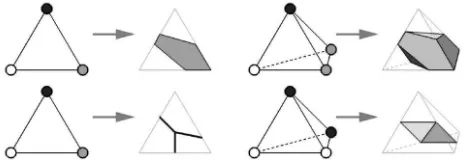
Variation of the number of colors. MC produces a level set by consulting a 2-colored function. But, substitope algorithms can also employ multiple colors, as was done in Interval Volumes [9], Contour Meshing [10], and General-ized MC [11], [12], [13], [14]. Fig. 3 (top row) shows an example of the geometric substitution in Interval Volumes for a 2-simplex and a 3-simplex with three colors.
Fig. 1 (bottom row) illustrates the 13 cases that result from extending Marching Squares from two colors to three, corresponding to f <0; f¼0; f >0. These cases can be easily deduced through brute-force inspection of the34¼81 ways that three colors can be assigned to four vertices, then by organizing the colorings into equivalence classes. Until now there has been no published case count for MC with this third color included, perhaps because the38¼6;561colorings are
too numerous to catalog by hand. We calculate the solution and report it in Section 3.3 as one of several new examples of case counts.
Variation of the colors’ symmetry. Two colors may be considered equivalent according to various choices of a symmetry group acting on the set of colors [15]. The natural choices for the symmetries are 1) the identity (as in Kirchberg’s Marching Hypercubes), 2) reversal of colors (as in MC and Interval Volumes), or 3) all permutations of colors (as in Separating Surfaces [16], which considers all 4! permutations of colors at the four vertices of a tetrahedron). Fig. 3 (bottom row) shows an example of the geometric substitution in Separating Surfaces for a 2-simplex and a 3-simplex with three colors. Fig. 1 (top row) shows the cases that would arise if Separating Surfaces, which considers any permutation of colors to be equivalent, were extended to operate on squares using four colors with all4!permutations of colors allowed.
1.2 Substitope Algorithm
The basic substitope algorithm consults a functionfat each vertex of polytopes tiling a domain; the resulting sub-stitopes are designed to create a visualization of the function rather than of the tiles. The substitope algorithm considers both the tiles and their colorings. This algorithm includes MC and all its variants. The steps of the algorithm are sketched below.
1. Traverse tiles in a region.
2. Assign a color to each vertex of a tile. 3. Match the coloring to a representative case. 4. Substitute polytopes for the colored tile.
The algorithm can be accelerated by skipping over the trivial substitutions [17], [18], [19], [20] rather than employ-ing an exhaustive traversal of the domain in Step 1.
Some, but not all, of the variations on MC precompute a look-up table in Step 3, which serves as an acceleration technique when the geometric substitution is applied in Step 4. But, the geometric substitution can also be performed procedurally, for example, when the dimension
[image:2.612.33.267.609.698.2]Fig. 1. Distinct cases of colorings of a square. Top row: Seven cases result from using four colors (fluid, bone, tissue, lesion) when applying Separating Surfaces to a square. Bottom row: Thirteen cases result from using three colors (– = +) with Marching Squares.
Fig. 2. Examples of geometric substitution rules in Marching Cubes, generalized to the n-simplex and n-cube, for n2 f2;3g. The colors correspond to sign offðviÞ constat each vertex, such as black for
positive and white for negative. Top row: 2-simplex replaced by line segment; 3-simplex replaced by triangle. Bottom row: 2-cube replaced by line segment; 3-cube replaced by triangle.
Fig. 3. Examples of substitopes. Top row (Interval Volumes): 2-simplex replaced by polygon; 3-simplex replaced by polyhedron. Colors denote intervals such as white for ðinfty; aÞ, gray for ða; bÞ, and black for
[image:2.612.299.533.617.699.2]is so large that the look-up table would exceed available memory [8]. Geometric substitution is by no means exclusive to substitope algorithms patterned after MC; it has found many uses in computer graphics to model shapes of plants [21], [22], complicated curves [23], and multi-resolution surfaces [24], [25]. But, substitope algorithms are distinct from these other geometric substitutions because of the central role played by vertex colors.
As the variations listed in Section 1.1 suggest, there are five key parameters that determine the number of cases for colored polytopes, listed below.
1. The shape symmetry. 2. The color symmetry.
3. The choice of tile2 {n-simplex,n-cube}. 4. The dimensionnof the polytope. 5. The numberkof colors.
The remainder of this paper explains how to count cases using group theory. In brief, orbits of groups acting on sets are enumerated using a computational algebra package. Section 2 describes the aspects of group theory that are required for solving the case-counting problem. Section 3 describes how a tool for computational group theory can be programmed to count cases and presents case counts organized into a taxonomy: a table with23244¼
192 entries corresponding to different values of the five parameters listed above. Section 4 presents the history of the case-counting problem, especially for the 4-cube. Section 5 shows how Po´lya theory can count the number of cases without explicitly enumerating them.
2
ACTION OF A
GROUP ON A
SET
For years, mathematicians have studied problems similar to counting cases of polytope colorings. In order for us to apply their results, we first convert the problem of counting cases (Step 3 of the substitope algorithm) into the appro-priate mathematical language. This task requires the use of group theory, which owes its name to a paper published in 1854 by Cayley [26].
A group is a setGwith a binary operation satisfying four criteria:
1. Gis closed under the operation.
2. The operation obeys the associative law.
3. Ghas an identity element (denoted by the symbol 1). 4. Each element inGhas an inverse.
Often the appearance of the binary operation is sup-pressed, so abis written asab andaais written asa2. More details about groups can be found in textbooks on modern algebra, such as the popular one by Fraleigh [27]. Familiar examples of groups include integers with the addition operation and rational numbers (without zero) under multiplication.
In creating the table for MC, Lorensen and Cline produced a set of 256 cube colorings. Then, they considered the action of a symmetry group on the 256 cube colorings. A groupactson a setXby mappingXto itself as described below.
Definition 1. A group G is said to act on a setX if 1) the identity fixes every element ofX:1x¼xand 2) the associative law holds:ðg2g1Þx¼g2ðg1xÞ, where1; g1; g22Gandx2X. (Note: some authors apply actions from the right rather than the left, thus writingxg1g2.)
One well-known group action is the set of all permuta-tions of n symbols. The group Sn, commonly called the symmetricgroup, contains alln!of these permutations.
Definition 2.The symmetric groupS2contains all permutations of the symbols 1 and 2.
S2¼ fð1Þð2Þ; ð1 2Þg:
We can relax the requirement that the symbols literally be “1” and “2” as long as we have symbols that come from a specified order. For example, we can interpretxandyas 1 and 2. Thus, we may write
S2¼ fðxÞðyÞ; ðx yÞg:
In this notation, S2 induces an action on any point
ðx; yÞ 2IR2. The first (identity) element leaves thex andy coordinates fixed; the second element is a cycle that sendsx toyandytox, producing a reflection about a diagonal line. Ifgg^¼ ðx yÞ 2S2, for example, then
^ g
gðxÞ ¼ ðx yÞ ðxÞ ¼y ^
g
gðyÞ ¼ ðx yÞ ðyÞ ¼x:
In the top line, the parenthetical expression ðx yÞ is the operator; the parenthetical expression ðxÞ is its argument. Note that both actions ofS2 preserve the shape of an axis-aligned square centered at the origin.
The usual convention when writing a permutation is to list the cycles it induces on elements of the set. By convention, the identity mapping is generally denoted ðÞ
rather than ðxÞðyÞ; trivial cycles likeðxÞ and ðyÞ are often suppressed when the permutation is written. Thus, the symmetric group on two letters is the set containing the two permutations () andðx yÞ.
The shape of the square is preserved by the action of mirror reflections (flips) exchangingxwithxorywithy. These two reflection groups arefðÞ;ðxxÞgandfðÞ;ðyyÞg; each is equivalent (isomorphic) to the group S2. Their direct product contains all four combinations of flip operations.
S2S2ffi f ðÞ; ðx xÞ; ðy yÞ; ðy yÞðx xÞ g:
These four permutations correspond to the identity, a flip of thex-axis, a flip of they-axis, and flips (note the order, from right to left) of thex, thenyaxes. In this particular example, the elements commute, soðy yÞðx xÞ ¼ ðx xÞðy yÞ, but, in general, the order matters.
The following sections explain how a group acts on a shape (the simplex or the cube) and on a set of colors, using Marching Squares as illustration. With only 24¼16 color-ings, eight group elements, and four equivalence classes, Marching Squares is a natural choice for connecting the intuitive, but eventually overwhelming, brute-force approach together with the abstract, but more general-izable, group-theory approach to enumerating cases.
2.1 Groups Acting on the Set of Vertices
LetF Cndenote the full set of symmetries acting on ann-cube.
F Cnis a group withn!2nelements; it includes all swaps and
see the algebra textbook by Cohn [28]. Combinations of swaps and flips are shown in Fig. 4 and Fig. 5.
The full set of symmetries F Sn on then-simplex can be
viewed as the group of allðnþ1Þ!possible permutations of thenþ1vertices. That is,F Sn¼Snþ1. Thedirect symmetry
group is the subset of the full symmetry group that preserves orientation. It contains the rotations but not orientation-reversing flips (mirror reflections). The direct symmetry groupDCnfor then-cube contains half of the elements ofF Cn.
The direct symmetry groupDSnfor then-simplex is called the
alternating groupAnþ1and contains half ofSnþ1.
To applyF C2orDC2to the square, we first label the four vertices of thereference square^sswhose vertices,
v1¼ ð1;1Þ v2¼ ð1;1Þ v3¼ ð1;1Þ v4¼ ð1;1Þ;
form the lower left, lower right, upper left, and upper right corners of a square centered at the origin. Squares, for the purpose of counting cases, are the flipped and swapped images of this reference square^ss.
Definition 3. A standard square is the image of the reference square ^ss under any action of shapeGroup. That is, s is a standard square if and only ifs¼g^ssfor someg2shapeGroup. Example 1.The elementðxxÞofshapeGroup¼F C2acts on the square, flipping it in thexdirection. So, its application to the reference square^ssgivesðxxÞð^ssÞ ¼ ðv2; v1; v4; v3Þ.
Example 2.Under the action of the permutationðxxÞon thex-axis, vertexv1 in the reference square^ss moves to position 2 and vertex v2 moves to position 1. Likewise, verticesv3andv4swap positions in the tuple. The group elementðxxÞcan be relabeled accordingly in terms of its effect on the vertices of ^ss, namely, ð1 2Þð3 4Þ. This relabeling is important in Section 3, which describes how the computational algebra package “GAP” can create shapeGroupautomatically.
All eight actions ofshapeGroup¼F C2are listed in Fig. 4 and illustrated in Fig. 5. In the left-most column of Fig. 4, elementg2F C2is written in terms of the coordinatesxand y it acts on. The middle column shows its action on the reference square ^ss¼ ðv1; v2; v3; v4Þ. The right-hand column renames the group element asg, which acts on the vertices of the square. Note that four of the group elements preserve the orientation of the square; these elements comprise the
direct symmetry group DC2 that acts on the square. The other four elements reverse the orientation of the square; these are the squares whose labels are restored when the page is held up to a mirror and rotated properly.
2.2 Groups Acting on the Set of Colors
In counting cases for MC, we see that one group acts on the vertices of a square by moving them around; another group acts on the set of colors, such as reversing black and white. We call the second groupcolorGroup.
A vertexvi in a square might be assigned either of the
symbols + and – (or, equivalently, either of two colorscolor1 andcolor2) to indicate the sign offðviÞ const, whereconst
is the isovalue. The color of vertex vi is determined by a
coloring functionðviÞwhich maps vertices to colors.
If^is a permutation on the colors, thencoloriis mapped
to the color^ðcoloriÞ. The notation is simplified if we use the
permutation that maps one color index to another color indexas shown below.
^
ðcoloriÞ ¼colorðiÞ:
Example 3.The permutation¼ ð1 2Þacts as follows on the color indices 1 and 2:
ð1Þ ¼ ð1 2Þ ð1Þ ¼ 2 ð2Þ ¼ ð1 2Þ ð2Þ ¼ 1:
There are three different color groups that play a crucial (albeit unmentioned) role in the substitope algorithms surveyed in Section 1.1. These are described below.
2.2.1 Identity Group
The identity group Idk, acting on k colors, contains the
single element (), which leaves the colors fixed. Nielson and Sung considered the ordering of the colors to be significant in their Interval Volumes algorithm, meaning the identity groupIdk was acting onkcolors.
2.2.2 Reversal Group
The reversal groupRevk acting on the numbers1::kswaps
[image:4.612.35.269.71.181.2]the first with the last element, the second with the next-to-last element, and so forth. MC, Marching Squares, Marching Hypercubes, Sweeping Simplices, and Contour Meshing all use the reversal group to reorder the colors corresponding to + and - in generating a level set. The groupRevkcontains Fig. 4. Permutations acting on axes and vertices. Column gg^ lists
permutations in terms of thexandyaxes. The next column shows the permuted vertices of the square ^ss¼ ðv1; v2; v3; v4Þ. Column g gives
[image:4.612.312.519.73.178.2]corresponding permutations in terms of vertices (not axes). Permuta-tions are written as cycles, acting by composition from right to left.
Fig. 5. Permutations from the full symmetry groupF C2in Fig. 4 acting on
only two permutations: the identity permutation () and the permutation defined below.
¼
ð1 kÞð2 k-1Þ::ðk
2
kþ2
2 Þ ifkis even
ð1 kÞð2 k-1Þ::ðk-1
2
kþ3
2 Þ ifkis odd:
8 < :
2.2.3 Symmetric Group
The symmetric group Sk arbitrarily permutes k colors. In
the Separating Surfaces algorithm, Nielson and Franke considered orderings of colors to be equivalent under any permutations, thereby implicitly allowing the symmetric groupSkto act on thekcolors.
So, shapeGroup (namely, the direct symmetry group or the full symmetry group) acts on the vertices of a square and colorGroup (namely, the identity group, the reversal group, or the symmetric group) acts on the colors. Together, they act on the combinatorial set of allknþ1colorings of the n-simplex or k2n
colorings of the n-cube. The next section describes the group acting on colorings.
2.3 Groups Acting on the Set of Colorings
The shape group and the color group work together to act on colorings of a polytope. It is convenient to write the coloring function ðviÞ as i, suppressing thev, so that a
coloring of the square can be written in the compact form given below.
Definition 4. A coloring of the n-tuple of vertices is the corresponding n-tuple of colors ð1; ::; nÞ and its permuta-tions byshapeGroupcolorGroup.
Example 4.A coloring of the triangle is a 3-tuple of colors
ð1; 2; 3Þ; a coloring of the square is a 4-tuple
ð1; 2; 3; 4Þ.
Example 5. Suppose color1 is purple and color2 is orange. The coloring ð1;1;1;1Þ is a square with all purple vertices. The coloringð1;1;2;2Þhas purple for the bottom two vertices and orange for the top two. The coloring
ð1;2;1;2Þhas purple on the left side and orange on the right. IfshapeGroup¼F C2andcolorGroup¼Rev2, then the coloringsð1;1;1;1Þ andð2;2;2;2Þ are equivalent via reversal of colors andð1;1;2;2;Þ ffi ð1;2;1;2Þvia rotation of the square.
The direct product shapeGroupcolorGroup acts on a coloring in the obvious way: An element of shapeGroup shuffles the order of the four colors and an element of colorGroup permutes the value of the colors. We call this product coloringGroup. An element h of coloringGroup has the formðg;^Þ, wheregacts on vertices and^acts on colors.
Example 6. The action of ðð2 3Þ; ^Þ on a coloring
ð1; 3; 2; 4Þof the square is
ðð2 3Þ;^Þ ð1; 2; 3; 4Þ ¼ ð^ð1Þ;^ð3Þ;^ð2Þ;^ð4ÞÞ;
where the two middle terms get switched—the result of permutationð2 3Þacting on the tuple—and the colors get permuted.
Representingcoloriby its subscriptiallows the action on
the coloringð1;1;2;1Þ to be written as follows, using (to permute indices) rather than:^
ðð2 3Þ; Þ ð1;1;2;1Þ ¼ ðð1Þ; ð2Þ; ð1Þ; ð1ÞÞ:
Again, the second and third elements in the tuple get swapped byð2 3Þ, whileis applied to the color indices. We next show an example with a specific permutation from shapeGroup and a specific permutation from colorGroup acting on a specific coloring.
Example 7. The group element ðð2 3Þ;ð1 2ÞÞ acts on the coloringð1;1;2;1Þas follows:
ðð2 3Þ;ð1 2ÞÞð 1; 1; 2; 1Þ
¼ ð ð1 2Þð1Þ; ð1 2Þð2Þ; ð1 2Þð1Þ; ð1 2Þð1ÞÞ
¼ ð 2; 1; 2; 2Þ:
The second and third elements of the tuple get swapped and all the colors get reversed. In this illustration, the actionð1 2Þof the coloring group happened to be applied second, after the action of the shape group. The two actions commute, so the order of application does not matter. Two colorings x1 and x2 are said to be equivalent if a group action maps one into the other (by permuting the vertices and colors). WithcoloringGroup¼F C2Rev2, for example, all eight of the squares are equivalent whose vertices are three black and one white or one black and three white. Each of these squares can be mapped to any other via the action of some element ofcoloringGroup. Each equivalence class of colorings forms an orbit, which is defined as follows:
Definition 5. The orbit of the coloring x under the coloring groupGis the setfgðxÞ : g2Gg.
Any two colorings xi and xj in the same orbit are
equivalent under the equivalence relation defined by the action ofG. Thus, the orbits form a partition of the set of all colorings. Fig. 6 shows the six orbits (represented by colorings 1111, 1112, 1122, 1221, 2221, and 2222) that partition the set of 16 colorings of the 2-cube under the action of F C2Id2. Each row contains an orbit, closed under the action of rotations and flips. When color reversal is allowed, the 0-black coloring 1111 joins the equivalence class with the 4-black coloring 2222 and the 1-black coloring 1112 joins the equivalence class with the 3-black coloring 2221; in other words, color reversal reduces the number of equivalence classes, thereby reducing their count from six to four. Fig. 7 shows these four orbits forF C2Rev2. Each row is closed under rotations, flips, and color reversal.
By casting the problem of counting cases in terms of groups, we can exploit powerful computational tools to enumerate orbits in situations where the large dimension or large combination of colorings makes hand-enumeration overwhelming.
3
TABLE OF
SUBSTITOPE
CASES
3.1 Computational Group Theory with GAP
GAP (Groups, Algorithms, and Programming) [30] is free software that supports computational group theory. We describe how to use GAP to solve the particular problem of counting cases for a two-colored square. (Note: GAP uses the convention of applying group actions from the right, as mentioned in the definition of “action” in Section 2.)
Below is a transcript of an interactive session using GAP for computing the number of cases (orbits) in Marching Squares. The session has been lightly edited to improve formatting. The user’s input is shown in sans-serif font and GAP’s reply is shown in the fixed-widthtypewriterfont. We begin by creating shapeGroup as the wreath product S2oSn,colorGroupas the reversal group, andcoloringGroup
as their product for dimension n with k colors (note: the double semicolons suppress feedback from GAP).
n := 2;; k := 2;;
shapeGroup := WreathProductProductAction ( SymmetricGroup(2), SymmetricGroup(n));; colorGroup := Group (PermList (Reversed ([1..k])));; coloringGroup := DirectProduct (shapeGroup, colorGroup);;
Next, we construct projection operators to extract each group (F C2andRev2) back from the direct product.
shapeProjection := Projection (coloringGroup, 1);; colorProjection := Projection (coloringGroup, 2);;
Next, we generate the list of colors and colorings, allowing GAP to answer back with its results. Note that all 24¼16 colorings are produced, beginning with all white and ending with all black.
numVerts := 2^n;;
coloredVerts := ListWithIdenticalEntries (numVerts, [1..k]); }
[ [1..2], [1..2], [1..2], [1..2] ]
colorings := Cartesian (coloredVerts);
[[1,1,1,1], [1,1,1,2], [1,1,2,1], [1,1,2,2], [1,2,1,1], [1,2,1,2], [1,2,2,1], [1,2,2,2], [2,1,1,1], [2,1,1,2], [2,1,2,1], [2,1,2,2], [2,2,1,1], [2,2,1,2], [2,2,2,1], [2,2,2,2] ]
Then, we define a function to perform the action of a group element on a coloring. The projections of the element
ðg; Þ 2coloringGroup yield the components g and that shuffle the order of the tuple and that permute the colors.
action :=function(coloring, groupElement)
local shapePerm, colorPerm, shuffled;
shapePerm := Image (shapeProjection, groupElement); colorPerm := Image (colorProjection, groupElement); shuffled := Permuted (coloring, shapePerm);
return(OnTuples (shuffled, colorPerm));
end;;
We let GAP produce the orbits and count how many there are. Notice that these orbits agree exactly with the tuples we computed by hand in Fig. 7.
orbits := OrbitsDomain (coloringGroup, colorings, action);
[[[1,1,1,1], [2,2,2,2]],
[[1,1,1,2], [1,1,2,1], [1,2,1,1], [2,2,2,1], [2,1,1,1], [2,2,1,2], [2,1,2,2], [1,2,2,2]], [[1,1,2,2], [2,2,1,1], [1,2,1,2], [2,1,2,1]], [[1,2,2,1], [2,1,1,2]]]
Length (orbits);
4
This demonstration shows how GAP can enumerate the orbits of a group action in Marching Squares and, thus, determine the number of cases for polytope colorings that arise in the two-dimensional version of Marching Cubes. The variable names suggest how to extend this example to handle other cases; for example, one can simply change the value ofn from 2 to 3 to enumerate the orbits and count them for MC. One can also change the definition of shapeGrouporcolorGroupat the beginning of the GAP code to generate the orbits for still other colorings. The next section describes how this approach can be extended to handle additional geometries and symmetries, constructing a complete taxonomy of case-counts for substitopes.
3.2 Parameter Study
[image:6.612.41.265.69.165.2]To build a complete taxonomy of case-counts, we wrote a program to let GAP loop over all parameter values. The shape groups are the direct symmetries and full symmetries of then-simplex andn-cube, yielding four possible choices. The color groups include three possibilities: the identity, reversal, and full permutation. The shape, the shape group, and the color group are the major parameters of the
Fig. 6. The six orbits ofF C2Id2acting on colorings of the 2-cube. In
[image:6.612.326.498.73.194.2]each row, any coloring can be mapped to any other via rotations and flips shown in Fig. 5. Colors 1 and 2 denote white and black; each coloring is given in the order lower-left, lower-right, left, upper-right. Left side, top to bottom: orbits with zero black, one black, and two adjacent black vertices. Right side, top to bottom: orbits with two opposite black, three black, and four black vertices.
Fig. 7. The four orbits ofF C2Rev2acting on colorings of the 2-cube. In
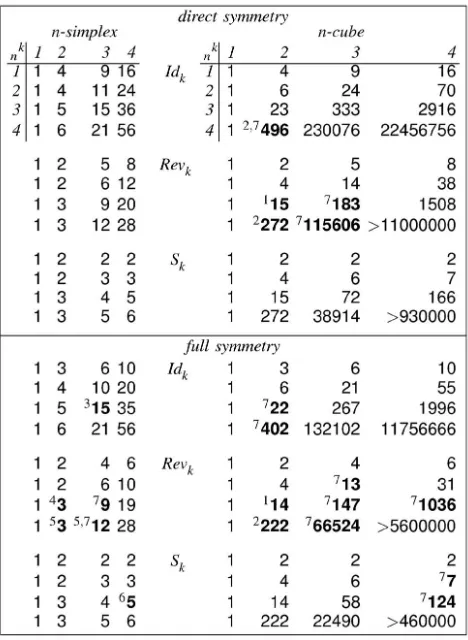
taxonomy of substitope cases, yielding 12 subtables within the taxonomy. The dimensionnand the numberkof colors are the minor parameters, in the range ½1::4, that vary within each subtable of Fig. 8. Each entry in the table gives the number of cases (orbits) for the corresponding colored polytopes. A table entry noted in boldface indicates a combination of parameters that was at work in any of six algorithms surveyed in Section 1.1. The GAP source code
orbitTable.gap that generated the table is freely avail-able for download at the GAP Web site. Computational details about generating the table are given in our previous paper [3]. Where calculation of the case-counts (for four colors of the 4-cube) exceeded the memory capacity of our machines, we merely estimated a lower bound for these entries based on the fact that no orbit can be bigger than the order of the group or else used results from Section 5.
3.3 Discussion
The following examples illustrate the table’s predictive utility. Entries in the table are specified by the five parameters (shapeGroup,colorGroup, shape,n,k).
Example 8.What happens when the algorithm for Separat-ing Surfaces is extended to 3-cubes with four colors? Consulting the table (full, Sk, n-cube, 3, 4) we see that
124 cases arise. For the square (n¼2) with four colors only seven cases arise; they are illustrated in Fig. 1 (top
row), with a possible interpretation of colors that might be derived from medical data.
Example 9. What happens when Marching Squares is extended to handle the degenerate situation fðviÞ
const¼0 at vertices vi? This case would almost never
occur if the scalar function were truly real-valued. But, in practice, integer-valued isosurfaces of integer-valued data sets are routinely displayed, so a level set will, with nonzero probability, pass through many grid point degeneracies. When the set of colors is augmented so it includes the degenerate zero value as a third color for the square (full,Revk,n-cube, 2, 3), 13 cases arise; they are
illustrated in Fig. 1 (bottom row).
Example 10.What happens when Marching Hypercubes is extended to handle the same degenerate situation where fðviÞ const¼0? The table predicts that, forn¼4, the
number of cases explodes from 222 with two colors to 66,524 with three colors under full symmetry and from 272 with two colors to 115,606 with three colors under direct symmetry.
Example 11. Weigle and Banks mentioned the degenerate situation where fðviÞ const¼0 for the n-simplex in
Contour Meshing, but did not enumerate all the cases. How many cases would be found for the 4-simplex with three colors? The table predicts that, for (full, Revk, n-simplex, 4, 3), there are 12 cases.
Example 12. What happens when Interval Volumes is applied to cubes instead of tetrahedra? The table predicts that, for (full,Revk,n-cube, 3, 3), there are 147 cases. Example 13.What happens when another interval is added
to Interval Volumes, creating the four “colors”ð1; aÞ,
ða; bÞ, ðb; cÞ, and ðc;1Þ? With k¼4, the table predicts that, for the tetrahedron (full,Revk,n-simplex, 3, 4), there
are 19 cases and, for the cube (full, Revk,n-cube, 3, 4),
there are 1,036 cases in a hypothetical 4-color version of Interval Volumes.
Example 14. When shapeGroup¼DC4 for the 4-cube, 496 cases arise when the colors are not permuted, whereas there are 272 cases under color reversal. Under full symmetry of the 4-cube, 402 cases arise when the colors are not permuted, whereas there are 222 cases under color reversal. Thus, 50 of the 272 cases fordirect have orientation-reversed partners among the 222 cases forfullin four-dimensional MC.
These examples illustrate how the table in Fig. 8 can be used to determine the number of cases required to implement substitope algorithms and how GAP can enumerate the cases to permit deeper understanding of how the cases occur.
4
HISTORY OF
COUNTING
CASES
[image:7.612.35.269.72.392.2]The problem of enumerating the colorings of ann-cube with two colors has a long history, predating Marching Cubes by more than a century. Mathematicians in the 1870s were considering the kinds of logical propositions that can exist. In Boolean functions ofnlogical variables, each variable can assume a value of either True or False, leading to 2n combinations in the domain of the function. If we Fig. 8. Table of case counts for substitopes. Each of the 12 subtables
contains the case-counts for a given shape group and color group in dimension n with k colors. 1MC. 2Marching Hypercubes. 3Interval
volumes. 4Sweeping Simplices. 5Contour Meshing. 6Separating
associate a spatial dimension inIRnwith each variable (True = 1 and False = 0), then each element of the domain can be represented as an n-vector with coordinates of 0s and 1s. Attempts to enumerate these equivalence classes of functions were carried out in the 1800s, apparently without theire realizing that 2-colorings of the n-cube were also being counted. In 1871, Jevons presented a paper that described the cases that arise in 2-colorings of the 2-cube and the 3-cube [31], but in the guise of Boolean functions. Jevons only considered 192 of the 256 propositions corresponding to 2-colorings of the 3-cube; he found 16 of the 22 equivalence classes. Regarding the 4-cube, Jevons remarked that “some years of continuous labour would be required to ascertain the types of laws [equivalence classes] which may govern the [65,536] combinations of only four things” (p. 143).
In 1877, Clifford claimed a solution to Jevons’s puzzle of counting cases for 2-colorings of the 4-cube. In geometric terms, Clifford’s approach was to consider each coloring as a vector with four components (one for each Boolean variable) with values of 0 or 1. He reported that the216¼
65;536 distinct functions fell into 396 equivalence classes. This impressive (but incorrect) result was publicized in that same year in a work by Jevons on formal logic [32]. Our calculation using GAP found 402 equivalence classes for 2-colorings of the 4-cube withF C4Id2, not 396 [3]. (In an unpublished manuscript fragment “Enumeration of the Types of Compound Statements” [33], Clifford begins an attempt to generalize to then-cube for arbitrarynand also attempts to determine the size of each equivalence class. For n¼4 and c¼1;2;3, he correctly finds the distribution of orbits to be 1, 4, and 6.)
Clifford’s results went unchallenged until 1940, when Po´lya demonstrated how his famous enumeration methods could be applied to this problem in an automated manner. He enumerated the 402 classes of 2-colorings of the 4-cube, and showed where Clifford’s manual tabulations had overcounted in some cases and undercounted in others: “Clifford trouve, par une me´thode laborieuse, les valeurs N4ð6Þ¼47, N4ð7Þ¼55, N4ð8Þ¼78, tandis que je trouve les nombres 50, 56, 74. Des ve´rifications varie´es de mes calcus et l’uniformite´ de ma me´thode me font croire que mes nombres sont justes” [34].1 So, the question of how to determine the number of cases forF C4Id2dates back to 1871 and its solution dates back to 1940.
5
Po´LYA
COUNTING
The subtables in Fig. 8 for which colorGroup¼Idk can be
determined through Burnside-Po´lya counting theory. The group-theorist Burnside derived a formula for counting the orbits of a permutation group [35, Section 145, Theorem VII] and Po´lya developed a theory that exploited Burnside’s result to solve a vast number of counting problems in his classic paper [36]. This work was translated into English as Combinatorial Enumeration of Groups, Graphs, and Chemical Compounds, with commentary and a wealth of references to further applications of Po´lya’s method, by Read [37].
Why are chemical compounds included in Po´lya’s exposition of counting cases? The reason is simple: A molecule is a graph whose vertices are atoms. The different kinds of atoms (e.g., carbon, hydrogen, chlorine) are the “colors.” This is illustrated by the following example: The organic molecule dichlorobenzene has the chemical formula C6H4Cl2; the six carbon atoms are connected in a hexagon, and each carbon is attached to an atom having color “hydrogen” or color “chlorine.” The two chlorines can be separated by 120, 240, or 360; each configuration (or stereoisomer) is an equivalence class of colorings. These equivalence classes are illustrated in Fig. 9. Po´lya realized that Burnside’s formula could be applied to count the number of stereoisomers of chemical compounds.
In this section, we present a brief introduction to Po´lya’s method and show how it can be used to derive some of the numbers in Fig. 8 without brute-force enumeration. A central concept in this method is thecycle index of a permutation groupG, whereGis theshapeGroupin our discussion. This multivariable polynomial records the cycle structure of each permutation inG. Its definition is given below.
Definition 6.Thecycle indexZof a groupGis the polynomial
ZðG;z1; z2;. . .; zdÞ ¼ X
g2G
zj1ðgÞ
1 z
j2ðgÞ
2 z
jdðgÞ d
!
=jGj;
where jiðgÞ is the number of cycles of length i in the permutationg2G,jGjis the order of (i.e., size of)G, anddis the degree ofG(the size of the set permuted byG). Note that jiðgÞmight happen to be zero; for example, no rigid rotation of the square contains a 3-cycle. It is a known result in group theory thatPdi¼1ijiðgÞ ¼dfor eachg2G, which can serve as a check when computing cycle indices by hand.
5.1 Po´lya Applied to a 2-Cube with Full Symmetry
We illustrate the cycle index using the full symmetry group F C2 for the square (presented in Fig. 5), also called the dihedral group D4. This group has order jD4j ¼8, degree d¼4, and contains the following elements.
[image:8.612.330.501.69.170.2]ð1Þð2Þð3Þð4Þ ð1 2Þð3 4Þ ð1 3Þð2 4Þ ð1 4Þð2 3Þ ð1Þð2 3Þð4Þ ð1 2 4 3Þ ð1 3 4 2Þ ð1 4Þð2Þð3Þ:
Fig. 9. The three stereoisomers of dichlorobenzene, whose structure is a hexagonal benzene ring with six atoms attached. Four of these atoms are hydrogen (light color) and two of them are chlorine (dark color). Each row contains colorings that are equivalent under the action of the shape group for a hexagon. Top row: ortho-dichlorobenzene, used as a paint remover. Middle: meta-dichlorobenzene, used as a toilet deodorizer. Bottom: para-dichlorobenzene, used as an insecticide.
Fig. 10 provides explicit details for computing the cycle index for the dihedral group, which corresponds to the discussion below. The second column shows the number of cycles, within element g, of length 1, 2, 3, and 4. The third column shows each zterm, whose subscripts are the cycle lengths and whose superscripts are the number of cycles of that length. The right column gives the product of these terms. When the superscript of a term is zero, that termz0
i
evaluates to unity and does not contribute to the product.
Onez4
1term. The identity permutation inD4, denoted by () or (1)(2)(3)(4), contains four disjoint cycles, each of length 1. Thus, according to the formula, this permutation contributes a term ofz4
1 to the cycle index.
Three z22 terms. There are three permutations that contain a pair of cycles. These permutations ð1 2Þð3 4Þ,
ð1 3Þð2 4Þ, and ð1 4Þð2 3Þ each consist of two cycles of length 2, so each contributes a term ofz2
2to the cycle index.
Two z2
1z12 terms. The permutation ð1Þð2 3Þð4Þ consists of two cycles of length 1, each of which contributes a factor of z2
1 to this permutation’s term, and one cycle of length 2, which contributes a factor ofz12. Thus, this permutation is represented by a term z2
1z12 in the cycle index. The permutation ð1 4Þð2Þð3Þ has the same cycle structure and contributes the same termz2
1z12 to the cycle index.
Two z1
4 terms. The two permutations ð1 2 4 3Þ and
ð1 3 4 2Þ each consist of a single cycle of length 4. Each contributes a term ofz1
4 to the cycle index.
Adding up these terms and dividing by the order of the group, we have
ZðF C2;z1; z2; z3; z4Þ ¼1z41þ2z21z12þ3z22þ2z14=8
as the cycle index of the shape group F C2ffiD4. Remark-ably, the cycle index polynomial serves as a generating system to produce all the values in the (full symmetry,Idk, n-cube) subtable of Fig. 8, with n¼2. The details are described below.
An elementary version of Po´lya’s theorem states that, under the identity action of the color group, the number of
inequivalent colorings of the square, with k colors, is obtained by replacing each variablezi in the cycle index of
theshapeGroupwith the integerk. Thus, fork¼2colors, the number of inequivalent colorings of the square is
ZðF C2; 2;2;2;2Þ ¼24þ22221þ322þ221=8
¼ð16þ16þ12þ4Þ=8
¼6;
which confirms the 2, 2 entry in the (full symmetry, Idk, n-cube) subtable. These are the six equivalence classes of colorings where black and white are not exchanged; for example, the all-white coloring is considered distinct from the all-black coloring.
More generally, we see that the number of inequivalent k-colorings of the square is
ZðF C2;k; k; k; kÞ ¼ k4þ2k3þ3k2þ2k
=8:
This formula can be used to confirm and extend the entire second row of the (full,Idk,n-cube) subtable in Fig. 8. So,
for example, withk¼3colors, we have
ZðF C2; 3;3;3;3Þ ¼34þ233þ332þ23=8
¼ ð81þ54þ27þ6Þ=8
¼21:
Fork¼4colors, we have
ZðF C2; 4;4;4;4Þ ¼44þ243þ342þ24=8
¼ ð256þ128þ48þ8Þ=8
¼55:
We call this polynomial inkthereducedcycle index of the group action.
5.2 Po´lya Applied to a 3-Cube with Direct Symmetry
For a more complicated example, we consider the direct symmetry groupDC3acting on the vertices of a 3-cube. A 3-cube has eight vertices, so this shape group has degree d¼8. We number the vertices of the cube from 1 to 8, as shown in Fig. 11 (left). We can convince ourselves that the group has order 24 as follows: From a standard position, the cube can be manipulated so that any of the six faces is on the bottom. Then, the cube can be rotated about a vertical axis to bring any of the four sides to the front. This yields a total of64¼24permutations, thusDC3has order 24. The cycle structures of each permutation inDC3 are explained below, collected according to rotation axes.
O n e i d e n t i t y . T h e i d e n t i t y p e r m u t a t i o n
ð1Þð2Þð3Þð4Þð5Þð6Þð7Þð8Þ consists of eight cycles each of length 1. Thus, its contribution to the cycle index is the termz8
1.
Nine rotations through opposite faces. We next consider rotations about the vertical axis passing up through the center of the 1; 2; 3; 4 face on the bottom and the5; 6; 8; 7 face on the top. A90 counterclockwise rotation of the cube about this axis produces the permutation ð1 2 4 3Þð5 6 8 7Þ. A 90 clockwise rotation produces the inverse permutation ð1 3 4 2Þð5 7 8 6Þ. Each of these permutations consists of two cycles of length 4, so each contributes a term of z2
[image:9.612.33.268.73.217.2]4 to the cycle index. Moreover, the 180 rotation about this axis produces the Fig. 10. Constituents of the cycle index for the shape groupG¼D4of
full symmetries of the square. The left column contains the group elements. The next column contains the cycle counts. In the top row, the identity element has four cycles of length 1, soj1¼4. In the second row,
the group element has two cycles of length 1, so j1¼2. The next
column contains thez-terms of the cycle index. The value ofjibecomes
the exponent ofzi. The right column contains the product of thezterms.
permutation ð1 4Þð2 3Þð5 8Þð6 7Þ, consisting of four cycles of length 2 and producing a contribution of z4
2 to the cycle index.
There are two other axes of rotation that pass through matching pairs of faces: one passing side-to-side through the centers of the1; 3; 7; 5face on the left and the2; 4; 8; 6 face on the right; the other passing front-to-back through the centers of the 1; 2; 6; 5face in front and the3; 4; 8; 7 face in back. There are three nontrivial rotations about each of these axes, with the same cycle structure as the three listed above for the top-bottom faces. The total contribution to the cycle index of the permutations resulting from rotations about the left-right axis and top-bottom axis is thus 6z24þ3z42.
Six rotations through opposite edges. Next, we consider an axis through the middle of the 1, 5 edge and its opposite 4, 8 edge. A rotation of 180 about this axis produces the permutation ð1 5Þð2 7Þð3 6Þð4 8Þ, for a contribution of z42. There are a total of six such axes through opposite edges, so the corresponding permutations contribute a total of6z4
2 to the cycle index.
Eight rotations through opposite vertices. Finally, we consider an axis passing diagonally through the cube, through vertices 4 and 5. A 120 rotation about this axis fixes points 4 and 5 and spins the trio of points 1, 6, and 7 (lying in a plane perpendicular to the axis) and the trio of points 2, 8, and 3. Thus, it produces the permutation
ð1 6 7Þð2 8 3Þð4Þð5Þ. A rotation in the opposite direction produces the inverse permutationð1 7 6Þð2 3 8Þð4Þð5Þ. Each of these permutations contributes z2
1z23 to the cycle index. Moreover, there are three other axes of this form: one through opposite vertices 1 and 8, one through vertices 2 and 7, and one through vertices 3 and 6. Collectively, the eight permutations of this form contribute8z21z23to the cycle index.
That makes1þ9þ6þ8¼24permutations, so the list is complete. Adding up all the contributions and dividing by the order of the group, we have
ZðDC3;z1; z2; z3; z4Þ ¼z81þ6z24þ9z42þ8z21z23=24
as the cycle index of the direct 3-cube groupDC3. Note that the longest cycle of any permutation in this group is only 4, although the degree of the group is 8 (i.e., there are eight vertices being acted on). Rather than include all eight of them as parameters of the function Z, we have suppressed the four “dummy variables”zifori >4to save space below.
As with the 2-cube, we obtain the number of ways to k-color the 3-cube by replacing each variable zi by the
integer k. Thus, for k¼2 colors, the number of different colorings of the cube, up to rotation, is
ZðDC3; 2;2;2;2Þ ¼28þ622þ924þ82222=24
¼23;
which confirms the 3, 2 entry in the upper right subtable of Fig. 8.
Generalizing once again, we can combine like terms and see that
ZðDC3;k; k; k; kÞ ¼k8þ17k4þ6k2=24
gives the number of differentk-colorings of the cube, up to rotation. This formula can be used to confirm and extend the entire third row of the upper right subtable of Fig. 8. So, for example, withk¼3colors, we have
ZðDC3; 3;3;3;3Þ ¼38þ1734þ632=24
¼333:
Whenk¼4, we have
ZðDC3; 4;4;4;4Þ ¼48þ1744þ642=24
¼2;916:
Clearly the most difficult part of using Po´lya’s theory to count cube colorings is the derivation of the appropriate cycle indices. Beyond three dimensions, the process quickly becomes tedious, nonvisual, and error-prone. Fortunately, the four-dimensional formulas are known and methods for systematically deriving the higher dimensional formulas exist. The formula for the cycle index of the full groupF C4 of symmetries of the 4-cube was derived by Po´lya [34]. He used this result to count the 2-colorings of the 4-cube in the context of counting equivalence classes of Boolean functions of four variables. The formula is
ZðF C4;z1; z2; z3; z4; z5; z6; z7; z8Þ ¼1=384
z16
1 þ51z82þ12z18z42þ84z44þ
32z41z43þ96z22z26þ12z41z62þ48z21z12z34þ48z28:
Po´lya counted the different 2-colorings of the 4-cube, up to rotation and reflection, by replacing each zi by 2. More
generally, we can obtain the number of k-colorings of the 4-cube by replacing eachzi with the integerk, yielding
ZðF C4;z1; z2; z3; z4; z5; z6; z7; z8Þ ¼1=384
k16þ12k12þ12k10þ83k8þ48k6þ180k4þ48k2
[image:10.612.87.479.79.155.2]
as the reduced cycle index.
Fig. 11. The motion-blurred images of continuous rotations of the 3-cube suggest the discrete rotations in the full symmetry groupF C3. From left to
We can confirm Po´lya’s (and GAP’s) count of 402 by replacingk with 2 in this formula. Replacingk with 4 fills one of the missing entries in the table that brute-force enumeration with GAP failed to compute due to insufficient memory [3]. It is easy to see why four colors caused trouble: There are 424
¼4;294;967;296 4-colorings of the 4-cube to consider via brute-force traversal. The reduced cycle index makes the calculation easy: There are 11,756,666 cases. We used GAP to derive
ZðDC4;z1; z2; z3; z4; z5; z6; z7; z8Þ ¼
k16þ12k11þ63k8þ63k4þ48k2
=192
as the reduced cycle index for DC4. Letting k¼4, we fill another entry (22,456,756) that was missing in the pre-viously published table [3].
5.3 Po´lya Applied to a 2-Simplex with Full Symmetry
Now, we turn our attention to symmetries of then-simplex. The full symmetry group acting on a triangle (2-simplex with three vertices) is the symmetric groupS3; its elements are all the permutations of three symbols. In the case of the triangle, the symbols are the three vertices. The3!¼6elements of the group are the identityð1Þð2Þð3Þ, the two rotationsð1 3 2Þand
ð1 2 3Þ, and the three flips ð1Þð2 3Þ,ð1 3Þð2Þ,ð1 2Þð3Þ. Thus, there is a termz3
1arising from three cycles of length 1, there are two terms z1
3 arising from one cycle of length 3, and three termsz1
1z12arising from one cycle of length 1 and one cycle of length 2.
Adding up all the contributions and dividing by the order of the group, we have
ZðS3;z1; z2; z3Þ ¼z31þ2z31þ3z11z12=6
as the cycle index of the full 2-simplex groupS3.
Lettingzi¼kand combining like terms, we see that the
number of differentk-colorings of the triangle is ZðDC3;k; k; kÞ ¼k3þ3k2þ2k=6:
[image:11.612.299.540.462.556.2] [image:11.612.294.510.640.755.2]This formula can be used to confirm and extend the entire second row of the left-hand, full symmetry,Idksubtable of
Fig. 8. Withk¼2;3;4colors, we have
ZðS3; 2;2;2Þ ¼ ð23þ322þ22Þ=6 ¼ 4 ZðS3; 3;3;3Þ ¼ ð33þ332þ23Þ=6 ¼ 10 ZðS3; 4;4;4Þ ¼ ð43þ342þ24Þ=6 ¼ 20
which match GAP’s brute-force calculations.
5.4 Po´lya Applied to a 3-Simplex with Direct Symmetry
In dimension n¼3, the tetrahedron (3-simplex with four vertices) can be acted on by the full symmetry group or by the direct symmetry group that preserves orientation. The latter group is the alternating group A4. Like S4, A4 has elements that permute four symbols, but each element ofA4 can be expressed by an even number of even cycles, as shown below.
ð1Þð2Þð3Þð4Þ ð1 2Þð3 4Þ ð1 3Þð2 4Þ ð1 4Þð2 3Þ ð1Þð2 3 4Þ ð3Þð1 2 4Þ ð4Þð1 3 2Þ ð2Þð1 4 3Þ ð1Þð243Þ ð4Þð1 2 3Þ ð2Þð1 3 4Þ ð3Þð1 4 2Þ
Thus, the cycle index includes a termz4
1 arising from four cycles of length 1. It contains three termsz2
2arising from two cycles of length 2 and eight termsz1
1z13arising from one cycle of length 1 and one cycle of length 3. Adding up all the contributions and dividing by the order of the group, we have
ZðA4;z1; z2; z3; z4Þ ¼z41þ3z22þ8z11z13=12
as the cycle index of the direct 3-simplex groupA4. Letting zi¼kand combining like terms, we see that the number of
differentk-colorings of the tetrahedron, up to rotation, is ZðA4;k; k; k; kÞ ¼ k4þ11k2
=12:
This formula can be used to confirm and extend the entire third row of the left-hand, direct symmetry,Idksubtable of
Fig. 8. Withk¼2;3;4colors, we have
ZðA4; 2;2;2;2Þ ¼ 24þ1122=12 ¼ 5 ZðA4; 3;3;3;3Þ ¼ 34þ1132=12 ¼ 15 ZðA4; 4;4;4;4Þ ¼ 44þ1142=12 ¼ 36
which match GAP’s brute-force calculations.
For general n, the cycle index ZðAn;z1;. . .; znÞ for the
alternating group can be computed from the cycle index of the symmetric group by the formula
ZðAn;z1;. . .znÞ ¼ZðSn;z1; z2; z3; z4;. . .Þ
þZðSn;z1;z2; z3;z4;. . .Þ:
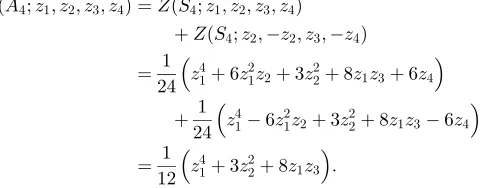
For example, we can compute the cycle index of the group A4as follows:
ZðA4;z1; z2; z3; z4Þ ¼ZðS4;z1; z2; z3; z4Þ þZðS4;z2;z2; z3;z4Þ
¼ 1
24
z41þ6z21z2þ3z22þ8z1z3þ6z4
þ 1
24
z416z21z2þ3z22þ8z1z36z4
¼ 1
12
z41þ3z22þ8z1z3:
We have illustrated the counting of coloredn-simplexes using cycle indices in order to emphasize the universal applicability of Po´lya’s theorem in the counting of equiva-lence classes of colored objects of various sorts. However, there is a shortcut in the case of the n-simplex. It can be shown that
ZðSn;k; k;. . .; kÞ ¼
nþk1 n
¼ðnþk1Þ!
n!ðk1Þ! :
For example, we have
ZðS4;k; k; k; kÞ ¼ kþ3
4
¼kðkþ1Þðkþ2Þðkþ3Þ
4!
¼ 1
24ðk
In addition, it can be shown that
ZðAn;k; k;. . .; kÞ ¼
nþk1 n
þ k
n
¼ðnþk1Þ!
n!ðk1Þ! þ k! n!ðknÞ!:
For example, we have
ZðA4;k; k;. . .; kÞ ¼ kþ3
4
þ k
4
¼kðkþ1Þðkþ2Þðkþ3Þ
4!
þkðk1Þðk2Þðk3Þ
4!
¼ 1
24ðk
4þ6k3þ11k2þ6kÞ
þ 1
24ðk
46k3þ11k26kÞ
¼ 1
12ðk
4þ11k2Þ:
Unfortunately, no such simple formulas exist in the case of n-cubes.
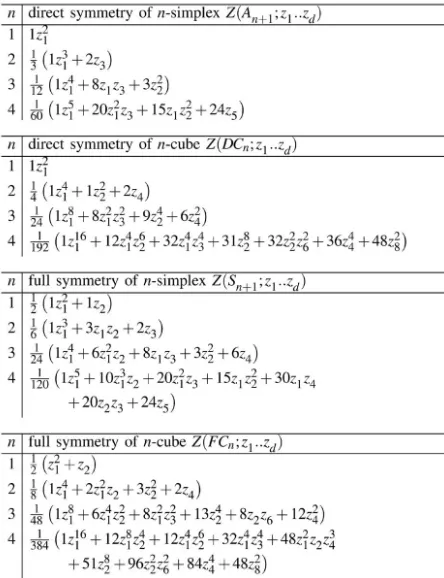
We used GAP to automate the task of determining the cycle structure of the various shape groups. From the cycle structure, we determined the cycle index and the reduced cycle index (a polynomial in thek colors). The results are summarized in Figs. 12 and 13. By choosing values of k from 1 to 4, one can immediately derive the four subtables for then-simplex andn-cube with colorGroupIdk. We are
exploring the use of GAP to compute the cycle indices of arbitrary groups.
5.5 Asymptotics
Compared to brute-force enumeration, Po´lya’s counting technique considerably reduces the complexity of determin-ing sizes of orbits asn andkincrease. Rather than inspect each of thek2n
colorings of ann-cube, one instead counts the number of cycles in each of the 2nn! elements of the full
symmetry group F Cn (each of the 2n1n! elements of the
direct symmetry group DCn). An element permutes 2n
vertices, so counting cycles in a permutation requires inspection of 2n symbols, a total of 2nn!2n operations. Stirling’s approximation
n!nnenpffiffiffiffiffiffiffiffi2n
for n! can be used to compare the expense of brute-force counting versus Po´lya counting. Taking the log of2nn!2nfor
Po´lya, we see that logð2nn!2nÞ is dominated by the term
nlogðnÞ. In a brute-force approach, all k2n colorings are produced, then each is compared to previously generated colorings (or equivalence classes thereof) to enumerate the orbits. LetcðnÞrepresent the average cost of the comparing colorings for ann-cube. We find
logðk2ncðnÞÞ ¼2nlogðkÞ þlogðcðnÞÞ;
which asymptotically dominates nlogðnÞ. Thus, Po´lya’s counting technique provides a distinct advantage in determining the number of colorings of a cube when n grows large. Of course, when we make use of known
formulas for the cycle indices of the permutation groups, it is not necessary to examine the cycle structure of every group element. This makes the advantage enjoyed by the Po´lya method even greater.
For the n-simplex, brute-force counting requires exam-ination of each of the knþ1 colorings, whereas Po´lya counting requires examination ofnþ1symbols in at most n!group elements for a total of at mostðnþ1Þn!operations. So, Po´lya is asymptotically faster than brute-force for counting cases ofn-simplex colorings as well as forn-cube colorings.
Although Po´lya-counting is asymptotically faster than brute-force enumeration of cases, the examples in the previous sections show that finding the cycle index via counting cycles of group elements is still laborious and, thus, is error-prone. The process can be expedited using GAP.
The functioncyclesInPermdefined below generates a list of cycles in a permutationpermacting ondegreevertices.
cyclesInPerm :=function(perm, degree)
local cLen, x, cNumbers;
cLen := Collected(CycleLengths(perm, [1..degree])); cNumbers := ListWithIdenticalEntries(degree, 0);
forxincLen
docNumbers[x[1]] := x[2];od;
returncNumbers;
end;
The function exploits GAP’s capability of computing the cycle lengths in a permutation. For example, the permuta-tion ð2 3Þ ¼ ð1Þð2 3Þð4Þ, acting on four vertices, has two cycles of length 1, one cycle of length 2, zero cycles of length 3, and zero cycles of length 4. This is shown in the fifth row of Fig. 10. When GAP applies the function
cyclesInPerm((2,3), 4), it produces the correct list½2;1;0;0
of cycle counts.
Using the functioncyclesInPermto count cycles in a single permutation, we create a function cyclesInGroup to count cycles in all the elements of a group. This is shown below.
cyclesInGroup :=function(group, degree)
locali, gList, gNumbers; gList := List(group);
gNumbers := ListWithIdenticalEntries(Size(gList), [ ]);
foriin[1..Size(gList)]
dogNumbers[i] := cyclesInPerm(gList[i], degree);od;
returngNumbers;
end;
WithF C4 denoting the full symmetry group of the 2-cube with four vertices, GAP evaluatescyclesInGroup(F C4, 4) to produce the list
[[4,0,0,0],[0,2,0,0],[0,2,0,0],[0,2,0,0], [2,1,0,0],[0,0,0,1],[0,0,0,1],[2,1,0,0]]
giving the cycle structure of each of the eight elements of F C4. This list exactly matches the list shown in the second column of Fig. 8.
List(Collected(gNumbers), Reversed);
[image:13.612.300.530.64.360.2] [image:13.612.41.263.74.363.2][[2,[0,0,0,1]], [3,[0,2,0,0]], [2,[2,1,0,0]], [1 [4,0,0,0]]]
The list after each coefficient indicates the exponents of the zi terms. For example, the element ½2; ½0;0;0;1
corre-sponds to the monomial term 2z01z02z03z14¼2z4. Taken together, the four collected terms produce the polynomial
pðz1; z2; z3; z4Þ ¼2z14þ3z22þ2z21z12þ1z41
from which the cycle index Z is found using Z¼p=jGj. Using GAP, one can therefore determine the cycle index for the full symmetry group and the direct symmetry group acting on the n-simplex or on the n-cube. The results are given in Fig. 12. Substitutingkfor eachziyields the reduced
cycle indices in Fig. 13.
The asymptotic growth of each reduced cycle index polynomial is determined by its leading term (in which k has the largest exponent). This leading term corresponds to the cycle structure of the identity element acting on the set of dvertices. The identity permutation consists ofdcycles, each of length 1, which contributes zd
1 to the cycle index. There can be no term with an exponent larger than d becausedis the degree of the group action on the set. The number of vertices isnþ1for ann-simplex and is2nfor an n-cube. Hence, the reduced cycle index is dominated by the termknþ1for a simplex and byk2nfor a cube. Group actions on the set of colors, such as reversal or full permutation, make some colorings become equivalent and thus reduce the number of orbits compared to the action ofIdk. Hence,
the largest number of equivalence classes for a simplex or
cube occurs when the color group is the identity. For any fixedn, askincreases, we have:
ZðSnþ1;k; k;. . .; kÞ
knþ1
ðnþ1Þ!
ZðAnþ1;k; k;. . .; kÞ 2knþ1
ðnþ1Þ!
ZðF Cn;k; k;. . .; kÞ
k2n
2nn!
ZðDCn;k; k;. . .; kÞ
k2n
2n1n!:
These approximations indicate the relative complexity of enumerating cases for simplexes and cubes withk colors. Note that the growth in the number of simplex cases is dwarfed by the number of cube cases. We have not yet computed the equations that result from applying non-trivial color groups; we plan to present those results in a future paper.
6
SUMMARY
Marching Cubes (MC), and algorithms like it, share the essential feature of applying geometric substitution to colored polytopes, producing substitopes. These algorithms vary in the choice of symmetry groups (direct symmetry or full symmetry) acting on vertices and permutation groups (identity or reversal or symmetric) acting on colors. They vary in the choice of polytope (n-cube orn-simplex) and in the choice of dimensionnand number of colorsk. The color is merely an abstraction of any function evaluated at a vertex.
We presented a technique for enumerating the cases of polytope colorings, where two colorings belong to the same
Fig. 13. Reduced cycle index polynomials. These polynomials generate the subtables of Fig. 8 corresponding to the action ofIdkon the colors.
Fig. 12. Cycle index polynomials. Replacing eachziwith the numberkof
equivalence class (or orbit) if a group action sends one coloring to the other. A software tool for computational group theory, called GAP, can enumerate all the orbits. Not only can GAP count the number of orbits automatically, but it can also enumerate the members of each orbit. This capability eliminates a very difficult part of developing any substitope algorithm. This tool works well for small values of nandk. One benefit of using GAP is that it automatically and independently confirms the results previously announced for counting the cases in four-dimensional MC [8], [7], [6], results that cannot reasonably be checked by hand and that have been of interest to mathematicians since the 1871 work by Jevons. Moreover, it permits us to predict the case-counts for other substitope algorithms that have yet to be invented, simply by treating the shape symmetry and the color symmetry as parameters of the case-counting function. The parameters impose a clear taxonomy on this collection of algorithms where no such organization has heretofore been suggested. This indicates that a very deep, very generic underlying algorithm for visualization exists which can be incarnated in many different ways. The taxonomy also shows the intimate connection between group theory, geometry, and visualization using substitope algorithms.
ACKNOWLEDGMENTS
The authors gratefully acknowledge support by US National Science Foundation grants CISE-#0083898 and FRG-#0101429 and by the Scottish Higher Education Funding Council (SHEFC) and the Particle Physics and Astronomy Research Council (PPARC) for use of the Beowulf cluster to run ParGAP on the larger problem sizes. They thank Eric Klassen for fruitful discussions about group actions and orbits.
REFERENCES
[1] W.E. Lorensen and H.E. Cline, “Marching Cubes: A High Resolution 3D Surface Construction Algorithm,”Proc. SIGGRAPH 1987,pp. 163-169, 1987.
[2] H.S.M. Coxeter,Regular Polytopes.Dover Publications, 1973. [3] D.C. Banks and S. Linton, “Counting Cases in Marching Cubes:
Toward a Generic Algorithm for Producing Substitopes,” Proc. Visualization 2003,2003.
[4] J. Bloomenthal, “Polygonization of Implicit Surfaces,” Computer-Aided Geometric Design,vol. 5, pp. 341-355, 1988.
[5] H.-W. Shen and C.R. Johnson, “Sweeping Simplices: A Fast Iso-Surface Extraction Algorithm for Unstructured Grids,”Proc. IEEE Visualization 1995,pp. 143-151, 1995.
[6] S.F. Kirchberg, “Marching Hypercubes—ein Verfahren zur Kon-struktion von Hyperfla¨chen aus 4D-Rasterdaten,” Universita¨t Dortmund, doplomarbeit am Lehrstuhl 7, 1993.
[7] J.C. Roberts and S. Hill, “Piecewise Linear Hypersurfaces Using the Marching Cubes Algorithm,” Visual Data Exploration and Analysis VI, Proc. SPIE,R. Erbacher and A. Pang, eds., pp. 170-181, Jan. 1999.
[8] P. Bhaniramka, R. Wenger, and R. Crawfis, “Isosurfacing in Higher Dimensions,”Proc. IEEE Visualization 2000,pp. 267-273, 2000.
[9] G.M. Nielson and J. Sung, “Interval Volume Tetrahedrization,”
Proc. IEEE Visualization 1997,pp. 221-228, 1997.
[10] C. Weigle and D.C. Banks, “Complex-Valued Contour Meshing,”
Proc. IEEE Visualization 1996,pp. 173-180, 1996.
[11] H.-C. Hege, M. Seebass, D. Stalling, and M. Zo¨ckler, “A General-ized Marching Cubes Algorithm Based on Non-Binary Classifica-tions,” Technical Report SC 97-05, Konrad-Zuse-Zentrum fu¨r Informationstechnik Berlin, Dec. 1997.
[12] D. Stalling, M. Zo¨ckler, O. Sander, and H.-C. Hege, “Weighted Labels for 3D Image Segmentation,” Technical Report SC 98-39, Konrad-Zuse-Zentrum fu¨r Informationstechnik Berlin, Dec. 1998. [13] Module: GMC, Template Graphics Software (User manual entry
for amira visualization software), 2000.
[14] K. Montgomery, C. Bruyns, and S. Wildermuth, “A Virtual Environment for Simulated Rat Dissection: A Case Study of Visualization for Astronaut Training,” Proc. IEEE Visualization 2001,pp. 509-512, 2001.
[15] H.-C. Hege, “Enumeration of Symmetry Classes in Mesh Genera-tion,” Report on Dagstuhl Seminar 9821: Hierarchical Methods in Computer Graphics, M. Gross, H. Mu¨ller, P. Schro¨der, and H.-P. Seidel, eds., pp. 9-10, May 1998.
[16] G.M. Nielson and R. Franke, “Computing the Separating Surface for Segmented Data,”Proc. IEEE Visualization 1997,pp. 229-233, 1997.
[17] H.-W. Shen, C.D. Hansen, Y. Livnat, and C.R. Johnson, “Isosurfacing in Span Space with Utmost Efficiency (ISSUE),”
Proc. IEEE Visualization 1996,pp. 287-294, 1996.
[18] J. Wilhelms and A.V. Gelder, “Octrees for Faster Isosurface Generation,”ACM Trans. Graphics,vol. 11, no. 3, pp. 201-227, July 1992.
[19] P. Cignoni, P. Marino, C. Montani, E. Puppo, and R. Scopigno, “Speeding Up Isosurface Extraction Using Interval Trees,” J. Symbolic Logic,vol. 3, no. 2, pp. 158-170, 1997.
[20] R.S. Gallagher, “Span Filter: An Optimization Scheme for Volume Visualization of Large Finite Element Models,” Proc. IEEE Visualization,1991.
[21] A. Lindenmayer, “Developmental Systems without Cellular Interaction, Their Languages and Grammars,” J. Theoretical Biology,vol. 30, pp. 455-484, 1971.
[22] P. Prusinkiewicz and A. Lindenmayer,The Algorithmic Beauty of Plants,1990.
[23] A. Glassner, “A Tutorial on Geometric Replacements,” IEEE Computer Graphics and Applications,vol. 12, no. 1, pp. 22-36, Jan. 1992.
[24] M. Lounsbery, T.D. DeRose, and J. Warren, “Multiresolution Analysis for Surfaces of Arbitrary Topological Type,”ACM Trans. Graphics,vol. 16, no. 1, pp. 34-73, 1997.
[25] L. Kobbelt, S. Campagna, and H.-P. Seidel, “A General Frame-work for Mesh Decimation,” Proc. Graphics Interface,pp. 43-50, 1998.
[26] A. Cayley, “On the Theory of Groups, as Depending on the Symbolic Equationn¼1,”Philosophical Magazine,vol. 7, pp. 40-47, 1854.
[27] J.G. Fraleigh,A First Course in Abstract Algebra,sixth ed. Addison-Wesley, 1998.
[28] P.M. Cohn,Algebra, volume 1,second ed. Wiley, 1984.
[29] AA. Seress, “An Introduction to Computational Group Theory,” Notices of the AMS,vol. 44, no. 6, pp. 671-679, June/July 1997. [30] M. Scho¨nert, GAP—Groups, Algorithms and Programming,
Lehr-stuhl D fu¨r Mathematik, RTWH, Aachen, 1994.
[31] W.S. Jevons, “Solution of the Inverse or Inductive Problem, Involving Two Classes,”Proc. Manchester Literary and Philosophical Soc.,vol. xi, pp. 65-68, Dec. 1871.
[32] W.S. Jevons, The Principles of Science: A Treatise on Logic and Scientific Method.1874, second edition, reprinted with corrections, 1879, 1883, 1887, 1892, 1900, 1905, 1907, 1913.
[33] W.K. Clifford, Mathematical Papers, R. Tucker, ed. London: MacMillan and Co., 1882, introduction by H.J. Stephen Smith; reprinted by Chelsea, N.Y., 1968.
[34] G. Po´lya, “Sur les Types des Propositions Compose´es,”J. Symbolic Logic,vol. 5, no. 3, pp. 98-103, Sept. 1940.
[35] W. Burnside,Theory of Groups of Finite Order,second ed. London: Cambridge Univ. Press, 1911.
[36] G. Po´lya, “Kombinatorische Anzahlbesimmungen fu¨r Gruppen, Graphen und Chemische Verbindungen,” Acta Math., vol. 68, pp. 145-254, 1937.
[37] G. Po´lya and R.C. Read, Combinatorial Enumeration of Groups, Graphs, and Chemical Compounds.New York: Springer-Verlag, 1987. [38] “GAP—Groups, Algorithms, and Programming, Version 4.3,” The
GAP Group, 2002, http://www.gap-system.org.
[39] W.K. Clifford, “On the Types of Compound Statement Involving Four Classes,” Proc. Manchester Literary and Philosophical Soc.,
vol. xvi, pp. 88-101, Jan. 1877.