SYSTEMS SUPPORT FOR DISTRIBUTED LEARNING
ENVIRONMENTS
Colin Allison
A Thesis Submitted for the Degree of PhD
at the
University of St Andrews
2003
Full metadata for this item is available in
St Andrews Research Repository
at:
http://research-repository.st-andrews.ac.uk/
Please use this identifier to cite or link to this item:
http://hdl.handle.net/10023/14519
Systems Support
for
Distributed Learning Environments
< > m o
A thesis submitted to the
University of St Andrews
for the degree of
Doctor of Philosophy
by
Colin Allison
ProQuest Number: 10166799
All rights reserved INFORMATION TO ALL USERS
The quality of this reproduction is dependent upon the quality of the copy submitted. In the unlikely event that the author did not send a com plete manuscript and there are missing pages, these will be noted. Also, if material had to be removed,
a note will indicate the deletion.
uest
ProQuest 10166799
Published by ProQuest LLO (2017). Copyright of the Dissertation is held by the Author.
All rights reserved.
This work is protected against unauthorized copying under Title 17, United States C ode Microform Edition © ProQuest LLO.
ProQuest LLO.
789 East Eisenhower Parkway P.Q. Box 1346
Abstract
This thesis contends that the growing phenomena of multi-user networked “learning environments” should be treated as distributed interactive systems and that their developers should be aware of the systems and networks issues involved in theii" construction and maintenance. Such environments aie henceforth referred to as
distributed teaming environments, or DLEs. Three major themes are identified as part of
systems support: i) shared resource coherence in DLEs; ii) Quality of Service for the end- users of DLEs; and iii) the need for an integrating framework to develop, deploy and manage DLEs.
The thesis reports on several distinct implementations and investigations that are each linked by one or more of those themes. Initially, responsiveness and coherence emerged as potentially conflicting requirements, and although a system was built that successfully resolved this conflict it proved difficult to move from the “clean room” conditions of a reseai'ch project into a real world learning context. Accordingly, subsequent systems adopted a web-based approach to aid deployment in realistic settings. Indeed, production versions of these systems have been used extensively in credit-bearing modules in several Scottish Universities.
Interactive responsiveness then emerged as a major Quality of Service issue in its own
right, and motivated a series of investigations into the sources of delay, as experienced by end users of web-oriented distributed learning environments. Investigations into this issue provided insight into the nature of web-oriented interactive distributed learning and highlighted the need to be QoS-aware.
As the volume and the range of usage of distributed learning applications increased the need for an integrating framework emerged. This required identifying and supporting a wide variety of educational resource types and also the key roles occupied by users of the system, such as tutors, students, supervisors, service providers, administrators, examiners.
Declarations
carried out by me and that it has not been submitted in any previous application for a higher degree.
date 25/6/2003... signature of candidate
I was admitted as a research student in 1991 and as a candidate for the degree of Ph D in 1991; the higher study for which this is a r^ord was carried out in the University of St Andrews bptween 1994 and 2002. ^ date 25/612003 signature of candidate i
I hereby certify that the candidate has fulfilled the condihoiis of the
this thesis in application for that degree,
date 25/6/2003 signature of supervisor..
the regulations of the University Library for the time being in foice, subject to any copyright vested in the work not being affected thereby. I also understand that the title and abstract will be published, and that a copy of the work may be made and supplied to any bona fide library or research worker. ,
Acknowledgements
The primary thanks for the completion of this part-time Ph.D. thesis must go to my immediate family, Rosa and Martin, without whose extensive support and tolerance this thesis would never have been finished. I must also thank my parents, Chris and John, who, in the Scottish tradition, instilled in me a belief in the value of learning and educational attainment. I also thank many colleagues and friends who have been supportive of the work behind this thesis: Mike Livesey for his insights into virtual time; Alan Ruddle for insight into TCP; Paul Harrington and Feng Huang for their enthusiasm during the Waip project; David Power, Christine Helliar, Donald Sinclair and Rosa Michaelson at the Department of Accounting and Business Finance, University of Dundee, for their close co-operation on Finesse; all the other participants in the TAGS pilots at various Scottish institutions; Alan Ruddle, David McKechan, Jose Serrano, Martin Bramley, Ross Nicholl and Martin Bateman for contributions towards the evolution of TAGS as both a production service and an experimental framework; Pete Lindsay for suggestions on protocol visualisation; Alan Dearie for finding time for supervision while having other responsibilities; Ron Morrison for having read and helped with the final version; the Postgraduate Committee and the School of Computer Science at the University of St Andrews for their understanding that theses being completed on a part-time basis can take a little longer than originally expected.
Colin Allison
Systems Support for Distributed Learning Environments
Contents
1. Introduction
1.1 Thesis Overview... l.l
1.2 Distributed Learning Environments... 1.1
1.3 The Genesis of Distributed Learning Environments...1.4
1.4 Pedagogical Goals and their Technical Implications...1.5
1.5 Users, Roles and Requirements... 1.8
1.5.1 Learner Requirements...1.8 1.5.2 Academic Requirements...1.9 1.5.3 Course Co-ordinator Requirements...1.9 1.5.4 System Administrator Requirements... . 1.10 1.5.5 Developer Requirements... 1.10 1.5.6 Service Provider Requirements... 1.10 1.5.7 User-Centric V iew s... 1.11
1.6 A Layered Reference Model...1.13
1.6.1 Quality of Service... 1.14
1.6.2 OLE Middleware...1.15
1.7 Summary...1.17
2. Systems concepts used in addressing OLE requirements
2.1 QoS, Computer Networks and the Internet... 2.3
2.3 Groupware... 2.27
2.3.1 Groupware Environments 2.29
2.3.2 Sharing, ConcuiTency and Coherence 2.31
2.3.3 Groupware Environments and QoS 2.34
2.3.4 Security 2.36
2.4 Summary...2.42
3 Related Work
3.1 Background...3.1
3.1.1 BSCW: Web-based groupware 3.3
3.1.2 PIP VIC: IP Multicast for Educational Applications 3.4
3.1.3 Internet2: QoS 3.4
3.1.4 Internet2: Security Infrastructure 3.5
3.2 dOPT: Coherence in Groupware Systems...3.5
3.2.1 The dOPT groupwaie model 3.6
3.2.2 Interpreting dOPT 3.10
3.2.3 Discussion: Serialisability in Groupware 3.11
3.3 TimeWarp: Coherence in Distributed Systems...3.14
3.3.1 Virtual Time 3.15
3.3.2 Local Virtual Time and Rollback 3.15
3.3.3 Global Virtual Time and Commitment 3.17
3.4 BSCW: A Framework for Web-Based Groupware Environments...3.18
3.4.1 BSCW in Educational Contexts 3.19
3.4.2 Discussion: Web-based Groupware 3.20
3.5 PIP VIC: IP Multicast Groupware in Educational Contexts...3.21
3.5.1 The Mbone Tools as Groupware 3.26
3.6 Internet2: A New Infrastructure for Education...3.28
3.6.1 Internet2 and Quality of Service: The Qbone 3.29
3.6.2 Distributed Access Control: Shibboleth 3.30
4. Addressing the Coherence Requirement
4.1. Explicit Virtual Time Based Coherence... 4.1
4.1.1. Twarp Process Model... 4.2 4.1.2. Operational Communications Model...4.4 4.1.3. Node Configuration...4.6 4.1.4. Global Virtual T im e...4.7 4.1.5. Persistent Object Storage and State...4.11 4.1.6. Lessons Learned from Twaip...4.14
4.2. WARP: A Coherence Mechanism for Distributed Groupware... 4.15
4.2.1. System Overview... 4.16
4.2.2. Objects...4.18 4.2.3. Atoms...4.19 4.2.4. The Differences between Atoms and Transactions...4.19 4.2.5. Resolving Conflict...4.21 4.2.6. The Warp Runtime Library... 4.29
4.3. A Groupware Case Study: The Warp-based Shared Spreadsheet...4.33
4.3.1. Group awareness features... 4.34
4.3.2. The shared context...4.36 4.3.3. WYSIWIS issues in the shared spreadsheet... 4.37 4.3.4. Editing Sessions... 4.38 4.3.5. Quality of Service Issues in the Spreadsheet... 4.38 4.3.6. The Shared Spreadsheet in an Educational Context...4.39 4.3.7. Lessons Learned... 4.41
5 Addressing the Framework Requirement
5.1 Finesse: Finance Education in a Scalable Software Environment...... 5.3
5.1.1 Origins of Finesse 5.4
5.2 The TAGS Framework for DLEs ... 5.21
5.2.1 Users, Roles and Groups 5.22
5.2.2 Events 5.24
5.2.3 Support for Developers 5.26
5.2.4 Resources 5.28
5.2.5 Support for Service Providers 5.33
5.3 Case Study: Group-Based Management of Distributed IT Work Placements....5.39
5.3.1 The Document Approval Tool (DAT) 5.41
5.3.2 Evaluation of the DAT 5.43
5.3.3 Evolution of the DAT 5.44
5.4 Summaiy...5.47
6 Understanding the Quality Of Service Requirements for Interactive Responsiveness
6.1 Interactive Responsiveness in Finesse... ;...6.2
6.1.1 Basic Web Operations 6.4
6.1.2 Proxies and caching 6.5
6.1.3 A Structured Timing Model 6.5
6.1.4 Timing Issues 6.8
6.1.5 Measurements 6.10
6.1.6 Analysis and Solutions 6.12
6.2 A Revised Model of Web Delay Analysis...6.13
6.2.1 Client Limitation 6.15
6.2.2 Network Limitation 6.16
6.1.3 Protocol Limitation 6.19
6.1.4 Server Limitation 6.24
6.2 Applying the revised model to TAGS...6.26
6.1.1 Client Limitation 6.27
6.1.2 S erver Limitation 6.28
6.1.3 Network Limitation 6.29
6.1.4 Comparison of Client, Network, Protocol and Server Limitations 6.29
7 Addressing the Qos Requirements for Interactive Resources
7.1 Interactive Responsiveness - A Multiple Server Approach... 7.3
7.1.1 The Case for Replication 7.6
7.1.2 A Replicated Resource Architecture 7.7
7.1.3 Types of Replication and Coherence 7.9
7.1.4 Replication Strategy 7.16
7.1.5 Coherence Strategy 7.17
7.1.6 An analytical model of coherence delay 7.22
7.1.7 Case study - The TAGS Notebook Resource 7.24
7.2 Interactive Continuous Media - Adaptability and Integration... 7.28
7.2.1 Adaptation Strategy 7.30
7.2.2 Integration Strategy 7.37
7.2.3 Case Study: Small Group Collaboration 7.40
7.2.4 A Scenario Driven Testbed for Conference Resource Development 7.42
7.3 Summary...7.43
8 Conclusion
8.1 Distributed Learning Environments...8.1
8.2 Coherence...8.2
8.2.1 A Shared Spreadsheet 8.3
8.3 QoS... ...8.3
8.3.1 Understanding Delay in Server-based Resources 8.4
8.3.2 Addressing Server Limitations 8.6
8.3.3 Addressing Timeliness 8.7
8.3.4 Integration of QoS-Oriented Support Features 8.8
8.4 The Framework... 8.8
Systems Support for Distributed Learning
Environments: Introduction
1.1 Thesis Overview
This thesis reflects how trails of interests, investigations and implementations gradually converged into the unifying topic of system support for distributed learning. This introductory chapter explains the concept of a “distributed learning environment”, why it is of significance and worthy of research, and what it requires in terms of systems and network support. The second chapter identifies and describes particular systems and networks concepts used to address the needs of such environments. These include specific concerns within the wider categories of computer networks, distributed systems and groupware systems that are applicable to distributed learning environments. Chapter 3 describes and critically evaluates some other research projects that are related to the systems issues identified in Chapters 1 and 2. These issues form the focus of the investigations described in the following four chapters:
Chapter 4: the use of virtual time to provide coherence in distributed groupware
Chapter 5: a framework for the development, deployment and management of web- based groupware in an educational context
Chapter 6: identifying, modeling and measuring the sources of delay in interactive responsiveness, a key Quality of Service requirement of distributed learning environments
Chapter 7: the design of architectures and prototyping of systems that support interactive responsiveness requirements, and timeliness requirements for video conferencing
Finally, Chapter 8 concludes this thesis.
1.2 Distributed Learning Environments
education, wider access and lower costs in the education and training sector. The most recent major report on the future of higher education in the UK‘ stated:
""Advances in communications and IT (C&IT) will radically alter the shape and delivery of learning throughout the world. Over the next decade ....UK institutions will rely heavily on C&IT to teach quality, flexibility and ejfectiveness of higher education. The potential benefits will extend to, and affect the practice of, learning and teaching and research. C&IT will have a central role in maintaining the quality o f higher education in an era when there are likely to be continuing pressures on costs and a need to respond to an increasing demand for places in institutions. C&IT will overcome barriers to higher education, providing improved access and increased effectiveness, particularly in terms of lifelong learning.''(Dearing 1997)
oriented, document-centric, groupware system, which is described in Chapter 3 under Related Work.
The problem is that the adoption of what is easy to accomplish on the web is then labeled as "e-learning" without any reference to pedagogy, and with little or no understanding of the underlying technology. An increasingly voiced criticism of this use of the web is that the role of the teacher is reduced to that of a selector of material (information) for learners to look at, and that learning is then confused with information transfer. Similarly, the heavy use of multiple choice questions for web-based assessment reflects the use of what is technically convenient rather than what is pedagogically effective.
On the technical side these e-leaming platforms are distributed systems in the simple sense that any client-serwer web interaction is distributed. As there is little attention paid to any networking or systems issues in these platforms it is not uncommon for them to collapse under load, misbehave when used in some unexpected manner, be unavailable at critical times, and be unable to accommodate innovative or effective pedagogies. For example, the shared spreadsheet described in Chapter 4, and the Portfolio Management Facility that uses real-time stock market data that is described in Chapter 5 could not be accommodated by those platforms.
Although it may seem obvious that the successful deployment of DLEs depends on the use they malœ of the network and systems infrastructure upon which they are built, online learning packages such as WebCT, Blackboard and others that are compared in
(Britain & Liber 1999) ignore such issues. Indeed, there seems little concern from such
packages, and their evaluators, for quality of service (QoS) issues of any kind.
This thesis contends that DLEs should be treated as QoS-aware distributed interactive systems, and documents the construction, deployment and evaluation of DLEs according to this principle. The benefit is that DLEs become more useable and effective, and better able to stimulate and support innovative and effective pedagogical practice.
1.3 The Genesis of Distributed Learning Environments
What is meant by a DLE in this thesis? The term is intended to capture the use of network-based distributed application environments that aie used directly by learners and teachers for educational purposes. The ubiquity of the Internet means that any educational institution can now exploit and share its teaching expertise and educational resources through online access programmes - this type of activity is no longer the preserve of specialist institutions. Indeed, if access to quality education is to be widened, it is imperative that all institutions play their part. The routine use of DLEs creates requirements for systems support and a need for appropriate software architectures.
DLEs differ in several important respects from earlier computer-based and distance learning scenarios. Online environments are intrinsically multi-user - where a student may previously have worked in isolation on a computer, DLEs have the potential to:
® Support teamwork, through various forms of conferencing and shared tasks.
® Introduce real world input into the study environment. For example: finance students studying fund management can work in groups to run a virtual portfolio of shares whose value is updated in real time by data from the London Stock Exchange; video streams of real-time surgery can be transmitted live to the desktop; meteorology students can access satellite weather data in real time and compare their predictions with those of the local news programs.
use they make of the system and feed this information back into the educational prcicesi. on an individual basis, thereby supporting student-centred learning. The use of a distributed client-server structure in DLEs also means that the QoS being delivered to a user can be monitored and measured. Analysis of this type of information can inrform the future development of a DLE’s content, architecture and selection of infrastructure options.
Some exponents of DLEs see them as replacing social learning and sidelining the lecturer and campus experience. There is nothing inherent in the concept of a DLE that supports these views. On the contiary, a DLE can reinforce the uniqueness and qualir^ o: education in different institutional contexts. It is noteworthy that MIT has provided free public access to many of its online teaching resources (Long 2002), because it believes thai
an effective education requires the experience that can only be gained by attending; an institution in person, that is, social learning.
So, it is important to state that opting to use DLEs does not imply the replacemerv o: educationally stimulating experience by “distance” or “virtual” learning. It follows tha: the process of DLE construction must be flexible and accommodating, and not prescribe or restrict the uses of IT in education. Accordingly, this thesis adopts the concept :>f a
framework approach to facilitate the research, development, deployment and
management of DLEs. This approach provides flexibility by sepaiating the generic requirements of DLEs from the specifics for any particular locale or subject-specnfic learning resource types. That framework is grounded in the established principles of interactive distributed groupware systems.
1.4 Pedagogical Goals and their Technical Implications
From the perspective of good educational practice the following features should ne supported in a DLE:
• group worldng should be routinely supported as well as the more traditional mcmel of the solitai y learner
• real-world input should be easy to incorporate, as should simulations
• students should find themselves at the centre of their online environment, with their individual needs addressed
® wider, more flexible access to education should be provided, often refeixed to as “anytime/anywhere” learning
Those pedagogical goals imply certain technical requirements.
® Support for group working means that online resources may be shared and used by
multiple concuixent readers and writers. This requires concurrency control, and raises the usual associated concerns with liveness, safety and fairness. If two or more members of a group ai'e modifying the state of a shared resource, at the same time, it is important that the resource is not left in an unintended state. If the shaied resource is distributed, replicated or cached, it is important that different users do not end up with different versions, while believing them to be accurate copies of a single authoritative version. In addition, multi-user awareness is important for teamwork. Members of a group need to know what others are doing, and have appropriate communication options to co-ordinate with each other. For example, text-based, audio or video conferencing may be used to augment shared resource interaction.
® Interactivity means that online working is much more than simply browsing or
returned to them should be no longer than some period that is considered reasonable within a particular context. (A user working from home over a relatively low bandwidth modem line will have lower expectations than one who is attachée to a high-speed campus network). If a network service is perceived to be “slow” rmen it will be seen as an unproductive use of time, and may be abandoned.
® Real world input is facilitated by direct Internet connection to dynamic data sets. For
example, the Finesse portfolio management facility (Power et al. 1998) allow s, the
management of a portfolio of shares by a student group. The groups maintain their portfolios by buying and selling shares chosen from a database of live value:: for companies that are quoted on the London Stock Exchange.
® Student-centred means understanding users as individuals and implies strong
monitoring capabilities, be they for manual inspection, automatic adaptation, or reflective feedback for learners. In an interactive online environment it is of course possible to implement extensive activity logging, which can then be “mined” for useful feedback on a student's use of a set of educational resources. This feedinack can be used to inform the resource development and adaptation process and themeb\ enhance the learning environment.
9 Anytime/anywhere implies a resilient, highly available network service. Availabhlit}
means coping with faults or slow downs in responsiveness. Providing a ser-'ice based on multiple servers can negate periods of non-availability caused by server crashes and peak loads. These servers may be distributed across a wide area, possibly globally. If the same set of servers is also used to share the load [:ien
1.5 Users, Roles and Requirements
What types of user does a DLE have? End-users typically fall into one of three general roles:
• learner
• academic
• systems-related
Within these general roles it is possible to list examples of specific roles and responsibilities, as shown in Table 1.1. A user may of course have more than one role, especially if they are academic staff. It is also possible for a staff member to be a student.
General
Roles Learner Academic Systems-related
Science student Tutor Systems
specific Arts student Lecturer Administrator
role Postgraduate Student Demonstrator Service Provider
examples Part-time Student Course Co-ordinator Software developer
Member of tutorial group External Examiner Member of module class Head of School Member of degree Director of Teaching programme cohort Subject-specialist
Table 1.1: Som e of the roles taken by end-users of a DLE
1.5.1 Learner Requirements
defined options; real-world input should be incorporated where appropriate; the DUE should be available anytime, from anywhere. Students also frequently wish to know how they are doing, relative to other members of their tutorial group or module cohort. Feedback such as appropriate class averages can be generated automatically and made accessible to them. Further types of reflective feedback may include attendance and performance records for a series of lectures or tutorials.
A student may also need to attend a tutorial remotely, using video conferencing for example. In this case the conference resource should be able to adapt to the nature of the remote network connection,
1.5.2 Academic Requirements
Academics may be computer literate, but aie raiely computing specialists with an understanding of operating systems. Accordingly, a DLE must be able to provide useful abstractions for them to work with. These are likely to include roles such as student,
tutor, and course co-ordinator, and concepts such âs group, course, module, class and
assignment. At the same time, lecturers require freedom and flexibility to create :heir own operational environment, so an approach that is too prescriptive is likely to prove unpopular and counter-productive. The provision of simple abstractions that can be used as building blocks is therefore attractive. Particular constructions can be saved as templates consisting of certain components and the relations between them. These can form the basis of generic models which can be used by those academics that are not directly involved in the DLE design and construction process to focus their requirements and evaluate the capabilities of a particular type of DLE, prior to choice and commitment.
1.5.3 Course Co-ordinator Requirements
due dates have been missed. It follows that a co-ordinator's role requires a different view and set of capabilities than those allocated to a tutor.
1.5.4 System Administrator Requirements
While a DLE should empower academics as much as is possible there will inevitably be tasks in its creation and maintenance that require computing expertise. These may include operating systems and web-server configuration, security measures, and server configuration. A system administrator is likely to need a global view of a DLE.. and have special privileges, in order to see the problems that are reported, and then readily fix them.
1.5.5 Developer Requirements
There should be no restriction on the nature of an educational resource. It may be a simple timetable, an automated assessment exercise or an interactive multi-user simulation. In contrast to learners and tutors, developers are computing specialisi.s. in that they develop and maintain resources. It is productive to let people play to :heir strengths, and in the case of developers this means allowing them to focus or. the objectives required by subject-specialists without worrying about the implementaticm of generic facilities for the deployment, distribution, access control, and other management tasks associated with a learning resource. A DLE should provide a useful set of generic services and interfaces for developers. For example, generic models for distribution allow a developer to choose the conditions under which their resource can be replicuied, made available, copied, re-used, and accounted for.
1.5.6 Service Provider Requirements
Responsiveness and availability should be supported. Supporting responsiveness means ensuring that the network connection is of adequate bandwidth and latency and that the server(s) can respond in adequate time, even under peak loads. If there is a high variance in loads and a dynamically growing user base scalability becomes a major issue. Initially provisioning a monolithic system of sufficient capability to meet peak demands is not a good solution as small changes in the scheduling of content or the size of the user base can quickly invalidate predictions about peaks. Availability means coping with failures. Failures can occur in either the network or the server. A scheme to maintain responsiveness and availability under varying loads is therefore highly desirable.
1.5.7 User-Centric Views
All users have a common usability requirement, namely a personalised, custom view of a DLE. This avoids infonnation overload and provides access to relevant resources. Such an interface may be refened to as a user-centric portal. In other words, the framework should provide facilities for maintaining knowledge about individuals' roles and associating it with their online identities. These relationships can then be used to dynamically generate home pages. The framework can also provide further presentational options for individuals.
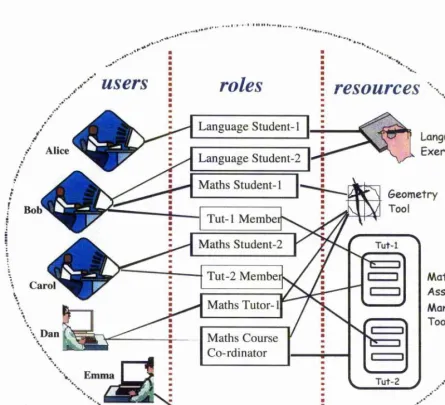
In Fig. 1.1 each user has their own view of the DLE. This simple example scenario features five users: three students, an academic staff member, and a systems administrator.
© Alice is only taking a language module and only sees a set of interactive language exercises.
® Bob is taking Languages and Maths. He sees the same language exercises as Alice, a Geometry tool, and an assignment management tool for handing in work, and receiving marks.
Dan is both a Course Co-ordinator and a Maths Tutor. He takes Tutorial Group Tut-1. He sees the Geometry Tool, a view of assignments limited to his own tutorial group, and also a view of the whole class, useful for a course co-ordinator.
Emma is a systems administrator, and can, in principle see anything in the DLE. This does not preclude a resource type from providing its own privacy mechanisms.
Alice
Bob
Carol
resources
Geometry Tool
users
Language Student-1
Language Student-2 Maths Student-1
Tut-1 Membe
Maths Student-2 Tut-l
Tut-2 Member
Maths Tutor-1
Maths Course Co-rdinator Emma
Language \ Exercises \
Tut-2
Maths
j
Assignment
I
Management/
Tool /
[image:24.615.92.538.219.624.2]issues for DLEs is to allow for this flexibility while maintaining the integrity of the underlying shared data structures, and the security of views - it would be inappropriate for Bob to be able to change the mark allocated by his tutor, or for Carol to see other student’s assignment submissions.
1.6 A Layered Reference Model
Figure 1.2 illustrates a layered approach to identifying the user-oriented features that a DLE should provide, and the systems concerns involved in supporting and realising these features. These concerns are mostly found in the middle layer. That is where the pedagogically diiven abstractions at the upper layer must be realised using a (largeh given) general-purpose infrastructure such as the Internet, and where the usability of a DLE from a customised user’s perspective should be understood and supported.
Usability Features
Abstractions for Tutors and Students; Educational Resources, Sessions, Groupwork, Interactivity, Real-world input. User-centric
Interfaces, Monitoring and Reflection Facilities
DLE Middleware and QoS
Sharing, Security, Concurrency, Availability, Replication, Distribution, Coherence, Responsiveness, Timeliness, Developer
and Application Programmer Interfaces, Interoperability
Low-level Infrastructure
Network Protocols, Operating Systems, Client-Server, Peer-to-Peer, Mobile Services, Authentication Authorities
Physical Networks, Computers, and Interface Devices
Figure 1.2: A DLE Reference Model
[image:25.628.113.467.303.657.2]pedagogical concern cannot not be addressed in any other way. The general approach taken is to work with existing hardware, operating system, networking and security technologies. The middle layer is characterised by two concepts - Quality of Service and Middleware.
1.6.1 Quality of Service
The tenn “Quality of Service” is most closely associated with computer net worldng. but for QoS to be meaningful to users of a service it should be viewed as a set of systemic properties resulting from the combined behaviour of all the inteixnediate components between end-users and a service. Support for this holistic view of QoS, can also be found in the ISO Open Distributed Processing program, where it is loosely defined as “... a system or object property, that consists of a set of quality requirements on the collective behaviour of one or more objects"(ISO/lEC 1996). More particularly "the role of
QoS management is to ensure that applications are able to specify and obtain the quality of service they require for their coirect execution" (Coulson & de MEER 1997). So. the
main issue is what we are prepared to accept as the correct execution of a DLE.
In the example scenario shown in Fig. 1.1 we could list QoS requirements as including security of views and access privileges; authentication of identity; integrity of shared resources in the face of concunent updates; and responsiveness. If any of these requirements is not met, then we could say that the DLE is not executing coirectly.
Certain QoS parameters are outwith the direct control of the DLE - the lower layer in Fig. 1.2 for example. It is maintained in this thesis however, that a DLE must be
QoS-aware. So, even if it cannot dynamically obtain more network bandwidth, or magically
1.6.2 DLE Middleware
Middlewai'e in general consists of augmenting a given infrastructure with an extra la\er of software that adds value in some useful way, and presenting appropriate progiamming interfaces and abstractions. The functionality provided by operating systems tends to be basic and general, reflecting their role in enhancing the value of an underlying collection of hai'dwai'e and I/O connections. When developing novel types of application it is often necessaiy to write some code that augments the basic facilities of the OS, but which is not necessaiily specific to a particular application. A network application-level protocol such as the Secure Shell (Security 2001) for example can be
considered as middleware in that it provides a functionality - end-to-end secure communication - that is not present in existing OS or network layers. Middleware is also used to meet some common needs of modem distributed applications where a legacy OS is inadequate. Application checkpointing for example would be a useful OS service (Allison 1994) but is almost always met by middleware such as libckpt (Plank al
1995).
Middleware is associated with security and interoperability in the context of the DUE oriented Internet! (IP2 1999) and ScotCIT programmes (Scotcit: 1998). Middleware can
also be thought of as a means of meeting the QoS, in the wider sense, required by applications. In the context of DLEs middleware is concerned with the functionality and performance necessary to support the resources and the organisational framework used by end-users. DLE middleware issues (see Fig. 1.2) include Sharing, Concurrer c\ .
Security, Coherence, Responsiveness, Availability, Replication, Distribution. Scalability, Timeliness and Interoperability.
protocols for example) can be at odds with the important end-user requirement for
responsiveness, possibly the single most critical QoS need (Ramsay et al. 1998). Sharing
also implies security. Security concerns include the maintenance of identities and controlled access to resources in the DLE. Structured protection facilities are necessary for both privacy and sharing.
Availability means coping with failures that can occur in either the network or the server.
Providing a service based on distributed servers can negate periods of non-availability caused by server and network outages. These may be distributed across the wide area, possibly globally. If the same set of servers is also used to share the load then
replication becomes an attractive strategy as it can, in principle, support responsiveness
and availability, and it also offers a practical means of implementing incremental scalability. Scalability is a major concern for service providers - to what extent does the increased management overhead of replication and distribution limit their scope? How scalable should a system be? If there is a high vaiiance in loads and a dynamically growing user base then initially provisioning a monolithic system of sufficient capability to meet peak demands is not a good solution as small changes in the scheduling of content or the size of the user base can quickly invalidate predictions about peaks. Consider an induction period for a class of a hundred students who are to use a DLE - that period can easily generate a load an order of magnitude or more than the average.
Timeliness is a generalisation of delay sensitivity that encompasses both responsiveness,
allows prospective users to use digital credentials maintained by a separate administrative body, external to the DLE. Educational content labeling and packaging standai’ds such as IMS (IMS Global Learning Consortium Inc. 2000), and SCORM
(Advanced„Distributed_Learning_lnc. 2001) are attempting to facilitate the routine import and
export of resources between DLEs. At time of writing it is far from clear that any of these putative and competing standards should be embraced, as they are fai* from complete and seem better suited to the needs of the airline industry training programmes where they originated. The general principle however of using a component-based approach to system construction, can be endorsed as it allows for sharing and re-use of educational resources.
The TAGS framework (Allison et al. 1999, Allison et al. 2000, Allison et al. 2001a, Allison et al.
2001b) can be regarded as middleware for DLEs. It provides support for access control
and group communication suitable for DLEs that in some way echoes basic OS support for these functions, but is at the right level for DLEs. It has provided a testbed for QoS analysis tools for DLEs, and extensions for distributed replication and integrating video conferencing.
1.7 Summary
Coherence (Chapter 4)
Fram ework
(Chapter 5) Quality o f Service(Chapters 6 and 7) • Multiuser
Applications • Teamwork • Information
sharing
• ConcuiTent Access • Distribution • Shared Resource
Integrity
• User Centric Views • Role Based Access • Group Membership • Services for Developers • Security
• Interoperability • Abstractions for non
specialists
• Responsiveness • Timeliness
• Identifying Sources of Delay • Modeling delay
• Measuring delay components • Service Architectures to support:
Scalability Availability
Network Adaptability Table 1.2: DLE System s Requirements
2 Systems Concepts used in Addressing DLE requirements
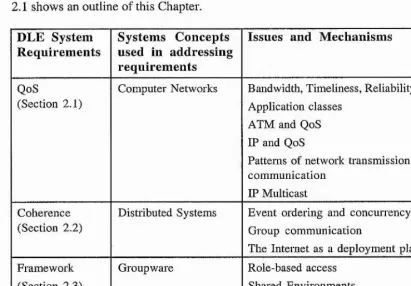
The previous chapter introduced the concept of a distributed learning environment (DLE), and identified thi'ee categories of systems requirements: QoS, Coherence, and a Framework. This chapter outlines the systems concepts used elsewhere in this thesis to meet these requirements in the support of DLEs. These building blocks are drawn from the established aieas of computer networks, distributed systems and groupware. Table 2.1 shows an outline of this Chapter.
DLE System
Requirements Systems Conceptsused In addressing requirements
Issues and Mechanisms
QoS
(Section 2.1) Computer Networks Bandwidth, Timeliness, Reliability, Jitter Application classes ATM and QoS
IP and QoS
Patterns of network transmission and communication
IP Multicast Coherence
(Section 2.2) Distributed Systems Event ordering and concurrencyGroup communication The Internet as a deployment platform Framework
(Section 2.3)
[image:31.612.82.494.237.523.2]Groupware Role-based access Shared Environments QoS requirements Security
Table 2.1: System s concepts used in addressing DLE requirements
Section 2.1 outlines and discusses issues surrounding network QoS. Although QoS is typically associated with the requirements of interactive, continuous, time-sensitive media - video conferencing and Internet telephony for example - it is shown in this section that these types of traffic must be seen within the overall context of a range of different classes of network applications. As the Internet is the effective platform for the deployment of DLEs, its protocol semantics aie assessed with reference to QoS. Network-level support for group communication is also discussed.
refers to the extension of concuiTency control policies and the enforcement of event ordering across a distributed system. This is particularly relevant to interactive shared resources, where there is often a tension between integiity and responsiveness. Hence, to the extent that responsiveness is a QoS issue, an important aspect of the coherence problem is one in which the integrity of some shared state must be maintained for multiple concuiTent readers and writers, without lengthening response times to unacceptable levels.
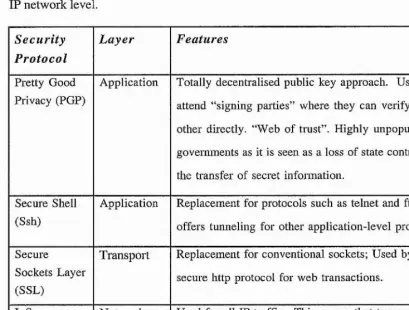
Section 2.3 describes groupware, a type of distributed system where user and group interaction is of prime importance. As the focus of group work is often some shared object or task, potentially involving multiple concurrent readers and writers, such resources require coherence. Much groupware starts from the point where group organisation and allocation of resources is a given (possibly seen as some middleware or OS function), but in a DLE it is important to have a framework for these functions. Accordingly, the concept of a groupware environment is introduced, and this provides the basis for the DLE framework described in Chapter 5. A distributed groupware environment or framework for distributed leaining must have a security model. Seciuity concepts are discussed and some cuiTent Internet security mechanisms aie listed.
2.1 QoS, Computer Networks and the Internet
QoS-awareness is an important feature of DLEs. A DLE consists of a rich mix of network application classes. It is important to understand how to formulate the QoS requirements for a particular application, and also how to evaluate the success of the infrastructure and middleware in meeting these requirements. While it may not be possible to directly change the QoS that parts of the infrastructure provide, being aware of the real nature of such problems is important, as adaptations and recommendations can be made to make better use of the infrastructure.
The concept of QoS originated in the context of network infrastructure, and, although purportedly concerned with the end user’s experience when using a network application, it is still in the infrastructure area that it is most advanced in tenus of agreed issues, standards and actual implementation. The QoS that an application requires from the underlying network infrastructure can be broken down into four major distinct quahties:
bandwidth, delay, jitter and reliability.
Bandwidth
Analogue bandwidth is measured in cycles per second, or hertz, whereas digital bandwidth is measured in bits per second. The different encoding and modulation schemes used by vaiious network technologies can mean that the effective digital bandwidth can be more or less than the nominal analogue bandwidth available - modems for example (3.3KHz | 28Kbps), or ethernet (20MHz | 10Mbps). It is generally only meaningful to talk about “raw” bandwidth with respect to the physical and data link layers. The effective bandwidth obtained by a network application is measured end-to- end, and it is this figure that is meaningful in the context of QoS.
Delay
network traversal always involves some degree of store and forward delay, and processing overheads, the end-to-end delay is typically substantially higher than the theoretical minimum. The significance of delay to an application can be characterised as its delay sensitivity. In some cases e.g. e-mail, ftp, the acceptable delay can be measured in minutes, or even hours. In strong contrast, an interactive video conference requires data to be delivered within milliseconds or it is too late to be of use. As mentioned previously, interactive responsiveness is a critical QoS parameter for the end users of network applications.
Jitter
Jitter refers to the vaiiance of inter-arrival gap in continuous media traffic. Play-out
buffers can be used to smooth
1
packet generation
play out points
time
20
19 18 sequence 17
out the jitter effect where numbers is 15
there is little interactivity. ^
12
The figure opposite shows a ^.i 10
play-out buffer in operation. 9 The distance between the two
diagonal lines is the size of the buffer and corresponds to the time period it can buffer packets over. The circles show packets that have missed their playout window and must be discarded. Where there is interactivity, such as Internet telephony or video conferencing, play-out buffers must be kept small, otherwise the timehness needed for meaningful interactivity will not be present.
total reliability is essential. Such applications would not be acceptable if bits of data were allowed to go missing. Browsers are interesting in that a Web page can still be usable even if some components (such as advertising images) fail to amve reliably and cannot be displayed.
Table 2.2 shows a network-centric view of application classes with different QoS requirements.
Application
class Examples Bandwidth DelaySensitivity JitterSensitive? Reliability(Loss Tolerance)
Filler traffic news updates mediitrn hours no no Unattended data/text
transfer
e-mail medium minutes no no
Unattended bulk data transfer
file transfer programs
plenty minutes no no
Control traffic UNI.3-1, ICMP.
IGMP low milliseconds no
sometimes
Interactive video video conferencing, distributed classroom
high milliseconds yes yes
Interactive audio Telephony medium milliseconds yes yes Interactive text/data telnet, X-windows medium milliseconds no no Interactive text/data
graphical/data
WWW medium milliseconds/ seconds
no sometimes
Video messaging multimedia e-mail high seconds/minutes no yes Image messaging high-resolution
fax
low minutes no yes
Video distribution Television high minutes/hours no yes Audio retrieval audio library medium seconds/minutes no yes Financial information Share prices medium seconds no no Distributed file service databases,
network file systems
medium milliseconds no no
Table 2.2: A network-centric view of application classes and QoS requirements
The shaded rows are particularly relevant to DLEs because they represent the wide mix of types of educational resources a DLE is expected to provide, and span the full range of major QoS requirements.
[image:35.612.82.493.181.516.2]important. The Finesse DLE (Power et al. 1998), described in Chapter 5, includes a portfolio management facility which uses real-time data from the London Stock Exchange. Even minor outages of this data feed aie a source of concern to groups of staff and students who work as fund management teams.
Network QoS is difficult to achieve wherever there is contention for finite network resources. It is even more difficult to meet when there is a widely vaiied set of application QoS requirements. However, mechanisms such as resource reservation and admission control, when combined with traffic shaping and the policing of current connections have been shown to allow QoS requirements to be met. Asynchronous Transfer Mode based networking has been one of the most successful technologies in providing QoS. It is described next, as an example of how to effectively support the type of QoS mix shown in Table 2.2, before we consider the QoS possibilities when using the Internet.
2.1.1 Meeting QoS Requirements: Asynchronous Transfer Mode (ATM)
ATM is connection-oriented. During the connection setup phase QoS pai'ameters can be negotiated. The connection-oriented nature of ATM means that, by controlling the admission of calls to the network, QoS guarantees that have been made to existing connections can be met provided traffic is shaped to behave in predictable ways and policing is used to prevent abuse. Table 2.3 summarises the scope of approved ATM version 4 QoS paiameters that may be negotiated on an end-to-end basis (The_ATM_Forum 1996).
Service Categories
Attributes CBR it-VBR nit- VBR UBR ABR
tiaific mrameters
PCR.CDVT V V V V V
SCR,MBS,CDVT ll/a V V lif'fi ll/a
MCR iiM n/a ll/a n/a V
QoS parameters
Peak-to-Peak CDV V - -
-Max CTD V V
-CLR sf -
-other
Feedback - - -
-CBR constant bit late It-VBR real time variable bit late nit-VBR non leal time variable bit rate UBR unspecified bit rate
ABR available bit rate PGR peak cell rate SCR sustainable cell rate MBS maximum buret size MCR minimum cell rate CDV cell delay variation
CDVT cell delay variation tolerance CDT cell transfer delay
CLR cell loss ratio
V ailribiUe is specified p r s e m c e , - not specified
Table 2.3: The Scope of ATM QoS.
ATM has been, and is being, used to support local area, metropolitan area and wide aiea networks carrying telephone, video and data payloads. In 1996 The Scottish Higher Education Funding Council invested in an ATM infrastructure, believing this to be a crucial move towards sharing of educational resources and widening of access. The infrastructure unfortunately tended to stop at the main campus router, although the Scottish m a n’s Video Conferencing Network was a notable exception.
desktop host overall system performance suffers, and if it is done on the NIC then the cost of the NIC goes up.
During the initial ATM deployment phase (1994 - 1997), “Fast Ethernet”, the IEEE 802.3u lOOMb/s standard (IEEE 1995) was developed and made available to the desktop and LAN infrastructures. Fast Ethernet NICs use existing copper wiring and are relatively cheap. Economies of volume production have resulted in low-priced, high- perfonnance Fast Ethernet switches. In addition, there was already widespread support in place for IP/Ethernet. Hence this relatively cheap drop-in upgrade to existing ethernet LAN connections displaced ATM, which was then laigely confined to the wide and metropolitan area roles, preventing its utilisation as an end-to-end technology. As QoS is an end-to-end issue this means that i) the strong potential for realising QoS through the use of ATM has not been achieved ; ii) ATM has failed in the desktop market place; and iii) practical solutions using today’s deployed technology will be IP-based.
2 .1 .2 The Internet Protocols
The Internet is the platform for DLEs. It is therefore important to know how it works and what it provides. It is equally important to know what it does not provide, as that functionality may need to be implemented as part of systems support for a DLE. Computer networks use the concept of layering to provide a vertical communication abstraction and protocols to provide a horizontal communication abstraction. Protocols are rules for meaningful interaction between two or more participants. Each layer is connected by one or more protocols horizontally, and one or more interfaces vertically.
Layer
Purpose
Example protocols
A pplication Supporting network applications ftp, http, smtp, ssh, ftp
Transport Host to host transfer tcp, udp
N etw ork Addressing and routing of datagrams through the
Internet
ip, icmp
D ata Link Data transport between directly connected network
entities
hdlc, ppp, ethernet, ATM
P hysical physical media and technologies: fibre, copper,
wireless, infrared, satellite, microwave, dwdm
bit encoding for
underlying media type
Figure 2.1 : The 5-layer Internet Model
A wide area network, or Internet, facilitates messages to be transmitted from one node to another across many inteimediate routers and other devices that are directly connected to each other by physical media links. The cuirent IP protocol, that is, the Internet Network layer, is used by millions of computers. It is an unreliable, best-effort, datagram delivery service. IP is an example of a connectionless protocol. Each datagram contains the full destination addiess and is routed independently from source to destination. As no intrinsic association exists between datagrams, they can disappear, get duplicated, anive out of order and suffer significant variation in delay. By analogy, if a Ph.D is sent in the post as eight different chapters enclosed in eight different envelopes, all with the same address, there is no guarantee they will take the same route or even arrive in the order they were sent. The data link layer, in contrast to the network layer, is only concerned with the transmission of data between directly connected nodes. The data link level is responsible for providing reliable communication over the underlying physical connection. This is achieved using numbered frames, acknowledgements, timeouts and repeated transmissions. For example, automatic repeat requests are often used in conjunction with sliding window protocols to provide a reliable point-to-point delivery while making efficient use of available bandwidth. These mechanisms are well documented in the literature. Failure detection at the link level is well specified and understood.
provide process-to-process communication between nodes, as opposed to network level delivery. It follows that there can be more than one transport level protocol using the same underlying network protocol. In the IP model it is possible to have either a connectionless or connection-oriented transport layer. The two most common Internet transport protocols are TCP and the User Datagram Protocol, UDP.
• TCP is connection-oriented, and provides a reliable byte-stream abstraction.
• UDP is connectionless, it is simply a transport level wrapper around the basic IP network level datagram.
Application protocols are typically represented by processes. Processes are addressed within an Internet node by 16-bit port numbers, relative to the transport protocol. There are potentially 2^^ UDP ports and 2^^ TCP ports available in a single Internet node. Some of these ports are reserved for processes which listen on behalf of well-known services such as e-mail, web traffic, and the DNS.
The significance of the relationships between the Internet data link, network, transport and application protocols is this: it is assumed by TCP that a missing packet or acknowledgement is not a sign of a faulty link ( as the data link level connections already correct such failures) but is a sign of congestion on the Internet. TCP accordingly backs off, lest it worsens matters by simply re-transmitting lost packets at the same rate and making the congestion worse. This has implications for the Web, as HTTP uses TCP. These implications are investigated in Chapter 6, as part of supporting QoS awareness in DLEs.
solutions have been proposed, but migrating the vast structure that is the Internet to a different way of worldng is a non-trivial task, technically, economically and politically. Economically, the Internet crosses many different administration and ownership domains, and this exacerbates the technical problem of guaranteeing QoS from end-to- end.
QoS on the Internet
There are three cuiTent IP initiatives which are relevant to QoS: IPv6 , IntServ and DiffServ.
IPv6 (Bradner & Manldn 1995) is the next generation IP protocol. It is fully specified and there are working implementations available for most operating systems. It is not directly compatible with the current IP, which is version 4, (IPv4). Amongst various changes from IPv4, IPv6 includes a 20-bit flow-id label field in the header of every datagram. The idea is that a resource reservation protocol such as RSVP (Braden et al, 1996) can ask the routers between two or more hosts to guarantee certain traffic shape requirements. After a period of negotiation a unique flow-id is assigned and should be used by all intermediaries to identify which packets belong to that flow. IPv6 has not yet been taken up widely because the main pressure for its deployment, IPv4 address space exhaustion, has been alleviated by relaxing the original IPv4 addressing scheme through techniques such as Classless Internet Domain Routing, Network Address Translation and leasing of IP addresses for the duration of a dial-up session.
The two cuiTent schemes for supporting QoS on IPv4 or IPv6 are the Integrated Services model (IntServ) and the Differentiated Services model (DiffServ).
performance and who are also wai'y of the high costs in R&D, for uncertain short term returns.
The Differentiated Services Model (Blake & al 1998) is more recent than IntServ, and to some extent is a response to concerns about the complexity of IntServ. The basic premise is that even two levels of service in the Internet is one more than is currently available, and hence an improvement. DiffServ posits a small number of differentiated service classes, e.g. bronze, silver and gold. These can be aggregated at the egress and ingress points of domain boundaries without sophisticated signalling. In addition, very importantly, DiffServ can work with existing IPv4 traffic through the redefinition of some standard bits in IP datagram headers that are generally unused for their original purpose.
Integrated Services
Differentiated Services
Granularity of Service individual flow aggregates of similar flows
Signaling essential e.g. RSVP existing TOS field
Admission Control essential, all routers edge routers only
Scalability limited by number of
flows limited by number of serviceclasses
Network management end-to-end circuits similar to existing IF autonomous systems
Table 2.4: Differences between IntServ and DiffServ
can be traced to server performance. In (Bhatti & Friedrich 1999) an empirical investigation is reported that involved instrumenting the service traffic of a major ISP. The network run by the ISP consisted of hundreds of servers supporting IP-based services that were accessed via 200 points of presence in the US. Average response times for a 40K text was found to be in the order of 2 seconds, while peak loads could take up to 7 seconds. The major source of variance in delay was server loading. Chapter 6 describes a methodology for identifying the source of poor responsiveness in web connections for DLEs, and has found that server-side performance can be the critical component.
2.1.3 Patterns of Network Transmission and Communication
The network concepts described up to this point have assumed a one-to-one pattern of communication. It is however important to understand how group communication at higher levels can best be supported by network protocols. We distinguish between patterns of transmission and communication. Transmission is one-directional (simplex) whereas communication implies bi-directional (duplex) traffic.
Patterns of network transmission can be classified as one-to-one, one-to-all, or
one-to-many. Broadcast may be characterised as one-to-all, unicast as one-to-one, and
multicast as one-to-many. Broadcast and unicast can be thought of as special cases of
multicast. Multicasting addresses a subset of all possible recipients. For a broadcast the subset is all recipients, and for a unicast the subset is one recipient.
9 o 9 9
° o 0-9° °o°o°
Figure 2.2a: Unicast Figure 2.2b: Broadcast Figure 2.2c: Multicast
message that is received by all members of a gi'oup, regardless of the group size. In the multiple unicast scenario N messages are required where N is the size of the group. In the filtered broadcast situation a hardware broadcast is used for all communication, and software filters are constantly employed to select items of interest. This is objectionable because of the high-load it places on the network and all connected hosts. In true multicast the network interface hardware supports multicast addressing and only passes on messages of interest to the host software. Simulated multicast is useful in situations where no ti'ue multicast is available but explicit group communication is still desirable as a means of expressing the solution to a problem.
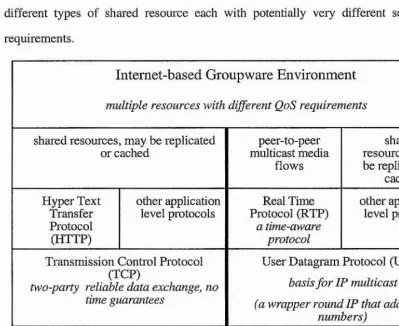
Protocols supporting these patterns can operate at any level in a layered model. At the data link level the IEEE 802 family of local area networks explicitly support unicast, multicast and broadcast transmission in their architecture and addressing. An attractive feature of shared media local area networks such as ethernet and token ring is that a multicast or broadcast message does not use more time or resources than a unicast message. At the network level IPv4 explicitly supports multicast as part of its addressing scheme (Class D address types). At the transport level UDP supports multicast in that it is a transport-level wrapper around the basic IP datagram. TCP on the other hand is strictly unicast.
Many-to-one has emerged as a popular pattern of
communication in the Internet, reflecting the ^ ^ ^ ^ request/response nature of the protocols and the
client server architecture. A single Web or e-mail server for example manages multiple TCP point-to-point connections from many clients, as shown in Fig.2.3.
2.1.3.1 IP Multicast
Net 2 Net 1
O ^ '
Net 3
unicast router
Net 2
multicast router
Figure 2.4a:
Multicast using multiple unicast IP multicast across three networksFigure 2.4b:
The dynamic maintenance of the Mbone is achieved through use of the Internet Group Membership Protocol (IGMP). IGMP manages joins and leaves for leaf nodes, and uses true multicast wherever possible by mapping IP multicast addresses to link-level multicast addresses. That is to say, where a set of IP multicast group members are attached to the same local area network, that network’s native mechanism for multicast support will be used.
The static structure of the Mbone is configured manually, as a set of tunnels between multicast routing processes. These processes were originally run on Sun Unix nodes, and did not offer the same throughput capability as large, dedicated unicast routers. However, the efficiency and scalability of the approach resulted in multiple concurrent audio and video streams being transmitted across the Internet. More recently IP multicast routing functionality has been included as part of major Internet routers, thereby promoting the potential for higher bandwidth IP multicast connections.
[image:46.615.96.457.58.286.2]