PARALLEL FUNCTIONAL PROGRAMMING FOR
MESSAGE-PASSING MULTIPROCESSORS
Gerald Ostheimer
A Thesis Submitted for the Degree of PhD
at the
University of St Andrews
1993
Full metadata for this item is available in
St Andrews Research Repository
at:
http://research-repository.st-andrews.ac.uk/
Please use this identifier to cite or link to this item:
http://hdl.handle.net/10023/13426
Parallel Functional Programming
for
M essage-Passing M ultiprocessors
Thesis submitted for the degree of Doctor of Philosophy at the
University of St. Andrews
by
Gerald Ostheimer
Division of Computational Science
Department of Mathematical and Computational Sciences University of St. Andrews
St. Andrews, Fife, KY16 9SS
ProQuest Number: 10167176
All rights reserved INFORMATION TO ALL USERS
The quality of this reproduction is d ep en d en t upon the quality of the copy submitted. In the unlikely ev en t that the author did not send a co m p lete manuscript
and there are missing p a g es, these will be noted. Also, if material had to be rem oved, a n o te will indicate the deletion.
uest
ProQuest 10167176
Published by ProQuest LLO (2017). Copyright of the Dissertation is held by the Author. All rights reserved.
This work is protected against unauthorized copying under Title 17, United States C o d e Microform Edition © ProQuest LLO.
ProQuest LLO.
789 East Eisenhower Parkway P.Q. Box 1346
Declaration
I, Gerald Kuno Ostheimer, hereby certify that this thesis has been composed by myself, that it is a record of my own work, and that it has not been accepted in partial or complete fulfilment of any other degree or professional qualification.
Signed Date Kc&dL
I was admitted to the Faculty of Science of the University of St. Andrews under Ordinance General No 12 on 1st October, 1988 and as a candidate for the degree of Ph.D. on 1st October, 1989
Signed Date HgG.c£c 1 ^ 3
I hereby certify that the candidate has fulfilled the conditions of the Resolution and Regulations appropriate to the Degree of Ph.D.
Signature of Supervisor . Date 2)1 /2 > /^ 3
Copyright
In submitting this thesis to the University of St.Andrews I understand that I am giving permission for it to be made available for use in accordance with the regulations of the University Library for the time being in force, subject to any copyright vested in the work not being affected thereby. I also understand that the title and abstract will be published, and that a copy of the work may be made and supplied to any bona fide library or research worker.
Abstract
Acknowledgments
Many people have had profound influence on this thesis and I want to pay tribute to some of them here.
To my supervisor, Tony Davie, for his willingness to supervise what started out as a thesis on computer architecture, for always being available for a quick word, and for giving me the freedom to follow my own way, however twisted.
To Peter Burgess, for putting up with my quirks during two years of sharing an office, for sharing his experience on distributed systems, for his willingness to listen to half-baked ideas and for talking me out of the more silly ones.
To Ron Morrison, for his encouragement of my work when he could see it taking shape.
To Arvind, for instilling in me a fascination with non-strictness and par allel architectures.
To David Gifford, for introducing me to the beauty of functional pro gramming, and for demonstrating that lectures can be at once fun and challenge.
To John Glauert, for pointing out the 7t-calculus to me at just the right moment.
To Bill Campbell, for guiding my life's journey to the beautiful town of St. Andrews.
To Kathy Hargreaves, whose competent editing advice on my MSc thesis helped me no end with this larger undertaking.
To my many friends, whose confidence in me always seemed greater than my own.
Table of Contents
Chapter 1 — Introduction... 5
1.1 Parallel computing and functional programming... 5
1.2 Contribution of this thesis... 5
1.3 Why functional programming matters... 6
1.4 What is holding us back?... 7
1.5 'Functional' architectures... 8
1.6 Current work... 10
1.7 Where we fit in... 11
1.7.1 Concurrency in functional programming systems and the 7r-calculus... 11
1.7.2 Automatic load bounding... 13
1.7.3 Granularity... 15 |
1.8 Thesis outline... 16
Chapter 2 — Previous and Related Work... 18
2.1 Contents... 18
2.2 Functional processes: simulating the X-calculus in the TT-calculus... 18
2.2.1 The 7c-calculus: a simple example... 19
2.2.2 The TT-calculus: syntax and reduction behaviour 20 2.2.3 A comparison of the Tc-calculus to the X-calculus 22
2.2.4 Simulating the normal-order X-calculus... 23
2.2.5 Simulating the call-by-value X-calculus... 26
2.3 The Manchester dataflow project... 28
2.3.1 Architectural overview... 29
2.3.2 Load bounding in the Manchester dataflow machine... 31
2.4 The MIT dataflow project... 32
2.4.1 From static dataflow to Monsoon... 32
2.4.2 Dataflow/von Neumann hybrid processors... 35
2.4.3 Load bounding for the MIT dataflow machines 39 2.5 ALICE/Flagship... 40
2.6 GRIP... 41
2.7 Lazy Task Creation... 43
2.8 Other previous work... 44
3.1 3.2 3.3 3.4 3.5 3.6 Chapter 4 4.1 4.2 4.3 4.4 4.5 4.6 4.7 4.8 Chapter 5 5.1 5.2
Contents... 45
Motivation... 45
Overview.... ... 46
Protocol 1 (Variables)... 47
Protocol 2 (Abstractions)... 47
The translation scheme... 48
3.4.1 Environment entry... 48
3.4.2 Name reference... 49
3.4.3 Abstraction... 49
3.4.4 Eager application... 50
3.4.5 Lazy application... 50
Sample reductions... 51
3.5.1 Simple function application... 52
3.5.2 Sharing of computation (1)... 53
3.5.3 Sharing of computation (2)... 55
Discussion... 57
• A Practical Compilation Scheme... 58
Introduction... 58
Source language... 59
Architectural framework... 60
Runtime framework... 61
Overview of the compilation scheme... 63
Translating non-strict expressions... 66
4.6.1 Constants... 66
4.6.2 Identifier reference... 67
4.6.3 Lazy function application... 68
4.6.4 Lazy let... 69
4.6.5 Lazy cons... 69
4.6.6 Conditional... 70
Translating strict expressions... 71
4.7.1 Eager function application... 71
4.7.2 Eager let... 72
4.7.3 Eager cons... 73
4.7.4 Addition... 74
Summary... 75
Load Bounding... 76
Introduction... 76
Pitfalls and dangers... 76
1
-r
5.3 A workable solution... 5.4 Eager compilation rules modified for load bounding. 5.4.1 Eager function application... 5.4.2 Eager let... 5.4.3 Eager cons... 5.4.4 Eager addition... 5.5 Adapting to changes in the workload... 5.6 Efficient load computation and load testing... 5.6.1 Probabilistic load estimation... 5.6.2 Cyclic load determination... 5.6.3 A hybrid solution and its cost... 5.7 The problem of sharing... 5.8 Summary... Chapter 6 — The STARDUST Architecture... 6.1 Introduction... 6.2 Architectural requirements for scalable, parallel
programs... 6.2.1 Scalability... 6.2.2 Topology independence... 6.2.3 Asynchronous, message passing
communications... 6.2.4 Fast context switching and process
synchronisation... 6.2.5 Sequential efficiency... ... 6.3 STARDUST as a RISC processor... 6.4 STARDUST as a building block for multiprocessor
6.5 6.6 6.7 6.8 er 7 7.1 7.2
6.5.1 Is STARDUST still a RISC architecture?... 6.5.2 Does STARDUST require infinite buffers?.... 6.5.3 What network bandwidth can we reasonably
... 78 f
... 80 ■' ... 80 ■I ... 82
... 83
... 84 1
... 85
... 86 y
... 87 ■i
... 87 t
... 89
I
... 90 %? ... 92
... 93 ■5 ... 93
... 94
... 94 t
... 95
... 95
... 96 ... 96 ... 96
... 97 ... 99
... 99 I
... 99 %
y:-... 100 ! ... 100 ■t ... 103 I; ... 104
... 105 '1 ... 105
7.3 System structure, routing and deadlock avoidance... .... 107 ■Ï
7.4 Node structure... ... .... 109
7.5 Experimental results... .... I ll ■1 7.6 Summary... .... 114 1 Chapter 8 — Conclusion... .... 115 ■i 8.1 What we have accomplished... ... 115 ÿ 8.2 Specifying parallel graph reduction in the 7c-calculus... .... 115
8.3 Compilation scheme... ... 116
8.4 Load bounding and runtime system... .... 117
8.5 The STARDUST machine... .... 119
8.6 Implementation and experimentation... ... 120
Chapter 1 — Introduction
1.1 Parallel computing and functional programming
Fifteen years after John Backus' clarion call to break the von Neumann bottleneck by adopting a functional programming style [Ba78], commercial multiprocessors are now available whose degree of parallelism is limited only by the size of a customer's wallet. Yet, there is little agreement on how best to program those machines and functional programming is not even among the leading contenders. While real speedups have been achieved for parallel functional programs on shared-memory multiprocessors with a limited degree of parallelism [AJ89], an effective scalahly parallel solution is still outstanding. We hope that the work presented here will be an important step towards the goal of scalable parallel functional computing. We begin this introductory chapter by summarising our main results. We then state our perspective of the role and the historical development of parallel functional computing and show how our work ties in with previous developments. We conclude the chapter with a 'road map' to the rest of the thesis.
1.2 Contribution of this thesis
Central to this thesis is a framework for the evaluation of implicitly parallel functional programs on message-passing multicomputers. Our model is based on a new encoding of the X-calculus in Milner's Tc-calculus. Milner has given two such encodings in [Mi92], a sequential one with call-by-name parameter passing semantics and a parallel one with call-by-value parameter passing semantics. Ours combines the advantages of both in the same framework. We can choose individually for each function application
We are thus able to preserve non-strict semantics and at the same time exploit parallelism where safely possible. Our ji-calculus encoding serves as the specification of a more concrete compilation scheme mapping a simple functional language into a message passing, parallel program by exploiting the implicit parallelism of functional programs. Since implicit parallelism gives rise to the problem of the parallelism explosion we give special emphasis to the issue of automatic load bounding. Without load bounding, the space requirements of some programs can change from linear to exponential. Our simple adaptive algorithm is integrated into the compilation scheme. We give an informal proof for the effectiveness of this algorithm, based on the structure of the compilation scheme, and discuss the limitations of our method. We discuss the architectural requirements for a machine to support our model efficiently and present the STAR:DUST
architecture, short for 'St. Andrews RISC: Dataflow Using Sequential Threads', designed to meet those criteria. A STAR:DUST node is a simple RISC processor with two new instructions supporting message passing and task switching. We have simulated a multiprocessor STARDUST machine on a Meiko Computing Surface and have obtained experimental results based on this simulator.
1.3 Why functional programming matters
'algebra of functional programs' in the sense of Backus [Ba78] with a range of correctness-preserving transformations that facilitates correctness proofs and the derivation of efficient programs from specifications. The interested reader is referred to work by Darlington [Da82] and Bird [BiS9] for a more comprehensive exposition of these features. Of special interest for our work is the fact that functional languages do not force the programmer to impose a total order on program execution. Referential transparency ensures that only data dependencies constrain the order of evaluation. The resulting freedom can be exploited by systems like ours to extract parallelism from programs not necessarily written with parallel execution in mind. This is not to say, however, that writing parallel functional programs is a trivial task. While a compiler can easily extract parallelism from a particular
functional program, different algorithms for the same problem may exhibit different amounts of parallelism, so good parallel programs will still require a special effort on the part of the programmer.
1.4 What is holding us back?
regime is exceedingly hard. Convential debugging techniques fail. In particular, the notion of 'stepping through a program' has little meaning in a functional context. For similar reasons, classical complexity analysis does not readily apply to functional programs. Finally, despite impressive progress that has been made with 'compiled graph reduction' originating with Johnsson [Jo84], functional programming systems are still behind their imperative cousins in terms of efficiency when measured on real-world algorithms. We will not enter into a discussion of the various reasons for this handicap. Let it suffice to say that one of the requirements for the design of Fortran, generally considered to be the first 'high-level' programming language, was to map to machine languages with minimal loss of efficiency. Recently this close relationship has been reinforced with the design of RISC microprocessors as 'C' machines, as described by Patterson and Sequin in [PS81].
1.5 'Functional' architectures
Since the earliest days of functional programming languages, their potential for parallelism has been recognised [Bu75]. At times, their inherent parallelism was presented as a means to catch up with imperative languages in the benchmark race. This expectation is, of course, to be taken with a large grain of salt. The competition for a parallel functional program is a parallel
comes to debugging. Functional programs, on the other hand, are deterministic by definition and have no need for special new 'parallel constructs' which could affect correctness.
large number of small tasks often dwarfed any benefit that could be obtained from parallelism. Secondly, mainstream computer architecture did not stand still. Speed improvements for sequential microprocessors have continued at an enormous rate even to the present day. High-bandwidth, low latency networks were developed for connecting large numbers of conventional von Neumann microprocessors [DS87, Le92]. Interface technology has been advanced tying processors closely to networks, e.g., for the transputer [Wh85], the J-Machine [DC89], the CM-5 [Le92]. See also [Hf92] for a recent proposal. Finally, it has now been recognized that economies of scale will favour, for the forseeable future, parallel machines made out of large numbers of cheap von Neumann style microprocessors over special-purpose parallel processor designs.
1.6 Current work
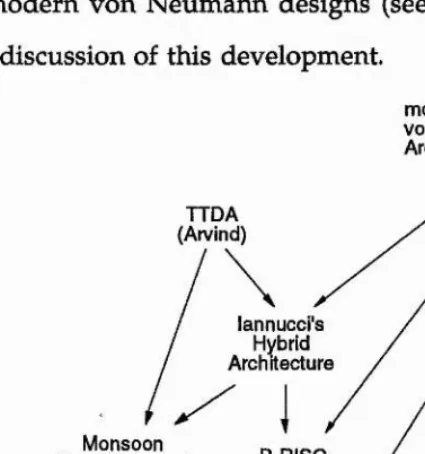
Work on parallel functional programming has not stopped, however. Current activities can be broadly divided into two classes. On the architectural side efforts have been directed towards a rapprochement with von Neumann microprocessor technology. In the case of the MIT dataflow project this was a gradual process: from the fine-grain, tagged-token dataflow architecture Monsoon [PC90], via lannucci's hybrid architecture [Ia88] and F-RISC [AN88], the MIT work has now progressed to the design of a coprocessor for the Motorola 88100, the *T (pronounced 'Start') project [NP92]. The GRIP project [PC87] at Glasgow ('Graph Reduction in Parallel') has been designed from the outset around a commercial microprocessor, the Motorola 68020.
The bulk of ongoing work, however, now concentrates its efforts on attempts to support the various forms of parallel architectures that have been developed for different programming models. Shared-memory machines are the target of work that has been done at Chalmers by
Augustsson and Johnsson [AJ89]. The FAST project at Imperial College and Southampton [GH90] supports networks of communicating processes such as those constructed with transputers. Hudak and his colleagues have implemented parallel graph reduction on an Intel hypercube as part of their work on the Alfalfa project [GH87]. Work by Cole at Glasgow [Co90] and Darlington at Imperial College on algorithmic skeletons is somewhat broader in scope. They propose writing parallel functional programs in terms of generic functions which would be implemented efficiently on a host of different architectures, spanning parallel models from SIMD to MIMD. For all their diversity, these projects share certain characteristics. In order to take advantage of parallelism, programmers need to use annotations of some sort to specify where parallelism is to be obtained. Consequently programmers are also responsible for bounding parallelism to sustainable levels. Furthermore, only coarse-grain parallelism can typically be exploited with any efficiency. The resulting programs often become non portable and non-scalable. We will discuss some of these projects in more detail in Chapter 2.
1.7 Where we fit in
Our fundamental interest is in implicit parallelism for scalable computers. In this section we will state the problems we set out to address and discuss the motivations behind our research. We will indicate how those motivations arose from previous work in the field.
1.7.1 Concurrency in functional programming systems and the 7c-calculus
has since been refined to compiled graph reduction, now universally considered the most efficient method of evaluating functional programs on off-the-shelf sequential machines. Many researchers have now undertaken to apply the basic model of graph reduction to parallel evaluation as well. This is possible since the graph reduction model preserves the parallelism implicit in functional languages. Obviously the implicit parallelism needs be made explicit at some stage, either during compilation or during evaluation. This is typically done in an ad-hoc manner suitable to the kind of parallel machine supported by a particular project. It is our contention that it is both useful and possible to elevate the process of 'making parallelism explicit' to a higher level in the design of a parallel functional language system. What is needed is a proper theory of concurrency in parallel functional programming. In the %-calculus [Mi92] Robin Milner provides us with the necessary tools for such a theory, demonstrated by his two encodings of the ^.-calculus in the Ji-calculus. We extend his work to modelling a functional programming system which exploits parallelism
and preserves non-strictness, taking up a theme from [Mi92].
Thus, strategies which appear natural in the presence of textual substitution may not seem so natural in a model involving autonomous agents. The former have clearly been most deeply studied in research on the X-calculus; one effect of providing n-calculus as a substrate may be to intensify the study of other strategies, such as those with shared reductions. (Emphasis ours)
We would like to note that we approached the problem strictly from an implementation point of view and have been made aware of the Jt-calculus only at a late stage of the work described here. In particular, our compilation scheme for message-passing multicomputers predates our 71-calculus
encoding for the X-calculus which is best viewed as a crystallisation of the main ideas.
1,7.2 Automatic load bounding
Consider the 'nfib' program, a program so trivial that it is now almost considered bad taste to publish performance figures based on it:
nfib 0 = 1
nfib 1 = 1
nfib n = 1 + nfib (n~l) + nfib (n-2)
'nfib' is strict throughout, contains neither fancy data structures nor higher order functions and offers vast amounts of parallelism of a very simple kind. Any functional implementation, so the reasoning goes, should do well on it. Yet in the context of implicit parallelism 'nfib' poses a difficult problem. Sequential execution of 'nfib' corresponds to a depth-first traversal of the tree-structured program graph. Therefore sequential 'nfib' requires space proportional to the maximum depth of recursion, i.e., it runs in linear space. Maximally parallel evaluation of 'nfib', however, corresponds to breadth first traversal and worst case space requirements are proportional to the size of the program graph, i.e., we now require exponential space. Even relatively small instances of parallel 'nfib' can exceed machine resources. At the same time we obtain no benefit from exploiting parallelism far in excess of the hardware parallelism at our disposal. So clearly we are interested in
-The 'parallelism explosion' was observed experimentally in the dataflow community and reported in [RS87, CA88]. Our work is closely related to that of Ruggiero and Sargeant who have implemented a hardware load throttle as part of their work on the Manchester dataflow machine. We are picking up an idea proposed in [RS87]
Another idea for dynamic software throttling is to plant two types of code for any parallel program: one serial and the other parallel. The machine switches from one style of code to the other at run time, according to how busy it is.
However, they go on to add
Although this method could be useful in the future, achieving a complete solution in this way is well beyond the state of the art. The conclusion is that despite being useful, software techniques are not enough to implement a general and effective throttle. We need some help from the hardware.
In this paper we present a software only solution with little overhead—in particular, we do not require expensive scheduling hardware. In addition, our work is novel in the following ways:
• We integrate our load bounding method into a simple compilation scheme for lazy functional languages.
• We present an informal proof of the effectiveness of our scheme based on the structure of the generated code.
• We identify sharing as a possible source of problems for load bounding.
14
1.7.3 Granularity
Consider the following simple functional program
let X = a*b;
y - 4*c
in (x+y) * (x-y)
and its dataflow graph (Figure 1.1), This example has been taken (in slightly simplified form) from [AC86] where it is used to demonstrate the instruction level parallelism implicit in many functional programs (or dataflow programs). In the example, x and y can be computed concurrently, and so can the addition and the subtraction.
[image:22.612.237.347.318.477.2]a b c
Figure 1.1: Instruction level parallelism
much of the recent work on parallel functional programming has focussed on restricting the exploitation of functional parallelism to the coarse-grain type.
Since the 'right' level of granularity depends largely on architectural parameters, it is hard to identify while parallel computer architecture is a quickly moving target. We consider the trend to coarse-grain parallelism within the functional community to be an overcompensation for the previous focus on excessively fine-grain parallelism. Our working hypothesis is that it will be possible to support parallelism efficiently on the inter-function level (we do not attempt to exploit parallelism within function bodies). The trend towards closer integration of network interfaces and high-bandwidth networks [EC92, HJ92] permits more efficient synchronisation than previously considered feasible. In Chapter 6 we present a model RISC architecture with a tightly integrated network interface [Os91]. STAR:DUST was heavily influenced by NikhiTs P-RISC architecture [AN88] described in the next chapter.
We restrict ourselves to distributed memory, message passing machines as those now appear set to prevail among massively parallel architectures. This trend is exemplified by the development history of the Connection Machine, originally a pioneering SIMD architecture, which was recently reborn in MIMD form [Le92].
1.8 Thesis outline
In this chapter we have outlined the main contributions of this thesis and the developments which preceded and motivated our work. In Chapter 2 we will have a closer look at some previous work important to ours. Chapter 3 contains a simulation of the X-calculus in Milner's 7c-calculus which serves as a specification for the compilation scheme presented in Chapters 4 and 5. The former contains the basic set of compilation rules
Chapter 2 — Previous and Related Work
2.1 Contents
In this chapter we will give a summary of previous work of which we make use, previous work that we improve on, as well as current related work moving in different directions. Parallel functional programming is a large field and we necessarily have to restrict our attention to those contributions that we deem most relevant to our work. In outline, we will give some details about Milner's 71-calculus as well as his encodings of the X-calculus. We will discuss some aspects of the Manchester dataflow project, in particular their achievements on load bounding. We review the development of the MIT dataflow work and discuss the design of the P-RISC architecture that grew out of it. We include a section on the first parallel graph reduction machine, ALICE, and its successor. Flagship. We discuss the design of the GRIP architecture, a major project in parallel functional programming which includes a strong architectural component. We conclude with a comparison of our load bounding approach to that of 'lazy task creation'.
2.2 Functional processes: simulating the X-calculus in the 7c-calculus
The 7C-calculus is the result of a search for a algebraic framework which would capture the essence of the notion of concurrent processes. It is particularly suitable for the description of systems which can change their configuration dynamically. The 7U-calculus improves on Milner's previous work on CCS, the calculus of communicating systems [Mi80], in that the former needs no recourse to a universe of values outside its own scope. In terms of internal completeness and conciseness it is comparable to the X-calculus which was a guiding paradigm in the design of the 7r-X-calculus. See Milner's Turing Award Lecture [Mi93] for an excellent discussion of the
motivations that lead to the jr-calculus. This section will be important to the rest of the thesis in two ways: we will require an understanding of the operational behaviour of the 7c-calculus in Chapter 3, where we use it to specify a non-strict parallel simulator for the X-calculus. Secondly we will present a brief outline of two such simulations given by Milner in [Mi92], one of them non-strict but sequential, the other parallel but strict.
2.2.1 The 7c-calculus: a simple example
Rather than getting immediately bogged down in notation and detail, let us start by presenting a simple Tt-calculus term, the simplest term which admits reduction:
xz I x(y)
This term is to be read as follows: write z i o x and, in parallel, read y from x.
Reduction is possible since there is a reader and a writer ready to communicate via the same channel, namely x. Communication takes place by cancelling read- and write-actions and substituting the value to be written
{z in the example) for any free occurrence in the reading process of the variable to be read (y in the example). As y does not occur free anywhere, reduction yields
0 I 0
which is equivalent to 0, the empty process. A slightly more useful example is the term
x z I x{y).xy
Here the read-action x(y) is followed by a write-action xy. Reduction yields 0 I x z
2.2.2 The 7c-calculus; syntax and reduction behaviour
We are now ready for a more systematic presentation of the 7c-calculus, adhering to the form given in [Mi92]. The 7c~calculus consists of a set of terms which intuitively stand for processes. The names of the 7c-calculus {x, y, z...) denote channels through which processes communicate. Channel names are also the only subject of communication. The syntax for %-calculus terms is summarised in Figure 2.1.
p ::= xy.P write-action: write y to x and then P p ::= x(y).P read-action: read y from x and then P
p ::= 0 empty process
p ::= P i 1P2 composition p ::= (y) P restriction
p ::= !P replication
Figure 2.1: Syntax of the it-calculus
The terms of the jc-calculus exhibit a simple block structure with two forms of name binding, namely read-action and restriction. In the following we will discuss each of the constructs in some more detail.
Write-action. A term of the form P = xz.Q represents a synchronous send-operation of a value z along a channel x. The process P cannot proceed until another process is ready to receive z on the same channel and will then continue with Q,
Read-action. Counterpart to a write-action. A process of the form x(y).Q
cannot proceed until another process is ready to send some value v along the channel x. The value v is then substituted for all free occurrences of y
inside Q. The read-action is one of two ways of binding names, i.e., the scope of y is Q.
x(y).P (y) xy.P write a new channel y to x x(y)(z).P x(y).x(z).P multiple reads from x
xyz.P xy.xz.P multiple writes to x
Note in the first rule how private names {y above) can be exported out of the scope of restriction via explicit communication. Note, finally, that all
S 3'i
-■> Empty process. We write 0 to represent the empty process which is necessary
to ground our syntactic rules. We will always abbreviate action terms of the form xz.Q to x z (similarly for read-actions).
Composition. We write Pi IP2 to denote two processes P\ and P2 operating concurrently. Note that there is no separate construct for sequential composition. This can be modelled using parallel composition and suitable synchronisation via interaction.
Restriction. We write {x)P to obtain a new channel name x which is private
to P. The term xz I (%) x(y) has no reduction, as the sending process and
f
the receiving process operate on different channels. Restriction is thesecond form of name binding, with P as the scope of x.
Replication. A term of the form IP stands for the parallel composition of as many instances of the term P 'as necessary'. Replication can be 'unwound' according to the structural equivalence IP sP I IP. Unwinding is unnecessary when there are existing copies of P which have not participated in any interactions. Note that unwinding does not represent reduction but is a structural equivalence relation like, for example, a-conversion.
occurrences of (%) signify bindings for the channel name x with simple static scoping rules.
The basic reduction rule, already hinted at in our explanation of read- and write-actions, is the following: for a pair of processes
Qi - xz.Pj and Q2 = x(y). P2
we get the reduction
Gi 162
f 11
P2(z/y).
Put in words, if Qi is ready to send a name z along the channel x and Q2 is
ready to receive a name along the same channel then they can interact. Interaction results in cancelling each of the two send/receive actions and substituting z for all occurrences of y inside P2* The complete set of reduction rules describes in detail the distribution of reduction over restriction and replication constructs, omitted here for sake of brevity. They can be found in [Mi92] along with a complete definition of structural equivalence for terms.
2.2.3 A comparison of the 7c-calculus to the X-calculus
It will be useful to compare the ;i-calculus with the X-calculus both to gain further understanding of the 7c-calculus itself and to appreciate the task before us of simulating the latter with the former. At the most elementary level, both calculi are term rewriting systems with a simple basic reduction rule. Both have simple static scoping rules for names. Neither provides any computational 'sugar' but both of them are computationally complete (for the -calculus this will follow from the fact that it can simulate the
X-calculus). In the 1-calculus, the basic concept is that of a function: terms represent functions and names denote functions. Functions are first-class objects. In the je-calculus, there are two basic entities, processes and channels. Terms represent processes, but processes are not first-class in that
the names of the 7c-calculus stand for channels only and channels are the only subject of of communication. There is a superficial correspondence between p-reduction in the 1-calculus and communication in the Tt-calculus in that both involve the substitution of an 'actual parameter' for a 'formal parameter'. However, while the term providing the actual parameter in a p-reduction becomes merged with the abstraction term, both reader and writer processes engaging in a Tt-calculus communication continue as independent agents after interacting. Studying the two reduction mechanisms closely we observe that p-reduction is the more complex of the two, involving as it does terms as actual parameters rather than 'atomic' channel names. On the other hand, identifying a redex in the 1-calculus is a simple 'local' syntactic operation whereas reduction in the jc-calculus involves identifying two matching redexes, a reader and a writer, which can occur anywhere within a term (see the example below). A final and fundamental difference between the two calculi is that normal forms for 1-calculus terms are unique, whereas the 7ï-calculus is nondeterministic. Consider for example the two reductions
%(y) I xzi I XZ2 “> 0 1 0 1 XZ2 = XZ2
%(y) I xzi I XZ2 0 I xzi I 0 = xzi
Each yields a different normal form, depending on which send-action succeeds.
2.2.4 Simulating the normal-order 1-calculus
for 1-caiculus reduction, Milner presents a scheme for the normal-order (sequential) 1-calculus in [Mi92] from which the following is largely quoted. Note that even without any explicit sequencing combinator, the jc-calculus is capable of expressing sequentiality by suitable synchronisation.
Each 1-calculus term M is encoded as [[Af]], a function which maps names to Ti-calculus terms. So [[Af]] m is a term of the Jt-calculus with the intuition that the name u is the link along which [[Af ]] 'receives' its arguments. Now, suppose that Af will itself be used in place of an argument represented by the variable x, i.e., x is bound to Af. Each time Af is 'called', via X,it must be told by the caller where to receive its own arguments. (In more familiar terminology, it must be given a pointer to its arguments). Thus the 'environment entry' binding % to Af is a Ti-term defined as follows, with w
representing the argument pointer(s).
Note the use of the replicator ! to allow for multiple references to the same environment entry*.
How does [IXx Af]] u receive its arguments? Along u it receives (as x) the name of its first argument, and also the name of a link where the rest will be transmitted. This explains the first line of Milner's encoding, which we now give in full:
[[Xa:JW]]« 4# »W(v). [[M]] V
M ] u # X U
[[MM] u # (v) ([[Mj] VI Vix). vu. [[% := M] )
Let us look, with Milner, at an example. We assume x is not free in N.
[[(!%.%) N]]u s (v) {v{x){w). [[%]] w I V(x). vu. [[% := N\] ) (1)
In using the notation [[x := M\] for environment entries we follow [M192] but point out that it is distinct from the encoding function [[Af]] u
-> (v)(x) (v(w). [[x]] w I VM. [[x :-N]] ) (2)
-> (% )#]]»! [[%:=A0]) (3)
= (x) (XM 1 !x(w). [[iV]] w) (4)
[M ]m I (x)[[x:-M] (5)
~ m ] u (6)
The following remarks help us read the above calculation:
— In (1), we have expanded the definitions for lambda abstraction and function application
— In (2), we have communicated a new channel x along v. Since x now | occurs in both parallel subprocesses, the restriction (x) has been moved ^ outwards to cover both occurrences.
— In (3), the restriction (v) has been dropped because v no longer occurs — The step to (4) represents the expansion of the definitions for identifier
reference and environment entry
— In (5), (x) has been moved inwards as x now only occurs in the right subterm
— The last step, to (6), goes beyond simple equivalence and represents the garbage-collection of an environment entry [[x := N]] which cannot be used further (since the subject x of the first action is restricted).
Milner also provides a proof that the reduction of [[Af]] in the Tc-calculus simulates that of Af in the X-calculus 'very closely'.
2.2.5 Simulating the call-by-value X-calculus
Since the Tt-calculus is suitable for expressing concurrency, we would expect it to be able to express the parallelism implicit in the X-calculus. Milner does so in his second encoding which simulates the call-by-value X-calculus. Under call-by-value semantics we completely reduce an argument term before passing its value to a function. In the new encoding [[M]] p, the name
p will have a different significance. The reason is that two 'events' which coincided for the normal-order calculus must now be separated, namely — the signal at p that M has reduced to a value (needed when M is the
argument of an application);
— the receipt of arguments by an abstraction M (needed when M is applied). Dealing with a call-by-value reduction strategy we will not need to pass 'apply nodes' as arguments, so our environment entries will now contain only values, i.e. abstractions and variables. So we begin by defining [{y := V]]
where V is either a lambda abstraction or a variable.
[ly := Xx.M\] !y(v). v(x)(p). [[M]] p
[Ij/:=x]] ly{v), XV
An environment entry for an abstraction keeps reading new sets of arguments v to which the abstraction is to be applied. For each set thus received, we pick up the first argument, x, and the rest of the arguments, p.
We instantiate a new copy of M to which we pass the arguments p. The first argument x is bound to the free variable x in M implicitly. An environment entry for a variable simple passes on any sets of arguments to that variable.
The first action of a (translated) value, [[V]] p, is to signal its reduction to a value. The channel y representing the signal provides access to an 'environment entry'. Note that [[y := V]] is here a subterm of [[V]] p, whereas the opposite was true in the normal-order encoding. In the most important
difference, however, to the normal-order encoding, the new translation [[M
N]] p allows M and N to 'run' in parallel. The auxiliary definition ap(p, <7, r) provides the necessary glue for relating functions to arguments: we pick up the value of M from q in the shape of an environment entry y and apply it to a new set of arguments v, which is constructed by extending the list of arguments p by the argument z computed by [[N]] r.
[[V\] P p(y). [[y := V]] (y not free in V)
[[M N]] p iq){r) (ap(p, q, r) I [[M]] q I [[N]] r)
^p(p,q,r) g(y)-yW-''(z)-v2p
The example reduction sequence below for the k-term {Xx.M)V demonstrates the simulation of p-reduction.
l[{Xz.M)V\]p s {q){r) (ap(y, q, r) I q(y). [[y:=Xz.M]] I r (z). [[z:= V]])
(r)(y)iÿ{v).r(z).vzp I [[y:=Xz.M]] I r(z). [[z:= V]]) (1) -> {r){y)(v)(r{z).vzp \ l\y:==Xz.M\] \v(z)(p).[[M]]p I (2)
r(z).[[z:=V]])
-> (y)W(z) (vzy I [|y:=Az.M]] \ v{z)(p),l[M\] p I [[z:=V]]) (3)
(y)(z)([|i/:=AzJyq] l
ump
l[[z:=m
(4)~ (z)[[M]]y I [[z:-V]]) (5)
Each of the four reduction steps consumes one of the actions defined by ap. The first step to (1) communicates the environment entry y for the functor
Xz.M. Reduction (2) communicates the name v by which the functor can access its arguments. In step (3) we pick up the environment entry z for the argument V. Finally we make the extended argument set zp available via v.
(some) parallelism in that for an application of the form M N both subterms can be evaluated in parallel, the application itself cannot proceed until the argument has been computed. Thus the parallelism implicit in a non-strict constructor function like cons which could return a result even before its argument values are available is not exploited by this scheme. More
seriously, Milner's call-by-value scheme obviously has strict semantics and I will thus fail to terminate for many terms which have a normal form.
We shall give a third encoding, combining the advantages of parallelism and non-strictness, in the next chapter.
2.3 The Manchester dataflow project
Making somewhat of a conceptual jump, we move from the theoretical domain of the E-calculus to computer architecture related research. The connection will be established in Chapters 3 to 6, where we develop a n-calculus specification of parallel graph reduction into a practical compiler for a novel parallel architecture.
Work on the Manchester dataflow machine is interesting to us mainly for their results on load bounding. In order to put these results into context, however, it will be useful to present a brief overview of the architectural side of the Manchester dataflow research. The architecture in itself is interesting as a major early example of a non-von Neumann machine that has been successfully implemented in hardware. While the similarities of the Manchester dataflow machine to our STARiDUST architecture may not be immediately obvious, the latter can trace back its origins to the former in a direct line. This lineage will be illustrated in detail in Section 2.4.
28
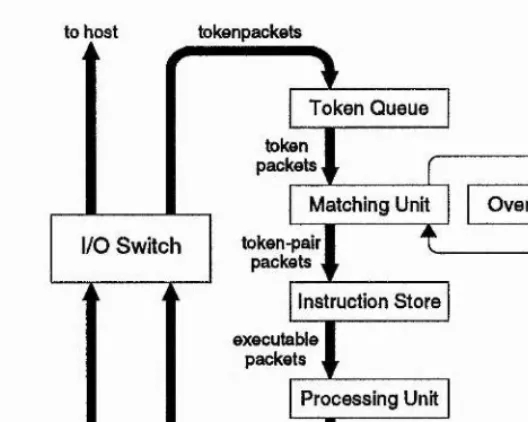
to host tokenpackets
token packets
token-pair packets ,
executable packets
Processing Unit Token Queue
Matching Unit
Instruction Store
Overflow Unit
I/O Switch
[image:36.612.166.430.63.274.2]from host tokenpackets
Figure 2.2: Structure of the Manchester dataflow system
2.3.1 Architectural overview
than one successor instruction, multiple instructions can be ready for scheduling at the same time.
Let us follow the path of an imaginary token inserted by the host computer. The I/O switch which is responsible for directing the token to the appropriate dataflow processor (of which our system contains only one) sends it on to the token queue. This queue is a circular buffer that smoothes out uneven rates of generation and consumption of tokens in the ring. When reaching the head of the queue, the token is passed on to the
matching unit, arguably the most unconventional component of the processor ring. The matching unit's prime responsibility is resolving instruction dependencies and scheduling instructions for execution. An incoming token carrying the first operand of a dyadic operation remains in the matching unit awaiting the arrival of its partner. The unit derives its name from this matching of partners. An incoming token that completes a match or is heading for a monadic operation is passed on to the instruction store which contains the program code. There the appropriate instruction is fetched and passed on along with the operands to the processing unit.
Typically the processing unit is made up of several function units (akin to the multiple function units of a modern von Neumann processor), one of which will perform the required operation and generate one or two output tokens.
Note that the mechanism described above is readily expandable to multiple processing elements as the basic instruction scheduling mechanism is easily extended to work across processors. Note also that on our journey through the pipeline we did not encounter a stage which would obviously correspond to 'main memory access'. The matching unit implicitly provides the storage needed for data which would be kept in stack frames in a more conventional runtime model. For this reason the size of
30
the matching unit exceeds 1 M-words and is unsuitable for complete VLSI integration even with present-day technology. Furthermore the structure of the matching unit is relatively complex as it requires associative access to waiting tokens. In the Manchester machine this is implemented via a hardware hash-function. Some of the data storage functions were later moved from the matching unit to a dedicated structure store,
2.3.2 Load bounding in the Manchester dataflow machine
When the Manchester project was started, it had not yet become clear that many typical programs would provide sufficient parallelism to keep a large parallel machine busy. So it came originally as a surprise when it was observed that the amount of parallelism exhibited by some programs could get so large that the design of a throttle mechanism was crucially important in order to limit the resource requirements of such programs (see Section 1.7.2). The throttle designed by Ruggiero and Sargeant and described in [RS87] is a hardware device which operates roughly according to the following principles. On receiving a request for starting a new process their throttle decides, based on the level of parallel activity in the machine, whether to grant a new activation name or not. Parallel activity is measured in terms of the length of the token queue. If the machine is too busy, the process is suspended and is reactivated only when the level of activity has dropped. In order to promote depth-first execution, the first child of a process is never suspended. Given several suspended subprocesses for one process, the leftmost one is the first candidate for unsuspension. This order is guaranteed by a queueing strategy. They impose a small delay between individual unsuspensions since processes take a while to start up and have no immediate effect on the length of the token queues.
activation names, suspending and unsuspending of processes, activity level reports and termination signals. From a hardware point of view, the throttle is a message processor with an attached store and was implemented using the same design as for the structure store, with different microcode.
2.4 The MIT dataflow project
While work on the Manchester machine has now ceased, research into dataflow machines and languages is still actively being pursued at the Computation Structures Group at MIT. Originating with Jack Dennis's early work on a static dataflow machine [De75] which appeared radically different from any architecture known at the time, the MIT work has progressed in several stages, as outlined below, to a system designed around a commercial microprocessor. One of the results of their long and productive work was the P-RISC architecture which became a major influence for the design of STARiDUST (Chapter 6). One purpose of this section is to illustrate that our STARiDUST architecture, and thus the computational model underlying our compilation scheme, is not just a 'wild stab in the dark' but rather a combination of the core features of dataflow machines with the sequential efficiency of modern von Neumann architectures.
2.4.1 From static dataflow to Monsoon
Jack Dennis early work on static dataflow machines modelled the flow of streams of data through a static dataflow graph. The nodes of the graph represented operations which could 'fire' as soon as a complete set of inputs was available. While providing ample opportunity for parallelism, static dataflow graphs do not support a very general programming model. In particular, they do not allow for recursion. Dennis' 1973 paper [De73] is generally regarded as the seminal work inspiring dynamic dataflow which is capable of modelling graphs that are expanding and contracting
dynamically. Dynamic dataflow is thus suitable for modern recursive programming languages. The MIT work on dynamic dataflow machines was lead by Arvind, whose proposal for a dataflow architecture with tagged tokens [AK80] is substantially similar to the Manchester dataflow machine (but developed independently). Therefore we will not discuss it in detail here except for pointing out that it includes a waiting-matching unit requiring the same expensive fully associative matching capabilities for data sets. In contrast to the Manchester machine, the TTDA (tagged-token dataflow architecture) was never built in hardware.
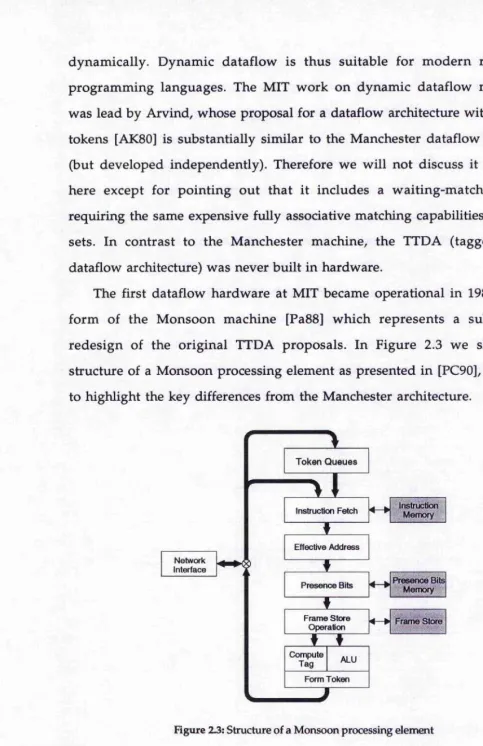
The first dataflow hardware at MIT became operational in 1988 in the form of the Monsoon machine [Pa8 8] which represents a substantial redesign of the original TTDA proposals. In Figure 2.3 we show the structure of a Monsoon processing element as presented in [PC90], redrawn to highlight the key differences from the Manchester architecture.
Network Interface
Token Q ueues
g
Instruction Fetch 4— ►
%-Mem6iy
Effective Address
♦
Presence Bits PreeenoeBits "Memory
Frame Store Operation
f ♦
Compute
Tag ALU
Form Token
j!
[image:40.612.27.510.19.765.2]4— >
The fundamental improvement is the elimination of the waiting-matching unit which was achieved by making the token store explicit. Rather than relying on the storage of tokens to be performed implicitly and individually by hardware in the waiting-matching unit, storage allocation on Monsoon is performed by software and in units of procedure frames. An individual procedure frame is mapped wholly to a contiguous memory area within a
frame store.
To understand the resulting changes in the operation of the processor pipeline consider the processing of a two-input operator (the following is largely quoted from [PC90]). The first token to be processed enters the pipeline and fetches the instruction specified in its tag field. During the effective address stage the location in the frame store where the match will take place is computed. The associated set of presence bits are examined and found to be in the 'empty' state. The presence state is thus set to 'fulT and the incoming value is written into the frame store location during the frame store stage. Further processing of the token is suppressed because the other operand has yet to arrive. This 'bubbles' the pipeline for the remaining ALU stages; no tokens are produced during form-token,
permitting a token to be removed from one of the token queues for processing. The second token to be processed enters the pipeline and fetches the same instruction. It therefore computes the same effective address. This time, however, the presence state is found to be 'full', so the frame store location (which now contains the value of the first token) is read and both values are processed by the ALU. Finally, one or two result tokens are created during the form-token stage.
Note that the pipeline of a Monsoon processing element is rather more similar to a conventional processor pipeline than that of the Manchester machine. An instruction fetch stage is followed by the computation of an
effective address, a load/store stage interacting with local memory, and an ALU stage. There is even direct support for sequential execution by allowing successor instructions to bypass the token queue and re-enter the pipeline immediately. The differences to conventional pipelines are still significant, however: instructions can have multiple successors, all but one of which are stored in a token queue. The resulting parallelism is used to good effect to avoid bubbles in the pipeline. And finally, the stage responsible for 'presence bits' provides efficient hardware support for 'join' synchronisation.
2.4.2 Dataflow/von Neumann hybrid processors
The analogies between Monsoon and conventional processors were not lost on the MIT team. In [Ia8 8], lannucci proposed the idea of dataflow machines and von Neumann machines sitting at opposite ends of a spectrum of architectures. The hybrid processor proposed in his paper travels another step towards von Neumann architectures by re-introducing registers as a very efficient means of communication for sequentially related instructions. (By constrast. Monsoon instructions can only send a single value to their successor in the form of a token. Where this is not sufficient, data have to be deposited in the frame store, i.e., in local memory.) By providing registers and dedicated instructions for testing and manipulating presence bits, lannucci's hybrid processor can dispense with the idea of 'tagged tokens' for communication within a procedure frame.
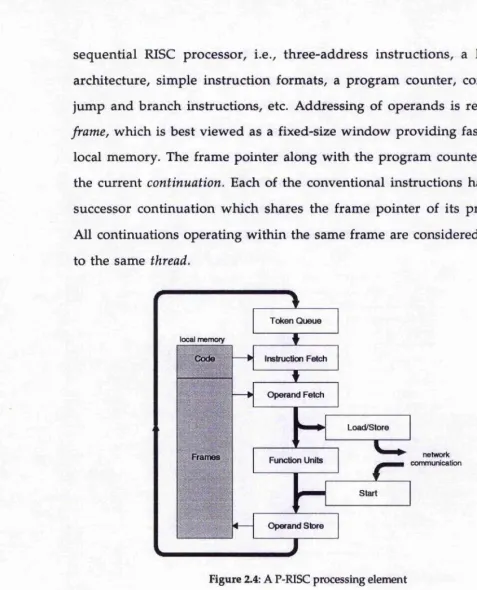
sequential RISC processor, i.e., three-address instructions, a load/store architecture, simple instruction formats, a program counter, conventional jump and branch instructions, etc. Addressing of operands is relative to a
frame, which is best viewed as a fixed-size window providing fast access to local memory. The frame pointer along with the program counter make up the current continuation. Each of the conventional instructions has a single successor continuation which shares the frame pointer of its predecessor. All continuations operating within the same frame are considered to belong to the same thread.
Token Queue
Instruction Fetcti
E
local memory
Code
Operand Fetcti
FunctKxi Un ts
Operand Store
Load/Store
network communication
[image:43.612.22.499.26.616.2]Start
Figure 2.4: A P-RISC processing element
The parallel extensions to the sequential RISC paradigm come in the shape of several simple new instructions which create, control and terminate threads.
• fork produces an additional continuation which is placed in the token queue along with the natural successor
• jo in conditional termination of the current thread, i.e., depending on a condition, j o i n has either one or zero continuations
• load reads a value from global memory; lo a d has no immediate successor which allows other threads to keep the CPU busy during long-latency operations; the thread is restarted only on arrival of the value to be loaded
• sto r e writes a value to global memory and continues with the next instruction; no synchronisation is performed
• loadc version of load with an implicit fork
• s ta r t sends a s t a r t message to a remote processing element; in coming s t a r t messages deposit a value into the local frame and place a continuation into the token queue (the arrival of values lo a d ed from global memory is in the form of s ta r t messages)
A P-RISC system is made up of processing elements as discussed above as well as structure store elements which satisfy global read/write requests and perform low level synchronisation tasks and memory management functions. Comparing P-RISC with Monsoon we observe that the 'complex' dataflow instructions have been split into separate synchronisation, arithmetic and fork/control instructions, eliminating the necessity of presence bits in the frame memory.
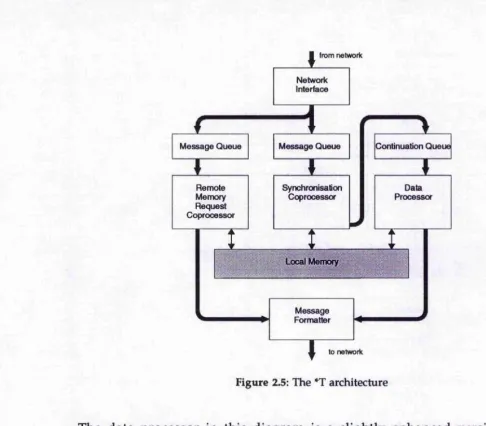
The (so far) final step in the MIT effort towards finding the optimal balance between dataflow and von Neumann processors is the *^T architecture [NP92], pronounced 'start', which is currently actively pursued in terms of hardware design (both lannucci's hybrid architecture and P-RISC are 'paper architectures'). We show a block diagram of *^T in Figure 2.5.
I
"■Ï.
from network
to network Message Queue
Message Queue Continuation Queue
Network Interface
Message Formatter Remote
Memory Request Coprocessor
Synchronisation
[image:45.612.18.504.24.450.2]Coprocessor ProcessorData
Figure 2.5: The *T architecture
The data processor in this diagram is a slightly enhanced version of the Motorola 88100, i.e., a commercial RISC microprocessor. The enhancements permit it to send messages to the network and to pick up new continuations (in the form of one word each for the program counter and a frame pointer). The data processor is responsible for the computational aspects of program execution. Two coprocessors sharing the same local memory are responsible for satisfying remote memory requests and synchronisation, respectively, without having to interfere with the data processor. Having a coprocessor for memory requests enables *T to avoid the complications of providing dedicated structure store units. The synchronisation coprocessor (SP) handles returning loads by storing any returning value into its destination location. If the original l o a d instruction is followed by a j o i n synchronisation, the SP executes it and, if successful, places its continuation