DETECTING A VISUAL OBJECT IN THE PRESENCE OF
OTHER OBJECTS: THE FLANKER FACILITATION EFFECT
IN CONTOUR INTEGRATION
Christopher Gillespie
A Thesis Submitted for the Degree of PhD at the
University of St Andrews
2015
Full metadata for this item is available in St Andrews Research Repository
at:
http://research-repository.st-andrews.ac.uk/
Please use this identifier to cite or link to this item:
http://hdl.handle.net/10023/9479
Detecting a visual object in the presence of other
objects: the flanker facilitation effect in contour
integration.
Christopher Gillespie
This thesis is submitted in partial fulfilment for the degree of
PhD
at the
University of St Andrews
Contents
1 Introduction 1
1.1 Motivation . . . 2
1.2 General introduction . . . 6
1.2.1 Detection of an object - psychophysical sensitivity . . . 6
1.2.2 Local features and object detection . . . 11
1.2.3 Attention and the detectability of objects and features. . . 17
1.2.4 The detection of Gaborized contours outside of the focus of attention . . . 18
1.2.5 Object, signal and feature numerosity . . . 21
1.2.6 Summary . . . 25
1.3 Experiment overview . . . 26
1.3.1 Experiments . . . 26
2 Is the detectability of a 3-D object embedded in multi-scale noise a↵ected by the presence of neighbouring objects? (Pilot experi-ment) 29 2.1 Abstract . . . 30
2.2 Introduction . . . 30
2.3 Aims . . . 33
2.4 Methodology . . . 35
2.4.1 Participants . . . 35
2.4.2 Apparatus . . . 35
2.4.3 Stimuli . . . 35
2.6 Results . . . 45
2.7 General Discussion . . . 45
2.8 Issues related to task procedure . . . 47
2.9 Issues related to the stimulus . . . 47
2.10 Conclusion . . . 48
3 Is the detectability of a Gaborized contour modulated by the pres-ence of nearby flanking contours? 49 3.1 Abstract . . . 50
3.2 Introduction . . . 51
3.2.1 Local processing and Contour integration . . . 54
3.2.2 Experimental Summary . . . 55
3.3 Experiment 1 . . . 56
3.3.1 Methodology . . . 56
3.3.2 Procedure . . . 63
3.3.3 Results . . . 66
3.3.4 Discussion . . . 71
3.4 Experiment 2a . . . 73
3.4.1 Methodology . . . 73
3.4.2 Procedure . . . 75
3.4.3 Results . . . 76
3.4.4 Discussion . . . 78
3.5 Experiment 2b . . . 78
3.5.1 Methodology . . . 79
3.5.2 Results . . . 81
3.6 General Discussion . . . 83
3.7 Conclusion . . . 88
4 Contour integration is facilitated by the presence of adjacent con-tours that share shape-level features. 91 4.1 Abstract . . . 92
4.2.1 The detection of symmetry and its e↵ect on the detectability
of a Gaborised contour. . . 94
4.2.2 The e↵ect of familiarity on the perceptual organisation of Ga-borized contours. . . 95
4.2.3 The contextual and lateral enhancement of detection due to the simultaneous presentation of features and objects. . . 96
4.2.4 The e↵ects of flanking contours, features and complexity on the detection of a target Gaborized contour. . . 97
4.2.5 Experimental summary . . . 102
4.2.6 Methodology . . . 103
4.2.7 Procedure . . . 109
4.3 Results . . . 112
4.3.1 A fit of the increase in complexity due to the addition of ori-entation noise with respect to the initial compactness of the target contour. . . 115
4.4 Discussion . . . 122
4.5 Conclusion . . . 126
5 The magnitude of the flanker facilitation e↵ect on contour integra-tion is modulated by changes in spatial locaintegra-tion and numerosity of flanking contours. 127 5.1 Abstract . . . 128
5.2 Introduction . . . 128
5.2.1 The flanker facilitation of a Gaborized closed contour. . . 130
5.2.2 Number of flanking contours surrounding the target contour. . 131
5.2.3 Alignment of flanking and target contours. . . 132
5.2.4 Experimental summary . . . 134
5.3 Experiment 1: Number of flankers surrounding target contour . . . . 135
5.3.1 Methodology . . . 135
5.4 Procedure . . . 138
5.5 Experiment 2 - Alignment of target contour and flankers. . . 144
5.5.1 Methodology . . . 144
5.5.2 Results . . . 146
5.5.3 Summary . . . 149
5.6 General Discussion . . . 149
5.6.1 The sampling of shape information from increasing numbers of flanking contours. . . 151
5.6.2 The enhancement of target contour detectability with di↵ er-ences in alignment. . . 152
5.7 Conclusion . . . 154
6 Shape similarity modulates the magnitude of the flanker facilitation e↵ect. 155 6.1 Abstract . . . 156
6.2 Introduction . . . 157
6.2.1 The role of context on object detection and perceptual orga-nization. . . 157
6.2.2 Experimental summary . . . 158
6.3 Experiment 1 . . . 159
6.3.1 Methodology . . . 159
6.3.2 Results . . . 166
6.4 Experiment 2 . . . 167
6.4.1 Methodology . . . 167
6.4.2 Results . . . 169
6.5 General Discussion . . . 170
6.6 Conclusion. . . 174
7 Conclusion 176 7.1 Overview of thesis . . . 177
7.2.1 Chapter 2 Is the detectability of a 3-D object embedded in multi-scale noise a↵ected by the presence of neighbouring
objects? (Pilot experiment) . . . 178
7.2.2 Chapter 3 Is the detectability of a Gaborized contour mod-ulated by the presence of nearby flanking contours? . . . 179
7.2.3 Chapter 4 Contour integration is facilitated by the presence of adjacent contours that share shape-level features. . . 180
7.2.4 Chapter 5 The magnitude of the flanker facilitation e↵ect on contour integration is modulated by changes in spatial location and numerosity of flanking contours. . . 182
7.2.5 Chapter 6 Shape similarity modulates the magnitude of the flanker facilitation e↵ect. . . 183
7.3 The flanker facilitation e↵ect Summary of findings. . . 185
7.3.1 How is the detection of a contour e↵ected by the presence of flanking contours? . . . 185
7.3.2 What is the role of the flanking contours and how does the visual system sample information from the flanking contours? 187 7.3.3 Is the flanker facilitation e↵ect a single perceptual mechanism? 189 7.3.4 The flanker facilitation e↵ect and low level processing . . . 190
7.3.5 The flanker facilitation e↵ect and the redundancy signal e↵ect 191 7.4 Further directions . . . 192
7.5 Conclusion . . . 193
8 Appendix 1 194 8.1 Pov-ray object stimuli . . . 194
8.1.1 Purpose . . . 194
8.1.2 General description . . . 194
8.1.3 Methodology . . . 195
9 Appendix 2 196 9.1 Multi-scale noise . . . 196
9.1.2 General description . . . 196
9.1.3 Methodology . . . 197
10 Appendix 3 200 10.1 Measurement of change in compactness. . . 200
10.1.1 Purpose . . . 200
10.1.2 General description . . . 200
10.1.3 Methodology . . . 201
11 Appendix 4 203 11.1 Interpolation of intermediate shape contours. . . 203
11.1.1 Purpose . . . 203
11.1.2 General description . . . 203
11.1.3 Methodology . . . 203
12 Appendix 4 205 12.1 Ethical approval . . . 205
List of Figures
1.1 Depictions of Mercury droplets by Arthur Worthington. . . . 6 1.2 Illusory objects and types of boundaries . . . 8 1.3 A Gabor patch . . . 9 1.4 Gaborized contours . . . 9 1.5 Figure-ground segmentation of one region of the visual field
from another . . . 10 1.6 The segmentation of a Gaborized contour from a background
of Gabor patches . . . 16
2.1 Objects used as a detection target. . . 36 2.2 Configuration changes for a single object. . . 37 2.3 Example set of multi-scale noise with varying maximum
fre-quency harmonics. . . 38 2.4 Example set of multi-scale noise with increasing numbers of
higher order octaves of a single frequency component (a.k.a.,
octave value) added to a single multi-scale noise.. . . 39 2.5 Example set of multi-scale noise with persistence values. . . . 39 2.6 The Multi-scale noise used to obscure target. . . 40 2.7 The dependent measurement was a change in the opacity of
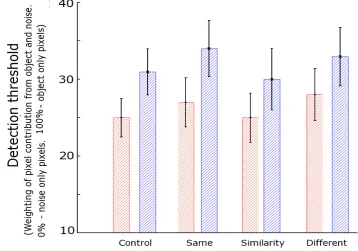
2.10 The mean detection thresholds for the experimental condi-tions for objects with identical parts (Red) and Non-identical
parts (Blue). . . 46
3.1 Shapes used to generate target and flanker Gaborized con-tours. . . 58
3.2 Methodology for generating Gaborized contours . . . 59
3.3 Orientation and positional adjustments to Gabor patches . . 60
3.4 The target region presented to a participant. . . 61
3.5 The experimental measurement of orientation noise. . . 62
3.6 Conditions presented to participant in experiment 1. . . 63
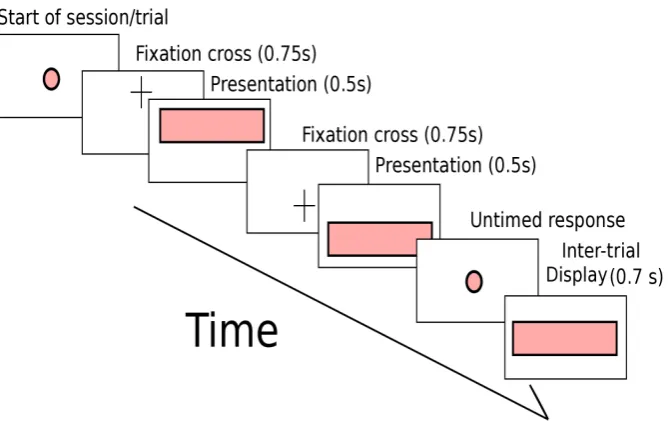
3.7 The time course of a single trial . . . 64
3.8 The mean detection threshold of the target contour as a function of each experimental condition. . . 67
3.9 The ratio of detectability of the target contour as a function of each flanking condition for each participant. . . 68
3.10 The ratio of the detection threshold as a function of the target contour shape. . . 69
3.11 The ratio of the mean detection threshold of the target con-tour as a function of each condition grouped by general pres-ence of symmetry and familiarity. . . 70
3.12 Shapes used to generate target and flanker Gaborized con-tours in experiment 2a. . . 74
3.13 Orientation of Gabor patches in periphery. . . 75
3.14 Conditions presented to participants in experiment 2a. . . 76
3.15 The mean detection thresholds of the target contour as a function of the peripheral Gabor field. . . 77
3.16 Shapes used to generate target and flanker Gaborized con-tours in experiment 2b. . . 80
3.18 The mean detection threshold of the target contour as a function of the main experimental interactions (noise and
target-flanker, symmetry and target-flanker conditions). . . . 89 3.19 The mean detection thresholds of the target contour of the
main conditions (symmetry and target-flanker) . . . 90
4.1 Change in complexity due to local changes in orientation in a circle. . . 99 4.2 Shapes used to generate target and flanker Gaborized
con-tours. . . 105 4.3 The individual complexity values for the generating shapes . 106 4.4 Conditions presented to participant in the experiment . . . . 108 4.5 The time course of a single trial . . . 110 4.6 The mean detection thresholds of the target contour as a
function of the target-flanker and symmetry conditions. . . . 114 4.7 The mean detection thresholds of the target contour as a
function of target familiarity and both the target-flanker and
symmetry conditions. . . 115 4.8 The mean detection threshold as a function of the complexity
of the shape of the target contour in the control condition. . 116 4.9 The compactness di↵erential for individual contours as a
function of the complexity of the initial contour shape in
the control condition. . . 117 4.10 The mean detection threshold as a function of the complexity
of the shape of the target contour in the same condition. . . 118 4.11 The compactness di↵erential for individual contours as a
function of the complexity of the initial contour shape in
the same condition. . . 119 4.12 Comparison of the quadratic fits of the compactness di↵
er-ential as a function of the complexity of the target contour
5.1 The presence of bilateral symmetry in adjacent contours in-troduces inter-object symmetries. . . 131 5.2 Shapes used to generate target and flanker Gaborized
con-tours. . . 136 5.3 The region surrounding the target contour containing
flank-ing contours in comparison to that used in previous
experi-ments. . . 139 5.4 Conditions presented to examine the role of numerosity of
flanking contours on target detectability. . . 139 5.5 The time course of a single trial. . . 140 5.6 The mean detection thresholds of the target contour as a
function of the numerosity of flankers. . . 143 5.7 The conditions used to examine the role of relative flanker
position on target detectability.. . . 146 5.8 the mean detection thresholds of the target contour as a
function of flanker alignment in the horizontal arrangement. 147 5.9 The mean detection thresholds of the target contour as a
function of flanker alignment in the vertical arrangement . . 148
6.1 Shapes used to generate target and flanker Gaborized con-tours. . . 161 6.2 Flanker shapes used to generate target and flanker Gaborized
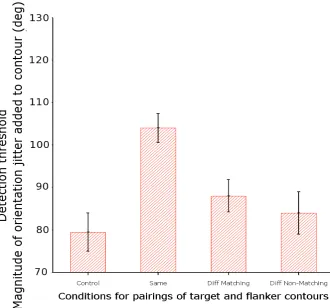
contours. . . 162 6.3 The time course of a single trial . . . 165 6.4 The mean detection thresholds as a function of flanker
sim-ilarity to target contour . . . 168 6.5 The mean detection thresholds as a function of matching or
non matching flanker shape . . . 170
Acknowledgements
The moment I started this Ph.D was the beginning of the most difficult period of my adult life. Yet, there have been some of the most wonderful events of my life during this time too. Although at times I have been doubtful I would manage to recover, never mind getting to this point and completing my thesis, I have managed it in no small part due to the people who have been by my side:
My future wife, Emma, who has patiently tolerated my little phd office in our living room. There has been no greater thing than to have her by my side and having met her has brought me a kind of happiness I never believed I would ever feel. My niece, Faith, for whom I am eternally grateful for being here after we nearly lost her forever. Her smiles and joy make something better out of life. My sister too, who in my darkest moments gave me a home to stay in when I needed to get away from everything. Not to mention her strength and capacity in keeping Faith safe. My mum, whose words have always driven me forward and who, when I needed her, was always there for me. I also know that my dad, who was lost to us all in the troubles when I was younger would have been very proud of what I’ve achieved. He has always felt very close to me, in both memory and thought, though it has been so many years since we last met.
discussions on complexity and on perception, Julie and her clear explanations, and of course, EPSRC, whose funding has allowed me to do this research in the first place.
Abstract
When an observer views a complex visual scene and tries to identify an object, his or her visual system must decide what regions of the visual field correspond to the object of interest and which do not. One aspect of this process involves the group-ing of the local contrast information (e.g., orientation, position and frequency) into a smooth contour object. This thesis investigated whether the presence of other flanking objects a↵ected this contour integration of a central target contour.
To test this, a set of Gaborized contour shapes were embedded in a randomised Gabor noise field. The detectability of the contours was altered by adjusting the alignment of the Gabor patches in the contour (orientation jitter) until a participant was unable to distinguish between a field with and without a target shape (2-AFC procedure). By varying the magnitude of this jitter, detection thresholds were deter-mined for target contours under various experimental conditions. These thresholds were used to investigate whether contour integration was sensitive to shared shape information between objects across the visual field.
1.1
Motivation
The detection of an object by the visual system may appear to be a trivial task a physical object projects an image onto the retina, which sends a signal to the visual cortex of the brain, which in turn processes this image allowing us to ’see’ a percep-tual object. However, this simple explanation belies the complexity of interpreting the presence of an object from the visual image. For example, the physical object’s contour may be obscured by the contour of another physical object, the object may share similar visual features with other objects (e.g., colour, texture), or the phys-ical object may be embedded in a complex background. Therefore, it can be hard to determine which aspects of the visual image should be used in constructing the representation of the perceptual object.
This is a ubiquitous environmental fact that animals with visual systems make use of. A predator, for instance, can use vegetation to hide its presence. The survival of its prey is linked to how well its visual system can distinguish the parts of the visual field belonging to the predator from the ever changing environment it is embedded in. From a psychophysical perspective, studying this process - how an object is seen in the environment - illuminates the conflicting ideas that underlie what is consid-ered ’an object’. For instance, a physical object is commonly understood as any item that exists external to the observer, and has mass and extension and reflects light onto the retina.
of an object (e.g., an arm of a person, the wheel of a car) or a ’whole’ object (e.g., A person, A car) have no simple correlation to physical properties objectively de-scribed.
This thesis is focused on the appearance of what is traditionally thought of as a whole perceptual object. A perceptual object is defined here as a coherent and seg-mented region of the visual field that can be perceptually detected and recognised reliably as separate from the surrounding scene.
It was clear from early experimental considerations that object detection is a far more difficult computational problem than it first appears. The initial visual in-formation deriving from an object and its surrounding region is registered in the response of individual cells in the retina. The visual system must then somehow determine which of the very large number of local cell responses distributed over a region of the retina belong to a single, whole perceptual object separated from the rest of the scene (Wallach, 1935). Furthermore, higher level processes related to visual awareness must register the perceptual object before it can be consciously seen. For instance, in a seminal set of experiments (Levin & Simons, 1997; Simons & Chabris, 1999) it was demonstrated that the allocation of attention in the scene could be directed in such a way as to prevent the detection of a prominent object moving through the center of the scene. Detection of objects is therefore not a simple process of passively receiving information, but a complex, dynamic and contextual process involving perceptual and attentional processes that are sensitive to a wide variety of potential sources of disruption and enhancement.
but similar images should refer to the same object (have the same identity) or refer to di↵erent objects? When there are numerous similar images, how is individual identity on one hand retained, and how are shared features perceived as such?
Many of these questions are relevant to common perceptual experiences. Exam-ples are everywhere: from being able to identify an individual animal from a herd of other similar animals; recognising a person and their mirror image as being as-sociated; following the complicated shifts in identity in the artistic illustrations of M.C Escher; and in scientific diagrams, such as the meticulously observed draw-ings documenting the fall of a single mercury droplet (see Figure 1.1) by Arthur Worthington (Worthington, 1894). There are perceptual e↵ects which are perhaps better understood as being a response to a whole set of objects at once.
While it has been long established that localised regions of visual activation can enhance and suppress the activation of adjacent regions and that the presence of multiple higher level features, such as a common semantic meaning, can enhance the speed by which detection occurs (see Section 1.2.5, p.22), a neglected area of research relates to how the presence of a multiplicity of objects a↵ects the percep-tion of a single object itself. Does the presence of a multiplicity of objects aid or impede the perception of an object? Under what conditions does any enhancement or degradation occur? How might the presence of other objects a↵ect the perception of visual details or identity of a single object?
Such wide-ranging integration of responses also means that the visual system can sometimes construct an illusory, perceptual object based on local information that does not necessarily correspond to a physical object (see Figure 1.2). An example of this is when a set of oriented contour elements form an illusory closed figure or object that perceptually separates from the background (see Figures 1.3 and 1.4). This kind of perceptual creation of an object could also be potentially used to in-vestigate the role of a multiplicity of objects on the perception of a single object. This approach is investigated in the bulk of the experiments reported here.
These experiments use stimuli in which shape information is presented by uncon-nected local luminance patterns (Gabor patches). These can be spatially organised so as to produce a perceptual object that is an illusory closed contour (Gaborized shape). By altering the difficulty with which such illusory contours are ’seen’ or de-tected the thesis investigates whether their detection is facilitated or suppressed by the presence of a multiplicity of objects. Hence, the experiment seeks to determine whether having multiple separate perceptual objects across the visual field plays a role in the perceptual organisation and detection of a central perceptual object.
Figure 1.1: Depictions of Mercury droplets by Arthur Worthington.
Presented here are a series of depictions of a single mercury droplet colliding with a surface. Arthur Worthington created these images by sitting in a darkened room that contained apparatus that dropped mercury at equal time intervals. A flash was used to lighten the room and provide a visual snapshot of the shape of the droplet. The drawings, when presented together, allowed an inspection of the se-quential morphology of mercury droplets. Reproduced under free copyright via Project Gutenberg.
1.2
General introduction
1.2.1
Detection of an object - psychophysical sensitivity
The physical world is made up of numerous objects in space that are constantly coming in and out of the view of an observer. What these objects project onto the retina depends on where, when and what the observer is doing. The ability to register an object being present is a fundamental perceptual process that allows an organism to navigate and perform specific tasks such as hunting.
task allows the investigation of what features the visual system is sensitive to, as-well as determine whether these are the results of conscious contingent strategies or represent general perceptual mechanisms.
For the detection process, one of the ways of measuring the performance of the visual system is to identify the smallest possible magnitude of some defined sensory stimulation that can be reliably reported as being present by a participant (Fechner, 1860/1999). This value, known as the detection threshold, can be compared under di↵erent stimulus conditions, yielding a measurement of task performance that can be used to determine the factors that influence the behaviour of the visual system. Related metrics, such as the sensitivity index (Tanner & Swets, 1954; Swets, 1985) (e.g., d’) can provide additional information regarding the extraction of the signal from the noise in an experiment.
One possible source of information for the visual system to aid in detection and recognition is to identify features in the environment that were una↵ected by changes in perspective or projective transformation (Gibson & Gibson, 1957; Gibson, 1979). These invariant features potentially provide a stable and reliable set of ecologically determined features that would be useful to perform detection tasks in most, if not all, environmental circumstances. It was determined that the visual system is in-deed sensitive to a number of invariant features such as shape symmetry (Mach, 1885/1959; Attneave, 1954; Delius & Nowak, 1982; Bornstein, Ferdinandsen, & Gross, 1981; Wagemans, 1995; Treder, van der Vloed, & van der Helm, 2011; de Kuijer, Deregowski, & McGeorge, 2004; van der Helm & Leeuwenberg, 1996, 2004; Treder, 2010; Friedenberg, 2000; Baylis & Driver, 2001; Machilsen, Pauwels, & Wagemans, 2009); shape aspect ratio (Zusne & Michels, 1962b; Regan & Hamstra, 1992) and the configuration of an object (the relationship of the parts of an object with respect to the whole) (Rensink, ORegan, & Clark, 1997; Bertamini & Farrant, 2005; Ho↵man & Singh, 1997; Keane, Hayward, & Burke, 2003).
Figure 1.2: Illusory objects and types of boundaries
The boundary of an object can be a↵ected by a number of environment factors (e.g., mist, obscuring objects, water distortions in size and shape). In the above diagram a square has been reduced to single points, and a circle has been blurred. Despite this they are still recognisable as geometric shapes. In turn, more complex shapes (In the form of the cat presented above) can still be recognised even though large amounts of continuous information has been lost.
recognise if they have seen the object before and what category the object belongs to (e.g., a mammal, a cat, my cat). These recognition processes can, in turn, influence how the visual system organises and detects objects. In particular, it can a↵ect the determination of the region corresponding to an object or figure and its separation from a background (Peterson & Gibson, 1993, 1994; Peterson, Harvey, & Weiden-bacher, 1991). Also, how discrete objects are grouped together (Vickery & Jiang, 2009) has been shown to be modulated by the visual system’s ability to recognise and learn new associations. The role of recognition processes will be discussed in greater detail in Section 1.2.2 (p.12) (For a review of quantitative and qualitative approaches to studying visual detection and recognition, see Quinlan, 1991).
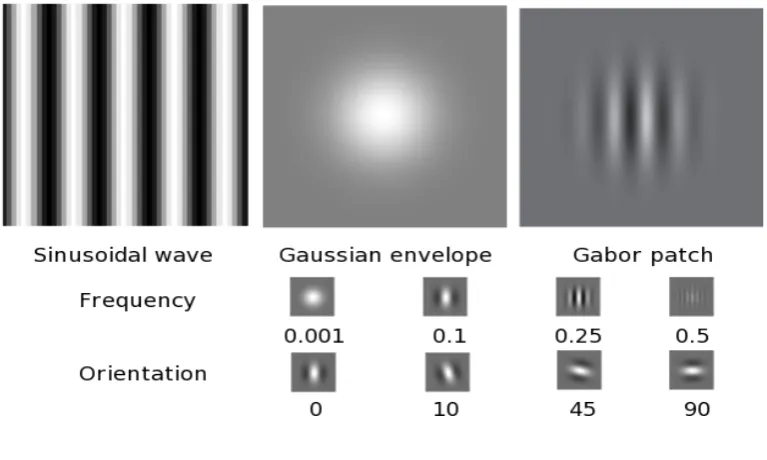
Figure 1.3: A Gabor patch
[image:25.595.106.490.97.327.2]To model the response of cells in the early visual system to the orientation and frequency of luminance a sinusoid is combined with a Gaussian envelope. This produces a Gabor patch. The frequency, contrast, phase and size of these Gabor patches can be adjusted as parameters
Figure 1.4: Gaborized contours
1954; Delius & Nowak, 1982; Bornstein et al., 1981; Wagemans, 1995; Treder et al., 2011; de Kuijer et al., 2004; van der Helm & Leeuwenberg, 1996, 2004; Treder, 2010; Friedenberg, 2000; Baylis & Driver, 2001; Machilsen et al., 2009). Symmetry is mathematically defined as being an invariant in the object to a transformation such as reflection, translation or rotation. Interestingly, symmetries, and in particular bilateral symmetry, are very commonly associated with biological objects and hence the sensitivity to such a feature can be thought of as being ecologically important. For this reason, a large number of studies have focused on bilateral symmetry.
Figure 1.5: Figure-ground segmentation of one region of the visual field from another
The luminance information (e.g., the region is black or white) is enough to determine if one region of the visual field is a figure (e.g., the glass or butterfly) or a background. This process is influenced by familiarity and recognition. An example of this is when one region can alternate between figure and background (bi-stability). This leads to the alternating percepts of a candlestick or two faces staring at each other. In the context of the Gaborized contours, the visual field must perform a similar task in which the group of Gabor patches is interpreted as belonging to a figure in some background.
tar-gets that were bilaterally symmetric permitted more efficient grouping of localised regions of contrast than those without. This, in turn, allowed the detection of the resultant contour at ever increasing amounts of noise (Machilsen et al., 2009). This study will be discussed in more detail in the following sections.
To understand how visual features and objects are encoded in the neural archi-tecture of the brain, early research recorded the activity of single neurons when a stimulus was presented to the subject (Hubel & Wiesel, 1959). The responsiveness and activity caused in a neuron by the presence of a psychophysical feature has been shown to be limited to a specific part of the visual field known as the receptive field (Sherrington, 1906; Ku✏er, 1953; Hubel & Wiesel, 1962). In the past two decades, the hemodynamic response resulting from the ensemble neural activity in the brain has been used (e.g., fMRI) to further understand visual mechanisms underlying de-tection and recognition. Using such procedures, a number of observations have been made about the organisation of the visual cortex with respect to visual perception. Using these methods it has been demonstrated that these receptive fields are feature dependent and that the extent of the visual field to which they respond can vary (Kastner et al., 2001).
More specifically, the basic size of the receptive fields for contrast information in the v1 region of the visual cortex has been shown to be <2 deg of the retinotopic field. While, in turn, the receptive fields for shape level information in the v3a and v4 regions have been shown to correspond to a much larger area (4 6 deg). The di↵erence between receptive field sizes may indicate that while some processing is local to a specific object, other forms of processing may include visual information deriving from nearby regions and objects. The complex e↵ects in the activity of neurons in the presence of multiple features will be discussed in the final section.
compli-cated dynamic environment that involves potential disruptions to such features such as occlusions or distortions. The next section will discuss detection in light of the tasks the visual system needs to perform prior to detection; the role of attention and the dynamic e↵ects on the detectability in the scene will then be discussed (p.17); finally, in the third section (p.22) the importance of the numerosity of objects and features to the visual system will be described in further detail.
1.2.2
Local features and object detection
Though the detection of objects and shapes is often associated with veridical per-ception (e.g., seeing what is physically there), illusions can occur in which an object is detected that is not present. Many examples of illusory objects and shapes, such as the Kanisza triangle (Kanizsa, 1976) have been demonstrated in which a small number of spatially separate features lead to the seeming presence of a whole shape. Samples of di↵erent types of changes in local features that maintain an overall im-pression of a shape are presented in Figure 1.2.
A number of important observations about the visual system have demonstrated that, while some initial local signal processing occurs in the retina (van Rossum & Smith, 1998; Laughlin, 1994, 1996) the visual cortex must perform computational processes to draw together the correct local features that correspond to a single ob-ject (Wertheimer, 1923; Wallach, 1935). Illusions, such as the Kaniza triangle, are indicative and diagnostic of the types of computational process that the neurons in the visual cortex engage in, in order to permit the experience of a perceptual object.
As described in the first section (p.6), the neurons in the v1 region of the visual cortex respond to the highly localised information corresponding to changes in lu-minance (e.g., contrast, frequency, orientation). It is known that the visual cortex makes use of such local information and systematically organises the responses of the cells.
coher-ent contours forming the boundary of an object in a scene (Wertheimer, 1923; Field, Hayes, & Hess, 1993; Gilbert & Wiesel, 1979, 1983; Lo✏er, 2008). However, the sensitivity to the local features is dependent on their position in the visual field. The sensitivity to contours and their local features decreases with increasing eccentricity from the centre of the fovea region of the eye (Regan & Beverley, 1983). The stan-dard model of how local features are perceptually grouped has been described as an association field (Field et al., 1993) in which the spatial relationships of local features determine the probability of their grouping into a contour. Such e↵ects have been shown to be complex with both spatially dependent enhancement and suppression to the detectability of local features in the presence of flankers (Polat & Sagi, 1993; Adini, Sagi, & Tsodyks, 1997; Zenger & Sagi, 1996; Bonneh & Sagi, 1999; Churan, Richard, & Pack, 2009; Cass & Spehar, 2005; Chen & Tyler, 2001; Freeman, Sagi, & Driver, 2001; Huang & Hess, 2007; Mizobe, Polat, Pettet, & Kasamatsu, 2001; Katkov & Sagi, 2010; Polat & Tyler, 1999; Sterkin, Yehezkel, Bonneh, Norcia, & Polat, 2008; Woods, Nugent, & Peli, 2002).
The importance of such contour integration processes has been underlined by obser-vations made of the neurophysiological responses in regions beyond V1. Activity in these regions occurs in the presence of spatially distributed contour level properties, in particular, curvature has been shown to be important to the v2 region onwards (Blakemore & Over, 1974; Watt & Andrews, 1982; Ho↵man & Richards, 1984). On an object and shape level, the presence of more global and holistic features such as whether a contour forms a closed boundary or open loop suggests that specific per-ceptual mechanisms are present that detect the closure of contours (Elder & Zucker, 1993; Kovacs & Julesz, 1993; Gerhardstein, Tse, Dickerson, Hipp, & Moser, 2012).
By arranging such Gabor patches spatially, objects can be represented as profiles or Gaborized contours (see Figure 1.4). To investigate the factors that permit the detection of the resultant Gaborized contours the local Gabor patches are then ad-justed by changing contrast, orientation or frequency. In doing so it is then possible to identify the psychophysical determinants that enhance or disrupt the contour integration process. However, while this standard procedure investigates the hierar-chical processing that link 1st and 2nd order properties (e.g., local orientations and curvature respectively) a number of recent experiments have shown that shape level features play an active role in contour integration. One such feature, the presence of symmetry (see also Section 1, p.6), has been shown to be an important factor for perceptual organisation of a Gaborized contour (Machilsen et al., 2009).
Machilsen et al (2009) studied whether the presence of bilateral symmetry in a contour could a↵ect the detectability of a contour. Using a standard experimental task (2-AFC procedure) they presented two potential stimuli: A field of distracter Gabor patches containing a target Gaborized contour and a second field of dis-tracter Gabor patches containing no target contour. Successively greater degrees of random orientation noise were added to the individual Gabor patches that made up the Gaborized contour until an observer was no longer capable of detecting a contour. The ability to detect the contour despite higher levels of orientation noise was therefore used as a measure of contour integration sensitivity. By comparing examples of shape with or without bilateral symmetry, the authors showed that the detectability of contours was better when symmetry was present in the contour as a global feature, indicating that shapes are more sensitively detected when they contain bilateral symmetry.
symmetry was present. However, unlike the original study, no contribution of bilat-eral symmetry could be observed. This study will be discussed further in Chapter 3 (p.51).
In another study published after the data collection in this thesis, Sassi, Demeyer, Machilsen, Putzeys and Wagemans (2014) demonstrated that both predictability, in which participants were presented either a block of trials consisting of either a single target contour (predictable) or multiple interleaved target contours (unpredictable) and familiarity, in which observers were trained with a specific contour shape, facil-itated the contour integration process. In a set of older relevant studies (Nygard, Sassi, & Wagemans, 2011; Sassi, Machilsen, & Wagemans, 2012) it was shown that the more readily identifiable an individual contour was, the more detectable a Ga-borized contour became.
The e↵ects of familiarity on the perceptual grouping of local features impact on the on-going debate concerning the relationship between a person’s ability to de-termine if an object is present (the object is segmented from a scene) and what that object is (a cat is present in the scene). The complementary processes have been considered to be a two stage hierarchical process in which segmentation occurs prior to any recognition (Nakayama, He, & Shimojo, 1995; Mack, Gauthier, Sadr, & Palmeri, 2008). However, evidence has accrued in which the very fact that the object has an associated identity can influence the segmentation of an object from the scene (Figure/Ground segmentation shown in Figure 1.5) (Peterson et al., 1991; Peterson & Gibson, 1993, 1994). This may indicate that a single perceptual mech-anism performs both detection and recognition (Grill-Spector & Kanwisher, 2005).
field, though, performance in both can be enhanced in the presence of other objects or shape level features.
Figure 1.6: The segmentation of a Gaborized contour from a background of Gabor patches
In the context of the Gaborized contours, the visual field must interpret the group of Gabor patches as belonging to a figure in some background. The ability to detect a contour is therefore a perceptual process that does not simply group the Gabor patches, but also separates the resultant contour from the background that surrounds it.
an observer sees an illusion of an outline of a cat, despite no continuous contrast information linking all regions and visual details of the overall shape (see Figure 1.2).
The standard method of investigating the psychophysical factors that are responsi-ble for this apparent grouping of lines into an overall contour, is to use local carriers of information (e.g., Gabor patches) and adjust the individual parameters across the whole set of these local carriers (frequency, size, contrast). Spatial arrangements of these Gabor patches so that their orientation aligns with an outline shape (contour) create what is known as a Gaborized contour. By embedding Gaborized contours in a larger field of randomised Gabor patches (shown in Figure 1.6) and adjusting the relative alignment of the shape-associated Gabor patches it becomes possible to make the detection of the contour a function of the ability of the visual system to perceptually group the localised contrast information together into a coherent contour.
The ability to detect an increasingly noisy Gaborized contour within a field of Ga-bor patches has been shown to be influenced by contextual factors (e.g., presence of bilateral symmetry, familiarity, expectation). However, the detection and relevance of these cues can be dependent on the allocation and direction of attention. The importance of attention and its role in detection will be discussed in the next section.
1.2.3
Attention and the detectability of objects and
fea-tures.
distribut-ing attention more broadly (For a review see Evans et al 2011). The complexity of both biological and social demands is reflected in how attentional mechanisms are structured. For instance, attentional processes can be defined by whether a stimu-lus is selectively chosen by directing the eyes to the location of the stimustimu-lus (’overt attention’) or, alternatively, by allocating cognitive resources on a stimulus that is not in the direct line of gaze (’covert attention’) (Posner, Snyder, & Davidson, 1980).
The study of the attentional factors that e↵ect an observer’s ability to detect objects has employed a number of di↵erent methodological strategies, these have included: tracking eye movements (Yarbus, 1961, 1967); The study of the attentional factors that e↵ect an observer’s ability to detect objects has employed a number of di↵erent methodological strategies, these have included: tracking eye movements (Posner, Nissen, & Ogden, 1975; Posner et al., 1980); and presenting a target amongst a number of distracters and determining how efficiently an observer can perform a visual search for the target (Treisman, 1982, 1988, 1991; Treisman & Gelade, 1980). While attention is often conflated with the conscious direction of eye movements, or line of gaze, to a target object, it is known that attention is a more complex process that, in part, automatically responds to the presence of salient cues (Posner et al., 1980). Furthermore, it is known that multiple sub-regions of the visual field can be attended to in a single instance (McMains & Somers, 2004) and that the presen-tation of high level semantic information primes the attentional system to detect the visual targets with decreased response times and increased accuracy (Maxfield, 1997).
diagnostic color or material (brown fur), i.e., individual features associated with the boar (’feature-based’). Hence, attention can be defined as a visual mechanism which permits the limited selection of some item(s) according to the type of task-based constraints (Location/Object/Feature) (Carrasco, 2011). Based on this understand-ing, attentional research has often focused on a specific factor such as the detection and identification of specific features (Driver & Baylis, 1989; Baylis & Driver, 1992; Duncan & NimmoSmith, 1996; Rossi & Paradiso, 1995) or objects (Duncan, 1984; Martinez, Ramanathan, Foxe, Javitt, & Hillyard, 2007).
In turn, however, attention has been demonstrated to be an extremely complex subsystem that operates at the level of both objects and features presented in space (Kravitz & Behrmann, 2011; Simons & Chabris, 1999). One such dramatic example of an interaction between objects in a scene and the allocation of attention was developed by Simons and Chabris (1999). They demonstrated that something as significant as a man walking in a gorilla costume could be impaired when partici-pants were directing their attention to other elements of a scene in which a group of men were passing a basketball between each other.
1.2.4
The detection of Gaborized contours outside of the
focus of attention
Using this technique it has been shown that feature-based attention influences the detectability of object contours created from Gabor patches (Stojanoski & Niemeier, 2007). Their studies investigated the ability of an observer to detect a peripheral unattended contour when it shared a feature in common with a central attended target contour (the features in question were either a contour shape, or motion cue). By adding orientation noise to the alignment of subsequent Gabor patches along the contour they reduced the likelihood that the visual system could perform contour integration on the presented contours. Using a dual-task procedure that extracted psychometric functions measuring the likelihood that a contour in the periphery was detected given a decreasing amount of collinearity.
A secondary, but equally important factor that was identified during this experi-ment was that the difficulty of the task was instrumental in whether the facilitatory e↵ect was observed. Stojanoski and Niemeier created an easy and difficult task for the performance of the secondary detection task. In these, the participant was re-quired to achieve a detection threshold of either 75 or 95 percent correct responses for the unattended contour. With respect to the contour-based feature, the collinearity of the targets was lower in the more difficult task than in the easier one.
These experiments were primarily focused on the role of feature based attention and the modulation of the detection of a contour outside the region of attention and it is not yet clear whether this process is an asymmetric e↵ect. For instance, it has been shown that the attended contours a↵ect unattended contours. However it may be that this is a two way interaction in which peripheral unattended features enhance the detection of the contour in a directly attended region. In this light, the present thesis investigates a potentially complementary e↵ect - does the presence of unattended or less attended object level information modulate the perceptual or-ganisation of a directly attended object?
There are a number of important di↵erences in the approach taken by this the-sis and that of the above experiment.
Firstly, familiarity is encoded into the contours by the choice of common every-day objects (e.g., Cat/Butterfly), whereas in comparison, the previous experiment used simple circular loops.
Secondly, the emphasis of the current experiments is on both common shape and the presence of discrete features (e.g., symmetry).
Thirdly, the detection threshold is uniform for all shapes of varying complexity (controlling for this factor is discussed in Chapter 4, p.94).
in more detail in the next section.
1.2.5
Object, signal and feature numerosity
The importance of multiple objects in the visual field is a complex and interdisci-plinary issue that incorporates many aspects described in the previous sections. For instance, contour integration can be considered a response to the numerosity of local features, while attention can be considered to be an ecological strategy to function adaptively in the context of many objects.
The next three subsections are concerned with the importance of multiple objects and features to the visual system and will demonstrate that the numerosity of ob-jects in the visual field is not accidental to the functioning of the visual system, but is a key component of visual processes and needs to be investigated to develop a fuller understanding of the underlying behaviour that leads to our experience of the world.
Redundancy gain from multiple visual features
The detection of an otherwise un-obscured object by a visual system should seem like a rather trivial process unlike the detection of illusory objects. However, early work on inter-sensory e↵ects by Todd (1912) showed that the speed by which a detection task is performed by an observer could be modulated by the simultaneous presentation of two otherwise separate ’signals’ (e.g., an auditory tone and a light). More specifically, the mean response time of an observer to a target was lower when both the tone and light were presented in comparison to the presentation of either the tone or light alone.
to the central target detection decreased the mean response time for such targets (Miller, 1982; Toellner, Zehetleitner, Krummenacher, & Mueller, 2011; Krumme-nacher, Muller, & Heller, 2001, 2002a, 2002b; Ivanov & Werner, 2009; Grubert, Krummenacher, & Eimer, 2011).
The redundancy gain provided by the simultaneous presentation of other relevant features has been shown to be sensitive to the presence of higher-level semantic associations. For instance, an individual letter in the modern Latin alphabet has an upper case and lower case letter for a single phoneme. Ben-David and Algom (2009) presented a target letter (say, the letter ’a’) with adjacent flanking letters that had identical visual features (’a’); were related by sharing a semantic role (’A’) or varying in shape and semantic meaning (’b’ and ’B’). By measuring the mean reaction time corresponding to successful and accurate detection they determined that the presence of both identical visual features and higher-level semantic meaning decreased the mean reaction time.
By using measurements of how quickly target detection occurs, the redundant sig-nals e↵ect is used to investigate how additional information from the various sensory modalities is combined in the act of detecting a target. At a very basic level then, any experiment that presents multiple simultaneous cues may be invoking the tem-poral benefits in combining two or more signals together.
Encoding of sets of objects
The quantification of objects is often associated with a single value such as the specific orientation of an object with respect to some axis. However, as is used so frequently in science, valuable information can be encoded by taking the average value of group of objects. Humans are remarkably adept at making guesses and judgements about general features in the world (e.g., clouds are white) but less adept at deciphering the specific features (e.g., the complex and sometimes subtle patterns of graduation of luminance and colour in clouds.)
Alvarez (2011) investigated the capacity of observers to make judgements about the general and specific features of sets of objects. Judgements concerning the gen-eral features of sets of objects were significantly accurate when compared with the true mean of the set. However, unlike the largely accurate judgements of the mean of some feature, observers were less capable of accurately accessing the individual features involved. This process of encoding the mean values of a feature of a set of objects, or ensemble encoding, was demonstrated to occur for a variety of features such as size (Ariely, 2001; Chong & Treisman, 2003), orientation (Dakin & Watt, 1997; Chong & Treisman, 2003; Parkes, Lund, Angelucci, Solomon, & Morgan, 2001) and the position (Alvarez & Oliva, 2008).
Though primarily focused on cognitive judgements about visual features these be-havioural experiments demonstrate that general information derived from sets of objects are available in the visual system. Hence, the human visual system is in some sense functionally designed to process the general information from a scene that may pertain to a group of objects, but may not be necessarily tuned to highly specific information.
Facilitation, Surround suppression and crowding in local features
across a specific region, environmental circumstances may lead to congruent and conflicting features lying in a single visual field.
As described in Section 1.2.1, enhancements to the detectability of a localised tar-get feature have been observed when presented in the presence of additional flankers (Polat & Sagi, 1993; Adini et al., 1997; Zenger & Sagi, 1996; Bonneh & Sagi, 1999; Churan et al., 2009; Cass & Spehar, 2005; Chen & Tyler, 2001; Freeman et al., 2001; Huang & Hess, 2007; Mizobe et al., 2001; Katkov & Sagi, 2010; Polat & Tyler, 1999; Sterkin et al., 2008; Woods et al., 2002). Likewise, a single increased size of local feature, or multiple features in close proximity have been shown to have the oppo-site, suppressive e↵ect in which the central target region becomes less detectable when the adjacent regions are simultaneously occupied by some competing flank-ing stimuli. This e↵ect is known as psychophysical surround suppression (Tadin, Lappin, Gilroy, & Blake, 2003; Born, 2000; Pack, Hunter, & Born, 2005; Churan et al., 2009; Spillmann, 1994; Troncoso et al., 2007; Petrov, Popple, & McKee, 2007). Other e↵ects can inhibit the recognition of features, in what is described as crowd-ing e↵ects (Bouma, 1970; Stuart & Burian, 1962; Pelli & Tillman, 2008; Toet & Levi, 1992; Levi, 2008; Levi, Hariharan, & Klein, 2002; Parkes et al., 2001; Pelli, Palomares, & Majaj, 2004). Under such conditions the capacity to distinguish the orientation or configuration of a target is a↵ected by the presentation of conflicting flanker information.
understanding of the role of suppression and inhibition of multiple objects and fea-tures activating individual or groups of neurons in the visual system may be more complex than previous research has indicated.
Summary of neurophysiological of early visual system
As has been described elsewhere in the introduction (p.3) , one significant task that the visual cortex needs to perform is to integrate the local luminance changes across the retina into a coherent whole object (Wertheimer, 1923; Wallach, 1935; van Rossum & Smith, 1998; Laughlin, 1994, 1996). However, even at this stage of processing the response to luminance on the retina is spatially dependent (Regan & Beverley, 1983), for example, the sensitivity to luminance contrast can vary with eccentricity from the foveal region of the eye.
This disparate information is then passed onto the primary visual system (V1 area). Here, neurons are tuned to specific features (e.g., contrast, frequency, orientation) within a given topographic region of the retina (Wertheimer, 1923; Gilbert & Wiesel, 1979, 1983; Marcelja, 1980). When the spatial distribution of such local features is taken into account, more complex visual features - such as curvature - are formed, and these are represented in regions beyond V1. Changes in curvature, for exam-ple, have been shown to trigger neuronal responses in the v2 region of the cortex (Blakemore & Over, 1974; Watt & Andrews, 1982; Ho↵man & Richards, 1984). Neurons further in the processing hierarchy are shown to be sensitive to even more global properties such as shape circularity. Sensitivity to circularity is associated with the v4 area of visual cortex (Gallant, Braun, & Vanessen, 1993; Gallant, Con-nor, Rakshit, Lewis, & VanEssen, 1996; Wilkinson et al., 2000; Wilson & Wilkinson, 1998; Dumoulin & Hess, 2007).
1.2.6
Summary
a continuous spatial scale, but it is instead linked to specific features and the area of the visual field the feature occupies. This complex system of feature-dependent, spatially linked responses leads to what could be described as feedback and lateral interactions.
The observed behavioural performance is then better considered a function of the context of a whole scene and all the objects present rather than a simple feed-forward detection of whatever is in a single location. For such a system, one plausible intu-ition is that having shared features for spatially independent objects across a scene could provide additional spatial and organisational information (in the form of feed-back) to use for ambiguous ’signals’, i.e. those that have a number of di↵erent interpretations.
The present thesis investigates this intuition in greater detail in light of the ever increasing amount of research that have demonstrated, not simply top-down e↵ects of cognitive understanding, but also purely perceptual feedback e↵ects on the for-mation of a percept.
1.3
Experiment overview
1.3.1
Experiments
Chapter 2 Is the detectability of a 3-D object embedded in multi-scale
noise a↵ected by the presence of neighbouring objects? (Pilot experi-ment)
The initial pilot experiment developed a methodology to investigate the e↵ects of object-level configural information on low-level features. The stimuli consisted of grey-scale rendered images of 3-dimensional target objects embedded in 3-dimensional multi-scale noise (Perlin noise). The detection of a target object was measured when presented alone or in the presence of flanking objects that had similar or di↵erent shape or similar or di↵erent part-configuration to the target object.
Chapter 3 Is the detectability of a Gaborized contour modulated by
the presence of nearby flanking contours?
The purpose of this set of experiments was to identify the basic e↵ect of the pres-ence of shape contours present in the periphery (flankers) on the contour detec-tion/integration of a target shape contour. These flanking contours could be similar or di↵erent or may only share some feature of the target shape (e.g., symmetry).
The experiment was done using a standard approach in contour integration studies, where the detection of Gaborized contour embedded in a noise field of similar ran-domly oriented Gabors was disrupted by adjusting the local orientations of Gabor patches belonging to the target contour.
Chapter 4 Contour integration is facilitated by the presence of adjacent
contours that share shape-level features.
Gaborized target.
The standard introduction of orientation noise increases the complexity of a target Gaborized contour until it can no longer be detected. However, before the addition of orientation noise the Gaborized contours were of varying initial shape complex-ity. Hence, performance di↵erences were not captured by the simple investigation of the detectability of the target contour. Both these e↵ects were investigated by devising a method that took into account the holistic shape changes that occurred to a virtual perimeter that would result if the visual system was extracting a smooth contour from the misaligned Gabor patches.
Chapter 5 The magnitude of the flanker facilitation e↵ect on contour integration is modulated by changes in spatial location and numerosity
of flanking contours.
The purpose of this set of experiments was to investigate the importance of con-textual factors such as numerosity and alignment on the magnitude of the flanker facilitation e↵ect. The spatial relationships of the flanker and target Gaborized con-tours were compared in two experiments by increasing the number of flankers and changing the relative alignment of the flankers with respect to the target contours to identify contextual factors that modulate the strength of the flanker facilitation observed in the previous experiments.
Chapter 6 Shape similarity modulates the magnitude of the flanker
facilitation e↵ect.
Chapter 2
Is the detectability of a 3-D object
embedded in multi-scale noise
2.1
Abstract
The detection of a whole object is a complex process in which the organization and visual details of the object’s parts can modulate how easily the visual system performs detection tasks. However, a number of experiments have demonstrated that the perceptual processes that underpin object detection are modulated by other objects in the visual field. This pilot study investigated whether the detectability of a 3-D object embedded in multi-scale noise was a↵ected by the presence of other flanking objects with shared or dissimilar part configuration and shape. In order to do this, a family of 3-D objects was generated by varying the shape and configuration of the object’s parts. The image of the target object was embedded in a random multi-scale noise field that masked visual information across di↵erent spatial scales. A 2-AFC adaptive staircase procedure was used in which the visibility of the target object was decreased until participants were no longer able to detect the object. To do this, the opacity of the multi-scale noise, with respect to the embedded object, was increased or decreased. The target was presented by itself in a control condition or was flanked horizontally by a second object of similar or dissimilar configuration of parts or overall global shape. Preliminary results indicated that the presence of flanking objects decreased the detectability of the target object. However, the identification of a number of methodological issues associated with both the stimulus and the experimental procedure prompted a reevaluation of the approach used in this pilot study to address the questions that motivated the experiment.
2.2
Introduction
Leeuwen-berg, 2004; Treder, 2010); aspect-ratio (Zusne & Michels, 1962a; Regan & Ham-stra, 1992); contour convexity/concavity (Ko↵ka, 1935; Kanizsa, 1976; Bertamini & Wagemans, 2013; Huttenlocher & Wayner, 1992; N. Rubin, Pao, & Gieger, 2000; Pao & Geiger, 2001); circularity/compactness (Zusne & Michels, 1962a; Gallant et al., 1993, 1996; Wilkinson et al., 2000; Wilson & Wilkinson, 1998; Dumoulin & Hess, 2007); viewpoint (Tarr & Pinker, 1989; Jolicoeur & Milliken, 1989; Moses, Ullman, & Edelman, 1996; Vetter & Poggio, 1994; Palmer, Rosch, & Chase, 1981; Koenderink & Van doorn, 1979; Tarr & Kriegman, 2001); and the arrangement of the parts of an object (Rensink et al., 1997; Bertamini & Farrant, 2005; Ho↵man & Singh, 1997; Keane et al., 2003).
However, the detection of the presence of whole objects is more complex than regis-tering the set of visual details. Keane et al (2003) demonstrated that the sensitivity to changes in the arrangement (also known as the configuration of the object) or the shape of an object’s parts was dependent on the types of change being presented. For instance, the replacement of an existing object part with a novel part (e.g., a spherical curved part replaced by a pyramidal, straight part) were less likely to be detected than changing the relative position of a part in the object. This suggests that the visual system encodes and responds to the overall configuration of an object more readily than the specific local details across the whole object.
In contrast, the early visual system is also involved in integrating purely localized in-formation such as contrast, orientation and curvature into the edges and boundaries of the object. (Wallach, 1935; Attneave, 1954). To do so, neurons are specifically responsive to localized and orientated contrast information (Hubel & Wiesel, 1959, 1962; Marcelja, 1980). The visual system can then, in turn, detect whole shapes amongst sets of these discrete regions of local information (Wertheimer, 1923; Field et al., 1993; Barlow & Reeves, 1979; J. Beck, Rosenfield, & Avry, 1989; Smits, Vos, & Van Oe↵elen, 1985; Lo✏er, 2008).
the local processing of a single object. Research into the simultaneous presentation of multiple objects and features has demonstrated that the detectability of a single target is dependent on contextual factors introduced between objects. For 2-D con-tours, for instance, peripheral unattended contours become more detectable when presented simultaneously with primary centrally attended contours when both share a specific feature (Stojanoski & Niemeier, 2007).
The studies described here demonstrate that the presence of specific features play a role in the detection of a central target. In turn, the presence of features in an attended central object can facilitate peripheral objects if they share the feature in common with the initial target object. However, a number of other, more specific enhancements have been observed that are linked to the presence of both multiple objects and other sensory cues.
In a perceptual e↵ect, known as the ’redundancy signals e↵ect’ (Todd, 1912; Miller, 1982), the speed of detecting a target stimuli was shown to be more rapid when it was presented with additional sensory information. To study this perceptual e↵ect these studies show how rapidly an observer can detect a target both with and with-out the presence of a di↵erent sensory cues. For example, when an observer is asked to detect either a brief auditory tone or light, they perform the detection of the light more quickly (in comparison to detecting the light alone) when both the tone and light are presented simultaneously.
Similar e↵ects have been observed in the visual mode alone when two or more feature dimensions are presented together (e.g., colour, orientation or semantic meaning of a shape) in the context of a visual-only detection task (Krummenacher et al., 2001, 2002a; Ben-David & Algom, 2009; Toellner et al., 2011).
more sensitive to the di↵erences between two otherwise identical checkerboard pat-terns when they were shown simultaneously side-by-side. This enhancement was shown to be greater than the ability of an observer to detect the di↵erence between the two patterns when they were presented sequentially.
Though objects occur independently in the environment and have unique projec-tions onto the retina, the evidence accrued in the research thus far has demonstrated that the performance of the visual system in detecting an object is a highly com-plex set of contextually sensitive processes that can enhance the detection of both intentionally targeted, as well as peripheral, objects.
An unanswered and important question is whether having other objects in the sur-rounding regions enhances or suppresses the local perceptual mechanisms responsible for visual detection (e.g., in a similar vein to the e↵ects of bilateral symmetry on the perceptual organization of a contour). Such visual interactions are particularly evident in a variety of visual depictions.
One such example is the depiction of a sequence of objects that represent a causal change (such as Escher’s etchings, or, Worthington’s scientific drawings (Worthington, 1894) shown in Figure 1.1, p.6). In such cases one automatically perceives a grouping that is dependent on systematic changes in part structure. These types of interac-tions imply not only that neighbouring objects could influence the visual processing of an individual target object, but also that such interactions may be dependent on similarities and di↵erences in part structure.
2.3
Aims
to be sensitive to the configuration of an object.
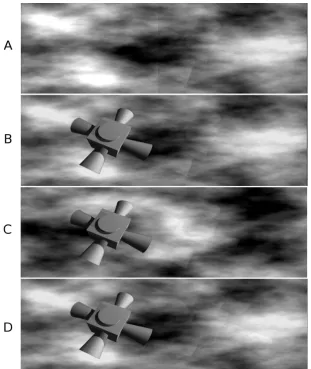
The primary goal of this methodology was to investigate whether the common-alities in the configuration of the objects facilitated detectability of similar objects in the visual field. To preserve the overall configuration of the object while dis-rupting the local features the experiment involved a novel application of a classic multi-scale fractal noise generation procedure (Peachey, 1985; Perlin, 1985). (see Appendix 1 and 2, p.200 and 202). The target object was embedded in a random luminance multi-scale noise image. Due to the nature of this so-called Perlin noise, this would e↵ectively result in obscuring the luminance information of the target object at multiple scales. The resultant image appears as a 3D object embedded in a 3D0noise cloud0.
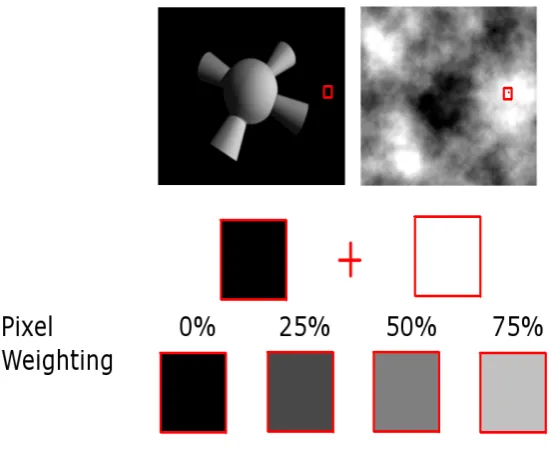
The detectability of the target object was measured by decreasing the visibility of the object with respect to the multi-scale noise. Specifically, the target object bitmap image was combined with a Perlin multi-scale noise image of the same pixel dimensions by averaging the pixel luminance values from each image (object and noise image). A visibility decrease corresponded to a greater luminance contribution from the multi-scale noise, than the object bitmap image, to the pixel value in the resultant stimulus.
The displayed stimuli consisted of a central target object with or without the pres-ence of other flanking object in the region surrounding the target object. The flanking objects either visually matched the target object (had corresponding parts and part configuration) or di↵ered (the parts or part-whole configuration di↵ered between target and flankers).
shape and the configuration of parts under such conditions.
One consequence of an object being embedded in scaled noise under these experi-mental conditions is that the visual system must first extract the local information to perform the detection task. Hence, any observed e↵ect on detectability by the presence of flanking objects could indicate that the additional objects alters local contrast processing or global shape detection processes. An identification of any detection advantage could then be used to examine how such mechanisms may op-erate.
2.4
Methodology
2.4.1
Participants
4 participants (ages 22-30) performed the experiment. Each participant performed one session of 1 hour. A break was provided mid-way during the session for as long as the participant wished. All participants had normal or corrected-to-normal vision. The St Andrews University Teaching and Research Ethics Committee (UTREC) granted ethical approval (Ethics reference number: PS7638). The participants were asked to report any impressions of the experiment with regard to difficulty or ease in post-experiment de-briefing.
2.4.2
Apparatus
Experiments were run on a Dell 2407WFP running a LCD display with a resolution of 1920x1200 and a refresh rate of 60Hz. The viewing distance was 57cm. Partic-ipants viewed the screen from a chin/head rest. The experiment was implemented using C++ with the OpenGL library.
2.4.3
Stimuli
objects (Object images) embedded in multi-scale noise (Noise images) that covered a rectangular area of 13 by 10 arc degrees placed on an otherwise black screen.
Object Images
3-Dimensional object stimuli were generated using the 3D modelling utilities pro-vided by PovRay (of Vision Pty. Ltd, 2004) (For details of the procedure see Ap-pendix 1. p.200). Objects were generated under a single di↵use illumination. The projective parameters were adjusted so that the angle of the main vertical axis of the object with respect to the line of sight of an observer was set to 30 degrees. The viewing angle was chosen to provide visual presentation of the entire configuration of the objects. This angle was chosen to provide visual presentation of the entire configuration of the objects.
Each object generated consisted of four object parts connected to a central body. The central body was a cuboid and the individual object parts had volumes less than 1/2 of the central object body. The parts of the objects were configured to form a symmetric cross-shape.
Four base objects were generated that were subdivided into two groups. One group of target objects had a set of parts that were identical with each other; the individual parts of the second group of target objects were a set of additional randomized 3-D objects. The four initial objects are shown in figure 2.1. The groups were chosen so that the e↵ects of changing the visual details of each part could be examined in future experiments.
Figure 2.1: Objects used as a detection target.
Objects consisted of 4 parts arranged perpendicular to the center of the main object body which was a simple solid. With respect to the plan view from the top of the objects the object viewpoint was set along the x and z axis to permit viewing of all parts. Two groups of objects were generated: (Top left and right) One group of objects with identical parts (360 degree rotation symmetry along the depth plane). (Bottom left and right) A second group of objects with di↵ering parts (without rotational symmetry). Both groups of objects were used as a basis from which an additional set of objects was generated.
object has a rotation of 30 degrees for a single part of the initial target object; and the third object has a rotation of 30 degrees for two parts of the initial target object.
Figure 2.2: Configuration changes for a single object.
For each object two variations of the original object were generated by the rotation of individual parts from their original perpendicular orientation with respect to the main object axis. The set of individual objects consisted of (A) index object without adjustment to object parts, (B) similar 1, with the upper right part rotated by 30 degrees, and (C) similar 2, with the upper left and upper right parts rotated by 30 degrees.
Noise images
The noise images consisted of what is known as Perlin noise (Perlin, 1985) using a C++ Noise generator library (Bevins, 2003). The noise consisted of a randomized alpha value for a given pixel between 0-255, with 0 being black and 255 being white. The generation of this multi-scale fractal noise is described in Appendix 2 (p.203).
Each noise image consisted of an area that subtended a region of 13 by 10 arc degrees when presented onscreen. Multi-scale noise has a two primary parameters: (A) the number of frequency harmonics for the noise image can be increased or decreased, this is described as the octave value of the multi-scale noise, and (B) the relative am-plitude of the frequency harmonics are altered, this property is known as persistence.