Formability optimisation of fabric preforms by controlling
material draw-in through in-plane constraints
S Chen, L T Harper*, A Endruweit, N A Warrior
Polymer Composites Group, Division of Materials, Mechanics and Structures, Faculty of Engineering, University of Nottingham, UK, NG7 2RD
*[email protected] , Tel +44 (0)115 9513823
Abstract
A genetic algorithm is coupled with a finite element model to optimise the arrangement
of constraints for a composite press-forming study. A series of springs are used to locally
apply in-plane tension through clamps to the fibre preform to control material draw-in.
The optimisation procedure seeks to minimise local in-plane shear angles by determining
the optimum location and size of constraining clamps, and the stiffness of connected
springs. Results are presented for a double-dome geometry, which are validated against
data from the literature. Controlling material draw-in using in-plane constraints around
the blank perimeter is an effective way of homogenising the global shear angle
distribution and minimising the maximum value. The peak shear angle in the
double-dome example was successfully reduced from 48.2 to 37.2 following a two-stage
optimisation process.
Keywords
1 Introduction
In the manufacture of composite components, draping of reinforcement fabrics can cause
large local shear deformations (change in fibre orientations, fibre volume fraction, fabric
thickness, etc.) to occur. For most fabrics, in-plane shear is the main deformation
mechanism in drape, but excessive local shear can lead to wrinkling (i.e. out-of-plane
buckling due to local compressive stresses) and fibre fracture [1]. To successfully drape
a reinforcement without encountering unwanted wrinkles and defects, the main challenge
is identifying optimum forming conditions. Among the processing parameters affecting
fabric press forming, the distribution of the blank holder force (BHF) and the blank shape
are two essential properties that should be optimised to improve the quality of the formed
shape [2, 3]. To optimise these parameters, efforts have been made to develop simulation
tools to facilitate parametric studies.
Kinematic drape simulation codes [4, 5] use a purely geometrical approach to compute
fabric drape patterns, but whilst this method is computationally relatively inexpensive,
there is no accounting for mechanical material properties or process conditions.
Conversely, Finite Element (FE) simulations enable the physics of the forming problem
to be modelled and are becoming a viable choice as computing resources improve. This
approach enables the influence of process parameters, including contacts and friction
between components to be studied, but more importantly can be used to indicate the
likelihood of defects occurring during forming. To date, most FE forming studies have
focused on capturing the deformation of fabrics accurately though implementation of
suitable constitutive material models [6, 7], rather than focusing on optimising the
Procedures for optimisation of the forming process can be classified as direct or indirect.
Indirect methods refer to trial and error approaches, which require experience to interpret
the results and can be time consuming. Nonetheless, they are likely to be used for
optimising composite forming processes, since the complex relationship between
wrinkling strain and clamping force does not need to be formulated. Indirect methods
have previously been used to optimise fabric blank size [2] and BHF distribution [3], in
order to minimise wrinkle formation. The probability for wrinkles to occur was shown to
increase as the blank size is reduced relative to the size of the punch, since the tension in
the blank is released during the latter stage of the forming process [2]. A uniform BHF
distribution produced the least wrinkles in forming a hemisphere. However, it was
concluded that a segmented blank holder is required to further reduce the level of
wrinkling, to vary the local pressure distribution as a function of intra-ply shear and
compressive forces [3].
Direct optimisation methods rely on mathematical relationships between the processing
parameters (BHF, blank shape, fabric pre-shear) and the objective function (describing
shear angle, wrinkling etc.) to be formulated, and have been used extensively for
optimising metal forming problems. They commonly employ Genetic Algorithms (GA)
[8-11], which mimic natural selection processes to enable the strongest permutation of
design variables to evolve, and inferior ones to fade out. GAs are not widely used for
optimising composite forming problems, because they are computationally expensive. A
GA was coupled with a kinematic drape model by Skordos et al. [5], where the drape start
point, drape direction and the pre-shear angle of the fabric were defined as design
parameters. Employing the GA reduced the CPU time to 30 % of that required for an
a GA to optimise the BHF around the perimeter of the blank, with the objective of
minimising wrinkling [12]. Results indicated that optimising the BHF successfully
eliminated concentrated buckling of tows around the base of the hemisphere, without
affecting the in-plane shear angle distribution.
This paper presents a GA coupled with a non-linear explicit FE model to optimise the
draw-in of the blank during composite press-forming. Spring-loaded clamps are used to
directly provide in-plane tension to the fabric, rather than applying a normal pressure
(resulting in in-plane friction) through a blank holder. This technique has been discussed
in the literature for thermoplastic forming [13, 14] and is currently used in the automotive
industry in preforming of non-crimp fabric. It enables the blank to be heated easily if the
fabric is bindered or pre-impregnated, as the clamps are situated outside of the heated
region of the press. This arrangement also offers more flexibility in terms of controlling
material draw-in, as the spring-loading for each clamp can be controlled independently,
but results in increased complexity. The optimisation procedure seeks to determine the
optimum location and size of each clamp and the stiffness of each spring controlling the
local draw-in. The objective is to minimise the global in-plane shear angle of the fabric.
2 Modelling of fabric preforming using in-plane constraints
2.1 Fabric material model
A non-orthogonal constitutive model is employed in this work to describe the fabric
behaviour during preforming, which was previously derived by the authors [15]. This
macro-scale model was shown to effectively capture the dominant factors in fabric
forming, including in-plane shear, fibre elongation and inter-tow/intra-ply slipping. This
because it appropriately describes the anisotropic behaviour of biaxial materials under
large shear deformation [17, 18]. A VFABRIC subroutine was developed in
Abaqus/Explicit to implement the mechanical constitutive relations for woven fabrics.
Comparisons against experimental data [15] indicated high levels of accuracy for the
simulation results, which was not significantly compromised by time-scaling or
mass-scaling employed to reduce CPU time.
2.2 Validation for forming model using in-plane constraints
Numerical tests have been performed to validate the material model against experimental
data for the case where in-plane constraints are used to provide tension in the fabric to
control draw-in [13, 18], rather than out-of-plane blank-holders. Material parameters
were consistent with the values in the literature [19-22] for a balanced plain weave glass
fibre/polypropylene commingled fabric. The value of Young’s modulus was taken to be
35.4 GPa in each fibre direction and the shear modulus was described by a polynomial:
MPa 0.1948) + | | 1.5928 -| | 6.3822 + | | 9.8228 -| | (6.7135
= 12 4 12 3 12 2 12
12
G (1)
where12is the in-plane shear angle in radians.
Validation was conducted using the same geometry and material properties as in the
literature [13, 18]. The blank was a single 0°/90° ply at a thickness of 0.4 mm. The
optimised blank shape described by Harrison et al. [13] was employed, and the ply was
modelled using quadrilateral membrane elements (M3D4R). Tooling was considered to
be rigid; Coulomb friction was adopted for both tooling-material and material-material
contacts, with a coefficient of 0.2; displacement boundary conditions were applied to the
punch, whilst in-plane spring elements were used to connect the edge of the blank to a
elements was 0.20 N/mm on the short edges and 0.27 N/mm on the long edges of the
rectangular frame [13].
A comparison of the shear angle distributions is presented in Fig. 1. Qualitatively, the
outline shape of the final formed part from the simulation is in very close agreement with
experimental data [13]. A quantitative analysis was performed by comparing the local
shear angle at 20 discrete locations (Table 1). Two experimental repeats were performed
[13], and the measurements from each of the four quadrants were averaged for each repeat.
Fig. 1 indicates that the predicted shear angles from the numerical solution fall within the
range of the experimental values, with deviations of generally less than 2according to
Table 1.
3 Methodology of in-plane constraint optimisation
3.1 General strategy
The initial blank size for the double-dome forming study discussed here was 470 mm ×
270 mm with a thickness of 0.4 mm, and the ply was discretised into 5076 square
membrane elements (M3D4R). The initial fibre orientations in the blank were at 0°/90°.
Springs are arranged around the perimeter of the preform to control material draw-in,
providing in-plane constraints during draping. The optimum design of this system is
dependent on the geometrical arrangement (number, position and size) of the springs and
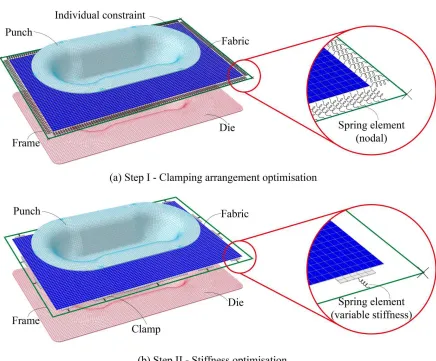
their mechanical properties (stiffness). The optimisation procedure is split into two stages
as shown in Fig. 2: (a) Step I: Clamping arrangement optimisation, (b) Step II: Spring
stiffness optimisation. The first step determines sensible clamping positions to improve
formability, by reducing the maximum global shear angle in the model. Compromises
step determines optimum spring stiffnesses for the derived spring arrangement, therefore
the final solution may not be the global optimum, but near-optimal.
This multi-stage approach makes the procedure independent of specific geometrical
parameters, thus providing the flexibility for application to a variety of test geometries.
Simultaneous optimisation could potentially be more cost-effective computationally and
produce a more efficient solution, but only if a suitable mathematical description could
be derived. However, this would require a specific new formulation of the optimisation
problem for each forming task and would not enable routine application of the method.
3.2 Step I: Clamping arrangement optimisation
Each node around the perimeter of the blank is initially constrained by an individual
spring element with the same initial stiffness (see Fig. 2a). The other end of the spring is
fixed to a fully constrained rigid frame. The force constraining movement of the blank is
always oriented along the spring element axis, extending the spring as the material draws
into the tool while forming. The status of each node (i.e. constrained or unconstrained) is
determined by the optimisation algorithm. When it is unconstrained, the spring element
is removed.
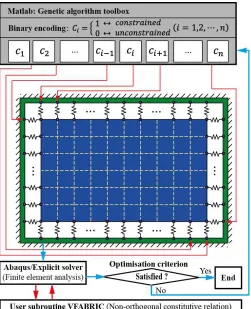
The clamping arrangement optimisation is implemented using Matlab, as shown in Fig.
3. For each loop or “generation” in the GA, a group of constraint patterns called
“individuals” is generated and Abaqus/Explicit input files are produced. The shear angle
distribution in the deformed blank for each individual is determined from Abaqus/Explicit
analyses and then returned to Matlab. The corresponding fitness value is determined from
A binary encoding method is applied to formulate each individual in-plane constraining
pattern for the optimisation algorithm. Each pattern represents a binomial-status series,
which can be described numerically by the encoding scheme in Fig. 3. Each bit in the
binary code represents one potential constraint position and its value corresponds to an
“unconstrained” or “constrained” status (0 or 1). By using this encoding scheme, the
physical problem can be converted into a mathematical problem to perform a series of
GA manipulations to heuristically search for the optimum constraining pattern.
This geometry optimisation problem can be written as:
minimise f{c1,c2,...,cn;12(x,y,z)}
subject to ( 1,2,..., )
ned unconstrai , 0 d constraine , 1 n i
ci
(2) ] 90 , 0 [ ) , , (
12 x y z
M
z y
x, , ) (
wheref{.} is the GA fitness function to describe the selection criterion of the constraining
pattern, which is employed to assess the distribution of shear angles in the material field.
The variableciis theith optimisation variable, which denotes the constrained status at the
ith potential position.݊is the total number of potential positions, i.e. the number of nodes
on the blank perimeter.
The fitness function is used to assess how well each individual constraining pattern has
adapted to the assessment criteria. Its value reflects the relative distance from the
optimum solution, where a smaller value is preferred. A maximum value criterion
(MAXVC) has been adopted here due to faster convergence compared with the Weibull
distribution quantile criterion (WBLQC) previously used [15], whilst maintaining
locking angle, by minimising the maximum shear angle. The maximum can be derived
from the finite element approximation for12(x,y,z). Thus,
} { max } ) , , ( { max )} , , ( ; , ... , , { , ... , 2 , 1 12 ) , , ( 12 2 1 i N i z y x n
MAXVC c c c x y z x y z
f M (3)
wherefMAXVC{.} denotes the fitness function using MAXVC, which aims to minimise the
maximum shear angle;Mis the spatial material region;12(x,y,z) is the continuous shear
angle distribution in the material region,M;Nis the total number of integration points;
is the absolute value of the variable;i=12(x,y,z)is the absolute value of the shear
angle at theith material point, (xi,yi,zi). Since the constraining pattern influences the shear
angle distribution, the value offMAXVCis used for quantitative assessment of the fitness.
The theoretical optimum positions from Step I cannot be directly used in Step II. It is
impractical to constrain the end of each individual yarn around the perimeter of the blank
in reality, thus neighbouring constraints need to be grouped together to form consolidated
clamps. If the distance between two adjacent constrained positions is smaller than a
threshold value, they are considered to be part of the same clamp. A minimum clamp size
is also specified, and any isolated constraints are discarded. Additionally, clamps are
removed or split if they generate excessive curvature around the perimeter of the blank
or increase MAXVC. The stiffness of each constraint is directly obtained by summing the
stiffnesses of all parallel springs associated with each individual clamp. These
compromises are essential for successful industrial implementation, but their negative
impact can be alleviated to some extent by optimising the spring properties in Step II.
Here, these practical considerations have been implemented manually, which is facilitated
by the two-stage optimisation approach. Whilst it would be feasible to include them in
the optimisation code as additional constraints or regularisation terms, as previously
objective function. This would largely reduce the efficiency in automatically creating FE
models, and the number of geometry variables may change during the optimisation,
significantly increasing complexity. A potential solution would be to define a large
enough number of variables and reserve sufficient memory, but this would be wasteful,
causing computational resources to become redundant.
Since all nodes along the edges were initially connected to springs in Step I, it was
necessary to choose a relatively low starting stiffness from the available range to avoid
over-constraining the blank. In this step, the constraint stiffness was set to 0.03 N/mm at
each applied position.
3.3 Step II: Spring stiffness optimisation
In-plane constraints are applied at the selected clusters of nodes identified in Step I (see
Fig. 2b). A subsequent optimisation step is performed using a GA to determine optimum
stiffness values for each spring from a user-defined range.
For simplification, only linear behaviour is considered, which can be parameterised as
) , ... , 2 , 1
(i m
d k
F ict
ct i ct
i (4)
where m is the number of constrained clamping positions after refinement, kict is the
stiffness of theith spring,dictis the in-plane displacement at theith constrained position,
andFictis the corresponding constraining force. Consequently, the optimisation variables
are converted into a stiffness kict (i = 1, 2, … , m). This method is also suitable for
modelling non-linear behaviour, as the optimisation method is intrinsically the same, but
the number of parameters increases.
The optimisation problem in Step II can be described as
minimise f{k1 ,k2 ,...,k ; 12(x,y,z)}
ct m ct
subject to k [(k ) ,(kict)upp] (i 1,2,...,m)
low ct i ct
i
where [(kict)low,(kict)upp] is the applicable stiffness range of the ith constraint. Similarly,
MAXVC is employed again as the fitness function to minimise the maximum shear angle
in Step II
} { max } ) , , ( { max )} , , ( ; , ... , , { , ... , 2 , 1 12 ) , , ( 12 2 1 i N i z y x ct m ct ct
MAXVC k k k x y z x y z
f M (5)
In this step, optimisation is aimed at finding a near-optimal solution to reduce the negative
influence induced by manually refining the constrained positions. A summary of the GA
is presented in Fig. 4.
3.4 GA stability analysis
The stability of a GA in delivering an optimum solution depends on the diversity of the
population. This is determined by the population size, the initial population and
probabilities for crossover and mutation. The population size has been chosen to be
greater than the number of optimisation variables, for example using 100 for Step I (76
variables corresponding to 76 clamping positions per quarter model). The initial
population is determined randomly to ensure sufficient diversity. The crossover
probability (i.e. the proportion of each population where genes from individuals in the
previous generation are recombined) was 0.8, a compromise between evolution rate and
solution accuracy. The mutation probability enables a small random variation in the
individuals of each generation to create new genes, ensuring genetic diversity and
enhancing the probability for an improved fitness score. Its value was determined
adaptively for this study, based on the fitness scores from the previous generation.
It is important to ensure that the initial population is distributed across the entire solution
individuals in the solution space is therefore measured to quantify the diversity of the
population. For the example of the 76 variables in Step I, the average distance between
individuals must be less than the maximum value of 8.7 (i.e. 761/2for 76 binary variables).
Furthermore, the average distance should progressively decrease for subsequent
generations, indicating a reduction in search space and convergence towards the global
optimum.
4 Results and discussion
4.1 Clamping arrangement optimisation from Step I
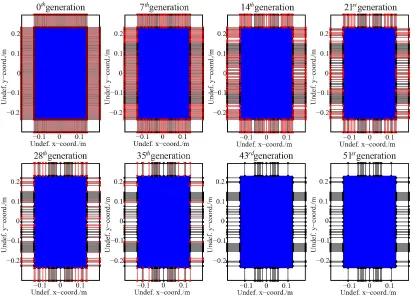
Several generations of clamping patterns have been selected to illustrate the optimisation
evolution for Step I (Fig. 5), indicating the reduction in number of constraints and the
evolution rate. Each generation represents a summary of 100 individual constraining
patterns, where the bars represent constrained locations. The initial population of 100
patterns for the zeroth generation was generated randomly, which then evolved into
subsequent generations according to the GA. In the figure, all bars are initially a shade of
red, which indicates that all of the constraint positions are represented similarly across
the 100 patterns. The shade of red changes as the constraining pattern evolves for each
subsequent generation, where a darker red (tending towards black) represents a higher
frequency for that constrained position. A lighter shade of red represents a lower
frequency, where white indicates complete removal of the constraint. As the fitness
function converges, all remaining bars appear black, which indicates that all 100 patterns
for that generation are in agreement.
Fig. 5 shows that some of the final constraint positions start to emerge as quickly as
weaker bars are removed and a symmetrical clamping pattern starts to develop. By
generation 35, there are very few red bars remaining, with the status of only 20 % of the
clamping positions uncertain at this stage. The final clamping pattern is determined after
generation 43, which is confirmed by comparing with the outcome from generation 51.
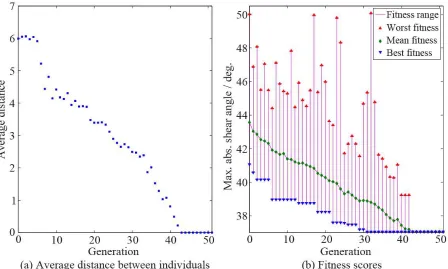
The diversity of the population for each generation in Step I has been checked by
evaluating the average distance between individuals, shown in Fig. 6a. For the first six
generations the value is approximately 6, indicating that the initial population covers
approximately 70 % (6/8.7) of the solution space. The average distance reduces by 1.6 %
(0.14/761/2) for each subsequent generation, indicating that evolution is progressive,
allowing sufficient opportunity for elite genes, (i.e. genes related to low fitness scores in
terms of maximum shear angles), to survive during offspring creation.
Fig. 6b shows the evolution of the fitness scores for Step I. The magnitude of the adaptive
Fitness Range is similar for each generation until the Best Fitness converges, implying
that a wide search range has been adopted throughout. The range of the fitness score
varies due to adaptive mutation. The optimum solution (i.e. convergence of the Best
Fitness) is achieved during generation 31. Perturbations induced by further mutations
during the next 12 generations (indicated by a non-zero fitness range) appear to have no
influence on the optimal solution. Furthermore, the mutation probability reduces to zero
following generation 43, after the optimal solution has been determined. Therefore, Fig.
6 confirms that the present diversity prevents local optimum solutions, random selection
and instability.
The maximum shear angle decreases by 11.2, from 48.2for the fully constrained system
(Fig. 7a) to 37.1after all unconstrained springs have been removed (Fig 7b). However,
individual springs are required to obtain the blank boundary conditions. Therefore, it is
necessary to compromise and combine neighbouring clamps and eliminate isolated ones
(see Fig. 7c). The minimum threshold distance between clamps was chosen to be 25 mm
(equivalent to the width of 5 finite elements), and the minimum clamp length was also
assumed to be 25 mm. In addition, the spring located at the mid-point of the short edge
(see Fig. 7b) was removed, as this could not be combined into a single clamp due to the
region of high curvature generated by the springs either side. Consequently, only two
clamps were required along each of the short edges to maintain the optimum draw-in. The
individual constrained positions from Fig. 7b were combined and reduced to 14 clamps,
as shown in Fig 7c. The stiffness of each consolidated spring was directly obtained by
summing the stiffness of all of the parallel springs belonging to each corresponding block.
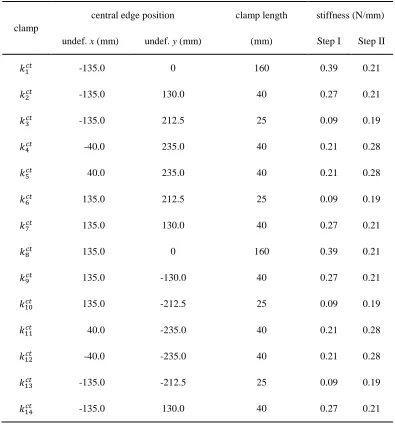
Table 2 provides a summary of the spring stiffnesses after Step I of the optimisation,
including the length and position of the corresponding clamps.
Although the maximum shear angle increased by 3.4in Fig. 7c compared with the result
in Fig. 7b, this still yields an overall reduction in peak shear angle of 7.7compared with
the unoptimised case. In addition, the shear angle distribution in Fig. 7b indicates that
wrinkling occurs along the long edges when constrained by individual springs, as there
are local transitions in shear angle. However, these disappear in Fig. 7c when longer
clamps are introduced along the edges. Constraining the blank using consolidated clamps
homogenises the boundary constraints to eliminate undesirable wrinkling around the
4.2 Stiffness optimisation from Step II
The spring stiffnesses from the solution in Step I (Fig. 7c) form the starting point of Step
II. Half of the individuals for the zeroth generation used the same combination of
constraint properties as the solution from Step I and the rest were generated randomly,
which then evolved into subsequent generations according to the GA. The population size
for the GA was 20 in each generation, and the tolerance for the fitness function was 0.05°.
For the current work, the range of spring stiffnesses in this step was chosen to be from
0.03 N/mm to 0.50 N/mm. The stability of the optimisation for Step II was validated using
the same methodology outlined for Step I. The fitness scores confirmed that the initial
population was suitably diverse, and Fig. 8a indicates that the solution was stable.
As shown in Fig. 8a, the maximum shear angle is reduced to 37.2 by optimising the
spring stiffnesses. This value differs by 0.1from the ideal optimum (37.1) in Step I (see
in Fig. 7b). It indicates that the negative influence induced by artificially adjusting the
constrained positions is minimised by seeking an optimal combination of clamp
stiffnesses in Step II, whilst making the solution more practical. Comparison of the
maximum shear angles during each step therefore confirms that the two-stage
optimisation does not significantly compromise the optimisation outcome. Using a more
generic GA approach may enable both optimisation stages to be combined (e.g. assigning
different sets of genes defining positions and stiffnesses) to further improve the accuracy
of the solution. However, this would require variable encoding lengths to be used for the
different parameters. Encoding the task as a single step optimisation problem may result
in a more efficient solution in the longer term, but it would be more complex to implement
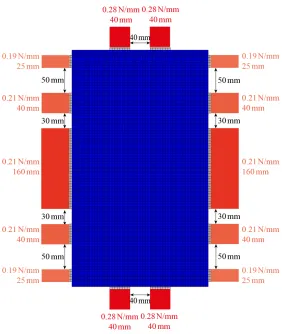
The convergence of the spring stiffnesses for Step II is presented in Fig. 8b. The optimum
combination of spring stiffnesses is presented in Table 2 and illustrated schematically in
Fig. 9. This figure allows a general strategy for spring placement to be derived: At zones
of the component geometry with small curvature, springs with relatively low stiffness are
attached through long clamps to provide near uni-axial tension. Zones with a high degree
of curvature require multiple springs with stiffnesses adapted to suit the fibre orientation,
which are attached through short localised clamps, allowing for multi-axial tension to be
applied to the blank. In general, springs attached to the clamps along the long edges have
a stiffness of 0.20 N/mm, and springs along the short edges are approximately 0.30 N/mm
for the current geometry. These are of similar magnitude to those used by Harrison et al.
[13], where fewer clamps were used, and the stiffer springs were placed on the long edges.
Figure 10 illustrates in-plane strains along the two principal fibre directions, where only
negative strains are shown. These negative strains indicate fabric compression, which
may result in localised wrinkles. The progression of the images implies that maximum
strains along both fibre orientations have been reduced through strain homogenisation
during optimisation, resulting in a reduction of potential regions of severe wrinkling.
Whilst the shear angle distribution was the optimisation objective, the distribution of
wrinkling strain is simultaneously homogenised as previously seen in a recent study [15].
5 Conclusions
A scenario has been introduced for controlling material draw-in during reinforcement
forming processes, using a series of in-plane springs to locally apply tension to the
preform, rather than using a blank holder to compress the preform out-of-plane and apply
bi-axial materials with large deformation, based on a VFABRIC model in
Abaqus/Explicit. The in-plane constraints around the edges were modelled using spring
elements connected to a fully constrained rigid frame, providing axial forces to control
material slippage into the cavity.
An optimisation methodology has been developed by combining the explicit FE model
with a genetic algorithm to optimise parameters associated with the in-plane constraints.
It has been implemented in two stages: (a) Step I: Clamping arrangement optimisation,
(b) Step II: Spring stiffness Optimisation. Process optimisation has been demonstrated
using a double-dome geometry from the literature. Results indicate that controlling
material draw-in by constraining the blank in-plane around the perimeter is an effective
way of homogenising the global shear angle distribution and minimising the local
maximum value. The peak shear angle was reduced from 48.2 to 37.2 following the
two-stage optimisation process. Strains along the two principal fibre directions have also
been reduced during the optimisation, through strain homogenisation, resulting in a
reduction of potential regions of severe wrinkling.
Acknowledgements
The work presented in this paper was completed as part of the “Affordable
Lightweighting Through Pre-form Automation” (ALPA) project. The authors gratefully
acknowledge the financial support of the Technology Strategy Board and technical
support from the project partners: McLaren Automotive, Formax, the Advanced
References
[1] Long AC, Clifford MJ. Composite forming mechanisms and materials characterisation. In: Long AC,
editor.Composite forming technologies. Cambridge: Woodhead Publishing Ltd., 2007. p. 1-21.
[2] Lin H, Wang J, Long AC, Clifford MJ, Harrison P. Predictive modelling for optimization of textile
composite forming. Compos Sci Technol2007; 67(15–16): 3242-3252.
[3] Yu WR, Harrison P, Long AC. Finite element forming simulation for crimp fabrics using a
non-orthogonal constitutive equation.Compos Part A-Appl S2005; 36(8): 1079-1093.
[4] Van Der Weeën F. Algorithms for draping fabrics on doubly-curved surfaces.Int J Numer Meth Eng
1991; 31(7): 1415-1426.
[5] Skordos AA, Sutcliffe MP, Klintworth JW, Adolfsson P. Multi-objective optimisation of woven
composite draping using genetic algorithms. In:27th International Conference SAMPE Europe. Paris,
2006.
[6] Yu WR, Pourboghrat F, Chung K, Zampaloni M, Kang TJ. Non-orthogonal constitutive equation for
woven fabric reinforced thermoplastic composites.Compos Part A-Appl S2002; 33(8): 1095-1105.
[7] Xue P, Peng X, Cao J. A non-orthogonal constitutive model for characterizing woven composites.
Compos Part A-Appl S2003; 34(2): 183-193.
[8] Wei L, Yuying Y. Multi-objective optimization of sheet metal forming process using Pareto-based
genetic algorithm.J Mater Process Tech2008; 208(1–3): 499-506.
[9] Conceição António CA, Magalhães Dourado N. Metal-forming process optimisation by inverse
evolutionary search.J Mater Process Tech2002; 121(2–3): 403-413.
[10] Chung JS, Hwang SM. Application of a genetic algorithm to process optimal design in non-isothermal
metal forming.J Mater Process Tech1998; 80–81: 136-143.
[11] Kahhal P, Brooghani S, Azodi H. Multi-objective Optimization of Sheet Metal Forming Die Using
Genetic Algorithm Coupled with RSM and FEA.Journal of Failure Analysis and Prevention 2013;
13(6): 771-778.
[12] Skordos AA, Aceves CM, Sutcliffe MPF. Drape optimisation in woven composite manufacturing. In:
5th International Conference on Inverse Problems in Engineering: Theory and Practice. Cambridge,
2005.
[13] Harrison P, Gomes R, Curado-Correia N. Press forming a 0/90 cross-ply advanced thermoplastic
composite using the double-dome benchmark geometry.Compos Part A-Appl S2013; 54: 56-69.
[14] Willems A. Forming simulation of textile reinforced composite shell structures. PhD dissertation,
Katholieke Universiteit Leuven, 2008.
[15] Chen S, Endruweit A, Harper LT, Warrior NA. Inter-ply stitching optimisation of highly drapeable
multi-ply preforms.Compos Part A-Appl S2015; 71: 144-156.
[16] Peng X, Cao J. A dual homogenization and finite element approach for material characterization of
textile composites.Compos Part B-Eng2002; 33(1): 45-56.
[17] Peng X, Cao J. A continuum mechanics-based non-orthogonal constitutive model for woven
[18] Harrison P, Gomes R, Correia N, Abdiwi F, Yu WR. Press forming the double-dome benchmark
geometry using a 0/90 uniaxial cross-ply advanced thermoplastic composite. In: 15th European
Conference on Composite Materials. Venice, 2012.
[19] Khan MA. Numerical and Experimental Forming Analyses of Textile Composite Reiforcements
Based on a Hypoelastic Behaviour. PhD dissertation, Institut National des Sciences Appliquees de
Lyon, 2009.
[20] Khan MA, Mabrouki T, Vidal-Sallé E, Boisse P. Numerical and experimental analyses of woven
composite reinforcement forming using a hypoelastic behaviour. Application to the double dome
benchmark.J Mater Process Tech2010; 210(2): 378-388.
[21] Cao J, Akkerman R, Boisse P, Chen J, Cheng HS, de Graaf EF, Gorczyca JL, Harrison P, Hivet G,
Launay J, Lee W, Liu L, Lomov SV, Long A, de Luycker E, Morestin F, Padvoiskis J, Peng XQ,
Sherwood J, Stoilova Tz, Tao XM, Verpoest I, Willems A, Wiggers J, Yu TX, Zhu B.
Characterization of mechanical behavior of woven fabrics: experimental methods and benchmark
results.Compos Part A-Appl S2008; 39(6): 1037-1053.
[22] Peng X, Rehman ZU. Textile composite double dome stamping simulation using a non-orthogonal
Tables
Table 1.Comparison of shear angle data from Abaqus/Explicit VFABRIC model against two sets of experimental results from literature [14].
ID
coord. (mm) shear angle (deg.)
ID
coord. (mm) shear angle (deg.)
x y
exp.
(case 1)
exp.
(case 2)
num. x y
exp.
(case 1)
exp.
(case 2)
num.
1 85 65 4.4 ± 2.9 3.3 ± 0.8 2.0 11 17.3 202.7 7.6 ± 1.5 6.2 ± 1.9 7.8
2 60 40 0.1 ± 0.5 0.1 ± 0.4 0.3 12 26 188 14.1 ± 0.7 13.7 ± 1.1 14.3
3 45 40 0.3 ± 0.3 0.3 ± 0.5 0.4 13 34.7 171.8 14.5 ± 2.1 15.2 ± 0.7 15.6
4 10 40 -0.4 ± 1.1 0.5 ± 1.1 0.7 14 44.6 155.9 22.3 ± 2.4 23.3 ± 1.9 25.0
5 60 80 3.7 ± 1.4 3.0 ± 2.0 2.8 15 52 142.1 31.5 ± 2.3 32.1 ± 2.1 32.8
6 45 80 0.5 ± 1.3 -0.5 ± 1.6 1.4 16 60 127.6 29.2 ± 1.8 29.1 ± 1.3 31.0
7 10 80 1.4 ± 1.4 -0.9 ± 0.9 2.7 17 68.9 112.6 15.8 ± 1.5 12.7 ± 3.0 12.1
8 25 120 11.9 ± 1.2 14.0 ± 2.1 12.1 18 77.1 97.2 4.0 ± 0.6 2.1 ± 2.7 4.7
9 5 140 7.0 ± 1.1 6.9 ± 0.4 7.0 19 84.9 83.4 4.1 ± 1.1 1.3 ± 2.9 5.0
Table 2.Clamping parameters obtained from Step I and Step II (The origin of the undeformed coordinate
system is the centre of the blank).
clamp
central edge position clamp length stiffness (N/mm)
undef.x(mm) undef.y(mm) (mm) Step I Step II
݇ଵ௧ -135.0 0 160 0.39 0.21
݇ଶ௧ -135.0 130.0 40 0.27 0.21
݇ଷ௧ -135.0 212.5 25 0.09 0.19
݇ସ௧ -40.0 235.0 40 0.21 0.28
݇ହ௧ 40.0 235.0 40 0.21 0.28
݇௧ 135.0 212.5 25 0.09 0.19
݇௧ 135.0 130.0 40 0.27 0.21
଼݇௧ 135.0 0 160 0.39 0.21
݇ଽ௧ 135.0 -130.0 40 0.27 0.21
݇ଵ௧ 135.0 -212.5 25 0.09 0.19
݇ଵଵ௧ 40.0 -235.0 40 0.21 0.28
݇ଵଶ௧ -40.0 -235.0 40 0.21 0.28
݇ଵଷ௧ -135.0 -212.5 25 0.09 0.19
Figures
[image:22.595.86.522.352.713.2]Fig. 1.Comparison of fabric forming model using in-plane constraints against experimental results from literature [14]; fibre orientation is 0°/90°.
Fig. 4.Implementation of Step II - Near-optimisation of constraint properties.
[image:24.595.85.500.408.704.2]Fig. 6.(a) Population diversity and (b) optimisation evolution for Step I.
[image:25.595.89.537.439.632.2]![Table 1. Comparison of shear angle data from Abaqus/Explicit VFABRIC model against two sets of experimental results from literature [14].](https://thumb-us.123doks.com/thumbv2/123dok_us/8667294.376208/20.842.58.601.142.475/table-comparison-abaqus-explicit-vfabric-experimental-results-literature.webp)