Don’t Count, Predict! An Automatic Approach to Learning Sentiment
Lexicons for Short Text
Duy Tin Vo and Yue Zhang
Singapore University of Technology and Design 08 Somapah Road, Singapore 487372
duytin [email protected] and yue [email protected]
Abstract
We describe an efficient neural network method to automatically learn sentiment lexicons without relying on any manual resources. The method takes inspiration from the NRC method, which gives the best results in SemEval13 by leveraging emoticons in large tweets, using the PMI between words and tweet sentiments to de-fine the sentiment attributes of words. We show that better lexicons can be learned by using them to predict the tweet senti-ment labels. By using a very simple neu-ral network, our method is fast and can take advantage of the same data volume as the NRC method. Experiments show that our lexicons give significantly better accu-racies on multiple languages compared to the current best methods.
1 Introduction
Sentiment lexicons contain the sentiment polar-ity and/or the strength of words or phrases (Bac-cianella et al., 2010; Taboada et al., 2011; Tang et al., 2014a; Ren et al., 2016a). They have been used for both rule-based (Taboada et al., 2011) and un-supervised (Turney, 2002; Hu and Liu, 2004; Kir-itchenko et al., 2014) or supervised (Mohammad et al., 2013; Tang et al., 2014b; Vo and Zhang, 2015) machine-learning-based sentiment analysis. As a result, constructing sentiment lexicons is one important research task in sentiment analysis.
Many approaches have been proposed to con-struct sentiment lexicons. Traditional methods manually label the sentiment attributes of words (Hu and Liu, 2004; Wilson et al., 2005; Taboada et al., 2011). One benefit of such lexicons is high quality. On the other hand, the methods are time-consuming, requiring language and domain
exper-tise. Recently, statistical methods have been ex-ploited to learn sentiment lexicons automatically (Esuli and Sebastiani, 2006; Baccianella et al., 2010; Mohammad et al., 2013). Such methods leverage knowledge resources (Bravo-Marquez et al., 2015) or labeled sentiment data (Tang et al., 2014a), giving significantly better coverage com-pared to manual lexicons.
Among the automatic methods, Mohammad et al. (2013) proposed to use tweets with emoticons or hashtags as training data. The main advantage is that such training data are abundant, and manual annotation can be avoided. Despite that emoticons or hashtags can be noisy in indicating the senti-ment of a tweet, existing research (Go et al., 2009; Pak and Paroubek, 2010; Agarwal et al., 2011; Kalchbrenner et al., 2014; Ren et al., 2016b) has shown that effectiveness of such data when used to supervise sentiment classifiers.
Mohammad et al. (2013) collect sentiment lexi-cons by calculating pointwise mutual information (PMI) between words and emoticons. The result-ing lexicons give the best results in a SemEval13 benchmark (Nakov et al., 2013). In this paper, we show that a better lexicon can be learned by directly optimizing the prediction accuracy, tak-ing the lexicon as input and emoticon as the out-put. The correlation between our method and the method of Mohammad et al. (2013) is analogous to the “predicting” vs “counting” correlation be-tween distributional and distributed word repre-sentations (Baroni et al., 2014).
We follow Esuli and Sebastiani (2006) in us-ing two simple attributes to represent each sen-timent word, and take inspiration from Mikolov et al. (2013) in using a very simple neural net-work for sentiment prediction. The method can leverage the same data as Mohammad et al. (2013) and therefore benefits from both scale and annotation independence. Experiments show
that the neural model gives the best results on standard benchmarks across multiple languages. Our code and lexicons are publicly available at https://github.com/duytinvo/acl2016.
2 Related work
Existing methods for automatically learning sen-timent lexicons can be classified into three main categories. The first category augments existing lexicons with sentiment information. For exam-ple, Esuli and Sebastiani (2006) and Baccianella et al. (2010) use a tuple (pos, neg, neu) to rep-resent each word, where pos, neg andneustand for possibility, negativity and neutrality, respec-tively, training these attributes by extracting fea-tures from WordNet. These methods rely on the taxonomic structure of existing lexicons, which are limited to specific languages.
The second approach expands existing lexicons, which are typically manually labeled. For exam-ple, Tang et al. (2014a) apply a neural network to learn sentiment-oriented embeddings from a small amount of annotated tweets, and then expand a set of seed sentiment words by measuring vector space distances between words. Bravo-Marquez et al. (2015) extend an existing lexicon by classifying words using manual features. These methods are also limited to domains and languages with man-ual resources.
The third line of methods constructs lexicons from scratch by accumulating statistical informa-tion over large data. Turney (2002) proposes to es-timate the sentiment polarity of words by calculat-ing PMI between seed words and search hits. Mo-hammad et al. (2013) improve the method by com-puting sentiment scores using distance-supervised data from emoticon-baring tweets instead of seed words. This approach can be used to automatically extract multilingual sentiment lexicons (Salameh et al., 2015; Mohammad et al., 2015) without us-ing manual resources, which makes it more flex-ible compared to the first two methods. We con-sider it as our baseline.
[image:2.595.321.505.63.185.2]We use the same data source as Mohammad et al. (2013) to train lexicons. However, rather than relying on PMI, we take a machine-learning method in optimizing the prediction accuracy of emoticons using the lexicons. To leverage large data, we use a very simple neural network to train the lexicons.
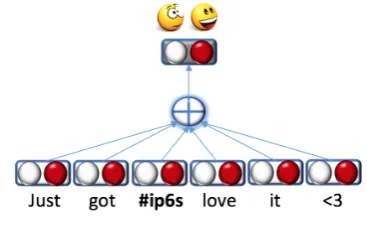
Figure 1: Our model.
3 Baseline
Mohammad et al. (2013) employ emoticons and relevant hashtags contained in a tweet as the senti-ment label of the tweet. Given a set of tweets with their labels, the sentiment score (SS) for a tokenw
was computed as:
SS(w) =PMI(w, pos)−PMI(w, neg), (1)
where pos represents the positive label andneg
represents the negative label. PMI stands for pointwise mutual information, which is
PMI(w, pos) = log2 freqfreq(w(w, pos)∗freq)(∗posN) (2)
Herefreq(w,pos)is the number of times the term
w occurs in positive tweets, freq(w) is the total frequency of term w in the corpus, freq(pos) is the total number of tokens in positive tweets, and
N is the total number of tokens in the corpus. PMI(w,neg)is calculated in a similar way. Thus, Equation 1 is equal to:
SS(w) = log2freq(w, pos)∗freq(neg)
freq(w, neg)∗freq(pos) (3)
4 Model
We follow Esuli and Sebastiani (2006), using pos-itivity and negativity attributes to define lexicons. In particular, each word takes the formw= (n, p), wherendenotes negativity andpdenotes positiv-ity (n, p ∈ R). As shown in Figure 1, given a tweet tw = w1, w2, ..., wn, a simple neural
net-work is used to predict its two-dimensional senti-ment labely, where [1,0] for negative and [0,1] for positive tweets. The predicted sentiment probabil-ityyof a tweet is computed as:
h=X
i
Language #pos #neg #Tweets
[image:3.595.323.507.62.120.2]English 4.5M 4.5M 9M Arabic 400k 400k 800k
Table 1: Emoticon-based training data.
y=softmax(hW) (5) where W is fixed to the diagonal matrix (W ∈ R2x2).
We follow Go et al. (2009) in defining the sen-timent labels of tweets via emoticons. Each token is first initialized by random negative and positive attribute scores in [-0.25,0.25], and then trained by supervised learning. The cross-entropy error is employed as the objective function:
loss(tw) =−Xy.ˆ log(y) (6)
Backpropagation is applied to learn(n, p)for each token. Optimization is done using stochastic gra-dient descent over shuffled mini-batches, with the AdaDelta update rule (Zeiler, 2012). All mod-els are trained over 5 epochs with a batch size of 50. Due to its simplicity, the method is very fast, training a sentiment lexicon over 9 million tweets within 35 minutes per epoch on an Intelr core™
i7-3770 CPU @ 3.40 GHz.
5 Sentiment Classification
The resulting lexicon can be used in both unsu-pervised and suunsu-pervised sentiment classifiers. The former is implemented by summing the sentiment scores of all tokens contained in a given document (Taboada et al., 2011; Kiritchenko et al., 2014). If the total sentiment score is larger than 0, the doc-ument is classified as positive. Here only one pos-itivity attribute is required to represent a lexicon, and we use the contrast between the positivity and negativity attributes (p−n) as the score.
The supervised method makes use of sentiment lexicons as features for machine learning classifi-cation. Given a documentD, we follow Zhu et al. (2014) and extract the following features:
• The number of sentiment tokens inD, where sentiment tokens are word tokens whose sen-timent scores are not zero in a lexicon;
• The total sentiment score of a document:P
wi∈DSS(wi);
• The maximal score:maxwi∈DSS(wi);
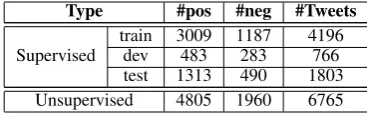
Type #pos #neg #Tweets
Supervised traindev 3009483 1187283 4196766 test 1313 490 1803 Unsupervised 4805 1960 6765
Table 2: Statistics of the Semeval13.
• The total scores of positive and negative words inD;
• The sentiment score of the last token inD.
Again we use SS(wi) = pwi −nwi as the
sen-timent score of each wordwi, because the
meth-ods are based on a single sentiment score value for each word.
6 Experiments
6.1 Experimental Settings
Training data: To automatically obtain train-ing data, we use the Twitter Developers API1 to
crawl emoticon tweets2 of English and Arabic
from February 2014 to September 2014. We fol-low Go et al. (2009), removing all emoticons used to collect training data from the tweets, and Tang et al. (2014b), ignoring tweets which are less than 7 tokens. A Twitter tokenizer (Gimpel et al., 2011) is applied to preprocess all tweets. Rare words that occur less than 5 times in the vocabulary are re-moved. HTTP links and username are replaced by hhttpiandhuseri, respectively. The statistics of training data is shown in Table 1.
Sentiment classifier: We use LibLinear3 (Fan
et al., 2008) as the supervised classifier on bench-mark datasets. The parametercis tuned by making a grid search (Hsu et al., 2003) on the accuracy of development set on the English dataset and five-fold cross validation on the Arabic dataset.
Evaluation: We follow Kiritchenko et al. (2014) in employing precision (P), recall (R) and F1 score (F) to evaluate unsupervised classifica-tion. We follow Hsu et al. (2003) and use accuracy (acc), the tuning criterion, to evaluate supervised classification.
Code and lexicons: We make the Python implementation of our models and the resulting sentiment lexicons available at https://github.com/duytinvo/acl2016
1https://dev.twitter.com/
Lexicons P UnsupR F SupAcc
[image:4.595.324.508.61.109.2]WEKA STSED 66.461 55.952.5 55.447.7 73.873.7 HIT 75.3 73.3 74.1 78.5 NRC EmoticonHashtag 70.373.2 71.474.6 70.873.8 77.479.9 nnLexicon 74.4 77.3 75.3 81.3
Table 3: Results on SemEval13 (English).
Labels trainBalanceddev test trainUnbalanceddev test
#pos
481 159 159
481 159 159
#neg 1012 336 336
#mix 500 166 166
#obj 4015 1338 1338
[image:4.595.81.282.62.153.2]#Tweets 1924 636 636 6008 1999 1999
Table 4: Standard splits of ASTD.
6.2 English Lexicons
The Twitter benchmark of SemEval13 (Nakov et al., 2013) is used as the English test set. In or-der to evaluate both unsupervised and supervised methods, we follow Tang et al. (2014b) and Kir-itchenko et al. (2014), removing neutral tweets. The statistics is shown in Table 2. We compare our lexicon with the lexicons of NRC4(Mohammad et
al., 2013), HIT5(Tang et al., 2014a) and WEKA6
(Bravo-Marquez et al., 2015). As shown in Table 3, using the unsupervised sentiment classification method (unsup) in Section 5, our lexicon gives sig-nificantly better result in comparison with count-based lexicons of NRC. Under both settings, our lexicon yields the best results compared to other methods.
6.3 Arabic Lexicons
We employ the standard Arabic Twitter dataset ASTD (Nabil et al., 2015), which consists of about 10,000 tweets with 4 labels: objective (obj), neg-ative (neg), positive (pos) and mixed subjective (mix). The standard splits of ASTD are shown in Table 4. We follow Nabil et al. (2015) by merg-ing trainmerg-ing and validatmerg-ing data for learnmerg-ing model. We compare our lexicon with only the lexicons of NRC7 (Salameh et al., 2015), because the
meth-ods of Tang et al. (2014a) and Bravo-Marquez et al. (2015) depend on manual resources, which are
4
http://saifmohammad.com/WebPages/Abstracts/NRC-SentimentAnalysis.htm
5http://ir.hit.edu.cn/∼dytang/ 6http://www.cs.waikato.ac.nz/∼fjb11/
7http://saifmohammad.com/WebPages/ArabicSA.html
Lexicons Balanced Unbalanced
NRC EmoticonHashtag 31.931.4 63.465.3
[image:4.595.330.502.136.298.2]nnLexicon 33.3 66.5
Table 5: Results on ASTD (Arabic).
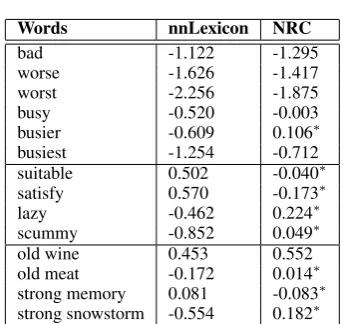
Words nnLexicon NRC
bad -1.122 -1.295
worse -1.626 -1.417
worst -2.256 -1.875
busy -0.520 -0.003
busier -0.609 0.106∗
busiest -1.254 -0.712
suitable 0.502 -0.040∗
satisfy 0.570 -0.173∗
lazy -0.462 0.224∗
scummy -0.852 0.049∗
old wine 0.453 0.552
old meat -0.172 0.014∗ strong memory 0.081 -0.083∗ strong snowstorm -0.554 0.182∗
Table 6: Example sentiment scores, where∗
de-notes incorrect polarity.
not available. As shown in Table 5, our lexicon consistently gives the best performance on both the balanced and unbalanced datasets, showing the advantage of “predicting” over “counting”.
6.4 Analysis
Table 6 shows examples of our predicting-based lexicon and the counting-based lexicon of Mo-hammad et al. (2013). First, both lexicons can correctly reflect the strength of emotional words (e.g. bad, worse, worst), which demonstrates that our method can learn statistical relevance as effec-tively as PMI. Second, we find many cases where our lexicon gives the correct polarity (e.g. suit-able, lazy) but the lexicon of Mohammad et al. (2013) does not. To quantitatively compare the lexicons, we calculated the accuracies of their po-larities (i.e. sign) by using the manually-annotated lexicon of Hu and Liu (2004) as the gold stan-dard. We take the intersection between the au-tomatic lexicons and the lexicon of Hu and Liu (2004) as the test set, which contains 3270 words. The polarity accuracy of our lexicon is 78.2%, in contrast to 76.9% by the lexicon of Mohammad et al. (2013), demonstrating the relative strength of our method. Third, by having two attributes
[image:4.595.73.291.185.263.2]7 Conclusion
We constructed a sentiment lexicon for short text automatically using an efficient neural network, showing that prediction-based training is better than counting-based training for learning from large tweets with emoticons. In standard evalu-ations, the method gave better accuracies across multiple languages compared to the state-of-the-art counting-based method.
References
Apoorv Agarwal, Boyi Xie, Ilia Vovsha, Owen Ram-bow, and Rebecca Passonneau. 2011. Sentiment analysis of twitter data. InProceedings of the Work-shop on Languages in Social Media, LSM ’11, pages 30–38.
Stefano Baccianella, Andrea Esuli, and Fabrizio Sebas-tiani. 2010. Sentiwordnet 3.0: An enhanced lexical resource for sentiment analysis and opinion mining. In Proceedings of LREC, volume 10, pages 2200– 2204.
Marco Baroni, Georgiana Dinu, and Germ´an Kruszewski. 2014. Don’t count, predict! a systematic comparison of context-counting vs. context-predicting semantic vectors. InProceedings of ACL, pages 238–247.
Felipe Bravo-Marquez, Eibe Frank, and Bernhard Pfahringer. 2015. Positive, negative, or neu-tral: learning an expanded opinion lexicon from emoticon-annotated tweets. In Proceedings of IJ-CAI, pages 1229–1235.
Andrea Esuli and Fabrizio Sebastiani. 2006. Senti-wordnet: A publicly available lexical resource for opinion mining. InProceedings of LREC, volume 6, pages 417–422.
Rong-En Fan, Kai-Wei Chang, Cho-Jui Hsieh, Xiang-Rui Wang, and Chih-Jen Lin. 2008. Liblinear: A library for large linear classification. The Journal of Machine Learning Research, 9:1871–1874.
Kevin Gimpel, Nathan Schneider, Brendan O’Connor, Dipanjan Das, Daniel Mills, Jacob Eisenstein, Michael Heilman, Dani Yogatama, Jeffrey Flanigan, and A. Noah Smith. 2011. Part-of-speech tagging for twitter: Annotation, features, and experiments. InProceedings of ACL-HLT, pages 42–47.
Alec Go, Richa Bhayani, and Lei Huang. 2009. Twit-ter sentiment classification using distant supervision.
CS224N Project Report, Stanford, 1:12.
Chih-Wei Hsu, Chih-Chung Chang, Chih-Jen Lin, et al. 2003. A practical guide to support vector classifica-tion.
Minqing Hu and Bing Liu. 2004. Mining and summa-rizing customer reviews. InProceedings of KDD, KDD ’04, pages 168–177.
Nal Kalchbrenner, Edward Grefenstette, and Phil Blun-som. 2014. A convolutional neural network for modelling sentences. InProceedings of ACL, pages 655–665.
Svetlana Kiritchenko, Xiaodan Zhu, and Saif M. Mo-hammad. 2014. Sentiment analysis of short infor-mal texts. J. Artif. Intell. Res., 50:723–762.
Tomas Mikolov, Kai Chen, Greg Corrado, and Jef-frey Dean. 2013. Efficient estimation of word representations in vector space. arXiv preprint arXiv:1301.3781.
Saif M. Mohammad, Svetlana Kiritchenko, and Xiao-dan Zhu. 2013. Nrc-canada: Building the state-of-the-art in sentiment analysis of tweets. In Proceed-ings of SemEval-2013, June.
Saif M Mohammad, Mohammad Salameh, and Svet-lana Kiritchenko. 2015. How translation alters sen-timent. Journal of Artificial Intelligence Research, 54:1–20.
Mahmoud Nabil, Mohamed Aly, and Amir F Atiya. 2015. Astd: Arabic sentiment tweets dataset. In
Proceedings of EMNLP, pages 2515–2519.
Preslav Nakov, Sara Rosenthal, Zornitsa Kozareva, Veselin Stoyanov, Alan Ritter, and Theresa Wilson. 2013. Semeval-2013 task 2: Sentiment analysis in twitter. InSecond Joint Conference on Lexical and Computational Semantics (*SEM), Volume 2: Pro-ceedings of SemEval-2013, pages 312–320.
Alexander Pak and Patrick Paroubek. 2010. Twitter based system: Using twitter for disambiguating sen-timent ambiguous adjectives. InProceedings of the 5th International Workshop on Semantic Evaluation, SemEval ’10, pages 436–439.
Yafeng Ren, Yue Zhang, Meishan Zhang, and Donghong Ji. 2016a. Context-sensitive twitter sen-timent classification using neural network. In Pro-ceedings of AAAI.
Yafeng Ren, Yue Zhang, Meishan Zhang, and Donghong Ji. 2016b. Improving twitter sentiment classification using topic-enriched multi-prototype word embeddings. InProceedings of AAAI.
Mohammad Salameh, Saif Mohammad, and Svetlana Kiritchenko. 2015. Sentiment after translation: A case-study on arabic social media posts. In Proceed-ings of NAACL-HLT, pages 767–777, May–June.
Duyu Tang, Furu Wei, Bing Qin, Ming Zhou, and Ting Liu. 2014a. Building large-scale twitter-specific sentiment lexicon : A representation learning ap-proach. InProceedings of COLING, pages 172–182, August.
Duyu Tang, Furu Wei, Nan Yang, Ming Zhou, Ting Liu, and Bing Qin. 2014b. Learning sentiment-specific word embedding for twitter sentiment clas-sification. In Proceedings of ACL, pages 1555– 1565, June.
Peter Turney. 2002. Thumbs up or thumbs down? se-mantic orientation applied to unsupervised classifi-cation of reviews. InProceedings of ACL.
Duy-Tin Vo and Yue Zhang. 2015. Target-dependent twitter sentiment classification with rich automatic features. In Proceedings of IJCAI, pages 1347– 1353, July.
Theresa Wilson, Janyce Wiebe, and Paul Hoffmann. 2005. Recognizing contextual polarity in phrase-level sentiment analysis. In Proceedings of HLT-EMNLP.
Matthew D Zeiler. 2012. Adadelta: an adaptive learn-ing rate method.arXiv preprint arXiv:1212.5701. Xiaodan Zhu, Svetlana Kiritchenko, and Saif