423
Metaphors in Text Simplification:
To change or not to change, that is the question
Yulia Clausen
Linguistics Department, SFB 1287 University of Potsdam
Potsdam, Germany [email protected]
Vivi Nastase
Department of Computational Linguistics University of Heidelberg
Heidelberg, Germany [email protected]
Abstract
We present an analysis of metaphors in news text simplification. Using features that cap-ture general and metaphor specific character-istics, we test whether we can automatically identify which metaphors will be changed or preserved, and whether there are features that have different predictive power for metaphors or literal words. The experiments show that the Age of Acquisition is the most distinc-tive feature for both metaphors and literal words. Features that capture Imageability and Concreteness are useful when used alone, but within the full set of features they lose their impact. Frequency of use seems to be the best feature to differentiate metaphors that should be changed and those to be preserved.
1 Introduction
Metaphor is ubiquitous in everyday language and central to human thought (Lakoff and Johnson, 1980). We find manifestations of it in collo-quial and academic discourse, newspaper, school textbooks, political discourse and probably any-where language is used. There are conflicting views though on whether metaphors are a useful communication device. Golden(2010) found that metaphors present in school textbooks can make the overall content comprehension more difficult. On the other hand, the essence of metaphor is to make abstract concepts, which are often hard to grasp, more easily understandable through con-crete descriptions (e.g.K¨ovecses,2017).
In this paper we investigate metaphors in the context of news texts simplification. On a cor-pus of parallel sentences from news articles and their simplified version (to grade 4 level, which corresponds to 9-10 years of age), we analyze metaphors that are kept, changed or added in the simplified version. Our aim is to verify
whether we can characterize and automatically de-tect metaphors that help or do not help text under-standing in the context of news articles.
The task of automatic text simplification has re-ceived a considerable amount of attention within NLP research. The proposed systems have, for the most part, addressed lexical and syntactic trans-formations, such as substitution of difficult words with simpler equivalents or altering the struc-ture of sentences to make them more easily un-derstandable (e.g. Barlacchi and Tonelli, 2013; De Belder and Moens,2010;Drndarevi´c and Sag-gion, 2012; Toruno˘glu-Selamet et al., 2016; Vu et al.,2014).
The automatic handling of metaphorical lan-guage has also been researched extensively. How-ever, the studies have mainly investigated the possibilities of automatic metaphor identification. Simplification of metaphorical language has not been explicitly addressed yet. This could be at-tributed to the fact that metaphor simplification is a challenging task for automatic implementa-tion (cf. Drndarevi´c and Saggion, 2012). Some approaches have considered the problem of au-tomatic metaphor interpretation (e.g. Bollegala and Shutova, 2013; Shutova, 2013), which aims to find literal paraphrases for metaphorical expres-sions. It is not clear though whether the literal version is easier to understand than the original metaphor. Sometimes lexical simplifications for complex words can be too basic to convey the orig-inal meaning (cf.Vu et al.,2014).
pre-dictive of lexical simplification in general. We use parallel versions (“raw” and simplified) of news data from Newsela1, a company that produces professionally simplified news texts, in which we annotate metaphors. In experiments that predict whether a target word will be changed or not, we analyze the performance of the features used w.r.t. the type of the target word – metaphoric or lit-eral (the full set of features is described in Section 4.2). We find that the Age of Acquisition is the strongest feature overall, for both metaphoric and literal words. Imageability, Familiarity and Con-creteness are useful when used alone, but within the context of the full set of features they lose their impact. Frequency of use is an important fea-ture for distinguishing metaphors that should be changed from those to be preserved.
2 Related work
Text simplification has numerous facets, and can be approached from different angles. The general need for simplification can be predicted based on the readability of a text, from the point of view of sentence complexity (ˇStajner et al.,2017) or a combination of lexical, syntactic and semantic text characteristics (De Clercq and Hoste,2016). Sim-plification can be targeted by identifying complex words (e.g. Paetzold and Specia, 2016; Yimam et al.,2018), and then performing lexical simplifi-cation (e.g.Glavaˇs and ˇStajner,2015;Glavaˇs and Vuli´c,2018;Horn et al.,2014;Kriz et al.,2018).
Lexical simplification systems often build on sentence-aligned simplification corpora and pro-pose substitutes for complex words from a num-ber of synonyms based on the words’ frequency, length and suitability for the original context (De Belder and Moens,2010;Drndarevi´c and Sag-gion, 2012; Vu et al., 2014). Approaches influ-enced by machine translation have also been ex-plored, as lexical simplification can be viewed as monolingual translation (e.g. Nisioi et al., 2017; Xu et al., 2016;Zhu et al., 2010). Other neural based models have also been developed, which ex-ploit word embeddings and their closeness in the vector space as clues for substitution candidates. Glavaˇs and ˇStajner (2015) produce word simpli-fications in a large regular corpus using word em-beddings to perform lexical substitution tasks. The simplification candidates are ranked based on fea-tures such as semantic and context similarity, and
1https://newsela.com/
information load.
Our focus in this paper is narrower. We aim to explore metaphors in text simplification, and check if there are specific features that predict whether a metaphor should be changed or not. To represent the instances in our data we use fea-tures that previous work on text simplification have shown to be beneficial, as well as features useful in metaphor identification tasks.
3 Data
The data for this study comes from Newsela, a company that provides professionally simplified news texts for school reading activities. The ed-itors follow simplification guidelines and are as-sisted by a tool in detecting difficult words. There is no description of the criteria used by the tool to detect such words. Regarding metaphors, the instructions are brief and seem to draw attention to idioms rather than metaphors: “be literal in lower versions. No straight out metaphors, as in no ‘paint into a corner’ in 5th grade or below.”.
Each Newsela article has five versions of differ-ent difficulty levels determined based on the Lex-ile2 readability scores, which are used to measure the complexity of texts and assign them to ap-propriate grade levels. Using these parallel news texts allows for the quick identification of changed items to produce a dataset to which metaphor in-formation is then added (Wolska and Clausen, 2017).
3.1 The dataset
We use a parallel corpus of 1,130 Newsela arti-cles byXu et al.(2015), where each original arti-cle has been aligned with its four simplified ver-sions at the sentence level based on Jaccard simi-larity. For our study we look at the original (V0) and the most simplified (V4) versions, as between them we expect the most differences w.r.t. simpli-fication strategies. From this corpus, we automat-ically sampled original sentences along with their equivalents from the chosen simplified version.
Each Newsela version covers several, unevenly distributed, grade levels. Because of the potential differences between the grade levels within ver-sions, we sampled only articles at grade level 12 from the original version and grade level 4 from the most simplified version. The selected grade levels correspond to the largest subsets within the
2
respective versions. The sampling was random-ized across documents to counter author and edi-tor bias. The final dataset contains 582 documents, each consisting of one original sentence and one or more sentences in the corresponding simplified version.3 All alignments were manually checked and corrected where necessary either by inserting missing sentences or by replacing wrong align-ments with the correct ones. This resulted in 278 corrections, exemplified below (“m” indicates the manually inserted sentence, initially missing from the alignment):
V0 A year ago, [Shaw] Mychal suffered a concussion in a game that rendered him temporarily unable to walk or speak. V4 Shaw suffered a concussion in a game last
year.
V4-m Shaw could not walk or speak for a while.
3.2 Metaphor annotation
We focus on the two most common word classes – nouns and verbs. In the sampled documents, we annotated their occurrences in the original sen-tences as either metaphoric or not by following the guidelines of the metaphor identification pro-cedure MIPVU (Steen et al.,2010).4
The annotation in this study builds on Wolska and Clausen (2017), where it was carried out as follows: one author initially identified metaphoric items in a smaller subset of the data. All unclear cases were then discussed with the second author and either resolved or left unannotated. The anno-tation was completed by the initial annotator. In this study, we use a version of the dataset with ex-panded annotations – every noun/verb left unan-notated in the previous study was anunan-notated for metaphoricity by the same annotator as in the ini-tial study.
In MIPVU, metaphoricity is identified by exam-ining a text on a word-for-word basis and deter-mining the context and the basic senses of each word. “Words” are considered to be lexical units provided with separate part of speech tags.5 A word is used metaphorically if its context sense
3
Documents where original and simplified versions were identical based on string comparison were excluded.
4
The annotation was done with the toolBRAT(Stenetorp et al.,2012):http://brat.nlplab.org/
5In MIPVU, phrasal verbs and compound nouns are
re-garded as single lexical units. Although we annotated them, in this paper we experiment only with the single words due to the non-availability of various features for multi-item words.
can be sufficiently contrasted to and understood in comparison with its basic sense. The context sense of a word is “the meaning it has in the situa-tion in which it is used”, whereas the basic sense is taken to be “more concrete, specific, and human-oriented” (Steen et al.,2010, p. 33-35).
The senses are determined by means of a dic-tionary; we consult the Macmillan Dictionary6, which is a standard reference used by the authors of the procedure. Different senses of a word cor-respond to separate, numbered descriptions within its grammatical category in a dictionary.
In an example from our dataset, given in (1), the verbstrugglingis used metaphorically, as there exists a more basic sense (“to use your strength to fight against someone or something”), which is contrasted to and compared with the contextual sense (“to try hard to do something that you find very difficult”).7
(1) But now she’sstrugglingto obtain documents required by the new law.
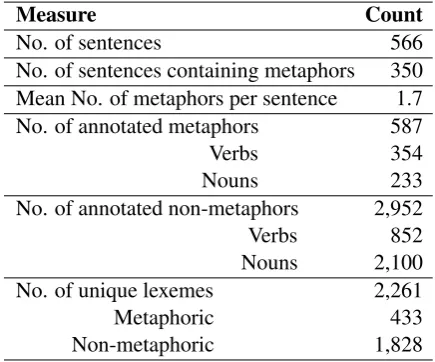
The quantitative information on the annotated dataset is summarized in Table1.
Measure Count
No. of sentences 566
No. of sentences containing metaphors 350 Mean No. of metaphors per sentence 1.7 No. of annotated metaphors 587
Verbs 354
Nouns 233
No. of annotated non-metaphors 2,952
Verbs 852
Nouns 2,100 No. of unique lexemes 2,261
Metaphoric 433
[image:3.595.307.525.403.584.2]Non-metaphoric 1,828
Table 1: Statistics on the annotated dataset.
3.3 Simplification types
For each annotated word we marked its equiva-lent in the simplified version and determined the simplification type chosen by an editor.8 There
6https://www.macmillandictionary.com/ 7
The definitions of the basic and contextual senses:
https://www.macmillandictionary.com/ dictionary/american/struggle_1
8
Simplification Original sentence Simplified sentence
metaphoric
same metaphor
. . . like the magnetized nails, unable to resist a pow-erful magneticforcein the galactic bulge . . .
Like the magnetized nails, they would have been un-able to resist a powerful magneticforcein the galac-tic bulge . . .
other metaphor
Obama also hasgrappledpublicly with reconciling King’s teachings on nonviolence . . .
Obama haswrestledpublicly with living up to King’s teachings on nonviolence . . .
changed to non-metaphor
In exchange for a 4 percentpieceof their companies, entrepreneurs in the program will gain access . . .
. . . people in the program will give up a 4 percent
shareof their companies. In exchange they will get . . .
phrase with metaphor(s)
But now she’s struggling to obtain documents re-quired by the new law.
But now she’shaving a hard timegetting the papers that the new law requires.
phrase w/o metaphor(s)
Utah officials say that since 2008, highway crashes have droppedannually on stretches of rural Inter-state . . .
They say there havebeen feweraccidents where the speed limit was raised.
word removed
Our goal is to provide Internet service to people in areas that can’t afford tothrow downfiber lines . . .
Our goal is to provide Internet service to people in areas that can’t affordØusual Internet lines . . .
non-metaphoric
same non-metaphor
“In the past several hundredyears, people have cul-tivated the habit of smoking wherever they want,” she said.
“In the past several hundredyears, people have “got-ten used to” smoking wherever they want,” she said.
other non-metaphor
With nothing less at stake than the future of planet Earth, NASA has decided to crowdsource ideas to de-tectand track asteroids . . .
NASA wants tofindand track asteroids, but it needs help. It is asking people around the world for ideas . . .
changed to metaphor
That information could help the team’s trainers im-plementpractice plans that keep him spry the rest of the season.
That could help the team’s trainersmakeplans that keep him healthy for the season.
phrase with metaphor(s)
“Even after the Holocaust, our minority still encoun-ters racism and discrimination,” he said, noting that they are Europe’s lasthired, first fired.
His people still suffer unfair and insulting treatment, he said. They are the last in Europeto get jobs. They are also the first to be fired.
phrase w/o metaphor(s)
On Thursday, the snowpack was a paltry 25 percent ofaveragefor this time of year.
The snowpack was just one-quarter ofwhat it usually isfor this time of year.
word removed
SnapDragon is a cross of Honeycrisp with a Jonagold-like hybrid that’s easier for farmers to manage.
[image:4.595.72.533.70.403.2]SnapDragon is a cross of the tasty Honeycrisp apple and another kind that’s easierØto grow.
Table 2: Simplification types for metaphoric and non-metaphoric lexical items.
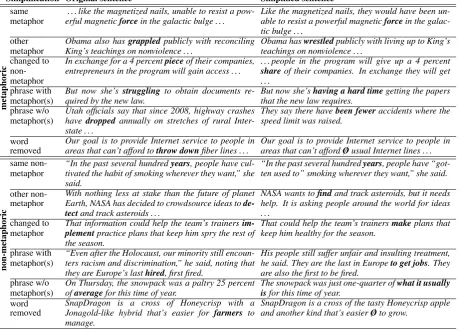
are six simplification options that were identi-fied for metaphoric items inWolska and Clausen (2017), which we now apply to non-metaphoric items as well. A word can be preserved (same metaphor/same non-metaphor)9, replaced by an-other word of the same metaphorical status (an-other metaphor for metaphoric items and other non-metaphor for literal items), replaced by a word of opposite metaphorical status (changed to non-metaphorfor metaphors andchanged to metaphor for literal items), rephrased with metaphorical lan-guage (phrase with metaphors) or without (phrase without metaphors), or removed (word removed). See Table2for an overview with examples.
The annotation of the simplification types in Wolska and Clausen (2017) was done as fol-lows: on a smaller subset of sentences annotated for metaphoricity, two authors identified and dis-cussed the simplification choices. Once these were finalized, one author annotated the remainder of
due to various reasons, e.g. complex syntactic structure. This is to be differentiated from the optionword removed, where the changes are performed on the word level and which we annotate.
9
Morphological deviations are considered the same word.
the dataset and the second author 99 instances.10 Inter-annotator agreement on the common subset wasκ = .87. In the present study, one author ex-tended the annotations.
The quantitative information on the annotated simplification types is summarized in Table 3.11 The statistics show that metaphors can be both useful and confusing for communication: 62% of the phrases that contained metaphors in the orig-inal article version contain a metaphor (the same or another one) in the simplified version. A small number of non-metaphors (2.3%) were replaced with metaphors in the simplified version.
With respect to the two word classes – nouns and verbs – we note considerable variation in the dataset (see Table 4). 93% of the verbs (186 metaphoric and 368 literal) appear less than five times; 67% (143 metaphoric and 256 literal) only once. The most frequent verbs annotated as metaphoric arehave (22), make (18) andtake
10
One erroneous instance had to be excluded.
1130 of the annotated words are not included in the counts;
Simplification type Count
Metaphoric 584
same metaphor 299
other metaphor 43
changed to non-metaphor 101 phrase with metaphor(s) 20 phrase without metaphor(s) 14
word removed 107
Non-metaphoric 2,925
same non-metaphor 1,933 other non-metaphor 418 changed to metaphor 34 phrase with metaphor(s) 32 phrase without metaphor(s) 77
[image:5.595.85.280.61.267.2]word removed 431
Table 3: Distribution of the simplification types.
(13). The verbssay(86) anduse(16) are mostly used literally. Nouns behave similarly: 95% (167 metaphoric and 1,049 literal) appear less than five times; 68% (131 metaphoric and 746 literal) with frequency 1. The most frequent nouns aredrone (9) (metaphoric), and year (47) and school (22) (literal). About 10% (65) verb types and 4% (56) noun types are used both metaphorically and lit-erally, indicating that features that combine infor-mation about the word and its context are needed.
Metaphoric Literal
V N V N
Min 1 1 1 1
Max 22 9 86 47
Mean 1.8 1.37 2.12 1.86 No. of types 196 169 401 1118
Table 4: Frequency distribution of metaphoric and lit-eral verb/noun types.
4 Experiments
The purpose of these experiments is to test whether there are distinguishable characteristics that indicate whether a metaphoric/literal word should/should not be changed to make the text easier to understand, and also whether there are features that are particular to metaphoric or lit-eral words with respect to simplification. We conducted two sets of experiments: on the full dataset (metaphoric and literal items), and on the metaphoric part of the data. Through the exper-iments on the full dataset we investigate whether
there are different features indicative of metaphor and literal word simplification, respectively. In the second set of experiments we perform a more in depth exploration of the metaphoric part of the data and look at the changes within the fine-grained simplification types.
4.1 Experimental setup
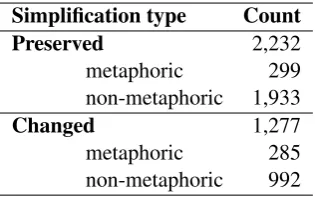
For the first set of experiments, we group the sim-plification types in two classes: preserved and changed. Unchanged items (i.e. same metaphor and same non-metaphor) were assigned the pre-served class. All other simplification types were combined aschanged. The quantitative informa-tion on the items used in the experiments is pro-vided in Table5.
Simplification type Count
Preserved 2,232
metaphoric 299 non-metaphoric 1,933
Changed 1,277
[image:5.595.338.496.287.386.2]metaphoric 285 non-metaphoric 992
Table 5: Statistics on the coarse-grained simplification types.
The experiments were done with a Linear Sup-port Vector Machine classifier using 10-fold cross-validation startegy.12 The feature values were standardized prior to the experiments.13We report the results of the random baseline, and the distri-bution of the different phenomena in the data.
4.2 Features
Data analysis has shown that both metaphors and literal words can be changed to help comprehen-sion, and either can be replaced with metaphoric or literal expressions. To determine whether there are identifiable characteristics that could make this distinction automatable, we compile a number of features that have been shown to be useful for text simplification and metaphor identification. The metaphor-sensitive features areImageability, Con-creteness, WordNet sensesandword’s context; the
12We use the SVM implementation in scikit-learn (
Pe-dregosa et al.,2011): https://scikit-learn.org/ stable/modules/generated/sklearn.svm. LinearSVC.html
13Standardization was performed with the
[image:5.595.81.283.447.531.2]general features are part of speech, vector space word representations, Age of Acquisition, word frequencyandFamiliarity. The feature types used and their coverage in our dataset are described be-low.
Part of speech: The part of speech (POS) tag-ging was done using the NLTK toolkit14 (Bird et al., 2009). The POS tags were then manually corrected where necessary. The two possible val-ues are noun and verb.
Vector space word representations: We ob-tained vector space representations for each an-notated word using Google’s pre-trainedword2vec model (Mikolov et al.,2013).15
Word embeddings have been successfully used in metaphor identification (e.g. Dinh and Gurevych 2016;Guti´errez et al. 2016) as well as in lexical simplification tasks (e.g. Glavaˇs and
ˇStajner 2015;Glavaˇs and Vuli´c 2018).
Age of Acquisition: Age of Acquisition (AoA) ratings were obtained from the AoA norms database of 51,715 English words (Kuperman et al., 2012). AoA denotes the approximate age at which a word is learned. The simplified news articles used in this study are intended for class-room use by 9-10 year old children. Words usu-ally acquired after this age should be more readily changed/removed in the simplified version.
We extracted the AoA ratings by matching both word forms and lemmas (e.g. nountesting/testing vs. verbtesting/test).
Imageability, Familiarity and Concreteness: Imageability stands for the ability of a word to evoke mental images; Familiarity refers to the fre-quency of exposure to a word; Concreteness de-scribes the level of abstraction associated with the concept a word represents. The connection of these variables to metaphor comprehension has been shown in multiple studies (e.g. Marschark et al. 1983; Paivio et al. 1968;Ure˜na and Faber 2010). Concrete words are more easily learned, processed and remembered than the abstract ones (Paivio et al.,1968). It is quite likely then that ab-stract words will be discarded during simplifica-tion.Marschark et al.(1983) found a link between high imageability and easier processing for certain
14
https://www.nltk.org/
15The model can be downloaded from here: https:// code.google.com/archive/p/word2vec/
metaphor types. These features were successfully used in lexical simplification (e.g.Jauhar and Spe-cia 2012;Vajjala and Meurers 2014).
Imageability and Familiarity ratings were ob-tained from the MRC Psycholinguistic Database (Wilson, 1988). This database contains up to 26 (psycho)linguistic attributes for 150,837 words. Concreteness ratings were extracted from a collec-tion of English Abstractness/Concreteness ratings (K¨oper and Schulte im Walde,2017).
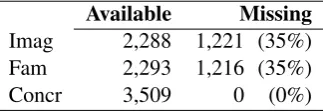
We extracted the values for the word forms if present in the databases and for the respective lem-mas otherwise. For a number of words, the values are missing (see Table 6). De Hertog and Tack (2018) use the third and first quartile values for Imageability and Concreteness, respectively, fol-lowing an assumption that rarer words tend to have lower imageability and concreteness, while Good-ing and Kochmar(2018) use the null value. We decided to assign instead a “neutral” value: the median value for each feature based on the ratings in the MRC.
Available Missing Imag 2,288 1,221 (35%) Fam 2,293 1,216 (35%)
[image:6.595.336.498.370.426.2]Concr 3,509 0 (0%)
Table 6: Counts for Imageability, Familiarity and Con-creteness ratings.
Word frequency: In lexical simplification sys-tems, it is common to substitute infrequent words with their more frequent synonyms (e.g.De Belder and Moens, 2010). AsKriz et al.(2018), we as-sume that highly frequent words are easier to un-derstand, whereas infrequent words are more diffi-cult and therefore will be removed/changed in the process of simplification.
We use word frequency counts from the SUBTLEXUS database (Brysbaert and New,
2009), a corpus of subtitles for American English of 51M words. The frequencies are given per mil-lion words. We extracted the values based on the word forms in our data (3,503 words); 6 words (.2%) have frequency 0.
to assign metaphoricity. The WordNet sense number could be an indication whether a word is metaphoric or not: the first sense is the more frequent, and could thus be considered basic, while the higher the sense number, the more likely it could be that the word is used metaphorically.
We use a Lesk-like (Lesk,1986) method to dis-ambiguate a target word relative to WordNet: a vector representation of the context of an anno-tated word (i.e. V0 sentence) is compared to a representation for each of the word’s definitions in WordNet. The representations are generated us-ing Google’s pre-trained word2vec model. The context and each definition are compared using Word Mover’s Distance (Kusner et al., 2015).16 We chose the synset number whose definition is most similar to the word’s context. The lookup in WordNet was done based on the word forms and matching POS tags. For 9 words (.3%) not found in WordNet the values are missing.
Word’s context: This feature reflects the dis-crepancy between the level of abstractness of a metaphoric word and its context. It was oper-ationalized with ratings of Concreteness (K¨oper and Schulte im Walde, 2017) and Imageability from the MRC database.
Turney et al. (2011) have shown that a word’s degree of abstractness, relative to the context it ap-pears in, can be successfully used to distinguish between literal and metaphoric meanings. Broad-well et al.(2013) used Imageability ratings to dis-cover metaphors based on the assumption that they stand out of their context as being highly image-able.
We considered a symmetrical seven-word win-dow centered on the target word. A wordw’s Con-creteness context (CC) value is computed as:
CCw=Cdn/2e −
bn/2c P
i=1
Ci+ n P
i=dn/2e+1
Ci !
wherenis the size of the window. The Imageabil-ity context (IC) is calculated in the same way.
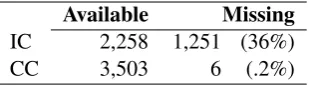
In the computation we used the context words with available Concreteness and Imageability scores in the database. If ratings for the target word itself or for all context words were not found, the value for the feature was set to missing. The overview of the value counts is given in Table7.
16
We used the implementation in Gensim Python library (Reh˚uˇrek and Sojkaˇ ,2010).
Available Missing IC 2,258 1,251 (36%)
[image:7.595.340.495.62.105.2]CC 3,503 6 (.2%)
Table 7: Counts for the words’ context features: Im-ageability context (IC) and Concreteness context (CC).
4.3 Experiment 1: Metaphoric vs. literal words
To assess the impact of the different features on predicting whether a word should or should not be changed, we group the features based on the type of information they capture:
• IFC(Imageability + Familiarity + Concrete-ness) – informative for metaphoric words
• WN+IC/CC (WordNet sense + word’s con-text) – different aspect of metaphor relevance
• Freq+AoA(word frequency + Age of Acqui-sition) – relevant for both metaphoric and lit-eral items
The F-score results on the full dataset (1,277 changed, 2,232 preserved instances) for different feature combinations are presented in Figure1.17
AoA has the highest Precision for the class changedin both metaphoric and literal cases. This shows that whereas this feature might be good in accurately detecting items that need simplifica-tion, it does not differentiate between metaphoric and literal usages in the current setting. Previ-ous studies have shown that some correlation ex-ists between the AoA and frequency of usage (e.g. Ghyselinck et al.,2004), but in this case the AoA feature and the Frequency feature have different effects when used alone (see Figure1). In partic-ular, the Frequency feature is not useful to deter-mine whether a word should be changed or not, contrary to our expectations.
We expected the “metaphor-specific” features (IFC) to have a higher impact on the metaphoric than on the literal words. When used alone they do lead to better prediction for changing metaphoric words compared to literal ones, but within the con-text of the full feature set, their impact is mini-mal (all, all-IFC/I/F/C). The imbalance in the data set could explain why, when using other features which can pick up on characteristics of literal
17
Figure 1: F-scores on learning changed vs. preserved on the full dataset, with results on all data and the metaphoric and literal subsets when using different feature combinations.
words (or both), the effect of Familiarity, Con-creteness and Imageability is lost.
The WN and context features also behave in an interesting manner. Alone, neither of these has much impact on distinguishing words that should be changed or not (WN/CC/IC). But when com-bined, their predictive power grows, particularly considering the approximate 1:5 ratio between metaphoric and literal target words. We tested a binary representation of the WN feature: is the dis-ambiguated sense the first one (the “basic” one) or not. This set-up led to worse results. This could mean that assuming that the first sense in WordNet is the “basic” sense is erroneous, even though it is the most frequent one.
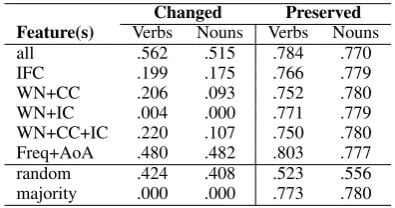
Changed Preserved Feature(s) Verbs Nouns Verbs Nouns
all .562 .515 .784 .770
IFC .199 .175 .766 .779
WN+CC .206 .093 .752 .780
WN+IC .004 .000 .771 .779
WN+CC+IC .220 .107 .750 .780
Freq+AoA .480 .482 .803 .777
random .424 .408 .523 .556
majority .000 .000 .773 .780
Table 8: F-scores: changed vs. preserved on the full dataset, for nouns (833 changed, 1474 preserved) and verbs (444 changed, 758 preserved).
Looking at the results on the subsets corre-sponding to nouns and verbs (see Table 8), we note that there are differences in terms of the use-ful features. Predicting that nouns should be pre-served is consistent w.r.t. the features used, and close to the majority baseline. Using all features leads to the best results overall, for both nouns and verbs, whether they should be changed or
pre-served. Metaphor-relevant features (IFC and con-textual information) are not helpful in predicting verbs and nouns that need to be changed. How-ever, they appear to be more relevant for verbs. The Frequency and Age of Acquisition combina-tion seems to be more important for verbs than for nouns.
4.4 Experiment 2: Metaphoric words
We use the subset of 285 changed and 299 pre-served metaphors to test the impact of different subsets of features for predicting change/preserve for metaphoric target words. The results are given in Table9for the complete metaphoric dataset.
We further analyze the results of classifying originally metaphoric words as changed or pre-served in the simplified texts. We look into the data subsets corresponding to the different metaphor simplification phenomena, and produce the recall results shown in Table10. We cannot compute precision because all instances in each subset belong to one class (i.e. eitherchanged or preserved).
[image:8.595.82.280.494.598.2]Changed Preserved Feature(s) P R F1 P R F1
all .573 .561 .567 .590 .602 .596
all-IFC .568 .558 .563 .586 .595 .590
all-I .568 .554 .561 .585 .599 .592
all-F .571 .561 .566 .589 .599 .594
all-C .573 .561 .567 .590 .602 .596
IFC .576 .519 .546 .581 .635 .607
WN+CC .522 .505 .513 .542 .559 .550
WN+IC .513 .540 .526 .539 .512 .525
WN+CC+IC .540 .519 .530 .558 .579 .568
WN .497 .554 .524 .523 .465 .492
CC .495 .319 .388 .515 .689 .589
IC .438 .186 .261 .499 .773 .606
AoA .602 .530 .563 .598 .666 .630
Freq .548 .884 .677 .734 .304 .430
Freq+AoA .594 .586 .590 .611 .619 .615
w2v .576 .572 .574 .595 .599 .597
random .489 .463 .476 .513 .538 .525
[image:9.595.72.292.60.265.2]majority .000 .000 .000 .512 1.00 .677
Table 9: Results on learning changed vs. preserved on the subset of metaphoric items (285 changed / 299 preserved instances). Best results are given in bold.
regardless of whether it is metaphoric or literal – when analyzing metaphoric words and classi-fying them into changed/preserved, Frequency is the best feature. This effect is apparent also when looking at the subsets corresponding to the differ-ent simplification types (see Table10).
Changed to Pres.
Feature(s) other met
phr. with met
lit. phr. no met
rem. same
all .651 .600 .515 .500 .570 .602
all-IFC .674 .600 .515 .500 .551 .595
all-I .651 .600 .505 .500 .651 .599
all-F .698 .600 .505 .500 .561 .599
all-C .585 .560 .582 .500 .570 .602
IFC .535 .850 .545 .286 .548 .635
WN+CC .581 .500 .525 .500 .458 .559
WN+IC .605 .550 .515 .571 .533 .512
WN+CC+IC .488 .650 .545 .500 .486 .579
WN .581 .450 .545 .643 .561 .465
CC .326 .450 .327 .286 .290 .689
IC .186 .200 .188 .143 .187 .773
w2v .674 .600 .495 .571 .598 .599
w2v+IFC .674 .600 .495 .571 .589 .605
AoA .605 .600 .535 .571 .477 .666
Freq .884 .950 .931 .929 .822 .304
Freq+AoA .651 .650 .604 .643 .523 .619 random .419 .450 .475 .357 .514 .518
Table 10: Recall: changed vs. preserved on the subset of metaphoric items (285 changed / 299 preserved in-stances) for each fine-grained simplification type. Best results are given in bold.
The word’s context features (IC/CC) have the highest Recall scores for the preserved cases, but in combination with the WordNet senses feature they stop being useful for differentiating between
the two classes. Just as in the first experiment, when used alone the IFC features are clearly use-ful, but within the full set of features they lose their predictive power. For the preserved items, the con-text features (IC/CC) show the best results. Those metaphors that were rephrased with metaphorical content are best described with the IFC features, whereas the WN senses feature is good when iden-tifying paraphrases without metaphors.
5 Conclusion
The analysis of metaphor usage in original and simplified versions of the same news texts has shown that not all metaphors are alike, from the point of view of text comprehension. A large percentage of metaphors in our dataset were ei-ther preserved or replaced using metaphorical lan-guage, while a (much) smaller number of literally used words was replaced with a metaphoric ex-pression.
The evaluation of the features most frequently used in literature for text simplification and metaphor identification has shown that for both metaphors and literal words, the most informa-tive feature is the Age of Acquisition. Features that capture the imageability, familiarity and con-creteness of a word have similar performance in predicting change/no change for both metaphori-cal and literal words when used alone. When used together with our other features, their predictive power diminishes. While not useful to separate changed and preserved words in the full dataset, for metaphoric words the frequency of usage is a telling feature, even at a fine-grained level.
One factor that could have influenced the results of these experiments is the incomplete coverage provided by the Imageability and Familiarity fea-tures. In future work we plan to improve the as-signment of missing values by deriving a value us-ing the scores assigned to the most similar words. We will further explore features that capture the interaction between a target word and its context, including contextual embeddings and the word’s syntactic role.
Acknowledgements
[image:9.595.73.293.422.641.2]References
G. Barlacchi and S. Tonelli. 2013. ERNESTA: A sen-tence simplification tool for children’s stories in ital-ian. InProceedings of the 14th International Con-ference on Computational Linguistics and Intelli-gent Text Processing - Volume 2, CICLing’13, pages 476–487, Berlin, Heidelberg. Springer-Verlag.
S. Bird, E. Klein, and E. Loper. 2009. Natural Lan-guage Processing with Python, 1st edition. O’Reilly Media, Inc.
D. Bollegala and E. Shutova. 2013. Metaphor inter-pretation using paraphrases extracted from the web.
PLoS ONE, 8(9):e74304.
G. A. Broadwell, U. Boz, I. Cases, T. Strzalkowski, L. Feldman, S. Taylor, S. Shaikh, T. Liu, K. Cho, and N. Webb. 2013. Using imageability and topic chaining to locate metaphors in linguistic corpora. In Proceedings of the 6th International Conference on Social Computing, Behavioral-Cultural Model-ing and Prediction, SBP’13, pages 102–110, Berlin, Heidelberg. Springer-Verlag.
M. Brysbaert and B. New. 2009. Moving beyond Kuˇcera and Francis: A critical evaluation of current word frequency norms and the introduction of a new and improved word frequency measure for Ameri-can English. Behavior Research Methods, Instru-ments & Computers, 41(4):977–990.
J. De Belder and M.-F. Moens. 2010. Text simplifica-tion for children. InSIGIR: Workshop on Accessible Search Systems, pages 19–26.
O. De Clercq and V. Hoste. 2016.All mixed up? Find-ing the optimal feature set for general readability prediction and its application to English and Dutch.
Computational Linguistics, 42(3):457–490.
D. De Hertog and A. Tack. 2018. Deep learning ar-chitecture for complex word identification. In Pro-ceedings of the Thirteenth Workshop on Innovative Use of NLP for Building Educational Applications, pages 328–334.
E.-L. Do Dinh and I. Gurevych. 2016. Token-level metaphor detection using neural networks. In Pro-ceedings of the Fourth Workshop on Metaphor in NLP, pages 28–33.
B. Drndarevi´c and H. Saggion. 2012. Towards auto-matic lexical simplification in Spanish: An empiri-cal study. InProceedings of the First Workshop on Predicting and Improving Text Readability for target reader populations, pages 8–16.
Christiane Fellbaum, editor. 1998. WordNet: An Elec-tronic Lexical Database. MIT Press, Cambridge, MA.
M. Ghyselinck, M. B. Lewis, and M. Brysbaert. 2004. Age of acquisition and the cumulative-frequency hy-pothesis: A review of the literature and a new multi-task investigation. Acta psychologica, 115 (1):43– 67.
G. Glavaˇs and S. ˇStajner. 2015. Simplifying lexi-cal simplification: Do we need simplified corpora?
In Proceedings of the 53rd Annual Meeting of the Association for Computational Linguistics and the 7th International Joint Conference on Natural Lan-guage Processing (Volume 2: Short Papers), pages 63–68.
G. Glavaˇs and I. Vuli´c. 2018. Explicit retrofitting of distributional word vectors. In Proceedings of the 56th Annual Meeting of the Association for Compu-tational Linguistics (Volume 1: Long Papers), pages 34–45.
A. Golden. 2010. Grasping the point: A study of 15-year-old students’ comprehension of metaphor-ical expressions in schoolbooks. In Graham Low, Zazie Todd, Alice Deignan, and Lynne Cameron, editors,Researching and Applying Metaphor in the Real World, pages 35–62. John Benjamins B. V.
S. Gooding and E. Kochmar. 2018. CAMB at CWI shared task 2018: Complex word identification with ensemble-based voting. InProceedings of the Thir-teenth Workshop on Innovative Use of NLP for Building Educational Applications, pages 184–194.
E. D. Guti´errez, E. Shutova, T. Marghetis, and B. Bergen. 2016. Literal and metaphorical senses in compositional distributional semantic models. In
Proceedings of the 54th Annual Meeting of the As-sociation for Computational Linguistics (Volume 1: Long Papers), pages 183–193.
C. Horn, C. Manduca, and D. Kauchak. 2014. Learn-ing a lexical simplifier usLearn-ing Wikipedia. In Proceed-ings of the 52nd Annual Meeting of the Association for Computational Linguistics (Volume 2: Short Pa-pers), pages 458–463.
S. K. Jauhar and L. Specia. 2012. UOW-SHEF: Sim-pLex - lexical simplicity ranking based on contex-tual and psycholinguistic features. In*SEM 2012: The First Joint Conference on Lexical and Compu-tational Semantics – Volume 1: Proceedings of the main conference and the shared task, and Volume 2: Proceedings of the Sixth International Workshop on Semantic Evaluation (SemEval 2012), pages 477– 481.
M. K¨oper and S. Schulte im Walde. 2017. Improving verb metaphor detection by propagating abstractness to words, phrases and individual senses. In Pro-ceedings of the 1st Workshop on Sense, Concept and Entity Representations and their Applications, pages 24–30.
Z. K¨ovecses. 2017. The Routledge Handbook of Metaphor and Language, chapter Conceptual Metaphor Theory. Routledge.
R. Kriz, E. Miltsakaki, M. Apidianaki, and Ch. Callison-Burch. 2018. Simplification using para-phrases and context-based lexical substitution. In
American Chapter of the Association for Computa-tional Linguistics: Human Language Technologies (Volume 1: Long Papers), pages 207–217.
V. Kuperman, H. Stadthagen-Gonzalez, and M. Brys-baert. 2012. Age-of-acquisition ratings for 30,000 english words. Behavior Research Methods, 44(4):978–990.
M. J. Kusner, Y. Sun, N. I. Kolkin, and K. Q. Wein-berger. 2015. From word embeddings to document distance. InProceedings of the 32nd International Conference on Machine Learning (ICML 2015), vol-ume 37, pages 957–966.
G. Lakoff and M. Johnson. 1980. Metaphors We Live By. University of Chicago Press, Chicago.
M. Lesk. 1986.Automatic sense disambiguation using machine readable dictionaries: How to tell a pine cone from an ice cream cone. In Proceedings of the 5th Annual International Conference on Systems Documentation, SIGDOC ’86, pages 24–26.
M. Marschark, A. N. Katz, and A. Paivio. 1983. Di-mensions of metaphor. Journal of Psycholinguistic Research, 12(1):17–40.
T. Mikolov, G. Corrado, K. Chen, and J. Dean. 2013. Efficient estimation of word representations in vec-tor space. In Proceedings of Workshop at ICLR, pages 1–12.
S. Nisioi, S. ˇStajner, S. Paolo Ponzetto, and L. P. Dinu. 2017. Exploring neural text simplification models. In Proceedings of the 55th Annual Meeting of the Association for Computational Linguistics (Volume 2: Short Papers), pages 85–91.
G. Paetzold and L. Specia. 2016. SemEval 2016 task 11: Complex word identification. InProceedings of the 10th International Workshop on Semantic Eval-uation (SemEval-2016), pages 560–569.
A. Paivio, J. C. Yuille, and S. A. Madigan. 1968. Con-creteness, imagery, and meaningfulness values for 925 nouns. Journal of Experimental Psychology, Monograph Supplement, 76(3, Pt. 2):1–25.
F. Pedregosa, G. Varoquaux, A. Gramfort, V. Michel, B. Thirion, O. Grisel, M. Blondel, P. Prettenhofer, R. Weiss, V. Dubourg, J. Vanderplas, A. Passos, D. Cournapeau, M. Brucher, M. Perrot, and ´E. Duchesnay. 2011. Scikit-learn: Machine learning in Python. Journal of Machine Learning Research, 12:2825–2830.
R. ˇReh˚uˇrek and P. Sojka. 2010. Software framework for topic modelling with large corpora. In Proceed-ings of the LREC 2010 Workshop on New Chal-lenges for NLP Frameworks, pages 45–50.
E. Shutova. 2013. Metaphor identification as interpre-tation. In Second Joint Conference on Lexical and Computational Semantics (*SEM), Volume 1: Pro-ceedings of the Main Conference and the Shared Task, pages 276–285.
G. Steen, L. Dorst, J. B. Herrmann, A. Kaal, T. Kren-nmayr, and T. Pasma. 2010. A method for linguis-tic metaphor identification: From MIP to MIPVU. John Benjamins B.V.
P. Stenetorp, S. Pyysalo, G. Topi´c, T. Ohta, S. Anani-adou, and J. Tsujii. 2012. brat: a web-based tool for NLP-assisted text annotation. InProceedings of the Demonstrations at the 13th Conference of the Euro-pean Chapter of the Association for Computational Linguistics, pages 102–107.
D. Toruno˘glu-Selamet, T. Pamay, and G. Eryi˘git. 2016.
Simplification of Turkish sentences. In Proceed-ings of The First International Conference on Turkic Computational Linguistics, pages 55–59.
P. D. Turney, Y. Neuman, D. Assaf, and Y. Cohen. 2011. Literal and metaphorical sense identification through concrete and abstract context. In Proceed-ings of the Conference on Empirical Methods in Nat-ural Language Processing, EMNLP ’11, pages 680– 690.
J. M. Ure˜na and P. Faber. 2010. Reviewing imagery in resemblance and non-resemblance metaphors. Cog-nitive Linguistics, 21:123–149.
S. Vajjala and D. Meurers. 2014. Readability assess-ment for text simplification: From analyzing docu-ments to identifying sentential simplifications. In-ternational Journal of Applied Linguistics, Special Issue on Recent Advances in Automatic Readabil-ity Assessment and Text Simplification, 165(2):194– 222.
S. ˇStajner, S. Paolo Ponzetto, and H. Stuckenschmidt. 2017. Automatic assessment of absolute sentence complexity. In Proceedings of the 26th Interna-tional Joint Conference on Artificial Intelligence, IJ-CAI’17, pages 4096–4102.
Tu Thanh Vu, Giang Binh Tran, and Son Bao Pham. 2014. Learning to simplify children stories with limited data. In9th Asian Conference on Intelligent Information and Database Systems, pages 31–41.
M. Wilson. 1988. MRC psycholinguistic database: Machine-usable dictionary, version 2.00. Behav-ior Research Methods, Instruments, & Computers, 20(1):6–10.
M. Wolska and Y. Clausen. 2017. Simplifying metaphorical language for young readers: A corpus study on news text. InProceedings of the 12th Work-shop on Innovative Use of NLP for Building Educa-tional Applications, pages 313–318.
W. Xu, Ch. Callison-Burch, and C. Napoles. 2015.
W. Xu, C. Napoles, E. Pavlick, Q. Chen, and Ch. Callison-Burch. 2016. Optimizing statistical ma-chine translation for text simplification. Transac-tions of the Association for Computational Linguis-tics, 4:401–415.
S. M. Yimam, Ch. Biemann, S. Malmasi, G. Paetzold, L. Specia, S. ˇStajner, A. Tack, and M. Zampieri. 2018. A report on the complex word identification
shared task 2018. InProceedings of the Thirteenth Workshop on Innovative Use of NLP for Building Educational Applications, pages 66–78.