Proceedings of the Fourth Arabic Natural Language Processing Workshop, pages 214–218 214
Simple but
not
Na¨ıve:
Fine-Grained Arabic Dialect Identification using only N-Grams
Sohaila Eltanbouly, May Bashendy, and Tamer Elsayed
Qatar University Doha, Qatar
{se1403101, ma1403845, telsayed}@qu.edu.qa
Abstract
This paper presents the participation of Qatar University team in MADAR shared task, which addresses the problem of sentence-level fine-grained Arabic Dialect Identification over 25 different Arabic dialects in addition to the Modern Standard Arabic. Arabic Dialect Iden-tification is not a trivial task since different di-alects share some features, e.g., utilizing the same character set and some vocabularies. We opted to adopt a very simple approach in terms of extracted features and classification mod-els; we only utilize word and character n-grams as features, and Na¨ıve Bayes models as classifiers. Surprisingly, thesimpleapproach achievednon-na¨ıveperformance. The official results, reported on a held-out testing set, show that the dialect of a given sentence can be iden-tified at an accuracy of 64.58% by our best submitted run.
1 Introduction
The Arabic Language is one of the oldest lan-guages in the world, which made Arabic dialects emerge over the years. Although Modern Stan-dard Arabic (MSA) is the only stanStan-dardized form of the Arabic language that has a predefined set of grammatical rules, it is only used in education, some media channels, and official written docu-ments. This owes to the fact that people tend to use dialects more in their daily life. Those dialects deviate from the classical MSA in terms of mor-phology, phonology, lexicon, and syntax (Janet,
2007). For example, a morphological difference could be seen in the affixes that are appended to the verb to indicate its tense, like the prefix
Ô
«
which indicate the present tense in Jordanian di-alect. The existence of many varieties of the Ara-bic dialects gave rise to the task of automatic iden-tification of written Arabic dialects, since a prior identification of those dialects is essential to many
applications, such as sentiment analysis, opinion mining, author profiling, and machine translation. Despite the significant differences between the di-alects, they still share some similarities such as having common character/vocabulary sets and ba-sic language rules which make dialect identifica-tion an interesting but challenging problem. More-over, the closeness between some dialects that are within the same country makes it even more chal-lenging to distinguish between them.
Unlike most of the previous work which tar-geted coarse-grained Arabic dialect identifica-tion, this work presents the participation of Qatar University team in the Multi Arabic Dialect Applications and Resources (MADAR) shared task (Bouamor et al., 2019) that addresses a fine-grained classification of 25 dialects of different Arabic cities in addition to MSA. We propose a
simple classification approach that only utilizes word and character n-grams using Na¨ıve Bayes learning model. While our approach is so simple (depending only on two categories of lexical fea-tures), it provednotto bena¨ıve; the official testing results show that our best submitted run achieved reasonably-goodF1scores across the different
di-alects, ranging from 0.52 to 0.84.
The rest of the paper is organized as fol-lows. Section 2 outlines the data used in build-ing/training our models. Section 3 details our pro-posed approach. Section 4 presents our runs and official testing results. Section 5 discusses and an-alyzes the performance of our best run. Finally, Section 6 concludes our work with some direc-tions of future work.
2 Data
corpus-26 and corpus-6, that include sentences trans-lated from the Basic Traveling Expression Cor-pus (BTEC) (Takezawa,2007) into different Ara-bic dialects and MSA, however, we only used the first corpus for developing our models. Corpus-26 contains 2,000 sentences translated into 25 paral-lel dialects plus MSA. This corpus is divided into training, development, and testing sets of 1600, 200, and 200 sentences per dialect respectively.
Several tools were used to build our system and process our data. Two main Python libraries were used for Arabic processing: pyarabic1 for tok-enization and diacritics removal, and the natural language toolkit (NLTK) for stop-words removal. For classification, we used both Scikit-learn and sklearn Python libraries.
3 System
The aim of this work is to design a system that can identify 25 different Arabic dialects (classes) in addition to MSA. We have adopted a similar approach to the one proposed by Salameh et al.
(2018). They trained a Multinomial Na¨ıve Bayes classifier over a feature combination of word n-grams, character n-n-grams, language models per di-alect, and sentence probabilities given by the lan-guage models, achieving an accuracy of 67.9%. In this section, the main blocks of our proposed sys-tem are presented.
3.1 Data Pre-processing
Arora et al.(2012) introduced the phrase “Garbage In, Garbage Out” to indicate that the data qual-ity greatly affects the classification task. In our system, the data was pre-processed by tokenizing over white spaces, removing Arabic stop words, and removing punctuation.
3.2 Feature Extraction
Extracting a set of discriminative features from the data helps in differentiating between the different classes. In our proposed models, only two cate-gories of features were considered: word n-grams and character n-grams.
• Word n-grams: The word unigrams and bi-grams are extracted and used as features. This category helps in distinguishing be-tween the different dialects since some words
1https://pypi.org/project/PyArabic/
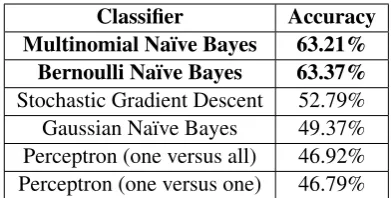
Classifier Accuracy Multinomial Na¨ıve Bayes 63.21%
Bernoulli Na¨ıve Bayes 63.37%
[image:2.595.318.514.61.160.2]Stochastic Gradient Descent 52.79% Gaussian Na¨ıve Bayes 49.37% Perceptron (one versus all) 46.92% Perceptron (one versus one) 46.79%
Table 1: Performance of different classifiers on the de-velopment set using word unigrams features only.
are uniquely found in specific dialects, cap-turing their lexical variations at the word
level.
• Character n-grams: The character n-grams, ranging from 2-grams to 5-grams, are ex-tracted and used as features. This category captures the morphological characteristics of the dialects by capturing prefixes and suffixes that distinguish some dialects at the charac-terlevel.
3.3 Feature Selection
Feature selection is an optimization technique that narrows down the feature space by selecting a sub-set of the most important features from the origi-nal set. In this work, we used Random Forest al-gorithm to select the top features. It is an ensem-ble learning algorithm that is based on combining a number of de-correlated decision trees in which the tree-based structure is naturally used to rank
the features.
3.4 Training Classifiers
We have experimented with a number of classi-fiers: Multinomial Na¨ıve Bayes, Bernoulli Na¨ıve Bayes, Stochastic Gradient Descent, Gaussian Na¨ıve Bayes, and Perceptron.
To choose the best classifiers for this task, we initially trained all classifiers only on word un-igrams features. Table 1 shows that Multino-mial Na¨ıve Bayes classifier (MNB) and Bernoulli Na¨ıve Bayes classifier (BNB) had, by far, the high-est (approximately equal) performance on the de-velopment set. Therefore, we only use those two in the rest of the experiments. Some previous stud-ies also used Na¨ıve Bayes classifiers for dialect identification, e.g., (Sadat et al.,2015).
Features Accuracy word character MNB BNB
1 - 63.21% 63.37%
1 2 57.40% 57.21%
1 3 62.52% 62.21%
1 4 65.67% 65.65%
1 5 65.85% 65.23%
1+2 - 63.50% 62.56%
1+2 2 58.56% 59.15%
1+2 3 62.85% 62.71%
1+2 4 66.00% 65.86%
1+2 5 65.75% 64.85%
1 2 + 3 59.42% 58.77%
1 3 + 4 64.37% 64.90%
1 3 + 5 65.35% 65.27%
1 4 + 5 66.25% 65.90%
1 3 + 4 + 5 65.33% 65.52%
[image:3.595.80.284.61.315.2]1 2 + 3 + 4 + 5 64.98% 64.42%
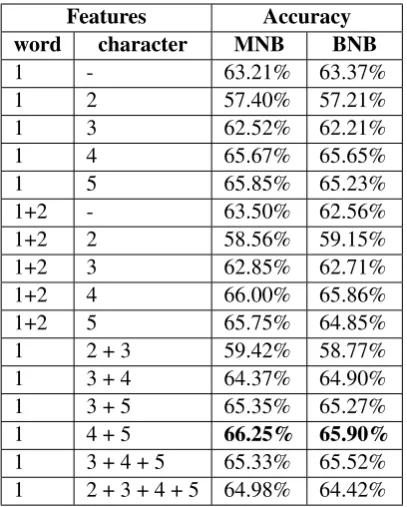
Table 2: Performance of MNB and BNB classifiers on the development set using different combinations of features.
Classifier #Features Time Accuracy
MNB 228,585 1:42h 64.71%
MNB-FS 203,200 1:31h 64.13%
Table 3: Training time and accuracy for MNB (trained over all character n-grams) and MNB-FS classifiers on the development set.
and character 2-grams to 5-grams. Table2shows the performance of different combinations of those features for both classifiers. The combination of the word unigrams with the character 4-grams and 5-grams achieved the highest accuracy.
Based on the performance of different clas-sifiers and different combinations of features (shown in Tables1and2), we chose the following models to represent our runs in the shared task:
1. MNB: In this run, a MNB classifier is trained with features that are obtained from combin-ing word unigrams, character 4-grams and character 5-grams. No feature selection is performed here.
2. Voting: In this run, two Na¨ıve Bayes clas-sifiers are trained, the first one is MNB and the second is BNB. The classifiers are trained using the word unigrams and character 4 and 5 grams. The classification is done by vot-ing between the two classifiers based on the
Run Prec. Recall F1 Acc.
MNB 0.6458 0.6440 0.6418 64.40%
Voting 0.6499 0.6458 0.6445 64.58%
MNB-FS
0.6292 0.6262 0.6232 62.62%
Table 4: Official performance of the 3 runs on test set.
higher probability. No feature selection is performed here.
3. MNB-FS: In this run, a MNB classifier is trained with character n-grams features rang-ing from 2-grams to 5-grams after feature selection. The main motivation behind this run is to improve the efficiency by reducing the feature space while maintaining good per-formance. The top 200 features of charac-ter bigrams, 3,000 of characcharac-ter 3-grams, and 200,000 of character 4-grams and character 5-grams were selected. As shown in Table3, feature selection reduced the size of the fea-ture space by about 11% which yields a drop in training time by about 10%. However, the performance is maintained across both mod-els, where the difference in accuracy is only about 0.6%.
3.5 Official Performance
Table4shows the overall performance on the test set for our three submitted runs. The results show that MNB run exhibited better performance than MNB-FS run. However, the Voting run, which ex-ploits the predictions proposed by both MNB and BNB classifiers, got the best performance. This in-dicates that the two basic classifiers had some dif-ferent predictions with difdif-ferent confidence (repre-sented by the classification probabilities) that were better leveraged by the voting scheme.
4 Discussion
Figure1illustrates theF1 score per dialect for the
best run, where dialects of the same country are colored the same. We notice thatF1scores range
[image:3.595.309.525.62.133.2]Figure 1:F1scores for the 25 dialects and the MSA for the best run. Same color indicates same country.
on Iraq and Libya is considered among the best. Moreover, Egypt has a noticeable but different ob-servation; its 3 representative cities/dialects (al-most) span the entire spectrum, with performance on Cairo and Alexandria (almost) make the ex-tremes. Finally, performance on MSA is among the top third, which is expected.
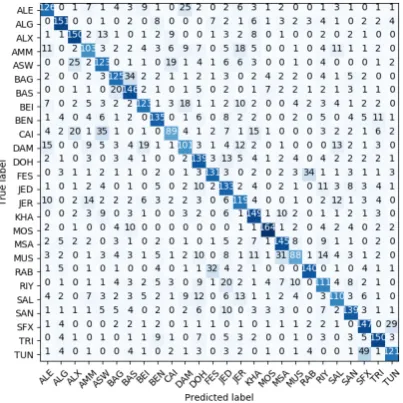
To shed more light on and gain more insights about the different performance on different di-alects, we illustrate the confusion matrix in Fig-ure 2. From the matrix, it is clear that some di-alects were confused with other didi-alects on the same country or other countries that are relatively close to it. The highest confusion is between Tu-nis (TUN) and Sfax (SFX) where 49 examples of TUN examples are misclassified as SFX and 29 vice versa. For example, misclassification of the TUN sentence “
? éJK. i
JK ú
Í@ ÕÎJ
®Ë@ èñ J
” asSFX can be due to the fact that the word “
èñ J
” appeared 41 times in SFX examples and only 14 times in TUN examples in the training data. Also, for Egypt, we can see from the confusion ma-trix that many examples are misclassified between these three dialects: Alexandria (ALX), Aswan (ASW), and Cairo (CAI), most notably in CAI which achieved a lowF1score of 0.53 because 35examples misclassified as ASW and 20 as ALX. Similarly, there is a recognizable confusion be-tween the countries in the same geographic area. For example, for the gulf area, 13 examples of Doha (DOH) were classified as Jeddah (JED) and 14 examples of Muscat (MUS) were classified as Riyad (RIY).
5 Conclusion & Future Work
In this work, we adopted a simple approach to classify the Arabic sentences into one of 25
di-Figure 2: Confusion Matrix for the best run.
alects of different cities all over the Arab world, in addition to MSA, utilizing only the word and character n-grams features. Our best submitted run to MADAR shared task, that represents a vot-ing scheme over two simple (both based on Na¨ıve Bayes) classifiers, achieved an overall accuracy of 66.34% on the development set and 64.58% on the testing set.
[image:4.595.317.519.247.449.2]References
Alka Arora, P K Malhotra, Sudeep Marwah, Anshu Bhardwaj, and Shashi Dahiya. 2012. Data prepro-cessing techniques in data mining.
Houda Bouamor, Nizar Habash, Mohammad Salameh, Wajdi Zaghouani, Owen Rambow, Dana Abdul-rahim, Ossama Obeid, Salam Khalifa, Fadhl Eryani, Alexander Erdmann, and Kemal Oflazer. 2018. The MADAR Arabic Dialect Corpus and Lexicon.Lrec, pages 3387–3396.
Houda Bouamor, Sabit Hassan, and Nizar Habash. 2019. The MADAR Shared Task on Arabic Fine-Grained Dialect Identification. InProceedings of the Fourth Arabic Natural Language Processing Work-shop (WANLP19), Florence, Italy.
Watson Janet. 2007. The Phonology and Morphology of Arabic. Oxford University Press.
Fatiha Sadat, Farzindar Kazemi, and Atefeh Farzindar. 2015. Automatic Identification of Arabic Language Varieties and Dialects in Social Media.Proceedings of the Second Workshop on Natural Language Pro-cessing for Social Media (SocialNLP) Dublin, Ire-land, pages 22–27.
Mohammad Salameh, Houda Bouamor, and Nizar Habash. 2018. Fine-Grained Arabic Dialect Identifi-cation. Processdings of the 27th International Con-ference on Computational Linguistics Santa Fe, New Mexico, USA, pages 1332–1344.