Proceedings of the 57th Annual Meeting of the Association for Computational Linguistics, pages 699–709 699
Just “OneSeC” for Producing Multilingual Sense-Annotated Data
Bianca Scarlini, Tommaso Pasini and Roberto Navigli
Department of Computer Science Sapienza University of Rome
{scarlini,pasini,navigli}@di.uniroma1.it
Abstract
The well-known problem of knowledge acqui-sition is one of the biggest issues in Word Sense Disambiguation (WSD), where anno-tated data are still scarce in English and al-most absent in other languages. In this paper we formulate the assumption of One Sense per Wikipedia Category and present OneSeC, a language-independent method for the automatic extraction of hundreds of thou-sands of sentences in which a target word is tagged with its meaning. Our automatically-generated data consistently lead a supervised WSD model to state-of-the-art performance when compared with other automatic and semi-automatic methods. Moreover, our ap-proach outperforms its competitors on mul-tilingual and domain-specific settings, where it beats the existing state of the art on all languages and most domains. All the train-ing data are available for research purposes at
http://trainomatic.org/onesec.
1 Introduction
The problem of acquiring knowledge (i.e., the knowledge acquisition bottleneck) is an open is-sue in Natural Language Processing (NLP). This problem has become even more critical with the advent of deep learning, as a bigger amount of data is needed to meet the requirements of more and more difficult tasks and increasingly complex models. Word Sense Disambiguation (WSD), i.e., the task of associating a word with its meaning in a context (Navigli, 2009), is one of the most affected research areas (Navigli, 2018). The in-terest in this field has grown remarkably due to the variety of applications that can benefit from it, such as Machine Translation (Neale et al.,2016) or Information Extraction (Delli Bovi et al.,2015). Most approaches to WSD are either supervised or knowledge-based. The former frames the problem
as a classification (Zhong and Ng, 2010) or se-quence learning (Raganato et al.,2017b) task, in which either a target word or all the content words in a sequence have to be tagged with one of their possible meanings. The latter, instead, exploits graph algorithms on knowledge bases, such as the Personalized PageRank method (Haveliwala,
2002;Agirre et al.,2014), or the densest subgraph heuristic (Moro et al.,2014). Hence, knowledge-based approaches rely on semantic networks such as WordNet1 (Miller et al., 1990), a manually-curated resource where synonyms are grouped into so-called synsets, or BabelNet2 (Navigli and Ponzetto,2010), a large multilingual encyclopedic dictionary that merges together different resources like WordNet, Wikipedia, Wikidata etc. There-fore, in one form or another both approaches to WSD need lexical-semantic data. This is espe-cially crucial in the case of supervised systems, which have proved capable of attaining higher re-sults on English, for which annotated data are available, whereas they fall behind knowledge-based approaches when tested on other languages. Unfortunately, carrying out semantic annotations for a target language requires time, resources and expertise in the field. Thus, in the last few years new approaches have been developed to mitigate the burden of knowledge acquisition by providing automatically or semi-automatically tagged cor-pora. The main goal of such techniques is to in-fer the meaning of words occurring in raw sen-tences by leveraging information drawn from dif-ferent sources of knowledge, i.e., parallel corpora (Taghipour and Ng,2015;Delli Bovi et al.,2017), or semantic networks (Pasini and Navigli, 2017;
Pasini et al., 2018). Although supervised mod-els achieve competitive results when trained on
1
https://wordnet.princeton.edu
automatically and semi-automatically annotated datasets, a major limitation concerning these ap-proaches is that they are strictly dependent on knowledge sources, which are in their turn diffi-cult to harvest. In fact, on the one hand, parallel corpora require human intervention for translat-ing a collection of texts into one or more different languages. On the other hand, semantic networks rely on manually-annotated lexical-semantic data for enriching the network itself.
In this paper we tackle the knowledge acqui-sition bottleneck by extending the hypotheses in-troduced in the two seminal papers byGale et al.
(1992b, One Sense Per Discourse) andYarowsky
(1993, One Sense Per Collocation) to Wikipedia categories, thereby making the following four con-tributions:
1. We formulate the new assumption of One Sense per Wikipedia Category, i.e., all the oc-currences of a word across Wikipedia pages in a category share the same word meaning.
2. We propose OneSeC (One Sense per Cat-egory), a novel fully-automatic method that produces multilingual sense-annotated datasets on a large scale by mapping Wikipedia categories to word senses.
3. We eliminate the dependency on the struc-ture of a semantic network by relying only on the association between Wikipedia pages and categories and on a sparse vector represen-tation of concepts, i.e., NASARI3(Camacho Collados et al.,2016).
4. We prove that OneSeC achieves state-of-the-art results on multilingual WSD and outper-forms its automatic and semi-automatic alter-natives on English.
2 One Sense Per Category
Preliminaries Wikipedia is the largest elec-tronic encyclopedia, available in approximately
300 languages. It is composed of pages and categories: pages are used to describe named entities and abstract concepts, while categories group pages that convey common semantic in-formation. For example, the Mouse (computing)
and Computer keyboard pages are grouped un-der the same category, namely, COMPUTING IN-PUT DEVICES. Similarly, the MONARCHS OF THE
3http://lcl.uniroma1.it/nasari/
UNITED KINGDOM category groups together all the past and present monarchs of the country, e.g.
Elisabeth II,Queen Victoria, etc. Based on this, in what follows we refer to the sentences of a cat-egory C as those sentences contained in all the pages of C, and we refer to the occurrences of a lemma in a category C as the occurrences of its inflected forms in the sentences ofC.
Automatically annotating Wikipedia Our ap-proach aims at creating a sense-annotated cor-pus in a target language by leveraging the seman-tic information contained within Wikipedia cate-gories. Therefore, by relying on the One Sense per Wikipedia Category assumption (see Section
1), we infer the meaning of words occurring in Wikipedia sentences by exploiting the information provided by their categories. For example, the lemma4 spring#n appears in more than 8K cate-gories, including SEASONSand MECHANICS. At the end of our procedure, OneSeC automatically assigns the metal elastic device sense to all the occurrences of spring#n in MECHANICS and the
seasonsense to those in SEASONS.
Given the whole Wikipedia together with its as-sociations between pages and categories and given a lexicon of words L, our approach computes a semantically-tagged dataset – where words in L
are annotated with their correct meaning – by per-forming the following three steps:
• Category Representation, which represents a lexeme-category pair(l, C) as the Bag Of Words of the sentences of the categoryC in which the lemmalappears (Section2.1).
• Sense Assignment, which assigns a senses
of the lemmalto each lexeme-category pair
(l, C)(Section2.2).
• Sentence Sampling, which extracts a certain number of sentences for each sensesof each lemmalin the lexiconLby exploiting the as-sociation between lexeme-category pairs and word senses computed in the previous step (Section2.3).
2.1 Category Representation
The first step aims at representing each lexeme-category pair(l, C)with a Bag Of Words (BOW). To that end, we lemmatise and POS tag the text of
4We use lemma and lexeme, i.e., a lemma#pos,
BOW mouse, cat, animal, vehicle, rodent, mice, mammal Mouse (animal) mouse, animal, rodent, mice, mammal, cat Mouse (device) mouse, computer, keyboard, device, input, output
Table 1: Excerpt of the sorted components of an ex-ample category’s BOW (first line) and two NASARI vectors (second and third line).
each page inC and retain only the content words in each sentence. Then, we consider all the sen-tences of C in which l appears at least once and we count the frequency of each other lemma oc-curring in the selected sentences. Finally, we build the BOW of(l, C) in which each dimension cor-responds to a lemma that is associated with its frequency, thus giving greater importance to more frequent words. For example, the pair(spring#n, MECHANICS) contains words such as force and
gravity, while the pair (match#n, SPORTS LAW)
includesteamandplay.
2.2 Sense Assignment
The second step aims at assigning a sense distri-bution to each lexeme-category pair. We exploit the BOW we computed and the NASARI lexical vectors (Camacho Collados et al.,2016) to repre-sent categories and synsets, respectively. NASARI leverages Wikipedia pages to provide a sparse rep-resentation of BabelNet synsets, having words as their dimensions weighted by their lexical speci-ficity (Lafon, 1980). NASARI has been used to compute the semantic similarity between two con-cepts (Pilevar et al., 2013) in combination with the Weighted Overlap (WO), which has proven to work better than cosine similarity for comparing sparse vectors. It takes as input two vectorsv1and
v2 and computes their similarity by considering the ranks of the components shared by both vec-tors5. However, as it takes into account only the common dimensions, it also gives a high similarity value when the two vectors share just a few dimen-sions with similar rankings. In light of this, we modified the original formula and added a weight factorΨas follows:
W O(v1, v2) = Ψ P w∈O
(rv1
w +rwv2)−1
|O|
P i=1
(2i)−1
(1)
whereOis the intersection set between the dimen-sions ofv1andv2,rwviis the rank of the dimension
5We note that the components of each vector are ranked
according to their weights.
[image:3.595.310.525.150.202.2](spring#n, SEASONS) (match#n, SPORTS LAW) The season of growth 0.63 A formal contest 0.49 Natural flow of water 0.10 Score needed to win 0.21 Movement upwards 0.08 Exact duplicate 0.07
Table 2: Excerpt of the sense distribution of spring#n and match#n for one of their categories.
Mouse (Animal) Score Mouse (Device) Score MICE 2.91 COMPUTING INPUT DEVICES 3.35 INVASIVE MAMMAL SPECIES 2.91 POINTING DEVICES 3.24 RODENTS 2.82 COMPUTER CONNECTORS 3.24 RODENTS OFAUSTRALIA 2.70 PERSONAL COMPUTERS 3.07 RODENTS OFAFRICA 2.65 COMPUTER KEYBOARDS 2.87
Table 3: Excerpt of the most related categories for the device and animal senses of mouse.
corresponding to the wordwin the vectorviandΨ
is a logarithmic function that depends on the size ofOand is defined asΨ =ln(|O|+ 1).
For example, given the BOW for a category re-lated to the animal mouse and the two NASARI vectors for theanimalanddevicesenses ofmouse
as in Table1, the standard weighted overlap scores theanimal sense 0.93 and thedevice sense 1.00, even though the latter has only the first dimension in common. When we add the logarithmic factor
Ψ, instead, the first sense is scored1.80while the second is scored0.69.
Therefore, for each lexeme-category pair(l, C)
we compute the WO betweenBC, i.e., the BOW
representation of the categoryC(see Section2.1), and each NASARI vector associated with a given sense ofl. Thus, given a set of weighted overlap scores{W O(BC, s1), . . . , W O(BC, sn)}, where
s1. . . sn are the senses of l, we assign to (l, C)
the sense that maximises the similarity with the category BOW as follows:
sense(l, C) = arg max
si
{W O(BC, si)}
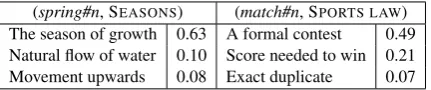
In Table 2 we show the distribution of senses for one category ofspring#nandmatch#n, respec-tively. As one can see, given the pair (spring#n, SEASONS)we select theseasonsense ofspring#n
as it is the highest ranked one in terms of WO, while the formal contest meaning of match#n is selected for(match#n, SPORTS LAW).
2.3 Sentence Sampling
Once each lexeme-category pair(l, C) is associ-ated with one sense, we can reverse the relation having – for each sense ofl – a list of categories
C1, . . . , Cm sorted by weighted overlap. For
related categories for the animal and the device
meanings of the lemmamouse#n. As one can see, the animal sense is mostly related to categories that concern the animal world, e.g. MICE, RO -DENTS, etc., while the device sense to the elec-tronic device world, e.g. COMPUTING INPUT DE-VICES, POINTING DEDE-VICES, etc. Therefore, for each sensesioflwe sample a set ofKsisentences
from C1, . . . , Cmi that depends on the BabelNet
ordering of senses. FollowingPasini and Navigli
(2017) we computeKsi applying a Zipfian
distri-bution:
Ksi =
K
iz (2)
whereKandzare two system parameters that de-fine, respectively, the number of examples to as-sign to the first sense of a lemma and how fast the function decreases, while i is the sense position in BabelNet. In the case that we find onlyβ sen-tences for the first sense ofl, with β < Ks1, we scale down allKsiby settingK=β, i.e., we
con-sider the maximum number of examples as those that are actually available for the first sense. For example, if we havez= 2.0andK= 500but we can retrieve only100sentences for the sense s1, we setK = 100when computingKsi fori > 1.
Hence, the number of sentences to be associated with s2 is 25, rather than 125, thus maintaining the distribution across senses balanced.
In order to provide different contexts of use for a given sensesi, we sampleKsCij sentences from
each categoryCj.KsCij is computed as follows:
KsCij =Ksi
j−1
mi
P j0=1
j0−1
(3)
where the second term is a smoothed version of the category rank reciprocal6, i.e., it is normalised by the sum of the reciprocal of each category rank (from1tomi).
Once we have determined the number of exam-ples to draw from each category, we sample the sentences according to their perplexity, which we compute with a Neural Language Model trained on WikiText103 (Howard and Ruder,2018)7.
The result of the above three steps is a semantically-annotated corpus where each mean-ingsof each lemmal∈Lis associated with a set of sentences in whichlis tagged withs.
6Recall that the categories associated with the sensesare
sorted by weighted overlap.
7http://files.fast.ai/models/wt103/
3 Experimental Setup
We exploited the Word Sense Disambiguation task to assess the quality of our automatically-generated corpus. Therefore, we trained a ref-erence WSD model on the data generated by OneSeC and compared the results against those achieved by the same model trained on other re-sources.
In what follows we introduce the reference Word Sense Disambiguation system, the test bed, the comparison systems and how we tuned the two parametersKandz.
Reference system We carried out the evaluation with two different WSD models: the SVM-based system It Makes Sense (Zhong and Ng, 2010, IMS) and the Bi-LSTM-based model introduced byRaganato et al.(2017b). For the latter we used MUSE embeddings (Lample et al., 2018) in the input layer, a learning rate of0.5and followed Ra-ganato et al.(2017b) for all the other hyperparam-eters. Depending on the setting, English or multi-lingual, we chose the best-performing system on a development set: Senseval-2 for English and an in-house development set for all the other languages8. For both models, unless differently stated, we used the Most Frequent Sense (MFS) of a lemma, i.e., its first-ranked meaning in BabelNet, as backoff strategy when the system was not able to provide an answer.
Test bed We used the evaluation framework for English all-words WSD made available by Ra-ganato et al.(2017a). This comprises all the past test sets, including Senseval-2 (Edmonds and Cot-ton,2001), Senseval-3 (Snyder and Palmer,2004), SemEval-2007 (Pradhan et al., 2007), SemEval-2013 (Navigli et al.,2013), SemEval-2015 (Moro and Navigli,2015) and ALL, i.e., the concatena-tion of all the aforemenconcatena-tioned datasets. For the multilingual evaluation, instead, we used the all-words multilingual WSD tasks of SemEval-2013 (Navigli et al., 2013) and SemEval-2015 (Moro and Navigli,2015). For both settings, we focused on nouns only, as NASARI vectors are available mainly for nominal concepts.
Following the literature, we report the F1 mea-sure on all the test sets unless stated differently.
8The development set of each language comprises 50
100 300 500 700 900 66.0
67.0 68.0 69.0 70.0 71.0 72.0 73.0
K
F
1
IMS Bi-LSTM
MFS Trendline IMS
Trendline Bi-LSTM
2 2.2 2.4 2.6 2.8 3
66.0 67.0 68.0 69.0 70.0 71.0 72.0 73.0
z
F
1
IMS
Bi-LSTM MFS
Trendline IMS
[image:5.595.88.514.62.230.2]Trendline Bi-LSTM
Figure 1: Performance on the development set of IMS and the Bi-LSTM model trained on OneSeC whenz= 2.0
andKranges between100and900(left) and whenK= 700andzranges between2.0and3.0(right).
English parameter tuning We tune the param-eters Kand z introduced in Section2.3 so as to maximise the performance of the reference system on the development set. We used Senseval-2 as tuning corpus and variedKbetween100and900
with a200step andz between2.0and3.0with a
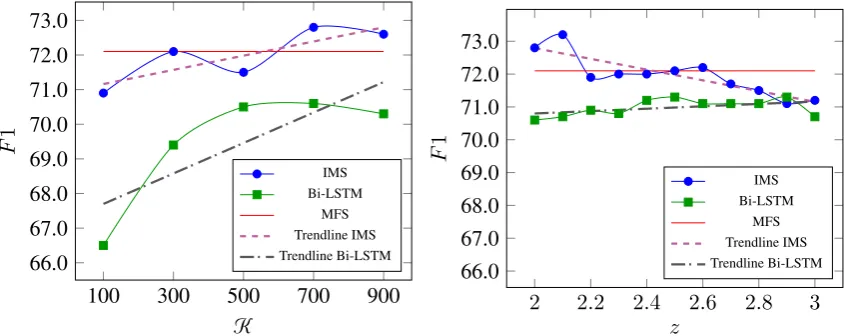
0.1step. We ran both models, IMS and Bi-LSTM, for each parameter value and chose the one that performed best. In Figure1(left) we show the re-sults of the two systems when trained on OneSeC wherezis set to2.0andKis increased from100
to 900. As can be seen, the Bi-LSTM trend in-creases more rapidly than the IMS one. However, its results are always lower than those attained by its alternative. IMS, in fact, scores almost5points higher starting from K = 100and maintains its lead through all the values of K. It reaches a plateau whenK= 700, which we interpret as the
plateau of knowledge. Indeed, increasing the num-ber of examples degrades IMS performance as no more informative sentences are found for a given sense. OnceK was set to700both for IMS and Bi-LSTM, we ran the same experiment varyingz. As one can see in Figure1 (right), IMS achieves the highest score whenz = 2.1 while Bi-LSTM whenz = 2.9. While IMS seems sensitive to this parameter, attaining better performance when the distribution of classes in training is more balanced, the neural model trend is almost constant, indicat-ing it is less dependent on the sense distribution.
Therefore, we chose IMS as our WSD reference system as it consistently outperformed its neural-network alternative. In the following we report the results of IMS trained on OneSeC withK= 700
andz= 2.1.
Multilingual parameter tuning We varied K
and z as for English and computed the perfor-mance separately on each language-specific de-velopment dataset. We then chose the parame-ters leading the reference model to the highest results averaged across all languages. Contrary to what was the case for English, the Bi-LSTM model outperformed IMS on most of the settings and achieved the highest score withK= 200and
z = 2.0. Hence, we report multilingual results attained by the Bi-LSTM model when trained on OneSeC withK= 200andz= 2.0.
Comparison systems We compared OneSeC with a manual, a semi-automatic and a fully-automatic alternative:
• SemCor (Miller et al., 1993): the most used training corpus in WSD, which provides more than200Kmanual annotations.
• OMSTI (Taghipour and Ng, 2015): a semi-automatic approach that extracts semantically-annotated data by exploiting parallel data to reduce the ambiguity of the target language. Since the resource contains SemCor by default, we considered only the semi-automatically generated examples in order to guarantee a fair comparison with OneSeC.
• Train-O-Matic9 (Pasini and Navigli, 2017, TOM): a knowledge-based method for the automatic generation of sense-annotated data.
Dataset OneSeC OMSTI Train-O-Matic SemCor
P R F1 P R F1 P R F1 P R F1
Senseval-2 72.3 69.1 70.7 64.8 38.5 39.6 69.5 65.5 67.4 73.5 61.3 66.8 Senseval-3 66.5 62.1 64.2 55.7 31.0 39.8 66.1 63.1 64.6 73.2 67.6 70.2
SemEval-07 63.7 62.9 63.3 64.1 35.9 46.0 59.8 59.8 59.8 68.9 65.4 67.1
[image:6.595.76.521.61.174.2]SemEval-13 64.0 58.3 61.0 50.7 23.4 32.0 61.3 53.3 57.0 63.2 55.4 59.0 SemEval-15 69.2 64.8 66.9 57.0 26.7 36.4 67.0 62.3 64.6 65.3 56.3 60.5 ALL 67.3 62.8 64.9 56.5 27.0 36.5 65.1 59.7 62.3 68.3 59.9 63.8
Table 4: Performance of IMS trained on different corpora on the English all-words WSD tasks when the MFS is disabled.
Dataset OneSeC TOM OMSTI SemCor MFS Senseval-2 73.2 70.5 74.1 76.8 72.1 Senseval-3 68.2 67.4 67.2 73.8 72.0 SemEval-07 63.5 59.8 62.3 67.3 65.4 SemEval-13 66.5 65.5 62.8 65.5 63.0 SemEval-15 70.8 68.6 63.1 66.1 66.3
ALL 69.0 67.3† 66.4† 70.4 67.6
Table 5: Results of IMS trained on different corpora on the English all-words WSD tasks. †marks statistical significance between OneSeC and its competitors.
For the multilingual setting, instead, due to the lack of manually sense-annotated data for non-English languages, we compared directly OneSeC against the best participating system in each task and Train-O-Matic. To set a level playing field, we also report the results attained by the Bi-LSTM model when trained on Train-O-Matic corpora for the tested languages.
4 Results
4.1 English All-Words WSD
We proceed by testing the reference WSD sys-tem on the data provided by OneSeC, Train-O-Matic, OMSTI and SemCor on the English all-words tasks.
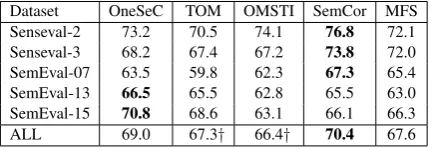
In Table5we compare the results of IMS when trained on different corpora. As one can see, OneSeC achieves the best results on ALL when compared to automatic and semi-automatic ap-proaches, and ranks second only with respect to SemCor. Interestingly enough, OneSeC beats its manual competitor on SemEval-2013 by 1 point and on SemEval-2015 by 4.7 points, an impres-sive result considering that OneSeC does not in-volve any human intervention during the gener-ation of the corpus. In Table 5 we also report the statistical significance between OneSeC and its competitors on the ALL dataset by juxtapos-ing a † symbol next to the score. In order to do
Dataset OneSeC TOM OMSTI Total
Senseval-2 401 400 197 436
Senseval-3 424 435 197 469
SemEval-07 125 127 68 127
SemEval-13 656 629 249 751
SemEval-15 228 226 102 253
[image:6.595.74.292.226.301.2]ALL 1359 1350 456 1557
Table 6: Number of nominal lemmas covered by each corpus.
this, we computed the McNemar’sχ2test ( McNe-mar, 1947) with significance levelα = 0.01 be-tween OneSeC and SemCor. It resulted in no sta-tistical significance, meaning that IMS trained on OneSeC is in the same ballpark as when trained on SemCor. We note that the goal of this work was not to achieve state-of-the-art results on En-glish WSD compared to manually-annotated cor-pora. However, performing competitively on stan-dard benchmarks represents one step further to-wards getting rid of the limitation imposed by re-sources like SemCor. Moreover, our approach out-performs Train-O-Matic, our direct competitor, on all the datasets, with the highest increment of3.7
points on SemEval-2007, while scoring almost2
points higher than TOM overall.
[image:6.595.308.525.226.316.2]Dataset Domain Size Backoff OneSeC TOM OMSTI MFS
P R F1 P R F1 P R F1
SemEval-13
Biology 135 MFS 67.4 67.4 67.4 63.0 63.0 63.0 65.9 65.9 65.9 64.4 - 65.1 60.7 62.8 59.0 53.3 56.0 48.1 18.5 26.7
Climate 194 MFS 68.0 68.0 68.0 68.1 68.1 68.1 68.0 68.0 68.0 67.5 - 65.0 54.6 59.4 63.4 50.0 55.9 58.0 24.2 34.2
Finance 219 MFS 69.4 69.4 69.4 68.0 68.0 68.0 64.4 64.4 64.4 56.2 - 67.2 61.6 64.3 62.1 51.6 56.4 57.4 28.3 37.9
Health Care 138 MFS 65.9 65.9 65.9 65.2 65.2 65.2 52.9 52.9 52.9 56.5 - 62.4 56.5 59.3 61.3 55.1 58.0 34.6 18.4 24.0
Politics 279 MFS 68.8 68.8 68.8 65.2 65.2 65.2 63.4 63.4 63.4 67.7 - 67.0 63.4 65.2 62.5 54.8 58.4 54.1 21.5 30.8
Social Issues 349 MFS 66.5 66.5 66.5 68.5 68.5 68.5 65.6 65.6 65.6 67.6 - 62.5 55.0 58.5 63.1 53.0 57.6 54.7 25.2 34.5
Sport 330 MFS 61.8 61.8 61.8 60.3 60.3 60.3 58.8 58.8 58.8 57.6 - 61.8 57.3 58.8 58.3 54.6 56.4 45.0 23.0 30.4
SemEval-15
Biomedicine 100 MFS 78.4 78.4 78.4 76.3 76.3 76.3 64.9 64.9 64.9 71.1 - 77.8 72.2 74.9 76.1 72.2 74.1 60.5 26.8 37.2
[image:7.595.72.526.61.293.2]Maths & Pc 97 MFS 60.0 60.0 60.0 50.0 50.0 50.0 36.0 36.0 36.0 40.9 - 59.8 58.0 58.9 50.0 47.0 48.5 21.2 11.0 14.5
Table 7: Domain-specific evaluation on SemEval-2013 and SemEval-2015 of IMS trained on OneSeC, TOM and OMSTI.
annotated examples for only half of the instances. Therefore, IMS – when trained on OMSTI – re-sorts heavily to the MFS backoff strategy.
In light of this, we computed precision (P), re-call (R) and their harmonic mean (F1) when no backoff strategy was used, as shown in Table4. As one can see, OMSTI’s performance drops heavily by roughly30points, confirming the figures in Ta-ble6. Train-O-Matic’s results, in contrast, remain consistent, scoring 1.5 F1 points less than Sem-Cor overall and managing to beat it on2datasets. OneSeC, instead, leads IMS to the highest results overall, managing to surpass those achieved, not only by its direct competitors, but also by SemCor. The results attest the high quality of our corpus, hence crowning OneSeC as the best choice over its competitors and even over manually-curated cor-pora when no back-off strategy is available.
4.2 Augmenting SemCor
To further investigate the quality of the exam-ples provided by OneSeC, we augmented SemCor with our automatically-tagged sentences (Sem-Cor+OneSeC). We added examples to SemCor in two cases:
1. When a word in OneSeC lexicon never ap-pears tagged in SemCor.
2. When not all senses of a word are covered by at least one example in SemCor.
In the first case we provided annotated sentences for all the senses of the target word withK= 700
andz = 2.1. In the second case, instead, we gen-erated examples only for those sensessiof a word
w that are missing in SemCor. We determined the number of examples for si by following the
Zipfian distribution in Formula 2 with z = 2.1
and K = |examples(s1, w)|, i.e., the number of examples in SemCor where w occurs tagged with its most frequent senses1. SemCor+OneSeC achieves70.7F1 points on ALL, beating SemCor alone (70.4) and SemCor+OMSTI (70.5)10.
4.3 Domain-Specific Evaluation
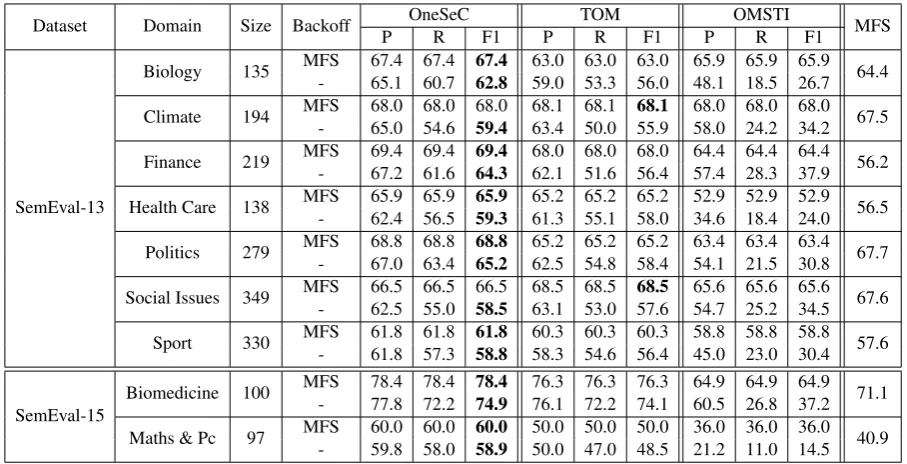
In Table 7 we show the results achieved by IMS on each specific domain of SemEval-2013 and SemEval-2015. As shown in the two tables, when compared with TOM and OMSTI, OneSeC leads IMS to consistently outperform all the other ap-proaches on SemEval-2015 and most of the do-mains of SemEval-2013. In fact, OneSeC scores lower only in 2 out of the 7 SemEval-2013 do-mains, whereas Train-O-Matic, instead, scores0.1
and2 points higher. However, when the MFS is disabled (second row of each domain), OneSeC is the best system across the board, demonstrat-ing it can also provide valuable examples for those words that are specific to a domain.
10We refer to SemCor+OMSTI as the dataset containing
4.4 Multilingual All-Words WSD
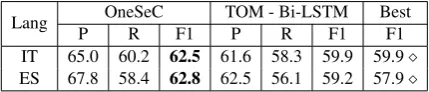
Finally, we move our focus to testing the abil-ity of OneSeC to scale to different languages. In Tables 8 and 9 we show the results obtained by Bi-LSTM trained on OneSeC and Train-O-Matic (TOM - Bi-LSTM) when the MFS backoff strat-egy is disabled. We compare the aforementioned approaches with the best participating system in SemEval-2013 and SemEval-2015, i.e., UMCC-DLSI’s (Guti´errez V´azquez et al.,2010) best run for the Spanish test set of SemEval-2013 and IMS trained on Train-O-Matic for all other datasets (Pasini et al.,2018). OneSeC proved, once again, to be the best system across the board, achieving state-of-the-art results on all languages. Our ap-proach outperforms its competitors on all datasets, with the highest increment of 7.4 points on the French test set for SemEval-2013, while scoring on average 3.2 F1 points higher compared to the existing state of the art.
Results show that OneSeC is a robust approach that is able to scale across languages and domains. It goes beyond the findings of Train-O-Matic and raises the state-of-the-art bar in multilingual WSD.
5 Related Work
Word Sense Disambiguation is a well-established task in the field of Natural Language Processing and it has been tackled from many different angles over the past years. One of the major problems concerning WSD has been the so-called knowl-edge acquisition bottleneck (Gale et al., 1992a), i.e., the paucity of lexical-semantic data. In fact, semantic resources are mainly exploited by WSD models in one of two different ways: as structured knowledge to identify the meaning of a word in a context in knowledge-based models (Moro et al.,
2014;Agirre et al.,2014;Chaplot and Salakhutdi-nov, 2018), and as training data to fit the param-eters of a classifier in supervised models (Zhong and Ng,2010;Yuan et al.,2016;Raganato et al.,
2017b;Luo et al.,2018).
On the one hand, knowledge-based models have proved to be more versatile when it comes to disambiguating less frequent words and texts in low-resourced languages, even though they suf-fer from the lack of statistical evidence of lexi-cal context. On the other hand, supervised models have consistently attained higher results in English WSD (Raganato et al., 2017a), however at the cost of less flexibility and lower results when
scal-Lang OneSeC TOM - Bi-LSTM Best
P R F1 P R F1 F1
IT 72.3 64.5 68.2 65.4 60.6 62.9 68.0
ES 76.0 68.3 72.0 71.7 66.8 69.2 71.0∗
FR 79.2 70.9 74.8 71.0 64.2 67.4 61.0∗
[image:8.595.309.524.186.232.2]DE 83.0 68.5 75.1 77.5 64.1 70.2 63.0
Table 8: Comparison of Bi-LSTM trained on OneSeC and TOM with the best system (Best) on SemEval-2013.Train-O-Matic,∗UMCC-DLSI.
Lang OneSeC TOM - Bi-LSTM Best
P R F1 P R F1 F1
IT 65.0 60.2 62.5 61.6 58.3 59.9 59.9
ES 67.8 58.4 62.8 62.5 56.1 59.2 57.9
Table 9: Comparison of Bi-LSTM trained on OneSeC and TOM with the best system (Best) on SemEval-2015.Train-O-Matic,∗UMCC-DLSI.
ing to other languages (Raganato et al., 2017b). Thus, research has recently been focused on new techniques that aim at mitigating the effects of the knowledge-acquisition bottleneck by automat-ically creating high-quality, sense-annotated train-ing corpora. Some earlier attempts consisted of annotating examples from the Web by exploiting the target words’ monosemous relatives (Agirre and Mart´ınez, 2004). But a major drawback of this kind of approach is its limited coverage. In fact, a training example can be provided only for those senses with at least one monosemous related concept. Raganato et al.(2016) presented in their paper a method for the automatic construction of a Semantically Enriched Wikipedia (SEW), where the number of hyperlink annotations was enlarged by means of a set of heuristics. As an outcome they released a corpus containing more than 200
million annotations for approximately 4 million concepts and named entities. Another approach was developed byOtegi et al.(2016) to enrich the multilingual text of Europarl (Koehn, 2005) and QTLeap (Agirre et al.,2014) with several features, including semantic annotations in 6 different lan-guages. Parallel corpora were exploited also in the more recent work ofTaghipour and Ng(2015, OMSTI)11, who presented a semi-automatic ap-proach that creates a novel semantically-annotated dataset by leveraging the manual effort made to align senses across different languages.
In contrast, recent methods have been able to fully automatise the whole process while
simulta-11http://lcl.uniroma1.it/wsdeval/
neously producing high-quality resources. For ex-ample,Delli Bovi et al.(2017) exploited an exter-nal WSD system, i.e., Babelfy (Moro et al.,2014), and the richer context provided by aligned sen-tences, to carry out semantic annotations for Eu-roparl. Instead,Pasini and Naviglicompletely re-moved the need for parallel corpora (Pasini and Navigli, 2017; Pasini et al., 2018) and for the WordNet backoff strategy (Pasini and Navigli,
2018) by introducing Train-O-Matic and two auto-matic methods for inducing the sense distribution. Our work follows this latter line of research and, similarly to the aforementioned approaches, au-tomatically provides multilingual sense-annotated data on a large scale. OneSeC stands out from its alternatives as it does not depend either on the structure of a semantic network (like Train-O-Matic), or on external WSD models (like Eu-roSense). In our approach, in fact, we only rely on Wikipedia categories and NASARI vectors to inject semantic information at sentence level.
6 Conclusions
In this paper we presented OneSeC, a novel method for the automatic creation of multilingual sense-annotated corpora on a large scale. Our ap-proach relieves the burden of human intervention, hence mitigating the knowledge acquisition bot-tleneck besetting WSD training data. Moreover, we take a further step towards removing any de-pendency on a semantic-network structure by ex-ploiting only Wikipedia categories and a sparse vector representation of concepts for creating our datasets. OneSeC outperforms its automatic and semi-automatic alternatives on the English WSD task, and achieves results in the same ballpark as those attained when manually-curated corpora are used for training. Furthermore, OneSeC scales to multiple languages without any additional human effort. Indeed, our approach also proved to be ca-pable of producing high-quality training data for low-resourced languages, leading a WSD super-vised model to achieve state-of-the-art results on all the datasets of the multilingual WSD tasks. We release more than one million tagged sentences for English, Spanish, Italian, French and German at
http://trainomatic.org/onesec.
As future work we plan to exploit a subset of the Wikipedia categories as coarse-grained sense in-ventory and enrich our dataset with coarser labels, hence enabling WSD at different granularities.
Acknowledgments
The authors gratefully acknowledge the support of the ERC Consolida-tor Grant MOUSSE No. 726487 un-der the European Union’s Horizon 2020 research and innovation pro-gramme.
References
Eneko Agirre, Oier Lopez de Lacalle, and Aitor Soroa. 2014. Random Walks for Knowledge-Based Word Sense Disambiguation. Computational Linguistics, 40(1):57–84.
Eneko Agirre and David Mart´ınez. 2004. Unsuper-vised WSD Based on Automatically Retrieved Ex-amples: The Importance of Bias. In Proc. of EMNLP, pages 25–33.
Jos´e Camacho Collados, Mohammad Taher Pilehvar, and Roberto Navigli. 2016. Nasari: Integrating ex-plicit knowledge and corpus statistics for a multilin-gual representation of concepts and entities. Artifi-cial Intelligence, pages 36–64.
Devendra Singh Chaplot and Ruslan Salakhutdinov. 2018. Knowledge-based word sense disambiguation using topic models. InProc. of AAAI, pages 5062– 5069.
Claudio Delli Bovi, Jos´e Camacho Collados, Alessan-dro Raganato, and Roberto Navigli. 2017. Eu-roSense: Automatic Harvesting of Multilingual Sense Annotations from Parallel Text. InProc. of ACL, pages 594–600.
Claudio Delli Bovi, Luca Telesca, and Roberto Nav-igli. 2015. Large-Scale Information Extraction from Textual Definitions through Deep Syntactic and Se-mantic Analysis. Transactions of ACL, 3:529–543.
Philip Edmonds and Scott Cotton. 2001. Senseval-2: Overview. InProc. of SENSEVAL, pages 1–5.
William A. Gale, Kenneth W. Church, and David Yarowsky. 1992a. A method for disambiguating word senses in a corpus. Computers and the Hu-manities, 26:415–439.
William A. Gale, Kenneth W. Church, and David Yarowsky. 1992b. One sense per discourse. InProc. of the workshop on Speech and Natural Language. ACL., pages 233–237.
Taher H Haveliwala. 2002. Topic-sensitive pagerank. In Proc. of the 11th international conference on World Wide Web, pages 517–526. ACM.
Jeremy Howard and Sebastian Ruder. 2018. Universal Language Model Fine-tuning for Text Classification. InProc. of ACL, pages 328–339.
Philipp Koehn. 2005. Europarl: A Parallel Corpus for Statistical Machine Translation. InProc. of MT summit, pages 79–86.
Pierre Lafon. 1980. Sur la variabilit´e de la fr´equence des formes dans un corpus. Mots, 1(1):127–165.
Guillaume Lample, Alexis Conneau, Marc’Aurelio Ranzato, Ludovic Denoyer, and Herv´e J´egou. 2018. Word translation without parallel data. International Conference on Learning Representations, pages 1– 14.
Fuli Luo, Tianyu Liu, Qiaolin Xia, Baobao Chang, and Zhifang Sui. 2018. Incorporating Glosses into Neu-ral Word Sense Disambiguation. In Proc. of ACL, pages 2473–2482.
Quinn McNemar. 1947. Note on the sampling error of the difference between correlated proportions or percentages. Psychometrika, pages 153–157.
George A. Miller, R.T. Beckwith, Christiane D. Fell-baum, D. Gross, and K. Miller. 1990. WordNet: an online lexical database. International Journal of Lexicography, 3(4):235–244.
George A. Miller, Claudia Leacock, Randee Tengi, and Ross T. Bunker. 1993. A semantic concordance. In
Proc. of the Workshop on Human Language Tech-nology, pages 303–308. Association for Computa-tional Linguistics.
Andrea Moro and Roberto Navigli. 2015. SemEval-2015 Task 13: Multilingual All-Words Sense Dis-ambiguation and Entity Linking. In Proc. of SemEval-2015, pages 288–297.
Andrea Moro, Alessandro Raganato, and Roberto Nav-igli. 2014. Entity Linking meets Word Sense Disam-biguation: a Unified Approach.Transaction of ACL, 2:231–244.
Roberto Navigli. 2009. Word Sense Disambiguation: A survey.ACM Computing Surveys, 41(2):1–69.
Roberto Navigli. 2018. Natural language understand-ing: Instructions for (present and future) use. In
Proc. of IJCAI, pages 5697–5702.
Roberto Navigli, David Jurgens, and Daniele Vannella. 2013. SemEval-2013 Task 12: Multilingual Word Sense Disambiguation. In Proc. of SemEval-2013, pages 222–231.
Roberto Navigli and Simone Paolo Ponzetto. 2010. Babelnet: Building a very large multilingual seman-tic network. InProc. of ACL, pages 216–225.
Steven Neale, Lu´ıs Gomes, Eneko Agirre, Oier Lopez de Lacalle, and Ant´onio Branco. 2016. Word Sense-Aware Machine Translation: Including Senses as Contextual Features for Improved Translation Mod-els. InProc. of LREC, pages 2777–2783.
Arantxa Otegi, Nora Aranberri, Antonio Branco, Jan Hajic, Steven Neale, Petya Osenova, Rita Pereira, Martin Popel, Joao Silva, Kiril Simov, and Eneko Agirre. 2016. QTLeap WSD/NED Corpora: Se-mantic Annotation of Parallel Corpora in Six Lan-guages. InProc. of LREC, pages 3023–3030.
Tommaso Pasini, Francesco Elia, and Roberto Navigli. 2018. Huge Automatically Extracted Training Sets for Multilingual Word Sense Disambiguation. In
Proc. of LREC, pages 1694–1698.
Tommaso Pasini and Roberto Navigli. 2017. Train-O-Matic: Large-Scale Supervised Word Sense Dis-ambiguation in Multiple Languages without Manual Training Data. InProc. of EMNLP, pages 78–88.
Tommaso Pasini and Roberto Navigli. 2018. Two knowledge-based methods for high-performance sense distribution learning. InProc. of AAAI, pages 5374–5381.
Mohammad Taher Pilevar, David Jurgens, and Roberto Navigli. 2013. Align, Disambiguate and Walk: A Unified Approach for Measuring Semantic Similar-ity. InProc. of ACL, pages 1341–1351.
Sameer S. Pradhan, Edward Loper, Dmitriy Dligach, and Martha Palmer. 2007. SemEval-2007 Task 17: English Lexical Sample, SRL and All Words. In
Proc. of SemEval-2007, pages 87–92.
Alessandro Raganato, Jos´e Camacho Collados, and Roberto Navigli. 2017a. Word Sense Disambigua-tion: A Unified Evaluation Framework and Empiri-cal Comparison. InProc. of EACL, pages 99–110.
Alessandro Raganato, Claudio Delli Bovi, and Roberto Navigli. 2016. Automatic Construction and Evalu-ation of a Large Semantically Enriched Wikipedia. InProc. of IJCAI, pages 2894–2900.
Alessandro Raganato, Claudio Delli Bovi, and Roberto Navigli. 2017b. Neural Sequence Learning Mod-els for Word Sense Disambiguation. In Proc. of EMNLP, pages 1167–1178.
Benjamin Snyder and Martha Palmer. 2004. The En-glish all-words task. In Proc. of SENSEVAL-3, pages 41–43.
Kaveh Taghipour and Hwee Tou Ng. 2015. One Mil-lion Sense-Tagged Instances for Word Sense Disam-biguation and Induction. InProc. of CoNLL, pages 338–344.
David Yarowsky. 1993. One sense per collocation. In
Dayu Yuan, Ryan Doherty, Julian Richardson, Colin Evans, and Eric Altendorf. 2016. Semi-supervised Word Sense Disambiguation with Neural Models. InProc. of COLING Technical Papers, pages 1374– 1385.