1235
Unsupervised Bilingual Word Embedding Agreement
for Unsupervised Neural Machine Translation
Haipeng Sun1∗, Rui Wang2, Kehai Chen2, Masao Utiyama2, Eiichiro Sumita2, and Tiejun Zhao1
1Harbin Institute of Technology, Harbin, China
2National Institute of Information and Communications Technology (NICT), Kyoto, Japan
[email protected],[email protected]
{wangrui, khchen, mutiyama, eiichiro.sumita}@nict.go.jp
Abstract
Unsupervised bilingual word embedding (UBWE), together with other technologies such as back-translation and denoising, has helped unsupervised neural machine translation (UNMT) achieve remarkable results in several language pairs. In previous methods, UBWE is first trained using non-parallel monolingual corpora and then this pre-trained UBWE is used to initialize the word embedding in the encoder and decoder of UNMT. That is, the training of UBWE and UNMT are separate. In this paper, we first empirically investigate the relationship between UBWE and UNMT. The empirical findings show that the performance of UNMT is significantly affected by the performance of UBWE. Thus, we propose two methods that train UNMT with UBWE agreement. Empirical results on several language pairs show that the proposed methods significantly outperform conventional UNMT.
1 Introduction
Since 2013, neural network based bilingual word embedding (BWE) has been applied to several natural language processing tasks (Mikolov et al.,
2013; Faruqui and Dyer, 2014; Xing et al.,
2015; Dinu et al., 2015; Lu et al., 2015;
Wang et al., 2016; Artetxe et al., 2016; Smith
et al., 2017; Wang et al., 2018). Recently,
researchers have found that supervision is not always necessary (Cao et al., 2016; Zhang
et al., 2017). Several unsupervised BWE
(UBWE) methods (Conneau et al.,2018;Artetxe
et al., 2018a) have been proposed and these
have achieved impressive performance in word-translation tasks. The success of UBWE makes unsupervised neural machine translation (UNMT) possible. The combination of UBWE with denoising autoencoder and back-translation has
∗
Haipeng Sun was an internship research fellow at NICT when conducting this work.
led to UNMT that relies solely on monolingual corpora, with remarkable results reported for several language pairs such as English-French and English-German (Artetxe et al., 2018c; Lample et al.,2018a).
In previous methods, UBWE is first trained using non-parallel monolingual corpora. This pre-trained UBWE is then used to initialize the word embedding in the encoder and decoder of UNMT. That is, the training of UBWE and UNMT take place in separate steps. In this paper, we first empirically investigate the relationship between UBWE and UNMT. Our empirical results show that:
• 1) There is a positive correlation between the quality of the pre-trained UBWE and the performance of UNMT.
• 2) The UBWE quality significantly decreases during UNMT training.
Based on these two findings, we hypothesize that the learning of UNMT with UBWE agreement would enhance UNMT performance. In detail, we propose two approaches, UBWE agreement regularization and UBWE adversarial training, to maintain the quality of UBWE during NMT training. Empirical results on several language pairs show that the proposed methods significantly outperform the original UNMT. The remainder of this paper is organized as follows. In Section
2, we introduce the background of UNMT. The results of preliminary experiments are presented and analyzed in Section 3. In Section 4, we propose methods to jointly train UNMT with UBWE agreement. In Sections 5 and 6 , we describe experiments to evaluate the performance of our approach and analyze the results. Section
7 introduces some related work and Section 8
2 Background of UNMT
There are three primary components of UNMT: UBWE initialization, denoising auto-encoder, and back-translation.
Consider a sentence X in language L1 and a
sentence Y in another language L2. The data
spaces of theL1 sentenceX and theL2 sentence
Y are denoted byφL1 andφL2, respectively. After initialization by UBWE, the encoders and decoders ofL1, L2 are trained through denoising
and back-translation. The objective functionLall
of the entire UNMT model would be optimized as:
Lall =Lauto+Lbt, (1)
where Lauto is the objective function for auto-denoising, and Lbt is the objective function for
back-translation.
2.1 Bilingual Word Embedding Initialization
Unlike supervised NMT (Bahdanau et al., 2015;
Chen et al., 2017a,b, 2018a; Vaswani et al.,
2017), there are no bilingual supervised signals in UNMT. Fortunately, UBWE (Zhang et al.,
2017;Artetxe et al.,2018a;Conneau et al.,2018) successfully learned translation equivalences between word pairs from two monolingual corpora. Typically, UBWE initializes the embedding of the vocabulary for the encoder and decoder of UNMT. The pre-trained UBWE provides naive translation knowledge to enable the back-translation to generate pseudo-supervised bilingual signals (Artetxe et al., 2018c; Lample
et al.,2018a). The embeddings of the encoder and
decoder change independently during the UNMT training process.
2.2 Denoising Auto-encoder
The auto-encoder is difficult to learn useful knowledge for UNMT without some constraints. Otherwise, it would become a copying task that learned to copy the input words one by one (Lample et al.,2018a). To alleviate this problem, we utilize the same strategy of denoising auto-encoder (Vincent et al., 2010), and noise in the form of random token swaps is introduced in this input sentence to improve the model learning ability (Hill et al., 2016; He et al., 2016). The denoising auto-encoder, which encodes a noisy version and reconstructs it with the decoder in the same language, is optimized by minimizing the
objective function:
Lauto=EX∼φL1[−logPL1→L1(X|C(X)]
+EY∼φL2[−logPL2→L2(Y|C(Y)], (2)
where C(X) and C(Y) are noisy versions of sentences X and Y, PL1→L1 (PL2→L2) denotes the reconstruction probability in the languageL1
(L2).
2.3 Back-translation
The denoising auto-encoder acts as a language model that has been trained in one language and does not consider the final goal of translating between two languages. Therefore, back-translation (Sennrich et al., 2016) was adapted to train translation systems in a true translation setting based on monolingual corpora. Formally, given the sentences X and Y, the sentences
YP(X) and XP(Y) would be produced by
the model at the previous iteration. The pseudo-parallel sentence pair (YP(X), X) and (XP(Y), Y) would be obtained to train the new
translation model. Finally, the back-translation process is optimized by minimizing the following objective function:
Lbt=EX∼φL1[−logPL2→L1(X|YP(X)]
+EY∼φL2[−logPL1→L2(Y|XP(Y)], (3)
where PL1→L2 (PL2→L1) denotes the translation probability across two languages.
3 Preliminary Experiments
To investigate the relationship between UBWE and UNMT, we empirically choose one similar language pair (English-French which are in the same language family) and one distant language pair (English-Japanese which are in the different language families) as the corpora. The detailed experimental settings for UBWE and UNMT are given in Section5.
3.1 Effect of UBWE Quality on UNMT
Performance
Figure 1 shows the UNMT performance using UBWE with different levels of accuracy. To obtain UBWE with different accuracy levels, we used the VecMap (Artetxe et al., 2018a) embedding at different checkpoints to pre-train UNMT.1
0 5 20 30 45 60 70 0
10 20
UBWE Precision@1
BLEU
score
[image:3.595.87.278.61.208.2]Fr-En En-Fr Ja-En En-Ja
Figure 1: UNMT performance using UBWE with different levels of accuracy.
Precision@1 indicates the accuracy of word translation using the top-1 predicted candidate in the MUSE test set2.
As the UBWE accuracy increased, the NMT performance of both language pairs increased. This indicates that the quality of pre-trained UBWE is important for UNMT.
3.2 Trend of UBWE Quality during UNMT
Training
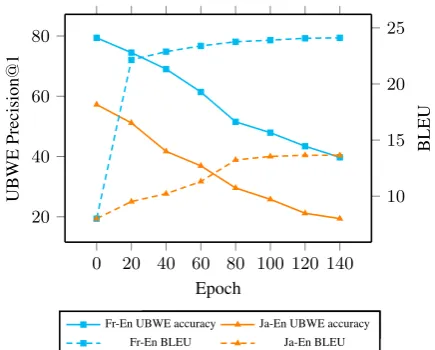
Figure 2 shows the trend in UBWE accuracy and BLEU score as UNMT proceeds through the training stage. VecMap was used to pre-train the word embedding for the encoder and decoder of UNMT. We used source embedding of encoder and target embedding of decoder to calculate the word translation accuracy on the MUSE test set during UNMT training.
0 20 40 60 80 100 120 140 20
40 60 80
Epoch
UBWE
Precision
@
1
Fr enc-En dec Ja enc-En dec 10 15 20 25
BLEU
Fr-En UBWE accuracy Ja-En UBWE accuracy Fr-En BLEU Ja-En BLEU
Figure 2: UBWE accuracy and BLEU score over the course of UNMT training.
2https://github.com/facebookresearch/
MUSE
Regardless of the language, the UBWE performance decreased significantly over the course of UNMT training, as shown in Figure2.
3.3 Analysis
The empirical results in this section show that the quality of pre-trained UBWE is important to UNMT. However, the quality of UBWE decreases significantly during UNMT training. We hypothesize that maintaining the quality of UBWE may enhance the performance of UNMT. In this subsection, we analyze some possible solutions to this issue.
Use fixed embedding? As Figure 2 shows,
the UBWE performance decreases significantly during the UNMT training process. Therefore, we try to fix the embedding of the encoder and decoder on the basis of the original baseline system (Baseline-fix). Table 1 shows that the performance of the Baseline-fix system is quite similar to that of the original baseline system. In other words, Baseline-fix prevents the degradation of UBWE accuracy; however, the fixed embedding also prevents UBWE from further improving UNMT training. Therefore, the fixed UBWE does not enhance the performance of UNMT.
Methods Fr-En En-Fr Ja-En En-Ja Baseline 24.50 25.37 14.09 21.63 Baseline-fix 24.22 25.26 13.88 21.93
Table 1: Results of UNMT
Use byte pair encoding (BPE) to increase
shared subwords? For English-French and
[image:3.595.72.290.524.699.2]C noise X X Y Y C(X)
YP(X)
C(Y)
XP(Y)
X Y Y X 𝓛𝒂𝒖𝒕𝒐 L1encoder L1decoder L1encoder L2decoder L2decoder L2encoder L2encoder L1decoder 𝓛 𝒃𝒕 𝓛𝒃𝒕 𝓛𝒂𝒖𝒕𝒐 EMB layer EMB layer EMB layer EMB layer 𝓛𝒂𝒈𝒓𝒆𝒆𝒎𝒆𝒏𝒕 𝓛𝒂𝒈𝒓𝒆𝒆𝒎𝒆𝒏𝒕
(y1, x1)
(y2, x2) ……
(y|Dict|, x|Dict|)
(x1,y1)
(x2,y2) ……
(x|Dict|,y|Dict|)
M Previous model M Previous model C noise (a) C noise C noise X X Y Y C(X)
YP(X)
C(Y)
XP(Y)
X Y Y X ency encx
W2ency decx
W1encx decy
𝓛𝒂𝒖𝒕𝒐
G2 D2
G1 D1
L1encoder L1decoder L1encoder L2decoder L2decoder L2encoder L2encoder L1decoder 𝓛 𝒃𝒕 𝓛𝒃𝒕 𝓛𝒂𝒖𝒕𝒐 𝓛𝒂𝒅𝒗𝟐 𝓛𝒂𝒅𝒗𝟏 EMB layer EMB layer EMB layer EMB layer M Previous model M Previous model (b)
Figure 3: (a) Architecture of UNMT with UBWE Agreement Regularization; (b) Architecture of UNMT with UBWE Adversarial Training.
4 Train UNMT with UBWE Agreement
Based on previous empirical findings and analyses, we propose two joint agreement mechanisms, i.e., UBWE agreement regularization and UBWE adversarial training, that enable UBWE and UNMT to interact during the training process, resulting in improved translation performance. Figure 3 illustrates the architecture of UNMT and the proposed agreement mechanisms.
Generally, during UNMT training, an objective function LBW E is added to ensure UBWE
agreement. The general UNMT objective function can be reformulated as follows:
Lall =Lauto+Lbt+λLBW E. (4)
4.1 UBWE Agreement Regularization
On the basis of the existing architecture of UNMT, we induce UBWE agreement regularization during back-translation to maintain the UBWE accuracy in the encoder and the decoder during UNMT training. The similarity function Similarity(L1, L2) of the encoder and decoder
embeddings is used to measure the UBWE accuracy and the objective functionLBW E is
LBW E ,Lagreement
=Similarity(L1, L2)
=Similarity(encL1, decL2)
+Similarity(encL2, decL1) (5)
where encL1 and encL2 denote all word embeddings of encodersL1 andL2, respectively,
decL1 and decL2 denote all word embeddings of decodersL1andL2, respectively.
As there is no test or development data set that can be employed as a bilingual dictionary in UNMT, before computing Similarity(L1, L2), we
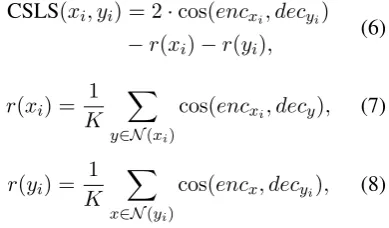
need to generate a synthetic word-pair dictionary to measure the UBWE accuracy during NMT training. Motivated by Conneau et al. (2018), we use the cross-domain similarity local scaling (CSLS) to measure the UBWE accuracy. This can also be viewed as the similarity between the source word embedding and the target word embedding.
CSLS(xi, yi) = 2·cos(encxi, decyi)
−r(xi)−r(yi),
(6)
r(xi) = 1
K
X
y∈N(xi)
cos(encxi, decy), (7)
r(yi) = 1
K
X
x∈N(yi)
cos(encx, decyi), (8)
where y ∈ N(xi) denotes the K nearest
neighborhood of the source wordxi, and similarly
forx ∈ N(yi). encxi denotes the embedding of
wordxiin encoderL1anddecyidenotes the word
embedding ofyi in decoderL2.
As the size of the entire vocabulary is large, we select a subset as the synthetic word-pair dictionary. By ranking the CSLS, we can select the most accurate word pairs{xi, yi}as the synthetic
dictionary Dictx−>y. The opposite word pairs
[image:4.595.82.519.73.257.2] [image:4.595.332.527.500.614.2]same method. encyj denotes the embedding of
word yj by encoder L2 and decxj denotes the
embedding of word xj by decoder L1. Both
dictionary sizes are set to|Dict|. Therefore, the similarity between the word embeddings in the encoder and decoder is measured as
Similarity(encL1, decL2)
≈ 1
|Dict| |Dict|
X
i
(1−cos(encxi, decyi)).
(9)
Similarity(encL2, decL1)
≈ 1
|Dict| |Dict|
X
j
(1−cos(encyj, decxj)).
(10)
The above similarity between word pairs in
Dictis used for UBWE agreement regularization during back-translation. Note that the synthetic word-pair dictionary is dynamically selected in each epoch of UNMT training.
4.2 UBWE Adversarial Training
In UBWE, there is a transformation matrix to project the source word embedding to the target word embedding. Motivated by Conneau et al.
(2018), we induce a transformation matrix using an adversarial approach . The generator is estimated as:
G1 =W1encx, (11)
where encx is the L1 the encoder word
embedding,decy is the correspondingL2 decoder
word embedding, and W1 is the transformation
matrix that project the embedding space of encx
onto that ofdecy. The discriminatorD1is a
multi-layer perceptron representing the probability that the word embedding comes from this language. It is trained to discriminate the language to which the word embedding between W1encx
and decy belongs. W1 is trained to confuse
the discriminator D1 by making W1encx and
decy increasingly similar. In other words, we
trainD1 to maximize the probability of choosing
the accurate language between the original word embedding and samples fromG1. The generator
G1is trained to minimizelog(1−D1(G1(encx))).
Thus, the two-player minimax game (Goodfellow et al., 2014) with value function V(G1, D1) is
optimized as:
min G1
max D1
V(D1, G1) =Edecy[logD1(decy)]
+Eencx[log(1−D1(G1(encx)))].
(12)
D2 and G2 are similar to D1 and G1. The
objective functions for the discriminator D1 and
generatorG1can be written as:
LD1 =Eencx[−log(1−D1(G1))]
+Edecy[−log(D1(decy)],
(13)
LG1 =Eencx[−log(D1(G1))]
+Edecy[−log(1−D1(decy)].
(14)
LD2 andLG2 are similar toLD1 andLG1. After inducing UBWE adversarial training into UNMT, theLBW E objective function is minimized as
LBW E ,Ladv =Ladv1+Ladv2, (15)
whereLadv1 = LG1 +LD1 andLadv2 = LG2 +
LD2. The proposedLBW E(LagreementorLadv) is
added to theLall in Eq. 4during back-translation
of UNMT training as shown in Figure3.
5 Experiments
5.1 Datasets
The proposed methods were evaluated on three language pairs: French-English (Fr-En), German-English (De-En), and Japanese-German-English (Ja-En). Fr-En and De-En are similar European language pairs. We used 30 million sentences from the WMT monolingual News Crawl datasets from 2007 to 2013. Ja-En is a distant languages pair and so UBWE training is much more difficult than for similar European language pairs (Søgaard
et al., 2018). In addition, Japanese and English
are different language families and their word orderings are quite different. As a result, the performance of Ja-En UNMT is too poor to further empirical study if only pure monolingual data are used. Therefore, we constructed simulated experiments using shuffled parallel sentences, i.e., 3.0M sentence pairs from the ASPEC corpus for Ja-En. We reported the results on WMT newstest2014 for Fr-En, WMT newstest2016 for De-En, and WAT-2018 ASPEC testset for Ja-En.
5.2 UBWE Settings
0 20 40 60 80 100 120 140 40
60 80
Epoch
UBWE
Precision
@
1
Base-Fr enc-En dec AR-Fr enc-En dec AT-Fr enc-En dec
22 24 26
BLEU
Base-Fr-En UBWE accuracy AR-Fr-En UBWE accuracy AT-Fr-En UBWE accuracy Base-Fr-En BLEU
AR-Fr-En BLEU AT-Fr-En BLEU
(a) Fr-En
0 20 40 60 80 100 120 140 20
40 60
Epoch
UBWE
Precision
@
1
Base-Ja enc-En dec AR-Ja enc-En dec AT-Ja enc-En dec
10 15
BLEU
Base-Ja-En UBWE accuracy AR-Ja-En UBWE accuracy AT-Ja-En UBWE accuracy Base-Ja-En BLEU
AR-Ja-En BLEU AT-Ja-En BLEU
(b) Ja-En
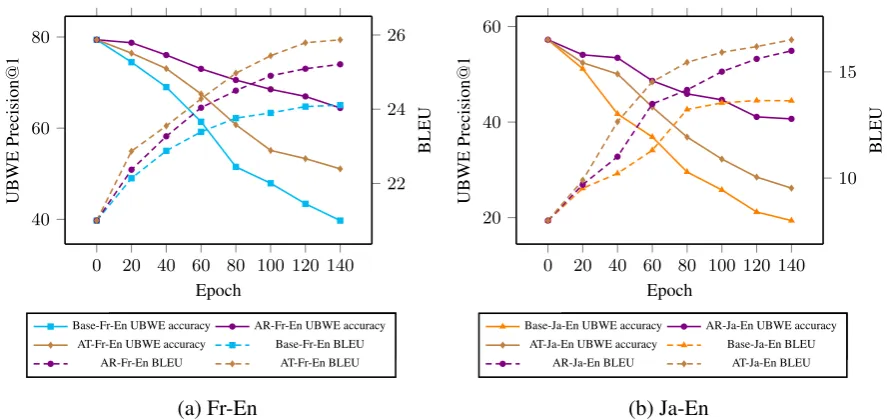
Figure 4: The trends of UBWE quality and BLEU score for baseline (Base), UBWE agreement regularization (AR), and UBWE adversarial training (AT) during UNMT training on the Fr-En and Ja-En dataset
Methods De-En En-De Fr-En En-Fr Ja-En En-Ja
Artetxe et al.(2018c) n/a n/a 15.56 15.13 n/a n/a Lample et al.(2018a) 13.33 9.64 14.31 15.05 n/a n/a Yang et al.(2018) 14.62 10.86 15.58 16.97 n/a n/a Lample et al.(2018b) 21.0 17.2 24.2 25.1 n/a n/a
UNMT Baseline 21.23 17.06 24.50 25.37 14.09 21.63
[image:6.595.77.521.65.275.2]+ UBWE agreement regularization 22.38++ 18.04++ 25.21++ 27.86++ 16.36++ 23.01++ + UBWE adversarial training 22.67++ 18.29++ 25.87++ 28.38++ 17.22++ 23.64++
Table 2: Performance (BLEU score) of UNMT. “++” after a score indicates that the proposed method was significantly better than the UNMT baseline at significance levelp <0.01.
the embeddings for each language independently with fastText3(Bojanowski et al., 2017) (default settings). The word embeddings were normalized by length and mean centered before bilingual projection. We then used VecMap4(Artetxe
et al., 2018a) (default settings) to project two
monolingual word embeddings into one space. To evaluate the quality of UBWE, we selected the accuracy of word translation using the top-1 predicted candidate in the MUSE test set as the criterion.
5.3 UNMT Settings
In the training process for UNMT, we used the transformer-based UNMT toolkit5and the settings
of Lample et al.(2018b). That is, we used four
3
https://github.com/facebookresearch/ fastText
4
https://github.com/artetxem/vecmap
5https://github.com/facebookresearch/
UnsupervisedMT
layers in both the encoder and the decoder. Three out of the four encoder and decoder layers were shared between the source and target languages. The dimension of the hidden layers was set to 512. Training used a batch-size of 32 and the Adam optimizer (Kingma and Ba,2015) with an initial learning rate of 0.0001,β1= 0.5. The vocabulary
size was set to 60k by concatenating the source and target corpora. We performed 140 epochs6 (approximately 500K iterations) to train every model. The case-sensitive BLEU score computed with the multi −bleu.perl script from Moses7 was used as the evaluation metric. For model selection, we followed the strategy described by
Lample et al.(2018a). That is, the BLEU score
computed between the original source sentences
6The definition of epoch in UNMT is different from that in NMT. We followed the settings inLample et al.(2018b)’s toolkit, i.e., 3500 iterations as one epoch.
7https://github.com/moses-smt/
and their reconstructions was used as the criterion. We selected the model that had the highest average BLEU score over the two translation directions.
For the proposed methods, both UBWE agreement regularization and UBWE adversarial training were added as objective functions at the beginning of UNMT training. The detailed parameter settings are discussed in Section6.
5.4 Performance
Figure 4 shows the trend in UBWE quality and BLEU score during UNMT training on Fr-En and Ja-En. Our observations are as follows:
1) For all systems, the UBWE accuracy decreases during UNMT training. This is consistent with our finding in the preliminary experiments.
2) For the system with UBWE agreement regularization and UBWE adversarial training, UBWE accuracy decreased much more slowly than in the original baseline system. This indicates that the proposed methods effectively mitigated the degradation of UBWE accuracy.
3) Regarding the two proposed methods, UBWE agreement regularization was better at mitigating the degradation of UBWE accuracy than UBWE adversarial training.
Table 2 presents the detailed BLEU scores of the UNMT systems on the De-En, Fr-En, and Ja-En test sets. Our observations are as follows:
1) Our re-implemented baseline performed similarly with the state-of-the-art method of
Lample et al. (2018b). This indicates that the
baseline is a strong system.
2) The proposed methods significantly outperformed the corresponding baseline in all the language pairs by 1∼3 BLEU scores.
3) Regarding the two proposed methods, UBWE adversarial training performed slightly better than UBWE agreement regularization by BLEU score, although UBWE agreement regularization was better at maintaining UBWE accuracy. The reason may be that agreement regularization is just added to the training objective of UNMT. In comparison, UBWE adversarial training is jointly trained with UNMT, thus has more interaction with UNMT model.
6 Discussion
We now analyze the effect of the hyper-parameters. There are two primary factors
that affect the performances of the proposed methods: the synthetic word-pair dictionary size for UBWE agreement regularization and λ for UBWE adversarial training.
6.1 Effect of Dictionary Size
We first evaluated the impact of the synthetic word-pair dictionary size |Dict| during UBWE agreement regularization training on the Fr-En task. As indicated by Table3, almost all models with different dictionary sizes outperformed the baseline system. This indicates that the proposed method is robust.
Dict Size Fr-En En-Fr BLEU BLEU Baseline 24.50 25.37 20K 25.15 27.18 10K 25.10 27.48
5K 25.14 27.58
3K 25.21 27.86
1K 25.25 27.40
[image:7.595.357.479.271.385.2]500 25.13 27.07
Table 3: Effect on Dictionary Size
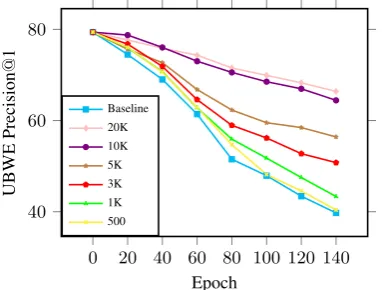
We also investigated the relationship between dictionary size and UBWE accuracy. As shown in Fig. 5, a larger dictionary size results in a slower decrease in UBWE accuracy. This indicates that a larger dictionary size helps estimate a better UBWE agreement. However, larger dictionary size did not always obtain a higher BLEU as shown in Table 3. The model with a dictionary size of 3000 achieved the best performance.
0 20 40 60 80 100 120 140 40
60 80
Epoch
UBWE
Precision
@
1
[image:7.595.323.515.570.715.2]Baseline 20K 10K 5K 3K 1K 500
0.01 0.1 0.3 0.5 0.8 1 5 10 100 24
26 28
λvalue
BLEU
score
[image:8.595.88.277.61.208.2]Base-En-Fr Base-Fr-En AT-En-Fr AT-Fr-En
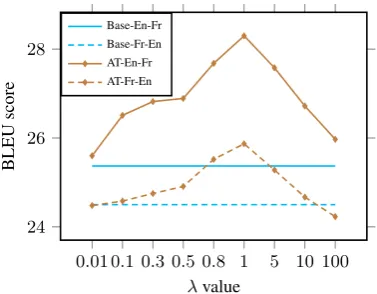
Figure 6: Effect of Hyper-parameter λ for UBWE adversarial training (AT) model on the En↔Fr dataset.
6.2 Effect of Hyper-parameterλ
In Figure6, we empirically investigated how the hyper-parameterλ in Eq. (4) affects the UNMT performance on the Fr-En task. The selection ofλ
influences the role of theLBW E across the entire UNMT training process. Larger values ofλcause theLBW E to play a more important role than the
back-translation and denoising loss terms. The smaller the value ofλ, the less important are the LBW E. As the Fig.6shows,λranging from 0.01
to 10 nearly all enhanced UNMT performance and a balancedλ= 1achieved the best performance.
6.3 Efficiency
We now discuss the efficiency of our proposed methods. Table4indicates that UBWE agreement regularization does not increase the number of parameters. UBWE adversarial training adds very few parameters. The training speed of these methods is almost the same. In addition, the proposed methods do not affect the UNMT decoding. Thus, our proposed methods do not affect the speed of the model.
Parameters Speed
Baseline 120,141K 3784
UBWE agreement regularization 120,141K 3741 UBWE adversarial training 120,764K 3733
Table 4: Analysis on parameters and training speed (number of processed words per second on one P100).
7 Related Work
The supervised BWE (Mikolov et al., 2013), which exploits similarities between the source language and the target language through a linear transformation matrix, serves as the basis for many
NLP tasks, such as machine translation (Bahdanau et al., 2015; Vaswani et al., 2017; Chen et al.,
2018b; Zhang and Zhao, 2019), dependency
parsing (Zhang et al., 2016; Li et al., 2018), semantic role labeling (He et al., 2018; Li et al.,
2019). However, the lack of a large word-pair dictionary poses a major practical problem for many language pairs. UBWE has attracted considerable attention. For example, Artetxe et al.(2017) proposed a self-learning framework to learn BWE with a 25-word dictionary, andArtetxe
et al. (2018a) extended previous work without
any word dictionary via fully unsupervised initialization. Zhang et al. (2017) and Conneau
et al. (2018) proposed UBWE methods via
generative adversarial network training.
Recently, several UBWE methods (Conneau
et al., 2018; Artetxe et al., 2018a) have been
applied to UNMT (Artetxe et al.,2018c;Lample
et al., 2018a). These rely solely on monolingual
corpora in each language via UBWE initialization, denoising auto-encoder, and back-translation. A shared encoder was used to encode the source sentences and decode them from a shared latent space (Artetxe et al.,2018c;Lample et al.,2018a). The difference is thatLample et al.(2018a) used a single shared decoder and Artetxe et al.(2018c) leveraged two independent decoders for each language.Yang et al.(2018) used two independent encoders for each language with a weight-sharing mechanism to overcome the weakness of retaining the uniqueness and internal characteristics of each language. Lample et al. (2018b) achieved remarkable results in several similar languages such as English-French by concatenating two bilingual corpora as one monolingual corpus and using monolingual embedding pre-training in the initialization step. This initialization achieves better performance than other UBWE methods. However, it does not work in some distant language pairs such as English-Japanese. This is why we did not use this initialization process for UBWE in our method.
In addition, an alternative unsupervised method based on statistical machine translation (SMT) was proposed (Lample et al.,2018b;Artetxe et al.,
2018b). The unsupervised machine translation
performance was improved through combining UNMT and unsupervised SMT (Marie and Fujita,
better UNMT performance through introducing the pretrained language model. Neural network based language model has been shown helpful in supervised machine translation (Wang et al.,2014;
Wang et al., 2018;Marie et al., 2018). We think
that the proposed agreement mechanism can work with the pretrained language model.
8 Conclusion
UBWE is a fundamental component of UNMT. In previous methods, the pre-trained UBWE is only used to initialize the word embedding of UNMT. In this study, we found that the performance of UNMT is significantly affected by the quality of UBWE, not only in the initialization stage, but also during UNMT training. Based on this finding, we proposed two joint learning methods to train UNMT with UBWE agreement. Empirical results on several language pairs show that the proposed methods can mitigate the decrease in UBWE accuracy and significantly improve the performance of UNMT.
Acknowledgments
The corresponding authors are Rui Wang and Tiejun Zhao. This work was partially conducted under the program “Promotion of Global Communications Plan: Research, Development, and Social Demonstration of Multilingual Speech Translation Technology” of the Ministry of Internal Affairs and Communications (MIC), Japan. Rui Wang was partially supported by JSPS grant-in-aid for early-career scientists (19K20354): “Unsupervised Neural Machine Translation in Universal Scenarios” and NICT tenure-track researcher startup fund “Toward Intelligent Machine Translation”.
References
Mikel Artetxe, Gorka Labaka, and Eneko Agirre. 2016. Learning principled bilingual mappings of word embeddings while preserving monolingual invariance. InProceedings of the 2016 Conference
on Empirical Methods in Natural Language
Processing, pages 2289–2294, Austin, Texas. Mikel Artetxe, Gorka Labaka, and Eneko Agirre. 2017.
Learning bilingual word embeddings with (almost) no bilingual data. InProceedings of the 55th Annual Meeting of the Association for Computational Linguistics (Volume 1: Long Papers), pages 451– 462, Vancouver, Canada.
Mikel Artetxe, Gorka Labaka, and Eneko Agirre. 2018a. A robust self-learning method for fully unsupervised cross-lingual mappings of word embeddings. In Proceedings of the 56th Annual Meeting of the Association for Computational Linguistics (Volume 1: Long Papers), pages 789– 798, Melbourne, Australia.
Mikel Artetxe, Gorka Labaka, and Eneko Agirre. 2018b. Unsupervised statistical machine translation. InProceedings of the 2018 Conference
on Empirical Methods in Natural Language
Processing, pages 3632–3642, Brussels, Belgium. Mikel Artetxe, Gorka Labaka, and Eneko Agirre. 2019.
An effective approach to unsupervised machine translation.CoRR, abs/1902.01313.
Mikel Artetxe, Gorka Labaka, Eneko Agirre, and Kyunghyun Cho. 2018c. Unsupervised neural machine translation. In Proceedings of the Sixth International Conference on Learning Representations, Vancouver, Canada.
Dzmitry Bahdanau, Kyunghyun Cho, and Yoshua Bengio. 2015. Neural machine translation by jointly learning to align and translate. In Proceedings of the 3rd International Conference on Learning Representations, San Diego, CA.
Piotr Bojanowski, Edouard Grave, Armand Joulin, and Tomas Mikolov. 2017. Enriching word vectors with subword information. Transactions of the Association for Computational Linguistics, 5:135– 146.
Hailong Cao, Tiejun Zhao, Shu Zhang, and Yao Meng. 2016. A distribution-based model to learn bilingual word embeddings. In Proceedings of COLING 2016, the 26th International Conference on Computational Linguistics: Technical Papers, pages 1818–1827, Osaka, Japan.
Kehai Chen, Rui Wang, Masao Utiyama, Lemao Liu, Akihiro Tamura, Eiichiro Sumita, and Tiejun Zhao. 2017a. Neural machine translation with source dependency representation. InProceedings of the 2017 Conference on Empirical Methods in Natural Language Processing, pages 2846–2852, Copenhagen, Denmark.
Kehai Chen, Rui Wang, Masao Utiyama, Eiichiro Sumita, and Tiejun Zhao. 2018a. Syntax-directed attention for neural machine translation. In AAAI Conference on Artificial Intelligence, pages 4792– 4798, New Orleans, Lousiana, USA.
Kehai Chen, Tiejun Zhao, Muyun Yang, and Lemao Liu. 2017b. Translation prediction with source dependency-based context representation. InAAAI Conference on Artificial Intelligence, pages 3166– 3172, San Francisco, California, USA.
dependence based context model for statistical machine translation. IEEE/ACM Transactions on Audio, Speech, and Language Processing, 26(2):266–280.
Alexis Conneau, Guillaume Lample, Marc’Aurelio Ranzato, Ludovic Denoyer, and Herv´e J´egou. 2018. Word translation without parallel data. In
Proceedings of the Sixth International Conference on Learning Representations, Vancouver, Canada. Georgiana Dinu, Angeliki Lazaridou, and Marco
Baroni. 2015. Improving zero-shot learning by mitigating the hubness problem. In Proceedings of the Third International Conference on Learning Representations, San Diego, California.
Manaal Faruqui and Chris Dyer. 2014. Improving vector space word representations using multilingual correlation. InProceedings of the 14th Conference of the European Chapter of the Association for Computational Linguistics, pages 462–471, Gothenburg, Sweden.
Ian J. Goodfellow, Jean Pouget-Abadie, Mehdi Mirza, Bing Xu, David Warde-Farley, Sherjil Ozair, Aaron C. Courville, and Yoshua Bengio. 2014. Generative adversarial nets. InAdvances in Neural Information Processing Systems, pages 2672–2680, Montreal, Quebec, Canada.
Di He, Yingce Xia, Tao Qin, Liwei Wang, Nenghai Yu, Tie-Yan Liu, and Wei-Ying Ma. 2016. Dual learning for machine translation. In Advances in Neural Information Processing Systems 29: Annual Conference on Neural Information Processing Systems 2016, pages 820–828, Barcelona, Spain. Shexia He, Zuchao Li, Hai Zhao, and Hongxiao Bai.
2018. Syntax for semantic role labeling, to be, or not to be. In Proceedings of the 56th Annual Meeting of the Association for Computational Linguistics (Volume 1: Long Papers), pages 2061–2071, Melbourne, Australia.
Felix Hill, Kyunghyun Cho, and Anna Korhonen. 2016. Learning distributed representations of sentences from unlabelled data. In NAACL HLT 2016, The 2016 Conference of the North American Chapter of the Association for Computational Linguistics: Human Language Technologies, pages 1367–1377, San Diego California, USA.
Diederik P Kingma and Jimmy Ba. 2015. Adam: A method for stochastic optimization. InProceedings of the Third International Conference on Learning Representations, San Diego, California.
Guillaume Lample and Alexis Conneau. 2019. Cross-lingual language model pretraining. CoRR, abs/1901.07291.
Guillaume Lample, Alexis Conneau, Ludovic Denoyer, and Marc’Aurelio Ranzato. 2018a. Unsupervised machine translation using monolingual corpora only. In Proceedings of the Sixth International
Conference on Learning Representations,
Vancouver, Canada.
Guillaume Lample, Myle Ott, Alexis Conneau, Ludovic Denoyer, and Marc’Aurelio Ranzato. 2018b. Phrase-based & neural unsupervised machine translation. In Proceedings of the 2018 Conference on Empirical Methods in Natural Language Processing, pages 5039–5049, Brussels, Belgium.
Zuchao Li, Jiaxun Cai, Shexia He, and Hai Zhao. 2018. Seq2seq dependency parsing. In Proceedings of the 27th International Conference on Computational Linguistics, pages 3203–3214, Santa Fe, New Mexico, USA.
Zuchao Li, Shexia He, Hai Zhao, Yiqing Zhang, Zhuosheng Zhang, Xi Zhou, and Xiang Zhou. 2019. Dependency or span, end-to-end uniform semantic role labeling. CoRR, abs/1901.05280.
Ang Lu, Weiran Wang, Mohit Bansal, Kevin Gimpel, and Karen Livescu. 2015. Deep multilingual correlation for improved word embeddings. In
Proceedings of the 2015 Conference of the North American Chapter of the Association for Computational Linguistics: Human Language Technologies, pages 250–256, Denver, Colorado. Benjamin Marie and Atsushi Fujita. 2018.
Unsupervised neural machine translation initialized by unsupervised statistical machine translation.
CoRR, abs/1810.12703.
Benjamin Marie, Rui Wang, Atsushi Fujita, Masao Utiyama, and Eiichiro Sumita. 2018. Nict’s neural and statistical machine translation systems for the wmt18 news translation task. InProceedings of the Third Conference on Machine Translation, Volume 2: Shared Task Papers, pages 453–459, Belgium, Brussels.
Tomas Mikolov, Quoc V. Le, and Ilya Sutskever. 2013. Exploiting similarities among languages for machine translation.CoRR, abs/1309.4168. Shuo Ren, Zhirui Zhang, Shujie Liu, Ming Zhou, and
Shuai Ma. 2019. Unsupervised neural machine translation with SMT as posterior regularization.
CoRR, abs/1901.04112.
Rico Sennrich, Barry Haddow, and Alexandra Birch. 2016. Improving neural machine translation models with monolingual data. In Proceedings of the 54th Annual Meeting of the Association for Computational Linguistics (Volume 1: Long Papers), Berlin, Germany.
Anders Søgaard, Sebastian Ruder, and Ivan Vuli´c. 2018. On the limitations of unsupervised bilingual dictionary induction. In Proceedings of the 56th Annual Meeting of the Association for Computational Linguistics (Volume 1: Long Papers), pages 778–788, Melbourne, Australia. Ashish Vaswani, Noam Shazeer, Niki Parmar, Jakob
Uszkoreit, Llion Jones, Aidan N Gomez, Ł ukasz Kaiser, and Illia Polosukhin. 2017. Attention is all you need. In Advances in Neural Information Processing Systems 30, pages 5998–6008.
Pascal Vincent, Hugo Larochelle, Isabelle Lajoie, Yoshua Bengio, and Pierre-Antoine Manzagol. 2010. Stacked denoising autoencoders: Learning useful representations in a deep network with a local denoising criterion. Journal of Machine Learning Research, 11:3371–3408.
Rui Wang, Masao Utiyama, Andrew Finch, Lemao Liu, Kehai Chen, and Eiichiro Sumita. 2018. Sentence selection and weighting for neural machine translation domain adaptation. IEEE/ACM Transactions on Audio, Speech, and Language Processing, 26(10):1727–1741.
Rui Wang, Hai Zhao, Bao-Liang Lu, Masao Utiyama, and Eiichiro Sumita. 2014. Neural network based bilingual language model growing for statistical machine translation. In Proceedings of the 2014 Conference on Empirical Methods in Natural Language Processing (EMNLP), pages 189–195, Doha, Qatar.
Rui Wang, Hai Zhao, Sabine Ploux, Bao-Liang Lu, and Masao Utiyama. 2016. A bilingual graph-based semantic model for statistical machine translation. In Proceedings of the Twenty-Fifth International Joint Conference on Artificial Intelligence, pages 2950–2956, New York, USA.
Rui Wang, Hai Zhao, Sabine Ploux, Bao-Liang Lu, Masao Utiyama, and Eiichiro Sumita. 2018. Graph-based bilingual word embedding for statistical machine translation. ACM Trans. Asian & Low-Resource Lang. Inf. Process., 17(4):31:1–31:23. Chao Xing, Dong Wang, Chao Liu, and Yiye
Lin. 2015. Normalized word embedding and orthogonal transform for bilingual word translation. In Proceedings of the 2015 Conference of the North American Chapter of the Association for Computational Linguistics: Human Language Technologies, pages 1006–1011, Denver, Colorado. Zhen Yang, Wei Chen, Feng Wang, and Bo Xu.
2018.Unsupervised neural machine translation with weight sharing. InProceedings of the 56th Annual Meeting of the Association for Computational Linguistics (Volume 1: Long Papers), pages 46–55, Melbourne, Australia.
Huan Zhang and Hai Zhao. 2019. Minimum divergence vs. maximum margin: An empirical
comparison on seq2seq models. In Proceedings of the Seventh International Conference on Learning Representations, New Orleans, USA.
Meng Zhang, Yang Liu, Huanbo Luan, and Maosong Sun. 2017. Adversarial training for unsupervised bilingual lexicon induction. In Proceedings of the 55th Annual Meeting of the Association for Computational Linguistics (Volume 1: Long Papers), Vancouver, Canada.