Munich Personal RePEc Archive
Educational Quality Thresholds in the
Diffusion of Knowledge with Mobile
Phones for Inclusive Human
Development in Sub-Saharan Africa
Asongu, Simplice and Nwachukwu, Jacinta
January 2017
Online at
https://mpra.ub.uni-muenchen.de/85484/
1
A G D I Working Paper
WP/17/057
Educational Quality Thresholds in the Diffusion of Knowledge with Mobile
Phones for Inclusive Human Development in Sub-Saharan Africa
Forthcoming: Technological Forecasting and Social Change
Simplice A. Asongu
African Governance and Development Institute, P.O. Box 8413, Yaoundé, Cameroon.
E-mail: [email protected]/[email protected]
Jacinta C. Nwachukwu
School of Economics, Finance and Accounting,
Faculty of Business and Law, Coventry University Priory Street, Coventry, CV1 5FB, UK
2
2017 African Governance and Development Institute WP/17/057
Research Department
Educational Quality Thresholds in the Diffusion of Knowledge with Mobile Phones for Inclusive Human Development in Sub-Saharan Africa
Simplice A. Asongu & Jacinta C. Nwachukwu
January 2017
Abstract
The study investigates critical masses or thresholds of educational quality at which the
diffusion of information with mobile phones enhances inclusive human development. The
empirical evidence is based on simultaneity-robust Fixed Effects regressions with data from
49 Sub-Saharan African countries for the period 2000-2012. The following findings are
established: (1) There are positive marginal and net effects on inclusive development from the
interaction between mobile phones and educational quality, (2) Between 10 and 27 pupils per
teacher is needed in primary education in order for mobile phones to enhance inclusive
human development, (3) From a comparative dimension: (i) English Common law countries
enjoy higher net effects compared to their French Civil law counterparts, (ii) positive net
effects are more obvious in politically stable (vis-à-vis politically unstable) countries, (iii)
positive net impacts are also more apparent in resource-poor (vis-à-vis resource-rich)
countries, (iv) low income (vis-à-vis higher income) countries have a higher net effect on
inclusive development, (v) landlocked (vis-à-vis unlandlocked) countries experience higher
net effects and (iv) Islam-dominated countries have a slightly higher net impact compared to
their Christian-oriented counterparts.
JEL Classification: G20; I10; I32; O40; O55
3 1. Introduction
This study investigates thresholds of educational quality at which the diffusion of
information with mobile phones improves inclusive human development in Sub-Saharan
Africa (SSA). The academic and policy relevance of the inquiry are at least threefold, notably:
(i) increasing levels of extreme poverty in the sub-region, (ii) the high potential for mobile
phone penetration in Africa vis-à-vis other world regions and (iii) the growing relevance of a
knowledge economy in 21st century development.
First, extreme poverty levels are staggering in SSA because as a recent World Bank
report on the attainment of Millennium Development Goals (MDGs) has shown, extreme
poverty has been decreasing in all regions of the world with the exception of SSA where
about 45 percent of countries in the sub-region have been experiencing increasing extreme
poverty levels (World Bank, 2015; Asongu & Kodila-Tedika, 2017)1.
Second, compared to other regions of the world, there is a great potential for mobile
phone penetration in Africa2. According to Penard et al. (2012) and Asongu (2017a), whereas
some emerging countries (e.g. in Latin America and Asia) and developed countries are
experiencing stabilization in the penetration of information and communication technology
(ICT), there is still a healthy room for leveraging mobile phones for development purposes in
Africa. ICT has been established to contribute to inclusive and sustainable development
(Alkemade & Surrs, 2012).
Third, educational quality has been documented to be valuable at enhancing inclusive
development in developing countries (Dakhi & de Clereq, 2007; Dunlap-Hinkler et al., 2010).
Beside the relevance of an excellent educational system in the post-2015 sustainable
development agenda is centred on the ‘knowledge economy’-driven policies. According to
Tchamyou (2016), a knowledge economy is indispensable in addressing contemporary
development challenges3.
1
According to Ravallion et al. (2008), extreme poverty which was originally defined by the United Nations in 1995 is an economic condition that is characterized by substantial deprivation in basic human needs, notably: health, education, shelter, safe drinkable water, food and information. While in 2008 the international poverty line was 1.25US$ per day (in 2005 prices), up from 1.00 US$ per day in 1996; in 2017 it is 1.90US$ per day. The number of people living in extreme poverty has been increasing in Sub-Saharan Africa, probably because the benefits of over two decades of economic growth resurgence have not been distributed equitably across the population.
2 The terms, ‘mobile phone penetration’, ‘mobile telephony’, ‘mobile’ and ‘mobile phones’ are used
interchangeably throughout this paper. It is important to note that “mobile phone” and “mobile telephony”
respectively relate to hardware and service provision.
3
4 This investigation incorporates the three strands above by using educational quality as
a policy variable in the role of mobile phones for inclusive development. In theory, the above
justifications are connected with the present inquiry because the educational quality and the
growth potential of the mobile phone can be successfully harnessed to tackle the policy
syndrome of non-inclusive development in SSA. Furthermore, there have been increasing
requests for more research on the development outcomes of mobile phones, partly because
caution has been expressed in scholarly circles for the mobile phone not to be considered as a
silver bullet for development (Mpogole et al., 2008, p. 71).
The positioning of this paper contributes to the extant literature on the importance of
mobile phones in inclusive human development. Most specifically, (i) empowerment of the
female gender (Maurer, 2008; Ojo et al., 2012); (ii) improvement of health services for the
underprivileged (Kliner et al., 2013); (iii) enhancement of financial inclusion (Singh, 2012;
Kirui et al., 2013); (iv) reduction of the rural-urban poverty gap (Qiang et al., 2011; Chan &
Jia, 2011); (v) elimination of demand-supply divergences, (vi) wastes in agriculture and
demand-/supply-side constraints (Muto & Yamano, 2009; Aker & Fafchamps, 2010); (vii)
social change and development (Gupta & Jain, 2014, 2015; Amankwah-Amoah, 2015, 2016;
Amankwah-Amoah & Sarpong, 2016; Afutu-Kotey et al., 2017); (viii) inequality adjusted
human development (Asongu & Le Roux, 2017); (ix) household management efficiency (Al
Surikhi, 2012) and (x) consolidation of opportunities in business (Ondiege, 2010; Mishra &
Bisht, 2013; Asongu, 2015). Accordingly, in addition to facilitating the doing of business
(Lee et al., 2010; Jin & von Zedtwitz, 2008; Kuoa & Yub, 2006; Kumar & Zahn, 2003), the
revolution in mobile phone usage has led to substantial positive externalities in inclusive
human development.
This study extends the aforementioned stream of literature by investigating policy
thresholds at which educational quality can complement mobile phones in order to promote
inclusive human development in SSA. In other words, we seek to investigate the role of
educational quality in modulating the effect of mobile phones on inclusive human
development. Educational quality which is measured in terms of the number of pupils per
qualified teacher in primary schools is an input variable. The notion of threshold represents
the minimum requirements in educational excellence needed to achieve inclusive human
development with mobile phones. In order to enhance the opportunity for policy implications,
the analysis is further decomposed into fundamental characteristics of human development
5 origins (English common law vs. and French civil law); religious domination
(Christian-oriented vs. Islam-dominated); openness to sea (landlocked vs. coastal); mineral
resource-rich (petroleum vs. non-petroleum exporting); conflict (politically stable vs. unstable)
countries.
By contributing to the macroeconomic literature on the management of technology for
non-exclusive outcomes, this study steers clear of mainstream microeconomic and corporate
technological innovation literature on the management of technology for business
opportunities. To be sure, some of the categories in the bulk of corporate technological
innovation literature have included: opportunity discovery and opportunity creation within the
setting of disruptive innovation (Wan et al., 2015; Hang et al., 2015); governance for
entrepreneurship (Asongu et al., 2017); identification of opportunities by scientific
entrepreneurs (Maine et al., 2015); emerging ecosystems (Overholm, 2015); targeting of
entrepreneurial innovators who are innovating continuously because of evolving financial
resources and skills (Best, 2015); entrepreneurial avenues for the ageing (Kohlbacher et al.,
2015) and innovation in technology for road-mapping new opportunities in patents (Jeong &
Yoon, 2015)4.
In the light of the above, this study complements the aspects of studies on
distributional externalities (Cozzens, 2011). Within this framework, our study is closest to
the growing stream of inquiries on the importance of mobile phones in social change and
development outcomes (Mira & Dangersfield, 2012; Brouwer & Brito, 2012; Islama &
Meadeb, 2012). Whereas, the underlying literature has been documented on both developing
(Gupta & Jain, 2012; Sonne, 2012) and developed (Thakar, 2012) countries, the policy
challenges are more apparent in developing countries, especially in SSA. This region is
experiencing limited development outcomes, despite enjoying more than two decades of
growth resurgence (Fosu, 2015a, p.44).
The rest of the study is structured as follows. Theoretical underpinnings are engaged in
Section 2 while the data and empirical methodology are covered in Section 3. Section 4
presents and discusses the findings whereas Section 5 concludes with future research
directions.
4
6 2. Theoretical background
2.1 Innovation and growth
Consistent with Asongu et al (2016), the relevance of ICT and knowledge in economic
prosperity has long been documented in the management and economics literature. In
general, these writers, acknowledged a two-way causality between economic activity and
knowledge. Contrary to early neo-classical frameworks which conceived technology and
knowledge as a kind of public commodity and exclusively exogenous to the economic system,
novel models of economic prosperity are based on both neo-Schumpeterian and endogenous
interpretations of economic development (Howells, 2005). In accordance with new models of
growth, progress in technology is the result of direct investment and actions by people via the
mobilization of fundamental resources associated with human capital (see Romer, 1990).
Within the above context, the theory of new growth considers technology in terms of a
knowledge generation and private commodities which can be rewarded with intellectual
property rights, as well as other forms of returns in innovation (Solow, 1994). Whereas the
private characteristics of technology (e.g. monopolistic power and patents) have been
confirmed in economic models, some scholars believe that monopolistic rents in technology
are temporary and incomplete (Uzawa, 1965). The postulation that technological progress and
innovation can both be endogenous and exogenous to an economic system has been supported
by Romer (1990) who argued that certain features in technology predispose it to become a
public commodity as time unfolds. According to Romer, because of cross-country spillovers
in technology and innovation, countries experience heterogeneous benefits from innovations
in technology. Hence, innovation could result in a disequilibrium in processes of human and
economic developments, which explains cross-country variations in economic prosperity
(Verspagen, 1997). This narrative accords with Rosenberg (1972) who earlier authenticated
that the degree by which novel technologies are employed for productive processes are
fundamental in explaining economic development. Therefore innovation outputs can be
harnessed for inclusive development.
2.2 Innovation outputs and inclusive development
Innovation outputs represent important drivers of inclusive and sustainable
development at corporate and national levels because they are influenced by a plethora of
features which include human capital as well as the creation and diffusion of knowledge. A
7
defined as an individual’s abilities, expertise, skills and knowledge that allow for variations in
action and economic growth. According to Rosenberg (1972), human capital is a crucial basis
for usage and fruitful exploitation of improved technology. With the help of formal and
continuous training, it is possible for members within a society to constantly update their
skills, capabilities and know-how (Dakhi & de Clereq, 2007; Kwan & Chiu, 2015). The
duration of the learning period is contingent on a multitude of factors; including the
complexity of the new technology as well as the educational level (Asongu & Nwachukwu,
2017). In SSA that is characterised with a low literacy rate, the quality of education is
essential to understand how the diffusion of technology is accommodated by existing
knowledge.
Another critical angle of innovation output is the creation and diffusion of knowledge
(see Kwan & Chiu, 2015). According to neoclassical growth models, the transfer of
technology is a fundamental source of innovation in developing countries (see Abramowitz,
1986; Bernard & Jones, 1996; Becheikh, 2013; Kamukama, 2013; Makanyeza, & Dzvuke,
2015; Tarus & Sitienei, 2015; Tchamyou, 2016; Asongu, 2017b; Tchamyou & Asongu,
2017). The dissemination of knowledge is a direct assessment of innovation output (Kwan &
Chiu, 2015). Reasonably, the creation and diffusion of knowledge include indicators like,
among others, foreign direct investment (FDI); ICT and published journals of scientific and
technical nature (see World Bank Knowledge Economy Index; Global Innovation Index,
2013)5. As argued by Asongu et al. (2016), while ideas are conceived in the minds of
individuals, interactions (e.g. connectivity) among individuals are fundamental to the
development of these ideas. In other words, the development and amplification of new
knowledge is contingent on the interactions between individuals. It follows that the
improvement in social and economic wellbeing within a nation depends on a plethora of
interactions and features relating to human capital (Badinger & Tondi, 2005; Asongu &
Nwachukwu, 2016b).
3. Data and methodology
3.1 Data
We assess the education thresholds in mobile phones for inclusive human
development in a panel of forty nine African nations with data from the United Nations
5
8 Development Program (UNDP) and African Development Indicators (ADI) of the World
Bank for the period 2000-2012. This periodicity is motivated by data availability constraints.
In line with recent African inclusive development literature, the outcome indicator is
measured with the inequality adjusted human development index (IHDI) (Asongu et al.,
2015). The human development index (HDI) represents a national average of achievements
in three main aspects, namely: (i) knowledge, (ii) decent standards of living and (iii) long life
and health. However, the IHDI goes beyond accounting for the national average to control for
inequality in the distribution of these three accomplishments.
In accordance with recent African knowledge economy (KE) (Tchamyou, 2016) and
mobile phone (Asongu & Nwachukwu, 2016a) literature, the mobile phone indicator is
proxied with the mobile phone penetration rate (per 100 people). Educational quality is
measured with the ‘pupil-teacher ratio’ in primary education. There are three main
motivations for the choice of this indicator. (i) We concerned about the degrees of freedom in
the selection of other educational quality measurements (e.g. ‘student-teacher ratio’ in
secondary or tertiary education), (ii) Relative to other educational levels, primary education
has been shown to be more interconnected with positive externalities in economic
development at the initial levels of industrialisation (see Stamatakis, 2002; Asiedu, 2014).
These authors remarked that primary education is linked to more social returns relative to
other educational levels when economies are at an early stage of industrialisation. (iii)
Knowledge beyond primary education is not indispensable for the use of mobile phones. The
choice of the ‘pupil-teacher ratio’ as the measurement of educational quality is consistent with recent literature (see Asongu & Nwachukwu, 2016a). The study assumes that primary
education is a basic and necessary condition for ICT literacy. Accordingly, the use of the
mobile phone for inclusive human development purposes requires some elementary level of
education. This is the intuition for modulating the use of mobile phone with education quality
to affect inclusive human development.
Consistent with recent inclusive human development literature (Asongu &
Nwachukwu, 2016c), four control variables are considered, namely: GDP per capita, private
domestic credit, foreign direct investment (FDI) and remittances. These variables have been
substantially documented in the inclusive growth/development literature to exert a positive
impact on inclusiveness (see Mlachila et al., 2014; Seneviratne & Sun, 2013; Anand et al.,
2012; Mishra et al., 2011). As emphasised by Ssozi and Asongu (2016), remittances are
9 for consumption purposes. GDP per capita, credit facilities and FDI have been documented by
Mlachila et al. (2014) as determinants of inclusive growth.
The definition of variables and corresponding sources are provided in Appendix 1, the
summary statistics are disclosed in Appendix 2, while the correlation matrix is presented in
Appendix 3.
3.2 Methodology
The Fixed Effects (FE) model is adopted in order to control for country-specific
features or the unobserved heterogeneity. Moreover, when a panel consists of observations on
fixed and comparatively small sets of cross section units (e.g. member states of a given region
or specific fundamental characteristics), there is a presumption in favour of FE (see Asongu,
2016).
The issue of endogeneity (e.g. simultaneity) is tackled by employing an Instrumental
Variable FE (IVFE) procedure. The instrumentation procedure for mobile phones and
educational quality are respectively in Eq (1) and Eq (2) below.
it
it jt
i Mob
Mob, ,1 , , (1)
where Mobi,t, is the mobile phone indicator of country i at period t, is a constant,
1 ,t i
Mob , represents mobile phone in country i at period t1 and i,t the error term.
it
it jt
i Edu
Edu, ,1 , , (2)
where Edui,t, is the educational indicator of countryi at period t, is a constant,
1 ,t i
Edu , represents the educational indicator of country i at period t1 and i,t the error
term. The procedure of instrumentation in Eq (1) consists of regressing the mobile phone on
its first lags. The corresponding fitted values are then saved and later used as the independent
variable of interest in Eq (3). The specifications are Heteroscedasticity and Autocorrelation
Consistent (HAC) in standard errors.
The panel FE model is presented as follows:
t i i t i h h h t i t i t i t
i M E ME W
IHD ,, ,
4 1 , 3 , 2 , 1 0 ,
, (3)where IHDi,t is inclusive human development for country i at period t; is a constant; M,
is mobile phone penetration; E, is educational quality ; ME, interaction between mobile
10
capita growth, Private domestic credit, Remittances and Foreign direct investment); i is the
country-specific effect and i,t the error term.
Since, we are employing an estimation technique that deals with interactive
regressions, it is important to briefly discuss some pitfalls linked to interactive specifications.
According to Brambor et al. (2006), all constitutive indicators should be integrated into the
specifications. Moreover, in order for the estimated parameters to make economic sense, they
should be interpreted as conditional marginal impacts. Thresholds from which the modifying
educational policy variable can complement mobile phones to have a positive effect on
inclusive human development should be within the range provided by the summary statistics.
4. Empirical results
4.1 Presentation of results
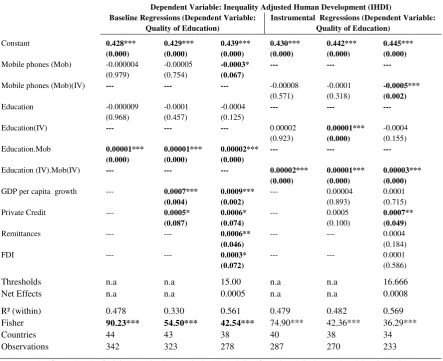
The empirical findings for FE regressions are presented in Table 1. While the
left-hand-side presents baseline regressions, the right-left-hand-side discloses more robust or
instrumental variable regressions. The findings are discussed in terms of marginal effects, net
impacts and threshold effects.
First, positive marginal effects are consistent across specifications. This is an
indication that increasing human development results from the interactions between mobile
phones and educational quality.
Second, the net effects based on conditional and unconditional effects are positive in
the third specifications of the left-hand-side and right-hand-side regressions. For instance the
net effect from education in the third specification in the left-hand-side is 0.0005([0.00002 ×
43.601] + [-0.0003]) and in the right-hand-side is 0.0008([0.00003 × 43.673] + [-0.0005]).
Accordingly, 43.601 and 43.673 are respectively the mean values of educational quality and
instrumental educational quality (see Appendix 2).
Third, the corresponding thresholds are also within the range provided by the
summary statistics (see Appendix 2). Accordingly, 15 (0.0003/0.00002) and 16.666
(0.0005/0.00003) are the respective critically masses of educational quality and instrumental
educational quality at which primary schooling complements mobile phones to start exerting a
11 Table 1: Inclusive development and mobile phones (Fixed Effects)
Dependent Variable: Inequality Adjusted Human Development (IHDI) Baseline Regressions (Dependent Variable:
Quality of Education)
Instrumental Regressions (Dependent Variable: Quality of Education)
Constant 0.428*** 0.429*** 0.439*** 0.430*** 0.442*** 0.445***
(0.000) (0.000) (0.000) (0.000) (0.000) (0.000)
Mobile phones (Mob) -0.000004 -0.00005 -0.0003* --- --- ---
(0.979) (0.754) (0.067)
Mobile phones (Mob)(IV) --- --- --- -0.00008 -0.0001 -0.0005***
(0.571) (0.318) (0.002)
Education -0.000009 -0.0001 -0.0004 --- --- ---
(0.968) (0.457) (0.125)
Education(IV) --- --- --- 0.00002 0.00001*** -0.0004
(0.923) (0.000) (0.155)
Education.Mob 0.00001*** 0.00001*** 0.00002*** --- --- ---
(0.000) (0.000) (0.000)
Education (IV).Mob(IV) --- --- --- 0.00002*** 0.00001*** 0.00003***
(0.000) (0.000) (0.000)
GDP per capita growth --- 0.0007*** 0.0009*** --- 0.00004 0.0001
(0.004) (0.002) (0.893) (0.715)
Private Credit --- 0.0005* 0.0006* --- 0.0005 0.0007**
(0.087) (0.074) (0.100) (0.049)
Remittances --- --- 0.0006** --- --- 0.0004
(0.046) (0.184)
FDI --- --- 0.0003* --- --- 0.0001
(0.072) (0.586)
Thresholds n.a n.a 15.00 n.a n.a 16.666 Net Effects n.a n.a 0.0005 n.a n.a 0.0008 R² (within) 0.478 0.330 0.561 0.479 0.482 0.569 Fisher 90.23*** 54.50*** 42.54*** 74.90*** 42.36*** 36.29***
Countries 44 43 38 40 38 34
Observations 342 323 278 287 270 233
*, **, ***: significance levels of 10%, 5% and 1% respectively. STJA: Scientific and Technical Journal Articles. GDP: Gross Domestic Product. FDI: Foreign Direct Investment. na: thresholds and/or net effects cannot be computed because of insignificant marginal effects. The small conditional and unconditional effects do not matter much in the establishment of thresholds if both the numerator and denominator needed for the computation of the thresholds are small. Accordingly, the established thresholds make economic sense when they are within the range (minimum to maximum) disclosed by the summary statistics. Hence, what matters is that the established threshold should make economic sense.
It is important to articulate the context of threshold or critical mass. The notion of
threshold is in accordance with Cummins (2000) on the minimum requirement of proficiency
in a given language before a second language can be learned effectively. Furthermore, the
definition of threshold in this study is also in line with the critical mass theory that has been
considerably documented in the literature on economic development (see Roller &
Waverman, 2001; Ashraf & Galor, 2013). A recent empirical application of the threshold or
critical theory with interaction variables can be found in Batuo (2015). Therefore, from the
perspective of this study, threshold impacts can be derived from interactive regressions. In the
light of these clarifications, our conception and definition of threshold is consistent with: (i)
12 Kuznets and U-shapes (Ashraf & Galor, 2013) and (iii) minimum requirements for enjoying
positive effects (Cummins, 2000).
The fact that the computed critical masses are within the lower limits of ranges
(minimum to maximum) means that below-average education is needed to start enjoying the
positive effect of mobile phone penetration on inclusive human development. In essence, an
educational critical mass of 15 is close to the minimum in the range of 12.466 to 100.236
while an instrumented educational critical mass of 16.666 is also close to the minimum range
of 12.978 to 98.978. Hence, 10 and 27 pupils per teacher is needed in primary schools in
order for mobile phones to enhance inclusive human development.
Fourth, all significant control variables have expected positive signs.
4.2 Extensions based on fundamental characteristics
In order to create opportunities for more policy implications, we decompose the
dataset into fundamental features of human development based on political stability, religious
domination, openness to sea, resource wealth, income levels and legal origins. The literature
has documented these factors as important in human development (see Mlachila et al., 2014;
Asongu, 2017b). An interesting literature by Mlachila et al. (2014, p.13) on the linkages
between inclusive development recognised the following fundamental features:
resource-wealth, state fragility, regional proximity and income levels. In line with the authors, inclusive
human development is positively associated with political stability, income levels and
resource-poor countries around the world because of the following reasons.
(1) It is more likely that high income nations are linked with better institutions to
permit the equitable distribution of wealth accruing from economic prosperity. There are two
main justifications for this positive linkage. On the one hand, higher incomes are associated
with more opportunities for employment and social mobility. On the other hand, better
institutions that are more related to higher income countries have been accepted to be critical
in determining the quality of growth in Africa (Fosu, 2015b, 2015c).
(2) Countries with relatively more political stability are reasonably more likely to
create conditions that are sympathetic for the benefits of economic growth to trickle down to
less privileged factions of society.
(3) Consistent with the discourse on income levels above, whereas the likelihood that
inclusive development is relatively better in resource-wealthy countries could run counter to
13 acknowledged scarcity in natural resources have focused more on knowledge economy and
human capability development as means to achieve inclusive development and growth
(Amavillah, 2015; Fosu, 2013; America, 2013). The narrative on human capability
development aligns with the Kuada (2015) paradigm shift to ‘soft economics’ as means to understand Africa’s non-inclusive development. (4) Legal origins have been shown to be
fundamental in comparative contemporary economic development (see. La Porta et al., 1998,
1999). Agbor (2015) confirmed this assertion in recent African development literature.
According to Beck et al. (2003), because of differences in political and adaptability
mechanisms between French Civil law and English Common law countries, the latter have
more ‘enabling conditions’ for the reduction of economic vulnerability and enhancement of
social mobility. Accordingly, the French Civil law lays more emphasis on the state power
compared to English common law countries which operate more on private property rights. It
follows that the institutional web of enforcement features, informal norms and formal rules
logically affect cross-country economic vulnerability and social mobility. (5) The foundation
of religious domination is consolidated by the notion that inclusiveness is affected by
solidarity. Islam and Christianity are the two such dominant religious models of solidity in
Africa.
(6) Landlockedness has an institutional cost (see Arvis et al., 2007). Furthermore,
such institutional drawbacks could be associated with less economic governance and/or the
formulation and implementation of effective policies that deliver public commodities for
inclusive development.
The criteria used to select the aforementioned fundamental country characteristics in
items 2 to 6 immediately above are in line with recent inclusive development (Mlachila et al.,
2014, p.13) and African development (Asongu, 2014a, p. 339) literature. In principle, the
categorisation of legal origins is from La Porta et al (2008, p. 289) whereas the classification
of income is in conformity with Asongu (2014b, p. 364)6 and the various World Bank
publications. Resource-rich nations are based exclusively on oil-dominated exports that
represent a substantial part of the GDP for at least a decade during the sampled periodicity.
While landlocked versus coastal nations are directly apparent from an African map, the
religious domination classification is from the Central Intelligence Agency (CIA) World Fact
6
14 Book (CIA, 2011). Politically unstable nations are those that have experienced political
violence/ instability during at least half of the investigated period.
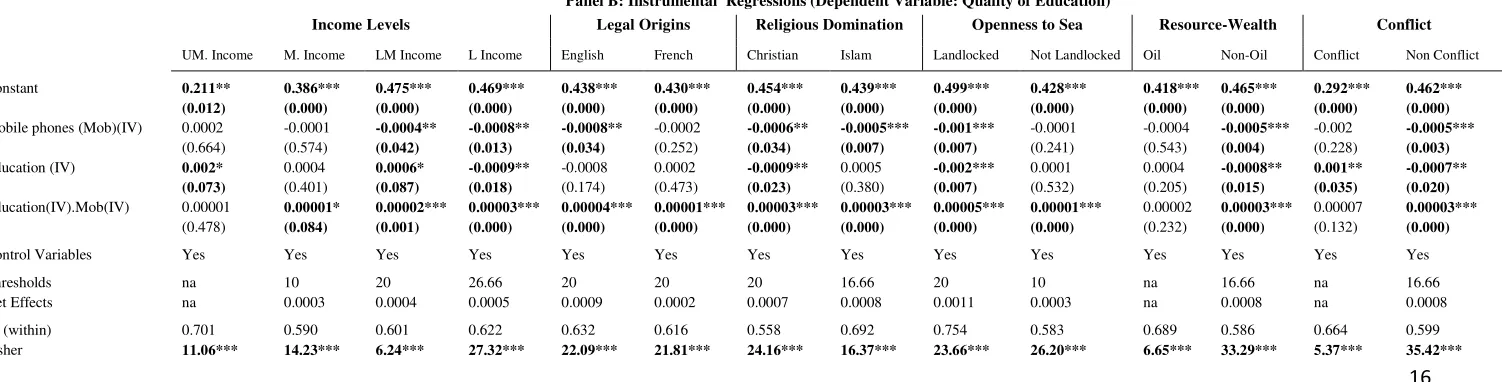
In order to account for the underlying fundamental characteristics, a further analysis is
performed on the relationship between educational quality, mobile phones and inclusive
human development. Table 2 presents the corresponding findings based on each of the
selected fundamental features of human development. While Panel A discloses baseline
regressions, Panel B shows instrumental regressions. For lack of space, we report the
independent variables of interest only given that most of the significant control variables
display the expected signs.
The following findings can be established from Table 2. (1) On average terms, the
threshold of educational quality for which mobile phones positively affect inclusive human
development is between 10 and 26.66. This implies that between 10 and 27 pupils per teacher
is needed in primary education, in order for educational externalities to materialise as
inclusive human development following an increase in mobile phone penetration. (2) On the
expected results, we find that: (i) English Common law countries enjoy higher net effects
compared to their French Civil law counterparts, (ii) positive net effects are more apparent in
politically stable (vis-à-vis politically unstable) countries and (iii) positive net impacts are
also more noticeable in resource-poor (vis-à-vis resource-rich) countries. (3) With regard to
unexpected findings: (i) low income (vis-à-vis higher income) countries have a higher net
effect on inclusive development and (ii) landlocked (vis-à-vis coastal) countries experience
higher net effects. (4) For the fundamental characteristic for which we could not anticipate a
comparative advantage in inclusive development, Islam-dominated countries have a slightly
higher net effect compared to their Christian-oriented counterparts.
We devote space to explaining the unexpected findings, particularly the superiority of
low income and landlocked countries. One the one hand, countries that are landlocked could
also acknowledge scarcity in logistic and transport facilities and therefore invest more in the
knowledge economy for inclusive human development. This is the case with Rwanda for
example. On the other hand, low income countries are more likely to harness inclusive
development advantages associated with the mobile phone compared to higher income
countries. For instance, low income countries are likely to benefit more from the use of
mobile telephony for banking activities. This is consistent with evidence that the mobile
phone has transformed the lives of many Africans by providing not just a means of
15 of the population (Jonathan & Camilo, 2008; Demombynes & Thegeya, 2012; Asongu, 2015).
An example with which to support this perspective is a recent World Bank study which has
revealed that Somalia, a low income country, is in the driver’s seat when it comes to using the
16 Table 2: Decomposition with Fixed Effects regressions
Dependent Variable: Inequality Adjusted Human Development (IHDI)
Panel A: Baseline Regressions (Dependent Variable: Quality of Education)
Income Levels Legal Origins Religious Domination Openness to Sea Resource-Wealth Conflict
UM. Income M. Income LM Income L Income English French Christian Islam Landlocked Not Landlocked Oil Non-Oil Conflict Non Conflict
Constant 0.309*** 0.415*** 0.452*** 0.461*** 0.399*** 0.453*** 0.454*** 0.446*** 0.425*** 0.433*** 0.428*** 0.464*** 0.311*** 0.448***
(0.000) (0.000) (0.000) (0.000) (0.000) (0.000) (0.000) (0.000) (0.000) (0.000) (0.000) (0.000) (0.000) (0.000)
Mobile phones (Mob) 0.00009 0.00004 -0.00002 -0.0002 -0.0006** -0.0001 -0.0005** -0.0002 -0.001*** 0.0001 -0.0005 -0.0003* 0.001 -0.0004**
(0.869) (0.859) (0.905) (0.351) (0.034) (0.422) (0.035) (0.263) (0.003) (0.547) (0.626) (0.075) (0.127) (0.022)
Education 0.0008 -0.0002 0.0006* -0.0007** -0.00005 -0.0003 -0.001*** 0.0003 -0.001* -0.00009 0.0004 -0.001*** 0.001*** -0.0005**
(0.546) (0.592) (0.073) (0.028) (0.908) (0.300) (0.003) (0.545) (0.063) (0.725) (0.170) (0.003) (0.006) (0.055)
Education.Mob 0.00001 0.00005 0.000007 0.00002*** 0.00004*** 0.00001*** 0.00002*** 0.00003*** 0.00005*** 0.000009* 0.00002 0.00002*** -0.00003 0.00002***
(0.527) (0.481) (0.192) (0.000) (0.000) (0.003) (0.000) (0.000) (0.000) (0.052) (0.394) (0.000) (0.192) (0.000)
Control Variables Yes Yes Yes Yes Yes Yes Yes Yes Yes Yes Yes Yes Yes Yes
Thresholds na na na 10 15 10 25 6.66 20 11.11 na 15 na 20
Net Effects na na na 0.00067 0.00114 0.00033 0.00067 0.00110 0.00118 0.00029 na 0.00057 na 0.00047
R² (within) 0.618 0.478 0.497 0.670 0.706 0.494 0.541 0.723 0.777 0.503 0.514 0.599 0.553 0.615
Fisher 9.04*** 11.27*** 5.66*** 40.67*** 37.51*** 16.33*** 27.68*** 23.22*** 34.44*** 22.82*** 4.08*** 42.50*** 4.78*** 45.56***
Countries 6 14 8 24 17 21 27 11 10 28 6 32 8 30
Observations 52 107 55 171 133 145 198 80 86 192 40 238 42 236
Panel B: Instrumental Regressions (Dependent Variable: Quality of Education)
Income Levels Legal Origins Religious Domination Openness to Sea Resource-Wealth Conflict
UM. Income M. Income LM Income L Income English French Christian Islam Landlocked Not Landlocked Oil Non-Oil Conflict Non Conflict
Constant 0.211** 0.386*** 0.475*** 0.469*** 0.438*** 0.430*** 0.454*** 0.439*** 0.499*** 0.428*** 0.418*** 0.465*** 0.292*** 0.462***
(0.012) (0.000) (0.000) (0.000) (0.000) (0.000) (0.000) (0.000) (0.000) (0.000) (0.000) (0.000) (0.000) (0.000)
Mobile phones (Mob)(IV) 0.0002 -0.0001 -0.0004** -0.0008** -0.0008** -0.0002 -0.0006** -0.0005*** -0.001*** -0.0001 -0.0004 -0.0005*** -0.002 -0.0005***
(0.664) (0.574) (0.042) (0.013) (0.034) (0.252) (0.034) (0.007) (0.007) (0.241) (0.543) (0.004) (0.228) (0.003)
Education (IV) 0.002* 0.0004 0.0006* -0.0009** -0.0008 0.0002 -0.0009** 0.0005 -0.002*** 0.0001 0.0004 -0.0008** 0.001** -0.0007**
(0.073) (0.401) (0.087) (0.018) (0.174) (0.473) (0.023) (0.380) (0.007) (0.532) (0.205) (0.015) (0.035) (0.020)
Education(IV).Mob(IV) 0.00001 0.00001* 0.00002*** 0.00003*** 0.00004*** 0.00001*** 0.00003*** 0.00003*** 0.00005*** 0.00001*** 0.00002 0.00003*** 0.00007 0.00003***
(0.478) (0.084) (0.001) (0.000) (0.000) (0.000) (0.000) (0.000) (0.000) (0.000) (0.232) (0.000) (0.132) (0.000)
Control Variables Yes Yes Yes Yes Yes Yes Yes Yes Yes Yes Yes Yes Yes Yes
Thresholds na 10 20 26.66 20 20 20 16.66 20 10 na 16.66 na 16.66
Net Effects na 0.0003 0.0004 0.0005 0.0009 0.0002 0.0007 0.0008 0.0011 0.0003 na 0.0008 na 0.0008
R² (within) 0.701 0.590 0.601 0.622 0.632 0.616 0.558 0.692 0.754 0.583 0.689 0.586 0.664 0.599
17
Countries 5 12 7 22 16 18 24 10 10 24 5 29 7 17
Observations 45 88 43 145 113 120 165 68 71 162 33 200 33 200
18 5. Concluding implications and future research directions
The study has investigated critical masses or thresholds of educational quality at which
the diffusion of knowledge with mobile phones enhances inclusive human development. The
empirical evidence is based on simultaneity-robust Fixed Effects regressions with data from
49 sub-Saharan African countries for the period 2000-2012. The following key findings have
been established. On the results without fundamental country characteristics: (i) positive
marginal effects are consistent across specifications, implying that increasing human
development can be traced to the interactions between mobile phones and educational quality,
(ii) net effects based on conditional and unconditional effects are positive and (iii) between 10
and 27 pupils per teacher is needed in primary education in order for mobile phones to
enhance inclusive human development. These below-mean (or average) thresholds imply that
with a minimum policy effort to raise educational quality, new information and
communication technologies like mobile phones (and related applications) can be effectively
harnessed to fight non-inclusive human development in the post-2015 sustainable
development agenda.
The following are observable from the results with fundamental characteristics. (1) On
average terms, between 10 and 27 pupils per teacher is needed in primary education in order
to capitalise on the inclusive human development benefits of increases in phone penetration.
(2) On the projected outcomes, we find that: (i) English Common law countries enjoy higher
net effects compared to their French Civil law counterparts, (ii) positive net effects are more
apparent in politically stable (vis-à-vis politically unstable) countries and (iii) that positive net
impacts are also more apparent in resource-poor (vis-à-vis resource-rich) countries. (3) With
regard to unexpected findings (i) low income (vis-à-vis higher income) countries have a
higher net effect on inclusive development and (ii) landlocked (vis-à-vis coastal) countries
experience higher net effects. (4) For the fundamental country characteristic for which we
could not anticipate a comparative advantage in inclusive development, Islam-dominated
countries have a slightly higher net effect compared to their Christian-oriented counterparts.
In the light of these findings, we have confirmed that education plays an important
role in the diffusion of knowledge for inclusive human development. This is consistent with
the literature that education contributes to the creation and diffusion of knowledge for
inclusive human development (Dakhi & de Clereq, 2007; Dunlap-Hinkler et al., 2010). The
19 phones and inclusive development in Africa (see Asongu, 2015) can be extended to causality.
It is relevant to note that the underlying study is based on cross-sectional data. More
generally, the findings of this study have confirmed the evolving stream of literature on the
inclusive benefits of mobile phones engaged in the introduction.
Given that a recent World Bank report has shown that extreme poverty has been
decreasing in all regions of the world with the exception of SSA, in the post-2015 sustainable
development agenda, governments of sampled countries would benefit from improving the
quality of education and engaging ‘knowledge economy’-driven policies in order to harness the inclusive human development benefits of mobile phone usage. Future studies can improve
on the existing literature by investigating other mechanisms by which the mobile phone can
improve inclusive development in the sub-region in the light of the other challenges of the
20 Appendices
Appendix 1: Definitions and sources of variables
Variables Signs Definitions Sources
Inclusive development IHDI Inequality adjusted human development index UNDP
Mobile Phone Mobile Mobile phone subscriptions (per 100 people) WDI
Mobile Phone (IV) Mobile (IV) Instrumented mobile phone subscriptions (per 100
people)
Author’s
calculation
Educational Quality Educ Pupil teacher ratio in primary education WDI
Educational Quality (IV) Educ(IV) Instrumented pupil teacher ratio in primary education Authors’
calculation
GDP per capita GDPpcg GDP per capita growth rate
Private Credit Credit Private credit by deposit banks and other financial
institutions (% of GDP)
WDI
Remittances Remit Remittances inflows (% of GDP) WDI
Foreign investment FDI Foreign direct investment net inflows (% of GDP) WDI
UNDP: United Nations Development Program. WDI: World Development Indicators. GDP: Gross Domestic Product.
Appendix 2: Summary statistics
Mean SD Min Max Obs
Inequality Adj. Human Development 0.721 3.505 0.129 0.768 485
Mobile Phone Penetration 23.379 28.004 0.000 147.202 572
Mobile Phone Penetration(IV) 25.313 28.144 2.705 156.082 522
Educational Quality 43.601 14.529 12.466 100.236 444
Educational Quality(IV) 43.673 14.227 12.978 98.512 365
GDP per Capita growth 2.198 5.987 -49.761 58.363 608
Private Domestic Credit 18.551 22.472 0.550 149.78 507
Remittances 3.977 8.031 0.000 64.100 434
Net Foreign Direct Investment Inflows 5.332 8.737 -6.043 91.007 603
SD: Standard deviation. Min: Minimum. Max: Maximum. Obs: Observations. Adj: Adjusted.
Appendix 3: Correlation Matrix (Uniform sample size : 233)
Edu GDPpcg Credit Remit FDI Mobile IHDI
1.000 0.029 -0.369 -0.073 -0.118 -0.461 -0.096 Edu 1.000 0.014 0.035 0.131 -0.003 -0.023 GDPpcg
1.000 -0.096 -0.117 0.471 0.599 Credit 1.000 0.078 -0.058 -0.050 Remit
1.000 0.114 -0.026 FDI 1.000 0.049 Mobile
1.000 IHDI
Edu : Educational quality. STJA: Scientific & Technical Journal Articles. Internet: Internet Penetration. GDPpcg : GDP per capita growth rate. Credit: Private domestic credit. Remit: Remittances. FDI: Foreign Direct Investment. Mobile: Mobile Phone Penetration. IHDI: Inequality Adjusted Human Development Index. Ind. Vble:
21 References
Abramowitz, M. (1986). “Catching-up, forging ahead or falling behind”, Journal of Economic
History, 46(2), pp. 385-406.
Afutu-Kotey, R. L. , Gough, K. W., & Owusu, G., (2017). “Young Entrepreneurs in the
Mobile Telephony Sector in Ghana: From Necessities to Aspirations”, Journal of African
Business, DOI: 10.1080/15228916.2017.1339252.
Agbor, J. A. (2015). “How does colonial origin matter for economic performance in sub-
Saharan Africa?”, In Augustin K. Fosu (Ed.), Growth and Institutions in African
Development, Chapter 13, pp. 309-327, Routledge Studies in Development Economics: New
York.
Aker, J. C., & Fafchamps, M. (2010). How Does Mobile Phone Coverage Affect Farm-Gate
Prices? Evidence from West Africa, Department of Economics and the Fletcher School, Tufts
University.
Alkemade, F., & Surrs, R. A. A., (2012). “Patterns of expectations for emerging sustainable technologies”, Technological Forecasting & Social Change, 79(3), pp. 448-456.
Al Surikhi, H. F., (2012). “Knowledge and Financial Management in Households: An Examination of Married Women’s Perspectives in Chadbourn, North Carolina”, Capstone
Collection, Paper No. 2489, Brattleboro.
Amankwah-Amoah, J., (2015). “Solar energy in sub-Saharan Africa: The challenges and
opportunities of technological leapfrogging”. Thunderbird International Business Review, 57(1), pp. 15-31.
Amankwah-Amoah, J., (2016). “Global business and emerging economies: Towards a new perspective on the effects of e-waste”. Technological Forecasting and Social Change, 105 (April), pp. 20-26.
Amankwah-Amoah, J., & Sarpong, D., (2016). “Historical pathways to a green economy: The evolution and scaling-up of solar PV in Ghana, 1980-2010”. Technological Forecasting and
Social Change, 102(January), pp. 90-101.
Amavilah, V. H. (2015). “Social Obstacles to Technology, Technological Change, and the
Economic Growth of African Countries: Some Anecdotal Evidence from Economic History”,
MPRA Paper No. 63273, Munich.
America, R. (2013). “Economic Development with Limited Supplies of Management. What
to do about it - the case of Africa”, Challenge, 56(1), 61-71.
Anand, R., Mishra, S., & Spatafora, N., (2012). “Structural Transformation and
the Sophistication of Production,” IMF Working Paper No. 12/59, Washington.
Arvis, J-F., Marteau, J-F., & Raballand, G. (2007). “The cost of being landlocked: logistics
22 Ashraf, Q., & Galor, O., (2013). “The Out of Africa Hypothesis, Human Genetic Diversity,
and Comparative Economic Development”. American Economic Review, 103(1), pp. 1-46.
Asiedu, E., (2014). “Does Foreign Aid in Education Promote Economic Growth? Evidence
From Sub-Saharan Africa”, Journal of African Development, 16(1), pp. 37-59.
Asongu, S. A., (2014a). “African development: beyond income convergence”, South African
Journal of Economics, 82(3), pp. 334-353.
Asongu, S. A., (2014b). “Globalisation (fighting) corruption and development. How are these phenomena linearly and non-linearly related in wealth effects?”, Journal of Economic Studies, 41(3), pp. 346-369.
Asongu, S. A., (2015). “The impact of mobile phone penetration on African inequality”,
International Journal of Social Economics, 42(8), pp. 706 -716.
Asongu, S. A., (2017a). “Conditional Determinants of Mobile Phones Penetration and Mobile Banking in Sub-Saharan Africa”, Journal of the Knowledge Economy.
DOI: 10.1007%2Fs13132-015-0322-z.
Asongu, S. A. (2017b). “Knowledge Economy Gaps, Policy Syndromes and Catch-Up
Strategies: Fresh South Korean Lessons to Africa”, Journal of the Knowledge Economy, 8(1), pp. 211-253.
Asongu, S. A., (2016). “Drivers of Growth in Fast Developing Countries: Evidence from Bundling and Unbundling Institutions”, Politics & Policy, 44(1), pp. 97-134.
Asongu, S. A., Boateng, A., & Akamavi, R., (2016). “Mobile Phone Innovation and Inclusive Human Development: Evidence from Sub-Saharan Africa”, African Governance and
Development Institute Working Paper No. 16/027, Yaoundé.
Asongu, S. A., & De Moor, L., (2015). “Recent advances in finance for inclusive
development: a survey”, African Governance and Development Institute Working Paper No. 15/005, Yaoundé.
Asongu, S. A., Efobi, U., & Beecroft, I., (2015). “Inclusive Human Development in Pre-Crisis Times of Globalisation-Driven Debts”, African Development Review, 27(4), pp. 428-442.
Asongu, S. A., & Kodila-Tedika, O., (2017). “Is Poverty in the African DNA (Gene)?”,
South African Journal of Economics. DOI: 10.1111/saje.12165.
Asongu, S. A., & Le Roux, S., (2017). “Enhancing ICT for inclusive human development in Sub-Saharan Africa”, Technological Forecasting and Social Change, 118(May), pp. 44-54.
Asongu, S. A, & Nwachukwu, J. C., (2016a). “The Mobile Phone in the Diffusion of
23 Asongu, S. A., & Nwachukwu, J. C., (2016b). “Mobile Phone Penetration, Mobile Banking
and Inclusive Development in Africa”, African Finance Journal, 18(1), pp. 34-52.
Asongu, S. A., & Nwachukwu, J. C., (2016c). “The Role of Governance in Mobile Phones for Inclusive Human Development in Sub-Saharan Africa”, Technovation, 55-56 (September-October), pp. 1-13.
Asongu, S. A., & Nwachukwu, J. C., (2017). “PhD by publication as an argument for
innovation and technology transfer: With emphasis on Africa”, Higher Education Quarterly. DOI: DOI: 10.1111/hequ.12141.
Asongu, S. A., Nwachukwu, J. C., & Orim, S-M., I., (2017). “Mobile phones, institutional quality and entrepreneurship in Sub-Saharan Africa”, Technological Forecasting and Social
Change. DOI: 10.1016/j.techfore.2017.08.007.
Batuo, M. E., (2015). “The Role of Telecommunications Infrastructure In The Regional
Economic Growth of Africa”, The Journal of Development Areas, 49(1), pp. 313-330.
Becheikh, N., (2013). “The Impact of Knowledge Acquisition and Absorptive Capacity on
Technological Innovations in Developing Countries: Evidence From Egyptian Small and Medium-Sized Enterprises”, Journal of African Business, 14(3), pp. 127-140.
Beck, T., Demirgüç-Kunt, A., & Levine, R. (2003). “Law and finance: why does legal origin
matter?”, Journal of Comparative Economics, 31(4), pp. 653-675.
Bernard, A., & Jones, C. (1996). “Technology and convergence”, The Economic Journal, 106 (437), pp. 1037-1044.
Best, M.H., (2015). “Greater Boston's industrial ecosystem: a manufactory of sectors”.
Technovation, 39-40 (2015), pp. 4-13.
Brambor, T., Clark, W. M., & Golder, M., (2006). “Understanding Interaction
Models:Improving Empirical Analyses”, Political Analysis, 14(1), pp. 63-82.
Brouwer, R., & Brito, L., (2012). “Cellular phones in Mozambique: Who has them and who doesn't?”, Technological Forecasting & Social Change, 79(2), pp. 231-243.
Chan, A., & Jia, T., (2011). “The Role of Mobile Banking in Facilitating Rural Finance:
Reducing Inequality in Financial Services between Urban and Rural Areas”, Accenture
Banking Services, http://www.accenture.com/SiteCollectionDocuments/PDF/PoV-Mobile-Banking-051611-EN.pdf (Accessed: 17/03/2015).
CIA (2011). Central Intelligence Agency, The World Factbook 2011.
Coleman, J.S. (1988). “Social capital in the creation of human capital”, American Journal of
Sociology, 94, (1998), pp. S95-S120.
24 Cummins, J. (2000). Language, power and pedagogy: Bilingual children in the crossfire. Clevedon, England: Multilingual Matters.
Dakhi, M., & de Clereq, D. (2007). “Human capital, social capital, and innovation: A
multi-country study”, Entrepreneurship and Regional Development, 16(2), pp. 107-128.
Demombynes, G., & Thegeya, A. (2012, March). “Kenya’s Mobile Revolution and the Promise of Mobile Savings”. World Bank Policy Research Working Paper, No. 5988, Washington.
Dunlap-Hinkler, D., Kotabe, M., & Mudambi, R. (2010). “A story of break thorough versus
incremental innovation: Corporate entrepreneurship in the global pharmaceutical industry”,
Strategic Entreneurship Journal, 4(2), pp. 106-127.
Fosu, A. (2013). Achieving development success: Strategies and lessons from the developing world, UNU-WIDER Policy Brief (November), Helsinki.
Fosu, A. K., (2015a). “Growth, Inequality and Poverty in Sub-Saharan Africa: Recent
Progress in a Global Context”, Oxford Development Studies, 43(1), pp. 44-59.
Fosu, A. (2015b). Growth and Institutions in African Development, First edited by Augustin K. Fosu, , Routledge Studies in Development Economics: New York.
Fosu, A. (2015c). Growth and institutions in African Development, In A. K. Fosu (Ed.), Growth and Institutions in African Development, Chapter 1, pp. 1-17, Routledge Studies in Development Economics: New York.
Gupta, R., & Jain, K., (2012). “Diffusion of mobile telephony in India: An empirical study”,
Technological Forecasting & Social Change, 79(4), pp. 709-715.
Gupta, R., & Jain, K., (2014). “Adoption of Mobile Telephony in Rural India: An Empirical Study”, Decision Sciences, 45(2), pp. 281-307.
Gupta, R., & Jain, K., (2015). “Adoption behavior of rural India for mobile telephony: A
multigroup study”, Telecommunications Policy, 39(8), pp. 691-704.
Hang, C.C., Garnsey, E., & Ruan, Y., (2015). “Opportunities for disruption”. Technovation
39-40 (2015), pp. 83-93.
Hashim, N., (2014). “How Knowledge, Policy Planning, and Implementation Succeed or Fail: The Jatropha Projects in Tanzania”, Journal of African Business, 14(3), pp. 169-183.
Howells, J. (2005). “Innovation and Regional Economic development: A matter of
perspective”, Research Policy, 34(8), pp. 1220-1234.
Ika, L., & Saint-Macary, J., (2014). “Special Issue: Why Do Projects Fail in Africa?”,
25 Islama, T., & Meadeb, N., (2012). “The impact of competition, and economic globalization on
the multinational diffusion of 3G mobile phones”, Technological Forecasting & Social
Change, 79(5), pp. 843-850.
Jeong, Y., & Yoon, B., (2015). “Development of patent roadmap based on technology
roadmap by analyzing patterns of patent development”. Technovation, 39-40 (2015), pp. 37-52.
Jin, J., & von Zedtwitz, M., (2008). “Technological capability development in China's mobile
phone industry”, Technovation, 28(6), pp. 327-334.
Jonathan, D., & Camilo, T. (2008). “Mobile banking and economic development: Linking adoption, impact and use”. Asian Journal of Communication, 18(4), pp. 318-322.
Joseph, N., Erasmus, W., & Marnewick, C., (2014). “The Idle State of Information and
Communication Technology Project Management”, Journal of African Business, 14(3), pp. 184-196.
Kamukama, N., (2013). “Intellectual Capital: Firms' Hidden Source of Service Quality in the Microfinance Industry in Uganda”, Journal of African Business, 14(3), pp. 150-161.
Kirui, O. K., Okello, J. J., Nyikal, R. A., & Njiraini, G. W., (2013). “Impact of Mobile
Phone-Based Money Transfer Services in Agriculture: Evidence from Kenya”, Quaterly Journal of
International Agriculture, 52(2), pp. 141-162.
Kliner, M., Knight, A., Mamvura, C., Wright, J., & Walley, J., (2013). “Using no-cost mobile phone reminders to improve attendance for HIV test results: a pilot study in rural Swaziland”,
Infectious Diseases of poverty, 2(12), pp. 1-7.
Kohlbacher, F., Herstatt, C., & Levsen, N., (2015). “Golden opportunities for silver
innovation: how demographic changes give rise to entrepreneurial opportunities
to meet the needs of older people”. Technovation 39-40 (2015), pp. 73-82.
Kumar, S., & Zahn, C., (2003). “Mobile communications: evolution and impact on business operations”, Technovation, 23(6), pp. 515-520.
Kuada, J. (2015). Private Enterprise-Led Economic Development, In J. Kuada (Ed.), Sub-Saharan Africa The Human Side of Growth, Palgrave Macmillan: New York.
Kuoa, Y-F., & Yub, C-W., (2006). “3G telecommunication operators’ challenges and roles: A perspective of mobile commerce value chain”, Technovation, 26(12), pp. 1347-1356.
Kwan, L.Y-Y, & Chiu, C-Y (2015). “Country variations in diiferent innovation outputs: The
interactive effect of institutional support and human capital”, Journal of Organisational
Behavior, 36(7), pp. 1050-1070.
La Porta, R., Lopez-de-Silanes, F., Shleifer, A., & Vishny, R. W. (1998). “Law and finance”,
26 La Porta, R., Lopez-de-Silanes, F., Shleifer, A., & Vishny, R. W. (1999). “The quality of
government”, Journal of Law, Economics and Organization, 15(1), pp.222-279.
La Porta, R., Lopez-de-Silanes, F., & Shleifer, A., (2008), “The Economic Consequences of
Legal Origin,” Journal of Economic Literature, 46(2), pp. 285-332.
Lee, M., Kim, K & Cho, Y., (2010). “A study on the relationship between technology
diffusion and new product diffusion”, Technological Forecasting and Social Change, 77(5), 796-802.
Maine, E., Soh, P.-H., & Dos Santos, N., (2015). “The role of entrepreneurial decision making
in opportunity creation and recognition”. Technovation, 39-40(2015), pp. 53-72.
Makanyeza, C., & Dzvuke, G., (2015). “The influence of innovation on the performance of small and medium enterprises in Zimbabwe”, Journal of African Business, 15(1-2), pp. 198-214.
Maurer, B. (2008, May). Retail electronic payments systems for value transfers in the developing world. Department of Anthropology, University of California.
Mishra, V., & Bisht, S. S., (2013). “Mobile banking in a developing economy: A
customer-centric model for policy formulation”, Telecommunications Policy, 37(6-7), pp. 503-514.
Mishra, S., Gable, S. L., & Anand, R., (2011), “Service Export Sophsitication and Economic Growth,” World Bank Policy Working Paper No. 5606, Washington.
Mira, M., & Dangersfield, B., (2012). “Propagating a digital divide: Diffusion of mobile telecommunication services in Pakistan”, Technological Forecasting & Social Change, 79(3), pp. 448-456.
Mlachila, M., Tapsoba, R., & Tapsoba, S. J. A., (2014). “A Quality of Growth Index for
Developing Countries: A Proposal”, IMF Working Paper No. 14/172, Washington.
Mosheni-Cheraghlou, A., (2013). “Mobile Banking: Who is in the Driver’s Seat?”, Working for a World Free of Poverty, The World Bank,
http://blogs.worldbank.org/allaboutfinance/mobile-banking-who-driver-s-seat (Accessed: 19/03/2015)
Mpogole, H., Usanga, H., & Tedre, M., (2008). “Mobile phones and poverty alleviation: a
survey study in rural Tanzania”, Proceedings of M4D 2008, Karlstad University, Sweden, pp.
62-72.
Muto, M., & Yamano, T., (2009). “The Impact of Mobile Phone Coverage Expansion on
Market Participation: Panel Data Evidence from Uganda”, World Development, 37(12), pp. 1887-1896.
Ofori, D., ( 2014). “An Exploratory Study of Project Management Competency in Ghana”,
27 Ojo, A., Janowski, T., & Awotwi, J., (2012). “Enabling development through governance and
mobile technology”, Government Information Quarterly, 30 (2013), pp. S32-S45.
Ondiege, P., (2010). “Mobile Banking in Africa: Taking the Bank to the People”, Africa
Economic Brief, 1(8), pp. 1-16.
Overholm, H., (2015). “Collectively created opportunities in emerging ecosystems: the case of solar service ventures”. Technovation, 39-40(2015), pp.14-25.
Penard, T., Poussing, N., Yebe, G. Z., & Ella, P. N., (2012). “Comparing the Determinants of Internet and Cell Phone Use in Africa: Evidence from Gabon ”, Communications &
Strategies, 86(2), pp. 65-83.
Petrakis, P. E., & Stamatakis, D. (2002). “Growth and educational levels: a comparative analysis”. Economics of Education Review, 21(2), pp. 513-521.
Qiang, C. Z., Kuek, S. C., Dymond, A., & Esselaar, S., (2011). “Mobile Applications for
Agricultural and Rural Development”, ICT Sector Unit, World Bank
http://siteresources.worldbank.org/INFORMATIONANDCOMMUNICATIONANDTECHN OLOGIES/Resources/MobileApplications_for_ARD.pdf (Accessed: 17/03/2015).
Ravallion, M., Chen, S., & Sangraula, P., (2008). “Dollar a Day Revisited”, World Bank
Policy Research Working Paper No. 4620, Washington.
Roller, L-H., & Waverman, L. (2001). “Telecommunications infrastructure and economic
development: a simultaneous approach”, American Economic Review, 91(4), pp. 909-923.
Romer, P. M. (1990). “Endogenous technological change”, Journal of Political Economy, 98(5), pp. S71-S102.
Rosenberg, N. (1972). “Factors affecting the diffusion of technology”, Explorations of
Economic History, 10(1), pp. 3-33.
Sen, A. (2010). “The mobileand the world”, Information Technologies and International
Development, 6, pp.1-3.
Seneviratne, D., & Sun, Y., (2013), “Infrastructure and Income Distribution in ASEAN-5:
What are the Links?” IMF Working Paper No. 13/41, Washington.
Singh, A. B., (2012). “Mobile banking based money order for India Post: Feasible model and assessing demand potential”, Procedia - Social and Behavioral Sciences, 37(2012), pp. 466-481.
Singh, A. B. (2012). “Mobile banking based money order for India Post: Feasible model and
assessing demand potential”, Procedia - Social and Behavioral Sciences, 37(2012), pp. 466-481.
Solow, R. M. (1994). Perspectives on Economic growth theory”, Journal of Economic
28
Sonne, L., (2012). “Innovative initiatives supporting inclusive innovation in India: Social business incubation and micro venture capital”, Technological Forecasting & Social Change,
79(4), pp. 638-647.
Ssozi, J., & Asongu, S. A., (2016). “ The Effects of Remittances on Output per Worker in Sub-Saharan Africa: A Production Function Approach”, South African Journal of Economics, 84(3), pp. 400-421.
Tarus, D. K., & Sitienei, E. K. (2015). “Intellectual capital and innovativeness in software
development firms: the moderating role of firm size”, Journal of African Business, 15(1-2), pp. 48-65.
Tchamyou, S. V., (2016). “The Role of Knowledge Economy in African Business”, Journal
of Knowledge Economy, DOI: 10.1007/s13132-016-0417-1.
Tchamyou, S. V., & Asongu, S. A., (2017). “Information Sharing and Financial Sector
Development in Africa”, Journal of African Business, 18(1), pp. 24-49.
Thakar, D., (2012). “Market competition and the distributional consequences of mobile
phones in Canada”, Technological Forecasting & Social Change, 79(2), pp. 223-230.
Wan, F., Williamson, P.J., & Yin, E., (2015). “Antecedents and implications of disruptive innovation: evidence from China”. Technovation, 39-40(2015), pp. 94-104.
World Bank (2015). “World Development Indicators”, World Bank Publications
http://www.gopa.de/fr/news/world-bank-release-world-development-indicators-2015 (Accessed: 25/04/2015).
Ureta, S. (2008). “Mobilising poverty?: Mobile phone use and everyday spatial mobility among low-income families in Santiago, Chile”, Information Society, 24(2), pp. 83-92.
Uzawa, H. (1965). “Optimum technical change in an aggregative model of economic growth”,
International Economic Review, 6(1), pp. 17-31
Verspagen, B. (1992). “Uneven growth between interdependent economies: An evolutionary