Munich Personal RePEc Archive
The Role of Productive and
Technological Capabilities on Export
Dynamics in Developing Countries
Vergara, Sebastian
Department of Economic and Social Affairs, United Nations
7 September 2018
Online at
https://mpra.ub.uni-muenchen.de/88937/
The Role of Productive and Technological Capabilities
on Export Dynamics in Developing Countries
θ
First draft – September 2018
Sebastian Vergara M. [email protected] Economic Affairs Officer
Department of Economic and Social Affairs United Nations
Abstract
Productive and technological capabilities matter. Several strains of the literature have emphasized them as major engines of export, growth and development. But how they matter is less clear. In fact, many open questions remain on how productive and technological capabilities influence export dynamics at microeconomic level. This paper empirically investigates their role on export dynamics in 40 developing countries between 2002 and 2012. In doing so, the paper exploits a country-sector-year database containing exporter-level statistical information. The empirical analysis shows that, within sectors, there is a larger number of exporters in countries with more productive capacities, and the exporters are larger and have higher prices for their products, even after controlling for level of development, size of the economy, commodity-dependency and other variables. Also, the results confirm a positive relationship between technological capabilities and diversification: within sectors, exporters in countries with more capabilities tend to export a higher number of products and to more destination markets. Furthermore, capabilities in high-technology exporters seem to play a crucial role regarding market diversification. Thus, the paper shows that, even just comparing exporters’ behaviour among the developing countries, stronger productive and technological capabilities are significantly related to the “extensive” and “intensive” margin of exports, the diversification across products and destinations, and the product quality, all relevant aspects of developing countries’ insertion in global trade markets. Overall, the paper underscores the role of capabilities not only on developing countries’ macroeconomic resilience to trade shocks, but also on their medium-term development prospects.
Key words: productive capacities, technological capabilities, export dynamics, R&D investments
JEL Classification: F14, O3
θ
1. Introduction
Productive capacities and technological capabilities have been emphasized in several strains of
economic literature as major engines of export, growth and development. The early contributions
on development theory emphasized the transformation of the productive structure –from
agriculture and extractive industries to more sophisticated and knowledge-based industries- as a
critical factor in shaping the international specialization patterns (Hirschman, 1958; Singer, 1950;
Prebisch, 1950). This would entail a process of accumulation of knowledge and capabilities
within the economy (Cimoli et al., 2009). The Schumpeterian ideas also emphasized the
importance of R&D investments and innovation activities in shaping market dynamics,
particularly through the process of creative destruction (Schumpeter, 1942).
Later, modern growth theories highlighted the role of human capital, R&D investments and, more
broadly, knowledge, as a major driver of economic growth (Romer, 1990; Aghion and Howitt,
1998). Finally, contributions on technology and trade theory underscored that technological
asymmetries were major determinants of trade flows and specialization patterns in foreign
markets, exerting enormous influence on economic performance in the short and medium-term.
The key idea was that trade patterns between countries would persist as along as differences in
technological capabilities to absorb, generate and use knowledge remain in place (Posner, 1961;
Dosi et al., 1990).
Despite these long-standing theoretical contributions, there are many open questions on how
productive and technological capabilities influence export performance and dynamics, even more
so across developing countries. From an aggregate perspective, some previous studies have shed
light on the existing asymmetries regarding technological, export and growth indicators between
countries. For example, Cimoli et al. (2005) discuss the position of Latin American countries on
different indicators regarding structural change, international trade insertion and productivity
growth vis a vis the United States, Scandinavian countries and the Republic of Korea. The main
results are that the performance of Latin American economies was relatively weak, with the
region lagging with respect to several indexes of technological efforts, capabilities accumulation
and productivity growth.
From an individual country perspective, many studies have emphasized the connection between
capabilities and exports. For example, Ernst et al. (1998) examines technological capabilities and
export success in the electronics and textile industries in six East Asian countries (Korea, Taiwan,
Thailand, Indonesia, and Vietnam). It clearly shows that learning, innovation and capabilities
accumulation, including product design, production processes, management routines, marketing
Also, there is ample evidence showing that that exporters are more productive than non-exporters,
and that exporter productivity premia tend to increase with the share of exports in total sales
(World Bank, 2007). Also, there is compelling evidence in favour of self-selection of more
productive firms into export markets, but scarce evidence on the learning-by-exporting
hypothesis. Furthermore, recent research has also shown that firms take the choice of entering or
expanding their operations in foreign markets together with investment, technology adoption,
product-mix and R&D and innovation decisions. For example, Aw et al. (2011) show that
productivity growth for electronic producers in Taiwan evolves endogenously to firm’s decisions
to export and invest in R&D. Also, the results show that a firm’s export and R&D decisions affect
each other and that both decisions affect productivity growth.
This paper attempts to shed light on the role of productive and technological capabilities on
export dynamics at microeconomic level by using a large sample of developing countries. For
example, the average steel exporter in Turkey is 1.5 times larger than the average steel exporter
in Mexico, while the initial level of exports of a new steel exporter in Turkey is about 1.6 times
larger than in Mexico. Meanwhile, Bangladesh exporters of apparel and clothing accessories
export to more than 4 destinations on average, while in Pakistan to only 2 destinations. Also, the
average Mexican exporter of electrical machinery and equipment exports on average more than
6 different products (at 6-digit of the HS 2002 classification), while Thailand exporters only 4
products. Obviously, these differences are related to the size of the country, level of development,
trade policy and comparative advantages. But, what about productive and technological
capacities? And across which export margin?
Against this backdrop, this paper tackles the following questions: Do countries with more
productive capacities have more and larger exporters? Do new exporters in foreign markets
display higher initial level of exports in countries with more productive capacities? Do exporters
from countries with more productive capacities have higher unit prices for their products? Are
exporters from countries with more technological capabilities more diversified, in terms of
products and destinations? Thus, the goal is to uncover what specific link are between capabilities
and the exporter behaviour in foreign markets. In particular, the paper attempts to connect the
issue of capabilities with the extensive and intensive margin of exports, product/destination
diversification, and product quality, all of which have been emphasized as relevant aspects of
international competitiveness. In doing this, the empirical strategy controls for other country
dimensions that can also be relevant, such as the size of the economy, level of development, trade
This paper uses data from the World Bank’s Exporter Dynamics Database, which compiles
statistical information from national sources exporter-level customs data, covering the universe
of annual export transaction (Fernandes et al., 2016).1 The database contains exporter-level
information for 40 developing countries between 2002 and 2012 aggregated at sectoral level. A
key issue is that there is no obvious approach to measure productive and technological
capabilities. The concept of capabilities is closely connected to the accumulation of explicit and
tacit knowledge, and to how different chunks of knowledge are mixed, combined and used to
generate new productive and technological capacities. Thus, the issue of capabilities is
multidimensional, encompassing economic, technological and institutional aspects.
The paper uses two proxies of capabilities, one for productive capacities, one for technological
capabilities. To measure productive capacities, the empirical approach uses the Economic
Complexity Index (ECI) (Hausmann at al., 2011). The ECI measures the multiplicity of
productive knowledge in an economy by combining information on the diversity of a country
exports (based on the number of its export products) and the ubiquity of its products (based on
the number of countries that export a particular product). Thus, the ECI not only builds upon
productive diversification2, but it also captures additional information regarding capabilities. As
discussed by Mealy et al. (2018), the ECI captures information on what type of products, and
thus, in what type of capabilities, countries are competitive in. Furthermore, given that the ECI
provides a rank ordering of countries in terms of how similar their exports and capabilities are to
each other and that this ordering helps to explain variations in GDP per capita and future growth
(Hidalgo and Hausmann, 2009), this suggest that some type of exports, and thus some type of
capabilities, are more relevant to development, a classical argument of the early development
theories3.
Meanwhile, to measure technological capabilities, the empirical approach uses R&D investments
as a proxy. The R&D investments reflect the technological efforts that countries put in place to
foster knowledge creation and technological progress. In fact, firm’s R&D activities encourage
product and process innovations and enhance the absorptive capacity to assimilate external
1 Fernandes et al. (2016) initially presented the Exporter Dynamics Database. They analyze how export behavior is linked to country size and level of development. Interestingly, the paper shows that larger and more developed countries have more and larger exporters, and a greater share of exports controlled by the top 5%. This database opens a variety of research possibilities to improve the understanding of export dynamics at disaggregated levels. 2 There is ample evidence on the relationship between diversification and development. Several studies conclude that there is positive relationship between export diversification and growth, especially for less developed countries (Al-Marhubi, 2000; Herzer and Nowak-Lehnmann, 2006).
knowledge (Griliches, 1979; Cohen and Levinthal, 1990; Griffith et al., 2003). In addition, R&D
activities can also convey intangible benefits to overcome barriers to exporting (Harris and Li,
2009; Tecce and Pisano, 1998), and they are also a crucial feature of the National Innovation
Systems4. In comparison to developed countries, national innovation systems in developing
economies are generally characterized by low level of R&D, high participation of public R&D in total R&D expenditures, innovation activities concentrated in natural-resources and low-tech activities, low level of human capital and workforce capabilities and lack of interactions among economic agents (Arocena and Sutz, 2002).
The empirical hypotheses are that the ECI and R&D investments are positively correlated with
different export dimensions. Intuitively, a higher the level of sophistication and a wider variety
of productive knowledge embedded in the productive structure should be reflected in the
international competitiveness. Thus, a higher ECI could imply a larger number of exporters
and/or higher levels of exports. Also, the productive knowledge could be reflected in the quality
of products, thus a positive correlation with unit prices is also tested5. Similarly, the level of R&D
is expected be positively connected with diversification across products and destinations markets,
particularly given the vital role it plays on product and process innovations (Mairesse and Mohen,
2010).
The contribution of this paper is threefold. First, it presents a comprehensive analysis within
developing countries on the role of productive and technological capabilities on export dynamics.
While the relevance of technological and innovation capabilities on firms’ export indicators has
been documented, comprehensive cross-country comparisons are scarce. Second, the paper
uncovers explicit links on how productive and technological capabilities relates to export
dynamics. Third, the links between capabilities and exports dynamics underline their role not
only on developing countries’ resilience to trade shocks, but also on their medium-term
development prospects. Obviously, the paper also displays several limitations. Most importantly,
the empirical analysis and the nature of the data prevents any inference on causality between
capabilities and export dynamics. The paper is organised as follows. Section 2 describes the data
and some basic statistics, providing an aggregate picture for the empirical analysis. Then, section
3 presents the empirical approach, while Section 4 discusses the main results. Finally, section 5
concludes.
2. Data and basic statistics
The statistical information regarding export dynamics comes from the Exporter Dynamics
Database6. This database compiles export information from national sources exporter-level
customs data, covering the universe of annual exporter transactions. The database contains
information for 40 developing countries between 2002 and 2012. Thus, it is a
country-sector-year database, unevenly distributed across developing countries (see Annex A2). In particular, it
comprises aggregated information at sectoral level (2-digit of the Harmonized System 2002
Classification)7 for the number of exporters (total and per product), average value of exports per
exporter and per entrant (new exporter in year t), average unit prices per exporter, average number
of products per exporter; and the average number of destinations per exporter, among other
variables.
As discussed, productive capacities are proxied by the Economic Complexity Index (ECI), from
the MIT’s Observatory of Economic Complexity (Simoes and Hidalgo, 2011)8. The ECI measures
the sophistication of a country’s productive structure by combining information on the diversity
of country exporting activity and the ubiquity of its products. These dimensions are based on the
number of products that a country exports and the number of countries that export a specific
product, respectively. The intuition is that more sophisticated economies tend to be more
diversified, and they are able to export products that, on average, have low ubiquity. Thus, it
encompasses information on the diversification and on what type of capabilities countries are
competitive. Meanwhile, technological capabilities are proxied by R&D investments over GDP,
data that comes from the World Development Indicators of the World Bank9. The R&D
investments reflect technological efforts. R&D investments is a variable commonly used to
measure country’s technological effort to generate, absorb and use knowledge, and it constitutes
a major input for introducing products and process innovations.
Figure 1 displays a simple correlation plot of the ECI and R&D across developing countries10,
with a significant country variation across both dimensions. The ECI ranges from -2.2 to 0.98,
6 For details about the database, see http://www.worldbank.org/en/research/brief/exporter-dynamics-database. 7https://unstats.un.org/unsd/tradekb/Knowledgebase/50043/HS-2002-Classification-by-Section
8https://atlas.media.mit.edu/en/. 9https://data.worldbank.org/products/wdi.
with an average of -0.39 and a standard deviation of 0.7011. Meanwhile, R&D investments range
from 0 to above 2.0 per cent over GDP, with an average of 0.45 and a standard deviation of 0.3612.
As expected, there is a relatively strong and positive correlation between ECI and R&D activities,
and countries with more productive knowledge tend to exhibit higher technological efforts. China
and Malaysia are among those with the highest combinations on productive and technological
capabilities, while countries such as Nicaragua and Tajikistan exhibit a relatively deficient
[image:8.612.175.430.230.449.2]performance.
Figure 1. Economic complexity and R&D investments, 2015
Source: author’s own elaboration based on data from the WDI and MIT Observatory on Economic Complexity.
The different combinations along these indicators for specific countries also underscore that the
ECI and R&D investments reflect distinct aspects of capabilities. For example, Mexico displays
a relatively high ECI as its export structure is diversified, with a relatively large share of
medium-high and medium-high-technology products.13 However, technological efforts in the Mexican economy is
limited, with relatively low levels of R&D investments, only 0.55% over GDP. This illustrates
several weaknesses in the its national innovation system, including a low participation of the
private sector on R&D activities, lack of interactions and cooperation between private sector and
universities, and relatively low level of human capital (Casanova, 2015). By contrast, Kenya
11 For developed countries, the ECI ranges between -0.27 and 2.42, with an average of 1.11 and a standard deviation of 0.60.
12 Annex A1 displays the histograms of ECI and R&D investments based on the sample estimation data.
13 In Mexico, export products such as cars, vehicle parts, delivery trucks, computers and other machinery and equipment products account for about 62 per cent of total exports.
Madagascar Tajikistan Nicaragua
Mexico Kenya
Malaysia China
y = 0.26x + 0.55
-0.5 0.5 1.5 2.5
-2.5 -1.5 -0.5 0.5 1.5
R
&
D
o
v
er
G
D
P
exhibit a relatively low level of ECI, with an export structure highly concentrated in a few
vegetable products and textiles. However, Kenya has visibly strengthened its efforts to increase
R&D investments recently, to about 0.8% of GDP, particularly by designing comprehensive
innovation policy frameworks in the last 15 years (Ndemo, 2015).
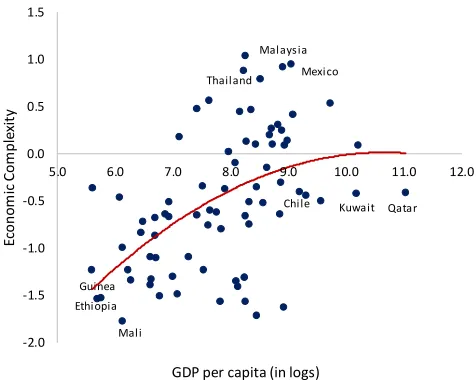
Figures 2 and 3 display simple correlation plots of ECI and R&D investments with the level of
development across developing countries, using GDP per capita as a proxy. As expected, both
variables are positively correlated with GDP per capita. The correlation is higher for the ECI
(0.49). Yet, some countries, such as Kuwait and Qatar and some Latin American economies,
exhibit a low level of productive capacities, despite a relatively high level of GDP per capita.
The correlation between R&D and level of development across developing countries is lower,
only 0.26. This shows that, while relatively poor countries tend to invest little in R&D as a norm,
there are also a variety of country specific circumstances14. For example, while countries such as
Chile, Colombia and some Arab States of the Persian Gulf display a relatively high GDP per
[image:9.612.190.428.391.581.2]capita, they underperform regarding R&D investments.
Figure 2. Economic complexity index and GDP per capita, 2015
Source: author’s own elaboration based on data from World Development Indicators, World Bank, and the MIT’s Observatory of Economic Complexity https://atlas.media.mit.edu/en/.
14 There is large literature that attempt to explain why poor countries invest too little on R&D. For example, Cicera and Maloney (2017) argue that the main reason is the scarcity of complementary factors to innovation, including physical and human capital, credit markets and managerial quality, among others.
Mal i Ethi opia
Guinea
Chi le Kuwait Qatar
Thail and Mal aysia Mexi co -2.0 -1.5 -1.0 -0.5 0.0 0.5 1.0 1.5
5.0 6.0 7.0 8.0 9.0 10.0 11.0 12.0
E co n o m ic C o m p le xi ty
Figure 3. R&D investments and GDP per capita, 2015
Source: author’s own elaboration based on data from World Development Indicators, World Bank. R&D data is for 2015 or latest available information.
3. Empirical approach
This section describes the empirical strategy to analyse the role of productive and technological
capabilities on the different export dynamics dimensions. The approach closely follows the one
taken by Fernandes et al. (2016). To analyse the role of productive capacities on different export
dimensions, I specify the following equation:
= + + + + (1)
where i, j, and t represent sectors, countries and years, respectively. There are several dependent
variables: i) Number of exporters (log of the total number of exporters), ii) Number of exporters
per product (log of the average number of exporters per product - products defined at 6-digit of
the HS 2002 classification); iii) Exportsper exporter (log of the average exports per exporter);
iv) Exports per entrant (log of the average exports per entrant, which is a new exporter in year
t), and v) Unit prices (log of the average export value over quantity). The variable ECI
corresponds to the Economic Complexity Index and the vector X encompasses several control
variables that can also play a role on the performance of the different export dimensions: GDP is
the log of GDP in constant US dollars; GDP per capita is the log of GDP per capita in constant
US dollars; Trade over GDP is total merchandise exports and imports over GDP; Manufacturing
sector correspond to the share of the manufacturing sector in the economy; and
Commodity-Dependent is a dummy variable that takes the value 1 if the country is a commodity dependent
Madagascar Kyrgistan
Colombia Kuwait
Mozambique Chi le
Brazi l Malaysia China
0.0 0.5 1.0 1.5 2.0 2.5
5.0 6.0 7.0 8.0 9.0 10.0 11.0 12.0
R
&
D
o
v
e
r
G
D
P
economy15. Finally, α
i and δi correspond to sectoral and year effects. The equation (1) is
estimated by Ordinary Least Squares (OLS), using robust standard errors adjusted by “clustering”
at country level.
Similarly, the equation to investigate the role of technological capabilities –using as proxy R&D
investments- on diversification across products and destinations is the following:
= + + & + " & ∗ $ %ℎ' ℎ + + (2)
where i, j, and t represent sectors, countries and years, respectively. The dependent variables are
i) Products per exporter (log of the average number of products per exporter – products defined
at 6-digit of the HS 2002 classification); and ii) Destination per exporter (log of the average
number of destination countries per exporter). R&D corresponds to aggregate R&D investments
over GDP. Similarly, GDP, GDP per capita, Manufacturing sector and Commodity-Dependent
are control variables. This approach includes a multiplicative variable of R&D and HighTech,
which isa dummy variablethat takes the value 1 if the sector is R&D intensive16. Including this
multiplicative variable allows us to test for a heterogeneous relation between R&D and export
dynamics across different sectors. It has been widely discussed that technical progress does not
occur evenly across all sectors, and some sectors are more innovative and stimulate technological
diffusion more than others (Pavitt, 1984). An illustration of this is that R&D investments do not
distribute homogenously across sectors, and electronics, machinery and pharmaceuticals
concentrate the bulk of technological efforts. Again, equation (2) is estimated by Ordinary Least
Squares (OLS), using robust standard errors adjusted by “clustering” at country level.
4. Regression results
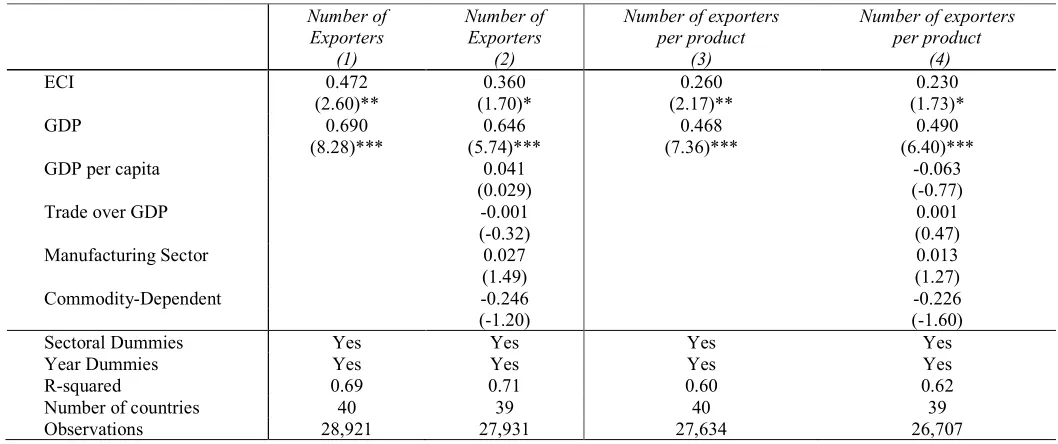
Table 1 presents the estimation results regarding the number of exporters, total and per product.
Columns (1) and (3) provides the baseline estimations, including only ECI and the level of GDP
as explanatory variables, while column (2) and (4) include the whole set of control variables. All
regressions include sectoral and year fixed effects. The coefficients associated to ECI are
significant at 5% in the baseline regressions for the total number of exporters and for the number
of exporters per product. Likewise, when including all the control variables in column (2) and
(4), ECI remains significant, at 10%, in both cases. This suggest that within sectors, countries
with more productive capacities have more exporters, total and per product. The regressions also
15 There are 22 commodity-dependent economies in the estimation sample: Cameroon, Chile, Colombia, Ecuador, Ethiopia, Gabon, Guatemala, Guinea, Kenya, Kuwait, Kyrgyzstan, Lao People's Dem. Rep., Madagascar, Malawi, Mali, Paraguay, Peru, Senegal, Uganda, Uruguay, Yemen and Zambia (UNCTAD, 2017).
show that the size of the economy is positively associated with the number of exporters, which
confirms previous results obtained by Fernandes et al. (2016). Thus, productive capacities tend
to be positively correlated with the extensive margin of exports across a relatively large sample
of developing countries.
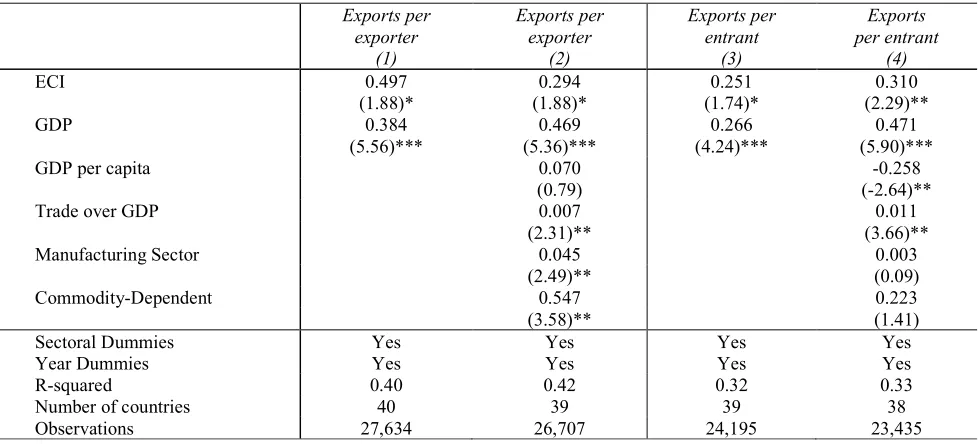
Table 2 displays the estimation results regarding the level of exports per exporter and the level
of export per new entrant in foreign markets. Again, column (1) and 3) provides the baseline
regressions, while columns (2) and (4) presents the regression with the full set of control variables.
In the case of exports per exporter, the coefficient associated to ECI is positive and significant,
at 10% in the baseline and at 10% with all the control variables. Among the other variables, the
results show that the size of the economy, the relevance of the manufacturing sector and trade
openness are positively correlated with the level of exports per exporter. In addition,
commodity-dependent economies tend to have a higher level of exports per exporter, due to the importance
of sectors based on natural resources. These sectors tend to be capital intensive and dominated
by only a few but very large exporters. For the case of exports per entrant, the coefficients
associated to ECI are positive and significant in the two regressions. This shows that, within
sectors, new exporters from countries with more productive capacities tend to have higher levels
of exports, even when controlling for other relevant variables. Altogether, this suggests that there
is clear-cut correlation between productive capacities and the intensive margin of exports across
developing countries.
Interestingly, column (4) of Table 2 also shows that the level of development, proxied by GDP
per capita, is negatively associated with the average level of export per entrant. Thus, it suggests
that the initial levels of exports for new exporters is larger in countries with lower levels of
development. While it might seem counterintuitive, this is consistent with the literature of trade
costs and barriers to trade, which clearly underscore that trade costs decrease as per capita income
increases (Arvis et al., 2012). Thus, new exporters in poorer countries confronts much higher
trade costs than a new exporter in a more developed and globally integrated economy. As a result,
new exporters then need to start their exporting activity with a relatively much larger volume of
exports to confront larger trade costs.
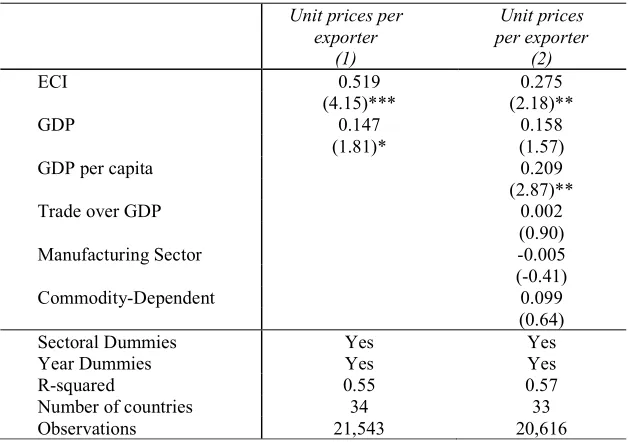
Meanwhile, the regression results regarding unit prices per exporter are presented in Table 3.
GDP per capita and the ECI are the only variables that display a significant correlation with unit
prices. Thus, within sectors, exporters from countries with higher levels of development and more
productive capacities tend to have higher average unit prices for their products. I interpret this
result as a strong indication that, within sectors, productive capacities are positively correlated
to a multiplicity of factors –such as demand shocks, market power or others-, the significant role
play by productive capacities for such a comprehensive sample of countries and for an extended
period of time is a solid indication that the main driver for these unit prices differences (in levels)
is product quality.
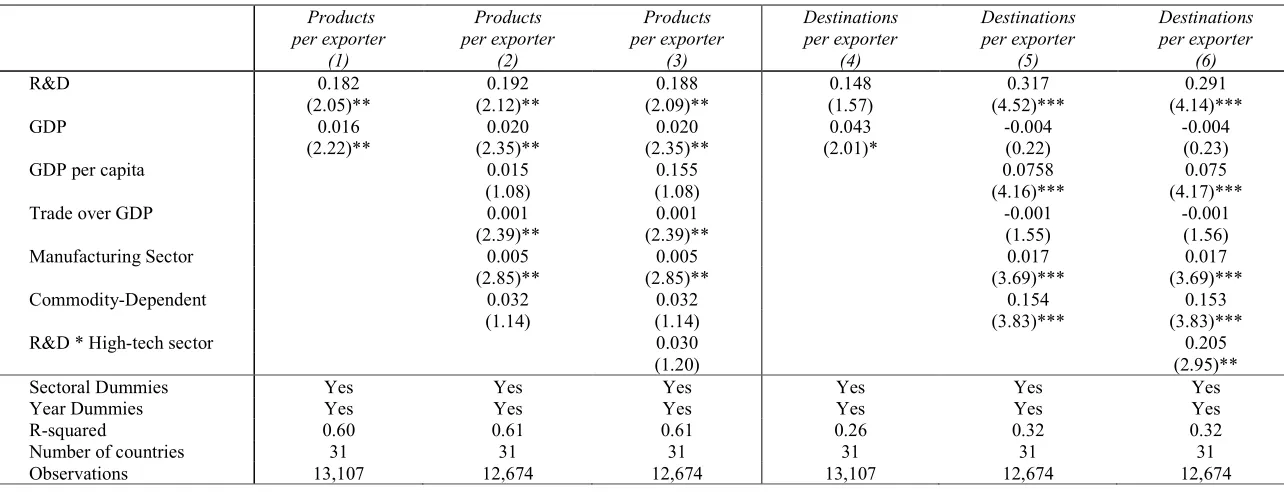
Finally, Table 4 displays the regression results for the role of R&D investments on exporter’s
diversification across products and destinations. Note that in these estimations the number of
countries considered are lower, only 31, due to the lesser availability of R&D data for some
countries. Column (1) presents the baseline regression when using products per exporter as a
dependent variable. Then, columns (2) and (3) sequentially add the control variables and the
multiplicative variable R&D*High-Tech. The estimated coefficients associated to R&D
investments are stable and suggest a positive and significant correlation with the number of
products per exporter. Thus, exporters in countries with higher level of R&D investments export
a larger number of products, at 6-digit of the HS classification, to foreign markets. Meanwhile,
the size of the economy, the trade openness and the size of the manufacturing sector are also
positively correlated with product diversification, which are, a priori, intuitive results.
Interestingly, the multiplicative variable R&D*High-tech is not significant, showing there are no
heterogeneous effects for high-technology sectors.
Columns (4), (5) and (6) of Table 4 displays the regression for the number of destinations per
exporter. When including all the control variables, the result shows that R&D investment is
positively correlated with diversification across destinations, together with level of development,
the size of manufacturing sector and the dummy for commodity-dependent economies. Thus,
within sectors, exporters from countries with higher R&D tend to export their products to a larger
number of destinations. Interestingly, the variable R&D*HighTech is positive and significant at
5%. This suggests that there is an additional correlation between R&D investments and the
number of destinations per exporter in high-technology sectors. Thus, the higher the level of
R&D, the larger the number of (average) destinations per exporter in high technology sectors.
This result is consistent with a growing literature, which emphasize the relationship between
R&D activities and export diversification, with causality that could run in both directions17.
17 For example, Baum (2015) examines the endogenous relationship between diversification and R&D activities in
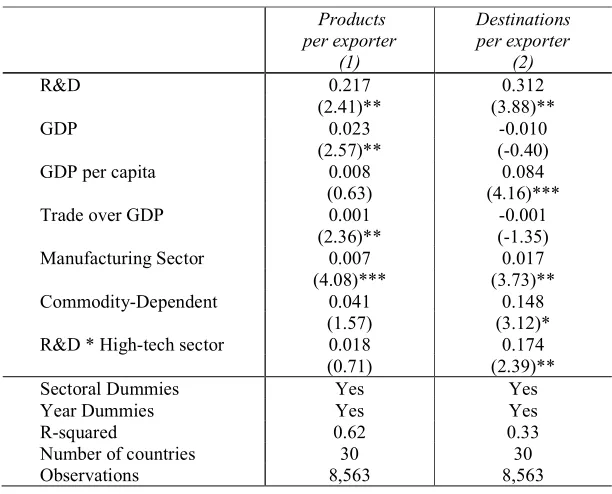
In order to analyse the sensitivity of the regression results, several robustness checks are
implemented. A key aspect to consider is to what extend the empirical results regarding
productive and technological capabilities could be driven by the estimation sample. In fact, the
estimation sample is not balanced across countries, and some countries are observed in the
database for longer periods of time (see Annex A2). To address this, there is a twofold strategy.
First, the equations are estimated using a restricted sample with the same number of observations
per country. Thus, the “additional” observations for some countries, in comparison to countries
with fewer observations, are left out from the estimation sample. Second, the estimations are
implemented on a second restricted sample, where countries have, at least, 500 observations.
With this approach, countries with fewer observations are left out from the estimation sample,
basically approximately 20% of the full sample. Finally, the equations are estimated by correcting
for the issue that some sectors have zero exports –in fact, not all countries export in every sector.
Correcting this issue expands the database by less approximately 5%. Despite some variations,
the robustness checks, particularly the results regarding productive and technological capabilities,
confirms the main conclusions18.
14
Table 1. Productive Capacities and the extensive margin of exports
Number of Exporters
(1)
Number of Exporters
(2)
Number of exporters per product
(3)
Number of exporters per product
(4)
ECI 0.472 0.360 0.260 0.230
(2.60)** (1.70)* (2.17)** (1.73)*
GDP 0.690 0.646 0.468 0.490
(8.28)*** (5.74)*** (7.36)*** (6.40)***
GDP per capita 0.041 -0.063
(0.029) (-0.77)
Trade over GDP -0.001 0.001
(-0.32) (0.47)
Manufacturing Sector 0.027 0.013
(1.49) (1.27)
Commodity-Dependent -0.246 -0.226
(-1.20) (-1.60)
Sectoral Dummies Yes Yes Yes Yes
Year Dummies Yes Yes Yes Yes
R-squared 0.69 0.71 0.60 0.62
Number of countries 40 39 40 39
Observations 28,921 27,931 27,634 26,707
Notes: Number of exporters is the log of the total number of exporters. Exporters per product is the log of the number of exporters per product, with products defined at 6-digit of the HS 2002 classification. GDP is the log of GDP in constant US dollars and GDP per capita is the log of GDP per capita in constant US dollars. ECI
15
Table 2. Productive Capacities and the intensive margin of exports
Exports per exporter
(1)
Exports per exporter
(2)
Exports per entrant
(3)
Exports per entrant
(4)
ECI 0.497 0.294 0.251 0.310
(1.88)* (1.88)* (1.74)* (2.29)**
GDP 0.384 0.469 0.266 0.471
(5.56)*** (5.36)*** (4.24)*** (5.90)***
GDP per capita 0.070 -0.258
(0.79) (-2.64)**
Trade over GDP 0.007 0.011
(2.31)** (3.66)**
Manufacturing Sector 0.045 0.003
(2.49)** (0.09)
Commodity-Dependent 0.547 0.223
(3.58)** (1.41)
Sectoral Dummies Yes Yes Yes Yes
Year Dummies Yes Yes Yes Yes
R-squared 0.40 0.42 0.32 0.33
Number of countries 40 39 39 38
Observations 27,634 26,707 24,195 23,435
16
Table 3. Productive Capacities and Unit prices
Unit prices per exporter
(1)
Unit prices per exporter
(2)
ECI 0.519 0.275
(4.15)*** (2.18)**
GDP 0.147 0.158
(1.81)* (1.57)
GDP per capita 0.209
(2.87)**
Trade over GDP 0.002
(0.90) Manufacturing Sector -0.005 (-0.41) Commodity-Dependent 0.099
(0.64) Sectoral Dummies Yes Yes Year Dummies Yes Yes R-squared 0.55 0.57 Number of countries 34 33 Observations 21,543 20,616
Notes: Unit prices is the log of the total export value over quantity. ECI corresponds to the Economic Complexity Index. GDP is the log of GDP in constant US dollars and
17
Table 4. Technological capabilities and Diversification
Products per exporter
(1)
Products per exporter
(2)
Products per exporter
(3)
Destinations per exporter
(4)
Destinations per exporter
(5)
Destinations per exporter
(6)
R&D 0.182 0.192 0.188 0.148 0.317 0.291
(2.05)** (2.12)** (2.09)** (1.57) (4.52)*** (4.14)***
GDP 0.016 0.020 0.020 0.043 -0.004 -0.004
(2.22)** (2.35)** (2.35)** (2.01)* (0.22) (0.23)
GDP per capita 0.015 0.155 0.0758 0.075
(1.08) (1.08) (4.16)*** (4.17)***
Trade over GDP 0.001 0.001 -0.001 -0.001
(2.39)** (2.39)** (1.55) (1.56)
Manufacturing Sector 0.005 0.005 0.017 0.017
(2.85)** (2.85)** (3.69)*** (3.69)***
Commodity-Dependent 0.032 0.032 0.154 0.153
(1.14) (1.14) (3.83)*** (3.83)***
R&D * High-tech sector 0.030 0.205
(1.20) (2.95)**
Sectoral Dummies Yes Yes Yes Yes Yes Yes
Year Dummies Yes Yes Yes Yes Yes Yes
R-squared 0.60 0.61 0.61 0.26 0.32 0.32
Number of countries 31 31 31 31 31 31
Observations 13,107 12,674 12,674 13,107 12,674 12,674
5.- Concluding Remarks
The accumulation of capabilities is a major driver of robust and sustained economic growth,
structural change and development. This paper examines the role of productive and technological
capabilities on export dynamics at microeconomic level in a large sample of developing countries.
The results indicate that productive capabilities are positively correlated with the intensive and
the extensive margins of exports and product quality. The results also confirm that technological
capabilities are strongly linked to diversification across products and destinations, especially in
high-technology sectors. In short, within similar sectors, developing countries with more
productive and technological capabilities have more exporters; and exporters are larger, more
diversified, and benefit from higher unit prices for their products.
These findings are important for several reasons. First, they explicitly underscore the relevance
of asymmetries of productive and technological capabilities across developing countries. So far,
most of the aggregate literature have compared technological capabilities between developing
and developed countries. As expected, these studies demonstrate that capabilities are a major
determinant of productivity, export and economic growth. This paper shows that capabilities
matter even when comparing export dynamics only among developing countries. Second, the
results illustrate how the accumulation of productive and technological capabilities play a role
on developing countries’ insertion in international markets.
Therefore, the paper underlines the role of capabilities not only on developing countries’
macroeconomic resilience to trade shocks -a major risk in the current international environment-,
but also on their medium-term development prospects. In fact, the accumulation of capabilities
is reflected in product and market diversification, a key factor to navigate international trade
shocks. In addition, productive and technological capabilities are mirrored in the extensive and
intensive margin of trade and on product quality, which are relevant aspects of international
competitiveness and on how countries dynamically adjust to changing demand patterns. Finally,
the paper implicitly suggest that productive and technological capabilities should also be a major
dimension to understand and evaluate the consequences and dynamics from the changing global
References
Aghion, Phillipe and Peter Howitt (1998). Endogenous Growth Theory, MIT Press, Cambridge, M.A.
Al-Marhubi, Fahim. (2010). “Export diversification and growth: an empirical investigation”, Applied economics letters, 7(9):559–562.
Arocena, Rodrigo and Judith Sutz (2005). “Innovation Systems and Developing Countries”, Working Paper No. 02-05, Danish Research Unit for Industrial Dynamics, DRUID.
Arvis, Jean-François, Duval, Yann, Shepherd, Ben and Chorthip Utoktham (2012). “Trade Costs in the Developing World: 1995 – 2010”, ARTNeT Working Paper Series, No. 121/December 2012
Aw, Bee Yan, Mark J. Roberts and Daniel Yi Xu (2011). “R&D Investment, Exporting, and Productivity Dynamics”, American Economic Review, Vol. 101, No. 4, pp. 1312–44.
Baum, Christopher F., Caglayan, Mustafa and Oleksandr Talavera (2015). “R&D Expenditures and Geographical Sales Diversification”, The Manchester School, Vol. 84, Issue 2, pp. 197-221.
Bravo-Ortega, Claudio, Benavente, Jose Miguel and Álvaro González (2014). “Innovation, Exports, and Productivity: Learning and Self-Selection in Chile”, Journal of Emerging Markets Finance and Trade, Vol. 50, 2014.
Casanova, Lourdes and Samantha Rullan (2015). “A review of the Mexican national innovation system”, International Journal of Business and Economic Sciences Applied Research, 8(3), pp.59-68.
Cirera, Xavier and William F. Maloney (2017). The Innovation Paradox: Developing-Country
Capabilities and the Unrealized Promise of Technological Catch-Up. Washington, DC: World
Bank.
Cimoli, Mario, Dosi, Giovanni, and Joseph Stiglitz (2009). “The Political Economy Capabilities Accumulation: The Past and Future of Policies for Industrial Policies”, in Industrial Policy and Development: The Political Economy of Capabilities Accumulation, Mario Cimoli, Giovanni Dosi and Joseph E. Stiglitz (Eds.), Oxford University Press, 2009.
Cimoli, Mario, Porcile, Gabriel, Primi, Annalisa, and Sebastian Vergara (2005). “Cambio Estructural heterogeneidad Productiva y Tecnología en América Latina”, in Heterogeneidad estructural, asimetrías tecnológicas y crecimiento en América Latina, M. Cimoli (Ed.), CEPAL and BID, Santiago de Chile.
Cohen, Wesley M., Daniel A. Levinthal. (1990). “Absorptive capacity: A new perspective on learning and innovation”, Administrative Science Quarterly 35, 128–152.
Dosi, Giovanni, Pavitt, Keith and Luc Soete (1990). The Economic of Technical Change and International Trade, London and New York, Harvester/Wheatsheaf Press.
Fernandes, Ana M., Freund, Caroline and Martha Denisse Pierola (2016). “Export Behavior, Country Size and Stage of Development: Evidence from the Exporter Dynamics Database”. Journal of Development Economics 119, pp.121-137.
Freeman, Chris (1995). "The 'national system of innovation' in historical perspective", Cambridge Journal of Economics 19 5-24.
Griffith, Rachel, Redding, Stephen and John Van Reenen (2003). “R&D and Absorptive Capacity: Theory and Empirical Evidence”, Scandinavian Journal of Economics 105(1), 99-118.
Griliches, Zvi (2000). R&D, Education, and Productivity: A Retrospective, Harvard University Press, Cambridge, 2000.
Harris, Richard and Quian Cher Li (2009). “Exporting, R&D, and absorptive capacity in UK establishments”, Oxford Economic Papers 61(1), 74–103.
Hausmann, Ricardo, Hidalgo, César A., Bustos, Sebastián, Coscia, Michele, Chung, Sarah, Jimenez, Juan, Simoes, Alexander and Muhammed A. Yıldırım (2011). The Atlas of Economic Complexity. Mapping the path to Prosperity. Center for International Development at Harvard University and MIT Media Lab, Massachusetts Institute of Technology.
Hausmann, Ricardo, Hwang, Jason and Dani Rodrik (2007). “What you export matters”. Journal of Economic Growth, 12(1):1–25.
Herzer, Dierk and Felicitas Nowak-Lehnmann (2006). “What does export diversification do for growth? an econometric analysis”, Applied economics, 38(15):1825–1838, 2006.
Hidalgo, Cesar and Ricardo Hausmann (2009). “The building blocks of economic complexity”. Proceedings of the National Academy of Sciences, 106(26), 10570–10575.
Hirschman, Albert O. (1958). The Strategy of Economic Development (Vol. 10) New Haven: Yale Univ. Press.
Lall, Sanjaya (2000). “The technological structure and performance of developing country manufactured exports, 1985-98”. Oxford development studies, 28(3):337–369, 2000.
Mairesse, Jacques and Pierre Mohnen (2010). “Using innovation surveys for econometric analysis”. In B. H. Hall and N. Rosenberg (editors), Handbook of the Economics of Innovation, Elsevier, Amsterdam, 2010, 1130-1155.
Mealy, Penny, Farmer, J. Doyne and Alexander Teytelboym (2018). “A new Interpretation of the Economic Complexity Index”, INET Oxford Working Paper No.2018-04.
Ndemo, Bitange (2015). “Effective Innovation Policies for Development: The Case of Kenya”, The Global Innovation Index, Chapter 9, Cornell University, INSEAD and the World Intellectual Property Organization (WIPO).
Pavitt, Keith (1984). “Sectoral patterns of technical change: towards a taxonomy and a theory”, Research Policy, vol. 13, pp.343-373.
Posner, Michael V. (1961). “International trade and technological change”, Oxford Economic Paper, vol.13.
Romer, Paul M. (1990). “Endogenous Technological Change”, Journal of Political Economy 98, S71-S102.
Schumpeter, Joseph. (1942). Capitalism, Socialism & Democracy. Routledge, London and New York.
Singer, Hans W. (1950). “The distribution of gains between investing and borrowing countries”,
American Economic Review, 40(2), 473–485.
Teece, David and Gary Pisano (1998). “The dynamic capabilities of firms: An introduction”, in G. Dosi, T. D.J. & C. J., Eds, Technology, Organisation, and Competitiveness: Perspectives on Industrial and Corporate Change, Oxford University Press, pp. 17–66.
UNCTAD (2017). The State of Commodity Dependence 2016. Special Unit on Commodities. UNCTAD/SUC/2017/2.
Wagner, Joachim (2017). “R&D Activities and Extensive Margins of Exports in Manufacturing Enterprises: First Evidence for Germany”, The International Trade Journal, Volume 31, 2017 - Issue 3.
Annex A1. Histograms – Sample Data
Economic Complexity Index
Source: author’s own elaboration based on data from MIT’s Observatory of Economic Complexity https://atlas.media.mit.edu/en/.
R&D Investments
Annex A2. Database - Distribution of observations across countries
Country Frequency Percent Cum.
Albania 834 3.00 3.00
Bangladesh 756 2.72 5.72
Botswana 939 3.38 9.1
Cambodia 569 2.05 11.15
Cameroon 893 3.21 14.36
Chile 950 3.42 17.78
Colombia 570 2.05 19.83
Costa Rica 934 3.36 23.19
Dominican Republic 925 3.33 26.52
Ecuador 931 3.35 29.87
El Salvador 665 2.39 32.26
Ethiopia 422 1.52 33.78
Gabon 80 0.29 34.07
Georgia 926 3.33 37.04
Guatemala 760 2.73 40.14
Guinea 280 1.01 41.14
Jordan 896 3.22 44.37
Kenya 665 2.39 46.76
Kuwait 188 0.68 47.44
Kyrgyzstan 654 2.35 49.79
Lao People's Dem. Rep. 377 1.36 51.15
Lebanon 475 1.71 52.86
Madagascar 559 2.01 54.87
Malawi 613 2.21 57.07
Mali 336 1.21 58.28
Mauritius 944 3.4 61.68
Mexico 950 3.42 65.10
Morocco 950 3.42 68.51
Nicaragua 912 3.28 71.80
Pakistan 760 2.73 74.53
Paraguay 473 1.70 76.23
Peru 950 3.42 79.65
Senegal 904 3.25 82.90
South Africa 948 3.41 86.32
Thailand 95 0.34 86.66
Turkey 950 3.42 90.08
Uganda 587 2.11 92.19
Uruguay 930 3.35 95.53
Yemen 397 1.43 96.96
Zambia 844 3.04 100.0
Annex A3. High technology sectors at 2-digit HS 2002 Classification
Section Description
30 Pharmaceutical products
37 Photographic or cinematographic goods.
84 Nuclear reactors, boilers, machinery and mechanical appliances; parts thereof
85 Electrical machinery & equipment; sound recorders/reproducers, televisions, parts & accessories 86 Railway or tramway locomotives, mechanical and electro-mechanical traffic signalling equipment. 87 Vehicles other than railway or tramway rolling-stock, and parts and accessories thereof.
88 Aircraft, spacecraft, and parts thereof. 89 Ships, boats and floating structures.
90 Optical, precision, medical or surgical instruments and apparatus; parts & accessories 91 Clocks and watches and parts thereof.
92 Musical instruments; parts and accessories of such articles. 93 Arms and ammunition; parts and accessories thereof.
Annex A4.1. Productive Capacities and the extensive margin of exports
(Balanced sample)
Number of Exporters
(1)
Exporters per product
(2)
ECI 0.478 0.285
(2.12)** (2.06)**
GDP 0.632 0.480
(5.11)*** (5.61)*** GDP per capita 0.017 -0.078
(0.12) (-0.93) Trade over GDP -0.002 0.000
(-0.42) (0.28) Manufacturing Sector 0.018 0.005 (0.78) (0.43) Commodity-Dependent -0.160 -0.184 (-0.73) (-1.26) Sectoral Dummies Yes Yes
Year Dummies Yes Yes
R-squared 0.70 0.61
Number of countries 38 38 Observations 12,122 11,525
Table A4.2. Productive Capacities and the intensive margin of exports
(Balanced sample)
Exports per exporter
(1)
Exports per entrant
(2)
ECI 0.228 0.271
(1.56) (1.78)*
GDP 0.482 0.481
(5.44)*** (6.43)*** GDP per capita 0.060 -0.251
(0.70) (-2.64)** Trade over GDP 0.008 0.012
(2.81)** ((4.25)*** Manufacturing Sector 0.055 -0.004
(3.09)** (-0.21) Commodity-Dependent 0.503 0.149
(3.38)** (1.02) Sectoral Dummies Yes Yes
Year Dummies Yes Yes
R-squared 0.42 0.32
Number of countries 38 38 Observations 11,525 10,293
[image:27.612.144.470.113.336.2]Table A4.3. Productive Capacities, Exports survival and Unit prices
(Balanced sample)
Unit prices per exporter
(1)
[image:28.612.192.420.112.336.2]ECI 0.243
(1.75)*
GDP 0.150
(1.28) GDP per capita 0.154 (1.99)* Trade over GDP 0.001
(0.38) Manufacturing Sector 0.006 (0.38) Commodity-Dependent 0.031 (0.20) Sectoral Dummies Yes Year Dummies Yes R-squared 0.56 Number of countries 30 Observations 8,679
Notes: Unit prices is the log of the total export value over quantity. ECI corresponds to the Economic Complexity Index. GDP is the log of GDP in constant US dollars and GDP per capita is the log of GDP per capita in constant US dollars. Trade over GDP is total merchandise exports and imports over GDP.
Table A4.4. Technological capabilities and Diversification
(Balanced sample)
Products per exporter
(1)
Destinations per exporter
(2)
R&D 0.217 0.312 (2.41)** (3.88)**
GDP 0.023 -0.010
(2.57)** (-0.40) GDP per capita 0.008 0.084
(0.63) (4.16)*** Trade over GDP 0.001 -0.001
(2.36)** (-1.35) Manufacturing Sector 0.007 0.017
(4.08)*** (3.73)** Commodity-Dependent 0.041 0.148
(1.57) (3.12)* R&D * High-tech sector 0.018 0.174
(0.71) (2.39)** Sectoral Dummies Yes Yes Year Dummies Yes Yes R-squared 0.62 0.33 Number of countries 30 30 Observations 8,563 8,563
Notes: Products per exporter is the log of the (mean) number of products per exporter. Destination per exporter is the log of the (mean) number of destination countries per exporter. R&D corresponds to aggregate R&D investments over GDP. GDP is the log of GDP in constant US dollars and GDP per capita
[image:29.612.152.458.112.359.2]