Proceedings of The Third Workshop on Computational Approaches to Code-Switching, pages 62–67 62
Code-Switching Language Modeling using Syntax-Aware
Multi-Task Learning
Genta Indra Winata, Andrea Madotto, Chien-Sheng Wu, Pascale Fung
Center for Artificial Intelligence Research (CAiRE) Department of Electronic and Computer Engineering
Hong Kong University of Science and Technology, Clear Water Bay, Hong Kong {giwinata, eeandreamad, cwuak}@ust.hk, [email protected]
Abstract
Lack of text data has been the major is-sue on code-switching language model-ing. In this paper, we introduce multi-task learning based language model which shares syntax representation of languages to leverage linguistic information and tackle the low resource data issue. Our model jointly learns both language mod-eling and Part-of-Speech tagging on code-switched utterances. In this way, the model is able to identify the location of code-switching points and improves the prediction of next word. Our approach outperforms standard LSTM based lan-guage model, with an improvement of 9.7% and 7.4% in perplexity on SEAME Phase I and Phase II dataset respectively.
1 Introduction
Code-switching has received a lot of attention from speech and computational linguistic commu-nities especially on how to automatically recog-nize text from speech and understand the struc-ture within it. This phenomenon is very com-mon in bilingual and multilingual communities. For decades, linguists studied this phenomenon and found that speakers switch at certain points, not randomly and obeys several constraints which point to the code-switched position in an utter-ance (Poplack, 1980; Belazi et al., 1994; Myers-Scotton, 1997; Muysken, 2000; Auer and Wei, 2007). These hypotheses have been empiri-cally proven by observing that bilinguals tend to code-switch intra-sententially at certain (morpho)-syntactic boundaries (Poplack,2015).Belazi et al. (1994) defined the well-known theory that con-straints the code-switch between a functional head and its complement is given the strong
relation-ship between the two constituents, which cor-responds to a hierarchical structure in terms of Part-of-Speech (POS) tags. Muysken(2000) in-troduced Matrix-Language Model Framework for an intra-sentential case where the primary lan-guage is called Matrix Lanlan-guage and the second one called Embedded Language (Myers-Scotton, 1997). A language island was then introduced which is a constituent composed entirely of the language morphemes. From the Matrix-Language Frame Model, both matrix language (ML) is-land and embedded language (EL) isis-lands are well-formed in their grammars and the EL is-lands are constrained under ML grammar (Namba, 2004). (Fairchild and Van Hell,2017) studied de-terminer–noun switches in Spanish–English bilin-guals .
Code-switching can be classified into two categories: intra-sentential and inter-sentential switches (Poplack,1980). Intra-sentential switch defines a shift from one language to another lan-guage within an utterance. Inter-sentential switch refers to the change between two languages in a single discourse, where the switching occurs af-ter a sentence in the first language has been com-pleted and the next sentence starts with a new lan-guage. The example of the intra-sentential switch is shown in (1), and the inter-sentential switch is shown in (2).
(1) 我要去check.
(I want to go)check.
(2) 我不懂要 怎么讲一 个小时seriously I
didn’t have so much things to say
Language modeling using only word lexicons is not adequate to learn the complexity of code-switching patterns, especially in a low resource setting. Learning at the same time syntactic fea-tures such as POS tag and language identifier al-lows to have a shared grammatical information that constraint the next word prediction. Due to this reason, we propose a multi-task learning framework for code-switching language modeling task which is able to leverage syntactic features such as language and POS tag.
The main contribution of this paper is two-fold. First, multi-task learning model is pro-posed to jointly learn language modeling task and POS sequence tagging task on code-switched ut-terances. Second, we incorporate language infor-mation into POS tags to create bilingual tags - it distinguishes tags between Chinese and English. The POS tag features are shared towards the lan-guage model and enrich the features to better learn where to switch. From our experiments result, we found that our method improves the perplexity on SEAME Phase I and Phase II dataset (Nanyang Technological University,2015).
2 Related Work
The earliest language modeling research on code-switching data was applying linguistic theo-ries on computational modelings such as Inver-sion Constraints and Functional Head Constraints on Chinese-English code-switching data (Li and Fung, 2012; Ying and Fung, 2014). Vu et al. (2012) built a bilingual language model which is trained by interpolating two monolingual language models with statistical machine translation (SMT) based text generation to generate artificial code-switching text. Adel et al. (2013a,b) introduced a class-based method using RNNLM for comput-ing the posterior probability and added POS tags in the input. Adel et al.(2015) explored the com-bination of brown word clusters, open class words, and clusters of open class word embeddings as hand-crafted features for improving the factored language model. In addition, Dyer et al. (2016) proposed a generative language modeling with ex-plicit phrase structure. A method of tying input and output embedding helped to reduce the num-ber of parameters in language model and improved the perplexity (Press and Wolf,2017).
Learning multiple NLP tasks using multi-task learning have been recently used in many
do-mains (Collobert et al.,2011;Luong et al.,2016; Hashimoto et al., 2016). They presented a joint many-task model to handle multiple NLP tasks and share parameters with growing depth in a sin-gle end-to-end model. A work by Aguilar et al. (2017) showed the potential of combining POS tagging with Named-Entity Recognition task.
3 Methodology
This section shows how to build the features and how to train our multi-task learning language model. Multi-task learning consists of two NLP tasks: Language modeling and POS sequence tag-ging.
3.1 Feature Representation
In the model, word lexicons and syntactic features are used as input.
Word Lexicons: Sentences are encoded as 1-hot vectors and our vocabulary is built from train-ing data.
Syntactic Features: For eachlanguage island, phrase within the same language, we extract POS Tags iteratively using Chinese and English Penn Tree Bank Parser (Tseng et al., 2005;Toutanova et al.,2003). There are 31 English POS Tags and 34 Chinese POS Tags. Chinese words are distin-guishable from English words since they have dif-ferent encoding. We add language information in the POS tag label to discriminate POS tag between two languages.
3.2 Model Description
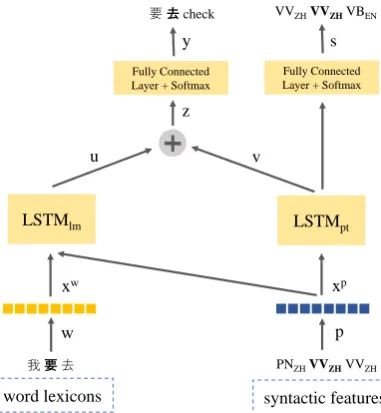
Figure1illustrates our multi-task learning exten-sion to recurrent language model. In this multi-task learning setting, the multi-tasks are language mod-eling and POS tagging. The POS tagging task shares the POS tag vector and the hidden states to LM task, but it does not receive any information from the other loss. Letwtbe the word lexicon in
the document andptbe the POS tag of the
corre-spondingwtat indext. They are mapped into
em-bedding matrices to get theird-dimensional vector representationsxwt andxpt. The input embedding weights are tied with the output weights. We con-catenatexw
t andx p
t as the input of LSTMlm. The
information from the POS tag sequence is shared to the language model through this step.
ut=LSTMlm(xwt ⊕x p t, ut−1)
LSTMlm
PNZHVVZHVVZH
Fully Connected Layer + Softmax
要去check
LSTMpt
我要去
Fully Connected Layer + Softmax
VVZHVVZHVBEN
u v
w p
xw xp
z
word lexicons syntactic features
y s
Figure 1: Multi-Task Learning Framework
where⊕denotes the concatenation operator,ut
andvt are the final hidden states of LSTMlm and
LSTMptrespectively. utandvt, the hidden states
from both LSTMs are summed before predicting the next word.
zt=ut+vt
yt=
ezt PT
j=1ezj
, wherej= 1, ..,T
The word distribution of the next wordytis
nor-malized using softmax function. The model uses cross-entropy losses as error functions Llm and Lpt for language modeling task and POS tagging
task respectively. We optimize the multi-objective losses using the Back Propagation algorithm and we perform a weighted linear sum of the losses for each individual task.
Ltotal =pLlm+ (1−p)Lpt
wherepis the weight of the loss in the training.
3.3 Experimental Setup
In this section, we present the experimental setting for this task
Corpus: SEAME (South East Asia Mandarin-English), a conversational Mandarin-English code-switching speech corpus consists of spon-taneously spoken interviews and conversations (Nanyang Technological University, 2015). Our dataset (LDC2015S04) is the most updated version of the Linguistic Data Consortium (LDC)
database. However, the statistics are not identical toLyu et al. (2010). The corpus consists of two phases. In Phase I, only selected audio segments were transcribed. In Phase II, most of the audio segments were transcribed. According to the authors, it was not possible to restore the original dataset. The authors only used Phase I corpus. Few speaker ids are not in the speaker list pro-vided by the authorsLyu et al.(2010). Therefore as a workaround, we added these ids to the train set. As our future reference, the recording lists are included in the supplementary material.
Table 1: Data Statistics in SEAME Phase I Train set Dev set Test set
# Speakers 139 8 8
# Utterances 45,916 1,938 1,228
# Tokens 762K 31K 17K
Avg. segments
length 3.67 3.68 3.18
[image:3.595.83.274.71.278.2]Avg. switches 3.60 3.47 3.67
Table 2: Data Statistics in SEAME Phase II Train set Dev set Test set
# Speakers 138 8 8
# Utterances 78,815 4,764 3,933
# Tokens 1.2M 65K 60K
Avg. segment
length 4.21 3.59 3.99
[image:3.595.309.526.245.366.2]Avg. switches 2.94 3.12 3.07
Table 3: Code-Switching Trigger Words in SEAME Phase II
POS Tag Freq POS Tag Freq
VVZH 107,133 NNEN 31,031
ADZH 97,681 RBEN 12,498
PNZH 92,117 NNPEN 11,734
NNZH 45,088 JJEN 5,040
VAZH 27,442 INEN 4,801
CDZH 20,158 VBEN 4,703
Training: The baseline model was trained using RNNLM (Mikolov et al., 2011)1. Then, we trained our LSTM models with different hid-den sizes [200, 500]. All LSTMs have 2 layers and unrolled for 35 steps. The embedding size is equal to the LSTM hidden size. A dropout reg-ularization (Srivastava et al., 2014) was applied to the word embedding vector and POS tag em-bedding vector, and to the recurrent output (Gal and Ghahramani,2016) with values between [0.2, 0.4]. We used a batch size of 20 in the train-ing. EOS tag was used to separate every sentence. We chose Stochastic Gradient Descent and started with a learning rate of 20 and if there was no im-provement during the evaluation, we reduced the learning rate by a factor of 0.75. The gradient was clipped to a maximum of 0.25. For the multi-task learning, we used different loss weights hyper-parameterspin the range of [0.25, 0.5, 0.75]. We tuned our model with the development set and we evaluated our best model using the test set, taking perplexity as the final evaluation metric. Where the latter was calculated by taking the exponential of the error in the negative log-form.
PPL(w) =eLtotal
4 Results
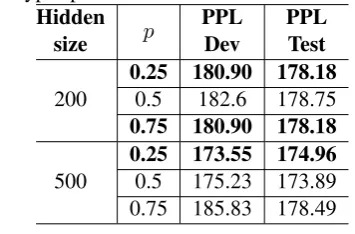
Table 4 and Table 5 show the results of multi-task learning with different values of the hyper-parameterp. We observe that the multi-task model with p = 0.25 achieved the best performance. We compare our multi-task learning model against RNNLM and LSTM baselines. The baselines correspond to recurrent neural networks that are trained with word lexicons. Table 6 and Table 7 present the overall results from different mod-els. The multi-task model performs better than LSTM baseline by 9.7% perplexity in Phase I and 7.4% perplexity in Phase II. The performance of our model in Phase II is also better than the RNNLM (8.9%) and far better than the one pre-sented inAdel et al.(2013b) in Phase I.
Moreover, the results show that adding shared POS tag representation to LSTMlm does not hurt
the performance of the language modeling task. This implies that the syntactic information helps the model to better predict the next word in the sequence. To further verify this hypothesis, we
1downloaded from Mikolov’s website
[image:4.595.320.498.95.212.2]http://www.fit.vutbr.cz/ imikolov/rnnlm/
Table 4: Multi-task results with different weighted loss hyper-parameter in Phase I
Hidden
size p
PPL Dev
PPL Test
200
0.25 180.90 178.18
0.5 182.6 178.75
0.75 180.90 178.18
500
[image:4.595.306.526.249.633.2]0.25 173.55 174.96 0.5 175.23 173.89 0.75 185.83 178.49
Table 5: Multi-task results with different weighted loss hyper-parameter in Phase II
Hidden
size p
PPL Dev
PPL Test
200
0.25 149.68 149.84 0.5 150.92 152.38 0.75 150.32 151.22
500
0.25 141.86 141.71 0.5 144.18 144.27 0.75 145.08 144.85
Table 6: Results in Phase I
Model PPL
Dev
PPL Test RNNLM (Adel et al.,2013a) 246.60 287.88 (Adel et al.,2015) 238.86 245.40 FI + OF (Adel et al.,2013a) 219.85 239.21 FLM (Adel et al.,2013b) 177.79 192.08
LSTM 190.33 185.91
+ syntactic features 178.51 176.57
Multi-task 173.55 174.96
Table 7: Results in Phase II
Model PPL
Dev
PPL Test
RNNLM 178.35 171.27
LSTM 150.65 153.06
+ syntactic features 147.44 148.38
Multi-task 141.86 141.71
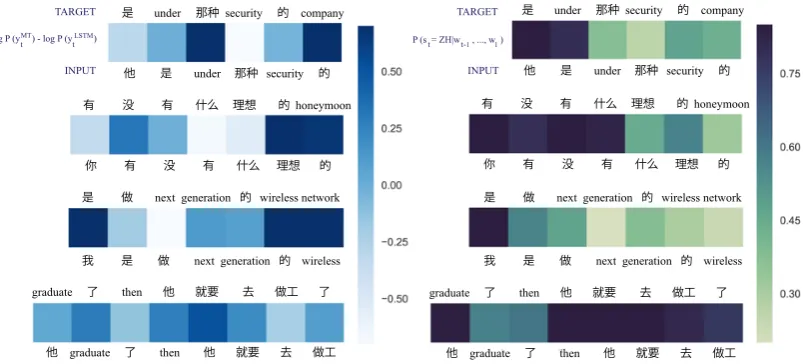
conduct two analysis by visualizing our prediction examples in Figure2:
INPUT
t t t t-1 1
TARGET
MT LSTM
log P (y ) - log P (y )
INPUT TARGET
P (s = ZH|w ,...,w )
他 graduate 了 then 他 就要 去 做工 graduate 了 then 他 就要 去 做工 了
他 是 under那种 security 的 是 under 那种 security 的 company
你 有 没 有 什么 理想 的 有 没 有 什么 理想 的 honeymoon
他 graduate 了 then 他 就要 去 做工 graduate 了 then 他 就要 去 做工 了
他 是 under那种 security 的 是 under 那种 security 的 company
你 有 没 有 什么 理想 的 有 没 有 什么 理想 的 honeymoon
是 做 nextgeneration 的 wireless network
我 是 做 nextgeneration 的 wireless 是 做 nextgeneration 的 wireless network
[image:5.595.102.504.66.248.2]我 是 做 nextgeneration 的 wireless
Figure 2: Prediction examples in Phase II.Left: Each square shows the target word’s log probability improvement by multi-task model compared to LSTM model (Darker color is better). Right: Each square shows the probability of the next POS tag is Chinese (Darker color represents higher probability)
cases, the multi-task model improves the predic-tion of the monolingual segments and particularly in code-switching points such as “under”, “secu-rity”, “generation”, “then”, “graduate”, “他”, and “的”. It also shows that the multi-task model is more precise in learning where to switch language. On the other hand, Table3shows the relative fre-quency of the trigger POS tag. The word “then” belong to RBEN, which is one of the most
com-mon trigger words in the list. Furthermore, the target word prediction is significantly improved in most of the trigger words.
b) Report the probability that the next produced POS tag is Chinese. It is shown that words “then”, “security”, “了”, “那种”, “做”, and “的” tend to switch the language context within the utterance. However, it is very hard to predict all the cases correctly. This is may due to the fact that with-out any switching, the model still creates a correct sentence.
5 Conclusion
In this paper, we propose a multi-task learning ap-proach for code-switched language modeling. The multi-task learning models achieve the best perfor-mance and outperform LSTM baseline with 9.7% and 7.4% improvement in perplexity for Phase I and Phase II SEAME corpus respectively. This implies that by training two different NLP tasks together the model can correctly learn the correla-tion between them. Indeed, the syntactic informa-tion helps the model to be aware of code-switching
points and it improves the performance over the language model. Finally, we conclude that multi-task learning has good potential on code-switching language modeling research and there are still rooms for improvements, especially by adding more language pairs and corpora.
Acknowledgments
This work is partially funded by ITS/319/16FP of the Innovation Technology Commission, HKUST 16214415 & 16248016 of Hong Kong Re-search Grants Council, and RDC 1718050-0 of EMOS.AI.
References
Heike Adel, Ngoc Thang Vu, Katrin Kirchhoff, Do-minic Telaar, and Tanja Schultz. 2015. Syntactic and semantic features for code-switching factored language models. IEEE Transactions on Audio, Speech, and Language Processing, 23(3):431–440.
Heike Adel, Ngoc Thang Vu, Franziska Kraus, Tim Schlippe, Haizhou Li, and Tanja Schultz. 2013a. Recurrent neural network language modeling for code switching conversational speech. In Acous-tics, Speech and Signal Processing (ICASSP), 2013 IEEE International Conference on, pages 8411– 8415. IEEE.
Gustavo Aguilar, Suraj Maharjan, Adrian Pastor L´opez Monroy, and Thamar Solorio. 2017. A multi-task approach for named entity recognition in social me-dia data. In Proceedings of the 3rd Workshop on Noisy User-generated Text, pages 148–153.
Peter Auer and Li Wei. 2007. Handbook of multilin-gualism and multilingual communication, volume 5. Walter de Gruyter.
Hedi M Belazi, Edward J Rubin, and Almeida Jacque-line Toribio. 1994. Code switching and x-bar the-ory: The functional head constraint. Linguistic in-quiry, pages 221–237.
Ronan Collobert, Jason Weston, L´eon Bottou, Michael Karlen, Koray Kavukcuoglu, and Pavel Kuksa. 2011. Natural language processing (almost) from scratch. Journal of Machine Learning Research, 12(Aug):2493–2537.
Chris Dyer, Adhiguna Kuncoro, Miguel Ballesteros, and Noah A Smith. 2016. Recurrent neural network grammars. In Proceedings of NAACL-HLT, pages 199–209.
Sarah Fairchild and Janet G Van Hell. 2017. Determiner-noun code-switching in spanish heritage speakers. Bilingualism: Language and Cognition, 20(1):150–161.
Yarin Gal and Zoubin Ghahramani. 2016. A theoret-ically grounded application of dropout in recurrent neural networks. InAdvances in neural information processing systems, pages 1019–1027.
Kazuma Hashimoto, Caiming Xiong, Yoshimasa Tsu-ruoka, and Richard Socher. 2016. A joint many-task model: Growing a neural network for multiple nlp tasks.arXiv preprint arXiv:1611.01587.
Ying Li and Pascale Fung. 2012. Code-switch lan-guage model with inversion constraints for mixed language speech recognition. Proceedings of COL-ING 2012, pages 1671–1680.
Thang Luong, Quoc V Le, Ilya Sutskever, Oriol Vinyals, and Lukasz Kaiser. 2016. Multi-task se-quence to sese-quence learning.
Dau-Cheng Lyu, Tien-Ping Tan, Eng-Siong Chng, and Haizhou Li. 2010. An analysis of a mandarin-english code-switching speech corpus: Seame. Age, 21:25–8.
Christopher D. Manning, Mihai Surdeanu, John Bauer, Jenny Finkel, Steven J. Bethard, and David Mc-Closky. 2014. The Stanford CoreNLP natural lan-guage processing toolkit. InAssociation for Compu-tational Linguistics (ACL) System Demonstrations, pages 55–60.
Tomas Mikolov, Stefan Kombrink, Anoop Deoras, Lukar Burget, and Jan Cernocky. 2011. Rnnlm-recurrent neural network language modeling toolkit. In Proc. of the 2011 ASRU Workshop, pages 196– 201.
Pieter Muysken. 2000. Bilingual speech: A typology of code-mixing, volume 11. Cambridge University Press.
Carol Myers-Scotton. 1997. Duelling languages: Grammatical structure in codeswitching. Oxford University Press.
Kazuhiko Namba. 2004. An overview of myers-scotton’s matrix language frame model. Senri In-ternational School (SIS) Educational Research Bul-letin, 9:1–10.
Universiti Sains Malaysia Nanyang Technological Uni-versity. 2015. Mandarin-english code-switching in south-east asia ldc2015s04. web download. philadel-phia: Linguistic data consortium.
Shana Poplack. 1980. Sometimes i’ll start a sentence in spanish y termino en espanol: toward a typology of code-switching1.Linguistics, 18(7-8):581–618.
Shana Poplack. 2015. Code-switching (linguistic). In-ternational encyclopedia of the social and behav-ioral sciences, pages 918–925.
Ofir Press and Lior Wolf. 2017. Using the output em-bedding to improve language models. In Proceed-ings of the 15th Conference of the European Chap-ter of the Association for Computational Linguistics: Volume 2, Short Papers, volume 2, pages 157–163.
Nitish Srivastava, Geoffrey Hinton, Alex Krizhevsky, Ilya Sutskever, and Ruslan Salakhutdinov. 2014. Dropout: A simple way to prevent neural networks from overfitting. The Journal of Machine Learning Research, 15(1):1929–1958.
Kristina Toutanova, Dan Klein, Christopher D Man-ning, and Yoram Singer. 2003. Feature-rich part-of-speech tagging with a cyclic dependency network. InProceedings of the 2003 Conference of the North American Chapter of the Association for Computa-tional Linguistics on Human Language Technology-Volume 1, pages 173–180. Association for Compu-tational Linguistics.
Huihsin Tseng, Daniel Jurafsky, and Christopher Man-ning. 2005. Morphological features help pos tag-ging of unknown words across language varieties. InProceedings of the fourth SIGHAN workshop on Chinese language processing.
Ngoc Thang Vu, Dau-Cheng Lyu, Jochen Weiner, Do-minic Telaar, Tim Schlippe, Fabian Blaicher, Eng-Siong Chng, Tanja Schultz, and Haizhou Li. 2012. A first speech recognition system for mandarin-english code-switch conversational speech. In Acoustics, Speech and Signal Processing (ICASSP), 2012 IEEE International Conference on, pages 4889–4892. IEEE.