John R. Hesselink1 Christopher F. Dowd1.2 Mark E. Healy1.2 Paul Hajek 1.3
Lori L. Baker1,4
Thomas G, Luerssen5
This article appears in the March/April 1988 issue of AJNR and the May 1988 issue of AJR.
Received July 29, 1986; accepted after revision September 1, 1987.
1 Department of Radiology, University of Califor -nia School of Medicine, and Magnetic Resonance Institute, San Diego, CA 92103. Address reprint requests to J. R. Hesselink, UCSD Medical Center, 225 Dickinson St., San Diego, CA 92103.
2 Present address: Department of Radiology, University of California School of Medicine, San Francisco, CA 94143.
3 Present address: I. Med. Klinik/Rontgenstation, Lazarettgasse 14, A-1090 Wein, Austria.
4 Present address: Department of Diagnostic Ra -diology, Stanford University School of Medicine, Stanford, CA 94305.
5 Department of Neurosurgery, University of Cal-ifornia School of Medicine, and MagnetiC Re so-nance Institute, San Diego, CA 92103.
AJNR 9:269-278, March/April 1988 0195-6108/88/0902-0269
© American Society of Neuroradiology
269
MR Imaging of Brain Contusions:
A Comparative Study with CT
Ninety-eight brain contusions in 17 patients served as a data base for a comparative study of MR and CT for defining brain contusions. MR was the more sensitive technique, detecting 98% of the brain contusions compared with only 56% by CT. CT was slightly better for showing hemorrhagic components, documenting 77% of hemorrhages com-pared with 71% for MR. The appearance of the contusions on MR was variable, depending on the T1- and T2-weighting of the images and the constituents of the contusions, such as edema, hemorrhage, and encephalomalacia. On MR, hemorrhagic components appeared as high signal on T1-weighted images and as either low or high signal on T2-weighted images, depending on the age of the hemorrhage. The approxi-mate ages of hemorrhagiC contusions were often suggested by their appearance on T1 -and T2-weighted images.
CT is very effective for evaluating acute head trauma, but MR is recommended for documenting brain contusions during the subacute and chronic stages of head injuries.
In the few years since its introduction, MR has assumed a major role in imaging the CNS. The superior sensitivity of MR for early detection of demyelinating disease,
cerebral neoplasia, infarction, and inflammation is generally accepted. Moreover,
its multi planar imaging capability affords better delineation of intracranial mass lesions and improves characterization of congenital malformations. MR is also very effective for evaluating chronic subdural hematomas [1-4]. Despite the successes
of MR, CT has remained the primary imaging method in acute head trauma because
of its sensitivity in detecting acute intracranial hemorrhage and its rapid scanning capability [5-8]. MR has not made much impact in this area primarily for three
reasons: first, acute hemorrhage may be isointense and difficult to see on the MR images; second, these patients require various support equipment, much of which
cannot be taken into the magnet room; and third, MR imaging requires more time,
and time is a critical factor in patients with intracranial hemorrhage.
Nevertheless, head-injury studies at the University of California, San Diego,
Medical Center and at other institutions have documented significant neurologic and behavioral residuals in head-injury patients who had entirely normal CT scans [9-11]. Obviously, more sophisticated imaging of the brain is required to study the neuroanatomic correlates of brain abnormalities in these patients. We conducted a comparative study to determine the sensitivity and accuracy of CT and MR for defining brain contusions in the subacute and chronic stages after injury.
Subjects and Methods
Study subjects came from an unselected group of head-injured patients who were being followed by one of us because of residual neurologic or behavioral problems. Only patients
270
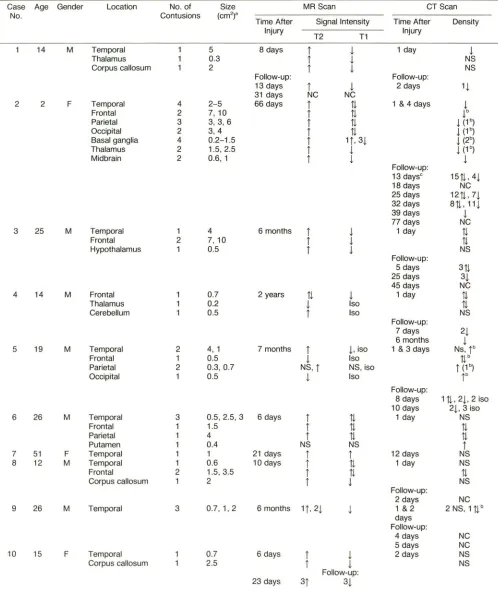
HESSELINK ET AL. AJNR:9, March/April 1988TABLE 1: Summary of 17 Patients with Brain Contusions Studied with MR Imaging and CT
Case Age Gender Location No. of Size MR Scan CT Scan
No. Contusions (cm2).
Time After Signal Intensity Time After Density Injury
T2 T1 Injury
14 M Temporal 5 8 days j ! 1 day !
Thalamus 0.3 j ! NS
Corpus callosum 2 j ! NS
Follow-up: Follow-up:
13 days j ! 2 days 1!
31 days NC NC
2 2 F Temporal 4 2-5 66 days j il 1 & 4 days !
Frontal 2 7,10 j il ! b
Parietal 3 3,3,6 j il ! (1")
Occipital 2 3,4 j it ! (1 b)
Basal ganglia 4 0.2-1.5 j 1j,3! ! (2b)
Thalamus 2 1.5,2.5 j ! ! (1 b)
Midbrain 2 0.6,1 j ! !
Follow-up:
13 daysc 15il,4!
18 days NC
25 days 12it,7! 32 days 8il,11!
39 days !
77 days NC
3 25 M Temporal 1 4 6 months j ! 1 day il
Frontal 2 7,10 j ! it
Hypothalamus 1 0.5 j ! NS
Follow-up:
5 days 3it
25 days 3!
45 days NC
4 14 M Frontal 0.7 2 years il ! 1 day it
Thalamus 0.2 ! Iso il
Cerebellum 0.5 j Iso NS
Follow-up:
7 days 2!
6 months !
5 19 M Temporal 2 4, 1 7 months j
!.
iso 1 & 3 days Ns, jbFrontal 1 0.5 ! Iso ilb
Parietal 2 0.3,0.7 NS, j NS, iso j (1b)
Occipital 1 0.5 ! Iso jb
Follow-up:
8 days 1 il, 2!, 2 iso
10 days 2!,3isO
6 26 M Temporal 3 0.5,2.5,3 6 days j j! 1 day NS
Frontal 1 1.5 j i! il
Parietal 1 4 j il it
Putamen 1 0.4 NS NS j
7 51 F Temporal 1 1 21 days j j 12 days NS
8 12 M Temporal 1 0.6 10 days j i! 1 day NS
Frontal 2 1.5,3.5 j j! i!
Corpus callosum 1 2 j ! NS
Follow-up:
2 days NC
9 26 M Temporal 3 0.7,1,2 6 months 1j,2! ! 1 & 2 2 NS, 1
it
bdays Follow-up:
4 days NC
5 days NC
10 15 F Temporal 0.7 6 days j ! 2 days NS
Corpus callosum 2.5 j
!
NSFollow-up:
[image:2.612.58.556.102.699.2]AJNR:9, March/April 1988 MR OF BRAIN CONTUSIONS 271
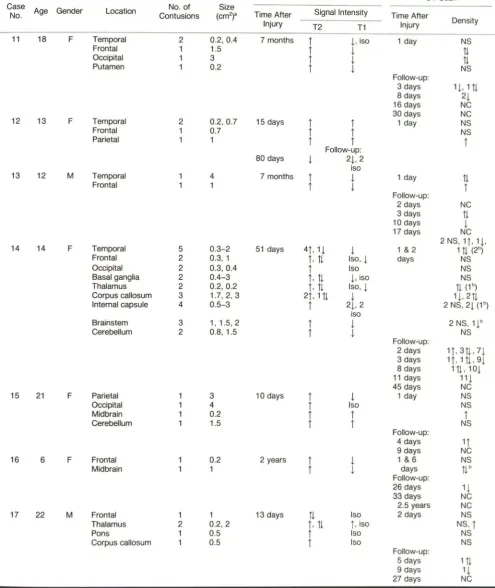
TABLE 1: (Continued)
MR Scan CT Scan
Case
Age Gender Location No. of Size Signal Intensity
No. Contusions (cm2)a Time After Time After
Injury T2 T1 Injury Density
11 18 F Temporal 2 0.2,0.4 7 months j 1, iso 1 day NS
Frontal 1 1.5 j 1
it
Occipital 1 3 j 1
it
Putamen 1 0.2 j 1 NS
Follow-up:
3 days 11, 1
it
8 days 21
16 days NC
30 days NC
12 13 F Temporal 2 0.2,0.7 15 days j j 1 day NS
Frontal 1 0.7 j j NS
Parietal 1 1 j j j
Follow-up:
80 days 1 21. 2
iso
13 12 M Temporal 4 7 months j 1 1 day
it
Frontal 1 j 1 j
Follow-up:
2 days NC
3 days
it
10 days 1
17 days NC
14 14 F Temporal 0.3-2
2 NS, 1j, 11,
5 51 days 4j, 11 1 1 & 2 1
it
(2b)Frontal 2 0.3, 1 j, U Iso, 1 days NS
Occipital 2 0.3,0.4 j Iso NS
Basal ganglia 2 0.4-3 j, it 1, iso NS
Thalamus 2 0.2,0.2 j,
it
Iso, 1 U (1b)Corpus callosum 3 1.7,2,3 2j, 1 U 1 11,2U
Internal capsule 4 0.5-3 j 21, 2 2 NS, 21 (1b)
iso
Brainstem 3 1, 1.5,2 j 1 2 NS, 11b
Cerebellum 2 0.8,1.5 j t NS
Follow-up:
2 days 1j, 3U, 71
3 days 1j,1U,9t
8 days 1 U, 10t
11 days 111
45 days NC
15 21 F Parietal 3 10 days j t 1 day NS
Occipital 4 j Iso NS
Midbrain 0.2 j j j
Cerebellum 1.5 j j NS
Follow-up:
4 days 1j
9 days NC
16 6 F Frontal 0.2 2 years j 1 1 & 6 NS
Midbrain 1 j 1 days
i1
bFollow-up:
26 days 11
33 days NC
2.5 years NC
17 22 M Frontal 1 1 13 days U Iso 2 days NS
Thalamus 2 0.2,2 j, U j, iso NS, j
Pons 1 0.5 j Iso NS
Corpus callosum 1 0.5 j Iso NS
Follow-up:
5 days 1
i1
9 days 11
27 days NC
Note. -T1 = T1-weighted images; T2 = T2-weighted images; NS = contusion not seen; NC = no change; iso = isointense (MR) or isodense (CT);
1
= increased, ! = decreased, and iL = mixed signal intensity (MR) or density (CT). Under follow-up, contusions from all locations are combined for each patient• For three or fewer contusions, the size of each contusion is given; for more than three the range is given. b The contusion was first seen on the second CT study.
[image:3.614.59.554.106.694.2]272 HESSELINK ET AL. AJNR:9, March/April 1988
Fig. 1.-Case 8: temporal and inferior frontal contusions.
A, CT scan 2 days after injury shows no parenchymal abnormality. High-density streak artifacts partially obscure frontal and temporal lobes. B, Proton-density-weighted MR scan (SE 20/3000) at 10 days reveals high-signal abnormalities in right temporal and inferior frontal lobes (arrows). C, T1-weighted image (SE 20/600) shows high-signal areas within contusions, indicating hemorrhagic components (arrows).
A
B
Fig. 2.-Case 8: shear injury of corpus callosum.
A, CT scan shows some blood along posterior falx. Asymmetry of lateral ventricles is from slight head tilt.
Band C, Proton-density-weighted (B, SE 20/3000) and T2-weighted (C, SE 70/3000) images reveal large contusion in splenium of corpus callosum
(arrows). Thin subdural hematoma is present in right occipital region, and subdural effusions are noted over both frontal lobes.
sectioning. In many cases, serial scans within the first 3 weeks of injury were available for review. MR scans were obtained 6 days to 2 years after initial injury.
The technical parameters for MR included a field strength of 1.5 T, slice thickness of 5 mm with a 2.5-mm interslice gap, 256 x 256 matrix, 20-cm field of view, and two excitations. Axial scans were obtained in all patients, supplemented with sagittal or coronal views
in selected cases. Pulse sequences included a T2-weighted spin -echo sequence with a repetition time (TR) of 2000-3000 msec and asymmetric echoes (TEs) of 20-25 and 70 msec, and a T1-weighted spin-echo sequence with TR = 600 msec and
n
'
= 20-25 msec. [image:4.613.54.560.79.310.2] [image:4.613.54.561.366.611.2]AJNR:9, March/April 1988 MR OF BRAIN CONTUSIONS 273
were studied further to determine the spectrum of findings in cerebral contusions during the various stages of evolution. Other intracranial abnormalities, such as epidural and subdural hematomas, were not included because the study was designed specifically for contusions and because many of the extracerebral hematomas were observed by CT during the acute phase of head injury and were surgically drained before MR was performed.
Results
The imaging studies revealed 98 brain contusions in 17 patients (Table 1). The number of contusions ranged from as many as 25 in one patient (case 14) to as few as one temporal
lobe contusion in case 7. The size of the contusions ranged from 0.2 to 10 cm2
.
The contusions had variable appearances on MR and CT scans. On T2-weighted images, 83 contusions were of in -creased signal intensity, 6 were of low, and seven were of mixed signal intensity. On T1-weighted images, 50 were low signal, nine increased signal, 19 mixed signal intensity, and 18 isointense. On CT, 25 of the contusions were low density, 10 high density, and 20 mixed density. As indicated in Table
TABLE 2: Locations of Contusions in Patients Studied by MR Imaging and CT
Location
Temporal lobe Frontal lobe Parietal lobe Occipital lobe Basal ganglia
Thalamus/hypothalamus Corpus callosum Internal capsule Brainstem Cerebellum
Total
Fig. 3.-Case 17: brainstem contusion.
A, CT scan. No abnormality is seen in brain
-stem.
B, T2-weighted MR scan (SE 60/2000) shows
abnormal high-signal area within right anterior
aspect of pons (arrow). MR scan was obtained
at more negative plane angle than CT scan.
No.
27 16 8 7 8 9 7 4 8 4 98
1, on follow-up studies, the signal and density characteristics of many of the contusions changed, primarily reflecting evo -lution of the hemorrhagic components. In addition, in case 2, 15 contusions that were initially low density became mixed density on follow-up CT after the patient developed coagu -lopathy.
The temporal lobe was the most common site of injury, accounting for 28% of all contusions (Fig. 1), followed by the frontal lobe with 16% (Table 2). Of the eight basal ganglionic lesions, four were in the putamen, three in the caudate
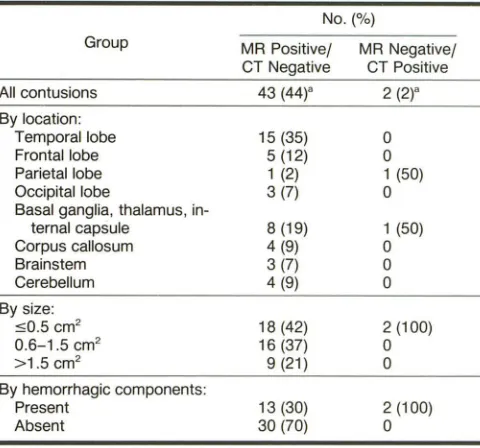
TABLE 3: Sensitivities of MR and CT for Detecting Brain Contusions
No. (%)
Group MR Positive/ MR Negative/
CT Negative CT Positive
All contusions 43 (44)' 2 (2)'
By location:
Temporal lobe 15 (35) 0
Frontal lobe 5 (12) 0
Parietal lobe 1 (2) 1 (50)
OCCipital lobe 3 (7) 0
Basal ganglia, thalamus, in
-ternal capsule 8 (19) 1 (50)
Corpus callosum 4 (9) 0
Brainstem 3 (7) 0
Cerebellum 4 (9) 0
By size:
::::0.5 cm2
18 (42) 2 (100) 0.6-1.5 cm2
16 (37) 0
>1.5 cm2
9 (21) 0
By hemorrhagic components:
Present 13 (30) 2 (100)
Absent 30 (70) 0
[image:5.612.316.556.253.477.2] [image:5.612.63.560.335.736.2]274
HESSELINK ET AL. AJNR:9, March/April 1988A
B
Fig. 4.-Case 17: hemorrhagic thalamic contusion.
A, CT scan 2 days after injury reveals focus of hemorrhage in left thalamus with some surrounding low density.
8, T1-weighted image (SE 25/600) 13 days after injury. Central area is of high signal because of T1 shortening from paramagnetic effect of methemoglobin.
C, T2-weighted image (SE 60/2000) reveals three components to lesion: (1) high-signal center represents hematoma cavity similar to that in 8, (2) ringlike area of low signal likely is from early deposition of hemosiderin about perimeter of hematoma, and (3) higher signal outside ring has poorly defined margins and represents some associated brain edema. Also noted is small contusion in splenium of corpus callosum (arrow) not seen in A or 8.
A
B
c
Fig. 5.-Case 12: hemorrhagic contusion.
A, T2-weighted image (SE 70/2000) 15 days after head injury shows small cortical contusion (arrow).
8, Corresponding T1-weighted image (SE 25/600) reveals components with short T1 (arrow), indicating methemoglobin within hemorrhagic contusions. C, Follow-up T2-weighted scan (SE 70/2000) 80 days after injury. Contusion is predominantly of low signal intensity (arrow), consistent with hemosiderin.
nucleus, and one in the globus pallidus. The one patient with a hypothalamic lesion developed diabetes insipidus. Seven contusions were found in the corpus callosum, including four in the splenium, two in the posterior body, and one in the
anterior body (Fig. 2). The midbrain was the most common site in the brainstem, accounting for six of eight contusions.
[image:6.612.56.560.85.322.2] [image:6.612.56.560.393.634.2]AJNR:9. March/April 1988 MR OF BRAIN CONTUSIONS 275
Fig. 6.-Case 4: hemorrhagic contusion of
thalamus.
A, CT scan 1 day after head injury shows hemorrhagic contusion in left thalamus (arrow). B, Scan 6 months later is normal with no evidence of calcification or hemorrhage.
C, T2-weighted MR scan (SE 60/1500) 2 years after injury reveals low signal intensity (arrow) at site of previous hemorrhage, reflecting T2 shortening, presumably secondary to deposition of hemosiderin.
D, Same area is isointense on T1-weighted image (SE 25/600).
A
Forty-three contusions (44%) were missed by CT compared with only two (2%) by MR (Table 3). The temporal lobe was
the most common site of CT misses (Fig. 1). Correlation of
these data with Table 2 also reveals that all four cerebellar
contusions were missed by CT. It is not surprising that more false negatives occurred with smaller contusions, where par-tial-volume effects might be a factor. CT was more likely to
miss bland contusions (70%) than hemorrhagic ones (30%).
The contusions missed by MR were 0.3 and 0.4 cm2
in size
and contained hemorrhagic components that were detected
by CT on the first day after trauma.
Hemorrhagic components were noted by imaging studies in 56 (57%) of the contusions (Table 1). Twenty-seven (48%)
of the hemorrhagic components were seen by both MR and
B
CT, 13 (23%) by MR only, and 16 (29%) by CT only. In the
patients who had follow-up CT scans, the contusions were noted to become isodense between 3 and 8 days, excluding
case 2 with complicating coagulopathy. Methemoglobin.
de-tected as increased signal on T1-weighted images, as pr
es-ent in 28 contusions scanned between 6 da and 2 months
after injury (Figs. 1, 4, and 5). Hemosiderin was observed as
low signal intensity on T2- eigh ed ima es in 15 contusions
(Figs. 4-6). Hemosiderin as een a earl a 13 days and
as late as 2 years after e In inj _ 0 e esian scanned
at 13 days was captured in a e with the
central methemoglo in urrou
(Fig. 4). In case 12 four hRfJlnrrlul,n~
[image:7.612.150.555.83.539.2]T1-276 HESSELINK ET AL. AJNR:9, March/April 1988
follow-up MR scan at 80 days, all four contusions became low signal on T2-weighted images, indicating conversion of
the methemoglobin to hemosiderin (Fig. 5).
Discussion
Traumatic injury to the brain is determined to a great extent
by the physical properties of the brain and skull. The brain is
extremely incompressible and has very little rigidity. Its volume
can be decreased only by exerting great pressure. On the
other hand, relatively little effort is required to distort the
shape of the brain. The brain substance is of relatively uniform
density. Slight differences exist between gray and white
mat-ter and between the CSF of the ventricles and brain
paren-chyma. The skull, on the other hand, has great rigidity [12].
The shape of the skull and brain are important in
determin-ing the location of brain contusions. Cortical injury is more
likely adjacent to roughened edges of the inner table of the
skull along the floor of the anterior cranial fossa, sphenoid
wings, and petrous ridges. Tissue disruption and cell injury
are associated with release of vasoactive substances and
other byproducts. Subsequent increase in vascular
permea-bility to serum proteins results in a progressive increase in
tissue water content. Over several days, edema fluid spreads
within the white matter. More serious injuries may be
asso-ciated with vascular disruption and hemorrhage into
contu-sions [12-14].
Rotational forces associated with severe head injuries
pro-duce shear stresses on the brain parenchyma. Since the brain
lacks structural rigidity, when the skull is rapidly rotated, the
brain lags behind, causing axial stretching, separation, and
disruption of nerve fiber tracts [12, 15]. Shear injuries com-monly occur at junctions between gray and white matter but are also found in the deeper white matter of the centrum
semiovale, corpus callosum, internal capsule, basal ganglia,
brainstem, and cerebellum [16].
The superior sensitivity of MR in detecting subacute and
chronic brain contusions in our series is not surprising (Table
3). Increased water in the form of edema fluid and associated
hemorrhagic components makes contusions readily visible on
T2-weighted images. T2-weighted images were more
sensi-tive than T1-weighted images, whether or not hemorrhage was present. Eighteen contusions were isotense on
T1-weighted images. MR was particularly helpful in identifying
contusions in the inferior frontal and temporal regions (Fig. 1).
These areas are difficult to evaluate on CT because of
streak-ing artifacts from bone at the base of the skull. Similar results
were reported by Zimmerman et al. [17] in a comparative
study of MR and CT for evaluating head injury. Although both
MR and CT showed acute hemorrhagic contusions, they
found MR to be far superior to CT in the detection and
characterization of shear injuries and hemorrhagic and
non-hemorrhagic contusions during the subacute and chronic
stages.
Imaging brainstem contusions is also a problem for CT
because interpetrous artifacts often obscure the anatomy in
the posterior fossa (Fig. 3). Deceleration forces associated
with impact to the head can result in momentary displacement
of the brainstem away from its normal anatomic position. This
distortion of anatomy may produce shear injury, tearing of
penetrating arteries or veins, and compression of the
brain-stem against the sharp edges of the tentorium or surfaces of
the clivus and petrous bones [12, 15]. Since the brainstem
has a rather dense population of cranial nerve nuclei and
important fiber tracts, a small lesion can result in profound
neurologic deficits. Obviously, an accurate assessment of
injuries to the brainstem is critical for an accurate prediction of the patient's recovery or morbidity. Our data confirm that
MR is clearly the imaging procedure to use for assessing
brainstem injury.
At least 21 of the brain contusions seen in our series can
be accurately classified as white-matter shear injuries, includ-ing those in the corpus callosum (Figs. 2 and 4), internal
capsule, and hemispheric white matter. In addition, most of
the contusions of the brainstem, basal ganglia, and thalamus
fit into this category. The brainstem contains many major fiber
tracts, such as the cerebellar peduncles and the corticospinal
tracts. Multiple fiber tracts also connect the basal ganglia and
thalamus with each other, with various brainstem nuclei, and
with the cerebral cortex. In a pathologic study, Adams et al.
[15] noted that many midbrain contusions were located in the region of the superior cerebellar peduncle.
In a clinicopathologic study of white-matter shear injuries, Zimmerman et al. [8] found that CT scans often showed
generalized cerebral swelling, subarachnoid hemorrhage,
ec-centric hemorrhage in the corpus callosum, and occasionally
focal blood adjacent to the third ventricle and in the hemi-spheric white matter. Identification of focal lesions on CT was difficult on the basis of low density alone and was primarily
dependent on detecting focal hemorrhage. Zimmerman et al.
also noted that CT failed to demonstrate more rostral shear
injuries in the internal capsule and brainstem that were later
found at autopsy. In a later comparative study of MR and CT
of head injury by the same group [17], seven of seven shear injuries were seen by MR; all were missed by CT.
Contrast-enhanced CT has not proved to be very useful for
assessing head injuries. In a study of 70 patients with acute
head injury, Mauser et al. [18] found that contrast-enhanced
scans provided no information not provided by plain CT in
94% of cases, and they concluded that IV contrast material
is not needed.
In our series, hemorrhagic components were documented
by CT or MR in over one-half of the brain contusions. Although CT was slightly more sensitive than MR for detecting
hem-orrhage, 13 hemorrhagic contusions were missed by CT,
compared with only two misses by MR (Table 3). Even though
MR missed 16 hemorrhagic components, 14 of these
contu-sions were still detected as high-signal foci on T2-weighted
images.
CT is considered to be very sensitive for the detection of
brain hemorrhage. Nevertheless, the sensitivity will depend
on the temporal relationship between the scan and the onset
of hemorrhage. The increased density of hemorrhage on CT
AJNR:9, March/April 1988 MR OF 8RAIN CONTUSIONS 277
Fig. 7.-Posttraumatic encephalomalacia in
young girl who had moderately severe head
trauma 2 years previously. Axial
proton-density-weighted (A, SE 30/2000) and sagittal
T1-weighted (B, SE 25/600) MR scans show cystic
degeneration of right anterior temporal lobe in
area of temporal lobe contusion. The patient also
had an orbital implant and prosthesis.
Fig. B.-Iatrogenic brain injury.
A, T2-weighted axial MR image (SE 60/1500)
shows small adjacent areas of low and high
signal within thalamus (long arrow). Another
low-signal area is noted in left globus pallidus (short
arrow). Areas of low intensity probably reflect focal deposition of hemosiderin; area of high intensity is probably an area of gliosis.
B, Sagittal section (SE 25/600) reveals linear
character of these abnormalities (arrows), which
resulted from multiple passes for insertion of
ventriculostomy catheter.
A
length of time depending on the size of the hematoma (Fig.
6). Initially, hemorrhagic contusions will be high density, but,
with time, they progress through an isodense stage and
eventually become low density and indistinguishable from
non hemorrhagic contusions [19]. It follows that CT is very
sensitive for detecting acute hemorrhage into contusions, but
relatively insensitive in the subacute and chronic stages. Also,
in the acute stage, a small amount of hemorrhage into a
contusion could possibly make it appear isointense on CT,
thereby masking the underlying contusion.
The MR appearance of hemorrhagic contusions is very
dynamic, changing over time as the internal chemistry of the
8
hematoma changes. In acute hematomas, deoxyhemoglobin
results in shortening of T2 and low signal on T2-weighted
images [20]. After 3-4 days, the deoxyhemoglobin is
con-verted to methemoglobin by an oxidative reaction, which
results primarily in T1 shortening and high signal on
T1-weighted images [21, 22] (Figs. 1 C, 48, and 58). With further degradation of the methemoglobin, hemosiderin is formed
and taken up by macrophages around the perimeter of the
hematoma. The primary effect of hemosiderin is shortening
of T2 and low signal on T2-weighted images [20]. We have
[image:9.612.222.556.89.566.2]278
HESSELINK ET AL. AJNR:9, March/April 19885C, and 6C). Hemorrhages at this chronic stage may appear
isointense on T1-weighted images. Since the evolution of magnetic properties within a hematoma is so dynamic, the
signal intensities on T1- and T2-weighted images provide
clues about the approximate age of hemorrhagic contusions.
A hemorrhagic contusion imaged during anyone of the
tran-sition periods may have a target appearance with multiple
layers of different signal intensities (Fig. 4C).
On the other hand, the changes of a nonhemorrhagic
contusion are less dramatic. During the initial phases, one first observes focal areas of T1 and T2 prolongation from brain edema and increased water content in the lesion. In larger contusions, mass effect on adjacent brain structures is often associated with these changes. The brain edema
in-creases over the first few days and then slowly decreases
over time. The end result of non hemorrhagic contusions is
areas of encephalomalacia with varying degrees of sulcal
prominence and focal ventricular dilatation (Fig. 7).
Another factor to remember in the interpretation of MR images of cerebral contusions is that many acutely head-injured patients require neurosurgical intervention in the form
of a temporary ventriculostomy catheter or some type of
ventricular shunt for more long-term decompression of the ventricles. These interventional procedures injure the brain and may also have hemorrhagic components (Fig. 8). Multi-planar imaging with MR often helps define the linear character of these abnormalities to help distinguish them from contu-sions related to the initial head injury.
In conclusion, in subacute and chronic stages of head
injuries, MR is more sensitive than CT for detecting brain
contusions. T2-weighted spin-echo images are best for
dem-onstrating the abnormalities. CT is better than MR for showing hemorrhagic components during the acute phase of trauma.
Hemorrhages are displayed on MR as high signal intensity on T1-weighted images and as either low or high signal on T2-weighted images, depending on the age of the hemorrhage.
The approximate age of hemorrhagic contusions is often
suggested by the signal characteristics and appearance on
T1- and T2-weighted images. The improved detection and
anatomic localization of brain contusions by MR provides new
opportunities to correlate brain structure with function, and
should also allow more accurate assessment of brain injuries
and prediction of outcome. CT will likely retain an important role in evaluating acute head injuries to exclude life-threaten-ing intracranial hemorrhage or cerebral swelling. Definition of the role of MR in evaluating acute head trauma requires further investigation.
REFERENCES
1. Young IR, Bydder GM, Hall AS, et al. Extracerebral collections by NMR
imaging. AJNR 1983;4:833-834
2. Sipponen JT, Sipponen RE, Sivula AS. Chronic subdural hematoma dem
-onstration by magnetic resonance. Radiology 1984;150:79-85 3. Moon KL Jr, Brant-Zawadzki M, Pitts LH, et al. Nuclear magnetic
reso-nance imaging of CT-isodense subdural hematomas. AJNR 1984;5: 319-322
4. Han JS, Kaufman B, Alfidi RJ. Head trauma evaluation by magnetic
resonance and computed tomography: a comparison. Radiology
1984;150:71-77
5. Dublin AB, French BN, Rennick JM. Computed tomography in head trauma.
Radiology 1977;122: 365-369
6. Forbes GS, Sheedy PF II, Piepgras DG, Houser OW. Computed tomogra-phy in the evaluation of subdurdal hematomas. Radiology 1978;126:
143-148
7. Zimmerman RA, Bilaniuk LT, Gennarelli T, Bruce 0, Dolinskas C, Uzzell B.
Cranial computed tomography in diagnosis and management of acute
head trauma. AJR 1978;131 :27-34
8. Zimmerman RA, Bilaniuk L T, Gennarelli T. Computed tomography of shearing injuries of cerebral white matter. Radiology 1978;127:393-396 9. Kalsbeek WD, McLaurin RL, Harris BSH, Miller JD. The national head and
spinal cord injury survey: major findings. J Neurosurg 1980;53:S19-S31.
10. Young B, Rapp RP, Norton JA, Haack 0, Tibbs PA, Bean JR. Early
prediction of outcome in head-injured patients. J Neurosurg
1981;54:300-303
11. Clifton GL, Gross RG, Makela ME, Miner ME, Handel S, Sadhu V. Neuro
-logical course and correlated computerized tomography findings after
severe closed head injury. J Neurosurg 1980;52:611-624
12. Holbourn AHS. Mechanisms of head injuries. Lancet 1943;2:438-441
13. Tornheim RA. Traumatic edema in head injury. In: Becker DP, Povlishock
JT, eds. Central nervous system trauma: status report. Bethesda, MD:
NINCDS, 1985:431-442
14. Jennett B, Teasdale G. Dynamic pathology in management of head injuries. Philadelphia: Davis, 1981 :45-75
15. Adams JH, Mitchell DE, Graham 01, Doyle D. Diffuse brain damage of
immediate impact type: its relationship to primary brainstem damage in head injury. Brain 1977;100:489-502
16. Peerless SJ, Rewcastle NB. Shear injuries of the brain. Can Med Assoc J
1966;96: 577-582
17. Zimmerman RA, Bilaniuk L T, Hackney DB, Goldberg HI, Grossman RI.
Head injury: early results of comparing CT and high-field MR. AJNR
1986;7:757-764
18. Mauser HW, vanNieuwenhuizen 0, Veiga-Pires JA. Is contrast-enhanced CT indicated in acute head injury? Neuroradiology 1984;26:31-32
19. Zimmerman RA, Bilaniuk L T, Dolinskas C, Gennarelli T, Bruce 0, Uzzell B. Computed tomography of acute intracerebral hemorrhagic contusion. Comput Tomogr 1977;1 :271-288
20. Gomori JM, Grossman RI, Goldberg HI, Zimmerman RA, Bilaniuk LT.
Intracranial hematomas: imaging by high-field MR. Radiology 1985;
157:87-93
21. Bradley WG Jr, Schmidt PG. Effect of methemoglobin formation on the
MR appearance of subarachnoid hemorrhage. Radiology 1985;156:
99-103
22. Sipponen JT, Sipponen RE, Tanttu JI, et al. Intracranial hematomas studied