Text-level Discourse Dependency Parsing
Sujian Li
1Liang Wang
1Ziqiang Cao
1Wenjie Li
21
Key Laboratory of Computational Linguistics, Peking University, MOE, China
2Department of Computing, The Hong Kong Polytechnic University, HongKong
{lisujian,intfloat,ziqiangyeah}@pku.edu.cn
Abstract
Previous researches on Text-level discourse parsing mainly made use of constituency structure to parse the whole document into one discourse tree. In this paper, we present the limitations of constituency based dis-course parsing and first propose to use de-pendency structure to directly represent the relations between elementary discourse units (EDUs). The state-of-the-art depend-ency parsing techniques, the Eisner algo-rithm and maximum spanning tree (MST) algorithm, are adopted to parse an optimal discourse dependency tree based on the arc-factored model and the large-margin learn-ing techniques. Experiments show that our discourse dependency parsers achieve a competitive performance on text-level dis-course parsing.
1
Introduction
It is widely agreed that no units of the text can be understood in isolation, but in relation to their context. Researches in discourse parsing aim to acquire such relations in text, which is funda-mental to many natural language processing ap-plications such as question answering, automatic summarization and so on.
One important issue behind discourse parsing is the representation of discourse structure. Rhe-torical Structure Theory (RST) (Mann and Thompson, 1988), one of the most influential discourse theories, posits a hierarchical genera-tive tree representation, as illustrated in Figure 1. The leaves of a tree correspond to contiguous text spans called Elementary Discourse Units (EDUs)1. The adjacent EDUs are combined into
1
EDU segmentation is a relatively trivial step in discourse parsing. Since our work focus here is not EDU segmenta-tion but discourse parsing. We assume EDUs are already known.
the larger text spans by rhetorical relations (e.g., Contrast and Elaboration) and the larger text spans continue to be combined until the whole text constitutes a parse tree. The text spans linked by rhetorical relations are annotated as either nucleus or satellite depending on how sali-ent they are for interpretation. It is attractive and challenging to parse the whole text into one tree. Since such a hierarchical discourse tree is analogous to a constituency based syntactic tree except that the constituents in the discourse trees are text spans, previous researches have explored different constituency based syntactic parsing techniques (eg. CKY and chart parsing) and var-ious features (eg. length, position et al.) for dis-course parsing (Soricut and Marcu, 2003; Joty et al., 2012; Reitter, 2003; LeThanh et al., 2004; Baldridge and Lascarides, 2005; Subba and Di Eugenio, 2009; Sagae, 2009; Hernault et al., 2010b; Feng and Hirst, 2012). However, the ex-isting approaches suffer from at least one of the following three problems. First, it is difficult to design a set of production rules as in syntactic parsing, since there are no determinate genera-tive rules for the interior text spans. Second, the different levels of discourse units (e.g. EDUs or larger text spans) occurring in the generative process are better represented with different fea-tures, and thus a uniform framework for dis-course analysis is hard to develop. Third, to reduce the time complexity of the state-of-the-art constituency based parsing techniques, the ap-proximate parsing approaches are prone to trap in local maximum.
In this paper, we propose to adopt the depend-ency structure in discourse representation to overcome the limitations mentioned above. Here is the basic idea: the discourse structure consists of EDUs which are linked by the binary, asym-metrical relations called dependency relations. A dependency relation holds between a subordinate EDU called the dependent, and another EDU on
which it depends called the head, as illustrated in Figure 2. Each EDU has one head. So, the de-pendency structure can be seen as a set of head
-dependent links, which are labeled by functional relations. Now, we can analyze the relations be-tween EDUs directly, without worrying about any interior text spans. Since dependency trees contain much fewer nodes and on average they are simpler than constituency based trees, the current dependency parsers can have a relatively low computational complexity. Moreover, con-cerning linearization, it is well known that de-pendency structures can deal with non-projective relations, while constituency-based models need the addition of complex mechanisms like trans-formations, movements and so on. In our work, we adopt the graph based dependency parsing techniques learned from large sets of annotated dependency trees. The Eisner (1996) algorithm
and maximum spanning tree (MST) algorithm are used respectively to parse the optimal projec-tive and non-projecprojec-tive dependency trees with the large-margin learning technique (Crammer and Singer, 2003). To the best of our knowledge, we are the first to apply the dependency structure and introduce the dependency parsing techniques into discourse analysis.
The rest of this paper is organized as follows. Section 2 formally defines discourse dependency structure and introduces how to build a discourse dependency treebank from the existing RST cor-pus. Section 3 presents the discourse parsing ap-proach based on the Eisner and MST algorithms. Section 4 elaborates on the large-margin learning technique as well as the features we use. Section 5 discusses the experimental results. Section 6 introduces the related work and Section 7 con-cludes the paper.
e1 e2
e1-e2*
e3
e1-e2*-e3
e1 e2
e1-e2*
e3
e1-e2-e3*
e1 e2
e1*-e2
e3
e1-e2-e3*
e1 e2
e1*-e2
e3
e1*-e2-e3
e1 e2
e2*-e3
e3
e1-e2*-e3
e1 e2 e3 e1 e2 e3
e1*-e2-e3
e2*-e3 e2-e3*
e1*-e2-e3
1 2 3 4
5 6 7 8
e1 e2 e3
e1-e2-e3*
[image:2.595.133.479.327.455.2]e2-e3*
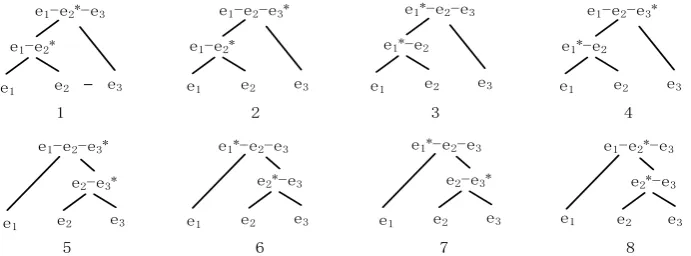
Figure 1: Headed Constituency based Discourse Tree Structure (e1,e2 and e3 denote three EDUs,
and * denotes the NUCLEUS constituent)
e1 e2 e3 e1 e2 e3 e1 e2 e3 e1 e2 e3
e1 e2 e3
e1 e2 e3 e1 e2 e3
e1 e2 e3
1' 2' 3' 4'
5' 6' 7' 8' 9'
e1 e2 e3
e0
e0 e0 e0
[image:2.595.119.496.505.592.2]e0 e0 e0 e0 e0
Figure 2: Discourse Dependency Tree Structures (e1,e2 and e3 denote three EDUS, and the directed
arcs denote one dependency relations. The artificial e0 is also displayed here. )
2
Discourse Dependency Structure and
Tree Bank
2.1
Discourse Dependency StructureSimilar to the syntactic dependency structure defined by McDonald (2005a, 2005b), we insert an artificial EDU e0 in the beginning for each
document and label the dependency relation link-ing from e0 as ROOT. This treatment will
sim-plify both formal definitions and computational implementations. Normally, we assume that each EDU should have one and only one head except for e0. A labeled directed arc is used to represent
We assume that the text2 T is composed of
n+1 EDUs including the artificial e0. That is
T=e0 e1 e2 … en. Let R={r1,r2, … ,rm} denote a
finite set of functional relations that hold be-tween two EDUs. Then a discourse dependency graph can be denoted by G=<V, A> where V de-notes a set of nodes and A denotes a set of la-beled directed arcs, such that for the text T=e0e1
e2 … en and the label set R the following holds: (1) V = { e0, e1, e2, … en }
(2) A V R V, where <ei, r, ej>A represents
an arc from the head ei to the dependent ej
labeled with the relation r.
(3) If <ei, r, ej>A then <ek, r’, ej>A for all ki (4) If <ei, r, ej>A then <ei, r’, ej>A for all r’r
The third condition assures that each EDU has one and only one head and the fourth tells that only one kind of dependency relation holds be-tween two EDUs. According to the definition, we illustrate all the 9 possible unlabeled depend-ency trees for a text containing three EDUs in Figure 2. The dependency trees 1’ to 7’ are pro-jective while 8’ and 9’ are non-propro-jective with crossing arcs.
2.2
Our Discourse Dependency TreebankTo automatically conduct discourse dependency parsing, constructing a discourse dependency treebank is fundamental. It is costly to manually construct such a treebank from scratch. Fortu-nately, RST Discourse Treebank (RST-DT) (Carlson et al., 2001) is an available resource to help with.
A RST tree constitutes a hierarchical structure for one document through rhetorical relations. A total of 110 fine-grained relations (e.g. Elabora-tion-part-whole and List) were used for tagging RST-DT. They can be categorized into 18 classes (e.g. Elaboration and Joint). All these relations can be hypotactic (“mononuclear”) or paratactic (“multi-nuclear”). A hypotactic relation holds between a nucleus span and an adjacent satellite
span, while a paratactic relation connects two or more equally important adjacent nucleus spans. For convenience of computation, we convert the
n-ary (n>2) RST trees3 to binary trees through adding a new node for the latter n-1 nodes and assume each relation is connected to only one
nucleus4. This departure from the original theory
2
The two terms “text” and “document” are used inter-changeably and represent the same meaning. 3
According to our statistics, there are totally 381 n-ary rela-tions in RST-DT.
4
We set the first nucleus as the only nucleus.
is not such a major step as it may appear, since any nucleus is known to contribute to the essen-tial meaning. Now, each RST tree can be seen as a headed constituency based binary tree where the nuclei are heads and the children of each node are linearly ordered. Given three EDUs5, Figure 1 shows the possible 8 headed constituen-cy based trees where the superscript * denotes the heads (nuclei). We use dependency trees to simulate the headed constituency based trees.
Contrasting Figure 1 with Figure 2, we use dependency tree 1’ to simulate binary trees 1 and 8, and dependency tress 2’- 7’ to simulate binary trees 2-7 correspondingly. The rhetorical tions in RST trees are kept as the functional rela-tions which link the two EDUs in dependency trees. With this kind of conversion, we can get our discourse dependency treebank. It is worth noting that the non-projective trees like 8’ and 9’ do not exist in our dependency treebank, though they are eligible according to the definition of discourse dependency graph.
3
Discourse Dependency Parsing
3.1
System OverviewAs stated above, T=e0e1 …en represents an input
text (document) where ei denotes the ith EDU of
T. We use V to denote all the EDU nodes and
VRV-0 (V-0 =V-{e0}) denote all the possible
discourse dependency arcs. The goal of discourse dependency parsing is to parse an optimal span-ning tree from VRV-0. Here we follow the arc
factored method and define the score of a de-pendency tree as the sum of the scores of all the arcs in the tree. Thus, the optimal dependency tree for T is a spanning tree with the highest score and obtained through the function DT(T,w):
0
0
0 , ,
, ,
( , )
( , )
( , , )
( , , )
f T
T
i j T T
i j T
G V R V
G V R V i j
e r e G
G V R V i j
e r e G
T
DT T argmax
argmax e r e
argmax e r
s ore T G
e c
w
w
where GT means a possible spanning tree with
( , T)
score T G and ( ) denotes the score of the arc <ei, r, ej> which is calculated according to
its feature representation f(ei,r,ej) and a weight
vector w.
Next, two basic problems need to be solved: how to find the dependency tree with the highest
5
score for T given all the arc scores (i.e. a parsing problem), and how to learn and compute the scores of arcs according to a set of arc features (i.e. a learning problem).
The following of this section addresses the first problem. Given the text T, we first reduce the multi-digraph composed of all possible arcs to the digraph. The digraph keeps only one arc <ei, r, ej> between two nodes which satisfies
( ) . Thus, we can proceed with a reduction from labeled parsing to unlabeled parsing. Next, two algorithms, i.e. the Eisner algorithm and MST algorithm, are pre-sented to parse the projective and non-projective unlabeled dependency trees respectively.
3.2
Eisner AlgorithmIt is well known that projective dependency pars-ing can be handled with the Eisner algorithm (1996) which is based on the bottom-up dynamic programming techniques with the time complexi-ty of O(n3). The basic idea of the Eisner algo-rithm is to parse the left and right dependents of an EDU independently and combine them at a later stage. This reduces the overhead of index-ing heads. Only two binary variables, i.e. c and d, are required to specify whether the heads occur leftmost or rightmost and whether an item is complete.
Eisner(T, )
Input: Text T=e0 e1… en; Arc scores (ei,ej) 1 Instantiate E[i, i, d, c]=0.0 for all i, d, c
2 For m := 1 to n
3 For i := 1 to n
4 j = i + m
5 if j> n then break;
6 # Create subgraphs with c=0 by adding arcs 7 E[i, j, 0, 0]=maxiqj (E[i,q,1,1]+E[q+1,j,0,1]+(ej,ei)) 8 E[i, j, 1, 0]=maxiqj (E[i,q,1,1]+E[q+1,j,0,1]+(ei,ej)) 9 # Add corresponding left/right subgraphs
10 E[i, j, 0, 1]=maxiqj (E[i,q,0,1]+E[q,j,0,0] 11 E[i, j, 1, 1]=maxiqj (E[i,q,1,0]+E[q,j,1,1])
[image:4.595.341.489.420.453.2]Figure 3: Eisner Algorithm
Figure 3 shows the pseudo-code of the Eisner algorithm. A dynamic programming table E[i,j,d,c] is used to represent the highest scored subtree spanning ei to ej. d indicates whether ei is
the head (d=1) or ej is head (d=0). c indicates
whether the subtree will not take any more de-pendents (c=1) or it needs to be completed (c=0). The algorithm begins by initializing all length-one subtrees to a score of 0.0. In the inner loop, the first two steps (Lines 7 and 8) are to construct the new dependency arcs by taking the maximum
over all the internal indices (iqj) in the span, and calculating the value of merging the two sub-trees and adding one new arc. The last two steps (Lines 10 and 11) attempt to achieve an optimal left/right subtree in the span by adding the corre-sponding left/right subtree to the arcs that have been added previously. This algorithm considers all the possible subtrees. We can then get the optimal dependency tree with the score
E[0,n,1,1] .
3.3
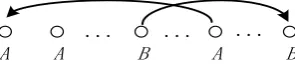
Maximum Spanning Tree AlgorithmAs the bottom-up Eisner Algorithm must main-tain the nested structural constraint, it cannot parse the non-projective dependency trees like 8’ and 9’ in Figure 2. However, the non-projective dependency does exist in real discourse. For ex-ample, the earlier text mainly talks about the top-ic A with mentioning the topic B, while the latter text gives a supplementary explanation for the topic B. This example can constitute a non-projective tree and its pictorial diagram is exhib-ited in Figure 4. Following the work of McDon-ald (2005b), we formalize discourse dependency parsing as searching for a maximum spanning tree (MST) in a directed graph.
... ...
A A B A B
...
Figure 4: Pictorial Diagram of Non-projective Trees
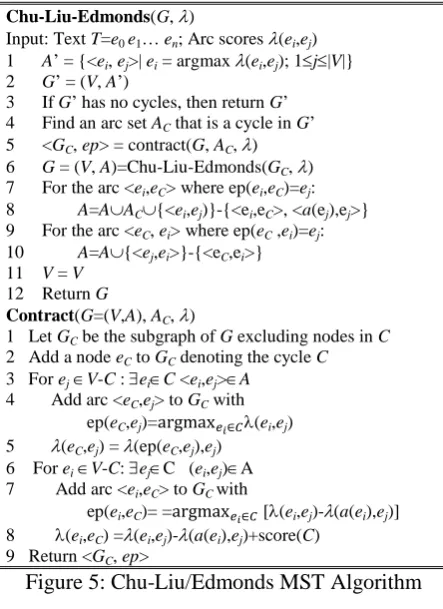
Chu and Liu (1965) and Edmonds (1967) in-dependently proposed the virtually identical al-gorithm named the Chu-Liu/Edmonds alal-gorithm, for finding MSTs on directed graphs (McDonald et al. 2005b). Figure 5 shows the details of the Chu-Liu/Edmonds algorithm for discourse pars-ing. Each node in the graph greedily selects the incoming arc with the highest score. If one tree results, the algorithm ends. Otherwise, there must exist a cycle. The algorithm contracts the identified cycle into a single node and recalcu-lates the scores of the arcs which go in and out of the cycle. Next, the algorithm recursively call itself on the contracted graph. Finally, those arcs which go in or out of one cycle will recover themselves to connect with the original nodes in
Chu-Liu-Edmonds(G, )
Input: Text T=e0 e1… en; Arc scores (ei,ej) 1 A’ = {<ei, ej>| ei = argmax (ei,ej); 1j|V|} 2 G’ = (V, A’)
3 If G’ has no cycles, then return G’
4 Find an arc set AC that is a cycle in G’ 5 <GC, ep> = contract(G, AC, ) 6 G = (V, A)=Chu-Liu-Edmonds(GC, ) 7 For the arc <ei,eC> where ep(ei,eC)=ej: 8 A=AAC{<ei,ej)}-{<ei,eC>, <a(ej),ej>} 9 For the arc <eC, ei> where ep(eC,ei)=ej: 10 A=A{<ej,ei>}-{<eC,ei>} 11 V = V
12 Return G
Contract(G=(V,A), AC, )
1 Let GC be the subgraph of G excluding nodes in C 2 Add a node eC to GC denoting the cycle C 3 For ejV-C : eiC <ei,ej>A
4 Add arc <eC,ej> to GC with ep(eC,ej)= (ei,ej) 5 (eC,ej) =(ep(eC,ej),ej)
6 For eiV-C: ejC (ei,ej)A 7 Add arc <ei,eC> to GC with
ep(ei,eC)= = [(ei,ej)-(a(ei),ej)] 8 (ei,eC) =(ei,ej)-(a(ei),ej)+score(C)
9 Return <GC, ep>
Figure 5: Chu-Liu/Edmonds MST Algorithm
4
Learning
In Section 3, we assume that the arc scores are available. In fact, the score of each arc is calcu-lated as a linear combination of feature weights. Thus, we need to determine the features for arc representation first. With referring to McDonald et al. (2005a; 2005b), we use the Margin Infused Relaxed Algorithm (MIRA) to learn the feature weights based on a training set of documents
annotated with dependency structures
1
, N
i i
T yi
where yi denotes the correct dependency tree for
the text Ti.
4.1
FeaturesFollowing (Feng and Hirst, 2012; Lin et al., 2009; Hernault et al., 2010b), we explore the following 6 feature types combined with relations to repre-sent each labeled arc <ei, r, ej> .
(1) WORD: The first one word, the last one word, and the first bigrams in each EDU, the pair of the two first words and the pair of the two last words in the two EDUs are extracted as features.
(2) POS: The first one and two POS tags in each EDU, and the pair of the two first POS tags in the two EDUs are extracted as features.
(3) Position: These features concern whether the two EDUs are included in the same sentence, and the positions where the two EDUs are located in one sentence, one paragraph, or one document.
(4) Length: The length of each EDU.
(5) Syntactic: POS tags of the dominating nodes as defined in Soricut and Marcu (2003) are ex-tracted as features. We use the syntactic trees from the Penn Treebank to find the dominating nodes,.
(6) Semantic similarity: We compute the se-mantic relatedness between the two EDUs based on WordNet. The word pairs are extracted from (ei, ej) and their similarity is calculated. Then, we
can get a weighted complete bipartite graph where words are deemed as nodes and similarity as weights. From this bipartite graph, we get the maximum weighted matching and use the aver-aged weight of the matches as the similarity be-tween ei and ej. In particular, we use
path_similarity, wup_similarity, res_similarity, jcn_similarity and lin_similarity provided by the nltk.wordnet.similarity (Bird et. al., 2009) pack-age for calculating word similarity.
As for relations, we experiment two sets of relation labels from RST-DT. One is composed of 19 coarse-grained relations and the other 111 fine-grained relations6.
4.2
MIRA based LearningMargin Infused Relaxed Algorithm (MIRA) is an online algorithm for multiclass classification and is extended by Taskar et al. (2003) to cope with structured classification.
MIRA Input: a training set
1
, N
i i
T yi
1 w0=0; v = 0; j = 0 2 For iter := 1 to K
3 For i := 1 to N
4 update w according to
Ti,yi
:1
min wj wj
s.t. ( , ) ( , ') ( , ')
where ' ( , )
i i i i i i
j
i i
s T s T L
DT T
y y y y
y w
[image:5.595.68.290.70.375.2]5 v=v+wj; 6 j = j+1 7 w = v/(K*N)
Figure 6: MIRA based Learning
Figure 6 gives the pseudo-code of the MIRA algorithm (McDonld et al., 2005b). This algo-rithm is designed to update the parameters w us-ing a sus-ingle trainus-ing instance
Ti,yi
in eachiteration. On each update, MIRA attempts to keep the norm of the change to the weight vector
6
[image:5.595.305.532.472.623.2]as small as possible, which is subject to structing the correct dependency tree under con-sideration with a margin at least as large as the loss of the incorrect dependency trees. We define the loss of a discourse dependency tree yi' (de-noted by L( ,y yi i') ) as the number of the EDUs that have incorrect heads. Since there are expo-nentially many possible incorrect dependency trees and thus exponentially many margin con-straints, here we relax the optimization and stay with a single best dependency tree
' ( , j)
i DT Ti
y w which is parsed under the weight vector wj. In this algorithm, the successive up-dated values of w are accumulated and averaged to avoid overfitting.
5
Experiments
5.1
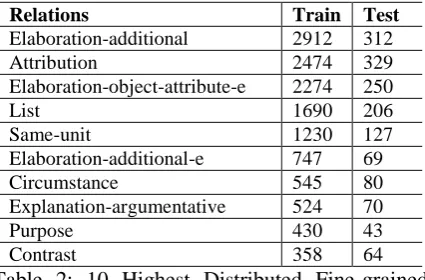
PreparationWe test our methods experimentally using the discourse dependency treebank which is built as in Section 2. The training part of the corpus is composed of 342 documents and contains 18,765 EDUs, while the test part consists of 38 docu-ments and 2,346 EDUs. The number of EDUs in each document ranges between 2 and 304. Two sets of relations are adopted. One is composed of 19 relations and Table 1 shows the number of each relation in the training and test corpus. The other is composed of 111 relations. Due to space limitation, Table 2 only lists the 10 highest-distributed relations with regard to their frequen-cy in the training corpus.
The following experiments are conducted: (1) to measure the parsing performance with differ-ent relation sets and differdiffer-ent feature types; (2) to compare our parsing methods with the state-of-the-art discourse parsing methods.
Relations Train Test Relations Train Test
[image:6.595.310.523.70.210.2]Elaboration 6879 796 Temporal 426 73 Attribution 2641 343 ROOT 342 38 Joint 1711 212 Compari. 273 29 Same-unit 1230 127 Condition 258 48 Contrast 944 146 Manner. 191 27 Explanation 849 110 Summary 188 32 Background 786 111 Topic-Cha. 187 13 Cause 785 82 Textual 147 9 Evaluation 502 80 TopicCom. 126 24 Enablement 500 46 Total 18765 2346
Table 1: Coarse-grained Relation Distribution
Relations Train Test
Elaboration-additional 2912 312
Attribution 2474 329
Elaboration-object-attribute-e 2274 250
List 1690 206
Same-unit 1230 127
Elaboration-additional-e 747 69
Circumstance 545 80
Explanation-argumentative 524 70
Purpose 430 43
Contrast 358 64
Table 2: 10 Highest Distributed Fine-grained Relations
5.2
Feature Influence on Two Relation SetsSo far, researches on discourse parsing avoid adopting too fine-grained relations and the rela-tion sets containing around 20 labels are widely used. In our experiments, we observe that adopt-ing a fine-grained relation set can even be helpful to building the discourse trees. Here, we conduct experiments on two relation sets that contain 19 and 111 labels respectively. At the same time, different feature types are tested their effects on discourse parsing.
Method Features Unlabeled Acc.
Labeled Acc. Eisner 1+2 0.3602 0.2651
1+2+3 0.7310 0.4855 1+2+3+4 0.7370 0.4868 1+2+3+4+5 0.7447 0.4957 1+2+3+4+5+6 0.7455 0.4983
MST 1+2 0.1957 0.1479
[image:6.595.306.541.391.518.2]1+2+3 0.7246 0.4783 1+2+3+4 0.7280 0.4795 1+2+3+4+5 0.7340 0.4915 1+2+3+4+5+6 0.7331 0.4851 Table 3: Performance Using Coarse-grained Re-lations.
Method Feature types Unlabeled Acc.
Labeled Acc. Eisner 1+2 0.3743 0.2421
1+2+3 0.7451 0.4079 1+2+3+4 0.7472 0.4041 1+2+3+4+5 0.7506 0.4254 1+2+3+4+5+6 0.7485 0.4288
MST 1+2 0.2080 0.1300
1+2+3 0.7366 0.4054 1+2+3+4 0.7468 0.4071 1+2+3+4+5 0.7494 0.4288 1+2+3+4+5+6 0.7460 0.4309 Table 4: Performance Using Fine-grained Rela-tions.
[image:6.595.61.541.559.704.2]we use unlabeled accuracy to calculate the ratio of EDUs that correctly identify their heads, la-beled accuracy the ratio of EDUs that have both correct heads and correct relations. Table 3 and Table 4 show the performance on two relation sets. The numbers (1-6) represent the corre-sponding feature types described in Section 4.1.
From Table 3 and Table 4, we can see that the addition of more feature types, except the 6th fea-ture type (semantic similarity), can promote the performance of relation labeling, whether using the coarse-grained 19 relations and the fine-grained 111 relations. As expected, the first and second types of features (WORD and POS) are the ones which play an important role in building and labeling the discourse dependency trees. These two types of features attain similar per-formance on two relation sets. The Eisner algo-rithm can achieve unlabeled accuracy around 0.36 and labeled accuracy around 0.26, while MST algorithm achieves unlabeled accuracy around 0.20 and labeled accuracy around 0.14.
The third feature type (Position) is also very helpful to discourse parsing. With the addition of this feature type, both unlabeled accuracy and labeled accuracy exhibit a marked increase. Es-pecially, when applying MST algorithm on dis-course parsing, unlabeled accuracy rises from around 0.20 to around 0.73. This result is con-sistent with Hernault’s work (2010b) whose ex-periments have exhibited the usefulness of those position-related features. The other two types of features which are related to length and syntactic parsing, only promote the performance slightly.
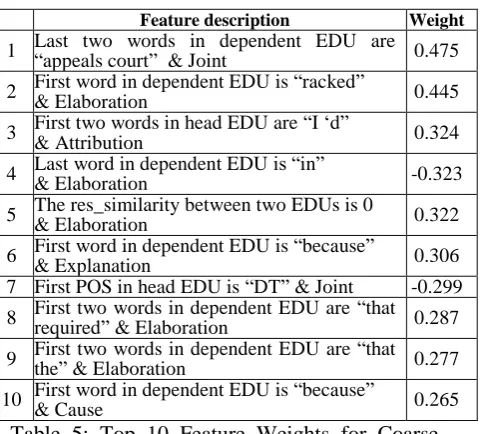
As we employed the MIRA learning algorithm, it is possible to identify which specific features are useful, by looking at the weights learned to each feature using the training data. Table 5 se-lects 10 features with the highest weights in ab-solute value for the parser which uses the coarse-grained relations, while Table 6 selects the top 10 features for the parser using the fine-grained relations. Each row denotes one feature: the left part before the symbol “&” is from one of the 6 feature types and the right part denotes a specific relation. From Table 5 and Table 6, we can see that some features are reasonable. For example, The sixth feature in Table 5 represents that the dependency relation is preferred to be labeled
Explanation with the fact that “because” is the first word of the dependent EDU. From these two tables, we also observe that most of the heavily weighted features are usually related to those highly distributed relations. When using the coarse-grained relations, the popular relations
(eg. Elaboration, Attribution and Joint) are al-ways preferred to be labeled. When using the fine-grained relations, the large relations includ-ing List and Elaboration-object-attribute-e are given the precedence of labeling. This phenome-non is mainly caused by the sparseness of the training corpus and the imbalance of relations. To solve this problem, the augment of training corpus is necessary.
Feature description Weight
1 Last two words in dependent EDU are “appeals court” & Joint 0.475
2 First word in dependent EDU is “racked” & Elaboration 0.445
3 First two words in head EDU are “I ‘d”
& Attribution 0.324
4 Last word in dependent EDU is “in”
& Elaboration -0.323
5 The res_similarity between two EDUs is 0 & Elaboration 0.322
6 First word in dependent EDU is “because” & Explanation 0.306
7 First POS in head EDU is “DT” & Joint -0.299
8 First two words in dependent EDU are “that required” & Elaboration 0.287
9 First two words in dependent EDU are “that the” & Elaboration 0.277
10 First word in dependent EDU is “because” & Cause 0.265
Table 5: Top 10 Feature Weights for Coarse-grained Relation Labeling (Eisner Algorithm)
Features Weight 1 Last two words in dependent EDU are
“ap-peals court” & List 0.576 2 First two words in head EDU are “I ‘d”
& Attribution 0.385
3 First two words in dependent EDU is “that the” & Elaboration-object-attribute-e 0.348 4 First POS in head EDU is “DT” & List -0.323 5 Last word in dependent EDU is “in” & List -0.286 6 First word in dependent EDU is “racked” &
Elaboration-object-attribute-e 0.445 7 First two word pairs are <”In an”,”But
even”> & List -0.252 8 Dependent EDU has a dominating node
tagged “CD”& Elaboration-object-attribute-e -0.244 9 First two words in dependent EDU are
“pa-tents disputes” & Purpose 0.231 10 First word in dependent EDU is “to”
& Purpose 0.230
Table 6: Top 10 Feature Weights for Coarse-grained Relation Labeling (Eisner Algorithm)
[image:7.595.301.542.193.410.2] [image:7.595.301.541.438.638.2]trees more than the coarse-grained relations. The best result of unlabeled accuracy using 111 rela-tions is 0.7506, better than the best performance (0.7447) using 19 relations. We can also see that the labeled accuracy using the fine-grained rela-tions can achieve 0.4309, only 0.06 lower than the best labeled accuracy (0.4915) using the coarse-grained relations.
In addition, comparing the MST algorithm with the Eisner algorithm, Table 3 and Table 4 show that their performances are not significant-ly different from each other. But we think that MST algorithm has more potential in discourse dependency parsing, because our converted dis-course dependency treebank contains only pro-jective trees and somewhat suppresses the MST algorithm to exhibit its advantage of parsing non-projective trees. In fact, we observe that some non-projective dependencies produced by the MST algorithm are even reasonable than what they are in the dependency treebank. Thus, it is important to build a manually labeled discourse dependency treebank, which will be our future work.
5.3
Comparison with Other SystemsThe state-of-the-art discourse parsing methods normally produce the constituency based dis-course trees. To comprehensively evaluate the performance of a labeled constituency tree, the blank tree structure (‘S’), the tree structure with nuclearity indication (‘N’), and the tree structure with rhetorical relation indication but no nuclear-ity indication (‘R’) are evaluated respectively using the F measure (Marcu 2000).
To compare our discourse parsers with others, we adopt MIRA and Eisner algorithm to conduct discourse parsing with all the 6 types of features and then convert the produced projective de-pendency trees to constituency based trees through their correspondence as stated in Section 2. Our parsers using two relation sets are named
Our-coarse and Our-fine respectively. The in-putted EDUs of our parsers are from the standard segmentation of RST-DT. Other text-level dis-course parsing methods include: (1) Percep-coarse: we replace MIRA with the averaged per-ceptron learning algorithm and the other settings are the same with Our-coarse; (2) HILDA-manual and HILDA-seg are from Hernault (2010b)’s work, and their inputted EDUs are from RST-DT and their own EDU segmenter respectively; (3) LeThanh indicates the results given by LeThanh el al. (2004), which built a multi-level rule based parser and used 14
rela-tions evaluated on 21 documents from RST-DT; (4) Marcu denotes the results given by Mar-cu(2000)’s decision-tree based parser which used 15 relations evaluated on unspecified documents. Table 7 shows the performance comparison for all the parsers mentioned above. Human de-notes the manual agreement between two human annotators. From this table, we can see that both our parsers perform better than all the other parsers as a whole, though our parsers are not developed directly for constituency based trees. Our parsers do not exhibit obvious advantage than HILDA-manual on labeling the blank tree structure, because our parsers and HILDA-manual all perform over 94% of Human and this performance level somewhat reaches a bottle-neck to promote more. However, our parsers outperform the other parsers on both nuclearity and relation labeling. Our-coarse achieves 94.2% and 91.8% of the human F-scores, on labeling nuclearity and relation respectively, while Our-fine achieves 95.2% and 87.6%. We can also see that the averaged perceptron learning algorithm, though simple, can achieve a comparable per-formance, better than HILDA-manual. The parsers HILDA-seg, LeThanh and Marcu use their own automatic EDU segmenters and exhibit a relatively low performance. This means that EDU segmentation is important to a practical discourse parser and worth further investigation.
S N R
Our-coarse 82.9 73.0 60.6
Our-fine 83.4 73.8 57.8
Percep-coarse 82.3 72.6 59.4
HILDA-manual 83.0 68.4 55.3
HILDA-seg 72.3 59.1 47.8
LeThanh 53.7 47.1 39.9
Marcu 44.8 30.9 18.8
Human 88.1 77.5 66.0
Table 7: Full Parser Evaluation
MAFS WAFS Acc
Our-coarse 0.454 0.643 66.84
Percep-coarse 0.438 0.633 65.37
Feng 0.440 0.607 65.30
HILDA-manual 0.428 0.604 64.18
Baseline - - 35.82
Table 8: Relation Labeling Performance
relation. Weight-averaged F-score (WAFS) weights the performance of each relation by the number of its existing instances. Table 8 com-pares our parser Our-coarse with other parsers
HILDA-manual, Feng (Feng and Hirst, 2012) and Baseline. Feng (Feng and Hirst, 2012) can be seen as a strengthened version of HILDA which adopts more features and conducts feature selection. Baseline always picks the most fre-quent relation (i.e. Elaboration). From the results, we find that Our-coarse consistently provides superior performance for most relations over other parsers, and therefore results in higher MAFS and WAFS.
6
Related Work
So far, the existing discourse parsing techniques are mainly based on two well-known treebanks. One is the Penn Discourse TreeBank (PDTB) (Prasad et al., 2007) and the other is RST-DT.
PDTB adopts the predicate-arguments repre-sentation by taking an implicit/explicit connec-tive as a predication of two adjacent sentences (arguments). Then the discourse relation between each pair of sentences is annotated independently to characterize its predication. A majority of re-searches regard discourse parsing as a classifica-tion task and mainly focus on exploiting various linguistic features and classifiers when using PDTB (Wellner et al., 2006; Pitler et al., 2009; Wang et al., 2010). However, the predicate-arguments annotation scheme itself has such a limitation that one can only obtain the local dis-course relations without knowing the rich context.
In contrast, RST and its treebank enable peo-ple to derive a compeo-plete representation of the whole discourse. Researches have begun to in-vestigate how to construct a RST tree for the given text. Since the RST tree is similar to the constituency based syntactic tree except that the constituent nodes are different, the syntactic parsing techniques have been borrowed for dis-course parsing (Soricut and Marcu, 2003; Baldridge and Lascarides, 2005; Sagae, 2009; Hernault et al., 2010b; Feng and Hirst, 2012). Soricut and Marcu (2003) use a standard bottom-up chart parsing algorithm to determine the dis-course structure of sentences. Baldridge and Las-carides (2005) model the process of discourse parsing with the probabilistic head driven parsing techniques. Sagae (2009) apply a transition based constituent parsing approach to construct a RST tree for a document. Hernault et al. (2010b) de-velop a greedy bottom-up tree building strategy
for discourse parsing. The two adjacent text spans with the closest relations are combined in each iteration. As the extension of Hernault’s work, Feng and Hirst (2012) further explore var-ious features aiming to achieve better perfor-mance. However, as analyzed in Section 1, there exist three limitations with the constituency based discourse representation and parsing. We innovatively adopt the dependency structure, which can be benefited from the existing RST-DT, to represent the discourse. To the best of our knowledge, this work is the first to apply de-pendency structure and dede-pendency parsing techniques in discourse analysis.
7
Conclusions
In this paper, we present the benefits and feasi-bility of applying dependency structure in text-level discourse parsing. Through the correspond-ence between constituency-based trees and de-pendency trees, we build a discourse dede-pendency treebank by converting the existing RST-DT. Based on dependency structure, we are able to directly analyze the relations between the EDUs without worrying about the additional interior text spans, and apply the existing state-of-the-art dependency parsing techniques which have a relatively low time complexity. In our work, we use the graph based dependency parsing tech-niques learned from the annotated dependency trees. The Eisner algorithm and the MST algo-rithm are applied to parse the optimal projective and non-projective dependency trees respectively based on the arc-factored model. To calculate the score for each arc, six types of features are ex-plored to represent the arcs and the feature weights are learned based on the MIRA learning technique. Experimental results exhibit the effec-tiveness of the proposed approaches. In the fu-ture, we will focus on non-projective discourse dependency parsing and explore more effective features.
Acknowledgments
References
Jason Baldridge and Alex Lascarides. 2005. Probabil-istic Head-driven Parsing for Discourse Structure. In Proceedings of the Ninth Conference on Com-putational Natural Language Learning, pages 96– 103.
Steven Bird, Ewan Klein, and Edward Loper. 2009. Natural Language Processing with Python — Ana-lyzing Text with the Natural Language Toolkit. O’Reilly.
Lynn Carlson, Daniel Marcu, and Mary E. Okurowski. 2001. Building a Discourse-tagged Corpus in the Framework of Rhetorical Structure Theory. Pro-ceedings of the Second SIGdial Workshop on Dis-course and Dialogue-Volume 16, pages 1–10.
Yoeng-Jin Chu and Tseng-Hong Liu. 1965. On the Shortest Arborescence of a Directed Graph, Sci-ence Sinica, v.14, pp.1396-1400.
Koby Crammer and Yoram Singer. 2003. Ultracon-servative Online Algorithms for Multiclass Prob-lems. JMLR.
Jack Edmonds. 1967. Optimum Branchings, J. Re-search of the National Bureau of Standards, 71B, pp.233-240.
Jason Eisner. 1996. Three New Probabilistic Models for Dependency Parsing: An Exploration. In Proc. COLING.
Vanessa Wei Feng and Graeme Hirst. Text-level Dis-course Parsing with Rich Linguistic Features, Pro-ceedings of the 50th Annual Meeting of the Association for Computational Linguistics, pages 60–68, Jeju, Republic of Korea, 8-14 July 2012.
Hugo Hernault, Danushka Bollegala, and Mitsuru Ishizuka. 2010a. A Semi-supervised Approach to Improve Classification of Infrequent Discourse Re-lations Using Feature Vector Extension. In Pro-ceedings of the 2010 Conference on Empirical Methods in Natural Language Processing, pages 399–409, Cambridge, MA, October. Association for Computational Linguistics.
Hugo Hernault, Helmut Prendinger, David A. duVerle, and Mitsuru Ishizuka. 2010b. HILDA: A Discourse Parser Using Support Vector Machine Classifica-tion. Dialogue and Discourse, 1(3):1–33.
Shafiq Joty, Giuseppe Carenini and Raymond T. Ng. A Novel Discriminative Framework for
Sentence-level Discourse Analysis. EMNLP-CoNLL '12
Proceedings of the 2012 Joint Conference on Em-pirical Methods in Natural Language Processing
and Computational Natural Language Learning Stroudsburg, PA, USA.
Huong LeThanh, Geetha Abeysinghe, and Christian Huyck. 2004. Generating Discourse Structures for Written Texts. In Proceedings of the 20th Interna-tional Conference on ComputaInterna-tional Linguistics, pages 329– 335.
Ziheng Lin, Min-Yen Kan, and Hwee Tou Ng. 2009. Recognizing Implicit Discourse Relations in the Penn Discourse Treebank. In Proceedings of the 2009 Conference on Empirical Method in Natural Language Processing, Vol. 1, EMNLP’09, pages 343-351.
William Mann and Sandra Thompson. 1988. Rhetori-cal Structure Theory: Toward a Functional Theory of Text Organization. Text, 8(3):243–281.
Daniel Marcu. 2000. The Theory and Practice of Dis-course Parsing and Summarization. MIT Press, Cambridge, MA, USA.
Ryan McDonald, Koby Crammer, and Fernando Pe-reira. 2005a. Online Large-Margin Training of De-pendency Parsers, 43rd Annual Meeting of the Association for Computational Linguistics (ACL 2005) .
Ryan McDonald, Fernando Pereira, Kiril Ribarov, and Jan Hajic. 2005b. Non-projective Dependency
Parsing using Spanning Tree Algorithms,
Proceed-ings of HLT/EMNLP 2005.
Emily Pitler, Annie Louis, and Ani Nenkova. 2009. Automatic Sense Prediction for Implicit Discourse Relations in Text, In Proc. of the 47th ACL. pages 683-691.
Rashmi Prasad, Eleni Miltsakaki, Nikhil Dinesh, Alan Lee, Aravind Joshi, Livio Robaldo, and Bonnie Webber. 2007. The Penn Discourse Treebank 2.0
Annotation Manual. The PDTB Research Group,
December.
David Reitter. 2003. Simple Signals for Complex Rhetorics: On Rhetorical Analysis with
Rich-feature Support Vector Models. LDV Forum,
18(1/2):38–52.
Kenji Sagae. 2009. Analysis of discourse structure with syntactic dependencies and data-driven shift-reduce parsing. In Proceedings of the 11th Interna-tional Conference on Parsing Technologies, pages 81-84.
of the North American Chapter of the Association for Computational Linguistics on Human Lan-guage Technology, Volume 1, pages 149–156.
Rajen Subba and Barbara Di Eugenio. 2009. An effec-tive discourse parser that uses rich linguistic
in-formation. In Proceedings of Human Language
Technologies: The 2009 Annual Conference of the North American Chapter of the Association for Computational Linguistics, pages 566–574.
Robert Endre Tarjan, 1977. Finding Optimum Branchings, Networks, v.7, pp.25-35.
Ben Taskar, Carlos Guestrin and Daphne Koller. 2003.
Max-margin Markov Networks. In Proc. NIPS.
Bonnie Webber. 2004. D-LTAG: Extending
Lexical-ized TAG to Discourse. Cognitive Science,
28(5):751–779.
Wen Ting Wang, Jian Su and Chew Lim Tan. 2010. Kernel based Discourse Relation Recognition with
Temporal Ordering Information, In Proc. of
ACL’10. pages 710-719.
Ben Wellner, James Pustejovsky, Catherine Havasi, Anna Rumshisky and Roser Sauri. 2006. Classifi-cation of Discourse Coherence Relations: an Ex-ploratory Study Using Multiple Knowledge
Sources. In Proc.of the 7th SIGDIAL Workshop on