49
A comparison of statistical association measures for identifying
dependency-based collocations in various languages.
Marcos Garcia Universidade da Coru˜na Grupo LyS, Dpto. de Letras Campus da Zapateira, Coru˜na Universidade da Coru˜na, CITIC
Campus de Elvi˜na, Coru˜na
Marcos Garc´ıa-Salido Universidade da Coru˜na Grupo LyS, Dpto. de Letras Campus da Zapateira, Coru˜na
{marcos.garcia.gonzalez,marcos.garcias,margarita.alonso}@udc.gal Margarita Alonso-Ramos
Universidade da Coru˜na Grupo LyS, Dpto. de Letras Campus da Zapateira, Coru˜na Universidade da Coru˜na, CITIC
Campus de Elvi˜na, Coru˜na
Abstract
This paper presents an exploration of differ-ent statistical association measures to auto-matically identify collocations from corpora in English, Portuguese, and Spanish. To evaluate the impact of the association mea-sures we manually annotated corpora with three different syntactic patterns of colloca-tions (adjective-noun, verb-object and nomi-nal compounds). We took advantage of the PARSEME 1.1 Shared Task corpora by se-lecting a subset of 155k tokens in the three referred languages, in which we annotated
1,526 collocations with their Lexical Func-tions according to the Meaning-Text Theory. Using the resulting gold-standard, we have carried out a comparison between frequency data and several well-known association mea-sures, both symmetric and asymmetric. The results show that the combination of depen-dency triples with raw frequency informa-tion is as powerful as the best associainforma-tion measures in most syntactic patterns and lan-guages. Furthermore, and despite the asym-metric behaviour of collocations, directional approaches perform worse than the symmetric ones in the extraction of these phraseological combinations.
1 Introduction
Although there is no agreement about the linguis-tic properties of collocations, it is commonly ac-cepted that the automatic identification of this type of multiword expressions (MWEs) is crucial for many natural language processing tasks such as natural language understanding, or machine trans-lation (Sag et al.,2002;Wehrli and Nerima,2018). From a statistical point of view collocations are recurrent co-occurrences of word pairs given a short span of text (Firth, 1957; Benson, 1990;
Sinclair, 1991). Thus, they are often identified by applying association measures (AMs, e.g., log-likelihood, pointwise mutual information, etc.) on co-occurrence counts in windows of different sizes (Pecina,2010). However, the phraseological tradition states that collocations are idiosyncratic asymmetric combinations of syntactically related pairs of words (Hausmann,1989;Benson,1989). In this regard, their asymmetry derives from the fact that one of the elements of a collocation (the
BASE, e.g.,cabintake a cab) is freely selected due to its meaning, while the choice of the other (the
COLLOCATE, e.g., take in the previous example) is restricted by the former (Mel’ˇcuk,1995,1998). Following this perspective, the process for extract-ing collocations should take advantage of syntac-tic parsing (Seretan, 2011). Moreover, and with a view to capture the asymmetry of these expres-sions, directional AMs have been proposed ( Car-lini et al., 2014). To evaluate the impact of each extraction method, some researchers perform a manual revision of a ranked list of collocation can-didates (Seretan and Wehrli, 2006), while others collect a set of gold-standard collocations (from corpora or dictionaries) to evaluate their identifi-cation methods (Krenn and Evert, 2001; Pearce,
2002;Pecina,2010;Evert et al.,2017).
Notwithstanding, most studies focus only on one language or just on a collocation pattern, and most of them use very different gold-standards (e.g., considering idioms or proper nouns as a type of collocations), so that their results are not com-parable and cannot be generalized to other lan-guages or collocational schemes.
us-ing three syntactic patterns (adjective-noun, verb-object, andnominal compounds) in English, Por-tuguese, and Spanish. To obtain accurate re-call and precision values, we have created gold-standard corpora containing1,526collocations la-beled in context in these languages.1 The annota-tion was performed following a phraseological ap-proach, which not only identifies each collocation but also classifies it according to a lexical function in the Meaning-Text Theory (Mel’ˇcuk,1998).
The results of the performed experiments show that, to extract these dependency-based colloca-tions, frequency data behaves similarly to the best association measures, and that directional mea-sures obtain worse results than symmetric ones. Moreover, these findings are general tendencies in the three languages that have been evaluated.
The rest of this paper is organized as follows. First, Section 2introduces some related work on the use of AMs for extracting collocations. Then, we briefly present the gold-standard corpora in Section 3. The evaluation and discussion of the results are addressed in Sections 4 and 5, while some conclusions are drawn in Section6.
2 Related Work
There is a rich variety of studies dealing with the automatic extraction of collocations from cor-pora. In this respect, several papers addressed this task applying different AMs to short sequences of ngrams (Smadja,1993) or syntactic dependencies (Lin,1999;Seretan and Wehrli,2006). Other stud-ies, such asKrenn and Evert(2001) andEvert and Krenn(2001) took advantage of POS-tags to focus on particular collocational patterns.
Pearce(2002) compared previous statistical ap-proaches to identify collocational bigrams, show-ing that the different definitions of collocations in-volve divergences in the results. In this respect, papers such asThanopoulos et al.(2002) include named entities in some of the gold-standards.
Pecina and Schlesinger (2006) and Pecina
(2010) carry out a large comparison of dozens of statistical metrics to identify collocations (includ-ing idioms) in Czech corpora, also propos(includ-ing sev-eral combinations of AMs which improve the per-formance of single measures. A recent compari-son of various AMs, using different corpus sizes and two different gold-standards in English can be found inEvert et al. (2017), which also evaluate
1
https://github.com/marcospln/collocations
surface-based and dependency-based approaches. InUhrig et al.(2018), the authors analyze the im-pact of several dependency parsers and syntactic schemes in the same task.
The asymmetric properties of collocations have been taken into account, for instance, in Gries
(2013), which proposed directional measures (∆P) to better capture the behaviour of these ex-pressions. Correspondingly, and following an approach similar to ours, Carlini et al. (2014) propose another asymmetric measure (N P M Ic)
based on a normalized version of mutual informa-tion (Church and Hanks,1990).
A related task consists of automatically classi-fying the semantic properties of collocations by means of lexical functions or glosses. In this re-gard, some studies apply machine learning meth-ods to train classifiers (Wanner et al.,2006,2016;
Gelbukh and Kolesnikova, 2012), while others use distributional semantics to identify a collocate given a base and a lexical function ( Rodr´ıguez-Fern´andez et al.,2016).
Among the many studies that evaluate AMs to extract collocations from corpora, most of them focus only on one language (usually in English, German, Czech, or Spanish) and use different approaches (surface-based or syntactic dependen-cies). Moreover, different interpretations of collo-cations make most studies not comparable. Taking the above into account, our evaluation is carried out in a new dataset in three languages and with different syntactic patterns, which has been man-ually annotated from a phraseological viewpoint following the Meaning-Text Theory.
3 Gold-standard multilingual corpora of collocations.
This section summarizes the annotation process of the corpora and its results.2 Before that, we
intro-duce the main characteristics of collocations in the phraseological viewpoint adopted in this paper.
3.1 Collocations
As said, we understand collocations as asymmet-ric combinations of two syntactically related lexi-cal units (Hausmann,1989). In this regard, one of the elements that form the collocation (the base) is chosen by the speaker due to its meaning. The base, in turn, restricts the selection of the other
lex-2SeeGarcia et al.(2019) for a detailed explanation of the
ical unit (the collocate), which conveys a particu-lar meaning in function of a given base.
Under the Meaning-Text Theory, the concept of collocation was formalized as follows:
A COLLOCATIONABofLis a semantic phraseme ofLsuch that its signified ‘X’ is constructed out of the signified of the one of its two constituent lexemes –say, of A– and a signified ‘C’[‘X’=‘A⊕C’] such that the lexeme B expresses ‘C’ contingent onA.
where Ais the base, B the collocate,L a lan-guage, and ‘C’ and ’X’ the meanings of the col-locate (in this context) and of the collocation, re-spectively. From this perspective, lexical restric-tions are more important than the co-occurrence frequency of the combination, which does not play any role in this definition (Mel’ˇcuk, 1998). This theory also proposes the concept of Lexi-cal Functions (LFs), a tool to represent the rela-tion between the base and a set of potential col-locates which convey a given meaning (Wanner,
1996; Mel’ˇcuk, 1996). Thus, using the Magn
LF (which means ‘intensification’) we could de-fineMagn(breath)=deep andMagn(effort)=great
to respectively represent the collocations deep breathandgreat effort.
3.2 Source corpora and annotation
To create our multilingual gold-standard cor-pus we used three subcorpora of the PARSEME Shared Task 1.1 (Ramisch et al., 2018). In this respect, some of the MWEs labeled by the PARSEME community (namely the light-verb constructions, LVCs) actually intersect with our objectives, so we took advantage of these anno-tations. We selected thetestsplits for Portuguese and Spanish (58k and 39k tokens, respectively), and thetraindataset for English (with53ktokens). These resources are annotated with Universal De-pendencies (Nivre,2015).
Guidelines: We defined specific guidelines for each collocation type following Mel’ˇcuk (1995). Besides, we attempted to be compatible with the PARSEME guidelines with a view to combining both annotations. Since we use dependency pars-ing to retrieve candidate collocations, we anno-tated the following three syntactic patterns, here exemplified with some of the included LFs:
Verb-object (obj): this collocation type refers to predicative nouns depending of verbs which do not contribute to the meaning of the com-bination (Oper1: fazer aparic¸˜ao; ‘[to] appear’ in Portuguese), express causation (CausOper1:
conceder autorizaci´on; ‘[to] give permission’ in Spanish) or a particular meaning with this specific base (N onStandard:[to] shake hands). Most of these cases were covered by the LVC category in the PARSEME guidelines, so besides annotating some new collocations, we revised each LVC and added their LFs.
Adjective-noun (amod): in these colloca-tions the adjective may express the meaning of ‘intensification’ (M agn: excelente calidad, ‘excellent quality’ in Spanish), or ‘attenuation’ (AntiM agn: baixo rendimento; ‘low perfor-mance’ in Portuguese), convey a positive or neg-ative evaluation of the speaker (Bon: great film,
AntiBon: dura realidade; ‘harsh reality’ in Por-tuguese), or have a specific sense when modifying the noun (N onStandard:agua dulce; ‘fresh wa-ter’ in Spanish).
Nominal compounds (nmodandcompound):
in a nominal compound, the head of the relation may express the concept of ‘head of a collective’ (Cap: police chief), ‘a part of’ (Sing: membro [do] grupo; ‘group member’ in Portuguese), or of a ‘set’ or the ‘totality’ of the dependent (M ult:
ramo de rosas; ‘bouquet of roses’ in Spanish).
Procedure: To carry out the annotation pro-cess, we first extracted every instance of the target relations (obj, amod, nmod, and com-pound) from the source corpora, then organized as
base;collocate;relation lemmatized triples. This process generated12,496candidates (≈5kamod,
≈3,5knmod/compound, and≈4kobj).
Using these data, all the triples were arranged into nine sheets (one per language and dependency relation) including for each candidate a link to an automatically generated HTML page with actual examples from the corpora.
between the annotators) were revised and classi-fied by the whole team of language experts.
Finally, the gold annotations were added to the initial corpora and transferred to WebAnno (Eckart de Castilho et al., 2016). Then, we used this tool to correct some special cases (e.g., collo-cations including internal MWEs) and to perform a general revision of the corpora before converting the WebAnno data into the final.conlluformat.
3.3 Final resources and results
From the initial ≈ 12.5k unique dependency triples, the annotation process yielded a total of
1,394 collocations (≈ 11%). The amod pattern was the most productive one (620 different ex-amples) followed by obj (579). Nominal com-pounds were the less frequent type, with 195 la-beled collocations. The multi-k inter-annotator agreement (Davies and Fleiss,1982) produced val-ues betweenk= 0.37(nmod) andk= 0.71(obj). During the annotation process, 447combinations were marked as doubt, and out of these,260were finally considered collocations by the language ex-perts. Even if we do not make explicit use of lex-ical functions in this paper, it is worth mentioning that the collocations in these final corpora are la-beled using60LFs, which may be useful to eval-uate extraction and classification strategies ( Wan-ner et al.,2016;Rodr´ıguez-Fern´andez et al.,2016;
Kolesnikova and Gelbukh,2018).
4 Evaluation
This section describes the experiments carried out to evaluate the performance of the different AMs in our gold-standard corpora.
4.1 Data
From the above presented gold-standard corpora we used the12.5kdependency triples of the three syntactic patterns as testing data to assess the im-pact of different AMs. The labeled collocations were used as true positives and the rest of the ex-amples as true negatives. Since the size of our data (≈ 155k) is not enough to extract statistical data for the computation of suitable association values, we compiled three corpora (one per lan-guage) with about 100 million tokens each. These reference corpora were used to obtain the statis-tical values of the 12.5 triples. With a view to obtain comparable results, we created these cor-pora in an analogous way. Thus, each of them
contains 50 million tokens from Wikipedia, 20 million from the Europarl corpus (Koehn,2005), 10 million from OpenSubtitles (Lison and Tiede-mann,2016), and a set of 20 million tokens formed by news, web pages, and small corpora from the Universal Dependencies 2018 and PARSEME 1.1 shared tasks (Zeman et al., 2018;Ramisch et al.,
2018). The texts were tokenized, PoS-tagged and lemmatized by LinguaKit (Gamallo et al.,2018), and parsed by UDPipe, a state-of-the-art depen-dency parser based on neural networks (Straka and Strakov´a, 2017). We used the Universal Depen-dencies formalism, which yielded the best results in a similar comparison (Uhrig et al.,2018), train-ing the models with the 2.3 version of the UD tree-banks (Nivre et al.,2018).
4.2 Experiments
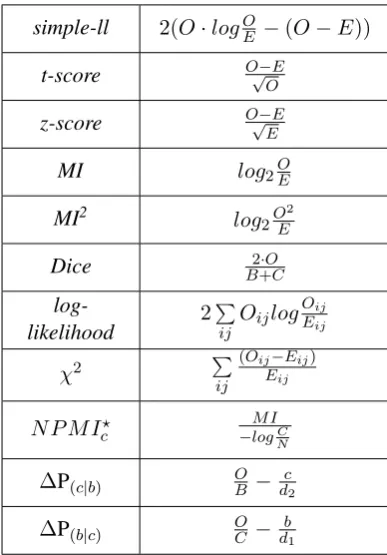
Besides raw frequency, we have evaluated eleven association measures which have been used for both dependency and ngram-based collocation ex-traction. As symmetric measures we used simple-ll, t-score, z-score, (pointwise) mutual informa-tion (MI), MI2, Dice, log-likelihood, andχ2 ( Ev-ert, 2008; Pecina, 2010). Also, we have in-cluded two directional AMs which have been pro-posed to model the asymmetry of collocations (see Section 3.1): DeltaP (Gries, 2013) in both di-rections (∆P(base|collocate), and∆P(collocate|base)),
andN P M Ic (Carlini et al., 2014). See Tables 3
and4in AppendixAfor the equations.
For each language and collocation pattern, we computed precision and recall values for ev-ery AM and plotted them into two dimensional
precision–recall(PR) curves. PR curves allow us to compare the performance of the different mea-sures, by looking at those curves closer to the top-right corner. Figure 1 includes two exam-ples of different PR curves in English and Por-tuguese (where x-axis is recall and y-axis preci-sion). These graphics are useful to rapidly observe those measures that are clearly better than others (i.e., they have higher precision in most recall val-ues), but the visualization may be ambiguous if the curves cross each other along the plot (in those AMs which are better than others only in specific recall intervals).
(a) Micro-average PR curves in the English corpus. (b) Micro-average PR curves in the Portuguese corpus.
[image:5.595.81.295.304.464.2]Figure 1: Precision-recall (y- and x-axis) curves for different AMs in English and Portuguese. Except for the best and worse measures (frequencyandMI), Figures1aand1binclude different AMs to facilitate the visualization.
Figure 2:Area under curveresults (micro-average) for each language.
and Goadrich,2006), andmean average precision
(MAP), which represents the mean of the preci-sion in each recall value (Pecina and Schlesinger,
2006;Pecina, 2010). FollowingPecinawe com-puted MAP in the recall intervalh0.1,0.9i.
First, we will show the micro-average results of each AM per language, followed by the results for each dependency relation. Finally, we will also present the AUC and MAP values for each lan-guage and relation.
4.3 Results
As mentioned, Figure 1 contains the precision-recallcurves for different AMs in English (1a) and Portuguese (1b). To guarantee a proper visualiza-tion we included only seven AMs in each plot: in both cases we drew the best and worse measures
Figure 3:Area under curveresults (macro-average us-ing the data of the three languages) for each depen-dency relation.
(frequency and MI, respectively), and five differ-ent curves for English and Portuguese.
In both cases, the best results were obtained by those AMs which promote recurrent combina-tions, such as the raw frequency or t-score, and the lowest ones by mutual information (which tends to assign high values to low-frequency can-didates). A deeper analysis of the curves in the three languages allowed us to define three groups of AMs: (i) those with better PR curves, including frequency, t-score, log-likelihood,χ2, and
simple-ll; (ii) another set with intermediate values (MI2, z-score, ∆P(c|b), and Dice); and (iii) three
mea-sures which produced lower results in most cases:
N P M Ic,∆P(b|c), and MI. Even if this
[image:5.595.311.530.305.465.2]the three languages seem to confirm this tendency. In Figure 2 it can be seen the micro-average AUC results for each language, with a clearer and more comparable visualization of the behaviour of the evaluated AMs in each language.
The next experiment was carried out to com-pare the performance of the AMs in each depen-dency relation. Figure 3 contains the AUC re-sults for each pattern. On the one hand, these values show that the results are quite different in each dependency relation. In this respect, verb-object combinations were those more accurately extracted, while the quality of the nmod extrac-tions were much lower than both obj and amod
(with intermediate results). On the other hand, Figure 3 also shows that the previously referred groups of AMs follow the same tendency in this evaluation as well.
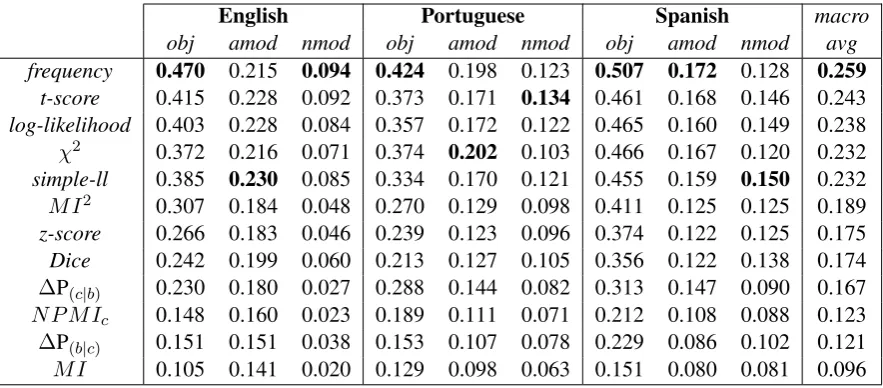
Finally, Tables 1 and 2 display the AUC and MAP values for each relation and language. Over-all, the AUC results follow the above mentioned tendencies. For verb-objectcollocations raw fre-quency obtained the best results in the three lan-guages, followed byχ2 (in Portuguese and Span-ish), and by t-score in English. Inamodandnmod
patterns, however, there are some differences in those measures with higher results. Thus, amod
candidates were better ranked by simple-ll in En-glish, whileχ2was the best AM in the Portuguese data. Fornmod, frequency, t-score, and simple-ll obtained the best numbers in English, Portuguese, and Spanish, respectively. Apart from these vari-ations in the highest-ranked measures, it is worth mentioning that the Dice coefficient had better re-sults thanχ2in the classification ofnmod combi-nations in Portuguese and Spanish.
The mean average precision (Table2) produced a different ranking of the AMs with regard to the previous evaluation. First, it is important to note that Dice has the best macro-average MAP val-ues, achieving the first position in three scenarios (obj collocations in Portuguese and Spanish, and
nmodin Spanish). Raw frequency performed bet-ter than Dice in five cases, but with low results in Portuguese with the obj dataset. Even though the best measures are basically the same (with the exception of Dice), the intermediate and lowest results differ from the AUC values: z-score gets worse macro-average numbers than the other mea-sures, while MI obtains better results, specially in
objin Portuguese and Spanish. Regarding the
di-rectional measures, both∆P variants get lower re-sults, whileN P M Ic shows a good performance
when compared to its AUC numbers.
5 Discussion
To make a better interpretation of the previous fig-ures, this section discusses the most interesting re-sults provided by the performed experiments.
First, when compared to the values provided by other studies, the low precision obtained in our ex-periments is striking. As an example, MAP values inPecina(2010) surpass0.65, while the best av-erage results in our tests were of about 0.30. In this regard, we consider that the different concept of collocation of both studies lead to critical dif-ferences in the results, as pointed in Section 2. For instance, the annotators of the referred study (Pecina, 2010) considered collocations some ex-pressions not covered by our data, such as idioms, phrasal verbs, or terms, with more than 20% of true collocations (versusthe 11%of our corpus). Other papers which use diverse corpora also obtain different results depending on the gold-standard (Evert et al.,2017). Apart from that, and as Fig-ure 2and Tables 1 and2 refer, there are evident differences among the collocation patterns, so di-rect comparisons should take this fact into ac-count. Specially innmod, the low results might be due to our restrictive annotation guidelines, which caused that only5.5%of the candidates were la-beled as collocations (versus14.6%and12.6%in
obj and amod, respectively). As pointed out in Section3.3, the inter-annotator agreement in this particular relation was also the lowest one.
Despite the divergences among the dependency relations, the average results per language did not show evident variations with respect to the eval-uated AMs. Small differences occur, however, inside each of the three mentioned groups. For instance, log-likelihood and MI2 work better, re-spectively, thanχ2 and∆P(c|b) in English, while
Portuguese had the opposite tendencies in both cases.
With regard to the directional measures, our ex-periments showed that, in spite of the asymmetric structure of collocations, symmetric measures pro-duced, on average, better results. The low values of∆P(b|c)are somehow expected because this AM
English Portuguese Spanish macro
obj amod nmod obj amod nmod obj amod nmod avg
frequency 0.470 0.215 0.094 0.424 0.198 0.123 0.507 0.172 0.128 0.259
t-score 0.415 0.228 0.092 0.373 0.171 0.134 0.461 0.168 0.146 0.243
log-likelihood 0.403 0.228 0.084 0.357 0.172 0.122 0.465 0.160 0.149 0.238
χ2 0.372 0.216 0.071 0.374 0.202 0.103 0.466 0.167 0.120 0.232
simple-ll 0.385 0.230 0.085 0.334 0.170 0.121 0.455 0.159 0.150 0.232
M I2 0.307 0.184 0.048 0.270 0.129 0.098 0.411 0.125 0.125 0.189
z-score 0.266 0.183 0.046 0.239 0.123 0.096 0.374 0.122 0.125 0.175
Dice 0.242 0.199 0.060 0.213 0.127 0.105 0.356 0.122 0.138 0.174
∆P(c|b) 0.230 0.180 0.027 0.288 0.144 0.082 0.313 0.147 0.090 0.167
N P M Ic 0.148 0.160 0.023 0.189 0.111 0.071 0.212 0.108 0.088 0.123
∆P(b|c) 0.151 0.151 0.038 0.153 0.107 0.078 0.229 0.086 0.102 0.121
[image:7.595.79.521.61.255.2]M I 0.105 0.141 0.020 0.129 0.098 0.063 0.151 0.080 0.081 0.096
Table 1: Area Under Curve (AUC) results for each language and collocation pattern, sorted by macro-average. Numbers in bold are the best results of each column.
English Portuguese Spanish macro
obj amod nmod obj amod nmod obj amod nmod avg
Dice 0.318 0.217 0.078 0.478 0.130 0.131 0.540 0.134 0.157 0.243
frequency 0.496 0.230 0.098 0.245 0.225 0.112 0.406 0.188 0.163 0.240
χ2 0.310 0.215 0.047 0.300 0.194 0.110 0.403 0.160 0.131 0.208
t-score 0.273 0.234 0.057 0.328 0.168 0.100 0.414 0.164 0.114 0.206
log-likelihood 0.280 0.219 0.048 0.334 0.174 0.084 0.352 0.148 0.090 0.192
M I2 0.246 0.190 0.042 0.256 0.136 0.096 0.358 0.126 0.119 0.174
N P M Ic 0.153 0.170 0.025 0.280 0.117 0.110 0.390 0.113 0.131 0.165
simple-ll 0.273 0.220 0.049 0.142 0.173 0.073 0.295 0.147 0.113 0.165
M I 0.110 0.149 0.021 0.305 0.100 0.129 0.391 0.083 0.138 0.158
∆P(c|b) 0.275 0.187 0.030 0.193 0.157 0.075 0.217 0.171 0.094 0.156
[image:7.595.78.522.297.492.2]∆P(b|c) 0.190 0.145 0.046 0.218 0.096 0.094 0.292 0.073 0.120 0.142 z-score 0.206 0.189 0.039 0.130 0.128 0.068 0.157 0.123 0.087 0.125
Table 2: Mean Average Precision (MAP) results for each language and collocation pattern, sorted by macro-average. MAP values were computed in the recall interval0.1–0.9. Numbers in bold are the best results of each column.
both ∆P(c|b) and N P M Ic achieved low results
when compared to symmetric measures such as t-score or log-likelihood. With respect toN P M Ic,
it is worth pointing that, as inCarlini et al.(2014), its results are better than MI (but lower, however, than its variant MI2). A qualitative analysis of the data shows, for instance, that∆P(c|b)promotes
non collocations such as separate [a] property
(obj),contemporary house(amod), orfreedom in-terval(nmod), while ranks very low combinations such as theverb-objectcollocationspay [a] trib-uteormake [a] mistake, theadjective-noun wide variety, or thenmodexamplecup [of] coffee.
Apart from the previous observations, the most relevant result when compared to similar
evalua-tions is the impact of raw frequency in the rank-ing of candidate collocations. InKrenn and Evert
(2001) the best values were achieved in most cases by t-score and by frequency, but in other studies such as Evert et al. (2017), frequency-based ex-tractions had only better results than MI (and than
frequen-Figure 4: Frequency versus mutual information of both collocations and non collocations in the three lan-guages. Statistics are computed using the data from the reference corpora.
cies higher than≈200are those with a better ratio between true positives and true negatives, while in low frequent combinations most candidates were not considered collocations. When looking at the data, one can see that frequent (non collocational) combinations such asfind [a] wayordo [a] thing
appear on the top positions, while less recurrent collocations (e.g., give [a] shrug, orcrude inten-sity) are not promoted due to their low frequency.
In order to delve deeper in the frequency impact we selected, from each reference corpus, the 10 most frequent combinations of each syntactic pat-tern and classified them into four categories: free combinations, collocations, idioms, or other. In
verb-objectandadjective-nounpatterns, most can-didates were classified as collocations (80% inobj, and≈40% in amod, which presents a wider dis-tribution). However, 60% of nominal compounds were classified as free combinations, 30% as id-ioms, and only 10% as collocations. This brief evaluation shows that, even if the use of raw fre-quency is not enough to carry out an accurate extraction of collocations, these data are useful to identify some types of collocations. Despite frequency-based extraction (and also other mea-sures which promote recurrent candidates) identi-fies recurrent free combinations and ignores true but infrequent collocations, those top-ranked can-didates are not especially noisy (except fornmod), so they may be a good starting point for further annotation. In this respect, it is important to note, as referred by studies such asLin(1999),Seretan and Wehrli(2006), orEvert(2008), that these ob-servations are especially relevant for
dependency-based collocation extraction, which only selects as candidates those pairs of lemmas with a particu-lar POS-tag which are related by specific syntactic relations. Other extraction strategies, using for in-stance ngrams of tokens, are more sensible to the effects of different AMs, because they often do not include the referred morphosyntactic and syntac-tic constraints which reduce the the noisy data. It is worth mentioning, however, that other experi-ments where co-occurrence frequency had a deci-sive impact also made use of syntactic information by means of constrained lexico-syntactic patterns (Krenn and Evert,2001;Evert and Krenn,2001).
In sum, the analyses carried out in this paper point out that frequency information plays an im-portant role in dependency-based collocation ex-traction. Nevertheless, the results also showed that the precision of both frequency and other AMs is not enough to automate the identification of collo-cations, so other strategies should be utilized. Fi-nally, our evaluation have also shown that most AMs behave similar in the three evaluated lan-guages, but also that each syntactic pattern reacts differently to the various AMs. In this regard, it would be interesting to apply specific AMs for different relations and frequency folds, aimed at identifying low-frequency cases (Evert and Krenn,
2001). Apart from that, combining different AMs (Pecina and Schlesinger,2006;Pecina,2010), and using semantic compositionality to identify idioms and other non collocation candidates might be use-ful to improve the unsupervised extraction of col-locations from corpora (Cordeiro et al.,2019).
6 Conclusions and Further Work
In this paper we have performed an evaluation of the impact of different statistical measures on the automatic extraction of dependency-based col-locations in different languages. To carry out these experiments, we annotated gold standard corpora containing 1,394 unique collocations in English, Portuguese, and Spanish. The annota-tion was done by means of syntactic dependencies, and each collocation was enriched with its lexical function in the Meaning-Text Theory.
[image:8.595.79.284.61.216.2]nmod combinations) reacts differently with re-spect to the various measures. Third, the 12 measures can be grouped in three different clus-ters regarding their behavior in the precision-recall curves. Fourth, in spite of the asymmetric struc-ture of collocations, symmetric measures achieve better results than the directional ones. And fi-nally, the results of our experiments indicate that, in syntax-based collocation extraction, raw fre-quency performs as well as the best AMs.
The results also confirm that single association measures are not enough to successfully extract collocations from corpora, so further work can be focused on the combinations of statistical informa-tion from different measures. In this respect, dis-tributional approaches that automatically classify MWEs regarding its compositionality may be also useful to filter out non collocational expressions from the extracted candidates.
Acknowledgments
This research was supported by a 2017 Leonardo Grant for Researchers and Cultural Creators (BBVA Foundation), by Ministerio de Econom´ıa, Industria y Competitividad (project with reference FFI2016-78299-P), and by the Galician Govern-ment (Xunta de Galicia grant ED431B-2017/01). Marcos Garcia has been funded by a Juan de la Cierva-incorporaci´on grant (IJCI-2016-29598), and Marcos Garc´ıa-Salido by a post-doctoral grant from Xunta de Galicia (ED481D 2017/009).
References
M. Benson. 1989. The Structure of the Collocational Dictionary. International Journal of Lexicography, 2(1):1–14.
Morton Benson. 1990. Collocations and general-purpose dictionaries. International Journal of Lexi-cography, 3(1):23–34.
Roberto Carlini, Joan Codina-Filba, and Leo Wanner. 2014. Improving collocation correction by ranking suggestions using linguistic knowledge. In Proceed-ings of the third workshop on NLP for computer-assisted language learning, pages 1–12, Uppsala. LiU Electronic Press.
Richard Eckart de Castilho, ´Eva M´ujdricza-Maydt, Seid Muhie Yimam, Silvana Hartmann, Iryna Gurevych, Anette Frank, and Chris Biemann. 2016.
A web-based tool for the integrated annotation of se-mantic and syntactic structures. In Proceedings of the Workshop on Language Technology Resources
and Tools for Digital Humanities (LT4DH), pages 76–84. The COLING 2016 Organizing Committee.
Kenneth Ward Church and Patrick Hanks. 1990. Word association norms, mutual information, and lexicog-raphy.Computational Linguistics, 16(1):22–29.
Silvio Cordeiro, Aline Villavicencio, Marco Idiart, and Carlos Ramisch. 2019. Unsupervised composition-ality prediction of nominal compounds. Computa-tional Linguistics, 45(1):1–57.
Mark Davies and Joseph L Fleiss. 1982. Measuring agreement for multinomial data. Biometrics, pages 1047–1051.
Jesse Davis and Mark Goadrich. 2006. The relation-ship between precision-recall and roc curves. In Proceedings of the 23rd international conference on Machine learning, pages 233–240. ACM.
Stefan Evert. 2008. Corpora and collocations. In Anke L¨udeling and Merja Kyt¨o, editors,Corpus Linguis-tics. An international handbook, volume 2, pages 1212–1248. Mouton de Gruyter, Berlin.
Stefan Evert and Brigitte Krenn. 2001. Methods for the qualitative evaluation of lexical association mea-sures. InProceedings of 39th Annual Meeting of the Association for Computational Linguistics, pages 188–195, Toulouse, France. Association for Com-putational Linguistics.
Stefan Evert, Peter Uhrig, Sabine Bartsch, and Thomas Proisl. 2017. E-VIEW-affilation–A large-scale eval-uation study of association measures for colloca-tion identificacolloca-tion. In Proceedings of eLex 2017– Electronic lexicography in the 21st century: Lexi-cography from Scratch, pages 531–549.
John R. Firth. 1957. A synopsis of linguistic theory, 1930-1955. Studies in linguistic analysis, pages 1– 32.
Pablo Gamallo, Marcos Garcia, C´esar Pineiro, Ro-drigo Martinez-Casta˜no, and Juan C Pichel. 2018.
LinguaKit: a Big Data-based multilingual tool for linguistic analysis and information extraction. In 2018 Fifth International Conference on So-cial Networks Analysis, Management and Security (SNAMS), pages 239–244. IEEE.
Marcos Garcia, Marcos Garc´ıa-Salido, Susana Sotelo, Estela Mosqueira, and Margarita Alonso-Ramos. 2019. Pay attention when you pay the bills. a mul-tilingual corpus with dependency-based and seman-tic annotation of collocations. InProceedings of the 57th Annual Meeting of the Association for Compu-tational Linguistics (ACL 2019), Florence. Associa-tion for ComputaAssocia-tional Linguistics.
Stefan Th. Gries. 2013.50-something years of work on collocations. International Journal of Corpus Lin-guistics, 18(1):137–165.
Franz Josef Hausmann. 1989. Le dictionnaire de collo-cations. W¨orterb¨ucher, Dictionaries, Dictionnaires, 1:1010–1019.
Philipp Koehn. 2005. Europarl: A Parallel Corpus for Statistical Machine Translation. InConference Pro-ceedings: the tenth Machine Translation Summit, pages 79–86, Phuket, Thailand. AAMT, AAMT.
Olga Kolesnikova and Alexander Gelbukh. 2018. Bi-nary and multi-class classification of lexical func-tions in spanish verb-noun collocafunc-tions. In Ad-vances in Computational Intelligence, pages 3–14, Cham. Springer International Publishing.
Brigitte Krenn and Stefan Evert. 2001. Can we do better than frequency? A case study on extracting PP-verb collocations. In Proceedings of the ACL Workshop on Collocations, pages 39–46, Toulouse, France. Association for Computational Linguistics.
Dekang Lin. 1999. Automatic identification of non-compositional phrases. InProceedings of the 37th Annual Meeting of the Association for Computa-tional Linguistics, pages 317–324, College Park, Maryland, USA. Association for Computational Linguistics.
Pierre Lison and J¨org Tiedemann. 2016. Opensub-titles2016: Extracting large parallel corpora from movie and tv subtitles. InProceedings of the Tenth International Conference on Language Resources and Evaluation (LREC 2016), Paris, France. Euro-pean Language Resources Association (ELRA).
Igor Mel’ˇcuk. 1995. Phrasemes in language and phraseology in linguistics. In Martin Everaert, Erik-Jan van der Linden, Andr´e Schenk, and Rob Schreu, editors, Idioms: Structural and psycholog-ical perspectives, chapter 8, pages 167–232. Hills-dale: Lawrence Erlbaum Associates.
Igor Mel’ˇcuk. 1996. Lexical functions: a tool for the description of lexical relations in a lexicon. In Leo Wanner, editor, Lexical Functions in Lexicography and Natural Language Processing, volume 31 of Studies in Language Companion Series, pages 37– 102. John Benjamins Publishing.
Igor Mel’ˇcuk. 1998. Collocations and lexical func-tions. In Anthony Paul Cowie, editor, Phraseol-ogy. Theory, analysis and applications, pages 23– 53. Clarendon Press, Oxford.
Joakim Nivre. 2015. Towards a universal grammar for natural language processing. InInternational Con-ference on Intelligent Text Processing and Computa-tional Linguistics, volume 9041 ofLecture Notes in Computer Science, pages 3–16. Springer.
Joakim Nivre et al. 2018. Universal dependencies 2.3. LINDAT/CLARIN digital library at the Institute of Formal and Applied Linguistics ( ´UFAL), Faculty of Mathematics and Physics, Charles University.
Darren Pearce. 2002.A comparative evaluation of col-location extraction techniques. In Proceedings of the Third International Conference on Language Re-sources and Evaluation (LREC’02), Las Palmas, Ca-nary Islands - Spain. European Language Resources Association (ELRA).
Pavel Pecina. 2010. Lexical association measures and collocation extraction. Language Resources and Evaluation, 44(1-2):137–158.
Pavel Pecina and Pavel Schlesinger. 2006. Combining association measures for collocation extraction. In Proceedings of the COLING/ACL 2006 Main Con-ference Poster Sessions, pages 651–658, Sydney, Australia. Association for Computational Linguis-tics.
Carlos Ramisch, Silvio Ricardo Cordeiro, Agata Savary, Veronika Vincze, Verginica Barbu Mititelu, Archna Bhatia, Maja Buljan, Marie Candito, Polona Gantar, Voula Giouli, Tunga G¨ung¨or, Abdelati Hawwari, Uxoa I˜nurrieta, Jolanta Kovalevskait˙e, Si-mon Krek, Timm Lichte, Chaya Liebeskind, Jo-hanna Monti, Carla Parra Escart´ın, Behrang Qasem-iZadeh, Renata Ramisch, Nathan Schneider, Ivelina Stoyanova, Ashwini Vaidya, and Abigail Walsh. 2018.Edition 1.1 of the PARSEME Shared Task on Automatic Identification of Verbal Multiword Ex-pressions. InProceedings of the Joint Workshop on Linguistic Annotation, Multiword Expressions and Constructions (LAW-MWE-CxG-2018), pages 222– 240. Association for Computational Linguistics.
Sara Rodr´ıguez-Fern´andez, Luis Espinosa Anke, Roberto Carlini, and Leo Wanner. 2016. Semantics-driven recognition of collocations using word em-beddings. InProceedings of the 54th Annual Meet-ing of the Association for Computational LMeet-inguistics (Volume 2: Short Papers), pages 499–505. Associa-tion for ComputaAssocia-tional Linguistics.
Ivan A. Sag, Timothy Baldwin, Francis Bond, Ann A. Copestake, and Dan Flickinger. 2002. Multiword expressions: A pain in the neck for NLP. In Pro-ceedings of the 3rd International Conference on Computational Linguistics and Intelligent Text Pro-cessing, volume 2276/2010 ofCICLing ’02, pages 1–15, London, UK. Springer-Verlag.
Violeta Seretan. 2011. Syntax-based collocation ex-traction, volume 44 of Text, Speech and Language Technology. Springer Science & Business Media.
John Sinclair. 1991. Corpus, concordance, colloca-tion. Oxford University Press, Oxford.
Frank Smadja. 1993.Retrieving collocations from text: Xtract.Computational Linguistics, 19(1):143–178.
Milan Straka and Jana Strakov´a. 2017. Tokenizing, POS Tagging, Lemmatizing and Parsing UD 2.0 with UDPipe. InProceedings of the CoNLL 2017 Shared Task: Multilingual Parsing from Raw Text to Universal Dependencies, pages 88–99, Vancouver, Canada. Association for Computational Linguistics.
Aristomenis Thanopoulos, Nikos Fakotakis, and George Kokkinakis. 2002. Comparative evaluation of collocation extraction metrics. InProceedings of the Third International Conference on Language Re-sources and Evaluation (LREC’02), Las Palmas, Ca-nary Islands - Spain. European Language Resources Association (ELRA).
Peter Uhrig, Stefan Evert, and Thomas Proisl. 2018. Collocation Candidate Extraction from Dependency-Annotated Corpora: Exploring Differ-ences across Parsers and Dependency Annotation Schemes. In Lexical Collocation Analysis, Quan-titative Methods in the Humanities and Social Sci-ences, pages 111–140. Springer.
Leo Wanner. 1996. Lexical Functions in Lexicogra-phy and Natural Language Processing, volume 31 of Studies in Corpus Linguistics. John Benjamins Publishing.
Leo Wanner, Bernd Bohnet, and Mark Giereth. 2006.
Making sense of collocations. Computer Speech & Language, 20(4):609–624.
Leo Wanner, Gabriela Ferraro, and Pol Moreno. 2016.
Towards Distributional Semantics-Based Classifica-tion of CollocaClassifica-tions for CollocaClassifica-tion DicClassifica-tionaries. International Journal of Lexicography, 30(2):167– 186.
Eric Wehrli and Luka Nerima. 2018. Anaphora reso-lution, collocations and translation, volume 341 of Current Issues in Linguistic Theory, pages 244–256. John Benjamins.
Daniel Zeman, Jan Hajiˇc, Martin Popel, Martin Pot-thast, Milan Straka, Filip Ginter, Joakim Nivre, and Slav Petrov. 2018. CoNLL 2018 shared task: Mul-tilingual parsing from raw text to universal depen-dencies. InProceedings of the CoNLL 2018 Shared Task: Multilingual Parsing from Raw Text to Univer-sal Dependencies, pages 1–21, Brussels, Belgium. Association for Computational Linguistics.
A Appendices
collocate ¬collocate
base O b =B
¬base c D =d2
[image:11.595.325.510.93.152.2]=C =d1 =N
Table 3: Contingency table for base–collocate combi-nations. Occurrences are computed only in dependen-cies with the target syntactic relation.
simple-ll 2(O·logOE −(O−E))
t-score O√−E
O
z-score O√−E
E
MI log2OE
MI2 log2O
2
E
Dice B2+·OC
log-likelihood 2
P
ij
OijlogOEijij
χ2 P
ij
(Oij−Eij)
Eij
N P M Ic? −M IlogC N
∆P(c|b) OB − c d2
∆P(b|c) OC −db1
Table 4: Association measures compared in this this paper.Emeans expected frequency (E= BCN ).
?Following Carlini et al. (2014) N P M I
c was
[image:11.595.318.512.218.496.2]