ISSN Online: 2327-5227 ISSN Print: 2327-5219
DOI: 10.4236/jcc.2017.512002 Sep. 30, 2017 13 Journal of Computer and Communications
Particle Swarm Optimization Algorithm
Based on Chaotic Sequences and Dynamic
Self-Adaptive Strategy
Mengshan Li, Liang Liu, Genqin Sun, Keming Su, Huaijin Zhang, Bingsheng Chen, Yan Wu
Gannan Normal University, Ganzhou, China
Abstract
To deal with the problems of premature convergence and tending to jump in-to the local optimum in the traditional particle swarm optimization, a novel improved particle swarm optimization algorithm was proposed. The self-adaptive inertia weight factor was used to accelerate the converging speed, and chaotic sequences were used to tune the acceleration coefficients for the balance between exploration and exploitation. The performance of the pro-posed algorithm was tested on four classical multi-objective optimization functions by comparing with the non-dominated sorting genetic algorithm and multi-objective particle swarm optimization algorithm. The results veri-fied the effectiveness of the algorithm, which improved the premature con-vergence problem with faster concon-vergence rate and strong ability to jump out of local optimum.
Keywords
Particle Swarm, Algorithm, Chaotic Sequences, Self-Adaptive Strategy, Multi-Objective Optimization
1. Introduction
Particle swarm optimization (PSO) algorithm is a swarm intelligence optimiza-tion algorithm, which derives agglomeraoptimiza-tion of organism behavior, such as a simulation of the behavior of a flock of birds or fish. Compared to other intelli-gent algorithms, PSO algorithm has simple structure, less parameters and is easy to describe and implement. The global search ability is stronger, without gra-dient information and many other features, which makes it to be widely used in many fields such as function optimization, multi-objective problem solving and How to cite this paper: Li, M.S., Liu, L.,
Sun, G.Q., Su, K.M., Zhang, H.J., Chen, B.S. and Wu, Y. (2017) Particle Swarm Optimi-zation Algorithm Based on Chaotic Se-quences and Dynamic Self-Adaptive Strat-egy. Journal of Computer and Communi-cations, 5, 13-23.
https://doi.org/10.4236/jcc.2017.512002
Received: September 13, 2017 Accepted: September 27, 2017 Published: September 30, 2017
Copyright © 2017 by authors and Scientific Research Publishing Inc. This work is licensed under the Creative Commons Attribution International License (CC BY 4.0).
DOI: 10.4236/jcc.2017.512002 14 Journal of Computer and Communications pattern recognition. In particular, it is applicable to solving the problems of non-linear, multipolar and non-differentiable and complex optimization [1] [2] [3]. However, the standard PSO algorithm also has shortcomings such as premature convergence and bad local searching ability similar to other intelligent algo-rithms [4] [5] [6]. For example, in the optimization of complex problems in high-dimension, the population may have accumulated to a certain point of stagnation without finding the global optimization point, forming premature convergence. In other words, the premature convergence problem does not guarantee that the algorithm can converge to the global extreme point. Mean-while, in the PSO algorithm search process, when the particle is approaching or entering the most advantageous region, the convergence speed is obviously slow. That is, in the later period of particle optimization, the search ability is poor. Thus, the application of PSO algorithm is restricted.
For the lack of PSO algorithm, the researchers propose many improvement strategies [7]. Inertia weighting factor [8], contraction factor and adaptive muta-tion operator are the most representative, such as linear decrease method [9], fuzzy adaptive method [10], distance information method and other inertial coefficients adaptive adjustment methods [11], PSO algorithm with compression factor, the PSO algorithm of adaptive mutation operator, etc. In addition, the PSO algorithm and the hybrid PSO algorithm combined with the PSO algo-rithm, synergy polices, chaos theory [12] and other algorithms [13] are also at-tracted by the researchers, such as quantum PSO algorithm with chaotic muta-tion operator [14]. In addimuta-tion, there are also many researches on discrete PSO algorithm, multi-objective PSO algorithm [15] [16], etc. At present, the im-provement of PSO algorithm mainly focuses on two aspects: adjustment of algo-rithm parameters and update of particle structure and trajectory. The aim is to make the algorithm solve or improve the local search slow, precocious conver-gence and so on, and improve the converconver-gence speed and accuracy of the algo-rithm to improve the performance of the algoalgo-rithm [17]. Although the proposed particle swarm improvement algorithm improves both performance and effi-ciency, it is difficult to improve the local search ability of the algorithm while avoiding precocious convergence. To provide better, more efficient, and cheaper particle swarm algorithms, academics and industry researchers have been ex-ploring and experimenting with new approaches [18].
DOI: 10.4236/jcc.2017.512002 15 Journal of Computer and Communications standard PSO algorithm and the classical multi-objective algorithm, the feasibil-ity and validfeasibil-ity of the algorithm are verified and the convergence speed and ac-curacy are discussed.
2. CSAPSO Algorithm
2.1. Standard PSO
Particle Swarm Optimization algorithm (PSO) is a group evolution algorithm proposed by scholars Eberhart and Kennedy [19] based on the social behaviors of birds in 1995. The PSO algorithm is derived from the behavior characteristics of biological groups and is used to solve the optimization problems. It has the advantages of easy description, easy implementation, little adjustment parame-ter, fast convergence speed and low calculation cost. And there is no high re-quirement for memory and CPU speed. In the process of particle optimization, the potential solution of the problem is assumed to be a “particle” in the n-dimensional space, and the particle will fly at a certain speed and direction in the solution space. In the iterative process, all particles use two global variables to represent the best position of the particle itself (pbest) and the best position of all particles (gbest). It is assumed that, in an n-dimensional search space, the particle population X =
(
x x1, , ,2 xn)
T is composed of m particles. The posi-tion of the ith particle is denoted as xi=(
x xi,1, i,2, , xi n,)
T and the velocity isdenoted as vi=
(
v vi,1, i,2, , vi n,)
T. The individual extremum is(
)
T,1, ,2, , ,
i i i i n
p = p p p , The global extreme of the population of particles is
(
)
T,1, ,2, , ,
g g g g n
p = p p p . During the k + 1 iteration, the particle updates its speed and position through Formulas (1) and (2).
(
) (
)
1
, , 1 , , 2 , ,
k k k k k k
i d i d i d i d g d i d
v+ =
ω
v +c p −x +c p −x(1)
1 1
, , ,
k k k
i d i d i d
x+ =x +v+ (2)
where, i=1,,m; ω is called an inertial weight factor, it makes the particles
keep sport inertia and have the ability to expand search space; C1 and C2 are the
learning factors, which represent the weight of each particle to the statistical ac-celeration item of the extremum position; rand () is a random number within (0, 1), vi dk, and xi dk, are respectively the velocity and position of particle i in
d–dimension kth iteration; pi dk, is the position of the individual extremum of
particle i in d-dimension, is the position of the global extremum of the whole population in d-dimension.
2.2. CSAPSO Algorithm
DOI: 10.4236/jcc.2017.512002 16 Journal of Computer and Communications extreme point area. In addition, the convergence rate of the algorithm becomes slow when approaching or entering the optimal solution area. The early conver-gence rate of PSO algorithm is fast, but in the later stage, when the algorithm converges to local minimum, due to the lack of effective local search mechanism, the local search speed is slow. According to the formula of particle velocity up-date of PSO algorithm, the change of particle velocity is determined by three factors: 1) The inertial weight factor, which represents the velocity information at the previous moment. It indicates the relationship between current speed and forward speed. 2) The cognitive factor, which is the development capacity coeffi-cient, represents the error of the optimum of the particle itself, and reflects the local mining and development capability of the particle. 3) The exploration fac-tor, which is the social sharing ability coefficient, represents the error of global optimum, the information sharing and cooperation ability between the particles. Under the circumstances, the inertia coefficient determines the search step length. When it is larger, it is good for global search. When it is smaller, it is helpful for local exploration. Cognitive factors and exploration factors are col-lectively called learning factors, which represent the effect proportion of the op-timum of the particle itself and global opop-timum. By adjusting the learning fac-tors properly, the global and local search of the particles can be weighed. When the algorithm is in precocious convergence, it is possible to change the explora-tion factor to achieve out of local optimal.
In order to improve the precocious convergence of the algorithm and improve the convergence speed of the algorithm, this paper uses adaptive weight adjust-ment strategy to realize the dynamic adjustadjust-ment of inertia coefficient. The cha-otic sequence generated by chacha-otic mapping is used to optimize the parameters of learning factor C1 and C2, and a chaos self-adaptive particle swarm
optimiza-tion algorithm (CSAPSO) is obtained. The inertial weight factor ω is adjusted
by Formula (3).
( )
(
)
max Pgbest k Plbestave max min k kmax
ω ω= − − ω −ω × (3)
where, ωmax and ωmin respectively represent the maximum and minimum values
of inertial weight; Pgbest (k) represents the global optimal for the kth iteration; Plbestave represents the local optimal average of all particles; kmax is maximum
number of iterations; k is current iteration times.
Learning factor C1 and C2 are adjusted by chaotic sequence generated by
cha-otic mapping. This paper uses the typical Lorenz’s equation to generate chacha-otic sequences, as shown in Formula (4).
(
)
d d d d d d
x y z
t
y x ay t
z b xz cz t
= − +
= +
= + −
(4)
DOI: 10.4236/jcc.2017.512002 17 Journal of Computer and Communications 5.7 respectively. The learning factor (c1, c2) is defined as:
( )
( )
1
2
c x t
c y t
=
=
(5)
Because the change of chaotic variables is random, ergodic and regular, the algorithm can maintain the diversity of population, effectively overcome the problem of precocious convergence, and improve global search performance.
The CSAPSO algorithm performs the following process: 1) To initialize the particle group
The position and velocity of particles in PSO algorithm are initialized. The in-itial position and velocity of the particles are generated randomly. The current position of each particle is used as the particle individual extremum, and the op-timal value of the individual extremum is selected as the global opop-timal value.
2) To calculate the adaptive value of group particles.
3) The adaptive value of each particle is compared with the adaptive value of the best position it has passed. If it is better, the current position is the best posi-tion of the particle.
4) The adaptive value of each particle is compared with the adaptive value of the global best position, and if it is better, the current position is the global best position.
5) The learning factor C1, C2 and inertial weight ω were obtained
respec-tively, and the velocity and position of the particles were updated and optimized 6) If the end condition of the algorithm is satisfied, the global best position is the optimal solution, saving the result and ending. Otherwise return to Step (2).
3. Numerical Experiment
3.1. Experiment Function and Evaluation
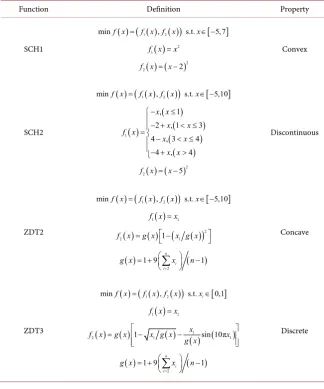
In order to test the performance of CSAPSO algorithm, this paper selects the multi-objective optimization test functions proposed by Schaffer [20] and Deb [21] as an experimental case. Multi-objective optimization problem is the most typical optimization problems, due to the constant contradiction and constraint among targets, it is difficult to achieve the optimal at the same time, as well as one of the optimization of goals must be at the expense of the other goals. The solutions to such problems are usually not unique, but a series of optimal solu-tions, also called non-inferior solutions. A collection of non-inferred solutions is often referred to as Pareto optimal solution. Because intelligent algorithm can search multiple solutions of solution space in parallel, multi-objective optimiza-tion is more suitable to verify the performance of intelligent algorithm. The mul-ti-objective optimization test functions used in this paper are shown in Table 1.
DOI: 10.4236/jcc.2017.512002 18 Journal of Computer and Communications
Table 1. Test functions used in this paper.
Function Definition Property
SCH1
( )
(
1( ) ( )2)
[ ] minf x = f x f x, s.t.x∈ −5,7( )
21
f x =x
( ) ( )2
2 2
f x = x−
Convex
SCH2
( )
(
1( ) ( )2)
[ ] minf x = f x f x, s.t.x∈ −5,10( ) ( ) ( ) ( ) ( ) 1 , 1 2 , 1 3 4 , 3 4
4 , 4 x x x x f x x x x x − ≤
− + < ≤
= − < ≤
− + >
( ) ( )2
2 5
f x = x−
Discontinuous
ZDT2
( )
(
1( ) ( )2)
[ ] minf x = f x f x, s.t.x∈ −5,10( )
1 1
f x =x
( ) ( )
(
( ))
22 1 1
f x =g x − x g x
( ) ( )
2
1 9 n i 1 i
g x x n
= = + −
∑
Concave ZDT3( )
(
1( ) ( )2)
[ ] minf x = f x f x, s.t.xi∈0,1( )
1 1
f x =x
( ) ( ) ( ) ( ) (1 )
2 1 1 sin 10π1
x
f x g x x g x x
g x = − − ( ) ( ) 2
1 9 n i 1 i
g x x n
=
= + −
∑
Discrete
1) Convergence index (GD), GD is used to describe the distance between the ungoverned solution that the algorithm searches for and the optimal front-end of the real Pareto.
2 1 GD N i i d N =
=
∑
(6)where, N represents the number of ungoverned solutions that the algorithm searches for, 2
i
d represents the shortest Euclidean distance between the non-inferior solution i and all solutions in the optimal front-end of the real Pa-reto.
2) Distribution index (SP), SP is used to evaluate the uniformity of distribu-tion of ungoverned soludistribu-tion.
(
)
2 1 21
1 SP
n i
i d d
n d = −
DOI: 10.4236/jcc.2017.512002 19 Journal of Computer and Communications 1
1 n
i i
d d
n =
=
∑
(8)where, N is the number of ungoverned solutions, and represents the shortest distance between the ith non-inferior solution in the target space and all solu-tions in the optimal front-end of the real Pareto.
3.2. Experimental Results
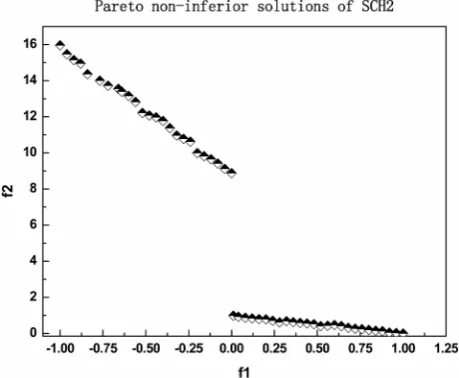
The CSAPSO algorithm was used to experiment with SCH1, SCH2, ZDT2 and ZDT3. The algorithm parameter is set to: the particle size is 50; the maximum iteration number is 100; the maximum and minimum values of inertia weight are 0.9 and 0.3 respectively; inertia weight ω and learning factor C1 and C2 are
[image:7.595.257.490.288.480.2]obtained according to Formulas (3) and (5) respectively. The Pareto non-infe- rior solutions of each function are shown in Figures 1-4.
Figure 1. Pareto non-inferior solution of SCH1.
[image:7.595.258.488.516.705.2]DOI: 10.4236/jcc.2017.512002 20 Journal of Computer and Communications
Figure 3. Pareto non-inferior solution of ZDT2.
Figure 4. Pareto non-inferior solution of ZDT3.
In the target function space, non-inferior optimal target domain is the boun-dary of the fitness value region, which is the effective interface. It can be seen from the experimental results that the four test functions accurately give the ef-fective interface, and the complete Pareto non-inferior solution can be obtained. In particular, for the discrete problem of ZDT3, the algorithm also gives a more accurate non-inferior solution. In general, the number of Pareto solutions ob-tained by the algorithm is more and the distribution is more uniform. The accu-racy and reliability of CSAPSO algorithm are verified.
[image:8.595.250.495.306.510.2]DOI: 10.4236/jcc.2017.512002 21 Journal of Computer and Communications
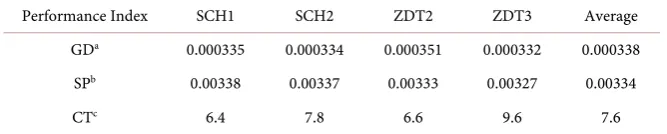
Table 2. Performance statistics of CASPSO.
Performance Index SCH1 SCH2 ZDT2 ZDT3 Average
GDa 0.000335 0.000334 0.000351 0.000332 0.000338
SPb 0.00338 0.00337 0.00333 0.00327 0.00334
CTc 6.4 7.8 6.6 9.6 7.6
aConvergence index, bDistribution index, cCalculated time (s).
The evaluation index GD, SP and CT confirmed the feasibility, accuracy and efficiency of the CSAPSO algorithm for solving multi-objective optimization problems. GD indicates that the non-inferior solution is very close to the optim-al front end of the reoptim-al Pareto. SP shows that the non-inferior solution has good distribution. CT shows that the time spent running is within acceptable limits.
In order to test the superiority of the algorithm in multi-objective optimiza-tion soluoptimiza-tion, comparing CSAPSO algorithm in this paper with classic non-poor classification multi-objective genetic algorithm(NSGA-II), multi-objective par-ticle swarm optimization, the statistical comparison results are shown in Table 3.
According to GD of Table 3, the convergence of CSAPSO algorithm is better than the other two algorithms. It is shown that the optimal front distance be-tween the non-inferior solution and real Pareto is smaller. That is, the solution is closer to the real solution. The SP of Table 3 shows that the distribution of non-inferior solutions obtained by the CSAPSO algorithm is better, that is, the distribution of the non-inferior solution of the algorithm is more uniform than the other two algorithms. For CT, the execution time of CSAPSO algorithm is between two algorithms, lower than NSGA II algorithm but higher than MOPSO. The reason for this is that the standard PSO algorithm is according to the equal step and flying in a single direction search, while CSAPSO algorithm dynamically adjusted with the flight process of particle, the process of dynamic adjustment will consume more time. Although the CSAPSO algorithm spends more computation time, the convergence and distribution of non-inferior solu-tions are better than the other two algorithms, which can obtain more and more evenly distributed feasible solutions.
In conclusion, through the CSAPSO algorithm for the numerical experiments of four multi-objective optimization problems, compared with the classical mul-ti-objective optimization of NSGA II algorithm and MOPSO algorithm, we can know, CSAPSO algorithm has a better comprehensive performance. Algorithm improves the convergence speed by dynamic adaptive mechanism. Through the chaotic learning mechanism, the precocious convergence problem is improved.
4. Conclusions
DOI: 10.4236/jcc.2017.512002 22 Journal of Computer and Communications
Table 3. Comparison results of three algorithms.
Performance Index NSGA II MOPSO CSAPSO
GD 0.000362 0.000465 0.000338
SP 0.00475 0.00502 0.00334
CT 8.7 6.8 7.6
precocious convergence of PSO algorithm, and improve the convergence speed. By the experiment of four standard test functions, the proposed algorithm can be used to solve the multi-target problem, and the obtained non-inferiority solu-tion can get a good approximasolu-tion of the optimal solusolu-tion set of Pareto and dis-tribute evenly. By comparing with other algorithms, CSAPSO algorithm has better property, which can provide practical reference value for many optimiza-tion problems in the project. In the future, the convergence strategy and ma-thematical proof of the PSO algorithm can be discussed in-depth.
Acknowledgements
The authors gratefully acknowledge the support from the National Natural Science Foundation of China (Grant Numbers: 51663001, 51463015, 51377025) and the science and technology research project of the education department of Jiangxi province (Grant Numbers: GJJ151012, GJJ150983).
References
[1] Neri, F., Mininno, E. and Lacca, G. (2013) Compact Particle Swarm Optimization.
Information Sciences, 239, 96-121. https://doi.org/10.1016/j.ins.2013.03.026 [2] Tan, K.C., Lee, T.H. and Khor, E.F. (2002) Evolutionary Algorithms for
Mul-ti-Objective Optimization: Performance Assessments and Comparisons. Artificial Intelligence Review, 17, 253-290. https://doi.org/10.1023/A:1015516501242 [3] Zitzler, E., Thiele, L., Laumanns, M., Fonseca, C.M. and da Fonseca, V.G. (2003)
Performance Assessment of Multiobjective Optimizers: An Analysis and Review.
IEEE Transactions on Evolutionary Computation, 7, 117-132. https://doi.org/10.1109/TEVC.2003.810758
[4] del Valle, Y., Venayagamoorthy, G.K., Mohagheghi, S., Hernandez, J.C. and Harley, R.G. (2008) Particle Swarm Optimization: Basic Concepts, Variants and Applica-tions in Power Systems. IEEE Transactions on Evolutionary Computation, 12, 171-195. https://doi.org/10.1109/TEVC.2007.896686
[5] Tsekouras, G.E. and Tsimikas, J. (2013) On Training RBF Neural Networks Using Input-Output Fuzzy Clustering and Particle Swarm Optimization. Fuzzy Sets and Systems, 221, 65-89. https://doi.org/10.1016/j.fss.2012.10.004
[6] Nickabadi, A., Ebadzadeh, M.M. and Safabakhsh, R. (2011) A Novel Particle Swarm Optimization Algorithm with Adaptive Inertia Weight. Applied Soft Computing, 11, 3658-3670. https://doi.org/10.1016/j.asoc.2011.01.037
[7] Akay, B. (2013) A Study on Particle Swarm Optimization and Artificial Bee Colony Algorithms for Multilevel Thresholding. Applied Soft Computing, 13, 3066-3091. https://doi.org/10.1016/j.asoc.2012.03.072
DOI: 10.4236/jcc.2017.512002 23 Journal of Computer and Communications
Optimization. IEEE Transactions on Systems Man and Cybernetics Part B: Cyber-netics, 39, 1362-1381. https://doi.org/10.1109/TSMCB.2009.2015956
[9] Khare, A. and Rangnekar, S. (2013) A Review of Particle Swarm Optimization and Its Applications in Solar Photovoltaic System. Applied Soft Computing, 13, 2997-3006. https://doi.org/10.1016/j.asoc.2012.11.033
[10] Valdez, F., Melin, P. and Castillo, O. (2011) An Improved Evolutionary Method with Fuzzy Logic for Combining Particle Swarm Optimization and Genetic Algo-rithms. Applied Soft Computing, 11, 2625-2632.
https://doi.org/10.1016/j.asoc.2010.10.010
[11] Marinakis, Y. and Marinaki, M. (2013) Particle Swarm Optimization with Expand-ing Neighborhood Topology for the Permutation Flowshop SchedulExpand-ing Problem.
Soft Computing, 17, 1159-1173.https://doi.org/10.1007/s00500-013-0992-z [12] Cheng, M.Y., Huang, K.Y. and Chen, H.M. (2012) K-Means Particle Swarm
Opti-mization with Embedded Chaotic Search for Solving Multidimensional Problems.
Applied Mathematics and Computation, 219, 3091-3099.
[13] Li, M.W., Kang, H.G., Zhou, P.F. and Hong, W.C. (2013) Hybrid Optimization Al-gorithm Based on Chaos, Cloud and Particle Swarm Optimization AlAl-gorithm.
Journal of Systems Engineering and Electronics, 24, 324-334.
https://doi.org/10.1109/JSEE.2013.00041
[14] Coelho, L.D. (2008) A Quantum Particle Swarm Optimizer with Chaotic Mutation Operator. Chaos Solitons & Fractals, 37, 1409-1418.
[15] Qasem, S.N., Shamsuddin, S.M., Hashim, S.Z.M., Darus, M. and Al-Shammari, E. (2013) Memetic Multiobjective Particle Swarm Optimization-Based Radial Basis Function Network for Classification Problems. Information Sciences, 239, 165-190. [16] Zheng, Y.J. and Chen, S.Y. (2013) Cooperative Particle Swarm Optimization for
Multiobjective Transportation Planning. Applied Intelligence, 39, 202-216.
https://doi.org/10.1007/s10489-012-0405-5
[17] Gandomi, A.H., Yun, G.J., Yang, X.S. and Talatahari, S. (2013) Chaos-Enhanced Accelerated Particle Swarm Optimization. Communications in Nonlinear Science and Numerical Simulation, 18, 327-340.
[18] Tsekouras, G.E. (2013) A Simple and Effective Algorithm for Implementing Particle Swarm Optimization in RBF Network’s Design using Input-Output Fuzzy Cluster-ing. Neurocomputing, 108, 36-44.
[19] Kennedy, J. and Eberhart, R. (1995) Particle Swarm Optimization. In: 1995 IEEE International Conference on Neural Networks Proceedings, Proceedings of Interna-tional Conference on Neural Networks, IEEE Australia Council, Perth, 1942-1948.
https://doi.org/10.1109/ICNN.1995.488968
[20] Schaffer, J.D. (1985) Multiple Objective Optimization with Vector Evaluated Ge-netic Algorithms. In: International Conference on Genetic Algorithms, Lawrence Erlbaum Associates, 93-100.
[21] Deb, K. (1999) Multi-Objective Genetic Algorithms: Problem Difficulties and Con-struction of Test Problems. Evolutionary Computation, 7, 205-230.