O R I G I N A L A R T I C L E
Open Access
The role of motivation in EFL students
’
perceptions of teacher/learner
responsibilities and learner abilities
Ay
ş
egül Okay
1*and Cem Balç
ı
kanl
ı
2* Correspondence: [email protected] 1Yıldız Teknik Üniversitesi,İstanbul, Turkey
Full list of author information is available at the end of the article
Abstract
It is the aim of this study to investigate EFL (English as a Foreign Language) students’ perceptions of teacher/learner responsibilities and learner decision-making abilities at tertiary level - questioning whether motivation has a role in these perceptions. To this end, 144 students who studied in the preparatory school of a state university took part in this study. In a mixed-methods research design, two questionnaires were used to collect quantitative data on students’perceptions and motivation, whereas an open-ended questionnaire was used to gather qualitative data to gain a deeper insight about the perceptions of the students. To analyze the quantitative and qualitative data, statistical analyses via SPSS Version 18 and latent level analyses were performed, respectively. The results suggested that high-motivated students do rate themselves good/very good in their decision-making abilities than their low-motivated peers. However, motivation or ability was not found to be related to students’perceptions of teacher/learner responsibilities. Since high-motivated students were good/very good at their decision-making abilities, but not more willing to share responsibilities with their teachers, it could be argued that motivation or ability alone does not ensure learner autonomy.
Keywords:Learner autonomy, Motivation, Perception, Responsibility
Introduction
The contemporary view of education today takes students as‘agents’of their own edu-cational destiny (van Lier, 2008, p. 47); and teachers, in accordance, have begun to change their roles from teaching to facilitating, helping, coordinating, counselling, con-sulting, advising, knowing, resourcing and so on. One of the main reasons for this shift is the advent of the term‘autonomy’into the area of language teaching and learning. Although learner autonomy is commonly defined as“the ability to take charge of one’s own learning” (Holec, 1981, p. 3), there have been many other definitions of learner autonomy since then. Little (1991), for instance, uses ‘capacity’ instead of ‘ability’and states that “autonomy is essentially a capacity for detachment, critical reflection, decision-making, and independent action” (p. 4). The famous ‘Bergen definition’, as Dam (1995) explains, associates autonomy with“readiness to take charge of one’s own learning in the service of one’s needs and purposes – which entails a capacity and
willingness to act independently and in co-operation with others, as a socially respon-sible person”(p.1).
In addition to these definitions, there are also different types and versions of auton-omy. For example, Benson (1997) is among the first to come up with different dimen-sions of autonomy, i.e. technical, political and psychological. Smith (2003), on the other hand, proposes strong and weak versions of autonomy – the former regarding auton-omy as an innate concept, whereas the latter suggests that autonauton-omy is learnable. Littlewood’s (1999) distinction of proactive and reactive autonomy indicates that the former helps learners make their own learning decisions, whereas the latter only enables learners to be flexible within the limitations already set by external agencies. According to Littlewood (1999), an autonomous person is the one who has independ-ent capacity to make and carry out the choices which govern his or her actions and this capacity depends on two main components: ability and willingness. Littlewood (1999) explains that willingness depends on having both the motivation and the confidence to take responsibility for the choices required (p. 428), whereas ability is more related to possessing both knowledge about the alternatives from which choices have to be made and the necessary skills for carrying out whatever choices seem most appropriate. Here it can be understood that motivation plays a crucial role explaining autonomy.
Regarding the question whether motivation plays a role in autonomy or autonomy plays a role in motivation, the first view suggests that autonomy is a prerequisite for motivation. Dickinson (1995) explains this view stating that “a measure of individual involvement in decision making in one's own learning enhances motivation to learn” (p. 165). Defining autonomy as both an attitude towards learning and a capacity for in-dependent learning, Dickinson (1995) proposes two theories of cognitive motivation:
“attribution theory” and“self-determination theory”. Deci and Ryan’s (1985) self-deter-mination theory differentiates between intrinsic and extrinsic motivation by putting them on a continuum where learners choose to learn at their own will “in the absence of a reward contingency or control” (p. 34); or where they perform an activity simply for an external reward or to avoid punishment. According to Deci, Vallerand, Pelletier and Ryan (1991), autonomy, thus, is an essential component in intrinsic motivation. The second theory, the attribution theory, is concerned with learners’ perceptions of the reasons for success and failure in learning (as cited in Benson, 2001). These percep-tions are important because, as Dickinson (1995) explains, they will influence their future performance because learners should also have control over learning success and failure in order to take responsibility for their own learning.
Autonomy is also present in Dörnyei and Csizér’s (1998) ‘ten commandments’ for motivating language learners:
1. Set a personal example with your own behavior. 2. Develop a good relationship with the learners. 3. Increase the learners’linguistic self-confidence. 4. Make the language classes interesting.
9. Create a pleasant relaxed atmosphere in the classroom. 10.Present the tasks properly.
The fact that autonomy is regarded as a commandment of motivation also supports the assumption that autonomy comes before motivation. There are also a number of studies supporting this view. Garcia and Pintrich (1996), for instance, argue that intrin-sic motivation is greater among children whose parents’and teachers’styles of inter-action are autonomy-supportive. Their research also indicates that the college students who perceived their instructors to be supportive of autonomy reported greater levels of motivation at the end of the semester, even after the effects of pretest motivation were partialed out. Bao and Lam (2008) report in their study that children with freedom of choice reported higher motivation than their peers who had to follow the choices pur-portedly made by their mothers or teachers. They also came up with the result that
“socio-emotional relatedness” was consistently a significant moderator of the effect of choice on children’s motivation. That is to say, when the children had good relation-ships with the people who made the choices for them, their motivation was as strong as if they had made their own choices. In other words, freedom of choice does not mat-ter when relatedness is high but it does matmat-ter when relatedness is low.
On the other hand, there are strong supporters of the opposite view –that is, motiv-ation precedes autonomy. In their study conducted with Chinese students, Chan, Spratt and Humphreys (2002) found that higher motivation led to higher frequency of engage-ment in the autonomous practices outside the classroom. In other words, the motivated students seemed to do more than their peers who claimed that they were less moti-vated. However, the authors found it surprising that in the interviews, those motivated or ‘well-motivated’ students (even the language majors) admitted that they had little inclination to pursue their learning beyond the classroom. The researchers interpreted these results suggesting that students’ attitudes are not always apparent in actual autonomous behavior. In another study, Fazey and Fazey (2001) also concluded that the students who had internalized motivation possessed attributes that would enable them to be self-determined in their studies. Üstünlüoğlu (2009) came up with similar results regarding Turkish students. She found that although most of the students in her study perceive themselves motivated, they neither seek challenges nor are willing to engage in activities out of the classroom. She also concluded in her study that moti-vated and high motimoti-vated students perceived themselves being more capable of activ-ities which require autonomy than their unmotivated or low-motivated peers.
The hypothesis of this present study is that motivation is a prerequisite for autonomy, for “motivation may lead to autonomy or be a precondition for it [and] absence of motivation seemed to inhibit practice of learner autonomy” (Spratt, Humphreys & Chan, 2002, p.262). Fazey and Fazey (2001) also state that “the lack of motivation is clearly detrimental to autonomous behavior” (p. 347). Autonomy, thus, is accepted to grow out of the individual’s acceptance of his or her own responsibility for learning (Chan, Spratt & Humphreys, 2002). Therefore, in this study, it is hypothesized that low-motivated students will be less eager to take responsibilities of their own learning and accordingly the research questions are as follows:
2. What are the EFL students’perceptions of their abilities?
3. What is the relationship between EFL students’perceptions of their English teachers’responsibilities and their own and their decision-making abilities? 4. What is the relationship between EFL students’motivation levels and their
perceptions of their/their teachers’responsibilities and their abilities?
Methods Participants
The present study took place at a preparatory school of a state university in Turkey. The participants were chosen by convenient sampling procedure. A total number of 144 students (61 males, 83 females) took part in the quantitative data collection process of the study. Thirty-eight of them also took part in the qualitative data collection process. At the time of data collection, they had all been studying English for 26 weeks and they were all at CEFR B1+ and B2 levels.
Data collection tools
In this study, two quantitative data collection tools were used. The first one was the questionnaire devised by Chan, Spratt and Humphreys (2002), which consisted of 52 questions, divided into four main sections. It required the subjects to report on:
(a) their perceptions of the English teacher’s responsibilities and their own; (b)their perceptions of their decision-making abilities;
(c)their motivation to study English; and
(d)how often they carried out different autonomous activities in and outside class.
Section (a) asked students to rate both their and their teachers’responsibilities in the Likert-type options ranging from“not at all”to“completely”. In her study, Üstünlüoğlu (2009) adapted this first section by removing the Likert-type options and only asking student to decide whose responsibility a certain action is: theirs, their teachers’, or both. In the present study, this adapted version of Section (a) was administered in the data collection process. The questions in Section (b) were Likert-type and asked students how able they think they are about their decision-making abilities. These abilities were related to the in-and-out-of-class responsibilities asked in the Section (a) of the ques-tionnaire to gather more information. Sections (c) and (d) were not used for data col-lection because Section (c) measured the motivation level of students only by asking them “how motivated they think they are”. However, depending merely on students’ own evaluations of their own motivation levels might not have been reasonable. There-fore, their motivation levels were measured separately by another data collection tool. The reason why Section (d) was also decided to be excluded from the data collection procedure was that it asked students“how often they did inside and outside class activ-ities” in an academic year. Chan, Spratt, and Humphreys (2002) explain that these ac-tivities could be thought of as “manifestations of autonomous language learning behavior” (p. 5). However, it may be argued that when a teacher assigns students to
‘read a grammar book’(Item 26 in the original questionnaire) or‘do grammar exercises’
they would, thus, might no longer be real representations of autonomous behavior. Therefore, in this study, only the Section (a) – adapted by Üstünlüoğlu (2009)– and Section (b) of the original questionnaire by Chan, Spratt, and Humphreys (2002) were used to measure students’ perceptions of: (a) the English teacher’s responsibilities and their own; and (b) their decision-making abilities.
Secondly, to measure their motivation levels separately, a translated and an adapted version of Gardner’s (1985) Attitude/Motivation Test Battery was used. Doğan (2009,
İngilizce hazırlık okuyan öğrencilerin motivasyon düzeyleri, Unpublished MA Thesis) adapted and translated this battery into Turkish. The battery test was given to a group of students to validate the instrument. The statistical analysis indicated that the instru-ment proved to be used in Turkish context (Cronbach alpha: 0,87). This adapted and translated version consisted of four components:
1. Motivational Intensity. This measure consists of ten multiple choice items which are
designed to measure the intensity of a student’s motivation to learn English in terms of work done for classroom assignments, future plans to make use of and study the language, etc. A high score represents a student’s self-report of a high de-gree of effort being spent in acquiring the language.
2. Desire to Learn English.Ten multiple choice items are included in this scale with a
high score expressing a strong desire to learn English.
3. Attitudes toward Learning English.This is a ten item scale, higher score from which
indicates a positive attitude toward learning English.
4. Instrumental Orientation.Students are presented with four items which stress the
pragmatic or utilitarian value of learning English. A high score indicates that the student endorses instrumental reasons for learning English.
In addition to these two quantitative data collection tools, an open-ended questionnaire as a qualitative data collection tool was also administered to gain a deeper insight into the results of the aforementioned questionnaire. This open-ended questionnaire was devised by the researchers. To this aim, all the 13 items in the Section (a) of the questionnaire were turned into trinary choice statements asking them to state whose responsibility a certain task is (i.e. their, their teacher’s, or both) and these statements ended with
“because…” so that the participants could state the reasons why they believed so.
Data collection procedures
Two quantitative questionnaires were administered to 144 students on the same day in the same class hours, and it took about 15 min to complete both questionnaires. The qualitative data, on the other hand, were collected from 38 students two weeks after the collection of the quantitative data, and it took about 30 min to complete the open-ended questionnaire.
Data analysis procedures
259). To this end, after the quantitative data were collected through two questionnaires, the qualitative data were gathered via an open-ended questionnaire to gain a deeper insight about the constructs being investigated and thereby to ensure research validity.
Quantitative data were analyzed statistically by SPSS version 18. The test for normal-ity examining standardized skewness and the Shapiro-Wilks test indicated the data were normally distributed. In order to answer the first two research questions, [(1) What are the students’perceptions of their responsibilities? (2) What are the students’ perceptions of their abilities?], frequency analyses were performed. For the third and fourth research questions [(3) Is there a relationship between students’ perceptions of their English teachers’ responsibilities and their own and their decision-making abil-ities? (4) Is there a relationship between motivation levels and perceptions of students in terms of their responsibilities and abilities?], Pearson correlation and One-way ANOVA analyses were carried out.
Qualitative data, on the other hand, were subjected to latent level analysis, which Dörnyei (2007) describes as ‘a second-level, interpretive analysis of the underlying deeper meaning of the data’(p. 246). This type of analysis includes coding, looking for patterns, making interpretations and building theories from the data.
Results
Perceptions of responsibilities
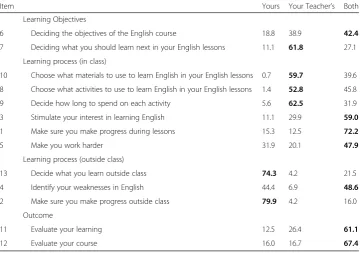
Table 1 below summarizes the results of students’perceptions of their and their English teacher’s responsibilities. Out of 13 responsibilities, students give the responsibility only to their teachers in 4 tasks, and only to themselves in 2 tasks, while the rest are stated as the responsibilities shared by both themselves and their teachers.
Table 1Students’perceptions of their own and their teachers’responsibilities in percentages
Item Yours Your Teacher’s Both
Learning Objectives
6 Deciding the objectives of the English course 18.8 38.9 42.4
7 Deciding what you should learn next in your English lessons 11.1 61.8 27.1
Learning process (in class)
10 Choose what materials to use to learn English in your English lessons 0.7 59.7 39.6
8 Choose what activities to use to learn English in your English lessons 1.4 52.8 45.8
9 Decide how long to spend on each activity 5.6 62.5 31.9
3 Stimulate your interest in learning English 11.1 29.9 59.0
1 Make sure you make progress during lessons 15.3 12.5 72.2
5 Make you work harder 31.9 20.1 47.9
Learning process (outside class)
13 Decide what you learn outside class 74.3 4.2 21.5
4 Identify your weaknesses in English 44.4 6.9 48.6
2 Make sure you make progress outside class 79.9 4.2 16.0
Outcome
11 Evaluate your learning 12.5 26.4 61.1
12 Evaluate your course 16.0 16.7 67.4
It is clear that students believe that they should decide the objectives of the lesson to-gether with their teachers, but the materials, the activities, and the time allocated to these practices should be decided by their teachers. When it comes to making progress outside the class, most students take the responsibility on themselves, leaving almost none to their teachers. Students also tend to share their teachers’ responsibilities in terms of evaluating their learning and the course. Most of them state that they should evaluate the course and their learning together with their teachers.
The open-ended questionnaire, which asks the students “why” they believe so, also supports these results:
Learning Objectives. The students believe that they should decide the objectives of
the English course together with their teacher. They mostly acknowledge that the teacher has knowledge and experience; but the students add that since they are the ones who want to learn English, they should learn whattheyneed and thus they should decide the objectives together with the teacher in accordance with their own educa-tional aims. Addieduca-tionally, the students state that their teachers should decide what they should learn next in their English lessons. Again they mostly explain that it is the teacher who is expert, knowledgeable, and experienced, and thus it is the teacher’s re-sponsibility to ‘plan’ and it’s their responsibility to ‘stick to’ the plan. A few students even put forward that students might ‘abuse’this or there might be‘chaos’if they were given the chance to do so. A few students question with sarcasm what their teachers would do if they took this responsibility on themselves as well.
Learning Process in Class. The students’general impression is that, after deciding
the objectives together with their teachers, their teachers should be the ones to decide the materials, the activities and the time spent on these practices. The students usually mention their teachers’experience, education and knowledge. A few students, however, state that it could be better if the teacher provided them with a set of materials to choose from and then they could decide on the materials which appeal to their interests.
Learning Process outside Class. Nearly all of the students state that it is their own
responsibility to decide what they learn outside the class and make sure they progress outside the class. The commonly put forward reason is that when they are outside the classroom, they are alone and since English cannot only be taught by the teacher in the classroom, it should be them who are responsible for learning outside the class. A number of students also mention that because they have a lot of students, it would be impossible for teachers to take interest in or identify weaknesses of each and every student. However, some of the students also indicate that they may not identify their weakness on their own because they might not know how to do so, so they suggest getting some‘help’,‘advice’, or‘counselling’from their teachers in this regard.
Learning Outcome. The common belief among students is that evaluating the
experience in doing so, they may be incapable of ‘objectively’ evaluating their own learning, so they state that they need their teachers to ‘control’ and to ‘check’ their learning outcome.
Perceptions of abilities
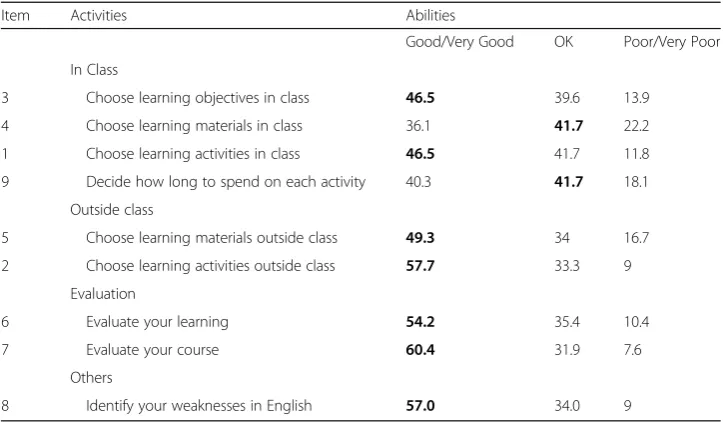
As Table 2 shows, the second section of the questionnaire asks students to evaluate their own decision-making abilities in a range of activities and processes. These activ-ities and processes are also the ones for which the students are asked about responsibil-ities in the first part of the questionnaire.
Among 9 activities, the students rate themselves having ‘very good/good’abilities for 7 of them; and they rate their abilities ‘OK’for only two of them. They do not regard themselves‘poor’in any of these activities. Here it is important to note that the major-ity of students rate themselves having ‘very good/good’ or ‘OK’decision-making abil-ities to perform in-class, outside-class and evaluation tasks. It is also easy to notice that students rate themselves good/very good when it comes to out-of-class activities or evaluation. They only do not seem to trust their abilities about in-class activities such as choosing learning materials or deciding on the time spent on each activity.
Motivation and ability
In order to find out whether motivation had a role in the perceptions of students’ decision-making abilities, Pearson correlation analysis was carried out. There was a meaningful positive correlation between students’motivation levels and perceptions of their decision-making abilities (r= .305n= 144,p= .00).
Motivation, ability and responsibilities–Are they related?
One-way ANOVA analyses were performed with students’ perceptions of their/their teachers’responsibilities and motivation levels in order to assess the role of motivation
Table 2Students’perceptions of their decision-making abilities in percentages
Item Activities Abilities
Good/Very Good OK Poor/Very Poor
In Class
3 Choose learning objectives in class 46.5 39.6 13.9
4 Choose learning materials in class 36.1 41.7 22.2
1 Choose learning activities in class 46.5 41.7 11.8
9 Decide how long to spend on each activity 40.3 41.7 18.1
Outside class
5 Choose learning materials outside class 49.3 34 16.7
2 Choose learning activities outside class 57.7 33.3 9
Evaluation
6 Evaluate your learning 54.2 35.4 10.4
7 Evaluate your course 60.4 31.9 7.6
Others
8 Identify your weaknesses in English 57.0 34.0 9
Responses for‘good/very good’and‘poor/very poor’categories are combined
in the perceptions of students regarding their/their teachers’responsibilities. Among 13 items, only one meaningful relationship was found. There was a significant relationship between the levels of students’motivation, F (2, 141) = 5.12,p= .00 and their percep-tions of their/their teachers’responsibility of “evaluating the course”. Post hoc analyses using the Scheffé post hoc criterion for significance indicated that the motivation levels of those students who put the responsibility on their teachers in deciding what they should learn next in their English lessons was significantly lower (M = 115.26, SD = 4.89) than those who put the responsibility more on themselves (M = 121.41, SD = 4.89) or both on themselves and their teachers (M = 130.70, SD = 3.89).
Another between-subjects ANOVA analyses were carried out with students’ percep-tions of their/their teachers’ responsibilities and their abilities. Among 13 items, only one meaningful relationship was found. There was a significant positive relationship be-tween students’perceptions of their abilities and their perception regarding their/their teachers’responsibility in“making them work harder”F (20, 123) = 1.80,p= .02. Post hoc analyses using the Scheffé post hoc criterion for significance indicated that stu-dents who rated themselves good/very good took on more responsibilities (M = 2.21, SD = 0.84) than those who rated themselves poor/very poor to make themselves work harder (M = 1,86, SD = .94).
Discussion
The data analyses of this study reveal that Turkish students at tertiary level give most in-class responsibilities such as choosing the materials and activities and deciding on how long to spend in these activities during class to their teachers because they think that it is their teachers who are experienced and who have the necessary skills and knowledge to do so. These findings are in line with those found in Chan, Spratt and Humphreys’(2002) research with Chinese students in Hong Kong. On the one hand, this resemblance of per-ceptions between Chinese and Turkish students supports the cultural aspect of learner autonomy, which suggests that autonomy is a“western construct”(Littlewood, 1999) be-cause eastern countries tend to regard teachers as a“source of knowledge”(Littlewood, 2000). Pennycook (1997) also claims that“autonomy is a western concept which may not suitable to the eastern world”, and he argues that this is especially true when autonomous behaviors require “questioning” (as cited in Humphreys & Wyatt, 2014, p. 52). On the other hand, another finding of the present study contradicts this idea of autonomy being a western concept because Turkish students are actually found to be eager to share re-sponsibilities with their teachers about out-of-class rere-sponsibilities such as“deciding what they learn outside class”stating that there is no teacher outside the class and they should be taking their own responsibility for their own learning. In other words, this study reveals that the reason why Turkish students do not show autonomous behaviors is not that they avoid questioning, but that they find themselves lacking the capacity and the skills of car-rying out that particular autonomous behavior.
teachers. These results do not match those found by Spratt, Humphreys and Chan (2002) who state that “motivation may lead to autonomy or be a precondition for it [and] absence of motivation seems to inhibit practice of learner autonomy”(p. 262). In contrast, this study claims that students’ motivation does not ensure students’ taking on responsibilities in-and-out of the classroom, and thus it can be argued that motiv-ation only might not guarantee learner autonomy.
The reason might be that since the participants in this study are the students who were neither introduced to the concept of autonomy nor were given the chance to act so, their motivational characteristics and their perceptions of responsibilities and decision-making abilities might have shown no meaningful relationship with their perceptions of autonomy in this particular study. As Fazey and Fazey (2001) explain, while the potential for auton-omy appears to exist at the individual level, students need to be given permission to dem-onstrate their capacities and develop them (p. 358); and as Chan, Spratt and Humphreys (2002) exert, students’attitudes may not always be apparent in actual autonomous behav-ior. From another viewpoint, Deci, et al. (1991) explain that“one can be highly competent and highly motivated, but be regulated externally or by introjects and thus not be autono-mous or self-determined” (p. 339). Therefore, although the students in this study were found to be motivated, they might not have shown any indication of autonomous behav-iors because they might not have had any chance to ever act so, or their motivation might not be internally driven to lead them to act autonomously.
Conclusions and implications
This study investigated the perceptions of Turkish EFL students regarding their/their teachers’responsibilities and their decision-making abilities in relation to their motivation levels. To this aim, one quantitative and one qualitative tool were used. One hundred and forty-four students at a prep school were administered the questionnaire, and 38 of them were also asked to elaborate on their answers via a separate open-ended questionnaire on their perceptions regarding their/their teachers’responsibilities. The questionnaires used to measure the perceptions of responsibilities and abilities were the ones used by Chan Spratt and Humphreys (2002) and Üstünlüoğlu (2009), and a separate scale to gauge the motivation level of students from (Doğan:İngilizce hazırlık okuyan öğrencilerin motivas-yon düzeyleri, unpublished) was also used.
The results of this study indicated that most students were not quite willing to take on in-class responsibilities. Rather, they surrendered the responsibilities to their teachers or they preferred that they dealt with them together with their teachers. Students were more likely to take on responsibilities if it were an out-of-class task such as deciding what to learn outside the class. Motivation, interestingly, did not show any effect on these percep-tions of students. To be more precise, neither high- nor low-motivated students showed a tendency towards sharing these responsibilities with their teachers. In other words, it was found that motivation only did not ensure students’taking on responsibilities in-and-out of the classroom, and thus it can be argued that motivation only might not guarantee learner autonomy.
indicate any relationship between students’ rating themselves good/very good in their decision-making abilities and their perceptions on their and their teachers’responsibilities. Thus, this study failed to prove that the students who rated themselves more able to make educational decisions also shared more responsibilities with their teachers, or vice-versa.
Therefore, this study has a number of implications in terms of autonomous learning and teaching. First of all, the results of this study suggest that the cultural diversifica-tions made under the term ‘learner autonomy’might not always turn out to be true for all countries. Although eastern cultures are usually thought to be favoring “reactive autonomy” (Littlewood, 1999), this study reveals that Turkish students contrarily demand “proactive” autonomy because they state that rather than following the objec-tives already decided by the teacher, they would rather decide the objecobjec-tives together with their teachers, since it is them- the students themselves - who know what they need and what they want in terms of learning English.
Second, the most important result of this study is that motivation or ability only does not guarantee learner autonomy. As Chan, Spratt and Humphreys (2002) ex-plain, students might not always have “the knowledge or the skills to make the right choices” (p. 8). Therefore, when it comes to making decisions inside or out-side the classroom, it is evident that they need training to become autonomous learners no matter how motivated students might be or no matter how able they think they are. Thus, this study supports Smith’s (2003) weak version of autonomy, which implies that autonomy is a capacity which students lack and therefore need training. As Fazey and Fazey (2001) also agree, while the potential for autonomy appears to exist at the individual level, students need to be given permission to demonstrate their capacities and develop them. Thus, students should not only be trained on how to become autonomous learners, but also be given the chance to take decisions together with their teachers.
For students to take decisions together with their teachers requires teachers to be au-tonomous enough to share this power of decision-making with their students, so it could be argued that “teacher autonomy is a prerequisite for learner autonomy” (McGrath, 2000, p. 109). However, as Little (2000) explains, “it is unreasonable to ex-pect teachers to foster the growth of autonomy in their learners if they themselves do not know what it is to be an autonomous learner” (p. 45). As for the case of Turkey, Erdoğan (2003), for example, found out in her study at a Turkish secondary school that the factors of teacher behavior hinder the development of learner autonomy because the teachers themselves were within the same education system and thus were unable to change their habits (Üstünlüoğlu, 2009).
Authors’contributions
This study was carried out with the mutual work of two authors. AO (first author) designed the study, reviewed the literature, collected the data and wrote the first draft. CB (second author) supervised the work, provided sources, helped with the data analyses, and revised the first draft. Both authors read and approved the final manuscript.
Competing interests
The authors declare that they have no competing interests.
Publisher’s Note
Springer Nature remains neutral with regard to jurisdictional claims in published maps and institutional affiliations.
Author details
1Yıldız Teknik Üniversitesi,İstanbul, Turkey.2Gazi Üniversitesi, Ankara, Turkey.
Received: 14 December 2016 Accepted: 18 July 2017
References
Balçıkanlı, C. (2010). Learner autonomy in language learning: Student Teachers’beliefs.Australian Journal of Teacher Education, 35(1), 90–103.
Bao, X. H., & Lam, S. F. (2008). Who makes the choice? Rethinking the role of autonomy and relatedness in Chinese children's motivation.Child Development, 79, 269–283.
Benson, P. (1997). The philosophy and politics of learner autonomy. In P. Benson & P. Voller (Eds.),Autonomy and independence in language learning. London: Longman.
Benson, P. (2001).Teaching and researching autonomy in language learning. London: Longman.
Çakır, A., & Balçıkanlı, C. (2012). The use of the EPOSTL to foster teacher autonomy: ELT student teachers’and teacher trainers’views.Australian Journal of Teacher Education, 37(3), 1–16.
Chan, V., Spratt, M., & Humphreys, G. (2002). Autonomous language learning: Hong Kong tertiary students’attitudes and behaviors.Evaluation and Research in Education, 16(1), 1–18.
Dam, L. (1995).Learner autonomy 3 - from theory to classroom practice. Dublin: Authentik.
Deci, E. L., & Ryan, R. M. (1985).Intrinsic motivation and self-determination in human behavior. New York: Plenum. Deci, E. L., Vallerand, R. J., Pelletier, L. G., & Ryan, R. M. (1991). Motivation and education: The self-determination
perspective.Educational Psychologist, 26, 325–346.
Dickinson, L. (1995). Autonomy and motivation.System, 23(2), 165–174.
Dörnyei, Z. (2007).Research methods in applied linguistics: Quantitative, qualitative and mixed methodologies. Oxford: Oxford University Press.
Dörnyei, Z., & Csizér, K. (1998). Ten commandments for motivating language learners: Results of an empirical study.
Language Teaching Research, 2(3), 203–229.
Erdoğan, S. (2003).Learner training via course books and teacher autonomy: A case of need. Retrieved March 7, 2017, from https://drive.google.com/file/d/0BwDvAVEemzNwODA3MDI0YzYtNTAxNy00YWJiLTlmMTAtMTBmZGE1MDI3Y mNm/view?ddrp=1&hl=en#.
Fazey, D., & Fazey, J. (2001). The potential for autonomy in learning.Studies in Higher Education, 26(3), 345. Garcia, T., & Pintrich, P. R. (1996). The effects of autonomy on motivation and performance in the college classroom.
Contemporary Educational Psychology, 21, 477–486.
Greene, J. C., Caracelli, V. J., & Graham, W. F. (1989). Toward a conceptual framework for mixed-method evaluation designs.Educational Evaluation and Policy Analysis, 11(3), 255–274.
Holec, H. (1981).Autonomy and foreign language learning. Oxford: Pergamon.
Humphreys, G., & Wyatt, M. (2014). Helping Vietnamese university learners to become more autonomous.ELT Journal, 68(1), 52–63.
Little, D. (1991). Learner autonomy 1: Definitions, issues and problems. InDublin: Authentik autonomy and independence in language learning(pp. 18–34). London: Longman.
Little, D. (2000) We’re all in it together: Exploring the interdependence of teacher and learner autonomy.Paper presented at Autonomy 2000, University of Helsinki Language Centre, 7–9 September 2000. In Newsletter of the IATEFL PL Autonomous Learning SIG 4.
Littlewood, W. (1999). Defining and developing autonomy in east Asian contexts.Applied Linguistics, 20(1), 71–94. Littlewood, W. (2000). Do Asian students really want to listen and obey?ELT Journal, 54(1), 31–35.
McGrath, I. (2000). Teacher autonomy. In B. Sinclair, I. McGrath, & T. Lamb (Eds.),Learner autonomy, teacher autonomy: Future directions(pp. 100–110). London: Longman.
Pennycook, A. (1997). Cultural alternatives and autonomy. In P. Benson, & P. Voller.Autonomy and Independence in Language Learning. Harlow: Longman. 35–53.
Smith, R. (2003). Pedagogy for autonomy as (becoming-)appropriate methodology, and‘Postscript: Implications for language education’. In R. C. Smith & D. Palfreyman (Eds.),Learner autonomy across cultures: Language education perspectives. Basingstoke: Palgrave Macmillan.
Spratt, M., Humphreys, G., & Chan, V. (2002). Autonomy and motivation: Which comes first?Language Teaching Research, 6(3), 245–266.
Üstünlüoğlu, E. (2009). Autonomy in language learning: Do students take responsibility for their learning?Journal of Theory and Practice in Education., 5(2), 148–169.