With 5 text-figures Printed in Great Britain
THE RELATION BETWEEN STIMULUS PARAMETERS AND
CURRENT FLOW THROUGH STIMULATING ELECTRODES
BY C. H. FRASER ROWELL
Department of Zoology, Cambridge University*
(Received 19 August 1962)
INTRODUCTION
During electrical stimulation of the insect brain with chronically implanted elec-trodes, measurements have been made of the thresholds of behavioural responses. These thresholds are in terms of the voltage across, or the current through, the preparation as measured by the usual type of monitoring circuit.
When pulse length and amplitude are constant, the threshold commonly varies with the pulse repetition rate (p.r.r.) of rectangular stimulating pulses, especially over the
30
20
10
D 11.
Antennal
flexure
C44. Standing jump
20 40 60 80
Pulses/sec.
D11. Foraging
C63.
Antennal flexion
100
24 r
.16
3 8
C 49. Locomotion
D 1 . Standing jump
20 40 60 80 100
Pulses/sec.
Fig. 1. Typical variations in thresholds of behavioural responses to electrical stimulation of the brain in Schistocerca with different pulse repetition rates, (a) Thresholds measured in terms of current through insect by a measuring circuit similar to that of Fig. z, but without isolation units, (b) Thresholds measured in terms of latency of response. Stimulus parameters other than pulse repetition rate constant throughout.
range 10 to ioo pulses/sec. (Fig. i.) Most frequently the threshold falls with increasing p.r.r.; responsiveness to one particular frequency also occurs, and also rising threshold with increasing p.r.r., though this last could easily be due to fatigue. Similar results have been reported by many previous workers with cerebral electrodes from both
i 6 C. H. FRASER ROWELL
vertebrate and invertebrate material, and have also been found in studies in which stimulation and recording from nerves took place through external hook electrodes.
An investigation was made to see whether this was necessarily a characteristic of the biological system, or whether artifacts were present in the form of changes in the physical conditions of stimulation. The results suggest that the latter is true.
METHOD
Negative rectangular pulses with a rise time of less than 10 /xsec. and a duration of about i msec, were applied from a stimulator of low output impedance. The stimulator had a considerable capacitance to earth, and for critical measurements it was necessary to isolate it, not only from the preparation but from the whole measuring circuit, by
Fig. 2. Experimental arrangement required to measure true current through and potential difference across, a load L connected to a square wave stimulator. The i M. resistor Rr increases
the input resistance of the Y2 channel of the oscilloscope, decreasing the shunt across the load L. The oscilloscope is triggered before the stimulus in order that the initial part of the wave-form may be seen. Further explanation in text.
Relation between stimulus parameters and current flow
RESULTS
The current wave-form seen when a single pulse is applied to the brain is complex, and varies with the size of the electrodes and the impedance of the preparation, but the most important elements produced by the electrodes described are shown in Fig. 3. An identical wave-form is seen if the same electrodes are placed in a saline of the same impedance as the preparation. The wave-form closely resembles that produced by the passive network shown in Fig. 3. An exact circuit analogue would, however, be much more complex, as the observed wave-form shows non-linear change with almost every parameter, and it is probably unsafe to identify any parts of the analogue with parts of the actual system. The initial current spike, equivalent to the parallel capacitance Cp,
30 r
20
10
1000PpF.
C 2000 pF.
270 K.
250 750 1250 /&.
<*)
Fig- 3- (a) Current wave-form through a Schistocerca brain during a 1-25 msec, 3 V. pulse.
(b) Analogue circuit giving a closely similar wave-form.
is usually neither high enough nor long enough to be physiologically effective, and the remaining wave-form during the pulse approximates to that of a series RC model (though not, of course, between pulses, as the series capacitance would imply no overall DC component). This agrees with the analogue circuit proposed by Sander & Yates (1953), for the polarization effect seen when similar pulses are applied to dilute electrolytes in electrolytic tanks.
The current wave-forms in saline and in the insect were examined during pulse trains. In all cases the effects observed in the insect were closely similar to those observed in saline of the same impedance. Change in current wave-form and am-plitude occurs in two different circumstances; (a) cumulative change with successive pulses, and (b) change when the p.r.r. is altered. The current changes which follow change in p.r.r. are reversible.
The cumulative change (a) is irregular and often very large over the first few pulses, but thereafter there is usually a slow progressive rise in current. With the electrodes described, this effect was small except in very long pulse trains; for example, 5000 pulses at 100 pulses/sec, might produce a total rise of 10% in current.
i 8 C. H. FRASER ROWELL
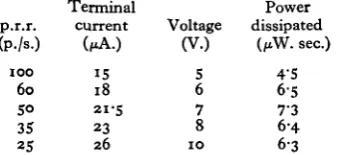
The simplest of the changes following change in p.r.r. (b) is an increase in current flow with increase in p.r.r. This is the commonest result, but with different electrodes, etc., increase in p.r.r. can produce a decrease in current flow, or an irregularly variable one (Fig. 4). The differences can be up to 50% in current over the range 10-100 pulses/sec. There is also a further effect. As long as the total electrical energy applied in unit time (joules) does not exceed a certain value (which is different for different electrodes and impedances) the relationship between current and voltage across the preparation is more or less linear. If, however, this value is exceeded by increasing pulse length, amplitude, or p.r.r. beyond a certain point, the current flow rapidly increases, and usually regains another stable level two or three times the original. This 'runaway' value varies with electrode size, being about 1-2 ;u.W sec. for the electrodes described, but about 5-6 /xW. sec. with a larger indifferent electrode (Table 1). Frequently, alteration of p.r.r. crosses this value, causing large differences in current flow.
I 5r 15
1000
10 p./s.
100 p./s.
500
flS. 1000
1000
[image:4.451.42.411.254.412.2]Fig. 4. Current wave-forms through three different electrode arrays in distilled water at 10, 60 and 100 pulses/sec. Negative electrode area 3 x io~4 mm.2 throughout, (a) 2-5 V. pulse. Positive electrode area 3 mm.2. Resistance ~ 300 K. (b) 4-5 V. pulse. Positive electrode area 3 cm.2. Resistance ~3ooK. (c) 2-0 V. pulse. Positive electrode area 3 x io"1 nun.1. Resis-tance ~3oo K. Initial current spikes not shown.
Table 1. Conditions producing current runaway at different pulse repetition rates p.r.r.
(P./s.)
1 0 0 6 0 5° 35 2 5 Terminal current (M0 15 18 21-5 23 26 Voltage (V.) 5 6 7 8 1 0 Power dissipated
(FW. sec.) 4"5 6 5 7'3 6-4 6 3
1 msec, pulses throughout. 20/x negative electrode, large positive electrode, in saline. Resistance between electrodes approx. 320 K.
[image:4.451.145.316.494.571.2]Relation between stimulus parameters and current flow 19
(Fielden, unpublished) that p.r.r.-sensitive transmission occurs in such preparations with preganglionic stimulation and post-ganglionic recording; however, simultaneous preganglionic recording showed that in some, though not all, cases the higher p.r.r. merely excited more preganglionic fibres. This was probably due to an increase in effective pulse amplitude such as described above.
DISCUSSION
The physical causes of the changes in current flow which have been described above are not at all clear, though there are many factors which might be important. For example, the equivalent circuit of the preparation is a very complex array of series and parallel resistances and capacitances. The rectangular voltage pulses applied can be considered as a mixture of sine waves of varying frequency and phase, with limiting values set by the rise and fall times of the pulse, the pulse length and p.r.r. The trans-mission characteristics of the circuit with respect to each component would differ, and thus change in p.r.r. will cause a change in overall transmission. Rough calculations indicate that this change is unlikely to be significant.
The electrodes used are of course subject to polarization, and as the voltage across them exceeds the gas overvoltage, hydrogen and oxygen will be formed at the cathode and anode, respectively. Whether or not a gaseous phase exists is determined by very complex factors. The current density at the stimulating electrode tip is high, diffusion from the tip is probably poor, and the calculated spreading resistance of the tip is only of the order of one-tenth the total resistance of the preparation. Calculations by Dr J. N. Agar indicate that the conditions of stimulation are at just about the critical level for the nucleation of hydrogen bubbles at the cathode. If this in fact occurs, there will be marked effects on current flow.
The results demonstrate changes in current flow which are in turn dependent on the size and shape of the electrodes used. This in itself suggests that polarization effects at the electrode are significant factors. The reversibility of changes with p.r.r. suggests a dynamic equibilibrium in these effects. A possible explanation would involve the setting up of concentration gradients of dissolved O2 and H2 around the
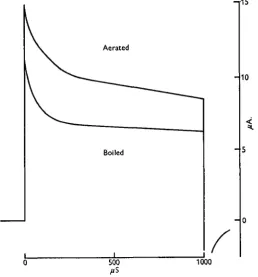
electrodes, facilitating or slowing down the electrolysis reaction, as in the use of oxygen-recording electrodes. The current flow through stimulating electrodes is cer-tainly markedly affected by the concentration of dissolved gases. Fig. 5 shows that a given combination of electrodes and pulses allowed 25 % more current flow per pulse in aerated than in boiled saline. It cannot therefore be doubted that the production of oxygen at the anode, whether or not it ever forms bubbles, can influence current flow.
If bubbles ever do become nucleated at the stimulating electrode, the volume of gas produced is likely to be large, even at what are considered low stimulating currents. 1 /xC. is equivalent to more than 1 x io~4 mm.3 H2 at the cathode; thus a 10 sec. train
2 0 C. H. FRASER ROWELL
pulses, and other wave-forms specifically designed to minimize polarization are frequently used, and also the electrodes present a much greater surface. However, it is interesting to examine a typical and well-documented case. Roberts (1962) has described stimulation of the dorsomedial thalamus of cats with monopolar electrodes and unidirectional pulses. The parameters, and those of a typical locust experiment, are given in Table 2. The average current applied per unit area is virtually the same in both cases (cat, 3-2 x io~3 A./mm.2, locust, 2-2 x icr3 A./mm.2) which suggests that
Aerated
Boiled
10
500 1000
Fig. s. Current wave-form through (a) aerated and (6) boiled distilled water during a r o msec., 2-5 V. pulse. Negative electrode area 3 x io"~4 mm.2 positive electrode area 3 mm.2. Both
[image:6.451.98.357.166.444.2]wave-forms photographed after several seconds at 100 pulses/sec. Initial current spikes not shown.
Table 2. Comparison of typical stimulus parameters producing behavioural responses
from cat and locust. Chronically implanted monopolar metal electrodes
Subject Cat (Roberts, 1962) Locust (Rowell
unpublished)
Diameter Area
Pulse
length Voltage
(msec.) Current (V.) P.r.r. Coulombs/sec. 125
25
10,000
465
0-2 i-o
mA.
2 0
6-5 6-5
100/sec.
So/sec. 32 xio-"1 x 10⁻⁶
Relation between stimulus parameters and current flow 21
To conclude: the results show that change in p.r.r. produces change in amplitude of the pulse current, which normal monitoring methods do not detect; this causes complex changes in the conditions of stimulation and the effective area of stimulation. The p.r.r. sensitivity of any preparation may well be due to these changes, rather than to a characteristic of the biological system. Such sensitivity can only be thought biological if it can be demonstrated to be independent of these stimulation artifacts, either by accurate monitoring of the current changes, or by further physiological checks, such as pre- and post-synaptic recording.
When the object of an investigation is to explore the qualitative responses of the nervous system to electrical stimulation, these effects can be ignored. When, however, it is necessary to correlate accurately the consequences and parameters of electrical stimulation, the results show that the latter must be measured more accurately than has been usual. They also emphasize that the electrical coupling between extracellular stimulating electrodes and the excitable tissue is complex, especially when the stimu-lating electrode is embedded in ganglionic material, and that nothing more than correlation is possible without further research into the biophysical systems involved.
SUMMARY
1. The flow of current through a small metal electrode, such as is commonly used in stimulation experiments, has been studied. The wave-form resulting from rect-angular voltage pulses has been examined with various electrodes, preparation im-pedances and analogue networks.
2. Variation of pulse repetition rate, when all other parameters are constant, causes wide variation of current flow and lesser variation of wave-form.
3. An attempt has been made to relate these changes to physical changes occurring at the electrode tip during polarization of the electrodes. Calculations indicate that the amount of gas generated by the currents commonly used in stimulation experi-ments would produce gross distortion of the tissues in the absence of diffusion, and may do so in practice when large currents are used.
4. It is concluded that changes of threshold with changes of pulse repetition rate are as likely to be due to the physical effects described here as to the physiological characteristics of the stimulated nervous system, to which they have sometimes been ascribed.
It is a pleasure to thank Dr D. Radley, of the Department of Engineering, Cam-bridge, for constant advice throughout this work, Dr J. A. Ramsay and Dr J. W. L. Beament for reading the manuscript and criticizing it, and Dr J. N. Agar for discussion and advice on the properties of polarizable electrodes. The work was undertaken during the tenure of a D.S.I.R. Research Fellowship.
REFERENCES
ROBERTS, W. W. (1962). Fear-like behaviour elicited from the dorsomedial thalamus of cat. J. Comp,
Physiol. Psychol. 55, 191-7.
ROWELL, C. H. F. (In preparation.) A method for chronically implanting stimulating electrodes into the brains of locusts, and some results of stimulation.
SANDER, K. F. & YATES, J. G. (1953). The accurate mapping of electrical fields in an electrolytic tank.