Preparing
for
the near future
Risks and Strategy in
Digital Transformation
Processes
Contact information
Preface
This thesis marks the end of my time as a student. It is written in order to graduate from my master
in Innovation Management of the study Business Administration at the University of Twente in
Enschede. As the cover already reveals, is this thesis written for TNT Post Billing & Document
Solutions. This organization is special in the sense that every Dutch individual knows the name TNT,
but has little knowledge about the lines of business in which it is active besides processing mail and
handling parcels. This is one of the reasons why this organization appealed to me when I was
looking for a graduating assignment. Another aspect that makes this organization so interesting for
scientific reasons is that, as an organization that has physical postal services as a core activity, TNT
Post is greatly affected by the digitalization of society. This made the research important and also
very challenging.
Over the last six months this research was done to help TNT Post Billing & Document Solutions in
approaching the near future in a world that is digitalizing at a fast rate. It was a challenging and
enervating project where I have learned a lot about the subject, but also about the organization. I,
therefore, hope that the recommendations made in this thesis will be of great value to the
organization. Battling the future is not easy, but I would like to think this thesis might help in
making it a bit easier.
Before I invite you to read this thesis I would first like to take the opportunity to thanks some of the
people who helped me in these last few months. First of all I would like to thank Jan den Dekker,
who offered me the opportunity to do my thesis at TNT Post and guided me through the process of
graduating at TNT Post with great interest and unlimited support. Second, I want to thank both of
my supervisors at the university, Rick Middel and Christiaan Katsma, for their valuable feedback and
useful insights. My family also deserves a special thanks for the support they have given me during
the process. Mom, dad and Juliet, graduating was not always easy, but because of your
understanding and listing ear it was fun and interesting to do. Last, I want to thank all my friends
and co-interns for their advice, good conversations and for making my graduation process into a
success.
Now it is time to invite you to read my thesis. I hope you will find it to be instructive, insightful and
that you will enjoy reading it.
Management summary
- -
6
Table of content
CONTACT INFORMATION ... 1
PREFACE ... 3
MANAGEMENT SUMMARY ... 5
TABLE OF CONTENT ... 6
LIST OF TABLES AND FIGURES ... 9
CHAPTER 1: TNT POST BILLING & DOCUMENT SOLUTIONS ... 12
1.1
TNT
NV ... 12
1.2
C
ENDRIS... 14
1.2.1
TNT Post Billing & Document Solutions ... 15
CHAPTER 2: PROBLEM STATEMENT & METHODOLOGY ... 18
2.1
P
ROBLEM DEFINITION... 18
2.2
R
ESEARCH OBJECTIVE... 21
2.3
R
ESEARCH QUESTIONS... 21
2.4
R
ESEARCH DESIGN... 22
2.5
R
EPORT STRUCTURE... 22
CHAPTER 3 : THEORETICAL FRAMEWORK ... 24
3.1
T
RANSITIONS IN BUSINESSES... 24
3.2
G
ETTING TO THE E OF E-
BUSINESS... 27
3.3
E-
BUSINESS TRANSITIONS AND RISKS... 28
3.4
S
TRATEGIC CONTEXT OF E-
BUSINESS TRANSITIONS... 34
3.4.1
Need for an e-strategy ... 34
3.4.2
Approach to an e-strategy ... 35
3.4.3
Role of an e-strategy in an e-business transition ... 37
3.5
C
OPING WITH E-
BUSINESS TRANSITIONS... 38
3.5.1
Scenarios ... 38
3.5.2
Constructing scenarios ... 39
3.5.3
Dangers and obstacles of scenarios ... 42
3.6
C
HAPTER ANALYSIS... 44
3.6.1
Theory analysis ... 44
CHAPTER 4: RESEARCH METHODOLOGY ... 50
4.1
C
ONCEPTUAL RESEARCH MODEL... 50
4.2
U
NITS OF OBSERVATION... 51
4.3
D
ATA COLLECTION METHODS... 51
4.3.1
Questionnaire ... 51
4.3.2
Interviews ... 53
4.3.3
Observations... 55
4.4
S
CENARIO DEVELOPMENT... 56
CHAPTER 5: EMPIRICAL RESULTS ... 58
5.1
R
ESULTS QUESTIONNAIRE... F
OUT!
B
LADWIJZER NIET GEDEFINIEERD.
5.1.1
Results risk analysis ... Fout! Bladwijzer niet gedefinieerd.
5.1.1.1
Relevance of risks ... Fout! Bladwijzer niet gedefinieerd.
5.1.1.2
Timing and predictability of the relevant risks ... Fout! Bladwijzer niet
gedefinieerd.
5.1.2
Results open questions questionnaire Fout! Bladwijzer niet gedefinieerd.
5.1.3
Summary questionnaire ... Fout! Bladwijzer niet gedefinieerd.
5.2
R
ESULTS INTERVIEWS...
F
OUT!
B
LADWIJZER NIET GEDEFINIEERD.
5.2.1
Short term risks ... Fout! Bladwijzer niet gedefinieerd.
5.2.2
Mid term risks ... Fout! Bladwijzer niet gedefinieerd.
5.2.3
Long term risks ... Fout! Bladwijzer niet gedefinieerd.
5.2.4
Strategy and competences ... Fout! Bladwijzer niet gedefinieerd.
5.3
C
ONCLUSION...
F
OUT!
B
LADWIJZER NIET GEDEFINIEERD.
CHAPTER 6: SCENARIOS ... 59
6.1
S
CENARIO BASIS...
F
OUT!
B
LADWIJZER NIET GEDEFINIEERD.
6.2
O
PPORTUNITIES&
T
HREATS...
F
OUT!
B
LADWIJZER NIET GEDEFINIEERD.
6.2.1
Opportunities ... Fout! Bladwijzer niet gedefinieerd.
6.2.2
Threats ... Fout! Bladwijzer niet gedefinieerd.
6.3
S
CENARIOS...
F
OUT!
B
LADWIJZER NIET GEDEFINIEERD.
- -
8
CHAPTER 7: CONCLUSION & RECOMMENDATIONS ... 60
7.1
C
ONCLUSION...
F
OUT!
B
LADWIJZER NIET GEDEFINIEERD.
7.2
R
ECOMMENDATIONS...
F
OUT!
B
LADWIJZER NIET GEDEFINIEERD.
CHAPTER 8: DISCUSSION ... 60
8.1
C
ONTRIBUTION OF THE RESEARCH...
F
OUT!
B
LADWIJZER NIET GEDEFINIEERD.
8.2
R
EFLECTION...
F
OUT!
B
LADWIJZER NIET GEDEFINIEERD.
8.3
F
URTHER RESEARCH...
F
OUT!
B
LADWIJZER NIET GEDEFINIEERD.
REFERENCES ... 61
List of tables and figures
FIGURE 1: MARKET SHARE OF TNT NV AGAINST THE AEX INDEX 15
FIGURE 2: STRUCTURE OF TNT NV 17
FIGURE 3: WORK PROCESS OF TNT POST BILLING & DOCUMENT SOLUTIONS 18
FIGURE 4: OVERVIEW OF THE TRANSACTION MAIL PRODUCT TYPES 19
FIGURE 5: VOLUME DECLUME POSTAL SECTOR 22
FIGURE 6: RESEARCH DESIGN 25
FIGURE 7: STRUCTURE THEORETICAL FRAMEWORK 27
FIGURE 8: MULTI-LEVEL PERSPECTIVE ON TRANSITIONS 29
FIGURE 9: STAGES IN THE USE OF E-BUSINESS 30
FIGURE 10: SOCIO-TECHNICAL MODEL OF PERCEIVED E-BUSINESS RISKS 32
FIGURE 11: CONTROL MODEL FOR E-BUSINESS RISKS 33
FIGURE 12: MODEL FOR E-STRATEGY 35
FIGURE 13: SCENARIO TYPOLOGY 42
FIGURE 14: EXAMPLE OF AN IMPACT/PREDICTABILITY MATRIX 44
FIGURE 15: TECHNOLOGICAL SUBSTITUTION PATHWAY 47
FIGURE 16: COMBINED MODEL 51
FIGURE 17: CONCEPTUAL RESEARCH MODEL 53
FIGURE 18: EXAMPLE QUESTION FOR QUESTIONNAIRE 55
FIGURE 19: TIME RELEVANCE OF RISKS 69
FIGURE 20: PREDICTABILITY OF RISK BEHAVIOUR 73
FIGURE 21: STAGES OF INNOVATION ADOPTION 93
FIGURE 22: VALUE CHAIN FOR TNT POST BDS 97
FIGURE 23: BUSINESS MODEL BUILDING BLOCKS 110
FIGURE 24: RECAP ON THE COMBINED MODEL 125
TABLE 1: MARKETS OF TNT POST NV 16
TABLE 2: E-BUSINESS RISKS AND ASSOCIATED UNCERTAINTIES 34
- -
10
TABLE 4: RESEARCH COMPONENTS OF THE SCENARIOS 52
TABLE 5: RESULTS QUESTIONNAIRE 62
TABLE 6: RELEVANT RISKS FOR TNT POST BDS 63
TABLE 7: IRRELEVANT RISKS FOR TNT POST BDS 66
TABLE 8: UNDECIDED RISKS FOR TNT POST BDS 67
TABLE 9: COMPETENCES OF TNT POST BDS 74
TABLE 10: FINAL LIST OF RELEVANT RISKS FOR TNT POST BDS 78
TABLE 11: RISKS FOR TRANSITIONING TO E-BUSINESS FOR TNT POST BDS 90
TABLE 12: CHARACTERISTICS SCENARIOS FOR TNT POST BDS 96
TABLE 13: EARLY ADOPTERS RISKS 100
- -
12
Chapter 1: TNT Post Billing & Document Solutions
The following company description will give insight in the structure of the organization and where this research takes place. It describes the basic history of TNT NV and the position of Cendris, which is a 100% subsidiary of TNT Post. Also TNT Post Billing & Document Solutions (hereafter TNT Post BDS) is discussed here, as a part of this large, multinational, organization.
1.1 TNT
NV
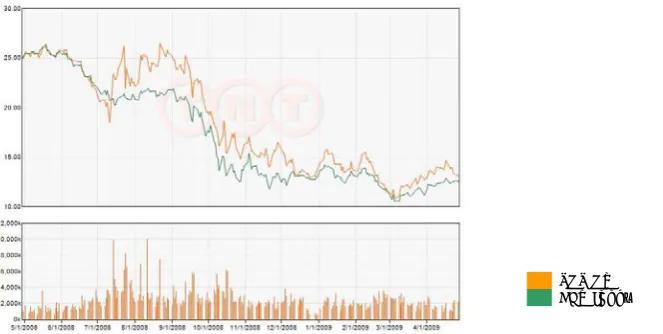
[image:14.595.115.447.377.544.2]Today, TNT NV, through its two divisions Express and Mail, is in the business of transferring goods and documents around the world. With its activities, TNT is part of the global transportation and distribution industry; a vast industry whose market size is estimated to be over US dollars (US$) 3,500 billion (as at 31 December 2007 approximately €2,400 billion). TNT serves more than 200 countries and employs around 161,500 people (group.tnt.com, 2008). As can be seen in the below standing figure, the share of TNT NV follows the tendencies of the AEX stock exchange. However, TNT NV for the last six months still performs better than the total market (figure 1).
Figure 1: Share prices of TNT NV against the AEX index (1/5/2008 – 1/5/2009) (Source:
Website TNT NV)
In the Netherlands it all began in 1799, when the Dutch postal services were reorganised into a single national enterprise. This formed the basis of PTT Post. As for TNT, its roots lay in Australia. In 1946, Ken Thomas started his own company, Thomas Nationwide Transport, that grew into a global enterprise, even operating its own fleet of aircrafts. Much of the growth came from take-overs and interests acquired in other companies. This also happened with PTT Post, the takeover was completed in 1996. TPG (TNT Post Group) separated from KPN in 1998 and in October 1998, Royal TPG Post officially changed its name in Royal TNT Post (group.tnt.com, 2008).
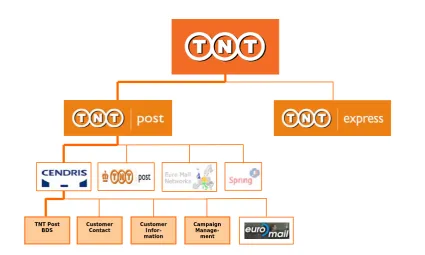
As said before, TNT's activities are divided between two operational divisions, Post and Express. An overview of the whole group is presented in figure 2 (p.17). TNT Post, which has a royal title, has
the primary task to collect, sort and distribute mail in the Netherlands. However, it also offers a wide range of other products and services. See TNT Post's website for more details: www.tntpost.com. TNT’s Express division is among the world’s largest express operators and the number one in
Europe. Worldwide, it delivers 4.4 million parcels, documents and pieces of freight a week to more than 200 countries TNT Express operates world wide in the delivery sector (group.tnt.com, 2008).
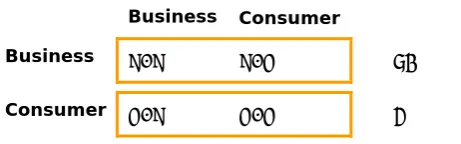
The postal market in the Netherlands can be divided into four parts. The B2B market together with the B2C market form the greatest part of the business. These markets include all the mail transactions. The remaining markets of C2B and C2C are most known by the common consumer, but represent a relative small part of the total business. Only during the holiday season will these markets grow temporarily, mainly due to the processing of Christmas cards and other holiday greetings. The separation of the markets and their percentages are shown is table 1.
Because this research takes place at TNT Post BDS, the Express division will not be discussed in further detail. TNT Post, however, is part of this research and is therefore described in more detail. As can be seen in figure 2 TNT Post consists of four subdivisions. First, the TNT Post division is the main postal operator in The Netherlands, processing 17 million postal items each day which are addressed to more than 7 million addresses in the Netherlands. European Mail Networks is responsible for the acquisition, development, operations and expansion of addressed and unaddressed postal networks in the most important European countries. The third subdivision, Spring, is a global joint venture for cross national postal services for businesses. This is a joint venture between TNT, The Royal Mail (UK) and Singapore Post (Website TNT Post, 2008). The last subdivision is Cendris and since the research takes place there, in the next paragraph a more extensive description will be given.
Business Consumer
Business B2B B2C 94%
[image:15.595.108.339.327.399.2]Consumer C2B C2C 6%
- -
14
Campaign
Manage-ment Customer
Contact Customer Infor-mation TNT Post
BDS
1.2 Cendris
Cendris is market leader in handling data and document streams. It provides services in building sustainable customer relations and optimizing internal data and document processes. In short Cendris is an expert in controlling all the communication channels, from the ‘old’ traditional media to the modern use of internet en e-mail. It can help organizations in getting the right message to the right target group or person.
To do this Cendris is divided in again five divisions. These are described in short below:
• TNT Post Billing & Document Solutions: offers services for printing, digital presentation and fulfilment of transaction mail and direct mail (see paragraph 1.2.1)
• Customer Information: assists organizations in the search for consumer and business information, database management, data analysis and marketing consultancy to facilitate the pursuit of (profitable) consumers.
• Customer Contact: offers services for inbound and outbound communication by telephone, e-mail and fax. For example, in order to help the increase in response to marketing campaigns.
• Campaign Management: combines the key services offered by Cendris. It offers a multi-channel platform from which (prospective) clients can be reached effectively.
• Euro Mail: a full service print- en mail organization. It has three main activities, namely: the preparation, process and distribution of direct mail and transaction mail and the execution of fulfilment projects (website Euro Mail, 2008).
[image:16.595.73.499.92.347.2]The second and third bullet represent the divisions that have direct communication with consumers. The other three bullets primarily communicate with organizations. Since TNT Post BDS serves as the
CUSTOMER
Trans-action mail
DOCUMENT
Data processing
Billing & Document Solutions
Print & Mail
E-billing
Scan-post Conversion/
lay-out
E-business principal in this research, the next paragraph will elaborate more on this business unit.
1.2.1
TNT Post Billing & Document Solutions
TNT Post BDS helps customers initiate and continue the dialogue with their customers and prospects. TNT Post BDS is specialised in one-off and ongoing printing of personalised document flows. This could be transaction mail flows, such as bank statements, invoices, pay slips or policies. For transaction mail hardcopy is no longer the only option: a range of communication channels and formats are being used concurrently and interchangeably, both offline and online (figure 3).
Organizations outsource their document flows to TNT Post BDS. Next to the output of large volumes in print and digital solutions, TNT Post BDS also analyses documents streams, identifies bottlenecks and translate this into smart, cost saving solutions. Of all its customers, 80% is an AEX listed organization. Since TNT Post BDS is active in a commodity market, the competition is tough and it has to fight to preserve its market share in the transaction mail market and gain market share in the digital products market of this industry. This last mentioned market is up and coming and has gained much attention over the last years, due to the digitalization of the world. Important competitors for TNT Post BDS are other postal distributors like Netwerk VSP. Sandd and DHL Global Mail, but in future developments especially organizations specialized in developing digital postal products like e-invoicing may pose a serious threat to TNT Post BDS. Besides competitive forces, also suppliers are influencing the organization, due to rising costs and lower production volumes in the physical production processes. More on these influential factors will be written in the remaining of this thesis.
Since January 15th 2008, TNT Post BDS is merged with the divisions “New business development”, “Electronisch Zakendoen”, and “Move to Solutions” of TNT Post. Since May 21st 2008, the company listens to the name TNT Post Billing & Document Solutions, which replaces the former name Cendris Document Presentment. Hierarchical TNT Post BDS is placed under Cendris, but it was chosen to
- -
16
attach the label of TNT to the new formed division because the name TNT has a better international reputation. A new name was required to suit the new proposition, whereby more focus lies on digital solutions for billing and document flows. This is a strategic step to fulfil the market tendency and thereby the customers’ needs and expectations regarding to digital solutions for document flows. To illustrate this, the mobile phone providers, who want to present invoices online, are first movers in the digital invoicing environment and more will follow in later stages of the product life cycle. Health-insurance organizations who want to present the client Health-insurance-policy online instead of physical mailings can do this from January 1st 2009, because of new legislation (Legislation bill, July 7,
2007). This is an example of political acts trying to stimulate digital product development. For TNT Post BDS this potentially means a degrading volume in physical production. Digital products of TNT Post BDS can and will be able to replace this physical production. Annually the digitalization rate of TNT Post BDS lies between 4-5% of the total production. More on this in the latter of this thesis.
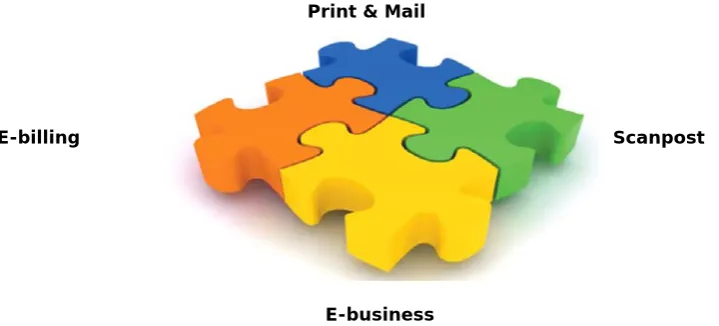
[image:18.595.113.473.409.572.2]At the moment four key product areas are identified within TNT Post BDS. The following figure shows these areas (figure 4) and were also mentioned in the previous figure. All these areas represent the new vision on the products that TNT Post BDS is offering. As can be seen three out of the four puzzle pieces are about digital products. This shows that the organization is anticipating on a changing market.
Figure 4: Overview of the transaction mail product types
Within the organization about 230 people are employed (exact number of FTE is depending on the number of temporary workers). These are spread over the factories and offices in Utrecht and The Hague, Apeldoorn and Heerlen. In 2008, TNT Post BDS reported €40.9 million in revenues, which is less than the year before when there was revenue of €44.5 million. This decline is caused by market circumstances and economic decline. Also the effects of digitalization are a factor in this downfall of income.
Print & Mail
E-billing Scanpost
For the year 2009 the mission and vision are as follows:
Vision
The transaction mail market is experiencing strong movement: for physical to digital. In this market there is space for a party which offers efficient solutions and help customers in the transition from physical to digital. In the information exchange of our customers great chances lay in the order-to-cash (outgoing transaction flows) and purchase-to-pay (ingoing transaction flows) circuits.
Mission
TNT Post Billing & Document Solutions wants to be the best organization in Europe in the areas of print, e-billing, scanpost and electronic business.
Principles:
●Customer satisfaction is leading
●A healthy profit for our shareholders
●Proud and motivated employees
- 18 -
Chapter 2: Problem statement & Methodology
Now the structure of the organization has been explained, a closer look can be taken at the research that is to be conducted. In this chapter multiple aspects of the research will be elaborated on. First the problem definition will determine what problem is going to be the topic of this research. Thereafter, the research objective will be defined. Also the research questions that have to be answered in this research are formulated. The figure that follows the research questions will explain the research design and last the report structure will be explained.
“
Electronic mail could replace 25% of snail mail by 2000”
TIME Magazine, 1998
2.1
Problem definition
The quote above was and still is overenthusiastic. Physical mail remains the most important kind of mail, but the future may well be different (Presentation L. Jimenez, 2006). In a world that is more and more focussed on digital services, the transition of physical mail seems inevitable. In the case of this research, mail products all fall in the categories of transaction mail and direct mail. The change that can be noticed for some years now is often called The Digital Economy or e-business (Kling et al., 1999; Wassenaar et al., 2004; Lynn, 1998; Chaffey, 2002). This can be categorized as industries and forms of IT-enabled business activities that are likely to be significant sources of economic growth in the next decade (Kling et al., 1999, p.17). According to Kling et al. (1999) this includes the IT industry itself, electronic commerce between businesses, the digital delivery of goods and services, and the IT supported retail sale of tangible goods. The introduction of this Digital Economy
has led to significant change and uncertainty in markets and also in a lot of organizations. Often these changes are technological in their nature and are introduced in organizations for many reasons (Preece, 1997, p.39). For example financial and economic objectives like increase of profitability, business and technical objectives like an increase in flexibility and social and organizational objectives like control and skill.
2007). All these efforts stimulate the use of e-business in organizations and facilitate the shift from the traditional way of doing business to doing business online.
Working towards the organizational level of the influence of e-business, first the general postal sector in The Netherlands has to be discussed. All postal services can de defined as follows: “Services involving the clearance, sorting, transport and delivery of postal items”. Postal items are defined as “An item addressed in the final form in which it is to be carried by the universal service provider”. In addition to items of correspondence such items also include e.g. books, catalogues, newspapers, periodicals and postal packages containing merchandise with or without commercial value” (EU directive 2002/39/EC, 2002)1. In this industry a lot is changing because of the upcoming
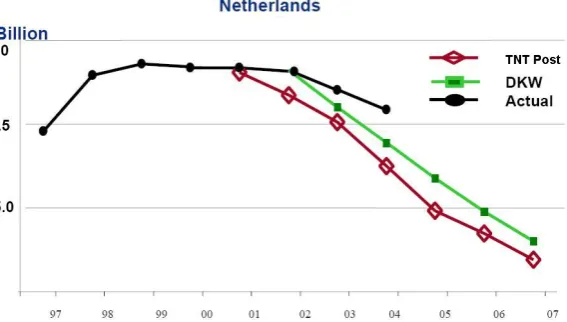
e-business. Since the introduction of the Internet, the number of postage that is physically send is declining, as can be seen in figure 5. This figure may be somewhat outdated, but it still shows the trends that are occurring in the postal sector. Reason for this decline is the increased use of electronic mail and other electronic services like SMS and MMS (Nader et al., 2008). Although mail volumes are declining, the total market for postal products is growing. The main explanation for this is the growing competition in the marketplace, which is liberalized more and more, especially in The Netherlands (Nader et al., 2008). Other explanations may be the development of new innovative products and markets, like the digital products in the postal sector, which obviously are an attempt to cope with the growing rate of e-business use.
To illustrate the direction the postal sector is going the following conclusions can be drawn from trends in the market. Please note that this is not a complete list of trends, but only a selected few of the industry trends. First, as said before, the total postal market continues to grow, but in transaction mail a decline can be noticed in volume (Nader et al., 2008). Also more and more signals, like the transition to electronic billing by telecom providers, show that electronic alternatives
1 For more information on the definition of the postal sector, please look up the whole directive. Explicitly is not
[image:21.595.119.403.434.595.2]chosen to present the complete definition, since it is quite extensive.
- -
20
for transaction mail industry become more frequent in the B2B mail traffic (Nader et
al., 2008). Another trend is the tarnishing of the industry, because of electronic alternatives. Other players in the market, e.g. specialized IT organizations, become more agile in the delivery of EBPP (Electronic Bill Presentment & Payment) products (Van der Lijn, 2008). This also makes it harder for players in the postal market to determine their direct competitors. Last, the liberalization of the sector and growing legislation makes competition tougher and therefore lowers revenue and margins, while costs keep rising (Van der Lijn, 2008; Interview manager (1), 2008).
The growing use of e-business is visible in both the general market and the postal industry. For specific organizations within this industry this may become a (strategic) problem, because their normal product range of physical products in threatened by possible substitution effects. TNT Post BDS currently is, according to internal sources, affected by this substitution tendency. Substitution can be defined as the act of substituting or putting one person or thing in the place of another; as, the substitution of bank notes for gold and silver as a circulating medium (Website Dictionary.com, 2008). For TNT Post BDS this means the transition from ‘physical Transaction Mail and repeating Direct Mail’ to ‘digital Transaction Mail and repeating Direct Mail’. TNT Post BDS sees this substitution as a strategic issue which has to be researched in further detail. A top-down approach should therefore also be chosen to resolve this issue. The products that are used for this transition process are already developed and put into action. So, the organization is not starting from scratch and the operational and tactical level have already been considered. However, it is still unclear when and how this transition process is going to take place and what this means for the organization from a strategic point of view. At the moment TNT Post in general accounts for a level of digitalization of 5-6% each year, with a maximum of 50% (interview manager (1), 2008). In 2009, TNT Post BDS will try to attract as much volume as possible to keep physical production profitable. Due to the growing digitalization in the coming years, margins of print production will diminish and the transfer to digital products must be made. According to one individual in the organization the transition may already be necessary somewhere in 2009 (interview manager (1), 2008). So, rapid change is coming and the organization on all levels, operational, tactical and above all strategic, should adapt to the new situation.
prediction of how the change is going to affect the organization from a market perspective. In offering a tool to prepare for the future scenario planning appears to be useful (Chermack, 2005, p.60). Chermack (2005) says: ‘In a world that changes too rapidly for prediction to be accurate, scenarios are gaining credibility as effective tools to prepare for an uncertain future.’ (Chermack, 2005, p.60). This is also supported by Börjeson et al. (2006). So, the appropriate ‘vehicle’ for preparing for the near future is the creation of scenarios.
Considering the previous, this thesis is done to help TNT Post BDS face the near future, when the transition to e-business is going to take place. This must approached from the strategic level, since this is the specific request of the organization. Because of this focus special attention should be paid to the changes that occur in the strategy because of the transition to e-business. Strategy in this context is also known as e-strategy and this is also included in the scope of this research.
2.2
Research objective
The above stated problem definition is the basis for doing this research. To clarify the goal of this research an objective has to be stated in which the intention of this research is presented. Therefore, the research conducted in this thesis has the following objective:
Prepare TNT Post Billing & Document Solutions for the transition to e-business, by determining the risks and strategic effects in different scenarios
2.3
Research questions
Having read the above standing, it is now possible to formulate research questions. The main research question is as follows:
What must TNT Post Billing & Document Solutions do to prepare for the transition to e-business in the near future?
This central question can be answered by posing research questions.
Research questions:
1 What risks and strategic effects are involved in the transition to e-business for TNT Post Billing & Document Solutions?
- -
22
2.4
Research design
The following graphic research design (figure 6) shows the path of writing this graduation paper.
2.5
Report structure
In this paragraph the report structure for the research report is presented. This research report will
contain the standard necessary parts of a report, like a preface, introduction, table of content,
references and appendixes. The chapters will be organized as follows. The first chapter gives an
introduction to the organization where this research takes place. The second chapter, this current
chapter, states the problem that is the subject of this research. Here also the research questions will
be introduced. The next chapter contains the theoretical framework, which is a substantial part of
the whole research. In chapter four the methodology is presented. In chapter five the results of the
questionnaire and interviews are given. Chapter six is used to form the scenarios, based on the
previous chapters. One of the last chapters, number seven, is the presentation of the conclusions
and recommendations. The last substantial part of the research will be the discussion in which the
process will be reflected and some suggestions are made for further research.
A Annaallyyssiissooff R
Reessuullttssbbyymmeeaannss o
offsscceennaarriiooss
C
Coonncclluussiioonnss&& R
Reeccoommmmeennddaattiioonnss
T
Thheeoorreettiiccaall
R
Reesseeaarrcchh
Transitions and stages of E-business E-strategy Scenarios A
Annsswweerrttoorreesseeaarrcchh
q
quueessttiioonn11
A
Annsswweerrttoommaaiinn
r
reesseeaarrcchhqquueessttiioonn
E
Emmppiirriiccaall
R
Reesseeaarrcchh
S
Seemmii-
-s
sttrruuccttuurreedd
I
Inntteerrvviieewwss
A
Annsswweerrttoorreesseeaarrcchh q
quueessttiioonn22 O
Obbsseerrvvaattiioonnss&&
D
Diissccuussssiioonn
Figure 6: Research design
Questionnaire
E-business transitions and
- -
24
Chapter 3 : Theoretical framework
In this chapter the literature that is related to the problem, as stated in chapter two, is discussed. Because multiple topics are important for this research the following framework will consist of different theories about different subjects. At the end of this chapter, however, all the literature comes together and can serve as a unified scientific body for the empirical analysis of this research. To prevent the reader from getting lost the following figure will explain the different topics discussed in this chapter (figure 7).
As can be seen, the theories used in this research are very different from each other. The goal of this chapter is to discuss the different theories and to try to connect them together. This will result in a combined research model that is specifically applicable to this research. Before turning to the core of this research the first two paragraphs give an introduction into transitions and the shift to e-business. After establishing a certain mindset is the actual theory used in this research discussed, as depicted above.
3.1
Transitions in businesses
When reviewing literature about transitions many different terms can be found for the same subject, e.g. regime transformation (Van de Poel, 2003), technological revolutions (Perez, 2002), technological transitions (Geels, 2002), system innovation (Elzen et al., 2004; Geels, 2007) and transition management (Rotmans et al., 2001). These theories vary from managing specific transitions to describing transitions from various levels. Therefore, in this research clear choices have to be made regarding the right level of analysis. Depending on which level this research finds
Analysis of the theory (§ 3.6)
General
introduction
to transitions
and stages of
e-business
(§ 3.1 & 3.2)
E-business transitions and risk theory (§ 3.3)
E-strategy theory (§ 3.4)
Scenario theory (§ 3.5)
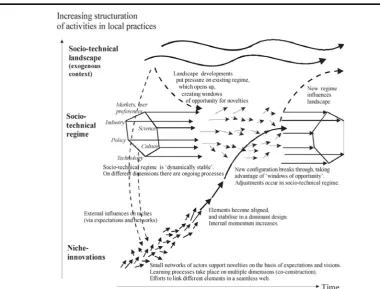
itself the appropriate theory should be chosen. Considering the multiple acting fields of the stated problem in this research, namely macro through micro level, it seems sensible to choose a theory that takes these acting fields into account. This is sensible because factors that influence the change in this research come from various layers of the external environment of the organization. It ranges from market shifts to changing attitudes from individual organizations that are acting outside the primary industry of interest in this research, namely the postal sector. These ‘outside’ organizations are for example banks and IT firms. In search of a model that explains the multiple layers of transitions, the multi-level perspective (MLP) was chosen. This model of Geels et al. (2007) is a method in which a transition is considered as a change that takes place on different levels (Geels et al., 2007). The MLP can help to describe how transitions work and distinguishes three levels of heuristic, analytical concepts (Rip et al., 1998; Geels, 2002), which are applicable for all business transitions as a result of radical innovations. These three levels can help to identify how the transition to e-business is manifesting itself across all levels. The three levels are:
1. Niche-innovations: These innovations form the micro level where radical novelties emerge. This environment acts as a sort of incubation room for new ideas and is usually unstable (Geels et al., 2007, p.400).
2. Socio-technical regime: According to Geels et al. (2007), this concept is about the shared cognitive routines to stabilize existing trajectories. The results are for example that engineers are blinded outside their field of work and that regulations and standards are used. This makes the regime rigid and less capable for change in the status quo (Geels et al., 2007, pp.399-400).
3. Socio-technical landscape: This forms the exogenous environment where both the niche and regime have no direct control over. Changes in the landscape often happen at a slow rate (decades) (Geels et al., 2007, pp.400).
The following figure presents the traditional transition model, using the concepts of the MLP (figure 8). The MLP argues that transitions come about through interactions between the three levels. Geels et al. (2007) say: ‘(a) niche-innovations build up internal momentum, through learning processes, price/performance improvements, and support from powerful groups, (b) changes at the landscape level create pressure on the regime and (c) destabilisation of the regime creates windows of opportunity for niche-innovations. The alignment of these processes enables the breakthrough of novelties in mainstream markets where they compete with the existing regime.’
- -
26
However, this approach and figure 8 has been much debated in the scientific world. It is considered too narrow and not applicable to all situations. Therefore renewed pathways for transitions were developed by Geels et al. (2007). Four pathways were designed to visualize different kinds of transitions. The four graphs of transitions can be found in appendix I. The first path is the transformation path, which is a disruptive transition. The second is the de-alignment and re-alignment path. Geels et al. (2007) describe this path as: ‘If landscape change is divergent, large and sudden (‘avalanche change’), then increasing regime problems may cause regime actors to lose faith. This leads to de-alignment and erosion of the regime. If niche-innovations are not sufficiently developed, then there is no clear substitute. This creates space for the emergence of multiple niche-innovations that co-exist and compete for attention and resources. Eventually, one niche-innovation
becomes dominant, forming the core for re-alignment of a new regime.’. The third path is
[image:28.595.77.458.87.376.2]technological substitution. Here strong landscape pressures will force a breakthrough from niche-innovations, causing a regime change. Last, the fourth path is the reconfiguration path where innovations from niches are transferred to regimes and then cause further alterations in the configuration of the existing regime, causing it to adapt and create a new architecture. Referring to transitions in organizations it can be concluded that transitions do not always come from within or from outside the organization. It therefore makes it more difficult for an organization to anticipate on change, since approaches to different kinds of transition may imply the use of different methods (Genus et al., 2008).
The theory of Geels (2007) has given a tool to explain transitions in different ways. Using this model it becomes possible to determine which kind of transition could fit this research. Therefore it will not contribute to the core of this research, but is only used to create a body of knowledge before diving deep into the matter of a transition in a specific instance. Before turning to this instance a second foundation is laid by explaining the concept of e–business and how it evolves.
3.2
Getting to the e of e-business
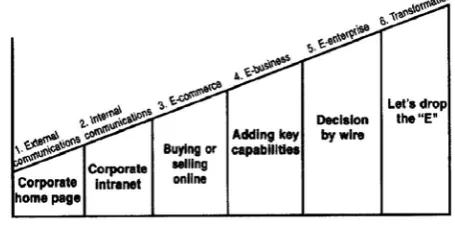
A subject which is related to transitions is the introduction of e-business in organizations. In the problem definition of this research a definition of e-business was already given. Still, it remains rather unclear what is meant by the introduction of e-business in an organization. To make it more comprehensive, Earl (2000) has identified six stages for the introduction of the ‘E-‘ in business (figure 9).
In identifying in which stage an organization finds itself it will be able to identify upcoming issues more easily and to say whether the organization is truly engaging in e-business (Earl, 2000, p.38). If an organization is really in another stage, it may not be ready for the transition. Unfortunately no guidelines are given to assess the stage the organization is in. But by estimating this, it can be said in which stage the organization is thought to find itself. The estimates for this are depicted in figure 9. According to Earl (2000) leadership is an important factor in getting from one stage to the next. Especially from stage four on this top-down approach via leadership is required, but strategy and business development may also well come from the lower regions of the organization (Earl, 2000, p.38). This means that initiating stages of transitioning to e-business can come from anywhere in the organization, but that at later stages the focus must be laid higher up in the organization to coordinate and develop the ‘e-‘ in e-business.
The shift of an organization to the e-commerce stage and further is essentially moving from a brick-and-mortar organization (traditional organization with physical presence) to a clicks-brick-and-mortar organization (physical presence and web presence). This beholds a shift from traditional production methods to a more electronic environment, where e-business is integrated to a certain extend in the organization (Barnes et al., 2004, p.199). It is important to notice that organizations that shift to
[image:29.595.176.404.330.443.2]- -
28
business should be prepared be accept change on a continuous basis, since e-business is never a stable proposition and will always change (Jackson et al., 2003, p.499). Butler et al. (1999) state that this continuous change is as, the network technologies that support this are built on silicon – i.e. sand – and “as the sand shifts so does an e-business”. So the introduction of e-business in an organization is bound to cause a lot of change. Having said that organizations must question whether they are prepared to make those changes and if there is a real need for them to introduce e-business. All too often organizations engage in e-business, because managers have heard that it is the new way of doing business (Jackson et al., 2003). However, it may not always be necessary to do so and therefore organizations should question whether it is favourable to introduce e-business (Jackson et al., 2003). To do this the benefits have to outweigh the downsides. Measuring this is not easy since a lot of factors influence this decision, e.g. investment costs, lay offs due to digitalization or tendencies of the market. Of course deciding whether to transition to e-business, is often not in complete control of the organization. Linking back to the kinds of transition paths it may well be possible that changes, from niches or the landscape, force organizations to introduce change. When this is the case, what aspects are crucial in an organization during such a transition?
The use of this paragraph is to show that an organization does not shift from being a traditional organization to an business (or further). It takes a development in stages before entering the e-business stage. The combination with transitions is easily made. Transitions are necessary to adopt ‘e-‘ alternatives in an organization. This brings the chapter to the next level where the link between transitions and e-business must be made.
3.3
E-business transitions and risks
In the previous two paragraphs general concepts concerning this research have been introduced. Having done this, a general body of knowledge has been created. It is now possible to turn to the core theories in this theoretical chapter.
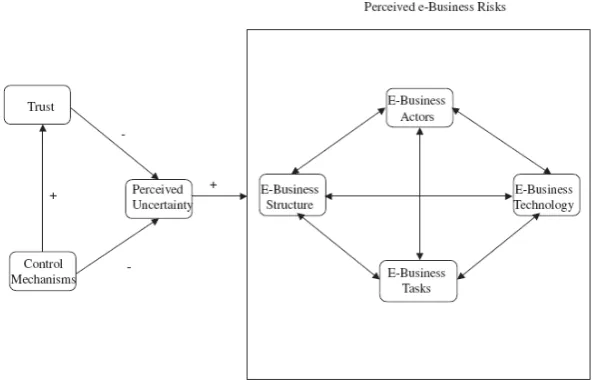
These items are: Task, Structure, Actor and Technology. These items are originally from Lyytinen et al. (1998), who described these dimensions in accordance with the article of Leavitt (1964). In this separation of components or dimensions “actors cover all stakeholders including users, managers, and designers; structure denotes project organization and other prevailing institutional arrangements; technology means development tools and methods as well as hardware and software platforms; and task signifies expected outcomes in terms of goals and deliverables.” (Lyytinen et al., 1998, p.238).
Figure 10: Socio-technical model of perceived e-business risks (adapted from Scott, 2004)
Together these four dimensions represent a way to identify perceived e-business risks (Scott, 2004). In figure 10 three items are situated outside the centre of perceived e-business risks, namely trust, control mechanisms and perceived uncertainty. These are also interrelated in this model. First control mechanisms have a positive effect on trust (+) and a decreasing effect on the perceived uncertainty (-). So when applying control mechanisms the trust of those involved rises and the sense of uncertainty is detained. Also the enhanced trust will be able to diminish uncertainty as well. All in all the lowered perceived uncertainty will lead to the more effectively managing of e-business risks.
- -
30
basis in this research, because it presents transitioning to e-business as a process that depends on multiple factors, which fits the needs of this research.
Figure 11: Control model for e-business risks (adapted from Scott, 2004)
In using this model perceived risks can be translated into uncertainties. Through extensive literature review Scott (2004) has identified sixteen risks associated with the transition to e-business. The relation between all aspects of this model allows it to be used in this research. If risks can be identified, so can uncertainties and. in turn, these can be related to control mechanisms. These can be used as sources for different configurations, depending on the risks that are present for the organization. The reason for developing different configurations allows the organization using them to anticipate on solving essential risks and therefore also enabling the organization to act upon opportunities and threats to the organization. It is easy to notice that the presented model looks almost identical to the previous model. The difference is in the way the risks are categorized. On the basis of the socio-technical model new dimensions (strategic, policy and organizational risks) have been created to incorporate all the social technical issues.
E-business risk Socio-technical dimension
Rationale
Unreliable technology Technology Uncertainty from e-business' critical reliance on immature technology, which is vulnerable to denial of service attacks, buggy software, etc.
Lack of expertise in doing
e-business Actor - Technology Uncertainty from the interaction of immature technology with inexperienced employees
Dependence on customers, suppliers, software vendors, the government, etc.
Actor - Structure Uncertainty from the interaction of e-business structure with (1)
consumers' lack of acceptance; (2) government intervention e.g. taxes; and (3) supplier/vendor lack of cooperation
An inadequate e-business strategy
Actor - Structure Uncertainty from the interaction of e-business structure with management who neglect strategic vision, goals and plans
Lack of profitability Task - Actor Uncertainty from the interaction of e-business tasks with management who sacrifice profitability for growth e.g. free or low pricing
Competitive issues Actor - Structure Uncertainty from the interaction of e-business structure with management who do not understand first mover advantage, switching costs, and complementarities
Leadership issues Actor Uncertainty from leadership lacking experience and too focused on technology
Reputation issues Technology - Structure Uncertainty from lack of alignment between technology and e-business workflow structure such as logistics Legal issues Technology - Structure Uncertainty from lack of alignment
between technology and authority such as government regulation Currency issues Technology - Structure Uncertainty from lack of alignment
between e-business technology and currency conversion
Culture issues Task - Actor Uncertainty from lack of alignment between employees and tasks that would avoid cultural issues e.g. appropriate language
- -
32
Identity issues Task - Structure Uncertainty from lack of alignment between e-business structure and tasks that would avoid identity issues e.g. smart cards
Identification issues Task - Structure Uncertainty from lack of alignment between e-business structure and tasks that would avoid identification issues e.g. digital signatures
Security issues Task - Structure Uncertainty from lack of alignment between e-business structure and tasks that would avoid security issues e.g. encryption
[image:34.595.65.523.100.311.2]Privacy issues Task - Structure Uncertainty from lack of alignment between e-business structure and tasks that would avoid privacy issues e.g. sale of customer data
Table 2: E-business risks and associated uncertainties (adapted from Scott, 2004, p.42-43)
These risks represent the basis of the model as it is depicted in figure 11. Here three categories of risks are identified, namely strategic risks, organizational risks and policy risks. The following table shows the identified risks subdivided among these three categories. This categorization was done by Scott (2004) after her extensive research.
Strategic risks Organizational risks Policy risks
Strategy Reputation Security
Competitive Reliability Privacy
Dependence Leadership Indentify
Culture Intellectual property
Expertise Identity
Currency Legal
Table 3: Subdivision risks among risk categories (adapted from Scott, 2004, p.47)
[image:34.595.73.470.434.537.2]According to Scott (2004) the identification of the above stated risks can help organizations to analyze where problems may occur in applying e-business to the organization (Scott, 2004, p.49). When this identification phase is done other parts of the model can be determined, which in turn may also help the organization in reducing the perceived risks.
Now the perceived risks of e-business have been stated, it is now possible to return to the previous stated chain of events that ultimately results in the determination of control mechanisms. According to Scott (2004) different risks and uncertainties, can lead to different kinds of control mechanisms. So, depending on the risks an organization faces, the model of control should be adapted to the organizational situation. As to the effect of certain combinations Scott (2004) states the following:
“E-business policy risks could be reduced using policy, technology and legislation control
mechanisms to increase cognitive trust from customers, who would perceive a reduction in uncertainty and hence lowered risk. Privacy policies, for example, tend to reassure consumers. business strategic risks could be reduced using management and audit control mechanisms.
E-business organizational risks could be reduced using management control mechanisms.” (Scott,
2004, p.49). Having said this it still remains unclear what the control mechanisms exactly mean for an organization. Unfortunately, the kind of control depends on the situation. This causes Scott (2004) to remain quite vague on what control exactly means. He does give some examples, like for example a privacy policy for policy control, biometrics for technology control, HIPAA for legislation control, the Board of Directors for management control and a security audit for audit control (Scott, 2004, p.49). It is also stated that in many cases, control is relative rather than absolute.
In this research the control mechanisms that are relevant will be identified. Although vaguely described in the literature, the mechanisms are interpreted by the author of this thesis. Below is a description of the vision that is given to the control mechanisms in this research.
Control mechanisms:
• Policy controls: rules and directives within an organization;
• Technology controls: training and testing of employees who work with new technologies;
• Legislation controls: rules and regulations from governmental institutions;
• Management controls: involvement of (upper) management in leading the organization, e.g.
setting boundaries or targets;
• Audit controls: evaluation of a person, organization, system, process, project or product.
- -
34
threats. The opportunities and threats from the market can be judged, because this becomes possible when identifying the risks and uncertainties involved in doing e-business (Andrews, 1987). Of course, these opportunities and threats have yet to be determined. This determination must be done by individuals who have explicit knowledge of the organization and its surroundings. Because of the empirical nature of the opportunities and threats, these will be presented in chapter six. Now the topic of strategy in an e-business surrounding has not been discussed yet. In the next paragraph strategy in an e-business context is discussed.
3.4
Strategic context of e-business transitions
The involvement of strategy in transitions of e-business is also a very important aspect (Barnes, 2004). In the previous the connection with e-business transitions came forward. When discussing strategy in an e-business context often the term e-strategy is used. This suggests a difference between normal strategy and strategy in an e-business context. In short this difference can be described by the fact that e-strategy is the electronic version of the common strategy (Jutla, 2001). The concept of e-strategy has not been discussed yet, so it is done in this paragraph. To be more concrete, in this paragraph the need for an e-strategy is discussed. Also a brief explanation is given on how to build an e-strategy. Last, the role of an e-strategy in an e-business transition is described.
3.4.1
Need for an e-strategy
3.4.2
Approach to an e-strategy
[image:37.595.139.469.245.349.2]The question on how to approach such a new strategy now arises. Many different approaches have been discussed over the last decade. In studying all the approaches available, the majority of them cannot be used easily because of lack of fundamental proof (validity and reliability) (Kim et al., 2008, p.203). Only a few researchers have empirically tried to discus the formation of an e-strategy. One of them is Kim et al. (2008). Kim et al. (2008) have developed a theory on how to build such an e-strategy, with a specific focus on performance (see figure 12).
Figure 12: Model for e-strategy (adapted from Kim et al., 2008, p. 205)
They state that there are two perspectives, namely the competitive strategy view (outside-in) and the resource-based view (inside-out) (Kim et al., 2008, p.204). The competitive strategy view, rooted in industrial organization literature, maintains an outside-in perspective where firm
performance is determined primarily by environmental factors such as industry structure (Spanos & Lioukas, 2001). Firm performance in this respect is determined by outside factors such as industry structure and organizations can secure positions to exploit that structure (Fahy & Hooley, 2002). The more recent resource-based view argues that firm-specific resources and capabilities are the factors determining firm performance (Spanos & Lioukas, 2001). In addition to this statement organizational resources - which are defined as valuable, rare, difficult to imitate, and difficult to substitute - create distinct strategic advantages. These resources can then be used to improve its market position (Barney, 1992; Hitt, Bierman, Shimizu, & Kochhar, 2001). Strategic fit is a core concept in strategy formulation, and the pursuit of strategic fit has traditionally been viewed as having desirable
- -
36
Cost leadership strategyIn this first type of strategy there are two requirements. First is the lowest cost position, which an organization needs to fulfil. Next to that is the benefit proximity, which is the benefit that customers can achieve. This second requirement is important, because without it competition could offer a better deal, which in turn, forces the organization to offer even lower prices and reduce margins on the products they sell (Jelassi et al., 2008, p.100). There are a number of levers, which help to achieve a cost leadership position. These levers are economies of scale, economies of scope, factor costs and learning effects.
Differentiation strategy
The second type of strategy is focused on offering comparatively more consumer benefit than competitors (Jelassi et al., 2008, p.103). This consumer benefit has a number of elements, both tangible and intangible. Some examples of these elements are product/service quality, convenience, product range, customization, speed of delivery, brand and reputation. All these elements can create a differential strategy, which then may also cause a competitive advantage.
Outpacing strategy (focus)
According to Jelassi et al. (2008) it is Porter who argued that one of the above stated strategies should be chosen and that a combination of the two would lead to a ‘stuck in the middle situation’, where neither a cost advantage nor a differentiation can be achieved and a trade-off choice has to be made (Jelassi et al., 2008, p.105). The outpacing strategy overcomes this problem and suggests focusing on one aspect, like quality management. An example for this approach is car manufacturer Toyota. On the one hand Toyota has a high perceived customer value due to quality management, which is differentiation. On the other hand this value is used to save costs, because fewer cars have to come back for call-backs and repairs, which give a cost advantage (Jelassi et al., 2008, p.105). There are three factors that can help to eliminate the trade-off problem: the development of new technologies, wastefulness, and economies of scale and learning effects.
(2008), the findings of their study suggest that e-business firms should develop a unique mixture of the innovative differentiation strategy and the focus strategy by securing technological resources so that they can stay competitive (Kim et al., 2008, p. 210). Of course, also the ‘standard’ cost leadership strategy should be applied. So, what does an innovative differentiation strategy exactly consist of? Kim et al. (2008) state that it consists of the design of products and services, the business processes and the unique technology for product/service differentiation (Kim et al., 2008, p. 210). Focus strategy on the other hand consists of cost reduction efforts for the target market, price competitiveness in the target market and the innovative process for the target market (Kim et al., 2008, p.211). Apart from that, cost leadership consists of price leadership, production and service cost advantage and operation cost advantage. The difference between cost leadership and focus strategy in the above standing is that the focus strategy tries to be the best in only one segment of the market or a small group of segments. With cost leadership alone it is tried to be the best, as it comes to cost, in all markets where the organization is active.
Besides the positioning strategies described above, which are focused on gaining a competitive advantage, a few other aspects of constructing an e-strategy are of importance and will also be used in this research. These aspects come from articles that lack an empirical basis, but they do present some important factors that have to be included. First of all, the core competences of an organization are of utmost importance (Jutla, 2001). They appeal to the strong aspects of the organization and should therefore not be neglected. Another note is that in constructing an e-strategy two issues are of great importance. First, the e-business on which the e-e-strategy is focused must be customer centric. This means that the whole organization should be customer oriented and the systems should be designed according to the needs of these customers (Evans, 2001, pp.8-9). The other issue is that technology enabling e-business should be acquired are the right time. Failing to do so may result in less efficiency and higher costs (Evans, 2001, p.12). All these aspects of e-strategy will be judged in this research, based on the observations and conclusions of the researcher.
3.4.3
Role of an e-strategy in an e-business transition
- -
38
audit control are advised, it must mean that business strategic risks are high. In relation to e-strategy this could mean that the focus should be laid on the gaining of market share, which is more strategic than solely focusing on cost reductions for the reduction of organizational risks. Obviously, depending on the risk factors should the strategy be adapted to fit the uncertainties and control mechanisms. Of course the opportunities and threats associated with the above stated risk analysis play a crucial role in the creation of an e-strategy. According to Hackbarth et al. (2000) organizations need to adapt the e-strategy in order to capitalize on opportunities and to minimize threats in rapidly changing business environments (Hackbarth et al., 2000, p.4).
In determining why certain authors have been used in this chapter it was of utmost importance that the selected theories could be aligned with the rest of the chapter. Although the subjects discussed in each paragraph are different they can be linked to each other. In the current paragraph multiple authors have been used to build the part of the theoretical framework that is about strategy and especially the electronic strategy. The variety of authors represents the different views that exist concerning this subject. There are, however, two authors who have played a central role in this paragraph. First of all Michael Porter (1979, 1998, 2001), who is considered one of the most influential researchers in the field of strategy. This is also the reason why he could not be missed in this research. The second author who is important to this part of the research is Kim et al. (2008). The article of him was used in this research because of his special focus on the link between performance and positioning in the market. Also the communality in the strategic options between Kim et al (2008) and Porter (1979, 1998, 2001) make the use of both authors viable.
In the next paragraph the last new part of this theoretical framework is presented and discussed. Thereafter, the analysis of the whole chapter will be made.
3.5
Coping with e-business transitions
In the problem definition of this research it was stated that using scenarios is the most suitable option for mapping the behaviour of risks and uncertainties during e-business transition. In this paragraph this method is further explained, so it can be used in the research. First general information on scenarios is given. Then, literature on how to build (strategic) scenarios is discussed. Third, the managerial dangers and opportunities of using scenarios are elaborated on. Together this will result in a part of this framework that allows the researcher to understand how scenarios work and how they can be used in this research. Also, managers can read about what to do and not to do when using scenarios. It will then form a solid basis and informative part of this theoretical framework.
3.5.1
Scenarios
credibility as an effective tool to predict the future, alter mental models, test decisions and improve performance (Chermack, 2005, p.60). Because of this enhanced perception as a valuable tool to predict the future it is also chosen to be applied in this research. The words scenario and scenario planning are used simultaneously, but represent the same concept. Scenarios are not predictions, extrapolations, good or bad futures, or science fiction. Instead, they are purposeful stories about how the contextual environment could unfold in time (Van der Heijden et al., 2002). Besides this, scenario planning attempts to compensate for two common errors in decision making, namely under prediction and over prediction of change (Schoemaker, 1995, p. 27). In scientific context, different typologies of scenarios can be found and no consensus can be found (Börjeson et al., 2006, p.724). In this research, however, the typology of Börjeson et al. (2006) is used, because it fits the scope of this research. According to Börjeson et al. (2006) there are three principal questions a user may pose for the future. These are What will happen?, What can happen? And How can a specific target be reached? (Börjeson, 2006, p.725). These three questions represent three categories of scenarios, namely predictive scenarios, explorative scenarios and normative scenarios. With respect to this research explorative scenarios will be build, which again can be subdivided in two types, namely external scenarios and strategic scenarios (see figure 13).
In relation to this research the strategic type should be chosen, because strategic scenarios incorporate internal and external factors influencing the future of, in this case, an organization (Börjeson et al, 2006, p.727). The latter will further explain why and how strategic scenarios should be used and constructed.
3.5.2
Constructing scenarios
According to Schoemaker (1995), it is key to understand that when constructing scenarios a distinction should be made between basic (market) trends and key uncertainties (Schoemaker, 1995, p.35). However, a lot more comes into play when constructing scenarios. At first glance, constructing scenarios seems pretty straight forward. However, this is certainly not the case. Over the years many authors have developed frameworks and theoretical constructs in order to make
Predictive
What-if Forecasts
Normative
Transforming Preserving
Scenarios
Explorative
External Strategic
- -
40
fitting scenarios depending on the situation (Börjeson et al. (2006); Burt et al. (2006); Schoemaker (1995); Wiek et al. (2006)). Because each scenario is different putting one together is not an easy job. In this research a combination of multiple frameworks is used to develop multiple scenarios. The construct of Wiek et al. (2006) will function as the basis and theory of Burt et al. (2006) is used to fill in this construct. These two authors have been chosen because of their presumed fit with the current research and also the recentness of the articles.
The construction of a scenario consists of six aspects: functions, goal formation, procedure, results, operating agents, and strategic agents (Wiek et al., 2006, p.745). The first aspect is the function of the scenario. The concept of probabilistic functionalism is founded by Egon Brunswik (Hammond et al., 2001). According to this definition of a function, a scenario construction is embedded in a structured set of methods and the function of scenario construction is determined by the overall goal, input, expected output, etc. of an integrated decision process (Wiek et al., 2006, p.746). Following this definition, the function of scenario construction in this research is to build organizational knowledge about the upcoming transition. The second aspect is goal formation and this is simply aimed at setting prerequisite goals to allow the whole procedure to result in useful information. In this research the goal is to come with multiple scenarios that allow the management of the organization to gain knowledge on possible outcomes of the digitalization effect, which is in fact a transition as described in the model of Rotmans et al. (2001). The third aspect is the so-called procedure, which comprises an iterative sequence of steps/methods (Wiek et al., 2006, p.746). In this research the steps that have to be identified come from Burt et al. (2006).
Burt et al. (2006) postulate that scenarios can serve to understand the external (often changing) environment. As Wack (1985) put it: “The future is no longer stable it has become a moving target. No single ‘right’ projection can be deduced from past behaviour. Therefore, we need to accept uncertainty, try to understand it, and make it part of our reasoning” (Wack, 1985, p.73). This quote implies that when the future is unstable it is best to look for possible future outcomes by creating scenarios. The most common way to start is to do a PESTEL analysis of the macro environment of the organization. Burt et al. (2006) however suggest that this is not the proper way to start since the PESTEL framework only shows information that is mostly common knowledge within the organization. Therefore they suggest an alternative approach, in which steps are formulated that will allow the researcher to build a procedure for constructing scenarios. These steps are clarified in the following.
Step 1: Identifying areas of concern (similar to traditional PESTEL approach)
an organization is not an island. Therefore, when assessing possible futures, the environment of an organization is a good starting point for constructing scenarios (Schoemaker, 1995, p.36). It is for this reason that, by identifying the opportunities and threats in the organizational environment, it becomes possible to identify the areas of concern.
Step 2: Brainstorming for key uncertainties
The second step is a brainstorming exercise in which the participants are tasked with an in-depth re-examining of the environmental variables captured during the previous step. In this current research this is done in another way, namely by doing preliminary interviews with the key individuals within the organization affected by the transformation (mainly MT-members) and gathering theoretical articles.
Step 3: Clustering key uncertainties
[image:43.595.174.431.432.605.2]The third step is to cluster all interrelated factors, as opposed to simple word associations under the PESTEL headings. Clustering is the activity of grouping causally related uncertainties, capturing the (emergent) understanding of the linkages and relationships among them (Burt et al., 2006, p.63). These clusters will help to reduce the extensive range of issues and to rename them under an all-embracing theme. The clusters can then be placed in an impact/predictability matrix (see figure 14).
Figure 14: Example of an impact/predictability matrix (adapted from Burt et al., 2006)
Step 4: Prioritizing uncertainties
Here some hierarchy is created with the clustered, and classified, uncertainties. By ranking them it becomes possible to identify the biggest potential impact uncertainties for the organization.
Step 5: Developing scenarios
- -
42
Step 6: Articulating and fleshing out scenariosIn this step every scenario is explored in depth. So-called storylines are developed and the image of the scenario becomes alive and is support to tell a story about what could happen in this scenario. In this research it is the researcher’s goal to base these storylines on factual in