Experimental Study on Fiber Reinforced Self
Compacting Concrete
Divya M. Lad
1, Varsha C. Katiya
21, 2Lecturer,Civil Engineering Department, Parul Institute of Engineering &Technology (Diploma Studies) Limda, Vadodara,
Gujarat, India
Abstract: Originally developed in Japan, SCC technology was made possible by the much earlier developed of super plasticizers for concrete. SCC has now been taken up with enthusiasm across Europe, for both site and precast concrete work. The use of Self Compacting Concrete is spreading worldwide because of its very attractive properties in the fresh state as well as after hardening. To qualify SCC mixes slump flow, V funnel, L Box, U box tests were conducted and fresh properties obtained are checked against the specifications given by EFNARC Guidelines. Compressive strength tests were conducted to know the strength properties of the mixes at the age of 7 and 28 days of curing. The use of SCC will lead to more industrialized production, reduce the technical cost of in situ cast concrete constructions, improve the quality, durability and reliability of concrete structures and eliminate some the potentials for human error. It will replace manual compaction of fresh concrete with modern semi-automatic placing technology and in that way improve health and safety on and around the construction site. Keywords: Self Compacting Concrete, Glass Fiber, Steel Fiber, Compressive Strength, Spilt tensile Strength
I. INTRODUCTION
Self-compacting concrete (SCC) has been described as "the most revolutionary development in concrete construction for several decades". Originally developed to offset a growing shortage of skilled labour, it has proved beneficial economically because of a number of factors, including:-
1) Faster construction
2) Reduction in site manpower
3) Better surface finishes
4) Easier placing, Improved durability
5) Greater freedom in design
6) Thinner concrete sections
7) safer working environment.
Originally developed in Japan, SCC technology was made possible by the much earlier development of super plasticisers for concrete. SCC has now been taken up with enthusiasm across Europe, for both site and precast concrete work. It was developed to overcome Deficiency of skill manpower and problem of placing and compacting congested civil engineering structures. Subsequently it has been observed that SCC not only reduces the requirements of man power, both skill and unskilled, but also results in more durable concrete
A. Problem Summary
II. LITERATURE REVIEW
Shahana Sheril P.T.[1]analysed that Self-compacting concrete is a relatively invention in concrete and the addition of fibers to it shows improved strength properties. Several studies have been done on self-compacting concrete with fiber addition. The SCC and GFRSCC mixtures had a cement replacement of 25% fly ash and the addition of glass fiber at 0.05%, 0.10%, 0.15% and 0.2% on total volume of mix. For testing its properties in the fresh state, slum−flow test, L−box, and V−funnel were used. Compression
(strength of 7 and 28 days), flexural and split tensile strength tests were carried out. The SCC developed split tensile Strengths ranging from 3.7MPa to 4.75 MPa for M20 grade and from 4.53 MPa to 4.8 MPa for M30 grade. GFRSCC with 0.1% glass fiber showed the substantial increase in the flexural strength than the other specimens.
Thomas Paul, Habung Bida, Bini kiron, Shuhad A K [2] investigated that the use of steel fibers in self-compacting concrete to enhance the physical and mechanical properties of self-compacting concrete. The objective of the study was to determine and compare the differences in properties of Normal concrete, SCC containing without steel fibers and SCC with steel fibers at different proportions. This experimental investigation was carried out to study the compressive strength, flexural strength, Split tensile strength of steel fiber reinforced concrete (SFRC) containing fibers of 0%, 0.4%, 0.8% and 1.2% volume fraction of end hooked steel fibers. Steel fiber of aspect ratio 75 was used. The result data obtained has been analysed and compared with a specimen having 0% steel fiber. The workability of SCC significantly reduced as the fiber dosage rate increases. The research paper proposes that due to these properties of steel fiber reinforced self-compacting concrete; it can be used at places where compaction is not possible and for the design of curvilinear forms.
Jayanta Chakraborty, Sulagno Banerjee [3] studied that It has been widely accepted that in the concrete industry the conventional concrete mixes also suffer from plastic shrinkage during the setting period and even can often lead to cracking. This paper discusses in detail a comprehensive review on various aspects of Glass and Steel Fiber Reinforced Self Compacting Concrete in regards to behaviour, applications and performance. Glass fiber reduces the possibility of cracks and improves the surface integrity as well as its homogeneity by the reduction in bleeding. Workability of self-compacting concrete decreases with increase in steel fiber volume fraction. Glass fibers increase the strength of concrete, without causing any problems. The addition of steel and glass fibers increases the Compressive strength to a great extent. The addition of steel and glass fibers improves the durability and the fracture parameters of concrete.
K.C.Denesh[4] analysed the fresh and hardened properties of SCC (M30&M40) with various steel fiber proportions.he found that hardened properties of M40 with 1% steel fiber gives better result. Use of fly ash improve setting characteristics but do not achieve required flow properties.
Mohammed Karem Abd[5]concluded that adding of glass fiber would reduce value of slump flow,T50cm, and time flow of V-funnel test. Also he found that compressive, splitting strength and modulus of rupture increase with increase in volume of fibers.
III. OBJECTIVES OF PRESENT STUDY
IV. MATERIALS/TOOLS
1) Cement: The cement used in the present study is 43 Grade Portland Pozzolana Cement, and the strength targeted was greater Than 30MPa.
2) Sand:The sand used was river sand with the specific gravity of 2.61, and an absorption capacity of 0.03%
3) Fine Aggregate: The coarse aggregates, obtained from a local source, had a specific gravity of 2.64 for 20 mm down Aggregates and 2.67 for 10 mm down aggregates.
4) Steel Fibers: Cross section of the steel fibers used was circular with a diameter of 1mm; the fibers were straight without any anchorage at the edges. They were obtained by cutting the locally available binding wire with length 50mm and hence maintaining an aspect ratio of 50 throughout the work.
5) Glass Fibers: The Cem-FIL Anti – Crack glass fibers were used. The glass fibers used are of Cem-FIL Anti-Crack HD with modulus of elasticity 72 GPA, Filament diameter 14 microns, specific gravity 2.68, and length 12 mm.
6) Water: Potable water conforming to IS 3025–1986 part 22 & 23 and IS: 456–2000 was used in the investigations.
7) Admixtures: Super plasticizer by MYK SCHOMBLUE high- performance Construction chemical Conforming to IS: 9103– 1999 was used in the present investigations
A. Tools/Test ON SCC
Table:1 Tools/Test on Scc
TEST TO BE CARRIED OUT PROPERTOES TO BE DETERMINED
Slump test Passing ability
V-funnel test Passing ability
J-ring test Passing ability
L-box Filling ability
U-box Filling ability
Fill box Filling ability
B. Properties of Glass Fibres
The design of glass-fiber-reinforced concrete panels uses knowledge of its basic properties under tensile, compressive, bending and shears forces, coupled with estimates of behavior under secondary loading effects such as creep, thermal response and moisture movement.
C. Properties of Steel Fibers
1) Increasing the initial first crack strength.
2) Large numbers of fibres intercepting the micro-cracks and preventing propagation by controlling tensile strength.
3) Unlike rebar and welded wire fabric, fibres are dispersed throughout the slab to Reinforce isotopically, so there is no weak
plane for a crack to follow.
4) Significantly reduced risk of cracking.
5) Reduced spalling joint edges.
6) Stronger joints., High impact resistance
V. DESIGN METHODOLOGY
A. Mix Design
As per requirement of mixed design, all data are collected through various tests of materials and mix design can be calculated. Following is the mixed design of concrete as per IS10262:2010.
B. Design Stipulation
Table:2 Design stipulation
1 Grade designation M30
2 Maximum nominal size of aggregate 10mm (angular)
3 Degree of Workability 0.90 compacting factor
4 The degree of quality control Good
1) Test Data For Materials
Table:3Test data for materials
1 Cement used PPC grade IS:269-1989
2 The specific gravity of cement 3.15
3 A specific gravity of Coarse aggregate 2.80
4 A specific gravity of Fine Aggregate 2.70
2) Solution
a) Step-1: Target mean strength of concrete fck = fck + t x s
fck = 30 N/mm2
t = 1.65 (for proportion of low results 1in20 IS: 1343-1980) s = 4.00 (Standard deviation (as per table-1 IS: 10262-2009)
fck = 30 + 1.65 x 4 = 36.6 N/mm2 (MPa) get avg. compressive strength at 28day fck = characteristics compressive strength at 28days
fck = fck + t x s
30+1.65*4 =36.6 N/mm2
b) Step-2: Selection of water cement ratio
From table-5.4 IS: 456-2000 maximum water-cement ratio (see note under 4.1) = 0.50 Based on experience adopt water-cement ratio as 0.55 as the cement is grade 53 Grade Hence, OK
c) Step-3: Selection of water and sand content
From table 9.7, for 20mm nominal maximum size aggregate and sand conforming to grading zone-II, water content per cubic meter of concrete = 186 kg and sand content as the percentage of total aggregate by absolute volume = 35%. i.e.
Water = 176 kg/m3 of concrete
Sand = 35% of total aggregate by absolute volume.
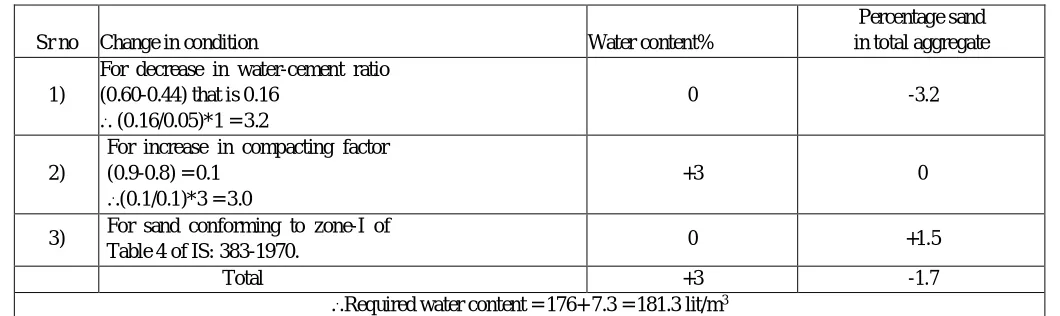
For change in values in water-cement ratio, compacting factor and sand belonging to Zone-I, the following adjustment is required.
Table:4 water and sand content
Sr no Change in condition Water content%
Percentage sand in total aggregate
1)
For decrease in water-cement ratio (0.60-0.44) that is 0.16
... (0.16/0.05)*1 = 3.2
0 -3.2
2)
For increase in compacting factor (0.9-0.8) = 0.1
...(0.1/0.1)*3 = 3.0
+3 0
3) For sand conforming to zone-I of
Table 4 of IS: 383-1970. 0 +1.5
Total +3 -1.7
...Required water content = 176+ 7.3 = 181.3 lit/m3
Required sand content as percentage of total aggregate by absolute volume P = 40-3.5 = 36.5%
d) Step-4: Calculation of cement content Water cement ratio = 0.55
182/c = 0.55 c = 402.8 kg/m3 = 403 kg/m3
From table-5 IS: 456 minimum cement content for moderate exposure condition = 300 kg/m3
Hence, 403 kg/m3 ˃ 300 kg/m3 OK…
e) Step- 5: Determination of CA and FA content Consider volume of concrete = 1m3
But, entrapped air in wet concrete = 2% Absolute volume of fresh concrete V = 1 m3
V = (W + C/SC + 1/p * fa/Sfa) * 1/1000... For fine aggregate 1 = (182 + 403/3.15 + 1/0.365 * fa/2.70) * 1/1000
1 = 331.269 + [1.053 fa] 1/1000 fa = 899.4 kg
Similarly, .Ca = 967.6 kg/m3 .mass of C.A.
C. Mix Proportion [M30]
Table: 5 Mix proportion
Water Cement Sand Grit Glass Fiber% Steel Fiber% Admixture
kg/m3
210 lit. 382 kg 635.07 kg 1104.85 kg 0.03 0.50 3.62
0.70 1.28 2.14 3.72 - - -
Cube Size= .15*.15*.15= 3.375*10-3
Total Quality for 1 cube= .7 + 1.28 + 2.14 + 3.72 = 7.84 kg Now,
1) In SCC, required steel fibers are 0.5 % of total weight of concrete.
2) In SCC, a Glass fiber is 0.03% of total weight of concrete.
3) In SCC, Admixtures is 1% of weight of cement
D. Mix Proportion [M30]
Table: 6 Mix proportion
Water Cement Sand Grit Glass
Fiber%
Steel Fiber%
Admixture kg/m3
182 lit. 403 kg 899.4 kg 967.6 kg 0.05 1 5.24
0.61 1.36 3.03 3.26 - - -
Cube Size= .15*.15*.15= 3.375*10-3
Total Quality for 1 cube= .7 + 1.36 + 3.03 + 3.26 = 8.35 kg Now,
1) In SCC required steel fibers are 1 % of total weight of cement.
2) In SCC, Glass fibers are 0.05 % of total weight of cement.
3) In SCC, Admixtures is 1.2 % of weight of cement.
VI. TEST REPORT
A. Slump Flow Test
Water Cement Sand Grit Slump flow test
(mm) Glass Fiber% Steel Fiber%
Admixture kg/m3
210 lit. 382 kg 635.07 kg 1104.85 kg 300
mm 0.03 0.50 3.62
182 lit. 403 kg 899.4 kg 967.6 kg 670
B. Flow Test
1) L-box test
Test Flow time Initial/start
Thk(cm) End/last Thk(cm)
L-box test 39 5.5 2.5
L-box test 32 5.7 2.7
2) U-box test
Test Flow time Initial/start
Thk(cm) End/last Thk(cm)
L-box test 39 5.5 2.5
L-box test 32 5.7 2.7
C. Compressive Strength Test
After 7-days (1st mix proportion)
grade Weight in kg Density gm/cc Observed load,KN Compressive strength
N/mm2
M-30
8.512 2.522 605.0 26.89
8.469 2.509 611.5 27.18
8.532 2.528 603.0 26.8
Average 26.96
After 7-days(2nd mix proportion)
M-30 8.623 2.554 605.0 22.77
8.658 2.563 611.5 23.65
8.693 2.572 603 24.02
Average 23.48
Flexural Strength Test
Sr no Identification mark Weight in kg Failure load kg Flexural strength
Kg/cm2
Flexural strength
(N/mm2)
1 Beam-1 39.8 1550 32.15 3.21
2 Beam-2 39.51 1600 33.19 3.32
3 Beam-3 39.66 1525 31.63 3.16
Average 3.23
VII. CONCLUSIONS
A. Glass fiber reduces the possibility of cracks and improves the surface integrity as well as its homogeneity by the reduction in bleeding.
B. Glass fibers increase the strength of concrete, without causing any problems.
C. The addition of steel and glass fibers increases the compressive strength to a great extent.
D. The addition of steel and glass fibers improves the durability and the fracture parameters of concrete. The slump value decreases as fiber quantity increases. Thus, workability decreases with increase in fiber content.
REFERENCES
[1] B. Akcay, M.A. Tasdemir, Mechanical behaviour and fibre dispersion of hybrid steel fibre reinforced self-compacting concrete. Construction and Building Materials. 28 (2012) 287–293.
[2] M. Pająk, The investigation on flexural properties of hybrid fiber reinforced self-compacting concrete. Procedia Engineering. 161 (2016) 121-126.
[3] D.A.S. Rambo, F.A. Silva, R.D.T. Filho, Mechanical behavior of hybrid steel-fiber self-consolidating concrete: Materials and structural aspects. Materials and Design. 54 (2014) 32–42.
[4] M. Pająk, T. Ponikiewski, The laboratory investigation on the influence of the polypropylene fibers on selected mechanical properties of hardened self-compacting concrete. Architecture Civil Engineering Environment. 3 (2015) 69-78.
[5] D.Y. Yoo, S.W. Kim, J.J. Park, Comparative flexural behavior of ultra-high-performance concrete reinforced with hybrid straight steel fibers. Construction and Building Materials. 132 (2017) 219–229.
[6] A.M. Brandt, Fibre reinforced cement-based (FRC) composites after over 40 years of development in building and civil engineering. Compos Struct. 86 (2008) 3–9.