A
COMPUTATIONAL MODEL OF THE SEMANTICS OF TENSE AND ASPECT
Rebecca J. Passonneau
Paoli R e s e a r c h C e n t e r , D e f e n s e Sysltems, U N I S Y S ~
The PUNDIT natural-language system processes references to situations and the intervals over which they hold using an algorithm that integrates the analysis of tense and aspect. For each tensed clause, PUNDIT processes the main verb and its grammatical categories of tense, perfect, and progressive in order to extract three complementary pieces of temporal information. The first is whether a situation has actual time associated with it. Secondly, for each situation that is presumed to take place in actual time, PUNDIT represents its temporal structure as one of three situation types: a state, process, or transition event. The temporal structures of each of these situation types consist of one or more intervals. The intervals are characterized by two features: kinesis, which pertains to their internal structure, and boundedness, which constrains the manner in which they get located in time. Thirdly, the computation of temporal location exploits the three temporal indices proposed in Reichenbach 1947: e v e n t time, speech time, and reference time. Here, however, event time is formulated as a single component of the full temporal structure of a situation in order to provide an integrated treatment of tense and aspect.
1 INTRODUCTION
The P U N D I T text-processing system extracts temporal information about real-world situations from short mes- sage texts. 2 This involves three c o m p l e m e n t a r y analy- ses. First, P U N D I T determines w h e t h e r a situation has actual time associated with it. A reference to a possible or potential situation, for example, would need a differ- ent treatment. Second, it determines the temporal struc- ture o f the predicated situation, or the m a n n e r in which it evolves through time. Finally, it analyzes the tempo- ral location of the actual situations with respect to the time of text p r o d u c t i o n or to the times of other situa- tions. T h e s e three pieces o f information are derived from the lexical head o f a predication (verbal, adjecti- val, or nominal), its grammatical inflections (tense, progressive, perfect), and finally, temporal adverbs such as before, after, and when. E a c h o f these compo- nents o f temporal meaning is assigned a context-depen- dent compositional semantics. A fundamental premise o f this a p p r o a c h is that the several sentence elements contributing temporal information can and should be analyzed in t a n d e m (Mourelatos 1981, D o w t y 1986) in order to determine the times for which predications are asserted to hold. This is accomplished by means of a model o f the semantics o f time that incorporates both aspect and a Reichenbachian treatment o f tense (Rei- c h e n b a c h 1947).
The temporal analysis c o m p o n e n t described here
was originally designed to handle P U N D I T ' s first text domain, C A S R E P messages, which are reports describ- ing equipment failures on n a v y ships. 3 This domain was a particularly appropriate one for implementing a com- ponent to analyze the time information c o n t a i n e d ex- plicitly within the individual s e n t e n c e s o f a text. CAS- REPs are diagnostic reports consisting o f simple declarative sentences. T h e y p r e s e n t a cumulative de- scription of the current status o f a particular piece o f equipment rather than narrating a s e q u e n c e o f events. Within one sentence, several different situations m a y be mentioned, linked t o g e t h e r by explicit temporal c o n n e c - tives such as before and after. It is thus possible to extract a good deal o f the important t e m p o r a l informa- tion from these texts without handling intersentential temporal relations. H o w e v e r , the implementation o f the temporal semantic c o m p o n e n t described here lays the necessary g r o u n d w o r k for eventually computing inter- sentential relations along lines p r o p o s e d in W e b b e r 1987 and this volume. 4 T h e capacity to p r o c e s s intersenten- tial temporal relations is, o f course, essential for ade- quately handling narrative data.
2 TEMPORAL INFORMATION
The premise o f the present work is that a c c u r a t e com- putation of the temporal semantics o f the verb and its grammatical categories o f tense, perfect, and progres- sive provide a foundation for computing o t h e r kinds o f
Copyright 1988 by the Association for Computational Linguistics. Permission to copy without fee all or part of this material is granted provided that the copies are not made for direct commercial advantage and the CL reference and this copyright notice are included on the first page. To copy otherwise, or to republish, requires a fee and/or specific permission.
0362-613X/88/010044-60503.00
Rebecca J. Passonneau A Computational Model of the Semantics of Tense and Aspect
temporal information, including the interpretion of tem- poral adverbials, s However, the task of modeling the semantic contribution of the verb and its categories is a complex one because temporal information is distrib- uted across several nonunivocal lexical and grammati- cal elements. As the extensive linguistic and philosoph- ical literature on tense and aspect demonstrates, the precise temporal contribution of any one surface cate- gory of the verb is contingent upon co-occurring verbal categories, as well as upon the inherent meaning of the verb, and even the nature of the verb's arguments (Comrie 1976, Dowty 1979, Mourelatos 1981, Vlach 1981, Vendler 1967). Hence, even a preliminary solution to the computational problems of interpreting temporal information in natural language requires recognizing the relevant semantic interdependencies. This paper pro- poses a solution to the computational task of extracting temporal information from simple declarative sentences based on separating temporal analysis into distinct tasks, each of which has access to a selected portion of the temporal input. The ultimate goal is to represent temporal information as explicitly as possible at each stage of analysis in order to provide the appropriate information for the next stage. Because the representa- tions are constructed incrementally, it is important that they should be explicit about what has been derived so far, yet sufficiently noncommittal to avoid conflicting with subsequent processing.
The present section of the paper provides the back- ground needed for understanding the information that the algorithm integrating tense and aspect (presented in Section 4) is designed to compute. First, in Section 2.1, I explain what is meant by a c t u a l t i m e and delimit the scope of the phenomena focused on here. Then in Section 2.2, I describe the components of temporal structure and how they are used to distinguish states, transition events, and two ways of referring to pro- cesses. Also in this section I review Dowty's (1979) aspect calculus and introduce how it is used in deriving the representation of temporal structure.
The remaining sections of the paper focus on the implementation. Section 3 describes the input to the temporal component. Section 4 presents the algorithm for computing the situation representations and their temporal location. Part of the computation of temporal location involves determining the reference time of a predication. Reference time pertains to the interpreta- tion of relational temporal adverbials, i.e., adverbials that relate the time of a situation to another time (e.g., The ship was refueled yesterday, cf. Smith 1981). 6 Temporal connectives, for example, relate the time of a syntactically subordinate predication to a superordinate one. A brief discussion of how the reference time participates in the interpretation of temporal adverbial clauses introduced by connectives such as before, after, and when is given in Section 5, whose more general topic is the utility of the situation representations for the interpretation of a variety of adverbial types. 7
2.1 ACTUAL TEMPORAL REFERENCE
Actual situations are those that are asserted to have already occurred, or to be occurring at the time when a text is produced. This excludes, e.g., situations men- tioned in modal, intensional, negated, or frequentative contexts. 8 A predication denotes an actual situation when two criteria are satisfied. First, at least one of the verb's arguments must be interpreted as specific (Dowty 1979, Mourelatos 1981, Vlach 1981). For exam- ple, the simple past of fly denotes a specific situation in Sentence 1 but not in (2), because the subject of the verb in (2) is a nonspecific indefinite plural.
1. John flew TWA to Boston. 2. Tourists flew TWA to Boston.
This paper does not address the interaction of the nature of a verb's arguments with the specificity of references to situations.
The second criterion is that the situation must be asserted to hold in the real world for some specific time. Predications in modal contexts (including the future; cf. Sentence 3) are excluded because their truth evaluation does not involve specific real-world times, but rather, hypothetical or potential times.
3. The oil pressure should/may/will decrease. Additionally, frequency adverbials like always may force a temporally nonspecific reading, as in (4).
4. John always flew his own plane to Boston. PUNDIT's time component does not currently identify modal contexts, frequency adverbials, or nonspecific verb arguments. However, it does identify predications denoting situation types when the form of the verb itself provides this information.
In evaluating actual time, PUNDIT distinguishes between examples like (5) and (6) on the basis of the verb and its grammatical categories. An actual use of the sentence in (5), for example, would report that a particular pump participated in a particular event at a specific time.
5. The lube oil pump seized. 6. The lube oil pump seizes.
7. The lube oil pump seized whenever the engine jacked over.
Rebecca J. Passonneau A Computational Model of the Semantics of Tense and Aspect
Section 5 illustrates the procedure by which the main clause of (7) would be processed so that its relation to the subordinate clause event could be identified later.
Lexical aspect is the inherent semantic content of a lexical item pertaining to the temporal structure of the situation it refers to, and thus plays a major role in computing temporal information. The aspectual catego- ries and their relevance to temporal processing are discussed in Section 2.2.
It should be noted that other semantic and pragmatic properties also affect temporal analysis. For example, there are conditions under which the present tense of a verb referring to an event, as in (6), is associated with an actual situation. Under the right conditions, first-person performatives (e.g., I warn y o u not to cross me) accom- plish the named event at the moment they are uttered (Austin 1977). Even a sentence like (6) can refer to an actual event if interpreted as a report of a presently unfolding situation, as in a sportscast. Handling tense in these types of discourse would require representing pragmatic features, such as the speaker/addressee rela- tionship, in order to handle the relation of indexicals like tense and person to the speech situation (Jakobson 1957). Section 3 briefly mentions some semantic distinc- tions pertaining to the verb in addition to lexical aspect, which PUNDIT does handle. Otherwise, however, this paper focuses on temporal analysis of third person descriptions containing verbs whose arguments refer to specific, concrete participants.
2.2 T E M P O R A L STRUCTURE OF ACTUAL SITUATIONS
Situations are classified on the basis of their temporal structure into three types: states, processes, and tran- sition events. Each situation type has a distinct tempo- ral structure comprised of one or more intervals. Two features are associated with each interval: kinesis and boundedness. Both terms will be defined more fully below, but briefly, kinesis pertains to the internal struc- ture of an interval, or in informal terms, whether something is happening within the interval. Bounded- ness pertains to the way in which an interval is located in time with respect to other intervals, e.g., whether it is bounded by another interval.
This approach to the compositional semantics of temporal reference is similar in spirit to interval seman- tics in the attempt to account for the semantic effects of aspectual class (Dowty 1986, Dowty 1982, Dowty 1979, Taylor 1977). However, interval semantics captures the distinct temporal properties of situations by specifying a truth-conditional relation between a full sentence and a unique interval. The goal of P U N D I T ' s temporal anal- ysis is not simply to sort references to situations into states, processes, and events, but more specifically to represent the differences between the three situation types by considering in detail the characteristics o f the set o f t e m p o r a l intervals that they hold or occur over
(Allen 1984:132). Thus, instead of specifying a single set of entailments for each of the three situation types, the
temporal semantics outlined here specifies what prop- erty of an interval is entailed by what portion of the input sentence, and then compositionally constructs a detailed representation of a state, ' process, or event from the intervals and their associated features. The critical difference from interval semantics is that while intervals are the fundamental unit from which situation representations are constructed, it is proposed here that intervals have properties that differentiate them from one another.
2.2.1 SITUATION TYPES AND T E M P O R A L STRUCTURE
The three situation types--states, processes, and tran- sition e v e n t s - - a r e distinguished from one another en- tirely on the basis of the grammatically encoded means provided by the language for talking about how and when they occur. Peopl e certainly can and do concep- tualize finer differences among real-world situations and can even describe these differences, given sufficient time or space. But certain gross distinctions are un- avoidably made whenever people mention things hap- pening in the world. Here and in the next section we will examine the temporal distinctions encoded in the form of the verb, often referred to as aspect, which are here referred to as temporal structure. Part of the temporal structure, that which Talmy (1985) described as the pattern of distribution of action through time, is repre- sented in the time arguments for the three situation types. Another part of the temporal structure, its event time, is the component of temporal structure that gets located in time by tense and the perfect. All the relevant distinctions of temporal structure are represented in terms of intervals and moments of time.
States. Very briefly, a state is a situation that holds over some interval of time, which is both stative and unbounded. A stative interval is one in which, with respect to the relevant predication, there is no change across the interval for which the situation holds. Thus stative intervals are defined here much as stative pred- ications are defined in interval semantics:
A n interval I over which s o m e predication q/ holds is stative i f f it f o l l o w s f r o m the truth o f 4, o v e r I that q/ is true at all subintervals o f I (Dowty 1986:42). Sentence 8 is an example of a typical stative predication whose verb phrase is headed by an adjective. During the interval for which the predicate low holds over the entity pressure, each subinterval is equivalent to any other subinterval with respect to the asserted situation; thus its kinesis is stative.
8. The pressure is low.
Some of the diagnostic tests for stative predications are that they cannot be modified by rate adverbials (*The
pressure was quickly low), nor referenced with do it
anaphora (The p r e s s u r e was very low. *The t e m p e r a t u r e also did it~that.) While inability to occur with the progressive suffix has often been cited as another diagnostic, it is a less reliable one. Dowty 1979 identifies a class of locative stative predications that occur in the
Rebecca J. Passonneau A Computational Model of the Semantics of Tense and Aspect
progressive (e.g., The socks are lying under the bed.)
Predicates denoting cognition or behavior have often been classified as statives but may occur in the progres- sive with reference to a cognitive or behavioral process. 9 Although such verbs do not appear in the current domain, they would be treated differently from pure stative verbs.
The intervals associated with states are also inher- ently unbounded, although a temporal bound could be provided by an appropriate temporal adverbial (e.g.,
The pressure was normal until the p u m p seized). ~°
When an unbounded interval is located with respect to another point in time, it is assumed to extend indefi- nitely in both directions around that time, as with the punctual adverbial in (9). The moment within the inter- val that is explicitly located by tense and the punctual adverbial is the situation's event time, depicted as a circle in the middle of the interval, with arrows repre- senting that the interval extends indefinitely into the past and toward the present.
9. The pressure was low at 0800.
Situation type: state Kinesis: stative
Boundedness: unbounded
This sentence would be true if the pressure were low for only an instant coincident with 0800, but it is not asserted to hold only for that instant; one thus assumes that it was low not only at the named time, but also prior and subsequent to it. In this sense, the interval is unbounded, as represented graphically above.
Processes. A process is a situation which holds over an active interval of time. Active intervals contrast with stative intervals in that there is change within the interval, a useful distinction for interpreting manner adverbials indicating rate of change, e.g., slowly and
rapidly. Since states denote the absence of change over
time, they cannot be modified by rate adverbials; pro- cesses can be.
The definition of active intervals is also adapted from the characterization of process predications in interval semantics:
A n interval I over which some predication qJ holds is active iff it follows f r o m the truth o f ~b at I that ~b is true over all subintervals o f I down to a certain limit in size (Dowty 1986:42).
Active intervals can be unbounded or unspecified for boundedness, depending on whether the verb is pro- gressive. In (10), the active interval associated with the alarm sounding is unbounded and bears the same rela- tionship to the named clock time as does the stative interval in (9) above.
10. The alarm was sounding at 0800.
< O
Situation type: process Kinesis: active
Boundedness: unbounded
Progressive aspect has often been compared to lexical stativity.l~ Here the commonality among sentences like (9) and (10) is captured by associating the feature of unboundedness both with stative lexical items and with progressive aspect. The temporal structures of states and unbounded processes are thus identical with re- spect to boundedness. However, the distinction be- tween the kinesis of (9) and (10) is retained by distin- guishing active from stative intervals.
In (11) the interval associated with the alarm sound- ing is unspecified for boundedness, meaning that the clock time may occur within the interval for which the alarm sounded, or at its onset or termination.
11. The alarm sounded at 0800.
Situation type: process Kinesis: active
Boundedness: unspecified
In (10), where the verb is progressive, the clock time is interpreted as falling within the unbounded interval of
sounding, but in (11), where the verb is not progressive,
the clock time can be interpreted as falling at the inception of the process or as roughly locating the entire process. ~2 Nonprogressive forms of process verbs ex- hibit a wide variation in the interpretation of what part of the temporal structure is located by tense. The influencing factors seem to be pragmatic in nature, rather than semantic. The solution taken here is to characterize the event time of such predications as having an unspecified relation to the active interval associated with the denoted process, represented graph- ically above by the dashed line around the event time.
Transition Events. A transition event is a complex situation consisting of a process which culminates in a new state or process. The new state or process comes into being as a result of the initial process. Since states have no kinesis, they cannot culminate in new situa- tions. The temporal structure of a transition event is thus an active interval followed b y - - a n d bounded b y - - a new active or stative interval.~3
That there are these three distinct components of transition events can be illustrated by the following sentences in which the time adverbials modify one of the three temporally distinct parts of the predicated event.
12. It took 5 minutes for the pump to seize. 13. The pump seized precisely at 14:04:01. 14. The pump was seized for 2 hours. 14
The duration 5 minutes in (12) above applies to the interval of time during which the pump was in the process of seizing. The clock time in (13) corresponds to the moment when the pump is said to have made a transition to the new state of being seized. Finally, the measure phrase in (14) corresponds to the interval associated with the new state.
Rebecca J. Passonneau A Computational Model of the Semantics of Tense and Aspect
much the same reasons. That is, achievements differ from accomplishments in being typically of shorter duration and in not entailing a sequence of subevents, but they nevertheless do in fact have some duration (Dowty 1986:43). Even so-called punctual events (e.g., They arrived at the station; She recognized her long-lost friend) can be talked about as if they had duration
(Talmy 1985, Jackendoff 1987), apparently depending on the granularity of time involved. It is my belief that handling granularity depends on appropriate interaction with a relatively rich model of the world and of the current discourse, but would not require new units of time; depending on the level of detail required, mo- ments could be exploded into intervals, or intervals collapsed into moments. For these reasons, punctual events are not treated here as a separate class.
With verbs in Vendler's class of achievements, the same participant generally participates in both the initial process and the resulting situation, as in (15):
15. The engine failed at 0800.
>
Situation type: transition event Kinesis: active
Boundedness: bounded
Here, the engine participates in some process (failing), which culminates in a new state (e.g., being inopera- tive). In each case, however, there are two temporally distinct intervals, as shown in the diagram above, one bounded by the other.
Causative verbs typically denote accomplishments involving subevents in which the action of one partici- pant results in a change in another participant, as in (16):
16. The pump sheared the drive shaft.
Here, a process in which the pump participated (shearing) is asserted to have caused a change in the drive shaft (being sheared). The consequence of the different argument structures of (15) and (16) on the event representation is discussed in the next section.
The boundary between the two intervals associated with a transition event, the transition bound, is defined as a transitional moment between the initial active interval and the ensuing active or stative interval asso- ciated with the new situation. An important role played by the transition bound is that it is the temporal com- ponent of transition events that locates them with respect to other times. For example, (15) asserts that the moment of transition to the new situation coincides with 0800. In contrast with examples 9-11, the status of the engine prior to 0800 is asserted to be different from its status at 0800 and afterwards. The components of temporal structureJproposed here are intended to pro- vide a basis for deriving what is said about the relative ordering of situations and their durations, rather than to correspond to physical reality. Thus a transition bound
is a convenient abstraction for representing how transi- tion events are perceived and talked about. Since a transition event is one which results in a new situation, there is in theory a point in time before which the new situation does not exist and subsequent to which the new situation does exist. This point, however, is a theoretical construct not intended to correspond to an empirically determined time. It corresponds exactly to the kind of boundary between intervals involved in Allen's (1983, 1984) meets relation.
2.2.2 D O W T Y ' S ASPECT CALCULUS
The intervals for which situations hold are closely linked with the semantic decompositions of the lexical items used in referring to them. This allows PUNDIT to represent precisely what kinds of situations entities participate in and when. The decompositions include not only N-ary relational predicates among the verb's arguments (Passonneau 1986), but also the aspectual operators for processes and events proposed in Dowty 1979. The main clauses for examples 9, 10, 15, and 16 are given below as examples 17-20.
17. The pressure was low.
Decomposition: low(patient([pressure 1 ])) 18. The alarm was sounding.
Decomposition: do(sound(actor([alarm 1 ]))) 19. The engine failed.
Decomposition:
become(inoperative(patient([engine 1 ])) 20. The pump sheared the drive shaft.
Decomposition:
cause(agent([pump 1 ]),become(sheared(patient ([shaftl]))))
In (17), the semantic predicate low is associated with the predication be low, and is predicated over the entity referred to by the subject noun phrase, the pressure. 15 The time component recognizes this structure as a stative predication because it contains no aspectual operators.
The decomposition for (18) consists of a basic seman- tic predicate, sound, its single argument, and the aspect- ual operator do, indicating that its argument is in the class of process predicates; the actor role designates the active participant.
The decompositions of transition-event verbs contain the aspectual operator become, whose argument is a predicate indicating the type of situation resulting from the event. With inceptive verbs, as in (19), the actor of the initial process is also the patient or theme of the resulting situation, although this dual role is not repre- sented explicitly in the decomposition. If a distinct actor causes the new situation, the verb falls into the class of causatives and the actor of the initial process is conven- tionally called an agent, as in (20). Other decompositional analyses (Dowty 1979, Foley 1984) conventionally rep- resent the initial process of transition-event verbs by associating an activity predicate (e.g., do) with the actor or agent of the initial process (e.g., cause(do(agent()),
Rebecca J. Passonneau A Computational Model of the Semantics of Tense and Aspect
become(inoperative(patient())))).
The decompositions in (19) and (20) can be considered abbreviated versions of these more explicit predicate/argument structures.The
become
operator of transition-event verbs thus provides a crucial piece of information used when deriving representations of transition events. Given a reference to a specific transition event that has already taken place, the temporal component deduces the ex- istence of the new situation that has come into being by looking at the predicate embedded beneath the become operator. This is described more fully in Section 4.2.3. As will be shown in Section 4, PUNDIT represents actual situations as predicates identifying the situation type as a state, process, or event. In order to familiarize the reader with the representation schema without needless repetition of detail, a single example of a situation representation is given below for (17).17. The pressure was low. state([lowl],
low(patient([pressurel])), period([lowl]))
Each situation representation has three arguments: a unique identifier of the situation, its semantic decom- position, and its time argument, in this case, the interval (or
period)
over which the predicate holds. The same pointer (e.g., [lowl]) is used to identify both a specific situation and its time argument because the actual time for which a situation holds is what uniquely identifies it. The participants in a situation help distinguish it from other similar situations, but while the same entities can participate in other situations, time never recurs.Having introduced the distinct situation types and the temporal structures that distinguish them, the next steps are to show how they are computed and how they permit a simple computation of temporal location. This will be done in Section 4. Since the preceding discus- sions also introduced the representation of lexical as- pect and the relevance of the verbal categories, it is now possible to clearly summarize the input which the temporal analysis component receives.
3 INPUT TO THE TEMPORAL COMPONENT
PUNDIT's time component performs its analysis after the sentence has been parsed and recursively after the semantic decomposition of each predicating element in the sentence has been created (Palmer 1986). Although this paper focuses on the temporal analysis of certain kinds of tensed verbs, the basic algorithm described here has been extended to handle other cases as well. Describing the full input to the temporal component provides an opportunity to mention some of them.
The input to the time component for each tensed clause includes not only the surface verb and its tense and aspect markings, but also the decomposition pro- duced by analyzing the verb and its arguments (cf. Section 2.2.2.). The input to the time component is thus a list of the following form:
[[Tense, Perfect, Progressive], Verb, Decomposition, {Context}]
Each element of the list will be described in turn.
3.1 VERBAL CATEGORIES
The first element in the input list is itself a list indicating the form of the verb, i.e., its grammatical inflection.
[[Tense, Perfect, Progressive], Verb, Decomposition, {Context}]
The tense parameter is either past or present.16 If the verb is in the progressive or perfect, the corresponding parameter appears while absence of either in the input sentence is reflected in its absence from the list.
3.2 THREE ORDERS OF VERBS
The next two elements in the input to the time compo- nent are the surface verb and its decomposition. Lexical aspect is encoded in the decomposition as described in Section 2.2.2 for the cases where it is relevant. How- ever, it is a more fundamental classification pertaining to the verb which helps determine the cases where aspect is relevant.
[[Tense, Perfect, Progressive], Verb, Decomposition, {Context}]
Since this information is only for treating more complex cases than are described in this paper, the following discussion is intended only to indicate that the model has been extended to cover verbs whose semantic structure contains temporal information of a different order than the inherent temporal structure of an actual situation. After a brief description of three temporal orders of verbs, the discussion will return to explication of the input required for implementing the basic model. In addition to the aspectual distinction among state, process, and transition-event verbs, there are other distinctions related to temporal semantics. A particu- larly significant one is among what I call first-, second-, and third-order verbs, by analogy with the distinction among first-, second-, and third-order logics. A first- order verb is one whose arguments are concrete enti- ties, e.g., humans, machines, and other physical ob- jects. A second-order verb takes as its arguments states, processes, and events, but does not in and of itself refer to a situation. Rather, its semantic content is primarily temporal or aspectual (e.g.,
occur, follow).
Third-order verbs refer to complex situations (e.g.,result, cause)
whose participants are themselves situations. The aspectual distinctions among verbs referring to states, processes, and transition events are only relevant to first-order verbs.Rebecca J. Passonneau A Computational Model of the Semantics of Tense and Aspect
Order Examples Definition
First " f a i l " , " o p e r a t e " verbs that denote situations and
whose arguments are not propositional' Second " o c c u r " , "follow" verbs that provide temporal
information about their propositional arguments Third " r e s u l t " , " c a u s e " verbs that denote situations but which also provide
temporal information about their propositional arguments
T a b l e 1. Three orders of verbs.
be seen
(24). 21. 22. 23.
24.
by contrasting examples 21 and 22 with (23) and
The failure occurred on Tuesday. The failure was discovered on Tuesday.
*The failure that happened on Monday occurred on Tuesday.
The failure that happened on Monday was dis- covered on Tuesday.
Example 22 mentions two distinct situations, a discov- ery and a failure. In (21), however, the subject of the sentence, the failure, denotes an event, but the verb occur does not denote a separate situation. It provides tense and aspect information for interpreting its argu- ment. In other words, the temporal information in (21) is very similar to that contained in (25):
25. Something failed on Tuesday.
A pragmatic difference between the two sentences is that in (21) it is not necessary to mention what failed whereas in (25), the verb fail must have a subject. Other verbs in this class are foUow, precede, continue, happen, and so on. Because these verbs contribute primarily temporal information, they are conventionally referred to as a s p e c t u a l verbs (Freed 1979, Lamiroy 1987, New- meyer 1975).
It is easy to see that the analysis of aspectual verbs must be implemented somewhat differently from verbs like fail, which directly denote situations. In a sentence like (25), the relevant temporal information is contained in the verb and its tense and aspect marking alone. In contrast, the temporal information in (24) pertaining to the fail event is distributed not only in the verb and its tense and aspect markers, but also in its subject. Temporal analysis of sentences like (24) must be per- formed not only at the main clause level, but also at the level of embedded propositions. In essence, analysis of aspectual verbs is of a different order. Consequently, verbs like fail are classified here as first-order verbs while the so-called aspectual verbs are classified as second order.
PUNDIT's temporal component also handles a third class of verbs, classified as third order. A third-order verb denotes a real-world situation, but its arguments are other situations. Consequently, the verb may con- tribute temporal information about the arguments as well as about the situation it denotes. The verb result illustrates this type. Sentence 26 asserts the existence of a result situation; the result relationship holds between
an instigating situation mentioned in the noun phrase loss o f air pressure, and a resulting situation mentioned in the noun phrase failure.
26. Loss of air pressure resulted in failure.
Additionally, the meaning of result includes the tempo- ral information that the instigating situation (the loss) precedes the resulting situation (the failure). A full temporal analysis of sentences like (26) requires two steps. The first is to analyze the temporal structure of the situation denoted by the verb. The second is to draw the correct temporal inferences about the verb's prop- ositional arguments. Such verbs combine some of the properties of both first- and second-order verbs and thus constitute a third order of analysis. Classifying a verb as a third-order verb drives the search for temporal inferences associated with its arguments.
The classification of these three orders of verbs, summarized in Table 1, is recorded independently of the lexical decompositions used by both the temporal- analysis component and the semantic interpreter. At present, verb-order information is used only by the temporal-analysis component. It essentially selects for the appropriate flow of control through the temporal- processing procedures. Although PUNDIT recognizes the distinction between first-, second-, and third-order verbs, and processes the relevant temporal information in each case, the remainder of the paper will deal only with the analysis of first-order verbs.
3.3 LEXICAL ASPECT
The third element in the input list is the decomposition structure produced by the semantic analysis of the verb and its arguments.
[[Tense, Perfect, Progressive], Verb, D e c o m p o s i t i o n , {Context}]
The important aspectual features of the decomposi- tions, discussed in Section 2.2.2, can be summarized as follows. If the decomposition of a first-order verb contains a become operator, the verb is in the transition- event class; otherwise, if it contains a do operator, the verb is in the process class; else, the verb (or other predicate) is stative.
[image:7.612.55.551.53.161.2]Rebecca J. Passonneau A Computational Model of the Semantics of Tense and Aspect
3.4 DISCOURSE CONTEXT
The final element in the input to the temporal compo- nent is a data structure representing the current dis- course context.
[[Tense, Perfect, Progressive], Verb, Decomposition, {Context}]
The first element of this data structure is a list of unanalyzed syntactic constituents. At this stage of processing, PUNDIT has produced a full syntactic analysis of a surface sentence (or sentence fragment), and a semantic decomposition of some predication within the sentence. After the semantic analysis of a clause, the constituent list contains all those syntactic constituents that do not serve as arguments of the verb, e.g., adverbial modifiers of the verb phrase and sen- tence adjuncts. After the analysis of the main clause of Sentence 27, for example, the constituent list would contain two unanalyzed constituents; the prepositional phrase introduced by during, and the subordinate clause introduced by when.
27. The pump failed during engine start, when oil pressure dropped below 60 psig.
This list of constituents is processed after the temporal content of a predication is analyzed in the search for temporal adverbials that modify the predication (cf. Section 5 below). The data structure representing the current discourse context contains temporally relevant information, such as the tense and voice of the main clause. The main-clause tense is used for the analysis of situations mentioned in embedded tenseless constitu- ents, while voice is used in analyzing adjectival pas- sives.
The next section describes an algorithm for interpret- ing the four pieces of information relevant to actual references to states, processes, and events. It demon- strates how the temporal structure and temporal loca- tion are generated from the verb's grammatical catego- ries of tense, perfect, and progressive, and from its lexical aspect.
4 ALGORITHM FOR THE TEMPORAL ANALYSIS OF INFLECTED VERBS
The introductory and discussion sections have undoubt- edly reinforced the view that semantic processing of temporal information is a complicated problem, even when the scope of the problem is constrained to the simple cases addressed here. Relevant information is distributed within and across distinct constituents, and their contribution to temporal information can depend upon co-occurring elements. Yet these are in no way insurmountable problems. The fundamental design prin- ciples behind my approach to temporal processing have been to carefully separate the analysis into distinct subtasks, to pare down to a minimum the information available to each task, and to provide a simple compo- sitional semantics for each kind of temporal input. In
this section, I outline the basic algorithm for the tem- poral analysis of inflected verbs. This algorithm ana- lyzes the four components of the inflected verb de- scribed in the preceding section (lexical aspect, progressive, perfect, tense). The output that is gener- ated can than serve as input for further temporal proc- essing. Section 5 illustrates the integration of this basic algorithm into a more global procedure that succes- sively interprets the main and subordinate clauses of complex sentences where the subordinating conjunction is a temporal adverbial.
The basic algorithm for the temporal analysis of inflected verbs has a simple tripartite control structure designed to answer three distinct questions:
1. Does the predication denote a specific situation with actual time reference?
2. If so, what is the t e m p o r a l structure of the situation, i.e., how does it evolve through time and how does it get situated in time?
3. Finally, what is the t e m p o r a l location of the situation with respect to the time of text production, and what is the temporal vantage point from which the situa- tion is described?
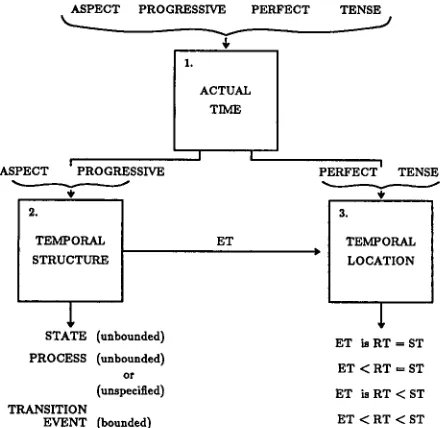
Figure 1 illustrates the algorithm's global control struc- ture, with the modules corresponding to each question as well as the relevant input for each module. The first module examines all four temporal parameters de- scribed in Sections 3.1 and 3.5 in order to reject certain cases. The second module requires only the two param- eters pertaining to the computation of temporal struc- ture. It sends a component of the temporal structure, the event time, to the third module, which locates the event time by analyzing the remaining two temporal parameters, tense and perfect.
4.1 MODULE 1: ACTUAL TIME
The first task performed by PUNDIT's temporal com- ponent is to identify references to specific situation tokens; that is, instances of situations which have actually occurred. The input is the lexical verb and its grammatical categories. In certain cases, the form of the verb itself can indicate that the predication refers to a type of situation, rather than to a specific token. Thus the screening step described here rejects these cases and otherwise assumes that the predication denotes a specific situation. As pointed out in Section 2.1, the verb itself provides insufficient information in two kinds of cases: those where explicit disconfirming information occurs elsewhere in the sentence (e.g., arguments of the verb, modals, frequency adverbials; cf. examples 2 and 7, repeated below):
2. Tourists flew TWA to Boston.
7. The lube oil pump seized whenever the engine jacked over.
Rebecca J. Passonneau A Computational Model of the Semantics of Tense and Aspect
ASPECT PROGRESSIVE PERFECT
4, L
ACTUAL TIME
I I
ASPECT z PROGRESSIVE
2.
TEMPORAL STRUCTURE
T E N S E
ET
i P E R F E C T T E N S E
T E M P O R A L L O C A T I O N
STATE (unbounded) ET is R T = ST PROCESS (unbounded)
ET < RT = ST
or
(unspecified) ET is RT < ST TRANSITION
EVENT (bounded) ET < RT < ST
Figure 1. Algorithm for temporal analysis of inflected verb.
for subsequent processing of semantically and pragmat- ically more complex phenomena.
In Section 2.1 it was shown that two classes of inflected verbs generally denote situation types, rather than actual tokens. These are process verbs and transi- tion-event verbs in the simple present tense (i.e., non- progressive and nonperfect), as exemplified in (28) and (29).
28. Number 2 air compressor operates at reduced capacity.
(operate
is a process verb.)29. They replace the air compressor every three years.
(replace
is a transition event verb.)For the compound tenses, present tense interacts with the progressive and perfect verbal categories. The pro- gressive alters the aspectual properties of nonstative verbs so that they refer to unbounded situations, and unbounded situations--unlike the other temporal struc- t u r e s - c a n be located in the actual present (cf. Section 4.2.2). With the perfect forms, the situation being
referred to is always located in the past, and tense pertains to the situation's reference time rather than its event time (cf. Section 4.2.3). Thus, as shown in Figure 1, all four elements in the temporal data structure are inspected in order to identify the two cases exemplified in (28) and (29).
Table 2 summarizes the relation between the in- flected verb and actual temporal reference.
In the current implementation of PUNDIT, predica- tions that meet the first condition do not receive further temporal analysis.
4 . 2 M O D U L E 2 : C O M P U T E T E M P O R A L S T R U C T U R E
Module 2 computes the first type of specific temporal information associated with reference to an actual situ- ation. It generates an explicit representation of the situation's temporal structure. This structure includes one or more time arguments associated with the seman- tic predicates in the decomposition, and the situation's event time. Each situation type--state, process, transi- tion event--receives an appropriate situation label, time argument(s), and event time. The temporal structure evoked by an inflected verb can be computed entirely on the basis of the values of the two aspectual elements in its input (Lexical Aspect, Progressive), as shown in Figure 1. The algorithm for Module 2, summarized in Table 3, will be described in the following three sections corresponding to the three situation types.
Though not shown in the figure or in Table 3, Module 2 also receives another input data structure: the seman- tic decomposition. The decomposition is analyzed dur- ing the processing of transition-event situations in order to associate distinct time arguments with distinct se- mantic predicates in the decomposition. This procedure is explained in the appropriate section below.
4 . 2 . 1 S T A T E S
As shown in Table 3, if the lexical aspect of the predicate is stative (Aspect = stative), then the progres- sive parameter is irrelevant for computing temporal structure. Lexical stativity is sufficient to identify the
L E X I C A L ASPECT PROGRESSIVE PERFECT TENSE ACTION
Nonstative no no present reject
accept
Table 2. Module 1: Actual Time.
L E X I C A L PROGRESSIVE L A B E L TIME EVENT
ASPECT ARGUMENT TIME (ET)
stative Yes/No State unbounded stative interval includes ET
process or transition event Yes Process unbounded active interval includes ET
process No Process unspecified active interval has ET
transition event No Event transition bound
unifies with
ET52
Table 3. Module 2: Temporal Structure.
[image:9.612.47.268.53.267.2]Rebecca J. Passonneau A Computational Model of the Semantics of Tense and Aspect
situation as a state whose time argument is an un- bounded stative interval.
Example 30 gives a simple stative sentence, the relevant input to Module 2, and the final situation representation. Note that (30) illustrates the use of the progressive with a verb in the locative class of statives noted in Dowty 1979, and mentioned in Section 2.2.1.17
30. Metallic particles are clogging the strainer. Lexical Aspect = stative
Situation Representation: state([clogl],
clog(instrument([materiall]),theme ([strainer2])), period([clogl]))
As soon as the lexical aspect is recognized to be stative, Module 2 generates the state label and period time argument used in creating the representation depicted above. A period time argument in the context of a state representation denotes a stative interval. The situation representation in (30) indicates that a specific state,
clogl, holds over the stative interval, period([clogl]);
the decomposition in the representation indicates the participants and the relation between them that holds over this interval. By definition, this interval also has an event time associated with it, whose relation to the interval we can determine by its boundedness feature.
Stative intervals are assumed to be unbounded unless an endpoint is provided by further processing (e.g., through adverbial modification, inference). For un- bounded intervals, the event time is always an arbitrary moment included within the interval. This is represented as a binary predicate of the following form, where the m o m e n t time argument is the event time:
Event Time = moment([clogl])
such that includes(period([clogl]), moment([clogl]))
This predicate and the state representation given above exemplify the output of Module 2 for state situations. The event time generated here is then passed to Module 3 in order to determine its temporal location. We will return to this same example in the discussion of tempo- ral location in Section 4.3.
4.2.2 PROCESSES
There are three surface forms that denote process situations: nonprogressive process verbs, progressive process verbs, and progressive transition-event verbs. The nonprogressive and progressive cases have distinct temporal structures, due to differences in the relation of the event time to the active interval over which the process holds. Since this is the only difference among the three cases, the similarities in temporal structure will be presented before the event time is discussed.
A nonstative predication that either has a process verb or is in the progressive (i.e., the three combina- tions of nonprogressive process, progressive process, and progressive transition-event) evokes a process rep- resentation. Thus the following three example sen- tences would each be represented with a process label
and a period time argument, representing the active interval over which the process holds. Examples 31 and 32 illustrate the two forms of process verbs that evoke process situations; since they receive the same repre- sentation, it is shown only once. Example 33 shows the third type of reference to a process, with a progressive transition-event verb.
31. The diesel operated. Lexical Aspect = process Progressive = no
32. The diesel was operating. Lexical Aspect = process Progressive = yes
31-32. Situation Representation: process([operate 1 ],
do(operate(actor([diesel]))) period([operate 1 ]))
33. The pump is failing.
Lexical Aspect = transition event Progressive = yes
Situation Representation: process([faill],
become(inoperative(patient([fail 1]))), period([faill]))
The process representation for (33) contains the full decomposition for the verb fail with its aspectual oper- ator become. In this context, the become operator does not denote a transition to a new situation, but rather, indicates a process of becoming, which might or might not culminate in such a transition.
Referring again to Table 3, we note that the active intervals for both (32) and (33) will be unbounded, in contrast to (31), where the active interval is unspecified for boundedness. The consequence of this difference on the representation of the event time is outlined in the following paragraphs.
Unbounded processes. The predicate specifying the
relation between the event time of an unbounded proc- ess and the period over which the process holds is identical to that for states. That is, the period time argument includes an arbitrary moment, which serves as the situation's event time, as shown below.
32. The diesel was operating.
Event Time = moment([operatel])
such that includes(period([operatel]), moment
([operatel]))
33. The pump is failing.
Event Time = moment([faill])
such that includes(period([faill]), moment([faill])) The progressive always implies unboundedness, and in this respect resembles lexical statives. Again, it is important to remember that an unbounded interval can acquire endpoints through further processing (e.g., of temporal adverbials, as in The diesel was operating until the pump failed.).
Unspecified processes. For nonprogressive process
Rebecca J. Passonneau A Computational Model of the Semantics of Tense and Aspect
L E X I C A L P R O G R E S S I V E L A B E L T I M E E V E N T
A S P E C T A R G U M E N T T I M E (ET)
transition e v e n t N o E v e n t transition bound unifies with E T
(From) Table 3.
11 in Section 2.2.1). This gives rise to an indeterminate relationship b e t w e e n the e v e n t time and the period time argument o v e r which the process holds; i.e., the e v e n t time m a y start, end, or be included within the period. This unspecified relationship is r e p r e s e n t e d by means of a binary has predicate, as shown in example 31.
31. The diesel operated.
[image:11.612.40.553.53.106.2]E v e n t Time = m o m e n t ( [ o p e r a t e l ] ) such that has(period([operatel]), m o m e n t ([operatel]))
Both event-time predicates given so far (i.e., includes, has) indicate a relation b e t w e e n an arbitrary m o m e n t and a single interval o v e r which a state or process holds. T h e r e is otherwise nothing distinctive about the mo- ment selected to be the e v e n t time o f a process or state situation. In contrast, as Table 3 indicates, and as discussed in Section 2.2.1, the e v e n t time o f a transition e v e n t is equated with a distinctive c o m p o n e n t of its temporal structure, viz., the transition bound b e t w e e n a process that initiates the e v e n t and the new situation reached at the culmination o f the process.
4.2.3 TRANSITION EVENTS
Table 3 shows only one c o m p o n e n t o f the temporal structure o f a transition e v e n t (the relevant line of the table is repeated below).
As noted in Section 2.2.1, a transition e v e n t has three temporal c o m p o n e n t s : an initial active interval leading up to a transition, the m o m e n t o f transition, and the interval associated with the new, resulting situation. In t h e o r y , then, one could represent the full temporal structure o f a transition-event predication (e.g., The pump failed) as three contiguous states of affairs: an initial process (e.g., failing) leading up to a transitional m o m e n t (e.g., becoming inoperative) followed by a new state o f affairs (e.g., inoperative). At present, P U N D I T explicitly represents only the latter two c o m p o n e n t s of transition-event predications: the m o m e n t (transition bound) associated with an e v e n t o f becoming, and the period associated with the resulting situation. This representation has been found to be adequate for the current applications. Thus transition events are actually assigned two situation representations: an e v e n t repre- sentation with a m o m e n t time argument, represented with the input decomposition, and a resulting state or process situation with a period time argument, for which a new d e c o m p o s i t i o n is derived from the input decomposition. E x a m p l e 34 illustrates a typical transi- tion-event sentence, the relevant input for computing temporal structure, and the two situation representa- tions.
34. The pump failed.
Lexical A s p e c t = transition e v e n t Progressive = no
Situation Representation: event([faill],
become(inoperative(patient([pump 1]))), moment([faill])
Situation Representation: state([fail2],
inoperative(patient([pump 1 ])), period([fail2]))
The first situation representation c o r r e s p o n d s to the transition e v e n t itself. Module 2 generates the e v e n t label and m o m e n t time argument used in creating the type o f e v e n t representation s h o w n a b o v e for nonpro- gressive transition e v e n t verbs. T h e m o m e n t argument o f a transition e v e n t is the transition b o u n d implying the onset o f a new situation. W h e n Module 2 creates an e v e n t with a m o m e n t argument, it also creates a repre- sentation for the implied situation. In E x a m p l e 34, the new situation is a state. When creating the representa- tion for the situation resulting f r o m a transition event, it is necessary to determine the appropriate situation label, time argument, and semantic d e c o m p o s i t i o n for the new situation. This is w h e r e the semantic d e c o m - position for transition events plays a role, as will be described below.
All transition-event verbs contain a state or p r o c e s s predicate e m b e d d e d beneath an instance o f the aspect- ual o p e r a t o r become. T h e full d e c o m p o s i t i o n r e p r e s e n t s the type o f situation associated with the m o m e n t o f transition. T h e portion e m b e d d e d b e n e a t h become is the situation type associated with the new situation. F o r example, the decomposition passed to the time c o m p o - nent for S e n t e n c e 34 would be:
become(inoperative(patient([pump 1 ]))).
As shown in (34), this d e c o m p o s i t i o n appears in the representation o f the transition e v e n t itself. T h e argu- ment to the become o p e r a t o r is then e x t r a c t e d for use in the new situation representation:
inoperative(patient([pump 1 ]))
The extracted decomposition is inspected to determine its aspectual class, c o m p l e t e l y analogously to the pro- cedure for determining the aspectual class o f the input predicate (cf. Section 3). In this case, the e m b e d d e d predicate d e c o m p o s i t i o n is stative b e c a u s e it contains no aspectual operators. If it contained the do operator, the new situation would have b e e n a process. 18 In this fashion, the d e c o m p o s i t i o n guides the selection o f the
Rebecca J. Passonneau A Computational Model of the Semantics of Tense and Aspect
situation label and time argument for the situation inferred to result from the transition event.
The final piece of temporal structure derived for a transition event is the temporal relation between the moment associated with the transition event (e.g., moment([faill])) and the period associated with the resulting situation (e.g., period([fail2])). The event mo- ment is the onset of the period. Following Allen 1983, this is called a start relationship. By definition, then, every transition bound starts some period. In the case of Example 34, the moment of failure starts the period for which the pump is in an inoperative state.
start(moment([fail 1]), period([fail2]))
The event time of a transitional event is always identi- fied with the transition bound. Thus for examples like (34), the moment time argument serves as the event time of the transition event. This identity relation is not represented as a predicate, but rather, is handled via unification, as indicated in Table 3.
4.3 MODULE 3: COMPUTE TEMPORAL LOCATION
PUNDIT's temporal component employs a Reichen- bachian analysis of tense whereby situations are located in time in terms of three temporal indices: the event time, speech time, and reference time. ~9 It diverges from Reichenbach primarily by distinguishing between the event time and the temporal structure of a situation. While Reichenbach acknowledged that the progressive, for example, pertains to temporal duration, he did not discuss the differences in temporal structure associated with distinct situation types and their interaction with tense. Here, the event time is only a single component of the full temporal structure of a situation. In this section, we will see how this method of defining the event time makes it possible to compute temporal location independently of lexical or grammatical aspect while preserving the distinctive temporal information they contribute to references to actual situations.
The tense and perfect parameters specify the se- quencing relations among the event time, reference time, and speech time, with each of the four configura- tions of tense and perfect specifying a distinct ordering, as shown in Figure 1 and repeated below:
ET is RT = ST
ET < RT = ST
ET is RT < ST
ET < RT < ST
simple present
present perfect
simple past
past perfect
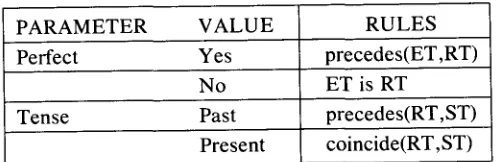
The speech time, or time of text production, is given. It serves as the temporal fulcrum with respect to which the other temporal indices are located. As shown in Table 4, the presence or absence of the perfect indicates whether the event time and reference time are distinct, in which case the event time precedes the reference time, or whether they are identical. Tense is taken to
indicate the relation between the reference time and the speech time, following Reichenbach's suggestion: the position o f R[T] relative to S[T] is indicated by the words "past", "present", and "future" (Reichenbach 1947).
PARAMETER VALUE RULES
Perfect Yes precedes(ET,RT)
No ET is RT
Tense Past precedes(RT,ST)
Present coincide(RT,ST)
Table 4. Module 3: Temporal Location.
Since we are dealing here with actual time, rather than potential or hypothetical time, there is only past or present. That is, the reference time either precedes or coincides with the speech time.
The reference time and the event time are identical to one another for the simple tenses (ET is RT), which has the effect that tense applies to the event time. Thus, for the simple present, the event time and the speech time coincide. Note that a distinction is made here between identity and coincidence of distinct indices. For any speech act or text containing a description of a situa- tion, the speech situation and the described situation are always conceptually and observationally distinct, thus also their respective temporal indices. These indices are therefore represented as distinct times, which, in the present tense, happen to coincide. However, with the simple tenses, there is no reason to create a distinct reference time and a relation saying that it coincides with the event time. Rather, there are two different functions, which, in the case of the simple tenses, are filled by the same temporal index. The function of the reference time is explained more fully below.
Webber (this volume) reviews and expands upon the role reference time plays in intersentential temporal reference. Reference time also plays a role in interpret- ing relational adverbials like now, yesterday, when, and so on. Adverbs like now and yesterday relate the refer- ence time of a predication to an implicit time, viz., the speech time. Relational adverbs like before, after, and when relate the time of the predication they modify to an explicitly mentioned time, i.e., the reference time asso- ciated with their syntactic complements. In the absence of the perfect, the reference time is identical with the event time, as in (35) and (36).
35. The pressure is normal now. 36. The pressure was low yesterday.
In the perfect tenses, the reference time and event time are distinct. The event time of both the present and past perfect predications in (37) and (38) is past, i.e., the moment of failure is in the past.
[image:12.612.325.573.127.208.2]