Design of Multichannel AP-DCD Algorithm using Matlab
Sasmita Deo
∗Abstract— This paper presented design of a low complex-ity multichannel affine projection (AP) algorithm using Dichoto-mous Coordinate descent(DCD) iterations. The computational complexity of this proposed algorithm is analyzed, and it is shown through simulation that the new multichannel algorithm not only provides the same performance as affine projection algorithm, it could also be implemented in hardware. It is expected that the new algorithm will consume less memory and power because it requires less number of multiplications and additions. The per-formance of the multichannel AP-DCD algorithm depends on the number of updates. When the number of update (Nu)
in-creases, the performance of the multichannel AP-DCD algorithm provides the same performance as AP algorithm. Furthermore, to offering a good convergence speed, the new algorithm pro-vides the expected tradeoff between convergence performance and computational complexity.
Keywords: Adaptive filter, affine projection, AP-DCD algorithm, multichannel.
1
Introduction
Generally, the multichannel adaptive filtering problem’s solu-tion depends on the correlasolu-tion between the number of chan-nels, order and nature of the impulse response involved in the system. In last few decades multichannel adaptive affine pro-jection algorithms are used in many different applications such as active noise control, acoustic echo cancelation and sound reproduction system. The family of AP algorithms presents good stability, fast convergence speed and modest computa-tional cost. Nevertheless, the computacomputa-tional complexity of AP algorithm increases with the projection order and efficient strategies require to achieve fast and robust algorithms for real time systems. Therefore, different fast affine projection (FAP) algorithms have been proposed [1] basing on efficient matrix inversions. However, these FAP algorithms were numerically unstable, computationally complex, and also it did not pro-vide the same convergence speed. Hence, FAP algorithm was further modified using Gauss-Seidel inversion [2] scheme for better numerical stability and low complexity. Although, this GSFAP [3] algorithm was good to implement for multichan-nel active noise control (ANC) system, but the complexity was not so small.
To reduce the complexity further, a Pseudo Affine Projec-tion (PAP) algorithm [4] using Levinson-Durbin recursion [2]
∗July 26th 2010 of the manuscript submission and revised paper submis-sion August 16th 2010. The author is with the Department of Electronics, University of York, & Communication Group, York, UK, YO10 5DD Tel/Fax: 00441904432308 Email: [email protected],[email protected]
was proposed. The proposed algorithm was moderately com-plex but the design was more comcom-plex than GSFAP. Hence, the Levinson-Durbin recursion was replaced with the Gauss-Seidel method [3, 5] to derive a simpler algorithm [6, 7], called the Gauss-Seidel Pseudo Affine Projection (GSPAP) algorithm. The GSPAP algorithm provided the similar con-vergence performance and the complexity of the GSPAP al-gorithm was typically lower than that of the FAP-RLS and GSFAP algorithms. However, the GSPAP algorithm is still used at least one inverse matrix computation. This algorithm could become very complex for large matrices and prone to numerical instability. Therefore, to improve the stability and to reduce the complexity, a new pseudo affine projection al-gorithm called the modified filter-x Dichotomous Coordinate Descent Pseudo Affine Projection (MFX-DCDPAP) algorithm was introduced [8]. However, it requires large number of mul-tiplications.
Thus, this paper presented a low complexity multichannel AP-DCD algorithm. The new algorithm is an extension work of single channel AP-DCD algorithm [9]. This proposed algo-rithm could be used in different applications of signal process-ing such as active noise control, acoustic echo cancelation and multimedia systems etc. The new multichannel algorithm has the potential to provide low complexity and better numerical stability, in addition, it also requires less number of multipli-cations. The multichannel AP-DCD algorithm is implemented in Matlab and discussed in the following sections.
2
Implementation of Multichannel AP-DCD
Algorithm
The block diagram of a multichannel affine projection algo-rithm using dichotomous coordinate descent iterations is illus-trated in Figure 1.X1(n)andX2(n)are the excitation signal matrix ofL×Kvector, whereLis the filter length andKis the projection order. h1(n)andh2(n)are the additive noise andw1(n)andw2(n)are the adaptive filter ofL×1vector.
ynis the output of the adaptive filter andK×1is the vector of
ynandenis the filter error. The complete analysis and design
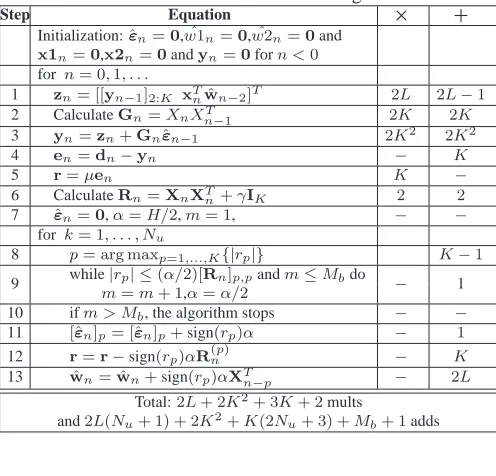
of the multichannel AP-DCD algorithm are given in table 1.
In the AP-DCD algorithm γ, µ and ˆε are
regulariza-tion factors, step-size parameters and the soluregulariza-tion vec-tor of the linear system respectively; x1n and x2n
are the excitation signal, dn is the desired signal
,wˆ1n and wˆ2n are the adaptive filter taps, at n instant
time. X1n = [x1n−K+1 . . . x1n−1 x1n]
w1(n) w2(n) h1(n) h2(n)
+ +
å
AP-DCD X1(n)
X2(n)
yn
+
dn en
[image:2.595.57.289.74.226.2]-Figure 1: Block Diagram of Multichannel AP-DCD Adaptive Filtering Algorithm
Table 1: Multichannel AP-DCD Algorithm
Step Equation × +
Initialization:ˆεn=0,wˆ1n=0,wˆ2n=0and
x1n=0,x2n=0andyn=0forn <0
for n= 0,1, . . .
1 zn= [[yn−1]2:K xnTwˆn−2]T 2L 2L−1 2 CalculateGn=XnXnT−1 2K 2K
3 yn=zn+Gnˆεn−1 2K2 2K2
4 en=dn−yn − K
5 r=µen K −
6 CalculateRn=XnXTn+γIK 2 2
7 ˆεn=0,α=H/2,m= 1, − −
for k= 1, . . . , Nu
8 p= arg maxp=1,...,K{|rp|} K−1
9 while|rp| ≤(α/2)[Rn]p,pandm≤Mbdo − 1 m=m+ 1,α=α/2
10 ifm > Mb, the algorithm stops − −
11 [ˆεn]p= [ˆεn]p+sign(rp)α − 1
12 r=r−sign(rp)αR(np) − K
13 wˆn= ˆwn+sign(rp)αXTn−p − 2L
Total:2L+ 2K2+ 3K+ 2mults
and2L(Nu+ 1) + 2K2+K(2Nu+ 3) +Mb+ 1adds
[x2n−K+1 . . . x2n−1 x2n]T where
x1n = [x1n−L+1 . . . x1n−1 x1n]
T;
x2n = [x2n−L+1 . . . x2n−1 x2n]
T;
h1n = [h1n−K+1 . . .h1n−1h1n]
T; h2 n =
[h2n−K+1 . . .h2n−1h2n]
T; I
K is an K × K identity
matrix and(·)T denotes the transpose matrix.
In step1, for calculation ofzn requiresxTnwˆn−2, because the
filter output yn = Xnwˆn−1 is calculated using a recursive
approach as shown in steps 1 to 3,[yn−1]2:K values known
from the previous(n−1)th sample.Xnis the matrix of [x1n;
x2n] andwˆn is the matrix of [w1(n);w2(n)]. Therefore, it
requires2Lmultiplications and2(L−1)additions.
In step2, the first row of Gn matrix is the
vec-tor [x1T
nx1n−1 x1Tnx1n−2 . . . x1Tnx1n−K] and
[x2T
nx2n−1 x2
T
nx2n−2 . . . x2
T
nx2n−K], calculation of
these vector requires 2K multiplications and 2K additions. step 3, the vector yn is calculated using the vector zn,
matrixGn and vectorˆεn
−1. It requires2K
2 multiplications
and 2K2 additions [9]. Step 4, the error vector e
n is
calculated using the vector dn, and the vector yn; it needs
K additions. Instead of normalizing ˆεby the step-sizeµ in
the original AP algorithm [10], the AP-DCD algorithm does this normalization with en (step 5) and obtains a vectorr.
This algorithm allows to avoid multiplications when updating the filter weights (step 13) for any value ofµ anddn is the
addition of two additive noise signalsh1(n)andh2(n).
Step 6, The correlation matrix Rn of the input matrixXn.
As having calculated the matrixGn, the only element of the
matrixRnthat requires calculation[Rn]K,K=XnTXn+γIk
. The other elements ofRncan be taken from matricesRn−1
andGn. Thus, the update of the matrixRn requires only 2
multiplications and 2 additions
Steps 7 to 13, solve the liner systemRnεn = r using the
DCD [11] algorithm and obtain an approximation solution
ˆ
εn. The DCD algorithm uses coordinate descent iterations
with variable step-size parameter α for solving the normal equations without multiplications and divisions [11]. In the DCD algorithm, the step-sizeαcan take one ofMbwith
pre-defined values corresponding to representation of elements
[ˆεn]p, p = 1, . . . , K, of the vector ˆεn as fixed-point words
withMbbits within an amplitude range[−H, H]. The
param-eterHshould preferably be larger than the absolute maximum
Hmaxamong elements of the true solution of the system. In
the case of uncertainty,H should be chosen high enough for a worst-case situation. Note that the choiceH > Hmaxdoes
not affect the adaptive filter performance and only results in an increase ofMb bylog2(H/Hmax)bits that has a little
im-pact on the complexity. IfH < Hmax, it may slow down the
convergence of the adaptive filter at the initial part of the learn-ing process. It is convenient to chooseH as a power-of-two number, resulting in the step-size parameter αalso a power of two. Then all multiplications by α can be implemented by bit-shifts, which significantly simplifies the algorithm im-plementation. Elements of the residual vectorr are denoted asrp,p = 1, . . . , K. The DCD algorithm starts the iterative
search from the most significant bits of elements inˆεn. As the
most significant bits have been updated, the algorithm starts updating the next bit, and so on. One update requiresK bit-shifts,Kadditions, andKcomparisons; the latter are counted as additions. With theNuupdates, the complexity of the DCD
algorithm is upper limited by2NuK+Mbadditions [12]. The
filter weights update at step 13 is included in the DCD itera-tions; it is implemented with addition and bit-shift operations only [9].
3
Computational Complexity of Multichannel
AP-DCD Algorithm
The maximum number of multiplications per iteration for the AP-DCD algorithm is:
MAP−DCD= 2L+ 2K 2
[image:2.595.47.295.298.536.2]Table 2: Comparison of the Number of Multiplications (×)
and Additions (+) per Iteration of the Multichannel AP-DCD Algorithm
Multichannel AP-DCD (×) per iteration (+) per iteration L= 16,K= 8,Nu= 16 186 969
L= 64,K= 8,Nu= 16 282 2601
L= 150,K= 5,Nu= 4 367 1622
L= 512,K= 8,Nu= 16 1178 17833
The maximum number of additions per iteration for the mu-tichannel AP-DCD algorithm is:
AAP−DCD = 2L(Nu+1)+2K2+K(2Nu+3)+Mb+1 (2)
In the multichannel AP-DCD algorithm design required367
multiplications and 1622additions at filter lengthL = 150, projection order K = 5and number of updates Nu = 4.
Whereas the reported paper of Albu et. al [8] MFX-DCDPAP algorithm required3198multiplications and3524additions at filter lengthL = 150, projection orderK = 5and number of updatesNu = 4. Due to more number of multiplication in
MFX-DCDPAP algorithm, it consumes more power in hard-ware design. However, in the multichannel AP-DCD design, it will consume less power and memory space in FPGA imple-mentation, because it has less number of multiplications and additions.
The number of multiplications and additions that are required for AP-DCD algorithm is illustrated in table 2. It is clearly ev-ident from the results that while MFX-DCDPAP algorithm re-quired3198multiplications and3524additions at filter length
L = 150, AP-DCD algorithm only required367 multiplica-tions and1622additions to provide same results. Therefore, the memory requirements of the multichannel affine projec-tion algorithm is significantly less than MFX-DCDPAP algo-rithm, because in MFX-DCDPAP needed several matrices and vectors in comparision to multichannel AP-DCD algorithm.
4
Numerical Results of Multichannel AP-DCD
Algorithm
The numeric results of multichannel AP-DCD algorithm were obtained by computer simulation using Matlab and then com-pared the misalignment with the original AP algorithm. The desired data are generated according to
hn1=h1nx1n+vn (3)
hn2=h2nx2n+vn1 (4)
wherevn andvn1 are independent zero-mean Gaussian
ran-dom numbers. Therefore the desired signal is the addition of the equation 3 and 4
dn=hn1+hn2 (5)
0 500 1000 1500
−25 −20 −15 −10 −5 0
Time (samples)
Misalignment, dB
APA, µ = 0.25
DCD−APA: Nu=1, µ = 0.45 DCD−APA: Nu=4, µ = 0.45 DCD−APA: Nu=8, µ = 0.45 DCD−APA: Nu=12, µ = 0.45 DCD−APA: Nu=16, µ = 0.45
Figure 2: L = 16, SN R = 30dB, Mb = 16, H = 4,
µ(AP) = 0.25, µ(DCD) = 0.45 ,K = 8,Nmc = 200
The data vectorsx1n andx2n contain autoregressive
corre-lated random numbers are given by
x1n =νx1n−1+wn (6)
x2n =νx2n−1+wn (7)
Whereν is the autoregressive factor (ν = 0.9) andwnis
in-dependent zero-mean random Gaussian numbers of unit vari-ance. Elements of impulse responses areh1iandh2i, where
i = 0. . . L−1, is independent zero-mean Gaussian random numbers with variance exp (−βi) in each simulation trial, new
vector h1 and h2 are generated. The misalignment in a multi-channel simulation trial is calculated as
||h1−wˆn1||2+||h2−wˆn2||2/||h1 +h2||2 (8)
The values obtained in Nmc trials are averaged and divided
by a number of channels and plotted against the time index n. The signal to noise ratio (SNR) is set 30dB for all simulation scenarios.
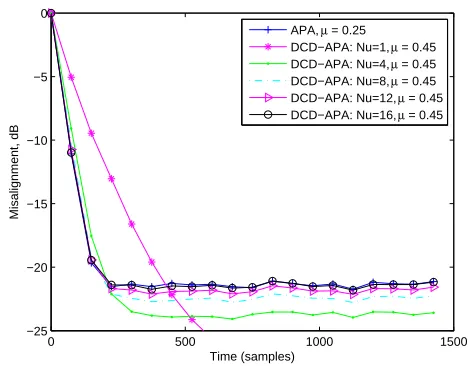
Figure 2 plotted against misalignment and time (iterations) of AP-DCD algorithm forK= 8, DCD step size(µ) = 0.45and
L= 16with different number of update (Nu) values . In case
of one update (Nu = 1) against AP algorithm, the AP-DCD
algorithm has a lower convergence speed than the AP algo-rithm and the steady state is out of range. When the number of updates increase atNu= 4and8the convergence speed stays
nearly same with AP algorithm and the steady state value ap-proaches towards AP algorithm. But atNu= 12, the
conver-gence speed is same as AP and the steady state values further approaches towards AP. However, forNu = 16, AP-DCD
al-gorithm provides the same performance as AP. This is due to the solution of the equationRnεn =rprovided by the DCD
0 500 1000 1500 −25
−20 −15 −10 −5 0
Time (samples)
Misalignment, dB
APA, µ = 0.25
[image:4.595.314.547.80.261.2]DCD−APA: Nu=16, µ = 0.9 DCD−APA: Nu=16, µ = 0.8 DCD−APA: Nu=16, µ = 0.6 DCD−APA: Nu=16, µ = 0.52 DCD−APA: Nu=16, µ = 0.42
Figure 3: L = 64, SN R = 30dB, Mb = 16, H = 4,
µ(AP A) = 0.25,Nu= 16,K= 8andNmc= 200
The figure 2 suggests, atNu= 16,K= 8the AP-DCD
algo-rithm provides the same performance as AP. Hence in figure 3, atNu= 16,K= 8andL= 64by adjusting the step size
(µ) of DCD against AP algorithm, the performance of mis-lignments with time (iterations) are analyzed. Atµ = 0.52
the AP-DCD algorithm provides slightly faster convergence speed and slower steady-state value than AP algorithm. With the increase inµ, the AP-DCD algorithm provides same con-vergence speed as AP but the steady-state approaches towards AP algorithm. When the step-size (µ) = 0.42the performance of convergence speed and steady-state values of the AP-DCD algorithm are same as AP algorithm.
Figure 4 shows that, forL= 512,K= 8,Nu= 16,µvalue
of DCD is adjusted with AP. After couple ofµvalue adjust-ment it is seen that atµ= 0.7, the learning curve is completely merzed with AP algorithm and has a perfect solver of the sys-tem equations. That means the convergence speed and steady state value of AP-DCD algorithm provides the same perfor-mance as AP.
5
Conclusions
The proposed multichannel low complexity affine projection algorithm using Dichotomous Coordinate descent (DCD) iter-ations implemented in Matlab. This proposed algorithm has better numerical stability than the other multichannel affine projection algorithm (MFX-DCDPAP). The performance of the multichannel AP-DCD algorithm depends on the number of updates. When the number of updates (Nu) increase, the
performance of the multichannel AP-DCD algorithm provides the same performance as AP algorithm. Furthermore, the computational complexity of the proposed algorithm is also analyzed, and it is shown through simulations that the new algorithm not only provides the same performance as AP al-gorithm, but also it could be implemented in hardware (FPGA,
0 5000 10000 15000
−25 −20 −15 −10 −5 0
Time (samples)
Misalignment, dB
APA, µ = 0.25
[image:4.595.57.291.81.262.2]DCD−APA: Nu=16, µ = 0.32 DCD−APA: Nu=16, µ = 0.9 DCD−APA: Nu=16, µ = 1.0 DCD−APA: Nu=16, µ = 0.6 DCD−APA: Nu=16, µ = 0.52 DCD−APA: Nu=16, µ = 0.4 DCD−APA: Nu=16, µ = 0.7
Figure 4: L = 512, SN R = 30dB, Mb = 16, H = 4,
µ(AP A) = 0.25,Nu= 16,K= 8
ASICs). It is also expected that AP-DCD algorithm will con-sume very less memory and power. Because it requires less number of additions and multiplications. In addition, it is also shown that the new algorithm provides the expected tradeoff between convergence performance and computational com-plexity. Further investigation is required for the proposed al-gorithm to implement in hardware (ASICs, FPGA).
Acknowledgment
The author would like to thank Dr. Yuriy V. Zakharov for his support and suggestions during this work, and also the author would like to thank Department of Electronics, York Univer-sity for providing the assistantship.
References
[1] Ding, H.,”Fast affine projection adaptation algorithms with stable and robust symmetric linear system solvers,”
IEEE Trans. Signal Processing, V55, N5, pp. 1730-1740,
2007.
[2] Bouteille, F., Scalart, P.,Corazza, M., ”Pseudo Affine Projection Algorithm New Solution for Adaptive Identi-cation,” Sixth European Conference on Speech
Commu-nication and Technology , 1999.
[3] Bouchard, M.,”Multichannel affine and fast affine pro-jection algorithms for active noise control and acoustic equalization systems,”IEEE Transactions on Speech and
Audio Processing, V11, N1, pp. 54-60, 2003.
[4] Albu, F., Paleologu, C.,”The Variable Step-Size Gauss-Seidel Pseudo Affine Projection Algorithm,”
Interna-tional Journal of Computer Science, V5, N1, 2010.
Workshop on Signal Processing Systems, pp. 109-114,
2002.
[6] Albu, F., Fagan, A., ” The Gauss-Seidel pseudo affine projection algorithm and its application for echo cancel-lation,” Asilomar conference on signals system and
com-puters, V2, pp. 1303-1308, 2003.
[7] Albu, F., Bouchard, M.,” A low-cost and fast con-vergence Gauss-Seidel pseudo affine projection algo-rithm for multichannel active noise control,”
Proceed-ings ICASSP, V5, pp. 121-124, 2004.
[8] Albu, F., Zakharov, Y., Paleologu, C., ”Modified filtered-x dichotomous coordinate descent recursive affine pro-jection algorithm,” Proceedings of the IEEE
Interna-tional Conference on Acoustics, Speech and Signal Pro-cessing, V0, pp. 257-260, 2009.
[9] Zakharov,Yuri.,”Low Complexity implementation of the Affine Projection Algorithm,”IEEE Signal Processing
letters, V15, pp. 557-560, 2008.
[10] Sayed, A. H.,”Fundamentals of adaptive filter-ing,”Hoboken, N. J.: Wiley, 2003.
[11] Zakharov, Y. V., Tozer, T. C.,” Multiplication-free itera-tive algorithm for LS problem,” Electronics Letter, V40, N9, pp. 567-569,2004.