MASTER
THESIS
A Signature-Based Approach to
DDoS Attack Mitigation Using
BGP Flowspec Rules
Author
Joeri K
OCKExamination board
dr. J.J. Cardoso De S
ANTANNAdr. A. P
ETERVincent
DEJ
AGERAbstract
Distributed Denial-of-Service (DDoS) attacks aim to to prevent the legitimate use of a service. Since the magnitude and frequency of these attacks are increasing, DDoS attacks are becoming an increasingly bigger problem for the Internet. BGP Flowspec is an extension to the Border Gateway Protocol (BGP), designed to provide a granular approach to DDoS mitigation. BGP Flowspec defines a network flow based on e.g. the source, destination and other packet specific information. This flow can be matched dynamically to incoming traffic in order to either drop the traffic, place it into a different forwarding instance for further examination, or police to a desired rate. Related research shows its potential for DDoS attack mitigation. However, BGP Flowspec lacks in precision, potentially resulting in the filtering of legitimate traffic. This could have a negative impact on the underlying network. Therefore, a minimization and maximization problem arises: on one hand, it is desirable to maximize the amount of DDoS traffic blocked. On the other hand, the negative impact on the network needs to be minimized. The goal of this research is to address this problem by investigating how DDoS attack mitigation can be improved by using BGP Flowspec. This research presents a methodology for generating BGP Flowspec rules using a signature-based approach, as well as an evaluation of these rules. This evaluation showed that many DDoS attacks can be effectively mitigated using this approach. However, some DDoS attacks are too generic to be mitigated using BGP Flowspec. Since DDoS attacks are very different from each other, a generic solution is very challenging to design.
Contents
1 Introduction 2
2 State-of-the-art on DDoS Attacks 5
2.1 Background . . . 5
2.2 Mitigation of DDoS attacks . . . 12
2.3 BGP Flowspec . . . 18
2.4 Conclusions . . . 24
3 BGP Flowspec Rule Generation 26 3.1 DDoS dissector . . . 27
3.2 Rule set generator . . . 30
3.3 Parser . . . 35
3.4 Conclusions . . . 37
4 Evaluation of BGP Flowspec Rules 39 4.1 Methodology . . . 40
4.2 Results . . . 50
5 Conclusions 59 5.1 Contribution . . . 60
5.2 Future work . . . 61
A Appendix 62 A.1 Detection performance table . . . 62
Chapter 1
Introduction
Over the years, Distributed Denial-of-Service (DDoS) attacks are becoming an increasingly bigger threat for the Internet. An attacker uses thousands of arbitrary hosts (usually with little to no security) and installs software on these hosts in order to utilize them for attacking a target system. DDoS attacks are evolving quickly and becoming more complex. The largest DDoS attack to date targeted GitHub with a traffic rate of 1.3 terabytes per second (Tbps), sending packets at a rate of 126.9 million per second [20, 2]. This increment in capacity and complexity makes it increasingly difficult to mitigate these attacks. Almost half (45%) of companies experience DDoS attacks nowadays, with more than 90% of those companies having experienced one in the past 12 months [45]. Defending against DDoS attacks is particularly challenging, since they do not exploit a specific vulnerability in a system. Instead, they exploit the very fact that the system is connected to the Internet, as well as the fact that the capacity of systems is always finite and expensive. Though the victim may have proper security methods installed, there is often little that can be done.
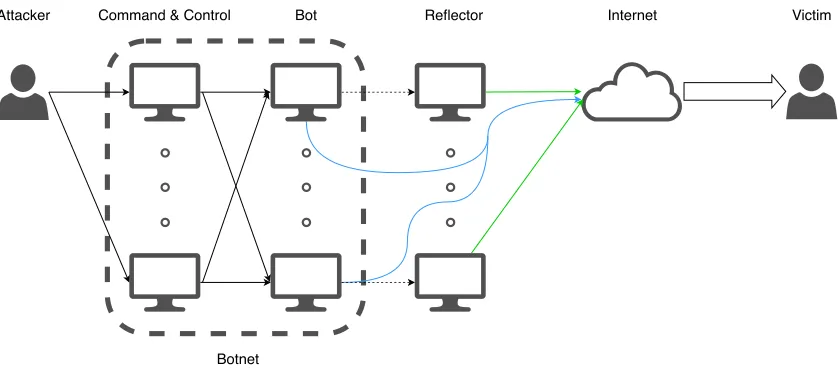
A simplified figure illustrating a DDoS attack can be seen in Figure 1.1. Note that an attacker usually has a set of machines commonly referred to as “command & control”. These machines are responsible for directing the bots, which are the machines on which the malware is installed. The set of command & control machines and bots combined are called a botnet. This botnet is used to generate a large quantity of Internet traffic, which is then routed to the victim.
A successful DDoS attack negatively impacts an organization’s reputation, in addition to damag-ing existdamag-ing client relationships. Significant financial losses can amount to $40,000 per hour for major enterprises [45]. With 50% of DDoS attacks lasting between 6-24 hours, the average DDoS cost can be assessed at about $500,000 — with some running significantly higher. Costs are not limited to the IT department however; they also have a large impact on units such as security and risk management, customer service, and sales. Examples of other consequences are (1) severe impact on eCommerce, resulting in substantial revenue loss, (2) inflated IT costs from Internet Service Providers (ISPs) and Infrastructure as a Service (IaaS) providers for bandwidth overages, or computing power, (3) short or long term damage to online reputation for critical services (gov-ernments, trading platforms, financial services, health care, etc.) and (4) forcing the IT staff to focus on the DDoS attack acting as a “smokescreen”, while the bad actors are exfiltrating data from target systems [21].
Chapter 1. Introduction
Attacker Command & Control Bot Internet Victim
[image:7.612.139.478.94.272.2]Botnet
Figure 1.1: An illustration of a DDoS attack.
stages are the attacker, the botnet, the reflector, the Internet Exchange Point (IXP), the Internet Service Provider (ISP), the organization and the target machine itself. Examples of mitigation methods are firewalls, Intrusion Detection Systems (IDS) such as Snort [63], Suricata [54], Bro [57] and IBM QRadar [33] or by using a Web Application Firewall (WAF) [81]. In addition, rather than scanning incoming network traffic, some tools can inspect the the internals of the host’s machine. Examples of such systems are OSSEC [56], AIDE [41] and Samhain [65]. These methods all apply mitigation at different stages of the packet’s route.
At the IXP and ISP stage, DDoS traffic can be mitigated as well. During these stages, the Border Gateway Protocol (BGP) is used for packet routing between large networks. BGP Flowspec [44] is an extension for BGP that can filter incoming network traffic at this level. BGP Flowspec supports 12 fields from the Network and Transport layer of the Internet Protocol (IP). These fields are used to define a “Flow Specification” (i.e. rules for incoming traffic) and an action for this traffic (e.g. discard or redirect the traffic). BGP Flowspec rules can be generated at the consumer level (where the DDoS attack is detected) and sent to the ISP, where the rules are installed on the network’s edge routers. When incoming traffic satisfies the flow specification, it is discarded, redirected or policed at an established rate.
Chapter 1. Introduction
The goal of this research is to address this minimization and maximization problem by evalu-ating how effective BGP Flowspec rules are for DDoS attack mitigation.In order to accomplish this goal, we split our investigation in the following Research Questions:
• RQ1: How does BGP Flowspec theoretically compare to existing DDoS mitigation solu-tions?
• RQ2:How can we write BGP Flowspec rules based on known DDoS attacks?
• RQ3:How effective are our BGP Flowspec rules for DDoS attack mitigation?
BGP Flowspec was originally designed for DDoS mitigation, aimed at providing a granular ap-proach at filtering traffic at this level. Literature shows that BGP Flowspec has a high potential in effectively filtering DDoS traffic at the ISP and IXP level [32]. However, it is currently not used by ISPs for mitigating DDoS attacks [64]. Thecontribution of this researchis two-fold: firstly, this research will provide a methodology for generating BGP Flowspec rules using a signature-based approach, i.e. generate rules based on existing DDoS attack data. To the best of our knowledge, no tools exist that use existing DDoS attacks in order to generate BGP Flowspec rules. Secondly, no research exists on evaluating the effectiveness of BGP Flowspec for DDoS attack mitigation. In this research, we will evaluate our generated rules as well as quantify the mitigation impact on the underlying network.
Chapter 2
State-of-the-art on DDoS Attacks
Recall research question 1:
How does BGP Flowspec theoretically compare to existing DDoS mitigation solutions?
In order to properly answer this research question, it is necessary to have an elaborate knowledge of the DDoS field. This knowledge is essential to understanding the various mitigation tech-niques, which will be explained in chapter 2.2. Therefore, the goal of this chapter is to provide that knowledge. We will achieve this goal by dividing this chapter into the following parts. We will first discuss the background of DDoS attacks in 2.1. Next, we will elaborate on classifying all DDoS attacks into 2 different types, as well as describe the 10 most commonly used DDoS attacks in 2.1.1. After that, in 2.1.2 we will mention the causes for DDoS attacks existing and in 2.1.3 the motivation that attackers have when performing a DDoS attack. We will close this chapter with some concluding remarks.
2.1
Background
A denial-of-service attack (DoS) is characterized by an explicit attempt to prevent the legitimate use of a service [47]. In addition, a distributed DoS attack (DDoS) makes use of multiple attack hosts in order to attain this goal. As DDoS is a far bigger threat to the Internet at the moment of writing this document, the focus will be on DDoS attacks.
Chapter 2. State-of-the-art on DDoS Attacks 2.1. Background
2.1.1
Types of DDoS attacks
Here, we will explain the 2 types in which DDoS attacks can be classified. Additionally, the most commonly used DDoS attacks will be listed, as well as the attack types they belong to.
Broadly speaking, DoS and DDoS attacks can be divided into two types [35]:
• Volumetric Attacks- Commonly referred to as brute-force attacks, a volumetric attack sends a high amount of traffic, or request packets, to a targeted network in an effort to overwhelm its bandwidth capabilities [71]. Opposed to semantic attacks, volumetric attacks are usually much more difficult to mitigate, since they abuse legitimate services. This means filtering would also affect legitimate traffic, resulting in a mitigation impact. Furthermore, in many cases, the target’s resources are limited, rendering it impossible for the target to do anything [47].
• Semantic Attacks- Rather than aiming to exhaust the target’s bandwidth, semantic attacks exploit a specific feature or bug at the victim’s machine. These attacks can usually be some-what mitigated by the victim by modifying the abused protocols or deploying network traf-fic filtering. Semantic attacks don’t need to generate as much traftraf-fic as volumetric attacks in order to inflict damage.
As Mirkovic and Reiher [47] state: “Countering semantic attacks by modifying the deployed protocol or application pushes the corresponding attack mechanism into the brute-force category. For example, if the victim deploys TCP SYN cookies to combat TCP SYN attacks, it will still be vulnerable to TCP SYN attacks that generate more requests than its network can accommodate.” For this reason, many DDoS attacks that are relatively devastating to a victim are examples of volumetric attacks.
Attacker Command & Control Bot Internet Victim
Botnet
[image:10.612.99.518.403.590.2]Reflector
Figure 2.1: The difference between the 2 types of DDoS attacks emphasized.
Chapter 2. State-of-the-art on DDoS Attacks 2.1. Background
In their report “2019 State of the Internet / Security: DDoS and Application Attacks”, Akamai [2] makes the distinction between DDoS attacks that are launched by a botnet or with reflection methods. A reflection attack is when the reply is sent back to the claimed origin of the request. With a spoofed source IP, the attacker can make the reflecting server send the reply to the selected victim. This distinction can be compared to the aforementioned distinction between volumetric and semantic attacks, with them corresponding to botnet and reflection attacks respectively.
In the remaining part of this chapter, we will elaborate on the 10 most commonly used DDoS attacks [6], as well as classify each one as either volumetric or semantic.
• Memcached DDoS Attack
A memcached attack is a volumetric DDoS attack. A memcached server is a server with a caching system for databases in order to speed up websites and networks. If these servers are vulnerable, attackers can abuse them by sending spoofed requests with the target’s IP in the header, to which the memcached server will respond. The server will send a much larger amount of data back to the target [15].
• NTP Amplification Attack
An NTP amplification attack is a volumetric DDoS attack. In a Network Time Protocol (NTP) amplification attack, an attacker uses the functionality of an NTP server in order to send traffic to a target. More specifically, the attacker sends a request (with a spoofed IP address of the target) to the NTP server, in which he requests a list. The server will respond by sending the list to the spoofed IP address. This way, the size of the response from the server is much larger than the original request [16].
• DNS Amplification Attack
A DNS amplification attack is a volumetric DDoS attack. A DNS amplification attack makes use of a Domain Name System (DNS) server. It is another reflection attack. In a DNS amplification attack, an attacker sends a spoofed request to a DNS resolver. In order to create a large amount of traffic, the attacker structures the request in a way that generates as large a response from the DNS resolvers as possible. As a result, the target receives an amplification of the attacker’s initial traffic, and their network becomes clogged with the large amount of traffic [9].
• SSDP Attack
An SSDP attack is a volumetric DDoS attack. An SSDP attack uses Universal Plug and Play (UPnP) devices in order to execute the attack. Whenever a UPnP device wants connect to a network, after receiving an IP address, the device will send a message to a certain multicast IP address. Next, this address will tell everyone in the network information about the new device. When other devices in the network receive this information, they will send a request to the new device asking for a full list of its features and services. An SSDP attack exploits this last step, since the response of the new device in this last step generates a large amount of traffic. An attacker sends spoofed UDP packets to available UPnP devices, which will all respond by sending a complete list of everything the device has to offer to the victim [17].
• DNS Flood
Chapter 2. State-of-the-art on DDoS Attacks 2.1. Background
distinguish the malicious traffic from legitimate traffic [10].
• HTTP Flood
A HTTP flood is a semantic DDoS attack. A HTTP flood is a rather basic kind of DDoS attack. In a HTTP flood attack, the attacker (usually through a botnet) sends a large amount of HTTP packets (e.g. GET, POST, HEAD etc.) to a server, overwhelming it with the amount of traffic [12].
• SYN Flood Attack
A SYN flood is a semantic DDoS attack. A SYN flood attack makes use of the handshake in setting up a TCP connection. Normally, when a user wants to set up a connection, he sends a SYN packet to the server, asking to set up a connection. The server will respond with a SYN-ACK packet and leave a port open while waiting for an ACK packet, which will never come. The attacker sends many of these requests in a short period of time. At some point, the server will have all available ports utilized for this, making legitimate TCP connections unavailable [18].
• UDP Flood Attack
A UDP flood is a volumetric DDoS attack. A UDP flood, by definition, is any DDoS attack that floods a target with User Datagram Protocol (UDP) packets [19]. The attack sends a large number of UDP packets to a targeted server with the aim of overwhelming that device’s ability to process and respond. When a server receives a UDP packet at a particular port, it will check if any programs are running and listening for requests at that port. If this is not the case, it will send an ICMP packet back stating the destination was unreachable. A UDP Flood attack abuses this by making the target server send many of these responses back in a short period of time. This way, the target’s resources can become exhausted. A UDP Flood attack usually has spoofed source addresses, so that the identity of the attacker remains hidden.
• Ping (ICMP) Flood Attack
A ping flood attack is a semantic DDoS attack. The Internet Control Message Protocol (ICMP) is an Internet layer protocol used in several tools, e.g. traceroute and ping. It is mainly used to determine the health and connectivity of the device to which the request is sent to. By having many devices in a botnet send ICMP requests to a target, the target is forced to use a lot of resources to send an ICMP response to each of these requests [13].
• Low and Slow Attack
Chapter 2. State-of-the-art on DDoS Attacks 2.1. Background
2.1.2
Causes for the existence of DDoS attacks
After the background and types of DDoS attacks, it is important to reflect on why DDoS attack are possible. We will now present 3 causes why DDoS attacks still exist. These causes are (1) the limited resources of devices, (2) the “end-to-end paradigm” design of the Internet, and (3) the interdependance on devices. Subsequently, the motivation that attackers have for executing these attacks will be explained in 2.1.3.
• Limited resources
Every router, network and other system in the Internet has limited resources. DDoS attacks exploit this fact, and make use of the limited bandwidth, processing power and storage capacities. This problem will persist, as target devices will always have limited resources. With today’s tools, even the most well-protected resources are vulnerable to DDoS attacks. This doesn’t mean that there are no solutions, however; it means that it is unlikely that the DDoS problem will dissolve completely.
• Design of the Internet
DDoS attacks are not only still possible, but easy to execute. One of the reasons for this is that the Internet is designed according to the “end-to-end paradigm”. The fundamental notion behind this paradigm is that when two processes communicate with each other over the Internet, the reliability of that communication can be expected from the end hosts rather than the intermediate hosts. “To a large extent, the core of the network provides a very general data transfer service, which is used by all the different applications running over it. The individual applications have been designed in different ways, but mostly in ways that are sensitive to the advantages of the end to end design approach.” [5]. The end-to-end paradigm shifts the complexity to end hosts, leaving the network between these hosts only responsible for packet forwarding. A good example of this paradigm in practise is the re-sponsibility of the Transmission Control Protocol (TCP). This protocol is located one layer above IP, and is responsible for the delivery guarantee of packets that are sent from sender to receiver. On one hand, this design choice allows for relatively easy implementation of complex features in the Internet since these features can be built on top of this implemen-tation. However, when one end user sends malicious traffic, the intermediate network will do nothing to stop it from arriving at its destination, since the hosts in the network are not designed to police traffic.
The aforementioned paradigm allows for some negative consequences for the Internet. For example, it makes the network vulnerable to IP spoofing, where a fake source IP is inserted into a packet’s header so the real sender’s identity is hidden. Furthermore, it creates oppor-tunities to perform DDoS attacks, since the network will forward all malicious traffic to the victim without question. There have been proposals to rethink the design of the Internet [5]. However, this design is not intended for preventing DDoS attacks, but rather to have a bet-ter implementation for the Inbet-ternet in general. Therefore, this design does not necessarily solve the DDoS problem. It is also uncertain whether all actors in the current Internet will adopt this new design.
• Interdependence on devices
Chapter 2. State-of-the-art on DDoS Attacks 2.1. Background
outside of the target’s network. These are usually devices that have poor security measures installed. This makes it difficult to prevent DDoS attacks from happening, since the Internet will always have devices that can be easily subverted by an attacker. In addition, due to the rise of the Internet of Things (IoT), the number of devices connected to the Internet will only increase in the future. This will allow for devices for an attacker to use, further increasing the potential capacity of DDoS attacks.
2.1.3
Motivations behind DDoS attacks
After understanding how DDoS attacks are possible in the present day, it is relevant to know why attackers feel the need to execute these attacks. As stated before, the goal of a DDoS attack is to prevent the legitimate use of a service. This part will elaborate on why someone would want to prevent the legitimate use of a service. We will list 6 motivations [61]: financial, political, rivalry, cyber warfare, a smoke screen and boredom.
• Financial- financial motivations for DDoS attacks often involve the extortion of the target system, i.e. a ransom that the target has to pay in order to get their services back online. If the target is a company, the attack generally is performed during e.g. a critical sales period, when the company has more reason to pay the ransom. Attacks motivated by financial reasons often result in revenue loss, service loss and potential public embarrassment for the target. This way of performing a DDoS attack has recently largely been overshadowed by the increasing presence of ransomware such as WannaCry [69]. When targeted with ran-somware, it is always advised to never pay the ransom, despite how important the captured data might be. There are also mitigation initiatives for this such as The No More Ransom Project [26], educating users about how ransomware works and offering known decryption tools.
• Political- political motivations revolve around hacktivism. Hacktivism means the moti-vation is not necessarily money, but rather political motives the attacker wants to express through the attack. An example of this is the 2015 GitHub attack [11], which lasted several days and adapted itself around implemented DDoS mitigation strategies. The DDoS traffic originated in China and it is strongly suspected that the Chinese Government oversaw the attack. This DDoS attack specifically targeted the URLs of two GitHub projects aimed at circumventing Chinese state censorship. It is speculated that the intent of the attack was to try and pressure GitHub into eliminating those projects.
• Rivalry- another reason might be to execute a DDoS attack on a competing company or government. If this is done during a critical sales period or other notable event, the result will be damage to the target’s reputation. Therefore, there is a commercial benefit for the attacker. An example of this is an attack in June of 2018, which saw cyber criminals bring down the Bitfinex cryptocurrency exchange [34]. The system crash during this attack was followed by a wave of garbage traffic, pointing to a multistage attack that was likely in-tended to undermine credibility in the site. It was probably competitive rivalry that caused the renowned online poker site, Americas Cardroom, to suffer a DDoS attack that forced first the interruption and then cancellation of a tournament.
Chapter 2. State-of-the-art on DDoS Attacks 2.1. Background
had a large effect on the Estonian government, since Estonia was one of the early adopters of online government.
• Smoke screen- a DDoS attack can be part of a larger plan, where the DDoS attack itself is not the main goal. The attack serves as a distraction for a business, while hackers execute the real attack while the IT department is occupied on mitigating the result of the DDoS attack. A survey by Kaspersky Lab [38] showed that over half of businesses questioned (56%) are confident that DDoS has been used as a smokescreen for other kinds of cyber crime, and of those business respondents, a large majority (87%) reported that they had also been the victim of a targeted attack.
• Boredom- there are examples of people executing a DDoS attack out of boredom. Since it is relatively easy to DDoS a machine with the use of Booters [67], people that lack a technical background are able to execute an attack. An example of this is kids performing a DDoS attack on their own school, simply because they could [24].
2.1.4
Concluding remarks
The goal of this chapter was to provide an elaborate knowledge of the DDoS field. In order to achieve this goal, we have given an extensive description of DDoS attacks by dividing this chap-ter into 4 parts. Firstly, we provided some background information on DDoS attacks. Next, we discussed the 2 types in which DDoS attacks can be classified: volumetric and semantic. Volu-metric attacks are attacks where the reply is larger than the request. By using amplification, an attacker can use few resources to attack a large target. Semantic attacks generally don’t generate a response as large as a volumetric attack, but exploit a specific feature or bug in a protocol used by the victim. We also listed the 10 most commonly used DDoS attack nowadays, and classified each one as either volumetric or semantic. Out of all DDoS attacks, volumetric attacks are the most devastating, since they are able to generate a very large amount of traffic, overwhelming the target.
Subsequently, we elaborated on the causes of the existence of DDoS attacks. Mainly due to the way the Internet is designed (the end-to-end paradigm), DDoS attacks are and will remain a problem in the future. Furthermore, since all machines have a limited amount of resources, they are always vulnerable to being a target of a DDoS attack. We also examined the motivations behind DDoS attacks. These motivations include financial, political, rivalry, cyber warfare, a smoke screen and even boredom.
Chapter 2. State-of-the-art on DDoS Attacks 2.2. Mitigation of DDoS attacks
2.2
Mitigation of DDoS attacks
In this chapter, we will elaborate on the various ways DDoS attacks can be mitigated. When a DDoS attack is initiated from a certain source, the attack traffic can be blocked at various stages during the packet’s route. “Ideally, DDoS attacks are mitigated close to the attacker, and mitiga-tion only affects malicious traffic” [32]. Henceforth, we will call these stages “mitigamitiga-tion levels”. The goal of this chapter is to provide a clear overview of the different methods and tools of mit-igation. In this chapter, we will first observe the mitigation levels (2.2.1), and list the applicable Internet layers and see which mitigation methods can be applied. These mitigation methods will be explained afterwards in 2.2.2. For each method, we will explain how DDoS traffic is mitigated, as well as list a set of tools with which these methods can be applied in practice. We will close the chapter with some concluding remarks.
2.2.1
Mitigation levels
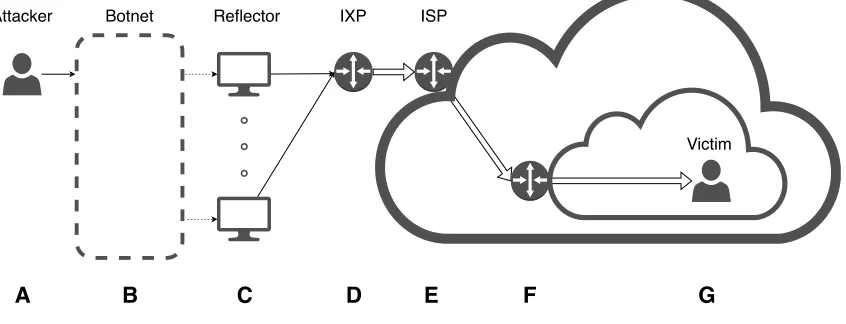
First, we will discuss the different levels at which DDoS traffic can be mitigated. Figure 2.2 is an expanded version of the overview picture we have seen, where the route that the packet trav-els is emphasized. The levtrav-els in the route at which DDoS traffic can be detected and mitigated are indicated with letters A through G. These represent the attacker, botnet, reflector, IXP, ISP, organization and target machine level respectively. For the remainder of this part, each level of mitigation is listed. For each level, we will list the Internet layers that are used, as well as the mitigation methods that can be applied. After that, each mitigation method will be explained in more detail.
Attacker
Victim Botnet Reflector IXP ISP
[image:16.612.98.521.406.568.2]A
B
C
D
E
F
G
Figure 2.2: A simplified overview of a DDoS attack packet’s route, with the different mitigation points marked with letters A, B, C and D.
• A: Attacker level
Chapter 2. State-of-the-art on DDoS Attacks 2.2. Mitigation of DDoS attacks
• B: Botnet level
Mitigating at this level involves the prevention of a botnet being used. This is out of the scope of this research.
• C: Reflector level
Mitigating at this level requires preventing reflectors from being used in a DDoS attack. This lies out of the scope of this research.
• D: IXP level
Before the packet will enter an autonomous network, it usually will pass through an Internet Exchange Point (IXP). At this level, the options on mitigating incoming traffic are relatively limited, partly due to the recent discussion on Net Neutrality [58], where it is questioned whether an IXP should have the ability to filter traffic based on its content. While outside the scope of this research, it is important that this topic is kept into account when equipping IXPs with this ability.
Internet layers Mitigation methods
Data link Blackholing
Network
• E: ISP level
At the ISP level, every mitigation method (as listed in 2.2.2) could be used. However, this is generally not done, since this would result in high costs for the end user. When an ISP puts DDoS mitigation measures in place that could be done by the end user as well, the ISP has to bill the end user for this. Furthermore, there is still the issue of net neutrality; it may not be desirable for an ISP to see the details of internet traffic, and filter it according to this information.
Internet layers Mitigation methods
Data link Blackholing
Network Intrusion Detection Systems
Transport Network firewall
Application Web Application Firewall
• F: Organization level
Deeper in the network, in the organization where the target machine is located (e.g. some-one’s home network), there are many options to mitigate DDoS traffic. Mitigating at this stage could be less effective, since the hardware cannot handle a throughput as large as an ISP’s edge router. However, mitigation tools in the organization level allow for more granularity compared to the IXP and ISP level.
Internet layers Mitigation methods
Network Intrusion Detection Systems
Transport Network firewall
Chapter 2. State-of-the-art on DDoS Attacks 2.2. Mitigation of DDoS attacks
On the machine of the target of the DDoS attack itself, it is also possible to block DDoS traffic.
Internet layers Mitigation methods
Network Intrusion Detection Systems
Transport Web Application Firewall
Application
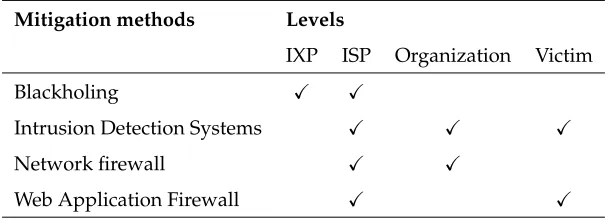
In order to further illustrate the difference between the levels, Table 2.1 shows the aforementioned levels and their corresponding Internet layers and mitigation methods. Similarly, Table 2.2 shows the mitigation methods that can be used for each level.
Internet layer Levels
IXP ISP Organization Victim
7 - Application X X
6 - Presentation
5 - Session
4 - Transport X X X
3 - Network X X X X
2 - Data link X X
[image:18.612.184.428.250.411.2]1 - Physical
Table 2.1: Each mitigation level and the Internet layer(s) where it can be applied.
Mitigation methods Levels
IXP ISP Organization Victim
Blackholing X X
Intrusion Detection Systems X X X
Network firewall X X
Web Application Firewall X X
Table 2.2: Each mitigation level and the mitigation methods that can be used.
2.2.2
Mitigation methods and tools
[image:18.612.153.460.458.568.2]Chapter 2. State-of-the-art on DDoS Attacks 2.2. Mitigation of DDoS attacks
DNS Redirection
In DNS redirection [80], a mitigation provider masks the target’s IP address as one of the mitiga-tion provider itself. All traffic is sent to the mitigamitiga-tion provider, which can then first filter out any malicious traffic before sending it back to the target. However, since this method uses an alter-ation in a DNS resolver, it only works on the applicalter-ation layer. Therefore, when a direct-to-origin attack occurs, the target IP can still be discovered and thus targeted with DDoS traffic. For this reason, DNS Redirection is not really used anymore.
Blackholing
Blackholing [22] is a mitigation method against DDoS attacks. The network traffic is routed else-where, to a “black hole”. This means that all traffic that is routed to the black hole will be dropped. This can have different consequences depending on the protocol used. When TCP is used, a notifi-cation will be returned to the source notifying that the traffic has been dropped. In connectionless protocols such as UDP, this is not the case. In DDoS mitigation, there are two types of black holes: a Destination Remotely-Triggered Black Hole (D/RTBH) and a Source Remotely-Triggered Black hole (S/RTBH). Both lead to essentially a null route that drops the traffic, but the difference between the two is the traffic that is being filtered.
In a D/RTBH, traffic that is headed towards a given destination is blocked. If a device is ex-periencing a DDoS attack, a D/RTBH can be set up that filters all traffic with the target’s IP as destination. However, this also blocks all benign traffic that is meant for the target. This means that the DDoS attack partly succeeded, since only outgoing traffic from the target’s machine is now possible.
A more favorable way of black holing could be a S/RTBH. In this case, traffic that originates from a given source IP address is dropped. This is useful in a non-distributed DoS attack, since the legitimate traffic coming from other sources will not be blocked. However, in most modern DDoS attacks, the traffic comes from many different sources. A typical DDoS attack can have around 10.000 source IPs, making it infeasible to blackhole each one.
It can be quickly noticed that blackholing is not the most optimal solution for mitigating DDoS attacks, since in many cases, legitimate traffic is blocked. Nevertheless, it is still a widely available option for organizations or individuals that don’t have access to modern DDoS mitigation tools. It can also be useful when the target of an attack is a smaller machine or site that is part of a larger network. In this situation, blackholing the target can prevent the other machines in the network from being affected by the attack.
Tools:
• BGP Flowspec [44]
Intrusion Detection Systems
Chapter 2. State-of-the-art on DDoS Attacks 2.2. Mitigation of DDoS attacks
installed at strategic points in the network where they are able to effectively detect and monitor traffic going to all devices in the network. An NIDS reads all inbound packets and searches for any suspicious patterns. When threats are discovered, based on its severity, the system can take action such as notifying administrators, or barring the source IP address from accessing the network.
The other type of IDS, as mentioned before, is called a Host-based IDS. As the name suggests, an HIDS is installed on the system itself, capable of monitoring and analyzing the internals of that system. An HIDS monitors the state of the machine constantly, enabling it to detect modifications to this state. When an intruder attempts to gain control of the machine, he will generally leave a trace (e.g. installing a key logger, installing malware for a botnet, etc.). If such an intruder would pass an NIDS that is installed in the network, there is a chance for the HIDS to detect the modified machine state. HIDS generally work with a database of system objects that it should monitor. It generates a checksum of this data, allowing it to easily check if the system state has been modified.
NIDS tools:
• Snort [63]
• Suricata [54]
• Bro [57]
• IBM QRadar [33]
HIDS tools:
• OSSEC [56]
• AIDE [41]
There are also hybrid systems that combine the two approaches to provide one comprehensive solution [59, 70, 72].
In addition to IDSs being installed on either the network or the host itself, there is a different way of classifying IDSs. In this case, they vary in the way they are implemented and detect traffic. Garc´ıa-Teodoro et al. explain the between these two techniques: “Signature and anomaly-based systems are similar in terms of conceptual operation and composition. The main differences between these methodologies are inherent in the concepts of ‘attack’ and ‘anomaly’. An attack can be defined as ‘a sequence of operations that puts the security of a system at risk’. An anomaly is just ’an event that is suspicious from the perspective of security’. Based on this distinction, the main advantages and disadvantages of each IDS type can be pointed out.” [28]
A signature-based IDS looks for specific patterns such as byte sequences in files or network traffic. These detection methods can be applied to HIDS as well as NIDS. In a HIDS, the tool will scan for log and config files searching for modifications. In an NIDS, the tool will scan for checksums of network packets. In addition, a signature-based NIDS generally has a database of signatures that represent malicious packets. Since a lot of hackers use the same tools to accomplish their goal (e.g. crack a password), these tools will generate the same traffic signatures every time. This makes a signature-based IDS a suitable way of detecting malicious actions. The drawback of signature-based IDSs is that it is impossible to detect new attacks, since no signatures of it exist yet.
Chapter 2. State-of-the-art on DDoS Attacks 2.2. Mitigation of DDoS attacks
an anomaly might be a large number of repeated failed login attempts, suggesting a hacker is trying to crack a password. In an NIDS, an anomaly can be any network traffic pattern that doesn’t match the model of ‘good’ behaviour. The drawback of anomaly-based IDSs is that there is a probability of suffering from false positives; legitimate traffic that was previously unknown, might be classified as an anomaly due to that traffic not matching the machine learning model.
Network Firewall
A network firewall, also commonly referred to as a packet filter, is used to filter incoming network traffic. A rule set is established, upon which the firewall either allows or denies incoming packets based on that rule set. A network firewall has default rules, but a system administrator can define rules in order to filter traffic. “A firewall typically creates a barrier between a trusted internal network and an untrusted external network, such as the Internet.” [55]
Tools:
• IPtables [51]
• Berkeley Packet Filter [46]
Web Application Firewall
A Web Application Firewall (WAF) is an application security measure deployed between a web client and a web server. When a WAF is in place, it performs an inspection of incoming and outgoing HTTP traffic. It differs from a regular firewall in that a WAF is able to filter the content of specific web applications, while a network firewall serves as a security barricade between servers. A WAF is generally successful in preventing attacks that originate from web application security flaws (e.g. SQL injection and cross-site scripting (XSS)).
Tools:
• ModSecurity [62]
2.2.3
Concluding remarks
The goal of this chapter was to provide a clear overview of the different methods and tools of mit-igation. In order to explain this clearly, we have divided the DDoS mitigation field into 7 different levels where DDoS mitigation can take place, as well as the different methods of mitigation that can be applied at these levels. These levels are (A) the attacker, (B) the botnet, (C) the reflectors, (D) IXP, (E) ISP, (F) organization and (G) the victim’s machine. At each level, some form of miti-gation or prevention is possible. Since levels A, B and C are outside of the scope of this research, we elaborated further on the latter four.
Many methods of mitigation exist, some of which we elaborated on in this chapter. These meth-ods are blackholing, Intrusion Detection Systems (IDS), a network firewall and a Web Application Firewall (WAF). We analyzed each method, and gave an overview of which mitigation method can be used on which level, as well as some example tools that can be used to apply the method. Furthermore, we listed the Internet layers that are applicable for each level.
Chapter 2. State-of-the-art on DDoS Attacks 2.3. BGP Flowspec
for a larger throughput capability (e.g. BGP Flowspec), while others show potential in offering more granularity (e.g. a network firewall).
When comparing the aforementioned methods and tools, the most interesting tool to acknowl-edge is BGP Flowspec. The reason for this is that it can be applied at the IXP and ISP level, where a lot of traffic passes through (thus having a large throughput capability). Furthermore, BGP Flowspec allows for more granularity than regular blackholing, which is the way mitigation is currently being done at these levels. Moreover, as we will make clear in the next chapter, very little research has been done on the effectiveness of this tool in mitigating DDoS traffic. The next chapter will describe BGP Flowspec in detail, as well as why it has potential to be extremely effective for DDoS mitigation.
2.3
BGP Flowspec
After gaining the knowledge on DDoS attacks, mitigation stages and methods, we will move our focus to the main topic of this document: BGP Flowspec. This is a tool that can be used for DDoS mitigation at the IXP and ISP levels as described in the previous chapter. While BGP Flowspec can be used for applying blackholing at these levels (see 2.2.2), BGP Flowspec also has the potential to block traffic more granularly. In this chapter, the goal is to gain knowledge on BGP Flowspec and understand how and why it can be an effective tool for mitigating DDoS traffic. We will first provide background information in 2.3.1. Next, we will elaborate on BGP Flowspec’s limitations (2.3.2) Subsequently, we will describe the mitigation impact this tool can have on the underlying network, since it is possible to block legitimate traffic unintentionally. This will be discussed in 2.3.3. Lastly, we will review related research (2.3.4). We will finish the chapter with some concluding remarks.
2.3.1
Background
The Border Gateway Protocol (BGP) [60] is the most important routing protocol in the Inter-net, since it provides communication between autonomous networks. Examples of autonomous networks communicating at this level are ISPs. An ISP can choose an internal routing proto-col itself (such as OSPF [49] or Routing Information Protoproto-col [31]), but communication between autonomous networks is always done using BGP. In BGP, two routers can become each others ‘peers’ upon starting a communication session. This session is set up with TCP and is configured manually. Every 60 seconds, a keep-alive message is sent to sustain the connection.
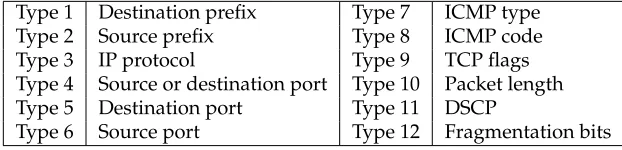
BGP Flowspec is an extension to the BGP routing protocol [44]. Its feature is to allow for filtering of network traffic among a large number of BGP peer routers. This way, it could be an effective method against DDoS attacks over networks. In contradiction to e.g. blackholing (where all traffic from or to a certain host is dropped), BGP Flowspec allows for a much more granular approach. It allows for construction of rules that match a defined network flow by offering 12 parameters. Examples of these are, among others, source/destination IP, packet length and flags. All 12 parameters are described in Table 2.3. Routers at the edge of an ISP’s network can apply Flowspec rules at any time. Furthermore, when traffic that satisfies the Flowspec rules arrives, the router can perform either of the following 3 actions [44]:
• Drop the traffic entirely
Chapter 2. State-of-the-art on DDoS Attacks 2.3. BGP Flowspec
• Allow the traffic at a reduced rate
The aforementioned 12 parameters are defined as Network Layer Reachability Information (NLRI). Any set of NLRI (as defined in Table 2.3) defines a network flow, i.e. a group of traffic packets that can be grouped together and labeled accordingly. An incoming network packet is considered to match the flow specification when it matches all components that are in the specification. When this occurs, one of the aforementioned actions will take place.
NLRI type
QoS match
fields
Description Example value
Type 1 Destination ad-dress
Defines the destination prefix to match. 130.89.161.0/24
Type 2 Source address Defines the source prefix to match. 130.89.161.0/24 Type 3 IP Protocol Contains a set of{operator, value}pairs that
are used to match the IP protocol value byte in IP packets.
1, 3, 5, 17-19
Type 4 Source or desti-nation port
Defines whether TCP, UDP or both will be packets will be influenced
1-80, 443
Type 5 Destination port
Defines the destination port that will be influ-enced by Flowspec
1-80, 443
Type 6 Source port Defines the source port that will be influ-enced by Flowspec
1-80, 443
Type 7 ICMP type Any (range of) ICMP types 0, 3-5 Type 8 ICMP code Any (range of) ICMP codes 3, 6-15
Type 9 TCP flags Any amount of TCP flags ACK, FIN, PUSH, SYN Type 10 Packet length Match on the total IP packet length
(exclud-ing Layer 2 but includ(exclud-ing IP header)
40, 255-1518
Type 11 DSCP Match on the Class Of Service flag 40, 255-1518 Type 12 Fragmentation
bits
[image:23.612.98.522.184.494.2]Any amount of IP fragmentation flags dont-fragment, is-fragment
Table 2.3: Flowspec tuple definition possibilities [8]
BGP Flowspec was proposed as a standard specified in RFC 5575 [44] in August 2009. To be able to utilize BGP Flowspec, an ISP’s routers must use BGP’s Capability Advertisement facility to exchange the Multiprotocol Extension Capability Code [3]. In 2015, Steinberger et al. conducted a survey in order to assess the technical ability to use BGP Flowspec among ISPs [74]. Their research shows that 52% do not currently support BGP Flowspec and 69% do not even plan to use it in 3 years. However, since this survey was conducted in 2015, the percentage of ISPs that support BGP Flowspec could have increased.
2.3.2
Limitations
Chapter 2. State-of-the-art on DDoS Attacks 2.3. BGP Flowspec
the use of Flowspec could improve this while requiring very little additional information. How-ever, there are some practical limitations to BGP Flowspec that are important to address. These limitations are a result of the implementation of the BGP Flowspec standard, as well as the hard-ware that it uses.
When examining various existing DDoS attack data sets, it can be seen that a DDoS attack often originated from multiple sources. For example, the data retrieved from DDoSDB [68] shows that many attacks originate from as much as 10.000 source IPs. According to the BGP Flowspec standard, the type 2 NLRI can be used to define a flow according to a source prefix. However, a given BGP Flowspec rule can only define one source prefix. If we want to generate a rule set that successfully defines this DDoS attack based on only this NLRI field, we would have to generate 10.000 BGP Flowspec rules. This does not scale for larger attacks.
Additionally, there are limitations on the hardware that vendors provide. For example, Cisco, a major network hardware vendor, has a hardware lineup that is designed for IXP-level routing. These routers use BGP for communication with other networks and are part of the Series Aggre-gation Services platform [8]. The operating system that is used on these routers (IOS XR) involves a limit of 3000 BGP Flowspec rules. Recalling the earlier example of a DDoS attack that originates from 10.000 source IPs, it is not feasible to apply BGP Flowspec rules to define this attack based only on the source IPs. Furthermore, IOS XR limits the number of multi-value ranges within a BGP Flowspec rule to 5 [42]. Loibl and Bacher [42] conducted research to produce a working set of configuration suitable for BGP Flowspec for multiple hardware vendors. They address various limitations in BGP Flowspec, such as bugs on certain hardware, as well as missing features in the standard. At the time of publishing, there were ongoing efforts to update the RFC 5575 standard, where BGP Flowspec is specified. It is unclear whether the bugs and missing features have been fixed in this update.
Finally, implementing a BGP Flowspec configuration is challenging, since all hardware vendors that support it (e.g. Cisco, Juniper, Huawei) have a different configuration language for imple-menting the rules. This makes it difficult to generate rules automatically and exchange them. Loibl and Bacher [42] also address that though there are use cases for exchanging BGP Flowspec rules among ISPs, the carriers seem to hesitate introducing this concept.
2.3.3
Mitigation impact
For an ISP to apply BGP Flowspec rules, it is of high importance to assess the impact these rules can have on the network. As previously mentioned, “mitigation impact” implies the negative impact a BGP Flowspec rule has on the ISP’s network. This applies to all hosts in the network, in-cluding the target host of the DDoS traffic on which the Flowspec rule is targeted. BGP Flowspec allows for the filtering of 12 fields in the IP header, resulting in relatively low granularity com-pared to e.g. a firewall. For this reason, it is important for a Flowspec rule to have the smallest possible mitigation impact on the network. The impact is defined by a set of factors. One of these factors is the number of false positives in the filtered packets, e.g. benign traffic that is nonetheless filtered by the Flowspec rule. This has a negative impact on the network, since non-DDoS traffic will be dropped at the ISP’s edge routers.
Chapter 2. State-of-the-art on DDoS Attacks 2.3. BGP Flowspec
more than 10.000 Flowspec rules in order to properly define a network flow that corresponds to the DDoS traffic. As discussed in the limitations (2.3.2), routers can only handle a maximum of 3000 installed BGP Flowspec rules. For this reason, defining this network flow with source IPs is infeasible. A solution for this can be to use prefixes (note that type 2 of the NLRI fields is defined by a source prefix to match) in order to ‘bundle’ multiple source IPs together. For example, if 100 of the source IPs start with 50.62.24.xx, we can group these together by creating a Flowspec rule with type 2 field “50.62.24.0/24”. However, in this situation, all traffic originating from this pre-fix is blocked. If the company receives a legitimate data packet from IP address 50.62.24.11, this data packet satisfies the condition of being in the 50.62.24.0/24 prefix. As a result, the packet is classified as a part of the DDoS traffic flow, and thus is dropped upon entering the ISP’s network. This situation results in a negative impact on the network, and should be avoided.
One of the core challenges that is relevant for this research is minimizing the aforementioned mitigation impact on the network. In order to solve this challenge, it is necessary to measure this impact in some way, in order to quantify its magnitude. When quantification of the mitigation impact is possible, a system can be built that self-adaptively deploys Flowspec rules, quantifies their impact and adjusts the rules in place if necessary. For example, if a set of rules measures an impact that is above a certain threshold, one or more rules can be omitted from the set in order to reduce the impact.
2.3.4
Related work
In order to fulfill the goal of this document, it is necessary to review existing literature related to the topic of this research. Here, we describe the research related to DDoS mitigation and BGP Flowspec. In addition, we analyze all relevant papers in a table (Table 2.4) in order to obtain an overview of the research that has and hasn’t been done at the time of writing this document. These two elements combined will provide knowledge on where this research lies in the DDoS field, and what gaps it attempts to fill. The papers discussed in this section have been retrieved using Google Scholar. After attempting several search queries, it was found that the term “bgp flowspec denial of service” was the most effective, resulting in 205 results. Out of these 205 re-sults, irrelevant papers, books and presentations were subtracted. After this subtraction, 9 papers remained that focus specifically on either DDoS mitigation, BGP Flowspec or mitigation impact (or a combination of these elements). These 9 papers will be discussed and reviewed in this sec-tion.
Mirkovic and Reiher [47] provide a detailed classification of the state-of-the-art of DDoS attacks. Although published in 2004, it still allows for a comprehensive taxonomy of DDoS attack as well as defense mechanisms. However, it lacks in providing a comparison of the effectiveness of the mentioned defense mechanisms. It also doesn’t propose how these different mechanisms can be combined into one, more complete solution to DDoS attacks.
Rather than looking to mitigate DDoS traffic close to the destination, Mirkovic et al. [48] propose to detect this traffic closer to the source. They developed a system called D-WARD that is able to stop incoming DDoS traffic at the edge routers of a network. This prevents a large amount of useless traffic entering the network. They do address several shortcomings of this method, how-ever. They is a possibility of false positives occurring when legitimate traffic flows start during the DDoS attack. It also lacks in detecting more subtle UDP attacks and repeated attacks, since it retains no memory of previously detected DDoS traffic.
Chapter 2. State-of-the-art on DDoS Attacks 2.3. BGP Flowspec
BGP as a routing protocol. Jamous et al. [36] proposed a system that is capable of near real-time detection and diversion of malicious network traffic. However, this research does not focus on the impact on the network, which is relevant to take into account. Furthermore, it does not pro-pose BGP Flowspec as a self-adaptive solution, which could mean that Flowspec rules negatively impacting a network will not be solved.
To illustrate how extensively BGP Flowspec is used, Steinberger et al. [74] conducted a survey among ISPs in order to assess their ability to use BGP Flowspec. They show that 52% do not currently support BGP Flowspec and 69% do not even plan to use it in 3 years.
In their research, Somani et al. [73] show the importance of assessing the mitigation impact (de-scribed as ‘collateral damage’). However, this research focuses on DDoS mitigation in general, rather than using BGP Flowspec specifically.
Dietzel et al. [23] proposed an advanced blackholing system with more granularity. They men-tion Flowspec as a tool for this as well, stating that, in the inter-domain environment, it requires ISPs to trust and cooperate with each other. “Flowspec, a popular intra-domain attack mitiga-tion technique, relies on trust, cooperamitiga-tion, and sharing of resources among different networks when deployed in the inter-domain environment. Unfortunately, these requirements are hard to satisfy when networks with diverse resources as well as different or even conflicting policies and business strategies form the Internet.” Essentially, the problem stated here is ISPs providing their resources to solve another ISP’s problem. This can raise doubt about liability, since the Internet is a highly competitive environment.
Gev et al. [29] present Backward Traffic Throttle (BTT), a mechanism to mitigate network flooding attacks. This system uses traffic statistics prior to the attack in order to control the bandwidth of incoming traffic, which can be compared to using fingerprint data as a basis for defining traffic flows. Furthermore, they take into account the mitigation impact by measuring the degradation of legitimate traffic rates during an attack (mentioned as the “goodput ratio”). In their research, they compare their BTT mechanism to BGP Flowspec among others on several fields. They argue that their method does not require non-standard router features (BGP Flowspec does require this) and that BTT does not require the identification of attack flows, while BGP Flowspec does. Furthermore, they argue that BGP Flowspec requires many rules commonly based on source and destination aggregates, which does not scale well.
Hinze et al. [32] examined the potential of BGP Flowspec for DDoS mitigation at the IXP and ISP level. They show that BGP Flowspec can effectively be used for DDoS mitigation with very little extra information on the DDoS traffic flow. However, the generation of rules is still a manual operation. Also, mitigation impact is not included. They conclude that DDoS mitigation at IXP level using BGP Flowspec has a high potential.
Chapter 2. State-of-the-art on DDoS Attacks 2.3. BGP Flowspec
Features
Paper DDoS
detection
DDoS
Mitigation
BGP Flowspec
Fingerprint data
Self-adaptiveMitigation impact
Mirkovic and Reiher [47] X X Mirkovic et al. [48] X X
Marques et al. [44] X
Jamous et al. [36] X X X Steinberger et al. [74] X
Somani et al. [73] X X
Dietzel et al. [23] X X X X
Gev et al. [29] X X X X
[image:27.612.160.492.89.305.2]Hinze et al. [32] X X X
Table 2.4: Literature review with several related topics marked for each paper.
2.3.5
Concluding remarks
The goal of this chapter was to gain knowledge on BGP Flowspec and understand how and why it can be an effective tool for mitigating DDoS traffic. In order to achieve this goal, we have divided this chapter into 4 parts. We first looked into background information on BGP Flowspec, in order to see which criteria are possible to define a network flow, as well as the actions that can be performed. BGP Flowspec allows for the filtering of traffic with the use of 12 fields. The traffic that matches the flow can either be dropped, redirected elsewhere for analysis or allowed at a reduced rate.
Moreover, we discussed the limitations of BGP Flowspec. When defining a traffic flow with a BGP Flowspec rule, only one instance of each field can be used. Therefore, rule generation does not generally scale well for attacks with a large number of source IPs. Additionally, there are limitations in the hardware that vendors provide, restricting the number of BGP Flowspec rules that can be installed at a given time. Lastly, since all hardware vendors have a different imple-mentation of their configuration language, it is challenging to generate rules automatically and exchange them.
Next, we elaborated on the mitigation impact. If a traffic flow is defined using BGP Flowspec rules, it is possible that legitimate traffic is blocked unintentionally. This results in a negative impact on the underlying network. One of the core challenges of this research is to find a way to measure this impact in order to quantify its magnitude. If this quantification is possible, we will be able to design a self-adaptive system where BGP Flowspec rule generation is based on the mitigation impact.
Chapter 2. State-of-the-art on DDoS Attacks 2.4. Conclusions
Ideally, ISPs and IXPs have a system in place that is self-adaptive, i.e. a system that measures the performance as well as the mitigation impact of a set of Flowspec rules and adjusts the rule set accordingly. This way, it is possible to generate effective DDoS traffic filtering while minimizing the negative impact on other users in the network.
2.4
Conclusions
The goal of this document was to provide the answer to Research Question 1. The question was defined as follows:
How does BGP Flowspec theoretically compare to existing DDoS mitigation solutions?
To answer this question, we divided this chapter into 3 sections: DDoS attacks (chapter 2), the mitigation of DDoS attacks (chapter 2.2), and BGP Flowspec (chapter 2.3). Firstly, we discussed the DDoS field. We provided some background information on DDoS attacks, and discussed the 2 types in which DDoS attacks can be classified: volumetric and semantic. We also listed the 10 most commonly used DDoS attack nowadays, and classified each one as either volumetric or semantic. Out of all DDoS attacks, volumetric attacks are the most devastating, since they are able to generate a very large amount of traffic, overwhelming the target. Subsequently, we elaborated on the causes of the existence of DDoS attacks. Mainly due to the way the Internet is designed (the end-to-end paradigm), DDoS attacks are and will remain a problem in the future. Furthermore, since all machines have a limited amount of resources, they are always vulnerable to being a target of a DDoS attack. We also examined the motivations behind DDoS attacks. These motivations include financial, political, rivalry, cyber warfare, a smoke screen and even boredom. Combining all information gained from this chapter, it is clear DDoS attacks are still a big problem and challenge nowadays (and will continue to be), and it is important to understand them fully before tackling mitigation.
In chapter 2.2, we provided a clear overview of the different methods and tools of mitigation. In order to explain this clearly, we have divided the DDoS mitigation field into 7 different levels where DDoS mitigation can take place, as well as the different methods of mitigation that can be applied at these levels. These levels are (A) the attacker, (B) the botnet, (C) the reflectors, (D) IXP, (E) ISP, (F) organization and (G) the victim’s machine. At each level, some form of mitiga-tion or prevenmitiga-tion is possible. Since levels A, B and C are outside of the scope of this research, we elaborated further on the latter four. Many methods of mitigation exist, some of which we elaborated on in this chapter. These methods are blackholing, Intrusion Detection Systems (IDS), a network firewall and a Web Application Firewall (WAF). We analyzed each method, and gave an overview of which mitigation method can be used on which level, as well as some example tools that can be used to apply the method. Furthermore, we listed the Internet layers that are applicable for each level. Using this information, it is made clear why certain mitigation methods are more effective than others, and why some methods work at a given stage where others don’t. Some methods allow for a larger throughput capability (e.g. BGP Flowspec), while others show potential in offering more granularity (e.g. a network firewall). When comparing the aforemen-tioned methods and tools, the most interesting tool to acknowledge is BGP Flowspec. The reason for this is that it can be applied at the IXP and ISP level, where a lot of traffic passes through (thus having a large throughput capability). Furthermore, BGP Flowspec allows for more granularity than regular blackholing, which is the way mitigation is currently being done at these levels.
Chapter 2. State-of-the-art on DDoS Attacks 2.4. Conclusions
as the actions that can be performed. BGP Flowspec allows for the filtering of traffic with the use of 12 fields. The traffic that matches the flow can either be dropped, redirected elsewhere for analysis or allowed at a reduced rate. Moreover, we discussed the limitations of BGP Flowspec. When defining a traffic flow with a BGP Flowspec rule, only one instance of each field can be used. Therefore, rule generation does not generally scale well for attacks with a large number of source IPs. Additionally, there are limitations in the hardware that vendors provide, restricting the number of BGP Flowspec rules that can be installed at a given time. Lastly, since all hard-ware vendors have a different implementation of their configuration language, it is challenging to generate rules automatically and exchange them. Next, we elaborated on the mitigation im-pact. If a traffic flow is defined using BGP Flowspec rules, it is possible that legitimate traffic is blocked unintentionally. This results in a negative impact on the underlying network. One of the core challenges of this research is to find a way to measure this impact in order to quantify its magnitude. If this quantification is possible, we will be able to design a self-adaptive system where BGP Flowspec rule generation is based on the mitigation impact. Lastly, we have given an extensive review of related work. The related literature shows that BGP Flowspec has a high po-tential in blocking DDoS traffic in a manner that is more granular than blackholing practices. BGP Flowspec has received some adoption in intra-domain environments and has been shown to have good reaction time and performance [7, 64]. However, existing research is lacking in addressing and quantifying the negative impact on the network.
In short, to answer research question 1: When comparing to other DDoS mitigation solutions, BGP Flowspec has one of the largest throughput capabilities, but lacks in granularity.
Chapter 3
BGP Flowspec Rule Generation
The previous chapter presented an in-depth look into DDoS field and the challenges it poses. We discussed how DDoS attacks can be mitigated, and introduced BGP Flowspec and it’s relevant lit-erature. We concluded that, when comparing BGP Flowspec to other DDoS mitigation solutions, it has one of the largest throughput capabilities, but lacks in granularity.
The goal of this chapter is to answer Research Question 2:
How can we write BGP Flowspec rules based on known DDoS attacks?
Chapter 3. BGP Flowspec Rule Generation 3.1. DDoS dissector
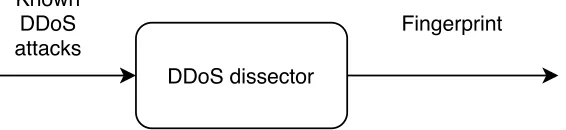
A simplified overview of the rule generation process is displayed in Figure 3.1. It can be seen that the rule generation process is divided into 3 main components: the DDoS dissector, the rule set generator and the parser. In this chapter, we will focus on each component of the overview below and explain the data used as input, the process that takes place and the output data that is generated.
DDoS dissector Rule set generator Parser Known
DDoS attacks
Fingerprint
Destination IP Rule limit
Rule set (intermediate language)
Device type
[image:31.612.104.520.172.296.2]BGP Flowspec rule set
Figure 3.1: An illustration of the rule generation process.
3.1
DDoS dissector
The first component of the rule generation process is the DDoS dissector. This is a function that is responsible of generating a summary of the network characteristics out of known DDoS attack traffic. This summary is called a “fingerprint”. It should be noted that the dissector is a separate module and part of DDoSDB [68]. DDoSDB is a platform designed to help DDoS attack victims and the academic community to get access to information about DDoS attacks. It collects its data from collaborators (often DDoS attack victims) that gathered data from DDoS attacks they experienced.
For this research, the dissector isnot developed by the authors and is thus taken for granted. There exists a close collaboration between the authors of this work and the developer of the dis-sector on DDoSDB. Therefore, the authors were able to invoke changes to the disdis-sector depending on the requirements for the rule generator. For this reason, the dissector on DDoSDB was chosen. We will look into the dissector in more detail.
DDoS dissector Known
DDoS attacks
Fingerprint
Figure 3.2: Overview of the dissector
[image:31.612.166.449.560.625.2]Chapter 3. BGP Flowspec Rule Generation 3.1. DDoS dissector
characteristics of the attack, which can also be extracted manually from the attack traffic. Instead, our rule generation algorithm relies on the dissector from DDoSDB. To the best of our knowledge, no other tools exist that extract the network characteristics of known DDoS attacks. Therefore, it is used for our rule generation algorithm.
3.1.1
Input
The input of the DDoS dissector is a collection of known DDoS attacks. For this research, the DDoS traffic required will be retrieved from DDoSDB [68]. The network traffic used as a source to our experiment originates from DDoSDB [68] as well. The data on DDoSDB is published on the platform in the form of an attack trace. The trace can be read from various formats, including pcap, pcapng, netflow v5, v9, IPFIX, and sflow. To the best of our knowledge, DDoSDB is the largest public database with DDoS attacks, containing over 900 different attacks and correspond-ing fcorrespond-ingerprints. Other DDoS attack data sets are known within the academic community [77, 82], but none of these are as extensive as DDoSDB.
Since a data set is used within the network of the authors of this research, this data set is biased. Several data sets have been used to test signature-based IDSs or firewalls in the last decade, with KDDCUP’99 being mostly widely used. Previous work includes statistical analysis of these data sets, and has found issues that result in a poor evaluation of anomaly detection approaches. This type of analysis has not been performed on the data set used in this research, and should be included in future work.
3.1.2
Process
As mentioned before, the dissector is responsible for generating a fingerprint of an attack vector. A fingerprint is defined as a summary of the network characteristics of that attack vector. For each attack vector on the platform, a fingerprint is generated. The dissector also anonymizes the fingerprint data in order to protect the identities of the victims, which means the destination IP address is omitted from the fingerprint. Furthermore, it should be noted that if there are multi-ple attack vectors present in a DDoS attack trace, each attack vector is presented separately on the platform with its own corresponding fingerprint. The source code of DDoSDB is publicly available on GitHub [66].
3.1.3
Output
Chapter 3. BGP Flowspec Rule Generation 3.1. DDoS dissector
1 {
2 f i l e t y p e : ” pcap ” 3 p r o t o c o l : ”TCP” 4 a d d i t i o n a l : {
5 t c p f l a g : ” . . . A . . . . ” 6 }
7 s r c i p s : [
8 {
9 as : ”10421”
10 i p : ” 1 2 9 . 1 1 8 . 2 2 2 . 1 6 ”
11 c c : ”US”
12 }
13 {
14 as : ”9158”
15 i p : ” 1 2 9 . 1 4 2 . 1 4 0 . 1 7 5 ”
16 c c : ”DK”
17 }
18 . . .
19 ]
20 t o t a l s r c i p s : 66610 21 s r c p o r t s : [
22 49298
23 58509
24 33571
25 . . .
26 ]
27 t o t a l s r c p o r t s : 41757 28 d s t p o r t s : [
29 80
30 ]
31 t o t a l d s t p o r t s : 1
32 key : ”39 b684d5e448abcece02cdf29dde6cda ” 33 s t a r t t i m e : ”2015−04−13 0 0 : 5 9 : 5 2 ”
34 d u r a t i o n s e c : 3 3 . 3 0 5 8 5 8 1 3 5 2 2 3 3 9 35 avg pps : 2 0 0 5 . 5 6 3 0 9 7 3 0 2 6 1 1 6 36 avg bps : 1 0 8 3 0 0 . 4 0 7 2 5 4 3 4 1 0 1
37 m u l t i v e c t o r k e y : ”39 b684d5e448abcece02cdf29dde6cda ” 38 s r c i p s s i z e : 66610
39 }
Chapter 3. BGP Flowspec Rule Generation 3.2. Rule set generator
3.2
Rule set generator
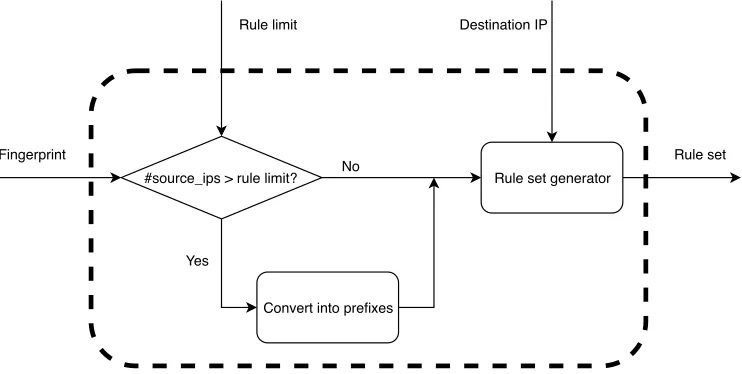
The next component for generating the rule set is the actual generator of the rule set based on the fingerprint. This component generates all BGP Flowspec rules necessary to specify the attack flow as described in the fingerprint. An expanded overview of this component can be seen below.
#source_ips > rule limit?
Convert into prefixes
Rule set generator Fingerprint
Yes
No
Destination IP Rule limit
[image:34.612.120.491.177.364.2]Rule set
Figure 3.3: An expanded overview of the rule set generator.
3.2.1
Input
The rule generation module has multiple input values: the fingerprint that is generated by the dissector (in JSON format), the maximum number of rules that can be installed on the router at once, and the destination IP for each rule (since this is not present in the fingerprint).

![Table 2.3: Flowspec tuple definition possibilities [8]](https://thumb-us.123doks.com/thumbv2/123dok_us/9627409.465269/23.612.98.522.184.494/table-flowspec-tuple-denition-possibilities.webp)