warwick.ac.uk/lib-publications
A Thesis Submitted for the Degree of PhD at the University of Warwick
Permanent WRAP URL:
http://wrap.warwick.ac.uk/80893
Copyright and reuse:
This thesis is made available online and is protected by original copyright.
Please scroll down to view the document itself.
Please refer to the repository record for this item for information to help you to cite it.
Our policy information is available from the repository home page.
A Study of Quartic K3 Surfaces with a
(
Z
/
2
Z
)
4Action
By
Florian Bouyer
Thesis
Submitted to the University of Warwick for the degree of
Doctor of Philosophy
Warwick Mathematical Institute
Contents
Page
Acknowledgements iii
Declaration iv
Abstract v
1 Introduction 1
2 Background 3
2.1 Lattices . . . 3
2.2 Basic Denitions . . . 6
2.3 The Family X . . . 9
3 The Galois and Monodromy Group 15 3.1 The Galois Group . . . 15
3.2 Monodromy Group . . . 23
3.3 K3 surfaces with many Q-conics . . . 34
4 Picard Lattices of Subfamilies 43 4.1 The Families and Lines . . . 44
4.2 The Picard Group . . . 48
5 Examples of CM Curves of Genus two Dened over the Reex Field 60 5.1 Invariants . . . 61
5.2 Reduction . . . 62
5.3 Results . . . 74
Appendix A 91 A.1 List of Singular Points . . . 91
A.2 List of Discriminants . . . 91
A.3 List of Planes . . . 93
CONTENTS CONTENTS
Acknowledgements
This thesis would have not been possible without the help of many people, more than I can thank here.
For helping me start my journey, and introducing to me the wonderful area of arithmetic geometry, I would like to thank my supervisor Damiano Testa. I also thank Marco Streng, who not only showed me the world of mathematical research but with whom I had a very fruitful collaboration.
My thanks also go to Samir Siksek and Ronald van Luijk for agreeing to read this thesis and be my examiners.
I am grateful to the Engineering and Physical Sciences Research Council for fund-ing my studies. For puttfund-ing up with (and answerfund-ing all) my queries, I would like to thank the whole administrative team of the Warwick Mathematics Institute, in partic-ular Carol Fisher. I extend my thanks to the whole number theory group at Warwick, who supported me for four years, gave me access to all computational resources I needed for this thesis and provided me with so many opportunities to teach.
This thesis (and my well-being) beneted from the many useful discussions and interesting comments that I received from my mathematical friends. In particular I want to thank Samuele, Alejandro, Mark, Chris B., Heline, Céline, Dave, Adam, Ben, Daniel, Alex, and Ian.
Declaration
Chapter 5 is a joint work with Marco Streng (Leiden) and an extended version of it has appeared as a paper [BS15]. Except for that chapter, I declare that, to the best of my knowledge, the material contained in this thesis is my own original work except where otherwise indicated, stated or where it is common knowledge.
Abstract
The main focus of this thesis is to study the equation
A(x4+y4+z4+w4)+Bxyzw+C(x2y2+z2w2)+D(x2z2+y2w2)+E(x2w2+y2z2) = 0.
To do so, we view this equation as a family of quartic K3 surfaces in P3[x,y,z,w],
para-metrised by points [A, B, C, D, E] ∈ P4. We pursue two directions. First we look
at 320 conics that such a K3 surface contains. In particular, we explore the eld of denition of these 320 conics and the Monodromy group linked to these conics. In the other direction we explore the quartic K3 surfaces which contain lines. We list all subfamilies of K3 surfaces for which a very general member contains 8, 16, 24,32 or 48 lines.
We combine the two directions, by using the lines and conics found, to explore the Picard group of the various families found. In particular, not only do we work out the Picard rank of a very general member of a family, but we also decompose the Picard lattice into known lattices.
Chapter 1
Introduction
One of the motivating questions in number theory is trying to solve Diophantine equa-tions, that is, to nd integral or rational solutions to a system of integral polynomials. Solving a Diophantine equation is equivalent to nding the rational points of its asso-ciated variety. As such, much work has been done to understand algebraic curves of low genus such as elliptic curves. While many problems are still open, mathematicians have also began to look in detail at curves of higher genus or at varieties of higher dimension. In this thesis we will do both, rst looking at K3 surfaces then studying genus two hyperelliptic curves.
Elliptic curves and K3 surfaces have trivial canonical divisors, hence K3 surfaces can be thought of as two-dimensional analogues of elliptic curves. While our un-derstanding of K3 surfaces has grown, answering questions on the arithmetic of K3 surfaces is still dicult. So instead of looking at all K3 surfaces, we impose some restrictions on the ones we investigate. For example, in this thesis we look at a family of quartic K3 surfaces that admit a (Z/2Z)4-action. More specically, consider the
(Z/2Z)4 subgroup ofAut(P3
Q) generated by
[x, y, z, w]7→
[y, x, w, z]
[z, w, x, y]
[x, y,−z,−w] [x,−y, z,−w]
.
We consider the quartic K3 surfaces in P3
Q which are invariant under these
transform-ations. We call such quartic surfaces invariant quartic, and the family of all invariant quartics is known to be parametrised byP4.
Introduction Introduction
quintic threefold N5⊂P4, plus the tangent cones of the10 singular points ofN5.
The rst motivating question of this thesis is: if an invariant quartic is dened over a number eld, what is the smallest eld extension over which the320conics are dened? This leads us to look at the Monodromy group of the 320 conics of a very general invariant quartic surface. We conclude that the moduli space of pairs (X, C), whereX is an invariant quartic K3 surface and C one of the mentioned320conic on
X, has10irreducible components. We contrast this with the following conjecture: the moduli space of pairs (X, C), whereX is a primitive K3 surface of genusg andC an
irreducible nodal curve on X, is irreducible. This conjecture is proven by Ciliberto
and Dedieu for3≤g≤11,g6= 10in [CD12].
The second motivating question is: if X is an invariant quartic surface containing
a line, what can we say about its Picard group? As Eklund studies the quartic surfaces parametrised by N5 in [Ekl10], we look at the surfaces parametrised by the tangent
cones. Using this, we nd invariant quartic surfaces containing 8,16,24 or 32 lines, which we group in various families. For each family we calculate the Picard group of a very general member, decompose it into known lattices and show that it is generated by the lines and conics lying on the surface. We notice that for a family of dimension
r, the Picard rank of a very general member is 20−r. This ts nicely with the fact
that certain moduli spaces of K3 surfaces whose Picard group contains a xed lattice
M has dimension20−rank(M).
We also turn our attention to curves of higher genus, namely we look at genus two hyperelliptic curves with complex multiplication (CM). A curve C/k of genus g
is said to have complex multiplication if the endomorphism ring of its Jacobian, over
k, contains an order in a number eld K of degree 2g. It is known that there exists
exactly13j-invariants giving elliptic curves overQwith CM, see for example [Cox13,
Thm 7.30ii]. Analogously, Van Wamelen [vW99a] gives a list of 19 curves of genus two overQwith CM by a maximal order. As this did not account for all quartic
CM-elds, we implement an algorithm to nd those not dened overQ. More precisely we
extend his list to include genus two hyperelliptic curves with CM dened over certain real quadratic extensions of Q. A recent paper by Kilicer and Streng [KS15] proves
that our list is complete.
The layout of the thesis is as follows: Chapter 2 deals with background knowledge that is assumed in the rest of the thesis. In particular the last section covers the main aspect of the family of invariant quartic K3 surfaces. Chapter 3 and Chapter 4 deal with the two motivating questions respectively, while Chapter 5 explains the work on genus two hyperelliptic curves.
Note. Many of the calculations done at various points throughout this thesis were done with the help of the computer algebra package Magma [BCP97] and Sage [S+13]. We
Chapter 2
Background
In this chapter we review some material and notation that will be used throughout the thesis. The rst section gives an overview of the theory of lattices that we need. In particular, we look at how given a lattice we can decompose it into root lattices and the hyperbolic lattice. For that purpose Table 2.1 gives the invariants of these lattices. The second section gives a quick recap of some basic algebraic geometry notions that we need. We provide some references where more details can be found.
The nal section is the most important one, as we introduce the family of quartic K3 surfaces that is the main study of this thesis. We also recap what we already know about this family, with many of the theorems being used explicitly and implicitly throughout the thesis.
2.1 Lattices
In this thesis a lattice,L, is a free abelian group of nite rank equipped with a
symmet-ric, non-degenerate, bilinear form h,i :L×L→Z. We say it has signature (b+, b−)
if for some basis {ei} of L⊗ZR we have
hei, eji=
1 i=j, i∈ {1, . . . , b+}
−1 i=j, i∈ {b++ 1, . . . , b++b−}
0 i6=j
.
A lattice is positive denite if it has signature (b+,0), negative denite if it has
sig-nature (0, b−), and indenite otherwise. A lattice, L, is even if hx, xi ∈ 2Z for all
x ∈L. Let {ei} be a basis for L, then a Gram matrix of L (with respect to {ei}) is
the matrix(hei, eji)i,j. The discriminant ofL, denotedDisc(L), is the determinant of
Background 2.1 Lattices
Example. Consider the following Dynkin diagrams:
An := ,
e1 e2 en−1 en
Dn :=
en−1 ,
e1 e2 en−3 en−2
en
E8 := e8
. e1 e2 e3 e4 e5 e6 e7
Each diagram denes a (root) lattice, with basis {ei} and bilinear form
hei, eji=
2 i=j
−1
ei ej
0 otherwise
.
Another example of a lattice is the hyperbolic plane lattice, denoted U, which is
the unique (up to isomorphism) rank 2 even indenite unimodular lattice. For some basis, its Gram matrix is
0 1
1 0
! .
Given a lattice L with basis {ei} and m ∈ Z, we denote by Lhmi the lattice
with basis {ei} and bilinear form hei, ejiLhmi =mhei, ejiL. By abuse of notation, we
denote the rank one lattice with bilinear form he1, e1i=m by hmi. If L1 andL2 are
two lattices with basis {ei},{fi} respectively, we denote by L1⊕L2 the lattice with
basis{ei} t {fi} and bilinear form given by hei, fji= 0. We will say that a lattice L
decomposes intoL1, . . . , Ln if L∼=L1⊕ · · · ⊕Ln.
We say a lattice L1 is a sublattice of a lattice L2 if it is a subset of L2 and if the
bilinear form of L2 restricted onL1 agrees with the bilinear form ofL1. A sublattice
is said to be primitive if L2/L1 is torsion free. If L1 is a full-rank sublattice of L2,
i.e. rank(L1) = rank(L2), then we call L2 an overlattice ofL1. Note that in such case
Disc(L1)/Disc(L2) = [L2 :L1]2.
In Chapter 4 we try to nd a decomposition of lattices intoAnhmi, Dnhmi, E8hmi
and Uhmi, to do so we will need some extra invariants. We may extend the bilinear
form h,i on L Q-linearly to L⊗Q and dene the dual lattice (which is often not a
lattice with respect to our denition):
Background 2.1 Lattices
Denition 2.1.1. The discriminant group of a lattice L is the nite abelian group AL:=L∗/L. We denote by`(AL) the minimal number of generators ofAL.
The discriminant group comes with a bilinear form,bL:AL×AL→Q/Z, dened
by bL(x+L, y+L)7→ hx, yiL∗ mod Z.
For even lattices, we dene the discriminant form, qL:AL →Q/2Z, by x+L7→
hx, xiL∗ mod 2Z.
The following theorem of Nikulin will help identify the lattices we will nd:
Theorem 2.1.2 (Nikulin [Nik80, Cor. 1.13.3]). If a lattice L is even, indenite with
rank(L)> `(AL) + 2, then L is determined up to isometry by its rank, signature and
discriminant form.
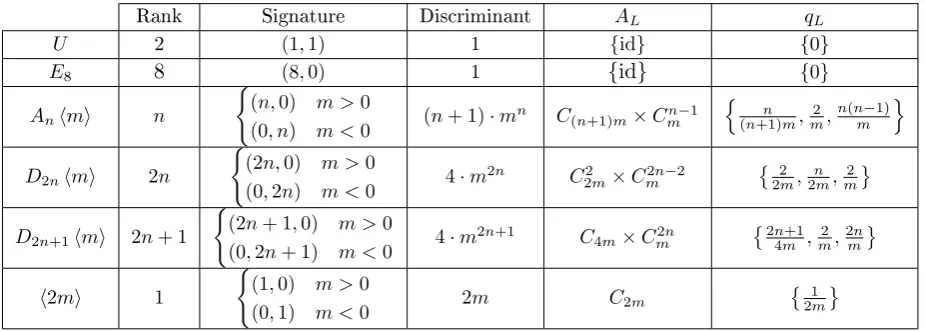
With that theorem in mind, we write down in Table 2.1 a summary of the rank, signature and discriminant form for the latticesU, E8, Anhmi, Dnhmi and h2mi.
Rank Signature Discriminant AL qL
U 2 (1,1) 1 {id} {0}
E8 8 (8,0) 1 {id} {0}
Anhmi n
(
(n,0) m >0
(0, n) m <0 (n+ 1)·m
n C
(n+1)m×Cmn−1
n
n
(n+1)m,
2
m, n(n−1)
m
o
D2nhmi 2n
(
(2n,0) m >0
(0,2n) m <0 4·m
2n C2
2m×Cm2n−2
2
2m,
n
2m,
2
m
D2n+1hmi 2n+ 1
(
(2n+ 1,0) m >0
(0,2n+ 1) m <0 4·m
2n+1 C
4m×Cm2n
2n+1
4m ,
2
m,
2n
m
h2mi 1
(
(1,0) m >0
(0,1) m <0 2m C2m
1
[image:12.595.84.547.329.495.2]2m
Table 2.1: Invariant of Lattices
The rowqLlists the values ofqL(xi) wherexi are chosen generators of AL, i.e.,AL= hx1i × · · · ×
x`(A)
. Therefore it only encodes partial information of the discriminant form and not the whole of it, but it encodes enough to rule out (in most cases) whether a summand occurs. As U and E8 have trivial discriminant group, we use following
theorem of Nikulin to identify copies ofU andE8 sitting inside a given lattice.
Theorem 2.1.3 (Nikulin [Nik80, Cor 1.13.15]). Let L be an even lattice of signature
(b+, b−).
• If b+≥1, b−≥1 and b++b−≥3 +`(AL) then L∼=U ⊕T for someT.
• If b+≥1, b−≥8 and b++b−≥9 +`(AL) then L∼=E8h−1i ⊕T for some T.
We note that we can not always have a decomposition of lattices intoAnhmi, Dnhmi, E8hmi
and Uhmi. When this happens, we express our lattices as full rank sublattices of a
Background 2.2 Basic Denitions
Theorem 2.1.4. [Nik80, Prop 1.4.1] Let Lbe an even lattice. Then there is a natural
bijection between isotropic subgroups G of AL (subgroups on which the discriminant
form qL satises qL(g) = 0 for all g∈G) and overlattices LG of L.
Furthermore, the discriminant form qLG is given by the discriminant form qL
re-stricted to G⊥/G, where orthogonality is with respect tobL.
2.2 Basic Denitions
As this thesis deals with properties of general members of families, we start by review-ing some standard denitions. LetK be a eld andX be a variety in PnK.
Denition 2.2.1. A general point ofX is a pointp∈Xoutside an (implied) Zariski
closed proper subset of X.
Example. LetX =P1Q, then for a general pointp = [s, t]∈X, we have thatt6= 0.
(The implied Zariski closed proper subset being{t= 0})
Denition 2.2.2. A very general point of X is a point p ∈ X outside a countable
union of Zariski closed proper subsets of X.
Example. LetX=P1Q,then for a very general pointp= [s, t]∈X, we have thats/t
is not a power of2. This can be seen as s/tis a power of 2if and only if there exists
d∈Z such that s−2dt= 0. So p outside the countable union ∪
d∈Z{s−2dt = 0} is
very general.
General and very general points have links with thin sets, which we review here. For the moment, suppose thatK has characteristic0.
Denition 2.2.3. A subsetΩ⊆Pn
K is said to be thin if there exists a variety X over
K and a morphismπ:X →PnK such that
1. Ω⊂π(X(K)),
2. The bre ofπover the generic point is nite, andπ has no rational sections over K.
We dierentiate between two types of thin sets.
Type 1 A thin set Ω ⊆ Pn
K is said to be of type 1 if there exists a homogenous
polynomial F(T1, . . . , Tn)∈K[T]such that F(t) = 0 for allt∈Ω. That is,
Ωis a proper Zariski closed subset of Pn.
Type 2 A thin set Ω ⊆ Pn
K is said to be of type 2 if it is obtained as follows.
Let F(X, T1, . . . , Tn) ∈K(T)[X]be absolutely irreducible (i.e., irreducible
over K(T)[X]), of degree ≥ 2 with respect to X, and such that the
Background 2.2 Basic Denitions
(i.e.,F(X, λT) =λmF(X, T)). Then Ωis the set of all t∈Pn
K such thatt
is not a pole of the coecients ofF andF(X, t) has a root in K.
Proposition 2.2.4 ([Ser97, Prop 9.1]). Every thin subset of PnK is contained in a
nite union of thin sets of type 1 and2.
Examples.
• The set Ω1 ={t:t= 0} ⊆P1K is a thin set of type 1. Note that for K =Q, a
general point is outside this set.
• Consider the polynomial S −T X2 ∈ K(S, T)[X]. Then Ω2 = {[s, t] ∈ P1K :
stis a square inK, t6= 0} is a thin set of type 2.
• Fixc∈Kand letFc=S−cT X2, then each distinct class inK∗/(K2)∗ gives rise
to a dierent thin setΩc(of type2). Furthermore, a nite union ∪c∈K∗/(K2)∗Ωc
is a thin set.
Denition 2.2.5. A eld K, of characteristic 0, is called Hilbertian if for alln≥1,
PnK is not thin.
Remark. For K to be Hilbertian it is enough to show that P1K is not thin (see [Ser97,
Rmk 9.5.1]). Examples.
• By the above example, if K is Hilbertian then K∗/(K2)∗ is innite, otherwise the nite union ∪c∈K∗/(K2)∗Ωc =P1K would be thin. In particular, local elds
and algebraically closed elds are not Hilbertian.
• Q is Hilbertian (Hilbert's irreducibility theorem, see [Ser97, Thm 9.6] for a
proof).
• If K is Hilbertian, any nite extension of K is also Hilbertian. In particular,
any number eld is Hilbertian.
We now turn our attention to reviewing some algebraic geometry notions we will need. We revert back to lettingK be an arbitrary eld.
Denition. A K3 surface is a smooth surface X over K with irregularity q =
dimH1(X,OX) = 0 and trivial canonical sheafωX ∼=OX.
Here a surface is a projective integral separated scheme of nite type and dimen-sion 2over K (see [Har77]).
Example. Smooth quartic surfaces in P3 are K3 surfaces.
Background 2.2 Basic Denitions
• A prime divisor onX is a curve Y on X,
• A (Weil) divisor D=P
niYi is a nite formal sum of prime divisors,
• LetDiv(X) be the set of Weil divisors onX,
• Letf be a non-zero rational function onX, we dene the divisor off as(f) =
P
νYi(f)Yi, where νYi(f) is the valuation of f in the discrete valuation ring
associated to the generic point of Y.
We can dene the intersection pairing (,) : Div(X)×Div(X) → Z which is a
symmetric bilinear function on Div(X), refer to [Har77, Sec V.1] for more details. There are three basic equivalence relations we can put on Div(X):
Linear Two divisorsC, D∈Div(X)are linearly equivalent if there exists a rational function f such thatC =D+ (f)
Algebraic Two divisors C, D ∈ Div(X) are algebraically equivalent if there exists a curve T, two closed points 0,1 ∈ T and a divisor E in X×T such that E0−E1 =C−D.
Numerical Two divisors C, D ∈ Div(X) are numerically equivalent if for all E ∈
Div(X),(C, E) = (D, E).
We note that linear equivalence implies algebraic equivalence, which in turn implies numerical equivalence.
Denition 2.2.7. We dene the Picard group ofXto bePic(X) := Div(X)/linear equivalence. LetPic0(X)be the set of divisor classes algebraically equivalent to zero. We dene
the Néron-Severi group of X to beNS(X) := Pic(X)/Pic0(X).
LetPicτ(X)be the set of divisor classes numerically equivalent to zero. We dene Num(X) := Pic(X)/Picτ(X).
Proposition 2.2.8. Let X be a K3 surface over K, then Pic(X) ∼= NS(X) ∼=
Num(X).
See, for example, [VA15, Prop 1.8] for a proof.
Proposition 2.2.9. [LN59] The Néron-Severi group of X is a nitely generated
abelian group.
Denition 2.2.10. The rank ρ:= rank(NS(X))is called the Picard number ofX.
Remark. For a K3 surfaceX, we have thatρ(X)≤22(see [BPVdV84, Prop VIII.8.3] and [BM77, Thm 5]). If X is dened over a eld of characteristic 0, thenρ(X)≤20. A K3 surface X withρ(X) = 20is called a singular K3 surface. A K3 surface X
Background 2.3 The Family X
Proposition 2.2.11. Let X be a K3 surface. Then Pic(X) equipped with (,) : Pic(X)×Pic(X)→Zis an even lattice.
Proof. Since for a K3 surfacePic(X)∼= Num(X)and by denitionNum(X)is torsion free, we have that Pic(X) is a lattice. Now using Riemann-Roch for surfaces, if C is
a non-singular curve of genus g, then (C, C) = (C, C+K) = 2g−2. Therefore, the Picard lattice is even.
2.3 The Family
X
The rst half of this thesis will concentrate on the varietyX ⊂P3
[x,y,z,w]×P4[A,B,C,D,E]
dened by the following equation over Q
A(x4+y4+z4+w4)+Bxyzw+C(x2y2+z2w2)+D(x2z2+y2w2)+E(x2w2+y2z2) = 0.
We viewX as a family of quartic surfaces overP3parametrised by points[A, B, C, D, E]
inP4.
Notation. We will useXp and [A, B, C, D, E]to denote the quartic surface
paramet-rised by the pointp= [A, B, C, D, E]∈P4.
Note. IfXp is a smooth quartic surface, then it is a K3 surface.
Consider the group Ωacting on P3×P4 generated by the following ve elements:
the point [x, y, z, w, A, B, C, D, E]is sent to
• [x, y, z,−w, A,−B, C, D, E],
• [x, y, w, z, A, B, C, E, D],
• [x, z, y, w, A, B, D, C, E],
• [x, y, iz, iw, A,−B, C,−D,−E],
• [x−y, x+y, z−w, z+w,2A+C,8(D−E),12A−2C, B+2D+2E,−B+2D+2E].
Denote these ve elements by φ1, φ2, φ3, φ4 andφ5 respectively. The groupΩxesX.
While it is a rather large group with order 24·6!, we can pick out a normal subgroup Γ, which is generated by the following four elements
• γ1 :=φ3φ24φ3φ25,
• γ2 :=φ24φ3φ25φ3,
• γ3 :=φ24,
Background 2.3 The Family X
The groupΓconsists of all elements ofΩwhich xP4[A,B,C,D,E]inP3×P4. In particular
upon picking a pointp∈P4we have thatΓis a subgroup ofAut(Xp)(when projecting
the elements ofΓonto theP3[x,y,z,w]component). Explicitly, when regardingΓas acting
on P3, we have that its generators are
[x, y, z, w]7→
[y, x, w, z] γ1
[z, w, x, y] γ2
[x, y,−z,−w] γ3
[x,−y, z,−w] γ4
.
From this we know that Γ ∼= C24. We calculate that Ω/Γ =∼ S6, but Ω C24 ×S6
because in particularΩhas trivial centre. For each γ ∈Γ\{id}we make a note of the
points of P3 which are xed by γ (restricted to P3). Each γ has two skew lines L, L
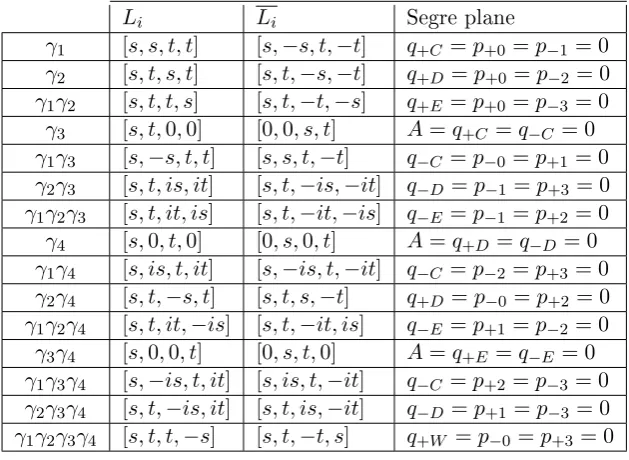
of xed points which are given by its(+1)and(−1)eigenspaces, respectively its(+i) and (−i) eigenspaces. The lines are given in Table 2.2 (along with the Segre planes which we explain after Proposition 2.3.5). Note that every pair of lines is also xed by anyγ ∈Γ(on top of containing the xed points of a particular γ).
Li Li Segre plane
γ1 [s, s, t, t] [s,−s, t,−t] q+C =p+0 =p−1 = 0
γ2 [s, t, s, t] [s, t,−s,−t] q+D =p+0 =p−2 = 0
γ1γ2 [s, t, t, s] [s, t,−t,−s] q+E =p+0 =p−3 = 0
γ3 [s, t,0,0] [0,0, s, t] A=q+C =q−C = 0
γ1γ3 [s,−s, t, t] [s, s, t,−t] q−C =p−0 =p+1 = 0
γ2γ3 [s, t, is, it] [s, t,−is,−it] q−D =p−1 =p+3 = 0
γ1γ2γ3 [s, t, it, is] [s, t,−it,−is] q−E =p−1 =p+2= 0
γ4 [s,0, t,0] [0, s,0, t] A=q+D =q−D = 0
γ1γ4 [s, is, t, it] [s,−is, t,−it] q−C =p−2 =p+3 = 0
γ2γ4 [s, t,−s, t] [s, t, s,−t] q+D =p−0 =p+2 = 0
γ1γ2γ4 [s, t, it,−is] [s, t,−it, is] q−E =p+1 =p−2 = 0
γ3γ4 [s,0,0, t] [0, s, t,0] A=q+E =q−E = 0
γ1γ3γ4 [s,−is, t, it] [s, is, t,−it] q−C =p+2 =p−3 = 0
γ2γ3γ4 [s, t,−is, it] [s, t, is,−it] q−D =p+1 =p−3 = 0
[image:17.595.158.473.391.621.2]γ1γ2γ3γ4 [s, t, t,−s] [s, t,−t, s] q+W =p−0 =p+3 = 0
Table 2.2: List of Invariant Lines
Notation. We shall denote byL the union of the 15 pairs of lines.
We now consider the cases when Xp is not a smooth surface using the following
proposition taken from [Ekl10, Prop 2.1].
Proposition 2.3.1. Let p = [A, B, C, D, E]∈P4. The surface X
Background 2.3 The Family X
only if
∆·A·q+C ·q−C·q+D ·q−D·q+E·q−E·p+0·p+1·p+2·p+3·p−0·p−1·p−2·p−3 = 0,
where:
∆ = 16A3+AB2−4A(C2+D2+E2) + 4CDE (2.3.1)
q+C =2A+C q+D =2A+D q+E =2A+E
q−C =2A−C q−D =2A−D q−E =2A−E
p+0=4A+B+ 2C+ 2D+ 2E p−0 =4A−B+ 2C+ 2D+ 2E
p+1=4A+B+ 2C−2D−2E p−1 =4A−B+ 2C−2D−2E
p+2=4A+B−2C+ 2D−2E p−2 =4A−B−2C+ 2D−2E
p+3=4A+B−2C−2D+ 2E p−3 =4A−B−2C−2D+ 2E.
Denition 2.3.2. The surface S3 ={∆ = 0} ⊂P4 is the Segre cubic. We shall refer
to the 15 hyperplanes inP4 dened by the 15 equations
{A, p±j, q±α:α∈ {C, D, E}, j ∈ {0,1,2,3}}
above as the singular hyperplanes.
The Segre cubic has10 singular points, namely:
[1,0,−2,−2,2],[1,0,−2,2,−2],[1,0,2,−2,−2],[1,0,2,2,2],
[0,−2,1,0,0],[0,2,1,0,0],[0,−2,0,1,0],[0,2,0,1,0],[0,−2,0,0,1],and [0,2,0,0,1].
We shall denote these 10 points by qi, i ∈ [1, . . . ,10], as ordered above. These 10
points have associated quartics in P3, which turns out to be quadrics of multiplicity
two. We denote the quadric associated to the point qi byQi. Explicitly they are:
x2−y2−z2+w2= 0, x2−y2+z2−w2= 0, x2+y2−z2−w2= 0, x2+y2+z2+w2 = 0, xy−zw= 0, xy+zw= 0, xz−yw = 0, xz+yw = 0, xw−yz = 0,andxw+yz= 0.
Remark 2.3.3. We note that the action Ωon P3×P4 induces an action on the set of
the15 singular hyperplanes, and a second action on the set of the 10 singular points
qi. The actions induced are as follows (using permutation notation):
• φ1acts as(p+0, p−0)(p+1, p−1)(p+2, p−2)(p+3, p−3)and as(q5, q6)(q7, q8)(q9, q10),
• φ2acts as(q+D, q+E)(q−D, q−E)(p+2, p+3)(p−2, p−3)and as(q1, q2)(q7, q9)(q8, q10),
Background 2.3 The Family X
• φ4 acts as(q+D, q−D)(q+E, q−E)(p+0, p−1)(p−0, p+1)(p+2, p−3)(p−2, p+3) and as
(q1, q2)(q3, q4)(q5, q6),
• φ5 acts as (A, q+C)(q+D, p+0)(q−D, p−1)(q+E, p−0)(q−E, p+1)(p+2, p−3) and as
(q1, q5)(q2, q6)(q7, q10).
It is known that for a general point on S3 the corresponding surface is a Kummer
surface ([Ekl10, Prop 2.2]). The following two propositions link such Kummer surfaces with their singular points.
Proposition 2.3.4. Let p= [x, y, z, w]be a point in P3\ L and let
• A= (yz+xw)(yz−xw)(xz+yw)(xz−yw)(zw+xy)(zw−xy),
• B= 2xyzw(−x2−y2+z2+w2)(−x2+y2+z2−w2)(x2−y2+z2−w2)(x2+y2+z2+w2),
• C= (yz+xw)(yz−xw)(xz+yw)(xz−yw)(x4+y4−z4−w4), • D= (yz+xw)(yz−xw)(zw+xy)(zw−xy)(−x4+y4−z4+w4), • E = (xz+yw)(xz−yw)(zw+xy)(zw−xy)(x4−y4−z4+w4).
Then the point [A, B, C, D, E] lies on the Segre cubic and the associated Kummer surface has the 16 singular points {γ(p) :γ ∈Γ}.
Proof. Let F = A(X4 +Y4 +Z4 +W4) +· · ·+E(X2W2 +Z2Y2). By algebraic manipulation, the system of linear equations
F(p) = ∂F
∂X(p) = ∂F ∂Y (p) =
∂F ∂Z(p) =
∂F
∂W(p) = 0
has a unique solution [A, B, C, D, E] ∈ P4 as given above. Hence, for the rest of
the proof let A, B, C, D, E be as in the proposition. The quartic surface dened by
[A, B, C, D, E]haspas a singular point. Substituting[A, B, C, D, E]into the equation ∆, we see that [A, B, C, D, E] lies on on the Segre cubic. Finally, having found one singular point, we note that sinceΓxes the quartic surface dened by[A, B, C, D, E], any pointγ(p) withγ ∈Γmust also be a point of singularity.
Note that in particular, any pointp∈P3\L uniquely denes the Kummer surface
of which it is a singular point.
Proposition 2.3.5. Let[A, B, C, D, E]be a point on the Segre cubic not lying on one of the 15 singular hyperplanes. Then the associated surface's 16 singular points are [x, y, z, w]where x, y, z andw solve the following equations:
• az8 +bz6w2 +cz4w4 +bz2w6 +aw8 = 0, with a = −A2B2, b = 4(2AD−
Background 2.3 The Family X
• (4A2−C2)(Ez2−Dw2)y2+A (4A2−C2)(z4−w4) + (E2−D2)(z4+w4)+
C(E2−D2)z2w2 = 0,
• 2(C2−4A2)xyzw+BCz2w2+AB w4+z4= 0.
Proof. Without loss of generality, using the action of Γ, we assume w= 1. Then the rst equation can be considered as a symmetric quartic polynomial with the variable
z2, and hencez can be written as a radical function ofA, B, C, D, E, i.e,
z=± v u u tu±±
q u2±−4
2 , whereu±=
−b±pb2−4a(c−2a)
2a .
Similarly, we can writexand yas radical functions ofA, B, C, D, E. Substituting the
point [x, y, z,1] (written in terms of A, B, C, D, E) into the equations of Proposition
2.3.4, we get an equality. Since a point uniquely denes the Kummer surface, we must have that the point[x, y, z,1]is a singular point of [A, B, C, D, E].
We explain why we need the hypothesis in the two previous propositions, namely taking a point in P3 away from L and taking a point in P4 away from the singular
hyperplanes. First we note that the intersection of one of the singular hyperplanes with the Segre cubic breaks down into3 planes. For example
{q+C = 0} ∩ {∆ = 0} = {q+C = 0, q−C = 0, A= 0} ∪ {q+C = 0, p−0 = 0, p+1= 0}
∪ {q+C = 0, p+0 = 0, p−1= 0}.
We check that we get15planes this way, which we shall refer to as the15Segre planes. Suppose the surface Xp is represented by a point p lying on one of the 15 Segre
planes, that ispdoes not satisfy the hypothesis of Proposition 2.3.5. Then, we calculate
that Xp does not have only 16 singular points, but rather two skew singular lines.
Namely one of the15 pairs of lines in L. On the other hand, consider the surfaceXp
withp ∈P4, which has the singular pointq ∈ L. By Proposition 2.3.1 we know that
either p lies on the Segre cubic or on one of the15 singular hyperplanes. If p lies on
the Segre cubic, then in fact p lies on one of the Segre planes. If p lies on a singular
hyperplane and not on the Segre cubic, then q lies on3 lines contained inL (c.f. A.1
in the Appendix).
Hence we have a one to one correspondence between the 15 pairs of skew lines of
L and the 15 Segre planes. Table 2.2 shows which Segre plane corresponds to which pair of lines.
Denition 2.3.6. Let Y be a quartic surface in P3. We say that a plane T inP3 is
Background 2.3 The Family X
Lemma 2.3.7. A quartic surface Y ⊂P3 which has a trope T is singular.
We now turn to the theorem from Eklund, [Ekl10, Thm 4.3], which motivated the questions of this thesis.
Theorem 2.3.8. A general K3 surface X from the family X contains at least 320 smooth conics.
Proof. The proof is adapted from [Ekl10, Thm 4.3], which we reproduce here as we will use some elements of the proof in the rest of the thesis. For this proof if Y is a
hypersurface, x Ye to be an equation dening Y.
Pickp∈P4general and letqibe a singular point of the Segre cubicS3(in particular
xi). We have that the associated surface to qi is Q2i, a quadric of multiplicity two.
The line throughpandqi intersectsS3 in exactly one other point, call itpi. Hence we
have Xfp =α
f Qi
2
+α0Xgpi for some α, α0 ∈Q. Asp is general by Proposition 2.3.5,
we have that the associated surfaceXpi is Kummer. Pick a singular point onXpi, say
[a, b, c, d], and consider its dual T :={ax+by+cz+dw= 0} ⊂P3[x,y,z,w]. As T is a
trope ofXpi (see [Ekl10, pg 12] for more details) we have thatXgpi =µ(Q0)2+λTe, for
some µ∈Q, a cubic equation λand a quadratic equationQ0. Hence, as an equation,
f
Xp = α
f Qi
+α0µ Q02
+α0λTe
= (√αQfi+ p
−α0µQ0)(√α
f Qi−
p
−α0µQ0) +α0λ
e
T . (2.3.2)
So Xp∩T is the union of two conics. As the general member of the family does not
contain any line (see [Ekl10, Prop 2.3]), nor does it have a trope (Lemma 2.3.7), we have that the two conics,√αQei±
√
−α0µQ0, are smooth (as they cannot be the union
of two lines) and distinct.
Since a general Kummer surface of X is determined by any of its singular points
(by Proposition 2.3.4) and hence by its tropes, all the tropes dened by using the 10 nodes q of S3 are dierent. As two dierent planes cannot have a smooth conic in
common, we conclude that we have constructed 10·16·2 = 320 smooth conics on
Chapter 3
The Galois and Monodromy Group
The motivating question for this chapter is if X is an invariant quartic K3 surface
dened over a number eld K, what is the smallest eld extension over which the
320 conics are dened?. The rst section is dedicated to answering that question. After nding the eld of denition of the 320 conics, in the second section, we are interested in studying the Monodromy group of the 320 conics. The main result of this chapter is that both the Galois group of the eld of denition of the 320conics, and the Monodromy group of the 320 conics are isomorphic to C210. As a corollary
we deduce that the moduli space of pairs(X, C), whereX is an invariant quartic K3
surface and andC one of the 320conic, has10 irreducible components.
The results of this chapter have been put together into a preprint [Bou15a].
3.1 The Galois Group
In this section we are going to shift away from working overQto working over number
elds. Let K be a number eld, and let p = [A, B, C, D, E] be a very general point in P4K. Then the associated K3 surface, Xp, has 320 conics on it. So let L be the
smallest number eld containing K over which those conics are dened. Hence L is
an extension of of K. We want to work out the Galois group of the eld of denition
of the 320conics. That is, we are interested inGal(L/K)so we rst ndL.
From Theorem 2.3.8 we have a constructive proof of the existence of the conics, so we want to construct equations dening the conics. In particular, we want to work out, for a xed p and for each conic, the eld of denition of α, α0, µ and Q0 (since Qi is dened over Q ⊆ K for all i). Note that we have that α and α0 depend only
on Qi (or more specically on the point qi), while µ and Q0 depend both on Qi and
the trope T (of which there are 16 choices once Qi is xed). So let αi and α0i be
associated to Qi. Using the equations dening the line through the point p and the
point qi, with the cubic equation dening S3 we can nd the point pi. Hence we
The Galois and Monodromy Group 3.1 The Galois Group
we can use simple algebra to calculate αi and α0i. We nd that αi = ∆βi−1 and
α0i=
βi−1 i∈[1, . . . ,4] (4βi)−1 i∈[5, . . . ,10]
where
β1 =12A2+
1
4B
2+ 4A(C+D−E)−(C2+D2+E2) + 2(CD−CE−DE)
β2 =12A2+
1
4B
2+ 4A(C−D+E)−(C2+D2+E2) + 2(−CD+CE−DE)
β3 =12A2+
1
4B
2+ 4A(−C+D+E)−(C2+D2+E2) + 2(−CD−CE+DE)
β4 =12A2+
1
4B
2−4A(C+D+E) + (C2+D2+E2) + 2(CD+CE+DE)
β5=−(AB+ 2AC−DE) β6=AB−2AC+DE
β7=−(AB+ 2AD−CE) β8=AB−2AD+CE
β9=−(AB+ 2AE−CD) β10=AB−2AE+CD
and ∆is dened by Equation (2.3.1). In particular, letting Ye be the equation
den-ing the hypersurface Y as in Theorem 2.3.8, we have Xfp = βi−1
∆Qfi 2
+Xgpi
, with the 1
4 factor absorbed in the equation dening Xpi when needed. Hence, using
Equation (2.3.2) and by rescaling withβi, we have, for a xedQi andT,
Xp∩T =
f Qi+
r −µi
∆Q
0
f Qi−
r −µi
∆Q
0
= 0,Xfp= 0
.
In particular, the eld of denition of the pair of conics dened by T only depends
on q−µi∆ and Q0. So let us x an i, set Xpi = [Ai, Bi, Ci, Di, Ei]and let us xT by
choosing the singular point [r3,i, r2,i, r1,i,1]on Xpi (using Proposition 2.3.5). That is,
T is dened byr3,ix+r2,iy+r1,iz+w= 0. As the singular point uniquely denesXpi,
we use the equations in Proposition 2.3.4 to rewrite the equation deningXpi in terms
of r3,i, r2,i and r1,i. Since Xgpi ∩Te = (Q0)2 substituting w = −(r3,ix+r2,iy+r1,iz)
intoXpi we nd that (Q0)2= (a0x2+a1y2+a2z2+a3xy+a4xz+a5yz)2 where
• a0= (r2r3−r1)·(r2r3+r1)·(r1r3−r2)·(r1r3+r2),
• a1= (r2r3−r1)·(r2r3+r1)·(r1r2−r3)·(r1r2+r3),
• a2= (r1r3−r2)·(r1r3+r2)·(r1r2−r3)·(r1r2+r3),
• a3=r3·r2·(2r12r22r23−r41−r42−r43+ 1),
• a4=r3·r1·(2r12r22r23−r41−r42−r43+ 1),
The Galois and Monodromy Group 3.1 The Galois Group
Hence for a xed iand trope T, the associated quadratic equation Q0 is dened over
the xed eld K(r1,i, r2,i) (recall that r3,i is a K-linear combination of r1,i, r2,i, see
Proposition 2.3.5). Now each tropeT, and hence each associatedQ0, ofXpi is dened
by Γ acting on the point[r3,i, r2,i, r1,i,1]. So we have that once ihas been xed, the
16 tropes and the16 associated quadratic equations are all dened overK(r1,i, r2,i).
Next we work out µi (which also depends on the singular point [r3,i, r2,i, r1,i,1]).
We use the fact that (as equations)Xgpi =µi(Q0)2+λTeand thatQ0 has now terms,
to nd that
µi = (Air14,i+Cir12,i+Ai)·a−22.
Again we see that the action of Γon [r3,i, r2,i, r1,i,1] will give us the other15 µ's. In
particular, as the16 singular points havez-coordinates ±r1,i,±r11,i,±rr23,i,i,±rr32,i,i, there
are only four dierent µ's, namely µ, r21
1,iµ, µ= (Ai r4
2,i r4
3,i +Ci r2
2,i r2
3,i +Ai)
·a−22 and r
2 3,i r2
2,iµ
(where a2 can be calculated, but will not be needed). Putting all of this together we
have proven the following proposition.
Proposition 3.1.1. Let p = [A, B, C, D, E] ∈ P4 and x i ∈ [1, . . . ,10]. Let pi =
[Ai, Bi, Ci, Di, Ei]∈ P4 be the third point of intersection between the Segre cubic S3,
and the line joining qi and p. Then the 32 conics lying on Xp and associated to the
point qi (as per the construction in Theorem 2.3.8) are dened over
Ki=K(r1,i, r2,i, rµ,i, rµ,i) (3.1.1)
where
r1,i is a root of ax8+bx6+cx4+bx2+a, (3.1.2) r2,i is a root of d(Eir12,i−Di)x2+Ai d r14,i−1
+e r14,i+ 1
+Cier21,i, (3.1.3)
rµ,i is a root of x2+
1 ∆(Air
4
1,i+Cir12,i+Ai), (3.1.4) rµ,i is a root of x2+
1 ∆(Air
4
1,i+Cir21,i+Ai), (3.1.5)
with r1,i= rr23,i,i (which can be expressed in terms of r1,i) and
a=−A2iBi2,
b= 4(2AiDi−CiEi)(2AiEi−CiDi),
c= 2(A2iBi2−2(Ei2+Di2)(4A2i +Ci2) + 16AiCiDiEi),
d= 4A2i −Ci2, e=Ei2−Di2.
The Galois and Monodromy Group 3.1 The Galois Group
Proposition 3.1.2. Let Xp be a K3 surface in the familyX. For each i∈[1, . . . ,10]
dene Ki as in Proposition 3.1.1. Then Gal(Ki/K) =∼ C2n for some 0 ≤ n ≤ 5
(that is n copies of Z/2Z). Futhermore, Ki = K(r1,i, r2,i, rµ,i) (i.e., adjoining rµ,i is
redundant).
Proof. We show that if the polynomials (3.1.2) to (3.1.5) are irreducible then Gal(Ki/K)∼=
C25. If any of the polynomials are not irreducible, then Gal(Ki/K) is a subgroup of
C25, and hence must beC2n for some 0≤n≤5.
To do so we use the resolvent method. Consider the group
h(12)(34)(56)(78),(13)(24)(57)(68),(15)(37)(26)(48)i ≤S8.
Note that this is the group of translations of a fundamental cube inside(Z/2Z)3 (label
the eight vertices of the cube 1to 8), hence it isC23. Letx1, . . . , x8 be indeterminate
variables, thenS8 acts on them byxi7→xσ(i). Note that the monomialx1x3+x2x4+
x5x7 +x6x8 is C23-invariant, so we can construct the resolvent polynomial RC3 2 =
Qg
j=1(X−Pj)wherePj are the elements in theS8-orbit ofx1x3+x2x4+x5x7+x6x8.
We rst consider the Galois group of K(r1,i) over K, and call itG. As the
poly-nomial (3.1.2) has as roots the eight dierent z coordinates of the16singular points, we have that the minimal polynomial of r1,i factorises as
(x−r1,i)(x+r1,i)
x− 1 r1,i
x+ 1
r1,i
(x−r1,i)(x+r1,i)
x− 1 r1,i
x+ 1
r1,i
,
where, as above, r1,i = rr23,i,i. If we substitute the xj with the jth root of the minimal
polynomial of r1,i (as ordered above), we nd that
x1x3+x2x4+x5x7+x6x8 = 4.
Hence in this caseRC3
2 has aK-rational non-repeated root, soG⊆C
3
2. But since the
minimal polynomial ofr1,i is already of degree8, we must have G∼=C23. In fact Gis
generated by r1,i 7→ −r1,i, r1,i 7→ r1
1,i and r1,i 7→ r1,i; denote them by σ2, σ3 and σ4
respectively.
Next, we consider the Galois group of K(r1,i, r2,i) over K. We have that the
minimal polynomial ofr2,i is of degree8(either through direct calculation, see [Bou],
or the fact that r2,i solves a quadratic in r21,i which itself solves a quartic). We can
nd all the conjugates ofr2,i, by noting that if we letσ2, σ3, σ4 act on the polynomial
(3.1.3), we get with±r2,ia total of eight conjugates. Furthermore, we know that±r2,i
corresponds to the y-coordinate of the singular points which have z-coordinate r1,i.
The Galois and Monodromy Group 3.1 The Galois Group
z-coordinateσj(r1,i). Hence we know that the minimal polynomial ofr2,ifactorises as
(x−r2,i)(x+r2,i)
x− 1 r2,i
x+ 1
r2,i
(x−r2,i)(x+r2,i)
x− 1 r2,i
x+ 1
r2,i
,
where r2,i = r1,i
r1,ir2,i. As above, we can see that the Galois group of K(r2,i) over
K is C23, and in particular, we now know that the eld extension K(r1,i, r2,i)/K is
Galois. After having made some choice of sign onσj(r2,i)for 2≤j≤4, it is not hard
to see that in fact Gal(K(r1,i, r2,i)/K) =∼ C24 generated by σ1, σ2, σ3 and σ4, where
σ1(r1,i) =r1,i and σ1(r2,i) =−r2,i.
Finally we look at K(rµ,i, rµ,i), and rst note that rµ,i and rµ,i have the same
minimal polynomial over K. In fact, we have that the minimal polynomial of rµ,i
factorises as
(x−rµ,i) (x+rµ,i) x− rµ,i r2
1,i
!
x+rµ,i
r2
1,i
!
(x−rµ,i) (x+rµ,i) x− rµ,i r21,i
!
x+rµ,i
r21,i
!
.
In this case, if we substitute the xj with the jth root of the minimal polynomial of
rµ,i (as ordered above), we nd that
x1x3+x2x4+x5x7+x6x8 = 2
r2 µ,i r2 1,i +r 2 µ,i r2 1,i !
= −2
∆ 2C1+A1 r
2 1,i+
1
r2 1,i
+r21,i+ 1
r2 1,i
!! .
Sincer12,isolves a quartic polynomial whose other roots are r12 1,i
, r21,i,r21
1,i, we have that
the above expression is in K. So RC3
2 has a K-rational non-repeated root, hence
Gal(K(rµ,i, rµ,i)/K)⊆C23. But since the minimal polynomial ofrµ,i is already of
de-gree8, we must haveGal(K(rµ,i, rµ,i)/K)∼=C23, in particularK(rµ,i, rµ,i)∼=K(rµ,i).
Hence we have [Ki :K] = 2·2·8 = 32, so we are looking for a group of order
32, which has C24 =hσ1, σ2, σ3, σ4i as a subgroup (after having extended σj properly
on Ki by making some choice of the sign of σj(rµ,i)). Let σ5 be the element xing
r1,i, r2,i and sending rµ,i 7→ rµ,i1 , and note it has order 2 but is not in the subgroup hσ1, σ2, σ3, σ4i. Furthermore, one can check that σ5 commutes withσj for 1≤j ≤4.
Hence we have that Gal(Ki/K)∼=C25.
The following lemma allows us to nd another way of expressing Ki, which will
help us nd L. While this lemma is quite standard, the proof has been included as it
details how we can construct a eld isomorphic to Ki.
Lemma 3.1.3. If Gal(L/K) ∼= C2n for some n, then there exist ∆1, . . . ,∆n ∈ K
whose images are linearly independent in the F2-vector space K∗/(K∗)2, such that
L∼=K √∆1, . . . ,
√
∆n
The Galois and Monodromy Group 3.1 The Galois Group
Proof. Let Gal(L/K) =σ1, . . . , σn|σi2= (σiσj)2= 1 ∼
=C2nand for eachi∈ {1, . . . , n}
let
e
σi =hσ1, . . . , σi−1, σi+1, . . . , σni ∼=C2n−1.
For each i, we have [Gal(L/K) : σei] = 2, so Le
σi the xed eld of e
σi, is a degree 2
extension of K. HenceLeσi =K(
√
∆i) for some square free∆i∈K.
We prove that [K(√∆i)( √
∆1, . . . ,
√
∆i−1) : K(
√
∆1, . . . ,
√
∆i−1)] = 2 by
show-ing that √∆i ∈/ K( √
∆1, . . . ,
√
∆i−1). For a contradiction suppose that
√
∆i ∈
K(√∆1, . . . ,
√
∆i−1), then by considering minimal polynomials, we can show that
√
∆i = α
p
∆i1. . .∆is for some α ∈ K and subset {i1, . . . , is} of {1, . . . , i −1}, i.e., ∆i is not linearly independent of∆1, . . . ,∆i−1 in K∗/(K∗)2. HenceK(
√
∆i) ∼=
K(p∆i1. . .∆is)andσi1 ∈σeixes p
∆i1. . .∆is. But sinceσi1 ∈σejforj∈ {i2, . . . , is},
we also have thatσi1 xes
p
∆j. So
p
∆i1. . .∆is = σi1(
p
∆i1. . .∆is)
= σi1(
p
∆i1)
p
∆i2. . .∆is,
hence σi1 xes
p
∆i1. This is a contradiction, since then K(
p
∆i1) is the xed eld of eσi1 × hσi1i=Gal(L/K).
As Leσi ⊂ L, we have that
√
∆i ∈ L. So K(
√
∆1, . . . ,
√
∆n) ⊂ L, but by the
previous paragraph and the Tower Law, we also have [K(√∆1, . . . ,
√
∆n) :K] = 2n.
HenceL∼=K(√∆1, . . . ,
√
∆n).
This means that for each of the elds Ki we can nd an isomorphic eld of the
form K(p∆1,i, . . . , p
∆5,i). Then L, which is the compositium of the Ki, will be
K(p
∆1,1, . . . ,
p
∆5,10). Hence, our next step is to determine∆i,j ∈K. First, we will
look atK1.
Proposition 3.1.4. Let p = [A, B, C, D, E] ∈ P4 be a very general point not lying
on the Segre cubic nor on the 15 singular hyperplanes, then the32 conics lying on Xp
associated to the point q1 are dened over the eld
K1∼=K
p
∆q+Cp−0p+1,
p
∆q+Cp+0p−1,
p
∆q+Dp+0p−2,
p
∆q+Dp−0p+2,
p
−∆q−Ep+1p−2
.
Proof. We use Lemma 3.1.3 to constructK1. From Proposition 3.1.2, Gal(K1/K) =
hσ1, σ2, σ3, σ4, σ5i whereσj acts onr1,1, r2,1, rµ,1 according to the following table
σ1 σ2 σ3 σ4 σ5
r1,1 −r1,1 r11,1 r1,1 r1,1 r1,1
r2,1 r2,1 r2,1 r21,1 −r2,1 r2,1
rµ,1 rµ,1 rµ,r21 1,1
rµ,1 rµ,1 −rµ,1
The Galois and Monodromy Group 3.1 The Galois Group
the expressionr1,1+r11,1 +r1,1+r11,1 which is xed underσj for j∈ {2, . . . ,5}but not
underσ1. Hence, upon calculating the discriminant of the minimal polynomial (after
checking it is quadratic) of such an expression, we have that the xed eld of σe1 is K
p
p−0p+1p+2p−2q+D (−q−E)
(where p±i, q±α are the equations in Proposition
2.3.1). Similarly we can use the following expressions to calculate the respective xed elds:
• r12,1+r21,1 forσe2 giving K √p+1p−1p+2p−2
,
• r12,1+ 1
r2
1,1 for e
σ3 givingK(
√
p+0p−0p+1p−1),
• r2,1+r1
2,1 +r2,1+
1
r2,1 for eσ4 givingK p
p+0p+1p−1p−2q+C(−q−E)
,
• rµ,1+rµ,r21 1,1
+rµ,1+rµ,r21 1,1 for e
σ5 givingK
p
∆p+0p−0q+Cq+D(−q−E)
.
Putting all of this together and rearranging, we get the required result.
Theorem 3.1.5. Let p = [A, B, C, D, E] ∈P4
K be a very general point not lying on
the Segre cubic nor on the 15 singular hyperplanes and letLbe the eld where the320 conics of Xp are dened. Then Gal(L/K)∼=C210.
Proof. The rst step is to calculate Ki for i∈ {2, . . . ,10} in terms of square roots of
elements in K. This is done by doing the same calculations as the above proposition
with dierentqi (and hencer1,i,r2,i,rµ,i). We nd, up to rearrangements,
K2∼=K
p
∆q+Cp−0p+1,
p
∆q+Cp+0p−1,
p
∆q+Ep+0p−3,
p
∆q+Ep−0p+3,
p
−∆q−Dp+1p−3
,
K3∼=K
p
∆q+Dp−0p+2,
p
∆q+Dp+0p−2,
p
∆q+Ep+0p−3,
p
∆q+Ep−0p+3,
p
−∆q−Cp+2p−3
,
K4∼=K
p
−∆q−Dp+1p−3,
p
−∆q−Dp−1p+3,
p
−∆q−Ep−1p+2,
p
−∆q−Ep+1p−2,
p
−∆q−Cp+2p−3
,
K5∼=K
p
−∆Aq+Eq−E,
p
−∆Aq+Dq−D,
p
∆q+Dp+0p−2,
p
∆q+Ep+0p−3,
p
−∆q−Ep+1p−2
,
K6∼=K
p
−∆Aq+Eq−E,
p
−∆Aq+Dq−D,
p
∆q+Dp−0p+2,
p
∆q+Ep−0p+3,
p
−∆q−Ep−1p+2
,
K7∼=K
p
−∆Aq+Cq−C,
p
−∆Aq+Eq−E,
p
∆q+Cp+0p−1,
p
∆q+Ep+0p−3,
p
−∆q−Ep+1p−2
,
K8∼=K
p
−∆Aq+Cq−C,
p
−∆Aq+Eq−E,
p
∆q+Cp−0p+1,
p
∆q+Ep−0p+3,
p
−∆q−Ep−1p+2
,
K9∼=K
p
−∆Aq+Cq−C,
p
−∆Aq+Dq−D,
p
∆q+Cp+0p−1,
p
∆q+Dp+0p−2,
p
−∆q−Dp+1p−3
,
K10∼=K
p
−∆Aq+Cq−C,
p
−∆Aq+Dq−D,
p
∆q+Cp−0p+1,
p
∆q+Dp−0p+2,
p
−∆q−Dp−1p+3
.
Then as the320conics of Xp are dened over the compositum ofK1, . . . , K10, we
see that Lis the eld extension
K
p
−∆Aq+Cq−C, p
−∆Aq+Dq−D, p
−∆Aq+Eq−E, p
∆q+Cp+0p−1,
p
The Galois and Monodromy Group 3.1 The Galois Group
p
∆q+Dp+0p−2,
p
∆q+Dp−0p+2,
p
∆q+Ep+0p−3,
p
∆q+Ep−0p+3,
p
−∆q−Cp+2p−3
.
Let Ω ⊆ P4K be the set of points where the image of the above ten
expres-sions−∆Aq+Cq−C, . . . ,−∆q−Cp+2p−3 are linearly independent in theF2-vector space
K∗/(K∗)2. Then Ω is a thin set (it is a union of 210−1 type 2 thin sets). As K is
Hilbertian (it is a number eld) the complement of Ω is non empty, so for a very general point Gal(L/K)∼=C210.
Example. In the case K = Q and [A, B, C, D, E] = [3,3,0,3,4] or [1,1,0,4,8], we
indeed haveGal(L/K)∼=C210.
Remark. While Magma [BCP97] could, in most cases, calculate the minimal polyno-mial of the expressions needed for Theorem 3.1.5 (r12,i+r21,i,r12,i+r12
1,i etc, see [Bou])
there were some dicult cases. Explicitly, fori= 5, . . . ,10Magma could not calculate the minimal polynomial of the expressionrµ,i+rµ,ir2
1,i +rµ,i+ rµ,i r2
1,i . We dealt with this
by considering
rµ,i+
rµ,i
r2 1,i
+rµ,i+
rµ,i r2 1,i 2 = r2µ,i+
r2µ,i
r4 1,i
+r2µ,i+
r2µ,i
r4 1,i
+ 2
r2µ,i
r2 1,i +r 2 µ,i r2 1,i
+ 2rµ,irµ,i
1 + 1
r2 1,i
1 + 1 r2 1,i
.
We already know that
rµ,i2 r12,i +
r2µ,i r21,i
! ∈K,
but we also have that
rµ,i2 + r2
µ,i r4
1,i
+r2µ,i+ r2µ,i r4
1,i
=−1
∆ Ai r
4 1,i+ 2 +
1
r4
1,i
+r41,i+ 2 + 1
r41,i
!
+Ci r21,i+
1
r2
1,i
+r21,i+ 1
r21,i
!!
=−1
∆
Ai
r
2
1,i+
1
r2
1,i
!2
+ r21,i+ 1
r2
1,i
!2
+Ci r21,i+
1
r2
1,i
+r21,i+ 1
r2
1,i
!
∈K.
So, instead we ask Magma to calculate the minimal polynomial of
2rµ,irµ,i 1 +
1
r12,i !
1 + 1
r21,i !
.
which turned out to be linear fori= 5, . . . ,10, and hence inK. Therefore we explicitly
calculate
rµ,i+
rµ,i
r12,i +rµ,i+ rµ,i
r21,i !2
∈K
The Galois and Monodromy Group 3.2 Monodromy Group
Remark. Out of interest, we list the50 discriminants we got that way in Table A.2 in the Appendix.
3.2 Monodromy Group
We remark that the eld of denition of the 320conics involves the same equations which characterises when a surface X inX is singular (c.f. Theorem 3.1.5 and
Pro-position 2.3.1). We explain this by studying the Monodromy group of the conics over a general non-singular K3 surface in X. First we briey recall what this Monodromy
group is.
Let Z be an algebraic variety with π : Z → X a surjective nite map of degree d > 0. Let p ∈ X be a general point of X and π−1(p) ={q0, . . . , qd−1} be its bre.
LetU ⊂X be a suitable small open subset ofX and set V =π−1(U). Then for any loop λ: [0,1]→U based at p, and any point qi ∈π−1(p), there exists a unique path e
λi in V such thatπ
e λi
=λand λei(0) =qi. So we may dene a permutation σλ of
π−1(p)by sending each pointqi to λei(1) =qj (for somej). Since σλ only depends on
the homotopy class of λ, we have a homomorphism π1(U, p)→Sd. The image of this
homomorphism is called the Monodromy group of the map π. Note that where π is
smooth π(U) is ddisjoint subset of Z. Therefore any loopλin U must lift to a loop
e
λcontained in one component of π−1(U), and hence have
e
λ(0) =λe(1). Therefore, to
study the Monodromy group of π, one needs to look at whereπ is not smooth.
In our case the varietyZparametrises the quartic surfaces ofX with the320conics on them and the mapπ :Z →P4
[A,B,C,D,E]is the natural projection. We want to study
the Monodromy group ofπ, that is, we want to look at the permutations of the conics
as we draw loops onP4. First we study a simpler problem, namely we will look at the
Monodromy group of the16 planes associated to the point q1 = [1,0,−2,−2,2]∈P4.
We shall denote this set of16planes byT1 (the planes are the tropes described in the
proof of Theorem 2.3.8).
Lemma 3.2.1. Let p= [A, B, C, D, E]∈P4 be a general point not lying on the Segre
cubic nor on the15singular hyperplanes. The setT1is{γ(r0,1x+r1,1y+r2,1z+r3,1w) =
0|γ ∈Γ} where
• r0,1= 23B
√
−q+Dq+Cq−E,
• r1,1=
√
q+C
√
p−2p−0p+2p+1+p+2
√
p+1p+0+
√
p−2p−1p+2p+0+p−2√p−1p−0,
• r2,1=
√
q+D
√
p−1p−0p+1p+2+p+1
√
p+2p+0+
√
p−1p−2p+1p+0+p−1√p−2p−0,
• r3,1=−
√ −q−E
√
p−0p−1p+0p+2+p+0
√
p+2p+1+
√
p−0p−2p+0p+1+p−0
√
p−2p−1,
The Galois and Monodromy Group 3.2 Monodromy Group
Proof. Theorem 3.1.1 already gives an expression for the planes, but we use the fact thatK(r1,1, r2,1, rµ,1)is isomorphic to
Kp∆q+Cp−0p+1,
p
∆q+Cp+0p−1,
p
∆q+Dp+0p−2,
p
∆q+Dp−0p+2,
p
−∆q−Ep+1p−2
and rewrite the singular point [r3,1, r2,1, r1,1,1] in terms of linear combinations of
square roots.
That is, letrbe any of the coordinates, we know thatrsolves a degree8polynomial whose terms are all even, and K(r) ∼= K(√∆1,
√
∆2,
√
∆3) for some ∆i's. So let
r=a0+a1
√
∆1+a2
√
∆2+· · ·+a7
√
∆1∆2∆3. The Galois group ofK(
√
∆1,
√
∆2,
√
∆3)
is naturally generated byσ1, σ2, σ3 whereσi( p
∆j) =
−p
∆j i=j
p
∆j j6=i
. On one hand
we know that the minimal polynomial of r factorises as
(x−r)(x+r)
x−1
r x+
1
r
(x−r)(x+r)
x− 1
r x+
1
r
,
and on the other hand, it factorises as
Y
σ∈Gal(K(r)/K)
x−σa0+a1
p
∆1+· · ·+a7
p
∆1∆2∆3
.
Now comparing the x7 coecient of both factorisation we deduce 0 = r−r+· · ·+ 1
r−
1
r = 8a0, hencea0 = 0. Without loss of generality, suppose thatσ1(r) =−r, then
0 =r−r=a2
√
∆2+a3
√
∆3+a6
√
∆2∆3, so
r=p∆1(a1+a4
p
∆2+a5
p
∆3+a7
p
∆2∆3).
If we suppose σ2(r) = 1r andσ3(r) =r, then
r+1
r +r+
1
r = 4a1 p
∆1,
r−1 r +r−
1
r = 4a4 p
∆1∆2,
r+1
r −r−
1
r = 4a5 p
∆1∆3,
r−1 r −r+
1
r = 4a7 p
∆1∆2∆3.
Hence we can easily work outa1, a4, a5, a7, and thereforer, by calculating the minimal
polynomial of the above four expressions. We apply that theory to r3,1, r2,1 and r1,1
in turn, and after some rearrangement we get the required result.
Remark. Similarly, for every i ∈ {1, . . . ,10}, we can work out Ti, the set of the 16
The Galois and Monodromy Group 3.2 Monodromy Group
A.3. Furthermore, the implementation of these calculations can be found [Bou]. Hence, to study the Monodromy group of the set T1 on a K3 surface, we need the
objectZ dened by
([A, B, C, D, E],[a, b, c, d])[a, b, c, d]∈ {γ([r0,1, r1,1, r2,1, r3,1]) :γ ∈Γ} ⊂P4×P3.
Note that we set up P3[a,b,c,d] to be the dual of P3[x,y,z,w], that is a point [a, b, c, d] ∈ P3[a,b,c,d] represents the plane ax+by+cz+dw = 0 in P3[x,y,z,w]. Now by the above
lemma,ri,1involves square roots and henceZis not a variety. So instead of looking at
the planes dened by the point [A, B, C, D, E], we look at the points [A, B, C, D, E] that can be dened by a given planeax+by+cz+dw= 0. Pick a point[a, b, c, d]∈P3
and, following Proposition 2.3.4, let
• A1 = (bc+ad)(bc−ad)(ac+bd)(ac−bd)(cd+ab)(cd−ab),
• B1 = 2abcd(−a2−b2+c2+d2)(−a2+b2+c2−d2)(a2−b2+c2−d2)(a2+b2+c2+d2),
• C1= (bc+ad)(bc−ad)(ac+db)(ac−bd)(a4+b4−c4−d4),
• D1= (bc+ad)(bc−ad)(cd+ab)(cd−ab)(−a4+b4−c4+d4),
• E1 = (ac+db)(ac−bd)(cd+ab)(cd−ab)(a4−b4−c4+d4).
The point [A, B, C, D, E] denes a quartic surface whose intersection with the plane
ax+by+cz+dy= 0is two conics if and only if[A, B, C, D, E]lies on the line joining [A1, B1, C1, D1, E1] and q1 = [1,0,−2,−2,2]. The line in P4[A,B,C,D,E] joining these
two points is dened by the equations
• g1:= 2(E1+D1)A−(2A1−E1)D−(2A1+D1)E= 0
• g2:= 2(C1−D1)A−(2A1+D1)C+ (2A1+C1)D= 0 • g3:= 2B1A−(2A1+D1)B+B1D= 0
So consider the variety V1 dened by
{g1 =g2 =g3= 0} ⊆P4[A,B,C,D,E]×P 3 [a,b,c,d].
The varietyV1 has the following properties:
• over any point of the dual ofL, we have a copy ofP4[A,B,C,D,E], • over the conica2−b2−c2+d2, we have a copy of P4[A,B,C,D,E],
• over the pointq1, we have a copy ofP3[a:b:c:d],
The Galois and Monodromy Group 3.2 Monodromy Group
We note that the dual of L ⊂ P3
[x,y,z,w] is itself L ⊂ P 3
[a,b,c,d] (by making the
corres-pondencex↔a, . . . , w↔d), as eachLiis dual toLi. Similarly, we have that the dual
of each quadric Qi ⊂P3[x,y,z,w] can be identied with the quadric itself Qi⊂P3[a,b,c,d].
Lemma 3.2.2. Let V1 ⊂P4
[A,B,C,D,E]×P 3
[a,b,c,d] be as above and π1, π2 the projective
maps V1 7→ P3[a,b,c,d] and V1 7→ P4[A,B,C,D,E] respectively. Then the projective map
π2 : V1 → P4[A,B,C,D,E] is smooth away from the points p such that π1(p) lies on 10
quadrics Qi, orπ2(p) is the pointq1 = [1,0,−2,−2,2].
Proof. Note that the union of the15 pairs of linesL are contained in the10 quadrics
Qi. Away from these15 pairs of lines, once we have xed[a, b, c, d], we have that the
point [A, B, C, D, E]is of the form
[µA1+ (1−µ), µB1, µC1−2(1−µ), µD1−2(1−µ), µE1+ 2(1−µ)]
for some µ∈K. We want to show that the Jacobian matrix
∂gi
∂xj A=µA
1+(1−µ),B=µB1,C=µC1−2(1−µ),D=µD1−2(1−µ),E=µE1+2(1−µ)
!
i,j
has rank 3. This is equivalent to showing that the determinant of at least one of the four matrices obtained from deleting a row in the Jacobian is non-zero. We calculate ([Bou]) that the four determinants are8µ3aF,−8µ3bF,8µ3cF, and−8µ3dF where
F = (bc−ad)4(bc+ad)4(ac−bd)2(ac+bd)2(ab−cd)4(ab+cd)4
·(a2−b2−c2+d2)6(a2−b2+c2−d2)2(a2+b2−c2−d2)4(a2+b2+c2+d2)2.
Note that F is a product of the 10 quadratics dening Qi, and hence cannot be 0.
While if µ = 0, then the surface [A, B, C, D, E] is [1,0,−2,−2,2]. If F 6= 0 and
µ6= 0, then one of the four determinants must be non-zero, hence the projection map is smooth at that place.
So we only need to worry about points lying on one of the 10 quadrics Qi. From
our construction (i.e., the objectZ and not the varietyV1), any such point either lies
on L or gives rise to one of the 10 singular points on S3, and hence corresponds to
a quartic K3 surface lying on one of the 15 singular hyperplanes. Therefore to study the Monodromy group ofT1, we only need to look at the15singular hyperplanes. We
will study this on the level of the object Z and not the variety V1.
Proposition 3.2.3. Given a non-singular K3 surface dened by the pointp= [A, B, C, D, E]∈
P4, we can nd a loop based at p that:
1. goes around the singular hyperplane {q+C = 0} and avoids the 15 singular
The Galois and Monodromy Group 3.2 Monodromy Group
2. changes the sign of √q+C in the equations dening r0,1, r1,1, r2,1 and r3,1.
This loop sends the plane
r0,1x+r1,1y+r2,1z+r3,1w= 0
to the plane
γ3(r0,1x+r1,1y+r2,1z+r3,1w) = 0
(where γ3 ∈Γ<Ω as dened in Section 2.3).
Proof. Pick a point [A, B, C, D, E]∈P4 which does not represent a singular K3
sur-face, and note thatC∈K⊂Ccan be written uniquely as−2A+reiφfor somer ∈R>0
and φ∈[0,2π). Dene a loop eλ(t) = [eλA(t),eλB(t),eλC(t),eλD(t),eλE(t)](0≤t≤3) as
e
λj =j for all t∈[0,3],j ∈ {A, B, D, E} and eλC =−2A+f(t), with f composed of
the following three segments:
f(t) =
(ρt+r(1−t))eiφ t∈[0,1]
ρeiφ+i(t−1)2π t∈[1,2] (ρ(3−t) +r(t−2))eiφ t∈[2,3]
and where ρ∈R>0 satises
ρ <min{|B+ 2D+ 2E|,|−B+ 2D+ 2E|,|8A+B+ 2D−2E|,|8A−B+ 2D−2E|}.
Now consider how the point [r0,1, r1,1, r2,1, r3,1] (where we have xed a root for each
square roots) changes as we travel along this loop. As t changes, the 10 equations occurring in r0,1, r1,1, r2,1 and r3,1 are aected in the following ways:
• q+C =f(t),
• q+D,q−E, andB all stay the same,
• p+0 =−p−1 =B+ 2D+ 2E+ 2f(t),
• p−0 =−p+1 =−B+ 2D+ 2E+ 2f(t),
• p+2 = 8A+B+ 2D−2E−2f(t),
• p−2 = 8A−B+ 2D−2E−2f(t).
For ease of argument we assume that for0≤t≤1, none of{p+0, p−0, p+1, p−1, p+2, p−2}
are0 (if they are, the argument can be changed by slightly curving the rst segment instead of using a straight line). So for the rst segment, we see that nothing remark-able happens. During the second segment, we have chosenρsmall enough so that none
of p+0, p−0, p+1, p−1, p+2 and p−2 are 0, but we see that
√