warwick.ac.uk/lib-publications
Manuscript version: Author’s Accepted Manuscript
The version presented in WRAP is the author’s accepted manuscript and may differ from the
published version or Version of Record.
Persistent WRAP URL:
http://wrap.warwick.ac.uk/112097
How to cite:
Please refer to published version for the most recent bibliographic citation information.
If a published version is known of, the repository item page linked to above, will contain
details on accessing it.
Copyright and reuse:
The Warwick Research Archive Portal (WRAP) makes this work by researchers of the
University of Warwick available open access under the following conditions.
Copyright © and all moral rights to the version of the paper presented here belong to the
individual author(s) and/or other copyright owners. To the extent reasonable and
practicable the material made available in WRAP has been checked for eligibility before
being made available.
Copies of full items can be used for personal research or study, educational, or not-for-profit
purposes without prior permission or charge. Provided that the authors, title and full
bibliographic details are credited, a hyperlink and/or URL is given for the original metadata
page and the content is not changed in any way.
Publisher’s statement:
Please refer to the repository item page, publisher’s statement section, for further
information.
A Privacy Attack on Contactless Payments
Maryam Mehrnezhad, Mohammed Aamir Ali, Feng Hao, and Aad van Moorsel
School of Computing Science, Newcastle University, Newcastle upon Tyne, United Kingdom
{m.mehrnezhad,m.a.ali2,feng.hao,aadvanmoorsel}@newcastle.ac.uk
Abstract. In a contactless transaction, when more than one card is pre-sented to the payment terminal’s field, the terminal does not know which card to choose to proceed with the transaction. This situation is called card collision. EMV (which is the primary standard for smart card pay-ments) specifies that the reader should not proceed when it detects a card collision and that instead it should notify the payer. In comparison, the ISO/IEC 14443 standard specifies that the reader should choose one card based on comparing the UIDs of the cards detected in the field. However, our observations show that the implementation of contactless NFC readers in practice does not follow EMV’s card collision algorithm, nor does it match the card collision procedure specified in ISO.
Due to this inconsistency between the implementation and the standards, we show an attack that may compromise the user’s privacy by collecting the user’s payment details. We design and implement a malicious app simulating an NFC card which the user needs to install on her phone. When she aims to pay contactlessly while placing her card close to her phone, this app engages with the terminal before the card does. Although the terminal detects a card collision (the app essentially acts like a card), it proceeds with the EMV protocol. We show the app can retrieve from the terminal the transaction data, which include information about the payment such as the amount and date. The experimental results show that our app can effectively spy on contactless payment transactions, winning the race condition caused by card collisions around 66% when testing with different cards. By suggesting these attacks we raise aware-ness of privacy and security issues in the specifications, standardisation and implementations of contactless cards and readers.
Keywords: NFC payment, NFC phone, Contactless payment, Privacy attack, EMV, Card collision.
1
Introduction
Near Field Communication (NFC) payment is already very popular. The statis-tics show that as of February 2016,£1,318.3 m was spent in the UK in the month using a contactless card. This is an increase of 19.1% on the previous month and an increase of 306.8% over the year1. Apart from contactless cards, other types
1
of technologies for contactless payment are suggested to the users. Examples include mobiles, tablets, watches, bPay bands, and bPay Stickers (bpay.co.uk). In fact, there are more than 350 different types of NFC-enabled devices on the market now2.
NFC technology is based on Radio Frequency Identification (RFID) technol-ogy. Security and privacy issues of RFID communication, and in particular NFC, have been studied intensively in the literature. Contactless cards are always on and a malicious reader in the proximity of such a device is able to trigger a response from the card, without the user’s awareness. A number of security and privacy violations have been reported in the literature exploiting such unautho-rised readings [17]. More security attacks include different types of relay attacks such as Man-in-The-Middle and Mafia attacks [18, 21, 30, 35].
On the other hand, there are many works showing how malicious apps com-promise user’s security/privacy by listening to different mobile sensor data via a background process. Examples include accelerometer and gyroscope [13, 15, 22– 24, 28, 36], camera and microphone [31], light [32], and Geolocation [14]. Most of these attacks work by accessing sensor data through a background process ac-tivated by a mobile app, which requires installation and user permission. Users normally install many different apps without even reviewing the app permis-sions. Thus, even if there is a permission request from the users, they normally ignore it [14]. This behaviour leaves the doors open for the attackers to obtain access to sensors. In this paper, we also rely on such a behaviour; we develop an app using the phone’s NFC functionality which the user needs to install.
Contributions.In this paper, for the first time, we show that the NFC func-tionality on the victim’s mobile phone can be used to compromise her contactless payment activities. This happens due to a particular situation in contactless pay-ment which is calledcard collision or card clash. Card collision is the situation when more than a contactless card (or NFC-enabled device) is available in the reader’s field at the same time. Card collision has been explained and addressed by EMV [10] and ISO 14443 [4]3, as the two main contactless payment references for developers to implement the contactless systems. We study these standards and propose attacks based on our findings. In particular, the contributions are:
– We explain the race condition caused by card collision and study the ap-proaches suggested by EMV and ISO on this. We perform experiments to discover the behaviour of contactless terminals when a card collision occurs. The results show that the implementation on contactless terminals match neither EMV nor ISO.
– We show that due to this inconsistency, it is possible to track the user’s contactless payment activities, for instance through a malicious app. The malicious app would have a chance to intercept payment messages and data if the phone is closely located to the contactless payment card (Fig. 1). We propose an attack vector following EMV contactless specifications by
2
nfcworld.com/nfc-phones-list/
3 For the rest of this paper, unless noted otherwise, by ISO standard we mean ISO/IEC
Fig. 1.Different card holder cases: flip wallet, back cover/stand, Opanable back cover, sticker cover, transparent cover.
requesting the Processing Options Data Object List (PDOL) from the ter-minal when the malicious app wins the race and connects with the terter-minal first.
– We develop an Android app and perform experiments to support our claim. The results show that our attack can effectively break users’ privacy and discover the pattern of their contactless payment activities.
This research highlights vulnerabilities in the standards and implementa-tions of contactless cards and readers when a collision occurs in a contactless transaction.
2
Card Collision
In this section, first we present a real-world example of card collision which is called Card Clash by Transport for London (TfL) [34]. Next, we explain the approaches suggested by EMV and ISO to handle card collision.
2.1 Oystercard and Bank Card Clash
Card clash is a well-known phenomenon for a metro traveller. For example in the London metro, a traveller can either use an Oystercard or a contactless bank card4 to pay for her journey. While swiping a wallet containing Oystercard and bank cards, the reader gets confused and does not know which card to take payment from. This causes discomfort for the users as follows [33, 34]:
– The commuter might inadvertently pay for her travel with a card she did not intend to use.
– The reader might refuse to work under this situation and the gate won’t open.
– The passenger could be charged two maximum fares for the same journey. This happens when the reader charges one card when she touches in and another card when she touches out.
4 In the rest of this paper unless noted otherwise, by bank card we mean contactless
– Even if the reader selects the contactless bank card over Oystercards for both start and end of journey, the passenger might end up being charged two times since she has already paid for a weekly travelcard on the Oystercard.
The only way to find out if any card clash happened is to sign into the user online accounts and check records of payment. If the user has been charged a maximum fare on two separate cards for the same journey, she can apply for a refund provided by TfL [34]. In fact, when TfL introduced card payments as an additional payment method to paper tickets and Oystercards in September of 2014, a huge number of double payments occurred in just a few weeks. Many of those were automatically refunded within 3-5 working days. TfL has auto-matically handed back about£300,000 to about 50,000 customers, with refunds averaging £5.93. Although the Card Clash issue was publicised very well, sur-prisingly, TFL estimates that around 1,500 instances of it are occurring every day [25]. Accordingly, different solutions have been suggested to passengers to avoid card clash [16, 20, 25, 33] which include:
– To choose the card that you want to pay with and take it out from the wallet.
– To register the Oystercard online, so that you can regularly check the online account for auditing.
– To check your bank statements regularly to find out if you have been charged on the wrong card.
– In the case of a double payment, to claim the refund by applying to the TfL website.
– To use protective cases for your contactless cards that you do not aim to pay with. Actually, Metro Bank gives free card protectors out to all of its customers.
– To switch to contactless payments. TfL has fixed the problem of weekly travelcards by applying them automatically both on Oystercards and con-tactless bank cards. Hence, the cost would not differ that much if a passenger switches to a contactless bank card. There are reports which show that it is even cheaper if costumers move to contactless bank cards [29].
– To use a Barclaycard contactless bPay wristband (bpay.co.uk) and pay with a wave of your hand. Any UK Visa or MasterCard debit or credit card can be linked to the bPay wristband.
Among the above solutions, those which suggest to replace the Oystercard by contactless cards or bands seem more user friendly. However, not all passengers are happy with paying for a bPay and wearing it all the time. On the other hand, people normally carry multiple bank cards. Hence even in the absence of the Oystercard, other contactless cards are still subject to card clash. Therefore, we believe that a fundamental approach is needed to overcome this real-world problem.
2.2 EMV contactless Specifications
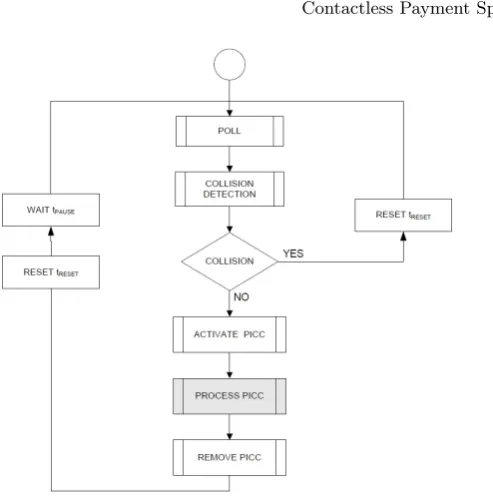
com-Fig. 2.Terminal Main Loop, taken from EMV contactless Book D.
panies such as Visa, MasterCard, and American Express. EMV has specifically defined specifications for contactless payment in books A, B, C and D [6–10]. ISO/IEC 14443 on the other hand, is an international standard that defines proximity cards used for identification, and the transmission protocols used for communication between the card and host. Generally, there are two ISO/IEC 14443 communication signal interfaces: Type A and Type B. They use different Radio Frequency Field (RF) modulation methods for the Proximity Coupling Device (PCD, Reader) to Proximity Integrated Circuit Card (PICC, Card) and the PICC to PCD communication. In this paper, the focus is Type A, which is the mainstream technology [26]. Android supports it, and all of our tested bank cards are Type A.
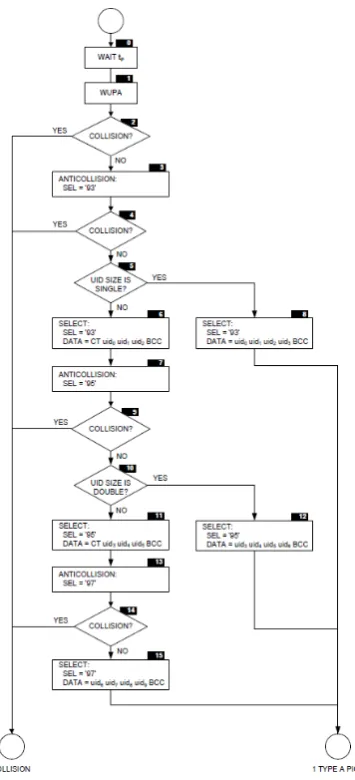
EMV Contactless Book D [10] definesCollisionas follows: “Transmission by two or more PICCs in the same PCD energizing field and during the same time period, such that the PCD [reader] is unable to distinguish from which PICC [card] the data originated”. Based on this definition, in different parts of EMV documents, the aim is to describe how EMV anti-collision mechanism handles the situation when there is more than a card in the field. Here we generally review the whole process for a contactless transaction from the reader’s point of view.
[image:6.595.194.441.94.345.2]card from the same technology in the field. If so, it activates the card. Remem-ber that contactless bank cards are passive, and the reader creates an energising RF (the operating field) that enables the card to power up. Next, the terminal application performs the transaction.
On the other hand, if there exists more than a card in the field, a collision is detected. Accordingly, the terminal will not initiate a transaction in this situa-tion. The collision detection procedure is applicable either on different technolo-gies (Type A, B, and others), or on multiple cards from the same technology. If more than one technology is in the field, the reader must report a collision, reset the operating field, and return to the polling phase. For Type A collision detec-tion, the terminal performs a specific procedure as follows (illustrated in Fig. 5; see Appendix B). Type A cards respond to Wake UP command synchronously using Manchester coding. This allows the terminal to detect the collision in the bit level. After the terminal waits for an intervaltp, it sends WUPA command.
In all parts of this algorithm, if the terminal detects a transmission error in re-sponse to the WUPA and Anti-Collision (AC) commands, it reports a collision, resets, and returns to the polling procedure. Otherwise, the reader sends an AC command which is used to obtain the complete UID of a Type A card, and to detect whether more than one Type A card is in the field. Depending on the UID size of the card, the response to the AC is different. In summary, regardless of the card collision procedure, according to EMV, once a collision is detected, the terminal should not proceed any more; instead it should reset the field and go back to the polling procedure.
2.3 ISO/IEC 14443
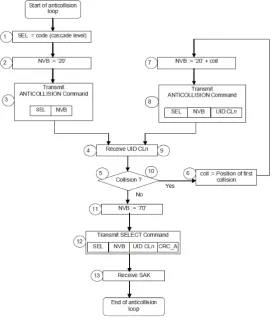
Payment cards (contact and contactless) are based on ISO/IEC 7816 [12] and ISO/IEC 14443 [2–5]. Mobile NFC payment technologies, such as Android Host-based Card Emulation (HCE) [1], are also Host-based on ISO/IEC 14443, which is an international standard in four parts, defining the technology-specific require-ments for proximity cards [2–5]. The third part of this standard [4], namely, Part 3: Initialization and anticollision, presents the same definition for collision as EMV. However, handling collision is different as we explain (presented in Fig. 6, see Appendix B).
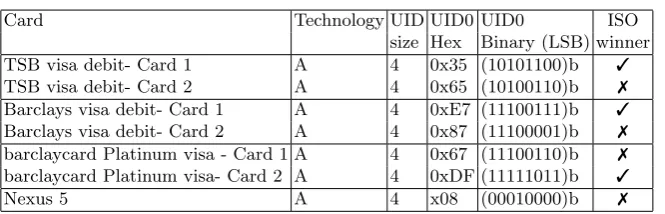
Card Technology UID UID0 UID0 ISO size Hex Binary (LSB) winner
TSB visa debit- Card 1 A 4 0x35 (10101100)b 3
TSB visa debit- Card 2 A 4 0x65 (10100110)b 7
Barclays visa debit- Card 1 A 4 0xE7 (11100111)b 3
Barclays visa debit- Card 2 A 4 0x87 (11100001)b 7
barclaycard Platinum visa - Card 1 A 4 0x67 (11100110)b 7 barclaycard Platinum visa- Card 2 A 4 0xDF (11111011)b 3
[image:8.595.144.477.112.219.2]Nexus 5 A 4 x08 (00010000)b 7
Table 1.Cards’ information, LSB: Least Significant Bit
typical implementation does [4]) to the previous similar bits, the terminal chooses the second card over the first one and continues with it.
As it can be seen unlike EMV, ISO specifies no termination in the case of a collision. Instead, a race condition is created in which depending on the implementation of the terminal, and the UIDs of the cards available in the field one card would be selected. This inconsistency between EMV and ISO perhaps would cause confusion when it comes to practical implementations of these systems. We believe this is an important issue and should be addressed by the community.
3
Experiments on Contacless Readers in Practice
In this section, we examine the anticollision procedure on the contactless termi-nals implemented in practice. We already know that in the case of a card clash in the London metro system, the card reader may either not proceed or pick one card over others without any particular pattern [34]. It is also reported that the cards that are picked up at the start and the end of a journey may be different (in this case the passenger can apply for a refund). This explanation by TfL suggests that the implementation in practice is not consistent with either EMV or ISO. To investigate this issue further, we performed an experiment to observe how payment terminals handled card collision in practice.
Before running the experiment, we tested the NFC chipsets on the cards and the phones that we used in our experiments by writing a reader app using the getId() function5. Our Nexus 5 mobiles returned random 4-byte UIDs which always start with ‘08’. The first byte represents the brand of the technology [27]. All our tested bank cards including TSB visa debit, Barclays visa debit, and barclaycard visa have fixed 4-byte UIDs, as presented in Table 1.
In this experiment, we examined three pairs of contactless cards as presented in Table 1. Each pair has been requested and issued from the same banks and roughly at the same time. (The two TSB visa debit, and the two Barclays visa debit, were requested at the exact same time, and the two barclaycard Platinum
5
No. POS Issuing bank Facing card Result Note to reader
1 MS 1, POS 1 TSB Card 1 No operation
2 MS 1, POS 1 TSB Card 2 No operation
3 MS 2, POS 1 TSB Card 1 No operation
4 MS 2, POS 1 TSB Card 2 No operation
5 MS 1, POS 2 TSB Card 1 No operation
6 MS 1, POS 2 TSB Card 2 Card 1 won msg1
7 MS 1, POS 2 TSB Card 1 Card 2 won on 2nd try msg1
8 MS 2, POS 2 TSB Card 2 Card 1 won
9 MS 2, POS 2 TSB Card 1 No operation
10 MS 2, POS 2 TSB Card 1 No operation
11 MS 1, POS 2 Barclays Card 2 Card 1 won 12 MS 1, POS 2 Barclays Card 1 Card 2 won
13 MS 1, POS 2 Barclays Card 2 Card 1 won msg1
14 MS 1, POS 2 Barclays Card 1 Card 2 won 15 MS 2, POS 1 Barclays Card 2 Card 1 won
16 MS 2, POS 1 Barclays Card 1 Card 2 won msg1
17 MS 2, POS 1 Barclays Card 2 Card 1 won msg1
18 MS 1, POS 3 barclaycard Card 2 Card 1 won 19 MS 1, POS 3 barclaycard Card 1 Card 1 won 20 MS 1, POS 3 barclaycard Card 2 Card 1 won 21 MS 1, POS 3 barclaycard Card 1 Card 1 won 22 MS 2, POS 2 barclaycard Card 2 Card 1 won 23 MS 2, POS 2 barclaycard Card 1 Card 1 won
24 MS 1, POS 1 barclaycard Card 2 Card 1 won on 2nd try msg2 25 MS 1, POS 1 barclaycard Card 1 Card 1 won
[image:9.595.150.457.101.440.2]26 MS 2, POS 3 barclaycard Card 2 Card 1 won 27 MS 2, POS 3 barclaycard Card 1 Card 1 won
Table 2.The results of putting card pairs in the race condition. MS stands for Metro Station. In the case of No operation, the cards were presented 3 times to the POS for the same transaction. msg1: ”Only present one card”, msg2: ”Card read failed”.
visa, were requested and received within a month. The TSB card 1 had been in use more than card 2, and the barclaycard card 2 had been in use much more than card 1.) We presented each pair to different contactless terminals several times in order to put them in race conditions. We made sure that both cards were attached to each other from the same side -contactless chipsets on each other. More specifically, when tapping the cards together to the reader, we put one of the cards on top of the other one for half of the experiments, and exchanged them for the rest of the tests.
on this observation, in the next sections, we demonstrate an attack which can compromise user’s privacy.
4
Attack Design
In this section, first we present the context of the attack. Then, we explain the feasibility of our attack by designing it based on the existing contactless payment specifications.
4.1 Threat Model and Attack Scenario
The context of this attack is when a user aims to pay for something by her contactless card where her card and phone are close to each other and both are presented to the reader’s field. If the phone manages to hijack a few initial NFC signals that the card is meant to receive from the terminal, the attack is successful. In this situation, the phone is able to learn a lot about this contactless payment by requesting PDOL data (details in section 4.2). The data can then be sent to a remote server controlled by the attacker. However, the malicious app would not continue further communication with the reader at some point (since it does not simulate the entire payment) and the user would realise that the payment is not being processed. In order to not disappoint the user on her second effort to pay, the NFC service on the mobile should be turned off for a few minutes once it hears from the reader. In this way, the user is able to complete the payment on the second try.
There are different ways in which the user might keep her card very close to her phone. For example, different models of card holder mobile cases are available in the market now. These cases are capable of containing a few cards as shown in Fig 1. These types of wallets are already very popular with users since they offer an easy way to travel light and keep wallet essentials close to hand. When it comes to contactless payment, these accessories are even more popular since the users do not even need to take the card out of the case. Users can slide their contactless card that is kept inside the mobile case and easily tap it against the reader for daily purchases. After the increase of the cap limit from£20 to£30 in 2015, more retailer shops started to accept contactless payments for small item purchases6.
Third parties are very interested in this sort of information, e.g., for ad-vertising purposes. The collected information could be used in several ways. Third parties normally stimulate the users to purchase items by providing them customized ads based on this information. In addition, they can perform data mining programs to extract the patterns of people’s shopping behaviours. An advanced attack might even pretend to be the user’s bank by presenting this shopping information to her and tricking her to reveal her credentials via social engineering techniques. This attack in this paper can be even more impactful if
6
the malicious app turns into the reader mode and extracts the card’s informa-tion as suggested by Emms et al. [17]. Once the informainforma-tion is extracted, the app goes to the card mode for the rest of the attack. In this way, the attacker can easily pretend to be the user’s bank by having her card information and her shopping records. We believe that these sorts of information are private to the users and should not be collected and shared without their permission.
4.2 Designing the Attack based on NFC Payment Protocols
In this section, we cover a few key points in relation to contactless payment pro-tocols in which we are going to refer in our implementation. EMV Contactless Book B [7] covers the Entry Point Specification. This specification defines the reader requirements necessary to enable the discovery and selection of a con-tactless application, and activation of the appropriate kernel for processing the transaction. Different kernels are used for different Application Definition File (ADF) names. (e.g., for a MasterCard ADF name, Kernel 2 will be used, and for a Visa ADF name, Kernel 3 will be used.) Based on the chosen Kernel, different procedures will run to complete a payment. However, the entry point protocols are the same for all card schemes.
Entry Point is designed around the use of a Proximity Payment System En-vironment (PPSE) as the selection mechanism. For multi-brand acceptance, this allows a reader to quickly obtain all the available brands and applications with a single command and to make an immediate choice based on priority and kernel availability. The Entry Point command and response Application Protocol Data Units (APDUs) are presented in Fig. 3. The File Control Information (FCI) as the response to the PPSE command from the card side includes the Directory Definition File (DDF) covering a product supported by the card, the Kernel Identifier of the kernel required for the specific application underpinning the product (conditional), and the priority of the Combination (conditional). The product is indicated by its ADF name in the card. Hence, it is the card which decides what kernel to choose and talk to. Entry Point finds Combinations by matching pairs of data elements (ADF Name) and Kernel Identifier in the card with pairs of data elements in the reader (AID and Kernel ID). Once all sup-ported Combinations have been found and the highest priority Combination has been identified, Entry Point selects the associated card application by sending a SELECT (AID) command with the ADF Name of the selected Combination. Depending on the selected AID and the kernel in the selected Combinations, a specific kernel is called to take care of the rest of the payment.
Fig. 3.The sequence diagram of the communication between our app and the reader.
5
Implementation
In this section we present the technical implementation of our attack.
5.1 Android HCE
Android supports emulating cards that are based on the NFC-Forum ISO-DEP specification (based on ISO/IEC 14443-1 to 4) and processes Application Pro-tocol Data Units (APDUs) as defined in the ISO/IEC 7816-4 specification. In compliance with ISO/IEC 7816-4, each HCE application has an Application ID (AID). This ID enables the reader app to select the correct service.
In our implementation, we declared an AID group including an AID filter of a Visa card (0xA0000000031010) in an XML resource to be pointed by a
SERVICE META DATA tag in the manifest declaration. On the other hand,
service XML file with an AID filter for the ADF name (“2PAY.SYS.DDF01”) in its ASCII hexadecimal representation of 0x325041592E5359532E4444463031. In the same file, we set the android:requireDeviceUnlock attribute to
falsein order to avoid the user being asked for unlocking her device.
TheHostApduServiceclass is extended for implementing an HCE service
with two abstract methods: processCommandApdu and onDeactivated. The former is called whenever the card receives an APDU from an NFC reader and enables half-duplex communication with the reader. The latter is called when either the NFC link is broken or the reader wishes to talk to another ser-vice. According to EMV, the first two APDUs (SELECT PPSE and SELECT AID) are for service selection. That is where we request PDOL, as shown in Fig. 3. After a successful service selection, the card and reader can exchange any type of data. When the app receives the first GPO command including the requested data, it logs the data in a file, and the attack terminates. Accordingly, our app turns the NFC off by going to the flight mode to allow the user to complete the purchase on the second try.
5.2 Android Flight Mode
Android does not offer any API for turning the NFC controller on/off program-matically. Therefore, developers usually set the NFC settings in a way that prompts the user to turn it on/off manually. In our attack, once our app hears from the terminal, it needs to turn off the NFC, so that the user can success-fully pay on her second try. One possible way to control the NFC adapter is to change the phone’s airplane mode setting. However, only those apps with the superuser permissions can change the Airplane mode setting which requires
WRITE SETTINGSandWRITE SECURE SETTINGSto be declared in the
man-ifest file. Starting from Android 4.2 , turning on/off airplane mode is not sup-ported by android APIs any more. Hence, this part of our attack only works on a rooted device.
On the other hand, this attack needs to keep the phone’s screen on since, at the moment, NFC does not work when the phone is off [1]. An advanced attack would turn the screen on only when the user wants to pay by using accelerometer and gyroscope sensor measurements in order to recognise such a gesture. Li et. al. in [19] show that it is effectively possible to use the tap gesture to unlock the phone for NFC applications based on accelerometer data. By augmenting such a gesture recognition feature to our code, we will have a complete application that is able to compromise users privacy in contactless payments.
6
Experiments and Results
Fig. 4.Contactless card attached to the phone in two different positions for the exper-iments; A (left): the NFC chipset was down, B (right): the NFC chipset was up.
In all experiments, the back of the phone was faced to the terminal (hence, the card was in a closer distance to the terminal than the phone).
6.1 Expected Results
According to the EMV specifications, regardless of the UID of the card and the phone, the terminal should not proceed in the case of a card collision. ISO stan-dards, however, suggest to opt one of the UIDs (typically with higher values) in the race condition. The first UID byte (UID0) of mobile phones that we tested is always ‘08’ (LSB: 00010000), and it is a single UID. As presented in Table 1, all of our cards should always win over the phone if it is a typical ISO imple-mentation. In the following experiments, we show that the expected behaviour does not happen in practice, and the phone wins with a high probability.
6.2 Experiment A: Card and Phone Collision
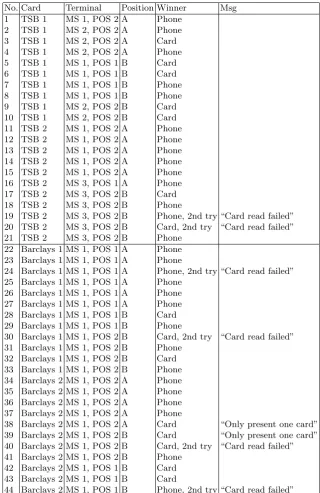
In this experiment, we tested a few different contactless cards by presenting each card with the phone to a few terminals (contactless metro ticket machines). We tested multiple cards including two TSB visa debit, and two Barclays visa debit on different machines. During this experiment, we asked a few users to pay for metro tickets with different contactless cards that we provided to them. These cards were attached to mobile phones (Nexus 5). These participants were informed of the purpose of the experiment, but were not asked to follow any particular procedure. We asked them to naturally pay contactlessly. We observed the behaviour of the terminals as summarized in Table 4 (see Appendix A).
Sender APDU Command Terminal00A404000E325041592E5359532E444446303100SELECT PPSE Phone 6F3C840E325041592E5359532E4444463031A52AFCI
BF0C2761254F07A0000000031010870101501042 4152434C4159434152442056495341BF6304DF20 01809000
Reader 00A4040007A000000003101000 SELECT AID
Phone 6F4B8407A0000000031010A5405010424152434CFCI including
41594341524420564953418701019F38189F6604PDOL request 9F02069F03069F1A0295055F2A029A039C019F37
045F2D02656EBF0C089F5A0531082608269000
Terminal80A8000023832130000000000000000080000000 GPO including
0000000826000000000008261605230016126739PDOL data
[image:15.595.146.472.111.277.2]00
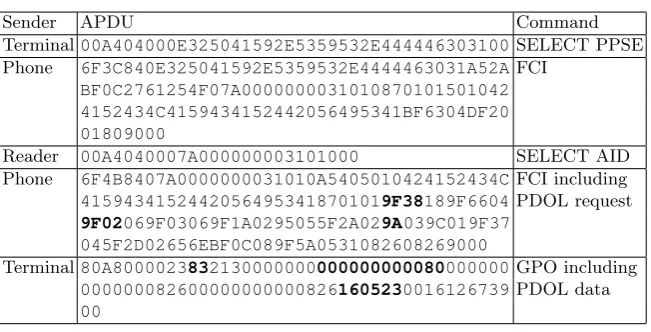
Table 3.Exchanged APDUs of experiment B
generally our app is able to recognise about 66% of the user’s contactless payment activities. Over time, this success rate would allow the attacker to accumulate information about the user’s contactless payment patterns.
Our observations show that contactless terminals present different messages on the display based on the situation. When select to pay, it displays: “Insert, swipe or tap for GBP 0.80” as the first message. If it can not choose either the card or the phone it displays: “Card read failed”, and it goes back to the first message. The fail message happened when our users tapped the card and the phone very quickly, hence none of them were presented to the field for a sufficient time. Similar to our experiments in Section 3, the terminal may show another message: “Only present one card”, but it still proceeds with the transaction.
6.3 Experiment B: PDOL Data
In order to show the impact of the attack more visibly, we performed another experiment. While purchasing a ticket, we presented our final app to a payment terminal in a metro station. Our app logged the PDOL data of the transaction and then went to the Airplane mode. We built our card app in a way that it responded to the two SELECT commands – PPSE and AID – before asking for PDOL data (see Fig. 3).
The exchanged command and response APDUs are shown in Table 3. As it can be seen, when the card sends the second FCI, by sending PDOL tag (‘9F38’), it requests different sort of information about the transaction such as the amount (tag=‘9F02’, Amount, Authorised (Numeric)) and transaction date (tag=‘9A’). Accordingly, the terminal responds with the first GPO command including the requested items for PDOL (‘83’) i.e. amount (‘000000000080’ = 0.80 pence) and date (‘160523’ = 2016 May 23) [11].
7
Conclusion
In this paper, we discussed a real world problem concerning the card collision when making contactless payments. We studied the EMV and ISO standards on card collision, and by performing experiments we discovered that the im-plementation in practice matches neither of them. Based on this inconsistency, we describe and implement an attack on the privacy of contactless payments. In this attack, we simulated a card within an app and tracked the user’s contactless payment transactions by requesting PDOL data from the terminal. When the phone and the card are both presented to a contactless terminal, our app could successfully win the race condition over the card in the majority of test cases.
Our findings suggest vulnerabilities in the current infrastructure which needs to be addressed. More specifically, the results of our experiments show that when tapping the terminal with more than a card, in most cases (Tables 2 and 4), the terminal does not even identify the card collision. Nevertheless, even if the terminal identifies the presence of more than a card in the field (by showing a message), it still proceeds with the transactions. The selection of the card appears random. A countermeasure to this identified privacy attack is updating the implementation of the payment terminals according to EMV’s card collision algorithm: i.e., the process should not proceed when more that one card is detected in the field. Updating some parts of EMV’s protocol and protecting the PDOL data would also mitigate the introduced attack. Finally, the EMV and ISO standards would need to be updated to have a consistent algorithm to handle card collision.
Acknowledgement
We would like to thank Dr. Michael Ward from EMV and Digital Devices for his valuable help towards our better understanding of EMV contactless specifi-cations. We would like to thank Dr. Martin Emms and Mr. Ehsan Toreini from Newcastle University for their help on performing the experiments of this work. We also thank all the anonymous reviewers of this paper. All experiments gained approval through Newcastle University’s research ethics processes. Feng Hao was supported by ERC Starting Grant No 306994, Aad van Moorsel was supported by EPSRC grant K006568.
References
1. Host-based card emulation. Available online at
http://developer.android.com/guide/topics/connectivity /nfc/hce.html.
2. INTERNATIONAL ORGANIZATION FOR STANDARDIZATION, BS ISO/IEC 14443-1:2008+A1:2012 Identification cards. Contactless integrated circuit cards. Proximity cards. Physical characteristics, 2012. Available at
3. INTERNATIONAL ORGANIZATION FOR STANDARDIZATION, BS ISO/IEC 14443-2:2010+A2:2012 Identification cards. Contactless integrated circuit cards. Proximity cards. Radio frequency power and signal interface, 2012. Available at
www.bsol.bsigroup.com.
4. INTERNATIONAL ORGANIZATION FOR STANDARDIZATION, BS ISO/IEC 14443-3:2011+A6:2014 Identification cards. Contactless integrated circuit cards. Proximity cards. Initialization and anticollision, 2014. Available at
www.bsol.bsigroup.com.
5. INTERNATIONAL ORGANIZATION FOR STANDARDIZATION, BS ISO/IEC 14443-4:2008+A4:2014 Identification cards. Contactless integrated circuit cards. Proximity cards. Transmission protocol , 2014. Available at
www.bsol.bsigroup.com.
6. EMV Contactless Specifications for Payment Systems, Book A: Architec-ture and General Requirements, 2015. Available at www.emvco.com /specifications.aspx?id=21.
7. EMV Contactless Specifications for Payment Systems, Book B: Entry Point, 2015. Available atwww.emvco.com/specifications.aspx?id=21.
8. EMV Contactless Specifications for Payment Systems, Book C2: Kernel 2 Specifi-cation, 2015. Available atwww.emvco.com/specifications.aspx?id=21. 9. EMV Contactless Specifications for Payment Systems, Book C3: Kernel 3
Specifi-cation, 2015. Available atwww.emvco.com/specifications.aspx?id=21. 10. EMV Contactless Specifications for Payment Systems, Book D:
Con-tactless Communication Protocol, 2015. Available at www.emvco.com /specifications.aspx?id=21.
11. EMV Integrated Circuit Card Specifications for Payment Systems, Book 3, 2011. Available atwww.emvco.com/specifications.aspx?id=223.
12. INTERNATIONAL ORGANIZATION FOR STANDARDIZATION, BS ISO/IEC 7816-4:2013, Identification cards. Integrated circuit cards. Organization, security and commands for interchange, 2013. Available atwww.bsol.bsigroup.com. 13. A. J. Aviv, B. Sapp, M. Blaze, and J. M. Smith. Practicality of accelerometer side
channels on smartphones. In Proceedings of the 28th Annual Computer Security Applications Conference, pages 41–50. ACM, 2012.
14. R. Balebako, J. Jung, W. Lu, L. F. Cranor, and C. Nguyen. ”little brothers watching you”: Raising awareness of data leaks on smartphones. In Proceedings of the Ninth Symposium on Usable Privacy and Security, SOUPS ’13, pages 12:1– 12:11, New York, NY, USA, 2013. ACM.
15. L. Cai and H. Chen. Touchlogger: Inferring keystrokes on touch screen from smart-phone motion. InHotSec, 2011.
16. M. Curphey. Card clash, what is it, and how to avoid ir, 2014. Avail-able online at http://uk.creditcards.com/credit-card-news/what-is-card-clash-and-how-to-avoid-it-1372.php.
17. M. Emms, B. Arief, N. Little, and A. van Moorsel. Risks of offline verify pin on contactless cards. In Financial Cryptography and Data Security, volume 7859 of Lecture Notes in Computer Science, pages 313–321. Springer Berlin Heidelberg, 2013.
19. H. Li, D. Ma, N. Saxena, B. Shrestha, and Y. Zhu. Tap-wave-rub: Lightweight malware prevention for smartphones using intuitive human gestures. InProceedings of the Sixth ACM Conference on Security and Privacy in Wireless and Mobile Networks, WiSec ’13, pages 25–30, New York, NY, USA, 2013. ACM.
20. G. Marshall. Travel using contactless cards: An update from tfl, 2014. Available online at http://londonist.com/2014/07/travel-using-contactless-cards-an-update-from-tfl.
21. M. Mehrnezhad, F. Hao, and S. F. Shahandashti. Security Standardisation Re-search: Second International Conference, SSR 2015, Tokyo, Japan, December 15-16, 2015, Proceedings, chapter Tap-Tap and Pay (TTP): Preventing the Mafia Attack in NFC Payment, pages 21–39. Springer International Publishing, Cham, 2015.
22. M. Mehrnezhad, E. Toreini, S. F. Shahandashti, and F. Hao. Touchsignatures: Identification of user touch actions based on mobile sensors via javascript. In Proceedings of the 10th ACM Symposium on Information, Computer and Com-munications Security, ASIA CCS ’15, pages 673–673, New York, NY, USA, 2015. ACM.
23. M. Mehrnezhad, E. Toreini, S. F. Shahandashti, and F. Hao. Touchsignatures: Identification of user touch actions and pins based on mobile sensor data via javascript. Journal of Information Security and Applications, 26:23 – 38, 2016. 24. E. Miluzzo, A. Varshavsky, S. Balakrishnan, and R. R. Choudhury. Tapprints: your
finger taps have fingerprints. In Proceedings of the 10th international conference on Mobile systems, applications, and services, pages 323–336. ACM, 2012. 25. K. Morley. Contactless cards: how to avoid paying twice, 2014.
Avail-able online at http://www.telegraph.co.uk/finance/personalfinance/money-saving-tips/11215583/Contactless-cards-how-to-avoid-paying-twice.html.
26. ISO 14443, ISO 18092, Type-A, Type-B, Type-F, Felica, Calypso NFCIP, NFC-HELP!, 2009. Available online at http://www.nfc.cc/2009/01/03/iso-14443-iso-18092-type-a-type-b-type-f-felica-calypso-nfcip-nfc-help/.
27. AN10927, MIFARE and handling of UIDs, 2013. By NXP, Company Public. 28. E. Owusu, J. Han, S. Das, A. Perrig, and J. Zhang. Accessory: password inference
using accelerometers on smartphones. InProceedings of the Twelfth Workshop on Mobile Computing Systems & Applications, page 9. ACM, 2012.
29. H. Saul. Oyster card users pay up to £91 more each week than people using new contactless payment, 2014. Available online at http://www.independent.co.uk/news/uk/home-news/oyster-card-users-pay-up-to-91-more-each-week-than-people-using-new-contactless-payment-9843642.htmll. 30. B. Shrestha, N. Saxena, H. T. T. Truong, and N. Asokan. Drone to the
Res-cue: Relay-Resilient Authentication using Ambient Multi-sensing, pages 349–364. Springer Berlin Heidelberg, Berlin, Heidelberg, 2014.
31. L. Simon and R. Anderson. Pin skimmer: Inferring pins through the camera and microphone. InProceedings of the Third ACM Workshop on Security and Privacy in Smartphones and Mobile Devices, SPSM ’13, pages 67–78, New York, NY, USA, 2013. ACM.
32. R. Spreitzer. Pin skimming: Exploiting the ambient-light sensor in mobile devices. InProceedings of the 4th ACM Workshop on Security and Privacy in Smartphones and Mobile Devices, SPSM ’14, pages 51–62, New York, NY, USA, 2014. ACM. 33. Why contactless cards can leave you with a losing deal, 2014. Available online at
http://www.theguardian.com/money/2013/may/25/contactless-cards.
35. J. Vila and R. J. Rodr´ıguez. Radio Frequency Identification: 11th International Workshop, RFIDsec 2015, New York, NY, USA, June 23-24, 2015, Revised Se-lected Papers, chapter Practical Experiences on NFC Relay Attacks with Android, pages 87–103. Springer International Publishing, Cham, 2015.
36. Z. Xu, K. Bai, and S. Zhu. Taplogger: Inferring user inputs on smartphone touch-screens using on-board motion sensors. InProceedings of the fifth ACM conference on Security and Privacy in Wireless and Mobile Networks, pages 113–124. ACM, 2012.
A
Experiment Results
In this section, we provide the detailed results of our Card and Phone Collision experiment. These results are presented in Table 4.
B
EMV and ISO Flowcharts
No. Card Terminal Position Winner Msg
1 TSB 1 MS 1, POS 2 A Phone
2 TSB 1 MS 2, POS 2 A Phone
3 TSB 1 MS 2, POS 2 A Card
4 TSB 1 MS 2, POS 2 A Phone
5 TSB 1 MS 1, POS 1 B Card
6 TSB 1 MS 1, POS 1 B Card
7 TSB 1 MS 1, POS 1 B Phone
8 TSB 1 MS 1, POS 1 B Phone
9 TSB 1 MS 2, POS 2 B Card
10 TSB 1 MS 2, POS 2 B Card
11 TSB 2 MS 1, POS 2 A Phone
12 TSB 2 MS 1, POS 2 A Phone
13 TSB 2 MS 1, POS 2 A Phone
14 TSB 2 MS 1, POS 2 A Phone
15 TSB 2 MS 1, POS 2 A Phone
16 TSB 2 MS 3, POS 1 A Phone
17 TSB 2 MS 3, POS 2 B Card
18 TSB 2 MS 3, POS 2 B Phone
19 TSB 2 MS 3, POS 2 B Phone, 2nd try “Card read failed” 20 TSB 2 MS 3, POS 2 B Card, 2nd try “Card read failed”
21 TSB 2 MS 3, POS 2 B Phone
22 Barclays 1 MS 1, POS 1 A Phone 23 Barclays 1 MS 1, POS 1 A Phone
24 Barclays 1 MS 1, POS 1 A Phone, 2nd try “Card read failed” 25 Barclays 1 MS 1, POS 1 A Phone
26 Barclays 1 MS 1, POS 1 A Phone 27 Barclays 1 MS 1, POS 1 A Phone 28 Barclays 1 MS 1, POS 1 B Card 29 Barclays 1 MS 1, POS 1 B Phone
30 Barclays 1 MS 1, POS 2 B Card, 2nd try “Card read failed” 31 Barclays 1 MS 1, POS 2 B Phone
32 Barclays 1 MS 1, POS 2 B Card 33 Barclays 1 MS 1, POS 2 B Phone 34 Barclays 2 MS 1, POS 2 A Phone 35 Barclays 2 MS 1, POS 2 A Phone 36 Barclays 2 MS 1, POS 2 A Phone 37 Barclays 2 MS 1, POS 2 A Phone
38 Barclays 2 MS 1, POS 2 A Card “Only present one card” 39 Barclays 2 MS 1, POS 2 B Card “Only present one card” 40 Barclays 2 MS 1, POS 2 B Card, 2nd try “Card read failed” 41 Barclays 2 MS 1, POS 2 B Phone
42 Barclays 2 MS 1, POS 1 B Card 43 Barclays 2 MS 1, POS 1 B Card
[image:20.595.146.467.126.620.2]44 Barclays 2 MS 1, POS 1 B Phone, 2nd try “Card read failed”