warwick.ac.uk/lib-publications
A Thesis Submitted for the Degree of PhD at the University of Warwick
Permanent WRAP URL:
http://wrap.warwick.ac.uk/88732
Copyright and reuse:
This thesis is made available online and is protected by original copyright.
Please scroll down to view the document itself.
Please refer to the repository record for this item for information to help you to cite it.
Our policy information is available from the repository home page.
U N
IV ER
SITAS WARWICEN
SIS
Spatio-temporal Framework on Facial expression
Recognition
by
Xijian Fan
Thesis
Submitted to the University of Warwick
for the degree of
Doctor of Philosophy
School of Engineering
List of Tables vii
List of Figures x
Acknowledgments ii
Declarations iii
Abstract iv
Publications vi
Abbreviations vii
Chapter 1 Introduction 1
1.1 Background knowledge . . . 1
1.1.1 Perspectives from psychology . . . 2
1.2 Objectives and motivation . . . 7
1.3 Contributions . . . 8
1.4 Structure of thesis . . . 9
Chapter 2 Literature review on Facial expression recognition 10 2.1 Techniques in facial expression recognition systems . . . 10
2.1.1 Face acquisition . . . 11
2.1.2 Feature representation . . . 17
2.1.3 Classification . . . 28
2.1.4 Challenges . . . 30
2.2 Datasets for facial expression recognition . . . 30
2.3 Multi-modal expression analysis . . . 32
2.4 Problem Space for facial expression analysis . . . 33
2.4.3 Individual difference in subjects . . . 35
2.4.4 Transitions among expressions . . . 35
Chapter 3 Patch based facial expression recognition framework 37 3.1 Introduction . . . 37
3.2 Proposed framework . . . 38
3.3 Facial landmark detection . . . 39
3.3.1 Pre-processing . . . 40
3.3.2 Eye and Nose Localisation . . . 40
3.3.3 Lip corner detection . . . 41
3.3.4 Eyebrow corner detection . . . 43
3.4 Extraction of active facial patches . . . 44
3.5 Feature extraction and classification . . . 45
3.5.1 Sparse representation . . . 45
3.5.2 Learning salient facial patches across expressions . . . 47
3.6 Experiments . . . 49
3.6.1 Experiments on the Cohn-Kanade database . . . 50
3.6.2 Experiments on JAFFE Database . . . 51
3.6.3 Experiments on fused database . . . 51
3.7 Conclusion . . . 52
Chapter 4 Spatial-Temporal Framework Based on Histogram of Gra-dient and Optical Flow 54 4.1 Introduction . . . 54
4.2 Proposed framework . . . 55
4.3 Dynamic features extraction . . . 58
4.3.1 PHOG TOP descriptor . . . 58
4.3.2 Dense optical flow descriptor . . . 60
4.3.3 Integration of descriptors . . . 63
4.4 Experiments . . . 64
4.4.1 Facial expression datasets . . . 64
4.4.2 Experimental results . . . 65
4.5 Conclusion . . . 74
5.1 Introduction . . . 75
5.2 Proposed framework . . . 77
5.2.1 Dimensionality reduction using 2D PCA . . . 77
5.3 Feature extraction . . . 78
5.3.1 Motion History Image . . . 78
5.3.2 Optical Flow Algorithm . . . 79
5.3.3 Optical Flow based MHI (MHI OF) . . . 80
5.3.4 Entropy . . . 81
5.3.5 Local Zernike Moment . . . 83
5.3.6 Extension to spatio-temporal . . . 85
5.3.7 Fusion using weighting function . . . 86
5.4 Experiments . . . 87
5.4.1 Facial expression datasets . . . 87
5.4.2 Experimental results . . . 87
5.5 Conclusion . . . 92
Chapter 6 Conclusions and Future Work 94 6.1 Conclusions . . . 94
6.2 Future work . . . 96
2.1 Number of image sequences (subjects) for each expression in the CK+ dataset. . . 32
3.1 The confusion matrix using Framework 1 on CK+ database. . . 50
3.2 The confusion matrix using Framework 1 on JAFFE database. . . . 51
3.3 The salient patches derived from fusion CK+ and JAFFE Dataset. . 52
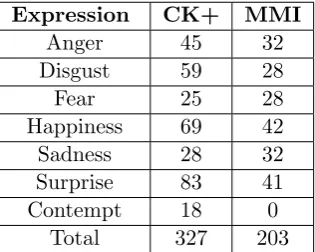
4.1 Number of image sequences (subjects) for each expression in the CK+ dataset and MMI dataset. . . 65
4.2 Multiclass SVM results of PHOG TOP from the whole face on
clas-sification of six facial expressions and Contempt of the CK+ dataset with leave-sequence-out cross-validation. . . 68
4.3 Multiclass SVM results in using Dense flow optical flow on
classifica-tion of six facial expressions and Contempt of the CK+ dataset with leave-sequence-out cross-validation. Dark grey shade - correct
recog-nition result of each emotion; and lighter grey shade - recogrecog-nition
result of each emotion misclassified with the maximal error. . . 69 4.4 Multiclass SVM results in using PHOG TOP on classification of six
facial expressions and Contempt of the CK+ dataset with
leave-sequence-out cross-validation. Dark grey shade - correct recognition result of each emotion; and lighter grey shade - recognition result of
each emotion misclassified with the maximal error. . . 70
4.5 Multiclass SVM results in using Framework 2 on classification of
six facial expressions and Contempt of the CK+ dataset with
leave-sequence-out cross-validation. Dark grey shade - correct recognition result of each emotion; and lighter grey shade - recognition result of
each emotion misclassified with the maximal error. . . 70
4.6 Comparative evaluation of Framework 2 with 2 methods using leave-subject-out cross-validation. . . 71
sequence-out cross-validation. The value in a parentheses denotes
the difference in recognition rate in using dense optical flow and in
using shape.) Dark grey shade - correct recognition result of each emotion; and lighter grey shade - recognition result of each emotion
misclassified with the maximal error. . . 72
4.8 Confusion matrix in using PHOG TOP on classification of six facial expressions and Contempt of the CK+ dataset with
leave-sequence-out cross-validation. The value in a parentheses denotes the difference
in recognition rate in using PHOG TOP and in using appearance (of Lucey et al.) Dark grey shade - correct recognition result of each
emotion; and lighter grey shade - recognition result of each emotion
misclassified with the maximal error. . . 72 4.9 Confusion matrix in using Framework 2 on classification of six facial
expressions and Contempt of the CK+ dataset with
leave-sequence-out cross-validation. The value in a parentheses denotes the difference in recognition rate in using the combined features of dense optical flow
and PHOG TOP and in using the combined features of shape and appearance (of Lucey et al.) Dark grey shade - correct recognition
result of each emotion; and lighter grey shade - recognition result of
each emotion misclassified with the maximal error. . . 73
4.10 Comparative evaluation of Framework 2 using MMI dataset . . . 74
5.1 Recognition rate of enMHI OF on classification of six facial
expres-sions and contempt of the CK+ dataset with leave-sequence-out cross-validation. . . 88
5.2 Recognition rate of QLZM MCF on classification of six facial
ex-pressions and contempt of the CK+ dataset with leave-sequence-out cross-validation. . . 89
5.3 Recognition rate of enMHI OF on classification of six facial
expres-sions and contempt of the CK+ dataset with leave-sequence-out cross-validation. . . 89
5.4 Recognition rate of using simple fusion strategy on classification of
six facial expressions and contempt of the CK+ dataset with leave-sequence-out cross-validation. . . 90
sequence-out cross-validation. . . 90
5.6 The overall recognition rates of the four spatio-temporal features on
the CK+ dataset. . . 90
5.7 Comparative evaluation of Framework 3 on the MMI dataset. . . 91
5.8 Number of image sequences (subjects) for each expression in the
AFEW dataset. . . 92 5.9 Recognition rate of the proposed strategy on classification of six basic
facial expressions and neutral expression of the AFEW dataset. . . . 93
1.1 Example of expression for the six basic emotions (Left-to-right from top row: anger, fear, disgust, surprise, happiness, and sadness). . . . 4
1.2 Example of AUs which defined in FACS . . . 5
1.3 Facial Action Units. . . 5 1.4 Some examples of Action Units. Action Units are atomic facial muscle
actions described in FACS. . . 6
2.1 Basic structure of facial expression recognition system . . . 11
2.2 The sum of the pixels within rectangle D can be computed with four
array references. The value of the integral image at location 1 is the sum of the pixels in rectangle A. The value at location 2 is A + B, At
location 3 is A + C, and at location 4 is A + B + C + D. The sum
within D can be computed as 4 + 1−(2 + 3). . . 15 2.3 The left, middle, and right graphics above show the absolute value,
and the real and imaginary components of a sample Gabor filter. . . 19
2.4 Three examples of the extended: the circular (8; 1) neighbourhood, the circular (12; 1) neighbourhood, and the circular (16; 2)
neighbour-hood, respectively . . . 21
2.5 PHOG descriptor of an image. . . 22 2.6 Example of expression for the six basic emotions (Left-to-right from
top row: anger, disgust, fear, happiness, sadness, and surprise). . . . 31
2.7 Example of the face and body feature extraction employed in the
FABO system. (a) Face features. (b) Body features shoulder
extrac-tion procedure. Shoulder regions found and marked on the neutral
frame (first row), estimating the movement within the shoulder re-gions using optical flow (second row) . . . 33
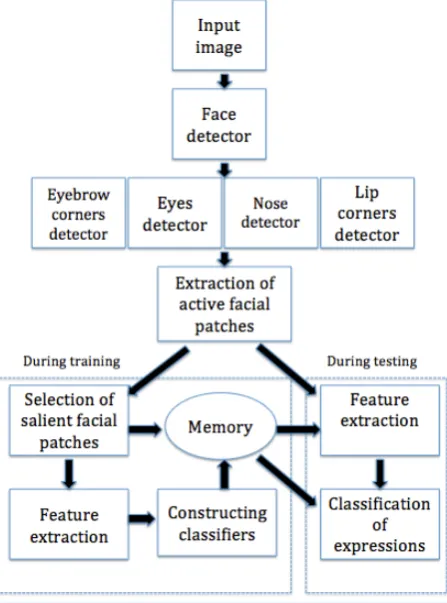
3.1 Framework 1 for facial expression recognition. . . 39
nose, (c) eyes and nose detection followed by coarse ROI selection
for eyebrows and lips, (d) detection of corners of lip and eyebrows,
(e) finding the facial landmark locations, and (f) extraction of active facial patches. . . 40
3.3 Lip corner localisation: (a) lips ROI, (b) applying horizontal Sobel
edge detector, (c) applying Otsu thresholding, (d) removing spuri-ous edges, and (e) applying morphological operations to render final
connected component for lib corner localisation. . . 42
3.4 Lip corner localisation where the upper lip is not entirely connected, (a-c) same as Figure 3.3, (d-e) selection of two connected components
by scanning from top, and (f) localized lip corners. . . 42
3.5 Eyebrow corner localisation: (a) rectangles enclosing ROI and plus marks showing the detection result, (b and f) eye ROIs, (c and g)
applying adaptive threshold on ROIs, (d and h) applying horizontal
Sobel edge detector followed by Otsu thresholding and morphologi-cal operations, and (e and i) final connected components for corner
localisation. . . 43 3.6 Position of facial patches. . . 45
3.7 (a) Sparse decomposition of a facial image including images of the
same person in the dictionary; (b) Sparse decomposition of an ex-pressive facial image including images of the same person in the
dic-tionary; (c) Sparse decomposition of the same image excluding images
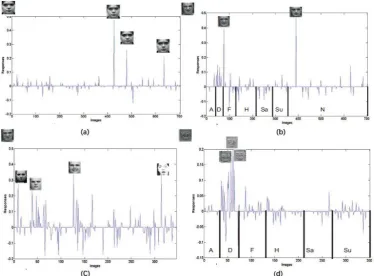
of the same facial class from the dictionary; and (d) Sparse decom-position of the differences images. . . 48
3.8 Eyebrow corner localisation: (a) rectangles enclosing ROI and plus
marks showing the detection result, (b and f) eye ROIs, (c and g) applying adaptive threshold on ROIs, (d and h) applying horizontal
Sobel edge detector followed by Otsu thresholding and
morphologi-cal operations, and (e and i) final connected components for corner localisation. . . 49
3.9 The recognition rate using different number of salient patches. . . . 50
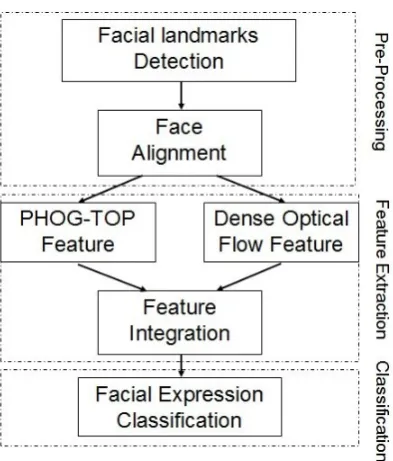
4.1 Framework 2 for facial expression recognition. . . 56 4.2 PHOG descriptor of a face. . . 58
(b) the x-y, y-t, and x-t planes, and the concatenation of resulting
histograms into a single feature set. . . 59
4.4 (Left) four facial sub-regions, and (right) face video sequence with 3D mouth sub-region. . . 61
4.5 (Left) a neutral image, and (right) with the dense optical flow
(de-noted by needles) superimposed. The magnitude and direction of the flow are respectively indicated by its length and the direction of its
arrow. . . 62
4.6 Example of expressions from CK+ dataset (top row) and MMI dataset (bottom row). Each image is the frame with the most expressive face
in a video sequence. . . 64
4.7 Recognition rates of all expressions PHOG from either XY, XT, YT
or their combination, i.e., PHOG TOP. . . 66
4.8 Recognition rates of all expressions in using combination of
non-weighted and non-weighted PHOG TOP. . . 67 4.9 Discriminant power of of facial sub-regions in recognising six
expres-sions using PHOG TOP. . . 69
5.1 Framework 3 for facial expression recognition. . . 77
5.2 Example of images from sequences (left and middle) and its MHI
(right). . . 79
5.3 Optical flow based MHI for Anger, Happiness and Surprise (from
right to left). . . 80
5.4 Example image entropies: (left column) neutral image and its
en-tropy; (middle colulmn) surprise image and its enen-tropy; and (right
column) MHI of surprise image and its entropy. Lighter shades
de-note larger entropy values. . . 82 5.5 QLZM based facial representation framework. . . 84
5.6 Recognition rates of all expressions using QLZM and QLZM MCF. . 88
5.7 Recognition rates of all expressions using MHI and MHI OF. . . 89
5.8 Sample frames from AFEW dataset. . . 92
I would like to thank Dr Tardi Tjahjadi for supervising me on facial expression
recognition. During his supervision, I have read, learnt and implemented a number
of algorithms, from which I was able to obtain ideas on what to do and how in order
to fulfil my PhD requirements. Dr Tardi is a very studious and hard-working person,
who arrives in the School at 7.30 am every morning and leaves at 6.00 pm. He often
works extra hours in the weekends to revise my manuscripts. His conscientious
personality also helped me correct numerous errors in my articles and encourage me
to be more careful. Thank you very much for helping me to submit three journal
articles, two of which has been published.
I would like to thank my lab-mates AngLi, Sruti, and Ting at Image
Pro-cessing and Expert Systems Laboratory, for providing various kinds of help. I would
like to thank my PhD friends, Zhaohui Wang, Junyi, Guannan, and Jieren for giving
me constant strength for four years. I want to thank my parents and other family
relatives as well.
Finally, I would like to express my gratitude to the School of Engineering
of Warwick University and China Scholarship Council for providing the financial
support throughout my PhD study.
I hereby declare that I have produced this thesis without the prohibited assistance
of third parties and without making use of aids other than those specified; notions
taken over directly or indirectly from other sources have been identified as such. This
thesis has not previously been presented in identical or similar form to any other
publication unless otherwise specified. The thesis work was conducted from 2012
to 2016 under the supervision of Reader Dr. Tardi Tjahjadi at Image Processing
Laboratory, School of Engineering, University of Warwick.
This thesis presents an investigation into two topics that are important in
facial expression recognition: how to employ the dynamic information from facial
expression image sequences and how to efficiently extract context and other relevant
information of different facial regions. This involves the development of
spatio-temporal frameworks for recognising facial expression.
The thesis proposed three novel frameworks for recognising facial expression.
The first framework uses sparse representation to extract features from patches of a
face to improve the recognition performance, where part-based methods which are
robust to image alignment are applied. In addition, the use of sparse representation
reduces the dimensionality of features, and improves the semantic meaning and
represents a face image more efficiently.
Since a facial expression involves a dynamic process, and the process contains
information that describes a facial expression more effectively, it is important to
capture such dynamic information so as to recognise facial expressions over the
entire video sequence. Thus, the second framework uses two types of dynamic
information to enhance the recognition: a novel spatio-temporal descriptor based
on PHOG (pyramid histogram of gradient) to represent changes in facial shape, and
dense optical flow to estimate the movement (displacement) of facial landmarks. The
framework views an image sequence as a spatio-temporal volume, and uses temporal
information to represent the dynamic movement of facial landmarks associated with
a facial expression. Specifically, spatial based descriptor representing spatial local
shape is extended to spatio-temporal domain to capture the changes in local shape
of facial regions in the temporal dimension to give 3D facial component
descriptors enhence the dynamic information and achieves better performance than
the individual descriptors.
The third framework also focuses on analysing the dynamics of facial
expres-sion sequences to represent spatial-temporal dynamic information (i.e., velocity).
Two types of features are generated: a spatio-temporal shape representation to
enhance the local spatial and dynamic information, and a dynamic appearance
rep-resentation. In addtion, an entropy-based method is introduced to provide spatial
relationship of different parts of a face by computing the entropy value of different
sub-regions of a face.
1. X. Fan, and T. Tjahjadi. A spatial-temporal framework based on histogram of
gradients and optical flow for facial expression recognition in video sequences.
Pattern Recognition 48.11 (2015): 3407-3416.
2. X. Fan, and T. Tjahjadi. A Dynamic Framework Based on Local Zernike
Mo-ment and Motion History Image for Facial Expression Recognition. (accepted
by Pattern Recognition)
3. X. Fan, and T. Tjahjadi. Patch based facial expression recognition. (under
preparation)
• 1D: 1-dimensional
• 2D: 2-dimensional
• 3D: 3-dimensional
• AFEW: acted facial expressions in the wild
• AUs: action units
• FACS: Facial Action Coding System
• FER: facial expression recognition
• GP: graph preserving
• GUI: graphical user interface
• KNN: K-Nearest Neighbour
• HMM: hidden Markov models
• HOG: histogram of gradient
• HSI: hue, saturation, and intensity
• IMU: inertial measurement unit
• LBP: local binary pattern
• LEAR: local evidence aggregated regression
• LGBP: local Gabor binary pattern
• LZM: local Zernike moment
• MEI: motion energy image
• MCF: motion change frequency
• MHI: motion history image
• NMF: non-Negative matrix factorisation
• OF: optical flow
• PCA: principal component analysis
• QLZM: quantised local Zernike moment
• RBF: radial basis function
• RGB: red, green and blue
• PHOG: pyramid histogram of gradient
• ROI: region of interest
• SD: subclass discriminant
• SRC: sparse-representation based classifier
• SVM: support vector machine
• TOP: three orthogonal plane
• VLBP: volume local binary patterns
Introduction
This thesis presents an investigation into two topics that are important in facial ex-pression recognition: how to employ the dynamic information from facial exex-pression
image sequences and how to efficiently and robustness extract context and other relevant information of different facial regions. This involves the development of spatio-temporal frameworks for recognising facial expression. Section 1.1 provides
the introduction of background knowledge, which includes the overview of facial expression studies from the cognition science. The research commencing with the
objectives and motivation is then introduced in Section 1.2. In addition, the main contributions are briefly introduced in Section 1.3. The organisation of this thesis are finally presented in Section 1.4.
1.1
Background knowledge
With the rapid development of the technology of computer and artificial intelligence, the demand for human and computer interaction (HCI) has been increasingly higher.
Verbal and non-verbal, as two main forms of communication play a vital role in our daily life and complete various routine tasks [1; 2; 3]
For the last forty years (specifically since 1974 [4]), computer vision research community has shown a lot of interest in analysing and automatically recognising facial expressions. Initially inspired by the findings of the cognitive scientists, the
computer vision/science research community envisioned to develop such frameworks that can do the job of expression recognition in videos or still images.
As we know, it is easy for people to recognise the emotion expression of
others when they communicate face to face. However, it is relatively difficult for computer. For motion recognition in computer vision, higher level knowledge is
also expression intention, cognitive processes, physical effort, or other intra or in-terpersonal meanings. Interpretation is assisted by context, body gesture, voice, individual differences, and cultural factors as well as by facial configuration and
timing [5; 6; 7].
Facial expressions are studied simultaneously by different scientists from dif-ferent domains i.e. cognitive scientists, psychologists, neuroscientists and computer
scientists etc. Although the algorithms proposed in this research work fall in the category of ”computer vision” but they are based on the psycho-visual study. As
the psycho-visual study is based on the principles of cognitive science, Section 1.1.1 provides the overview of facial expression studies from the cognition science litera-ture.
1.1.1 Perspectives from psychology
Communication in any form i.e. verbal or non-verbal is vital to complete various
daily routine tasks and plays a significant role in life. Facial expression is one of the most effective form of non-verbal communication and it provides a clue about
emotional state, mindset and intention [8; 9; 10; 3]. Facial expressions not only can change the flow of conversation [11] but also provides the listeners a way to communicate a wealth of information to the speaker without even uttering a single
word [12]. According to [13; 14] when the facial expression does not coincide with the other communication i.e. spoken words, then the information conveyed by the face gets more weight in decoding information. We are used to see face with different
expressions every day, but still sometimes we fail to understand them. It is such paradox of the obvious and the mysterious that intrigues people to study the face
and facial expressions.
Facial expression can be interpreted at different levels. The most widely used facial expression description is the Facial expressions are studied since ancient
times, one of the reason is that it is one of the most important channel of non-verbal communication [15]. Initially, facial expressions were studied by great philosophers
and thinkers like Aristotle and Stewart. With Darwin, the study of facial expres-sions became an empirical study. Darwin’s studies created large interest among psychologists and cognitive scientists. The 20th century saw many studies relating
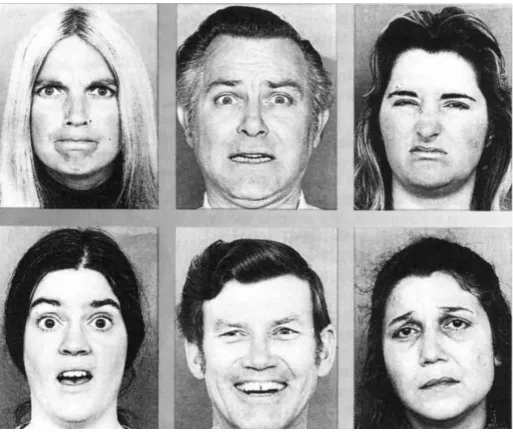
facial expression to emotion and inter-human communication. Most notably, Paul Ekman reinvestigated Darwin’s work and claimed that there are six universal
emo-tions(see Figure 1.1), which are produced and recognised independently of cultural background [3].
(emotions) or in terms of activated facial muscles underlying the displayed facial ex-pression. These two approaches originate directly from the two major approaches of facial expression measurement in psychological research: message and sign
judge-ment [16]. Message based approaches infer to what underlies a displayed facial ex-pression, such as affect. Cross-cultural studies by Ekman [3] and the work by Izard [17] demonstrated the universality and discreteness of subset of facial expressions,
which are referred as basic or universal expressions. Generally, physical changes in face shape make the descriptor for sign based approach. The most widely-used
approach is that of Ekman and colleagues, known as Facial Action Coding System (FACS) [18] (See Section 1.1.1.2 for reference).
1.1.1.1 Ekman’s six basic emotions
The initial research conducted by Ekman determined that there are six prototypical
facial expressions which are also referred as ”universal” since they were found to be universal across human cultures and ethnicities [1]. These six basic facial ex-pressions are anger, disgust, fear, happiness, sadness and surprise (see Figure 1.1),
each of which expressions is performed by its exclusive or common activities of facial muscles.
• Anger - symbolised by lid and lip tightening, eyebrow lowering and eyes bulging
• Happiness - symbolised by lip corner raising, cheek raising and mouth opening
partly
• Disgust - symbolised by upper lip raising and nose bridge wrinkling
• Fear - symbolised by the eyebrow pulling together, upper lids raising, middle
of forehead wrinkling, and lips stretching horizontally
• Sadness - symbolised by inner brow pulling together, lip corner lowering and
lids dropping
• Surprise - symbolised by eyebrows (both inner and outer) raising, jaw dropping
Figure 1.1: Example of expression for the six basic emotions (Left-to-right from top row: anger, fear, disgust, surprise, happiness, and sadness).
The Ekman’s six basic emotion system has been extensively used in computer vision community for testing the performance of facial expression recognition system.
In this research work, we also use Ekman’s six basic emotion to evaluate various proposed frameworks of facial expression recognition.
1.1.1.2 Facial action coding system (FACS)
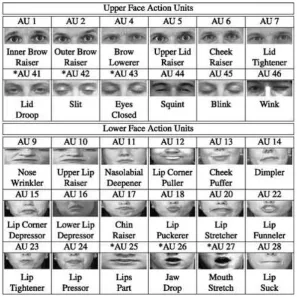
Facial Action Coding System (FACS) [18] is one of most widely used tools for
de-scribing facial muscle action. There are 46 Action Units (AUs) (see Figure 1.2) and Action Descriptors (ADs) defined for describe the facial expressions in FACS, where AUs encode the action (contraction or relaxation) of one or more muscles, while
ADs which are different from AUs are unitary movements involving the action of several muscle groups.
Figure 1.2: Example of AUs which defined in FACS
Figure 1.3: Facial Action Units.
AUs are considered to be the smallest visually discernible facial movements.
They are atomic, meaning that no AU can be split into two or more smaller com-ponents. Any facial expression can be uniquely described by a combination of AUs.
1.1.1.3 FACS AU combinations and intensity
As AUs represent the ”atoms” of facial expressions, multiple AUs often occur
simul-taneously. Out of 46 AUs 30 AUs are anatomically related to the contractions of specific facial muscles: 12 are for upper face, and 18 are for lower face (see Figure
1.4). When AUs occur in combination, they may be additive where the combina-tion does not change the appearance of the constituent AUs, or non-additive where the appearance of the constituents does change [19]. So far, about 7000 valid AU
combinations have been identified within the FACS framework.
Further relationships among multiple AUs exist as well. For instance, in
Figure 1.4: Some examples of Action Units. Action Units are atomic facial muscle actions described in FACS.
In addition to determining which AUs are contained within the face, the intensity of each AU present must also be ascertained. Intensity is rated on a scale from A (least intense) through E (most intense). Criteria for each intensity level are
given in the FACS Manual for each AU [18].
1.1.1.4 Drawbacks of FACS
FACS codes often reveal unnecessary details that can hamper facial expression recog-nition approaches. The sheer number of combinations (7000 AU combinations) can
lead to a bad generalisation performance as it is virtually impossible to have access to a training database that covers all possible AU combinations while featuring a
sufficient number of instances of specific facial expressions [21].
Also, the problem with using FACS is the time required to coding every frame of the video. FACS was envisioned for manual coding by FACS human experts.
It takes over 100 hours of training to become proficient in FACS, and it takes approximately two hours for human experts to code each minute of video [22].
1.2
Objectives and motivation
Due to the limitations of FACS aforementioned, this thesis focuses on analysing and
recognising six basic facial expression directly not using FACS, and addressing some challenging problems of current research in facial expression recognition. In partic-ular, a few novel techniques [20; 23; 24] were developed to represent facial features
in spatio-temporal domain, aiming at increasing the robustness and effectiveness of facial representation. Inspired by these research, we attempt to address some prob-lems exist in spatial based facial feature representation in spatio-temporal domain
(considered as 3 dimensional (3D)) not just in spatial domain.
Facial expression is one of important and effective means of non-verbal
com-munication. When people communicate face to face, facial expression has been con-sidered as one of useful tools in assisting a listener to infer the intention of speaker or providing feedback to the speaker even when the listener is silent [12]. To some
extent, a facial expression contains rich information of personal behaviour, which is a complex reflection of human emotion, mental state and health state. Thus using
computer technology to understand and analyse facial expression could change the relation between human and computer significantly, which plays an important role in realising harmonious human and computer interaction (HCI) [25].
As is widely known that it is easy for people to recognise facial expression of others when people communicate face to face. But for computer, it is a difficult task to recognise facial expressions of a person [26]. This is because expressions
are displayed along with complex activities of a specific set of facial muscles, where each expression is affected by one or combination of several facial muscles [2]. It is
really challenging to construct an exact mathematics model to describe the activities of these muscles. In addition, a change of facial expression normally reflects the
movement of a number of facial landmarks (e.g. mouth corner, lips, eyebrows,
etc.), and current computer technology is not good enough to localise the accurate locations of these landmarks, which leads to a failure in accurately detecting the
activities of facial muscles [24]. Another main reason is that different people perform facial expressions in different ways, which means even the same expression might differ when performed by two different persons. Furthermore different expressions
of a person do not correspond to obvious emotion [27]. For example, the opening of mouth does not always means smiling, but could be surprise or sadness. Some other
factors also affect facial expression such as age, race, gender, hair, etc. Therefore, it is difficult for a computer to use a general criteria to categorise various expressions, and it is a challenging task to use computer for analysing and recognising facial
In recent years, facial expression recognition has been an active research topic, which has drawn more and more attention [19]. The following are some rea-sons. First, the development of technology on relevant research areas encourages the
advancement of facial expression recognition. In the past decades, face recognition [28; 29], face detection [30; 31], face tracking [32; 33]have made a huge progress, e.g., the accuracy and robustness of face detection and tracking methods have been
significantly increased. Second, the wide range applications of facial expression recognition in terms of both academic and business has accelerated the
develop-ment of facial expression recognition [34; 35]. For example, a computer game is more attractive and realistic if the game is capable of reacting in real-time accord-ing to the expressions of gamer (e.g., anger and happiness). In some surveillance
systems of different environments such as cars, planes, factories, etc., certain pas-sive mental states (e.g., fatigue) can be detected immediately by a facial expression
recognition system so as to give timely alarms and thus avoid the occurrence of an accident [36]. In the field of linguistics, facial expression can be combined with lip reading to help people who have problems with hearing to communicate with
others. In addition, facial expression analysis has extensive applications on security environment and medical treatments [35]. Thus, due to their potential applications
and promising future, facial expression recognition can become a useful clue to solve problems of other relevant research fields, and also should be paid more attention.
1.3
Contributions
This thesis proposes three novel facial expression recognition frameworks: work 1 (presented in Chapter 3), Framework 2 (presented in Chapter 4) and Frame-work 3 (presented in Chapter 5).
Framework 1 uses sparse representation to extract features from patches of a face to improve the recognition performance, where part-based methods which are
robust to image alignment are applied. In addition, the use of sparse representation reduces the dimensionality of features, and improves the semantic meaning and represents a face image more efficiently.
Since a facial expression involves a dynamic process, and the process contains information that describes a facial expression more effectively, it is important to
capture such dynamic information so as to recognise facial expressions over the entire video sequence. Thus, Framework 2 uses two types of dynamic information to enhance the recognition: a novel spatio-temporal descriptor based on PHOG
framework views an image sequence as a spatio-temporal volume, and uses temporal information to represent the dynamic movement of facial landmarks associated with a facial expression. Specifically, spatial based descriptor representing spatial local
shape is extended to spatio-temporal domain to capture the changes in local shape of facial regions in the temporal dimension to give 3D facial component sub-regions of forehead, mouth, eyebrow and nose. The descriptor of optical flow is
also employed to extract the information of temporal. The fusion of these two descriptors enhance the dynamic information and achieves better performance than
the individual descriptors.
Framework 3 also focuses on analysing the dynamics of facial expression se-quences to represent spatial-temporal dynamic information (i.e., velocity). Two
types of features are generated: a spatio-temporal shape representation to enhance the local spatial and dynamic information, and a dynamic appearance
represen-tation. In addition, an entropy-based method is introduced to provide spatial re-lationship of different parts of a face by computing the entropy value of different sub-regions of a face.
1.4
Structure of thesis
The thesis begins with an overview of facial expression recognition in Chapter 2, which explains the existing techniques, challenges and problem space. Special
fo-cus is made on reviewing existing methods for facial expressions recognition. The datasets which are widely used in the field of facial expression recognition are also introduced in this chapter.
Chapter 3 provides a detailed explanation of Framework 1 which is based on patch methods. A novel method of detecting face regions is also introduced in this
chapter.
An extension to 2D spatial descriptor that uses two types of dynamic infor-mation is presented in Chapter 4. An analysis on the contribution of different facial
subregions using the Framework 2 is also presented in this chapter.
Framework 3 is presented in Chapter 5, which exploits a spatio-temporal
feature based on local Zernike moment in the spatial domain using motion change frequency. In addition, the design process of a dynamic feature comprising motion history image and entropy is introduced in this chapter.
Literature review on Facial
expression recognition
This chapter provides literature review on facial expression recognition, which in-troduces techniques in the area of facial expression recognition, the widely used
datasets, current challenges and problem space. Section 2.1 briefly covers core components of a system that recognises facial expression. Section 2.2 describes characteristics of different datasets used for evaluating and benchmarking different
facial expression recognition algorithms. Section 2.3 and Section 2.4 provide multi-modal expression analysis and the problem space for facial expression recognition, respectively.
2.1
Techniques in facial expression recognition systems
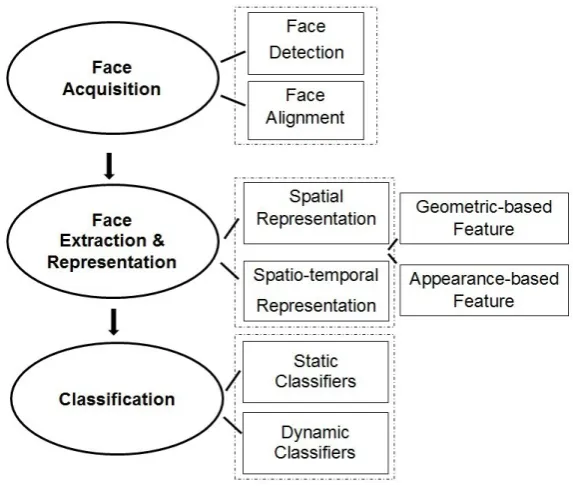
In general, a facial expression recognition system comprises three modules: face
acquisition, feature representation and classification.
The stage of face acquisition includes face detection and face alignment,
where face detection is used to find the face region in the input images or image sequences, and face alignment is applied to reduce the effect of variation in head pose and scene illumination to give a better recognition performance.
After the face is located, the next stage is to extract and represent the facial changes caused by facial expressions, which is very crucial for further processing.
The recognition performance of the whole framework greatly depends on the rep-resentation extracted from face images. If the computed reprep-resentation is accurate enough, using a relative simple classifier could achieve an acceptable recognition
Figure 2.1: Basic structure of facial expression recognition system
paid to extracting facial features to improve the recognition performance (in terms
of recognition rate) of facial expression recognition.
The classification of a detected facial expression is the last stage of facial expression recognition systems. The facial changes can be identified as facial
ac-tion units or prototypical emoac-tional expressions. Our work focuses on the task of recognising prototypical emotional expressions.
In the following subsections (Section 2.1.1: face acquisition which includes
face detection and alignment, Section 2.1.2: feature extraction and Section 2.1.3: expression classification), the literature on all of the three modules will be briefly
reviewed.
2.1.1 Face acquisition
The first step in facial expression recognition is face acquisition which includes face
detection and face alignment. Locating the face region in a image or single frame of a video sequence is referred as face detection, while locating the face region over the
whole video sequence is termed as face tracking. Face detection plays an important role in facial expression recognition. Face is a kind of natural structure which has a fairly complex details variation. The challenges of detecting such natural structure
hair, glasses or beard; (3) as a 3D object, face image is inevitably affected by the shadow of light produced. Therefore, addressing these problems above can provide a clue to generate an effective face detection framework which detects face more
ac-curately and quickly. Methods for face detection can be grouped into four categories [38]: knowledge-based methods, feature-based methods, template matching meth-ods, and appearance-based methods. Face alignment based on whole face is usually
performed by detecting facial landmark and using their location to compute a global transformation (e.g. Euclidean, affine) that maps an input face to a basic face. The
transformation can be computed using Active Appearance Models (AAM).
2.1.1.1 Face detection
Face detection methods can be classified into four categories [38]: knowledge-based methods, feature-based methods, template matching methods, and
appearance-based methods.
Knowledge-based methods: knowledge-based methods use pre-defined rules or models to determine a face based on general human knowledge. Usually,
the rules capture the relationships between facial features. It is trivial to find simple rules to describe the features of a face and their relationships. For example, face
appears in an image with two eyes (usually), a nose and a mouth. To describe relationship between features, distance and relative position are good metric.
In [30], Yang and Huang proposed a face detection method using hierarchical
knowledge, which they proposed three level system, where at first level all possible face candidates are found. The rules at a higher level are general descriptions of
what a face looks like while the rules at lower levels rely on details of facial features. Motivated by the simplicity of the approach proposed by Yang and Huang [30], Kotropoulos and Pitas [39] proposed face detection algorithm which extends their
method. Kotropoulos’s method [39] makes computationally complex algorithm of Yang’s [30] much simpler. Mekami and Benabderrahmane [40] proposed algorithm that not only detects face but also its inclination. They used Adaboost learner for
face detection. For the calculation inclination, they used an eyes detector. Then the line passing through the two eyes is identified, and the angle to horizon is calculated.
Problem with this approach is the difficulty in translating human knowledge into rules. If the rules are detailed (i.e., strict), they may fail to detect faces that do not pass all the rules. If the rules are too general, they may give many false positives.
Moreover, it is difficult to extend this approach to detect faces in different poses since it is challenging to enumerate all the possible cases. On the other hand, heuristics
Feature-based methods: Feature-based methods aim to find some facial features that still exist even when pose or light conditions changes, and use them to obtain the exact location of face. These facial features include skin colour and
texture.
In the colour images, the skin colour is an important feature of human face, and using skin colour as a cue feature is an effective way to detect human face. In
the recent years, researchers have attempted to detect skin colour from colour image in moderate light [41; 42]. Lighting compensation methods and non-linear colour
transformation has been used for detecting skin regions, and maps of eyes, mouth, and nose can be generated to verify face candidate [43]. In some cases where the pixels between skin and non-skin overlap in many colour space, textural and
spa-tial features are employed for modelling skin [44]. Tan proposed a skin detection algorithm along with eye detection combining Gaussian model and 2D histogram
[45] for detecting human skin automatically in colour image. However, all of these existing methods focus on generating skin model and training parameters, which increase detection performance at the cost of calculations. Also, the performance
of detection is affected by several challenging factors: illumination variation, differ-ent ethnic groups and complex background. The variation in light source or in the
illumination level (indoor, outdoor, shadows, etc.) might cause the change in the colour of the skin. Normally, because of the non-plane shape of the facial features, the dark shadow in the face may result of directional lighting that blackened some
facial parts. Sometimes, the reflection of strong lighting may lead to a bright sport in a face. People from different ethnic groups (race) have various skin colour ap-pearance, and they also have different face structures. For instance, Asian people
have yellow skin colour, while Europeans have white skin colour. Complex back-ground is another challenge. In the real world, furniture, clothes, hair, etc. may
bring skin-like colour, which causes the skin detector to make false detection. Some distinct texture in human face can be used for separating them from different similar subjects. In [46], Augusteijn and Skufca proposed a method
infer-ring the presence of a human face by using the identification of face like texture (skin, hair and others) which are computed using second order statistical features
(SGLD) on sub regions of 16×16. A cascade correlation neutral network [47] was used for classifying texture, and a Kohonen self-organising feature map [48] was exploited to generate clusters for different texture classes.
Template matching based methods: template matching based meth-ods manually predefine a general face pattern (model) using a function.
com-puted for eyes, nose, mouth and face contour independently. Template matching based methods is easy to implement with low computational complexity. However, they are not good when dealing with changes in
scale, pose and shape and subsequently deformable templates have been presented to obtain the invariance of shape and scale. Sinha proposed a Ratio Template Algorithm for the cognitive robotics project at MIT [49].
This algorithm was used to develop a system that located the eyes by first detecting the face in real environment [50]. In [51], Anderson and
McOwen applied ”Golden Ratio” to the Ratio Template, and designed a modified version referred as the Spatial Ratio Template tracker, which showed a better performance under different illumination. However, the
limitations of predefined templates based methods are their inadequacy to deal with variation in scale, pose, and shape.
Appearance-based methods: unlike template-matching methods which rely on a predefined template or model, appearance-based methods use large num-bers of examples (images of faces and or facial features) depicting different variations
(face shape, skin colour, eye colour, open closed mouth, etc.) Face detection in this case can be viewed as a pattern recognition problem with two classes: face and
non-face [40]. In general, appearance-based methods rely on techniques from statis-tical analysis and machine learning to find the relevant characteristics of face and non-face images [38]. Seminal work in appearance-based methods for face detection
are based on eigenfaces [52], neural networks [53], support vector machines [54] and hidden Markov models [31].
Adaboost (proposed by Freund and Schapire [55]) has also been used by
several researchers to create robust system for detection of objects in real time [38]. Papageorgiou et al. used this algorithm to detect pedestrians using the Haar wavelet
to extract discriminating features in [56]. Inspired by the algorithm proposed by Papageorgiou et al., Paul Viola and Michael Jones [57] proposed an algorithm for face detection.
In our research work, we used Viola-Jones object detection algorithm for detecting face and salient facial regions as it is the most cited and considered the
fastest and most accurate pattern recognition method for face detection [38]. Viola-Jones object detection algorithm is explained below.
Viola-Jones detection method incorporates the following four key concept:
2. Integral image: To rapidly compute Haar-like features Viola and Jones pro-posed intermediate representation for the image, called integral image. The integral value for each pixel location (x, y) is the sum of all the pixels above
it and to the left of (x, y) inclusive (refer Equation 2.1):
ii(x, y) = X
x0≤x,y0≤y
i(x0, y0), (2.1)
whereii(x, y) is the integral image andi(x, y) is the original image.
Using the integral image, any rectangular sum can be computed in four array references (see Figure 2.2). For example, the value of an integral image at location 1 is the sum of the pixels in rectangle A. The value at location 2 is
A + B, and location 4 is A + B + C + D. The sum within D can be computed as 4 + 1(2 + 3). Clearly, the difference between two rectangular sums can
be computed in eight references. Since the two-rectangle features defined above involve adjacent rectangular sums they can be computed in six array references, eight in the case of the three-rectangle features, and nine for
four-rectangle features [57].
Figure 2.2: The sum of the pixels within rectangle D can be computed with four array references. The value of the integral image at location 1 is the sum of the pixels in rectangle A. The value at location 2 is A + B, At location 3 is A + C, and at location 4 is A + B + C + D. The sum within D can be computed as 4 + 1−(2 + 3).
3. AdaBoost method: Viola and Jones selected an AdaBoost training algorithm proposed by Freund and Cshapire [55]. This algorithm is used to determine the presence Haar-like feature by setting threshold levels. Threshold value
is used to determine the presence of a Haar-like feature (the sum of pixels values in the shaded rectangle is subtracted from the white rectangle). If the
difference is above a threshold, that feature is regarded to be present.
Secondly, within any image sub-window the total number of Haar-like features
features, and focus on a small set of critical features. To achieve this goal, the weak learning algorithm is proposed by Viola Jones which selects the single rectangle feature which best separates the positive and negative examples. For
each feature, the weak learner determines the optimal threshold classification function, such that the minimum number of examples are misclassified [57].
Learning algorithm combines many weak classifiers to create one strong
clas-sifier, where weak means the classifier only gets the right answer a little more often than random guessing would. Then, this learning algorithm selects a set of weak classifiers to combine and assigns a weight to each. This weighted
combination is the strong classifier.
4. Cascades of classifiers: Viola and Jones introduced a method for combining successively more complex classifiers in a cascade structure for increased de-tection performance while radically reducing computation time. The rational
behind this is to construct boosted classifiers which reject many of the negative sub-windows while detecting almost all positive instances. Simpler classifiers
are used to reject the majority of sub-windows before more complex classiers are called upon to achieve low false positive rates [57]. Each stage is only required to eliminate slightly more than 50% of false detection as long as it
kept the positive hit rate close to 100%.
2.1.1.2 Face alignment
Face alignment is a fundamental step for facial expression recognition, which is designed to reduce the affect resulting from the variation of head pose and face
geometry. The performance of face alignment have a direct impact on further process and the performance of recognition. Basically, the alignment can be divided into whole face, part and point alignment based on the output of process of alignment.
Similar to whole face alignment, part based alignment use AAM technique, where the facial parts are localised as fixed size patches around detected landmarks.
In some case, faces might be warped into a reference frontal face model non-rigid alignment before patches are cropped (e.g. [58; 59]). Techniques that perform part detection to localise each patch individually can also be used [60].
Point based alignment is useful for shape descriptor, which involves the lo-calisation of fiducial (stable) points. AAM is also used for point alignment. As the
by detecting points use a point detector on the first frame and then tracking them using tracking methods (e.g., Gabor based point detector [62] and particle filter [63]).
2.1.2 Feature representation
After aligning the detected face image, feature representation and extraction is
ap-plied to analyse and recognise facial expressions automatically. The idea behind the feature presentation aims to extract optimal feature that should minimise intra-class variation of facial expression, while maximising inter-intra-class, while maximising
inter-class variation [64]. In some case, the best classifiers might fail to gain satisfied recognition if inadequate features are exploited.
2.1.2.1 Spatial representation
Spatial features encode an image or single frame from video sequences which can be
referred as 2D [65]. Various spatial methods for facial expression extraction have been proposed, which can be categorised as geometric-based and appearance-based
methods. Geometric-based features are represented using the information of shape and locations of facial components (including mouth, eyes, brows, nose, etc.), while the appearance features capture the information of texture of face, such as wrinkles
and furrows.
Geometric-based methods: in the geometric-based approaches,
represen-tation using a set of facial points is one of the most frequently used, where the x
andy coordinates of facial points are simply concatenated to form a feature vector as input of classification [66; 67]. There are some other methods to represent shape
which are less common. Huang, et al. use the relative distances between facial landmarks instead of row coordinates to describe the shape in [68]. In [19], Tian, et al. compute the distances and angles of landmarks to represent the activities of
various facial parts i.e. movements of eyebrow, opening/closing of the mouth and the state of the cheek. One of limitations of appearance-based approach is that the
representation based on either the raw location of landmarks or the relative loca-tion deeply depends on the performance of points detecloca-tion and alignment, which means it is easily affected by the error of previous step (i.e. face detection and
align-ment). However, geometric-based approach is relatively robust to the variations of illumination as the intensity of the pixels is not used.
position and size of various facial features, and that, by measuring the movement of certain facial points, the underlying facial expression can be determined. In order for geometric methods to be effective, the locations of these fiducial points must be
determined precisely; in real-time systems, they must also be found quickly. The exact type of feature vector that is extracted in a geometry-based facial expression recognition systems depends on a) which points on the face are to be tracked, b)
whether 2D or 3D locations are used, c) the method of converting a set of feature positions into final feature vector.
The typical examples of geometric based methods for facial expression recog-nition are those of Pantic and her colleagues [69], who used a set of facial charac-teristic points around the mouth, eyes, eyebrows, nose, and chin.
Research has been done with success in recent times to combine features extracted using appearance-based methods and geometric feature-based methods
[58; 70]. The key problem with geometric methods is to precisely locate the landmark and track it. In the real applications, due to the pose and illumination variations, small resolution input images, and the noise from the background, it is still very
hard to precisely locate the landmarks.
Appearance-based methods: existing appearance-based approaches for
facial expression recognition encode low-level or high-level information, where the former one which is more popular interprets expressions using low-lever histograms and Gabor descriptor, while the latter one is encoded using sparse coding [71; 72; 73]
or Non-Negative Matrix Factorisation (NMF) [74; 75] . Some part-based methods [76; 59] attempt to extract appearance information by splitting face region into a number of local face components. Brief overview of the above mentioned
represen-tations are given as follows.
Gabor representation is an representative feature vector of such approach
that describe the local appearance models of facial expressions, which is applied in different recognition frameworks (i.e. the winner of FERA AU detection [77; 78] and AVEC [79]). The Gabor decomposition of an image is computed by convolving
the input image with a set of Gabor filters, which can be tuned to a particular frequencyk0 = (u, v), where k =kk0k is the scalar frequency and ϕ= arctan(uv)
is the orientation [80; 81]. Gabor filters accentuate the frequency and orientation respectively. A Gabor filter can be represented in the space domain using complex exponential notation as:
Fk0 =
k20 σ2exp(−
k02x2
2σ2 )(exp(ik0)−exp(− σ2
2 ), (2.2)
example of a Gabor filter is given in Figure 2.3, which shows the absolute value (left), real component (middle) and imaginary component (right) of the filter in the space domain.
Figure 2.3: The left, middle, and right graphics above show the absolute value, and the real and imaginary components of a sample Gabor filter.
For expression analysis, a filter bank of multiple Gabor filters tuned to
dif-ferent characteristic frequencies and orientations is used for feature extraction. The combined response is called a jet. Filter banks typically span at least 6 different orientations and have frequencies spaced at half-octaves. Prior to classification,
the extracted features are usually converted into real numbers by calculating the magnitude of the complex filter response.
Due to the good performance on describing facial texture, Gabor feature are
utilised for recognising facial expression. Lyons et al. [82] developed a recognition framework by computing Gabor responses over facial mesh points, which achieved
recognition rate of over 90% by using linear discriminant analysis and classical near-est neighbour classifier. In the work of [83; 84], Tian et al. also applied Gabor features for recognising FACS AUs, where they extracted Gabor bank along with
a number of landmarks (i.e. the corner of eyes, forehead, the corner of eyebrows, etc.). The developed system gained satisfying recognition rate for recognising AUs
by using three layer neutral network. Donato et al. [85] proposed a recognition framework based on whole face region using Gabor filters. They encoded face im-age using a filter bank of 5 frequencies and 8 spatial orientations, which achieved
an good recognition rate of over 95% on several AUs. Littlewort et al. has shown a high recognition accuracy (93.3% for Cohn-Kanade facial expression database )
using Gabor features. They proposed to extract Gabor features from the whole face and then selected the subset of those features using AdaBoost method. In [86], Littlewort et al. computed Gabor features on difference image instead of raw image
a large dimensionality of feature which leads to a high computational cost in terms of time and memory, especially if they are applied to a wide range of frequencies, scales and orientations of the image features.
In recent years, some frameworks based on low-level histogram are proposed for facial expression recognition, which achieves satisfied performance [87; 88; 89; 90; 91]. Low-level features are usually extracted from local regions, and encode the local
texture information by computing histogram. Then, the histograms on each local region are concatenated into feature vector by different normalising and pooling
strategies. The final representation are the concatenation of all local histogram. Low-level representation has tolerance to variations of illumination to she extent, since they encode the local regions. Also, the use of normalisation is able to deal with
the global variation of illumination, and pooling can reduce the affect of alignment errors. However, low-level representations take no account of semantic information
and con figural information. Several representative methods are briefly introduced below [90].
Local Binary Pattern (LBP) were initially proposed for texture analysis [92],
but recently they have been successfully used for face and facial expression analysis [87; 88]. The most important property of LBP features are their tolerance against
illumination changes and their computational simplicity. The operator labels the pixels of an image by thresholding the 3x3 neighbourhood of each pixel with the centre value and considering the result as a binary number. Then the histogram of
the labels can be used as a texture descriptor. Formally, LBP operator takes the form:
LBP(xc, yc) = 7
X
n=0
s(in−ic)2n, (2.3)
The operator later was extended to use neighbourhood of different size [93].
Using circular neighbourhoods and bilinear interpolating, the pixel values allow any radius and number of pixels in the neighbourhood. See 2.4 for examples of the extended LBP operator, where the notation (P, R) denotes a neighbourhood of P
equally spaced sampling points on a circle of radius of R that form a circularly symmetric neighbour set.
Shan [89] et al. applied the LBP features on facial expression recognition and also got promising performance. Zhao et al. [88] proposed to model texture using volume local binary patterns (VLBP) an extension to LBP, for expression
Figure 2.4: Three examples of the extended: the circular (8; 1) neighbourhood, the circular (12; 1) neighbourhood, and the circular (16; 2) neighbourhood, respectively
both spacial and temporal information is considered in VLBP, it got better result comparing with the traditional LBP.
Histogram of gradient (HOG) [95] was originally developed for person de-tection and object recognition. In [96], HOG descriptor are extracted from face image using a dense grid, and are used for face recognition. Histograms of Oriented
Gradients are generally used in computer vision, pattern recognition and image pro-cessing to detect and recognise visual objects (i.e. faces). We propose to use HOG
descriptors because we need a robust feature set to discriminate and find faces under difficult illumination backgrounds, wide range of poses, etc., by using feature sets that overcome the existing ones for face detection.
The ideas behind HOG are edge orientation histogram, SIFT descriptor [97] and shape context. They are computed on a dense grid of cells that overlap local
contrast histogram normalisations of image gradient orientations to improve the detector performance [95]. So that, this feature set performs very well for other shape based object classes (i.e. face detection) because of the distribution of local
intensity gradients, even not processing any knowledge of the corresponding gradient [97].
To compensate the illumination, histogram counts are normalised by
accu-mulating a measure of local histogram energy over the connected regions, then use the results obtained to normalize all cells in the block (e.g., size 2) and finally, the
combination of these histograms represents the HOG descriptor, which can yield a better robustness to variation in illumination. The HOG descriptor is affected by several of its parameters: the choice of gradient operator; the binning of
(i.e., square and rectangular). Dalal and Triggs gave a detailed and systematically implementation study on the effect of the various choices on descriptor performance in [98].
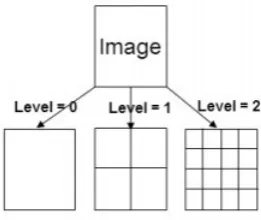
Pyramid HOG (PHOG) was proposed in [99], which is a spatial shape de-scriptor and got its inspiration from the works of Dalal et al. [100] on histograms of oriented gradients and Lazebnik et al. [101] on spatial pyramid matching. It
represents an image by its local shape and the spatial layout of the shape. The idea of PHOG is shown in 2.5. Process for the PHOG feature extraction are explained
as follows:
1) Canny edge operator is applied to extract contours from the given stimuli.
2) Then, the image is divided into spatial grids by iteratively doubling the number
of divisions in each dimension.
3) Afterwards, a histogram of orientation gradients are calculated on each edge point using 3x3 Sobel mask without Gaussian smoothing and the contribu-tion of each edge is weighted according to its magnitude. Within each cell,
histogram is quantized intoN bins. Each bin represents the accumulation of number of edge orientations within a certain angular range.
4) To obtain the final PHOG descriptor, histograms of gradients at the same levels are concatenated. The final PHOG descriptor is a concatenation of
HOG at different pyramid levels. Generally, the dimensionality of the PHOG descriptor can be calculated by: NP
[image:40.595.255.386.548.658.2]l4l.
Figure 2.5: PHOG descriptor of an image.
In recent years, local moment based methods has been applied for facial expression recognition, which achieves a good performance [102]. Classical image
are their main limitations leading to numerical instabilities and sensitivity to noise. Complex moments are defined similarly to geometric and have been used to describe the shape of a probability density function and to measure the mass distribution of
a body. Hu moments exhibits translation, rotation and scaling invariance, and has been applied in many areas [103]. Orthogonal moments are projections of a function onto a polynomial basis. ZMs employ complex Zernike polynomials as its moment
basis set [104], and have been used to recognise facial expressions [105]. The rotation invariance of Zernike-based facial features is discussed in [106; 29]. QLZM is used in
[102] for recognising facial expressions. However, ZM has its shortcomings, namely it is a low level histogram representation which ignores the spatial relations (i.e., configure information) among the different facial parts. Also, ZMs only describe
the texture information in each frame of image sequences, and do not capture any dynamic information.
All aforementioned representation describe local texture, and their features encode the distribution of edges. Recent methods aim instead to obtain higher-level representations to encode features that are semantically interpretable. Two such
representations are Non-Negative Matrix Factorisation (NMF) and sparse coding. NMF methods decompose a matrix into two non-negative matrices. The
decomposition is not unique and can be designed to have various semantic inter-pretations. One NMF-based technique is Graph-Preserving NMF (GP-NMF) [75], which decomposes face into spatially independent components through a spatial
sparseness constraint [107]. Another NMF-based method is Subclass Discriminant NMF (SD-NMF) [74], which represents an expression with a multimodal projection. Unlike GP-NMF, SD-NMF does not explicitly enforce decomposition into spatially
independent components. The basis image provided [74] suggest that the infor-mation encode can be holistic componential or configural. NMF methods creat a
number of basis images, and the features of NBF representations are the coefficients of each basis image. The method performs minimisation to compute the coefficients, therefore its computational complexity varies based on the optimisation algorithm
and the number and size of basis images.
Sparse coding based methods which exploit sparsity in pattern classification
have been proposed recently, which has shown promising performance. Wright et al. [108] used sparse representation for face recognition to find a face representation using a sparse linear combination of an over-complete dictionary. More specifically,
the sparse-representation based classifier (SRC) in [108] is a novel algorithm for robust face recognition, which can address the problems of face occlusion, corruption
small number of atoms which is chosen from an over-complete dictionary which consists of all training samples. The sparsity constraint of the coding coefficients is employed to ensure only a few samples from the same class of the query face have
distinct non-zero values, whereas the coefficients of other samples are equal or close to zero [108]. The sparsity of the coding coefficient can be directly measured by
l0. It is shown that if there are sufficient training samples for each facial class, it
is possible to represent a test image sample as a linear combination of only those training samples that belong to the same facial class [108]. The sparse representation
they proposed achieved high responses to the face image of the same identity class and low responses to the other classes. Motivated by the work of Wright et al., Zafeiriou and Petrou [73] used sparse representation to recognise facial expressions.
In their paper, it is shown that the performance of sparse representation using the original images directly for facial expression recognition is not satisfactory, and
the sparse coefficient vectors are much more related to the facial identity than to facial expression. They argue that to achieve more efficient representations, person-independent representation should be applied such as difference image and facial
grids. However, their methods still use full face image which might not be able to handle occlusion. SRC proposed by Wright et al. [108] was applied for the purpose
of facial expression recognition in [109; 110; 111]. Most of existing methods using sparse representation made use of features which describe intensity changes of face appearance (i.e., appearance based feature). In [109], Huang et al. combined the
SRC with LBP features and shape of image [112], which showed the SRC using LBP achieved better recognition performance than SRC using image raw pixels. [110] showed that SRC performed better than using nearest neighbour [113] and support
vector machine classifiers [112], independent of features used (e.g., raw pixel, LBP, Gabor wavelet, etc.) However, In comparison with extracting facial features from
the whole image, patch based methods which extract facial features by dividing a face image into several sub-regions (patches) have shown promising performance as reported in [114; 115; 116; 117].
Most existing methods exploit the whole face image, which leads to some limitations on face alignment, and they are not able to handle the problems
asso-ciated with occlusions. In the case of using the whole image, small misalignment might cause displacement of the sub-region locations which increase the classifi-cation error. The size and shape of facial organs from different persons are not
the same. Also, the same facial position are not always present in one particular block in all images. In comparison with extracting facial features from the whole