Original citation:
Williams, Oliver and Del Genio, Charo I.. (2014) Degree correlations in directed
scale-free networks. PLoS One, Volume 9 (Number 10). Article number e110121. ISSN
1932-6203
Permanent WRAP url:
http://wrap.warwick.ac.uk/63531
Copyright and reuse:
The Warwick Research Archive Portal (WRAP) makes this work of researchers of the
University of Warwick available open access under the following conditions.
This article is made available under the Creative Commons Attribution 4.0 International
license (CC BY 4.0) and may be reused according to the conditions of the license. For
more details see:
http://creativecommons.org/licenses/by/4.0/
A note on versions:
The version presented in WRAP is the published version, or, version of record, and may
be cited as it appears here.
Oliver Williams1, Charo I. Del Genio2,3,4*
1Department of Physics, University of Warwick, Coventry, United Kingdom,2Warwick Mathematics Institute, University of Warwick, Coventry, United Kingdom,3Centre for Complexity Science, University of Warwick, Coventry, United Kingdom,4Warwick Infectious Disease Epidemiology Research (WIDER) Centre, University of Warwick, Coventry, United Kingdom
Abstract
Scale-free networks, in which the distribution of the degrees obeys a power-law, are ubiquitous in the study of complex systems. One basic network property that relates to the structure of the links found is the degree assortativity, which is a measure of the correlation between the degrees of the nodes at the end of the links. Degree correlations are known to affect both the structure of a network and the dynamics of the processes supported thereon, including the resilience to damage, the spread of information and epidemics, and the efficiency of defence mechanisms. Nonetheless, while many studies focus on undirected scale-free networks, the interactions in real-world systems often have a directionality. Here, we investigate the dependence of the degree correlations on the power-law exponents in directed scale-free networks. To perform our study, we consider the problem of building directed networks with a prescribed degree distribution, providing a method for proper generation of power-law-distributed directed degree sequences. Applying this new method, we perform extensive numerical simulations, generating ensembles of directed scale-free networks with exponents between 2 and 3, and measuring ensemble averages of the Pearson correlation coefficients. Our results show that scale-free networks are on average uncorrelated across directed links for three of the four possible degree-degree correlations, namely in-degree to in-in-degree, in-in-degree to out-in-degree, and out-in-degree to out-in-degree. However, they exhibit anticorrelation between the number of outgoing connections and the number of incoming ones. The findings are consistent with an entropic origin for the observed disassortativity in biological and technological networks.
Citation:Williams O, Del Genio CI (2014) Degree Correlations in Directed Scale-Free Networks. PLoS ONE 9(10): e110121. doi:10.1371/journal.pone.0110121
Editor:Daniele Marinazzo, Universiteit Gent, Belgium
ReceivedJuly 22, 2014;AcceptedSeptember 15, 2014;PublishedOctober 13, 2014
Copyright:ß2014 Williams, Del Genio. This is an open-access article distributed under the terms of the Creative Commons Attribution License, which permits unrestricted use, distribution, and reproduction in any medium, provided the original author and source are credited.
Data Availability:The authors confirm that all data underlying the findings are fully available without restriction. All relevant data are within the paper and its Supporting Information files.
Funding:OW acknowledges support by the URSS (Undergraduate Research Support Scheme) of the University of Warwick. CIDG acknowledges support by EINS, Network of Excellence in Internet Science, via the European Commission’s FP7 under Communications Networks, Content and Technologies, grant No. 288021. The funders had no role in study design, data collection and analysis, decision to publish, or preparation of the manuscript.
Competing Interests:The authors have declared that no competing interests exist.
* Email: [email protected]
Introduction
The use of networks is fundamental to model the structure and the dynamics of a vast number of systems found throughout the natural and engineered worlds. Their main appeal lies in allowing the reduction of a complex system to a discrete set of elements, the nodes, that interact across links. Then, one can study the structural properties of a network and infer results on the behaviour of the system thus modelled [1,2]. The simplest global structural attribute of a network is its degree distribution P(k), which expresses the probability of having a node withklinks. A particularly important case is that of scale-free networks, in which the degree distribution obeys a power-law P kð Þ*k{c [3–6]. Scale-free networks have
been observed in citation distributions [7–9], Internet and WWW topology [10,11], biological systems [12,13], technological, eco-nomic and social systems [14,15], and transport processes [16,17], and therefore they have been the subject of a considerable body of research. A generalization of the simple network model can be introduced by defining a directionality for the links. Directed networks are more suited to represent systems in which the interaction between elements is not necessarily symmetric, such as food webs or gene regulatory networks [18]. In this case, the connectivity of a node is no longer represented by a single scalar, as each node has a number of incoming connections (its in-degree
k2
Methods
To study the preferred correlation structure induced by scale-freeness in directed networks, we performed extensive numerics, generating statistical ensembles of networks with power-law distributed in-degrees and out-degrees. The generation of directed networks with given degree distributions involves two distinct phases. First, extract two sequences of integer numbers that follow the distributions, and assign these to the nodes as directed half-links, or ‘‘stubs’’. Taken in pairs, these numbers form a so-called bi-degree sequence, and correspond to the in-degree and the out-degree of each node. Then, sample the bi-out-degree sequence creating network realizations without self-edges or multiple edges. A suitable method to perform this second step is the algorithm discussed in Ref. [29], which allows an efficient uniform sampling of the realizations of a bi-degree sequence. However, not every sequence of integer pairs can be realized by a simple directed graph. Thus, before being able to apply the sampling algorithm, we need to develop a procedure to properly create bi-degree sequences that admit realizations, which are referred to as graphical. To do so, we start from the Fulkerson theorem [30], which states the necessary and sufficient graphicality conditions for bi-degree sequences:
Theorem 1
A sequence of non-negative integer pairs D~ k{
1 ,k
z 1 , k{
2 ,k
z
2
,. . ., k{ N,k
z N
gwithk{
1§k
{
2§ §k
{
N is graphical
if and only if
k{
1 ƒN{1, 1max ƒiƒN
kz
i ƒN{1 , ð1Þ
XN
i~1
k{ i ~
XN
i~1
kz
i , ð2Þ
Xx
i~1
ki{ƒ Xx
i~1
minx{1, kzi z X
N
i~xz1
minx,kiz: ð3Þ
Theorem 1 can be used to efficiently verify the graphicality of an extracted sequence using the particularly fast implementation described in [29]. The theorem can be intuitively understood by looking at the three conditions. Condition 1 simply ensures that no node has a number of incoming or outgoing stubs that exceeds the number of other nodes. This is clearly a necessary condition, since each node can connect to or receive connections from at most all the remaining nodes. To understand Condition 3, notice that the left-hand side is just the number of incoming stubs in the set consisting of the firstxnodes. Then, consider how to maximize this number. To start with, take each of the firstxnodes and connect them to all the others in the set. However, note that each nodei
can only have as many outgoing connections as its out-degreekz i .
Thus, if the out-degree of node i is large enough, it can be connected to all the remainingx21 nodes; otherwise, it can only be connected tokz
i amongst the remainingx21. The first term in
the sum on the right-hand side accounts for these connections. The second term in the sum has the same meaning. However, the sum is now taken over the nodes that arenotwithin the first x. Thus, each can connect to at most x, rather than x21, other nodes. Finally, Condition 2 mandates the total number of
incoming stubs equal the total number of outgoing stubs. This introduces an important constraint in the generation of graphical bi-degree sequences. To see why, write the number of incoming and outgoing stubs as
XN
i~1
k+
i ~NSk+T: ð4Þ
In general, the power-law exponents for in-degrees and out-degrees in directed scale-free networks can be different [1–5]. Then, if the out-degrees scale askzcz
and the in-degrees ask{c{
,
forN&1, it isSk+T&c+{1
c+{2. Thus, one cannot expect the sums
of in-degrees and out-degrees to be equal, if the respective power-law exponents are different. In fact, in the region of interest
2vcƒ3, the variance of power-law distributions is unbounded,
since Sk+2T&c+{1
c+{3. Thus, in this range of exponents, one
should not expect Condition 2 to be satisfied even when choosing the same exponent for in-degrees and out-degrees.
To guarantee that Condition 2 is satisfied, and avoid the trivial non-graphicality of the generated bi-degree sequence, one cannot extract independently the sequences of in-degrees and out-degrees. Rather, one should be extracted without further constraints, and the other should be conditioned to have the same sum as the former. Without loss of generality, assume thatcz
wc{. Then, it
isSk{
TwSkzT. Thus, freely extracting the out-degrees requires,
on average, to lower the mean in-degree with respect to its unconstrained value. This effectively introduces an upper cutoff excluding all the degrees above a certain thresholdNU. For a large
network, the normalization constant of the in-degree distribution with an upper cutoff is
ZNU:
ðNU
1
k{{c {
dk{~
NU1{c{NUc{{1{1
c{{1 : ð5Þ
Thus, the mean in-degree is
Sk{ TNU~
ðNU
1
k{ {c {
z1
ZNU dk z
~c
{{
1
c{{2NU
NUc{{2{1
NUc{{1{1: ð6Þ
Equating Eq. 6 with the expression for the unconstrained mean out-degree yields
NU
NUc{ {2{1
NUc{ {1{1
~c
{{
2
c{{1 cz{
1
cz{2: ð7Þ
The solution to Eq. 7, plotted in Fig. 1, show that for almost all the choices ofc{
andcz
, the upper cutoff would eliminate the vast majority of the tail of the degree distribution. As the defining characteristic of scale-free networks is a power-law tail, this indicates that the choice of conditioning the in-degree distribution on the sum of the out-degrees is not suitable for sequence generation.
sum. This time, the cutoff introduced is a lower cutoffNL on the
out-degree distribution. ForN&1, the out-degree normalization constant with lower cutoff is
ZNL:
ð?
NL kz {c
z
dkz~N
1{cz L
cz{1 : ð8Þ
Then, the mean out-degree is
SkzTNL~
ð?
NL kz {c
z
z1
ZNL dk z
~c
z{
1
cz{2NL: ð9Þ
As the two mean degrees have to be equal, it is
NL~ c{{
1
c{{2 cz{
2
cz{1: ð10Þ
Note that, defining the excess exponent E:cz{ c{
, the equation above can be rewritten as
NL~ c{{
1
c{{2 1{
1
c{{1zE
: ð11Þ
This form explicitly shows thatNLis 1 when the exponents are
equal andE= 0, and it increases monotonically withE, towards an asymptotic value of c{{
1
ð Þ=c{{
2
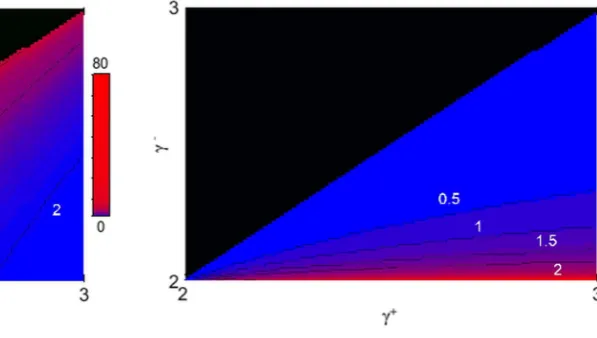
ð Þ. As illustrated in Fig. 2, such cutoff is very mild. Thus, this approach leaves the tail of the distribution entirely untouched. Moreover, for more than half of the region of interest, the whole out-degree distribution has no effective cutoff at all.
Notice that defining a proper method for the generation of power-law distributed directed degree sequences is essential for the accuracy of research outcomes. In fact, approximate techniques have uncontrolled errors and produce results that depend on the details of the approximation made [18,31].
Results and Discussion
At the light of the considerations expressed in the previous section, we generated ensembles of bi-degree sequences of random power-law distributed integers with exponents between 2 and 3, conditioning the sequence with the greater exponent on the sum of the sequence with the lower one. Then we tested the sequences for graphicality, and sampled the graphical ones using the direct construction algorithm detailed in Ref. [29]. For each sample, we measured the assortativities using the Pearson coefficients
rab~
P
i,jAi,j
(
kia{SkaTL)
kbj{SkbTL
ffiffiffiffiffiffiffiffiffiffiffiffiffiffiffiffiffiffiffiffiffiffiffiffiffiffiffiffiffiffiffiffiffiffiffiffiffiffiffi P
ikia
(
kai{SkaTL)
2
r ffiffiffiffiffiffiffiffiffiffiffiffiffiffiffiffiffiffiffiffiffiffiffiffiffiffiffiffiffiffiffiffiffiffiffiffiffiffiffiffiffiffi P
jk b j k
b j{SkbTL
2
r , ð12Þ
where the averages are taken over all directed links, the elements of the adjacency matrix of the networkAi,jare 1 if there is a link
[image:4.612.61.321.59.231.2]from nodeito nodej, andaandbcan be2or+, indicating in-degrees or out-in-degrees, respectively [32]. We stress that the sampling method used is a degree-based graph construction algorithm [33]. Algorithms in this class can access the entire space of the realizations of a graphical sequence. They work by building the sample graphs via the systematic placement of links, guaranteeing that the graphicality of the sequence is maintained after each step. At every moment, the combinatorially exact probabilities of placing each allowed link are completely deter-mined. Thus, these methods efficiently allow uniform graph sampling, without introducing biases due to a particular choice of generative model or construction algorithm, which can result in overrepresentation or inaccessibility of part of the realization space.
Figure 1. Effective upper cutoff on the in-degrees if they are conditioned on the sum of the out-degrees.The contour plot shows the logarithm of the introduced upper cutoff. Note that for almost all the choices of power-law exponents, such cutoff is so low that the greatest part of the distribution tail is lost, affecting the scale-free character of the resulting network. The labels indicate the logarithm of the cutoff for the corresponding contour lines. Only half of the region is plotted, as we are under the assumption thatcz
[image:4.612.240.539.63.232.2]wc{. doi:10.1371/journal.pone.0110121.g001
Figure 2. Effective lower cutoff on the out-degrees if they are conditioned on the sum of the in-degrees. The contour plot shows the logarithm of the introduced lower cutoff. Unlike what happens with the reverse choice, the cutoff introduced is always minor, and it actually vanishes for most of the choices of in-degree and out-degree exponents. The labels indicate the logarithm of the cutoff for the corresponding contour lines. Only half of the region is plotted, as we are under the assumption thatcz
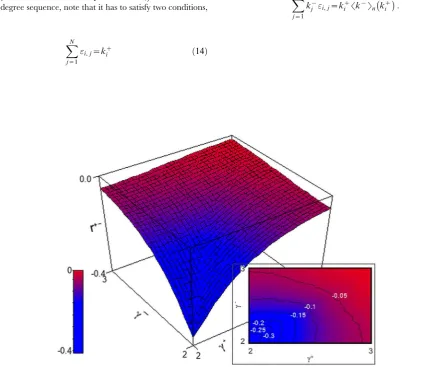
The results indicate the absence of any dependence of the in-in, in-out and out-out coefficients on the choice of power-law exponents. In fact, these three coefficients all vanish within the uncertainties throughout the region studied. Conversely, the out-in coefficient is always negative (Fig. 3), indicating disassortative correlation between the out-degree of the node at the beginning of a link and the in-degree of the node at its end. Figure 4 illustrates this pattern of dependence by plotting the average in-degree
Sk{
Tnof the neighbours of nodes with a given out-degreek+, for an ensemble of networks withcz~
c{~
2:01andN= 1000. The values of Sk{
Tn decrease quickly and monotonically with k+,
confirming the strong disassortative nature of the networks. Our results show substantial similarities between the correlation structure of directed and undirected scale-free networks. Indeed, it is a well-known fact that random undirected scale-free networks are disassortative [34–38]. Thus, to explain our findings, we use the entropic treatment described in Ref. [39], extending it to directed networks. To do so, write the information entropy of a given network as
S~{Xi,j"i,jlog"i,jz1{"i,jlog 1 {"i,j, ð13Þ
where "i,j is the expectation value for the ði,jÞ element of the
adjacency matrix. To derive an expression for"i,jin the case of a
given bi-degree sequence, note that it has to satisfy two conditions, namely
XN
j~1
"i,j~k z
i ð14Þ
and
XN
j~1
k{
j "i,j~kzi Sk {
Tn kz i
[image:5.612.317.487.58.189.2]
: ð15Þ
Figure 3. Degree correlations in directed scale-free networks.The Pearson correlation coefficientr+2is always negative, indicating that directed scale-free networks are naturally disassortative when one considers the out-in correlation. The inset shows a contour plot of the same data, for added clarity. The labels in the contour plot indicate the value ofr+2for the corresponding contour lines.
[image:5.612.89.521.319.686.2]doi:10.1371/journal.pone.0110121.g003
Figure 4. Disassortative degree correlations.The plot shows the average in-degreeSk{
Tnof the neighbours of nodes with a given out-degree k+ for an ensemble of networks with cz~
c{~
2:01 and N= 1000. The dependence ofSk{
Tnonk+clearly indicates that nodes with low out-degree link preferentially to nodes of high in-degree, and nodes with high out-degree link mostly to nodes of low in-degree. The monotonically decreasing dependence confirms the strong disassorta-tive nature of the networks.
A form that satisfies these conditions is
"i,j~
1 N kz i k { j SkT (
z
ð s
2
sbz2
d nð {ðbz1ÞÞ{d nð {1Þ
kz i k { j n
Sk{nT {k zn i {k
{n j zSk
{n T 2
4
3 5dn
9 = ;
ð16Þ
where b is a free parameter. In principle, the factor
s2 sbz2d n
{ðbz1Þ
ð Þ{d nð {1Þ
in Eq. 16 can be replaced by
any arbitrary function ofn. However, the choice made, in which
st:Sk {t
T{SkTSk{t{1T, allows to reproduce the observed dependence ofSk{
Tnonkz
. Then, computing the integral in Eq. 16, it is
"i,j~
1
N
Sk{2 T{SkT2 Sk{bz2T{SkTSk{bz1T (
kz i k
{ j
bz1
Sk{bz1T
{kz i
bz1
{k{ j
bz1
zSk{bz1T 2 6 4 3 7 5
zkz i zk
{
j {SkT
g
:ð17ÞUsing Eqs. 13 and 17, we can find the choice of b that maximizesS, and compute the Pearson coefficientr*
correspond-ing to the maximum entropy network for any given power-law exponents. Notice that in the equations above, we make no distinction betweenSkz
T and Sk{
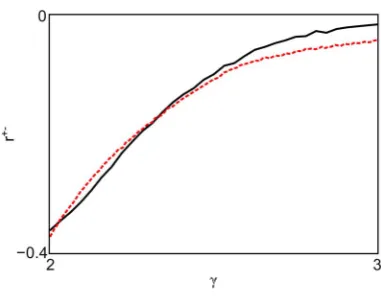
T, as they must be equal to ensure graphicality of the bi-degree sequence. Also, we restrict the parameter search to the values that yield networks without self-edges or multiple self-edges. To carry out the calculation, we use the degree-maximizing sequence as representative of the scale-free networks for each value ofc[6]. Figure 5 displays a comparison betweenrz{
as measured by simulations andr*, in the case of
cz~ c{
. The two sets of results are substantially in agreement, save for higher values ofc, wherervrz{
. This can be explained by considering that the degree-maximizing sequences used to computer*
feature more high-degree nodes than would be found on average, thus decreasing the assortativity of their realizations. In summary, we showed that directed scale-free networks are naturally uncorrelated when considering in-in, in-out and out-out correlations. Thus, when looking across a directed link, the in-degree of the originating node has no influence on the in-in-degree or the out-degree of the target node. Similarly, the out-degrees are not affected by the out-degrees of the neighbours. However, the out-in correlation coefficient is found to be negative throughout the region studied. This indicates that the natural state of directed scale-free networks is one in which nodes of low degree prefer to link to nodes of high degree, and vice versa. The origin of this preference is entropic, as the coefficients found are in good agreement with those corresponding to the maximum information entropy. Thus, the observation of a disassortative directed scale-free network is not sufficient to infer the existence of extra growth mechanisms beyond those responsible for its degree distribution. These results suggest that the disassortative correlations observed in many real-world systems, such as biological and technological networks, do not necessarily arise because of design or evolution-ary pressure. In fact, the absence of such drivers, and the resulting randomness, would lead to the observation of the anticorrelated state as the most probable one. Notice that this does not exclude the presence of evolutionary mechanisms, which may certainly be the cause of an observed disassortative network topology in some specific cases. However, their action would have to promote the maximum-entropy state, thus making their presence undetectable from the degree distribution and correlations alone.
Supporting Information
File S1 Raw data files. (GZ)
Acknowledgments
The authors would like to thank Alex Arenas for fruitful discussions.
Author Contributions
Conceived and designed the experiments: CIDG. Performed the experiments: OW. Analyzed the data: CIDG OW. Wrote the paper: CIDG OW.
References
1. Boccaletti S, Latora V, Moreno Y, Chavez M, Hwang D-U (2006) Complex networks: Structure and dynamics. Phys Rep 424: 175–308.
2. Boccaletti S, Bianconi G, Criado R, Del Genio CI, Go´mez-Garden˜es J, et al. (2014) The structure and dynamics of multiplex networks. Phys Repin press, http://dx.doi.org/10.1016/j.physrep.2014.07.001.
3. Albert R, Baraba´si A-L (2002) Statistical mechanics of complex networks. Rev Mod Phys 74: 47–97.
4. Newman MEJ (2003) The Structure and Function of Complex Networks. SIAM Review 45: 167–256.
5. Caldarelli G (2007) Scale-free networks – complex webs in nature and technology. Oxford: Oxford University Press. 328 p.
6. Del Genio CI, Gross T, Bassler KE (2011) All scale-free networks are sparse. Phys Rev Lett 107: 178701.
[image:6.612.59.250.58.206.2]7. de Solla Price DJ (1965) Networks of Scientific Papers. Science 149: 510–515.
Figure 5. Entropy-maximizing disassortativity.The plot shows the out-in correlation coefficients for directed scale-free networks with cz~
c{
:c. The simulation data are shown in solid black. The red dotted line corresponds to the coefficients that maximize the information entropy for a givenc. The good agreement of the results indicates the entropic origin of the disassortativity observed in directed scale-free networks.
doi:10.1371/journal.pone.0110121.g005
8. Redner S (1998) How popular is your paper? An empirical study of the citation distribution. Eur J Phys B 4: 131–134.
9. Newman MEJ (2001) The structure of scientific collaboration networks. Proc Natl Acad Sci USA 98: 404–409.
10. Albert R, Jeong H, Baraba´si A-L (1999) Diameter of the World-Wide Web. Nature 401: 130–131.
11. Va´zquez A, Pastor-Satorras R, Vespignani A (2002) Large-scale topological and dynamical properties of the Internet. Phys Rev E 65: 066130.
12. Jeong H, Tombor B, Albert R, Oltvai ZN, Baraba´si A-L (2000) The large-scale organization of metabolic networks. Nature 407: 651–654.
13. Jeong H, Mason SP, Baraba´si A-L, Oltvai ZN (2001) Lethality and centrality in protein networks. Nature 411: 41–42.
14. Amaral LAN, Scala A, Barthe´le´my M, Stanley HE (2000) Classes of small-world networks. Proc Natl Acad Sci USA 97: 11149–11152.
15. Liljeros F, Edling CR, Amaral LAN, Stanley HE, Berg Y (2001) The web of human sexual contacts. Nature 411: 907–908.
16. Toroczkai Z, Bassler KE (2004) Network Dynamics: Jamming is Limited in Scale-free Systems. Nature 428: 716.
17. Toroczkai Z, Kozma B, Bassler KE, Hengartner NW, Korniss G (2008) Gradient networks. J Phys A Math Theor 41: 155103.
18. Mo¨ller M, Drossel B (2013) Scaling laws in critical random Boolean networks with general in- and out-degree distributions. Phys Rev E 87: 052106. 19. Newman MEJ (2002) Assortative mixing in networks. Phys Rev Lett 89: 208701. 20. Maslov S, Sneppen K (2002) Specificity and Stability in Topology of Protein
Networks. Science 296: 910–913.
21. Newman MEJ (2003) Mixing patterns in networks. Phys Rev E 67: 026126. 22. Eubank (2004) Modelling disease outbreaks in realistic urban social networks.
Nature 429: 180–184.
23. D’Agostino G, Scala A, Zlati V, Caldarelli G (2012) Robustness and assortativity for diffusion-like processes in scale-free networks. EPL 97: 68006.
24. Del Genio CI, House T (2013) Endemic infections are always possible on regular networks. Phys Rev E 88: 040801(R).
25. Youssef M, Khorramzadeh Y, Eubank S (2013) Network Reliability: The effect of local network structure on diffusive processes. Phys Rev E 88: 052810. 26. Foster JG, Foster DV, Grassberger P, Paczuski M (2010) Edge direction and the
structure of networks. Proc Natl Acad Sci USA 107: 10815.
27. Squartini T, Garlaschelli D (2011) Analytical maximum-likelihood method to detect patterns in real networks. New J Phys 13: 083001.
28. van der Hoorn P, Litvak N (2013) Degree-degree dependencies in directed networks with heavy-tailed degrees. arXiv:1310.6528.
29. Kim H, Del Genio CI, Bassler KE, Toroczkai Z (2012) Constructing and sampling directed graphs with given degree sequences. New J Phys 14: 023012. 30. Fulkerson DR (1960) Zero-one matrices with zero trace. Pac J Math 10: 831–
836.
31. Drossel B, Greil F (2009) Critical Boolean networks with scale-free in-degree distribution. Phys Rev E 80: 026102.
32. Teller S, Granell C, De Domenico M, Soriano J, Gomez S, et al. (2014) Emergence of assortative mixing between clusters of cultured neurons. PLoS Comp Bioin press.
33. Del Genio CI, Kim H, Toroczkai Z, Bassler KE (2010) Efficient and Exact Sampling of Simple Graphs with Given Arbitrary Degree Sequence. PLoS One 5, e10012.
34. Park J, Newman MEJ (2003) Origin of degree correlations in the Internet and other networks. Phys Rev E 68: 026112.
35. Maslov S, Sneppen K, Zaliznyak A (2004) Detection of Topological Patterns in Complex Networks: Correlation Profile of the Internet. Physica A 333: 529– 540.
36. Bogun˜a´ M, Pastor-Satorras R, Vespignani A (2004) Cut-offs and finite size effects in scale-free networks. Eur Phys J B 38: 205–209.
37. Catanzaro M, Bogun˜a´ M, Pastor-Satorras R (2005) Generation of uncorrelated random scale-free networks. Phys Rev E 71: 027103.
38. Litvak N, van der Hofstad R (2013) Uncovering disassortativity in large scale-free networks. Phys Rev E 87: 022801.