Manuscript version: Author’s Accepted Manuscript
The version presented in WRAP is the author’s accepted manuscript and may differ from the published version or Version of Record.
Persistent WRAP URL:
http://wrap.warwick.ac.uk/114395
How to cite:
Please refer to published version for the most recent bibliographic citation information. If a published version is known of, the repository item page linked to above, will contain details on accessing it.
Copyright and reuse:
The Warwick Research Archive Portal (WRAP) makes this work by researchers of the University of Warwick available open access under the following conditions.
© 2017 Elsevier. Licensed under the Creative Commons Attribution-NonCommercial-NoDerivatives 4.0 International http://creativecommons.org/licenses/by-nc-nd/4.0/.
Publisher’s statement:
Please refer to the repository item page, publisher’s statement section, for further information.
Accepted Manuscript
One-step method to prepare starch-based superabsorbent polymer for slow re-lease of fertilizer
Xiaoming Xiao, Long Yu, Fengwei Xie, Xianyang Bao, Hongsheng Liu, Zhili Ji, Ling Chen
PII: S1385-8947(16)31510-8
DOI: http://dx.doi.org/10.1016/j.cej.2016.10.101
Reference: CEJ 15957
To appear in: Chemical Engineering Journal
Received Date: 12 June 2016 Revised Date: 6 October 2016 Accepted Date: 21 October 2016
Please cite this article as: X. Xiao, L. Yu, F. Xie, X. Bao, H. Liu, Z. Ji, L. Chen, One-step method to prepare starch-based superabsorbent polymer for slow release of fertilizer, Chemical Engineering Journal (2016), doi: http:// dx.doi.org/10.1016/j.cej.2016.10.101
One-step method to prepare starch-based superabsorbent polymer for slow
release of fertilizer
Xiaoming Xiao a, Long Yu a,*, Fengwei Xie b,**, Xianyang Bao a, Hongsheng Liu a, Zhili Ji a, Ling
Chen a
a
Centre for Polymers from Renewable Resources, School of Food Science and Engineering, South
China University of Technology, Guangzhou, Guangdong 510640, China
b
School of Chemical Engineering, The University of Queensland, Brisbane, Qld 4072, Australia
*Corresponding author. [email protected] (L. Yu).
**
Corresponding author. [email protected], [email protected] (F. Xie)
Abbreviations: SAP, superabsorbent polymer; SBSAP, starch-based superabsorbent polymer; WCS,
waxy corn starch; NCS, normal corn starch; G50, Gelose 50 starch; CAN, ceric ammonium nitrate;
N,N’-MBA, N,N’-methylene-bisacrylamide; AM, acrylamide; PAM, polyacrylamide; FTIR,
Fourier-transform infrared; TGA, thermogravimetric analysis; SEM, scanning electron microscopy;
ESEM, environmental scanning electronic microscope; WAC, water absorption capacity; G', storage
Abstract:
Here we report the use of a one-step process of reactive melt mixing to prepare starch-based
superabsorbent polymers (SBSAPs) for the slow release of urea as a fertilizer. A modified
twin-rotor mixer, with improved sealing to establish an oxygen-free environment, was used to study
the chemical and physical reactions during the melt-processing through monitoring the temperature
and torque. The effects of the initiator (ceric ammonium nitrate, or CAN), crosslinker
(N,N’-methylene-bisacrylamide, or N,N’-MBA) and saponification agent (NaOH) under different
reaction conditions (time, temperature, and shear intensity) were systematically studied. Also
investigated was the effect of starch with different amylose content. Fourier-transform infrared
(FTIR) spectroscopy and thermogravimetric analysis (TGA) confirmed that using this simple
technique, SBSAPs were successfully prepared from either high-amylopectin starch (waxy corn
starch) or high-amylose starch (Gelose 50) grafted with AM and crosslinked by N,N’-MBA. Gel
strength was evaluated by rheometry, which revealed a significant increase in storage modulus (G')
obtained in the crosslinked high-amylose SBSAP gels. Also, scanning electron microscopy (SEM)
images showed a more sophisticated structural network with a smaller pore size in the crosslinked
high-amylose gels. Urea as a fertilizer was embedded in the SBSAP gel network, and this network
controlled the urea release in water. The release rate of urea depended on the gel strength, gel
microstructure and water absorption capacity (WAC) of SAP, which was affected by the reaction
conditions and degree of saponification.
1. Introduction
The application of fertilizers, in particular, nitrogen fertilizers, is the most effective and
commonly-used method to boost crop yield [1]. Nitrogen is the essential nutrition for plant growth,
and the insufficiency of nitrogen has been considered the most important limiting factor for the yield
[2]. Urea is considered containing high nitrogen content and is the most widely used nitrogen
fertilizer. However, with the flowing water, urea is easy to dissolve and run off while hard to be
fixed by soil particles as it is a neutral organic molecule. These characteristics make the utilization
rate of conventionally-formulated urea stay at a level less than 35% in developing countries where a
large amount of urea is consumed [2-8]. The leaching fertilizer pollutes the ground water and
surface water, resulting in the eutrophication of lakes and reservoirs eventually imposing risks to the
ecosystem [9, 10].
Fortunately, newly-developed technologies for the slow release of urea provide solutions to
concurrently meeting the nutrient needs of plants, enhancing crop yields, and reducing the nutrient
loss to the surroundings [11]. A typical method for the slow-release of urea is to apply a coating to
urea. The most commonly-employed coating material is the oil-based polymers (e.g., polyethylene,
polypropylene, polyvinyl chloride, polystyrene, and acrylonitrile-butadiene-styrene polymer) [12,
13]. While the coated urea can prolong the release time and promote the efficiency of nitrogen [10],
this method introduces a new pollution source due to the non-biodegradability of its coating [14].
Also, usually, batch solution methods are used to produce coated urea, which has a low efficiency in
restrict its practical application in agriculture [4, 17], and these batch methods can hardly be
popularized in developing countries.
A superabsorbent polymer (SAP) can absorb and retain significant amounts of water, forming a
superabsorbent hydrogel which is a three-dimensional matrix constituted by hydrophilic polymers
that are chemically or physically crosslinked, and which slowly release the water and associated
ingredients in a dry circumstance. SAPs have already been widely used in agriculture and many
other areas [17-20]. They are suitable for agricultural applications as a soil conditioner and nutrient
carrier [21]. Comparing with traditional SAPs, the starch-based SAP (SBSAP) is superior
regarding its biodegradability, renewability, abundance, and low cost [22, 23]. These advantages of
starch are in alignment with the current regulations addressing the environmental concerns.
However, the preparation of SBSAPs using traditional solution methods requires multiple steps,
which are time- and energy-intensive and generate large amounts of chemical wastes [24-26].
Increasing attention has been focused on innovative technologies for the cost-effective production of
SBSAPs with improved performance.
This work has established a one-step method to prepare slow-release fertilizer embedded in
SBSAPs. This approach was based on using a HAAKE rheometer incorporating a twin-rotor mixer,
which was modified to improve its sealing and feeding, and to build an oxygen-proof environment
[27]. Although reactive extrusion (REX) for starch modification has been developed since early
1990’s [28-34], extrusion is a highly complex process bringing difficulties in accurately
manipulating the chemical reaction and the characteristics of the final products. Moreover, the
In contrast, a mixer is a much cheaper and simpler facility highly useful in polymer engineering
including the processing and blending of thermoplastics and the mastication and vulcanization of
thermosets. In recent years, studies have been reported about the use of a mixer/blender-type
reactor for chemical modification of polymers, which has been demonstrated to be efficient to
produce materials with desirable performance [27, 35-37]. However, the relationship between the
reaction conditions, material structure and long-term release behavior of fertilizer-loaded SBSAP
prepared by reactive mixing has not been thoroughly investigated.
This work concerns the systematic understanding of the effects of the initiator (ceric ammonium
nitrate, or CAN), crosslinker (N,N’-methylene-bisacrylamide, or N,N’-MBA) and saponification
agent (NaOH) under different reactive mixing conditions (time, temperature, and shear intensity) on
the SBSAP characteristics. Three corn starches with different amylose/amylopectin ratios were
used to understand the impact of the original molecular structure on the SBSAP features and release
performance. Thus, we established the dependence of the slow-release performance (up to 45 days)
of the SBSAPs prepared by reactive mixing on the structure, gel strength and swelling degree of
SBSAP. This relationship provides valuable information to guide the industrialization of this
simple and cost-effective technology.
2. Materials and methods
2.1. Materials
Corn starches with different amylose/amylopectin ratios were used in this work. Waxy corn
ratio: 27/73) were purchased from Zhongliang Co., Ltd.. Gelose 50 (G50) (amylose/amylopectin
ratio: 50/50) was acquired from Penford (Australia).
Acrylamide (AM) was purchased from Tianjin Kemeou Chemical Reagent Co., Ltd. (China);
N,N’-methylene-bisacrylamide (N,N’-MBA) from Shanghai Yuanju Biotechnology Co., Ltd. (China);
ceric ammonium nitrate (CAN) from Sinopharm Chemical Reagent Co., Ltd. (China); and urea from
Guangdong Guanghua Sci-Tech Co., Ltd. (China). All the chemicals were chemically pure.
2.2. Preparation of materials
A reactor system was established using a HAAKE Rheocord Polylab RC500p system
incorporating a HAAKE Rhemix 600p twin-rotor mixer (ThermoHaake, Germany), which can
provide high torque to process highly viscous materials. One of the key requirements of this work
was to seal the mixer since the starch modification needed to be carried out with water and initialized
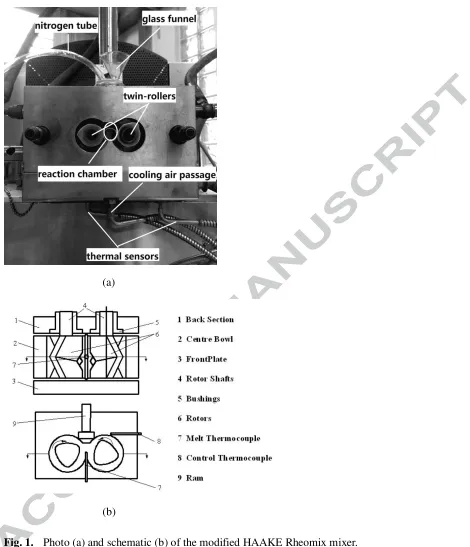
in an oxygen-free environment. Fig. 1 shows a picture of the modified mixer and its schematic.
Teflon film was used to seal the gaps between the three barrels of the mixer, and the feeder on top
was sealed by a silicon-rubber cover to prevent the moisture loss during the reaction. On the silicon
rubber cover, there was a funnel for feeding liquid chemicals and a connecting tube for purging the
(a)
(b)
Fig. 1. Photo (a) and schematic (b) of the modified HAAKE Rheomix mixer.
[image:9.612.73.543.62.609.2]In Method 1, the starch modification was firstly carried out to produce the SBSAP, followed by
the addition of urea to the mixer. For the chemical modification, the starch was grafted with
acrylamide and then crosslinked by N,N’-MBA to produce a starch-based hydrogel. Specifically,
10.00 g of starch, 15.00 g of AM and 30.00 g of distilled water with 0.07 g of N,N’-MBA were added
to the mixer at 80 °C, and the mixing was carried out at 80 rpm for 10 min to gelatinize the starch
under shear stress. Afterward, the temperature of the mixer was decreased to 65 °C by compressed
air, and nitrogen started to be introduced into the mixer. After the reaction chamber had been
purged with nitrogen for 10 min, 0.50 g of CAN was added to the mixer at 65 °C and 80 rpm to
initiate grafting. After the reaction had lasted for 10 min, 9.00 g of NaOH was added to the mixer
and the mixing was undertaken at 65 °C and 80 rpm for another 10 min for saponification. Then,
the saponification was completed, and 20.00 g of urea was added to the mixer and the mixing was
undertaken for another 40 min at 80 °C and 80 rpm. The urea-embedded SBSAP prepared using
Method 1 was coded “SBSAP/urea-M1”.
Method 2 involved the preparation of urea-embedded SBSAPs with the reaction of starch and its
mixing with urea in the single procedure. Urea was firstly granulated into powder and mixed with
starch, and then the same procedure was followed exactly as in the first method describe above.
Using this method, the sample prepared was coded “SBSAP/urea-M2”.
The neat SBSAP (without urea) was also prepared using a method similar to Method 2 for the
starch chemical modification except that urea was not introduced.
After the reactive mixing, the materials were swollen in distilled water for 2 days, followed by
translucency. The samples were then oven-dried at 50 °C for 1 day and then ground into powder,
which was used for Fourier-transform infrared spectroscopy (FTIR), thermogravimetric analysis
(TGA), and gel strength measurements.
2.3. Characterizations
2.3.1. Fourier-transform infrared spectroscopy (FTIR)
Infrared spectra were obtained for the native and modified starches using a Tensor 37 FTIR
spectrometer (Bruker Corporation, Billerica, Massachusetts, USA) equipped with a deuterated
triglycine sulfate (DTGS) detector. The acquisition of spectra was undertaken at a resolution of
4 cm−1 in the range of 4000–600 cm−1 for 64 scans. All spectra were baseline-corrected and
normalized using the Bruker OPUS software before comparison.
2.3.2. Thermogravimetric analysis (TGA)
A PerkinElmer Diamond TGA system (Waltham, Massachusetts, USA) was used to determine
the thermal decomposition of the samples. The measurements were carried out with the samples
heated from 30 °C to 650 °C at 10 °C/min in a nitrogen atmosphere.
2.3.3. Rheometry
The hydrogels of urea-embedded SBSAPs were studied using a Discovery Hybrid Rheometer
(TA Instruments, New Castle, DE 19720, USA). The testing geometry contains a cone with a
testing. Strain sweep in the range of 0.1–100% was carried out at a frequency of 1 rad/s at 25 °C.
Frequency sweep ranging from 0.01 rad/s to 100 rad/s was undertaken at a strain of 1% at 25 °C.
2.3.4. Water absorption capacity (WAC)
Water absorption capacity (WAC) was measured using the method according to a previous study
[37]. Approximate 0.50 g of the dried SBSAP was placed into the bag, which was then soaked in
distilled water at ambient temperature for 6 h. Afterward, the bag with the sample was hung until
no water dropped off and was further wiped using a paper towel to remove any free water. The net
weight of the each water-absorbed SBSAP sample was weighed. WAC was calculated using the
following equation:
WAC (g/g) = (M1–M2)/M2
where M1 and M2 (g) are the weights of the swollen and dried SBSAP samples, respectively. All
the results are reported as the average of three replicates.
2.3.5. Scanning Electronic Microscope (SEM) and Environmental scanning electronic microscope
(ESEM)
A ZEISS EVO 18 scanning electron microscope (Carl Zeiss AG, Oberkochen, Germany)
morphologies. The observation was undertaken at a voltage of 10 kV, in the high vacuum mode,
and at 18 °C. The SBSAPs were vacuum-freeze-dried and gold-plated before testing.
The morphologies of urea-embedded SBSAPs were observed using an FEI Quanta 200
environmental scanning electron microscope (ESEM) (FEI Company, Hillsboro, Oregon, USA)
equipped with an X-ray energy dispersion spectrometer. The scanning was operated in the low
vacuum mode, at a voltage of 20.0 kV, a temperature of 18 °C, a magnification of 300, and a working
distance of 22.4 mm. Before measurements, the samples were dipped in excess distilled water for
12 h to reach its full swollen state.
2.3.6. Release performance in water and ultraviolet spectrophotometry
Urea-embedded SBSAPs were dipped in a 4L capacity bottle with 3 L tap water. The solution
was sampled in the amount of 2 mL at different times (1, 5, 10, 15, 20, 25, 30, 35, and 40 days) for
detecting the urea contents using a Cary 50 ultraviolet (UV) spectrophotometer (Varian Medical
Systems, Inc., Palo Alto, CA, USA).
The urea concentration was calculated using the para-dimethyl-amino-benzaldehyde colorimetry.
Specifically, 2 mL of the urea solution was placed in a 25mL graded tube, added with 20 mL of the
20 g/L para-dimethyl-amino-benzaldehyde solution and 4 mL of the 2 mol/L H2SO4 solution. Then,
distilled water was further added to the solution to reach 25 mL. The solution was shaken up and
down for three times to make the reaction complete and even, followed by a 15min rest before
testing using the UV spectrophotometer at 422nm wavelength. The UV-absorbance results were
3. Results and discussions
3.1. Preparation of urea-embedded SBSAPs
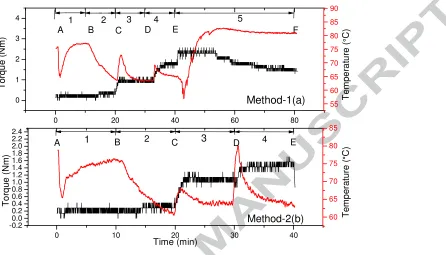
Fig. 2 shows the typical temperature and torque vs. time curves for SBSAP/urea-M1 and
SBSAP/urea-M2.
Using Method 1, there were five stages (Stages 1–5) in the reaction process. At Stage 1
(0–10 min), starch, AM, and distilled water with N,N’-MBA were added to the mixer and the mixing
was undertaken at 80 °C and 80 rpm for 10 min to gelatinize the starch under shear stress. At this
stage, no apparent change in torque was noticed, while the temperature rapidly decreased at time
zero when the material and chemicals were fed in and then increased back to 80 °C within 5 min.
At Stage 2 (10–20 min), the temperature went down from 80 °C to 65 °C by compressed air.
Torque was observed to increase slightly from 15 min to 20 min which was as expected since the
reduced temperature could lead to an increase in viscosity of the polymer. At 20 min (Stage 3), the
initiator, CAN, was introduced, and both the temperature and torque rapidly increased suggesting the
occurrence of the grafting reaction. At 30 min (Stage 4), NaOH was introduced for saponification.
The temperature was observed to increase abruptly with the introduction of NaOH but then slowly
declined, indicating that saponification was a rapid process. Meanwhile, the increased torque
suggested that the saponified starch-g-PAM had a higher viscosity. At 40 min (Stage 5), urea was
added which was reflected by a rapid drop in temperature and increase in torque. The temperature
was set 80 °C to melt urea, obtaining a homogeneous mixture of urea and SBSAP so that the torque
0 10 20 30 40
-0.20.0 0.2 0.4 0.6 0.8 1.0 1.2 1.4 1.6 1.8 2.0 2.2 2.4 Time (min) T o rq u e ( N m )
A 1 B 2 C 3 D 4 E
Method-2(b) 60 65 70 75 80 85 T e m p e ra tu re ( ° C )
0 20 40 60 80
0 1 2 3 4 T o rq u e ( N m )
1 2 3 4 5
A B C D E F
Method-1(a) 55 60 65 70 75 80 85 90 T e m p e ra tu re ( ° C )
Fig. 2. Typical torque/temperature vs. time curves during reactive mixing for SBSAP/urea-M1 and
SBSAP/urea-M2 (starch type: G50; CAN content: 5.0%; N,N’-MBA content: 1.0%; degree of
saponification: 30%; urea content: 200%).
Using Method 2 to prepare the urea-embeded SBSAP, there were four stages in the process. At
Stage 1, urea, starch, AM, and distilled water with N,N’-MBA were added into the mixer at 80 °C
and 80 rpm to allow 10 min to gelatinize the starch under shear stress. Similar to Stage 1 using
Method 1, the torque experienced little change, while there was initially a sudden drop in
[image:15.612.89.535.141.396.2]increased afterward, the increase speed seemed lower using Method 2 probably due to the melting of
additional urea in the formulation. In the second (10–20 min) and third (20–30 min) stages, the
temperature and torque followed the same trends as in Method 1. At 30 min (Stage 4), with NaOH
introduced for saponification, there was a stronger increase in temperature, which probably due to
the reaction between NaOH and urea. This reaction would consume part of urea to form sodium
cyanate, ammonia, and water. The torque values between two methods were quite similar from
Stage 1 and Stage 3, whereas the torque in Method 2 was lower at Stage 4. It was possible that the
water from the reaction between NaOH and urea reduced the viscosity of the material. Despite the
unwanted reaction between NaOH and urea, Method 2 (totally 40 min) was more time-efficient than
Method 1 (totally 80 min).
3.2. Visual appearance
As shown in the Fig. 3, after preparation and achieving maximum swelling in water,
SBSAP/urea-M1 was a hydrogel in pieces, while SBSAP/urea-M2 presented larger lumps. It was
proposed that as Method 1 used a time twice that using Method 2, an additional 40min shear
Fig. 3. Photos of the swollen hydrogels of SBSAP/urea-M1 (a) and SBSAP/urea-M2 (b) (starch
type: G50; CAN content: 5.0%; N,N’-MBA content: 1.0%; degree of saponification: 30%; urea
content: 200%).
3.3. Morphology
Fig. 4 shows the surfaces of SBSAPs after preparation but before swelling. No significant
difference could be seen between the neat SBSAP (Fig. 4a), SBSAP/urea-M1 (Fig. 4b), and
SBSAP/urea-M2 (Fig. 4c), except that SBSAP/urea-M1 and SBSAP/urea-M2 contained some
particles/aggregates. It was possible that these particles/aggregates were the urea and/or the
byproducts from the reaction (e.g. sodium cyanate in Method 2), which was phase-separated from
[image:17.612.77.506.71.235.2]Fig. 4. ESEM images of neat SBSAP (a), SBSAP/urea-M1, (b) and SBSAP/urea-M2 (c) (starch
type: G50; CAN content: 5.0%; N,N’-MBA content: 1.0%; degree of saponification: 80%; urea
content: 400%).
After swollen to the full extent, a three-dimensional structure can be observed in SBSAPs as
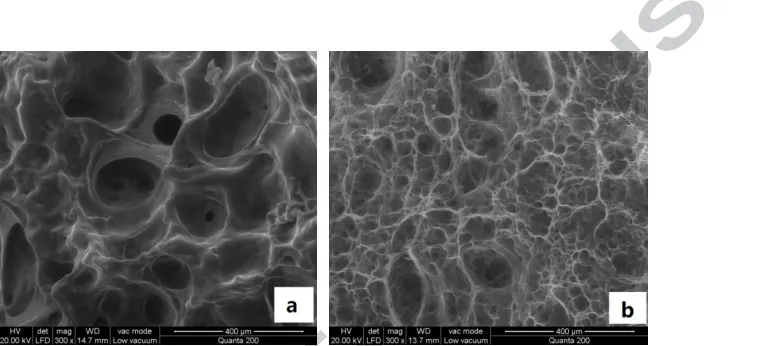
shown in Figs. 5, 6, and 7. Fig. 5 showed the networks of the swollen SBSAP/urea-M1 and
SBSAP/urea-M2. SBSAP/urea-M1 displayed much thicker cell wall (Fig. 5a), which could
contribute to a higher storage modulus of the hydrogel (discussed later). In contrast,
SBSAP/urea-M2 showed a higher porosity and larger surface area (Fig. 5b), which might lead to
higher swelling and WAC (discussed later). The difference shown here could be attributed to the
different preparation methods. For SBSAP/urea-M2, as urea was blended with the starch from the
[image:18.612.73.536.79.417.2]It has been widely reported that urea can act as a gelatinization agent to effectively disrupt the
original hydrogen bonding of starch [38-42]. However, for SBSAP/urea-M1, urea was added after
the starch gelatinization and chemical modification, so the gelatinization effect of urea was not
shown. Also, Fig. 2 has shown that the viscosity of the material after 30 min in the mixer using
Method 2 was lower than that using Method 1, which was preferable for forming a porous structure.
Fig. 5. SEM images of the swollen hydrogels of SBSAP/urea-M1 and SBSAP/urea-M2 (starch type:
G50; CAN content: 5.0%; N,N’-MBA content: 1.0%; degree of saponification: 30%; urea content:
200%).
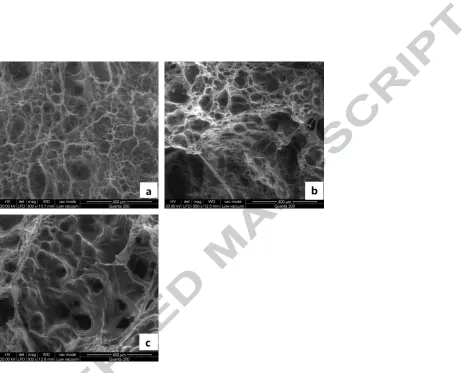
As showed in Fig. 6, G50-based SAP presented a smaller pore size and higher pore density than
SAPs from NCS and WCS with lower amylose contents. It was possible that amylose was more
[image:19.612.78.458.260.433.2]to graft monomer chains onto amylose, which is a linear molecule, than the amylopectin, which is a
branched molecule.
Fig. 6. SEM images of swollen hydrogels of SBSAP/urea-M2 from different starches: G50 (a),
NCS (b), and WCS (c) (CAN content: 3.75%; N,N’-MBA content: 1.0%; degree of saponification:
30%; urea content: 200%).
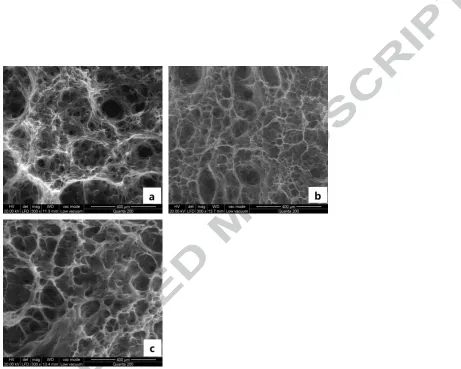
Fig. 7 showed the effect of the crosslinker (N,N’-MBA) content on the microstructure of
[image:20.612.78.540.132.505.2]was in agreement with previous research [16]. Irrespective of the N,N’-MBA content, a
three-dimensional structure with a high pore density and uniformly-distributed pores were obtained,
which was instrumental to the water absorption and the controlled release of fertilizer.
Fig. 7. ESEM images of swollen hydrogels of SBSAP/urea-M2 with 0.5% (a), 1.0% (b), and 1.5%
(c) crosslinker (N,N’-MBA) content (starch type: G50; CAN content: 3.75%; degree of
[image:21.612.74.535.158.527.2][image:22.612.71.278.413.624.2]
3.4. Chemical structure analysis
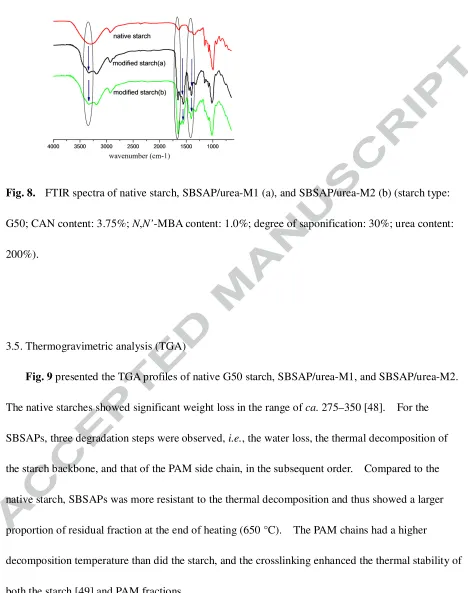
Fig. 8 shows the FTIR spectra of native G50 starch, SBSAP/urea-M1, and SBSAP/urea-M2.
The typical FTIR spectra of the native starch exhibited the O–H stretching absorption in the region of
3550–3200 cm−1 (broad, s), the C–H stretching at 2930 cm−1 (m), and the wave numbers of 1158,
1081, and 1015 cm−1 (s) for the C–O–C stretching (a triplet peak of starch) [24]. The band at
1642 cm−1 could be attributed to the adsorbed water in starch amorphous regions [45-47]. Before
the FTIR analysis, SBSAP/urea-M1 and SBSAP/urea-M2 were washed with water to remove urea
and unreacted chemicals. These SBSAPs displayed additional bands at 3425 cm−1, 1658 cm−1,
1600 cm−1, and 1409 cm−1, indicated the N–H stretching, the C=O stretching, the N–H bending, and
the –C–N stretching, respectively. These are characteristics of the −CONH2 group contained in
acrylamide [24]. Therefore, starch-g-PAM copolymers were successfully synthesized using the
Fig. 8. FTIR spectra of native starch, SBSAP/urea-M1 (a), and SBSAP/urea-M2 (b) (starch type:
G50; CAN content: 3.75%; N,N’-MBA content: 1.0%; degree of saponification: 30%; urea content:
200%).
[image:23.612.71.539.90.683.2]3.5. Thermogravimetric analysis (TGA)
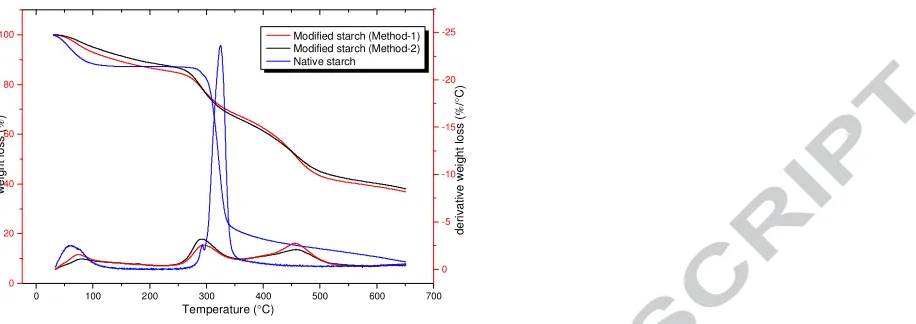
Fig. 9 presented the TGA profiles of native G50 starch, SBSAP/urea-M1, and SBSAP/urea-M2.
The native starches showed significant weight loss in the range of ca. 275–350 [48]. For the
SBSAPs, three degradation steps were observed, i.e., the water loss, the thermal decomposition of
the starch backbone, and that of the PAM side chain, in the subsequent order. Compared to the
native starch, SBSAPs was more resistant to the thermal decomposition and thus showed a larger
proportion of residual fraction at the end of heating (650 °C). The PAM chains had a higher
decomposition temperature than did the starch, and the crosslinking enhanced the thermal stability of
[image:23.612.121.325.101.253.2]0 100 200 300 400 500 600 700
0 20 40 60 80
100 Modified starch (Method-1)
Modified starch (Method-2) Native starch
Temperature (°C)
w e ig h t lo s s ( % ) 0 -5 -10 -15 -20 -25 d e ri v a ti v e w e ig h t lo s s ( % /° C )
Fig. 9. Weight loss and derivative weight loss curves of native starch, SBSAP/urea-M1 (a) and
SBSAP/urea-M2 (b) (starch type: G50; CAN content: 5.0%; N,N’-MBA content: 1.0%; degree of
saponification: 80%; urea content: 400%).
3.6. Water absorption capacity (WAC)
The WAC results were showed in Tables 1, 2, and 3. According to Table 1, SBSAP/urea-M2
had a higher WAC than SBSAP/urea-M1. From Table 2, G50 showed a greater WAC than the
other two starches. Table 3 indicated that WAC increased significantly as the crosslinker content
(N,N’-MBA) was decreased, which was consistent with a previous study [50]. The WAC data here,
along with the SEM results, indicated that the close relationship between the porosity and WAC.
[image:24.612.82.540.105.267.2]Table 1. Effect of the preparation method on the gel property and release rate of SBSAP/urea (starch
type: G50; CAN content: 5.0%; N,N’-MBA content: 1.0%; degree of saponification: 80%; urea
content: 400%)
Sample Method 1 Method 2
Storage modulus(Pa) 3137±156.1 1241±34.5
WAC (g/g) 146.0±0.7 215.8±2.7
30-day release rate (%) 77.33±0.59 71.20±0.21
Table 2. Effect of the starch type on the gel property and release rate of SBSAP/urea-M2 (CAN
content: 3.75%; N,N’-MBA content: 1.0%; degree of saponification: 30%; urea content: 200%)
Sample G50 NCS WCS
Storage modulus (Pa) 1486±51.6 2008±79.8 1345±86.5
WAC (g/g) 151.9±2.7 79.85±0.46 89.49±2.0
[image:25.612.70.429.411.632.2]Table 3. Effect of the N,N’-MBA content on the gel property and release rate of SBSAP/urea-M2
(starch type: G50; CAN content: 3.75%; degree of saponification: 30%; urea content: 200%)
Sample 0.5% N,N’-MBA 1.0% N,N’-MBA 1.5% N,N’-MBA
Storage modulus (Pa) 675.7±3.24 1486±51.6 3493±156.7
WAC (g/g) 253.3±3.8 151.9±2.7 118.5±1.1
30-day release rate (%) 83.10±0.52 76.20±0.61 83.40±0.77
3.7. Gel strength
Tables 1, 2, and 3 also listed the gel strength data for different samples. As seen in Table 1,
the storage modulus of SBSAP/urea-M1 was much higher than SBSAP/urea-M2, which was
consistent with the result of SEM. From Table 2, it can be seen that NCS had a higher storage
modulus than WCS and G50. WCS has no amylose content which is not favorable for the grafting
reaction and the formation of a three-dimensional structure that affect the gel strength [43, 44, 51].
Meanwhile, G50-based SAP had a higher WAC, which might account for its lower gel strength than
the one based on NCS. Table 3 showed that the crosslinker (N,N’-MBA) content had a significant
effect on the gel strength. The storage modulus of SBSAP hydrogel was doubled as the crosslinker
was increased from 0.5% to 1.0% and was doubled again as that was further increased from 0.10 g to
0.15 g. The higher gel strength with a higher crosslinker content was as expected according to
previous research [50]. By adjusting the crosslinker content, appropriate hydrogel strength can be
3.7. Release performance in water
The release performance was both affected by the gel strength and WAC. According to the
Flory-Huggins swelling theory [53], the SBSAP absorbed water through hydrophilic interactions.
The hydrophilic groups were ionized and the electrostatic repulsion occurred, contributing to the
formation of a three-dimensional network. The network formation allowed the generation of an
elastic force contrary to the electrostatic repulsion. As the electrostatic repulsion was offset by the
elastic recovery force, the full swelling extent of the SBSAP was reached. The absorbed water
could be classified as non-frozen water, immobile water, and free water based on their different
binding forces with the SBSAP network. Urea was dissolved in the water hold by the SBSAP
network, diffusing outwards through the network driven by the osmotic gap between the inner and
outside of the network.
Fig. 10 showed a typical urea release profile of SBSAP/urea-M2 in static water. In the early
stage (0–5 days), the network was strong enough, and less than 15% of urea was released only by the
dynamic exchange of free water. In the intermediate stage (5–20 days), more than 50% of urea was
released at a much higher rate. Then, during 20–40 days, more than 80% of urea was released. As
the release time prolonged, the gel strength decreased, and the adhesive force of the network
weakened, which contributed to a faster release rate. We noticed more than 10% of urea remaining
un-released in the SBSAP, which was possibly integrated with the unfrozen water. After the 45-day
0 10 20 30 40 50
0 20 40 60 80 100 u re a r e le a s e d i n w a te r (% )
release time (day)
Fig. 10. Typical urea release curve in static water of SBSAP/urea-M2 (starch type: G50; CAN
content: 5%; N,N’-MBA content: 1.0%; degree of saponification: 30%; urea content: 200%).
4. Conclusions
In this work, a simple one-step approach using reactive mixing to prepare SBSAPs for the slow
release of the urea fertilizer was demonstrated. The urea content in SBSAP was up to 400%, and
the release behavior mainly depended on the gel strength and WAC, which was entirely different
from traditional coated fertilizers. The crosslinker content could significantly control the gel
strength and WAC. Besides, the G50-based SAP had a higher WAC than those based on the
lower-amylose starches. Using the SBSAPs prepared by reactive mixing, the slow release of urea
in water was achieved. Specifically, less than 15% urea was released within 1 day, the release rate
after 30 days exceeded 80%, and the release lasted for more than 45 days. The present research
provides a cost-effective solution to prepare a slow urea release technology, which was promising in
[image:28.612.81.540.102.269.2]slow-release device. Moreover, the processing model demonstrated in this article would be
valuable for developing similar simple and cost-effective technologies for fabricating a broad range
of functional polymers and materials.
Acknowledgements
The authors from South China University of Technology (SCUT), China, would like to
acknowledge the research funds from NSFC (Project Nos. 31130042 and 31571789) and STPG
(Project Nos. B090600054 and B010404002). The research is also supported by the Guangdong
Innovative &Entrepreneurial Research Team Program (Project No. 2013C085).
Reference
[1] W.M. Stewart, D.W. Dibb, A.E. Johnston, T.J. Smyth, The contribution of commercial fertilizer nutrients to food production, Agronomy Journal 97 (2005) 1-6.
[2] B. Ni, M. Liu, S. Lü, Multifunctional slow-release urea fertilizer from ethylcellulose and superabsorbent coated formulations, Chemical Engineering Journal 155 (2009) 892-898.
[3] B. Ni, M. Liu, S. Lu, L. Xie, Y. Wang, Environmentally friendly slow-release nitrogen fertilizer, J Agric Food Chem 59 (2011) 10169-10175.
[4] N. Xiaoyu, W. Yuejin, W. Zhengyan, W. Lin, Q. Guannan, Y. Lixiang, A novel slow-release urea fertiliser: Physical and chemical analysis of its structure and study of its release mechanism,
Biosystems Engineering 115 (2013) 274-282.
[5] M. Zhang, B. Gao, J. Chen, Y. Li, A.E. Creamer, H. Chen, Slow-release fertilizer encapsulated by graphene oxide films, Chemical Engineering Journal 255 (2014) 107-113.
[6] L.E.D. Smith, G. Siciliano, A comprehensive review of constraints to improved management of fertilizers in China and mitigation of diffuse water pollution from agriculture, Agriculture,
Ecosystems & Environment 209 (2015) 15-25.
[9] R. Fernández-Escobar, M. Benlloch, E. Herrera, J.M. Garcı́a-Novelo, Effect of traditional and slow-release N fertilizers on growth of olive nursery plants and N losses by leaching, Scientia Horticulturae 101 (2004) 39-49.
[10] M.Y. Naz, S.A. Sulaiman, Slow release coating remedy for nitrogen loss from conventional urea: a review, J Control Release 225 (2016) 109-120.
[11] Y. Yang, M. Zhang, Y.C. Li, X. Fan, Y. Geng, Controlled Release Urea Improved Nitrogen Use Efficiency, Activities of Leaf Enzymes, and Rice Yield, Soil Science Society of America Journal 76 (2012) 2307.
[12] B. Azeem, K. KuShaari, Z.B. Man, A. Basit, T.H. Thanh, Review on materials & methods to produce controlled release coated urea fertilizer, J Control Release 181 (2014) 11-21.
[13] K.R. Mohd Ibrahim, F. Eghbali Babadi, R. Yunus, Comparative performance of different urea coating materials for slow release, Particuology 17 (2014) 165-172.
[14] A. Ammala, S. Bateman, K. Dean, E. Petinakis, P. Sangwan, S. Wong, Q. Yuan, L. Yu, C. Patrick, K.H. Leong, An overview of degradable and biodegradable polyolefins, Prog. Polym. Sci. 36 (2011) 1015-1049.
[15] D. Cordell, J.-O. Drangert, S. White, The story of phosphorus: Global food security and food for thought, Global Environmental Change-Human and Policy Dimensions 19 (2009) 292-305.
[16] F.W. Wellmer, J.D. Becker-Platen, Sustainable development and the exploitation of mineral and energy resources: a review, International Journal of Earth Sciences 91 (2002) 723-745.
[17] A. Pourjavadi, A.M. Harzandi, H. Hosseinzadeh, Modified carrageenan 3. Synthesis of a novel polysaccharide-based superabsorbent hydrogel via graft copolymerization of acrylic acid onto kappa-carrageenan in air, European Polymer Journal 40 (2004) 1363-1370.
[18] M.R. Guilherme, F.A. Aouada, A.R. Fajardo, A.F. Martins, A.T. Paulino, M.F.T. Davi, A.F. Rubira, E.C. Muniz, Superabsorbent hydrogels based on polysaccharides for application in agriculture as soil conditioner and nutrient carrier: A review, European Polymer Journal 72 (2015) 365-385.
[19] C. Chang, B. Duan, J. Cai, L. Zhang, Superabsorbent hydrogels based on cellulose for smart swelling and controllable delivery, European Polymer Journal 46 (2010) 92-100.
[20] A. Rashidzadeh, A. Olad, D. Salari, A. Reyhanitabar, On the preparation and swelling properties of hydrogel nanocomposite based on Sodium alginate-g-Poly (acrylic
acid-co-acrylamide)/Clinoptilolite and its application as slow release fertilizer, Journal of Polymer Research 21 (2014).
[21] L. Sartore, G. Vox, E. Schettini, Preparation and Performance of Novel Biodegradable
Polymeric Materials Based on Hydrolyzed Proteins for Agricultural Application, Journal of Polymers and the Environment 21 (2013) 718-725.
[22] A. Hao, Y. Geng, Q. Xu, Z. Lu, L. Yu, Study of different effects on foaming process of
biodegradable PLA/starch composites in supercritical/compressed carbon dioxide, Journal of Applied Polymer Science 109 (2008) 2679-2686.
[23] K. Zhong, Z.T. Lin, X.L. Zheng, G.B. Jiang, Y.S. Fang, X.Y. Mao, Z.W. Liao, Starch
[24] P. Lanthong, R. Nuisin, S. Kiatkamjornwong, Graft copolymerization, characterization, and degradation of cassava starch-g-acrylamide/itaconic acid superabsorbents, Carbohydr. Polym. 66 (2006) 229-245.
[25] S. Pal, T. Nasim, A. Patra, S. Ghosh, A.B. Panda, Microwave assisted synthesis of
polyacrylamide grafted dextrin (Dxt-g-PAM) Development and application of a novel polymeric flocculant, International Journal of Biological Macromolecules 47 (2010) 623-631.
[26] G. Sen, S. Pal, Polyacrylamide Grafted Carboxymethyl Tamarind (CMT-g-PAM): Development and Application of a Novel Polymeric Flocculant, Macromolecular Symposia 277 (2009) 100-111. [27] D. Qiao, W. Zou, X. Liu, L. Yu, L. Chen, H. Liu, N. Zhang, Starch modification using a twin-roll mixer as a reactor, Starch - Stärke 64 (2012) 821-825.
[28] F. Xie, L. Yu, H. Liu, L. Chen, Starch modification using reactive extrusion, Starch/Stärke 58 (2006) 131-139.
[29] G. Moad, Chemical modification of starch by reactive extrusion, Prog. Polym. Sci. 36 (2011) 218-237.
[30] J. Stagner, V. Dias Alves, R. Narayan, A. Beleia, Thermoplasticization of high amylose starch by chemical modification using reactive extrusion, J. Polym. Environ. 19 (2011) 589-597.
[31] J.B. Olivato, M.V.E. Grossmann, F. Yamashita, D. Eiras, L.A. Pessan, Citric acid and maleic anhydride as compatibilizers in starch/poly(butylene adipate-co-terephthalate) blends by one-step reactive extrusion, Carbohydr. Polym. 87 (2012) 2614-2618.
[32] E. Hablot, S. Dewasthale, Y. Zhao, Y. Zhiguan, X. Shi, D. Graiver, R. Narayan, Reactive extrusion of glycerylated starch and starch–polyester graft copolymers, Eur. Polym. J. 49 (2013) 873-881.
[33] S. Kugler, T. Spychaj, K. Wilpiszewska, K. Gorący, Z. Lendzion-Bieluń, Starch-graft
copolymers of N-vinylformamide and acrylamide modified with montmorillonite manufactured by reactive extrusion, J. Appl. Polym. Sci. 127 (2013) 2847-2854.
[34] Y. Zhang, H. Li, X. Li, M.E. Gibril, M. Yu, Chemical modification of cellulose by in situ reactive extrusion in ionic liquid, Carbohydr. Polym. 99 (2014) 126-131.
[35] M. Avella, M.E. Errico, R. Rimedio, P. Sadocco, Preparation of biodegradable
polyesters/high-amylose-starch composites by reactive blending and their characterization, J. Appl. Polym. Sci. 83 (2002) 1432-1442.
[36] C. Nakason, T. Wohmang, A. Kaesaman, S. Kiatkamjornwong, Preparation of cassava starch-graft-polyacrylamide superabsorbents and associated composites by reactive blending, Carbohydr. Polym. 81 (2010) 348-357.
[37] D. Qiao, H. Liu, L. Yu, X. Bao, G.P. Simon, E. Petinakis, L. Chen, Preparation and
characterization of slow-release fertilizer encapsulated by starch-based superabsorbent polymer, Carbohydr. Polym. 147 (2016) 146-154.
[38] A. Hebeish, I.A. El-Thalouth, M.E. Kashouti, Gelatinization of rice starch in aqueous urea solutions, Starch - Stärke 33 (1981) 84-90.
[39] R.L. Shogren, C.L. Swanson, A.R. Thompson, Extrudates of cornstarch with urea and glycols: structure/mechanical property relations, Starch/Stärke 44 (1992) 335-338.
[41] X.F. Ma, J.G. Yu, Y.B. Ma, Urea and formamide as a mixed plasticizer for thermoplastic wheat flour, Carbohydr. Polym. 60 (2005) 111-116.
[42] X.F. Ma, J.G. Yu, J.J. Wan, Urea and ethanolamine as a mixed plasticizer for thermoplastic starch, Carbohydr. Polym. 64 (2006) 267-273.
[43] Y. Long, G. Christie, Microstructure and mechanical properties of orientated thermoplastic starches, Journal of Materials Science 40 (2005) 111-116.
[44] W. Zou, L. Yu, X. Liu, L. Chen, X. Zhang, D. Qiao, R. Zhang, Effects of amylose/amylopectin ratio on starch-based superabsorbent polymers, Carbohydr. Polym. 87 (2012) 1583-1588.
[45] N. Santha, K.G. Sudha, K.P. Vijayakumari, V.U. Nayar, S.N. Moorthy, Raman and infrared spectra of starch samples of sweet potato and cassava, Proceedings of the Indian Academy of Sciences, Chemical Sciences 102 (1990) 705-712.
[46] R. Kizil, J. Irudayaraj, K. Seetharaman, Characterization of irradiated starches by using FT-Raman and FTIR spectroscopy, J Agric Food Chem 50 (2002) 3912-3918.
[47] R.H. Wilson, B.J. Goodfellow, P.S. Belton, B.G. Osborne, G. Oliver, P.L. Russell, Comparison of fourier transform mid infrared spectroscopy and near infrared reflectance spectroscopy with differential scanning calorimetry for the study of the staling of bread, Journal of the Science of Food and Agriculture 54 (1991) 471-483.
[48] X. Liu, Y. Wang, L. Yu, Z. Tong, L. Chen, H. Liu, X. Li, Thermal degradation and stability of starch under different processing conditions, Starch - Stärke 65 (2013) 48-60.
[49] S.J. Lu, M.L. Duan, S.B. Lin, Synthesis of superabsorbent starch graft-poly(potassium acrylate-co-acrylamide) and its properties, Journal of Applied Polymer Science 88 (2003) 1536-1542.
[50] K. Kabiri, H. Omidian, S.A. Hashemi, M.J. Zohuriaan-Mehr, Synthesis of fast-swelling superabsorbent hydrogels: effect of crosslinker type and concentration on porosity and absorption rate, European Polymer Journal 39 (2003) 1341-1348.
[51] P. Chen, L. Yu, G. Simon, E. Petinakis, K. Dean, L. Chen, Morphologies and microstructures of cornstarches with different amylose–amylopectin ratios studied by confocal laser scanning
microscope, Journal of Cereal Science 50 (2009) 241-247.
[52] S. Noppakundilograt, N. Pheatcharat, S. Kiatkamjornwong, Multilayer-Coated NPK Compound Fertilizer Hydrogel with Controlled Nutrient Release and Water Absorbency, Journal of Applied Polymer Science 132 (2015).
Highlights:
Starch-based superabsorbent polymers for urea release were prepared by reactive mixing
The effects of initiator, crosslinker, and saponification agent were investigated
Acrylamide was successfully grated onto starch
Crosslinking resulted in a structured network with smaller pore size