http://wrap.warwick.ac.uk
Original citation:
Ronayne, David (2015) Price comparison websites. Working Paper. Coventry: University of Warwick. Department of Economics. Warwick economics research papers series (WERPS) (Number 1056 (version 4)). (Unpublished)
Permanent WRAP url:
http://wrap.warwick.ac.uk/66207
Copyright and reuse:
The Warwick Research Archive Portal (WRAP) makes this work by researchers of the University of Warwick available open access under the following conditions. Copyright © and all moral rights to the version of the paper presented here belong to the individual author(s) and/or other copyright owners. To the extent reasonable and practicable the material made available in WRAP has been checked for eligibility before being made available.
Copies of full items can be used for personal research or study, educational, or not-for-profit purposes without prior permission or charge. Provided that the authors, title and full bibliographic details are credited, a hyperlink and/or URL is given for the original metadata page and the content is not changed in any way.
A note on versions:
The version presented here is a working paper or pre-print that may be later published elsewhere. If a published version is known of, the above WRAP url will contain details on finding it.
Warwick Economics Research Paper Series
Price Comparison Websites
David Ronayne
October, 2015
Series Number: 1056 (version 4)
ISSN 2059-4283 (online)
Price Comparison Websites
David Ronayne
17 October 2015
Abstract
The large and growing industry of price comparison websites (PCWs) or ‘web
aggregators’ is poised to benefit consumers by increasing competitive pricing
pres-sure on firms by acquainting shoppers with more prices. However, these sites also
charge firms for sales, which feeds back to raise prices. I investigate the impact of
introducing PCWs to a market for a homogeneous good. I find that introducing a
single PCW increasesprices for all consumers, both shoppers and non-shoppers.
More generally, in the most profitable equilibrium for competing PCWs, prices
tend torisewith the number of PCWs. (JEL: L11, L86, D43)
Keywords: online markets; price comparison sites; competition; price dispersion;
1University of Warwick; [email protected]. I thank Dan Bernhardt, Rani Spiegler, Motty Perry,
Daniel Sgroi, Kobi Glazer, Andrew Oswald, Alessandro Iaria and Giulio Trigilia for their helpful discussion. I
1. Introduction
Over the past two decades a new industry of price comparison websites (PCWs) or ‘web
aggregators’ has emerged. The industry has enabled consumers to check prices of many firms
selling a particular service or product simultaneously in one place. The sites are popular in
many countries, and in many markets including utilities, financial services, hotels, flights and
durable goods.2 These sites command billions of dollars of revenue annually.3 In the UK,
PCWs for utilities and financial services have been particularly successful. There are roughly
48 such PCWs in the UK, where over 70% of internet users have used such a site. The largest
four aggregators generated approximately£800m ($1.2bn) in revenue during 2013, with
aver-age annual profit of the group increasing by 14% that year.4
The internet has altered search costs, allowing consumers to compare prices across firms in
a matter of clicks, intensifying competitive pricing pressure between firms. While a consumer
may not know all the firms in a market, a PCW can expose the full list of market offerings,
maximizing inter-firm pressure. However, underlying this increased competition are the fees
paid by firms who sell their products through the websites. In the UK these are understood
to be between £44-60 ($69-95) for a customer switching gas and electricity provider.5 These
fees, in turn, act as a marginal cost faced by producers, affecting their pricing decisions.6 The
2Examples for utilities and services include Moneysupermarket.com, Google Compare and Gocompare.com;
for flights Skyscanner.net and Flights.com; for hotels Hotels.com and Booking.com; and for durable goods
Ama-zon Marketplace, Pricerunner.com and Pricegrabber.com.
3Regarding travel services, Priceline Group (which owns Booking.com and Priceline.com) and Expedia Inc.
(which owns Expedia.com and Hotels.com) made approximately $6bn in total agency revenues in 2014. Regarding
durable goods, Amazon Marketplace sold 2 billion items from third-party sellers. See their 2014 Annual Reports
for details.
4Number of PCWs taken from Consumer Focus (2013) report into PCWs in the UK. The ‘big four’ refers to
Money Supermarket, Compare the Market, Go Compare and Confused.com. Number of PCWs Usage data from
the 2013 Mintel Report on Web Aggregators. Financial information taken from the companies’ own annual reports
where available, otherwise inferred from parent group reports or newspaper articles. See appendix for details.
5For example, see BBC (2015). Fees are significant in other sectors too e.g., in the hotel-reservation sector
they are reported to be 15-25% of the purchase price (see Daily Mail, 2015).
industry gleans substantial profits from these fees. As such, it is not clear whether the central
premise that PCWs lower prices is valid. This fundamental tension is encapsulated in a quote
from the BBC (2014):
“There’s another cost in the bill. It’s hidden, it’s kept confidential, and yet it’s
for a part of the industry that appears to be on the consumers’ side. This is the cut of
the bill taken by price comparison websites, in return for referring customers. The
recommendation to switch creates churn in the market, and it is seen by supplier
companies as worth paying high fees to the websites. Whether or not customers
choose to use the sites, the cost to the supplier is embedded within bills for all
customers.”7
This article examines this “churn” and addresses the fundamental question of when
con-sumers are better off with a PCW in the marketplace. In homogeneous good markets, I
charac-terize when all consumers are made worse off following the introduction of PCWs.
My model builds on the elegant framework of Baye and Morgan (2001), who investigate the
strategic incentives of a PCW or ‘information gatekeeper’. Without the PCW in their model,
each consumer is served by asingle ‘local’ firm which sells at the monopoly price (it is too
costly for consumers to travel to another store). This leads to the result that consumers benefit
from the introduction of a PCW, because firms must compete for the business of consumers
who enjoy free access to the site. In the modern online marketplace however, firms also have
their own websites.8 In the absence of an aggregator, consumers do not need to physically
travel to purchase the good; they can visit another firm’s website just as easily as they could an
aggregator’s.
My model features two types of consumers: shoppers, who use PCWs in equilibrium, and
model the latter, assuming that the two are correlated.
7The concern was also expressed by US senator Amy Klobuchar regarding mergers of hotel-reservation sites:
“The whole idea of cheaper hotels is very good, but if it all starts to come under one company, you can easily
foresee the situation where they can charge higher commissions that are then passed on to consumers.” (New York
Times, 2015)’
inactive consumers, who buy directly from a particular firm. Although shoppers are always
better off than inactive consumers in equilibrium, my primary result is that both types are
always made worse off by the introduction of a single PCW. I then provide conditions under
which consumers are harmed by the introduction of multiple competing PCWs. This is the
first article in this setting to show such results, reversing those in the existing literature, which
I show can be seen as a special limiting case.9 My model supposes each shopper is informed
of the prices fromq > 1of then firms’ websites in the absence of a PCW, rather thanq = 1
as in Baye and Morgan. Without a PCW, shoppers see q prices; after the introduction of the
PCW, they will see all of them in equilibrium. I show that adding competition (q > 1) to the
setting without an aggregator reverses their finding: expected equilibrium prices are raised by
the introduction of a single PCW, making all consumers worse off.
What happens is that the equilibrium fee a single PCW charges for a sale through its site is
so high that it more than negates any benefits from the increased firm competition. One may
conjecture that allowing multiple competing aggregators will undo this result, akin to textbook
Bertrand competition. I extend the model to allow for multiple PCWs, and for shoppers to
check any number of them. My characterization shows that both the number of PCWs and the
number of PCWs that shoppers check (or are informed of) matter. Concretely, when shoppers
only check one of many PCWs, they all effectively remain monopolists and so consumer
wel-fare does improve with any number of PCWs. At the other extreme, where shoppers check all
PCWs, Bertrand-style reasoning at the aggregator level results as a special case: PCWs
under-cut each other’s fees to reach a unique zero-profit equilibrium and shoppers benefit from their
existence. When shoppers visit some, but not all PCWs, consumer welfare tends to rise with the
number of PCWs checked, but it falls with the number of PCWs. In particular, in this realistic
scenario, there is a critical number of PCWs beyond which all consumers can be worse off than
without any aggregators at all.
I then investigate the impact of different policies and other market features. Generally,
PCW fees are either not disclosed or are detailed on a subpage of the websites. When PCWs
9This is in the absence of any persuasion or direction of consumers to more expensive products by firms (e.g.,
publicly announce fees so that consumers are made aware of them, I show that this creates the
possibility that firms and shoppers could coordinate on the cheapest PCW, which can result in
equilibria that benefit shoppers relative to a world without PCWs.
My primary focus is on settings where a firm sets the same price for a product on every
website that it is sold. This assumption describes many markets where PCWs operate
includ-ing gas, electricity, mortgages and durable goods. However, I extend the analysis to consider
markets such as the hotel reservation sector, where a firm’s price can differ across sites. I show
that both types of consumers can be worse off when shoppers only check one PCW in
equilib-rium. However, unlike markets without price discrimination, when shoppers check at least two
PCWs, competitive pressure between aggregators can work `a la Bertrand. I also consider
mar-kets where consumers may face some non-negligible search cost in order to retrieve prices e.g.,
home insurance quotes. Here, the number of shopping consumers is endogenously determined
by the distribution of search costs and the expected savings consumers can make by using it. I
show that despite this activity at the ‘extensive search margin’, an aggregator can still make all
consumers worse off, including those who decide to start shopping.
Section 2 reviews the literature; Section 3 presents the model; Section 4 conducts
com-parative statics with a monopolist PCW; Section 5 models competing aggregators; Sections 6-8
consider settings with publicly observable fees, price discrimination and search costs; Section 9
concludes.
2. Literature
This article contributes to the literature on ‘clearing-house’ models, see for example (Salop
and Stiglitz, 1977; Varian, 1980; Rosenthal, 1980; Baye and Morgan, 2001, 2009; Baye et al.,
2004; Chioveanu, 2008; Arnold et al., 2011; Arnold and Zhang, 2014). These models
rational-ize price-dispersion in homogeneous goods markets.10 Indeed, price dispersion has persisted
10The search cost literature also provides explanations of price dispersion (e.g., Burdett and Judd, 1983; Ellison
and Ellison, 2009; Ellison and Wolitzky, 2012; Stahl, 1989; 1996; Stigler, 1961). Motivated by the rise of the
internet, clearing-house models abstract from a direct modeling of consumer search costs. The frameworks are to
despite the advances of technology such the internet and comparison sites. Early studies
docu-mented marked dispersion in the online markets for goods (e.g., Brynjolfsson and Smith, 2000;
Baye et al., 2004). A recent study by Gorodnichenko et al. (2015) finds substantial cross-seller
variation in prices, and voices support for clearing-house models that categorize consumers into
loyal and shopping consumers. The equilibria in my model feature price dispersion regardless
of whether there is an aggregator (or ‘clearing-house’). Without a PCW, this is because there is
someconsumer search. Producing price dispersion with a PCW that employs the pricing
mech-anism seen in practice, is a challenge. The shift in the aggregator industry away from charging
one-off fixed fees, toward pay-per-sale fees to firms is rationalized as profit-maximizing PCW
behavior by Baye et al. (2011). However, without the introduction of some other exogenous
fixed cost to a firm of listing on the PCW (e.g., transaction costs), price-dispersion vanishes in
equilibrium. I do not deny the existence of such additional costs, but emphasize that dispersion
arises in my framework without appeal to fixed listing costs.
The larger relevant literature is that of two-sided markets, pioneered by Rochet and Tirole
(2003) (see also Caillaud and Jullien, 2003; Ellison and Fudenberg, 2003; Armstrong, 2006;
Reisinger, 2014). These articles model platforms where buyers and sellers meet to trade,
focus-ing on platform pricfocus-ing and the effect of network externalities with differentiated products and
platforms. These models do not explicitly model seller-side competition, which is central to my
setting. More recent contributions do (e.g., Belleflamme and Peitz, 2010; Hagiu, 2009) but they
model the platform as the only available technology, which is not appropriate for the questions
I address. Edelman and Wright (2015) allow sellers and buyers to conduct business off
plat-form, but they study environments with differentiated product markets, where the intermediary
directly offers buyer-side benefits such as rebates. In contrast, I model a homogeneous good,
isolating price as the determinant of consumer welfare, where the only benefit a ‘platform’
brings is informational: it lists available prices. The potential benefit of a PCW to consumers
is that it can lower prices via the interaction of strategic, competing firms, and hence the size
3. Model
A World Without a PCW
There are n firms and a unit-mass of consumers. Firms produce a homogeneous product
at zero cost without capacity constraints. Consumers wish to buy one unit and have a
com-mon willingness to pay of v > 0. Each consumer is endowed with a ‘default’, ‘current’ or
‘preferred’ firm from which they are informed of the price. This assumption has many natural
interpretations. In a market for services or utilities (e.g., gas and electricity tariffs, mortgages,
credit cards, broadband, cellphone contracts, car, home and travel insurance etc.) consumers
can be thought of as having a current provider for the service for which they know the price
they pay and the renewal price should they remain with the same provider.11 In the market
for flights, hotels or durable goods, consumers can be thought to have a carrier, hotel (or hotel
chain) or producer which they prefer, perhaps bookmarked in their browser or for which they
receive marketing emails that directly inform them of the price or prompt the user to find out
via hyperlinks, in a matter of seconds.
A proportion α ∈ (0,1) of consumers are ‘shoppers’. Casual empiricism suggests that
many people enjoy browsing or looking for a bargain. Shoppers check (are aware of) at least
one rival firm’s website and therefore know q > 1of the n prices. A shopper sticks with his
or her default firm if its price is not beaten by another price. If a rival firm’s price is cheaper,
the shopper switches. The remaining proportion of 1− α consumers are ‘auto-renewing’,
‘loyal’, ‘offline’ or ‘inactive’ consumers who do not shop around. In markets where firms are
service providers, such consumers simply allow their contract with their existing provider to
continue with their default firm. Much of the furore surrounding PCWs has been directed at
those operating in the services and utilities sectors. In the presentation that follows I adopt
terminology suited to that sector, of ‘current’ firms or providers with consumers referred to as
‘shoppers’ and ‘auto-renewers’.
I assume that each firm has an equal share of current consumers of each type (αn shoppers
and 1−nα auto-renewers). Firms set prices and shoppers simultaneously decide which
firm websites to visit. I focus on equilibria in which firms adopt identical pricing strategies
and shoppers employ symmetric shopping strategies. Going forward I refer to such symmetric
equilibria simply as equilibria.
This setup generalizes Varian (1980), nesting his equilibrium.12 He motivates the two types
as being completely ‘informed’ about all n prices, or ‘uninformed’. The informed buy the
cheapest on the market, while the uninformed buy from their default firm. In my model,
shop-pers seeqprices where1 < q ≤nand I derive the unique equilibrium. Whenq =n, Varian’s
equilibrium corresponds to that derived in Proposition 1 below.
Shoppers can be characterized by nqgroups. Each group is a list of the firms checked by that consumer. For example, considerq = 2, n = 4 with firms indexed 1,2,3,4. Then there
are 6 possible comparisons shoppers could make: {12,13,14,23,24,34}, where the two digits
refer to which firms’ prices are checked. Each firm is involved in nq−−11= 3price comparisons. Shoppers employ symmetric shopping strategies, and hence are evenly distributed across these
groups: 16compare the prices of firms 1 and 2, 16compare firms 1 and 3, and so on. Equivalently,
one could interpret a consumer as randomizing uniformly over which rival-firm websites she
or he checks.13
Now consider the best-response of firms. Without loss of generality, let F : p → [0,1]
denote the cumulative distribution function of prices charged by firms in equilibrium.
Proposi-tion 1 describes the equilibrium without a PCW.
Proposition 1. In the unique equilibrium firms mix according to the distribution
F (p) = 1−
(v−p)(1−α)
qpα
q−11
over the supportp∈
v(1−α) 1 +α(q−1), v
.
Price dispersion is a central feature in clearing-house models and showcases how they
ra-tionalize price dispersion in homogeneous goods markets. The limited-search assumption does
not alter the intuition for why. Bertrand-style reasoning of undercutting down to the marginal
12The only differences being that I assume zero costs and do not employ his zero-profit condition.
13Although I focus on a symmetric distribution across these pairs, this shopper behavior is not an assumption
per se; it is a best response in equilibrium to symmetric firm behavior because consumers are then indifferent to
cost (here normalized to 0) does not play out. A firm can guarantee itself a profit of at least
v(1−α)
n >0from its auto-renewers. Therefore, any point mass in equilibrium strategies must be for somep >˙ 0. Any such mass would always be undercut by firms to gain a discrete number
of shoppers for an arbitrary-loss in price.
Models building on Varian’s assume that in a world without a clearing-house, consumers
cannot check other prices, so the pure monopolistic-price equilibrium of p = v results. As in
Stahl (1989), were there no shoppers, I would obtain such a Diamond (1971) equilibrium with
each firm chargingv; and were there only shoppers, then the Bertrand outcome ofp= 0would
result. Unlike Stahl, shoppers do not necessarily know the prices of all firms, but they know
at least two. Proposition 1 shows that with some (but non-zero) search, price dispersion still
emerges in equilibrium.
It is also instructive to note that equilibrium pricing does not vary with the number of firms,
n, as long as q < n. Each shopper comparesqprices, regardless of the total number of firms.
When making pricing decisions, a firm is not concerned about the number of other firms per
se, but rather about the other prices shoppers know. As all firms price symmetrically and
independently in equilibrium, it is as if each firm only facesq−1rivals. In other words, what
matters is the number of comparisons shoppers make, not the number of firms in the market.
A World With a PCW
Suppose an entrepreneur creates a price comparison website. I add a preliminary stage
to the game at which the PCW sets a ‘click-through fee’c ∈ R+ that a firm must pay to the
aggregator per sale made via the site. Consumers do not learnc, although they will have correct
expectations in equilibrium.14 Each firm sees the feecand must choose a price, and whether or
not to post it on the PCW.
Models with a clearing-house that does not charge a fixed fee typically have many
equilib-ria, see for instance Baye et al. (1992) for their characterization of the full set of equilibria of
Varian (1980). Throughout the paper, I focus on symmetric equilibria in which shoppers only
check PCWs.15 With a monopoly PCW, this results in a unique equilibrium. In this
equilib-rium, firms list on the PCW with probability one and prices are dispersed, providing shoppers
a strict incentive to check the PCW.16
To find the equilibrium, I use the following lemma which takescas fixed and characterizes
the ensuing mutual best-responses of firms. Define G(p;c) to be the cumulative distribution
function of prices charged by firms for a given click through feec:
G(p;c) = 1−
(v−p) (1−α)
α(np−(n−1)c)
n−11
Lemma 1. The mutual best-responses of firms as a function ofc:
1. Ifc∈[0, v(1−α)), firm best-responses are described byG(p;c), and have no point masses.
2. Ifc=v(1−α), there are two classes of responses, one with no point masses described by
G(p, c), and those in which all firms charge the same price.
3. Ifc∈(v(1−α), v], all firms charge the same price.
Where pricing is described byG(p;c)each firm always lists its price on the PCW.
Whencis in the lower interval described by Lemma 1, firms undercut each other until the
point at which they would be better off charging the maximum pricev and only selling to their
auto-renewers. However, ifcexceeds v(1−α), undercutting does not reach this point, so no
firm would jump tov. Rather, it reaches a point where all firms charge the same price, selling
to all their consumers directly; no firm undercuts further or jumps tov. The reason no further
undercutting occurs is that doing so would mean charging a price p < c that would win all
rival firms’ shoppers, but would do so at a loss. The reason no firm jumps tov is that they are
15Recall this is in addition to knowing their current or preferred firm’s price, which upon sale, continues to
count as a direct purchase e.g., the auto-renewal letter, the bookmarked airline or the hotel’s marketing email.
16More generally there exist other equilibria e.g., trivial equilibria in which no firms or shoppers attend the
PCW. The set-up is then identical to that of the previous section and the equilibrium is given by Proposition 1 with
making more in this pure-pricing equilibrium where they sell to all their consumers directly. If
c=v(1−α)then both mixed and pure equilibria obtain as threshold cases.
To derive the equilibrium fee set by the PCW, consider its incentives. The PCW will make
zero profit if firms all charge the same price, as then no shoppers switch. In contrast, the
PCW earns positive profit in any mixing equilibrium wherever c > 0. The PCW thus has a
strong incentive to induce price dispersion because shoppers switch when they can obtain a
strictly lower price with a new firm. A feature of distributions with no point masses is that the
probability of a tie in price is zero. As a result, shoppers at n−1 of then firms will switch.
Given that firms mix in this way, the PCW will raise c as high as possible before reversion
to a pure equilibrium, which here happens forc > v(1−α). Proposition 2 characterizes the
equilibrium.17
Proposition 2. In the unique equilibrium where shoppers check the PCW, the PCW sets a
click-through fee of c = v(1−α), firms list on the PCW and mix over prices according to
G(p;v(1−α))over the supportp∈[v(1−α), v].
That only pure equilibria exist for c > v(1−α) is what limits the PCW fee and allows
there to be price dispersion at equilibrium without fixed costs for firms. It is the outside option
of current shoppers for firms that limits the fee that the PCW charges. Shoppers know their
current provider’s price regardless of where they check prices and stay with their current firm
if there are no lower prices to be found on the PCW. Hence, a firm can always guarantee itself
its own shoppers and avoid the aggregator’s fee by charging a price low enough to undercut the
market and not list on the PCW. It is this threat that discourages the PCW from charging fees
that are even higher in equilibrium. If firms did not have this outside option, the PCW could
raise its fee toc = v, firms would chargep = v, price dispersion would be lost and the PCW
would be able to extract all the surplus.
17Note that in the symmetric equilibrium, all firms list on the PCW. In practice, some firms do not always list
on PCWs. Note that here there exist asymmetric equilibria wherem≥2firms list on the PCW, mixing over prices [v(1−α), v]in a similar way to the CDF of Proposition 2, with the othern−mdo not list, chargingvand selling only to their auto-renewers with all shoppers uniformly spread over the mixing firms. The price-rising result of
4. Comparative Statics
Comparing the equilibria of Propositions 1 and 2 reveals how the PCW affects consumer
welfare.
Proposition 3. Both types of consumer are worse off with the PCW than without.
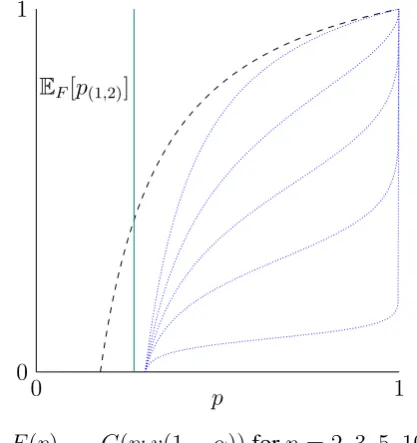
The key to the proof is to show that the expected shopper-price under F is less than the
lower bound of the support of G(see Figure 1). It immediately follows that shoppers expect
to pay more underG, as the expected lowest price is even higher. ThatGfirst-order stochastic
dominatesF shows that auto-renewers expect to pay more underG, as the expected price is
[image:14.595.187.396.376.598.2]higher.
Figure 1: Equilibrium price distributions calibrated withq= 2,v = 1,α=.7
0 1
0 1
F(p) G(p;v(1−α))forn = 2,3,5,10,50
p
EF[p(1,2)]
With the introduction of a PCW, the two effects stated in Corollaries 1 and 2 give rise to
Proposition 3:
Corollary 1. Within the mixed-price equilibrium firm responses of Lemma 1, asc∈[0, v(1−
Corollary 2. As the number of firms increases, the expected price paid by shoppers falls, but
the expected price paid by auto-renewers rises.
Corollary 1 shows that when the PCW sets a higher fee, the expected price paid by both
shoppers and auto-renewers rise. The fee is passed on by firms to consumers through a
first-order stochastic shift in the prices set in equilibrium. Upon winning, a firm must pay the PCW
for all of the (n−n1) shoppers who purchase through the site. Because the amount paid rises with
the fee, the price charged in equilibrium also rises with the fee.
The second effect is that the PCW increases competitive pressure among firms to fight for
alln−1rival firms’ shoppers. In contrast, without the PCW, firms effectively competed against
onlyq−1rivals. Different models in the clearing house literature offer different predictions
about the effect ofn on equilibrium prices. Some derive distributions for which an increase
inn raises prices for both types of consumer (e.g., Rosenthal, 1980); while in other models it
lowers prices for shoppers and raises prices for captive consumers (e.g., Varian, 1980; Morgan
et al., 2006).18 My model belongs to this second category. An increase in n has two effects
on equilibrium prices. First, increased competition pushes probability mass to the high-price
extreme of the distribution, as Figure 1 shows. This results in a first-order stochastic ordering in
n: expected price thus increases in nand auto-renewers pay more. Second, shoppers now pay
the lowest ofn+ 1prices rather thann, which reduces the expected lowest price. Corollary 2
reveals that this second effect more than offsets the first, implying that shoppers pay less in
expectation when there are more firms.19
In order to relate these two effects of a PCW to Proposition 3, I make the following remark.
Remark 1. Ifq=n,G(p; 0) =F(p)
The entrance of a PCW increases both the fee firms pay (from0tov(1−α)) and the number
of prices that shoppers compare (from q ton). The first effect raises the expected price
auto-18Also see Baye et al. (2006) for a discussion on this point and a wider review of clearing-house models.
19Although the result of Corollary 2 is common to clearing-house models, it may seem a rather nuanced
prediction of equilibrium pricing. Morgan et al. (2006) conduct an experiment with participants playing the role
renewers pay, which is compounded further by n > q, so they are unambiguously worse off
with a PCW. The effects pull shopper welfare in opposite directions, but Proposition 3 shows
that no matter how large n is, it fails to undo the effect of the optimally chosen PCW fee c.
Hence, shoppers are also worse off in expectation with a PCW.
Due to the constant-sum nature of the game, welfare necessarily sums tov in equilibrium.
As firms make the same expected profit in both worlds, there is a one-to-one relation between
the decrease in consumer welfare and the profits of the PCW. That the PCW does not reduce
firm profits comes from the fact that (with or without the PCW) firms have(1−nα)auto-renewers.
Firms can therefore guarantee themselvesv 1−nα
in both worlds. Although this article focuses
on consumer rather than producer welfare, it is important to point out that the incentives of the
PCW and firms are not aligned. This is because there is exactly one cheapest price and hence
α n−n1shoppers who switch from non-cheapest prices, which increases with n. An increase in n however, would of course, squeeze per firm profit. Therefore, a PCW would always
encourage market entry if it could.
One channel through which all consumers would gain is by more auto-renewers becoming
shoppers:20
Corollary 3. As the proportion of shoppersαincreases, expected prices paid by shoppers and
auto-renewers both decrease.
One may conjecture that a PCW would want to maximize α (the number of shoppers) in
order to obtain more referral fees. However, this logic is incomplete. Expanding the PCWs
action set to include the determination ofα(one can think of the PCW determiningαthrough
advertising) yields the following result:21
Corollary 4. If the PCW can determineαas well ascin the preliminary stage, then the PCW
setsα = 12.
20This is a prediction common to clearing-house models, for which Morgan et al. (2006) find experimental
support.
21αis determined costlessly for the PCW. If this advertising costs were a convex function ofα, it would not
PCW revenue is hump-shaped in profit. As α → 0 it receives less and less traffic, and
hence vanishing revenue. Asα → 1, firms have fewer auto-renewers to exploit, which pushes
v(1−α), the maximum fee for which firms are willing to mix, to zero. Indeed, whenα = 1
all consumers are shoppers and the PCW removes any incentive for firms to increase prices as
there are no auto-renewers to exploit. As a result, all firms charge the same price, leaving the
PCW with zero profit. Thus, even if the PCW could bring all consumers online, it has a strict
incentive to ensure that only some do so.
5. Competing Aggregators
Now suppose there areK > 1PCWs indexed byk = 1, ..., K. Each PCW moves
simul-taneously in the first period with PCWk setting a fee ck. A crucial measure of competitive
pressure is the number, r, of aggregators shoppers check where 1 ≤ r ≤ K. In the setting
without PCWs, shoppers know the prices of q ≤ n firms. In the world with PCWs, one can
interpret r ≤ K as the number of aggregators that shoppers are aware of. In the equilibria
derived, firms list on all PCWs so shoppers are indifferent to which set of PCWs they check.
However, PCW fees and firm-pricing strategies depend onr. Hence, there are different sets of
equilibria for each r. This leads me to index equilibria by r. I first consider the case where
shoppers check just one of the PCWs.
Proposition 4. WithK >1competing PCWs, if shoppers checkr = 1PCW then both types of
consumer are worse off with the PCWs than without.
Proposition 4 obtains because the high-fee, single-PCW equilibrium of Proposition 2 with
c = v(1−α)remains the unique equilibrium fee.22 Introducing competing PCWs exerts no
downward pressure on fees. There are no equilibria at lower fee levels because shoppers only
check one PCW, which means there is no incentive for PCWs to undercut each other’s fees. If
they did, they would not increase their volume of sales, but they would receive lower fees. In
contrast, for any candidate equilibrium withc < v(1−α), there is an incentive toraisethe fee
because PCWs can maintain the same volume of sales and earn a higher fee.
22As in the monopolist case, firms’ outside option gives rise to pure-pricing firm responses at higher fee levels,
In the simplest textbook Bertrand result, there is an immediate fall in the equilibrium price
between that of a monopoly firm and the marginal-cost pricing of two firms. At the aggregator
level however, Proposition 4 shows that this logic is incomplete: withK >1such undercutting
does not even necessarily begin. The persistence of the consumer-welfare-decreasing
equilib-rium in Proposition 4 is an artefact of each shopper only checking one PCW which effectively
makes each PCW a monopoly, facing no competitive pressure. Because all PCWs offer the
same information, shoppers have no incentive to check other PCWs. In this respect, the
equi-librium is reminiscent of Diamond (1971), but at the aggregation level, not the firm level. One
might think that the Bertrand remedy for shoppers would be to require them to check at least
two PCWs, causing PCWs to undercut each other until an equilibrium with all PCWs charging
c= 0is reached. I now explain how this logic is incomplete. Suppose now that there areK >1
aggregators, and shoppers checkr >1PCWs. First, I examine the special case ofr=K >1:
Proposition 5. With K > 1competing PCWs, shoppers are guaranteed to be better off than
before the introduction of PCWs ifr =K >1. Further, the unique equilibrium PCW fee-level
isc= 0if and only ifr=K >1.
The spirit of this result resembles that of Bertrand. To see why there cannot be some other
equilibrium withc > 0whenr =K > 1, suppose so and consider an undercutting deviation
by PCW1 to somecˆ1 =c−. Shoppers do not detect the deviation and so do not change their
behavior. As for firms, notice that for anyp they strictly prefer to list exclusively on PCW1:
When a firm is the cheapest, it will sell toallshoppers so long as it lists onsomePCW. This is
precisely becauser=K. Hence by listing on PCW1only, there is no reduction in the number
of shoppers switching to them when they are cheapest, but there is a reduction in the fee the firm
pays ascˆ1 < c. The PCW finds this deviation strictly profitable because it receives a discrete
gain in the number of shoppers switching through it, for an arbitrarily small loss in price.
Where shoppers check more than one PCW, but not all PCWs, we have:
Lemma 2. WhenK > r > 1, there exists an equilibrium in which PCWs chargec >¯ 0, and
firms list on all PCWs, mixing over prices byG(p; ¯c)where
¯
c= v(1−α)Kr(K−r)
More generally, there exist equilibria in which all PCWs charge c ∈ [0,¯c]. To understand
how much consumer welfare can be reduced, I analyze the highest-fee equilibrium from this set.
Because PCWs have a strong incentive to coordinate on this equilibrium, it may be especially
relevant in practice.
Notice that substituting r = K in Lemma 2 yieldsc¯= 0, and one obtains Proposition 5.
One can see now that the Bertrand-style reasoning underlying Proposition 5 was a special case.
To understand why the principle does not apply more generally, consider a fee level c > 0
and an undercutting deviation by PCW1 to some c1 = c− > 0. Unlike whenK = r > 1,
whenK > r > 1it is not necessarily better for a firm to only list on the cheaper PCW1. By
listing a price exclusively on PCW1, there are nowKK−r >0shoppers who do not see the firm’s
price. These shoppers will not buy from it even if it is the cheapest. Firms now face a trade-off:
Exclusively listing on PCW1 means that any sales incur only the lower feecˆ1 upon a sale, but
there will be a reduction in sales volume because not all shoppers check PCW1. Which force is
stronger in this trade-off depends on the size of the undercut. If PCW1 undercuts by enough,
firms will deviate to list exclusively on PCW1, breaking the symmetric equilibrium. Unlike
the simpler logic of Proposition 5, it is no longer true that any > 0 undercut will attract
firms to exclusively list on the cheapest PCW. Hence, PCWs do not always have an incentive
to undercut each other and higher-price equilibria are sustained.
I now discuss how the set of equilibria varies with how many PCWs shoppers check (r)
and the number of aggregators (K). Firstly, as shoppers check more PCWs in equilibrium, the
incentive for a PCW to undercut the fees of other PCWs increases so that only lower fee-levels
can be sustained in equilibrium. That is,c¯is limited by a higherr: ddr¯c <0
However, as the number of aggregators increases, the incentive is reversed. The number
of shoppers checking a given PCW (Kr) falls. Accordingly, in equilibrium each firm receives
less of its expected revenue from any single PCW. It then requires a more severe undercut from
a PCW to get firms to exclusively list on it and forgo the business available from the other
aggregators. For undercuts that are too severe, it is unprofitable for a PCW to deviate, even if
it were to win exclusive arrangements with all firms as a result. Thus, asK increases, higher
higher number of aggregators can lead to higher fees, and hence higher prices. Furthermore:
Proposition 6. For anyr, there exists aK˜ such that as long as there are more thanK˜
aggre-gators both types of consumer are worse off than before the introduction of PCWs.
In the limit, the proportion of firm income that comes from sales on any one aggregator
becomes vanishingly small. As this happens, ¯c → v(1−α)i.e., sustainable equilibrium fee
levels approach the monopoly-PCW level, again making both types of consumer worse off than
before the introduction of the sites.
6. Publicly-Observable Fees
One reason that competing aggregators do not drive fees to zero is that shoppers do not
detect changes in the fees set by PCWs in equilibrium. This precludes a coordinated response
between firms and shoppers that could punish a PCW that charges higher fees. If fees were
publicly announced so that shoppers were aware of them, then credible subgame equilibria
could follow the fee-setting decision in which the PCW charging the lowest fee is attended by
all firms and shoppers. Any higher-fee equilibrium would then be undercut untilc= 0, leading
to lower shopper-prices. It follows immediately that:
Proposition 7. WhenK >1and PCW fees are observed by shoppers, there exists an
equilib-rium withc= 0.
There are multiple equilibria because there are many subgame equilibria that can follow any
vector of PCW fees, including less intuitive ones where coordination occurs at more expensive
PCWs.23 If one adopts the plausible refinement that firms and consumers only patronize the
lowest-fee PCWs, then one obtains the zero-fee equilibrium as the unique equilibrium.
However, even with sufficient refinement criteria to implement the zero-fee equilibrium, in
some markets one may question a policy of fee-announcements on a more fundamental level.
23Proposition 7 excludes the monopoly-PCW case (K = 1), where the unique equilibrium is still that of
Proposition 2 because of course no coordination between firms and consumers over which PCW to attend is
If fees can be publicly announced, then surely so can firm prices, which would extinguish the
role of a PCW in the first place.
In reality, PCW fees are not publicized directly. However, some PCWs do advertise
sum-mary statistics of the price information of firms that list on them. PCWs frequently advertise
the average savings a consumer using their site is expected to make, which could direct
shop-pers to the cheapest PCW. By Proposition 7, this could lead to a shopper-welfare-improving
equilibrium. However, many PCWs do not advertise based on purchase-relevant information.24
PCWs spend large sums on such advertising, which has been shown to correlate with the
num-ber of unique visitors they experience, suggesting that many shoppers are directed to PCWs
based on information other than price.25 If such ‘persuasive’ advertising caused all shoppers to
loyally visit one site each i.e.,r= 1, Proposition 2 applies and all consumers would have been
better off without the PCW industry.
7. Price Discrimination
So far, I have considered the impact of web services that list or ‘aggregate’ the available
information (prices) charged by firms offering a product or service. In practice, this is often
the case in the markets for gas, electricity, financial products such as mortgages, and durable
goods.26 However, in other markets, a firm may set a price p
0 for a direct purchase, and pk different prices for each PCWk that it lists on. Where a PCW operates by referring shoppers
back to a firm’s website to complete the purchase, the fact that the click came from a PCW is
recognized by the firm’s site, which then offers the price seen on the PCW that attracted the
click. WhenK ≥r = 1, we have:
Proposition 8. With price discrimination, ifr= 1, there exists an equilibrium in which PCWs
setc=v(1−α), firms list on all PCWs,p0 =v andp1 =· · ·=pK =v(1−α).
24See the campaign of Comparethemarket.com, based on a story about meerkats.
25The big four PCWs in the UK spent approximately£110m in 2010 on advertising. The evidence here is from
Nielsen Company (findings reported by the This is Money 2015 and Marketing Magazine 2011).
26For UK gas and electricity markets, regulation limits each energy company to offering a maximum of four
The ability of firms to price discriminate does not prevent PCWs from setting fees at the
same high level as in Proposition 4 becauser= 1. As before, there is effectively no competitive
pressure between PCWs. However, price discrimination does lead to firms listing a common
price on PCWs in equilibrium because PCWs no longer have an incentive to keep prices posted
on it dispersed. This is because firms can set a high direct purchase pricep0 = v and a lower
price through the PCWs. Given this, shoppers always purchase through a PCW. Because allα
shoppers now purchase through PCWs, rather than in the case without discrimination, where
onlyα n−n1did so, total PCW profit is nowαv(1−α)rather than n−n1αv(1−α). As firm profit is unaffected, it follows then that relative to the case without price discrimination, total
consumer welfare falls. There are, however, opposing effects on shoppers and auto-renewers.
Auto-renewers are worse off, as firms charge them the monopoly price v. Shopper welfare
though improves as they now face pk = v(1−α)for sure, whereas before this was just the
minimum of the support of equilibrium prices. More importantly, shopper welfare does not
improve sufficiently to overturn Proposition 3, which continues to hold: all consumers are
worse off than in a world with no PCWs. The ability of firms to discriminate allows them to
fully extract surplus from their captive auto-renewers; but PCWs can now extract the revenue
from sales to all shoppers through their sites.27
In equilibria with r > 1, the incentive for aggregators to undercut is present. Corollary 5
describes a best response of firms following a unilateral downward deviation by a PCW1 from
a symmetric fee level.
Corollary 5. When firms price discriminate, following c1 ∈ (0, c2) and c2 = c3 =, . . . ,=
cK ≡ c ∈ (0, v(1−α)] there exist mutual best-responses of firms such that they list on all
PCWs, settingp0 =vandpk =· · ·=ckfor allk.
When r = 1, there is no incentive for a PCW to make such an undercutting deviation as
suggested by the equilibrium described in Proposition 8. When r > 1 however, PCWs have
this incentive to undercut because they can enjoy a discrete gain in fee revenue from the rK−1
27As before, in the equilibrium of Proposition 8, PCWs cannot raise fees further, to sayc0 > v(1−α)because
of firms’ outside option. Following such a unilateral PCW deviation, firms would setp0=v(1−α)so that their
of shoppers who were checking their PCW but buying though another site in the symmetric
equilibrium. When firms can price discriminate across websites, firms can compete in prices
on PCW1 without changing their prices on other PCWs. This shows how price discrimination
can unleash undercutting at the PCW level whenever consumers check r > 1 PCWs, which
can in turn lead to zero-fee equilibria.28 This contrasts with markets where PCWs aggregate
price-information, where Proposition 5 showed that this undercutting was only fully unlocked
whenr =K.
Aggregation and Discrimination in Large Markets
In the setting with a PCW and price discrimination, the equilibrium of Proposition 8 shows
the price paid by the two types are as maximally separated: Shopper price is competed down
to firms’ marginal cost c, and auto-renewers payv. In the setting with an aggregator and no
price discrimination, the equilibrium is given by Proposition 2 where Corollary 2 explains
that as the number of firms increases, the expected prices paid by shoppers and that paid by
auto-renewers, diverge. This occurs because as the number of firms increases, so does the
competitive pressure on pricing to win shoppers. As a result, more probability mass is placed
on lower prices. Firms compensate for this by also increasing the mass placed on higher prices,
increasing their expected profit from auto-renewers. In fact, for arbitrarily large markets, I
show that these two settings are equivalent.
Proposition 9. As n → ∞, following the introduction of a PCW, the expected prices faced
by both types of consumer in a setting without price discrimination (Proposition 2) approach
those in a setting with price discrimination (Proposition 8).
The result highlights the connection between the two market structures. Indeed, I find that
all consumers can be worse off with a PCW with or without the possibility of price
discrimina-tion. I emphasize therefore that the key difference between the settings lies in their predictions
under competition at the aggregator level.
8. The Extensive Search Margin
This paper utilizes a clearing-house framework, where auto-renewers are inactive and can
also be interpreted as being offline, loyal, uninformed or as having high search costs. Here, I
fo-cus on a search-cost rationalization, better applied to markets where obtaining a quote requires
more information from the consumer e.g., home insurance. In an environment without a PCW
where auto-renewers find it too costly to enter these details into a firm’s website to retrieveone
extra price, the introduction of a PCW offers to exposeallprices to them, for the same single
search cost. Depending on their search cost, the introduction of a PCW may then cause an
auto-renewer to engage in comparison via the PCW. Some empirical studies have offered a similar
argument to explain observed increases in market competitiveness (e.g., Brown and Goolsbee,
2002; Byrne et al., 2014). Their arguments are distinct from mine because they contrast a world
with web-based aggregators relative to a world without the Internet, rather than a world with
the Internet and firm websites. This engagement of new customers is commonly referred to as
the ‘extensive search margin’ (for a recent discussion see Moraga-Gonz´alez et al., 2015).
The benefit of an additional search for a consumer in the world without a PCW is the
difference between the expected price and the expected lowest of two prices drawn (fromF).
With a PCW, the benefit of a search on the PCW is the difference between the expected price
and the expected lowest ofndraws (fromG).29 I denote these search benefits with and without
an aggregator respectively as,
B1 =EG[p]−EG[p(1,n)], B0 =EF[p]−EF[p(1,2)].
The model is as before save that each auto-renewer faces a search costs. I assume these costs
are heterogeneous, distributed by S over s ∈ [ ¯s,∞).
30 I assume
¯s > B0 which means that without a PCW, no auto-renewers shop, preserving the equilibrium of Proposition 1. After
the introduction of a PCW, the benefit of a search (B1) may outweigh the cost (s) for some
auto-renewers, who then choose to use the site. I use the term ‘converts’ and ‘non-converts’ to
29These terms are analogous to the ‘value of information’ in Varian (1980).
30That there is no upper bound ensures that there are always some auto-renewers, and hence price dispersion,
distinguish between auto-renewers who decide to shop or not in equilibrium with a PCW.
The total number of consumers using the PCW (shoppers and converts) is endogenously
determined in equilibrium and is denotedα˜ = α+ (1−α)S(B1). Givenα˜, the PCW sets its
profit-maximizing feec=v(1−α˜). Ascandα˜are exogenous to firms, equilibrium pricing is
as in Proposition 2 withα˜replacingα. In turn, pricing determinesB1. There is an equilibrium
when this value of α˜ satisfies S(B1) = α1˜−−αα. When there exists such an S, α˜ is said to be
‘rationalized’.
Corollary 3 showed that a higher α increases the welfare of all consumers. Corollary 1
showed that a lowerchas the same effect. As the equilibrium fee level isv(1−α˜), both forces
work to benefit all types of consumer. However, whether consumers actually gain depends
on how many auto-renewers are converted. In fact, relative to the world without a PCW, the
presence of converts is not sufficient to guarantee lower prices for any consumer, not even
converts themselves:
Proposition 10. Shoppers, converts and non-converts can all be worse off with a PCW than
without.
The proof gives an example of such an equilibrium, along with a distributionS that
ratio-nalizes it. More generally, there can be many equilibria, each with a differentα˜. If the benefit
(B1) is small or there are no types with low search costs so thatS(B1) = 0, there are no
con-verts (α˜ = α) and the equilibrium of Proposition 2 applies. Proposition 10 shows that when
someauto-renewers convert, all consumers can be worse off with a PCW. However, there may
also exist equilibria whereα˜is high enough such that some consumers benefit. Whether these
equilibria exist depends on the distribution of search costsS. For a given PCW search benefit
B1, when more auto-renewers have low search costs (higherS(B1)),α˜is higher,cis lower and
total consumer welfare is higher.
The number of firms also determines the size of the benefit the PCW offers (B1), and hence
the number of converts. I now investigate which consumers benefit from an aggregator when the
potential benefit it offers to consumers (B1−B0) is as large as possible. For a givenα˜, a higher
number of firms increases the equilibrium search benefitB1 (see Corollary 2). Specifically, as
I letq = 2in the world without a PCW, which makesB0as low as possible, asB0is increasing
inq.31 Accordingly, I define,
Definition. A market has ‘maximum potential’ whenq = 2andn → ∞.
Proposition 11. If the market has maximum potential: converts are better off; shoppers can be
worse off; and non-converts are worse off with a PCW than without.
When the market has maximum potential, converts are guaranteed to be better off but
shop-pers still may not be.32 Shoppers may not be better off because even with maximum potential,
there may still not be sufficiently many auto-renewers converting to PCW use.
9. Conclusion
The analysis shows that the introduction of PCWs may not in fact benefit consumers by
reducing expected prices. The introduction of a single aggregator facilitates comparison of the
whole marketplace for shoppers, exerting competitive pressure on firm pricing. However, the
aggregator charges a fee which, in turn, places upward pressure on prices. The net effect is that
prices increase for all consumers, who would be better off without the site.
Competition at the aggregator level need not lead to a reduction in fees. There are many
equilibria, which I parameterize by the number of PCWs that shoppers check. If shoppers
only check one PCW each, consumers are no better off than in the monopoly setting. More
aggregators only guarantee to benefit shoppers if they check all of them. If shoppers check
an intermediate number, increasing the number of aggregators can lead to higher prices; for a
sufficiently high number, all consumers can again be better off without the industry. Hence,
when there are many aggregators in the market, how many of them shoppers check is a crucial
variable. As a result, regulatory bodies may wish to consider incentivizing consumers to check
more, alongside stronger actions such as limiting the fees charged by aggregators and limiting
the number of PCWs in the market.
31See the end of the proof of Proposition 5.
32By Proposition 9, one can also use Proposition 11 to consider the effect of introducing a PCW into a market
If competing PCWs publicly announce fees, this can result in low-fee equilibria, but it relies
on coordination between firms and shoppers. In markets with price discrimination, if shoppers
only check one PCW, the monopoly fee level can still be sustained, making consumers worse
off. However, with competing aggregators where shoppers check multiple PCWs, there is then
the incentive for the sites to undercut each other’s fees. As such, regulators may also wish to
consider whether it is possible to introduce price discrimination into markets in which it is not
currently present. In online markets with non-negligible search costs, even those consumers
who rationally start engaging in price comparison may be worse off following the introduction
of a PCW. Helpful policies would help erode these costs where possible and encourage more
inactive consumers to engage in comparison.
Appendix
A1. Summary Statistics of UK PCW Industry
The figures quoted for turnover and profit in the introduction for the UK utilities and
ser-vices industry are estimates for 2013 for the largest four such companies. The estimate for each
site was taken from the following sources:
• Money Supermarket: Their own 2013 annual report.
• Confused: The Admiral Group’s Annual Reports 2012 and 2013.
• Go Compare: Newspaper ‘The Guardian’ 2014 article.
• Compare the Market: Parent BGL Group’s Annual Report 2013 and BBC article 2015.
For the first three, the figures were taken directly from the cited sources. For Compare the
Market, estimated to be the largest of the four sites, the estimate is particularly rough as BGL
Group offer no breakdown of their accounts. I assumed that the proportion of BGL’s total
revenue and profit due to Compare the Market was the same where the estimate for annual
profit due to Compare the Market is taken from the BBC article. Even if the estimated£800m
of total turnover and 14% for average annual profit growth for these sites is off by a margin, the
A2. A World Without a PCW
The domain of prices is R. The equilibrium pricing strategy can always be described by
its CDF (denoted F in this section, and with other letters later on). In what follows, either
equilibrium pricing distributions will be pure (so that F is flat, with one jump discontinuity
at this price); or will have no point masses so thatF is continuous, which implies the density
f exists and f = F0, wherever F0 exists. Lemmas A1-A3 are variants of Varian (1980)’s
Propositions 1,3 and 7 respectively.
Lemma A1. In any equilibrium, there are no pricespcharged s.t. p≤0orp > v.
Proof: Anyp ≤ 0generates firm profits π(p) ≤ 0which is dominated by p = v which gives
profit of at least v(1−nα) > 0 because firms always sell to their auto-renewers. For p > v,
π(p) = 0because no one will buy at such a high price, hence againp=vdominates.
Lemma A2. In any equilibrium, there are no point masses.
Proof: Suppose not. Then the there is a point mass in equilibrium,p˙s.t. pr(p= ˙p)>0. Note
thatp˙∈(0, v]from Lemma A1. Because the number of point masses must be countable, there
exists an ε > 0small such that p˙−ε > 0 and is charged with probability zero. Consider a
deviation of a firm from the equilibriumF to a distribution over prices where the only difference
is that the new distribution chargesp˙−εwith probabilitypr(p= ˙p)andp˙with probability zero.
Note that a firm appears in nq−−11of the groups of shoppers. Index these groupsz = 1, ..., nq−−11
(this is without loss asF is symmetric). Letpr( ˙p;t, z)be the probability underF that a firm is
cheapest in groupz along witht = 0, ..., q−1others. Call the difference in profit due to the
deviationdand note that:
lim
ε→0d=
(n−1
q−1)
X
z=1
q−1
X
t=0
pr( ˙p;t, z) αn
q 1− 1 q +
q−(t+ 1)
q(t+ 1)
˙
p
The term in parentheses is the difference in the amount of shoppers won under the deviation
and under F, in given group, when the firm along with t others chargep˙, and p˙ is the lowest
price in that group. Due to symmetry of the groups,pr( ˙p;t, z)is the same for all groups, so let
this more simply be termedpr( ˙p;t). Also givenpr( ˙p;t)>0, this simplifies to:
n−1
q−1
n q
q−1
X
t=1
pr( ˙p;t)α
t t+ 1
˙
hence for someε >0there exists a profitable deviation, soF could not have been an
equilib-rium.
Lemma A3. In any equilibrium, the maximum of the support off must bev.
Proof: Suppose not. Definep¯as the maximum element of the support and note that by Lemma A2
the probability of a tie at any price is zero. By Lemma A1,p¯∈ (0, v). Consider a firm called
upon to playp < v¯ in equilibrium. They only sell to their auto-renewers, makingp¯(1−nα) but
would strictly prefer to deviate tov and makev(1−nα), a contradiction.
Proposition 1. In the unique equilibrium firms mix according to the distribution
F (p) = 1−
(v−p)(1−α)
qpα
q−11
over the supportp∈
v(1−α) 1 +α(q−1), v
.
Proof: By Lemma A2, there is more than one element of the equilibrium support, and by
Lemma A3 v is the maximal element. In equilibrium, a firm must be indifferent between
all elements of the supportp, hence profit must equalv 1−nαfor allp, that is:
(1) v
1−α n
=p
"
1−α n +
α
n q
X(p) #
X(p)≡
n−1
q−1
n−1
n−1
F(p)0(1−F(p))n−1+...+
q−1
q−1
n−1
q−1
F(p)n−q(1−F(p))q−1
The first term on the RHS of (1) is the profit from ARs, who always purchase at p ≤ v.
The second term is the expected proportion of shoppers that a firm will win, charging pricep.
Shoppers can be characterized by nqgroups, where the set of groups is given by{1, ..., n}q.
X(p)describes the expected number of groups a firm expects to win given it charges p. By
Lemma A2 there are no ties in price, so label prices byp1 < ... < pn. p1 will be the cheapest
in every group in which it appears, and it appears in nq−−11 of the groups. The probability of being the lowest price is given by nn−−11F(p)0(1−F(p))n−1, which accounts for the first term
inX(p). The observation thatpiis the cheapest in nq−−1i
groups ifi≤n−(q−1), zero groups
otherwise, accounts for the remaining terms ofX(p). The following manipulations to simplify
the second term on RHS of (1) this make use of the binomial theorem:
=p αn
q
n−1
X
j=q−1
j q−1
n−1
j
which after some manipulations can be shown to be:
=pαq
n(1−F(p))
q−1
rearranging forF(p)gives:
F (p) = 1−
(v−p)(1−α)
qpα
q−11
Notice that this is a well-defined c.d.f. over:
p∈
v(1−α) 1 +α(q−1), v
Notice thatvis strictly preferred to anyp∈h0,1+v(1α(−qα−)1)
.
A3. A World With a PCW
I look for symmetric equilibria where PCWs charge some fee level c ≥ 0 and shoppers
check PCWs in equilibrium. I do not look at equilibria where firms never list on PCWs, where
the setting without a PCW applies. To derive equilibria, one needs to know the mutual
best-responses of firms to unilateral deviations of PCWs. To do so, takecand equilibrium shopper
strategy as given, and consider the firm responses.
LetK ≥1denote the number of PCWs andr : K ≥ r ≥1the number of PCWs checked
by shoppers. In symmetric equilibrium, a proportion Kr of each firm’s shoppers check any given
PCW. Define a vector of PCW fees asc = (c1, ..., cK) ∈ RK+ labeled such thatc1 ≤... ≤ cK.
Letβk ∈ [0,1]be the probability with which a firm enters PCWk and define the event E: “all
PCWs are empty”. Denote(a1, a2) = (p,K) as a firm’s action, where pis the price charged
and2{1,...,K} is set of all combinations of PCWs they could choose to list in whereKa typical
element, and ∅ denotes not listing on any PCW. Define the following CDF, which is used
throughout:
(2) G(p;c) = 1−
"
(v−p)(1−α)
α np−(n−1)K1(c1 +· · ·+cK)
#n1−1
which is well-defined over the support[
¯p(c), v]where¯p(c) =
v(1−α)+K1(c1+···+cK)α(n−1)
1+α(n−1) . When
c1 =· · ·=cK ≡c, letG(p;c)and
Lemma A4. In any equilibrium, there are no pricespcharged s.t. p≤0orp > v.
Proof: No p ≤ 0or p > v because they yield negative and zero profit respectively, whereas
(v,∅)yields v(1n−α) >0.
Lemma A5. Ifc1 ∈[0, v(1−α)),pr(E) = 0.
Proof: Supposepr(E) > 0. Denote the infimum of prices charged when no PCW is listed on
and that of prices ever listed on a PCW asp0 and
¯prespectively. [Note the infima exist because prices are a bounded from below by Lemma A4]. Note thatp0 ≥
¯pbecause (¯p,∅) is strictly preferred to any lower price as a firm faces no competition for prices below
¯poff the PCWs. Consider when the firm is called upon to play(p0,∅)(or a price arbitrarily closely abovep0):
Ifp0 > c1, a deviation to(p0 −,1)is strictly profitable. This is because with probability
pr(E)n−1 >0PCWs are empty with other firms charging at leastp0. By listing the firm then
has a positive probability of winningαr K
n−1
n new shoppers. For a sufficiently small >0, this will offset the arbitrary loss in revenue from its own consumers.
Ifp0 ≤c1, firm profit must be at least¯
p
nwhich can be guaranteed by(
¯p,1), becausep0 ≥¯p. In turn, this must be at least as much as v(1n−α) which the firm can guarantee by playing(v,∅).
Putting these together,p0 ≥
¯
p≥v(1−α)> c1 which contradictsp0 ≤c1.
Lemma A6. Ifc1 ∈[0, v(1−α)), firm strategies have no point masses.
Proof: Define
¯p1(c1)as the price at which a firm is indifferent between selling to all shoppers exclusively through the cheapest PCW(s) and chargingv, only sell to auto-renewers:
¯p1(c1) =
v(1−α) +αc1(n−1)
1 +α(n−1)
By Lemma A5, some(p,K)is played. Note that firms would by construction not play(p,K)
wherep <
¯p1(c1), strictly preferring(v,∅). To see that there are no point masses: If there were a point mass at(
¯p1(c1),K)then there is a positive probability of being tied for the lowest price at(
¯p1(c1),K). By definition of¯p1(c1)firms would strictly prefer to deviate to (v,∅).
If there were a point mass at ( ˙p,K)s.t. p >˙
¯p1(c1)then there is a positive probability of being tied for the lowest price at( ˙p,K). A firm would strictly prefer to shift that probability
firms’ shoppers at an arbitrary loss in revenue from its own consumers. There is always an
>0small enough to ensure this is profitable because
¯p1(c1)> c1 ⇐⇒ c1 < v(1−α).
Lemma A7. If there are no point masses, the maximum of the supportf must bev.
Proof: This is a variant of Varian (1980) Proposition 7.
Lemma A8. Ifc1 ∈[0, v(1−α))andc1 < c2,β1 = 1.
Proof: By Lemma A5 it is never the case that all PCWs are empty. Supposeβ1 <1. Lemma A6
implies there is more than one price,pˆ, that is listed on some other PCWs. By Lemma A7 there
is one such thatp < vˆ . Consider a firm being called upon to play this(ˆp,K-1)where1 ∈/ K-1
andm¯ = max{K-1}. As this price has a positive probability of being the lowest of all firms, it
will generate sales through the PCWs inK-1. But as PCW1 is the unique cheapest PCW, there
is a strictly profitable deviation to(ˆp,K-1∪1\m¯).
Lemma A9. If c1 = . . . , cK ≡ c ∈ (v(1 −α), v], firm pricing strategies are pure where
p∈[v(1−α), c]. Any(β1, . . . , βK)∈(0,1]K can be supported.
Proof: Either there is a point mass or there is not.
1. Suppose there is a point mass at pricep˙. Ifp > c˙ , firms have a strict incentive to shift this
mass to( ˙p−,{1, . . . , K}). Ifp < v˙ (1−α), firms prefer to shift this mass to(v,∅). These
leavesp˙∈[v(1−α), c]as the only points that can be point masses. There can be at most one
point mass: If not, then there a second point massp < c¨ , which if played withK6=∅would
generate negative profit, so(¨p,∅)is preferred; ifK=∅, then(¨p+,∅)for some sufficiently
small >0is preferred. To see that this pure pricing atp∈[v(1−α), c]can be part of firm
strategies, note that firm profit isπ = np ≥ v(1n−α), so there is no strict incentive to sell only
to auto-renewers instead. Because shoppers buy directly when prices are all the same, there
are no sales through PCWs and so firms are indifferent between any(β1, . . . , βK)∈(0,1]K.
2. Suppose there is no point mass. By Lemma A7 the maximum of the support isv, wherev
is not the only element of the support, else it would be a point mass. There is therefore a
positive probability of a firm being the cheapest at somep. There can be no(p,K)s.t.p < c
charged: IfK6=∅played profit from these sales is negative, so(p,∅)is preferred; ifK=∅,