warwick.ac.uk/lib-publications
planning using focus groups. Proceedings of the ICE - Engineering Sustainability, 166 (ES2).
pp. 61-74.
Permanent WRAP URL:
http://wrap.warwick.ac.uk/80776
Copyright and reuse:
The Warwick Research Archive Portal (WRAP) makes this work by researchers of the
University of Warwick available open access under the following conditions. Copyright ©
and all moral rights to the version of the paper presented here belong to the individual
author(s) and/or other copyright owners. To the extent reasonable and practicable the
material made available in WRAP has been checked for eligibility before being made
available.
Copies of full items can be used for personal research or study, educational, or not-for-profit
purposes without prior permission or charge. Provided that the authors, title and full
bibliographic details are credited, a hyperlink and/or URL is given for the original metadata
page and the content is not changed in any way.
Publisher’s statement:
Published version: http://dx.doi.org/10.1680/ensu.12.00012
Journal webpage: http://www.icevirtuallibrary.com/toc/jensu/current
A note on versions:
The version presented in WRAP is the published version or, version of record, and may be
cited as it appears here.
Engaging residents’ groups in
planning using focus groups
&1 Katherine BrookfieldMA, PhD
Postgraduate research student, Faculty of Engineering and the Environment, University of Southampton, Southampton, UK
&2 Alan BloodworthMA, MSc, CEng, DIC, DPhil, MICE Lecturer in Civil Engineering, Faculty of Engineering and the Environment, University of Southampton, Southampton, UK
&3 John MohanBA, PhD
Professor of Social Policy, Faculty of Social and Human Sciences, University of Southampton, Southampton, UK
1 2 3
Involving residents in decisions on the planning and design of the built environment can deliver numerous benefits, but soliciting their productive and meaningful engagement is not easy. There are various pitfalls to navigate and issues to address. This paper reflects on several of these by drawing on the experience of conducting focus groups with a variety of residents’ groups where attitudes to environmental design were discussed. The paper considers issues around the process of identifying and selecting groups to engage with, barriers to group and individual participation in engagement exercises, and the process of opinion formation and evolution in a group setting (and the implications of this for the interpretation of focus group data). Interestingly, for some residents’ groups, preferences for the design and development of the built environment appeared to be rather conservative although there was scepticism of the agenda and activities of local government and property developers. The paper considers what this might mean for efforts to involve these groups in consultation and engagement activities on planning and development matters. Overall, it is hoped that this paper will form a useful resource for those embarking on consultation and engagement activities, particularly those wishing to work with residents’ groups or seeking to employ focus groups.
1. Introduction
Drawing on the experience of completing focus groups with a diverse sample of residents’ groups in a study exploring attitudes to environmental design, this paper provides hints, tips and guidance on the practice of involving communities in consultation and engagement activities, such as those accompanying planning and development decisions. These might be decisions on the content of new or revised planning policy, the future use of a site or the design of a proposed development. Specifically, the paper provides guidance on a particular type of consultation and engagement method, the focus group, and offers advice on employing this method and engaging more generally with a segment of the community that is frequently active in planning matters: residents’ groups. The guidance (sections 5–9) covers a range of topics including
& identifying residents’ groups for consultation and engage-ment activities
& the issue of representativeness in these activities
& factors that can inhibit residents’ groups and their members from participating in these activities
& focus group design
& issues to consider when evaluating and interpreting focus group discussion data
& the potential impact of conservative environmental design preferences and a certain scepticism of the agenda and activities of local government and property developers on efforts to involve residents’ groups in consultation and engagement activities on planning and development matters.
development has identified public participation in decision-making as desirable (section 2). It does this by reflecting on the various arguments made for participation. The paper then explores (section 3) the different forms of, or approaches to, public involvement, indicating that the degree to which the public directs the outcomes is the key to differentiating one form of involvement from another. It considers how these different approaches suggest different techniques, methods and arrangements for achieving or securing public involvement before discussing one method in particular: the focus group. The paper then moves on to outline the study which generated the guidelines that form the main focus of the discussion (section 4). The conclusions draw out key aspects of this guidance before a final section identifies the paper’s practical application and wider relevance.
2. Why involve the public in planning
decisions?
The case for involving the public in planning decisions is based on not one but on many arguments and rationales, originating both in the literature and in planning policy and guidance. For example, looking across the literature on participation, Bickerstaff and Walker (2001) identify three such rationales. They claim this body of literature variously argues that participation ought to occur because citizens simply should have the right to shape outcomes; that participation can improve the quality of decisions, as it can bring to light information that might otherwise be missed by technical experts; and that it can enhance the legitimacy of decisions and, subsequently, aid their delivery and implementation (Bickerstaff and Walker, 2001). Turning to the engineering literature, arguments include suggestions that it can generate ‘support and ownership’ of plans and projects, ‘reduce uncertainty’ around such items and aid the delivery of policies (Batheramet al., 2005, p. 10). As a last example, in the planning literature it is claimed that, among other things, participation allows the views and interests of marginalised groups to be addressed while it can support the generation of new knowledge and understanding, as collabora-tion and an exchange of ideas between different parties occur (Campbell and Marshall, 2000).
Turning to planning policy and guidance, various arguments for public participation are identified, particularly in the previous government’s publication,Community Involvement in Planning: The Government’s Objectives (Office of the Deputy Prime Minister (ODPM), 2004). In this document, it is claimed that public involvement
& leads to outcomes that better reflect the views and aspirations and meet the needs of the wider community in all its diversity
& is valuable as a key element of a vibrant, open and participatory democracy
& improves the quality and efficiency of decisions by drawing on local knowledge and minimising unnecessary and costly conflict
& educates all participants about the needs of communities, the business sector and how local government works & helps promote social cohesion by making real connections
with communities and offering them a tangible stake in decision making. (ODPM, 2004, p. 4)
The government at the time of writing also values the idea and practice of involving the public in planning decisions. It claims such involvement is inherently right, and so simply ought to occur, but also suggests that it can help tackle the adversarial nature of planning and lead to the delivery of higher levels of development (Clark, 2011). The recent Localism Act 2011 (2011) introduces initiatives that take forward this interest in participation. Within the Act, neighbourhood planning pro-vides opportunities for communities to develop land-use strategies for ‘neighbourhood areas’, while the introduction of compulsory pre-application consultation for certain types of development (to be specified in secondary legislation), places new requirements on applicants to engage with the public (Department for Communities and Local Government (DCLG) 2011a, 2011b, 2011c).
Governments elsewhere have also pursued the objective of involving the public in planning decisions. The Organisation for Economic Co-operation and Development (OECD, 1996) points, for instance, to the significance attached to public participation in various planning and development projects in Japan, Australia and Canada, while Pahl-Weber and Henckel (2008) discuss how Germany includes requirements around public participation in its planning legislation (in section 3 of the Federal Building Code, theBaugesetzbuch).
parties to the convention, including Spain, Germany, Italy and Norway.
3. Involving the public in planning decisions
– different approaches and alternative methods
Public involvement in planning decisions can take different forms, with the degree to which the public directs the decision-making process being the key to differentiating one form or approach from another. Bickerstaff and Walker (2001) draw a distinction between consultation, where technical experts solicit the public’s views on a matter but there is no guarantee these opinions will be acted upon, and participation, where citizens are afforded a measure of control over the shape of outcomes. In Sherry Arnstein’s (1969) well-known ladder of citizen participation, eight forms of participation are identified, each being assigned a different rung on a ladder, with citizen control of the decision-making process progressively increasing as the ladder is scaled. At the lowest rungs (one and two, identified as manipulation and therapy) there is non-participa-tion: citizens are simply provided with information on, or ‘educated’ about, a planning matter. The middle rungs three to five (identified as informing, consultation and placation), offer degrees of tokenism as citizens are provided with a voice but with no guarantee that it will be acted upon. Informing entails informing citizens of their rights, options and responsibilities, which is usually a one-way flow of information providing no opportunity for citizens’ views to be raised and recognised. Consultation, as in the definition of Bickerstaff and Walker (2001), involves inviting citizens to express their views but there is no assurance that these will be taken into account in decision-making. Placation affords citizens some power to shape outcomes but experts and other traditional power-holders retain ultimate control, an example being scenarios where citizens are facilitated to develop a land-use plan but power-holders retain the right to determine its legitimacy or feasibility, and thus whether or not it is pursued (Arnstein, 1969, p. 220). The types of participation found towards the top rungs of the ladder (six to eight, identified as partnership, delegated power and citizen power) provide citizens with varying degrees of decision-making authority and managerial control. For example, they might gain the majority of seats on a decision-making body.
In the UK the approach to involving the public in planning decisions often seems to constitute consultation, as defined by Arnstein (1969) and Bickerstaff and Walker (2001). Indeed, Bickerstaff and Walker (2001) make just this point, and the manner of involving the public in the determination of planning applications would seem to be a practical example. Here, the public is invited to comment on applications but there are no assurances that these comments will be reflected in the final decision.
The form of participation sought from the public in planning decisions will shape the method or methods employed and/or the set of arrangements put in place to secure it. For example, if Arnstein’s (1969) top-rung approach of citizen control is pursued, a decision-making body giving citizens full manage-rial power and dominant decision-making authority would need to be created. Alternatively, for the seemingly prevalent approach of consultation, methods designed to invite and capture public opinion are needed, which might include postal or online surveys, public meetings, interviews or, of particular interest in this paper, focus groups.
3.1 Focus groups
A focus group can be defined as a group of individuals selected to exhibit certain characteristics pertinent to the object of study, engaged in a focused discussion guided by a set of predetermined talking points presented by a moderator (Barbour, 2007; Gaskell, 2000; Krueger and Casey, 2000). The groups can vary in size, although in larger groups, such as those with more than 12 participants, there are fewer opportunities for all to speak (Krueger and Casey, 2000). The method provides rich insights on content, referring to ideas and opinions developed and expressed in a group setting, and process, meaning group interaction and dynamics (Barbour, 2007; Gaskell, 2000; Holloway, 1997; Morgan, 2006; Munday, 2006). However, as the paper discusses, focus groups are rather less useful in the pursuit of certain other interests, such as engaging with a representative sample of participants. As with any method then, focus groups are useful and appropriate in some contexts but not in others. Rosengren (1981, p. 120) alludes to this in his comment: ‘approaches and methodologies are never good per se; they are good for something’. One must consider carefully the goals of a consultation and engagement exercise when reflecting on the use of focus groups since they will be appropriate in some but not all circumstances.
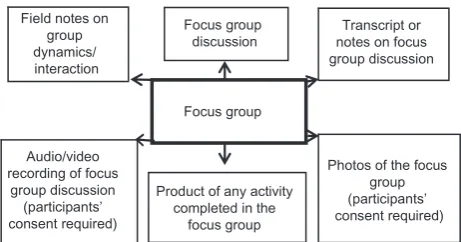
participants. For any given project the research interest will determine the type of data collected. Figure 1 indicates the variety of data and outputs that can be produced from a focus group.
Focus groups are a tried and tested method for including the public and other stakeholders in decision-making on planning and development matters (OECD, 1996). For Cohen (2005) they are a useful mechanism for collecting views in the early stages of a development project prior to the production of tangible proposals. For Batheramet al.(2005) they allow the exploration of conflicting views and the resolution of disputes. The Royal Town Planning Institute (RTPI) mentions focus groups in its Guidelines on Effective Community Involvement and Consultation (RTPI, 2005), while the previous UK government identified them as a mechanism for involving different stakeholders in the preparation of regional spatial strategies (ODPM, 2004: p. 21).
Although they are clearly associated with consultation, focus groups could be employed in other approaches to, or forms of, public involvement. For example, taking Arnstein’s (1969) concept of placation strategies, in a strategy that enables citizens to develop plans and policies, focus groups could be the forum within which these plans and policies are developed. Consequently, the hints, tips and guidance on focus groups discussed in this paper might be of interest to those practising consultation and to those pursuing alter-native approaches.
Having defined focus groups and considered their relevance to public participation in planning, attention now turns to the study that generated the hints, tips and points of guidance on this method and on the process of engaging with residents’ groups.
4. Residents’ groups and their attitudes to
environmental design
The lead author completed a study, referred to as ‘the study’ in this paper, between 2009 and 2012 that looked, in part, at residents’ groups’ attitudes towards neighbourhood and town design. Focus groups were conducted with a diverse sample of residents’ groups, with discussion focusing on attitudes to the design and development of the built and natural environment (Brookfield, 2011, 2012a, 2012b). In the study and in this paper, residents’ groups were defined as voluntary, non-party political, place-based groups that profess to operate to protect and promote the perceived interests of the group’s locality (Saunders, 1980; Shortet al., 1986). They comprise residents, a category encompassing homeowners and social housing and private housing tenants, and they operate as multi-issue rather than single-issue organisations (Davis, 1991; Saunders, 1980; Shortet al., 1986).
Focus groups were carried out with 11 residents’ groups based in Southampton between 2010 and 2011. Independent researchers are advised to conduct only a modest number of focus groups – Gaskell (2000) recommending six to eight and Krueger and Casey (2000) four. This is mainly because recruiting and running focus groups, and transcribing and analysing the focus group discussion data (if required for the objectives of the study), are time-consuming tasks.
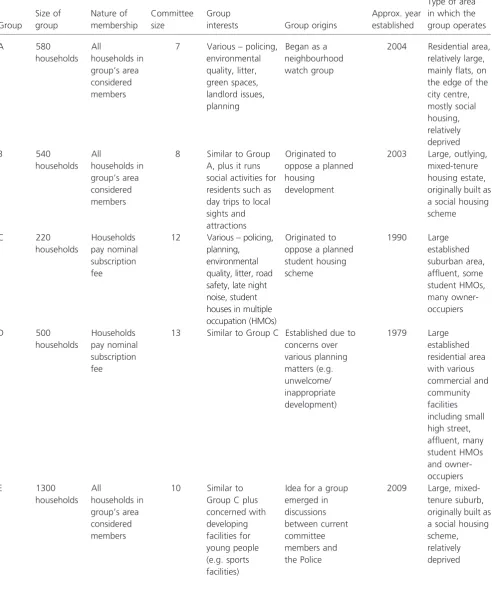
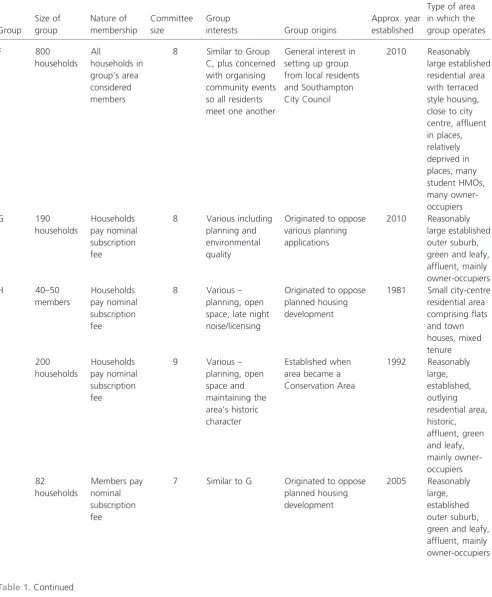
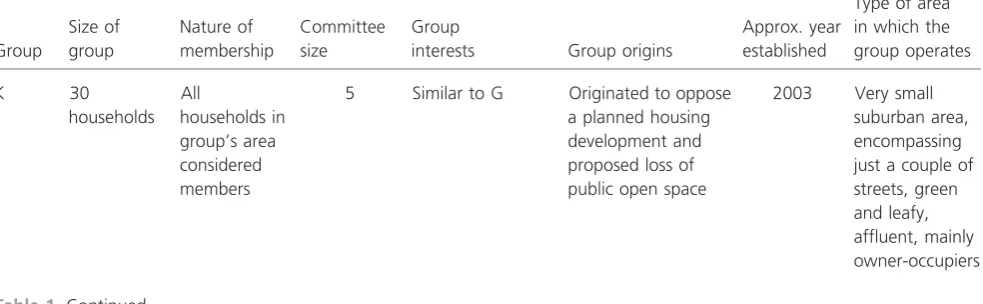
The 11 selected groups were drawn from across the whole city of Southampton, from homeowner areas and areas of social housing, from built environments of higher and lower densities and from places of affluence and relative deprivation. They operated in the outer and inner suburbs, in areas of terraced housing and in city-centre residential schemes. Their areas of activity ranged from a couple of streets to large areas comprising several thousand households. Some groups counted all residents in their immediate area as members, while others required households to actively join the organisa-tion and pay a nominal subscriporganisa-tion fee. The groups varied in age, with some having been established for just a couple of years and others having been active for a couple of decades. Their interests and activities could differ, although, interest-ingly, planning and development matters were of concern to all. Table 1 provides key information on the 11 groups (identified as groups A to K to protect their anonymity).
The focus groups explored views on neighbourhood and urban design, specifically thoughts on land-use mix, with several activities developed for this purpose. These activities examined preferred land uses near housing, preferred distances between housing and non-residential uses, and the preferred arrangement of land uses within a neighbour-hood and an entire settlement. Each focus group lasted between an hour and an hour and a half. The lead author
Focus group Field notes on
group dynamics/ interaction
Focus group discussion
Transcript or notes on focus group discussion
Photos of the focus group (participants’ consent required) Product of any activity
completed in the focus group Audio/video
[image:5.595.50.281.610.731.2]recording of focus group discussion (participants’ consent required)
Group Size of group Nature of membership Committee size Group
interests Group origins
Approx. year established
Type of area in which the group operates A 580 households All households in group’s area considered members
7 Various – policing, environmental quality, litter, green spaces, landlord issues, planning
Began as a neighbourhood watch group
2004 Residential area, relatively large, mainly flats, on the edge of the city centre, mostly social housing, relatively deprived B 540 households All households in group’s area considered members
8 Similar to Group A, plus it runs social activities for residents such as day trips to local sights and attractions
Originated to oppose a planned housing
development
2003 Large, outlying, mixed-tenure housing estate, originally built as a social housing scheme C 220 households Households pay nominal subscription fee
12 Various – policing, planning, environmental quality, litter, road safety, late night noise, student houses in multiple occupation (HMOs)
Originated to oppose a planned student housing scheme 1990 Large established suburban area, affluent, some student HMOs, many owner-occupiers D 500 households Households pay nominal subscription fee
13 Similar to Group C Established due to concerns over various planning matters (e.g. unwelcome/ inappropriate development) 1979 Large established residential area with various commercial and community facilities including small high street, affluent, many student HMOs and owner-occupiers E 1300 households All households in group’s area considered members
10 Similar to Group C plus concerned with developing facilities for young people (e.g. sports facilities)
Idea for a group emerged in discussions between current committee members and the Police
[image:6.595.58.551.153.750.2]2009 Large, mixed-tenure suburb, originally built as a social housing scheme, relatively deprived
Group
Size of group
Nature of membership
Committee size
Group
interests Group origins
Approx. year established
Type of area in which the group operates
F 800
households All
households in group’s area considered members
8 Similar to Group C, plus concerned with organising community events so all residents meet one another
General interest in setting up group from local residents and Southampton City Council
2010 Reasonably large established residential area with terraced style housing, close to city centre, affluent in places, relatively deprived in places, many student HMOs, many owner-occupiers
G 190
households
Households pay nominal subscription fee
8 Various including planning and environmental quality
Originated to oppose various planning applications
2010 Reasonably large established outer suburb, green and leafy, affluent, mainly owner-occupiers
H 40–50
members
Households pay nominal subscription fee
8 Various – planning, open space, late night noise/licensing
Originated to oppose planned housing development
1981 Small city-centre residential area comprising flats and town houses, mixed tenure
I 200
households
Households pay nominal subscription fee
9 Various – planning, open space and maintaining the area’s historic character
Established when area became a Conservation Area
1992 Reasonably large, established, outlying residential area, historic, affluent, green and leafy, mainly owner-occupiers
J 82
households
Members pay nominal subscription fee
7 Similar to G Originated to oppose planned housing development
[image:7.595.48.541.148.746.2]2005 Reasonably large, established outer suburb, green and leafy, affluent, mainly owner-occupiers
acted as the moderator introducing the activities and steering the discussion.
With this study now outlined, attention turns to the guidelines on the use of focus groups, and the practice of engaging with residents’ groups, that emerged from it. As explained in the introduction, the guidance is arranged around six topics.
5. Identifying residents’ groups for
consultation and engagement activities
The initial process of identifying residents’ groups in Southampton proved a complex and time-consuming task, presenting a number of challenges and issues.
5.1 Finding groups: sources of information
Information on the existence, location and interests of groups had to be drawn from a variety of sources, since no single body held a complete list of these organisations. Southampton City Council, councillors, local voluntary networks and directories, and a citywide umbrella organisation representing numerous residents’ groups were fruitful sources of information. However, techniques such as keyword Internet searches, reviewing archived local media reports and searching the databases of grant-awarding bodies, such as the National Lottery, proved helpful in identifying a small number of groups. In total, from these various sources, 120 residents’ groups were identified. Contact details, such as for a chair or secretary, could be established for 84 of these, although these details proved on occasion to be unreliable. Sometimes individuals had moved from the address listed or had left the organisation.
The experience of this aspect of the study suggests that, when seeking to involve established organisations such as residents’ groups in consultation and engagement exercises, a substan-tial amount of time might need to be built into any project plan to accommodate the potentially prolonged task of
identifying and contacting groups. It also suggests that, in some instances, multiple sources of information need to be used to identify groups, rather than relying solely on a single source, such as a local authority or umbrella organisation. Lastly, it suggests the researcher risks being disappointed in consultation and engagement exercises, as outdated or inaccurate contact information can make it difficult, if not impossible, to engage with all the organisations identified. This could be of particular concern if these organisations are believed to have a significant or unique link to the issue under consideration.
5.2 Cases where there are no groups to be found
The 120 residents’ groups identified in Southampton were not uniformly distributed across the city. Mirroring the findings of Short et al. (1986) in central Berkshire, the groups were concentrated in some locations but absent in others. Looking across Southampton’s 16 electoral wards (Figure 2), Bargate ward, which encompasses the city centre and its immediate surroundings, had the greatest number of groups at 14, while at the other extreme Sholing, a suburban area towards the eastern edge of the city, had just two groups. Concentrations of groups were found in the tightly packed terraced streets spreading out from the city centre in parts of Bevois ward, in a number of the mature, leafy suburban streets of Bassett ward and in and around the city-centre residential neighbourhood of St Mary’s in Bargate ward. Figure 2 also identifies the number of residents’ groups per 1000 residents, shown to be low across all wards, although varying between them (the average for the city as a whole is 0?52). To appreciate circumstances and conditions in these wards, a tool like Neighbourhood Statistics, a free to access government website that offers large amounts of local area data on various topics (http://www.neighbour-hood.statistics.gov.uk/dissemination/) may be used to obtain headline socioeconomic data on a ward-by-ward basis, as shown in Table 2 (available online as a supplementary data file).
Group
Size of group
Nature of membership
Committee size
Group
interests Group origins
Approx. year established
Type of area in which the group operates
K 30
households All
households in group’s area considered members
5 Similar to G Originated to oppose a planned housing development and proposed loss of public open space
[image:8.595.59.551.153.305.2]2003 Very small suburban area, encompassing just a couple of streets, green and leafy, affluent, mainly owner-occupiers
Certain studies have suggested that being involved in a residents’ group is associated with particular socioeconomic characteristics. For example, studies have found that owner-occupiers and social housing tenants are more likely to join and form residents’ groups than private housing tenants (Davis, 1991; Short et al., 1986), while middle-aged and senior residents are more likely to join than are young adults (Middleton et al., 2005; Scott et al., 2007). In places where communities demonstrate a low level of the features associated with participation in a residents’ group, one might expect to find fewer such groups. However, it was not possible in the study to thoroughly investigate how far this assertion explained the uneven distribution of groups in Southampton. Because the geographical boundaries of all 120 residents’ groups could not be accurately established, it was also not possible to use Neighbourhood Statistics to gather the socioeconomic data particular to each group’s locality. Although socioeconomic data were available at ward level, it seemed that electoral wards were at too great a spatial scale to explore whether there was any relationship between the context and social composition of a local area and the presence of residents’ groups.
The experience of this aspect of the study suggests that different places may require different consultation and
engagement strategies. For instance, it is inadvisable to develop a strategy that targets residents’ groups in areas that lack these organisations. A tailored plan that responds to the individuals, interests and groups in an area is needed. As an additional point, Batheramet al.(2005) report that tapping into existing networks and established groups can reduce the time and effort expended in consultation and engagement activities. The lack of residents’ groups in an area might impact on the shape and perhaps availability of these networks and thus the level of resources necessary to support such activities.
6. Representativeness in consultation and
engagement activities
As certain socioeconomic characteristics are associated with participation in a residents’ group, it is unlikely that a group’s social composition will reflect the actual social composition of the community in which it operates. Further, the act of joining a residents’ group distinguishes members from non-members, creating an obvious point of difference. Most of those participating in the study were older adults, with many identifying themselves as retirees. A number of these partici-pants associated their views with those of an older generation and claimed that younger adults and young families would have a different outlook. While perceiving their views as Bassett
12 (0·87)
Bargate 14 (0·80)
Harefield 3 (0·22)
Bitterne 5 (0·36) Swaythling
6 (0·44)
Woolston 6 (0·44)
Sholing 2 (0·14) Peartree
8 (0·59) Bitterne Park
5 (0·37)
Bevois 10 (0·62) Portswood
10 (0·68) Shirley
6 (0·43)
Freemantle 4 (0·28) Coxford 10 (0·72)
Redbridge 10 (0·68)
Millbrook 6 (0·38)
City centre
M27
[image:9.595.107.521.143.421.2]Southampton Water
particular to a specific demographic, and indeed constituting a narrow demographic, many groups identified protecting and promoting the interests of their local area and its wider population as their raison d’eˆtre.
Perhaps confirming a common-sense view, the experience of this aspect of the study highlights the importance of carefully considering the basis on which place-based groups, like residents’ groups, are included in a consultation and engage-ment exercise. They cannot simply be assumed to represent the street, neighbourhood or wider area in which they operate. If the aim of a public involvement exercise is to engage with a representative sample of individuals, one which reflects the social composition of, say, an entire community, this aspect of the study suggests that researchers should not restrict engage-ment activities to residents’ groups alone.
In a consultation and engagement exercise, a key issue in determining whether the focus group will be an appropriate method is the importance attached to engaging with a representative sample of participants, such as one which is statistically representative of an entire neighbourhood. Focus groups are not designed for this kind of sampling (Barbour, 2007). They contain a relatively small number of individuals and usually only a relatively small number of groups are convened (for the reasons discussed earlier). Achieving a statistically representative sample of participants under these conditions is difficult, if not impossible. Consequently, if the goal of an engagement exercise is to involve a representative sample, focus groups should be rejected or used only in combination with a method that facilitates such sampling (e.g. surveys).
7. Factors that can inhibit residents’ groups
and their members from participating in consultation and engagement activities
In the study, efforts to recruit residents’ groups and their members appeared to be negatively affected by a number of issues.
7.1 Group factors
Residents’ groups have differing interests and undertake different activities informed by the context and issues peculiar to their local area. For instance, in Southampton, while student HMOs were a key concern for the collection of groups that operated around the city’s two universities, groups in other places did not identify these properties as a particular issue or concern. Further, and unique among the 11 groups, a group operating in a relatively deprived community with a poor-quality environment proactively sought to develop new facilities in the local area. By contrast, most other groups seemed more concerned with resisting development. Groups also differed in how frequently they met. Some operated on a
reactive basis, meeting only when a ‘threat’ was detected, such as a planning application. Others had a regular programme of meetings and an ongoing agenda of activities. Given their differing interests, depending on the issue under consideration, residents’ groups and, indeed, other types of group might vary in their desire to participate in consultation and engagement exercises. Groups that had a strong interest in planning matters seemed particularly willing to participate in the study. Further, while there might be opportunities with some residents’ groups to coordinate consultation and engagement events with existing meetings, for others specially convened meetings might be necessary. Again, this could be true for other types of group. The result might be an impact on participation rates because individuals would need to make a special effort to attend the event. In the study, when specially convened meetings were held for the focus groups, participation rates could sometimes be low.
7.2 Personal factors
Between securing a group’s interest in a consultation exercise and actually completing the exercise lies the task of securing the participation of individual group members. In the study, members of the 11 residents’ groups self-selected to the focus groups. They were not nominated by the wider group or selected by the lead author. This supports ethical research techniques, since individuals purposefully chose to participate in the study. However, self-selection can result in a skewed sample, with a potential issue being the degree to which it represents the wider group. In the case of a focus group, self-selection is liable to result in the participation of only those who are comfortable discussing their views in a group setting, and who have sufficient time to dedicate to the exercise. Work commitments, caring duties and a lack of confidence in sharing views with others might, either alone or in combination with other factors, have created barriers to some group members participating in the study. One might anticipate these barriers to participation among the members of various other types of group and among individuals more generally.
7.3 The influence of ‘experts’
although they did when others spoke. To try and encourage an inclusive group discussion, where everyone had an opportunity and was supported to speak, the moderator would at times directly address questions to individual participants and then seek the views of others on the response provided. This approach helped draw all participants into the discussion.
8. Focus group design
The extent to which participants actively engage in a focus group can be influenced by both the design and length of the focus group. Focus groups that interest participants and are of a reasonable length can, unsurprisingly, support participation. In the study, much thought went into designing focus group exercises that were interactive and varied, with exercise materials kept colourful and eye-catching while the entire focus group was restricted to an hour or an hour and a half in length. One exercise in particular proved successful in engaging all participants, even the more reticent ones. This exercise required the group to work together to design their ideal town using different coloured discs to represent different land uses and a base-sheet showing the boundary of a settlement. This exercise was associated with a concentrated burst of activity. All participants eagerly began placing discs on the base-sheet, discussed, agreed and disagreed on the location of different uses and frequently talked over one another. In the larger focus groups, discussion fragmented as subgroups emerged and began taking responsibility for the design of specific sections of the ideal town. While this level of activity posed difficulties when transcribing the focus group discussion, as the task of distinguishing individual voices proved time-consuming and at times impossible, the exercise was valuable for capturing and maintaining the interest of all participants. The experience of this aspect of the study highlights the potential for interactive, group work activities to form a useful addition to focus groups. They can stimulate the involvement of all participants and inject energy into the whole exercise.
9. Issues to consider when evaluating and
interpreting focus group discussion data
In the study, two notable issues emerged in the focus groups and when the focus group transcripts were analysed. Both are typical of the focus group method and affect what the discussion data can say about the attitudes of residents’ groups towards town and neighbourhood design.
9.1 The tendency for views to change
Barbour (2007) reports that during a focus group participants can repeatedly change their opinion as discussion progresses and fresh contributions occur. This issue was identified among a number of participants in the study. For example, one participant stated early on a firm dislike for zoning and separating land uses but, as discussion progressed, particularly during the ideal town exercise, spoke positively about ‘boxing’
together different types of land use and locating clusters of noisy uses and employment uses far away from residential areas. In a different group, a participant at first favoured interspersing local services and facilities, such as corner shops and health centres, among housing in residential areas, but later on argued for a ‘hub and spoke’ design where various non-residential uses were concentrated in distinct service centres encircled by areas of housing. In this design, multiple satellite service centres (the spokes), and their associated housing, would be located around a main town centre (the hub).
When reporting findings from a focus group, commenting on the way opinions change is part of providing an accurate and reliable account of the research act. However, alternating opinions may present an issue if the goal is to use the focus group findings to inform the design of a new development or the content of a new plan. Where opinions move back and forth substantially on, for instance, favoured design character-istics or preferred policy goals, it can be difficult to determine how these varying, perhaps contradictory, views should, or can, inform the design or plan-making process.
9.2 The tendency for views to converge
Barbour (2007, 2008) comments on the tendency for opinions to converge in focus groups with discussion ending in consensus. Real or perceived peer group pressure, and participants recognising the presence of others, are seen to prompt this move towards agreement (Barbour, 2007; Scott, 2011). In the research, while discussion was dynamic, moving between agreement and disagreement, in most groups the ultimate outcome was consensus. This consensus was displayed or established in a number of ways. The participants could explicitly state their agreement with another’s views, or they could denote agreement through their body language by nodding when another was speaking. They could work collectively, incorporating and building on one another’s comments to arrive at a final collective thought, and they could talk through points of difference with other participants, altering their opinions to accord with those of another participant.
these personal thoughts, the focus group method should be rejected in favour of techniques such as interviews or surveys where there is no group setting and thus no group influence. The tendency towards a convergence of opinions can, however, be exactly what is required in situations where the goal of a discussion is to reach agreement (Barbour, 2008). For example, in a scenario where a set of guidelines must be collectively agreed by a variety of stakeholders, a focus group could be a useful forum for identifying widely supported guidance (see Andrew (2000)).
10. Conservative environmental design preferences and scepticism of the agenda and activities of local government and property developers
In the study, most residents’ groups identified their ideal residential environment as something akin to the stereotypical postwar British suburb. This was a predominantly residential environment comprising low density housing with private gardens. It exuded peace and quiet as most traffic-generating and commercial uses were expunged. It contained areas of public open space together with the occasional local service, such as a corner shop, doctor’s surgery or primary school. Purcell (2001) found a similar ideal, which he called the suburban ideal, among affluent homeowner groups in the suburban hinterlands of Los Angeles, USA. In the study, groups were also seen to favour preserving the status quo in established residential and historic areas, believing that new development should be prevented or at least required to blend in with its immediate surroundings. Collectively, these findings suggest that certain members of residents’ groups, at least in some instances, hold relatively conservative environmental preferences where the traditional is favoured and change is disliked.
Given this tendency for conservative preferences, if consulta-tion and engagement activities are carried out with residents’ groups on proposals for a highly innovative development or plan, one that substantially departs from the norm, a largely negative response might be anticipated. Determining how to address such a response, such as how to incorporate it into the design or plan-making process, is a potentially challenging but important issue. Ignoring negative responses is an easy way to antagonise those who participated (Cohen, 2005). Several of the residents’ groups in the study reported disillusionment and disappointment with past consultation exercises on planning, development and car parking matters. They felt that these had been ‘tick box exercises’ where the local authority or property developer behind the exercise had identified a preferred approach long before their opinions had been sought. They seemed to be sceptical of consultations carried out by these types of organisations, believing that the residents’ views, including any negative views, were rarely acted upon or taken
forward. In the case of development proposals, if the negative response occurs in a pre-application consultation, ignoring it could simply mean it will resurface when the application is decided by the local planning authority – finding expression in representations to this authority during the decision-making process. Indeed, many of the residents’ groups in Southampton were active participants in the planning system, monitoring and commenting on planning applications.
Several of the residents’ groups that participated in the study reported feeling marginalised and powerless in planning and development matters, as developer and local authority interests were always seen to triumph over theirs. While this view might be a distortion of the truth, where residents’ groups do subscribe to it, it might influence the way in which they approach the consultation and engagement activities carried out by these organisations. For example, they may be suspicious and sceptical of these activities. To counter this, consideration needs to be given to the way consultation and engagement is presented and the point at which it occurs. Consultation and engagement activities occurring early on, when there would appear to be clear opportunities to influence the issue under consideration, may receive a better reception and more enthusiastic response than activities occurring towards the end of a project when most decisions have been made (Cohen, 2005). How the findings of any consultation and engagement activity are communicated back to those who participated, and how it can be shown that the findings have shaped the outcomes, are also important issues to address in a public involvement exercise (Batheramet al., 2005).
11. Conclusions
Various arguments have been made for involving the public in planning decisions and, in the UK and elsewhere, planning practice and guidance supports the concept. However, public involvement can take different forms with the degree to which the public directs the decision-making process being the key in differentiating one form, or approach, from another.
& Focus groups provide rich data on content, referring to the ideas and opinions developed and expressed in a group setting, and process, meaning group interaction and dynamics.
& Focus groups are not designed to capture a representative sample of participants. They engage with a relatively small number of individuals and usually only a small number of groups are convened. If the aim of a public involvement exercise is to engage with a representative sample, the focus group method should be combined with, or rejected in favour of, an alternative method, such as a survey, which is capable of engaging with such a sample.
& In focus groups, individuals who confidently assert their authority on a subject can sometimes inhibit others from speaking. To encourage an inclusive discussion where all participants are supported in presenting their views, one technique can see the moderator directly addressing questions to individual participants, with the goal being to draw everyone into the conversation.
& In focus groups there can be a tendency for participants to repeatedly change their opinion as discussion progresses and fresh contributions occur. This presents challenges when considering and evaluating focus group data and deciding how it should be incorporated within, for instance, a development or policy proposal.
& In focus groups there can be a tendency for opinions to converge, with discussion ending in consensus. This raises questions about how focus group discussion data should be interpreted. It can be unclear how far any identified consensus is the result of genuine agreement among participants and how far it is influenced by the focus group method itself.
Besides focus groups, the paper also presents guidance on the process of engaging with residents’ groups. Such guidance may be relevant to any public involvement exercise where residents’ groups will be present, key points of this guidance follow.
& When seeking to engage with residents’ groups, or indeed other types of established group, a substantial amount of time might need to be built into any project plan to accommodate the task of identifying and contacting groups.
& Tapping into existing networks and contacting established groups, such as residents’ groups, can reduce the time and costs involved in consultation exercises. However, the existence of these networks and groups can differ between places. For example, while some areas may have no residents’ groups others may have many.
& Residents’ groups are unlikely to reflect the actual social composition of the areas in which they operate. In fact, the very act of joining a group distinguishes members from
non-members, creating an obvious point of difference. One needs to carefully consider the basis on which residents’ groups, and indeed any other place-based group, are included in a public involvement exercise, since they cannot simply be assumed to represent the localities in which they operate.
& Some residents’ groups can exhibit rather conservative preferences in the design and development of the built environment. Consequently, individuals and organisations proposing innovative planning or development projects and policies might need to prepare for a rather negative response from these bodies.
11.1 Practical relevance and potential applications of the paper
The ideas put forward in this paper are relevant to individuals and organisations considering or pursuing public involvement exercises that might include residents’ groups and/or focus groups. These might be exercises supporting planning decisions but, equally, they could be exercises on a host of non-planning matters.
Although it has been developed from the particular experience of conducting focus groups with residents’ groups, the guidance here on identifying and engaging with these groups has application to public involvement exercises more generally. For example, as found with the residents’ groups, there may be no single source of information on a particular group of stakeholders or consultees. In such cases, the advice to explore multiple sources of information, rather than restricting research to a single source, would seem useful.
The guidance offered on focus groups, such as factors inhibiting participation, the design of focus groups and issues to consider when interpreting focus group discussion data, are applicable to any group-based discussion activity occurring in any setting. These could be public involvement activities associated with planning and development matters but, equally, they could be linked to a variety of other contexts. For instance, Andrew (2000) describes how focus groups were carried out with representatives from English Nature, the National Farmers Union and various other organisations to produce guidelines on trimming roadside hedges. The resulting guidance leaflet was a group winner in the Engineering Council’s Environment Award for Engineers in 1999, proving just how useful focus groups can be when employed in the right context (Andrew, 2000).
Acknowledgements
REFERENCES
Andrew R(2000) Community involvement – don’t keep the
public in the dark.Proceedings of the Institute of Civil Engineers – Municipal Engineer139(2): 96–73, http://dx.doi. org/10.1680/muen.2000.139.2.69.
Arnstein SR(1969) A ladder of citizen participation.Journal of the American Institute of Planners35(4): 216–244.
Barbour R(2007)Doing Focus Groups. Sage, London, UK.
Barbour R(2008)Introducing Qualitative Research – A Student Guide to the Craft of Doing Qualitative Research. Sage, London, UK.
Batheram M, Hardin J and Whitfield S(2005) Successful participation methods for local transport planning.
Proceedings of the Institute of Civil Engineers – Municipal Engineer158(1): 9–16, http://dx.doi.org/10.1680/muen. 2005.158.1.9.
Bickerstaff K and Walker G(2001) Participatory local governance and transport planning.Environment and Planning A33(3): 431–451, http://dx.doi.org/10.1068/ a33173.
Bloor M, Frankland J, Thomas M and Ronson K(2001)Focus Groups in Social Research. Sage, London, UK.
Brookfield KL(2011) Quality of life and the design of urban environments: the perspective of tenants and residents associations.Wellbeing 2011 Conference; First
International Conference Exploring the Multi-Dimensions of Well-being. Birmingham City University, Birmingham, UK.
Brookfield KL(2012a) Mixed use: celebrated concept, partially promoted practice – English experience with implementing a planning principle.International Journal of
Environmental, Cultural,Economic & Social Sustainability
(in press).
Brookfield KL(2012b) Neighbourhood plans and suburban
dreams.Journal of the Town and Country Planning Association81(8): 320–324.
Campbell H and Marshall R(2000) Public involvement and planning: looking beyond the one to the many.
International Planning Studies5(3):321–344.
Clark G(2011) Sustainable development through local empowerment: The Campaign to Protect Rural England (CPRE) Annual Lecture, February.
Cohen T(2005) Community involvement in planning: finding a happy medium,Proceedings of the Institute of Civil Engineers – Municipal Engineer158(1): 5–9, http:// dx.doi.org/10.1680/muen.2005.158.1.5.
Davis JE(1991)Contested Ground – Collective Action and the Urban Neighborhood. Cornell University Press, New York, USA.
DCLG (Department for Communities and Local Government)
(2011a)An Introduction to Neighbourhood Planning.
DCLG, London, UK.
DCLG(2011b)Localism Bill: Compulsory Pre-applications for
Consultations between Prospective Developers and Local Communities – Impact Assessment. DCLG, London, UK.
DCLG(2011c)Pre-application Consultation with Communities: A Basic Guide. DCLG, London, UK.
Defra (Department for Environment, Food and Rural Affairs)
(2005)Securing the Future – The UK Government Sustainable Development Strategy. Cm 6467. The Stationery Office, Norwich, UK.
Gaskell G(2000) Individual and group interviewing. In
Qualitative Research with Texts, Image and Sound(Bauer, MW and Gaskell G (eds)). Sage, London, UK, pp. 38–56.
Grant J(2011) Storytelling, group dynamics and professional cultures: lessons from a focus group study.Planning Theory and Practice12(3): 407–425.
Holloway I(1997)Basic Concepts for Qualitative Research, Blackwell, Oxford, UK.
Krueger RA and Casey MA(2000)Focus Groups – A Practical
Guide for Applied Research, 3rd edn. Sage, London, UK.
Localism Act 2011(2011)Elizabeth II. The Stationery Office, Norfolk, UK.
Middleton A, Murie A and Groves R(2005) Social capital and neighbourhoods that work.Urban Studies42(10): 1711– 1738.
Morgan DL(2006) Focus group. InSage Dictionary of Social Research Methods(Jupp V ed.)). Sage, London, UK, pp. 121–122.
Munday J(2006) Identity in focus: the use of focus groups to study the construction of collective identity.Sociology
40(1): 89–105.
ODPM (Office of the Deputy Prime Minister)(2004)Community Involvement in Planning: The Government’s Objectives. ODPM, London, UK.
OECD (Organisation for Economic Co-operation and Development)(1996)Innovative Policies for Sustainable Urban Development: The Ecological City. OECD, Paris, France.
Pahl-Weber E and Henckel D(2008)The Planning System and
Planning Terms in Germany – A Glossary. Akademie fu¨r Raumforschung und Landesplanung, Berlin, Germany.
Purcell, M(2001) Neighbourhood activism among homeowners
as a politics of space.Professional Geographer53(2): 178–194.
Rosengren KE(1981) Advances in Scandinavian content analysis: an introduction. InAdvances in Content Analysis(Rosengren KE (ed.)). Sage, Beverly Hills, CA, USA.
Royal Town Planning Institute (RTPI)(2005)Guidelines on Effective Community Involvement and Consultation. RTPI, London, UK.
Saunders P(1980)Urban Politics – A Sociological Interpretation. Penguin, Harmondsworth, UK.
Scott A(2011) Focussing on focus groups: effective
participative tools or cheap fixes for land use policy.Land Use Policy28(4): 684–694.
society and managing spatial change in the rural–urban fringe.Policy and Politics35(1):163–190.
Short JR, Fleming S and Witt S(1998)Housebuilding, Planning and Community Action: The Production and Negotiation of the Built Environment. Routledge & Kegan Paul, London, UK.
United Nations(1998)Convention on Access to Information, Public Participation in Decision Making and Access to Justice in Environmental Matter.See http://http://www. unece.org/fileadmin/DAM/env/pp/documents/cep43e.pdf (accessed 17/02/2013).
WHAT DO YOU THINK?
To discuss this paper, please email up to 500 words to the editor at [email protected]. Your contribution will be forwarded to the author(s) for a reply and, if considered appropriate by the editorial panel, will be published as discussion in a future issue of the journal.
Proceedingsjournals rely entirely on contributions sent in