!
ISSN 2185-3762!
So You Want to Start a Peer Online Writing Center?
Christine Rosalia, Hunter College, City University of New York, USA
Corresponding author: [email protected]
Publication date: March, 2013.
To cite this article
Rosalia, C. (2013). So you want to start a peer online writing center? Studies in Self-Access Learning Journal, 4(1), 17-42.!
To link to this article
http://sisaljournal.org/archives/mar13/rosalia
This article may be used for research, teaching and private study purposes. Please contact the author for permission to re-print elsewhere.
! "#!
So You Want to Start a Peer Online Writing Center?
Christine!$%&'()'*!+,-./0!1%((/2/*!1).3!4-)5/0&).3!%6!7/8!9%0:!! !
Abstract
The purpose of this article is to share lessons learned in setting up three different peer online writing centers in three different contexts (EFL, Generation 1.5, and ESL). In each center the focus was on the language learner as a peer online writing advisor and their needs in maintaining centers “for and by” learners. Technology affordances and constraints for local contexts, which promote learner autonomy, are analyzed. The open-source platforms (Moodle, Drupal, and Google Apps) are compared in terms of usability for peer writing center work, particularly centers where groups co-construct feedback for writers, asynchronously. This paper is useful for readers who would like a head start or deeper understanding of potential logistics and decision-making involved in establishing a peer online writing center within coursework and/or a self-access learning center.
Keywords: peer feedback, open source technologies, online learning, second language writing, online writing center
The benefits of peer learning for student writers has a long and well documented history, with research evidence of success across higher education (Falchikov, 2005; Topping, 2003). In the United States, Whitman (1988)
summarized systematic benefits of peers teaching peers for students, teachers, and institutions. They found that students gained “a more active role in the learning process” when engaged in peer teaching because “reviewing and organizing material as a ‘teacher’ was more cognitively rigorous than simply receiving it as a ‘student’ alone—to teach was to learn twice” (p. 5). Other benefits for peer review1, often cited specifically for language learners, are that the giver of feedback gains self-evaluation skills for assessing their own writing (Chien, 2002) and improves their own writing proficiency (Lundstrom & Baker, 2009), especially their
!!!!!!!!!!!!!!!!!!!!!!!!!!!!!!!!!!!!!!!!!!!!!!!!!!!!!!!!
1 In this paper peer review, peer feedback, peer tutoring, and peer teaching are used synonymously.
! ";!
appreciation of audience (Tuzi, 2004). Improvements have been documented even in cases when the peer reviews a paper written above their current writing
proficiency (Marcus, 1984).
For classroom language teachers, the facilitation of peer review can be a rich and regenerating resource. With proper student training and structure, adding peer review to a class increases the amount and promptness of individualized instruction to writers. For example, in an efficient thirty minutes with a class of 30 writers a teacher can circulate the classroom making sure 30 writers get and give feedback on the ideas of their essay. In large classrooms, as Laurillard (2008) notes, each student would normally get as little as 5 minutes of individualized teacher attention per week. However, in a “flipped”2 reading and writing classroom, in which a teacher sets up “reciprocal teaching” activities that include peer review, he or she is circulating around the room refining (and learning from) peer dialogues. The teacher is using peer feedback to notice information about the student reviewer and writer simultaneously (Paulus, 1999). How does the student use metacognitive strategies? How is the student summarizing theirs and others’ texts? How are they questioning, clarifying, and predicting as they read and write? Do they find one role--being a reviewer or the reviewee--easier? Is the dialogue real, encouraging, helpful, and productive?
Peer dialogue and its written artifacts are not only very telling for assessing metacognitive literacy skills. Teachers might also use the artifacts of peer review to understand ways to innovate and reset their own pedagogy. One example of this can be seen in Black’s (2005) study of English language learners who formed a
homegrown fan fiction network online, outside of formal school. She observed the “stickiness” of these writers’ online feedback: when an author left feedback on another author’s blog, the two authors were automatically “linked”. Once linked, Black observed her reluctant second language writers thrive in a professionalized
!!!!!!!!!!!!!!!!!!!!!!!!!!!!!!!!!!!!!!!!!!!!!!!!!!!!!!!!
2 The “flipped classroom” is a term used by educational technologists to refer to an approach
! "<!
community of writers, where writers gave each other moral support and concrete resources, such as story skeletons. She found that writers using socially mediated technology gained voice--became more autonomous multilingual writers--and it inspired her to think of why this productivity so sharply contrasted with these writers’ school experiences. We may take blogging as a writer/audience tool for granted today, but in the early 2000s, the time of Black’s research, paying attention to this peer learning (the stickiness of blogs) meant a teacher gleaning pioneering teaching techniques from the students she might have expected learning from the least. Capturing ideas for professional development from students’ peer learning may be particularly important for teachers of academic writing who may not have taken course work in the teaching of writing during their training. Second language scholars, still today, cite the dearth of professional preparation of writing teachers (Leki, Cumming, & Silva, 2006; Ortmeier-Hooper & Enright, 2011).
A keen eye on peer tutoring and learning is not only helpful to teachers, but also to institutions. When students work as ‘teachers’ they consider teaching as a future profession; thus, peer tutoring serves as a form of informed teacher
recruitment (Whitman, 1988), with many writing center peer tutors becoming teachers (Gillespie & Lerner, 2007). However, teacher recruitment is not the limit of peer tutoring’s effect. One research project by Hughes, Gillespie, & Kail (2010) looked at 126 former peer tutors across three universities who had had their peer tutoring experience in the 1980s (24%), 1990s (33.6%), or 2000s (42.4%), and who later had careers in and outside of education. This study found that peer tutoring gave peer tutors “a new relationship with writing; analytical power; a listening presence; skills, values and abilities vital in their professions; skills, values and abilities vital in families and in relationships; earned confidence in themselves; and a deeper understanding of and commitment to collaborative learning” (Hughes et al., 2010, p. 14).
Peer tutoring by multilinguals in centers for English writing
! =>!
or EAL) writers and tutors. Some reasons for a lack of inclusion of EAL peers tutors in writing centers (in English and non-English dominant countries) include: lack of exposure or acceptance of writing center pedagogy; language teachers already successfully grappling with peer review in their action-based research classrooms (Min, 2005; Hu, 2005); insufficient student readiness for learner
autonomy (Cotterall, 1995), and lack of financial, institutional, and/or philosophical structure for supporting peer tutors (Mynard & Almarzouqi, 2006). In addition, in some contexts there may still be perceptions by students (and some teachers) that language learners do not want peer review by nonnative speakers because of a privileging of the native speaker (Kramsch, 1997) or because of previous classroom experiences that did not successfully use peer review in tandem with teacher and self-assessment (Nelson & Carson, 2006). Teachers and students might worry that the writing center experience would be a mere replication of classroom peer
feedback, a negative experience, or, if outside the classroom, something difficult for self-access learning centers to consistently fund. Indeed, Bedore and O’Sullivan (2011) used multiple research methods (surveys, focus groups, and follow-up interviews with students, novice teachers, teacher educators, and a program director) to document how at one university there was a “complicated” and “deep-rooted ambivalence” toward peer review, despite appreciation of its potential benefits. Confidence and commitment to peer review correlated with one’s teaching experience. As one research participant explained:
I think we all struggle… [H]ow do we teach peer review? How do we model it? Not just, why it's useful, but how to actually do it. I mean, we've had so much trouble finding an effective way to teach it. (Bedore & O’Sullivan, 2011, p. 11)
Benefits of online peer writing centers
! ="!
response) and the allowance of different kinds of anonymity (i.e., “blinding” of reviewers, authors, and/or the use of aliases), all of which are important if learners and teachers lack confidence in facilitating peer feedback. A common issue undermining confidence includes language learners’ (as tutees and tutors) not having enough metacognitive awareness or prior experience with English
metalanguage to discuss writing deeply and at various levels. Tutors worry about how to respond to a writer who may ask a question such as “How is my grammar?” (when the paper they are reading has many categories of grammatical error) or “How are my prepositions?” (when the tutor feels the writer’s paper has more important content-related weaknesses that ought to be addressed first). Because online written feedback given asynchronously is automatically recorded, these records can be used by writing center directors or teachers as learning objects. They can be used for recursive training on the doing and facilitating of peer feedback. Therefore, in situations where teachers and/or learners lack confidence, or simply want to exploit the interaction for more learning, an online record of the process (Hounsell, 2007) is helpful. Unlike in face-to-face centers, if a tutor wants to “observe” another tutor as a way of professionally developing, they do not need to schedule an observation: the “evidence” they want to observe is already available to them. Staff of an online writing center automatically share experiences, and can “data-mine” for feedback they wish to emulate, or further discuss.
Choosing the Technology, Work Protocols, and Mission for Your Center
The technology necessary for an online peer writing center depends on the needs, resources, and quality of feedback hoped for by its constituent users. In the three peer online writing centers this article describes, peer advisors would write feedback and a teacher would lead a discussion (give feedback-on-feedback) of how well the feedback:
(1) capitalized on the writer’s strength(s), (2) paid attention to affect,
! ==!
(4) fostered more learning,
(5) modeled good language use, and
(6) considered multiple self-assessments (the writer’s and the peer advisors’)
In each project, facilitating peer feedback to reach these six criteria was purposefully designed to improve the peer advisors’ own writing, self-regulation, and ability to give quality feedback to writers (Rosalia & Llosa, 2009). It was important in all projects that feedback was not just a product sent to a writer, like putting a coin into the feedback machine and waiting for feedback to come out. Though providing quality feedback was important, equally important was the process of negotiation, for and with peer advisors. Therefore, in each system there were three readers for every submission: reader 1, reader 2, and a facilitator that helped to check that together reader 1 and reader 2 wrote quality feedback. In other words, a facilitator made sure that the finished feedback satisfied the six criteria, but also that in theprocess of feedback generation, that the peer advisors wrote notes to each other. Instances of notes were about where one reader had left off and had expected the next reader to continue, or about what one reader assessed the quality of the feedback to, currently, be. A recurring thread was making sure peer feedback (re)triggered and sustained self-assessment (theirs and the writer center client’s) and the use of teachers--as means, and as resources, not as ends (Ciekanski, 2007). A writer’s own self-assessment was considered to be a critical feature of a good online peer writing center because it signaled the extent to which the writer was able to self-monitor and demonstrate metacognitive awareness.
Comparisons of Technologies Used in Support of Centers
! =?!
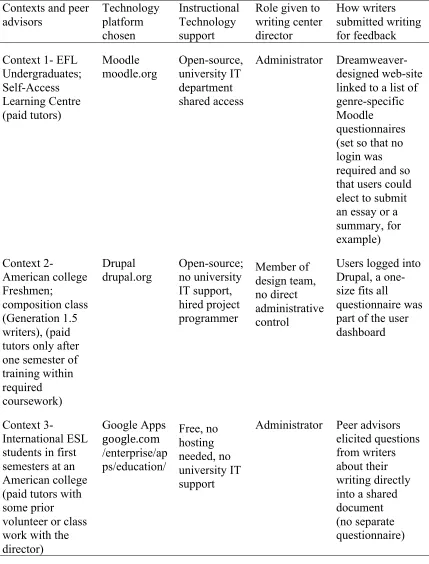
writing center director (e.g., ability to directly make user accounts or customize users’ experiences), and how writers submitted writing for feedback. While one center paid peer tutors, two used a classroom model, at first, in which students did peer tutoring as a course requirement, and later competed for a limited number of “paid” positions. Peer tutoring as an initial course requirement can serve two purposes: it can be used as a “pilot” to document to funders that a center is worth implementing, and, second, as unpaid training. As such, both the peer tutor(s) and the director of a center are able to see if online peer tutoring is a good fit.
The author recognizes, too deeply, the struggle for funding to pay peer tutors (or a director). While a program might not be able to fund peer tutors, some creative solutions used include winning funds to buy peer tutors’ textbooks for courses in their major, asking for semester stipends for tutors (rather than hourly pay), and providing tutors one-on-one tutoring on their own homework, as a form of bartering. One-on-one tutoring, while time-consuming for a director / teacher, is rewarding in that tutors’ homework is often the same kinds of assignments they would later see submitted to a center. Finally, while paying students for the painstaking work of providing quality online feedback to writing center clients is still the best option, when interviewed about pay issues, tutors have often said, after the experience, that money was not the key motivator for them. Indeed, online user logs and records consistently show that tutors work beyond the time they have been paid for--a clear indicator that the work is engaging enough in its own right.
! =@!
Table 1. Comparison of Peer Online Writing Centers in Three Contexts
Contexts and peer
advisors! Technology platform chosen!
Instructional Technology support!
Role given to writing center director!
How writers submitted writing for feedback!
Context 1- EFL Undergraduates; Self-Access Learning Centre (paid tutors)
Moodle
moodle.org Open-source, university IT department shared access
Administrator Dreamweaver- designed web-site linked to a list of genre-specific Moodle questionnaires (set so that no login was required and so that users could elect to submit an essay or a summary, for example) Context 2- American college Freshmen; composition class (Generation 1.5 writers), (paid tutors only after one semester of training within required coursework) Drupal drupal.org Open-source; no university IT support, hired project programmer Member of design team, no direct administrative control
Users logged into Drupal, a one-size fits all
questionnaire was part of the user dashboard
Context
3-International ESL students in first semesters at an American college (paid tutors with some prior volunteer or class work with the director) Google Apps 2%%2(/AB%C /enterprise/ap ps/education/ Free, no hosting needed, no university IT support
! =D!
Contexts 1, 2, and 3 were, in order: a center for EFL undergraduate writers in Japan, a center for an intact undergraduate class of multilingual computer systems majors in the United States, and a center for ESL pre-college and community college writers, also in the United States. In order to promote writer learner autonomy, feedback began and ended in each of these systems with a writer’s help-request. That is, in order to submit writing for feedback, writers were required to self-assess their own writing and complete a help-request. !
Peer tutors were then to address this help-request, even if it did not match what they felt should be a priority in making the writing better. They were also to do this even if the question was vague, such as the always popular: “How is my writing?”.
Context 2 was unlike the other two contexts in that, initially, the peer
advisors had a dual role of being both peer advisors and writers who submitted their own writing in the online system. They were required to do this as part of three classroom assignments. Later, students in Context 2 applied and competed for five limited paid positions (one-time semester stipends). These five tutored a
composition class on assignments similar to the ones they had just completed in their composition class.
! =E!
Figure 1. Center for EFL undergraduates: Splash page >> Submission self-select page
Figure 2. Center for undergraduate generation 1.5 computer systems majors: Drupal login page>> “submission central” dashboard for submitting and reviewing peer writing
Figure 3. Center for ESL pre-college writers: Gmail invitation to share a Google Doc >> writer opens up their Google Drive
! =#!
rather, that peer advisors are active participants in the initial and the continued choosing of technological solutions.
Shared decision-making
Shared decision-making is particularly important in deciding how peer advisors and staff work together to co-construct feedback to writers: peer advisors need to feel comfortable in how they work together through technology because the process of giving feedback requires complex layered readings of screen text and dynamic “feedback-on-feedback.” Figure 4, is a sample of complex layered reading and talk about feedback between three peer advisors in Context 3. Reader 1 used blue font to show her voice (and says to the writer: “this is one of the best essays we have worked on in the writing center, so far.”), Reader 2 used orange font, and Reader 3 (the “Facilitator”) used green font. The writing center director used a comment bubble to check in with peer advisors about the overall process.
I wonder however, if we should say that “this is one of the best essays we have worked on in the writing center, so far.” While this tone is encouraging, I’m not sure that it gives our center a slightly biased tone. What do you think, facilitator? I agree. I do think it is not appropriate to say that.
Figure 4. Sample colored in-text feedback-on-feedback among three peer advisors, plus writing center director comment bubble on overall process
When this process is collaborative, I have seen comments like the following in Figure 5 from peer advisors about their work:
It's a lot of accounts to keep track of, but I'm glad that we're finally being productive.
I loved reading Joy’s (pseudonym) final feedback because it really shows how nitty gritty the process is. In the internal feedback portion, there is so much negotiation and colorful mess! And with the facilitator comment bubbles, oh boy! But the final version looks sooo neat.
This is looking better and better. =)
! =;!
Figure 5. Peer advisor open reflection regarding state of writing center work
Note that Appendix 1 shows the finished feedback that this advisor refers to. While this reflection on how technology trials are going (using two Google App logins and a third Facebook login) is mixed, there is no question that the peer advisor is involved and positive about where she and her colleagues are going in evaluating technologies for their center. The post is open and has a spirit of collaborative experimentation.
An important consideration in setting up an online peer tutoring system is a belief in a few fundamental values: that students’ words are their own and not to be appropriated; that the role of a tutor is to be respectful of a peer’s writing (a fellow tutor’s or the writer’s), no matter what the level of ability; that co-construction of feedback is beneficial because it requires negotiation of the degree and direction of feedback to the writer; and that the end goal of peer tutoring is not to “fix” a peer’s essay (the “put developing essay in, get perfect essay out” model), but to promote learner autonomy with attention to affect and camaraderie.
! =<!
Taro does not write anything to the group, nor does he respond to the first reader’s request for feedback on her feedback. She had worried if her feedback had been “too self-centered”, helped “too much”, or had addressed the writer’s request for “verb tense” help. As a second reader, Taro (whose work is in italics and/or red font) did not respond to his colleague’s opening dialogical remarks or feedback assessment. Additionally, Taro appropriates the writer’s text (the bold and black text) giving a novice and, perhaps, unhelpful reason for revision: he writes that the writer should use his version, as it is “more smooth”. Here is the post verbatim:
[Reader 1’s separated note to the group] Hi everyone, I think I gaved too self-centered advice which was too much help for her in this essay... ! Please check if my advice is good for her. Also, I think there are more points to improve about her word choice, so I'd like you to check it as well. In my opinion, her verb tense has no problem, but if you have a different idea, please correct it. Thank you!
******************************************************************************************** [Reader 1’s feedback to the writer]
Dear Joyce (pseudonym for writer),
Your essay is very easy to follow because you explained in detail about your teacher! However, we had some sentences whose meanings are not so obvious for us.
Let's have a look at the sentences underlined.
[Writer’s text from the writer’s essay]
She gave us a lot of assignments and test. They were really terrible things. For example, if I made a mistake on her test which we have to write 80 sentences, I had to write again 10 times each sentence. It took really long time to finish writing.
1. "They were really terrible things.
We can understand what you mean, but you need to make sure whether the meanings are clear
if you have audience. Also, this sentence means like you had a lot of
assignments and tests and it was so hard for you, but some audience might take this sentence is negative. Maybe you wrote about great points of your teacher, so you might want to write it in more positive way. For example, you can say like "She gave us tremendous quantity of /quite a few assignments and tests, which told on me." or "We had so many assignments and tests that we couldn't ..." etc.
[Taro’s response as Reader 2]
We rewrote some sentences with other words which might be more smooth to read.We hope avobe examples would be helpful for your further improving. Please challenge.
! ?>!
Figure 6. Sample of Taro’s lack of negotiation with other peer tutors during online advice co-construction
Taro was not used to a layered collaborative approach to co-constructing feedback. Still in his first weeks of training, this approach was understandably new to him. One can see the difference between his response to a writer’s work, and the response of the first reader, a peer advisor with more experience. Though still with weaknesses, the first reader’s advice to Joyce considers “audience” and a conflict in tone between the writer saying “great points” about the subject of the essay (a loved former high school teacher) and then “terrible things.” It can be inferred that this is why she worried that she should say more to the writer about “word choice.” There is some indication that Taro internalized some of the first reader’s advice not only because he uses the subject-pronoun “we”, but also, because his revision uses the first reader’s suggestion to adjust “word choice” or to better explain the “terrible things” sentence. However at this stage of his collaborative writing development, Taro is not showing the higher order skill of providing feedback on feedback or eliciting critique of his work. As a second reader, rather than improving Reader 1’s feedback, Taro brings more confusion to the text. Nor is his feedback convincingly promoting Joyce’s learner autonomy. His “please challenge” will likely be
ineffective because of its vagueness.
When asked about working outside his assigned time, Taro used metaphors of needing to get a product back out to a customer: “Process talk” among staff meant less to him than finishing many submissions in a short time. Thoughts about whether he had been appropriating a writer’s words instead of addressing their questions about their own writing, or his responsibility to respond to colleagues’ questions about the quality of their feedback, in his mind, slowed production down. Defensive of his more authoritative style for feedback giving, Taro explained, verbatim:
! ?"!
the Prof. accept the such [sic] form (style) of essay or letter, I am a not right person to touch to their posted essay.
To the outside reader, it may be hard to understand that Taro is talking about peer advisor work. In contrast to the reflection on advising work of the peer advisor in Figure 5, Taro does not feel shared ownership of the co-construction process, yet. After just initial peer training, he was not ready to give up the traditional hierarchy of schooling roles—and some learners never are. The “students” Taro refers to are his co-workers who got angry with him for working outside of his assigned time (it meant submissions they were to have worked on had already been taken by Taro). The “essay” Taro refers to is the feedback post, and “the Prof” is the writing center director, who attempted to discuss word by word Taro’s advice to the writing center client, Joyce. More training or group discussion was needed to address Taro’s conflicts more directly and clearly. This is why it is recommended to build in regular face-to-face meetings with staff. Initially, writing under the micro lens of shared online forums, even if one uses anonymous aliases, can be uncomfortable. Taro was not expecting so much attention to be drawn to how he was giving feedback or to give so much attention to others’ feedback. Likewise older peer advisors were used to work in a certain way. A risk that peer feedback systems sometimes take is the time that is required for a group to define, understand, and refine their collaboration. A group may need up to one semester to find their working grove--another reason for piloting peer advisor work carefully.
! ?=!
not drafted feedback with Reader 1. The third reader or facilitator would need to write back to Taro and Reader 1 separately (giving each feedback about the quality of what was written individually) and still make choices about condensing and synthesizing final feedback to the writer. Protocols and communicating through writing are paramount, and are good pressures on peer tutors, if they see them as opportunities for refining both their applied technology and writing skills. The absence of physical context presents an authentic communicative context in which clear communication through writing becomes the need driving peer tutors’ efforts.
Recommendations. Having peer advisors develop their center’s work manuals and protocols, themselves, is one way to make sure that a peer online writing center is by and for peer tutors. Because it is common and practical for writing centers to have peer tutors with varying amounts of expertise, older tutors can initially lead newer tutors in this work. When writing protocols (and revisiting them over time), peer tutors internalize and personalize a complex process.
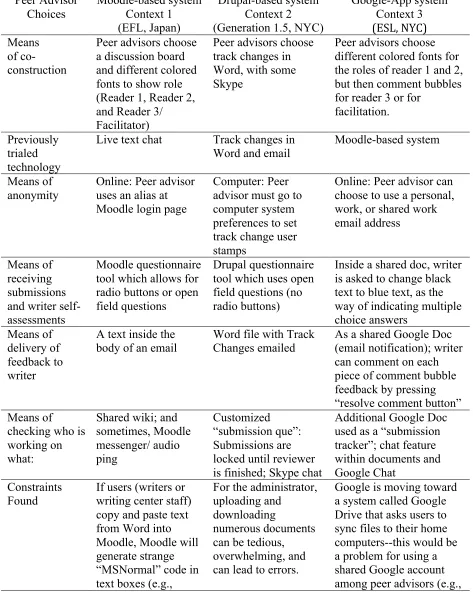
Innovation is spurred because in their explaining and negotiating protocols with other members, better ways of working are often realized. Table 2 shows how peer advisors in each center were first shown a method, which after one semester they could elect to change. First using one system helped them to later be in a position of comparing and appreciating other technologies. Thus, for example, in Center 1 peer advisors experimented with online chat before deciding to use asynchronous
! ??!
Table 2. Technology-based Comparison of Peer Advisor Management Across Centers
Peer Advisor
Choices! Moodle-based systemContext 1 ! (EFL, Japan)!
Drupal-based system!
Context 2 (Generation 1.5, NYC)!
Google-App system!
Context 3! FGHI*!791J!
Means of
co-construction !
Peer advisors choose a discussion board and different colored fonts to show role (Reader 1, Reader 2, and Reader 3/ Facilitator)!
Peer advisors choose track changes in Word, with some Skype !
Peer advisors choose different colored fonts for the roles of reader 1 and 2, but then comment bubbles for reader 3 or for
facilitation.!
Previously trialed technology!
Live text chat! Track changes in
Word and email ! Moodle-based system!
Means of
anonymity ! Online: Peer advisor uses an alias at Moodle login page!
Computer: Peer advisor must go to computer system preferences to set track change user stamps !
Online: Peer advisor can choose to use a personal, work, or shared work email address !
Means of receiving submissions and writer self-assessments!
Moodle questionnaire tool which allows for radio buttons or open field questions!
Drupal questionnaire tool which uses open field questions (no radio buttons)!
Inside a shared doc, writer is asked to change black text to blue text, as the way of indicating multiple choice answers !
Means of delivery of feedback to writer!
A text inside the
body of an email! Word file with Track Changes emailed ! As a shared Google Doc (email notification); writer can comment on each piece of comment bubble feedback by pressing “resolve comment button”!
Means of checking who is working on what: !
Shared wiki; and sometimes, Moodle messenger/ audio ping! Customized “submission que”: Submissions are locked until reviewer is finished; Skype chat !
Additional Google Doc used as a “submission tracker”; chat feature within documents and Google Chat !
Constraints
Found! If users (writers or writing center staff) copy and paste text from Word into Moodle, Moodle will generate strange “MSNormal” code in text boxes (e.g.,
For the administrator, uploading and
downloading
numerous documents can be tedious, overwhelming, and can lead to errors. ! !
! ?@!
@#%@%). In addition, sometimes Moodle page will not load, text will
“disappear,” be truncated, or user will get an error message about “a script” readability issue!
For peer advisors, Microsoft Word Track Changes will crash the computer operating system or the Word Application, if users have made too many comments or if they are too long (e.g., over 50 words long)!
syncs cause loss of work among too many
computers). ! !
Multiple simultaneous account logins (e.g.,
&,KC).LM%8BA%02,
0/'N/0"LM%8BA%02)!
are not allowed!
Heuristics and
work-arounds! Users use mail programs such as gmail to write, autosave, or clear formatting from Word file text before pasting it into
Moodle!
Users must name their files very carefully (e.g.,
CindyEssay_Reader1); administrators need to back-up word files used in
co-construction, because Drupal file
management is not easy to search!
Continue using the old version of Google Docs; At the Google App administrator level, take away from users the “Drive” plug-in; Organize docs into folders, be aware of notification settings; Share one master account (e.g., &,KC).LM%8BA%02) for setting up “invites” and use another gmail account outside of work network (e.g.,
N')&3L2C')(AB%C) in order to “tab” between accounts as one works!
Affordances!
! Moodle allows multiple users to share editing rights to not just one page but to multiple tools (questionnaires, wikis, timed quizzes that can mimic timed writing tests);
Moodle has a good interface for “hiding” some features from some users; it was created by an educator, and anticipates educator needs!
Drupal is highly customizable with more plug-ins and templates compared to Moodle; has a
professional clean look!
! ?D!
As Table 2 demonstrates, especially for “heuristics and work-arounds”, using open source or free technologies necessitates regular communication among staff. Choice, flexibility, and problem solving are indigenous to peer writing center practice.
!
Conclusions
At question in this paper was not whether online peer tutoring works or not. In the author’s experience, if peer tutors decide how, are actively involved, listened to, and supported by teachers and writing center directors, the benefits are rich and can be shared by many constituents. Instead, at question is what an online peer writing center might look like for learners in your setting. This paper has reviewed different tools used in different contexts (to give you a head start) and encourage you to focus on (1) how learners will manage technology choices, and (2) become resilient to the “messiness” inherent in choosing tools and protocols to take charge of their own learning. The need for regular revisits by the staff of work protocols is emphasized because the main affordance of an online writing center is also its challenge: peer tutors use technology and writing to communicate and to be interdependent. This approach argues for the co-construction of peer feedback facilitated by a teacher and later, as the center grows, with senior peer advisors. Co-constructing online feedback requires layered readings of feedback-on-feedback. Groups learn how to do this together, over time, and with much collaboration. Regular face-to-face meetings with staff make possible a cohesive online life. So you want to start an online writing center? Make sure it is built upon
interdependence, a commitment to social autonomy, and collaboration over time.
Notes on the contributor
!
Christine Rosalia is an Assistant Professor of TESOL. Her research interests include second language writing, educational technology, and the fostering of self-regulated learning among language learners. She is currently applying her experience
! ?E! ! "#$#%#&'#(!
!
Bedore, P., & O'Sullivan, B. (2011). Addressing instructor ambivalence about peer review and self-assessment. WPA Journal, 34(2), 11-36.
Black, R. W. (2005). Access and affiliation: The literacy and composition practices of English language learners in an online fanfiction community. Journal of
Adolescent & Adult Literacy, 49(2), 118-128. doi:10.1598/JAAL.49.2.4
Chien, C. L. (2002). Strategy and self-regulation instruction as contributors to improving students' cognitive model in an ESL program. English for
Specific Purposes, 21(3), 261-289. doi:10.1016/S0889-4906(01)00008-4
Ciekanski, M. (2007). Fostering learner autonomy: Power and reciprocity in the relationship between language learner and language learning adviser.
Cambridge Journal of Education, 37(2), 111-127.
doi:10.1080/03057640601179442
Cotterall, S. (1995). Readiness for autonomy: Investigating learner beliefs. System,
23(2), 195-205. doi:10.1016/0346-251X(95)00008-8
Falchikov, N. (2005). Improving assessment through student involvement: Practical
solutions for aiding learning in higher and further education. New York,
NY: Routledge Falmer.
Hounsell, D. (2007). Towards more sustainable feedback to students. In D. Boud & N. Falchikov (Eds.), Rethinking assessment in higher education: Learning
for the longer term (pp. 101-113). New York, NY: Routledge.
Hu, G. (2005). Using peer review with Chinese ESL student writers. Language
Teaching Research, 9(3), 321-342. doi:10.1191/1362168805lr169oa
Hughes, B., Gillespie, P., & Kail, H. (2010). What they take with them: Findings from the peer writing tutor alumni research project. Writing Center Journal, 30(2), 12-46.
Gillespie, P. & Lerner, N. (2007). Longman guide to peer tutoring (second edition). New York, NY: Longman.
Kramsch, C. (1997). The privilege of the nonnative speaker. PMLA, 112(3), 359-369.
Laurillard, D. (2008, April). Digital technologies and their role in achieving our
! ?#!
Education, University of London, UK. Retrieved from
http://eprints.ioe.ac.uk/628/1/Laurillard2008Digital_technologies.pdf!
Leki, I., Cumming, A., & Silva, T. (2006). Second-language composition teaching and learning. In P. Smagorinksy (Ed.), Research on composition: Multiple
perspectives on two decades of change. (pp. 141-170). New York, NY:
Teachers College Press.
Lerner, N. (2001). Choosing beans wisely. The Writing Center Newsletter, 26(1), 1-5.
Lundstrom, K., & Baker, W. (2009). To give is better than to receive: The benefits of peer review to the reviewer’s own writing. Journal of Second Language
Writing, 18(1), 30-43. doi:10.1016/j.jslw.2008.06.002
Marcus, H. (1984). The writing center: Peer tutoring in a supportive setting. English
Journal, 73(5), 66-67. doi:10.2307/816981
Min, H-T. (2005). Training students to become successful peer reviewers. System, 33(2), 293-308. doi:10.1016/j.system.2004.11.003
Mynard, J., & Almarzouqi, I. (2006). Investigating peer tutoring. ELT Journal, 60(1), 13-22. doi:10.1093/elt/cci077
Nelson, G., & Carson, J. (2006). Cultural issues in peer response: Revisiting “culture”. In K. Hyland & F. Hyland (Eds.), Feedback in second language
writing: Context and issues (pp. 42-59). New York, NY: Cambridge
University Press.
Ortmeier-Hooper, C., & Enright, K. A. (2011). Mapping new territory: Toward an understanding of adolescent L2 writers and writing in US contexts. Journal
of Second Language Writing, 20(3), 167-181.
doi:10.1016/j.jslw.2011.05.002
Paulus, T. M. (1999). The effect of peer and teacher feedback on student writing.
Journal of Second Language Writing, 8(3), 265-289.
doi:10.1016/S1060-3743(99)80117-9
Roberge, M, Siegal, M., & Harklau, L. (Eds.). (2009). Generation 1.5 in college composition: Teaching academic writing to U.S.-educated learners of ESL.
New York, NY: Routledge.
Rosalia, C., & Llosa, L. (2009). Assessing the quality of online peer feedback in L2 writing. In R. de Cássia Veiga Marriott & P. Lupion Torres (Eds.),
Handbook of research on e-learning methodologies for language acquisition
! ?;!
Topping, K. (2003). Self and peer assessment in school and university: Reliability, validity and utility. Innovation and Change in Professional Education, 1, 55-87. doi:10.1007/0-306-48125-1_4
Tuzi, F. (2004). The impact of e-feedback on the revisions of L2 writers in an academic writing course. Computers and Composition, 21(2), 217-235. doi:10.1016/j.compcom.2004.02.003
Whitman, N. A. (1988). Peer teaching: To teach is to learn twice (Report No. 4). Washington, DC: ASHE-ERIC Higher Education Reports. Retrieved from Education Resources Information Center website:
http://www.eric.ed.gov/PDFS/ED305016.pdf!
! "#!
Example Final Feedback to a Writer from the ESL Peer Online Writing Center
!
Hi Joy,
We are so happy you are sharing your writing with us at the Writing Center. We will do the best we can to make this feedback a vehicle to speed your writing abilities. Be very welcome to work with us!
You have told us about your writing: “ Writing in english is not easy for me. This is the first time I’m studying how to write essays or statements in English. I also believe that my vocabulary is very simple and limited for a graduate level. I will need to focus on grammar, sentence structure and vocabulary while I gain practice in academic writing.”
You have also told us:
1) Your purpose with this writing is practicing for the TOEFL and GRE essays as well as for the Personal Statement for Graduate School applications.
2) For content, you would like us to focus our feedback on the development of your Ideas. 3) Related to structure and mechanics, you would like our focus be on Verb Tenses and in Vocabulary.
4) This is the first draft of the essay.
5) You think it is important for us to know your opinion on your writing (your personal assessment)
And here is the feedback we have prepared for you:
This is an interesting piece of writing that includes a variety of complex sentence structures and a good exploration of ideas. We liked your thesis statement because you set yourself up to explore the merits and drawbacks of technology.
There are a couple of things that we have provided feedback on –
This is a well written essay:
Vocabulary -- essentially, the vocabulary you use is precise and rich . We liked your use of "obsolete" “mediate” and " permeated"
! $%!
complex sentence structures like this one:
The old fashion way of sending hand-written letters is a very antiquated way to send a warm greeting to a friend, compared to all the options Facebook, Twitter, Gmail and smart phones can bring to your hand.
We caught two sentences that have some structure you have to work on and marked them below.
Strengthening the development of your essay: We like the example that you gave of your brother and Internet research. But perhaps it may also be good to consider why it’s not good enough to just look on the Internet for your answer. What kind of research is good to do on the Internet and what kind is not as powerful? Why?
TOEFL or timed writing strategies: Time your work. it is important to develop this topics in a short time (20 minutes approximately, so you have to write less but well). If you want some more practice on typical TOEFL topics check out the WRITER RESOURCES we put here on our home page: powc.org We’d love to know what you think of the ETS site. By the way we do not see a title for your essay, was there a prompt?
A small change -- don’t forget to indent paragraphs.
Your essay with some comments that you can discuss more with us (if you like by pressing REPLY) I’ll (Christine) facilitate this advice on behalf of our tutors. We’d be happy to know any questions or feedback on our feedback you had for us :-D You can ask us questions by using comment bubbles yourself or emailing us at [email protected]. We’d also love to see more of your writing :-D
The contemporary world is regulated in most part by technology. Electronic devices mediate everything we do, from the moment we wake up until the time we close our eyes to go to sleep. Our thoughts, feelings and ideas are compromised by technologies which make communications faster, easier and more efficient. There is a new way of communication that human beings are adapting to, changing our traditional means of interconnecting with each other, but at the same time creating a big gap between individuals, until the point of isolation.
Electronic devices are becoming more common every day. We are constantly front of new technologies, which will make our lives more efficient. It is true that some machineries and artifacts can make our lives, easier and faster than ever. For example, going shopping, paying bills, studying and even meeting people was never so simple. Also (by using?) new technologies like smartphones and computers, one person can reach another one in a fraction of the time; but are we really communicating to each other? One
1/1/13 5:49 PM
1/1/13 5:49 PM
1/1/13 5:49 PM
1/1/13 5:49 PM
1/1/13 5:49 PM
Comment: "#$!%$$&!'()*+,&+-!
We think you meant the idiom FOR THE MOST PART here? See
http://idioms.yourdictionary.com/for-the-most-part!
Comment: "#$!%$$&!'()*+,&+-!
(parallelism: you wrote faster and easier, so the last word must also reflect this comparative.)!
Comment: "#$!%$$&!'()*+,&+-!
A reviewer said to you here: This is a good thesis statement that shows that you will explore the new way of communication as well as its drawbacks. You mention very specifically the drawback (isolation), but perhaps this statement can be stronger by mentioning what this new way of communication is.!
Comment: "#$!%$$&!'()*+,&+-!
(Perhaps the word you’re looking for is confronted by, is it right?) Or did you mean IN FRONT OF? What is the effect you want to have on your reader here? If you use CONFRONTED you get our emotion. If you use IN FRONT OF we have an image of a person in front of a computer screen. Which do you want?!
Comment: "#$!%$$&!'()*+,&+-!
! $&!
chatting with friends, checking this and that, without realizing that we’ve been actually alone, without moving, without doing more than looking at a screen.
Younger generations are even more attached to electronic devices. In the last ten years technology has permeated almost all aspect of our behavior. Social networks are frequented by teenagers who find themselves more comfortable communicating trough
(spelling?) a computer than having a face to face conversation in real life. As an example, when I ask my teenage brother for something, his first and most frequent tool for research is the Internet. The answers are there, and everyone can post them. It seems like we are forgetting our traditional way of communication and human beings are getting used to be isolating(isolated) from each other, interconnected only trough (spelling? through?) the computer networks.
The old fashion way of sending hand-written letters is a very antiquated way to send a warm greeting to a friend, compared to all the options Facebook, Twitter, Gmail and smart phones can bring to your hand. One short text updating your profile and you receive notifications from everyone. It is simple and definitely saves our time. But the truth, however, is that we are loosing complex conversations between each other and our interactions with the rest of the world is every day becoming more simple and venal.
Technology, indeed, make our lives easier and efficient. The way we go about accomplishing our daily duties is simpler because we have new technologies that allow us to save time, money and avoid some complications. But Life is definitely more complex than that. A lot of ordinary actions such as informal conversations in the company of others or writing letters are now obsolete. We are getting use to live isolating from each other becoming dependent to electronic devices as the easiest way to keep in touch.
1/1/13 5:49 PM
1/1/13 5:49 PM
1/1/13 5:49 PM
1/1/13 5:49 PM
1/1/13 5:49 PM
1/1/13 5:49 PM
1/1/13 5:49 PM
1/1/13 5:50 PM
1/1/13 5:50 PM
1/1/13 5:50 PM
1/1/13 5:50 PM
We completely agree!!
If you actually want to see an interesting TED TALK on this subject, Shirley Turkle is really interesting! She points out a similar point to you here.
http://www.ted.com/talks/sherry_turkle_alo ne_together.html -!
Comment: "#$!%$$&!'()*+,&+-! (How many aspects - one or more than one?)!
Comment: "#$!%$$&!'()*+,&+-! (Can you think of a more precise word than behavior, perhaps one that makes us think about our actions connecting with others?)!
Comment: "#$!%$$&!'()*+,&+-! (Can you think of a drawback related to just using the Internet to research a question without communication? Perhaps a question to consider is: What is knowledge without communication and verification?)!
Comment: "#$!%$$&!'()*+,&+-! This is a good complex sentence, but if you divide it into two simple sentences, you can see that the first part is a fragment.)!
Comment: "#$!%$$&!'()*+,&+-! (check spelling)!
Comment: "#$!%$$&!'()*+,&+-! One reviewer said: ( I guess venal in English means corrupted, and you meant vacuous, isn’t it?)!
Comment: "#$!%$$&!'()*+,&+-!
One reviewer said: (You bring up a good point here, Diana. I have to wonder though -- are you saying that hand-written letters are something we should continue, or should it be replaced by a greeting from social media? That’s not exactly clear because in the beginning you say it’s a “warm greeting”, but that it’s also efficient. But we also don’t know how to maintain conversations anymore. Furthermore, I think this paragraph may be much better as your first body paragraph. It follows the sequence of your thesis statement better -- that there is a newer and more efficient way to communicate, but that there are problems.)!
Comment: "#$!%$$&!'()*+,&+-! (check subject- verb agreement)!
Comment: "#$!%$$&!'()*+,&+-!
(getting “used to”? Did you leave out a ‘d’ here?)!
Comment: "#$!%$$&!'()*+,&+-!
! "#!
Appendix 2
Comparative Workflows of Peer Advisors in Three Online Writing Centers
EFL Center (Moodle-based system)
1. Peer Advisor checks survey for submissions
2. Updates a shared wiki so that the group knows what submission they are
working on
3. Goes back to submission, transfers writer’s help-request into a private
discussion board thread for negotiating and co-constructing feedback
4. Writes draft 1 of advice
5. Updates the shared wiki telling of the work that they did, then starts another
reading if more time on their shift; may act as a first reader or as a second reader on a different “open submission”
6. Waits for feedback-on-feedback from other peer readers and teacher regarding
the quality of their feedback.
Generation 1.5 classroom center (Drupal-based system)
1. An assignment for class is due; peer advisors are also writers and submit their
writing to a Drupal system. A questionnaire is used to spur self-assessment and to direct peer advice.
2. After personal submission, acting as feedback givers, peer advisors download
a Microsoft Word file and give feedback using the track change tool. Preferences are changed in Word so that an alias is used as the comment name. A submission “lock” button is pressed and others cannot download the same submission thus making it impossible to mistakenly have two people working on the same submission at once.
3. Give feedback as a first reader.
4. Upload Word file with track changes, saving file with the name of the writer +
first reader.
5. Fill out a form to Reader 2 telling of their concerns about the current state of
feedback to the writer.
6. Download another submission; lock the submission; work as a second reader,
helping to improve the peer feedback of a first reader.
7. Upload and give comments.
8. Wait for feedback-on-feedback from other readers and/or teacher.
Pre-college ESL center (Google App-based system)
1. Peer advisor checks shared email for enquiries to use online writing center
2. When finding an enquiry, shares a Google document that is a questionnaire
with writer
3. Waits for writer’s response
4. Uses another Google document shared with other staff as a “submission
tracker”
5. Acts as first or second reader on other submissions as needed.
6. Waits for feedback-on-feedback from other readers and/or teacher