ISSN Online: 1913-3723 ISSN Print: 1913-3715
DOI: 10.4236/ijcns.2017.107008 July 28, 2017
On a Generic Security Game Model
Vivek Shandilya1, Sajjan Shiva2
1Department of Computing Sciences, Jacksonville University, Jacksonville, USA
2Department of Computer Science, University of Memphis, Memphis, USA
Abstract
To protect the systems exposed to the Internet against attacks, a security sys-tem with the capability to engage with the attacker is needed. There have been attempts to model the engagement/interactions between users, both benign and malicious, and network administrators as games. Building on such works, we present a game model which is generic enough to capture various modes of such interactions. The model facilitates stochastic games with imperfect information. The information is imperfect due to erroneous sensors leading to incorrect perception of the current state by the players. To model this error in perception distributed over other multiple states, we use Euclidean distances between the outputs of the sensors. We build a 5-state game to represent the interaction of the administrator with the user. The states correspond to 1) the user being out of the system in the Internet, and after logging in to the system; 2) having low privileges; 3) having high privileges; 4) when he successfully at-tacks and 5) gets trapped in a honeypot by the administrator. Each state has its own action set. We present the game with a distinct perceived action set corresponding to each distinct information set of these states. The model faci-litates stochastic games with imperfect information. The imperfect informa-tion is due to erroneous sensors leading to incorrect percepinforma-tion of the current state by the players. To model this error in perception distributed over the states, we use Euclidean distances between outputs of the sensors. A numeri-cal simulation of an example game is presented to show the evaluation of re-wards to the players and the preferred strategies. We also present the condi-tions for formulating the strategies when dealing with more than one attacker and making collaborations.
Keywords
Security System Architecture, Stochastic Game, General Sum Game, Imperfect Information, Numerical Simulation
1. Introduction
Ensuring security of a system delivering important services, with exposure to the How to cite this paper: Shandilya, V. and
Shiva, S. (2017) On a Generic Security Game Model. Int. J. Communications, Network and System Sciences, 10, 142-172.
https://doi.org/10.4236/ijcns.2017.107008
Received: June 24, 2017 Accepted: July 25, 2017 Published: July 28, 2017
Copyright © 2017 by authors and Scientific Research Publishing Inc. This work is licensed under the Creative Commons Attribution-NonCommercial International License (CC BY-NC 4.0).
http://creativecommons.org/licenses/by-nc/4.0/
143 Internet, has many challenges. When such a system is distributed with many stakeholders , the task of securing such system becomes more complex. A typical system, delivering one or more services would be operating with the co- ordination of processes and data on many different systems exposed to the Internet with different degrees of security. Each stakeholder has his own computational space. Thus each stakeholder providing a service to other stakeholders has to ensure the security of the legitimate users’ processes and data while also dealing with malicious users appropriately [1]. In the recent time, many successful attacks have been new, persistent and evolved over time.There have been attempts to employ game theory to model and address such attacks
[2]. These attacks are accomplished with multiple steps. When an attacker begins to attack, at each step he is breaching the security of the computational space of his service provider and other related stakeholders. The administrators and security systems must defend the system from such attackers. To do so effectively, it is important to detect each anomalous behavior at the earliest and respond appropriately to minimize the damage. But the information received from the detection of an anomalous behavior may not be sufficient to classify the user as an attacker or a legitimate user who made an innocent fumble or an unusual workload. In such cases the security system must engage with the user to get sufficient information at the earliest to deal with him appropriately. Since such engagement by the administrator or the security system is an expensive overhead, only a detection of an anomalous behavior must trigger such engagement. Thus, we need an event (detection of anomalous behavior) driven engagement and a security system facilitating it.
The engagement of the suspected user and the administrator/security system is essentially an interaction between two decision making entities. We observe that game theory provides the relevant framework for such a mechanism design. Hence, we present here an architecture for such a security system based on game theory.
Applying game theory to computer/cyber/network security has been an active research area since 2005 [3]. The crucial part of these attempts is to build appropriate game models to address the security situations. Most of the efforts have been to address a very specific attack by devising a suitable game model and executing a game. Roy, et al. [4] provides a survey of the works to model the interaction between a user and a network administrator and a classification of these works based on the game models used. Since our architecture is aimed at addressing different attacks it must have game models appropriate to each attack. But we observe that a generic game model which is abstracted enough to address the typical scenarios would facilitate well in deriving the specific game models. We present a generic game model, a game and numerical simulation to validate our analyses of its utility.
144
imperfect information, zero sum, stochastic game with numerical simulation showing the advantage of considering the imperfect information. The main motivation for considering the imperfection in the information was the errors in the player’s sensors. The error in the sensor makes the player believe that he may be in the states other than the state he really is. We make two extensions to this work. The simulation method used to study and explore the value of the game and the rewards for the strategies are an extension of [6] which has only 5 strategic options.
Our model has the same structure as [5] with one extension. When there are more than two states in the game, this error in sensor could make him mistakenly believe he is in any of the other states than the one he really is in. The error in perceiving the current state gets distributed over the other states depending on the sensor reading’s error needed to misread the state as the current state. Based on this extension in the game model, a game with five states is designed. The error in the perception of current state gets distributed over the four states other than the real state. Thus, the probability of the player1 being deluded to be in any of the other states is proportional to the distance between the sensor readings of state defining variables of the other states from that of the current real state.
The second extension is in the game. Since the set of actions available at each state are distinct in the game considered here the extended action sets will be different from the original action sets. For the administrator the sensor error is the cause of perceiving the current state as an information set instead of a single state. The user, who is assumed in this work to have an error free sensor, also faces deception while game enters the Trap state. Then administrator’s ploy in the honey pot makes the user unsure of his current state and causes extension of his perceived action set. This increase in the size of the perceived action set at honey pot for the user, making his/her choosing the action less obvious due to increased apparent choices. Following these interactions, administrator will be able to determine the motive of the user under suspicion. This whole interaction based on the administrator ploy is abstracted into one single state.
We analyze the game for its solution discussing the preferred strategies. A numerical simulation implemented in the programming language C of the game validating the analysis is presented. In evaluating the simulation, we discern that the strategy has to precipitate into game theoretic actions, which in turn into computer/network administrator actions. We present a gradation of aggression the players can assert and study the game’s dynamics.
The main motivation for this work is to devise a game model and a game generic enough to incorporate real security games, needed to build a security system. [7] presents the architecture to construct a security system based on the game theory approach. The generic game model and the game here are useful to derive different game models and instantiate games, appropriate for different
1Administrator, as the sensor of the user is considered to be error free we are considering here the
145 security situations. The major contributions of this work are summarized as below.
1) We present a security system architecture, its components and the detailed operational flow.
2) We extend the previously proposed game model by devising a method for modeling the distribution of sensor error over multiple states.
3) We devise a game which is representative of the security related interac- tions. The game has 5 states, each having a distinct action set, resulting in dis- tinct perceived/extended action set corresponding to each distinct information set of states.
4) We present the expression for the generalized Imperfect Information Factor in Appendix B.
5) We present the numerical simulations studying the dynamics of such a game when played with malicious users of different natures, and picking the preferred strategy profile.
6) We present the framework to actively interact with suspicious players in honeypot.
7) We present the conditions for interacting with a group of attackers and for collaboration.
2. Related Works
A survey of application of game theory for network security based on the targets in a network is at [8]. A survey of different network related attribution to the game theoretic actions with equilibrium calculation is at [9]. A simulation of security game with 5 strategic options of administrator and the adversary is at
[6]. A dynamic altering of the properties of a computing platform based on the game-theory to counter the attacks is studied with simulations at [10]. A zero- sum game model is presented at [11]. A game theoretic framework with classifi- cation of the attackers based on the skill and motivation, with solution based on solving the Markov chain is at [12]. A game theoretic attempt to secure the infrastructure resources is at [13]. Computation of 2-Player Nash Equili- brium is shown at [14] to be complete in the class PPAD introduced at [15]. An algori- thm for general-sum stochastic game in two scenarios is at [16]. Considering behavioral probability weighting of players on their equilibrium strategies in three types of security games is presented in [17]. In this work, the weighting of players results in capturing the situations where different objectives are needed for attacks to succeed, as noted by the Total Effort, Weakest link and Best Shot games. We here use the different behaviors (as explained in Section 7.1) of players as a parameter which they vary to achieve optimal result against the adversary.
3. Game Inspired Security Architecture
146
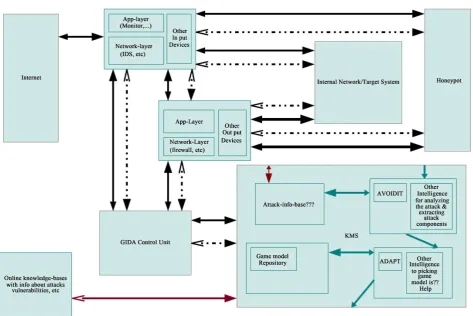
Figure 1. GIDA.
• Target System: It is the computational space in CBS which is being protected by the GIDA security system. As is prevalent, such a system would be a network of many systems. All the interaction with other blocks happen through the Sensors & Actuators (S-A) blocks. It is having a two-way data link and a two-way control-signal link with the (S-A) block. The target system is the CBS of the organization which would be using GIDA-based as a real time security system to protect itself from attacks and failure. It would typically contain the usual subsystems that make up any of the present day industrial business system, like database server, web server, confidential files, etc.
• Internet: This block is the external world with which the target system communicates during its operation. The system has no control over the form and content of what happens there and should only deal with what comes from it, into itself. The interaction of data coming in and going out into the Internet from the system happens through the (S-A).
Thus there is a data link with the (S-A) block.2
The Internet is functionally connected in layers. Typically, the immediate external surface would be that of the Internet Service Provider for the company.
2Though there is a possibility of getting some control-signal information, like requesting the ISP to
147 Then those provided by the clients and those interacting with in that surface, and so on.
• Sensors: This block is the channel through which all the interactions happen between the Internet and the target system. The sensors and actuators are a bit indistinguishable functionally in terms of distinct systems as interactivity of the system components is maturing with technology. For example, even though Firewall keeps a gate to disallow some traffic as per the prescribed policies, it also gives a count of what is the attempted traffic and the one that does go through, to the defense system. In the first function it is acting as an actuator while in the second as a sensor. But the predominantly sensing com- ponents are put into sensors. An example for sensors operating at application layer is at [18].
• Actuators: This block has the actuators.
The anomalies can happen high up at the application layer or the lower layers like Network layers, Transmission layer, Data link layer and so on. With the convergence in the datacom technologies the distinction of these layers is also not clear in the present times. So, what ever the sensors and actuators the operate with a given functionality space is contained in this block.
Similarly, with the maturing of technology of interfaces the same devices/ systems some times do both sensing and actuating functions. So, that classifica- tion is also not a hard one. But the systems which are able to sense the anomalies, at what ever the layer are termed as sensors and the systems which are able to act upon to affect the Target System’s behavior are considered as actuators.
There is typically some inbuilt set of actions based on the standard prescribed policies, which allow the actuators to take actions. Responses for some obvious anomalies are also covered by them. But when some anomaly is observed which is not obvious then those readings/values/data/related to that event is sent to the GIDA Control Unit (GCU). Then the GCU transfers these observations to the Knowledge Management System (KMS) and receiving an action plan based on an appropriate game model it will direct/send control signals to the actuators to take actions to deal with the scenario. Subsequently the sensor functionality of the systems in this block keep sending any required information back to the GCU.
In case of an observed anomaly which has a corresponding prescribed action for the sensor/actuator system to counter, then it shall be acted upon as prescrib- ed. But never the less the event is reported to the GIDA Control Unit, at the earliest, for it to be logged in and documented in the KMS for further analysis and forensic activities to learn about the system and scenarios.
It is having both a two-way data link and two-way control-signal link with the block Target System and a data link with the block Internet.
148
many online government databases maintaining such knowledge bases. This block keeps itself updated from those knowledge bases and reports to them its own findings.
There is a two-way data link and a two-way control link to the GCU block. There is also a two-way data link with the External Defense knowledge Systems block.3 The KMS is the block which takes the input of observations anomalies submitted through the GCU. These inputs are analyzed to identify the attack/attacks as per AVOIDIT, and to pick a suitable model as per ADAPT. Then this game model is given as output to the GCU. This can be as simple as a onetime action of shutting down a web server or restarting a database or a sequence of actions in time based on the game model.
While identifying attack, to take the advantage of the up to date online resources, the block with information related to attack, vulnerabilities, risk etc. will be communicating with the online resources to get the information about the latest attacks.
• Honeypot: This block is the trap to which a suspected user is sent, to understand his intentions when his activity raises alarm through the sensors enough to consider it unsafe to let him interact with the main system.
It has a two-way data link and a two-way control link to the (S-A) block. This block mimics the main target system in its constitution virtually. Even though does not contain any real confidential information or high value assets, it only poses to have them.
When the anomalous behavior of a user is ambiguous enough to resist the classification as either an attacker or a normal user, further inquiry is needed to learn more about the intention of the user. If it seems unsafe to wait and watch the user to operate on the real system, it is a convenient strategy to lead him to Honeypot where he is under the illusion of being in the real system, and opera- tes as his plans. This facilitates GIDA to observe the user’s behavior through the same (S-A) block, which also is connected to the Honeypot. Here its not only observing the actions, an instigating interaction is possible leading to a classifi- cation of the user possibly with optimum time and effort. Such a classification would help in the appropriate treatment of the user.
• External Defense knowledge Systems: This block is the online knowledge bases related to attacks, vulnerabilities, risks etc. There is a two-way data link with KMS block.
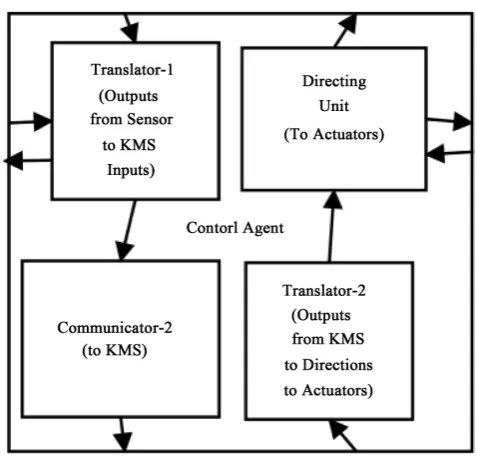
• GCU: This block as shown in the Figure 2 is the central control unit, for the whole defense operation of GIDA. It is connected to the (S-A) which intimates when there is any anomaly observed. This starts the involvement of this unit. The control agent translates and facilitates the communication be- tween the Sensors and the KMS in one way, while from KMS to the Actua- tors in the other, as shown in the Figure 3. As and when required it sends control signals to (S-A) to abort a traffic or operation, divert it to Honeypot or communicate with the KMS to decide what to do.
3Since this is done periodically and not necessarily during the engagement with an attacker the links
149
Figure 2. GIDA control unit.
Figure 3. GIDA control agent.
This block controls and co-ordinates the defense/security activity of GIDA. It gets its inputs about the observed anomalies from the sensors in the (S-A) block and submits it to KMS and gets the plan of action as per a game model as the counter measure. It then uses the look-up table to send directions for such actions to be performed by the actuators in the (S-A) block.
This block consists of mainly three sub blocks. A GIDA-Control-Agent and the two other blocks with look-up tables for translating the two inputs into two outputs. The first one is a look-up table mapping inputs of observation4 of anomaly/anomalies from the sensors to the inputs to be submitted to KMS5. The second one is a look-up table mapping the output of the KMS which is an ac-
4These observations collected by the sensors must be useful for the Attack Identification System for
analysis. So, GIDA Control Unit will have to feed it in appropriate way.
5With the maturing of the model, the KMS can be designed to take the inputs which are as closer to
[image:8.595.254.493.279.507.2]150
tion-plan based on a game model, to the the action commands to be given to the actuators in the Actuators block. The control agent box has four constituents as shown below.
3.1. Operational Flow
The typical operational flows are as follows:
1) when there is no attack or any problems in the operation of the target system, the target system is simply interacting with its clients over Internet. Both the interactions and operations are being observed by the systems in the (S-A). The most probable event in GIDA system on such a day would be, a lucky update of the knowledge base in KMS related to some attack from an online resource.
2) When there is an anomaly observed by the sensor, which is obvious in nature, and already has a prescribed action to be taken by a co-operating actuator, then such an action would be taken immediately and the event is reported at the earliest to the GIDA Control Unit. The information received like this will be submitted to KMS for documentation and forensic purposes.
3) When anomaly is observed by some sensors, and the observed pattern does not have any obvious (reflex) action plan for the sensors/actuators, they report those observations to the GCU. Then these inputs and submitted6 to the KMS appropriately by the GCU7. The information is analyzed and attack/attacks is/are identified using attack identification system. That identification will be used to pick the appropriate game model as per ADAPT. That game model will be given as the output of KMS to the GCU. Then GCU takes prescribed sequence of action as per that game model8.
Once an observed anomalous behavior is not obvious enough for the actuator/sensor systems to act upon itself, the anomaly is referred to the GCU. Then through KMS, every response is formulated as a game. As everywhere in game theory literature, from the trivial interaction to the most sophisticated one is modeled as a game, we model all the responses unequivocally as a game.
4) When the information from the observed anomaly is sufficient to classify the user to be not safe to operate in the main system, while it is insufficient to classify if he is really malicious and identify his intentions, he would be directed to honeypot and the step two or three is followed as if he is on the main system.
3.2. Game Model Repository
The success of a security system based on game theoretic ideas lies on appro- priateness of the game model to represent the current security situation and the effectiveness of the prescribed strategies. Not only different attacks warrant for different games to be played with different appropriate game models, different scenarios with same kind of attack may need different game models with
6The GIDA Action Agent uses the first lookup table for this.
7A typical example for this would be when two different sensors detect slight anomalies, but
indi-vidual neither large enough to warrant a standard reflex action, as per sensor/actuator policies.
151 different considerations of rewards and transition functions. But to have a generic game model which can be used to derive such game models is crucial, as that gives the general structure with proven boundary conditions. The Figure 4
shows this connection.
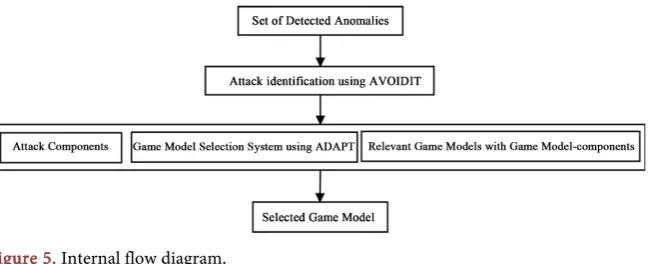
Functionally GIDA is designed as an event-driven system as show in Figure 5. Computationally, it is an implementation of a Buchi Automaton.9 An overview of the event flow can be summarized as in this figure. A set of anomalies is detected in the operation of system to be protected (during operations by a user/ some users). This triggers the operation of GIDA. Then this information is used to identify the possible attack/attacks going on using the taxonomy AVOIDIT. This gives the attack components, the relevant game models. Using both of these in ADAPT, the relevant game model is obtained.
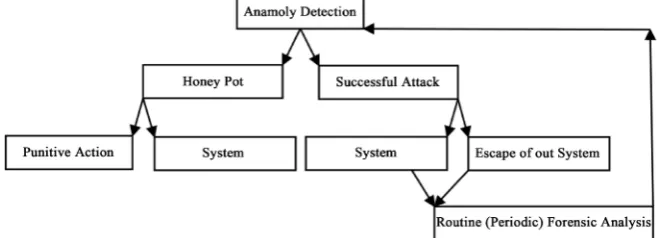
[image:10.595.220.519.370.527.2]This Figure 6 gives a succinct event flow diagram of the events in terms of interactions between a user and an administrator. By this figure and the previous one, we can see that though we need different game models with different cha- racteristics, there seems a commonality in the security games and the modeling requirements. Until now most of the effort is focused on using game theory to address some particular attacks. But to systematize this as a paradigm for security solution, a generic game model becomes a necessity.
Figure 4. Generic game model’s utility.
Figure 5. Internal flow diagram.
9The system will have accepting conditions and not an accept state like the general NFA, and is
[image:10.595.213.540.573.705.2]152
Figure 6. Security event flow.
4. Game Model
The model considers that a player10 k observes the game’s true state using an im- perfect sensor/a set of imperfect sensors. That means, player k can view the present state ξj to be any state in the information set j
{
1, 2, , p}
k
j j j
Iξ = ξ ξ ξ
with ξj being an element of j
k
Iξ . The perceived action set at this state may be
expanded, i.e., player may decide to take an action which is allowed at
ξ
ji ≠ξ
jwhere
ξ
ji belongs to jk
Iξ . When the true state is ξj, let the player k’s extended
action set j k j
j j
k k
I
B A
ξ
ξ =
ξ∈ ξ where jk
Aξ denotes the allowed action set of player
k at state is ξj.If the player k takes an action j
k
Bξ
α ∈ , when the true state is
j
ξ but αk is not in k j
A , then in terms of the influence on state transition
probabilities, αk is considered equivalent to player k taking no action at state
j
ξ . However, its influence on player k’s payoff αk may not be equivalent to
player k taking no action at state ξj depending upon the cost of the attempted
execution of αk. Formally, the model is represented by a tuple,
(
S E E, 1, 2,A A Q R R1, 2, , 1, 2,β)
whose elements are defined below.1) S=
{
ξ ξ
1, ,2,ξ
N}
is the set of states.2) k
{
k1, k2, , k}
N
E = Eξ Eξ Eξ , k=0,1 where the jth, 0< <j N, set Eξj with
{
1 , 1 1, 0}
j
j i i i
m
k k k k
j j i j j
Eξ = p ≤ ≤i m
∑
= p = p > , represents the error probabilities of kthplayer’s sensor at the true state ξj over the corresponding information set, j
k
Iξ .
{
1, 2, , N}
k k k k
I = Iξ Iξ Iξ , k=0,1 where the Ikj represents the information set of
player k when the true state is ξj, i.e.,
{
1, 2, , , ,}
j i m j
k
j j j j
Iξ = ξ ξ ξ ξ
where ,
j i
k
j j
m = Iξ ξ ∈S, with mj≤N being an integer indicating the number
of states that have a possibility of being considered the current state at state ξj
with the condition that ξj∈Iξj .
3)
{
1, 2, , N}
, 0,1k k k k
A = Aξ Aξ Aξ k= is the action set of player k, where
{
1, 1, ,}
j Mk
k k k k
j j j
Aξ = α α α is the action set of player k at state ξj. Let
153
{
1, 2, , n}
, 0,1k k k k
B = Bξ Bξ Bξ k=
where j
k
Bξ represents the action set of player k at j
k
Iξ . That means
k
j j j j
k k
I
B A
ξ
ξ =
ξ∈ ξ . By introducing different action sets at each state we may get distinct jk
Bξ at for each distinct j
k
Iξ . Let Tξkj = Bξkj .
4) The state transition probabilities are represented by function
[ ]
1 2
: 0 1
Q S B× ×B × →S which maps a pair of states and a pair of actions to a
real number between 0 and 1. The model assumes that for any state k j
ξ if the
player k takes an action j
k k j Bξ
α ∈ , which is does not belong to j
k
Aξ , then
(
1, 1, 2, 2) (
1, Normal_operation, 2, 2)
k l l
j i i j j i j
Q ξ α α ξ =Q ξ α ξ
where l represents the other player.
5) The reward11 of the player k is determined by the function 1 2
:
k
R S×B ×B →R
which maps a state and a pair of actions to a real number.
6) β, 0< <β 1 is the discount factor for discounting the future rewards in
this infinite horizon game.
4.1. The Error Distribution
As k
E represents the set of error probabilities of the player k, let us consider the set of error probabilities j
k
Eξ with the current state being ξj. Let the error
of the sensor for player k at the state ξj is
k j
γ , 0≤γkj <1. The error
k j
γ is
always less than 1 because the real state ξj is always taken as an element of the
information set Iξj at ξj. Then at the current state ξj, let the probabilities
with which administrator perceives the current state to be ξ1, ξ2, ξ3 and ξ4
be k1 j p , 2 k j p , 3 k j
p , and
4
k j
p respectively. Then the error at state ξj is
(
1 i)
j 1 jN
k k k k
j i pj pj pj
γ =
∑
= − = − . For 1≤i j, ≤N, leti k j
ω be the set of sensor in- puts to the player k indicating the current state to be ξi, while the real current
state is ξj. In practice the sensor can be a device or a collection of devices
which collects values of some parameters of the system. All such parameters can be considered to form an orthogonal basis of the vector space, where some closed volume is taken to be associated with each state. All of those points in that closed region get mapped to one state. All of them have the values of the parameters which lead the player to perceive the current state to be the parti- cular state.12
Let the current real state be ξj, where 1≤ ≤j N. At this state the sensor
inputs at two different instances be, say i k j ω and
h k j
ω , where 1≤i h, ≤N due to erroneous sensors. This leads to the perception of the current state to be ξi
and ξh respectively. Depending on the nature of the system, consider some
representative statistical measure of central tendencies like Mean, Mode, Median
and so on, of i
k j
ω and h
k j
ω . Let ih
k j
Ed to be the Euclidean distance between
11The expected quantified value of the outcome is called reward.
12It is true that some of the parameters may yield discontinuous intervals of values associated with a
154
those measures.In this work, larger errors are assumed to be less probable than the smaller errors in sensor operations,that is, Edjkji >Edjkjh⇒pkji > pkjh. In the
following game with 5-states, the sensor error is distributed over the three states other than the real current state. This means for example, if the sensor error at
1
ξ is 0.3, then the probability with which the administrator perceives the current state to be not ξ1 is 0.3. This could result in perceiving the current state
to be ξ2, ξ3 and ξ4 states respectively with probabilities of 0.15, 0.1 and 0.05.
From the sensor relation, we have the sensor error at state , 1 i
N
k k
j i j j i pj
ξ ≠ γ =
∑
= related to the probabilities of virtual states.The sensor outputs values of parameters which define states. Particular range of values of particular set of parameters will correspond to a state. In fact the general way to define it, is a set of values, covering the range, for each of the parameters to correspond to a state. And if there are some parameters whose values do not affect in deciding a particular state then then range can accom- modate any value.
The states of the system is formulated using the following. • values13 corresponding to a set of parameters14
• a vector space with these parameters constituting the basis15
Thus we can formulate probabilities of observed instant being in the defined states as follows.
• S→ −S O
where
{
0, 1, 2, , N}
S O− = S O S O S O− − − S O− ,
{
0, 1, 2, , Fi}
i i i i i
S−O = s−o s−o s−o s−o
( )
( )
( )
( )
(
0 , 1 , 2 , ,)
j j j j j
i i i i i
s−o = s−o s−o s−o s−o g is the j gth -di-
mensional sequence corresponding to th
i state, ξi.
( )
j i
s o− l = a MCT, representative value of the expected range of values for the th
l parameter in the jth behavior ∈ξi. l∈N, 0≤ ≤l g
g = number of parameters observed by sensors 0≤ ≤j Fi, where Fi+1
disjoint ranges correspond to state ξi
When there is an anomaly detected, in terms of sensor values, which do not exactly fit into any particular state and there is uncertainty about to which state the current values belong to, imperfect information must be considered.
• Current observed Values of parameters as anomaly
(
0, 1, 2, , g)
CV = cv cv cv cv implies the current values of g parameters • consider the minimum of Euclidean distances with elements in each state
(
∆0f0,∆1f1,∆2f2,,∆NfN)
. where fi is theth
fi element, 0≤ ≤fi Fi has
the minimum of distances between CV and
fi
i
s o− element in the th
i
state.
(
)
0
min j fi
j g
j i
j i
cv s o
g
=
= − −
∆ =
∑
(1)13Range of values, represented by a MCT.
155 The error in perception of states is given by
0
0
fj fi
i
fj j N
j i
j
j j N
j j
p
= =
= = ∆ − ∆ =
∆
∑
∑
(2)And the error distribution is given by • Then the error at state ξj is
1
1
i j j
N
k k k k
j j j j
i
p p p
γ =
= − = −
∑
(3)• Larger errors are assumed to be less probable than smaller errors. An simple illustration to show its application can be as below. Example:
Let some office has a worker’s network traffic as below.16 Low_Privilege State
8AM - 6PM ={Download ≤ 1 Mbps, Upload ≤ 150 kbps}
This behavior is low-privilege, when worker works at his computer in the office. High_Privilege State
8AM - 6PM ={Download ≤ 1 Mbps, Upload ≤ 150 kbps}
This behavior is high-privilege, when manager works at his computer.
Sensor Readings On some day, at 3:30 PM there is 1.7 Mbps download and 150 kbps upload.
1)
(
0.7 0.3(
)
)
0.7 0.30.7 0.3
+ −
=
+ Probability in Low_Privilege State. Mean Down-
load: 1 Mbps
2)
(
0.7 0.3(
)
)
0.3 0.70.7 0.3
+ −
=
+ Probability in High_Privilege State. Mean Down-
load: 2 Mbps
4.2. Reward and Transition Functions
In a given state of the game, the action selected by the players decide their rewards and not the resulting state transition that happens depending on such a selection. The rewards are affected by the
• The cost of attempting/executing an action. Let the unit vector representing this be a1.
• The desirability of the possible state change brought by the selection of an action. Let the unit vector representing this be a2.
• The amount of information being divulged to the other players regarding the intention made explicit by the selection of an action. Let the unit vector representing this be a3.
Depending upon the system these aspects may be mutually affecting each other or independent of each other. The reward is located in the vector space thus constructed with these unit vectors as basis. With system having, each of these aspects a1, a2 and a3 with i j, ∈
{
1, 2,3}
& i≠ j, fully affecting the16For other kinds of parameters, with crucial readings transmitted across channel, edit distance can
156
other, (colinear), a ai⋅ j =1, being mutually independent (orthogonal), a ai⋅ j=0
and when partially affect each other will have 0< ⋅a ai j<1. This is illustrated at
Appendix A.
The transition depends on the actions selected by the players in the current state and the stochasticity involved. Stochasticity is not arbitrary nor have to do with the instability of the system per se, but provides for the possibility of the state transition propelled by the actions of the players with conflicting interests.
4.3. Equilibrium
Given the information set associated with each state j, 0≤ ≤j 4 the corres-
ponding mixed strategy is given as
( )
(
, 1) (
, , 2)
, ,(
, l)
,k k k k k k k
j i i i i i i
π ξ = π ξ α π ξ α π ξ α
where j
k i Iξ
ξ ∈ ,
i k
l= Aξ &
j
k k i Bξ
α ∈ . Thus,
( )
j
k k
j Tξ
π ξ = . We are considering
general-sum games. When the game starts, say at ξj, with the input of state ξj
and each player’s selected action
(
0, 1, 2, , K)
j j j j
α α α α , we calculate the reward at state ξj of each player, , 0
k j
r ≤ <k K as per the reward function Rk. The net
reward incurred by player k is
(
0, 1, 2, ,)
0(
0,1, 2, ,)
( )
ln,
K K
y
k j k
j j
j q
β
π π π π π π π π
ν − β ν ξ
=
=
∑
where qj is the probability of reaching the state ξ ξj j∈S during the game’s
execution at th
j step. 0
0 , 1 i j
j i i
q =
∏
== q q = as game does start at ξj state with0
j= , qj is the probability of game reaching ξj from ξj−1. y is the effective
discounting factor deciding the threshold at horizon, due to insignificance of the effective value addition of further rewards. Since the game is an imperfect information game, 1
0
Bξ gives the perceived action set. Here if the states ξ ξ ξ1, 2, 3
are perceived to be the current state with a probability say, 0.1, 0.3 and 0.6 respectively, we get the probabilities associated with actions of each state multi- plied by these corresponding probabilities. With this extended action set, the selection is done, by each players, their rewards are calculated for this step.
We know that the actions belonging to ξ2 & ξ3 cannot be executed and its
selection is equated to selecting the normal operation of ξ1, for the effect on
state transition.Now based on these probabilities the effective action selection is evaluated for the player. Thus the Nash equilibrium would be the strategy profile
(
0 1 2)
0 1*, *, *, , & & & & &
K k K
c c c c
π π π π
where
(
0 1 2)
(
0 1 2)
*,*,*, , , ,* * *,*, ,*, ,*
,
k K k K
i
k k k
c ⇔νπ π π π π ≤νπ π π π π
, 0
k
i c k K
∀ ∀ ≤ ≤ .
5. The Game
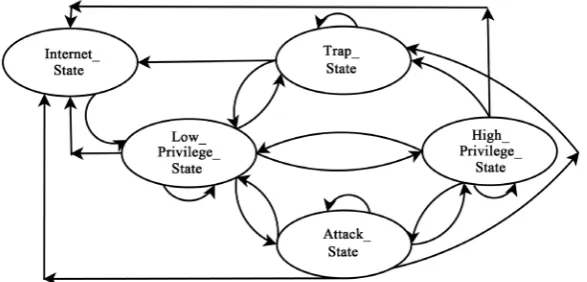
157 related or not, could be respectively categorized and represented by formulating two different states. When a malicious user successfully attacks and a suspicious user gets trapped in a honeypot by the administrator for investigation, the resulting two situations are formulated as two other states. When the user logs out of the system he is considered to be out there in the Internet in another state. Since the security oriented activity happens only after the user is at least in the low privilege state, to start with, the game as in 7 explicitly begins at the Low_ Privilege_State in the Figure 7. Thus these 5 states provide a relevant representa- tion of general conditions of user activity and hence the user-administrator interaction.
( )
( )
( )
{
( )
( )
}
0 1 2
3 4
S Internet_State , Low_Privilege_State , High_Privilege_State , Attack_State , Trap_State
ξ ξ ξ
ξ ξ
=
0
ξ = Internet_State: In this state, the user is out there in the world connect- ed to Internet. He has to go through authentication as in Sign_In successfully to get in to the system. For this, the user must take the Sign-In-Request action and the administrator must grant/take-the-action Sign_In to the user. The normal operation in this state by the user means that he is not sending a legitimate request for Sign_In, and just like millions on the net, is just out there at some IP-address. The normal operation in this state by the administrator means that he is not signing-in this user by granting the permission to be in the system. The cracking efforts to break in to the system by a user is also captured by the normal operation of the user. The blocking, refusal to letting in or system just being unavailable is also captured by the administrator’s normal operation. This is to emphasize the main focus to be the interaction of a user while he is already in the system.The game reaches this state:
• when the administrator successfully signs out a user from any of the other 4 states, in response to user’s any choice of action including a Sign_Out_ Request at that state.
[image:16.595.228.522.570.711.2]-when the user having completed his legitimate jobs in the system goes away. -when the malicious user having completed his malicious tasks escapes out of the system out in to the Internet.
158
• when a person connected to the Internet tries to sign in to the system with a Sign_In_Request but the administrator refuses to let in.
• when a person connected to the Internet tries to sign in to the system with a Sign_In_Request and the administrator allows to let in but the operation fails (due to bad connection, system problem, etc. captured by the stochasticity) and the user remains outside the system on Internet.
Thus the action set of both the administrator & the user is as below.
( )
( )
{
}
( )
( )
{
}
0 0 1
0 0 1
0 0 0
0 0
1 1 1
0 0
Normal_Operation_IS_U ,Sign-In_IS
Normal_Operation_IS_A ,Sign-In_Request_IS A
A
ξ
ξ
α α
α α
=
=
1
ξ = Low_Privilege_State: In this state the user is in the system passing through the initial authentication. This is the state when the administrator can take notice of the user’s activity. Any anomaly in the user behavior will start attracting administrator’s attention/concern. The game can reach this state, • when the user is already in the system after logging in going through the
initial authentication successfully. The administrator can observe the user behavior, though he is not particularly concerned, to begin with.
• when the transition from ξ1 to ξ2 does not succeed, either due to the given
the transition probability (system’s stochasticity), or the administrator may decide not to promote the user to ξ2.
• when the user in ξ2 acts to return to low privilege, the administrator demotes and the transition succeeds.
• when the administrator decides that a user does not have any malicious intention at ξ4 & lets him back into the system.
• when the user who successfully attacked the system at ξ3, returns to legitimate & low key behavior with in the system either to continue to be so or to elope later. This happens when the user takes the action Return_LPS and
the administrator takes the action
( )
211
Normal_Operation_AS_A α the transi-
tion succeeds as per the occurrence ratio.
( )
( )
{
( )
( )
( )
}
1 0 1
2 3 4
0 0 0
1 1
0 0 0
1 1 1
Normal_Operation_LPS_A ,Sign-Out_LPS , Promote , Defend_LPS , Trap_LPS
Aξ α α
α α α
=
( )
( )
{
( )
( )
( )
}
1 0 1
2 3 4
1 1 1
1 1
1 1 1
1 1 1
Normal_Operation_LPS_U ,Sign-out_Request_LPS , Privilege_Request , Attack_LPS , Resist_LPS
Aξ α α
α α α
=
17
2
ξ = High_Privilege_State: In this state the user has gained more privileges than in the ξ1. For example, when a user who entered to check his bank account
balance has gone into (the higher privileges) editing mode of account information, like the passcode, usually has to go through more authentication. The game reaches this state
17Here we note that the Normal_Operation is an abstraction of the actions that are typical to that
159 • when the user successfully receives the privileges by the administrator to move from the Low_Privilege_State.The user should chose the action Privilege_ Request and administrator should choose the action Promote, and depending on the game’s stochasticity, if the transition succeeds, ξ2 is reached.
• when the user continues to operate with the privileges granted by the
administrator with neither attacking nor being trapped by administrator. That is, when both the players are choosing Normal_Operation, depending on the occurrence ratio the game could remain here.18
• when the user after successfully attacking the system in ξ3 and completing
the intended damage returns to operating as a High_Privilege user. The user should choose Return_HPS, the administrator Normal_Operation_AS_A and the transition should succeed.
( )
( )
{
( )
( )
( )
}
2 0 1
2 3 4
0 0 0
2 2
0 0 0
2 2 2
Normal_Operation_AS_U ,Sign-Out_HPS , Demote , Defend_HPS , Trap_HPS
Aξ α α
α α α
=
( )
( )
{
( )
( )
( )
}
2 0 1
2 3 4
1 1 1
2 2
1 1 1
2 2 2
Normal_Operation_AS_A ,Sign-Out_Request_HPS , Privilege_Relinquish , Attack_HPS , Resist_HPS
Aξ α α
α α α
=
3
ξ = Attack_State: In this state the user has already attacked the system successfully. He is either accessing other’s confidential data or damaging the system or doing some other harm. Here either he is doing some normal operations which is actually some attacking activity or eloping along with the confidential data, or returning to legitimate behavior with either high or low privileges into ξ1 & ξ2. He would be concerned to wipe out as much as
possible any trace of his attack before he goes away. In this state administrator can revive the system, which is like restarting a file server for example, if the file server is found compromised. This can accompany with sending the suspected user either out of the system or to honeypot taking the game to ξ4 with the
action Trap_AS. The game reaches this state • when the user successfully attacks from the ξ1. • when the user successfully attacks from the ξ2.
• when the user succeeds to behave inconspicuously with Normal_Operation continuing to damage the system.19
• when the transitions to ξ ξ1, 2 & ξ3 fails as per the stochasticity of the
system.
( )
( )
{
( )
( )
( )
}
3 0 1
2 3 4
0 0 0
3 3
0 0 0
3 3 3
Normal_Operation_AS_A ,Sign-Out_AS , Revive_LPS , Revive_HPS , Trap_AS
Aξ α α
α α α
=
18Alternatively, when the transitions from
2
ξ fail to reach the three other states, the game could remain in this state as shown in the Figure 1.
19The game reaches this state when the user’s attempt to transit to the normal state is unsuccessful.
160
( )
( )
{
( )
( )
( )
}
3 0 1
2 3 4
1 1 1
3 3
1 1 1
3 3 3
Normal_Operation_AS_U ,Sign-Out_Request_AS , Increase_Attack , Return_LPS , Return_HPS
Aξ α α
α α α
=
4
ξ = Trap_State: In this state, the administrator, after suspecting the user while in ξ ξ1, 2 & ξ3 to be an attacker, and has successfully sent him to the
honey pot. In this state user could either enact Normal_Operation actions, or with a suspicion of being trapped can do Sign-Out-Request action, which is either trying to close all his operations and logging out at the earliest or engage with the administrator in his ploy behaving like a benign user. User can also confirm his malicious intention by enacting it during the inquiry. The game reaches this state
• when the administrator successfully traps in to Honeypot a user suspecting him of some malicious intention.
• when the user with no malicious intention continues to do Normal_Operation oblivious of being trapped and the administrator continuous to observe him at Honeypot. Alternatively ξ4 is reached when a user with malicious intention
becomes suspicious of being trapped starts behaving.
• when the user who originally had malicious intention may try to attack at the false targets provided by the administrator and try to escape by choosing the Sign-Out-Request action, but does not succeed.
• when the administrator identifies the user who has successfully attacked the system and decides to trap him into honeypot while the user is either trying to return to ξ1 & ξ2.
In each of these actions the user engages with the administrator’s ploy. In the end administrator may declare either the user innocent and let him back in to the system through the ξ1 or catch him and take further punitive actions. The
fact that the user already created suspicion, makes the administrator to let him back to the ξ1, and let him earn his higher privileges, than to directly enter ξ2.
( )
( )
{
( )
( )
( )
}
4 0 1
2 3 4
0 0 0
4 4
0 0 0
4 4 4
Normal_Operation_TS_A ,Sign-Out_TS , Test_TS , Judge _ TS , Allow_TS
Aξ α α
α α α
=
( )
( )
{
( )
( )
}
4 0 1
3 3
1 1 1
4 4
1 1
4 4
Normal_Operation_TS_U ,Sign-Out_Request_TS , Commit , Behave
Aξ α α
α α
=
Consequently, the action sets of the players are summarized as below.
{
1 2 3 4 5 1 2 3 4 1 2 3 4 5 1 2 3}
1
1 1 1 1 1 1 1 1 1 1 1 1 1 1 1 1 1
1 1 1 1 1 2 2 2 2 3 3 3 3 3 4 4 4
User_Action_Space
, , , , , , , , , , , , , , , , . A
α α α α α α α α α α α α α α α α α =
=
{
1 2 3 4 5 1 2 3 4 5 1 2 3 4 1 2 3}
2
2 2 2 2 2 2 2 2 2 2 2 2 2 2 2 2 2 1 1 1 1 1 2 2 2 2 2 3 3 3 3 4 4 4
Administrator_Action_Space
, , , , , , , , , , , , , , , , .
A
α α α α α α α α α α α α α α α α α =
=
With the above information about the states and actions, the other 6 compo-
nents of the 9-tuple, 1 2 1 2
, , , , ,
E E Q R R
β
are suitably designed reflecting the161
6. Game Analysis
As the general case, each of the five states being perceived with a non-zero probability at each state would make the whole action space of the player as the extended action set at each state. But for the game to go into fifth state adminis- trator has to explicitly take the user out of the main system and put into the honeypot. Since neither the stochasticity of the game nor the user can acciden- tally take the game to this state, administrator wont mistake to be in it while being in the other states. Thus, 0 0
i j
p = for j≠i & j=4, while 0 0
i j
p
≤ &
0
1 i 1,1 , ,
N j
i= p = ≤ j i≤N
∑
. Thus, 0{
}
1, 2, 3 ,1 3
j
Iξ = ξ ξ ξ ≤ ≤j . Hence, the extended
action set corresponding to the information set would be for j≠4,
{
0 1 0 1 2 3 4 0 1 2 3 4 0 1 2 3 4 0 1 2 3 4}
0 0 0 0 0 0 0 0 0 0 0 0 0 0 0 0 0 0 0 0 0 0 0
0 , 0, 1 , 1, 1 , 1 , 1 , 2 , 2, 2 , 2 , 2 , 3 , 3, 3 , 3 , 3 , 4 , 4, 4 , 4 , 4
j
Bξ = α α α α α α α α α α α α α α α α α α α α α α
In the Trap state the administrator’s response tries to delude the user about his current state to be his preferred state. We consider the user’s sensor to be perfect in general, which is the worst case scenario. Thus user’s view of the states
can be defined as 1 0
i j
p = if j≠i j, ≠4. 1 1
i j
p = if j=i & j≠4. Since the
user can also have a honey pot detection system 14 4 0
p > . The administrator’s ploy at ξ4 need not be only passive reactive one, a motivation for a proactive
one is suggested with the carrot and stick approach in [5]. [19] & [20] discuss such scenarios where the inquiry into the nature and motivation of the attacker are discussed.
Based on the above strictures, the game was simulated and evaluated for rewards to find the preferred strategy profiles.
7. Simulation
The game starts only after a sensor reporting an anomalous action by a user. Thus there is a suspicion in the admin and a plausibility of malice in the user. At this stage it is both an incomplete and imperfect information game, with the admin not being sure of both the user’s nature and the current state of the game. The rewards for each affecting feature of the game are symbolically distributed over the discrete space defined by −1000, 100, 10, 0,10,100,1000− − . The logari-
thmically varied values are chosen to represent how the expense of actions and potential outcomes of actions differ. Though it has to be fine tuned for the different attacks based on the specifics this setup gives us a general idea. Taking a Normal_Operation action and for the administrator and the user is a low expense action to attempt and execute in the context of the game. Thus it leads to 0 pay off for both of them in ξ1 & ξ2. Similarly the sign-out request from
the user and the sign-out from the admin also leads to a high probability exit of the user from the system. This does not progress the interaction further, but leads to a logical non-antagonizing move. That way the payoff to both is 10, which is not nothing, but not much.
162
action is least likely to succeed. This also makes the user aware that the admin is trying to trap him, and thus he may start behaving leading to no chance of discovery by the administrator of his real motive with malice, if there was one. This would hence result in −100 to the admin and 100 to the user. These figures are also considered due to the expense of resources to take these actions and the actions impact on the game.
The aggressive actions are the most expensive actions for the players. The exact defensive actions will result in least likelihood of succeeding of the aggre- ssive actions by the opponents. These defensive actions are the second most expensive actions to attempt/execute. The aggression will also yield higher payoff to the player than the defending one, if succeeds. When one player takes an aggressive action, the other player taking Normal_Operation or general state transiting actions will lead to greater loss to him and higher gain to the aggressor. This game dynamics at state ξ1 is explained in Appendix A.
For computational reasons we restricted the simulation with some constraints. The game was programmed in C and run on a Debian7.6 of GNU/Linux on an Intel CoreTM i5 Processor with 4 GB RAM machine.
1) We ran the simulation with 100 strategies each varying in a gradation of aggression.
2) We find an approximate Equilibrium as explained at Appendix C.
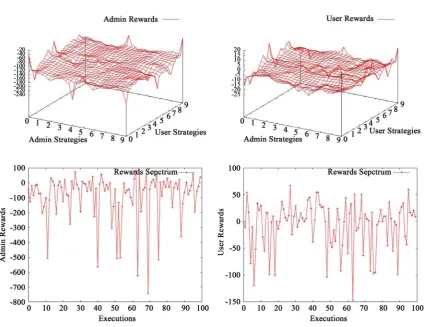
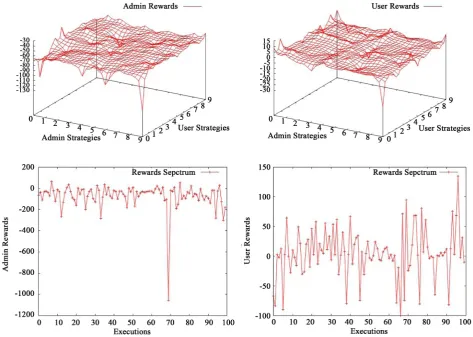
3) We ran it for three types of users/attackers and delineate the findings.We simulated the games with each player 100 strategies, playing each 100 times. For better visualization purpose we plot rewards for 10 strategies (whose results are representative of the results with larger range) to cover the aggression, with steps of 0.1 from 0 to 0.9 in Figures 8-10.20
The simulation was conducted with three user profiles in terms of skill, sophistication and effectiveness as Below_Average, Average and Above_Average users. When in Low_Privilege_State, the Average user would attack and the Administrator defends, playing the perfect antagonizing, there is 0.5 probability that attack succeeds. This way he is on par with the administrator in terms of imposing his will on the system operation. Numerically the Below_Average user would have <0.5 probability to be succeed while the Above_Average user >0.5 in such a situation. As this example illustrates the essential characteristics, all other transitions are similarly poised.
7.1. Results
Since the game is stochastic, for the same strategy profile there could be different rewards for the players. So, we ran the game for each strategy profile for 100 times, and picked the average reward. We evaluate a preferred strategy in terms of the discretized gradation of aggression as discussed in Appendix C. Figures 8-10 show the rewards of administrator and the users and the spread of rewards during multiple executions for a typical strategy profile.
20TL ⇒ Top Left, TR ⇒ Top Right, BL ⇒ Bottom Left, BR ⇒ Bottom Right, AR ⇒ Admin Reward,
163
[image:22.595.113.540.395.722.2]Figure 8. Below-average-user: TL-AR, TR-UR, BL-ARS, BR-URS.
164
Figure 10. Above-Average-User: TL-AR, TR-UR, BL-ARS, BR-URS.
We found many -NOSPs with =0.01 and a different prescribed one in
each case. The prescription is based on the least motivation for the attacker to deviate, hence the chance of game going as expected his higher.
7.1.1. Below_Average User (BAU)
( )
7, 2 is the prescribed -NOSP. It recommends for the user and adminis-trator to be least aggressive. The game starts with some anomaly by user and thus if the user is perceived as a BAU, then both players are better off to curtail their aggression.
7.1.2. Average User (AU)
( )
8, 6 is the prescribed -NOSP. It recommends for the user to be lessaggressive as he is more affective while the administrator to be quite aggressive.
7.1.3. Above_Average User (AAU)
( )
4,1 is the prescribed -NOSP. It recommends for the user and administratorto be least aggressive.
165 when its most advantageous to them.
Conjecture 1: The aggression needed by the administrator for achieving equilibrium follows normal distribution over the power of the user, with the mean at the power of both being equal, while interacting with same reward functions and discount factor.
Conjecture 2: The aggression needed by the administrator for achieving the equilibrium would vary from linear to Normal distribution as the depth of the game tree increases, for the same reward functions and the user. The depth of the game tree is a function of discount factor and threshold discount.
8. n-Player Game
The game model presented in Section 4, considers n n, ∈Z, 0< < ∞n players where the interactions between many users and administrators can be modeled. As practicality alludes, considering a single administrator would be convenient and useful for most cases. Thus the interaction between many users and an administrator is interesting to investigate. In such a situation, the users can be disparate and working on their disjoint motivations. They could also be working as a group. On the other hand, the administrator can be interacting separately with many users or interact with a group of users with actions collectively affecting all of them. In the light of the game model and game we presented in Sections 4 and 5 respectively, we derive the conditions of the group behavior and reaction of administrator to a group to be optimal.
For each state j, let
max
k j
r be the reward associated with the preferred action choice of the user k. During the course of the game, if max
f f
co
i i
j k j k
j j
j r j r
ξ ξ
ξ ξ
= =
= < =
∑
∑
,k
k∈S with Sk=
{
k k1, ,2 ,ka}
where cok j
r is the reward of kth player at jth
state when taking co-operative actions, a is the number of users who have motivations that can be pursued in co-operation. There are two trees of game progress that are considered here. In the first case, when each player takes action to fully maximize his total reward during the sequence of game play, he is trying to maximize the probability of those state which maximizes his reward. While doing so two such players may make the game progression such that the final resulting sequence of game play gives both a total reward which is far below their maximum possible value. But this value can be lower than a compromised game transition sequence in which both have higher probability to make higher reward. Recognizing this point, would be the threshold to co-operate.
166
boot the operating system itself to address both users. The condition is
max common
1 1
g n g n
j j
g r g r
= =
= < =
∑
∑
where rjmax and rjcommon are the rewards associated with the actions taken for
each individual game towards optimal reward, played with different users and the actions taken to collectively/commonly affect all the users concerned. At this condition the administrator is better off playing a single game considering all the users as a collective adversary.
In particular, when many players are involved, the decision process becomes decentralized. If this is true of the defending side, then taking optimal actions such that overall security is served best becomes a challenge. This problem was addressed in [21] and was shown that the individual optima for each defender in his own game to safe guard his own asset may not serve the global good when the assets defended by different defenders are interconnected and interde- pendent.
9. On Engaging Suspicious Users
The only way the game enters the Trapped State ξ4 is from the other states. In
the other states , the administrator could become suspicious about a particular user. After sufficient observation of such a behavior of the user, the adminis- trator could become sure that it is not safe to have that user operating freely in the network. For that particular reason administrator sends him to honey pot. Then the game enters the Trapped State ξ4. Then the administrator will have a
belief about the user’s motive based on these actions of user at one or more of the other states (ξ ξ ξ1, 2, 3), when the game enters ξ4. For example, in a site
offering the service of audio streaming but no download, trying to download (successfully or not) could be a reason to put him in Trapped State. The admi- nistrator holds the belief that the user wants to steal the audio files. The admi- nistrator does not know conclusively yet, either the true nature or motivation of the user. By nature, the user may be not an attacker, a naive attacker or an advanced attacker. The motivation of the user is what exactly he/she intends to do in the network. A normal user might have accidentally performed an action which was not allowed. This uncertainty to the administrator entails to incom- plete information in the game play. All the further interactions of admi- nistrator’s ploy with the user is abstracted to take place in a single state ξ4 of
the main game in Figure 1. Here, the prime motivation of the administrator is to learn the “original” motivation of the user with the minimum number of interactions to identify the nature and motivation of the user and thus determine the suitable response. The administrator, based on his current belief about the user’s nature and motivation, creates the situation in the state ξ4. Administra-