Abstract—Latest mobile phones bring many advantages to
our daily life. These gadgets are usually equipped with multiple sensors, such as camera, GPS, and accelerometer. The data collected from these sensors are used to develop several applications, such as face recognition, voice recognition, and daily activity analysis. Studies show that many accidents occur during daily activities, and we propose the idea that mobile phones can be used to distinguish these accidents from activities of daily living (ADL). Early intervention may reduce or eliminate the risk of fatal injury during an accident. In this study, we introduce a new mobile phone application designed for the recognition of falls and reporting the incident to appropriate authorities. We built a predictive model using supervised learning methods with selected features to detect falls with ratio as high as possible. 8 healthy people performed various activities carrying smart phone on their pockets to record simulated falls and ADLs to build our data set. The data-set consist of 43 time-domain features extracted from 3-axis accelerometer data. The analysis of several feature selection algorithms demonstrates that only 5 to 10 most discriminative features give the best success ratio for fall detection. Our test results show that the proposed system can recognize the fall events with approximately %90 success ratio.
Index Terms—fall detection, smart phone, android, feature
reduction, accelerometer, supervised learning
I. INTRODUCTION
N recent years, mobile devices turned into powerful devices due to their capabilities. Diverse sensors, such as microphone, camera, accelerometer etc., enable mobile devices to perform several multi-functional applications. These sensors can be used for various purposes because of their small size and lower cost. In this study, we introduce a mobile application using accelerometer sensor for detecting and informing fall events.
In several studies [1-5], accelerometer has been used to recognize daily activities of a user. In fact, there are many useful applications that detect user’s activity. For example, some applications monitor activities of a user and then calculate how much energy is expended by this user. The activity information also gives us the opportunity to
This research has been supported by Yildiz Technical University Scientific Research Projects Coordination Department under the grant number 2013-04-01-GEP01.
Dr. M. Amac Guvensan is with Yildiz Technical University, Department of Computer Engineering, Davutpasa Campus, 34220, Turkey. (corresponding author; phone: +902123835765; e-mail: amac@ yildiz.edu.tr).
A. Oguz Kansiz and H. Irem Turkmen is with Yildiz Technical University, Department of Computer Engineering, Davutpasa Campus, 34220, Turkey.
customize the behavior of a mobile phone automatically. For example, the loudness of the music could be adjusted according to the type of the current activity. The volume could be increased while jogging, whereas the loudness could be decreased while standing or sitting.
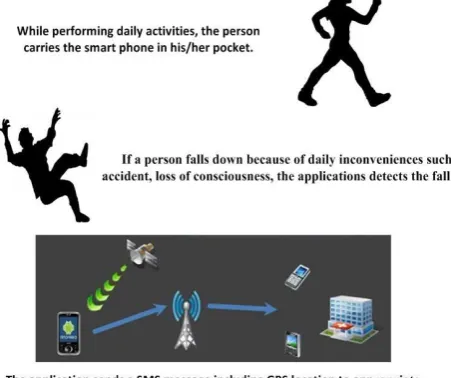
There is a high potential risk of an accident during our daily life. While jogging, running, walking, ascending upstairs, and descending upstairs; people could fall down and injure themselves. On some cases, people would not be able to call for help because of their unconsciousness or the seriousness of their injury caused by an accident. The main motivation of this work is to implement a mobile application which detects and reports these accidents (fall events) to appropriate authorities such as police, ambulance, firefighter or close relatives of the injured person. It is very important to note that early intervention may reduce or eliminate the risk of fatal injury. In this study, we aim at recognizing fall events by discriminating them from daily activities. However, some activities or movement patterns may be mistaken as an accident by classification algorithms. To avoid mistaken calls to police, ambulance, firefighter etc., the application shows an alert after the detection of an accident. If a user who is thought to be involved in an accident do not dismiss this alert display for a given time, then the application reckons for an accident. Finally, a SMS message including GPS location (where the fall occurred) is sent to the specified numbers that indicated by the user. Figure 1 shows the process of a fall detection and message delivery.
Fig. 1. Fall detection and sending message
Selection of Time-Domain Features for Fall
Detection Based on Supervised Learning
A. Oguz KANSIZ, M. Amac GUVENSAN, H. Irem TURKMEN
[image:1.595.306.532.556.745.2]The proposed mobile application has been implemented on Android OS due its advantages such as free usage, open source and easy programming. All of the Android-based cell phones as well as all new smart phones, contain tri-axial accelerometer which is used by detecting fall events.
The key contributions of this study could be given as follows:
The main contribution of this study is the evaluation of the time-domain features to determine the most discriminative features while using supervised learning methods for fall detection.
We present a new mobile application that monitors a user’s activity and makes a decision about the activity whether it is an accident or not.
The application proposed in this paper attempts to detect fall events by using machine learning methods with reduced number of features. In order to classify and make decision about activity whether it is a fall or not, we collected accelerometer data of several daily activities. We aggregated this raw time series accelerometer data into samples and labeled each sample with the activity that occurred while data was being collected. Then, we built predictive models for activity recognition using three classification algorithms. In Section II, existing studies are introduced. Section III describes the data collection, feature extraction/selection algorithms and classification algorithms. In Section IV, we mention about the classification algorithms that we have tested and the results of these algorithms. Next, we demonstrate the results of three feature selection algorithms in comparison. We conclude the paper and mention about our future work in Section V.
II. RELATED WORK
Activity recognition based on accelerometer data has taken much attention in the past years. One of them aims at recognizing activities through matching the movement patterns of other objects such as books, glasses, etc. [4]. The study, in [3], focuses on the classification of daily activities in order to calculate the expended energy. On the other hand, some works [2],[5] investigate how the device orientation and location on a human body affect the success rate of the activity recognition.
During daily activities people may fall down and injure themselves. Thus, some researchers have focused on the fall detection and proposed several methods to detect fall events occurring during daily activities. Existing studies show us that the main approach to discriminate the fall events among daily activities is using “thresholding” method [6-14]. Bourke et al [6] designed a system that uses vertical thresholding and then validate it against the motion capture system. Hou et al [9] use tilting angle as a threshold value. In [9], falls are considered as not only an impact on a ground but also taken as a situation that human body lays on a ground for some time. In addition, adaptive thresholding has been used for fall detection [10].
There are also some works which implement the fall detection systems on smart phones [11-14]. These works
investigate the results of usage of thresholding methods in detecting fall events. In [13], the fall events are segmented into five phases: normal, unstable, freefall, adjustment and motionless. They use features that extracted from constructed five-phase model for fall detection.
The common usage of the mobile phones encourages us to exploit them by detecting fall events. Thus, people, especially elderly ones, carrying mobile phones would feel themselves secure even if they fall down, hit by a vehicle or faint. In this study, we propose a new fall detection system running on Android OS. The main goal of this study is to investigate the impact of time-domain features on the success rate of fall detection. As a result, we select the most discriminative features for the fall detection.
III. FALL DETECTION
People may fall down due to several reasons such as hitting by a car, during a fight, robbery, heart attack, etc. These dangerous conditions would result in permanent health problems or fatal injuries. In order to minimize the number of causalities, the detection of fall events is invaluable.
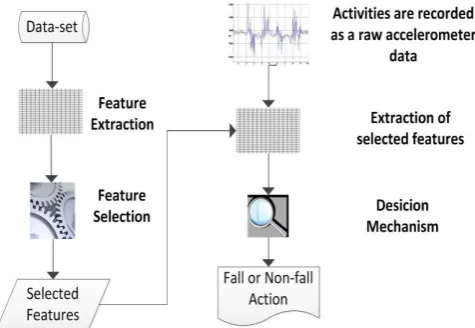
[image:2.595.307.545.436.600.2]Our fall detection system consists of two main steps: training phase and test phase. At the beginning, the system is trained based on the features extracted from the collected accelerometer data. After the training phase based on the footprint of fall events, the system determines whether the condition occurred in 3 seconds is a fall or not. The block diagram of the fall detection system is given in Figure 2.
Fig. 2. The block diagram of fall detection
A. Data Collection
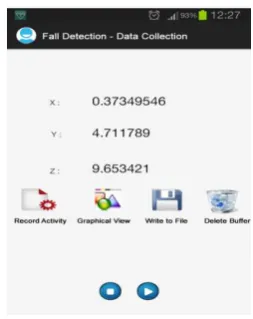
per second. Accelerometer data could be tracked via the interface of our application. Moreover, users can stop/continue recording, give label to recorded activities and write these values to a file through the user interface, shown in Figure 3.
Fig. 3. The user interface for data collection
To acquire realistic data, 8 people asked to perform daily activities and several types of falls. Table I illustrates the number of samples for fall events and non-fall actions.
TABLEI
THE TYPES OF THE ACTIVITIES AND THE NUMBER OF THE SAMPLES Types of
The Activities
Activity name Number of samples
Standing 56
Walking 56
Running 44
Non-Fall Ascending stairs 44
Descending stairs 33
Travelling in a car 31
Braking in a car 5
Dropping the phone 16
Fall Falling 127
B. Feature Extraction and Selection
The proposed fall detection application exploits supervised learning methods. These methods determine based on the selected features. Raw data obtained from the accelerometer in -x, -y, and -z values corresponding to the three axes/dimensions (see Figure 4), are inadequate to discriminate the fall events. Thus, we first extract time-domain features from raw time-series accelerometer data. The sampling frequency has been chosen 20Hz. According to our observations, fall detection occurs at most in 3 seconds. Therefore, we use 60 readings to classify fall events.
43 features, given in Table II, have been extracted from these 60 readings including average values, standard deviations and max values of each axis. These values have been used in [1] in order to classify daily activities.
Fig. 4. Axis of motions [1]
Apart from the study in [1], since there are only two classes (fall and non-fall actions), in our study, we aim at minimizing the number of these features and finding the most discriminative ones.
TABLEII EXTRACTED FEATURES Feature’s name Description of Feature
avgX,avgY,avgZ (3) Average values for each axis
stdX,stdY,stdZ (3) Standart deviation values for each axis
maxX,maxY,maxZ (3) Maximum value of each axis
adcX,adcY,adcZ(3) Average difference of consecutive values for each axis
averageResultantAcc √(xi ^2 + yi^ 2 + zi^ 2) value for interval (Average Resultant Accelerometer Value)
Binned Distrubition for x, y and z.(30)
We determine the range of values for each axis (maximum – minimum), divide this range into10 equal sized bins, and then record what fraction of the 60 values fell within each of the bins.
To minimize the number of extracted features, we have exploited three feature selection algorithms: OneRAttributeEval, RelieFAttributeEval and SVMAttributeEval. OneRAtrributeEval algorithm uses the minimum-error attribute for predicition, whereas ReliefFAttributeEval evaluates the worth of an attribute by repeatedly sampling an instance and considering the value of the given attribute for the nearest instance of the same and different class. On the other hand, SVMAttributeEval evaluates the worth of an attribute by using an SVM classifier. Attributes are ranked by the square of the weight assigned by the SVM.
C. Classification of Fall and Non-fall Actions
There are two classes in this classification problem: fall events and non-fall actions. The non-fall actions include daily activities, such as standing, walking, ascending stairs, descending stairs, travelling in a car, dropping the smartphone. In this study, our goal is to develope a mobile phone application that detects fall events with high accuracy. Computational and memory constraints of mobile phones lead us to choose supervised learning methods with low computational cost at the detection phase. Therefore, we use K-Star, J48 and Naive Bayes algorithms for classification and then evaluate their results.
[image:3.595.305.549.246.404.2]J48 is an implementation of the C4.5 algorithm in Weka [16]. C4.5 algorithm is used for generating a decision tree in which the attribute with the highest normalized information gain is chosen to make the decision in internal nodes.
A Naive Bayes Algorithm is a simple probabilistic classifier that estimates class membership probabilities of a test object using Bayes' theorem [17].
IV. EXPERIMENTAL RESULTS
In this study, we have used Weka [14] to evaluate the success rate of the classification algorithms and feature selection methods. Our main objective is to find the most discriminative time-domain features for fall detection. We have tested three feature selection algorithms including OneRAttributeEval, ReliefFAttributeEval, and SVMAttributeEval, for determining the most discriminative features. According to the ranking list of the features, we find the precision and recall values for each number of features divisible to 5 within the range of 5 and 43. The results of each feature selection algorithm have been validated with three well-known classification algorithms, namely Naïve Bayes, J48 and K-Star.
In this study, the key performance metrics are chosen as precision and recall values. However, considering that the proposed application alerts a warning message after each detection of fall events, the user could easily dismiss this message and prevent the application to send the message to the authorities and/or close relatives. Therefore, false alarms for fall detection would be eliminated cost-effectively via the user interface. However, missing a fall event is intolerable and could result in vital conditions. Admitting that the accuracy of detecting fall events is more important than the accuracy of non-fall actions, we focus on the recall values for the fall detection, where the “fall events” represent positive classes. While testing our dataset, we have used 10 fold cross-validations.
To compare the results of classification algorithms, precision and recall values are calculated according to (1) and (2), respectively.
samples predicted
positively of
number
samples positive
true of number
precision (1)
samples positive
actual of number
samples positive
true of number
recall (2)
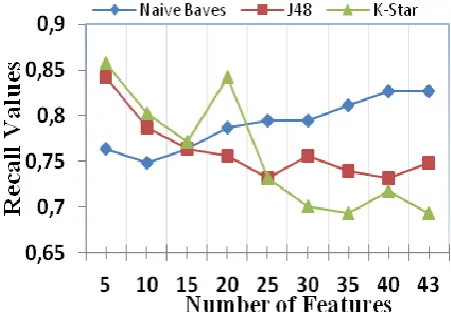
[image:4.595.311.537.51.209.2]Figure 5, Figure 6 and Figure 7 demonstrate the recall values of each classifier for different number of features. Analyzing three graphics shows us that the success rate of each classifier generally inversely proportional to the number of features, except the combination of OneRAttributeEval and Naive bayes. The results also show that high success ratio of fall detection could be achieved with less number of features. Note that both CPU usage and battery capacity are critical to the mobile phones. Using less features would not decrease the usage of CPU but also would save energy while preserving the success rate of detection of fall events.
[image:4.595.312.536.256.403.2]Fig. 5. OneRAttributeEval results for every classifier
[image:4.595.311.524.450.603.2]Fig. 6. RelifFAttributeEval results for every classifier
Fig. 7. SVMAttributeEval results for every classifier
Analyzing the results of three feature selection algorithms indicates 8 most discriminative time-domain features, given in Table III, for fall detection. Especially standard deviation values and average difference of consecutive values are highly important for detection of fall events.
TABLEIII
MOST DISCRIMINATIVE FEATURES FOR FALL DETECTION Ranking Name of the Features
1 avgY (average value of Y-axis)
2 stdZ (standart deviation value of Z-axis)
3 adcY(average difference of consecutive values for Y-axis)
4 adcX (average difference of consecutive values for X-axis)
5 stdY(standart deviation for Y-axis)
6 adcZ (average difference of consecutive values for Z-axis)
7 stdX (standart deviation for X-axis)
8 averageResultantAcc(average resultant accelerometer value)
TABLEIV
MAXIMUM RECALL VALUES OF EACH CLASSIFIER FOR EACH FEATURE
SELECTION METHOD WHERE THE “FALL” EVENTS REPRESENT POSITIVE CLASSES
OneRAttribute ReliefFAttribute SVMAttribüte
M axim u m Re call Num b er of F eat u re s M axim um Re call Num b er of F eat u re s M axim u m Re call Num b er of F eat u re s Naive
Bayes 0,827 40 0,874 10 0,882 10
J48 0,843 5 0,819 10 0,85 5
K-Star 0,858 5 0,866 15 0,866 5
We also compared the precision and recall values of 43 features against the precision and recall values of the optimal number of features which gives the maximum recall values (see Table V, Table VI and Table VII). Although the weighted-average values of K-STAR algorithm are slightly higher than Naive Bayes and J48, we have implemented Naive Bayes in our mobile application due to its low-complexity and high recall values obtained for fall events.
TABLEV
PRECISION AND RECALL VALUES FOR NAÏVE BAYES Presicion Recall
43 features 10 features 43 features 10 features
Fall 0.669 0.683 0.827 0.882
Non-fall 0.914 0.94 0.818 0.818
Weigted-average 0.838 0.860 0.820 0.837
TABLEVI
PRECISION AND RECALL VALUES FOR J48DECISION TREE Precision Recall
43 features 5 features 43 features 5 features
Fall 0.856 0.844 0.748 0,850
Non-fall 0.894 0.933 0.944 0.930
Weighted-average 0.882 0.906 0.883 0.905
TABLEVII
PRECISION AND RECALL VALUES FOR K-STAR Precision Recall
43 features 5 features 43 features 5 features
Fall 0.917 0.909 0.693 0.866
Non-fall 0.877 0.942 0.972 0.961
Weighted-average 0.889 0.932 0.886 0.932
V. CONCLUSIONS AND FUTURE WORK
In this study, we propose a novel approach that distinguishes falls from daily activities by using supervised learning methods with reduced number of features. We first collected the accelerometer data from 8 subjects that performed fall and non-fall actions by carrying smart phone in their pockets. Then, we extracted features that represent the characteristics of fall and non-fall actions from accelerometer data. Feature selection methods were applied on extracted features to evaluate their contribution on classification performance. K-Star, J48 and Naive Bayes algorithms were employed for classification. The best classification accuracy results were obtained by using K-Star classifier on samples with reduced number of features. An average recall value of 0,88 was achieved by using 10 discriminative features which were selected by SVMAttributeEval algorithm.
Classification results experimentally demonstrated that feature reduction methods could considerably increase the performance of the proposed fall detection system since they give us the opportunity to reduce the computational cost.
Although the proposed method give good results, pre-elimination of actions that do not show fall pattern by thresholding methods can decrease the usage of CPU and improve the performance of the system.
In the future, we plan to enlarge our data-set by collecting data belong to various accident situations like hitting by a car and additional daily activities such as bicycling, and jumping.
REFERENCES
[1] R. Kwapisz, G. M. Weiss, S. A. Moore,”Activity Recognition using Cell Phone Accelerometers” ,Newsletter ACM SIGKDD Explorations Newsletter archive Volume 12 Issue 2, pp.74-82 ACM New York, NY, USA, December 2010.
[2] A. Henpraserttae, S. Thiemjarus, S. Marukatat , "Accurate Activity Recognition Using a Mobile Phone Regardless of Device Orientation and Location," Body Sensor Networks (BSN), 2011 International Conference on , vol., no., pp.41-46, 23-25 May 2011.
[3] H.A. Rubaiyeat, K. Tae-Seong, M.K. Hasan, "Real-Time Recognition of Daily Human Activities Using a Single Tri-Axial Accelerometer,"
Embedded and Multimedia Computing (EMC), 2010 5th International Conference on , vol., no., pp.1-5, 11-13 August 2010. [4] S. Wang, J. Yang, N. Chen, X. Chen, Q. Zhang; , "Human activity
recognition with user-free accelerometers in the sensor networks,"
Neural Networks and Brain, 2005. ICNN&B '05. International Conference on , vol.2, no., pp.1212-1217, 13-15 October 2005. [5] U. Maurer, A. Smailagic, D. Siewiorek, M. Deisher, “Activity
recognition and monitoring using multiplesensors on different body positions.” In IEEE Proceedings on the International Workshop on Wearable and Implantable Sensor Networks, 3(5), 2006.
accelerometer characterized using an optical motion-capture system,"
Engineering in Medicine and Biology Society, 2008. EMBS 2008. 30th Annual International Conference of the IEEE , vol., no., pp.2832,2835, 20-25 August 2008.
[7] A.K Bourke,P. Van de Ven, M. Gamble, R. O'Connor, K. Murphy, E. Bogan, E. McQuade, P. Finucane, G. OLaighin, J. Nelson, "Assessment of waist-worn tri-axial accelerometer based fall-detection algorithms using continuous unsupervised activities,"
Engineering in Medicine and Biology Society (EMBC), 2010 Annual International Conference of the IEEE , vol., no., pp.2782,2785, September 2010.
[8] Y. Yang; X. Zhao, "Development of a fall detection algorithm based on a tri-axial accelerometer," Biomedical Engineering and Informatics (BMEI), 2011 4th International Conference on , vol.3, no., pp.1371,1374, 15-17 October 2011.
[9] Y. Hou; N. Li; Z. Huang, "Triaxial accelerometer-based real time fall event detection," Information Society (i-Society), 2012 International Conference on , vol., no., pp.386,390, 25-28 June 2012.
[10] P. Jantaraprim, P.Phukpattaranont, C. Limsakul, B. Wongkittisuksa "Improving the accuracy of a fall detection algorithm using free fall characteristics," Electrical Engineering/Electronics Computer Telecommunications and Information Technology (ECTI-CON), 2010 International Conference on , vol., no., pp.501,504, 19-21 May 2010.
[11] Y. Cao; Y. Yang; W. Liu, "E-FallD: A fall detection system using android-based smartphone," Fuzzy Systems and Knowledge Discovery (FSKD), 2012 9th International Conference on , vol., no., pp.1509,1513, 29-31 May 2012.
[12] Vo Quang Viet; Gueesang Lee; Deokjai Choi, "Fall Detection Based on Movement and Smart Phone Technology," Computing and Communication Technologies, Research, Innovation, and Vision for the Future (RIVF), 2012 IEEE RIVF International Conference on Newsl , vol., no., pp.1,4, Feb. 27 2012-March 1 2012.
[13] Yue Shi; Yuanchun Shi; Xia Wang, "Fall Detection on Mobile Phones Using Features from a Five-Phase Model," Ubiquitous Intelligence & Computing and 9th International Conference on Autonomic & Trusted Computing (UIC/ATC), 2012 9th International Conference on , vol., no., pp.951,956, 4-7 September 2012. [14] M. Hall, E. Frank, G. Holmes, B. Pfahringer, P. Reutemann, and I. H.
Witten, "The WEKA data mining software: an update," ACM SIGKDD Explorations Newsletter 11, no. 1, pp. 10-18, 2009. [15] John G. Cleary, Leonard E. Trigg: K*: An Instance-based Learner
Using an Entropic Distance Measure. In: 12th International Conference on Machine Learning, 108-114, 1995.
[16] R. Quinlan, C4.5: Programs for Machine Learning, Morgan Kaufmann Publishers, San Mateo, CA, 1993.