Leaf rust caused by Puccinia hordei O�h is an im-portant disease of barley in Central Europe. New virulent isolates as well as combinations of virulent genes have overcome most of the resistance genes known so far and only the leaf rust resistance gene
Rph7 is still effective in Europe. For this reason it is necessary to identify new sources of resistance. Resistance in Hordeum vulgare subsp. vulgare was shown to be very limited but a high variability was found in the wild progenitor Hordeum vulgare
subsp. spontaneum (= Hordeum spontaneum = Hvs) (J�� et al. 1996; W������ et al. 2003), which is a valuable source for broadening the genetic base of resistance to P. hordei, therefore 500 H. vulgare
subsp. spontaneum accessions were screened for resistance and out of these, 38 lines with complete resistance to a set of known isolates of P. hordei
including Rph7 virulence were identified.
In this respect rph16 derived from Hordeum spon-taneum 680 was already mapped on chromosome 2H (I������ et al. 1998). The present study aims at the mapping of leaf rust resistance of H. sponta-neum 677, which is likely due to a dominant gene (W������ et al. 1999).
Respective markers will be useful tools for marker-assisted selection and gene pyramiding in breeding programs for leaf rust resistance.
MATERIAL AND METHODS
Plant material.Genetic mapping was performed in a population of 83 doubled haploid lines (DH) which was produced by anther culture from F1 plants derived from a cross between H. spontaneum
677 (resistant) × Krona (susceptible).
Evaluation and Mapping of a Leaf Rust Resistance Gene
Derived from
Hordeum vulgare
subsp.
spontaneum
D���� KOPAHNKE1, M����� NACHTIGALL2, F���� ORDON1andB���� J. STEFFENSON3
1Institute of Epidemiology and Resistance and 2Institute of Resistance Research and Pathogen
Diagnostics, Federal Centre for Breeding Research on Cultivated Plants, Aschersleben, Germany; 3Department of Plant Pathology, University of Minnesota, Upper Buford Circle, USA
Abstract: Studies of marker development were performed on a doubled haploid population derived from the cross of a highly resistant line H. spontaneum 677 × Krona (susceptible). Previous segregation studies on F2 and F3 populations revealed that the resistance of H. spontaneum 677 was likely due to a single dominant gene. Bulked segregant analysis using AFLPs and SSRs was conducted to identify markers linked to this leaf rust resistance gene. By this approach the resistance gene was located on barley chromosome 2H with the closest markers linked at 6.1 cM (E35M54b) and 13.6 cM (Bmac0218) based on the analysis of 83 DH-lines. In order to get first hints whether this gene may be allelic to rph16 located on chromosome 2H STS marker MWG 2133 co-segregating with rph16 was tested but it turned out to be monomorphic. However, in a resistance test with a set of four different isolates of Puccinia hordei, H. spontaneum 677 showed a different reaction pattern from that of H. spontaneum 680, the source of rph16. Tests of allelism to confirm these results are in progress.
Resistance tests.The standard leaf rust isolate I-80 virulent to Rph1, 2, 3, 4, 8, 9, 10, 11 and 12, but avirulent to the resistance gene in H. spontaneum 677 was used for phenotyping the H. spontaneum 677 × Krona mapping population.
The determination of qualitative resistance to leaf rust is carried out by means of a seedling test in the greenhouse. Seedlings were incubated with urediniospores for 24 h at 18°C and 100% humidity in a growth chamber. Plants were scored 8–10 days after inoculation according to the scale of L����� and C�������� (1952). Infection types 0, 1 and 2 indicate host resistance and types 2-3, 3 and 4 host susceptibility. The χ2 test was used to assess segregation ratios.
All isolates found in Europe are avirulent for
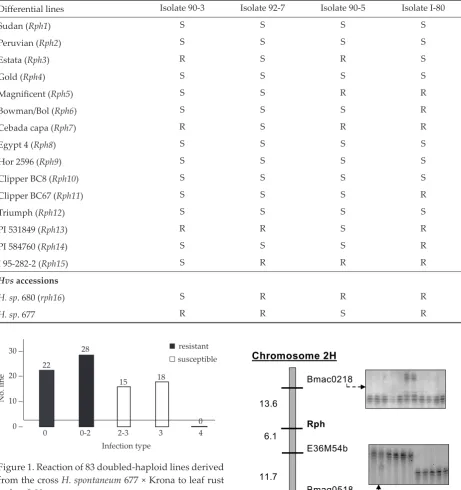
Rph7. The standard isolate I-80 of P. hordei possesses a wide range of virulence (Table 1). For further dif-ferentiation of the resistant H. spontaneum accessions resistance tests were carried out in the U.S. Isolates (90-3, 92-7, 90-5) with virulence/avirulence pa�erns, that have not been observed in the P. hordei popula-tion present in Europe, were used (Table 1).
DNA isolation and linkage analysis. DNA samples were prepared from the fresh leaf tissue of green-house-grown barley plants. Standard procedures like CTAB-based DNA isolation were carried out as described by S����� M����� et al. (1984). Besides this, a fast small-scale DNA isola-tion according to D������� et al. (1997) was ap-plied. DNA concentration was measured on the fluorometer DyNA Quant 200 (Hoefer/Amersham Biosciences).
For marker identification bulked segregant analy-sis (BSA) was carried out using equal amounts of DNA from 10 resistant and 10 susceptible DH lines (M��������� et al. 1991). For marker development SSRs (R����� et al. 2000) and AFLPs were used (V�� et al. 1995). In order to get information about the chromosomal location of the gene, 5 SSRs per chromosome were analysed in the first step.
The PCR reactions for SSRs were performed in a total volume of 20 µl in a thermal cycler PTC 200 (Biozym Diagnostics GmbH) and consisted of 50 ng template DNA, 1 × PCR buffer, 1.5mM MgCl2, 0.3µM of forward and reverse primer, 200µM dNTPs, 1 unit Taq polymerase (Roche Diagnostics GmbH). The amplification products were separated in a denaturing polyacrylamide gel in a Sequi-Gen Cell (BioRad Laboratories Inc.). The DNA fragments were detected using the silver-staining method.
For AFLP analysis, template DNA (300 ng) from the parents and bulks was digested with 5 units of the restriction enzymes EcoRI and MseI. For tem-plate preparation the selection of biotinylated DNA restriction fragments was omitted. The adapter liga-tion, pre-amplification and selective amplification with Cy5-labelled EcoRI +3 primers were carried out according to the AFLP protocol suggested by GibcoBRL. The detection of the amplified DNA fragments was performed on an automatic laser fluorescence sequencing machine (ALFexpress, Amersham Biosciences).
Linkage analysis was performed with the MAPMAKER software program, version 3.0 (L��- ��� et al. 1987). The Kosambi function was used to convert recombination frequencies to map distances in centimorgans (K������ 1944).
RESULTS AND DISCUSSION
Reactions of the host differential lines and of the Hvs accessions to 4 isolates differentiating resistant lines are presented in Table 1. H. spon-taneum 677 turned out to be resistant to isolates 92-7, 90-3 and I-80 but susceptible to isolate 90-5. In contrast to this, H. spontaneum 680 (rph16) is exclusively susceptible to isolate 90-3 and shows the same reaction as the line I 95-282-2 (Rph15).
H. spontaneum 677 shows the same reaction to these 4 isolates as the line PI 531849 with the known Rph13 gene, but in another resistance test H. spontaneum 677 shows to the isolates I 8-2 and I 30-1+4280 resistant reactions and PI 531849 susceptibility.
By analysing the progeny of the cross L 94 × H. spon- taneum 677 in F2 and F3 a good fit to a segregation ratio of 3r:1s was observed, giving a hint to a single dominant gene encoding resistance to P. hordei in this line (W������ et al. 1999).
The results of the disease scoring of DH-lines of the H. spontaneum 677 × Krona cross using rust isolate I-80 are shown in Figure 1.
A segregation ratio of 50r:33s was determined. χ2 value for a 1r:1s segregation is 3.48 and for 3r:1s segregation indicative of the presence of two resistance genes is 9.60 suggesting that one gene is involved in resistance to isolate I-80 in
observed. Therefore, additional genes influencing the level of resistance may be involved.
[image:3.595.66.528.115.606.2]A set of 35 previously described SSR mark-ers was screened for detection of polymorphic bands between the resistant and susceptible bulks (R����� et al. 2000). As a result of the bulked segregant analysis polymorphisms were detected on chromosome 2H. In the next step additional SSR markers for chromosome 2H were analysed and mapped. Linkage was detected between the
Figure 2. Partial map of barley chromosome 2H using the mapping population H. spontaneum 677 × Krona. Genetic distance is given in centimorgans (cM)
Chromosome 2H
Rph
Bmac0218
E36M54b
Bmag0518 13.6
6.1
11.7
6.1 11.7
EBmac0521 Bmac0093 EBmac0558 EBmac0715 2.4
Figure 1. Reaction of 83 doubled-haploid lines derived from the cross H. spontaneum 677 × Krona to leaf rust isolate I-80
Table 1. Reactions of a set of barley differentials and ofHordeum spontaneum accessions to inoculation with four isolates of P. hordei
Differential lines Isolate 90-3 Isolate 92-7 Isolate 90-5 Isolate I-80
Sudan (Rph1) S S S S
Peruvian (Rph2) S S S S
Estata (Rph3) R S R S
Gold (Rph4) S S S S
Magnificent (Rph5) S S R R
Bowman/Bol (Rph6) S S S R
Cebada capa (Rph7) R S R R
Egypt 4 (Rph8) S S S S
Hor 2596 (Rph9) S S S S
Clipper BC8 (Rph10) S S S S
Clipper BC67 (Rph11) S S S R
Triumph (Rph12) S S S S
PI 531849 (Rph13) R R S R
PI 584760 (Rph14) S S S R
I 95-282-2 (Rph15) S R R R
Hvs accessions
H. sp. 680 (rph16) S R R R
H. sp. 677 R R S R
30 –
20 –
10 –
0 – 22
28
15 18
0
0 0-2 2-3 3 4
Infection type
No. line
■ resistant
[image:3.595.320.519.459.711.2]resistance locus and the SSR markers Bmac0218, Bmag0518, EBmac0521, EBmac0558, Bmac0093 and EBmac0715 (Figure 2). SSRs EBmac0415, Bmac0134, HVM26, HVM63, EBmac0557 and Bmag0003 were monomorphic. The closest linked SSR markers are Bmac0218 and Bmag0518, which are flanking the gene at a distance of 13.6 cM and 17.8 cM, respectively.
Because SSRs are quite distantly linked to the resistance derived from H. spontaneum 677, AFLP marker saturation was conducted using about 200 AFLP primer combinations.
Polymorphic DNA fragments between the parents and the bulks were amplified by using the AFLP primer combinations E39M58, E42M48, E37M33 and E36M54. Out of them the AFLP marker E36M54b was mapped at a distance of 6.1 cM to the resist-ance gene. The total map including 6 SSR markers and one AFLP marker constitutes 51.4 cM. The map position of the leaf rust resistance gene is shown in Figure 2.
Unfortunately, linkage detected up to now is quite loose. Therefore, additional AFLPs will be screened and besides this phenotypic analysis will be repeated on those genotypes showing no unequivocal reactions, i.e. 2–3 scores. Analysing 42 DH lines of this population which were scored resistant (infection type 0) or susceptible (infection type 3) closer linkage was observed, i.e. 4.8 cM for Bmac0218 and 9.7 cM for Bmag0518.
As the gene of H. spontaneum 677 like rph16 is located on chromosome 2H, the STS marker MWG 2133 developed by I������ et al. (1998) and co-seg-regating with rph16 was analysed but it turned out to be monomorphic in our DH-population. There-fore, no information could be obtained whether resistance of H. spontaneum 677 was located at exactly the same chromosomal region. As it has been found recently that Rph15 and rph16 are al-lelic (W�������� et al. 2004), extensive tests for allelism will be carried out in future.
Without respect to chromosomal location resist-ance to leaf rust derived from H. spontaneum 677 is likely to be prospective for future breeding pro-grammes as it shows a different resistance spectrum in comparison with the Rph15/rph16 locus.
References
D������� D.B., K����� E. (1997): A rapid and economic technique for RAPD analysis of plant genomes. Rus-sian J. Genetics, 33: 358–365.
I������ V., W������ U., G����� A. (1998): Molecular mapping of a new gene in wild barley conferring complete resistance to leaf rust (Puccinia hordei O�h). Theor. Appl. Genet., 97: 1235–1239.
J�� Y., C�� G.H., S��������� B.J., F��������� J.D. (1996): New leaf rust resistance genes in barley and their allelic and linkage relationship with other Rph
genes. Phytopathology, 86: 887–890.
K������ D.D. (1944): The estimation of map distances from recombination values. Ann. Eugen, 12: 172– 175.
L����� E.S., G���� P., A��������� J., B����� A., D��� M.J., L������ S.E., N������ L.(1987): MAPMAKER: An interactive computer package for constructing primary genetic linkage maps of experimental and natural populations. Genomics 1: 174–181.
L����� M.N., C�������� W.J. (1952): Studies on dwarf leaf rust of barley. US Dept. Agric. Techn. Bull.,
1056: 1–17.
M��������� R.W., P���� �., K������ R.V. (1991): Identi-fication of markers linked to disease resistance genes by bulked segregant analysis: a rapid method to detect markers in specific genomic regions by using segregating populations. Proc. Nat. Acad. Sci. USA,
88: 9828–9832.
P������� J. (1998): Selektion eines 500 Sippen umfas-senden Sortimentes Hordeum spontaneum conv. Koch auf qualitative und quantitative Resistenz gegen den Zwergrost (Puccinia hordei O�h) unter Berück-sichtigung weiterer pilzlicher Bla�pathogene der Gerste. [Dissertation.] Martin-Luther Universität, Halle-Wi�enberg.
R����� L., M������� M., I����������� S.D. M������ K., C����� L., F����� J., E������ K.J., T������� S., M�������� M., M������ A., M������ E., M�������� N., S������ T., G���� M., P����� W., W���� R. (2000): A simple sequence repeat-based linkage map of barley. Genetics, 156: 1997–2005.
S����� M����� M.A., S������ K.M., J�������� R.A., A����� R.W. (1984): Ribosomal DNA spacer-length polymorphisms in barley: Mendelian inheritance, chromosomal location and population dynamics. Proc. Nat. Acad. Sci. USA, 81: 8014–8018.
V�� P., H����� R., B������ M., R������ M., ��� �� L� T., H����� M., F�������� A., P�� J., P������ J., K����� M., Z����� M. (1995): AFLP: A new tech-nique for DNA fingerprinting. Nucleic Acids Res.,
23: 4407–4414.
W�������� J.S., S��������� B.J., F��� A.B. (2004) Con-version of an amplified fragment length polymor-phism marker into a co-dominant marker in the mapping of the Rph15 gene conferring resistance to barley leaf rust, Puccinia hordei O�h. Theor. Appl. Genet., 108: 712–719.
Abstrakt
K������� D., N�������� M., O����, F., S��������� B. J. (2004): Zhodnocení a zmapování genu rezistence ke rzi ječné odvozeného z Hordeum vulgaresubsp. spontaneum. Czech J. Genet. Plant Breed., 40: 86–90.
Testy nutné pro získání markeru byly prováděny na populaci dihaploidů odvozených z křížení vysoce rezistent-ní linie H. spontaneum 677 × Krona (náchylná odrůda). Předcházející studie štěperezistent-ní F2 a F3 populací ukázaly, že rezistenci H. spontaneum pravděpodobně řídí jeden dominantní gen. Byla provedena analýza segregantů (BSA) s použitím AFLP a SSR s cílem identifikovat markery, které jsou ve vazbě s tímto genem rezistence ke rzi ječné. Na základě analýzy 83 dihaploidních linií byl gen rezistence lokalizován na chromozomu 2H ječmene s nejbliž-ším markerem ve vazbě 6.1 cM (E35M54b) a 13.6 cM (Bmac0218). Aby byly získány předběžné údaje o tom, zda tento gen může být alelický s genem rph16, lokalizovaným na chromozomu 2H, byl k testům použit STS marker MWG 2133, kosegregující s rph16; ukázalo se však, že je monomorfní. V testu rezistence čtyřmi různými izoláty Puccinia hordei jevilo H. spontaneum 677 odlišné spektrum reakcí od H. spontaneum 680, zdroje rph16. Probíhají testy alelismu k ověření získaných výsledků.
Klíčová slova: Hordeum vulgare; ječmen; Puccinia hordei; rez ječná; rezistence; SSR; AFLP; genetické mapování
Corresponding author:
Dr. D���� K�������, Federal Centre for Breeding Research on Cultivated Plants, Institute of Epidemiology and Resistance, Theodor-Roemer-Weg 4, D-06449 Aschersleben, Germany
tel.: + 49 3473 879 187, fax: + 49 3473 2709, e-mail: [email protected]
W������ J., W������ U., S��� K.; H�������A., K������� D., P�������� G. (2003): Diversity in resistance to biotic stresses. In: B������, R. von (Eds): Diversity in Barley (Hordeumvulgare). Elsevier Science B.V., Amsterdam: 143–178.