Abstract—In this paper, we present the performance analysis of 112 Gb/s polarization division multiplexed-differential quadrature phase shift keying (PDM-DQPSK) optical label switching system with frequency swept coherent detected spectral amplitude code labels in simulation. In this system, the payload consists of two 28 Gbaud channels which are orthogonally polarized. Direct detection is selected to demodulate the PDM payload in the receiver. 4 bits of 156 Mb/s spectral amplitude code label are frequency-swept coherently detected. The label and payload signal performances are assessed by the eye diagram opening factor (EOF) and bit error rate (BER) as function of received optical power (ROP) and optical signal to noise ratio (OSNR). We optimized the payload laser linewidth as well as the frequency spacing between the payload and labels likewise frequencies between the labels. For back-to-back system and 120 km transmission, label eye opening factors are 0.93 and 0.90 respectively, while payload optical signal-to-noise ratio is 23.4 dB and the payload received optical power is -13.3 dBm for a bit error rate of 10-9. The payload could well be demodulated after 900 km transmission at a BER of 10-3 using forward error correction (FEC).
Index Terms—coherent detection, optical label switching (OLS), polarization division multiplexed (PDM), spectral amplitude code (SAC).
I. INTRODUCTION
Optical communication has become one of the most important parts in modern communications due to the explosive growth of Internet data and services, and its developing direction is all-optical network (AON), with high-capacity and broad bandwidth. The ever-growing transmission capacity demand in optical transmission systems has brought out the necessity of increasing the spectral efficiency by employing different transmission techniques and also increasing transmission speed in optical networks. One optical technique used to improve the efficiency of optical communication systems is polarization
Manuscript received February 28, 2016; revised March 28, 2016. This work was supported by National Natural Science Foundation of China (61205067).
Aboagye Isaac Adjaye is a PhD. Student at the University of Electronic Science and Technology of China Chengdu Sichuan 611731, China. Phone number: 008618328355105; e-mail: ikeaboagye94@gmail
Chen Fushen is with the Communication and Information Engineering Department, University of Science and Technology of China. Chengdu, Sichuan 611731, China. Phone number: 008613668273841; e-mail: [email protected]
Cao Yongsheng is with the Communication and Information Engineering Department, University of Science and Technology of China. Chengdu, Sichuan 611731, China. Phone number: 008618981973132; e-mail:[email protected]
division multiplexing (PDM). The use of PDM permits multiplying the transmission capacity, as different signals can be transmitted over orthogonal states of polarization of the same light [1]. Optical label switching (OLS) technique is considered a way to increase transmission speed in optical networks [2]. OLS beats the electronic bottleneck of system switches and disposes of optical-electronic-optical change to diminish the transmission delay. Recently Spectral amplitude code (SAC) labelled switching system has attracted much attention and is considered as one of the most promising labelling techniques due to its relatively simple structure, high output, high speed and potential flexibility. SAC has been applied in optical code division multiple access (OCDMA) and spectral code labeled systems [3], [4]. In this paper, we build a 112 Gb/s polarization division multiplexed (PDM)-differential quadrature phase shift keying (DQPSK) transmission system with 156 Mb/s SAC labels in simulation. Frequency-swept coherent detection is employed to decode the SAC label. The high speed payload is directly detected by a polarization tracker [5]-[8], which gets rid of complicated digital signal processing procedure [9], [10]. The label and payload signal performances are assessed by the eye diagram opening factor (EOF) and bit error rate (BER) as function of received optical power (ROP) and optical signal to noise ratio (OSNR). By analyzing the factors that affect the quality of the received signal, we optimize the parameters and obtain good transmission performance for both the payload and label.
II. OPERATIONPRINCIPLEOFFREQENCY-SWEPT COHERENTDETECTION
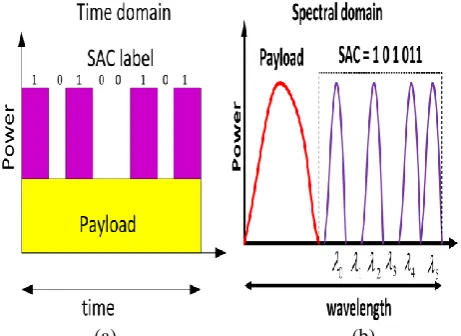
Coherent detection allows the greatest flexibility in modulation formats, as information can be encoded in amplitude and phase, or alternatively in both in-phase (I) and quadrature (Q) components of carrier. The receiver exploits knowledge of the carrier's phase to detect the signal. In a SAC label framework, SAC label and payload occupy the same time space however diverse wavelengths. Labels are encoded in wavelength domain, and recognized by their amplitudes, [11], [12]. Fig. 1 shows the schematic diagrams of SAC label in both wavelength and time domain.
Performance Analysis of 112 Gb/s
PDM-DQPSK Optical System with Frequency Swept
Coherent Detected Spectral Amplitude Labels
(a) (b)
Fig. 1. Schematic diagrams of spectral amplitude code (SAC) label: (a) time domain and (b) wavelength domain.
The structure of a frequency swept coherent detection scheme of SAC label is shown in Fig. 2. Fig. 2 (a) is a SAC label which has 4 bits code “1010” in wavelength domain. Fig. 2 (b) is a frequency-swept local oscillator (LO) whose swept frequency covers the entire SAC label’s frequencies. The SAC label and LO are combined by a 3 dB coupler and the hybrid signal is transferred to baseband electrical signal in time domain after photo-detection (PD). Therefore, the label signals can be recovered by low pass filters (LPF) as shown in Fig. 2 (c).
Fig. 2. Principle of frequency-swept coherent detection of SAC label: (a) input SAC label in wavelength domain; (b) frequency-swept LO; (c) output SAC label in time domain.
III. SYSTEMMODEL
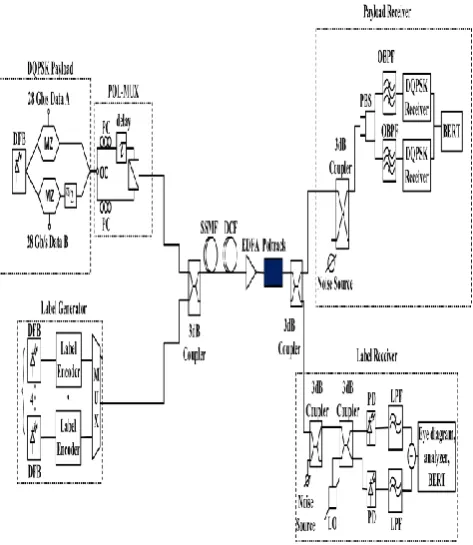
The simulation setup of the 112 Gb/s PDM-DQPSK SAC transmission system is executed using VPI Transmission Maker 8.3. This is shown in Fig. 3. A continuous wave laser at 1552.60 nm and 10 MHz linewidth is considered as optical source. For convenience and simplification of payload generator, two orthogonal polarization channels are generated by one distributed feedback (DFB) laser source [13]. A 28 GBaud DQPSK signal at 1552.60 nm is split by a polarization beam splitter (PBS) into two beams. One beam goes through 0 degree polarization controller (PC), while the
other one goes through 90 degree PC after 1 ns delay to make two signals uncorrelated. A polarization beam combiner (PBC) is employed to combine two orthogonal polarization signals into one beam of 112 Gb/s PDM-DQPSK payload. The SAC label generation unit is made up of a laser, an optical switch and a pseudo random binary sequence (PRBS) generator. For the generation of SAC label signal, a four-DFB laser array and a label encoder are applied, and at a label rate of 156 Mb/s. The chosen label laser wavelengths are at 1552.92, 1552.96, 1553.00, 1553.04 nm, respectively. The frequency interval between each label is 5 GHz while the spacing between payload and label is 40 GHz, so as to control the laser pulse signal and encode SAC label. By combining the payload and label, we obtain an optical packet of 112 Gb/s PDM-DQPSK payload and 156 Mb/s four-code SAC label. A standard single mode fiber (SSMF) and dispersion compensation fiber (DCF) are used as the transmission fiber. For this part, chromatic dispersion (CD), polarization mode dispersion (PMD) and loss of SSMF are 0.16 ps/nm/km, 0.2 ps/km1/2 and 0.2 dB/km, respectively, while the parameters of DCF are -0.8 ps/nm/km, 0.2 ps/km1/2 and 0.5 dB/km, respectively. The dispersion compensation fiber forms one-fifth the length of the standard single mode fiber. An erbium-doped fiber amplifier (EDFA) is installed in the link to compensate for lost power. The polarization tracker transforms the arbitrary polarization state to settled polarization state. In our simulation, it recovers the orthogonal polarization states of the PDM payload signal with power loss of greater than 0.1 dB. The polarization tracker recovers 0 degree and 90 degree of two orthogonal polarization states of PDM payload signal in order to mitigate the PMD impairment. After polarization tracker, the packet is split to two branches by a 3 dB coupler and fed into both payload and label receivers to demodulate payload and label respectively. For the payload, the polarization beam splitter (PBS) separates the signals in the X and Y demultiplexes the PDM signal based on the fact that the polarization states have been set to orthogonal X and Y. The signal is filtered by an optical band pass filter (OBPF) with bandwidth of 112 GHz, and demodulated by a DQPSK receiver. Each receiver has a pair of MZIs, each with 0.05 ns delay. The differential optical phase between interferometer arms is set to
/ 4 and
/ 4. A Gaussian order of 2 and a BERT are also needed to evaluate the DQPSK signal performance. For the label, a [image:2.595.55.286.66.234.2] [image:2.595.50.290.410.589.2]Fig. 3. Simulation setup of 112 Gb/s PDM-DQPSK SAC label system.
IV. PERFORMANCEANALYSISANDRESULTSOF THESYSTEM
The eye diagram of I and Q components of the received DQPSK signal for back-to-back (BTB) and after 120km transmission is shown in Fig. 4 (a) and (b). The polarization condition of the SAC labels is unusual after transmission yet in frequency-swept coherent detection, which is not sensitive to the label's polarization state; the SAC label can in any case be demodulated in our proposed system.
(a) Eye diagrams of (BTB)
(i) I Branch (ii) Q Branch
Fig. 4 (a). Eye diagrams of (BTB): i and ii are I branch and Q branch of BTB.
(b) Eye diagrams of payload
(i) I Branch (ii) Q Branch
Fig. 4 (b). Eye diagrams of DQPSK payload after 120 km transmission: i and ii are I and Q branch of payload.
The reception quality of the payload is affected by the laser linewidth. In Fig. 5, for 100 kHz and 1 MHz laser linewidth cases, the bit error rate (BER) is smaller than the BER in a 10 MHz laser linewidth in both the BTB and 120 km transmission conditions for the same optical signal to noise ratio (OSNR) and received optical power (ROP). To achieve good transmission performance, system should operate with current conventional DFB lasers with a typical linewidth value in the order of up to 10 MHz.
(a) (b)
Fig. 5. Effects of payload’s laser linewidth: (a) BER vs. Received power; (b) BER vs. Optical signal to noise ratio.
[image:3.595.303.535.63.233.2] [image:3.595.305.548.391.587.2] [image:3.595.47.276.496.654.2]PMD and PDL effects. PMD produces a polarization state that varies randomly and a PDL which breaks the orthogonality of the two polarizations. This makes it hard for the signal to be demultiplexed. The polarization tracker is installed to repair the PMD and PDL impairments. This caused a power loss of less than 0.1 dB in our simulation. Fig. 6 shows the effects of polarization tracker on PMD.
[image:4.595.304.546.51.255.2](a) (b)
Fig. 6. Effects of polarization tracker and PMD: (a) BER vs. ROP (b) BER vs. OSNR.
As observed from Fig. 6, without the polarization tracker, the signals cannot be demodulated due to PMD and PDL impairments. With a big PMD in the fiber, the polarization tracker cannot fully recover. PMD impairment may cause some ROP and OSNR penalty. Eye diagram is a very successful way of quickly and intuitively assessing the quality of a digital signal. It serves as an additional testing procedure for verifying transmitter output compliance, and revealing the amplitude and time distortion elements that degrade the BER for diagnostic purposes. Eye opening factor (EOF) is usually used to measure the received quality of SAC label. Its expression is:
EOF=EA-
1 0
1
EA
Where EA is the eye amplitude,
0 and
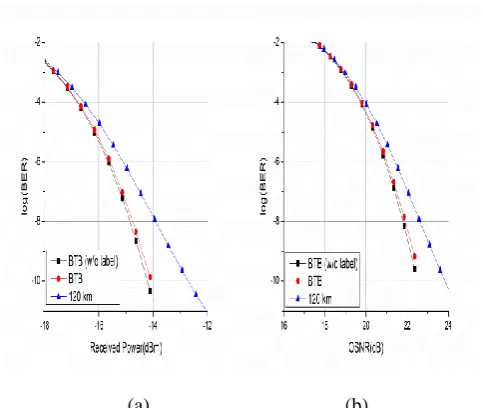
1 are the standard deviations of the sample points of ‘0’ bits and ‘1’ bits within the sample range. In our transmission, the EOF of the BTB is better opened than transmission after 120km. For BTB, the label EOF is 0.93 whereas the label EOF after 120 km is 0.90. A long distance transmission of the SAC label with a high speed payload is achieved with the method of frequency-swept coherent detection.The transmission performance of the payload is shown in Fig. 7. The graph shows the transmission penalty for BTB with labels and without labels while the penalty for 120 km is compared to BTB with labels. The results of their performances are shown in Table I.
(a) (b)
Fig. 7. Transmission performance of the payload; (a) BER vs. Received Power (b) BER vs. OSNR
TABLE I
TRANSMISSION PENALTY FOR RECEIVED POWER AND OPTICAL SIGNAL TO NOISE RATIO AT BER OF 10-9
Transmission Received Power (dBm)
Optical Signal to noise ratio (dB)
Value Penalty Value Penalty BTB
(without label) -14.5 22.2
BTB
(with label) -14.4 0.1 22.4 0.2
120 km -13.3 1.1 23.4 1.0
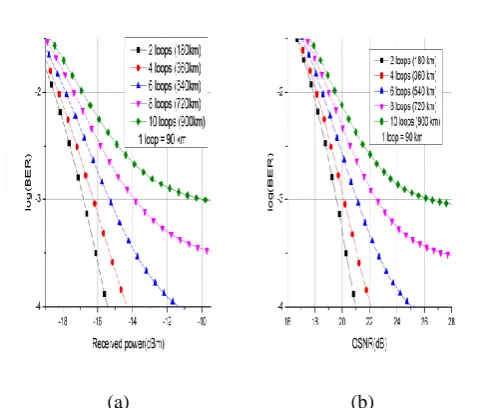
Lastly, we examine and study long haul transmission by creating loop to study the performance of the system using forward error correction (FEC). The loop consisted of a standard single mode fiber (SSMF) of length 75 km and a dispersion compensation fiber (DCF) of length 15 km adding up to a total length of 90 km per loop bearing in mind each loop should not exceed 100 km. The loop also consisted of an EDFA to compensate the power loss. Using BER of 10-3 and forward error correction (FEC), a transmission distance of 900 km is achieved. The intensity dependent impairments are reduced automatically. The power gain margin can be used to increase the span of the optical link, which accounts for less number of amplifiers.
TABLE II
LONG HAUL TRANSMISSION USING FORWARD ERROR CORRECTION (FEC)
Distance (km)
BER Received Power (dBm)
OSNR (dB)
180 10-3 -16.80 19.55
360 10-3 -16.23 21.13
540 10-3 -15.31 21.07
720 10-3 -13.87 22.55
[image:4.595.49.289.141.340.2](a) (b)
Fig. 8. Long haul transmission using forward error correction (FEC). (a) BER vs. ROP (b) BER vs. OSNR.
V. CONCLUSION
The performance and analysis of 112 Gb/s PDM-DQPSK transmission system with 4-bits 156 Mb/s SAC label is presented. The payload signal is demodulated using direct detection while the SAC label is detected using frequency- swept coherent detection. The polarization tracker in direct detection brings an insertion loss of less than 0.5 dB and a few watts of power consumption. The laser linewidth of the payload is optimized to 10 MHz. The frequency spacing between the payload and the label is 40 GHz and the spacing between the labels is optimized to 5 GHz. The transmission performances of both the payload and label are good. For BTB and a 120 km transmission, the label EOFs is 0.93 and 0.90 respectively. The payload’s OSNR for BTB without label, BTB with label and after 120 km is 22.2 dB, 22.4 dB and 23.4dB respectively. The payload’s ROP for BTB without label, BTB with label and after 120 km is -14.5 dBm, -14.4 dBm, and -13.3 dBm respectively at a BER of 10-9. A 900 km long haul transmission of the payload is also achieved using forward error correction (FEC) at a BER of 10-3. This result indicates that the high speed payload and SAC label are compactible. The good performance of the system has potential application in future for all optical label switching.
ACKNOWLEDGMENT
Aboagye Isaac Adjaye thanks Professor Chen Fushen and Professor Cao Yongsheng of School of Communication and Information Engineering, University of Electronic Science and Technology of China for the support and guidance.
REFERENCES
[1] M. I. Hayee, M. C. Cardakli, A. B. Sahin, and A. E. Willner, “Doubling of bandwidth utilization using two orthogonal polarizations and power unbalancing in a polarization-division multiplexing scheme,” IEEE Photonics Technology Letters, vol.13, no. 8, pp. 881–883, 2001.
[2] He T., Nicolas K. Fontaine, Ryan P. Scott, et al. Optical arbitrary waveform generation-based packet generation and all-optical separation for optical-label switching [J]. IEEE Photonics Technology Letters, 22(10): pp. 715-717, 2010.
[3] Y. Cao et al., “Recognition of spectral amplitude codes by frequency swept coherent detection for optical label switching,” Photonics Netw. Commun. 20(2), 131(2010).
[4] Y.Cao et. Al., “Performance of IM, DSPK, DQPSK payload signals with frequency swept coherent coherent detected spectral amplitude code labeling.” Opt. Switch. New. 8(2), 79 (2011).
[5] B. Koch, et al. Endless optical polarization control at 56 krads, over 50 gigaradian, and demultiplex of 112-Gbs PDM-RZ-DQPSK signals at 3.5 krads” IEEE Journal of Selected Topics in Quantum Electronics, 16(5), 1158 (2010).
[6] B. Koch, R. Noé, D. Sandel, et al. 20-Gbs PDM-RZ-DPSK transmission with 40 krads endless optical polarization tracking [J]. IEEE Photonics Technology Letters, 25(9), 798-801, 2013.
[7] Jinnan Zhang, Xueguang Yuan. et al. Stable 112-Gb/s POLMUX-DQPSK transmission with automatic polarization tracker. IEEE International Conference on Transparent Optical Networks, Munich, pp. 1-4, 2010.
[8] P. Boffi, M. Ferrario, L. Marazzi, et al. Impact of time-interleaving on directly-detected 100-Gb/s POLMUX RZ-DQPSK robustness to PDL-induced crosstalk [J]. Optics Express, 18(7), 6972-6977, 2010. [9] Lavery D., Maher R., et al. Digital coherent receivers for long reach
optical access networks [J]. IEEE Journal of Light Technology, 31(4), 609-620, 2013.
[10] J.J. Yu, Z. Dong, H. Chien, et al. Transmission of 200 G PDM-CSRZ-QPSK and PDM-16 QAM with a SE of 4 b/s/Hz [J]. IEEE/OSA Journal of Lightwave Technology, 31(4), 515-522, 2013. [11] S.A Nezmalhossini et al., “Novel FWM-based spectral amplitude
code label recognition for optical packet-switched network,” IEEE Photonics J. 5(4), 6601510 (2013).
[12] J.B. Rosas-Fernandez et al., “Ultrafast forwarding architecture using a single optical processor for multiple SAC –label recognition based on FWM,” IEEE J. Sel. Top. Quantum Electron. 14(3), 868 (2008). [13] Y. Feng, H. Wen, H.Y. Zhang, et al. 40-Gb/s PolMux-QPSK
transmission using low-voltage modulation and single-ended digital coherent detection. Chinese Optics Letters, 8(10), 976-978, 2010.
[image:5.595.46.290.53.257.2]