© 2016, IRJET | Impact Factor value: 4.45 | ISO 9001:2008 Certified Journal
| Page 665
Regression Modeling of Risk Factors and its Impact on Progress of
Activities in Infrastructure Projects
Mr.R.Gajendran
1,
Mr.V.Navin Ganesh
21
Final year M.E. Construction Engineering and Management, Department of Civil Engineering,Kongu
Engineering College, Perundurai, TamilNadu, India
2
Assistant Professor, Department of Civil Engineering, Kongu Engineering College, Perundurai, TamilNadu,
India
---***---Abstract
-
The purpose of this paper is to evaluate the ten components of risk management on delay in progress Time of project by incorporating perception of Project managers, Assistant engineers and Supervisors. In total, 30 factors that might cause delays of Infrastructure projects were defined through a detailed literature review. The researchers collected 118 questionnaires from the project managers, Contractors, Engineers and Supervisors. This research examines the influence of Risk factors on type of funding projects and the results of this study indicate that there is a significant difference exists between companies Approaches on varies project activities . The results were identified through questionnaire survey for collecting data from respondents. The main scope of this study would help and can benefit the concern to establish suitable policies relating to risk management in infrastructure projects.Key Words: Infrastructure, Progress, Activities, Policies, Approaches
1. INTRODUCTION
All projects and businesses are subject to the effects of uncertainty, arising from a variety of sources, including technical, management, financial, commercial etc. The Infrastructure industry is a key activity in any economy, it influences and is influenced by the gross domestic product of any country. Infrastructure developments play a vital role in influencing the economic viability and social welfare of every country. The difficulty and dynamics of the decision making in infrastructure development and management has steadily increased over recent years. Risks have a significant impact on a construction project’s Delay in progress time. The main objective this study is to identify the factors which highly influencing the Progress of the project in both government and private funding projects.
To meet the growing demand for public services, many governments have solicited private investments for public infrastructure projects by adopt the proposal of
privatization, which grants the private sector the right to design ,finance , and construct a specific infrastructure and operate it for a concession period. The BOT approach has been considered the best way to reduce independent loans and improve a government’s credit rating. The participation of private companies in a BOT project defines that the project risks and the financial and administrative burden are transferred from the public sector to the private sector (Namhun Lee and John E.Schaufelberger -2014).
The main root causes of risk are owner, contractor and clients. Under the complex risk category from the contractor’s perspective, relates to the loss and expense which often may not be reimbursable (Jasper Mbachuand Samuel Taylor -2014).Under the consideration of owner any loss and expense claims which could be transferred in to contractor, except if it could be proven that the foundation variations were beyond the expectations of any experienced and diligent contractor at the time of tender. These are the risks that could restrict the ability of the contractor to achieve the anticipated time margin on a project.
The creation of risk research model would help to identify the severity of risks on project time and also need help benefit the concern to establish suitable policies relating to risk management in infrastructure projects. The financial oriented risk management is very crucial to achieve the project objective with in time.
1.1 Literature Review
Jasper Mbachuand Samuel Taylor (2014) discus about the most risky factors under the broad categories comprise, respectively, unforeseen site conditions, poor project management, inexperience or incompetent estimating team, work overload arising from taking on too many contracts at the same time, shortage of skilled labour and clients unreasonable expectations.
© 2016, IRJET | Impact Factor value: 4.45 | ISO 9001:2008 Certified Journal
| Page 666
and conditions in which the tasks or activities areperformed. The risk profile of the activities can be defined and the maximum quantity of resources to reduce the risk can then be identified.
Rasheed A Salawua and FadhlinAbdullahb (2014) determines the development levels of individual construction organisations on each attributes help to identify their areas of strengths and weaknesses on risk management capability.
Ana I. Irimia-Diegueza et al (2014) focused on the risk identification and is to set up the state of the art in risk management in megaprojects. This paper identifies the most important risks tackled in the literature and gives confirmation that more research is necessary in risk management.
Patel Ankit Mahendra et al (2013) proposes to apply the risk management technique which includes well - documented procedures for the one stop solution all types of hazards most likely to occur during any construction project Lifecycle.
1.2 Proposed Research Model
1.3 Objectives
To identify the various dimensions of risk
management practices in Infrastructure
developers.
To examine the impact of various Risk factors on Progress of the project.
1.4 Proposed Hypothesis
H01: Applications will have no significant impact on Progress of the project.
H02: Inadequacy will have no significant impact on Progress of the project.
H03: work Environment will have no significant impact on Progress of the project.
H04: Changes will have no significant impact on Progress of the project
H05: Approaches will have no significant impact on Progress of the project.
H06: Communication will have no significant impact on Progress of the project.
H07: Restrictions will have no significant impact on Progress of the project.
H08: Approvals will have no significant impact on Progress of the project.
H09: Acceptance will have no significant impact on Progress of the project.
H10: Maintenance will have no significant impact on Progress of the project.
1.5 Need for Study
Identify the major impacts and the role of major risks in construction works.
Risk is inbuilt everywhere especially in
construction projects. The activity that are present in the construction industries could result in financial disasters, fatal injuries, disruption and delayed operation.
1.6 Period of study
The study was conducted during the period of May 2015 to February 2016.
1.7 Method of Surveying
The general methodology of the study relies largely on the survey, questionnaire which will be distributed and collected from the local building contractors of different sizes by mail or by employee meeting. A systematic literature review was initially conducted to identify the risk factors that affect the performance of construction industry as a whole.
2 DATA ANALYSIS
2.1 Reliability Analysis
Applications
Restrictions Communication
Approvals
Changes
Inadequacy Working environmentCompany approaches
Acceptance
Progress of
the Project
© 2016, IRJET | Impact Factor value: 4.45 | ISO 9001:2008 Certified Journal
| Page 667
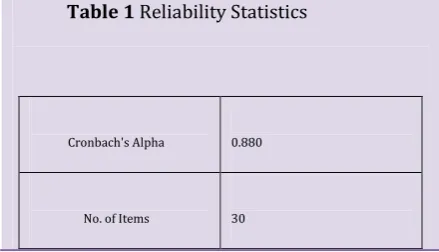
The coefficient alpha scores were calculated forassessing reliability of the Risk management which are listed dimension wise in Table I. the coefficient alpha values for variables are well above the criterion as recommended by Nunnaly(1978) for assessing reliability of the scale.
Table 1 Reliability Statistics
Cronbach's Alpha 0.880
No. of Items 30
2.2 Factor analysis
A principal component factor analysis with varimax rotation was established on 30 variables that assessed the real Risk management process in Infrastructure development industries. The statistical test result (KMO=0.735, Bartlett’s test of sphericity=435.00, significance=0.000) revealed that the factor analysis method was appropriate. The ten dimensions and the percentage of variance explained are listed in table 2.
Table 2 KMO and Bartlett's Test
Kaiser-Meyer-Olkin Measure of Sampling Adequacy. 0.735
Approx. Chi-Square 1432.604
Bartlett's Test of Sphericity Df 435
Sig. 0.000
Factor 1, which was categorized as Applications, was composed of five variables and accounted for 24.322 per cent variance. Factor 2 comprised of six variables that relate to the Inadequacy in provision of materials and payments it accounts for 7.914 per cent of the variance. Factor 3 was labelled as Working Environment that includes four variables. It accounts for additional 6.871 per cent of variance. Factor 4 was Changes that contained one variable accounted for additional 5.243 per cent. Factor 5 was Company Approaches and comprised of two variables. It accounted for an additional 4.901 per cent of variance. Factor 6 was labelled as worker ability. It
consists of three variables and accounted for 4.306 per cent of variance. Factor 7 was named as Restrictions that composed of two variables. It accounted for an additional 4.236 per cent of variance. Factor 8 was labelled as Getting Approvals. Factor 9 and 10 mentioned as Acceptance and Maintenance which consists of variables as three and one.
Table 3 Risk Process on Delays in Progress Time of Project
Sl.No. Risk process No. of variables including
Eigen value
Percentage of variance explained
Cumulative percentage of variance explained
1 Applications 5 24.322 13.065 13.065
2 Inadequacy 6 7.914 8.317 21.383
3 Working
Environment
4 6.871 7.151 28.534
4 Changes 1 5.243 6.999 35.533
5 Company
Approaches
3 4.635 6.573 42.106
6 Communication 2 4.306 5.893 47.949
7 Restrictions 2 4.236 5.839 53.788
8 Approvals 2 3.966 5.736 59.524
9 Acceptance 3 3.788 4.778 64.302
10 Maintenance 1 3.352 9,322 68.634
2.3 Multiple regression analysis
The present study has made an attempt to examine the influence of Risk factors on project progress of each activity, multiple regressions was administered. The regression model is,
Y=a+β1X1+ β2X2+ β3X3+ β4X4+ β5X5+ β6X6+ β7X7+ β8X8+ β9X9+ β10X10+e
Where, y is the mean score on Progressof the Project a=intercept,
X1= Mean score on Applications, X2= Mean score on Inadequacy,
X3= Mean score on Working Environment, X4= Mean score on Changes,
[image:3.595.51.271.181.307.2]© 2016, IRJET | Impact Factor value: 4.45 | ISO 9001:2008 Certified Journal
| Page 668
X6= Mean score on Communication,X7= Mean score on Restrictions, X8= Mean score on Approvals, X9= Mean score on Acceptance, X10= Mean score on Maintenance.
β1 to β10 = slope coefficient of all the above factors. e=error rate.
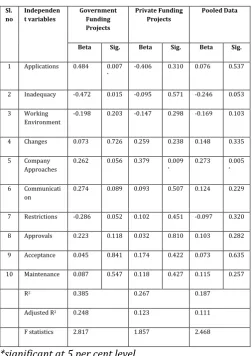
The impact of Risk factors among the respondents on their overall impact has been measured among Government Funding Projects, Private Funding Projects and also for the pooled data separately. The results are given in the table 4.
Table 4 Influence of Risk Factors on Progress of the Project
Sl. no
Independen t variables
Government Funding Projects
Private Funding Projects
Pooled Data
Beta Sig. Beta Sig. Beta Sig.
1 Applications 0.484 0.007
*
-0.406 0.310 0.076 0.537
2 Inadequacy -0.472 0.015 -0.095 0.571 -0.246 0.053
3 Working
Environment
-0.198 0.203 -0.147 0.298 -0.169 0.103
4 Changes 0.073 0.726 0.259 0.238 0.148 0.335
5 Company
Approaches
0.262 0.056 0.379 0.009
*
0.273 0.005
*
6 Communicati
on
0.274 0.089 0.093 0.507 0.124 0.229
7 Restrictions -0.286 0.052 0.102 0.451 -0.097 0.320
8 Approvals 0.223 0.118 0.032 0.810 0.103 0.282
9 Acceptance 0.045 0.841 0.174 0.422 0.073 0.635
10 Maintenance 0.087 0.547 0.118 0.427 0.115 0.257
R2 0.385 0.267 0.187
Adjusted R2 0.248 0.123 0.111
F statistics 2.817 1.857 2.468
*significant at 5 per cent level
Among the Government Funding Projects, the significantly and positively influencing progress time is Application of new techniques. A unit increase in the perception of the above said factors results in to delays in Progress by 0.48 units. Among the Private Funding Projects, the variable Company Approaches since their regression coefficient is significant at 5 per cent level. A unit increase in the above said risk factors results in to 0.379units of delay in progress of the project activities.
Among the pooled data the significantly and positively influencing risk factors on progress is Company Approaches, since their respective regression coefficient is significant at 5 per cent level.
2.4 Testing of hypothesis
[image:4.595.307.559.263.687.2]The results of the testing of the hypothesis in the context of Risk management criteria with ten factors are detailed in table 5.
Table 5 Testing of Hypothesis
S.No. Hypothesis T value Βeta Results
1 Applications will have no
significant impact on the Progress of the project
0.619 0.537 Not Confirmed
2 Inadequacy will have no
significant impact on the Progress of the project
-1.928 0.053 Not Conformed
3 Working Environment
have no significant
impact on the Progress of the project
-1.647 0.103 Not Confirmed
4 Changes will have no
significant impact on the Progress of the project
0.968 0.335 Not Confirmed
5 Company Approaches
will have no significant impact on the Progress of the project
2.872 0.005* Confirmed
6 Communication will
have no significant
impact on the Progress of the project
1.210 0.229 Not Confirmed
7 Restrictions will have no
significant impact on Progress of the project
0.999 0.320 Not Confirmed
8 Approvals will have no
significant impact on Progress of the project
1.081 0.282 Not Confirmed
9 Acceptance will have no
significant impact on the Progress of the project
0.477 0.635 Not Confirmed
10 Maintenance will have
no significant impact on the Progress of the project
1.139 0.257 Not Confirmed
3. CONCLUSION
[image:4.595.36.289.288.645.2]© 2016, IRJET | Impact Factor value: 4.45 | ISO 9001:2008 Certified Journal
| Page 669
Applications, Inadequacy, Working Environment, Changes,Company Approaches, Communication, Restrictions, Approvals, Acceptance and Maintenance. This study also examine that the significant relation between the company approaches and progress time and also express the impact values of Government Funding Projects, Private Funding Projects and also the pooled data. The Progress of each activity is important for every company to achieve project objective with in stipulated time period if it is getting delay, effects the profit. This study relates only the risk factors with one dependent variable similar studies could be conducted with different dependent variables and also it has only conducted in project fund related factors which mainly affect the projects.
.
REFERENCES
[1] Alfredo Federico Serpellaa, Ximena Ferradaa, Rodolfo Howarda and Larissa Rubioa(2014), “Risk Management In Construction Projects: A
Knowledge-Based Approach”, Social and
Behavioral Sciences, Vol.119, pp.653-662.
[2] Ana I. Irimia-Diegueza, Alvaro Sanchez- Cazorlaa and Rafaela Alfalla-Luquea (2014), “Risk Management in Megaprojects”, Procedia - Social and Behavioral Sciences, Vol.119, pp. 407 – 416.
[3] B. Kayis, G. Arndt, M. Zhou and S.
Amornsawadwatana(2007), “A Risk Mitigation Methodology for New Product and Process Design in Concurrent Engineering Projects”, Annals of the CIRP, Vol. 56,pp.167-170.
[4] Chaitali S. Pawar, Suman S. Jain and Jalinder R. Patil (2015), “Risk Management in Infrastructure Projects in India”, International Journal of Innovative Research in Advanced Engineering, Vol. 2, pp.172-176.
[5] Damien Schatteman, Willy Herroelen, Stijn Van de Vonder and Anton Boone(2008), “Methodology for Integrated Risk Management and Proactive Scheduling of Construction Projects”, Journal Of Construction Engineering And Management, Vol.134,pp.885-893.
[6] Dr. R. K. Kansal and Manoj Sharma (2012) “Risk Assessment Methods and Application in the Construction Projects”, International Journal of Modern Engineering Research, Vol.2, pp.1081-1085.
[7] Farid Ezanee and Mohamed Ghazali (2009),
“Operational Risks for Highway Projects in Malaysia”, International Journal of Social
Education, Economics and Management
Engineering, Vol:3,pp .41-44.
[8] Garry D. Creedy, Martin Skitmore and Johnny K. W. Wong(2010), “Evaluation of Risk Factors Leading to Cost Overrun in Delivery of Highway Construction Projects”, Journal Of Construction Engineering And Management, Vol. 136,pp.528-537.
[9] Jasper Mbachu and Samuel Taylor(2014),
“Contractual risks in the new zealand construction industry analysis and mitigation measures” ,International Journal of Construction Supply Chain Management ,Volume 4 ,pp.22-33. [10] Kolhatkar And Er. Amit Bijon Dutta(2013), “Study
Of Risk In Construction Projects”, Global Research Analysis, Vol.19, pp.104-107.
[11] Luiz Henrique Rodrigues Da Silvaa and Jose Antonio Crispima(2014), “The Project Risk Management Process, A Preliminary Study”, Procedia Technology, Vol.16, pp. 943-949.
[12] Matineh Eybpoosh, Irem Dikmen and M. Talat Birgonul(2011), “Identification of Risk Paths in International Construction Projects Using Structural Equation Modeling”, Journal Of Construction Engineering And Management, Vol.137,pp.1164-1175.
[13] Muhammed Mufazzal Hossen, Sunkoo Kang and Jonghyun Kim(2015), “Construction Schedule Delay Risk Assessment By Using Combined Ahp-Rii Methodology For An International Npp Project”, Nucl Eng Technol,Vol.47,pp. 362-379. [14] Namhun Lee and John E. Schaufelberger(2014),
“Risk Management Strategies for Privatized Infrastructure Projects”, American Society of Civil Engineers,Vol.1061,pp.1-9.
[15] Olalekan Mumuni Ogunbayo (2014),
“Assessmentof Risk Analysis Processes in the Nigerian Construction Industry”, International Journal of Advancements in Research & Technology, Vol.3, pp.36-42.
[16] Patel Ankit Mahendra, Jayeshkumar R. Pitroda and J. J. Bhavsar (2013). “A Study of Risk
Management Techniques for Construction
Projects in Developing Countries”, International Journal of Innovative Technology and Exploring Engineering , Vol.3, pp.139-142.
© 2016, IRJET | Impact Factor value: 4.45 | ISO 9001:2008 Certified Journal
| Page 670
safety task, and developing positive safety climatein construction project”, Automation in
Construction, Vol. 34,pp. 92-100.
[18] Ping Tserng.H, Samuel Y.L. Yin, R.J. Dzeng , B. Wou,
M.D. Tsai And Y. Chen(2009), “A Study Of Ontology-Based Risk Management Framework Of Construction Projects Through Project Life Cycle”, Automation in Construction, Vol.18, pp.994-1008.
[19] Rasheed A Salawua and Fadhlin Abdullah (2014), “Assessing Risk Management Maturity of Construction Organisations on Infrastructural Project Delivery in Nigeria”, Global Conference on Business & Social Science, Vol.172, pp.643-650. [20] Samuel Laryea and Will Hughes (2011), “Risk and
Price in the Bidding Process of Contractors”, Journal Of Construction Engineering And Management, Vol. 137,pp.248-258.
[21] Sang Hyuk Lee and Myungsik Do(2015), “A Study
on the Rate of Return of Infrastructure Projects for Joint Venture” , International Journal of Transportation ,Vol.3, pp.1-12.
[22] V.Sathishkumar, P.N.Raghunath and K.Suguna
(2015), “Critical Factors Influencing to Management Risk in Construction Projects’’, The International Journal Of Engineering And Science, Vol.4,pp.37-46.
[23] Vitor Sousa , Nuno M. Almeida and Luís A.
Dias(2015), “Risk-Based Management Of