warwick.ac.uk/lib-publications
A Thesis Submitted for the Degree of PhD at the University of Warwick Permanent WRAP URL:
http://wrap.warwick.ac.uk/78859
Copyright and reuse:
This thesis is made available online and is protected by original copyright. Please scroll down to view the document itself.
Please refer to the repository record for this item for information to help you to cite it. Our policy information is available from the repository home page.
Definitive Programming:
A Paradigm for Exploratory Programming
by
Simon Yun Pui Yung
A thesis submitted for the degree of
Doctor of Philosophy in Computer Science
Department of Computer Science
University of Warwick
Coventry CV 4 7 AL
U.K.
IMAGING SERVICES NORTH
Boston Spa, Wetherby West Yorkshire, LS23 7BQ www.bl,uk
BEST COpy AVAILABLE.
IMAGING SERVICES NORTH
Boston Spa, Wetherby West Yorkshire, LS23 7BQ
www.bl.uk
PAGE NUMBERING AS
Definitive Programming:
A Paradigm for Exploratory Programming
Simon fun Pui fung
Supervisor: Dr W M Beynon Department of Computer Science
University of Warwick Coventry, U.K.
A thesis submitted for the degree of Doctor of Philosophy
Abstract
Exploratory software development is a method that applies to the development of programs whose requirement is initially unclear. In such a context, it is only
through prototyping and experimenting on the prototypes that the requirement can be
fully developed. A good exploratory software development method must have a short
development cycle. This thesis describes our attempt to fulfil this demand. We address this issue in the programming language level. A novel programming paradigm
-definitive (definition-based) programming - is developed.
In definitive programming, a state is represented by a set of definitions (a
definitive script) and a state transition is represented by a redefinition. By means of a definition, a variable is defined either by an explicit value or by a formula in terms of other variables. Unless this variable is redefined, the relationship between the variables
within the definition persists.
To apply this state representation principle, we have developed some definitive
notations in which the underlying algebras used in formulating definitions are domain-specific. We have also developed an agent-oriented specification language by which
we can model state transitions over definitive scripts. The modelling principles of
definitive programming rest on a solid foundation in observation and experiment that is
essential for exploratory software development.
This thesis describes how we may combine definitive notations and the
agent-oriented programming concept to produce software tools that are useful in exploratory
software development. In this way, definitive programming can be considered as a
paradigm for exploratory programming.
Table of Contents
Table of Contents ... i
Table of Listings ... vii
f F ' '" Table 0 Igures •.•.••.•.•..•••••••.•••••.••••••••.•••••.••••••••••.••••••• VIII Acknowledgements ... i x 1 Introduction ... l 1 . 1. Programming Language and Software Development ... 1
1.2. Dependency and Observation ... 5
1.3. Motivating Ideas ... 6
1.4. What Has to be Done ... 11
1.4.1. Brief History of Definitive Programming Research ... 11
1.4.2. The Future ... 12
1.5. Contribution of This Thesis ... 13
1 .6. Outline of the Thesis ... , ... 15
2 Definition-Based State-Transition Models in the Abstract, .•...•..•.. 1 7 2.1. The Definition-Based State-Transition (DST) Model ... 18
2.2. Comparison of the Concept of State and Transition in Different Programming Paradigms ... 19
2.2.1. Conventional Imperative Programming ... 21
2.2.2. Functional Programming ... 23
2.2.3. Object-Oriented Programming (OOP) ... 24
2.3. Virtues of the DST Model ... 26
2.3.1. Data Dependency, Concurrency and Consistency ... 26
2.3.2. Support for Incomplete Models ... 28
2.3.3. Possible Transformation ... 28
3 Software Tools Using Dependency ... 31
3. 1. Spreadsheets ... 32
3. 1.1. Basic Concepts of a Spreadsheet ... " ... 32
3.1.1.1. Variable names ... 33
3.1.1.2. Range Functions and Operations ... 35
3. 1.1.3. Order of Evaluation ... 35
3. 1. 1.4. Differences Between a Spreadsheet And a Definitive Script ... 36
3.1.2. Appraisal of Spreadsheet Programming and Definitive Programming ... 36
3.1.2.1. What-If ... 37
3.1.2.2. Rapid Prototyping ... 38
3. 1.2.3. Cognitive Dimensions ... 40
3.2. Document Preparation Software ... 42
3.3. Graphics Editors and User Interface Tools ... 44
3.4. The Make Utility ... 46
3.5. Theoretical Framework ... , ... 47
4 The Scout Notation ... 48
4.1. The DoNaLD Notation ... 49
4.2. Motivating the Design of SeouL ... 51
4.2.1. Visualisation of State ... 51
4.2.2. Assumptions of Definitive Notations ... 53
4.3. The Design of Scout ... 56
4.3.1. The Window Data Type ... 57
4.3.2. The Display Data Type ... 60
4.3.3. Other Data Types and Operators ... 60
4.4. The Implementation of Scout ... 64
5. 1. The Jugs Problem ... 69
5.2. Modelling a Screen Layout Using Scout. ... 70
5.2.1. Screen Layout Modelling Process ... 70
5.2.2. Special-Purpose Notation for Specific Task ... 73
5.2.3. Flexibility of Model ... " ... 75
5.2.4. Separation of Control and Presentation ... 77
5.3. Exploratory Screen Layout Development ... 78
5.3.1. Convenient State Changes ... 79
5.3.2. Flexible Definition Arrangement ... 79
5.3.3. Design and Simulation Joined Together ... 81
5.4. Summary ... 87
6 Integ ra ti 0 g Defioiti ve Nota ti oos ... 0 • • • • • • • 0 • • • 0 . 0 • • • • 0 • • • • • • 0 • • • 0 • • 0 . 88 6.1. Motivation for the Scout Project.. ... 88
6.2. Scope of the Scout Project ... 92
6.3. Implementation of Defmitive Notations ... 92
6.3.1. Steps for Implementing a Definitive Notation ... 93
6.3.2. Run-Time Structure ... 94
6.3.3. The Choice of Graphics Interface ... 96
6.4. Other Guidelines for the Design and Implementation of Definitive Notations ... 97
6.4.1. Bridging Definition ... 97
6.4.2. Naming Scheme ... 99
6.4.3. Switching Between Notations ... 99
6.4.4. Other Considerations ... 100
6.5. Evaluation of the Scout Project ... 101
6.5.1. Modelling, Understandability and Usability ... 101
6.5.2. Support for Iterative Design ... 103
7 Generalising Single-Agent Definitive Systems ... ) 05
7. 1. Definitive Programming vs Functional Programming ... " ... 107
7.1.1. Design and Implementation of Admira ... 107
7.1.1.1. What Is an Admira Definition? ... 108
7. 1.1.2. Storage of Definitions ... 108
7. 1. 1.3. Evaluation of Expression ... " ... 109
7. 1.2. Recursive Definition and Circular Definition ... 109
7. 1.3. State and Interaction ... 113
7.2. Agent-like Abstractions and Definitive Scripts ... 115
7.2.1. Meta-Definition ... 115
7.2.2. Semi-evaluation ... 117
7.2.3. Inheritance ... 117
7.3. Input Management ... 120
7.3.1. The Room Example ... 120
7.3.2. The Vehicle Cruise Control Example ... 122
7.3.3. Extension to the Scout System ... 123
7.3.3. 1. Considerations ... 123
7.3.3.2. The Extension Plan ... 126
7.3.4. Input Handling Techniques ... '" ... 129
7.3.4.1. Push Button ... 129
7.3.4.2. Toggle Switch ... 129
7.3.4.3. Menu Buttons ... 130
7.3.4.4. RadioButtons ... 130
7.3.4.5. Duration-Sensitive Button ... 131
7.3.4.6. Clocking ... 132
7.4. Summary and Conclusion ... 133
8 Agent-Oriented Definitive Programming ...•...•....•.•...•..•.. 135
8.2. Terminology in the LSD Notation ... 141
8.3. Transformation from LSD to ADM ... '" ... 144
8.4. An Evaluation of the LSD Notation ... 148
8.4.1. Grouping Guarded Commands ... 149
8.4.2. Parallel Action Specification ... 149
8.4.2.1. Limitation of LSD for Specifying a Swapping Agent ... 150
8.4.3. Call-by-Reference Parameter ... 152
8.4.4. Hidden-Text Annotation ... 153
8.5. Translation from ADM to EDEN ... 154
8.5.1. Motivation ... 154
8.5.2. The Translation Scheme ... 154
9 Summary and Conclusion ... 158
References ... 162
Appendices
Appendix A: Technical Document of the Scout System
Appendix B: User Guide to Admira
Appendix C: Program Listing of Admira
Appendix D: The Jugs Example
0.1. EDEN Definitions and Actions
0.2. Scout Display Specification
D. 3. Original Display Specification
Appendix E: The Visualisation Example
E. 1. The Script
E.2. Sample Output
Appendix F: The Room Example
F .1 . The Script
Appendix G: The Vehicle Cruise Control Simulation Example
G .1. The LSD Specification of the Simulation
G.2. EDEN Implementation of the LSD Specification
G. 3. Scout Graphical Interface of the Simulation
G . 4. Sample Output
Appendix H: The Railway Station Simulation Example
H. 1 . The LSD Specification
H.2. A Corresponding ADM Program
H.3. EDEN Implementation of the ADM Program
H.4. Extract of a Textual Simulation
H. 5. Scout Graphical Interface of the Simulation
Table of Listings
Listing 2.1: Two DoNaLD Specification for Describing the
B
Shape ... 29Listing 3.1: An Example of Makefile ... .46
Listing 4.1: A DoNaLD Description of a Square ... , ... 54
Listing 4.2: Another DoNaLD Description of a Square ... 54
Listing 4.3: A Sample Scout Fragment ... , ... 55
Listing 5.1: Definitions for Locations ... 72
Listing 5.2: Other Scout Definitions ... 72
Listing 5.3: The Scout Definitions Relating the Pour Menu Option ... 80
Listing 5.4: Square-root Guessing Program in EDEN ... 83
Listing 5.5: Translated Square-root Guessing Program in C ... 84
Listing 6.1: Program Fragment of the Scout Notation ... 98
Listing 7.1: An Admira Script for Calculating Variance. . . .. . . .. 108
Listing 7.2: A Stack-based Integer Desk Calculator in pLucid ... 114
Listing 7.3: A Proposed DoNaLD Specification of a Ladder ... 115
Listing 7.4: A Proposed DoNaLD Specification of Rectangular Objects ... 118
Listing 7.5: Specification of a Square ... , ... 119
Listing 8.1: An LSD Specification of a Station-Master ... 141
Listing 8.2: ADM Entity Descriptions of A1armO and ClockO ... 145
Listing 8.3: ADM Specification of the Station-Master Entity ... 147
Listing 8.4: A Swapping Agent lllustrating Parallel Actions ... 150
Listing 8.5: A Swapping Example (1st Attempt) ... 150
Listing 8.6: A Swapping Example (2nd Attempt) ... 151
Listing 8.7: A Swapping Example (3rd Attempt) ... 151
Listing 8.8: A Swapping Example (4th Attempt) ... 152
Listing 8.9: A Swapping Agent Using Call-by-Reference Parameters ... 153
Table of Figures
Figure 1.1: The Exploratory Software Development Cycle ... 4
Figure 1.2: Programming Paradigms vs Propagation of State Change ... 8
Figure 2.1: An
8
Shape ... 29Figure 3.1: Graphical User Interface Mechanism in Our Systems ... 45
Figure 4.1: DoNaLD Script of a Room ... 50
Figure 4.2: A Non-rectangular Region ... 63
Figure 4.3: Ways of Putting a String in a Non-rectangular Region ... 63
Figure 4.4: A Way of Partitioning a Non-rectangular Region ... 64
Figure 4.5: The Role of EDEN Actions in the Implementation of a Definitive Notation ... 65
Figure 5.1: A Sample Jugs Output. ... 71
Figure 5.2: Screen Layout Design ... 71
Figure 5.3: Cyclic Overlapping Windows ... 75
Figure 5.4: The Trident Way of Software Development ... 86
Figure 6.1: An Arrangement of Four Lines ... 89
Figure 6.2: A Poset Representing the Line Arrangement in Figure 6.1.. ... 89
Figure 6.3: An S4 Graph ... 90
Figure 6.4: Run-time Structure of a Definitive System ... 95
Figure 6.5: Run-time Structure of the Scout System ... 95
Figure 7.1: A Sample Output of the Room Viewer Example ... 121
Figure 7.2: A Sample Output of the Vehicle Cruise Control Simulation ... 122
Figure 8.1: Procedures for Animating an LSD Specification ... 138
Ackn owle dge me nts
I wish to express my gratitude to my friends and colleagues who helped me and encouraged me during these years. In particular, I thank Dr. Steve Russ in Warwick
and Dr. Rick Thomas in Leicester University for their useful comments. I must thank
my brother, Edward Yung for his love, care and practical help while he was with me in
the University.
I am most grateful to my supervisor, Dr. Meurig Beynon, for the continuous help, encouragement and constructive criticism he has given me during the work.
Especially, I thank him for allowing me to have a year off for developing my
personality and communication skills during the course.
I am so much thankful to the Coventry Chinese Christian Church who
supported me during my financial hardship so that I may concentrate on my study.
And above all, I have to thank God for providing me both the necessary intelligence for
1
Introduction
1.1. Programming Language and Software
Development
Programming is more than translating what we want the computer to do into a computer
program; it involves the whole process of determining what basic information the
computer needs to possess, determining what we want the computer to do,
transforming the specification into a program and evaluating the specification and the implementation. Implementation is only a small step in the software development
cycle. Implementation in the JSD software development process, for example, only
contributes to one of the six development steps [Jackson83]. What is more, some
authors claim that the hard thing about software construction is deciding what one
wants to say, not saying it (cf [Brooks86, Sommerville89]).
Although historically programming languages have been concerned with
implementation, some kind of programming language is essential as the fundamental
communication medium between the participants in the software development process.
essence of the problem of complex software development [HareI92]. Research on
programming language design should focus not only on implementation issues but also
on the relationship between a programming language and the whole software
development cycle.
Perhaps we can learn a lesson from the development of object-oriented
programming (OOP). The idea of OOP (viz programming as object-based modelling)
was first brought out by Simula, and can be traced back to the sixties [Naur63,
BDMN79]. It was not widely known until the early 80's, when the object-oriented
language Smalltalk [GR83] and later C++ [Stroustrup86] were launched. They
triggered lots of interest in the programming community. "Suddenly everybody is
using it, but with such a range of radically different meanings that no one seems to
know exactly what the other is saying", Cox commented [Cox86]. It is difficult to
define OOP. Wegner attempted to define it by "object-oriented = objects + classes +
inheritance" [Wegner87], but this definition fails to address those object-oriented
languages that have no classes. In some object-oriented languages, properties of
objects are inherited from other individual objects rather than from classes. Hence,
Nelson modifies the definition of OOP to "object-oriented
=
(objects + classes + inheritance) OR (objects + delegation)" [Nelson90]. Because of the diversity ofpractice in OOP, Nelson claims that we are creating an object-oriented "Tower of
Babel" [Nelson91]. When discussing OOP, many, such as [SB86] and [DT88], refer
to techniques like inheritance, message passing and data encapsulation but neglect the object modelling principle. Noticeably from the late 80's, the underlying programming
methodology of object-oriented languages is emphasised. For instances, Booch
discusses object-oriented design (OOD) rather than what an object-oriented language
can do [Booch91]; Meyer rightly states that the first principle of object-oriented
program design is "ask not first what the system does: ask WHAT it does it to!"
software design issues in order to give a clear direction to the development of a
programming paradigm.
Two important aspects of software design are: it is a sort of design and it is
dealing with computation. One difficulty in design is that the software requirement is
often unclear or a specification may not be available because the domain of application
is poorly understood [Trenouth91]. As Whitefield puts it: "design is more of a dialectic
between the generation of possible solutions and the discovery of the constraints
operating on the solution space" [Whitefield89]. Also Fisher and Boecker state that
"design is best understood as an incremental activity that makes use of existing
prototypical solutions to gain a deeper understanding of a problem" [FB83]. These
motivate the exploratory software development process.
One of the earliest proponents of exploratory software development was Sheil.
By showing some cases in which any attempt to obtain an exact specification from the
client is bound to fail (because the client does not know and cannot anticipate exactly
what is required), Sheil concludes that "no amount of interrogation of the client or
paper exercises will answer these questions; one just has to try some designs to see
what works" [SheiI83]. This statement characterises exploratory software
development.
One of the examples used in this thesis can illustrate this. During the simulation
of a train departure protocol, we discover that it is possible for the train to move while a passenger has opened a door and is attempting to board the train. It is a dangerous act.
When the departure protocol is examined, the protocol between the driver,
station-master and guard works well in isolation, the passengers also make correct decisions
for alighting and boarding. A problem arises only when these two sets of protocol
interact. It is therefore difficult to foresee the problem before simulation.
Since there may not be any expected problematic areas in the protocol, it would
any remedy can be suggested. In the train example, for instance, a possible remedy
might leave the protocol of both the station-master and the passenger unchanged, but
add locks to the doors. Because 'understanding' seems to be the bottle-neck of
software design, exploratory software development put its emphasis on
'understanding'. Exploratory software development employs a
run-understand-debug-edit (RUDE) cycle [Partridge86, PW87]. In this RUDE cycle, experiments are
conducted and observations are made in order to understand the behaviour of the
software prototype. A main objective in programming paradigm development is
therefore to shorten the observation and understanding processes.
Figure 1.1: The Exploratory Software Development (RUDE) Cycle
There is a common characteristic between experimentation and computation
-they are both state-based. Experimentation gives rise to a state-based interpretation of
the prototype - what is the state of the prototype when something becomes the input to
the experiment? Computation is also state-based. Computation concerns states and the
interactions between them. It is natural, therefore, to develop a state-based exploratory
programming paradigm.
In addition to being state-based, an exploratory programming paradigm should
respect four principles for exploratory software development laid out by Trenouth in
[Trenouth91]. Exploratory software must always be: continuously executable, easily
extendible, conveniently explorable and usefully explainable. In this thesis, we
consider a new approach to programming, and seek to justify the claim that this
1.2. Dependency and Observation
There is a close correspondence between observation and dependency. The reason that
we do experiments is because we believe that the input/output relationship of an
experiment will be consistent throughout different observations. Therefore, the
relationship can be identified or verified through experiments.
The properties we might be interested in changing and observing in an
experiment characterise an object. Our approach to software experiment is to capture
the dependency information of the properties within an object and between objects by
means of definitions. This is why we have called our approach definitive programming, meaning definition-based programming. A set of definitions, or what we have called a definitive script, then records the current state of experiment. In order
to change the current state (or to perform an experiment), part of the definitive script is
to be redefined. By a definition we mean a formula of the form:
x = f(Y1,
Y2, ... )
The value of the variable
x
is always equal to the evaluation of the formula f(Y1,Y2, ... ).
By defining variables using formulae rather than explicit values, the data dependency of
the variables is recorded. The value of x depends upon the values of
Y1, Y2, ...
whereY1.
Y2, ...
may themselves be functionally dependent upon other variables.A defmitive script of this nature is restrictive; it can only capture uni-directional
relationships. That is, in a set of definitions, no circular dependency is allowed. On
the other hand, this generally guarantees that a set of definitions can be evaluated.
Moreover, we believe that the study of 'definitions' will establish a better foundation
for more complex relationships such as constraints. This is evident from the fact that
some constraint systems, such as ThingLab, Procol and RL/l [BD86, MBF89, LV91,
van Denneheuvel91, CP87], define constraints explicitly or implicitly by sets of
similar function to a definition in our sense. By the appropriate selection of methods,
one from each set, the constraints are resolved. This process can be understood as
establishing and evaluating a definitive script.
1.3. Motivating Ideas
It is our belief that there is a way of programming that is rooted in modelling
dependency between observations. This belief is supported by the following evidence:
1) Research done on definition-based systems
Several definitive notations have been designed and implemented. A definitive
notation is a programming notation that can be used for formulating a set of
definitions. It is described as a "programming notation" rather than a
"programming language" because it only represents part of the information needed
for general-purpose programming. DoNaLD and ARCA are two examples of
definitive notations. DoNaLD is a definitive notation for 2-D line drawing
[BABH86] and ARCA is a definitive notation for displaying and manipulating a
class of combinatorial diagrams [Beynon86a]. The data types in DoNaLD and
AReA are application-oriented. For example, DoNaLD has shape, point, line and
circle whereas AReA has diagram, colour and vertex.
Definitive systems such as the DoNaLD system ease our understanding and
observation of the application in at least two ways. Firstly, the definitive notation is
closer to the application than a general-purpose language. The gap in translating
between the programming model and the real world is narrowed. Secondly,
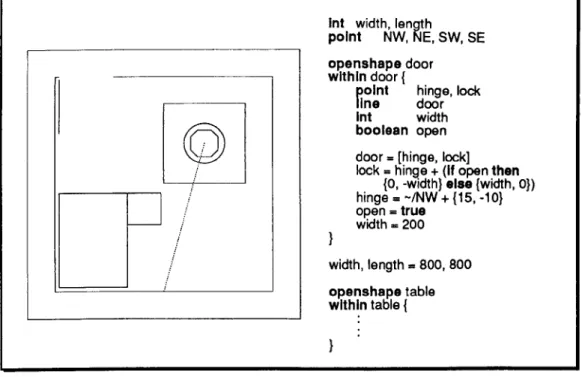
definitive systems provide immediate feedback. If a box is defined in DoNaLD by
lines joining its four corners and the positions of three corners are defined relative
to the south-west corner (box/SW), repositioning of the box by redefining the
DoNaLD variable box/SW will have an immediate effect on the positions of the four
be done on the current state in a short time. Later in the thesis, it will be shown that all the qualities of an exploratory programming paradigm - continuous
executability, extendibility, explorability and explainability - are present in
definitive systems.
In addition to the research in definitive state representation, methods of specifying
transitions between states are also investigated. The EDEN definitive languagel is
the contribution of Edward Yung to specifying definitive state transitions in a
sequential fashion [Yung89]; [Slade89] provides a thorough study of the LSD
specification language for concurrent systems modelling and the ADM
programming language for the implementation of LSD. These show that definitive
programming is capable of specifying general state-transition models. Hence,
definitive programming is an all-purpose programming paradigm which captures
data dependency.
2) Connections between definitive programming and other programming paradigms
We are actively developing an agent-oriented definitive system. This kind of
programming partitions a system into sub-systems according to the agents
involved. Every agent has a knowledge of its environment and has its own
variables. All these are represented by definitions. An agent will act upon its own
understanding of the environment by typically redefining some variables. In this
programming paradigm, programming using definitive state representation is
similar to functional programming and the agent partitioning is similar to
object-oriented decomposition.
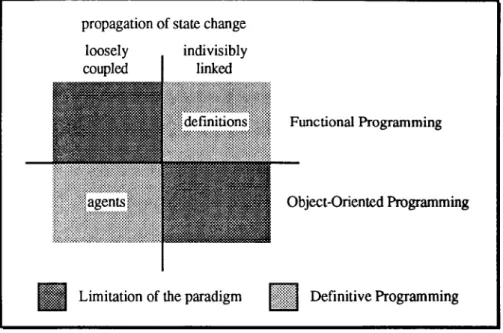
propagation of state change
Functional Programming
Object-Oriented Programming
Limitation of the paradigm 1!:!!:j!!!::j::::1 Definitive Programming
Figure 1.2: Programming Paradigms vs Propagation of State Change
Definitions and agents are associated with two complementary kinds of propagation
of state change. Definitive scripts are associated with indivisible propagation (e.g.
as in a mechanical linkage) and agents with loosely coupled propagation (e.g. as in
asynchronous communication), as illustrated in Figure 1.2.
In a functional program, everything is a function. Writing a functional program is
expressing the input/output relationship of an application in functional terms. There
is no concept of state in functional programming. This means that the relations
expressed in a functional program are of a static nature.
The primary use of functional abstractions in a historical sense is to represent
relationships between observations made in the same context. These relationships
are associated with modelling indivisible propagation of state change - they
correspond to 'definitions' in Figure 1.2. A functional abstraction is not the most
appropriate way to model propagation of state change that is loosely coupled, such
as commonly arises in interactive programming (see §2.2.2 and §7.1).
Object-oriented programming, in contrast, models propagation of state change in a
operation performed on one object requires corresponding operations to other
objects, this is modelled by means of message passing.
Object-oriented programming simplifies the representation of loosely coupled state
changes by reducing the problem of programming a system to that of programming
the objects within the system. This is closely connected with the role of agents as
in Figure 1.2. Object-oriented programming is less successful in representing
indivisible propagation of state change such as is required for synchronisation in
concurrent object-oriented models [Baldwin87].
Figure 1.2 indicates that a definitive program which combines scripts of definitions
and agent specification exploits the best qualities of the functional and
object-oriented paradigms.
3) Broad programming practice
There are few programming paradigms in use in the commercial world but there are
many programming paradigms used or under development in research laboratories.
Procedural languages dominate commercial computing, but increasing program
complexity and improved parallel hardware technology lead us to question their
suitability for applications in the future [Turner83, Landin66, Baldwin87]. Many
programming paradigms are invented. But will anyone of them be the future
programming paradigm, if there is one?
Baldwin, Hillis and Steele have argued that data parallelism is the key to
maximising the utility of parallel hardware [Baldwin87, HS78]. Data parallelism is
closely connected with the identification of data dependency. Baldwin compares
several programming paradigms with respect to their suitability for multi-processor
machines [Baldwin87]. By his analysis, neither conventional procedural
programming is good for specifying data dependency. In contrast, definitive
programming explicitly describes dependency relationships between data.
Baldwin suggests that constraint programming may be the best candidate for
parallel programming. However, constraint satisfaction is generally recognised to
be a time-consuming exercise. Most of the existing constraint systems either accept
only a restricted kind of constraint or use constraint management methods that are
given explicitly by the programmer. There are clear connections between definitive
scripts and systems of constraints (cf § 1.2). Definitive programming may be an appropriate compromise where efficiency, expressive power and convenience are
concerned.
In [Smith87], Smith argues that the relation between a program and the outside
world should guide the development of new foundations for programming - the
traditional account of the semantics of programs is not adequate. Programming
paradigm development should also focus on "the semantics of the semantics" of
programs. Definitive programming, a paradigm founded on describing the
relationship between observations obtained from experiment, may address the
essence of the problem [Beynon92, BR92].
The above points indicate that the most widely known and well established
programming paradigms have significant limitations. It is entirely possible that a
new programming paradigm which is based on modelling dependency would shake
the whole programming world.
4 ) Use of dependency in current systems
Although dependency is rarely formally studied, it is not difficult to identify
systems which make heavy use of dependency. The most prominent one is the
famous spreadsheet. An electronic spreadsheet is a table of cells in which the
values of the cells. A graphical user interface tool is another example. A style sheet
in word processors is yet another. Spreadsheets and style-based word processors
may be the most commonly used software tools, and most probably the explicit use
of dependency is a crucial reason for their success.
1 .4.
What Has to be Done
Our research in definitive programming can be logically divided into two sub-areas:
representation of states and modelling of transitions. In the area of representation of
states, definitive notations are designed and implemented to evaluate and explore the
advantages and disadvantages of definitions. In the area of modelling transitions,
higher-level specification and control languages are designed to govern the transitions
of states. Furthermore, a theoretical framework needs to be developed. Practical
examples are also required in order to evaluate the research in every stage.
1.4.1. Brief History of Definitive Programming Research
It would be helpful to present a short history of the research in definitive programming
to give some flavour of the scope the research involved. Whilst the definitive paradigm
has a relatively short history, definitive principles have been used informally to
maintain relationships between values of variables for a very long time. Early examples
include the specification of machining sequences in numerical machine tools in APT
[ITT67], Wyvill's interactive graphics language [Wyvill75] and the electronic
spreadsheets of the early 70's. The first paper to describe the abstract concept of a
definitive notation was [Beynon85], published in 1985. Independent definitive
notations and an agent privilege specification language were then developed in parallel.
In the area of developing definitive notations, there were only two definitive
notations designed before 1987. They were ARCA and DoNaLD. Amongst them only
ARCA was implemented. One reason for the slow development of definitive notations
design and implementation of the definitive language EDEN in 1987, the implementation job of definitive notations is greatly eased. The name EDEN is, in fact, an abbreviation of "an Engine for DEfinitive Notations". The implementation of a definitive notation becomes a task of producing a translator from the specific notation to EDEN and writing an associated EDEN library for the simulation of the data types and underlying algebra in the notation. This is a much simpler job than writing the evaluation engine for a new family of definitions. However, definitive notations were still running in isolated environments. Within a session, one could only interact with a single definitive notation other than EDEN.
Much of the development of an agent privilege specification language was carried out by Mike Slade. The LSD notation, first defined in 1986 [Beynon86b] and subsequently modified in 1989 [Slade89], was a result of this research. LSD is a specification language for the behaviour of multi-agent reactive systems. An LSD specification is not executable; it has to be transformed manually into the ADM language before execution [BSY88]. The ADM definitive language was designed both for the interpretation of LSD and to give a more satisfactory abstract account of the hybrid programming paradigm used in EDEN, and subsequently implemented for the former role by Slade. The main problem with ADM is its limited data types. This restricts the usefulness of ADM and hence hinders the development of LSD.
1. 4 • 2 • The Future
Ideally, the ultimate system will be very large. In that system, many definitive notations will describe different parts of a program. Possibly these definitive notations will be defined within a more powerful and general language. The LSD specification language has plenty of scope for improvement as well. Ideally, we should like to be able to specify the methods of conflict resolution for agent actions in LSD. Also, the transformation from LSD to an executable program should be simpler. A possible
simulation decisions in this way, the annotated LSD specification will be executable, in
principle. The ability to specify conflict resolution also implies the ability to model
higher level data dependencies, such as constraints.
Although we have some hints of what this ultimate system will be like, it still
seems to be a long way before a preliminary version can be prototyped. More research
on the LSD notation itself, the transformation process and the linkage between
definitive notations has to be done beforehand.
1 .5. Contribution of This Thesis
This thesis is not intended to overcome all the obstacles to the ultimate system. Its main
objective is to merge previous research efforts in definitive programming around a
unified theme. It becomes apparent that 'Programming as Modelling' is one of the
major contributions of definitive programming to the software development process
[BRY90, BBY92, BY92], and it is in this context that previous researches merge. Definitive notations, by having their specific domains and being definitive in nature, are
suitable for modelling states of the real world, while the agent privileges described by
LSD are suitable for modelling the dynamic behaviour of the real world. Because of its
strong modelling orientation, definitive programming satisfies the requirements for
exploratory programming - it is state-based, continuously executable, easily extendible,
conveniently explorable and usefully explainable. Apart from abstract discussion of the
potential of definitive programming, my practical contribution is to combine several
definitive notations, and to some extent LSD, into a single programming environment
based on definitions. This brings us practically a step forward to our vision of
programming.
This thesis will describe both practical work done and the philosophical
Practical work
1. In the area of definitive representation of state: A definitive system, Scout, in which
several definitive notations can be used cohesively, is designed and implemented. This involves modifications to the existing implementation of definitive notations as well as developing a general interface program to the window system.
2. In the area of transition of states: Firstly, the source of definitions of the system is widened. Originally, the only way of introducing new definitions was via textual input; now definitions can be generated by mouse events as well as generated by the system itself. Additional sources of input allow the system to respond to richer form of interaction with its environment. Secondly, an ADM-te-EDEN translator is prototyped. Since ADM is an implementation language for LSD and EDEN is the underlying language of the Scout system, the ADM-to-EDEN practically links the previous research works together. This work also indicates how the practical power of EDEN can, in principle, be expressed in the purer programming paradigm of the ADM where all changes of state are represented by redefinitions.
3. In the understanding of definitive notations: The definitive notation Admira is prototyped. Since the evaluation mechanism of Admira makes use of the functional programming system Miranda [Turner86], studying Admira is a means to understand the relationship between definitive programming and functional programming.
PhilosQphical advancement
This thesis:
2. develops the idea of using definitions for modelling the real world. By means of
definitions, the gap between a computer programming model and the real world is
narrowed.
3. advocates the new concept that definitive programming is good for exploratory
software development.
4. evaluates, by means of illustrative examples, the advantages and limitations of
current definitive system. In the course of this discussion, it will be demonstrated
that definitive notations can playa significant part in general-purpose definitive
programming.
1
.6. Outline of the Thesis
This thesis is organised so as to defend the claim that definitive programming is a
programming paradigm that is suitable for exploratory software development. In the
next chapter, the heart of definitive programming - the Definition-based
State-Transition COST) model - is introduced. The abstract virtues of the DST model will
also be explained. Chapter 3 shows that some commonly used software tools are
already using concepts and techniques close to our notion of definitions. Chapter 4
describes my design and implementation of the Scout definitive notation. Scout is a
definitive notation for describing screen layout. By means of an illustrative example,
Chapter 5 demonstrates how the Scout notation assists exploratory screen layout
design. Chapter 6 describes my work on integrating several definitive notations.
Through integration of definitive notations, we can broaden the domain for our
exploration. Chapter 7 stands between the discussion of definitive representation of
state and specification of transitions over such a representation. It discusses the ways
in which the power of single-agent definitive systems, such as Scout, may be
enhanced. The discussion prompts us to introduce more general agents into definitive
describing a software tool for assisting the implementation of LSD and giving practical
suggestions for improving LSD, this chapter advocates that agent-oriented definitive
programming can not only deal with all-purpose programming but is also suitable for
exploratory development of software. Chapter 9 summarises the thesis and concludes
2
Definition-Based
State-Transition
Models
J..n
•
the
Abstract
It has been mentioned in the introductory chapter that our system may ultimately
comprise many notations. Our current system can already relate six notations:
DoNaLD, ARCA, Scout, EDEN, ADM and LSD. DoNaLD is a definitive notation for
2-D line drawings [BABH86]; ARCA is a definitive notation for displaying and
manipulating a class of combinatorial diagrams [Beynon86a]; Scout is a definitive
notation for describing screen layout [Yung88]; EDEN is a general definitive language
for arithmetics, strings and lists [Yung87, Yung89]; ADM is a parallel definitive
language [Beynon88b, BSY88, Slade89] and LSD is an agent protocol specification
language [Beynon86b, Slade89]. Each of these notations addresses a specific domain.
notations, it is easy to lose focus on what the essence of definitive programming is.
Therefore, this chapter will abstractly describe the core of the definitive paradigm - the
Definition-based State-Transition (DST) model- before we discuss particular aspects
of these definitive notations or languages in more detail in later chapters. This chapter
will also discuss the virtues of definitive programming in relation to exploratory
software development.
2.1. The Definition-Based State-Transition (OST)
Model
In the early stages of the research on the definitive paradigm, emphasis was laid on
generalising the "spreadsheet" principle to more general programming notations
[Beynon85, Beynon88a, Beynon89]. Until the development of the LSD notation in
1986, the kind of interaction involved was still confined to "redefinitions by user". The
LSD notation described a system in terms of processes (and later agents [Slade89])
interacting with each other. Since then, research on definitive programming has been
widened to address general-purpose programming. Of particular interest in our
research is the programming principle embedded in what we have called definitive
programming [BNS88, Beynon88b, BRSYY89, BNRSYY89, BSY90], viz the use of sets of definitions to represent computational states. The understanding of definitive
programming in terms of states and transitions evolved gradually; the phrase
"definition-based state-transition model" first appeared in our papers as recently as
1989. The major work on studying the DST model started then.
A definition-based state-transition (DST) model is a state-transition model in
which a state is represented by a set of definitions - a definitive script - and a transition
is represented by a redefinition. A redefinition has essentially the same significance as
a definition. The term redefinition is appropriate because a definition will overwrite the
previous definition of the variable concerned whilst, if the variable has no current
If a definition has to be discarded from a state, it is equivalent to redefining the variable by a special undefined value. This is because we can imagine that the state is a
universal set of variables in which the variables are defined with undefined values by
default.
2.2. Comparison of the Concept of State and Transition
in Different Programming Paradigms
Petre and Winder categorise programming languages along a continuum between two
extremes of computational models - the imperative model and the declarative model
[PW88]. The imperative model is the computational model of the von Neumann
machine. This is a model of "computation by effect". Under this model, algorithms
are expressed as a sequence of changes of states. An imperative program contains
explicit instructions for controlling the flow of execution. The declarative model, on
the other hand, is a model of "computation by value". There is no sense of instruction
in a declarative model, instead there is a "script"l which defines what is to be
computed. Petre and Winder argue that there is a continuum of languages associated
with the shift from an imperative to a declarative style that involves the transference first
of explicit control and then of algorithmic information from the program description to
the implementation.
It is obvious that the imperative languages are state-based languages. The declarative languages are arguably stateless in the sense that they describe an abstract
input/output relationship rather than any computational state. From another
perspective, we might reason that a script is concerned with the deSCription of only one
state - the encapsulated behaviour of the required program (cf Chapter 7). In either way, the concept of state is not significant in declarative languages.
It is generally accepted that procedural programs are hard to verify and are more
difficult to adapt onto parallel machines [Baldwin87]. However, we believe that some
kinds of activities in the real world are most conveniently described by procedures. For
example, a person may like to pick up a book from a bookshelf, walk to a desk and put
the book on the desk. The behaviour of a person naturally comprises a sequence of
actions which is most appropriately represented by a procedure.
In definitive programming, a state is prescribed by a definitive script. The
maintenance of values of variables in a definitive script is similar in spirit to declarative
programming in that it involves implicit evaluation of expressions. In contrast to
declarative programming, definitive programming does not presume a declarative style
of specifying transitions. (Indeed, later in the thesis, we advocate the use of an
agent-oriented style for specifying state transitions.) There is, therefore, scope in definitive
programming to explore the virtues of both declarative and procedural programming.
Applying Petre and Winder's classification method, the position of the DST
model in the continuum from "imperative" to "declarative" is somewhere in between the
two extreme models but its bias may vary depending upon the way of specifying state
transitions. On one hand, the DST model has variables and a concept of state. In this
way, definitive programming is similar to the imperative model. On the other hand, the values of the variables are not necessarily directly modified by a program instruction
(there may not be any). This is because a definitive variable is fundamentally defined
by a fonnula instead of an explicit value. That is, its value is determined by what it is
asserted to be rather than by direct assignment. Therefore, if the language that governs
the state transitions is procedural, the DST model would be biased towards the
imperative model. Otherwise, the DST model would be biased towards the declarative
In view of ollr freedom to choose the specification style for state transitions, we
can identify the main characteristic in the DST model to be its novel approach to state
representation. Therefore, in the rest of this section, we will focus on comparing the
concept of state in different programming paradigms.
A definitive script specifies the following information pertaining to a state:
1) a collection of values (values of variables),
2) references to the components of the state (variable names),
3) data dependency information between components of the state,
4) methods of maintaining the state (formulae).
In the following sub-sections, the state representation methods of conventional
imperative programming, functional programming and object-oriented programming are
compared with that of definitive programming.
2.2.1. Conventional Imperative Programming
In conventional imperative programming, a state is a collection of variables containing
explicit values. The machine changes the state by assigning new values to the
variables. The connection between the values of the variables cannot be observed by
looking at one state only. The meaning of a variable cannot be understood without
referring to the program; the meaning of a variable may even change from one state to
the other during program execution. For example, in the following program fragment
1 sum:= 0;
2 for I := 1 to N do 3 sum := sum + a[I]; 4 mean := sum / N;
5
6 sum:= 0;
7 for I := 1 to N do
the meaning of sum in line 4 is the summation of N numbers but the meaning of sum
has changed to the variance of the N numbers after line 9, and at other points, sum is a
storage of intermediate results.
Definitive programming, to certain extent, gives meaning to the variables. A
definitive variable is defined by a formula. This formula is the 'value' of the variable.
The formula prevails until the variable is redefined by another formula. However, the
value of the formula may change over time as the variables in the formula are redefined.
Therefore, there are two levels of understanding a definitive variable: knowing its
interpretation (associated with the formula itself) and knowing its current value (the
value calculated from the formula).
Backus in his much referenced paper "Can Programming be Liberated from the
von Neumann Style?" [Backus78] points out two main problems with conventional
languages: word-at-a-time bottleneck and splitting programming into an orderly world
of expressions and a disorderly world of statements.
Word-at-a-time bottleneck is the input/output limitation of the von Neumann
machine model. This is reflected by the basic operation in a conventional procedural
language - each atomic state transition allows a change to the value of just one variable
(a single assignment). Because of advances in computer architecture, this
word-at-a-time bottleneck no longer applies to computer hardware. It is now the conventional
procedural language that imposes this bottleneck. Definitive programming breaks this
bottleneck by allowing indivisible changes of values of many variables in a single
transition of state. When the definition of a variable is changed, not only the value of
this variable will be updated but also the values of those variables defined in terms of
this variable.
Backus uses the phrase "the orderly world of expressions" to refer to the
expression has useful algebraic properties whilst a statement has few useful
mathematical properties. Using expressions in the context of assignments destroys the
usefulness of the algebraic properties of expressions by side effects. In contrast, the
definitive state representation preserves the usefulness of the algebraic properties of
expressions by persistently associating the expressions with variables. A change of
value induced by the change of other variables does not alter the expression associated
with that variable.
2.2.2. Functional Programming
Functional programming and definitive programming are, in principle, not comparable
concerning states and transitions because functional programming is stateless. A
functional script defines what is to be computed rather than how to compute the target
value. Neither is there a concept of procedural variable in functional programming; a
mathematical variable is officially not allowed to vary [BR89].
A disadvantage of functional programming arises also from the lack of the
concept of state; such a concept is almost indispensable for describing states and
transition in interactive programs. Dataflow languages (a branch of functional
languages) are more promising in handling interactive programming. Wadge's VISCID
program is an attempt to write a vi-like2 screen editor in LUCID [Wadge85]. Other
attempts at writing screen editors in other non-procedural languages like Prolog and
LiSp3 used side-effects and imperative features; Wadge tried to show using VISCID that
it is in fact possible to write non-trivial and non-mathematical applications within the
constraints of a functional language. However, VISCID relies on the lazy evaluation
strategy to control what Wadge has called "internal memory" variables. (Lazy
2 Vi is a standard UNIX full screen text editor.
evaluation (call-by-need) is used in preference to eager evaluation, where a function is
evaluated as soon as all the arguments are evaluated. If LUCID ran using an eager
evaluation strategy, VISCID could only perform batch mode editing rather than
interactive editing.) Based on the fact that the execution of VISCID relies on a
particular evaluation strategy and that it has a notion of internal memory, we shall argue
that although we
can
use a functional language to program interactive applications,programming in a state-based language would be a more satisfactory solution.
Although definitive programming and functional programming adopt
significantly different programming models, a definitive script (a set of definitions) and
a functional script have a useful mathematical property in common: a script (in either
paradigm) will always evaluate to a unique set of values. It is even plausible to argue
that a functional script is a definitive script (see §7.1).
Hudak did a survey on functional programming [Hudak89]. The survey
includes a discussion on the active research areas in functional programming. It is
interesting to note that there are researches going on in the direction of integrating
functional and imperative programming [Lucassen87]. It has been indicated in the last
sub-section that we are not promoting imperative programming. However, we
emphasis the importance of state-based programming. Although defmitive scripts and
functional scripts are superficially similar, their interpretation is fundamentally different:
our systems recognise on-line redefinition of scripts as part of the computation. This
provides a basis for interactive programming using definitive representations of states.
2.2.3. Object-Oriented Programming (OOP)
Many of the ideas behind object-oriented programming have roots going back to
SIMULA [DN66]. The first substantial interactive, display-based implementation was
the SMALLTALK language [GR83]. Associated with the widespread use of the C
language, extensions of C - such as Objective C [Cox84, Cox86] and C++
with all these languages - they are all procedural. Hence, OOP gives some people a
first impression that it is fundamentally procedural. However, there are a considerable
number of object-oriented extensions to non-procedural languages. Loops [BS81],
CommonLoops [BKKMSZ86], OakLisp [LP86] and CommonObjects [Snyder87] are
some object-oriented extensions to Lisp; SCOOP claimed to be object-oriented Prolog
[VLM88]. Hence, it is possible to merge OOP with other programming paradigms.
Object-oriented programming is more appropriately understood as a design philosophy
[Meyer88, Booch91, WP88].
Cox has described object-oriented programming as an evolutionary
development from procedural programming [Cox86]. In particular, the concept of data
in object-oriented programming has evolved from a procedural framework. An object
is more than a simple value (for example a floating point number in Fortran), or a group
of values (for example a structure in Pascal); an object has some methods associated
with it to specify how it is to be maintained.
Definitive programming can be viewed as a different kind of evolution from
data specification in a procedural style. Definitive programming enriches the meaning
of data by assigning to the variables formulae instead of plain values. In a way, we
may consider that a definition has already provided a method (the formula) for the
maintenance of the variable defined, so that simply grouping the related variables
together has a flavour of oriented programming. This suggests that
object-oriented programming and definitive programming can be usefully combined. Yung
has given some suggestions for object-oriented EDEN [Yung89] and Chapter 7.2.3 in
2.3. Virtues of the DST Model
2.3.1. Data Dependency, Concurrency and Consistency
An important area of concern in studying different programming paradigms is the
support for recording and retrieving data dependency information. Data dependency
information is useful in two areas: concurrent programming and program development.
With data dependency information. the compiler can automatically distinguish
when two operations must be done sequentially because one produces or destroys a
value that the other needs. Therefore, the more easily the data dependency information
can be obtained, the better the program is suited for parallel processing.
In definitive programming. an acyclic graph of dependency can be drawn from
a set of definitions and concurrent updating of the variables can be performed in each
layer of the graph. Such a scheme for concurrent maintenance of definitions is
discussed in depth in [Yung89]. This way of parallelisation is a kind of data
parallelisation (Le. parallel evaluation of data) which can be determined implicitly by the
system. Since it is hard to prove the correctness of those parallelisation schemes given
explicitly in a program. implicit parallelisation is more reliable. Moreover, data
parallelism is highly effective [Baldwin87. HS78]. Definitive state representations
seem to be a good foundation for concurrent programming.
Turner [Turner83] and Landin [Landin66] predicted the future trend for the
development of programming languages would be non-procedural languages. One
reservation they have about the development of non-procedural languages is that "on
conventional von Neumann computers, non-procedural language runs two to three
orders of magnitude slower than traditional imperative languages" [Turner83]. Turner
suggested that non-procedural languages can be used as effective tools for software
prototyping while waiting for the development of systems suitable for non-procedural
example dataflow machine architecture [Veen86, Sowa87], dataflow / von Neumann hybrid architecture [Iannucci88], parallel logic inference machine [Clocksin87, Jorrand87] and object-oriented computer architecture [Harland88].
Speed of execution is significant, but the efficiency of developing a program is of equal importance. The identification of data dependency provides useful information in maintaining a program during program development. Consider the following scenario. Suppose that the value of a in an imperative language, at a stage of program development, had to be maintained to the same value as 2 x b, but some time later the programmer determined to alter this assertion to "a equals to 3 x c". Then what the programmer has to do is to remove all the assignment statements of the form
"a
= 2 x b" and insert assignments"a
= 3 xe"
after each modification of the variablec.
If some of the "a = 3 x e" statements were, by mistake, not inserted, the old value of e would beretained in
a
at certain points of the program. Or if some of the"a
=
2 x b" statements were not deleted, then a might obtain a value totally unrelated toc.
Understanding data dependency assists the programmer to know exactly what actions have to be done to the program when the specification is altered.Definitive programming not only makes use of the data dependency information to maintain the consistency of data, it actually prevents inconsistency. Because there is only one persistent definition of a variable stored inside a state, no redundant infonnation and hence no potential inconsistency of data will be found in a definitive
2.3.2. Support for Incomplete Models
It is clear that, in certain contexts, such as during the construction or modification of a
model, some variables are not evaluable because the dependent variables are not
defined. This does not affect other parts of the model that do not depend on these
undefined variables. The partially completed model may still have a meaning: a room
without furniture is still a room. Even when a definition depends on undefined
variables, its defining formula is also meaningful, not least for the purposes of
analysis. A definition limits the possible values of the variable. This point will be
elaborated in the next section.
2.3.3. Possible Transformation
Just looking at a set of values gives us little information for reasoning about what these
values mean and how they should be manipulated. The following two DoNaLD
specifications5 both produce the shape shown in Figure 2.1.
By looking at the shape alone, it is not possible to guess which specification is
the one that generates this shape. This shape may represent a file cabinet with its
drawer opened, or it may represent a LED display which is showing the digit 8. A
correct interpretation of the shape can only be made with reference to the underlying
model in mind, which means a state of an object is more than a set of values (say pixel
values). Definitions relate the state and the model in such a way that changes in the
model reflect changes of external state; the possible transformations to the object are
openshape cabinet within cabinet (
int width, length
point NW, NE, SW, SE
Ii1e N, S, E, W
N = [NW, NE] S = [SW, SE] E = [NE, SE] W=[NW,SW]
width, length = 300, 300
SW = (100, 200} SE = SW + {width, O} NW = SW + {O, length} NE = NW + {width, O}
openshape drawer within drawer {
boolean open
} }
int length
Ii1e N, S, E, W
length = if open then -/Iength else
°
open = trueN = [-/NW + {a, length}, -/NE + {O, length}]
S
= [-/NW, -/NE]W = [-/NW + {O, length}, -/NW] E
=
[-/NE + {O, length} , -/NE]openshape led within led {
}
int digit
pard
p1, p2, p3, p4,pS,p6Ii1e L1, L2, L3, L4, LS, L6, L7
boo~ on1,on2,on3,on4,onS,on6,on7
digit = B
p1 = {100, BOO} p2 = {100, SOO} p3 = {100, 200} p4 = {400, SaO} pS = {400, SOO} p6 = {400, 200}
on1 = digit != 1 and digit != 4
on2 = digit!=
a
and digit!= 1 and digit!= 7 on3 = digit != 1 and digit != 4 and digit != 7 on4 = (digit == 0 or digit >= 4)and digit != 7
onS = digit == 0 or digit == 2 or digit == 6 or digit == 8
on6 = digit != S and digit != 6 on7 = digit != 2
L 1 = if on1 then [p1, p4] else [p1, p1] L2 = if on2 then [p2, pS] else [p2, p2] L3 = if on3 then [p3, p6] else [p3, p3] L4 =
If
on4 then [p1 , p2] else [p1, p1] LS = if onS then [p2, p3] else [p2, p2] L6 = if on6 then [p4, pS] else [p4, p4] L7 =If
on7 then [pS, p6] else [pS, pS]Listing 2.1: Two DoNaLD Specification for Describing the
8
ShapeB
Figure 2.1: An
8
ShapeIf we are interested in the
8
shape only, so that no more change to the shape isneeded, this information about possible transformation becomes redundant. Confusion
may arise here as to whether the transformation information should be classified as part
procedural graphics drawing package, it is possible to transform a geometric object to
another geometric object via addition and deletion of line segments or other operations.
A transformation from a
3
shape to anB
shape may take the following sequence:3,
a
and
B.
Does it mean "3 + two lines=
8"? Of course not. The interpretation of thisB
shape as the number 8 cannot be justified. Using definitions to represent a state of anobject models the object more faithfully because, on top of a set of values, the possible
transformations about the object are described as well.
2.3.4. Exploratory Software Development
To assist in exploratory software development, definitive programming provides:
• a modelling principle: a set of definitions models a state. This helps in the
understanding phase of software development.
• data consistency. By means of definitions, values of variables will be maintained to their associated formulae. This implies fewer errors during editing a definitive
program and easier for debugging.
• good prospects for efficient execution. The potential for data parallelism in
evaluating definitive scripts is an advantage for allowing more explorations in
shorter time.
These lay a solid foundation for developing definitive programming into an
exploratory programming paradigm.
The possibility for software exploration makes reasoning about the properties of
definitive programs difficult. This reasoning issue has to be addressed in the future, it
is probably associated with the issue of specifying the intended use of definitive