warwick.ac.uk/lib-publications
A Thesis Submitted for the Degree of PhD at the University of Warwick
Permanent WRAP URL:
http://wrap.warwick.ac.uk/99595
Copyright and reuse:
This thesis is made available online and is protected by original copyright.
Please scroll down to view the document itself.
Please refer to the repository record for this item for information to help you to cite it.
Our policy information is available from the repository home page.
T H E B R I T I S H L IB R A R Y DOCUMENT SUPPLY CENTRE
TITLE
0 (2 ) ‘Zquivariant M oie Interactions
A U T H O R
Andrew S. Hill
IN ST IT U T IO N
and DATE
University of Warwick,Attention is drawn to the fact that the copyright of
this thesis rests with its author.
This copy of the thesis has been supplied on condition
that anyone who consults it is understood to recognise
that its copyright rests with its author and that no
information derived from it may be published without
the author’s prior written consent.
T H E B R IT IS H L IB R A R Y
DOCUMENT SUPPLY CENTRE 1 1 12' r j i 1 4 1 5 ! 6
cms 1
Boston Spa. Wethertoy West Yorkshire
United Kingdom R ED U C TIO N X ...
21
0 ( 2 )
'Lquivariant
MocCeInteractions
Andrew S. Hill
P h .D . T h esis. O c to b e r 1988.
CONTENTS
CHAPTER 0. In trod u ctio n.
50.0. E q u ivariant B ifu r c a t io n Theory. 50 .1 . Action o f 0 (2 ) « Tn . 50.2. In v a ria n t Theory.
CHAPTER 1. The 0(2 ) e q u iv a ria n t steady-state/H opf mode in te ra c tio n s . 51 .0 . Background r e s u lt s f o r the steady-state/Hopf in te ra c tio n . 51.1. Isotropy Subgroups and Fixed Point Subspaces o f 0(2 ) x S 1 . 51 .2 . Computation o f 0 (2 ) In v a ria n ts and E q u iv a ria n ts . 51.3. Solution Branches and corresponding Eigenvalues. 51 .4 . The sp e cial case (t,m ) = ( 2 ,1 ) .
CHAPTER 2. The 0(2 ) e q u iv a ria n t steady-state/Hopf/Hopf mode in te ra ctio n s 5 2 .0 . S t a b ilit y r e s u lt and intended Model.
52 .1 . Isotropy Subgroups and Fixed Point Subspaces o f 0(2 ) x Tn . 5 2 .3 . Amplitude/phase Equations and (corresponding) Eigenvalues. CHAPTER 3. Mode In te ra ctio n s in the Taylor-Couette system.
53 .0 . The Taylor-Couette System.
53 .1 . The ten-dim ensional kernel : flows and symmetries. 53 .2 . B ifu rca tio n sequences in the ten-dimensional k e rn e l.
Many thanks m ust go to m y supervisor, Ian Stewart, for the fruitful conversations
and suggestions along with the original idea to pursue the study o f the three mode
interaction. I am grateful to Peta McAllister for the painstaking typing o f many
difficult tables. I would also like to thank m y fam ily and in particular my wife,
Pat Grinter, without whose support, both financially and otherwise, completing this
thesis would have been infinitely more difficult.
SIci&OTvUdgtments.
!Declaration.
ABSTRACT
CHAPTER 0 . In tro d u ctio n.
§ 0 .0 . Equivariant B ifu r c a t io n Theory.
The e x p lic it use o f group theory to organise the a n a ly s is o f b ifu rca tio n s in a dynamical system with given symmetry, has provided a well grounded framework in which the consequences o f symmetry can be discussed. This framework, u s u a lly re fe rre d to as E qu iv a ria n t B ifu rca tio n Theory, has been developed by a number o f authors c . f . Golubitsky and Sch ae ffer (19 84), S a ttin g e r (1 9 8 3 ), G o lu b itsk y , Schae ffer and Stew art (1988).
At the heart o f E q u iv a ria n t B ifu rca tio n Theory i s "spontaneous symmetry breaking" whereby a new branch o f solution s in h e rits some subgroup o f syim e tries o f the o r ig in a l branch. The theory analyses t h is phenomenon when the symmetry group i s a compact Lie group acting lin e a r ly on a system o f d if fe re n tia l equations w ith disting uished b ifu rca tio n parameter.
In p a rtic u la r , we c o n sid e r a compact L ie group r and system o f ODE
i ♦ g (x .x ) - o ( l )
where g : Rn x K p -► lRn i s a smooth mapping, x e F p the disting uished b ifu rca tio n parameters, and r > acting lin e a r l y on F n , commutes w ith g ,
y9 (x.x) - g (y X ,x ) v Y « r . (2 )
2
-9 ( 0 ,XQ) « 0
and the lin e a r iz a t io n L = (Dg)n
o ,X 0
a x i s , the lo s s o f s t a b il i t y fo r the guaranteed.
has eigenvalues on the imaginary steady-state solution x = 0 is
The r-e q u iv arian ce , co n dition ( 2 ) , allows us to c la s s if y new branches o f so lu tio n s b ifu rc a tin g from x = 0 , as fo llo w s . A point x has isotropy subgroup
I x = {y £ r | yx = x}
(3)
which gives p r e c is e ly the symmetries o f a so lu tio n x . Associated with the iso tro p y subgroup i s the fix e d point subspace
F i x ( l ) ■ 1/ i J " | , J = J V , , 1 ) . ( « )
so th at a so lu tio n to (1) ly in g in F ix ( z ) and not contained in any sm aller fix e d point subspace has iso tro p y z . In fa c t we see th a t any p o int lyin g in the o r b it o f a p o in t x , i . e . r * x , w ill have iso tro py contained in some conjugate o f zx . S t r i c t l y speaking, sin ce we consider o r b it representations o f s o lu tio n s , we c la s s if y so lu tio n s by conjugacy c la s s e s . Before intro ducin g some o f the to o ls o f e q u iv a ria n t b ifu rc a tio n theory - made a v a ila b le by the presence o f a compact group o f symmetries - l e t us introduce the c la s s o f b ifu rc a tio n problem we study.
p a r t ic u la r , i f the eigenvalues are zero we have stead y-state b ifu rc a tio n s , and i f p u re ly imaginary, Hopf b ifu rc a tio n s . Currently the eigenspaces asso ciated w ith these e ig en valu e s, or the corresponding lin e a riz e d eigen fu n c tio n s , are referred to as modes. As a number o f branches go unstable sim ultaneously there i s often a coupling o f the modes, v ia the no n-linear terms, g iv in g ris e to complicated behaviour. I t i s these so c a lle d mode in te r a c tio n s , in a dynamical system with 0 (2 ) symmetry, which concern us. In p a r t ic u la r we study 0 (2 ) symmetric steady-state/Hopf and steady-state/ Hopf/Hopf in te ra c tio n s .
The fundamental com plication introduced by symmetry i s th at eigenvalues o f L need not be sim ple. D iffe re n tia tin g (2 ) gives
yL « Ly V Y « r (6)
and i t fo llo w s from (6 ) th at the eigenspaces o f L are r - in v a ri ant sub spaces. T y p ic a lly these subspaces are irre d u cib le representations so that corresponding to each represen tation there w i l l be a type o f steady-state and a type o f Hopf b ifu rc a tio n , c . f . G o lub itsky, Sch ae ffer and Stewart (1988).
4
-Chossat (19 85). However, s t i l l to be considered i s the non-standard actio n f o r steady-state/H opf in te ra ctio n w ith double-zero and double imaginary eigenvalues ± wi and a lso a l l types o f three-mode in te ra c tio n s . However, as stated above, we r e s t r i c t our atte n tio n in the three mode case to the study o f the steady-state/Hoof/Hopf in te ra c tio n where we assure the eigenvalues 0 , ±w^i , and tu^i are each double.
In the study o f the th ree mode case we make two assumptions:
(a ) ^ 0 fo r any p a ir ( n ^ n .) ,
(7)
(b ) the vecto r f i e ld g in (1 ) i s in B irk h o ff normal form.
( 7 ) (a ) i s the standard assumption th at the modes are non-resonant, c . f . Takens (1 9 7 4 ). The assumption o f B irk h o ff normal form introduces to ro id al symmetry and allows us to compute the o r b ita l asymptotic s t a b il i t ie s o f so lu tio n ty p e s. Although t h is is a r e s t r ic t io n on the dynamic behaviour under con sideratio n as w i l l be seen in S2 there i s s t i l l 'plenty* going on.
In the study o f steady-state/H o pf in te ra c tio n i t i s possible to use a L1apunov-Schmidt reduction and although assuming B irk h o ff normal form to a l l orders would allow us to compute s t a b il i t ie s e x a c t ly , i t remains p ossible to estim ate the s t a b il i t ie s without t h is assumption, c . f . Stewart (1988).
» 0 .1 . Action o f 0(2 ) » T° .
5
-and Stew art (1985) -and Cho ssat, Golubitsky -and K e y fitz (1986). Before s ta tin g these re s u lts we introduce some o f the nomenclature.
Suppose X 1s a r - in v a r ia n t vecto r f i e ld whose lin e a r p art l has eigenvalues 0 , ±u>.,i , . . . , ±u>ki i . e . we assume an equ ivarian t centre manifo ld reduction has been performed (o r 1 f k « 1 a Liapunov- Schmidt reduction can be performed in s te a d ).
D e fin itio n 1. A re p resen tation o f a group r on a v ecto r space V i s said to be ab so lu tely irre d u c ib le i f the only lin e a r mappings on V comnuting with L are s c a la r m ultiples o f the id e n t it y , c . f . G o lu b itsk y, Sch ae ffer and Stew art (1 9 8 8 ).
D e fin itio n 2. The eigenvalues are non-resonant i f
» ) »]«•, aku.k ¿ 0 V a^ c 0 ( 1 » e ) and r-sim ple i f
b X 1') the r e a l e ige n sp ace Wj co rrespon din g to ±Wj i can be w r itte n
Wj » vj • V j where
r acts a b so lu te ly irre d u c ib ly on
o r (11) r acts ir r e d u c ib ly but not ab so lu tely irre d u c ib ly on . Under the assumption o f r - s im p lic it y a lin e a r change o f coordinates gives
l ■ r v . '
.
v
6
-and
O
m = dim W, '0
The assumption o f non-resonance gives the fo llo w ing to ra l a ctio n .
describes the standard Tn to ral action extended to Wg 9 ____ ® Wk • L e t Hn be the lin e a r space o f vector fie ld s whose c o e ffic ie n ts are homogeneous polynomials o f degree n . Le t ad L (Y ) ■ [ L .Y ] denote the Lie b racke t operation and l e t G be a complement fo r L(H ) in H
n n' n '
In p a r t ic u la r le t
Then we have the fo llo w in g :
Theorem 1 . Let X be a r- in v a ria n t vector f ie ld whose lin e a r p art L has p u re ly imaginary, r-sim p le non-resonant e ig en values. Then by a vector f i e ld change o f coordinates X can be put in the normal form
Let * » (* .
where
CJ * C0,*J 'nj '
;s1n*J 'nj «**j »„J.
fo r j » 1 ,k .
G„ - (Y , H„ ; (R e) . Y - Y Y * , Tk )
(3)
7
-where RN+1 i s r - in v a r ia n t and vanishes through order N , and
Yn € Gn n Hn( r ) where V r > “ {Y « Hn : Y .< r - in v a ria n t) .
Proof See G o lubitsky and Stewart (19 85).
A general . . . . # WL
r * Tk diagonal action may now be defined on by
where
T(“o... V i ... V V
■ ! i* o ...T ,1,TW1 ...TVk ’T"k^ r « r « Tk
(Vj.wf) « Mf • V, * Vf .
(<)
Furthermore we may w rite
K i-0
t 2K+l
(5 )
using the obvious id e n t if ic a t io n . We apply the re su ltin g 0 (2 ) * T k a c tio n in f l and s2.
§0.2 In v a ria n t Theory.
Obtaining a p recise d escrip tio n o f the r-e q u iv a ria n t mappings, ^ -*■ i s made possible by the assumption th at r i s compact, allowing us to e x p lo it some standard in v a ria n t th eo ry. We state the re s u lts fo r r-e q u iv a ria n t smooth germs o f maps (F n ,0 ) •* (F n ,0 ) and bear in mind th at id e n tify in g F 2 with C as in § 0 .2 allo w s us to work with a group action more convenient fo r the c a lc u la tio n s . We begin w ith some notation, c . f . G o lu b its k y , Schaeffer and Stew art (19 88).
Recall from §0.0 th at a r-equi v a ria n t mapping g: F n -*■ F n s a t is f ie s
y9(x) • g(yx) » y « r . (l)
S im ila r ly a r- in v a r ia n t function f : F n -*■ F s a t is f ie s
f(yx) ■ f(x) V y « r . (2)
We w rite E ( r ) fo r the s e t o f a l l smooth map-germs a t 0 g : F n -*■ F n which s a t i s f y ( 1 ) , and E ( r ) fo r the s e t o f a l l smooth function-germs a t 0 s a t is f y in g ( 2 ) . Observe th at E ( r ) forms a module over the ring E ( r ) . S i m il a r l y , w rite P ( r ) fo r the module o f r-equ1variant poly nomial mappings F n -*• F n and P ( r ) fo r the rin g o f r- in v a r ia n t poly nomials F n -+F . The cen tral r e s u lt i s the fo llo w in g , due to Weyl (1946).
Theorem 1 (H ilbert-W eyl Theorem) L e t r be a compact L ie group acting on F n . Then the rin g P ( r ) i s f i n i t e l y generated.
(2 ) The b asis may contain r e la t io n s , as i s ,f o r example the case f o r 0 (2 ) * T*1 acting on I 2™41 .
(3 ) We may, o f course, replace F n by a general vecto r space.
There are two other e ss e n tia l theorems due to Schwarz (1975) and Poenaru (1 9 7 6 ). In each we le t r be a compact Lie-group acting on R n
Theorem 2 (Schwarz) Every function-germ in E ( r ) may be expressed as a function-germ o f the H ilb e rt b asis o f P ( r ) .
10
-CHAPTER 1 .
The 0 (2 ) e q u iv arian t steady-state/Hopf mode in te ra c tio n .
5 l -°- Background Results fo r the steady-state/H opf in te ra c tio n . Studies o f the 0(2 ) stead y-state Hopf mode in te ra c tio n , as p re v io u sly remarked, have been performed in varying co n texts. However, i t s t i l l remains to consider a non-standard actio n fo r the above mode in te ra c tio n with double zero and imaginary eigenvalues ± ui . Results o f G o lubitsky and Stewart (19 85), (1986) in reducing the vecto r f ie ld under consideration by the Liapunov-Schmidt method, allow us to state the general form o f the 0 (2 ) » S1 b ifu rc a tio n problem studied here.
As in §0 consider a system o f O .D .E .i
x ♦ g ( x , x ) - 0 (1)
where x c ]Rm , X e F i s a b ifu rc a tio n parameter and g : F n * F - { s a smooth mapping. Suppose a lso that
- 11
i . e . g commutes with the action o f 0 (2 ) . The assumption that (**9 )(0 ,0 ) has 2ero o r Pu re ly imaginary eigenvalues allow s us to put the vecto r fie ld g (here we id e n tif y lin e a r vector f ie ld s with a lin e a r system o f O .D .E .) into B irk h o ff normal ¿m*.In other words we may assume g conmutes w ith 0(2 ) * to any f i n i t e order. Assuming the stro nger condition th at g conmutes w ith 0 (2 ) * S1 to a ]2 orders we have the fo llo w ing:
Theorem 1 Let <f> : * IR^ -♦ be the Liapunov-Schmidt reduced mapping so th at zeros o f $ are in 1-1 correspondence with p erio dic solution s of (1 ) o f period near 2n/|w| then
♦(z.x.T) - h(z,x) - 1(l+T)z*
where h : * F -*• commutes w ith 0 ( 2 ) * , t is the perturbed period parameter, and z * * ( O ^ ^ ) , the zero coordinate corresponding to the eigenspace o f the zero eigen value.
Proof A fte r a change o f coordinates the above follow s from Proposition 4 .3 , G olubitsky and Stew art (1986).
The assumption o f B irk h o ff normal form to a l l orders allow s us to put ♦ in e x a c tly the above form and allo w s us to compute p re c is e ly the s t a b i l i t i e s of p erio dic branches asso ciate d with the zeros o f (1 ) .
Begin by le tt in g (i^,Aq,tq) be a s o lu tio n to $ * 0 . Assume h commutes w ith 0 (2 ) x to a l l orders so th at $ takes the above form. P ro p o sitio n 8.1 o f Golubitsky and Stew art (1986) shows th at fo r a p e rio d ic solution
12
-w ith isotropy r , there are asso ciate d -with the so lu tio n a t le a s t d • 6 zero eigenvalues.
Theorem 2 Assuming h is in normal form, then the p eriodic so lu tio n u (* ) 'S o r b ita lly asym p to tically s ta b le I f 6-d^ eigenvalues o f ^ ^ (h g .X g .tg ) th at a^ not fo rced by the group a ctio n to be aero, have p o sitiv e r e a l Pa r « - The s o lu tio n i s unstable i f one o f these has negative real p a rt.
Proof See Golubitsky and Stew art (1985).
As remarked e a r li e r i t is not necessary to assume B irk h o ff normal form to a l l orders in the computation o f s t a b il i t ie s . However, 1n some systems there e x is t p hysical symmetries id e n tifia b le w ith S1 which imply - as long as a centre m anifold reduction can be performed - fh«f h may be put in th is form without lo s s o f g e n e ra lity . Such an example is the Taylor-Couette system, see S3.
F in a lly , performing a Liapunov-Schmidt reduction re s u lts in general co n d itio n s. Let the complex conjugate eigenvalues *f(d g )Q x be o (x ) s i * ( x ) • where o (0 ) , $ (0 ) ■ 1 and o '(0 ) t 0 - tran sv e rsa l In te rs e c tio n . Let q ( ^ . i , . i j . l . t ) be the 0 (2 ) . s ’ -e q u iv a rla n t complex Liapunov-Schmidt reduced b ifu rc a tio n problem then, w ritin g G « + 1G^ we have
(1 ) g' ( 0) • 0 . Gz (0 ) - 0
( K ) 6 ,( 0 ,. . .O . t ) • 0 , s f ( 0 . . . , t ) " -1 (4 )
(111) G^O.O) . o '( 0 ) .
13
-T h is follow s from Proposition 4 .2 Golubitsky and Stewart (1985).
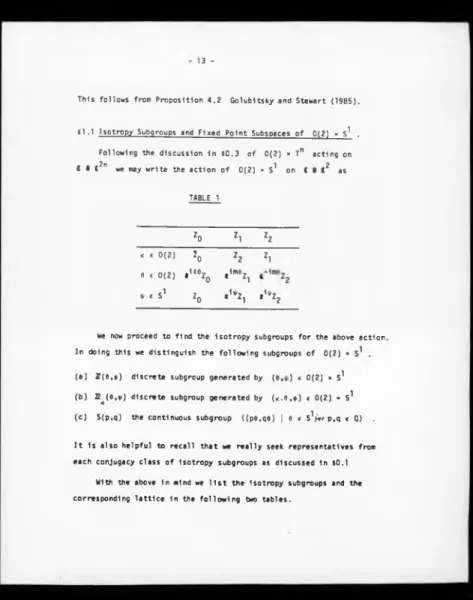
§1.1 Isotropy Subgroups and Fixed Point Subspaces o f 0(2) « S1 . Following the discussio n in 50.3 o f 0(2 ) * Tn acting on Œ ® H2n we may w rite the actio n o f 0 (2 ) * S1 on Œ ® Œ2 as
TABLE 1
zo Z1 Z2
K « 0 (2 ) 20 Z2
zi
e « 0 (2) *u % «, M Z,
♦ « S1 zo *1*z , « ' %
We now proceed to fin d the iso tro p y subgroups fo r the above a ctio n . In doing th is we d istin g u ish the fo llo w ing subgroups o f 0 (2 ) x .
(a ) Z(e,i|>) d iscre te subgroup generated by ( e ) c 0 (2 ) x S1 (b ) 2^(0,<>) d iscre te subgroup generated by (ic.e.ii») e 0 (2 ) * s 1 ( c ) S (p ,q ) the continuous subgroup {(p e .q e ) | e c S^ftr p,q e Q} .
I t i s also h elp ful to re c a ll th a t we r e a lly seek re p resen tatives from each conjugacy cla s s o f iso tro py subgroups as discussed in 50.1
14
-Note th at fo r the c y c li c group 2 ^ 0 ,0 ) o f order 2 we use the shorthand 2^ and th at we do not consider any t r i v i a l action o f 0 (2 ) * S1 .
TABLE 2
Isotropy Subgroups and t h e ir fix e d point subspaces.
z F ix I dim F i x ( r ) 0. 0(2) - s ' (0 )
1.
2.
2c» I ( ^ .0)« s ' £ even S (l.- m )
1m(Z0 ) - Z, . Z2 - 0
z0 - z2 . 0
1
2
3.* z , - Z (ir.ir)
m z0 - o . z , - z 2 2 4. Z^C* Z(ir,mir) 3
£ even
Im(Z0 ) - 0 . Z, « Z2 3
5. 2 ^ (0 ,w )[* Z(iT,rmf)] £ even
Im (Z„) - 0 . Z , = -Z2 3
6. * < x '"t 1 ) * > * . ■ * 1 Z2 - 0 4
7(a) 2 ( 5 •*>
zo - ° 4
(b) 2(w ,im r)(£ even) s • c 2 6
15
-we w rite down the l a t t i c e (o f conjugacy c la s s e s ) o f isotropy subgroups o f 0(2 ) * s 1 . We w rite I 1 = Z(n,nm ) and note that there are d ifferences according to whether i i s even, d iv is ib le by 4 and m = 1 , which are not shown in Table 3.
where arrows in d ica te containment of one conjugacy c la s s in another. I t remains to v e r if y Table 2. The sim p lest way to do th is i s to pick 0 (2 ) x s 1 o r b it re p resen tatives and fin d t h e ir corresponding iso tropy subgroups. We assume any t r i v i a l actio n i s factored out, 1 .e . the kernel o f the actio n i s facto re d out. F i r s t we look fo r iso tro py subgroups not containing the in v o lu tio n * . Considering the action o f elements in such isotropy subgroups e x p l i c i t l y we have
TABLE 3
L a ttic e o f isotropy subgroups o f 0 (2 ) x s
0 ( 2 ) x S
16
-By inspectio n we immediately have fo r I even the group element (*,m n) fix e s a l l Z e d ® G2 and assuming ( e ,* ) acts n o n - t r iv ia lly no more such elements e x i s t , v e rify in g e n try 7 (b ). Suppose ZQ f 0 sin ce k l I we may choose e ith e r Z] t 0 (Z? - 0 ) or Z? f 0 (Z , ■ 0)and weobtain entry 6 . Now, assuming If t i we may ro ta te ZQ onto the real a xis by e £ 0 (2 ) M < }* S1 . Since we have above the only iso tro p y sub groups 2 s . t . k i 2 and Zqf 0 in F1x(2) we now seek iso tro p y subgroups containing < with fix e d p o int subspaces containing (elements with non-zero f i r s t coordin ate. Such iso tro p y subgroups w ill contain elements of the form « .( e .V ') and, ag a in , w ritin g the action e x p li c it ly we have
< .(» .» ) (Z 0 . Z , , 2 j ) • ( , - U e 20 . , 1<"«**>Z2 . <">-*>*,). (3 )
I t i s immediate that no such elements f i x d i d 2 .
We now make the fo llo w in g claim : I f Z i s fix e d by * . ( 6 , * ) then
Z « (0 (2 ) X S1 ) . (X o .Z .iZ ) . (4 ,
To prove th is consider f i r s t the group a c tio n on the second and th ird coordinates. (3 ) im p lie s
( . ) , 1("***> z2 - z ,
(b) .• '< M -*>Z, • Z2 . * *
17
-and computing the action o f (- f- . - ™ + p .) gives ( e ’ 7 l6 20 ,z 2 , ( Since we have Zp < (0 (2 )\ f« rJ) -XQ choose e' to obtain the r e s u lt .
To v e r if y e n trie s 1 , 3 . 4 and 5 in Table 2 we must check fo r conjugacies.
Proposition There e x is t Y e 0 (2 ) \ {k) xs1
(a) t( 0 .Z ,.Zj) ■ ( o .z , . - z 2 ) (b) v ( * 0 .Z .- Z ) = (Xq,Z Z) when e|4
(6)
Proof he note th a t fo r (6 ) ( a ) T - - f ) . Lettin g y . ( , . * ) in ( 6 ) (b ) we have
(a ) e1le - o .
(b ) e1™ +1* . 1 . (7 ) ( c ) e -im a *i* . , _
Now ( 7 ) ( a ) , (b ) and (c ) imply there e x is t p ,q ,r C Z such th at
(a ) *e = 2p-n , (b ) me + \li • 2qu , (c ) -me + 1/7 * (2r+l )w Combining ( 8 ) (b ) and (c ) g ii th is by !B(a) g ives
4m
£ - ( Z ( q - r ) - u P
(8)
( 2 ( q - r ) - l) ir , and d iv id in g
( 9 )
-1>PZ2 )
18
-I t is immediate from (9 ) th a t ( 6 ) (b) holds i f f t | 4 .
F i n a l l y we check f o r re m a in in a is o tro p y subnrouDS n ot c o n ta in in a <
SuDpose we have ZQ « 0 in th e elements o f th e f i x e d - o o in t su b sn ace.
Noting th at S (l,m ) = <S(l,-m )ic 1 we v e r if y e n trie s 2 and 7 (a ) in Table 2.
Remark In the case when tan d m are odd, and in p a r t ic u la r equal to 1 , we have (Xq,X^,-X^) e (0 (2 ) * ) • (i Yq,X.| ,X .|) w h ich, in t h is coordinate system, i s the o r b it re p resen tative chosen by Golubitsky and Stew art (1986). Also when i i s even th is i s not a new o r b it re p resen tativ e and i s therefore not required.
§1.2 Computation o f 0(2 ) In va ria n ts and E q u iv a ria n ts .
We are concerned here w ith computing the 0 (2 ) x S1 e q u iv a ria n t normal form fo r smooth (germs o f) maps G : C3 (t3 . As we have already seen these smooth e q u iv a ria n t maps form a module over the rin g o f smooth in v a ria n t maps and the rin g has a f in it e number o f generators so we begin with the fo llo w ing :
Proposition 1 The rin g o f smooth 0(2 ) x in v a ria n t (germs o f) maps -»F i s generated by:
N0 ‘ u0 • N1 * ul +u2 • ” 1 * ul u2 • °1 * Re( z o ^ * z 2 )n)
02 - «1Im(zg(i.z2)r')
where u.. * z ^ , « ui”u2
19
-Proof We prove the above fo r polynomial maps C3 -♦ F then fo llo w s by Schwartz(1975).
A polynomial mapping C3 -«-F has the form
f ( 2 ) • £ Aab za; b
in m ulti-index no tation.
Now consider the action o f 0 ( 2 ) \ U } x S1 on f : ( th at f o r invariance
f ( v z ) - f ( z ) V y . 0 (2 ) . S1 .
From ( 2 ) , by comparison o f c o e ff ic ie n t s ,
(a ) e c 0 (2 ) \ (k} £ (a 0-bQ) + m ^ -^ -ag + b g ) « 0 (b ) * « S1 al -bl +a2 ' b2 = 0
Now generators fo r the rin g o f in v a ria n ts correspond spanning s e t fo r in te ge r so lu tio n s o f (3 ) in (Z+)® .
Combining ( 3 ) (a ) and (b ) gives
(a ) ( t odd) * (a 0-bo) + 2m(a1-b1) - 0 (b ) ( t even) £ ( » o ' V + m( al * bi ) • 0 • Concentrating on ( 4 ) (a ) - noting the same argument w ill
i even - we have, since s. and m are assumed coprime
( • ) «O O (b) e .-b .
The re s u lt
i1*
C3 -*• F re c a llin g
(2)
(3)
to a minimum
(4 )
hold fo r
(5)
20
-Now j - 0 gives V1 ■ ( 1 ,1 ,0 ,0 ,0 ,0 ) , V? « ( 0 ,0 ,1 ,1 ,0 ,0 ) , and v3 * ( 0 ,0 ,0 ,0 ,1 ,1 ) belonging to (E+)6 . When j > 0 we nay w rite (5 ) ( a ) and (b) as
(a ) ( » ¿ ,0 ...0) + S V ,
, where s , t e 2 + (6 ) (b ) tV , - (0,0 ,0 ,b -j , 0 ...)
which provides us w ith a fu rth e r member o f our spanning set ( 2 m j,0 ,0 ,£ j,£ j,0 ) but since j > 0 , the minimum such element in (Z * )6 i s V4 « (2m,0 ,0 ,£ .1 ,0 ) .
S im ila rly fo r j < 0 we obtain ( 0 ,- 2 m j ,- £ j ,0 ,0 ,- £ j ) and sin ce - j > 0 we may d ivide through g iving Vg = (0 ,2 m ,£ ,0 ,0 ,£ ) .
V1»V2»V3»V4 and V5 correspond to the in v a ria n ts uo*ui * u2* Zom^ l z 2 ^ and ^ 1^2^* ' R®call1ng th at we seek only the re al in v a ria n ts these become
V V “ 2 , . Im (z|m( ( i 1z 2 ) 't) .
Now f i n a l l y we consider the action o f k . C le a r ly we obtain the in v a ria n ts NQ , N, , M, and 0 , and sin ce fo r f ( z ) = Ira(z§",( i 1z2 ) t ) we have f(<Z) = - f ( Z ) we m u ltip ly by the minimum anti-sym m etric poly nomial 6-| = u-j-Ug to obtain in v a ria n ce .
Theorem 2 The module o f 0 (2 ) x e q u iv a ria n t smooth (germs o f) mappings C3 I 3 has the fo llo w ing b a sis over the rin g o f in v a ria n ts :
zo . is, z0 .
*0 ^1*2^
. is, 50’1(*1*2)B
0
0
0
0
0 . 1 0 • ' 0 . i ' 0 . 0 1 ■ , 0 Z1 Z1 U2Z1 U2Z1 z0<*1z2 ' z2 2SfiI 22 )B ' z2
z2 . u ,z2 u ,z2
z0<z1z2 )B 1 1 zg (z ,z 2 ) e 1z,_
0 . i f 0
u2, 5**122>8 ' z2 u22° ^ l z2 )e l z 2
_U1 z0 ( Z1 z2)^ \ “lzS(zlz 2 )e"'zl
where 2v t odd ' v i even
■ r * i odd ( 1/2 i even.
Proof Recall th at Poenaru (1976) says we need only check the above fo r polynomial maps. We deduce the above from a Lerrnna and Proposition concerning the re la tio n s h ip between in v a ria n ts and equ1variants o f the general actio n 0 (2 ) . 7 " on t i t 2" . Before giving these we generalize some n o tatio n . For the polynomial j : t • t 2' . t 1 t ! " commuting with the action o f 0 (2 ) . f on t • t 2n , S 0 .2 , w rite
9<z ) 1 (90( l ) ... 92j _ i ( z ) . g2J ( z ) , . . . , g2n ( z ) ) . ¡ ( . | | l ! * . | (7)
where g (y z) . Yg (z) V T , 0 (2 ) x t" . (8 )
Application o f the in v o lu tio n x gives from (7 ) and ( B ) .
( • ) 90 ( « z ) ■ 90(1)
22
-(9 ) (b ) im plies th at we seek fo r g2j-_i : C 9 tt2n -*■ I , 0 (2 )^k * T11 e qu ivarian ts over 0 (2 ) x T11 in v a r ia n t s . (9 ) (a ) makes the gQ e qu ivarian ts s lig h t ly more messy but we are able to extend the follow ing to obtain the required r e s u lt .
Caveat: In sta tin g and proving the fo llo w in g we are aware that i t can be derived from more general re s u lts in A lge b raic Geometry. However, we give the re s u lt and proof appropriate fo r t h is s e tt in g , ra th e r than introducing unnecessary machinery.
Lemma 3 . The e n trie s in the b asis f o r 0 (2 ) * Tn e qu ivariants corresnonding to . i = l ... .2n, are given by a spanning s e t over II o f , where
s2f
i s the H ilb e rt b asis fo r the rin g o f 0 (2 ) x T0 in v a ria n t polynomials
C2n+1 F .
Remarks G p is n o t'f re e 1 i . e . there e x i s t re la tio n s in . Althouqh not a necessary condition one consequence o f t h is i s th at the above soanning s e t i s not unique with the obvious im p lica tio n fo r 0(2 ) x Tn enu ivarian t b ifu rc a tio n Droblems th at the c o e ff ic ie n ts in any T aylo r extension d if f e r , depending on the chosen H ilb e rt b a s is .
In order to prove Lemma 3 we re q u ire the fo llo w ing p roposition.
P roposition 4. I f I is an 0(2 )\{te ) x Tn complex in v a ria n t then i s an 0 (2 ) \ {k) x Tn e q u iv a ria n t on I . . Moreover, the (I. e n trie s
a2i 1
23
-Proof Begin by considering the general form fo r a polynomial 9, : t « t 2n - t , i . e .
9 ,(2 ) - lA ab2af b (11)
0 (2 J-x* x Tn equivariance im plies
(a ) e « 0 (2 ),« V o - V * - » ,
(b) * , «
s'(*,)
(c ) * j « S ' ( * 3 )
V bi ♦ • , + r bi+ i • ' (>2)
a2 j-1"b2j-l+a2j~b2j ’ 0
•
Applying the same reasoning as in P rop osition 1 in varian ce w . r .t . 0 ( 2 ) ^ x Tn leads to
(>) m0<*0'i 0 > + ^ * 2 j-1 (“ 2J-1 ' 82J-1 ' “ ¿ ¿ * * 2 )1 ■ 0
(13)
(b)
But (1 3 )(a ) and (b ) together are e qu ivale n t to
(a)
V *
0' 8
0>
*j b,
"
2j-l(*
2j - r 8
2j - r °
2J+9
2j>
2JA1+1
* m1 (« ^ -(e ^ -l)-“ i * 1* e i <.i ) - » ,
(b)
«i - (8,-1) ♦ •)«, - ej+, • ,
(15)
24
-Obtaining the equivalences i s simply a matter o f checking through the p ossible ways o f ob taining m1 in (1 5 )( a ) . This v e r if ie s the f i r s t part o f the cla im . As in Prop osition 1 we seek a minimal spanning s e t to (12) in p+)6 . We have, from (1 5 ), th at an element o f such w i l l take the form
v ■ (a0 ,e0...4j - l ,62j - r1,02j ,62j ... “2n - l ,82n - l ’ a2n ,62n> • <,6 >
(«o... ®2n> « 19 •
I t i s now easy to see th at any so lutio n to (12) may be w r it te n as V plus lin e a r combinations o f elements o f Ig . g
W riting 6 as the generating se t fo r the 0 (2 ) x Tn in v a r ia n t complex polynomials C2n+1 •+ I we now extend the above re s u lt to 6 . F i r s t le t us introduce some nomenclature.
Le t M.j , i * 1 ...N , be a monomial in Ig . E it h e r i s < in v a ria n t or no t. I f not l e t
V ■ N1 ■
(17)
W riting those in v a ria n ts th a t are * in v a ria n t as we see th a t
19- <A1... " - - V i ... w •
With the above nomenclature we have the fo llo w ing :
Claim 5 : G c o n sists o f elements o f the form
25
-Mi Mj MkM* + Ni Nj NkN* are 9enerated by the above. The r e s u lt then follow s
by in d u ctio n . g
Proof o f Lemma 3 Begin by taking d e riv a tive s o f G , in the above claim . Using Proposition 4 , a f t e r e lim in a tin g redundancies, we obtain - 2 - ^ ,
s2f i / 0 , i s a b asis fo r 0(2 )\< « Tn e q u iv arian t polynom ials t 2n+^ .* over 0 (2 ) x T0 in v a ria n t polynomials C2n+1 - t . We ob tain a H ilb e rt b asis Gp by taking complex (lin e a r ) combinations o f G so th at complex (lin e a r ) combinations o f Gp w ill give a spanning s e t as required. □
aZ1
Proof o f Theorem 2 I t i s a sim ple matter to fin d the e q u iv a ria n ts corresponding to g] and g2 from Lemma 3.
To fin d the e q u iv arian ts corresponding to gQ begin by no ticing th at
Gp gives 0(2)-w x S1 equ ivarian ts corresponding to gQ . (N o tice,
3Z0
th at (9 ) (a ) ru le s out the need to consider complex (1 in e a r ) combinations. ) Now, fo r gQ we also have < e qu ivariants which are 0 ( 2 ) \kx in v a ria n t in p a r t ic u la r , i(u^ -u2) i s such an in v a ria n t Using the above claim we can check t h is is the only such polynomial. W riting V - ( 1 , i(u j- u 2 )^ we have V ' , a f t e r elim in atin g redundancies, gi ves the basis
320
elements corresponding to gg . □
51 .3 . So lution Branches and corresponding Eigenvalues.
- 26
-i s th a t we may w r-ite
where
qV k w t j j, * 2
r’j j-i i h t i z j * R5; ; (2) i 2 ) * - ' , PJ = + i61p^+1
Qj « qj + 1qJ+l + u2qJ+2 + iu2qJ+3
Rj « Qj .<
pJ ,q j are (germs o f) mappings (N0>.
and z odd 6
z even
. . . 02,X , ) - F f t z odd
1
(t/2 z even.
(1)
Branc hin g equ ations an d eig en val ue s fo r so lu ti o n s w it h given sy m m e tr y.
-28
« V i - » ’ CSJ O
> S P
csj>o
~ r , / SO csj o
csj o co — '
X c r so ir> ^? c s j^ o i csjcsj
c o ^ CSJ _____________ CSI^O
— SO —■
% - * V ~ X ° CSJ r— O .
o . csj Ô —^
csj X i_n - + .— 'a :
CSJxO CSJjO CL
' • O ’ SO CSJ
c r __ o . + __ csi0 " c r 1—1 ló
X + CSJ O + CSJ i—
— O X CSJ .— X CSJ o csj X + CSJ »— + -—- X - % 1
O’ c r c r (O c r c r __X ir> c r ' c r
z i •+■ n_ — - c i csj r o ^ c r co O . z >— i * ° ’S
-CSJ — » X
co co elcsj + co x . ¿ t , , ? 5 i— ¿ O’
£ ~ ? S .---1 O F - Z C S J r- 1
~ x ° «S’ c o *
o e s i^ ^- “ c s j^ o .— z S “ ^ ~ > P >
■— z O »
-O ' — e r X ’ e x ^ c r
CSJ O . 1 8 0 I X CSJ Q . «______________ 1
il i h
«a-¿ ¿ -g ¿ ï S - s
o o
°>p °>p
f " co
.. N CQ CQ
¿J_C> J — > 1 - 1
-°K ° _ Í ° ~ CSJ CSJ
? ? o __ ~ r - CSJ i—
n ° x ° Bx ° * U h
CQ 8 * 0 8 * 0 ° > P
en Lf’o ’ ^ c r t' Jx
-CSJ^r— c
a_
CQ_ wO or¡J » 7 T - r r ■ « v r y
%r~r.? * -r
<«= r r i— CSJ i— CSJQ . Q . O ’ O ’fu_x roX x x " a ~ > r ~ > r S T
_ ? y _
y
t . 4->
«o (O
1
_
«= *'■'
^ f 7 ' “ Ô
* * T
- x ° • —X
J=
Xo4
(a
)
c
td
30
-Remarks
(1 ) Notice th at although we l i s t re s u lt s fo r * odd and even (»* 2) in Table 4 the branching equations fo r these two cases are quite d if fe r e n t . In the former the branching equations are always even in x0 and x-| whereas in the latter,m onom ials th at are odd in xQ occur. We e x p lo it the f i r s t in an a p p lica tio n in §3.
(2 ) For s o lu tio n type 7 a sh o rt c a lc u la tio n shows th at i f x^ t t 0 then q3( 0 ,x3+ x |,x3x | , 0 . 0 , x ) = 0 . We s h a ll see th at q3(0 ) t 0 , in S3, i s a non-degeneracy condition required to guarantee so lu tio n s with lower dimension fix e d p o int subspaces and so a f u ll d escrip tio n o f solution type 7 requires s in g u la r it y th eo ry.
(3 ) Notice when branching equations 4 and 5 co in cid e as predicted by the group th eo ry.
To f a c i l i t a t e the c a lc u la tio n o f the eigenvalues o f (d $ ), . (Xq,Aq»tq; we bring together a number o f r e s u lt s commonly used in the lit e r a t u r e c . f . Golubitsky and Stew art (1985), G o lu b itsk y, Stew art and S h a e ffe r (1987), Buzano and G o lub itsky (1983).
The f i r s t r e s u lt hinges on the is o ty p ic decomposition o f a vector space X under a compact L ie group r . F i r s t , w rite
X - V, • . . . 9 Vk (3 )
31
o f r on r- irre d u c ib le s o f Vi and , i / j i s non-isomorphic.
Lemma 1 Fo r a lin e a r map L : X •* X commuting with r , we have, using the above notation
L ( V 1 ) c V i .
Proof See Golubitsky (e t a l ) (1987).
The above w ill o b vio usly hold fo r the compact Lie group z c 0 (2 ) x acting on t3 and the lin e a r map ( d$ ) | F i x ( Z) which commutes with z . The second re s u lt a lso allo w s us to make use o f the nu ll-eig en ve cto rs
0 f ( d i ) ( Z . x . T ) •
Proposition 2 Le t c T and be d iffe re n tia b le with the id e n tity . d(Y t .2) | °
Assume d> ( z ) = 0 then --- i s a n u ll-e ig e n v e cto r fo r d t | t=0
(d * > ( * . x . T) •
Proof As in Buzanoand G o lubitsky (1983). Since <p(z) * 0 we have
♦(Yt z ) ■ 0 (4 )
sin ce « vanishes on r*z . Now, ju s t d if fe re n tia te ( 4 ) .
Note: The n u ll-e ig e n v e cto r i s non-zero when the curve i s transverse to Z which i s the generic s it u a t io n .
32
-( a ) ( z 0 , z l f z2 ) - ^ ( e 1 te z0 , e lmez 1 ,e 1mez2 ) « (1 t Z g . i n ^ ,-im z2 )
H i , ( 5>
(b ) ( *0.1, .« j ) + % (z Q .e ^ z ^ e 1^ ) - ( O . l z , , ^ ) .
Remarks Lemma 1 allo w s us to put the 6x6 m atrix d$ into block diagonal form. I t i s , o f course, the case th at any o f the above re la tio n s h ip s would have come out in the wash but in keeping with the general philosophy we allo w group theory to both organise and sim p lify the c a lc u la tio n s .
We are now able to d e ta il the c a lc u la tio n s o f the eigenvalues fo r
1. Fo r I * 2 < x S1 we decompose I3 = VQ i 9 9 V2
where « <(1,1,0,0,0,0)> , V¿ = <(1, - l ,0,0,0,0)> ,
V-, = < ( 0 ,0 ,1 ,0 ,1 ,0 ) ,( 0 ,0 ,0 ,1 ,0 ,1 )> and = < (0 ,0 ,1 ,0 ,- 1 ,0 ) ,( 0 ,0 ,0 ,1 ,0,-j>
fo r the a c tio n s , which
are o b v io u sly non-isomorphic.
No- ( d » ) | „ . ♦ Z 0 . pi »♦n 4
but p = 0 is the branching equation fo r t h is is o tro p y , so th at one
1 2
e ig en value i s 2pA xt .
33
-3*o s»0
( d* ) | v . = p1 = 0 , g iving a zero 1 2
320 » c Also (d«j> )
h •
1 1.2 , takes the form
’ *1 bi '
V
»*1 9$. 9$. where a = ---- + b .
szi 322 3Zi 9Z2
Giving eigenvalues q ♦ n5* 21 <1 *o i 1(q2 x q6x 2- l - , )
(6)
2. For I = 6 ( 1 ,-m) we decompose « Vq ® ® V2 where = C . The action i s e a s ily seen to be non-isomorphic. Note, ( d $ ) L ,
| Vj j ■ 0,1,2. , takes the form
b ,"
where a . = ■ and b . « — * . (7 )
Computing the e n trie s we have, a f t e r s u b stitu tio n o f branching equations, J . ,„ 2 2 „2 \v2 ,
«0 " p + 1P • b0 “ 0 • a i " («In. + 1(1n. )x!
• 2 * (q3 ♦ iq4)x2 .
34
-3. T * i « 2 ( 1 , „ ) we decompose t3 as 1n 1 with the fo llo w ing action
vo *0 V1 V2 1 -1
R. R.tit m m
1 -1 1 1
whichare again non-isomorphic. Also notice th a t the nu ll-eig en ve cto r ( O .i x .i x ) o f ( 5 ) (b ) belongs to F i x ( r ) - V, so th at ( d * ) L has a zero
vi eigenvalue and so we need o n ly consider the tra c e of
3$, 3$,
(d«t>) I v * Re( ---- + --- ) . we a ls o have th e n u ll- e ig e n v e c to r
I 1 3Z1 3Z2
(0, i x , - i x ) o f ( 5 ) (a ) belongs to V2 g ivin g a s im ila r r e s u lt f o r (d<*.) j y 3 3 $ o 3$m 3«-In f a c t , trace ({d e ) „ ) • Re( — i --- ? ) - - Re( — 1 --- ? ) ,
I
2
s z , s z2
s z,)i2
by applying < and using equ ivariance or by straig h tfo rw ard observation. Following 1 we v e r if y the eigenvalues fo r 3 .
To c a lc u la te eigenvalues fo r so lu tio n s 4 and 5 req uires a l i t t l e more e f f o r t .
2
The iso tro p y subgroup 1-2^ decomposes t3 . V, 9 V? where V, - * ( z0*20 . z , t z 2 , z ^ Z j , 0 , 0 , 0)> - F i x ( r )
36
-Computing the e n trie s fo r (10)
*0, I ! °
» 0 s5o
I ! e 82i
n1*2
pN0*0 ' ♦ («P0i +2p ^ ) x j x p + ^ 3 A - 2 J B
7 T / ^ ‘ 2\ V ° *
2pi , v > 4
* <2PN1^«pJ/o^PM31«i)«5''x?‘ -'
* 6Po1xoa' , »?e' 1
2 "*(i r * ¡v> ■
4[ ql 0V 1 * 5 qV
^
’ 4 « * v ? * I Po/S'M 6''
+ “ a 3 x ? " 1* 2643 + o5X041* 2®-1 * n 7 yo+12e+l
4 7 q01x0 X1 4 qN0x0 X1 4 qN0x0 X1 ♦ S o5 x2“- 1*46’ 1 t “ o7 x 2a-l 4e+l
7 "O ^O X1 4 7 ^ * 0 X1
2 Re(— - + — L) 2q3x f ♦ ( B - l H q ^ ^ f j x J x f- 2 . 2,7,g x26
* ^ N,* 2 * « " ¿ / l ♦ < / , *2sP01x0x?6
* “pm3/ ? ♦ 26P o ,xSxPt2 ♦ 4P5N, xSxf6
S .
,5 a 2fi+2 „5 .2a .2B-2
* 26<<0 ,x0 XI
4<^ ,x0x3B+4 ♦ 2q7i x2“ x?6
+ 4a7 xa x26+2
^ V l
]
T r i v i a l l y we obtain the trace and to lowest order* * * [, PN0(P3+2qJ , )x0xf * 2<“ - ') p 3(q3*2qj )«S'2x(6*2
♦ ( o - l ) (e -1)p3q5x^“ "2x4e‘ 2
* 2(2p ^ epV0-2,2. -2) ( i , io<„ , x ; -2,2, -2)>2, g
37
-In the case »hen t i s odd we may neglect fu rth e r terms giving the re quired entry in Table 4 (a ) but when t i s even the entry i s r e a lly the T a y lo r expansion a t aero o f ( 1 1 ). However, t h is s lig h t abuse of no tation should not cause too many problems.
To compute e n tr ie s fo r (9 ) we have, using branching equations,
A fte r some algebra we obtain the given e n trie s . A s im i la r , c a re fu l, computation v e r if ie s the eigenvalues f o r so lu tio n type 5.
»♦ 1
a (q3V x f ) x ; ♦ a i (q % q V ) x !
3$, 3«.
38
-51 .4 . The special case (£,m ) = (2 ,1 )
The standard 0(2 )-H o pf a n a ly s is , c . f . Golubitsky and Stewart (19 85), or Schecter (1976) and B a ja j (1982) fo r a p a rtic u la r case w ith a d iffe re n t approach, fin d s two primary branches corresponding to a ro ta tin g wave with a one-dimensional iso tro p y subgroup and a standing wave with isotropy subgroup 2^ • The i n i t i a l e xp ectatio n , in an 0(2) mode in te ra c tio n , is to fin d a l l the primary branches a t the degeneracy. However, Table 2 shows th at when £ i s even and m = 1 the iso tro py subgroup corresponding to the standing wave has a three dimensional fix e d point subspace and since a primary branch i s guaranteed only when dim F ix (Z ) = 2 , c . f . Golubitsky and Stew art (1 9 8 5 ), these cla s s e s of non-standard 0 (2 ) actio n s give new phenomena fo r 0(2 )-stead y-state/H o pf in te ra c tio n s . In f a c t , when t ( the branching equations on the three-dimensional fix e d point subspace form a Z 2-e q u iv a ria n t corank-two b ifu rc a tio n problem and the contact equ ivalent normal form s, up to codimension 5 , are known c . f . Dangelmayr and Armbruster (1983). We use these re s u lts to s im p lify the study o f the above s p e c ia l case. We begin the a n a ly s is o f the s p e cia l case and explanation o f the above by co n sideratio n o f the appropriate branching equations.
39
-where map (Xq,2x^ ,x^,XqX * ,0 ,x) -*■ IR and 1 / 4 .
Remark: The standard method of fin d in g so lu tio n s to equations o f the above type i s to use equation ( l ) ( c ) to e lim in a te t and then apply the im p lic it function theorem to conclude the existen ce o f so lu tio n s in some neighbourhood o f the o r ig in - see §3. However, sin ce the equations are not even in each v a ria b le th is brute force method becomes messy and ( c e r t a in ly ) does not provide a clean route to the q u a lit a tiv e descrip tio n we seek.
Concentrating on equations ( 1 ) ( a ) and (b) - as we may assune t to be e lim inated - w rite
( a ) 9q(x0 ,x1•*) = P xo + P X1
(b ) 9^(xo*x | . * ) - I 1 ♦ q3* i + q5x0x j * ' 2 ) /2 + q’ x o x j1'*2 *72)« ,
(2)
we see th at - 9 ,(«o'■X,,») = 9 ] (Xq. -x, .» ) i . e . g1 commutes with the 2Z2
actio n X1 - x , . I t i s now c le a r th at G(xQ, x1!•>) ■ (90(« o * « l»«) •
9 ,( x 0.« forms a corank two Z 2~equivariant b ifu rc a tio n problem. Dangelmayr and Armbruster study th is problem using the theory o f im perfect b ifu rc a tio n s o f Golubitsky and S ch ae ffe r, which i s developed in f u l l in Golubitsky & Schae ffer (1 9 8 5 ). The two basic ideas o f the above theory are contact equivalence (w ith a disting uished b ifu rc a tio n parameter) and a un iversal unfolding. The notion o f contact equivalence i s w ell known and in th is case we also wish the Z 2-symnetry to be preserved. The appropriate d e fin it io n i s :
-- 41
[■'
4
and 0.0. 0. X1
Remarks:
(1 ) When £|4 g ^ X p .x ^ x ) does not coimute with 22 action and the b ifu rc a tio n problem is a general problem g : IR2 x ]R -*• ]R2 - a t le a s t on th is fix e d p o int subspace. I f codim g s 3 we have a H illto p
b ifu rc a tio n c . f . Golubitsky and Sch ae ffer (1985). However, gx (0 ,0 ) = 0 , a non-degeneracy condition in the above, so thatcodim g 2 4 .
(2 ) When £/4 but £ > 2 we a lso fin d co d in g s 4 .
I t i s well known th at the Liapunov-Schmidt method reduces study of degenerate Hopf b ifu rc a tio n s to a corank-one 2 2~equivariant b ifu rc a tio n problem c . f . G olubitsky and Langford (1980) fo r a s in g u la rity theory approach with distin g u ish ed b ifu rc a tio n parameters. Consideration o f a steady-state/Hopf in te ra c tio n w ithout any symmetry reduces via the Liapunov- Schmidt method to the study o f a Z2-e q u iv a ria n t corank-two b ifu rc a tio n problem c . f . Armbruster e t al (1 9 8 5 ). Unfortunately the above paper adopts the approach th at the two modes should be 'v i s i b le ' a t the degeneracy precluding the study o f ( 1 ) . The philosophy adopted in th is th e s is i s to consider mode in te ra c tio n s p rim a rily as the dynamics a ris in g on the d ire ct sum o f eigenspaces corresponding to the individu al modes. This in te rp retatio n obviously includes (1) fo r study.
43
-Note: The unfolding Go in (5 ) i s equ ivalent to replacing q*(0) w ith 8 in the branching equations where we s e t afqj(0)|5ig n(q ^ (0)) = 8 .
To obtain appropriate choices fo r , e^ and Eg we consider the s t a b il i t y conditions fo r the above. The eigenvalues associated with the so lutio n types fo r (fc.m) = (2,1) can be computed in the same way as those in § 1 .3 . U n fo rtu n ately, the ro ta tin g wave s o lu tio n does not have a correspondingly simple is o ty p ic decomposition, leaving us with a 4x4 m a trix. However, in any a p p lica tio n a numerical a n a lysis could be carried out - we adopt th is philosoDhy in §3 where larg e m atrices providing s t a b il i t ie s are not amenable to an a n a ly s is by hand.
T aylo r expanding the re s u lt s o f the above computation fo r the e xtractable eigenvalues we have:
(0) T r i v i a l Solution : d jx [2] , B + q^X [4 ] ( I ) Steady-state : o m . p i
"0
4
, 8 + q jx t q5x0 [2.2]( I I ) Rotating wave : o c n . q i »? [ID , and eigenvalues o f
a 0 0 b
0 a b 0 0 c d 0
c 0 0 d
p' + ip x! 3
,2V2
1
pJ + ip x! _5
■7X? ♦ 1<r6T 8, * ) d - (q3 ♦ 1q4)x?
44
-Adopting the convention th at eigenvalues should be p o sitive fo r s t a b il i t y we see th a t:
(1 ) Pw > 0 i s necessary fo r the steady-state to be b ifurcate
N0
s ta b ly and th at the so lu tio n b ifu rca te s s u p e rc ritic a lly i f
p] < 0 when p i > 0 .
*
™
o
(2 ) The ro tatin g wave requires q l > 0 fo r s t a b ilit y and
0
b ifu rca te s s u p e r c r it ic a lly when q j < 0 . This g iv e s:
£1 “ • c2 * s1gn ) • c3 ‘ " s , 9" (O5(0) ) . (8)
A quick check shows th at i f the ro tating wave and tyoe ( I I I ) solution are to concur then q^(0) > 0 . S im ila r ly , i f the type (IV ) solution and the ro tating wave were to b ifu rc a te sim ultaneously then q^(0) «• 0 , a t le a s t when condition (8) i s imposed.
Since we deal w ith the reduced equations fo r the type ( I I I ) solution observe th at the s t a b il i t ie s on the three dimensional fix e d point subspace are given by the eigenvalues o f
sgo Ü2 ,x 0 3X,
Ü1 I E i
**0 SX,
45
-Computing DGq , w ith the above conditions imposed, gives
Trace DG = 3x£ - xn - a
‘
3 2' ' 0,
det DGa « - 2 s1gn(pJ (0) ) x ,
47
-CHAPTER 2.
The 0(2 ) e q u iv a ria n t steady-state/Hopf/Hopf mode in te ra c tio n .
§2 .0 . S t a b ilit y re s u lt and intended model.
Study o f the 0(2)-steady-state/Hopf/H opf mode in te ra ctio n is a natural extension o f e ith e r o f the two-mode systems. We study the system
i ♦ g(x.x) - o
(l)
where g : * F -*• IR^ and g conmutes with the 0(2) action o f §0.1. The assumptions (7 ) in §0.0 o f non-resonance and B irk h o ff normal
2
form im ply, § 0 .1 , th at g commutes with 0 (2 ) x T . A fu rth e r important im p licatio n o f the assumption o f B irk h o ff normal form, fo r a p p lica tio n s, i s , a ft e r id e n tify in g F10 = a5 :
Theorem 1 A so lu tio n Z (t ) o f (1 ) i s o r b it a lly asym ptotically stable i f the eigenvalues o f (D g), which are not zero or forced by the action
z0 2
o f 0(2 ) x T to be zero have p o s itiv e real p a rts .
Proof Having made a simple adjustment fo r the presence o f a steady-state mode the re s u lt fo llo w s from Theorem 5 .1 , Chossat e t al (1987).
49
-TABLE 5.
z0 Z1 z2 z3 z4 < « 0(2) z0 z2 21 z3 e t 0(2) e z0 e zt
1* ,
e z2 e z3 e z4 *1 « S'xiO ) 1 e ' z , e ' z2 1
1*2 1 1*2
lk2 £ (O)xS' 1 1 1
* ?z 3 • ?z4
Also r e c a ll th at by fa cto rin g out the kernel o f the group action we may assume there i s no common d iv is o r fo r a l l three o f I , m, n .
We proceed as in S i .1 to fin d the iso tro py subgroups and in doing so we d is tin g u is h the fo llo w ing subgroups o f 0(2) x T2
(a ) Z(e,<|»i ti|i2) d iscre te subgroup generated by ( e,»p1 ) e0(2) \ {k}xT2
(b) Z K ( e ,* r * 2) d iscre te subgroup generated by (<6,^ ,^2 ) « 0 (2 )x T2 (1 ) (c ) S ( p ,q ,r ) the continuous subgroup {(p e ,q e ,re ) |e e s \ p ,q ,r e Q}
The p o s s ib ilit y th at any p a ir in U ,m ,n ) may have a common d iv is o r re s u lt s in the consideration o f the fo llo w ing cases:
(t,m) « d] ; (i,n) - d? ; (m,n) « d3 . (2)
We w rite
5 0
-In the follow ing tables we give the iso tro py subgroups a ft e r the t r i v i a l action o f 0(2 ) (Table 5) has been facto red out. I t is also important to re a lis e th at, with (2) in mind, we abuse notation in the follow ing way.
I f d] t 1 , dg i 1 and d3t 1 then the actions o f 0(2)
re s t ric t e d to E , - < (I0.Z ,.Z 2)> . £? - < ^ 0 . z y z,)> or E j ■ < ( . , . i j .23.24 ) . have non-empty k e rn e ls, K. , n = 1 ,..,3 . Therefore, on a fix e d point sub space w ith appropriate coordinates se t to zero we think of the isotropy sub groups as a subgroup of (0 (2 ) * T2) ^ / ^ . C le a rly the above choice is not unique, consider the p o s s ib ility F i x ( I ) c Ei n E^ , i t j .
In t h is case s e t K,.^ to be the kernel o f the action o f 0(2 ) re s t ric t e d to Ei n E^ . From (3 ) we have
( di ’ dj ) * 1 1 * J (4)
otherwise the t r ip le (£,m ,n) would have a common d iv is o r.
(4) -> d3 |m] , d2 |n3 . (5)
We w rite
m - m4d,d3 . n * n4d2d3 . (6)
51
Isotropy subgroups and fix e d point subspaces
TABLE 6 .
z F 1 x (I) dim F i x ( z )
0 . 0 (2)«T2 {0)
1. * T2 , 0 . 0) Im(z0 ).2 ,= 2 2. 2 3=z4 . 0 1
2. (a ) S ( l,- m ,.0 ) « S ( 0 ,0 ,l ) V 22*z 3*24 ■ 0 2
<b) S ( l ,0 ,- n 4 )« S (0 ,1 .0 ) V W 24 ■
0 2
3 . (a ) Z * Z ( £ - , * , 0 ) x S ( 0 , 0 , l )
k m4 20*Z3 * 24 ’ 21 ■ z 2 2
(b) Z * Z ( — ,0 ,» ) x S ( 0 ,1 .0
‘ n4 W l 2 • ° - z 3 * 24 2
4 . (a ) I K« S (0 ,0 ,1 ) [x Z ( * tia^ir,0)] Im(z0 )=23=z4 = 0 , 2, = 2, 3
even
(b) Z K«S(0( 1 ,0 ) t>Z(i«,0,n2ir)] lm(20 ) - 2 . . 2 2 ■ 0 . 23 . 24 3
i 2 even
5 . (a ) Z ( 0 ,ir .0 ) x S (0 ,0 .1 ) [ «Z(Tr,m,ir,0 ) ] Im ( 2 .) .2 ,.Z 4 ■ 0 . 2. - - 1 , 3
f / £-| even
(b ) Z ( 0 ,0 ,ir)x S (0 .1 ,0 )[x Z ( ir ,0 ,n 2ir)3 Im(z0 ) .z .= z - 0 , 2, = -24 3
< r i* i * 2 even
6 . S ( l.- « 3 .- n 3 )
z0"22*z4 * 0 4
7. S(1,-m 3, n3)
V 22*23 - 0 4
8. Z < x Z(ir,m3ir,n3'n)
20 * ° * z r z2- z3"z4 4
9. ( 0 , 0 ,it) * Z(it,m3it,n 3iT) (n3 even)
20 ■ “ • z r z2- z3 ■ ” z4 4
10. 2 ^ (0 ,it,0) x Z (71,111211,0 211) (m3 even)
20 * ° - 2 1 “ “ z2- z 3 ‘ 2t 4
2 2itm.
11. (a ) 2 ( | i , - j - ! - , 0 ) x S ( 0 ,0 ,l ) [ xZ(n.m -ii.,0)] ZJZ3-Z4 = 0 4
t 2 t , even
2 2nn?
(b) Z ( | ! , 0 n r ^ )« S (0 .1 .0 )[ xZ(w.0 .n2w)] z1*Z2«Z4 « 0 4
52
-TABLE 6 ( c t d .)
12. (a) * S (0.0.1)
m4 z0*z3*z4 - 0 4
(0 ) * £ - . 0 . » ) * S (0 .1 .0 )
n4 Z0"21*z2 ■ 0 4
13. Z < x Z (",np r,n») lm(20 )*0 , 2, *2j . 23-24 5
a even
14. 2 ^ (0 ,t, 0) x Z(T,mn,niT) ( i f 4 | f then m even) Im(20)=0, 2, - -22 . 23=24 5
n even
15. Z<( 0 ,0 ,it) x Z(TT,mTT,nir) ( i f then n even) lm(20)=0, 2, -22, 23= -24 5 * even
16. 2 <( 0 ,tt,h) x Z(T,nviT,nn) lm(20) -0, 2,= -22, 2j= -24 5
{ 1 even
” • ( V 1 )
o
o 6
1B- 2% - i ^ - * > (" s '” ) z0* zl * 0 6
19. Z ( ^ , ^ L ) . t>2
z2*z 3 * 0 6
20. Z ( | l , S p ., i j l ) , i>2
z2*z4 ' 0 6
2 1 .(a ) Z(ir,m n ,0 ) £-| even
z 3*z4 ■ 0 6
(b) Ziu.O.ngTf) 12 even zl*z2 ■ 0 6 22. Z(n,nrn,mr) £ odd
z0 * 0 8
£ even l S 10
Notes: I f £ even then Z K(0 ,ir t w) * 2 ^ * , 0 , 0 ) and furthermore fo r 4 | / 14 = 16 and 13 = 15 when m i s even
1 3 * 1 4 , 1 5 * 1 6 when n i s even
L
a
tt
ic
e
o
f
is
o
tr
o
p
y
su
b
g
ro
u
p
s
54
-Containment in Table 7 in d icate s containment in a re p re se n ta tiv e o f a conjugacy cla s s o f a coset.
Legends Table 7.
3 (») coincides with 4 (a ) when m.j =1 and *.j even, 3(b) coincides w ith 4 (b ) when * 1 and ¿2 even, - « ( • ) coincides w ith 5 (a ) ^ | f, and 13 « 14, 15 - 16 , <(b) coincides with 5(b ) ♦ U * »"<! 13 - 15, 14 « 16. * 8 and f not present i f m^ = 1 and ‘ 1 even o r m^ *
* 9 1 f n3 even,, 10 i f m^ even.
** 11(a ) absent i f *1 s 2 - 11(b) absent i f *2 s 2 ‘ S 12(a) only 'contained' in 2 (a ) i f 3 (a) coincides w ith 4 (a ) .
12(b) only 'contained' in 2(b ) i f 3(b) coincides w ith 4 (b ). SS 17 absent i f m^ = 1 , 18 absent i f n^ = 1 .
General ru le . I f an iso tro py subgroup is absent then containment j u s t passes along the tab le in the natural way. e .g . i f 17 is absent then 12 i s contained d ir e c t ly in 21.
F in a lly since 21(a) and (b) represent a t r i v i a l a c tio n o f 0(2 ) * T2
55
-To v e r if y Tables 6( a ) , (b ) and ( c ) i t i s ap prop riate to adopt a s im ila r procedure as th at fo r Table 2 S l . l . We enumerate subspaces o f and then check 'a lg o rith m ic a lly ' which are fix e d - elim in atin g those made redundant by conjugacy i . e . i f dim F ix (r^ ) ■ dim F ix t l g ) and F i x ^ ) c r * F ix ( E j) then i s conjugate to • E n trie s 1-5(b ) fo llo w immediately from Table 2. Fo r the remainder we have dim F i x ( l ) « 4 and e ith e r < e I or n o t. F i r s t consider the case ki 1 .
To begin suppose dim F ix (Z ) * 4 and the coo rdinate zQ i 0 then e n trie s l l( a ) - 1 2 ( b ) fo llo w from Table 2. Now suppose dim F i x ( l ) = 4 and z ■ 0 . W riting the actio n o f ( e ,^ ,« ^ ) « 0 (2 ) * T2/K3 e x p li c it ly
Checking through the consequences fo r ( e , *2) i f Zg * z^ * 0 or Zg B z3 * 0 gives e n trie s 6 and 7 . I f z3 * z^ * 0 then we may a lso fa c to r through the actio n by thus v e r if y in g 1 2 (a ). S im ila r ly we check 1 2 (b ). Suppose now, th at dim F ix (E ) > 4 and Zq ■ 0 .
2i "3e , I f z1 .Zg i 0 then (7 ) »> e J ■ 1 so th at e ■ — . Which
» . 3
in turn im p lie s * x and *2 “ 1 fit accordin9 as *3 * ° o r z4 * 0 . But we see th at choosing both i s ruled out by conjugacy - j u s t apply * . This v e r if ie s entry 17 and s im ila r ly fo r 18. E n try 21 1s obvious.