Analysis of the Spectra of Compounds
Containing Lanthanide Ions
A THESIS
SUBMITTED FOR THE DEGREE
OF
PHD IN PHYSICS
IN THE
UNIVERSITY OF CANTERBURY
by
Steven M. Crooks
Abstract
This thesis is concerned with the mechanics of transforming between observational data of lanthanide ion transition intensities and the parameters which model the observed intensities. The accuracy of intensity measurements and the underlying accuracy of the model used to predict the observables is investigated. Investigation is made of the effect of uncertainties for the fitting of transition intensities and rotatory strengths.
In this thesis it is shown that the parameterisation of the transition intensity operator using the Reid-Richardson Ai~ intensity parameters is inherently, multi-valued. vVhen the superposition model is not explicitly assu.:ned,, distinc~ sets of A~ parameters can exist which produce identical calculated spectra. In this thesis, a new parameterisation was de-veloped which allows the easy identification of the multiple solutions of the electric-dipole transition parameters. It is possible to transform between the different A[~ solutions by a matrix transformation. Additionally, this new parameterisation allows the different polarisations that can be observed in the symmetry to be treated separately. For exam-ple, in most high symmetry systems it is possible to write a parameterisation for the 1r polarisation and fit the resulting parameters independently of the parameters for the (]" polarisation.
With only a single polarisation for the intensities or circular dichroism it is not possible to determine all of the A~ parameters, both (]" and1r are required. Published analyses of circular dichroism are repeated using the new parameterisation scheme showing the effect of this polarisation dependence, and the improvement over previous work.
The intensities for low symmetry systems, or the 1r polarised intensities for most symmetries, can be written as a linear matrix equation.
The possible use of Stark effect splittings to determine the intensity parameters is investigated. The use of the Stark effect in the investigation of transition intensities appears to have been previously unexplored by other researchers. It is found that such Stark splittings are expected to be resolvable and have magnitudes of the order of O.lcm - l .
It may be possible to utilise splittings of hyperfine lines to determine parameters which describe the transition intensities.
Intensity parameters are presented for a variety of systems that have been analysed for the first time in this thesis. Intensity parameters for the C4v symmetry centre of Pr3+:CaF2 and Pr3+:SrF
2 systems are presented. The vibronic transitions for the Cs2NaEr3+Cl6 system were analysed and the vibronic intensity parameters were determined. Re-analysis of the previous results was carried out uising the new parameterisation and a new set of intensity parameters is presented.
The level of statistical significance that can be assigned to distinct parameter sets is examined. It is found that quite small variations in the
x
2 value for fitting intensities can.JBRARY
Michael Reid, without whom I am nothing.
Acknowledgements
In writing these acknowledgements I find that it necessary to differentiate between those who have been actively engaged in some substantiative way in the work of this thesis, and without whom this thesis would not have been written, and those who have been important in an intangible, though not tangential way.
In the former case, participation of Gary Burdick and Michael Reid were intrinsic to the completion of this thesis, and my successful completion of it is indubitably linked with there capable supervision and understanding. It is doubtful whether much would have been achieved without the skills, enthusiasm and commitment shown to me by them. My success is therefore in equal parts theirs.
In the later case, I find many of the activities that were required for the completion of this degree were may much easier and accessible by the staff and students of the University of Canterbury. I can however single out some who were notably helpful. Mark Atchison for computer related problems, former students Dr's Bary Searle, Luke McAven, Mattias Johnson Stephen Jamieson and Dr Stephen Botha for providing and contributing to pleasant work environment, and my Academic co-supervisors Dr ·william Moreau and Professor Rod Syme.
Contents
Figures viii
Tables ix
1 Introduction 1
1.1 The structure of this thesis 2
2 Theory of Transition Intensities
in
Lanthanides 42.1 Introduction 4
2.2 The Model Space 4
2.3 The Free Ion 5
2.4 The Crystal Field 8
2.5 Transition Intensities 9
2.6 Vibronic Intensities 14
2.7 The Superposition Model 17
2.8 Vibronic Intensity Parameterisation 19
3 General Fitting of Transition Intensities 21
3.1 Introduction 21
3.2 Non-Linear Fitting 21
3.2.1 Multiple Solutions 23
3.3 Transition Intensities for Pr3+ in MEF 2 Hosts 29
3.3.1 Results for Pr3+:SrF2 and :SrF2 31
3.4 Results for the Nd3+:YAG system 36
3.5 Vibronic Intensities in the Er3+:Cs2NaErC16 system 38
3.5.1 Introduction 38
3.5.2 Theoretical 39
3.5.3 Results 41
3.5.4 Conclusions 44
3.6 Vibronic Intensities in the RE3+:Alkaline Earth Fluorides 49
3.7 Testing the Superposition Hypothesis 53
3.7.1 Introduction 53
3.7.2 Method Applied 53
3.7.3
Oh
symmetry Cs2NaErCl6 543.7.4 Results for Cs2NaErC16 55
3.7.5 C4v symmetry Pr3+:SrF2 and Pr3+:CaF2 59
3.7.6 Results for SrF 2 and CaF 2 59
3.7.7 Results for Nd3+:YAG 61
3.8 Conclusions 64
4 Linear Fitting 66
4.1 Introduction 66
4.2 Matrix Uncertainties 67
4.3 Polarisation Resolved Intensity Measurements 71
4.4 Circular dichroism 74
4.5 Matrix Circular Dichroism Fitting 75
4.6 The Nd3+:0DA system
81
4.7 The Stark Effect 85
4.8 Stark-Effect Hyperfine Interactions 87
4.9 Conclusions 92
5 Monte- Carlo Analysis 94
5.1 Resolveability of Minima 94
5.1.1 Variation in
x
2 for created data 975.2 Conclusions 104
6 An Application of Zeeman Spectroscopy 106
6.1 Zeeman Measurement of Eigenvectors 106
7 Conclusions 112
8 Future work 114
Appendix 1 116
Figures
3.1
Transformation between A~ and Cartesian A!~ parameters for D2 symmetry25
3.2
Transformation between A~ and Cartesian A~ parameters for D3 symmetry 263.3
Transformation between A~ and Cartesian A~ parameters for C'4v symmetry26
3.4
The distributions of thex
values for hypothesis testing in Cs2NaErCl6(v3 mode)
55
3.5
The distributions of thex
2 values for hypothesis testing in Cs2N aErCl6
(v4 mode)
57
3.6
The distributions of thex
2 values for hypothesis testing in SrF2
61
3.7
The distributions of thex
2 values for hypothesis testing in CaF 263
3.8
The distributions of thex
2 values for hypothesis testing in Nd3+:YaAl501264
4.1
The transformation matrix for Sm3+:Na3[Sm(oxydiacetate)3]2NaC1046H
2068
4.2
The variation of thex
2 function between two different local minima81
5.1
The statistical variation in the global minimum96
5.2
The statistical variation in the global minimum97
5.3
Comparison of the variation in global minima98
5.4
Thex
2 distribution for rectangularly distributed random data sets100
5.5
The discrepancy between the calculated and observed intensities comparedwith random numbers
101
5.6
Statistically correctedx
2 values resulting from fitting A;~ parameters to created intensities with small added uncertainties103
5.7
Statistically correctedx
2 values resulting from fittingAtr
parameters tocreated intensities with large added uncertainties
103
Tables
2.1 The number of parameters for common point symmetries 12
3.1 Transformation of the intensity parameters to the irreducible set for 1r
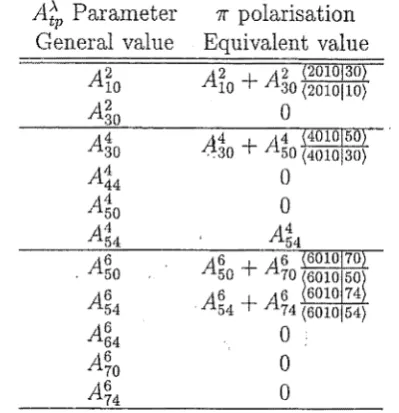
polarisation in C4v symmetry 28
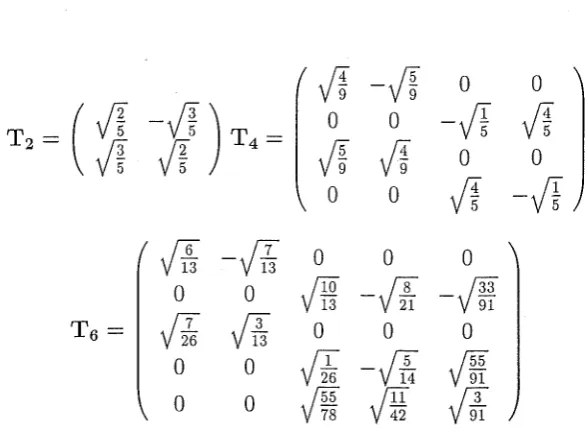
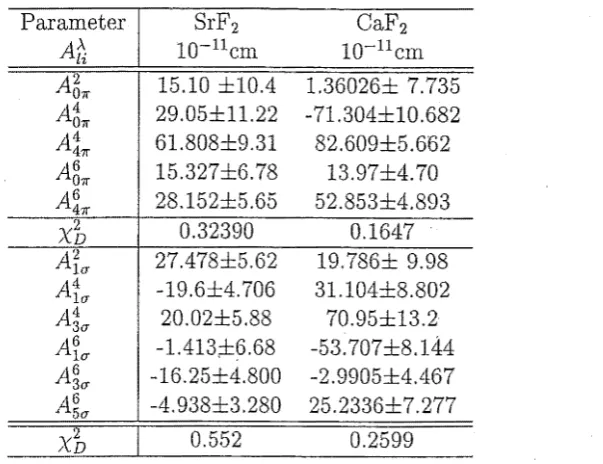
3.2 Pr3+:SrF2 and Pr3+:CaF2 crystal field parameters 30 3.3 Fitted parameters for the Pr3+:SrF2 and Pr3+:CaF2 systems 32 3.4 Fitted parameters for the Pr3+:SrF2 and Pr3+:CaF2 systems 33 3.5 CaF2:Pr3+ transition intensity comparison 34 3.6 SrF2:Pr3+ energy level and intensity comparison 35 3.7 Nd3+:YAG parameters for the lowest 9 local minima 36 3.8 Amplitudes of vibration of the ligands in the co-ordinate system of the
erbium ion, as predicted by the various force fields. 40 3. 9 Vibronic intensity parameters in terms of the intrinsic intensity parameters 41 3.10 The magnetic dipole intensities in Cs2NaErCl6 43
3.11 Energies for crystal field fitting of the ion in Cs2NaErCl6 45 3. Fitted values of the intrinsic parameters for ErCl~- 45 3.13 Vibronic Oscillator Strengths, Pi1, for absorption transitions at 20K of
the ion in Cs2NaErC16 46
3.14 Transformations from the
!JNI)
basis to the point group basis for the chain Os ::> Oh ::> D4h ::> 04v ::> 04 503.15 Fundamental vibrational mode vibronic parameters 51
3.16 Second Harmonic Vibronic parameters. 52
3.17 Superposition hypothesis test results for the Cs2NaErCl6 v3 vibronic mode 56
3.18 Superposition hypothesis test results for the Cs2NaErC16 v4 vibronic mode 56 3.19 Superposition hypothesis results for CaF2:Pr3+ 59 3.20 Superposition hypothesis test results for SrF 2:Pr3+ 60 3.21 Superposition hypothesis parameters for Nd3+:Y3Al5012 62
4.1
Afa-
parameters from linear transformation fitting for a linearly parameterset 76
4.2 Published intensity parameters for the :ODA systems 77 4.3 Observed and predicted rotatory strengths for Eu3+:oxydiacetate 78 4.4 Observed and predicted rotatory strengths for :oxydiacetate 80
4.5 Local minima for the Nd3+:0DA system 82
4.6 Hamiltonian parameters for the Nd3+:0DA system 83
4.7 Lowest minima for the Nd3+:0DA system 83
4.8 Nd3+:0DA intensity parameters 84
4.9 The isotopic abundances of the rare earth elements
5.1 Parameter values used in testing the superposition hypothesis in the Nd3+:YAG
system 99
5.2 Statistically corrected
x
2 .value for various random distributions 1006.1 Er3+ eigenvectors for the 4F112 multiplet in Cs2NaErCl6 110
8.1 Amplitudes of vibration of the ligands in the co-ordinate system of the erbium ion, as predicted by the various force fields. 123 8.2 Vibronic intensity parameters in terms of the intrinsic intensity
parame-ters. This table corrects errors in table 3 of [3]. T1u and T2u symmetry modes (1- and 1-) are denoted by i 1 or 2 respectively.
Ra
denotes the equilibrium ligand-erbium distance, and M ie; the ligand mass. 123 8.3 Fitted values of the intrinsic paiameters for ErCl~-. Each mode is fittedindividually. Note the sign change relative to older work, as explained in [11]. Values in 10-11 cm-1
. The value denoted by
t
is not observable forthe v6 mode. 124
8.4 Vibronic Oscillator Strengths, Pif, for absorption transitions at 20K from the (4!
15; 2
)ar
8 level of the Er3+ ion in Cs2NaErCl6 . For v3 and v,1 , thetabulated wavenumbers correspond to the TO modes in each case; and for v6 to the ZB mode. The tabulated oscillator strengths are summed over the three components each of v3 and v4 , and the two components of
v6 • Values in parentheses () are model predictions and are not included
in the fit. 124
8.5 Two different AtP parameter sets yielding identical transition intensity calculations for NdODA. Set 1 is taken from May et al. [8]. All values
have units i x 10-12 em. 133
8.6 Two different Be_~ parameter sets corresponding to the At~ parameter sets of Table 8.5. All values have units i x 10-12 em. 133
8.7 Four different A~ parameter sets yielding identical transition intensity calculations for Nd:YAG. Set 1 is taken from Burdick et al. [9]. All values
have units i x 10-12 em. 134
8.8 Four different B~ parameter sets corresponding to the A~ parameter sets of Table 8. 7. The B£~ and
B£z
parameters have units i x 10-12 em. TheChapter 1
Introduction
Lanthanide series ions are characterised by t'he filling of the 4f N shell. Since this shell is
internal to the lanthanide 5s2 5p6 core it is strongly electrostatically shielded and so the environment has a relatively small perturbative effect on the 4jN electronic states.
When a lanthanide ion is doped into a.,host crystal ;the interactions between the host ions and the rare-earth ion can be represented by mathematically complicated many-body interactions. The solution to the general Schroedinger equation for such a system, without any approximations, is beyond the bounds of modern physics. To make any progress describing the system some simplifications must be made. Central to the description of lanthanide ions is the introduction of the model space, in which the basis states are the 4jN electronic states, perturbed by the local environment. Projection into a model space is always mathematically valid, and is independent of any order of perturbation. The result of such a projection is that the parameterisation of various operators which describe physical effects is possible. The energy levels can be modelled by the effective crystal field Hamiltonian. Matrix elements of the effective operators between the model space eigenfunctions are identical to the matrix elements of the real operators between the real eigenstates.
[Judd 1962] (Ofelt 1962] were able to parameterise the intensities of the rare earth ions for the case of J-multiplet to J-multiplet transitions. Axe (Axe 1963] applied this formalism to the individual !VI levels of an ion. Newman and Balasubramanian [Newman
1975] showed that the parameterisation of Axe, Judd and Ofelt was not the most gen-eral single electron operator parameterisation of the crystal field and were able to write down a more general parameterisation. A parameterisation suitable for the calculation of transition intensities based on the work of [Newman 1975) was given in [Reid 1983].
During the work on this thesis it was discovered that the parameterisations of the electric-dipole transition operator as written in (Newman 1975] and [Reid 1983] allowed multiple sets of parameters to produce identical calculated spectra. This is shown to be a natural consequence of the coordinate system used to express the parameterisation, and has been overlooked by all of the previous researchers who have studied transition intensities.
A new parametrisation system was derived during this thesis which allow the sep-aration of the electric-dipole intensity parameters into distinct sets which transform as the irreps
r
x,y,z of the point group and therefore illuminate the multiple solutions moreclearly. For example in most high symmetry groups it is possible to separate the intensity parameters into two sets which independently describe the 1r and a polarisations.
During this thesis use was made initially of the Reid-Richardson A~ parameterisation. When it became apparent that this had multiplicities in it, much of the work was repeated using the new parameterisation scheme. The Reid-Richardson parameterisation is still
2 Chapter 1. Introduction
used in places in this thesis, and is appropriate under the correct circumstances.
With the existence of a mathematical description of the process of dipole transitions in rare earths it is possible fit the experimental results against the modelled set of calculated values, and obtain a set of parameters which describe phenomenologically the interactions occurring in the system. However, if such a model is to be useful it is necessary to show that the final parameters are reproducible within some tolerable level of uncertainty.
We can readily identify two persistent sources of uncertainty. Transitions occur be-tween our effective transition operators are evaluated bebe-tween eigenfunctions of the effec-tive Hamiltonian of a system. Since the Hamiltonian is never exactly described by the model that we construct the wavefunctions produced have some degree of uncertainty associated with them. So therefore do the matrix elements of the transition operator. The second major source of uncertainty is,the measure+nent of the intensities themselves. All physical measurements have some degree of imprecision in them, and intensities are in fact particularly difficult to measure accurately.
We therefore must consider the influence of these uncertainties on the fitted intensity parameters. Only by knowing the uncertainties associated with a set of measurements can we accept or reject hypotheses as to the nature of the interactions which define a system. For example, the approximation that assumes that the ·interactions between a rare earth ion and a neighbouring ion of a host are effectively independent of the proximity of other host ions is known as the superposition model. vVhile this has been examined extensively for the calculation of the energy levels, and appears to adequately describe the phenomenology of the crystal field, the applicability of this model to the transition operator is not as well defined. This is because there exist only a few studies of the transition intensities and the parameters obtained from their fitting are often poorly determined. Examination of the problems involved and suggested solutions form the basis of this thesis.
1.1
The structure of this thesis
Chapter [2] gives an introduction to the essential physics required to understand the majority of this thesis.
Chapter [3] summarises and reviews examples of non-linear transition intensity fitting that have been carried out in this thesis. Results for the Reid-Richardson A~ and the new
A2r
parameters which are defined in this thesis are obtained, and the superposition hypothesis of the lanthanide-ligand interaction is examined.Section [3.2.1] details multiplicities in the solutions of the A;P parameters from intensity fitting.
This section describes the parameterisation of the effective electric-dipole transition operator in terms of the
A2r
parameters, which are appropriate for the investigation of specific polarisations.Fitted parameter sets resulting from the investigation of various systems obtained in this thesis are presented in sections [3.3-3.5].
1.1. The structure of this thesis 3
dichroism data for Sm3+ and the oxydiacetate host.
The utilisation of the Stark effect and the spectroscopy of the hyperfine levels of the rare earth ions is examined in sections [4.7-4.8]. The Stark effect is shown to be capable of producing effects which are possibly determinable in the hyperfine lines of a rare earth ion.
Chapter [5] is an investigation of the distinguishability of different minima and the effects of uncertainties on the fitted parameters. Using Monte-Carlo methods it is possible to estimate the level of statistical significance between two minima and decide whether they correspond to distinct, distinguishable parameter It was found that quite small variations in the
x
2 value are significant.The use of the Zeeman effect to determine the eigenfunction composition of eigenvec-tors is examined in Chapter [6]. .. ·
Chapter [7] summarises the results obtained in this thesis.
In chapter [8] a series of suggestions is made for avenues of further research.
Chapter 2
Theory of Transition Intensities in Lanthanides
2.1
Introduction
This chapter gives a brief overview of the physical phenomena responsible for crystal field splittings and transition intensities for states in the 4/N shell of lanthanide ions.
All lanthanide ions have a filled Xenon configuration inner core, a 4/N shell which fills with electrons along the lanthanide series and a distribution of electron configurations which are external to the 4/N electrons. Since the majority of the 4/ radial wavefunction is internal to the outer electron wavefunctions, these states are only slightly perturbed by the exterior environment. They are shielded electrostatically by the outermost electrons and are approximately 5 eV below the valence band in energy. For these reasons the 4/N configuration electrons behave as electrons in an isolated ions.
The spectroscopy and structure of lanthanide ions in solids therefore has many analo-gies with that of isolated ions. For example the eneranalo-gies of the states in an isolated lanthanide ion as determined by arc spectra studies will be shifted by a relatively small amount compared with those energies when the lanthanide ion is doped into a host medium or is part of a molecule.
The well shielded 4/N configuration of lanthanide ions allow perturbative methods to be used to explain their physics and chemistry. For example electric dipole transitions are forbidden between states o! the same parity, but can be produced in the lanthanide ions by the weak perturbation of the environment that surrounds it. The spectroscopy of the lanthanide can therefore be used as a probe to examine the interaction between the lanthanide and the surroundings.
The material of this chapter has been extensively covered elsewhere [Wybourne 1965] [Judd 1963J[Butler 1981][Huffner 1988].
2.2
The Model Space
When a lanthanide ion is located inside a host material a non-spherical perturbation is exerted on the 4/N configuration. The lanthanide ion eigenstates will no longer be localised on the 4/N electronic shell and so the actual electronic states of the lanthanide will be a combination of the electronic states of the surrounding ions and the rare-earth itself. The calculation of such wavefunctions from the spectroscopic information available (energy levels and transition intensities) is a problem too formidable at present to be attempted. To simplify the situation it is natural to introduce the idea of the model
space.
2.3. The Free Ion 5
system to a· sma,ller more restricted space. Therefore we can always partition the space, as in [Brandow i975] and write the matrix Schroedinger equation as:
We can therefore eliminate part of the space and produce a projected Schroedinger equation. On elimination of '1/Jq this becomes:
( Hpq E - Hqq Hqp
+
Hpp '1/Jp )=
E'l/Jp=
Hef t'l/JpThe projected equation and the original have the saine eigenvalues and this procedure is independent of any level of perturbation. The difference is that now our operators are effective operators acting in a model space. The projection into a model space can be chosen such that the effective operators have the same transformation properties as the real operators acting in the real space. The operators do not necessarily have to be Hermitian in the model space but such a projection is usually chosen to preserve the familiar transformation and orthonormality relations of the operators.
The model space that this thesis is concerned with is the model space consisting of the
4jN electronic states. The effective Hamiltonian acting on the model space eigenfunctions is equivalent to the real Hamiltonian acting on the complete set of states of the entire lanthanide-ligand system which means
The transformation that projects from the real space to the model space can be written [Lindgren 1985] in terms of a projection operator D. This is referred to by [Lindgren 1985] as a wave operator:
It is shown in [Brandow 1975] [Lindgren 1985] that the real space eigenfunctions and operators can be recovered by perturbatively expanding the operators in the model space basis. The difficulty that arises is that the effective operators may be more complicated than the real space operators.
2.3
The Free Ion
6 Chapter 2. Theory of Transition Intensities in Lanthanides
where Z* is the effective charge of the nucleus, felt by the 4f N electrons. The nuclear
charge is effectively reduced due to the intervening shells of electrons between the 4fN and the nucleus that reduce the electric potential that the 4fN electrons are exposed to.
N denotes the number of electrons in the 4fN shell, and ((ri) is the spin orbit coupling function:
with
U(ri)
being the potential in which the ith electron is moving.The Hamiltonian consists of terms corresponding in order to the kinetic energy of the electrons, the electrostatic potential due to the electron-nucleu:;; interaction, the mutual repulsion of the charged electrons, and the coupling of the spin and orbital angular mo-mentum of the electrons. As it is written the Hamiltonian can not be explicitly solved since it is a many-body problem. We thus invoke the central field approximation which says that the nucleus is stationary, that is that the electrons move about in a static central potential.
The first two terms of our Hamiltonian represent the kinetic energy operator and potential energy operator. These are spherically symmetric so they do not lower the degeneracy of the electronic states of the 4fN electrons. They will alter all of the levels by the same amount and therefore can be ignored when discussing the splitting of energy levels of a lanthanide ion.
The remaining two terms are the Coulomb interaction and the spin orbit interaction respectively. ·when the Coulomb interaction is much greater than the spin-orbit inter-action the Russell-Saunders labelling of the states is appropriate. The orbital and spin angular momentum of the electrons can be added together independently to produce a total spin and orbital angular momentum, which are then coupled to give a total angular momentum. In this scheme each electronic state is denoted by 28+1L
1JVJ.
In lanthanide ions, the spin orbit coupling term is a large perturbation of the Coulomb interaction, so the coupling is termed intermediate coupling. Since the Russell-Saunders
states are a complete set they can be used as a basis to express the wavefunctions resulting from the interactions of all the subsequent perturbations. States for the lanthanides can still be labelled by their largest S, L component.
The calculation of the energy levels of a lanthanide ion requires the evaluation of matrix elements of the effective Hamiltonian. Coulomb interaction matrix elements have the form:
1/rij can be expanded in terms of Legendre polynomials, and the resultant matrix elements written as [Ruffner 1988J[Butler 1981]
(4fN SLiVlsi\1Lie2/rl214fN S'L'M,~MD
=
;;: pk
l)Lfiw6M,M£ fiss'SMsMl 49 (~ ~ ~
)2
2.3. The Free Ion 7 By symmetry properties of the 3j symbol, these matrix elements will be non-zero only when k E {2, 4, 6}. The Fk are known as Slater parameters and are functions of the radial wavefunctions of the 4fN electrons. Theoretically, the Slater parameters are calculable exactly for the free ion. In practise they are left as free parameters and are varied with respect to the fitting of the experimentally determined energy levels. The Coulomb inter-action is diagonal in S, L, JV!s and Nh. These labels remain as good quantum numbers under the Coulomb interaction. It is possible for different states within the 4fN config-uration to have the same SL labels, so additional quantum numbers are introduced to distinguish multiplicities. This is explained in any advanced text e.g. [Judd 1963][Butler 1981].
Spin-orbit interactions arise from the interaction of the magnetic field produced by the electron's orbital motion with the fiel¢, produced by its intrinsic spin. This has the effect of mixing together states of the same total angular momentum J. The S, L labels are now no-longer good quantum numbers. J, .MJ remain good quantum numbers for the spin-orbit Hamiltonian. The majority of the effect of the spin-orbit interaction can be parameterised inside a single configuration in terms of an operator of the form
I:i
si · li [Lindgren 1985]. Matrix elements of this interaction may be written as [Ruffner 1988]:N
(4fNSLJNIJI L((ri)si ·lil4fNS'L'J'NJ~)
i=l
( )J+L+s'o 8 f n j {
s s'
1 } (II nil
' ')
= (41 -1 JJ' MJM~ v84 L' L 1 4fSL V 4fS L
Here V11 represents a mixed spin/angular double tensor operator. Reduced matrix
elements of V11 are tabulated in [Nielson 1964].
There are other effects in addition to the Coulomb and the spin-orbit interactions. The most important of these other interactions is the electrostatic configuration interaction. The most significant contributions of this can be parameterised by three two body integrals denoted as a, {3, I· Additionally there are six three body integrals, Tk, k E {2, 3, 4, 6, 7, 8} [Wybourne 1965][Judd 1988]. Naturally, a system with only one or two electrons will not have the Tk parameters defined for it.
The electrons can also interact with other electrons via the spin-other-orbit interac-tion. In this case we consider the effect on an electron of the magnetic fields of the other electron's spins. This results in the introduction to first order of three additional pa-rameters. These are the Marvin [Marvin 1947] parameters denoted by l\1!0
, NI2 and NI4.
The Marvin parameters are functions of the 4fN radial eigenstates. Ratios of the Mar-vin parameters are usually fixed at values determined by pseudo-relativistic Hartree-Fock calculations [ Goerller-Walrand 1996].
Finally, we include the electrostatically correlated spin-orbit interaction, parameterised by the parameters pk, k E {2, 4, 6}. Inclusion of these additional terms in the Hamiltonian does not lower the degeneracy of any of the levels, but it does substantially reduce the discrepancy between calculated and measured energy levels.
8 Chapter 2. Theory of Transition Intensities in Lanthanides
however, the most important operators with the largest effects on the energy levels of the rare earth ions.
2.4
The Crystal Field
The previous section considered only the effects due to an isolated rare-earth ion. When such an ion is doped into a host crystal, the effects of the crystal field must be included in the Hamiltonian. This modifies the terms previously discussed and adds additional terms. Since the ion occupies a site of a specific geometrical symmetry, we can use abstract symmetry analysis to study the ions eigenfunctions. The rotations and translations of the crystal which leave the ion in the same environment in a,solid will form a group. Since symmetry operations of the crystal around the' point of the rare earth ion must leave the Hamiltonian unchanged the Hamiltonian must transform like the identity irrep of the group. By similar arguments, it is apparent that the eigenfunctions of a rare-earth ion must be unchanged under transformations that are members of the group, although degenerate components may become mixed through group transformations. From this it follows naturally that the states of a rare earth ion at a point of symmetry must be labelled by irreducible representations (irreps) of the symmetry group of that It is conventional to refer to the ions of a crystal that surround a rare-earth ion as ligands, since rare earth ions tend to form predominantly ionic bonds.
The majority of the effect of the crystal field interactions can be expressed in terms of one-electron parameters, conventionally denoted as
B{f.
The complete set of one-electron operators that describe the crystal field Hamiltonian can then be written as:Hc
1 ~sgcg(e,¢)k,q
where the Racah tensor operators
C{f ( e,
¢) are related to spherical harmonics as:cQK(e, "')
~
y:K(e "')
'+'
v
2k+i
Q ' '+'The summation over the terms in the crystal field Hamiltonian is restricted by several things. Firstly, the electrons we will deal with are 4fN electrons, hence K can be no more than 6. Also the interaction must be Hermitian and time reversal even which implies that
K must be even, restricting it to values of 0,2,4 and 6. The ]{
=
0 term shifts all of the energies equally, contributing only to the average energy of the configuration. This does not contribute to any spectroscopic manifestations within the 4fN shell since only energy differences are observed and so theK
= 0 term can be ignored. The symmetry of the site occupied by the rare-earth ion may also restrict the spherical harmonics used to describe its crystal field Hamiltonian.2.5. Transition Intensities 9
As an initial crude approximation the effects of the crystal field can be considered to be purely electrostatic. The ligands interact with the lanthanide ion by their charge distributions only. The electrostatic point charge model has long been known to be inadequate for all but the simplest descriptions of the crystal field, and it is generally accepted that the effects of overlap covalency and ligand polarisability must be included. Diagonalisation of the Hamiltonian will yield energy levels and eigenfunctions. In practice the squared difference between the calculated and observed energies are added to give some
x
2 function and the Hamiltonian is varied to minimise that function. The results of the previous discussion show that the Hamiltonian can be represented parametrically by a small number of coefficients and their corresponding operators. parameters are varied and the operators are naturally fixed. The variation of the parameters is repeated iteratively to find the global minimum or .~est .fit of parameters: The function used here is the standard deviation, o- defined as:1 M
M- n
t;(O('i)-
C(i))2,where M is the number of data points and n is the number of parameters. O(i) and C(i)
are the observed and calculated values of the ith line energy.
2.5
Transition Intensities
The spectroscopic manifestation of the lanthanide ion eigenstates is through the obser-vance of transitions between them. Transition intensities are usually observed between the ground state and the excited states, either in absorption or emission. Excited state absorption, where an excited level is populated by laser excitation, is rarely carried out. Observations and experiments involving emission from an excited state to states which are not the ground state is not uncommon. A typical example are the 5 D
1 -+ 7 FJ' transitions
of
The experimental difficulties are such however that the vast majority of all the tran-sitions that could theoretically occur are not observed for a lanthanide ion. Detailed and accurate fitting of the transition intensities for the lanthanide ions is uncommon. Most researchers prefer to measure energy levels and splittings, which are experimentally more accessible.
Observation of a quantum effect is mathematically describable as the matrix element of an operator acting between eigenstates. To describe transition intensities therefore requires the description of the relevant transition operators. The electric dipole transition operator may be written
eD!
ere; .
10 Chapter 2. Thepry of Transition Intensities in Lanthanides
. ·.·~~
Higher order terms in the Dirac equation will give small corrections to this. Since the calculations of the eigenfunctions of the lanthanide ion are being carried out in the 4/N model space, we note that the states from which we create matrix elements to represent these transitions will always be 4/N, hence the same parity. Under the parity transforma-tion r1 --+ -r1 the electric dipole transition operator transforms from
D
1 to -Dl,
hencethe relation:
follows naturally. We must therefore mix together states from outside the 4/N config-uration to account for the observed electric dipole transitions [Judd 1962]. A lanthanide ion situated at a site that is centro-symme.tric will by definition 'have no odd-parity com-ponents of its crystal field states at all, and so cannot produce zero-phonon transitions. An ion in such a symmetry may however be coupled to odd-parity vibrations and vibronic transitions can occur. Magnetic dipole transitions between the 4/N electronic states have no such parity restrictions.
It is possible to write down an effective electric dipole transition operator, which will act on the 4/N model space eigenfunctions the same way as the real dipole transition operator in the real space of eigenfunctions [Reid 1998]. Applying standard Rayleigh-Schroedinger perturbation theory expands each wavefunction as a perturbation series, the result of which is
Therefore, the matrix elements of the transition operator can be written to first order in U as
vVe abstract the algebra in the middle of the 4/N states to form an effective dipole transition operator
The perturbation operator
U
contains all possible physical interactions that can mix the 4/N states with opposite parity states.2.5. Transition Intensities 11
Newman and Balasubramanian [Newman 1975] were able to write a general parame-terisation of the transition intensities between the crystal field split levels. Using vector spherical tensors, the equivalent parameterisation can be written [Reid 1983]:
yqeff
=
2.:
A~PU(~+q)( -l)q(,\(p+
q),
t -Pllq) .
>..tp
Actual intensity calculations can then be written as:
where the sum a, b is over the degenerate components of the initial and final states and
gi is the degeneracy of the ground state. ·The states
j\II,
1r,a)
are linear combinations ofljm)
states produced by diagonalising the complete effective Hamiltonian representing the free-ion and the crystal field.Fitting of the intensities requires the minimisation of some function. The
x
2 function used here is mainly2 1 N IO(i)- C(i)l2
Xn = N - n
.~
0( i)+
C( i)This is the statistically corrected
x
2 function. In this thesis it is referred to as differential weighting or divweight. ·wherex
2 is used in this thesis without any subscripting it will be referring to this function. This form of weighting does not ignore uncertainties, but merely sets then as proportional to the value of the observable. An alternativex
2 function18
2 = 1
~IO(i)
C(i)l2Xc N ~ 2 ,
- n i=l CJi ·
where CJi is the standard deviation of each observed intensity. VVhen both of these
x
2functions are used they will be distinguished by the subscripts
c
orn
as used above. The use of the different weighting functions is expanded upon in section [3.3.1].Summing over all values of lVh in a multiplet and applying Racah algebra [Judd 1962][0felt 1962] allows the isotropic electric dipole transition dipole strength to be ex-pressed as:
I=
~e
22.:
i1>..(4fN1/YJIIUC-'~)II4fN1/;'J')
2•
,\E{2,4,6}
Spectroscopic observations are normally made of the oscillator strength. The oscillator strength of a transition is defined in dimensionless units called
f-
numbers [Broer 1945] by81rmc
f
=
3h,\(2J+
1)e21
·
Then,\ parameters will be referred to as the Judd-Ofelt intensity parameters. The it>..
12 Chapter 2. Theory of Transition Intensities in Lanthanides
Group t- = 1- 2- 3- 4-
s-
6-
7- t=A±1 t =A Totalc1 3 5 7 9 11 13 15 54 27 81 c2 1 3 3 5 5 7 7 24 15 39
C4v 1 0 1 1 2 1 2 9 2 11
D2 0 2 1 3 2 4 3 9 9 18
D3 0 1 1 2 1 3 2 6 6 12
0 0 0 0 1 0 1 0 0 2 2
Table 2.1: The number of parameters for common point symmetries obtained through the occurrences of the point group identity irrep 0 in
r
of 03. Each t- can give rise to one parameter for each value of .A that exists such that A =r
± 1 or A =r.
Additionally, A E {2, 4, 6} for a time-even, Hermitian operator. For example, the only t- irreps of 03 that contain the identity irrep 0 of the group 0 aret- = 4-, 6- and therefore only parameters with A
=
t-=
4, 6 m:e allowed.In practise this relation is seldom seen to hold. The derivation of the Sl>. parameters requires the assumption that the Jvf1 multiplet levels are all equally populated. This is a rather drastic assumption, since the separation in levels in most multiplets is several hundred em -1 and even at room temperature we would expect the lower levels to be relatively more highly populated. At elevated (room) temperatures where the
nA
param-eters are universally measured the intensities are likely to include intensity from vibronic processes as an additional source of complication. Measurement of individual crystal field split spectral lines requires low temperatures, where the action of lattice phonons do not broaden the lines. Such measurements are usually made at temperatures of 10K or less.Transition intensities are a measurement of the eigenvector composition of a crystal field state. Transition intensities can therefore be utilised to determine the identity of a crystal field eigenstate and allow assignments in such cases where alternative techniques are inapplicable or experimentally complicated. For example, in a D2 symmetry Kramer's
ions eigenstates have only one irrep and cannot be distinguished. Transition intensities have been used as an aid to assignment in such cases.
The effective transition operator should be Hermitian and time reversal even and therefore the D.>. parameters are restricted for one electron operators to /\ E {2, 4, 6} for
4jN electrons. There are therefore only three D.>. parameters for any system. The number of A;P parameters will be different for different site symmetries. The transition operator can be seen to transform as the bases x,y,z under operations of the point group.
The symmetry of the electric dipole operator acting in a basis of electronic states must contain the identity irrep for those matrix elements to be non-zero. The dipole transition operator has odd-parity and can be defined in 0 3 as a linear combination of the 03 irreps labelled by
t-.
The argument that the transition operator is Hermitian and must obey time reversal selection rules restricts expansions of it to tensors of rank
A
E {2, 4, 6}.2.5. Transition Intensities 13
number of times that the identity irrep can be produced by irreps of the states and operators involved with the restriction that either
t-
= A or= ).
±
1.When the symmetry is lowered to that of a point group the
t-
irreps of 03 will be expressible as linear combinations of irreps of that point group. Those that contain an identity element in the point group symmetry can give rise to a dipole operator matrix element.Therefore the number of times that the identity irrep is contained in the 03 irrep labelled by for each value of ). E {2, 4, 6} determines the number of different pa-rameters for a given value of t- [Butler 1'981
J.
Since the value of t is restricted tot
=
A 1, A, ).+
1, we can readily determine the number of ArP parameters for anysymmetry group. Table 2.1lists this decomposition for some of the more common groups, and the groups included in this study.
Alternatively [Newman 1975] restates this
~s
then~mber
of times that the irreducible representations of x, y,z occur in the 03 representations of , 4 +, 5+ fort
A±
1 and in2-, 4-, for
t
= ). .
Values of p in AfP are determined by the symmetry of the site occupied. The 0.-\ parameters are required by their definition to be positive definite. The AfP parameters may be generally complex in the form a+
i/3,
where a orf3
may be either positive or negative.Polarised intensities can be defined by the summation over the q subscripts on the effective transition matrix elements .. We follow the usual conventions in defining 1r ( q 0)
and u ( q =
±
1) polarisation intensities for electric dipole transitions asI41
r-.,uy(1T)
;.
I:
I I:
A~(A(p)10Jtp)(w4
1
;v,aiU;Iw
41
y,b)l
2
,
t a,b A,t,p
If polarised spectra are observed, the full A~ parameterisation will have redundancies in it. For example if only
1T
polarised transitions are observed, then only parameters required to expand z, and not the full x, y,z will be required. Therefore a number of parameters will be required equal to the number of times the irreducible representation that transform asz
occurs in point group for the 03 representations of 2+, 4 +, and 2-, 4-, 6- fort
A±
1 and t A respectively.This is explicit in [Newman 1975], which in that source defines the transition operator
veff
veff
=
L
Ag(p)u~<,](,Q,p
with the parameters
Ag
(rr)
andAg (
u), although the definition of u and 7r in thatsource differs from that used here. An alternative parameterisation of the electric-dipole transition intensity was determined in this thesis. This is described in section [3.2.1]. Using this alternative parameterisation, the effective operator can be expressed as
vreff =
2:::
A~U[',14 Chapter 2. Theory of Transition Intensities in Lanthanides
where T denotes the polarisation in
x,
y,z
coordinates. For example, the effective operatorfor a polarisation can be written as
v:ff
2:.,
AtcrU/' .
A.l
There exists a direct transformation between the A~ parameters and the A[~ parameters. This was determined during this thesis and is explained in subsection [3.2.1]. The total number of A~ parameters is equivalent to th,e total number of A~ parameters for a given symmetry.
If the superposition model is assumed (section [2.7]) then the number of At~ parameters is reduced, as the parameters with
t
A are assumed to be iden~ically zero. This has the effect of eliminating the ambiguities in the intensity parameter set, leaving only unique solution.An important consequence of the polarisation redundancies is that if the a and 1r
po-larisations transform distinctly in the group then any set of intensity data must contain a minimum number of a and 1r transitions for all A;P intensity parameters to be
unam-biguously determined. A single anisotropic polarisation spectrum cannot unamunam-biguously determine the full Reid-Richardson A~ intensity parameters. In summary, the A~ pa-rameters are useful when examining the superposition model ( q. v. ), where the value oft
relative to ). is important. The
Afr
parameterisation is the logical choice for parameteris-ing the effective electric-dipole transition operator when polarisations other than isotropic are to be examined.2.6
Vibronic Intensities
It is possible for vibrational states of a system to couple to electronic states of the same system. This combination is broadly described as the vibronic interaction. The Hamilto-nian acquires a purely vibrational part Hvib,
where
Hez
is the complete electronic Hamiltonian discussed previously.The vibrational Hamiltonian contains only terms in the nuclear displacements of in-terest. The vibrational Hamiltonian Hvib is of the form:
Hvib = Ho
+
V,where the harmonic part of the Hamiltonian
H
0 is:1 (p2 Py2
+
Pz2) 2m xand V is a perturbation representing any anharmonic terms in the expansion of the potential.
For example, in the Pr3+:MEF
2:H- system (where ME is either Sr or Ca) we
2.6. Vibronic Intensities 15
stationary. In Er3+:Cs2NaErCl6 the quasi-molecular assumption is made, meaning that
the jEr3+Cl6l3- moeity is assumed isolated in space and that therefore the lattice has no effect on it. An important question then arises as to how good these approximations are. \Ale have no information on the shape of the potential in which the ions of the 1Er3+Cl6l3- moeity vibrates so we are follow the conventional assumption that it is
parabolic. This is the standard practice for molecular dynamics. The potential can be expanded as a Taylor series, the zero and linear terms can be neglected due to the fact that the molecule is vibrating about its equilibrium position. The linear terms are considered to dominate over the higher terms in the co-ordinates, leading to a linear force law. Several theoretical models of the motion of H- ions in the alkaline earth fluorides are discussed in [Jacobs 1970}.
Since the vibrational frequency of the is close to
j1fi
of the H- frequency indi-cating a parabolic potential [Reeves 1987} we could assume that the Hamiltonian for theis that of a harmonic oscillator. We can then make use of the virial theorem and note that on average half of the energy of oscillation is kinetic at any given time, and half is potential. Therefore we can write for a single-phonon vibration
3 1
2 2)
4
nw
=2
fLw(x
,
where fL is the reduced mass of the ligand-Lanthanide pair given by
mi\1/
fL = Nf m
with j'vf the mass of the Lanthanide, and
m
the mass of the vibrating ligand. The average of the square of the displacement is( 2)
X = 2JLW . 3lidisplacement turns out to be in the order of 20 pica-meters, which is a substantial motion for any ligand. By comparison, the effective amplitudes for Cs2NaErC16 is around
3 pica-meters. Therefore the effect of the H- on the neighbouring F- ions may not be small and may affect the entire calculation of the vibronic overtones. In the interests of a simple calculation we will any H- :F- interactions. Alternatively, it could be said that the r.m.s. displacement squared (x2) may not be as large as crudely calculated here, thus scaling the entire set of calculated intensities.
The complete Hamiltonian of the electronic states and the vibrational states is usually too complicated to be treated exactly. vVe invoke the Born-Oppenheimer approximation to write vibronic states as adiabatically separable products
j<P)
1¢)I
x),
where the 1¢) states are solutions of the electronic Hamiltonian and thelx)
are solutions of the vibrational Hamiltonian.The observed intensities can now be written [Fischer 1984}[Berserker 1989} as
Srr'nm
=
I(<I>rnlfLI<Pr'm)l
216 Chapter 2, Theory of Transition Intensities in Lanthanides
where we have partitioned the transition operator into the electronic part
Jl(q)
which. operates only on the electronic states, and the vibrational part f.L(Q),
which acts only on the nuclear co-ordinates. Naturally in a pure electronic transition the vibrational part of the transition operator can be ignored.Eigenvectors from the effective electronic Hamiltonian are orthogonal
and thus matrix elements of the form
(xnlf-LtQ)Ixm)(¢rl¢r,),
which give rise to the infra-red vibrational absorption, will vanish forr
I=
r'.
Diagonalising the vibrational Hamil-tonian yields the vibrational eigenfunctions. If anharmonic terms V are included the resulting eigenfunctions will not be completely pure!n:unynz)
states.We are thus left only with the transition operator for electronic states. Including magnetic and electric dipole transitions only, we can write the electronic part of the transition intensity between 4fN levels as
where
Vq(
Q)
is the effective dipole ttansition operator andmq
is the magnetic dipole operator. We expect the electronic transition operator to be a function of spatial co-ordinates. Matrix elements of the magnetic operator are functions of physical constants and are coupled to vibrational motion only as weak perturbations [Faulkner 1979]. Mag-netic contributions are included in this thesis only in the zero-phonon transitions. The vibronic transitions will be the result of the coupling of the electric dipole and the vibra-tional transition operators. The resultant effect of the coupling of the vibravibra-tional motions with the electronic states can be expanded using the Hertzberg-Teller series (Fischer 1984],In this series,
Vq (
0)
is the zero-phonon electric dipole transition operator. term is the transition operator for the single-photon/single-phonon interaction terms in this series produce the n-phonon interaction operators.The next . Higher
Each of these operators will produce transitions that are spectroscopically distinct, as they occur at different energies. Each of these operators will be parameterisable in terms of the A~ parameters.
The addition of anharmonic terms in the vibrational potential will result in the mixing of the wavefunctions of the vibrational oscillator. The result is the wavefunctions of any given vibrational state are expressible as linear combinations of harmonic oscillator states
a
2. 7. The Superposition Model 17
terms are physically small in the cases studied. For the Cs2NaErC16 system, it was
necessary to assume that the vibrations were harmonic, since no n-phonon vibrational states or anharmonic effects were observed. This means that we can effectively ignore the effects of anharmonicity in calculating the intensities of single-photon/single-phonon vibronic transitions.
The transition intensity for the vibronic transitions can be written as
Srr'nm
L
j(WrniVqiWr'mW
I (
<I?r!Vq(v) !<J?r,)
121(L
O:bXbiQvlL
O:aXa) 12b a
~
I (
<I?r!Vq(v)
l<l?.r') 1
21
(XnJQvJxmW
where the a:a values are determined from the vibrational anharmonicity. Only single vibrational operator transitions are allowed, since the vibrational anharmonicity only weakly mixes the pure vibrational states together.
2. 7
The Superposition Model
The superposition model states that the effect of lanthanide ion interacting with the host can be broken down into a sum of independent cylindrically symmetric interactions between each individual lanthanide-ligand pair. Superposibility of the lanthanide-ligand interaction remains an open question in many systems. The superposition model pro-vides a way of reducing the number of parameters required to describe the effective dipole operator vqef! by restricting the A~P parameter set. Under the superposition model
as-sumptions [Newman 1989] the effect of each ligand is independent, and we may therefore write the total A;P as a sum of ligand contributions
A.x
=(-l)PA"'"'ct
(Ra)rt
tp t ~ -v R
L L
Here the
c:_P
is a Racah spherical harmonic an~ represents the angular position of the ligands relative to the central ion of interest. The A~ are interpreted as intrinsic intensityparameters that are characteristic of each lanthanide-ligand pair. These intrinsic
A;
parameters could be assumed to be transferable between hosts with the same lanthanides and ligands, but with different point group geometries. The radial dependence of the A~P is crudely modelled by a monomial with some powerT/.
18 Chapter 2. Theory of Transition Intensities in Lanthanides
· functions.. The A~ will reflect the symmetry of the site at which the ion of interest is . situated.
The superposition model by definition assumes that the ligand-lanthanide interaction is of Coov lOC:;\1 symmetry. This excludes the A~ parameters,"which have
t
=A. Naturally this ought to be verified by some experimental result, ,and the general validity of the superposition model remains an open question. ·In the J NI basis the effective dipole transition operator is expressible as linear
combi-nations of tensor operators. Transforming into the point group basis allows the expression of the transition operator as combinations of tensors that reflect the symmetry of the point group.
Within the bounds of the superposition model and the Hertzberg-Teller approxima-tion, the evaluation of the coefficient for. the effective transit1on operator is merely a matter of differentiating some Racah spherical harmonics. The·dipole transition operator is a function of the A~ parameters, which are related to the intrinsic
A;
by the geo-metrical relations of the superposition operator. The differentiation of thec;
and radial monomial(Ro/ RLyr
will then relate parameters of the vibronic transition operatorVq
to those of the purely electronic transition operator Vq and the purely vibrational operatorQ
Tl- ~QA
Vq = EJQ .
The electronic part of this operator is defined in the Hertzberg-Teller approximation as
8Vq
BQ
8/BQ
'L:>.,t,p A;:~'2.:1
Ui\+(/\+l, -qjt-p)(
-l)qL:>.,t,p aA;p;aQ
'2.:1
Ui\+(.\+l, 1--qjt-p)(
-l)qFor example, consider the
13-
0) vibrational state. Written as a spherical harmonic this is2.8. Vibronic Intensity Parameterisation 19
2.8
Vibronic Intensity Parameterisation
For one photon-one electron processes, the vibronic electric dipole transition operator can be parameterised exactly as the electric dipole transition operator. This parameterisation was developed using the Reid-Richardson
AzP
scheme. Since the superposition model is explicitly assumed whenever the vibronic interactions are examined in this thesis there will be a unique solution for the resultant A~ parameters.The selection rule for the existence of the vibronic
AzP
parameters is that ther
transforms as the irrep of the vibrational mode associated with the vibronic transition [Reid 1984]. For example if the vibrational mode is of T1u symmetry in the symmetrygroup Oh, then examination of the number of times the 03 irreps contain the T1u irrep
determines the number of Ai~ parameters.
The parameterisation of the intensities can be developed in the notation of [Reid 1984][Butler 1981].
In the J !VI basis the effective transition operator, Vq can be written as a function of combinations of the spherical unit tensors
U/'
Vq
=
I:
Atp
I:
U/'+p,+z,
1--qlrp)(
-l)q,A,t,p l
where A=2, 4, 6 and t /\
+
1.Transforming to a point-group basis, this becomes:
Vaqi =
In this notation [Butler 1981], a, b, c are branching multiplicity labels, i is an additional label if q is not one dimensional. The superscripts
±
denote the parity for the conversion to S03 into 03 ( = S03*
Ci) irrep labels.For phonon vibronic transitions involving simultaneous electron plus one-phonon processes, the effective vibronic transition operator for electric dipole processes is defined as
udvj T7 (d * "*)Q
V aqi
=
v aqi V J dvj ,where Vaqi ( dv* j*) is defined as a purely electronic operator acting only within the 4f N
configuration, and Qdvj is a one-phonon operator dependent only on nuclear vibrational
coordinates. The symmetry of the vibrational state is denoted by v, j being used in addition if the state is degenerate and dis a label to distinguish multiplicities of vibrational modes the the same vibrational symmetry. For example the common RE3+:Cl6 systems contain two 1-(t1
u)
vibrational modes. Note that for matrix elements of this operator20 Chapter 2. Theory of Transition Intensities in Lanthanides
The transition intensity of a single-phonon/single-photon transition is thus written as:
where J ( Q~vj) j2 is the average squared displacement of the ligand in the dvth mode.
Expanding the electronic operator in the point-group basis:
Vaqi ( dv* j*)
Vibronic transitions may be completely characterized in terms of the parameter set
{A;_::c*r;*(dv*)(Qdv)}. We may choose Q to be a normal coordinate in the vibrational
mechanics of the system. In the harmonic approximation (Qdv) is [(v l)h/87r2CO'dv]112
for vibrational excitation and [vhj87r2cO'dvJll2 for vibrational de-excitation, where v is
the vibrational quantum number of the initial state and 0' dv denotes the fundamental
frequency in wavenumbers of the dvth normal mode.
Chapter 3
General Fitting of Transition Intensities
3.1
Introduction
This chapter presents the results of fitting of intensity data using the A;P and A~ parame-ters. The systems examined here are Cs2NaErC16 , Pr3+:SrF2 , Pr3+:CaF2 and Nd3+:YAG.
When doped into an alkaline earth host, such as SrF2 or CaF2 , the rare earth ion
predominately occupies a site of C4v symmetry (referred to the "A" site [Wells 1996]).
This point group has no inversion operator in it so odd parity states can be created by crystal field perturbations. This system allows zero-phonon electric dipole transitions. Electric dipole transitions are examined and parameterised in section [3.3].
In Cs2NaErC16 , the Er3+ ion occupies a site of Oh symmetry and therefore
single-photon/zero-phonon electric-dipole transitions would violate parity conservation. Single-photon transitions are allowed when coupled with a vibrational phonon. The Cs2NaErCl6 system is examined as an example of the vibronic parameterization of transition intensities in section [3.5].
It is also possible to form a vibronic system in the MEF2 alkaline earth fluorides. The
electronic states of a lanthanide ion doped into an alkaline earth fluoride may be coupled to a vibrational motion of a host ligand. Such vibronic interactions have been observed [Reeves 1987], though there appears insufficient data available to fit intensity parameters to for any rare earth in the MEF2 hosts. Within the bounds of the superposition model it is however possible to make predictions about the intensity spectrum of the vibronic transitions for such systems. Preliminary work in this direction is presented in section
[3.6].
The Nd3+ ion doped into Nd3+:YAG occupies a site of D2 symmetry. Substantial zero-phonon electric dipole intensity data exists [Burdick 1994]. This system and published parameters was utilised to examine the superposition model of the lanthanide-ligand inter-action. This is done by comparing the
x
2 resulting from fitting parameterisations using thesuperposition and non-superposition A;P parameter sets for each system. The A;P param-eterisation scheme is required to explicitly contrast the difference between a superposition and non-superposition model of the lanthanide-ligand interaction. The Pr3+:JviEF
2 and Cs2NaErCl6 systems were also included in this procedure. The results of this procedure
are presented in section [3. 7].
3.2
Non-Linear Fitting
The general formula for the transition intensity between two
4/
N states in a rare earth is anon-linear function. The intensity data is not linearly related to the intensity parameters


![Table 3.5: CaF2:Pr3+ zero-phonon transition intensity data. Source [Wells 1998]. Intensity in arbitrary units](https://thumb-us.123doks.com/thumbv2/123dok_us/9939636.495774/43.598.154.436.221.568/table-phonon-transition-intensity-source-wells-intensity-arbitrary.webp)
![Table 3.6: SrF2:Pr3+ energy levels zero-phonon intensity data. Source [Wells 1998]. Intensity data (Oscillator strengths) in arbitrary units](https://thumb-us.123doks.com/thumbv2/123dok_us/9939636.495774/44.595.138.430.185.607/table-energy-intensity-source-intensity-oscillator-strengths-arbitrary.webp)