Evaluation of Terminologies Acquired from Comparable Corpora : an
Application Perspective
Estelle Delpech
Universit´e de Nantes - LINA FRE UMRS 6249
2 rue de la Houssini`ere BP 92208, 44322 Nantes Cedex 3, France estelle.delpech(at)univ-nantes(dot)fr
Lingua et Machina
c/o Inria Rocquencourt, BP 105 Le Chesnay Cedex 78153, France ed(at)lingua-et-machina(dot)com
Abstract
This paper describes a protocol for the evaluation of bilingual terminologies ac-quired from comparable corpora. The aim of the protocol is to assess the terminologies’added-value in a task of specialized translation. The protocol con-sists in having specialized texts translated in various situations: without any spe-cialized resource, with an domain-related bilingual terminology or using Internet. By comparing the quality of the segments translated using these various resources, we are able to assess the impact of our bilingual terminologies on the quality of the translation.
1 Introduction
Evaluation plays an important role in NLP devel-opments: it assesses the quality of tools, brings out the progress made between two developments, spots the limitations and highlights possible lines of research. Regarding the evaluation of nologies, Nazarenko et al. (2009) show that termi-nologies are complex objects and that their evalu-ation can be quite arduous. These authors distin-guish between three evaluation modes:
evaluation through reference : the terminology is compared to a standard reference, the eval-uation metric indicates the adequacy between the assessed terminology and the reference terminology.
evaluation through interaction : the evaluation aims at measuring the cost of the transforma-tion of the raw terminology as outputted by the system into the final, validated, ready-to-use terminology.
evaluation through application : the evalua-tion’s purpose is to compare the performance
of a given application with and without the terminology, the metric indicates the added-value of the terminology and depends on the application.
Nazarenko et. al. (2009) propose protocols and metrics for the first two evaluation modes and fo-cus on monolingual terminologies only. The aim of this paper is to propose a protocol for the eval-uation through application of bilingual terminolo-gies acquired from comparable corpora. The con-sidered application is human specialized transla-tion.
Terminologies acquired from comparable cor-pora are usually assessed using an evaluation through reference protocol (Fung, 1997; Sadat et. al., 2003; Koehn et. al., 2002). Algorithms which extract bilingual terminologies from comparable corpora output a list of 1-to-n alignments: each source term is aligned with the nbest candidate translations, most of the time the Top20 candi-date translations. The output of the algorithm is compared to a reference lexicon and the evalua-tion metric is a precision score computed on the Top1,Top10orTop20candidates. For example, a 50% precision on theTop20 candidates indicates that the correct translation is found among the first top 20 candidates for 50% of the source terms.
Section 2 explains how terms are aligned in comparable corpora and examines the issue of translation quality assessment. The evaluation protocol is defined in section 3. The experimen-tation and results are described in section 4. Per-spectives and future work are discussed in sec-tion 5.
2 Background
In this section, we describe the algorithm used for term alignment (section 2.1) and give a brief state-of-the-art survey in translation quality assessment (section 2.2).
2.1 Term alignment from comparable corpora
Comparable corpora are sets of texts written in two languages which are not translations of each other but which share a substantial part of their vocab-ulary, mainly because they are topic-related. The major advantage of comparable corpora is that it is much more available than parallel corpora and enables the processing of unprecedented language pairs. It is also often argued that the target lan-guage texts found in comparable corpora contain more spontaneous / natural terms and expressions than in parallel corpora because the target texts are not translations and they have not been influenced by the language of the source text.
Term alignment from comparable corpora was initiated by the work of Fung (1997) and Rapp (1995). The alignment algorithm is based on distributional linguistics and considers that two terms are probable translations if they occurr in similar contexts. The context of a term T is repre-sented by a vector indicating the number of times T co-occurs with each word within a given con-textual window (for instance: three words on the left of T and three words on the right of T). The cooccurrence frequencies are normalized using the log-likelihood ratio (Dunning, 1993). Words in the source context vectors are translated into the tar-get language using a bilingual seed lexicon. Then, the source and target vectors are compared using a similiarity measure such as the Cosine similarity measure. The most similar the vectors, the most likely the target and source terms are translations of each other. Morin and Daille (2009) report that the correct translation is to be found among the top 20 best candidates for 42% to 80% of the source terms depending on corpus size, on the
complex-ity of the terms and whether the alignment is made using specialized corpora or general language cor-pora. As a consequence, the output lexicon is ambiguous and sometimes, the correct translation does not appear among the candidates.
2.2 Translation quality assessement (TQA) Because we want to compare the quality of transla-tions made by humans with and without bilingual terminologies, we need to find a way to assess hu-man translation quality. If Machine Translation (MT) enjoys well-defined and rather consensual metrics to evaluate its quality, evaluation of human translation poses a real challenge. These two do-mains use different protocols for the assessment of translations. On the one hand, MT evaluation focuses on comparing the output of different MT systems. This evaluation is done in reference to one or several human translations. On the other hand, translation studies seek to assess the quality of a human translation on its own, without any ref-erence to a standard translation. In fact, the only reference is the judge himself/herself.
2.2.1 TQA and machine translation
There are two ways of assessing machine transla-tions. One is calledobjectiveorautomatic eval-uation. The other is called subjectiveor human evaluation.
In objective evaluation, translations are eval-uated through a measure which is automatically computable and which has the advantadge of be-ing reproducible. Examples of such measure are: BLEU (Papineni et al., 2002) which is based on the count of common n-grams between the as-sessed translation and reference translation(s) and METEOR (Banerjee and Lavie, 2005) which is similar to BLEU but leaves room for variation by including morphological variants and synonyms in the n-gram comparison. These metrics are in turn meta-evaluated by computing their correla-tion with human jugements. Though handy for the evaluation of MT systems on a daily basis, these metrics were not used in the shared trans-lation tasks of the ACL Workshop on Statistical Machine Translation where they are perceived as imperfect substitutes of human assessment, see the work of Callison-Burch et al. (2009; 2010) for ex-ample.
protocols stand out :
judgement task The judge grades each transla-tion independently. The grading scale can be quite complex, like 5 points scales over two criteria (fluency, adequacy) or simple binary judgements (correct/incorrect).
ranking task The judge ranks several translation of the same source segment from worse to best, each translation being produced by a different system.
These protocols are meta-evaluated using inter-and intra- annotator agreement measures which gives some indication on the coherence of the judgements. Experiments by Callison-Burch (2007) show that annotation tasks which involve complex sets of categories (e.g. 5 points scales over adequacy and fluency vs. binary judgements) and larger segments (sentences vs. phrases) tend to be more time-consuming and to result in lower agreement. The ranking task is con-sidered easier and less time-consuming than the judgement task. It also yields a higher annotator agreement.
2.2.2 TQA and translation studies
In translation studies, TQA is mainly used by the translation industry as a way to monitor the quality of its products. Secar˘a (2005) gives an overview of various translation grids. Although there is no consensus, all grids follow more or less the same methodology. Translation errors are categorized (e.g. spelling, grammar, terminology) and each er-ror type is assigned a certain cost which is propor-tional to its gravity. A passage of a given length is randomly selected from the translation under as-sessment. Errors are marked and the cost points add up. If the sum of the points exceeds some threshold, the translation is deemed unacceptable. These grids are criticised by theoretical ap-proaches to TQA - see Williams (2001) for in-stance - because they stick to the lexical and syntactic levels and do not take into account higher linguistic levels like discursive or argumen-tal structures. They are also monolithic and sup-posed applicable to any kind of text whereas au-thors like Reiss (1971) have argued that the eval-uation criteria and their weight should be adapted to the text’s function.
3 Protocol
The evaluation protocol is based on the rank-ing and judgement tasks used in MT subjec-tive evaluation. These tasks were chosen be-cause of their relative simplicity (compared to traditional 5-points scales) which also results in more reliable judgements as shown by Callison-Burch et al. (2007). Automatic evaluation met-rics were discarded because their only advantage - reproducibility - is of no use in this kind of evaluation: the protocol includes a subtask which is not reproducible (the translation) which makes the overall evaluation non-reproducible anyway. Evaluation grids were also discarded because they are too complex to put in practice, difficultly avail-able and scarcely documented.
The evaluation’s protocol is as follows:
1. Translators translate specialized texts in three different situations which we call “situations of translation”. These situations of transla-tion share a common base of identical generic resources (two monolingual and one bilin-gual dictionnaries). Translation are made from second-language to native language: situation 0 : translate with generic
re-sourcesonly
situation 1 : translate with generic resources + abilingual terminologyextracted from comparable specialized corpora. situation 2 : translate with generic resources
+ full access toInternetwhere the trans-lator can find all sorts of translation aids Situation 0 acts as a baseline where the trans-lator has no specialized resource. The ter-minology used in situation 1 is the terminol-ogy under assessment. In situation 2, the Web is considered as some sort of “super-” or “meta-” specialized resource, because the translator will have access to all the special-ized lexicons and termbases that are available online.
3. For each problematic term, judges rank the translations produced in the different situa-tions1 (ranking task). They also judge each translation separately using three categories: exact, acceptable or wrong (judgement task). 4. The added-valued of the bilingual terminol-ogy (situation 1) is measured by the compar-ing the quality of the translations produced in situation 1 with the quality of the translations produced in situations 0 and 2.
We decided to restrict the evaluation to the problematic terms rather than evaluating the qual-ity of the whole translation because it appears from works in translation studies (Williams, 2001; Reiss, 1971) that the overall quality of the trans-lation of a text emerges from the complex inter-action of various parameters (register, syntax, ar-gumental structure, spelling, etc.) most of which terminologies have no influence upon. By focus-ing on the problematic terms and expressions, we isolate the part of the translation that terminologies are meant to improve. As a side effect, evaluating small segments also saves time and yields more reliable judgements as demonstrated by Callison-Burch et. al. (2007).
The judgement task is based on three categories presented in table 1. These categories were cho-sen in accordance with Reiss (1971) who states that the translation of “content-focused texts” (e.g. scientific and technical texts, manual for use...) should favor the transfer of the source text’s mean-ing over the transfer of the source text’s form. An acceptable translation is a translation which conveys the meaning of the source term. An ex-act translation is a translation which makes use of the expected, standard target term. In a way, the “meaning transfer” and “accurate form” crite-ria parallel the more classical “adequacy” and “flu-ency” criteria found in MT campaigns.
meaning transfer accurate form
exact 4 4
acceptable 4
wrong
Table 1: Translation quality criteria
In order to leverage differences in the quality of the translations which would arise from the trans-lator’s expertise rather than from the quality of the
1Ties are allowed.
language resource, each situation of translation is evaluated on the basis of texts translated by sev-eral translators. In turn, one has to be cautious that translators do not translate texts from the same do-main in different situations of translation. Indeed, if a translator translates a text from domain A in situation 1, he/she must not translate a text from domain A in situation 2: there is a risk that the translator re-uses some terms’translations he/she has learnt in the previous situation.
A critical point when judging the translation of technical texts is that the judges often lack domain expertise and that domain experts are rarely avail-able. One can get round this trouble by choosing specialized texts which already have an existing translation, like research paper abstracts for exam-ple. Judges can also get help from general termi-nological databases such asTermium2.
The consistency of the judgements can be im-proved by first running a blank evaluation on a small set of data and then discussing the dis-agreements with the judges (Blanchon and Boitet, 2007). In any case, it is necessary to provide the judges with clear instructions and examples of an-notations on debatable cases.
4 Experimentation
This section describes the experimental frame-work (section 4.1) and the result of the evaluation (section 4.2).
4.1 Experimental framework 4.1.1 Data
Two bilingual terminologies were built for the evaluation. One was acquired from comparable corpora on BREAST CANCER and the other from comparable corpora onWATERSCIENCE. TheWA -TER SCIENCEcorpus is quite large (2M words per language) and its topic is coarse-grained. Texts are research papers from the journalsSciences de l’eau3andWater Science and Technology4. Con-versely, theBREASTCANCERcorpus is small (400k words per language) with a fine-grained topic. Texts come from various research papers of the publications portal Elsevier 5. The texts to be translated belong to the same domains. They are divided into scientific texts and popular science
2http://www.termiumplus.gc.ca/ 3http://www.rse.inrs.ca/
texts. The scientic texts are 2× 3 research pa-pers abstracts taken fromElsevier and the water science journals. The popular science texts are 2
×1 webpages taken from bilingual websites on
breast cancer6and water treatment7).
BREASTCANCER WATERSCIENCE
scientific 508 499
pop. science 613 425
Table 2: Size of texts to be translated (number of words)
4.1.2 Data processing
The algorithm described by Fung (1997) was ap-plied to the terms and to every open-class word occurring more than 5 times in the corpus. Extra knowledge was automatically added to the terms and open-class words in order to help the trans-lators: part-of-speech, frequency, collocations8, variants9, related terms10, definitions11, concor-dances. Translators could browse the terminology via a dedicated interface designed for terminolo-gies acquired from comparable corpora (Delpech and Daille, 2010).
4.1.3 People involved
Due to the lack of human resources to perform the evaluation, there was some collisions in the roles of translator/judge and translator/organizer. Three persons were involved in the test of the pro-tocol. The author of the paper, who is not a trained translator, translated the texts in the baseline situ-tation (general resources only) and organized the evaluation. Two trained translators translated the texts in situation 1 (terminology) and 2 (Internet) and also judged the translations. The translations were anonymized and randomly shuffled so that the judges would not know the origin of the trans-lations.
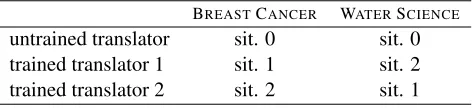
Texts, domains and situations were distributed as follows :
6http://www.cbcf.org/ 7http://www.lenntech.com/
8most remarkable cooccurrents, the association measure
is the log-likelihood ratio (Dunning, 1993)
9phrases which have not been identified as terms by the
term extractor but have words in common with the entry term
10terms which have words in common with the entry term 11either the Wikipedia or Wiktionary article if avalaible or
a sentence extracted from the corpus and containg a very sim-ple pattern like “A $TERM is a...”
BREASTCANCER WATERSCIENCE untrained translator sit. 0 sit. 0 trained translator 1 sit. 1 sit. 2 trained translator 2 sit. 2 sit. 1
4.2 Results
4.2.1 Translators’ feedback
It was difficult for translators to adapt to the am-biguity of the alignments. Although the aim and the context of the evaluation had been explained to them, they still expected the correct transla-tion to appear “on click”, just like it happens with the traditional languages resources they are accus-tomed to. Another obstacle was the coverage of the terminology, especially for theWATERSCIENCE domain whose topic was not refined enough. Ta-ble 3 shows the percentage of words of the texts to be translated which also appear in the termi-nology. Clearly, fined-grained corpora should be favored over large corpora.
BREASTCANCER WATERSCIENCE
EN texts 94% 14%
FR texts 67% 78%
Table 3: Terminology coverage of the vocabulary of the texts to be translated (EN) and their refer-ence translation (FR)
4.2.2 Problematic terms
Problematic termsare terms or expressions that a translator found difficult to translate. Problematic terms retained for the evaluation are terms which were tagged problematic by at least 2 translators. We collected 148 problematic terms (26 tagged by 2 translators and 122 tagged by 3 translators). Ta-ble 4 shows the repartition of proTa-blematic terms among domains and types of corpora.
BREASTCANCER WATERSCIENCE
pop. science 34 10
specialized 43 51
[image:5.612.316.552.72.126.2]total 87 61
Table 4: Problematic terms used for evaluation
4.2.3 Time
which is normal because they had less resources to browse (7.15 words/sec. on average). There is no significant time difference between situation 1 and situation 2 (11.18 and 11.6 words/sec. respec-tively).
4.2.4 Agreement between judges
Agreement was computed using the Kappa coef-ficient (Carletta, 1996) which takes into account the observed agreementP(A)and the agreement which would have occurred by chanceP(E).
Kappa= P(A)−P(E) 1−P(E)
Agreement was better for the ranking task: 0.65 (substantial) than for the judgement task: 0.36 (fair) which is consistent with the findings of Callison-Burch et. al. (2007). Agreement was bet-ter for the popular science texts: 0.57 (moderate) than for the scientific texts: 0.48 (moderate).
[image:6.612.349.490.60.113.2]4.3 Judgement task
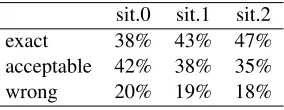
Table 5 gives quality judgements for the transla-tions of the BREAST CANCER texts. The propor-tion of translapropor-tions judgedwrongis almost equiv-alent for all situations. Translations produced in situation 1 (with the terminology) are more often judgedexactthan the translations produced in situ-ation 0 (only generic resources). Translsitu-ations pro-duced in situation 2 (with Internet) are the most accurate ones.
sit.0 sit.1 sit.2
exact 38% 43% 47%
acceptable 42% 38% 35%
wrong 20% 19% 18%
Table 5: Translations’ quality -BREASTCANCER do-main
Table 6 gives quality judgements for the transla-tions of theWATERSCIENCEtexts. One can see that translations produced in situation 1 are of lesser quality than those produced in situation 0. This is unexpected because situation 1 and situation 2 share a common base of generic resources. Trans-lations produced in situation 1 should be at least as good as translations produced in situation 0.
The fact is that the translators used the lan-guages resources in different manners depend-ing on the situation in which they performed the
sit.0 sit.1 sit.2
exact 59% 56% 77%
acceptable 23% 23% 16%
wrong 18% 21% 7%
Table 6: Translations’ quality -WATERSCIENCE do-main
translations. Thanks to the data collected dur-ing the translation phase, we are able to tell, for each term translation if it was produced using the generic resource or the specialized resource (ter-minology/Internet) or relying on intuition (not ex-clusive). Table 7 shows that the translators who had access to a specialized resource scarcely used the generic resource. It might be because they felt the generic resource was useless to get the trans-lation of technical terms and they prefered to use directly the specialised resource. But as theWATER SCIENCEterminology covers only a small part of vocabulary of the texts to translate, it was barely advantageous. A systematic exploitation of the generic resource in situation 1 would have led to translations at least as good as those produced in situation 0.
[image:6.612.346.492.393.446.2]sit.0 sit.1 sit.2 gen. ress. 43% 14% 3% spec. ress. - 25% 56% intutition 79% 77% 44%
Table 7: Exploitation of the language resources depending on the situation of translation
4.4 Ranking task
The ranking task results are similar to those of the judgement task. When different translations of the same terms are compared, those produced in sit-uation 2 are always better, whatever the domain. Those produced in situation 1 are better than the ones produced in situation 0 only for theBREAST CANCERdomain, probably because of divergences in the exploitation of the language resources as ex-plained above.
5 Discussion and future work
[image:6.612.127.269.476.531.2]sit.0 sit.2 sit.1 better than 28% 26% sit.1 as good as 47% 42% sit.1 worse than 26% 32%
Table 8: Translations’ ranking - BREASTCANCER domain
sit.0 sit.2 sit.1 better than 18% 16% sit.1 as good as 49% 41% sit.1 worse than 33% 43%
Table 9: Translations’ ranking -WATERSCIENCE do-main
several situations of translation in which the trans-lators have access to diverse language resources: only generic resources, generic resources and the evaluated terminology, generic resources and full access to Internet. The added-value of the termi-nology is supposed to be evidenced by the differ-ence in the quality of the translations produced in the three situations. We have described in sec-tion 4 a first trial of the protocol. This first trial showed that some hitches in our procedure prevent us from clearly demonstrating the added-value of terminologies acquired from comparable corpora : we had contradictory results for theBREASTCAN -CERandWATERSCIENCEdomains. Nonetheless, this first experimentation, although carried out with a small set of data and participants, allowed us to test the feasibility of the protocol and pinpointed problems which must be solved before launching a more thorough evaluation :
• The observed added-value of the terminol-ogy highly depends on its coverage of the texts used to evaluate it. Any measure of this added-value should also mention the ade-quacy between the assessed terminology and the texts to be translated, otherwise it is not interpretable. We determined this adequacy in a simple manner, by computing the propor-tion of words in the texts to be translated that also occurr in the terminology. This leaves some room for improvement. The compara-bility of the corpora used form terminology extraction and alignment must also be taken into account. For this, we are planning to use the comparability measure developped by Bo and Gaussier (2010).
• The joint use of several language resources seems to bias the results as the translators’ behaviour changes in function of the re-sources he/she has as his/her disposal. It is better to have only one resource per situation of translation, for instance:
– situation 0: no resources,
– situation 1: assessed terminology only, – situation 2: Internet only.
• Translators should be prepared to translate in a situation which is unusual to them. Ideally, one shoud run at first a blank translation task so as to discuss it with the translators and help them apprehend these new situations and re-sources.
The next step is to scale-up the protocol. We will renew the experiment on a much larger scale (a whole class of students translators) and include all the improvements listed above.
[image:7.612.129.267.159.214.2]Acknowledgments
This work was funded by the company Lingua et Machina and the French National Research Agency (funding no. ANR-08-CORD-009). I would like to thank Cl´emence de Baudus and Mathieu Delage for their participation in the eval-uation.
References
S. Banerjee and A. Lavie. 2005. METEOR: An Au-tomatic Metric for MT Evaluation with Improved Correlation with Human Judgments Proceedings of Workshop on Intrinsic and Extrinsic Evaluation Measures for MT and/or Summarization at the 43rd Annual Meeting of the Association of Computational Linguistics, pp. 65–72.
H. Blanchon and C. Boitet. 2007. Pour l’´evaluation ex-terne des syst`emes de TA par des m´ethodes fond´ees sur la tˆache Traitement Automatique des Langues, 48(1):33–65.
L. Bo and E. Gaussier. 2010. Improving Corpus Com-parability for Bilingual Lexicon Extraction from Comparable Corpora 23`eme International Confer-ence on Computational Linguistics, pp. 23–27.
C. Callison-Burch, C. Fordryce, P. Koehn, C. Monz and J. Schroeder. 2007. (Meta-) Evaluation of Ma-chine Translation Proceedings of the 2nd workshop on Statistical Machine Translation, pp. 136–158.
C. Callison-Burch, P. Koehn, C. Monz and J. Schroeder. 2009. Findings of the 2009 Workshop on Statistical Machine Translation Proceedings of the Fourth Workshop on Statistical Machine Trans-lation, pp. 1–28.
C. Callison-Burch, P. Koehn, C. Monz, K. Peterson, M. Przybocki and O. Zaidan. 2010. Findings of the 2010 Joint Workshop on Statistical Machine Trans-lation and Metrics for Machine TransTrans-lation Pro-ceedings of the Joint Fifth Workshop on Statistical Machine Translation and Metrics MATR, pp. 17–53.
J. Carletta. 1996. Assessing Agreement on Classifi-cation Tasks: The Kappa Statistic Computational Linguistics, 22(2).
E. Delpech. 2010. Dealing with lexicon acquired from comparable corpora : validation and exchange Pro-ceedings of the 2010 Terminology and Knowledge Engineering Conference (TKE 2010), pp. 211–223.
T. Dunning. 1993. Accurate Methods for the Statistics of Surprise and Coincidence Computational Lin-guistics, 19(1):61–74.
P. Fung. 1997. Finding Terminology Translations from Non-parallel CorporaProceedings of the 5th Annual Workshop on Very Large Corpora, pp. 192–202.
P. Koehn and K. Knight. 2002. Learning a Translation Lexicon from Monolingual Corpora Unsupervised Lexical Acquisition: Proceedings of the Workshop pf the ACL Special Interest Group on the Lexicon (SIGLEX), pp. 9–16. Association for Computational Linguistics. Philadelphia, Pennsylvania.
E. Morin and B. Daille. 2009. Compositionality and lexical alignment of multi-word terms Lan-guage Resources and Evaluation (LRE), 44:79–95. P. Rayson, S. Piao, S. Sharoff, S. Evert, B. Villada Moir´on (eds.) Springer Netherlands
A. Nazarenko, H. Zargayouna, O. Hamon and J. Van Puymbrouk. 2009. ´Evaluation des outils ter-minologiques : enjeux, difficult´es et propositions Traitement Automatique des Langues, 50(1):257– 281.
K. Papineni, S. Roukos, T. Ward and W.-J. Zhu. 2002. BLEU: A method for automatic evaluation of ma-chine translation. Proceedings of the 40th Annual Meeting of the Association for Computational Lin-guistics, 311–318.
E. Planas. 2005. Similis : un logiciel d’aide `a la traduction au service des professionnels. Traduire, 206:41–48.
R. Rapp. 1995. Identifying Word Translations in Non-Parallel Texts.Proceedings of the 35th Annual Meeting of the Association for Computational Lin-guistics, pp. 320–322.
K. Reiss. 1971. Translation criticism, the potentials and limitations : categories and criteria for trans-lation quality assessment. St. Jerome Pub., Manch-ester, GB.
M. Renders, H. Djean and E. Gaussier. 1971. Assess-ing Automatically Extracted BilAssess-ingual Lexicons for CLIR in Vertical Domains: XRCE Participation in the GIRT Track of CLEF 2002 Lecture Notes in Computer Science., pp. 363–371.
F. Sadat, M. Yoshikawa and S. Uemura. 2003. Learning Bilingual Translations from Comparable Corpora to Cross-Language Information Retrieval: Hybrid Statistics-based and Linguistics-based Ap-proach Proceedings of the 6th International Work-shop on Information Retrieval with Asian Lan-guages., 11:57–64
A. Secar˘a. 2005. Translation Evaluation - a State of the Art Survey. eCoLoRe / MeLLANGE Workshop, 39–44.