A Text-driven Rule-based System for Emotion Cause Detection
Sophia Yat Mei Lee† Ying Chen†* Chu-Ren Huang†‡
†
Department of Chinese and Bilingual Studies The Hong Kong Polytechnic University
*
Department of Computer Engineering China Agriculture University
‡
Institute of Linguistics Academia Sinica {sophiaym, chenying3176, churenhuang}@gmail.com
Abstract
Emotion cause detection is a new research area in emotion processing even though most theo-ries of emotion treat recognition of a triggering cause event as an integral part of emotion. As a first step towards fully automatic inference of cause-emotion correlation, we propose a text-driven, rule-based approach to emotion cause detection in this paper. First of all, a Chinese emotion cause annotated corpus is constructed based on our proposed annotation scheme. By analyzing the corpus data, we identify seven groups of linguistic cues and generalize two sets of linguistic rules for detection of emotion causes. With the linguistic rules, we then de-velop a rule-based system for emotion cause detection. In addition, we propose an evaluation scheme with two phases for performance as-sessment. Experiments show that our system achieves a promising performance for cause oc-currence detection as well as cause event detec-tion. The current study should lay the ground for future research on the inferences of implicit information and the discovery of new informa-tion based on cause-event relainforma-tion.
1 Introduction
Text-based emotion processing has attracted plenty of attention in NLP. Most research has focused on the emotion detection and classification by identifying the emotion types, for instances happiness and sadness, for a given sentence or document (Alm 2005, Mihalcea and Liu 2006, Tokuhisa et al. 2008). However, on top of this surface level information, deeper level information regarding emotions, such as the experiencer, cause, and result of an emotion, needs to be extracted and analyzed for real world applications (Alm 2009).
In this paper, we aim at mining one of the crucial deep level types of information, i.e. emotion cause, which provides useful information for applications ranging from economic forecasting, public opinion mining, to product design. Emotion cause detection is a new research area in emotion processing. In emotion processing, the cause event and emotion correlation is a fertile ground for extraction and entailment of new information. As a first step towards fully automatic inference of cause-emotion correlation, we propose a text-driven, rule-based approach to emotion cause detection in this paper.
Most theories of emotion treat recognition of a triggering cause event as an integral part of emotional experience (Descartes 1649, James 1884, Plutchik 1962, Wierzbicka 1999). In this study, cause events refer to the explicitly expressed arguments or events that evoke the presence of the corresponding emotions. They are usually expressed by means of propositions, nominalizations, and nominals. For example, “they like it” is the cause event of the emotion happiness in the sentence “I was very happy that they like it”. Note that we only take into account emotions that are explicitly expressed, which are usually presented by emotion keywords, e.g. “This surprises me”. Implicit emotions that require inference or connotation are not processed in this first study. In this study, we first build a Chinese emotion cause annotated corpus with five primary emotions, i.e. happiness, sadness, anger, fear, and surprise. We then examine various linguistic cues which help detect emotion cause events: the position of cause event and experiencer relative to the emotion keyword, causative verbs (e.g. rang4 “to cause”), action verbs (e.g. xiang3dao4 “to think about”), epistemic markers (e.g. kan4jian4 “to see”), conjunctions (e.g. yin1wei4 “because”), and prepositions (e.g. dui4yu2 “for”). With the help of
these cues, a list of linguistic rules is generalized. Based on the linguistic rules, we develop a rule-based system for emotion cause detection. Experiments show that such a rule-based system performs promisingly well. We believe that the current study should lay the ground for future research on inferences and discovery of new information based on cause-event relation, such as detection of implicit emotion or cause, as well as prediction of public opinion based on cause events, etc.
The paper is organized as follows. Section 2 discusses the related work on various aspects of emotion analysis. Section 3 describes the construc-tion of the emoconstruc-tion cause corpus. Secconstruc-tion 4 presents our rule-based system for emotion cause detection. Section 5 describes its evaluation and performance. Section 6 highlights our main contri-butions.
2 Previous Work
We discuss previous studies on emotion analysis in this section, and underline fundamental yet unre-solved issues. We survey the previous attempts on textual emotion processing and how the present study differs.
2.1 Emotion Classes
Various approaches to emotion classification were proposed in different fields, such as philosophy (Spinoza 1675, James 1884), biology (Darwin 1859, linguistics (Wierzbicka 1999, Kövecses 2000), neuropsychology (Plutchik 1962, Turner 1996), and computer science (Ortony et al. 1988, Picard 1995), as well as varying from language to language. Although there is lack of agreement among different theories on emotion classification, a small number of primary emotions are commonly assumed. Other emotions are secondary emotions which are the mixtures of the primary emotions.
Researchers have attempted to propose the list of primary emotions, varying from two to ten basic emotions (Ekman 1984, Plutchik 1980, Turner 2000). Fear and anger appear on every list, whe-reas happiness and sadness appear on most of the lists. These four emotions, i.e. fear, anger, happi-ness, and sadness, are the most common primary emotions. Other less common primary emotions
are surprise, disgust, shame, distress, guilt, interest, pain, and acceptance.
In this study, we adopt Turner’s emotion clas-sification (2000), which identifies five primary emotions, namely happiness, sadness, fear, anger, and surprise. Turner’s list consists of primary emo-tions agreed upon by most previous work.
2.2 Emotion Processing in Text
Textual emotion processing is still in its early stag-es in NLP. Most of the previous works focus on emotion classification given a known emotion con-text such as a sentence or a document using either rule-based (Masum et al. 2007, Chaumartin 2007) or statistical approaches (Mihalcea and Liu 2005, Kozareva et al. 2007). However, the performance is far from satisfactory. What is more, many basic issues remain unresolved, for instances, the rela-tionships among emotions, emotion type selection, etc. Tokuhisa et al. (2008) was the first to explore both the issues of emotion detection and classifica-tion. It created a Japanese emotion-provoking event corpus for an emotion classification task us-ing an unsupervised approach. However, only 49.4% of cases were correctly labeled. Chen et al. (2009) developed two cognitive-based Chinese emotion corpora using a semi-unsupervised ap-proach, i.e. an emotion-sentence (sentences con-taining emotions) corpus and a neutral-sentence (sentences containing no emotion) corpus. They showed that studies based on the emotion-sentence corpus (~70%) outperform previous corpora.
Little research, if not none, has been done to examine the interactions between emotions and the corresponding cause events, which may make a great step towards an effective emotion classifica-tion model. The lack of research on cause events restricted current emotion analysis to simple classi-ficatory work without exploring the potentials of the rich applications of putting emotion ‘in con-text’. In fact, emotions can be invoked by percep-tions of external events and in turn trigger reactions. The ability to detect implicit invoking causes as well as predict actual reactions will add rich dimensions to emotion analysis and lead to further research on event computing.
3 Emotion Cause Corpus
an emotion cause is and discuss how emotion cause is linguistically expressed in Chinese. We then describe the corpus data and the annotation scheme. For more detailed discussion on the con-struction of the emotion cause corpus, please refer to Lee et al. (2010).
3.1 Cause Events
Following Talmy (2000), the cause of an emotion should be an event itself. In this work, it is called a cause event. By cause event, we do not necessarily mean the actual trigger of the emotion or what leads to the emotion. Rather, it refers to the imme-diate cause of the emotion, which can be the actual trigger event or the perception of the trigger event. Adapting TimeML annotation scheme (Saurí et al. 2004), events refer to situations that happen or oc-cur. In this study, cause events specifically refer to the explicitly expressed arguments or events that are highly linked with the presence of the corres-ponding emotions. In Lee et al.’s (2010) corpus, cause events are categorized into two types: verbal events and nominal events. Verbal events refer to events that involve verbs (i.e. propositions and nominalizations), whereas nominal events are simply nouns (i.e. nominals). Some examples of cause event types are given in bold face in (1)-(6).
(1)Zhe4-DET tou2-CL niu2-cattle de-POSS zhu3ren2-owner,
yan3kan4-see zi4ji3-oneself de-POSS niu2-cattle re3chu1-cause huo4-trouble lai2-come le-ASP, fei1chang2-very hai4pa4-frighten, jiu4-then ba3-PREP
zhe4-DET tou2-CL niu2-cattle di1jia4-low price
mai4chu1-sell.
“The owner was frightened to see that his cattle caused troubles, so he sold it at a low price.”
(2)Mei2-not xiang3dao4-think ta1-3.SG.F shuo1-say de -POSS dou1-all shi4-is zhen1-true hua4-word, rang4 -lead ta1-3.SG.M zhen4jing1-shocked bu4yi3-very.
“He was shocked that what she said was the truth.”
(3)Ta1-3.SG.M dui4-for zhe4-DET ge4-CL chong1man3 -full of nong2hou4-dense ai4yi4-love de-DE xiang3fa3 -idea gao1xing4-happy de-DE shou3wu3zu2dao3-flourish.
“He was very happy about this loving idea.”
(4)Zhe4-DET ci4-CL yan3chu1-performance de-POSS jing1zhi4-exquisite dao4shi4-is ling4-cause wo3-1.SG
shi2fen1-very jing1ya4-surprise.
“I was very surprised by this exquisite perfor-mance.”
(5)Ni2ao4-Leo de-POSS hua4-word hen3-very ling4-make
kai3luo4lin2-Caroline shang1xin1-sad.
“Caroline was very saddened by Leo’s words.”
(6)Dui4yu2-forwei4lai2-future, lao3shi2shuo1-frankly wo3 -1.SG hen3-very hai4pa4-scared.
“Frankly, I am very scared about the future.”
The causes in (1) and (2) are propositional causes, which indicate the actual events involved in caus-ing the emotions. The ones in (3) and (4) are no-minalized causes, whereas (5) and (6) involve nominal causes
3.2 Corpus Data and Annotation Scheme
Based on the list of 91 Chinese primary emotion keywords identified in Chen et al. (2009), we ex-tract 6,058 instances of sentences by keyword matching from the Sinica Corpus1, which is a tagged balanced corpus of Mandarin Chinese con-taining a total of ten million words. Each instance contains the focus sentence with the emotion key-word “<FocusSentence>” plus the sentence before “<PrefixSentence>” and after “<SuffixSentence>” it. The extracted instances include all primary emo-tion keywords occurring in the Sinica Corpus ex-cept for the emotion class happiness, as the keywords of happiness exceptionally outnumber other emotion classes. In order to balance the number of each emotion class, we set the upper limit at about 1,600 instances for each primary emotion.
Note that the presence of emotion keywords does not necessarily convey emotional information due to different possible reasons such as negative polarity and sense ambiguity. Hence, by manual inspection, we remove instances that 1) are non-emotional; 2) contain highly ambiguous emotion keywords, such as ru2yi4 “wish-fulfilled”, hai4xiu1
“to be shy”, wei2nan2 “to feel awkward”, from the corpus. After the removal, the remaining instances in the emotion cause corpus is 5,629. Among the remaining instances, we also remove the emotion keywords in which the instances do not express that particular emotion and yet are emotional. The total emotion keywords in the corpus is 5,958.
For each emotional instance, two annotators manually annotate cause events of each keyword. Since more than one emotion can be present in an
1
instance, the emotion keywords are tagged as <emotionword id=0>, <emotionword id=1>, and so on.
573 Y 0/shang1 xin1/Sadness
<PrefixSentence> ma1ma ye3 wen4 le ling2 ju1, dan4 shi4 mei2 you3 ren4 jian4 dao4 xiao3 bai2. </PrefixSentence> <FocusSentence>wei4 le [*01n] zhe4 jian4 shi4 [*02n] , wo3 ceng2 <emotionword id=0>shang1 xin1</emotionword> le hou2 jiu3,dan4 ye3 wu2 ji3 yu4 shi4. </FocusSentence> <Suf-fixSentence>mei3 dang1 zai4 kan4 dao4 bai2 se4 de qi4 gou3, bu4 jin4 hui4 xiang3 qi3 xiao3 bai2 </SuffixSentence>
573 Y 0/to be sad/Sadness
<PrefixSentence> Mom also asked the neighbors, but no one ever saw Little White. </PrefixSentence> <FocusSentence> Because of [*01n] this [*02n] , I have been feeling very <emo-tionword id=0> sad </emo<emo-tionword> for a long time, but this did not help. </FocusSentence> <SuffixSentence> Whenever [I] see a white stray dog, [I] cannot help thinking of Little White. </SuffixSentence>
Figure 1: An Example of Cause Event Annotation
Figure 1 shows an example of annotated emotional sentences in corpus, presented as pinyin with tones, followed by an English translation. For an emotion keyword tagged as <id=0>, [*01n] marks the be-ginning of its cause event while [*02n] marks the end. The “0” shows which index of emotion key-word it refers to, “1” marks the beginning of the cause event, “2” marks the end, and “n” indicates that the cause is a nominal event. For an emotion keyword tagged as <id=1>, [*11e] marks the be-ginning of the cause event while [*12e] marks the end, in which “e” refers to a verbal event, i.e. ei-ther a proposition or a nominalization. An emotion keyword can sometimes be associated with more than one cause, in which case both causes are marked. The emotional sentences containing no explicitly expressed cause event remain as they are.
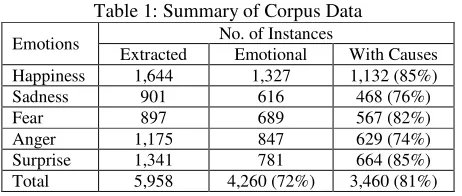
[image:4.612.75.306.606.704.2]The actual number of extracted instances of each emotion class to be analyzed, the positive emotional instances, and the instances with cause events are presented in Table 1.
Table 1: Summary of Corpus Data
Emotions No. of Instances
Extracted Emotional With Causes Happiness 1,644 1,327 1,132 (85%) Sadness 901 616 468 (76%) Fear 897 689 567 (82%) Anger 1,175 847 629 (74%) Surprise 1,341 781 664 (85%) Total 5,958 4,260 (72%) 3,460 (81%)
We can see that 72% of the extracted instances ex-press emotions, and 81% of the emotional in-stances have a cause. The corpus contains happiness (1,327) instances the most and sadness (616) the least. For each emotion type, about 81% of the emotional sentences, on average, are consi-dered as containing a cause event, with surprise the highest (85%) and anger the lowest (73%). This indicates that an emotion mostly occurs with the cause event explicitly expressed in the text, which confirms the prominent role of cause events in expressing an emotion.
4 A Rule-based System for Cause
Detec-tion
4.1 Linguistic Analysis of Emotion Causes
By analyzing the corpus data, we examine the correlations between emotions and cause events in terms of various linguistic cues: the position of cause event, verbs, epistemic markers, conjunctions, and prepositions. We hypothesize that these cues will facilitate the detection of emotion cause events.
First, we calculate the distribution of cause event types of each emotion as well as the position of cause events relative to emotion keywords and experiencers. The total number of emotional instances regarding each emotion is given in Table 2.
Table 2: Cause Event Position of Each Emotion
Emotions Cause Type (%) Cause Position (%) Event Nominal Left Right Happiness 76 6 74 29 Sadness 67 8 80 20
Fear 68 13 52 48 Anger 55 18 71 26 Surprise 73 12 59 41
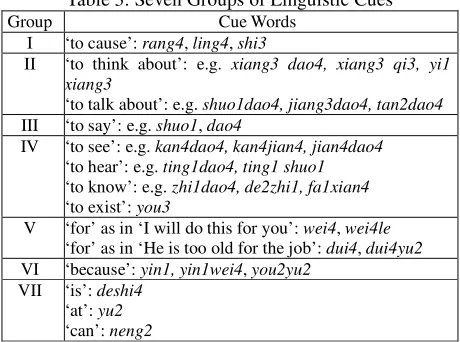
Second, we identify seven groups of linguistic cues that are highly collocated with cause events (Lee et al. 2010), as shown in Table 3.
Table 3: Seven Groups of Linguistic Cues
Group Cue Words I ‘to cause’: rang4, ling4, shi3
II ‘to think about’: e.g. xiang3 dao4, xiang3 qi3, yi1 xiang3
‘to talk about’: e.g. shuo1dao4, jiang3dao4, tan2dao4 III ‘to say’: e.g. shuo1, dao4
IV ‘to see’: e.g. kan4dao4, kan4jian4, jian4dao4 ‘to hear’: e.g. ting1dao4, ting1 shuo1
‘to know’: e.g. zhi1dao4, de2zhi1, fa1xian4
‘to exist’: you3
V ‘for’ as in ‘I will do this for you’: wei4, wei4le
‘for’ as in ‘He is too old for the job’: dui4, dui4yu2
VI ‘because’: yin1, yin1wei4, you2yu2
VII ‘is’: deshi4
‘at’: yu2
‘can’: neng2
Group I includes three common causative verbs, and Group II a list of verbs of thinking and talking. Group III is a list of say verbs. Group IV includes four types of epistemic markers which are usually verbs marking the cognitive awareness of emotion in the complement position (Lee and Huang 2009). The epistemic markers include verbs of seeing, hearing, knowing, and existing. Group V covers some prepositions which all roughly mean ‘for’. Group VI contains the conjunctions that explicitly mark the emotion cause. Group VII includes other linguistic cues that do not fall into any of the six groups. Each group of linguistic cues serves as an indicator marking the cause events in different structures of emotional constructions, in which Group I specifically marks the end of the cause events while the other six groups marks the beginning of the cause events.
4.2 Linguistic Rules for Cause Detection
We examine 100 emotional sentences of each emo-tion keyword randomly extracted from the devel-opment data, and generalize some rules for identifying the cause of the corresponding emotion verb (Lee 2010). The cause is considered as a proposition. It is generally assumed that a proposi-tion has a verb which opproposi-tionally takes a noun oc-curring before it as the subject and a noun after it as the object. However, a cause can also be ex-pressed as a nominal. In other words, both the pre-dicate and the two arguments are optional provided
that at least one of them is present.
We also manually identify the position of the experiencer as well as the linguistic cues discussed in Section 4.1. All these components may occur in the clause containing the emotion verb (focus clause), the clause before the focus clause, or the clause after the focus clause. The abbreviations used in the rules are given as follows:
C = Cause event E = Experiencer
K = Keyword/emotion verb B = Clause before the focus clause
F = Focus clause/the clause containing the emotion verb A = Clause after the focus clause
For illustration, an example of the rule description is given in Rule 1.
Rule 1:
i) C(B/F) + I(F) + E(F) + K(F)
ii) E = the nearest Na/Nb/Nc/Nh after I in F
iii)C = the nearest (N)+(V)+(N) before I in F/B
(7)[C yi1 la1 ke4 xi4 jun1 wu3 qi4 de bao4 guang1], [I shi3] [E lian2 he2 guo2 da4 wei2][Kzhen4 jing1] . “[C The revealing of Iraq’s secret bacteriological weapons] [K shocked] [E the United Nations].”
(8)[C heng2 shan1 jin1 tian1 ti2 chu1 ci2 cheng2], [I ling4] [E da4 ban3] zhi4 wei2 [Kfen4 nu4] 。 “[C Yokoyama submitted his resignation today], [K angered] [E the people of Osaka].”
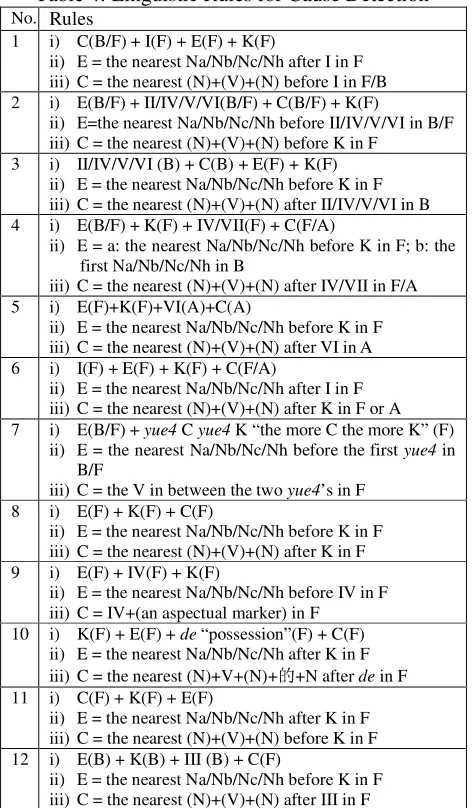
[image:6.612.94.541.80.179.2]Table 4 summarizes the generalized rules for de-tecting the cause events of the five primary emo-tions in Chinese. We identify two sets of rules: 1) the specific rules that apply to all emotional in-stances (i.e. rules 1-13); 2) the general rules that apply to the emotional instances in which causes are not found after applying the specific set of rules (i.e. rules 14 and 15).
Table 4: Linguistic Rules for Cause Detection
No. Rules
1 i) C(B/F) + I(F) + E(F) + K(F)
ii) E = the nearest Na/Nb/Nc/Nh after I in F iii) C = the nearest (N)+(V)+(N) before I in F/B 2 i) E(B/F) + II/IV/V/VI(B/F) + C(B/F) + K(F)
ii) E=the nearest Na/Nb/Nc/Nh before II/IV/V/VI in B/F iii) C = the nearest (N)+(V)+(N) before K in F
3 i) II/IV/V/VI (B) + C(B) + E(F) + K(F) ii) E = the nearest Na/Nb/Nc/Nh before K in F iii) C = the nearest (N)+(V)+(N) after II/IV/V/VI in B 4 i) E(B/F) + K(F) + IV/VII(F) + C(F/A)
ii) E = a: the nearest Na/Nb/Nc/Nh before K in F; b: the first Na/Nb/Nc/Nh in B
iii) C = the nearest (N)+(V)+(N) after IV/VII in F/A 5 i) E(F)+K(F)+VI(A)+C(A)
ii) E = the nearest Na/Nb/Nc/Nh before K in F iii) C = the nearest (N)+(V)+(N) after VI in A 6 i) I(F) + E(F) + K(F) + C(F/A)
ii) E = the nearest Na/Nb/Nc/Nh after I in F iii) C = the nearest (N)+(V)+(N) after K in F or A 7 i) E(B/F) + yue4 C yue4 K “the more C the more K” (F)
ii) E = the nearest Na/Nb/Nc/Nh before the first yue4 in B/F
iii) C = the V in between the two yue4’s in F 8 i) E(F) + K(F) + C(F)
ii) E = the nearest Na/Nb/Nc/Nh before K in F iii) C = the nearest (N)+(V)+(N) after K in F 9 i) E(F) + IV(F) + K(F)
ii) E = the nearest Na/Nb/Nc/Nh before IV in F iii) C = IV+(an aspectual marker) in F
10 i) K(F) + E(F) + de “possession”(F) + C(F) ii) E = the nearest Na/Nb/Nc/Nh after K in F iii) C = the nearest (N)+V+(N)+的+N after de in F 11 i) C(F) + K(F) + E(F)
ii) E = the nearest Na/Nb/Nc/Nh after K in F iii) C = the nearest (N)+(V)+(N) before K in F 12 i) E(B) + K(B) + III (B) + C(F)
ii) E = the nearest Na/Nb/Nc/Nh before K in F iii) C = the nearest (N)+(V)+(N) after III in F
13 i) III(B) + C(B) + E(F) + K(F)
ii) E = the nearest Na/Nb/Nc/Nh before K in F iii)C = the nearest (N)+(V)+(N) after III in B 14 i) C(B) + E(F) + K(F)
ii) E = the nearest Na/Nb/Nc/Nh before K in F iii)C = the nearest (N)+(V)+(N) before K in B 15 i) E(B) +C(B) + K(F)
ii) E = the first Na/Nb/Nc/Nh in B
iii)C = the nearest (N)+(V)+(N) before K in B
Constraints are set to each rule to filter out incor-rect causes. For instances, in Rule 1, the emotion keyword cannot be followed by the words de “pos-session”/ deshi4 “is that”/ shi4 “is” since it is very likely to have the cause event occurring after such words; in Rule 2, the cue word in III yuo3“to ex-ist” is excluded as it causes noises; whereas for Rule 4, it only applies to instances containing keywords of happiness, fear, and surprise.
5 Experiment
5.1 Evaluation Metrics
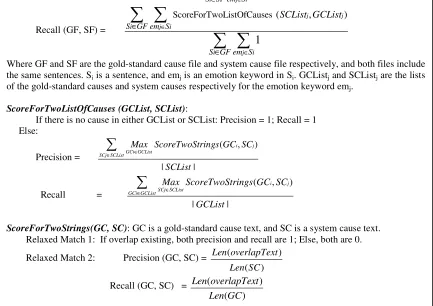
An evaluation scheme is designed to assess the ability to extract the cause of an emotion in context. We specifically look into two phases of the per-formance of such a cause recognition system. Phase 1 assesses the detection of an emotion co-occurrence with a cause; Phrase 2 evaluates the recognition of the cause texts for an emotion.
Overall Evaluation:
[image:6.612.73.309.306.710.2]Phase 1: The Detection of Cause Occurrence
The detection of cause occurrence is considered a preliminary task for emotion cause recognition and is compounded by the fact that neutral sentences are difficult to detect, as observed in Tokuhisa et al. (2008). For Phase 1, each emotion keyword in a sentence has a binary tag: Y (i.e. with a cause) or N (without a cause). Similar to other NLP tasks,
we adopt the common evaluation metrics, i.e. accu-racy, precision, recall, and F score.
Phase 2: The Detection of Causes
The evaluation in Phase 2 is limited to the emotion keywords with a cause either in the gold-standard file or in the system file. The performance is calcu-lated as in Overall Evaluation scheme.
5.2 Results and Discussion
[image:7.612.89.517.196.312.2]We use 80% sentences as the development data, and 20% as the test data. The baseline is designed as follows: find a verb to the left of the keyword in question, and consider the clause containing the verb as a cause.
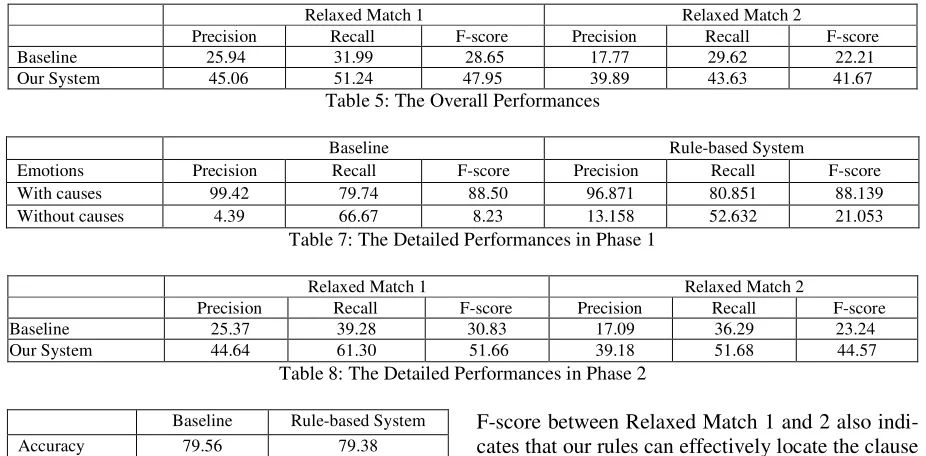
Table 5 shows the performances of the overall evaluation. We find that the overall performances of our system have significantly improved using Relaxed Match 1 and Relaxed Match 2 by 19% and 19% respectively. Although the overall per-formance of our system (47.95% F-score for Re-laxed Match 1 and 41.67% for ReRe-laxed Match 2) is not yet very high, it marks a good start for emotion
Overall evaluation formula:
Precision (GF, SF) =
ScoreForTwoListOfCauses( , )
1
j j j
j
i i
i i
S GF em S
S SF em S
SCList GCList ∈
∈
∈
∈
∑ ∑
∑ ∑
Recall (GF, SF) =
ScoreForTwoListOfCauses( , )
1
j j
j
j
i i
i i
S GF em S
S GF em S
SCList GCList
∈
∈
∈
∈
∑ ∑
∑ ∑
Where GF and SF are the gold-standard cause file and system cause file respectively, and both files include the same sentences. Si is a sentence, and emj is an emotion keyword in Si. GCListj and SCListj are the lists of the gold-standard causes and system causes respectively for the emotion keyword emj.
ScoreForTwoListOfCauses (GCList, SCList):
If there is no cause in either GCList or SCList: Precision = 1; Recall = 1 Else:
Precision =
( , )
| |
i j GCi GCList
SCj SCList
Max ScoreTwoStrings GC SC
SCList
∈ ∈
∑
Recall =
( , )
| |
i j SCj SCList
GCi GCList
Max ScoreTwoStrings GC SC
GCList
∈ ∈
∑
ScoreForTwoStrings(GC, SC): GC is a gold-standard cause text, and SC is a system cause text.
Relaxed Match 1: If overlap existing, both precision and recall are 1; Else, both are 0.
Relaxed Match 2: Precision (GC, SC) = ( ) ( ) Len overlapText
Len SC
Recall (GC, SC) = ( )
( ) Len overlapText
Len GC
[image:7.612.83.516.256.562.2]
Relaxed Match 1 Relaxed Match 2
[image:8.612.75.538.79.307.2]Precision Recall F-score Precision Recall F-score Baseline 25.94 31.99 28.65 17.77 29.62 22.21 Our System 45.06 51.24 47.95 39.89 43.63 41.67
Table 5: The Overall Performances
Baseline Rule-based System
Emotions Precision Recall F-score Precision Recall F-score With causes 99.42 79.74 88.50 96.871 80.851 88.139 Without causes 4.39 66.67 8.23 13.158 52.632 21.053
Table 7: The Detailed Performances in Phase 1
Relaxed Match 1 Relaxed Match 2
Precision Recall F-score Precision Recall F-score Baseline 25.37 39.28 30.83 17.09 36.29 23.24 Our System 44.64 61.30 51.66 39.18 51.68 44.57
Table 8: The Detailed Performances in Phase 2
Baseline Rule-based System Accuracy 79.56 79.38
Table 6: The Overall Accuracy in Phase 1
cause detection and extraction.
Table 6 and 7 show the performances of the baseline and our rule-based system in Phase 1. Ta-ble 6 shows the overall accuracy, and TaTa-ble 7 shows the detailed performances. In Table 6, we find that our system and the baseline have similar high accuracy scores. Yet Table 7 shows that both systems achieve a high performance for emotions with a cause, but much worse for emotions without a cause. It is important to note that even though the naive baseline system has comparably high per-formance with our rule-based system in judging whether there is a cause in context, this result is biased by two facts. First, as the corpus contains more than 80% of sentences with emotion, a sys-tem which is biased toward detecting a cause, such as the baseline system, naturally performs well. In addition, once the actual cause is examined, we can see that the baseline actually detects a lot of false positives in the sense that the cause it identifies is only correct in 4.39%. Our rule-based system shows great promise in being able to deal with neutral sentences effectively and being able to detect the correct cause at least three times more often than the baseline.
Table 8 shows the performances in Phase 2. Comparing to the baseline, we find that our rules improve the performance of cause recognition us-ing Relaxed Match 1 and 2 scorus-ing by 21% and 21% respectively. On the one hand, the 7% gap in
F-score between Relaxed Match 1 and 2 also indi-cates that our rules can effectively locate the clause of a cause. On the other hand, the rather low per-formances of the baseline show that most causes recognized by the baseline are wrong although the baseline effectively detects the cause occurrence, as indicated in Table 7. In addition, we check the accuracy (precision) and contribution (recall) of each rule. In descending order, the top four accu-rate rules are: Rules 7, 10, 11, and 1; and the top four contributive rules are: Rules 2, 15, 14, and 3.
6 Conclusion
References
Alm, C. O., D. Roth and R. Sproat. 2005. Emotions from Text: Machine Learning for Text-based Emo-tion PredicEmo-tion. In Proceedings of the Human Lan-guage Technology Conference and the 2005 Conference on Empirical Methods in Natural Lan-guage Processing, Vancouver, Canada, 6-8 October, pp. 579-586.
Alm, C. O. 2009. Affect in Text and Speech. VDM Verlag: Saarbrücken.
Chen, Y., S. Y. M. Lee and C.-R. Huang. 2009. A Cog-nitive-based Annotation System for Emotion Com-puting. In Proceedings of the Third Linguistic Annotation Workshop (The LAW III), ACL 2009. Chaumartin, F.-R. 2007. A Knowledgebased System for
Headline Sentiment Tagging. In Proceedings of the 4th International Workshop on Semantic Evalua-tions.
Darwin, C. 1859. On the Origin of Species by Means of Natural Selection. London: John Murray.
Descartes, R. 1649. The Passions of the Soul. In J. Cot-tingham et al. (Eds), The Philosophical Writings of Descartes. Vol. 1, 325-404.
Ekman, P. 1984. Expression and the Nature of Emotion. In Scherer, K. and P. Ekman (Eds.), Approaches to Emotion. Hillsdale, N.J.: Lawrence Erlbaum. 319-343.
James, W. 1884. What is an Emotion? Mind, 9(34):188– 205.
Kozareva, Z., B. Navarro, S. Vazquez, and A. Nibtoyo. 2007. UA-ZBSA: A Headline Emotion Classifica-tion through Web InformaClassifica-tion. In Proceedings of the 4th International Workshop on Semantic Evalua-tions.
Kövecses, Z. 2000. Metaphor and Emotion: Language, Culture and Body in Human Feeling. Cambridge: Cambridge University Press.
Lee, S. Y. M. 2010. A Linguistic Approach towards Emotion Detection and Classification. Ph.D. Disser-tation. Hong Kong.
Lee, S. Y. M., C. Ying, and C.-R. Huang. 2010. Emo-tion Cause Events: Corpus ConstrucEmo-tion and
Analy-sis. In Proceedings of The Seventh International Conference on Language Resources and Evaluation (LREC 2010). May 19-21. Malta.
Lee, S. Y. M. and C.-R. Huang. 2009. Explicit Epistem-ic Markup of Causes in Emotion Constructions. The Fifth International Conference on Contemporary Chinese Grammar. Hong Kong. November 27 - De-cember 1.
Masum, S. M., H. Prendinger, and M. Ishizuka. 2007. Emotion Sensitive News Agent: An Approach To-wards User Centric Emotion Sensing from the News. In Proceedings of the IEEE/WIC/ACM International Conference on Web Intelligence.
Mihalcea, R. and H. Liu. 2006. A Corpus-based Ap-proach to Finding Happiness. In Proceedings of the AAAI Spring Symposium on Computational Ap-proaches to Weblogs.
Ortony A., G. L. Clone, and A. Collins. 1988. The Cog-nitive Structure of Emotions. New York: Cambridge University Press.
Picard, R.W. 1995. Affective Computing. Cambridge. MA: The MIT Press.
Plutchik, R. 1980. Emotions: A Psychoevolutionary Synthesis. New York: Harper & Row.
Saurí, R., J. Littman, R. Knippen, R. Gaizauskas, A. Setzer, and J. Pustejovsky. 2004. TimeML Annota-tion Guidelines. http://www.timeml.org.
Spinoza, B. 1985. Ethics. In E. Curley, The Collected Works of Spinoza. Princeton, N.J.: Princeton Univer-sity Press. Vol 1.
Talmy, L. 2000. Toward a Cognitive Semantics. Vol. 1and 2. Cambridge: MIT Press.
Tokuhisa, R., K. Inui, and Y. Matsumoto. 2008. Emo-tion ClassificaEmo-tion Using Massive Examples Ex-tracted from the Web. In Proceedings of COLING. Turner, J. H. 1996. The Evolution of Emotions in
Hu-mans: A Darwinian-Durkheimian Analysis. Journal for the Theory of Social Behaviour, 26:1-34.
Turner, J. H. 2000. On the Origins of Human Emotions: A Sociological Inquiry into the Evolution of Human Affect. California: Stanford University Press. Wierzbicka, A. 1999. Emotions Across Languages and