World Maritime University
The Maritime Commons: Digital Repository of the World
Maritime University
World Maritime University Dissertations Dissertations
2000
Implementation of a contingency plan for effective
marine pollution prevention in Sri Lanka
D. A. Karunasena World Maritime University
Follow this and additional works at:http://commons.wmu.se/all_dissertations
Part of theEnvironmental Studies Commons
Recommended Citation
Karunasena, D. A., "Implementation of a contingency plan for effective marine pollution prevention in Sri Lanka" (2000).World Maritime University Dissertations. 70.
WORLD MARITIME UNIVERSITY
Malmö, Sweden
IMPLEMENTATION OF A CONTINGENCY PLAN
FOR EFFECTIVE MARINE POLLUTION
PREVENTION IN
SRI LANKA
by
Karunasena D.A
Sri Lanka
A dissertation submitted to the World Maritime University in partial fulfillment of the requirements for the award of the degree of
MASTER OF SCIENCE
in
Maritime Administration and Environmental Protection
DECLARATION
I certify that all the material in this dissertation that is not my own work has been
identified, and that no material is included for which a degree has previously been
conferred on me.
The contents of this dissertation reflect my own personal views which are not
necessarily endorsed by the University
Supervised By:
Lt.Cdr. Maximo Q. Mejia Jr.
Lecturer, Maritime Administration and Environmental Protection World Maritime University
Assessor:
Dr. Moira McConnell
Professor, Maritime Administration and Environmental Protection World Maritime University
Co- Assessor:
Capt. Ivan Andersen
ACKNOWLEDGEMENT
I would like to extend my gratitude to the former Director of the National
Hydrographic Office, the Chairman and Director General of National Aquatic
Resource Agency and the Ministry of Fisheries and Aquatic Resource Development
for permitting me to pursue this course of study at World Maritime University. I am
also profoundly grateful to the Admission Board of the World Maritime University
in granting the scholarship and for the Danish Development Agency (DANIDA) kind
sponsorship.
Additionally the tutelage and guidance provided by the professors and lecturers was
a tremendous benefit. Further appreciation is also extended to all the other members
of staff, in particularly the library staff, for their kind and efficient help in supplying
substantial input data needed in the research of the study.
I thank and express my sincere gratitude and admiration to Mr. Maximo Q. Mejia,
who as my supervisor in this task, has given me valuable and continued guidance in
assuring that research was focusing on the right track.
Also my special thanks to the Deputy Director of the Maritime Administration of Sri
Lanka, Chairman of the Marine Pollution Prevention Authority of Sri Lanka,
Research staff of Environmental division, Socio-economic division and the Library
staff of National Aquatic Resources Agency who assisting me to obtain necessary
information for the research study.
Finally very special thanks and gratitude to my wife Ramya for the encouragement
and patience in taking care of our children during my absence.
ABSTRACT
Title of Dissertation: Implementation of a Contingency Plan for Effective
Marine Pollution Prevention in Sri Lanka
Degree: MSc
An early preparedness is the internationally recognized approach for the prevention
of ship source marine pollution. The designated land based institutions will assist and
undertake the control and prevention of marine pollution from ships when those are
out of control under the distress.
In major oil spill situations, when state institutions are not well organized to deal
with the problem it can cause more damage to the environment and also will cost
more than of organizing of Institutions for the job. Sri Lanka is not an oil producer
or major importer but it is situated near the major oil tanker route between the
Middle East and the Far East. This presents a risk of oil pollution to the Sri Lanka
waters. The implementation of the National Oil Spill Contingency Plan is therefore
of vital importance for the protection of all coastal regional resources as well as of
the marine environment.
The vast amount of technical capabilities belonging to different resources groups
needs to be coordinated within a limited time period in combating oil pollution and
presents a challenging task for the lead agency of the contingency plan. This
dissertation will examine what might be one of the best approaches to handling oil
spill problems and will look at necessary reforms in the maritime sector
administration in improving the effectiveness of the contingency plan of Sri Lanka.
TABLE OF CONTENTS
Declaration... ii
Acknowledgment ...iii
Abstract ...iv
Table of Contents ... v
List of Tables ...ix
List of Figures ... x
List of Abbreviation ...xi
CHAPTER I INTRODUCTION ... 1
CHAPTER II PHYSICAL AND MARINE ENVIRONMENT OF SRI LANKA 2.1 Maritime boundary and marine environment of Sri Lanka ... 5
2.1.1Climatic conditions ... 6
2.1.2 Wind Patterns ... 7
2.1.3 Wave, Tide and Currents pattern ... 7
2.1.4 Sandy beaches and sediments ... 9
2.1.5 Inland water bodies and rivers ... 9
2.2 Maritime industry and pollution issues ... 9
2.2.1. Operational discharges by ships ...12
2.2.2 Tanker movement in southwest coast in Sri Lanka ...13
2.2.3 Accidental oil Spills ... 14
2.2.4 Single point buoy mooring (SPBM) at port of Colombo ... 16
2.2.5 Bunkering service ... 17
2.2.6 Refineries and storage system ...17
2.2.7 Dry-docking and ship repairs...18
2.2.8 Ethnic conflict and the marine environment pollution...18
2.3.1Ground water pollution...19
2.3.2 Air pollution ...19
2.3.3 Ballast water ...20
2.4 Coastal zone management...20
2.5 Importance of safeguarding the marine environment ...20
CHAPTER III MARINE ENVIRONMENT PROTECTION 3.1Environmental issues and management...22
3.1.1 Effective organizational structure for the maritime affairs...22
3.1.2 Protection of natural environment in Sri Lanka...24
3.1.3 The maritime administration and marine pollution prevention ...25
3.1.4 Indian Ocean memorandum of understanding (IOMU)...26
3.1.5 Hydrographic services...28
3.1.6 Monitoring of marine environment pollution...29
3.2 State responsibility in marine pollution prevention and management...31
CHAPTER IV MARINE ENVIRONMENT PROTECTION LEGISLATION 4.1 International Convention for the Prevention of Pollution from Ships 1973/78 (MARPOL 73/78)... 33
4.2 Torrey Canyon Incident ... 34
4.2.1 The Convention relating to Intervention on High Seas in Cases of Oil Pollution 1969... 34
4.2.2 International Convention on Civil Liability for Oil Pollution Damage 1969 ... 36
4.2.3 International Fund Convention for Compensation for oil Pollution Damage 1971...36
4.2.4The International Convention on Civil Liability for Oil
4.3 International Convention on Oil Pollution Preparedness Response
and Cooperation 1990 (OPRC 90) and its characteristics ...38
4.4 United Nations Convention on the Law of the Sea (UNCLOS 82)...39
4.5 Marine pollution protection policy in global sense and policy Developments in Sri Lanka ...41
4.6 Enforcement problems, issues and the port state control...42
CHAPTER V OIL SPILL CONTINGENCY PLAN 5.1 Policy and Strategy on oil pollution control contingency plan ...44
5.2 National Oil spill Contingency Plan of Sri Lanka ...47
5.2.1 Communication ...48
5.2.2 Oil spill reporting ...48
5.2.3 Oil spill alerting ...48
5.2.4 Resource groups ...49
5.3
Planning of oil pollution response
...505.4 Evaluation of oil spill through aerial survey and observation ...51
5.5 Clean up of oil at sea ...52
5.6 Shore line clean up operation ...53
5.7 Logistic support ...53
5.8 Oil spill response policy and resource implication ...54
CHAPTER VI OIL POLLUTION COMPANSATION 6.1 Ship owner’s liability and P & I Clubs... 55
6.2 Condition for the exemption of shipowner from his liability...56
6.3 Financial guarantee requirement for oil carrying vessels ...57
6.4 Claims...57
6.4.3 Complex situations in preparation of claims...59
6.5 Civil Liability Convention and Fund Convention and their limitation...60
CHAPTER VII ORGANIZATIONAL STRUCTURE FOR OIL POLLUTION RESPONSE 7.1Concept and contingency planning process...61
7.2 Environmental impact assessment and sensitivity maps ...63
7.3 The Lead Agency ...64
7.4 Governing factors of emergency response...65
7.4.1 Identify and secure the source of oil spill ...65
7.4.2 Eliminate the potential for a greater spill...66
7.4.3 Monitor and track the spill...67
7.4.4 Contain the spill and protect resource at risk...67
7.4.5 Recover the spill...68
7.4.6 Clean up the contaminated areas and equipment...69
7.4.7 Restore contaminated/damaged resources and areas...69
7.5 Incident command structure and coordination...70
7.6 International Cooperation...72
CHAPTER VIII CONCLUSION...74
Bibliography ...81
Appendices...84
Appendix 1 World Crude oil sea borne trade 1994...85
Appendix 2 Organizational Structure of Maritime Administration in France ...86
Appendix 3 Policy Structure of Maritime Administration in Germany...87
Appendix 4 Organizational Structure of Maritime Administration in Germany...88
Appendix 5 Organizational Structure of Maritime Administration in Finland...89
Appendix 6 Organizational Structure of Maritime Administration in Sweden...90
Appendix 7 Organizational Structure of Maritime Administration in China...91
LIST OF TABLES
page
Table 1 Number of crude oil tankers transits via Dondar (Sri Lanka)
traffic separation scheme during January to December 1999 ... 14
Table 2 Major tanker accidents and caused oil spills ... 15
Table 3 Dissolved petroleum residue concentration in various regions ... 30
Table 4 Resource holder groups for the oil spill contingency plan of Sri
Lanka...49
LIST OF FIGURES
page
Figure 1 Map of Sri Lanka - Indian Ocean/South Asia... 5
Figure 2 Coastal and Marine Jurisdiction of Sri Lanka... 6
Figure 3 Geographical distribution of Data of Oil slicks in the Indian Ocean...11
Figure 4 Pictorial representation of Oil slicks in the Indian Ocean...12
Figure 5 Number of ships arrived to Port of Colombo during 1991-1997...13
Figure 6 Model - Structure for maritime administration...23
Figure 7 Organizational structure of the Maritime administration of Sri Lanka...25
Figure 8 Role in Contingency Planning in oil spill response...45
Figure 9 Oil Pollution Response Organization - Grouping of Task & Structure...64
LIST OF ABBREVIATION
CFC Chlorofluorocarbons
CLC Civil Liability Convention
EEZ Exclusive Economic Zone
GNP Gross National Product
GRT Gross tonnage
ICS Incident Command System
IGOSS Integrated Global Ocean Station System
IMO International Maritime Organization
IMDG International Maritime Dangerous Goods
INDOEX Indian Ocean Experiment
IOPC International Oil Pollution Compensation
ITCZ Inter Tropical Convergence Zone
MAPMOP Marine Pollution Monitoring Pilot Project
MPPA Marine Pollution Prevention Authority
MFARD Ministry of Fisheries & Aquatic Resources Development
MOU Memorandum of Understanding
NARA National Aquatic Resources Agency
NHO National Hydrographic Office
NOAA National Oceanic and Atmospheric Administration
NOx Nitrogen Oxides
OSC On-Seen Commander
OPA Oil Pollution Act
PSC Port State Control
SDR Special Drawing Rights
SOx Sulfurs
UNCLOS United Nation Convention on Law of the Sea
VOC Volatile Organic Compound
CHAPTER I
INTRODUCTION
Oil is, and will be the single most important source of energy in the world for the
foreseeable future, mainly because of the ample global supply and reserves, easy
transportability, and unavailability of economically and technically feasible
substitute.
Furthermore there is a strong relationship between energy and the economy. Energy
influences the economy, and economy influences the energy. It can be said economic
growth means growing demand of energy and changes in price of energy or
disruption of energy supply will certainly have an impact on the economy. The price
increase of oil in recent time proves to be the case.
In last decade due to the faster growing economy in Far East countries, mainly in
Japan major portion of Middle East crude oil transported to the Fareast and it will
continue to grow further in future. The crude transport by sea obviously causes
numerous way of marine pollution. A little research available to estimate the present
level of pollution in the Indian Ocean and the Sri Lanka is the main Island become a
hostage in the Indian sub continent to the marine pollution due to crude oil
movement between Middle East and Far East. One can argue that there was no threat
for the Coastal waters of Sri Lanka, as so far major accident not happened in the
region. However the Sri Lanka can not ignore the situation if it has an effect for the
marine resources. The scientists says fish resources are diminishing around west
Some coastal states, knowing the effects of marine pollution rules and regulations are
tightening to prevent and clean up their oceans. A tough new law was enacted in
1990 in the United States to prevent and clean up ocean pollution famously known as
Oil Pollution Act 1990 (OPA 90).
This new law has resulted in the following:
a) Increase tanker owners liability eight fold, from UD$ 150 per gross ton to
US$1200 per ton or US$ 10 million, whichever is greater.
b) Require double hull on all tankers and barges within 25 years if enters the US
waters.
c) Set up a federal trust fund of US$ 1 billion to be financed by a fee of 5 cent per
gallon on imported oil to be paid by the petroleum companies
d) Allow the provinces to enact their own stricter laws, many of which provide for
unlimited liability in the event of oil spill.
The small island like Sri Lanka can not ignore the marine environmental pollution
and also can not perform like a developed maritime nation do as there are many other
priorities in front of the country. Although the successive governments have taken
number of cause of actions to protect the marine environment and the results are not
much appreciable for the effort made in this respect. In 1981 the marine pollution
prevention Act was brought to the Parliament of Sri Lanka and established the
Marine Pollution Prevention Authority (MPPA) giving the responsibility to act up on
the subject. The beginning of the Act described the purpose as:
“An Act to provide for the prevention, reduction and control of pollution in Sri Lanka waters; to give an effect to international conventions for the prevention of pollution of the sea and for matters connected with or incidental thereto….”
(Marine pollution Prevention Act 1981, Sri Lanka)
In 1995 MPPA has established a National Oil Contingency Plan but later found the
need of amendment to get the finance and the necessary staff for the organization.
other local institutions during an spill and coordinating of the resources the main task
of MPPA. This approach is needed greater effort and lead to complex structure of
organization. The author's main concern is the organizational structure requirement
to address the pollution prevention issues in implementation of the National Oil Spill
Contingency Plan.
In this study, the Chapter Two will discuss the geographical scope of Sri Lanka and
the marine environment, the tanker movements in the Indian Ocean, its effects for the
marine pollution in coastal waters. It will further discuss other contributory factors
for the marine pollution. In addition the few major oil spills took place in the world
in last three-decade with their brief the accounts and impacts will be discussed in the
same chapter to give awareness of the effects of oil pollution.
The third chapter will be devoted to express how the maritime affairs should be
handled for the best interest of the country taking few examples from developed
maritime nations and make comparison with organizational structure as a whole that
handles maritime affairs in Sri Lanka. The National Oil Spill Contingency Plan has
suggested number of resource groups, combining various institutions to carry out the
implementation of oil spill contingency plan and effects of those groups will be
examined in relation to the set goals.
The marine pollution problems are mostly of an international nature. Therefore the
international instruments are necessary to solve the issues confronting the individual
parties. The application of the international conventions to national laws is a best
method to improve the legal regime to handle the incidents. In the fourth chapter, this
subject will be discussed.
Chapter Five is devoted to discussing the main features required for an oil spill
The oil pollution prevention and action of clean up operation governs the polluter
pay principle. Chapter Six will discuss the method of obtaining the compensation for
the oil pollution damage and its limitations.
Chapter Seven will discuss the organizational command structure need for the oil
pollution response organization and effect of the Incident Command System Model
during an oil spill combating operation.
The final chapter will discuss and recommend the best course of actions available to
improve the maritime sector as well as actions needed for effective implementation
CHAPTER II
PHYSICAL AND MARINE ENVIRONMENT OF SRI LANKA
2.1 Maritime boundary and marine environment of Sri Lanka
Figure 1: Map of Sri Lanka in Indian Ocean
Sri Lanka is situated in the India Ocean, off the southern tip of India (Figure1). The
island covers an area of 65,610 square kilometers that include the inland water
bodies of 870 square kilometers. Sri Lanka's coastline circles along about 1,585
kilometers of sandy beaches, extensive lagoons and estuaries, mangroves, coastal
marshes and dunes. Seaward of the coastal line lie reefs of coral or sand stone and
shallow beds of coastal estuarine sea grass. Beneath and beyond extends the
continental shelf. Except in the north, where it links Sri Lanka and India, this
square kilometers or equivalent to nearly half the land area of the country. The
Exclusive Economic Zone covers nearly (EEZ) 517,000 square kilometer (Figure 2).
The narrow passage called "Palk Straight" that separates Sri- Lanka and India.
Figure 2 Coastal and Maritime Jurisdiction of Sri Lanka
Source: National Hydrographic office -Sri Lanka
2.1.1Climatic conditions
The climate of Sri Lanka generally influenced by two monsoon seasons, namely
southwest (May to October) and northeast (December to March). The wind pattern
undergoes a complete shift during January and July as a result of the monsoons. This
annual cycle is dominated by the heating and cooling of Asiatic continent.
The climate is typically tropical in the lowlands with an average temperature of 27
central regions of the island between May to July while the northeast monsoon rains
occur in the northern and eastern regions in December and January.
2.1.2 Wind patterns
The velocity of the wind across the country is usually less than 50 kilometer per
hour. Weak and variable breezes exist during inter monsoonal periods. Also through
out the season, winds intensify and often change the direction in the afternoon. The
winds of the northern inter- tropical convergence zone (ITCZ) normally operate from
south to north and typical equatorial convergence storms are experienced all over the
country, usually late afternoon. During the month of May, winds of the ITCZ flow
towards the north and rainfall is received all over the country but with the heights
concentration over the southwestern areas with the arrival of the month June, the
southwest monsoon is at peak force, and the southwestern area of the island receives
even more rain. The northeastern part of the land will experience occasional rain
from convection storms that exist during the periods of monsoon break. During
cyclone weather condition in both the Bay of Bengal and Arabian Sea majority of
tropical convection storms winds reach more than 120 kilometers per hour and
follow the path towards north of the island.
There is a pattern, that repeats itself every 10-15 years wherein cyclone move closer
and cross over the island causing considerable damage to the coastal areas of the
northern and eastern parts of the country. The cyclones in 1964, 1978 and 1991 badly
affected the coastal zone in northern and eastern part of the country.
2.1.3 Wave, Tide and Currents pattern
Much of the swell that affects Sri Lanka, that originates in the south Indian Ocean
(40-50 degrees south) because of the influence of high depressions and storms. This
moves in northerly direction and is felt along the coast of the southern half of the
island. The highest waves are during the southwest monsoon and that travels about
the winds blow over short stretches of water from the north and even wind blowing
from the Bay of Bengal does not produce steady large waves. By and large
exploitable energy of the waves is relatively law during the period as well as during
the inter-monsoonal periods (Swan, 1981).
There are different type of sea current available around Sri Lanka and some currents
developed in the Bay of Bengal, the Arabian Sea, as well as in the equatorial region
meet in this area and are affected by the monsoon. The strongest currents are felt
along the southern coastal line. The coastal currents over the continental shelf are
parallel to the coastline and are stronger off the eastern coast than off the western
coast. In addition the massive water exchanges between the Bay of Bengal, the
Arabian Sea and the Equatorial oceanic zone result in currents reaching velocities
approximately one meter per second or more during October to January in the
southern coast of Sri Lanka
During the monsoon period the waters between India and Sri Lanka experienced
currents of velocity in the range of 2.5 to 3.0 meter per second. The coastal currents
are complicated by the interaction of shelf topography, counter of the coastline,
water depth, wind intensity and direction and tidal influence.
The seas around Sri Lanka are micro-tidal with tidal range of 750 centimeters during
the spring tide and 25 centimeter at neap tide. The period between tides is
approximately 12 hours and is thus semidiurnal. The tidal waves move southwards
along the west coast of India, heading towards Sri Lanka twice a day so that western
coast of island experiences high tide synchronously. The tidal crest arrives at the
southwest coast near the Port of Galle within about 12 minutes and then moves in an
anti-clockwise heading to eastward and northward reaching the east coast port of
2.1.4 Sandy beaches and sediments
The beaches of Sri Lanka are rich in sands containing mineral such as ilmenite,
rutile, monozite and zircon. Over three fourths of the 1 785 kilometers length of
coastline are beach areas. The formation of these beaches are based on the contour of
the coast line, nature of coastal and submerged land forms adjacent to the beaches as
well as the wave energy that brings the sand from the sea. In addition, most of the
beaches act as barriers and are supported by the lagoons, swamps, and ill-drained
terrains. They are also sometimes found between headlands and river mouths. These
beaches are also relatively narrow due to the low tidal range and low wave energy
that brings less sand from the sea.
2.1.5 Inland water bodies and rivers
The total area of inland water bodies approximately 870 square kilometers that
consist of six rivers, the two longest rivers being the Mahaweli and Kelani. The
Mahaweli is the longest river, 325 kilometers in length with an average annual
discharge of 7,650 million cubic meters of water primarily utilized for hydro- electric
power generation and, downstream, for the irrigation of agricultural land covering
nearly one sixth of the country. The second longest river Kelani, which has a length
of 144 kilometers running to the sea from the capital Colombo, and is that city’s
main source of fresh water.
The natural environmental and geographical features of the country are favorable to
human life, but most of the unplanned human intervention has posed a major threat
to both living and non-living resources today. The protection of the marine
environment by intervention of the State is essential task to ensure the well being of
the society.
2.2 Maritime industry and pollution issues
Over the past five centuries, following foreign occupation, the country's development
commerce has accelerated population shifts to the coasts. Since independence from
British rule in 1948, coastal settlement grew in size, economic importance,
particularly in the south, southwest and west. The 1998 census recorded that 8
million people, that is 44% of total population of the country, live in coastal districts.
Out of this coastal districts population nearly 55% are living in near the coastal line.
Fishing, tourism, industry and agriculture sustain the growing economy of the coastal
regions. The 24% of the land area that covers the west and south west coastal regions
and also nearly 44% of the total population of the country living in these area,
directly or indirectly depend upon those economic activities. The capital city
Colombo, six municipal councils out of total thirteen of the country are found in this
area and the two main commercial ports, ten fisheries ports and twenty nine fish
landing centres are located in the west and south west coasts. Fishing contribute
nearly 2% of the gross national product and recent studies have shown coastal area
fishing in decline. In addition, sun, sand and surf of are Sri Lanka's major tourist
attractions and offers recreational opportunities for the people. The tourism industry
brings in foreign exchange as well as creates employment for people. The main shipping lane between the Far East, Middle East and Europe turn through the west
and the south west coastal areas of Sri Lanka. More than 1000 crude tankers move
every month in addition to other cargo ships through this shipping lane.
All of the above stated economic activities of the coastal regions results a heavy land
based pollution. A recent study carried out by the Ministry of Environment
(Municipal waste, Sri Lanka, 1999) shows nearly 2694 tons of municipal waste are
generated per day, and of which 37% is generated by the capital city, Colombo. Even
up to now there is no proper land based waste management system other than use for
landfills. This causes ground water pollution and in turn has a major effect in the
pollution of coastal waters.
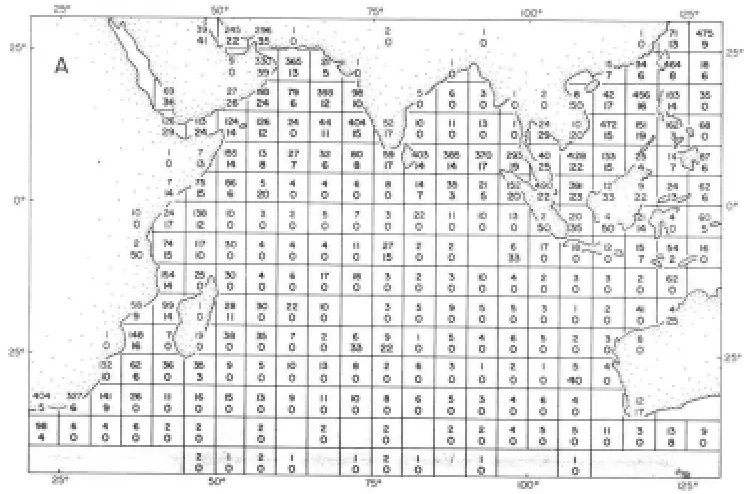
sea pollution around Sri Lanka. Figure 3 shows the intensity oil slicks in the
southwest coast of Sri Lanka. Although the data provided in the figure 3 little old
(1975-1978), the current situation can not be impressive rather than poor. This is
because continually increase of crude vessel movement in region and very little or no
effective action so far made to implement adequate regulatory regime within
jurisdiction of the country arrest the all marine pollution problems.
Figure 3: Geographical distribution of data of oil slicks on the Indian Ocean (1975-1978)- (Upper value: Total number of visual observation) of oil slicks for 5° x 5°square of latitudes and longitude (Lower value: Positive reports from total observations) of the Indian Ocean.
Source: Global Oil pollution study report 1975-1978
These oil slicks are coinciding with the tanker route between Middle East and Japan.
According to a study made by Integrated Global Ocean Station System (IGOSS,
1978) the oil slick concentration is much higher in the west coast Sri Lanka than in
the east coast. Figure 4 below shows the concentration and distribution pattern of oil
Figure 4- Pictorial presentation of data, the distribution of oil slicks in the Indian Ocean as indicated by the percentage of positive reports. Total number of visual observation of oil slicks for 5° x 5°square of latitudes and longitude of the Indian Ocean.
Source: Global Oil pollution study report 1975-1978
The same report has given an indication of concentration of tar balls in the West
coast of Sri Lanka is much higher compare with the coat line of the Indian sub
continent.
2.2.1. Operational discharges by ships
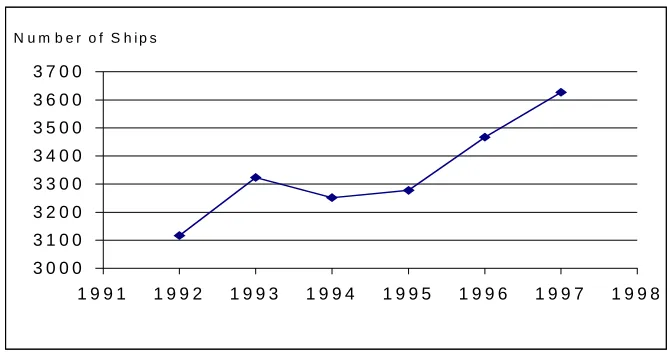
Approximately 3350 ships are arriving at the Port of Colombo annually, and this
figure is expected to continue and expand in future .The following diagram shows
the number of ships visited at Port of Colombo during the year 1999. Although it is
prohibited to do so, many ships discharge wastes as well as bilges in coastal waters
when law enforcement is weak in a country. Most ships that visit the port of
Figure 5 Number of ship arrived to Port of Colombo during 1991-1997 Source: ILS- Shipping Statistics Year Book 1998
bilge water and pollute the marine environment. The law enforcement can only be
possible by having an effective coast guard system policing the waters in three
nautical mile range around Sri Lanka that enable to control the unauthorized
operational discharges from ships
2.2.2 Tanker movement in southwest coast in Sri Lanka
Japan is the world's second largest oil consumer, imports major portion of crude oil
from Middle East. According to a 1994 world crude oil sea born trade statistic, Japan
has imported 171 millions (Appendix 1 in page 85) of crude oil import from Middle
East. Crude oil is transported by tankers and moved via the Indian Ocean, that is the
southwestern coast of Sri Lanka.
Some 200 kilometers south of Colombo is a small coastal town called Dondar, The shipping lane connecting the Far East and the Middle East lies 12 nautical miles
southwest of this town maintain a traffic separation. According to the Statistics every
month more than 1000 oil tankers transit through the Dondar traffic separation scheme of the shipping lane and has potential risk for a collision accident. The Table
1 shows the number of oil tankers transit through the Dondar traffic separation N u m b e r o f S h i p s
3 0 0 0 3 1 0 0 3 2 0 0 3 3 0 0 3 4 0 0 3 5 0 0 3 6 0 0 3 7 0 0
scheme each month during 1999. This area is most nearest for tanker route and any
accidental spill will not take to reach the coast and it will be matter of hours.
Table 1: Number of Crude oil tanker transit via Dondar shipping lane to Japan during the Year 1999. Source: Vessel Traffic Service, Port Authority of Singapore
Month Number of
tankers
January 1112
February 999
March 1129
April 1061
May 1075
June 1085
July 1252
August 1317
September 1189
October 1295
November 1121
December 1145
The volume of traffic increases the probability of accidental risk may also increase.
Although no major accidents have been reported at Dondar separation scheme up to
the present time it should be considered one of the risky area to have an oil spill.
Addition to that this area is subject to high seasonal monsoon and any accidental oil
spill poses greater pollution risk for the coastal region of the country.
2.2.3 Accidental oil spills
Ship casualties could occur due to collision, grounding, fire, explosion or breakdown
due to structural failures. Furthermore these may be due to human error, equipment
failure, lack of information in connection with navigational aids or other reasons. As
stated earlier the accident of oil tankers may result in large quantities of oil spills in
to the sea and depend up on the circumstances. These oil spills cause significant
There are number of major tanker accidents occurred in the world during last three
decades that have caused heavy marine and environmental pollution and some of
these incidents are given in the Table 2.
Table 2: Some of Tanker accidents and caused oil spills
Name of the Tanker Year Oil spill (mt) Sea Area accident caused Torry Canyon 1967 119000 South West England
Amoco Cadiz 1978 227000 Brittany
Castillo de Belver 1983 257000 Cape Town
Iliad 1983 80000 Sfaktiria Island of Greece
Exxon Veldez 1989 37000 Alaska – Pr. William sound
Braer 1993 85000 Shetland Island of United Kingdom
Keumdong 1993 1280 Republic of Korea
Kihnu 1993 100 Tallinn- Estonia
Yeo Myung 1995 440 Maemul Island of Republic of Korea
Sea Empress 1996 72000 South-West Wales of United Kingdom
The first most recognized major tanker accident was in 1967 when the tanker Torrey Canyon ran a ground on off south- west coast of England. The vessel was complete by wrecked spilling 119,000 tons of heavy crude oil.
The Liberian registered tanker Braer grounded south of the Shetland Islands (United Kingdom) on 5 January 1993. The ship eventually broke up, both the cargo and
bunker fuel of 85,000 tons spilled out The oil spray blown by strong winds and
affected the farmland and houses close to the coast. United Kingdom government
imposed a band the fishing in the area that was affected by oil spill, prohibiting the
capture, harvest and sale of all kind of fishes from within the area. The end result
to US$ 46 million. Out of those claims US$ 4.8 million paid by the insurer of the
vessel and US$ 41 million paid by the Civil Liability Fund Convention.
On August 3, 1995, the Korean tanker Yeo Myung (138 GRT) laden with 440 tons of heavy fuel oil was collided with a tug off Maemual Island, near Koeje island off the
coast of South Korea. Approximately 40 tons of heavy fuel oil was spilled. Clean up
operations were initially carried out by the local authorities but subsequently handed
over to a specialist group. The clean up cost amounted to US$ 523,000 and the
fisheries cooperatives affected have claimed US$ 6.9 million for the loss of fisheries
and mariculture. In addition the tourism sector near the beaches of Koeje Island
claimed US$ 1.7 million for loss of business. Fish farmers claimed an additional US$
230,000 for the damage caused to fish farms near the area.
The Estonian tanker Kihnu (949 GRT) grounded on 16 January 1993 close to the Port of Tallinn in Estonia. It was estimated that some 100 tonnes of heavy fuel oil
and 40 tonnes of diesel oil were spilled as a result of the grounding. The clean up
operations were carried out not only by Estonia but by Finland since the spill has
affected the sea and beaches of the Finland. The clean up cost US$ 65,100 was borne
by the Finnish government subsequently paid by the CLC fund. The above sum was
paid for the preventive action taken by the Finish Government but not for the
assistance given to the Estonian authorities.
The above stated accidents and their brief accounts help us to gain a basic
understanding of the cause and effect of oil spills.
2.2.4 Single point buoy mooring (SPBM) at port of Colombo
In 1988 a Single Point Buoy Mooring (SPBM) was established 4 1/2 nautical miles
off the breakwaters of Port of Colombo to facilitate the pumping of crude oil from
near the capital Colombo. The most recent accident reported was July 1998 when
nearly 75 tons of light crude oil were spilled during discharge operations, causing
pollution to the beaches of the most populated areas near the capital Colombo. The
clean up operations were completed within 2 days with the use of dispersants. The
authorities apparently employed this medium without due regard to the harmful
effects it is known to cause the environment.
2.2.5 Bunker service
The Petroleum Corporation of Sri Lanka provides bunkering services inside the Port
of Colombo. Approximately 600,000 tons of marine diesel and marine gas oil are
supplied annually to vessels by the service. Five barge vessels are used for this
purpose and minor fuel spills occur during the bunkering. There were 3 small scale
(10 –50 tons) spill incidents reported from this unit in 1998 and 1999. According to
the authorities these spill were caused lack of proper maintenance and regular
inspection of the equipment.
Proper attention has to be paid for the human element as well as the vessels and
equipment involved in order to minimize the spills during operation.
2.2.6 Refineries and storage system
The crude oil refinery plant is located about 14 km from Colombo and has a refining
capacity of 6,900 tons per day and stores nearly 40% refined fuel are stored in
surface tanks that are located in the city's high security zone. In 1997, however, four
tanks of each having a capacity 60,000 liters caught fire, burning all the fuel within
two days, part of which reached the sea through the area’s canal system. This is yet
another system that could result in a greater impact for marine pollution if the policy
2.2.7 Dry-docking and ship repairs
The Colombo Dockyard Limited (CDL) is the country's biggest ship repair yard with
four docks having the capacity to repair up to 100,000 DWT vessels. The
specifications of the dry docks are as follows:
Dock No Capacity Length Width Height
(Dwt) (m) (m) (m)
1 30 000 213 26.0 9.7
2 8 000 107 16.5 6.7
3 8 000 122 16.0 5.5
4 100 000 236 44.0 8.9
The average annual intake for the repair yard is around 150 ships and although action
has been taken by the yard to minimize oil pollution, minor oil spills are inevitable
during the repairs.
2.2.8 Ethnic conflict and marine environment pollution
Since the ethnic conflict started in 1983 in northern Sri Lanka, all material, food and
passenger transport carried by sea plus all Navy vessels and aircraft have been
targeted for attack. More than 15 vessels have been sunk by the rebel groups in the
last 10years. This also contributes to oil pollution in coastal waters. Furthermore the
location of sunken ship wracks are not monitored and taken into nautical charts, so
other vessels navigating over the sunken ships results even more accidents.
2.2.9 Fishery vessels
Although fishing vessels are smaller in engine capacity there is big fleet of around
38,000 are operating through out the country. These vessels also discharge waste,
garbage and burn considerable amounts of fuel oil on daily basis and pollute the
2.3 Other sources of marine pollution
Approximately 24% of population are living in urban areas and coastal cities and
have a major problem of disposal of domestic waste. For example, the swage
generated in the cities and urban areas are discharged with out any proper treatment
to the canal system. Furthermore industrial waste water, sludge water from kitchen
and laundries also reaches the canal system and finally end up at sea with out any
treatment. The Colombo's seaward area consist approximately 3 100 hectare and out
which 2100 hectare that cover northern part of the city all these waste water directly
discharged in to the Kelani river. The Southern portion which consist of 1 000 hectare discharged directly to sea via another cannel. It has been estimated sewage
flow consist of organic load of 10,000- 26 400 kg BOD5/d the to the Kelani river.
2.3.1Ground water pollution
The most serious threat to ground water comes from nitrate and bacterial (fecal)
contamination. The rural sector sewage effluent from pit latrine soakaways and
septic tanks, causing bacterial contamination and absorb to the rivers and canals then
affects for the ground water pollution. In addition the leakage of pesticides into
ground water may also occur in main agricultural areas. All inland water pollution
finally affects the marine environment.
2.3.2 Air pollution
There are many sources of air pollution in the modern world. Fossil fuel is the single
largest contributor to atmospheric pollution. Recent studies have shown that ship
exhaust emission may now be responsible for up to 14% of world wide nitrogen
oxides (NOx) emission and approximately 8% of sulfur oxides (SOx). Also it has
been estimated that the world annual fuel consumption by ships amounts to 140
million tones, consisting of the 4% the world's total fuel consumption. In addition the
equipment use in ships are uses NOx andSOx, halons used for fire extinguishers,
organic compound (VOC) and those emissions to the atmosphere causes damage to
human health as well as terrestrial/aquatic ecosystem. It is therefore important to
ensure proper regulation and effective control of the machinery and equipment of
vessels to minimize the emission of such gases to the atmosphere.
2.3.3 Ballast water
The carrying of ballast water is essential for the ship for her stability. However,
studies carried out in some countries have shown that many species of bacteria,
plants and animals can survive in viable form in the ballast water and sediment
carried in ships even after the voyage of several weeks' duration. Subsequent
discharge of ballast water or the sediment into the waters at discharging ports may
seriously upset the existing ecological balance due to the colonies of harmful species
that are arrived with the ballast water. The potential danger has been identified
worldwide and many regulations are now in force to control the effects.
2.4 Coastal zone management
Many environmental pollution issues are inherently the byproduct of the negligence
of human activities leading to the coastal zones. Given less priority, it has developed
from a community to an issue of national issues of national significance. Most of
these could have been minimized at the community level if those been integrated into
urban management programs. The sewage and garbage disposal management in
urban and coastal cities needs high priority of action plan. In Sri Lanka, the Coast
Conservation Act enacted in 1981 and subsequently amended in 1996 to incorporate
action on coastal pollution issues.
2.5 Importance of safeguarding the marine environment
Both marine pollution and air pollution have dual effects on the sun's rays reaching
oceanic waters. In oceans, limited sunlight threatens the survival of plankton, the key
organisms in the food chain. As it was discussed previously (figure 3) in the Indian
carried out by the Institute of Oceanography in San Diego, USA, has found a thick
cloud of tiny particles over the Indian ocean covering 10 million square kilometers
from the Arabian Sea to Bay of Bengal and spilling over into the equatorial Indian
Ocean to about 5 degrees south of the equator, partly covers air space over the Sri
Lanka. The team leader of INDOX, Ramanathen expressed his view, the danger of
Indian Ocean pollution for the article of National Science Foundation News in June
1999:
If you cut the amount of sunlight going in to the ocean, you will also impact the amount of moisture evaporating from the sea surface either regionally or globally and consequently entire hydrological cycle is being perturbed. A reduction of sunlight reaching the ocean surface can also have a detrimental effect on plant life that depends on photosynthesis, including plankton, which provides link in the marine food chain. (NFS News, June 1999)
The effects of these clouds may be very complex and need further studies for a
conclusion. However the pollution of the Indian Ocean has an impact over the
countries in the region and therefore effective measures need to be taken by both Sri
Lanka as well as other States in the region for the protection of their vast body of
CHAPTER III
MARINE ENVIRONMENT PROTECTION
3.1
Environmental issues and managementIn the previous chapter, it was discussed the sources of pollution and the effect for
the marine environment in Sri Lanka. The pollution is predominantly a result of the
action of people and the amount waste generated in Sri Lanka from the land based
sources are considerably lower compared to other countries like India, Pakistan and
Bangladesh in the region. Of cause, one reason is less population. However the
non-availability of proper system of management and inadequate facilities for the safe
disposal of waste has become a growing problem for the country in protecting the
marine environment. In the growing economy, it will be aggravated with increasing
of industrialization. Therefore legislation, enforcement, facilities, infrastructure and
support services are essential elements for the prevention of pollution and waste
management in the country. Current status of ships generated pollution management
also has no difference, only a few legislative steps have taken recent past to address
the issue. This chapter will try to address the current plans and problems confronting
the management of marine environment protection.
3.1 .1 Effective organizational structure for maritime affairs
Effective and efficient organizational structure is vital important for any organization
for its successfulness of its intended mission. Many of the developed maritime
nations are having effective organizational structure from the highest level of
legislative council to the lowest implementation level. There is a common feature in
most of these countries in handling the maritime affairs and have some common
Ministry holds responsibility and for the maritime affairs, and the subject operates
under the department of Maritime Transport in the above countries. The policy
development and implementation are the two key functions of the department. In
broader sense followings are task carried out by the maritime transport department:
• Supervision of maritime safety
• Protection of the marine environment against pollution from ships
• Pilotage
• Search and rescue
• Marine surveying and the production of nautical charts
The Swedish maritime administration handles two additional functions namely
making of fairways and icebreaking. In the above countries, the organizational
structure dealing with maritime affairs are given the appendices 2 to 5 in pages
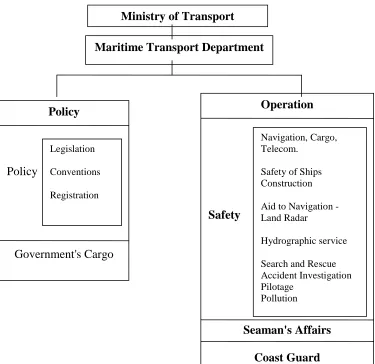
77-80. In comparison the model structure in figure 6 is common for the four countries
discussed above.
In China, the maritime affairs operate under the Ministry of Communications and
there are 14 major departments to administer the maritime affairs under a Director
General's office. The Appendix 6 in page 86 gives the complete structure of the
maritime administration in China. The marine pollution prevention and hydrographic
services are also two key department functions under the maritime administration.
Maritime affairs are generally international in nature and all the elements that are
needed for the the administration should be developed in parallel structure for easy
and effective implementation This is the policy prevailing in the countries discussed
Figure 6: Model structure for maritime transport administration
3.1.2 Protection of natural environment in Sri Lanka
The Central Environmental Authority of Sri Lanka was established under the
National Environmental Act No.47 of 1980 and further amended in 1988 to protect
the natural environment of the country. Furthermore in 1999 the same act was
redrafted to incorporate the functions of the Ministry of Environment in related to
environmental issues. The National Environmental act has not provided provision for
the marine pollution prevention. Furthermore until 1980's there was no organization
to regulate and protect the marine environment in Sri Lanka. In 1981, creation of the
Marine Pollution Prevention Authority (MPPA) under the Ministry of Port and Ministry of Transport
Maritime Transport Department
Policy
Policy
Government's Cargo
Legislation
Conventions
Registration
Operation
Safety
Seaman's Affairs
Coast Guard
Navigation, Cargo, Telecom.
Safety of Ships Construction
Aid to Navigation -Land Radar
Hydrographic service
Search and Rescue Accident Investigation Pilotage
3.1.3 The maritime administration and marine pollution prevention
The maritime administration was first created during the British rule (1815-1948) by
passing the Merchant Shipping Act of 1863. However, the present Merchant
Shipping Act was developed in 1971 after the independent. The Ministry of Shipping
Aviation and Tourism took in-charged of the maritime affairs during 1970's. Then
1980's the maritime affairs were brought under a new Ministry, Trade and Shipping.
In 1990's the Ministry of Trade and Shipping was split to two and the Ministry of
Shipping becomes as
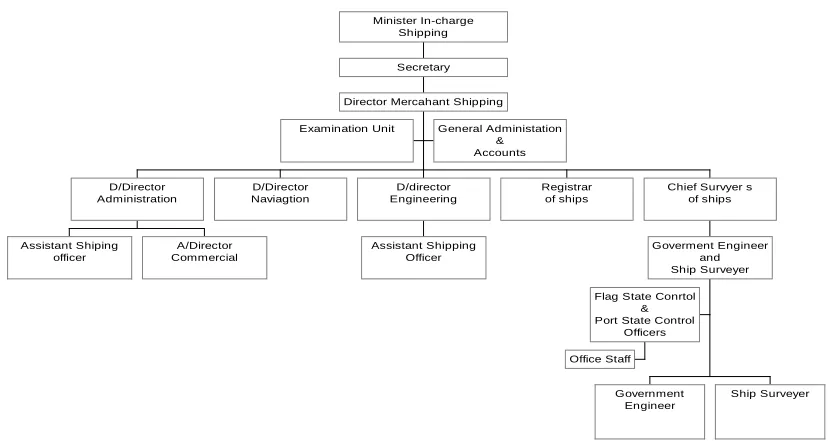
Figure 7: Organisational structure of the Maritime administration of Sri Lanka
Source: Merchant shipping Directorate of Sri Lanka
the Ministry of Ports & Shipping. Then the Maritime Administration and the
Pollution Prevention Authority be come under the Ministry command structure for
the implementation policy of maritime affairs as well as protection of marine
environment. However in 1999 the Ports and Shipping has become further two
ministries and the Ministry of Ports is currently responsible for the supervision of
MPPA and the maritime administration has brought under the Ministry of Shipping.
Organizational Structure of Maritime Administraion
Examination Unit General Administation & Accounts Assistant Shiping officer A/Director Commercial D/Director Administration D/Director Naviagtion Assistant Shipping Officer D/director Engineering Registrar of ships Office Staff Flag State Conrtol
& Port State Control
Officers Government Engineer Ship Surveyer Goverment Engineer and Ship Surveyer Chief Survyer s
of ships Director Mercahant Shipping
Secretary Minister In-charge
The role of Ministry of Ports is to give the guidance and develop the policies to The
role of Ministry of Ports is to give the guidance and develop the policies to operate
the commercial ports more efficiently and effectively and bring highest economic
return. In the case of policy development and guiding on marine pollution prevention
under the same ministry as a national service, it seems the two roles are in conflicting
nature. The role of marine pollution prevention and protection as a subject is more
linked towards the maritime administration and environmental management than the
port management. This development seems discontinuation of the direct link between
the Marine Pollution Prevention Authority and the Maritime Administration. It will
be a benefit in operation point of view if the maritime administration and the marine
pollution prevention authority have single command structure for the policy
development to function more effectively in protecting the marine environment.
In current status maritime administration powers are regulating thorough the ministry
in charge and efficiency is in question relation to need of the country for economic
development. Therefore it need certain amount of autonomy to improve the
efficiency and effectiveness. For example, the maritime administration of Denmark
has a power to implement the international legislation without a parliament Act if the
State is ratified the conventions (Danish Environmental Protection Agency Report
1999) where as in implementation of the international conventions in Sri Lanka need
parliament endorsement. This is will take considerable amount of time. This
procedure will help to avoid the delay of implementation of international conventions
and that will benefit to the country to regulate maritime industry more speedily.
3.1.4 Indian Ocean memorandum of understanding (IOMU)
The substandard ships are more dangerous for the marine environment. The port state
control (PSC) is the final safety net available to eliminate the substandard ships
visiting their ports. Therefore world have been divided administratively to seven
Understanding to fulfil the role of Port State Control and to have a regional
cooperation for the task. Memoranda of Understanding are currently operating in the
European Union (Paris MOU), Asia Specific (Tokyo MOU), West Africa (Abuja
MOU), Mediterranean (Mediterranean MOU), Caribbean (Caribbean MOU), Black
Sea (Black Sea MOU), Latin American (Viña del Mar MOU) and Indian Ocean
(Indian Ocean MOU).
Paris MOU countries has annual target of inspection is 25% of the total vessels
visiting their ports and the Tokyo MOU countries target is 50% of total vessels that
are visiting their ports. In 5 June 1998 the countries belongs to Indian Ocean
Memorandum of Understanding, where Sri Lanka is also a member and has signed
an agreement to inspect the minimum of 10% of total ships visiting the ports. The
highest potential risk for the sea pollution is substandard ships and the inspection by
PSC and sharing the information of Port State Controls for further action is one way
of removing the risk of pollution of marine environment. This is one of the important
actions taken recent past as a collective effort of member states of Indian MOU with
the assistance of IMO.
The effectiveness of port state control inspection depends upon the training and
experience available to the PSC officers and these areas requires more improvements
in quality and quantity of staff in line with the demand of Colombo port. As stated
above marine pollution prevention matters are concerned, no plan has been
developed to identify the ships polluting Sri Lanka’s waters other than inspection of
certificates for conformity with anti-pollution regulation. There are evidence of crude
washing carried out by many tankers along the tanker route west coast in Sri Lanka
and this is only can be controlled and minimized having a surveillance with a
effective coast guard regime that covers the tanker route within the Jurisdiction of the
Research Institute should monitor the water quality along the tanker route, then it can
be understood the level of oil pollution. However implementation of such program
has a slow progress due to inadequate resources and other priorities.
When the crude tankers entering and passing through the coastal waters of a state,
there should be a mechanism to monitor or reporting system to the coastal state. This
arrangement has a greater advantage because, during an oil spill, quick response can
be organized as well as the state can make necessary decision in advance to minimize
the possible threats from the spill. For example, any vessel carrying crude in
Canadian waters must report in advanced to the Marine Environment Protection
Agency and also should produced a certificate of guarantee from a marine pollution
response organization. There is no such reporting system at present available and Sri
Lanka should make request to IMO reasoning out the need and that will benefit to the
region. At present in the Far East route only monitoring take place at the vessel
traffic service of Singapore.
3.1.5 Hydrographic services
The maintenance of navigational aids as well as updating of nautical charts within
the maritime jurisdiction of the country is one of the key functions of the maritime
administration. In this respect the close link between the Maritime Administration
and Hydrographic Service is vital important for the preparation and updating of
nautical charts. This could be a one of the reason many countries have developed
their hydrographic service under the maritime administration. For example,
monitering of ship wracks and notice to the mariners one of a function of
hydrographic service.
The proposal was made to establish a National Hydrographic Service in Sri Lanka is
coinciding with the United Nation's Law of the Sea Conference in 1980. The
there is very little working relationship between the Hydrographic Service and the
Maritime Administration. The functions of Hydrographic Service is govern from the
amended act of Aquatic Resource Research and Development in 1997 and is
operating under the National Aquatic Resources Agency (NARA) of Ministry of
Fisheries and Aquatic Resources Development (MFARD). As earlier stated the
production of the nautical charts and updating, investigation and monitoring of
obstacles in navigational routes within the national jurisdiction are need grater
attention of the maritime administration as it provides the information for safe
navigation. Also when a ship is grounded within the maritime jurisdiction, there
should be a mechanism to report for the Hydrographic Service to make a survey the
position for the safety requirements for future navigation. However this part has not
paid attention in the implementation process both in hydrographic service as well as
in maritime administration. In December 1999, a coastal trading ship was grounded
as it has run over sunken ship wrack in the coastal waters in northern part of the
country. Therefore the nautical chart updating and notice to the mariners, the action
plan need a review to avoid such accidents and the two institutions are needed close
cooperation in respective tasks.
3.1.6 Monitoring of marine environment pollution
Today's society because of the development of information technology and the
electronic media most of the people are aware that, there is a growing problem of
environmental pollution and where ever it happens. The preparedness for the
prevention of pollution always need some form of scientific evidence for the
authorities to act up on. The fundamental reason behind is that every State has their
owned priorities in diverting the resources. In chapter two, it was discussed the
amount of pollution taking place particular to the Indian Ocean and specially with
regard to oil slicks and tar concentration. However the limited research material
found available in the marine pollution pertaining to the Indian Ocean. The marine
1975-1978 and that shows Indian Ocean pollution more significant comparative to
other oceans (IGOSS-Report p 25).
Table 3: Dissolved / Dispersed petroleum residue concentration in various region/µg / l
Sources: IGOSS -Global Oil pollution report, NOAA
The summary of its finding is given in table 2.The analysis has given a comparison
of these oceans with regard to petroleum oil slicks and the tar concentration. The
table 2 above shows that even that number of samples of dispersed petroleum residue
taken from the Indian ocean (45) are low for the study, still results are indicating for
heavy pollution is taking place in the Indian Ocean. This has been proved further
from analysis given in the Indian sub-continent oil slick data discussed in earlier
chapter. That has indicated, in the west coast of Sri Lanka out of 59 samples
collected, there were 17 positive reports of oil slicks but in the east coast Sri Lanka
and out of 403 samples only 14 were positive. This figures highlight the greater
concentration of oil slicks in the west coast and it could be due to two reasons
namely:
• Crude Oil tanker route between Far East and Middle East
monitering and implementation international legislation with regard to ship source
pollution to protect the marine environment around Sri Lanka.
During past three decades most of potential threats from ships for the marine
environment have been identified. In summary the general form of substances and
activities that contribute to marine pollution are:
• Oil
• Noxious liquid and substances
• Harmful goods in packed form
• Sewage and garbage
• Extensive sulfur oxide from the combustion of fuel oil and nitrogen oxide from diesel engines
• Discharge of volatile organic compound from tanker cargoes
• Discharge of halons and chlorofluoro carbons that effects to deplete the ozone layer
• Discharge of ballast water
In the same time many of these areas are concerned necessary preventive measures
has been identified and international convention put in place. But the implementation
of the international conventions is varying and that are depending upon the resources
capability of individual country. However the monitoring and research studies are
vital important to take precautionary action.
3.2 State responsibility in marine pollution prevention and management
It is obvious that marine pollution prevention and the preparedness for prevention
are primarily a responsibility of the State. There are five steps to be followed in
developing proper organizational structure for the task. The first step is necessary to
inspection regime or the port state control is to arrest and eliminate the sub standard
ships visiting their ports. The fourth item is to have a coast guard regime to play a
supportive role as a policing agency within the coastal jurisdiction. At last the above
institutions should work together with a common objective for the set targets. All
actions and out comes should regularly review and adjust if any deficiencies are
observed in the individual respective programs. Furthermore regional cooperation is
another requirement in the maritime affairs and it will help to overcome problems
and difficulties and benefits for the region as a whole.
In this chapter it was point out that maritime affairs are generally international nature
so that all issues in marine pollution, pertaining to ship sources has to be dealt with
the international conventions. Therefore the next chapter will be discussed the
international conventions and the national laws that are needed to protect the marine
CHAPTER IV
MARINE ENVIRONMENT PROTECTION LEGISLATION
The first international convention on marine pollution prevention was the International Convention for the Prevention of Pollution of the Sea by Oil, in short known as OILPOL entered in to force in 1954 with an agreement of 40 countries. The convention imposed an obligation on ship owners, operators and masters their ships to minimize their accidental and operational pollution.However the enormous growth of oil transport and the size of tankers, the increase of chemicals being carried out by sea and growing concern for the world's environment as a whole made many felt that OILPOL is inadequate to arrest and minimize the pollution of sea. This chapter deals with later developments in the international legislation relevant Marine Environment Protection and the actions taken by Sri Lanka to give an effect those international legislation.
4.1 International Convention for the Prevention of Pollution from Ships 1973/78 (MARPOL 73/78)
As stated above the growing problems in maritime accidents and the pollution of the sea by the shipping industry was a major concern at IMO in the 1970's. As a result IMO has convened a diplomatic conference to draft a new convention on prevention of marine pollution in 1973. The conference resulted in the adoption of the International Convention for the Prevention of Pollution from Ships (MARPOL 73).
reports on incidents involving harmful substances, arbitration and six Annexes which contain regulations for the prevention of various forms of pollution:
Annex I: Prevention of pollution by oil
Annex II: Control of pollution by noxious liquid substances in bulk
Annex III: Prevention of pollution by harmful substances carried by sea in packaged form
Annex IV: Prevention of pollution by sewage from ships (this is not yet in force) Annex V: Prevention of pollution by garbage from ships
Annex VI: Prevention of air pollution from ships (this is not yet in force and up to now Sweden and Norway are only parties to Annex VI)
4.2 Torrey Canyon Incident
In March 17, 1967 the tanker Torrey Canyon ran ground near the Scilly Isles- outside United Kingdom territorial waters with a cargo of 119 000 of oil on board. Approximately 60 000 tons of oil discharged as a result of grounding. The British Government then ordered the wrack bombed so as to burn the remaining oil. This action was contrary to the international law at the time. This incident lead to a general review the international law connected with maritime matters. One of the few problems crated
Torrey Canyon incident was who is responsible for the environmental damage as well as for the victims of the accidents. The development three major International Conventions were the final out come by IMO to overcome those issues.
4.2.1 The Convention relating to Intervention on High Seas in Cases of Oil Pollution 1969
Government against Torrey Canyon was justified by the International Law Commission indicating as an act of necessity. It was the doctrine formed the basis of the convention. The Intervention Convention of 1969, allows parties to take action necessary to prevent, mitigate or eliminate grave and imminent danger to their coastline or related interests such as fishing activities, tourism, living resources and of wildlife from pollution or threat of pollution of sea by oil. The convention to apply, the stated interests should be directly affected or threatened. Hence there is a power to the coastal State to intervene on purely on environmental ground. Also the convention is not restricted to the tankers and applies to any floating craft. However the convention does not apply to an installation or device engaged in the exploration and exploitation of resources from seabed as well as ships belongs to Government that not in trade and warships. When taking action by the coastal State in danger, the State must only act after due consultation with appropriate interests, including flag state(s), ship(s) involved, the owner(s) of the ship(s) or cargoes in question appointed for the purpose.
The convention is a guide to develop national laws enable to make an institutional powers to take measures to prevent, mitigate or eliminate in the event that there is grave and imminent danger to the coastline of the state or the related interests. The actions may me be to
• move the ship or part of the ship to another place
• remove cargo from the ship
• salvage the ship, part of the ship
• sink or destroy the ship or part of the ship
• sink, destroy or discharge into the sea any of the ship's cargo